Hubbry Logo
Yan LibenYan LibenMain
Open search
Yan Liben
Community hub
Yan Liben
logo
8 pages, 0 posts
0 subscribers
Be the first to start a discussion here.
Yan Liben
Yan Liben
from Wikipedia
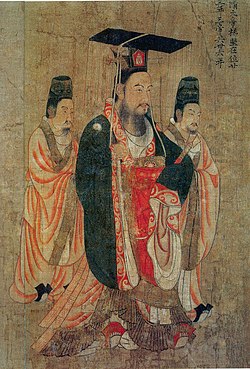
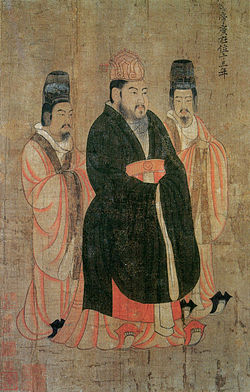
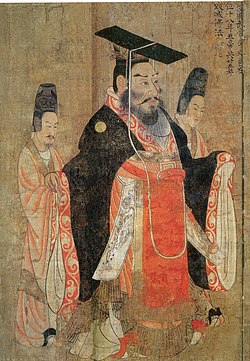
Portrait of Yan Liben

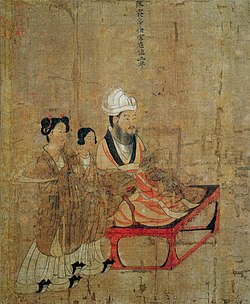
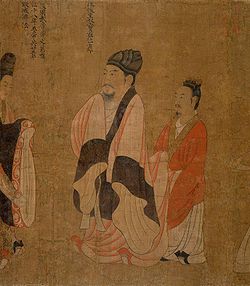
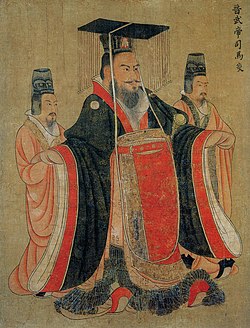
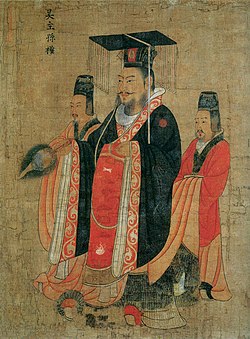
Yan Liben (Chinese: 閻立本; pinyin: Yán Lìběn; Wade–Giles: Yen Li-pen; c. 600 – 14 November 673[1]), posthumous name Baron Wenzhen of Boling (博陵文貞男), was a Chinese architect, painter, and politician during the early Tang dynasty. His most famous work, possibly the only genuine survival, is the Thirteen Emperors Scroll.[2] He also painted the Portraits at Lingyan Pavilion, under Emperor Taizong of Tang, commissioned in 643 to commemorate 24 of the greatest contributors to Emperor Taizong's reign, as well as 18 portraits commemorating the 18 great scholars who served Emperor Taizong when he was the Prince of Qin. Yan's paintings included painted portraits of various Chinese emperors from the Han dynasty (202 BC–220 AD) up until the Sui dynasty (581–618) period. His works were highly regarded by the Tang writers Zhu Jingxuan and Zhang Yanyuan, who noted his paintings were "works among the glories of all times".[3]

From the years 669 to 673, Yan Liben also served as a chancellor under Emperor Taizong's son Emperor Gaozong (r. 649–683).

One of the reliefs of the six favourite horses at the mausoleum of Emperor Taizong (d. 649), possibly after a drawing by Yan Liben

A record of 1120 gives 42 titles of Yan's paintings, though the Thirteen Emperors Scroll is not among them. Only four Buddhist subjects are listed, against 12 Daoist. The remainder are portraits, "gods of the planets and constellations" or records of events at court. Of the surviving works attributed to him, the Thirteen Emperors Scroll is "the first that is generally accepted as being partly original", though much of it seems later.[4] A similar figure of an emperor in fresco in the Mogao Caves (Cave 200), might be by the same hand, and carries the appropriate date of 642.[5]

By tradition the reliefs of the six favourite horses at the mausoleum of Emperor Taizong (d. 649) were designed by Yan Liben, and the relief is so flat and linear that it seems likely they were carved after drawings or paintings.[6] Yan Liben is documented as producing other works for the tomb, a portrait series that is now lost, and perhaps designed the whole structure.[7]

Background

[edit]

It is not known when Yan Liben was born. His ancestors were originally from Mayi (馬邑, in modern Shuozhou, Shanxi), but had relocated to the Guanzhong region (i.e., the region around Chang'an) several generations prior to Yan Liben. Yan Liben's father Yan Pi (閻毘) was the deputy director of palace affairs during Sui dynasty, and both Yan Liben and his older brother Yan Lide (閻立德) were known for their abilities in architectural matters and service to the imperial government in that area.

Both were also painters and successful administrators at court, and trained Yan Liben in succession; his father died suddenly at 49. He grew up in Chang'an, and initially collaborated with his elder brother on two works whose titles are recorded.[8]

During Emperor Taizong's reign

[edit]
Emperor Taizong Receiving the Tibetan Envoy, probably a later copy

Yan Liben was skilled in public work projects, but became particularly known for his artistic skills. It was for this reason that Emperor Taizong, the second emperor of the Tang dynasty, commissioned Yan to paint portraits to commemorate the 24 great contributors to his reign at Lingyan Pavilion and the 18 great scholars who served under him when he was the Prince of Qin. His Emperor Taizong Receiving the Tibetan Envoy probably dates to this period.

Although the Chinese aristocracy counted painting as one of their accepted pastimes, the profession of the painter was not a highly venerated vocation. On one occasion, when Emperor Taizong was rowing a boat with his attendant scholars at the imperial pond, there were birds flying by. Emperor Taizong had the scholars write poems to praise the scene and then summoned Yan to paint a portrait of the scene. Yan was at the time already a mid-level official in the administration, but when he summoned Yan, the imperial attendants called out, "Summon the imperial painter, Yan Liben!" When Yan heard the order, he became ashamed for being known only as the painter, and he commented to his son, "I had studied well when I was young, and it was fortunate of me to have avoided being turned away from official service and to be known for my abilities. However, now I am only known for my painting skills, and I end up serving like a servant. This is shameful. Do not learn this skill." However, as he still favored painting, he continued to do so even after this incident.

During Emperor Gaozong's reign

[edit]

During the Xianqing era (656–661) of the reign of Emperor Taizong's son Emperor Gaozong, Yan Liben served as the imperial architect. He later succeeded his brother Yan Lide as the minister of public works (工部尚書, Gongbu Shangshu). Around the new year 669, he became acting You Xiang (右相): the head of the examination bureau of government (西臺, Xi Tai) and a post considered one for a chancellor, and Emperor Gaozong created him the Baron of Boling. As Yan's fellow chancellor Jiang Ke (the acting head of the legislative bureau (左相, Zuo Xiang)) was promoted to the chancellor post at the same time due to his battlefield achievements, a semi-derogatory couplet was written around the time stating, "The Zuo Xiang established his power over the desert, and the You Xiang established his fame over a canvass." In 670, Yan became officially the head of the legislative bureau, now with the title changed to Zhongshu Ling (中書令). He died in 673.

[edit]
Full scroll of the Emperor Taizong Receiving the Tibetan Envoy. Song dynasty copy
Full scroll of the Thirteen Emperors Scroll (歷代帝王圖)

See also

[edit]

Notes

[edit]

References

[edit]
[edit]
Revisions and contributorsEdit on WikipediaRead on Wikipedia
from Grokipedia

Yan Liben (c. 600–673) was a Chinese painter, architect, and civil official of the early Tang dynasty (618–907), renowned for his expertise in figure and portrait painting that emphasized historical and imperial subjects with precise lines and vivid details.
His most notable surviving work, the handscroll Portraits of Thirteen Emperors, depicts rulers from the Han through Sui dynasties in formal attire, serving as a rare example of Tang-era portraiture that influenced later Chinese artistic traditions.
As a court artist and collaborator with his brother Yan Lide, an imperial architect, Yan Liben contributed to monumental projects and paintings of diplomatic scenes, such as foreign envoys presenting tribute, which underscored the Tang court's cultural and political prominence.
His career also encompassed administrative roles, blending artistic innovation with service to the state, though few original paintings remain due to historical losses.

Early Life and Background

Family and Origins

Yan Liben was born circa 600 CE into a prominent family of officials and artists in the region around (modern , Province), during the transition from the Sui to the . His family's ancestral roots traced to Mayi (modern Shuozhou, Province), a northern frontier area, but they had migrated southward to several generations prior, establishing themselves amid the region's political and cultural centers. His father, Yan Pi (also rendered Yan Bi), held significant administrative roles across dynasties, including service under the (557–581) and Sui (581–618) as an expert official and painter, culminating in his position as deputy director of palace affairs by the late Sui period. This background positioned the Yan family within the elite bureaucratic class that bridged the Sui-Tang transition, leveraging artistic and administrative talents for court favor. Yan Liben had an older brother, Yan Lide, who similarly excelled as both a government official and painter, collaborating with him on imperial projects under Emperor Taizong. Limited records exist on other immediate relatives, though the family's aristocratic status facilitated Yan Liben's early access to courtly education and patronage in the nascent Tang era.

Education and Early Influences

Yan Liben was born circa 600 CE in Wannian, Province, into a prominent family of officials and artists during the transition from the (581–618) to the (618–907). His father, Yan Pi, held the position of vice director of construction under the Sui court and was recognized for his proficiency in and , providing a foundational artistic milieu for his sons. His older brother, Yan Lide (c. 580–656), similarly combined administrative roles with creative pursuits, rising to president of the board of public works and serving as grand architect in the early Tang, exemplifying the family's integration of and craftsmanship. Yan Liben's early training occurred within this familial context, where he studied art and calligraphy under his father's guidance alongside his brother, absorbing techniques suited to courtly production such as figure depiction and architectural rendering. This apprenticeship-like immersion, common among hereditary artist-officials, equipped him with skills in precise line work and historical portraiture, influenced by Sui-era conventions of moralistic and imperial imagery. The family's prior service in Sui administration and relocation to the Guanzhong region near Chang'an further shaped his worldview, exposing him to a blend of Confucian scholarship, Buddhist motifs, and the practical demands of state projects. By his early adulthood, amid the Tang's cultural and imperial emphasis on visual of , these influences positioned Yan Liben for commissions that bridged artistry and , as seen in his 626 painting of The Eighteen Scholars at the Palace of Qin for the future Emperor Taizong. This early work reflected not only technical inheritance from his lineage but also adaptation to Tang patronage, prioritizing vivid, authoritative representations over mere decoration.

Political Career

Service Under Emperor Taizong

Yan Liben entered imperial service during the reign of Emperor Taizong (r. 626–649), leveraging his family's expertise in and to contribute to court projects. He and his brother Yan Lide, both skilled craftsmen, assisted in the construction and embellishment of imperial tombs, including the stone relief carvings on panels for the , Taizong's burial site. In 641, Yan Liben painted a silk scroll depicting Emperor Taizong receiving the Tibetan envoy Ludongzan, illustrating a diplomatic that symbolized Tang prestige and foreign submission. This work, known as Emperor Taizong Receiving the Tibetan Envoy, highlighted his role as a principal court figure painter during the Zhenguan era (627–649). A major commission came in 643, when Taizong ordered the creation of the Lingyan Pavilion at Lingyan Temple near to honor 24 founding meritorious officials of the . Yan Liben executed the portraits for these walls, capturing the likenesses and achievements of figures like Li Jing and , thereby immortalizing Taizong's vision of virtuous governance and loyalty.

Service Under Emperor Gaozong

In 669, during the reign of Emperor Gaozong (r. 649–683), Yan Liben was appointed as a , a high-ranking position in the Tang bureaucracy that involved advising on state affairs and administrative oversight. This role marked the pinnacle of his political ascent, as he also served as of the Right, with responsibilities extending to matters of and within the imperial court. His tenure coincided with a period of increasing influence by Empress Wu, though Yan Liben, known for his conservative leanings rooted in earlier Tang traditions, maintained focus on scholarly and cultural administration amid the shifting power dynamics. Yan Liben held these positions until his death on November 14, 673, after which he received the highest posthumous honors, including the title Wenzhen of Boling ("true scholar") and burial with imperial rites befitting a distinguished minister. No major or initiatives are directly attributed to him during this chancellorship in surviving records, reflecting his primary contributions in stabilizing cultural and administrative continuity rather than frontline policy innovations.

Administrative Achievements and Roles

Yan Liben began his administrative career under Emperor Taizong (r. 626–649) as a mid-level , where he also served as chief , contributing to imperial projects that supported the early Tang court's consolidation of power. Following the death of his brother Yan Lide, Liben succeeded him as Minister of during the Xianqing (656–661), overseeing and initiatives essential to the dynasty's expansion and maintenance of public facilities. Under Emperor Gaozong (r. 649–683), Yan Liben ascended to higher echelons of government, demonstrating administrative competence that led to his appointment as of Boling in 669 and , a position he held from 669 until his death in 673. In 669, he was named of the Right (You Xiang) and acting head of the Examination Bureau (Xi Tai), roles that involved policy formulation and oversight of examinations, bolstering the Tang meritocratic system. By 670, he advanced to the official headship of the Examination Bureau as Zhongshu Ling, influencing key administrative decisions and the selection of officials. His achievements in included managing imperial architecture, such as constructions and potentially the sculpting of the six stone horses at Zhaoling, Taizong's , which symbolized military prowess and dynastic legitimacy through durable monumental projects. These roles underscored Yan Liben's integration of technical expertise in architecture with high-level governance, aiding the Tang state's institutional stability amid territorial expansions and internal reforms.

Artistic Career

Architectural Contributions

Yan Liben demonstrated expertise in through his roles as imperial architect under Emperor Taizong (r. 626–649) and later as Minister of Public Works following his brother Yan Lide's death around 656. In these positions, he oversaw public engineering and construction initiatives integral to Tang imperial infrastructure. A primary contribution involved collaboration with Yan Lide on imperial mausoleum designs, particularly the Zhaoling Mausoleum for Taizong near , constructed after the emperor's death in 649. The brothers contributed to its overall layout and decorative elements, blending architectural planning with sculptural reliefs. Notably, Yan Liben and Yan Lide are credited with creating the renowned reliefs of the "Six Steeds" at Zhaoling, depicting Taizong's favored warhorses from battle. Each measures approximately 7 feet by 6 feet by 2 feet and weighs about 7,500 pounds; Yan Liben drew the figures, while Yan Lide supervised the . These works highlight precise anatomical rendering and dynamic composition, serving both commemorative and protective functions in the tomb complex.

Painting Techniques and Style

Yan Liben's painting techniques emphasized meticulous line work and vibrant color application on silk, characteristic of early Tang court art. He employed delicate, scarcely modulated ink outlines to define figures, achieving precision in rendering facial features, robes, and postures that conveyed imperial dignity and historical verisimilitude. This approach aligned with the presumed portraiture tradition, prioritizing clarity and realism over expressive flourishes, which became the benchmark for official Tang portraiture. In works like the Thirteen Emperors, attributed to him, figures stand in hierarchical arrangement with minimal background elements, focusing attention on individualized expressions and elaborate attire to evoke Confucian ideals of rulership. His style featured smooth, vigorous lines combined with elegant, bright colors, allowing for flexible compositions that integrated architectural details and foreign elements in scenes such as tribute missions. Unlike the bolder, freer brushstrokes later associated with Wu Daozi, Yan Liben's method was conservative and detailed, influencing subsequent figure painters who adopted his careful depiction of court life and ethnic diversity in paintings like Tribute Bearers. This fine brushwork technique, akin to precursors of , involved layered coloring to differentiate social statuses and cultural distinctions, as seen in the varied facial features and garments of envoys. Such precision served both aesthetic and didactic purposes, reinforcing Tang through visual narrative.

Major Commissions and Works

Yan Liben's most prominent commission came in 643 during the reign of Taizong, when he was tasked with creating life-sized portraits of 24 meritorious officials for display in the at Taiji Palace. These paintings honored individuals who contributed significantly to the establishment and consolidation of the , serving both as historical records and exemplars of loyalty and service. The portraits, executed in ink and color, emphasized realistic depiction of facial features and attire to convey moral and political ideals. Another key work attributed to Yan Liben is the handscroll The Thirteen Emperors (Lìdài Dìwáng Tú), measuring approximately 51.3 by 531 cm, featuring rulers from the through the Sui, including and . Preserved in the , this Tang-era painting (second half of the ) uses and color on to portray emperors in formal robes, with inscriptions identifying each figure; scholarly analysis notes its role in legitimizing Tang rule by linking it to predecessors, though debates persist on whether it is an original by Yan or a contemporary attribution. Yan Liben also produced illustrations of diplomatic encounters, such as Emperor Taizong Receiving the Tibetan Envoy, depicting the emperor granting an audience to a Tibetan around 641–643, highlighting Tang's cosmopolitan outreach. Surviving versions, held in the Palace Museum, , capture the grandeur of court rituals and ethnic diversity in attire and features. Additionally, he painted scenes of foreign tribute processions in works like the Portraits of Periodical Offering of Tang, which documented envoys from regions including and bearing gifts, underscoring the dynasty's economic and cultural exchanges; a copy preserves elements of the original composition. A notable narrative painting attributed to Yan is Xiao Yi Acquiring the "Orchid Pavilion Preface" by Deception, portraying Prince Xiao Yi of Liang scheming to obtain Wang Xizhi's famous scroll during the Southern Dynasties' chaos. This work, in the , , exemplifies Yan's skill in figure grouping and expressive gestures to convey intrigue and . While no originals survive, these attributions reflect his reputation for historical and portraiture genres, as recorded in Tang texts like Zhang Yanyuan's Famous Paintings of All Dynasties.

Legacy and Historiography

Traditional Reception in Chinese Art History

In traditional Chinese art , Yan Liben (c. 600–673 CE) was esteemed as a master of renwu hua (), particularly for his precise delineation of historical and imperial subjects, with critics lauding his ability to imbue forms with vitality and moral resonance. Zhang Yanyuan (815–after 875 CE), in his Lidai minghua ji (Record of Famous Paintings through the Ages, completed 847 CE), positioned Yan and his brother Yan Lide as the pinnacle of painters, describing their works as embodying "the head and crown" of the era's artistic achievements through meticulous brushwork that captured "bone method" (structural essence) and spiritual likeness (shen). This evaluation emphasized Yan's secular and historical themes, such as imperial portraits, over religious motifs, reflecting a courtly preference for paintings that reinforced dynastic legitimacy and Confucian ideals of rulership. Subsequent compilations reinforced this acclaim, portraying Yan as a benchmark for realism and compositional harmony. The Xuanhe huapu (Xuanhe Catalogue of Paintings, 1120 CE), an imperial collection inventory, compared later artists like Han Gan (706–783 CE) to Yan, stating that Han "could contend with Yan Liben for the lead" in equine and figural depiction, underscoring Yan's enduring authority in linear precision and expressive modeling. Zhu Jingxuan's earlier Tang chao minghua lu (Record of Famous Paintings of the Tang Dynasty, c. 840 CE) similarly highlighted Yan's contributions as "glories of all times," crediting him with over 120 recorded works, including diplomatic scenes like foreign envoys presenting tribute, which symbolized Tang cosmopolitanism. Yan's reception influenced attributions and emulation across dynasties, with Song and Yuan collectors seeking his paintings for their perceived authenticity in conveying historical gravitas, though copies often supplanted originals due to Tang-era losses. Traditional critics valued his conservative, architecturally influenced style—rooted in fine ink outlines (gongbi) and subtle coloring—over the bolder, more fluid approaches of contemporaries like Wu Daozi (c. 680–760 CE), establishing Yan as the exemplar of refined, evidentiary portraiture in historiographical canons. This canonization persisted in Ming-Qing painting theory, where Yan's method was invoked to critique excesses in later figure painting, prioritizing empirical likeness to historical records over imaginative flourish.

Attributions, Debates, and Modern Scholarship

Several paintings are traditionally attributed to , including the handscroll Thirteen Emperors, which depicts thirteen rulers from the Han to Sui dynasties and is housed in the . This attribution relies on stylistic features such as delicate, unmodulated lines characteristic of early Tang court painting, as recorded in catalogs like the Xuanhe huapu. Other works, such as Emperor Taizong Receiving the Tibetan Envoy, commemorate specific historical events like the 641 audience with Ludongzan and bear colophons from Northern collectors including between 1080 and 1086. Debates persist regarding the authenticity of these attributions, as no undisputed Tang originals by Yan Liben survive, with most extant versions being Northern Song copies of seventh-century prototypes. For Thirteen Emperors, scholars since the twelfth century have questioned the selection and grouping of rulers, with modern analyses by figures like Jin Wei-nuo and Chen Pao-chen examining authorship and era without reaching consensus on the portrayal logic. Similarly, Portraits of Periodical Offering of Tang (also known as Tribute Bearers), depicting foreign envoys, exists only as a Song dynasty copy, traditionally linked to Yan Liben or his brother Yan Lide, though lacking direct signatures or seals. Modern scholarship emphasizes iconographic and contextual analysis over scientific methods, which are rarely applied to ancient Chinese paintings due to preservation priorities. In Thirteen Emperors, visual cues such as the presence of gunmian crowns on seven rulers signal imperial virtues, while their absence on others, like emperors, implies critiques of illegitimacy or religious indulgence leading to downfall. These interpretations frame the work as encoding Tang-era political commentary on predecessors' governance and religious policies. For diplomatic scenes like the Tibetan envoy painting, studies highlight their role in evoking Tang cosmopolitanism, influencing Song-era art to contrast with contemporary humiliations under Jin rule. Overall, attributions rest on connoisseurship and historical colophons, with ongoing debates underscoring the challenges of verifying seventh-century authorship through later reproductions.

References

Add your contribution
Related Hubs
User Avatar
No comments yet.