


Community hub
Recent from talks
Contribute something
Nothing was collected or created yet.
Khasa Kingdom
View on Wikipedia
Khasa-Malla kingdom (Nepali: खस मल्ल राज्य, romanized: Khasa Malla Rājya), popularly known as Khasa Kingdom (Nepali: खस राज्य, romanized: Khasa Rājya) and Yatse (Wylie: ya rtse) in Tibetan, was a medieval kingdom established around the 11th century in regions that are presently in far-western Nepal and parts of Uttarakhand state in India.
Key Information


The origins of the ruling family are disputed with some arguing that the kingdom was ruled by kings of Khasa tribe who bore the family name "Malla" (not to be confused with the later Malla dynasty of Kathmandu).[2] However a growing body of evidence indicates that the ruling family were descended from the Tibetan House of Yatse and was gradually Indianised.[3] The Khasa Malla kings ruled western parts of Nepal during 11th–14th century.[4] The 954 AD Khajuraho Inscription of Dhaṇga states that the Khasa Kingdom were equivalent to the Gaudas of Bengal and the Gurjara-Pratihara dynasty.[5]
History
[edit]An ancient tribe named Khasa is mentioned in several ancient legendary Indian texts, including the Mahabharata. The Khasas are mentioned in several Indian inscriptions dated between 8th and 13th centuries CE.[5] The Khasa Malla kingdom was feudatory and the principalities were independent in nature.[6] Most of its territory was over the Karnali River basin.[6] In the 12th century, King Nāgarāja conquered the principal Jumla Kingdom of the central Himalayas and overran lands up to Bheri River in the east, Satluj River in the west and Mayum pass of Tibet in the north.[7] King Nāgarāja also referred as Jāveśvara (Nepali: जावेश्वर), came from Khāripradeśa (present-day Ngari Province) and set up his capital at Semjā.[8] The Khas dynasties were originated at 11th century or earlier period. There were two dynasties of Khas one at Guge and other at Jumla.[9]
The widely regarded most renowned King of Khasa Malla Kingdom was Prithvi Malla.[8] Prithvi Malla had firmly established the Kingdom around 1413 A.D.[10] The limits of the reign of King Pṛthvīmalla reached the greatest height of the Khas Empire which included Guge, Purang and Nepalese territories up to Dullu in the southwest and Kaskikot in the east.[11] Giuseppe Tucci contends that The Tibetan chronicles show Pṛthvīmalla as the last king of this empire.[12] This kingdom disintegrated after the death of Abhaya Malla and formed the Baise rajya confederacy.[10]
Inscriptions
[edit]
The earliest Khasa Malla inscription was the copper plate inscription of King Krachalla dated Poush 1145 Shaka Samvat (1223 A.D.) which is in the possession of Baleshwar temple in Sui, Kumaon.[13][1][14] Furthermore, Krachalla described himself as a devout Buddhist ('Parama Saugata')[15][14] and is mentioned to have won over "Vijayarajya" (realm of victory) and destroyed the demolished city of Kantipura (Kartikeyapur).[16]
Ashok Challa had issued several inscriptions in modern-day Bodhgaya, Bihar dated 1255 and 1278.[13] In the Bodhgaya copperplate inscription, he refers to himself as "Khasha-Rajadhiraja ("emperor of the Khashas").[17] There are inscriptions of Ripu Malla on the Ashoka Pillar of Lumbini and Nigalihawa; the Lumbini pillar bears the name of his son as Sangrama Malla.[1] Prithvi Malla's stone pillar inscription dated 1279 Shaka Samvat (1357 A.D.) at Dullu discovered by Yogi Naraharinath, contains the names of his predecessors.[18] It further states that the Khasa Malla dynasty was founded six generations before Krachalla by Emperor Nagaraja. The inscription further states that Emperor Nagaraja founded the Khasa Malla capital at Seṃjā (or, Siṃjā, Sijā, Sijjā), near modern Jumla.[13] A gold inscription of Prithvi Malla discovered at Jumla, dated 1278 Shaka Samvat (1356 A.D.) mentions "Buddha, Dharma, Sangha" along with "Brahma, Vishnu, Maheshwara".[15] The inscription of Prithvi Malla on Shitushka in Jumla is quoted as:
Oṃ maṇi padme huṃ. Maṃgalama bhavatu śrīpṛthvīmalladevaḥ likhitama idaṃ puṇyaṃ jagatī sidyasyā[19]
The languages used by Prithvi Malla in his inscription belongs to 13th century form of modern Nepali.[20]
Religion, language, and culture
[edit]
The language of the Khas Kingdom was Khas language and Sanskrit.[8][22] Some of the earliest Devanagari script examples are the 13th century records from the sites in the former Khasa kingdom. These archaeological sites are located in Jumla, Surkhet and Dailekh districts. Sinja Valley was the ancient capital city and powerful town of the Khas Mallas[23] between 12th and 14th century and the centre of origin of Nepali (Khas) language.[21]

Most of the initial Khas kings before Pṛthvīmalla were Buddhist. Hinduisation of the kingdom began when King Ripumalla commenced the southward expansion of the kingdom and contacts to India slowly increased.[11] King Pṛthvīmalla always used Buddhist syllables in his inscription though he had a strong preference for Hinduism. The Prashasti of Dullu inscription by Pṛthvīmalla shows Buddhist syllables, mantra, and invocations, however, the latter Kanakapatra of Shitushka was fundamentally Hindu. These two inscriptions of King Pṛthvīmalla showed the transition of the state from Buddhism to Hinduism.[25] The reign of King Punya Malla and Prithvi Malla had strict traditional Hindu ritual and customs.[26] A Buddhist-Hindu shrine Kakrebihar has a signboard referring it to the reign of King Ashok Challa but as per experts, it could belong to the reign of King Krachalla.[27]
Rulers
[edit]Titles, ranks, and suffixes
[edit]The successors of King Nāgarāja adhered to some suffix as -illa and -challa like King Chapilla, King Krachalla.[28] Challa and Malla were titles of kings and princes. Rāulā was the title of a high-ranking official. Personalities like Malayavarma, Medinivarma, Samsarivarma, Balirāja,[note 1] etc. had title of Rāulā.[30] Mandalesvara or Mandalik was a title conferred on powerful persons of the Kingdom. Royal princes, senior officials and defeated Kings were appointed to the post of Mandalesvara.[31]
List
[edit]The Dullu stone pillar inscription dated 1279 Shaka Samvat (1357 A.D.) of King Prithvi Malla consists the following names of his predecessors:[18] 1. Krachalla 2. Ashokachalla 3. Jitari Malla 4. Akshaya Malla 5. Ashoka Malla 6. Ananda Malla 7. Ripu Malla 8. Sangrama Malla 9. Jitari Malla 10. Aditya Malla
The list of Khas kings mentioned by Giuseppe Tucci is in the following succession up to Prithvi Malla:[32]
- Nāgarāja (Nepali: नागराज);[33][34] also known as Jāveśvara[8] or Nagadeva by Tibetan chronicles including a Chronicle of Fifth Dalai Lama[35]
- Chaap/Cāpa (Nepali: चाप; IAST: Cāpa); son of Nāgarāja[34]
- Chapilla/Cāpilla (Nepali: चापिल्ल; IAST: Cāpilla), son of Cāpa[34]
- Krashichalla (Nepali: क्राशिचल्ल; IAST: Krāśicalla), son of Cāpilla[34]
- Kradhichalla (Nepali: क्राधिचल्ल; IAST: Krādhicalla), son of Krāśicalla[34]
- Krachalla (Nepali: क्राचल्ल; IAST: Krācalla), son of Krādhicalla[34] (1207 CE[1]–1223)
- Ashoka Challa (Nepali: अशोक चल्ल; IAST: Aśokacalla), son of Krācalla[34] (1223–87)
- Jitari Malla (Nepali: जितारी मल्ल; IAST: Jitārimalla), first son of Aśokacalla[36]
- Ananda Malla (Nepali: आनन्द मल्ल; IAST: Ānandamalla), second son of Aśokacalla[36]
- Ripu Malla (Nepali: रिपु मल्ल; IAST: Ripumalla) (1312–13), son of Ānandamalla[36]
- Sangrama Malla (Nepali: संग्राम मल्ल; IAST: Saṃgrāmamalla), son of Ripumalla[36]
- Aditya Malla (Nepali: आदित्य मल्ल; IAST: Ādityamalla), son of Jitārimalla[36]
- Kalyana Malla (Nepali: कल्याण मल्ल; IAST: Kalyāṇamalla), son of either Ādityamalla or Saṃgrāmamalla[36]
- Pratapa Malla (Nepali: प्रताप मल्ल; IAST: Pratāpamalla), son of Kalyāṇamalla, had no scions[36]
- Punya Malla (Nepali: पुण्य मल्ल; IAST: Puṇyamalla)[26] of another Khas family of (Purang royalty)[32]
- Prithvi Malla (Nepali: पृथ्वी मल्ल; IAST: Pṛthvīmalla), son of Puṇyamalla[36]
- Surya Malla (Nepali: सूर्य मल्ल) Son of Ripu Malla, Nāgarāja clan back to rule
- Abhaya Malla (Nepali: अभय मल्ल) (14th century)[10]
Tibetoloical list
[edit]The list of rulers of Khasa (Tibetan: Ya rtse) Kingdom established by the Tibetologists Luciano Petech, Roberto Vitali[37] and Giuseppe Tucci are:[32]
- Naga lde (Nepali: Nāgarāja) (early 12th century)
- bTsan phyug lde (Nepali: Cāpilla) (mid-12th century)
- bKra shis lde (Nepali: Krāśicalla) (12th century)
- Grags btsan lde (Nepali: Krādhicalla) (12th century) brother of bTsan phyug lde)
- Grags pa lde (Nepali: Krācalla) (fl. 1225)
- A sog lde (Nepali: Aśokcalla) (fl. 1255–1278) son
- 'Ji dar sMal (Nepali: Jitārimalla) (fl. 1287–1293) son
- A nan sMal (Nepali: Ānandamalla) (late 13th century) brother
- Ri'u sMal (Nepali: Ripumalla) (fl. 1312–1314) son
- San gha sMal (Nepali: Saṃgrāmamalla) (early 14th century) son
- A jid smal (Nepali: Ādityamalla) (1321–1328) son of Jitari Malla
- Ka lan smal (Nepali: Kalyāṇamalla) (14th century)
- Par t'ab smal (Nepali: Pratāpamalla) (14th century)
- Pu ni sMal/Puṇya rMal/bSod nams (Nepali: Puṇyamalla) (fl. 1336–1339) of Purang royalty (another Khas family)
- sPri ti sMal/Pra ti rmal (Nepali: Pṛthvīmalla) (fl. 1354–1358) son
Decline
[edit]
After the siege of Chittorgarh in 1303, large immigration of Rajputs into Nepal occurred. Before it, few small groups of Rajputs had been entering into the region from Muslim invasion of India.[6] These immigrants were quickly absorbed into the Khas community due to larger similarities.[6] Historian and Jesuit Ludwig Stiller considers the Rajput interference to the politics of Khas Kingdom of Jumla was responsible for its fragmentation and he explains:
Though they were relatively few in number, they were of higher caste, warriors and of a temperament that quickly gained them the ascendancy in the princedoms in the Jumla Kingdom, their effect on the kingdom was centrifugal.
— Ludwig Stiller's "The Rise of House of Gorkha"[6]
Francis Tucker also further states that "the Rajputs was so often guilty of base ingratitude and treachery to gratify his ambition. They were fierce, ruthless people who would stop at nothing."[6] After the late 13th century the Khas empire collapsed and divided into Baise Rajya (22 principalities) in Karnali-Bheri region and Chaubise rajya (24 principalities) in Gandaki region.[6]
The 22 principalities were
The 24 principalities were
References
[edit]Footnotes
[edit]Notes
[edit]- ^ a b c d Gnyawali 1971, p. 266.
- ^ Adhikary 1997, p. 37.
- ^ Grimes, Samuel (2025). "What's in a Name? Reflections on the Tibetan Yatse Dynasty and Nepal's Role in Its Transition to the Indic ('Khas') Malla Dynasty". The Medieval History Journal. 28: 32–58. doi:10.1177/09719458231202646.
- ^ Krishna P. Bhattarai (1 January 2009). Nepal. Infobase Publishing. p. 113. ISBN 978-1-4381-0523-9.
- ^ a b Thakur 1990, p. 287.
- ^ a b c d e f g Pradhan 2012, p. 3.
- ^ Rahul 1978, p. 60.
- ^ a b c d Regmi 1965, p. 717.
- ^ Carassco 1959, pp. 14–19.
- ^ a b c Pradhan 2012, p. 21.
- ^ a b Tucci 1956, p. 109.
- ^ Tucci 1956, p. 112.
- ^ a b c "Ian Alsop: The Metal Sculpture of the Khasa Mallas". Archived from the original on 15 November 2021.
- ^ a b Regmi 1971, p. 269.
- ^ a b Gnyawali 1971, p. 267.
- ^ Regmi 1971, pp. 269–271.
- ^ "Nepali language | History, Grammar & Writing System | Britannica". www.britannica.com. 27 November 2023. Retrieved 28 November 2023.
- ^ a b Gnyawali 1971, p. 265.
- ^ Tucci 1956, p. 43.
- ^ Gnyawali 1971, pp. 268.
- ^ a b Centre, UNESCO World Heritage. "Sinja valley". UNESCO World Heritage Centre. Retrieved 28 November 2023.
- ^ Tucci 1956, p. 11.
- ^ Adhikary 1997, p. 76.
- ^ Le Huu Phuoc, Buddhist Architecture, p.269
- ^ Tucci 1956, p. 110.
- ^ a b Adhikary 1997, p. 81.
- ^ "Buddhist relics in western Nepal – Nepali Times". 7 June 2019. Archived from the original on 15 November 2021.
- ^ Adhikary 1997, p. 35.
- ^ Adhikary 1997, p. 72.
- ^ Adhikary 1997, p. 89.
- ^ Adhikary 1997, p. 84.
- ^ a b c Tucci 1956, p. 66.
- ^ In Defence of Khas: Ritu Raj Subedi therisingnepal.org.np Archived 27 May 2019 at the Wayback Machine
- ^ a b c d e f g Regmi 1965, p. 714.
- ^ Tucci 1956, pp. 54–59.
- ^ a b c d e f g h Tucci 1956, p. 50.
- ^ L. Petech (1980), 'Ya-ts'e, Gu-ge, Pu-rang: A new study', The Central Asiatic Journal 24, pp. 85–111; R. Vitali (1996), The kingdoms of Gu.ge Pu.hrang. Dharamsala: Tho.ling gtsug.lag.khang.
Books
[edit]- Adhikary, Surya Mani (1997). The Khaśa kingdom: a trans-Himalayan empire of the middle age. Nirala. ISBN 978-81-85693-50-7.
- Carassco, Pedro (1959), Land and polity in Tibet, University of Washington Press, ISBN 0295740833
{{citation}}: ISBN / Date incompatibility (help) - Gnyawali, Surya Bikram (1 December 1971) [1962], "The Malla Kings of Western Nepal" (PDF), Regmi Research Series, 3 (12): 265–268
- Pradhan, Kumar L. (2012), Thapa Politics in Nepal: With Special Reference to Bhim Sen Thapa, 1806–1839, New Delhi: Concept Publishing Company, ISBN 9788180698132
- Rahul, Ram (1978). The Himalaya as a frontier. Vikas. ISBN 9780706905649.
- Regmi, D.R. (1965), Medieval Nepal, vol. 1, Firma K.L. Mukhopadhyay
- Regmi, Mahesh Chandra (1 December 1971), "The Baleshwar Inscription of King Krachalla" (PDF), Regmi Research Series, 3 (12): 269–272
- Thakur, Laxman S. (1990). "The Khasas: An Early Indian Tribe". In K. K. Kusuman (ed.). A Panorama of Indian Culture: Professor A. Sreedhara Menon Felicitation Volume. Mittal Publications. pp. 285–293. ISBN 978-81-7099-214-1.
- Tucci, Giuseppe (1956), Preliminary Report on Two Scientific Expeditions in Nepal, David Brown Book Company, ISBN 9788857526843
{{citation}}: ISBN / Date incompatibility (help)
Khasa Kingdom
View on GrokipediaOrigins and Ethnic Background
Disputed Ethnic Origins
The ethnic origins of the Khasa people and their kingdom's rulers have long been debated among historians, with traditional scholarship emphasizing Indo-Aryan roots tracing back to northwestern India. Ancient Indian texts, including the Mahabharata and Puranas, describe the Khasas as a semi-nomadic tribe associated with the Himalayan periphery, potentially linked to early Indo-Aryan migrations into the region around the 1st millennium BCE.[3][4] This view posits the Khasas as indigenous hill-dwellers who intermixed with Brahmana and Rajput groups from the Indian plains, forming the core Pahari castes of western Nepal by the medieval period.[1] Contrasting this, a body of evidence from Tibetan chronicles and epigraphic analysis suggests the ruling Malla dynasty originated from the Tibetan Yatse (Ya-ts'e) lineage in western Tibet, migrating southward into the Karnali basin by the 11th-12th centuries CE.[5][4] Proponents argue that the Yatse kings, sometimes identified as "Khas" or "Calla" in Tibetan sources, established control over Khasa territories, as evidenced by royal inscriptions at sites like Dullu featuring Tibetan script alongside Sanskrit names—a deliberate nod to Tibetan heritage.[5] This dynasty, initially Buddhist, underwent gradual Indianization, adopting Malla titles and Hindu iconography while ruling a trans-Himalayan domain that included Taklakot (Purang) as a northern outpost.[6][4] The dispute hinges on interpreting these sources' reliability: Indian texts may reflect Sanskritized self-perceptions rather than genetic origins, while Tibetan records, though detailed on royal genealogies, could exaggerate influence to legitimize regional power.[4] Linguistic evidence supports Indo-Aryan dominance among the populace, with Khas-Kura (proto-Nepali) as the vernacular, but the rulers' composite culture—blending Tibetan patronage of bronzes and Nepalese styles—indicates elite-level Tibetan infusion rather than wholesale population replacement.[7][1] Ongoing archaeological work, including analysis of 12th-14th century inscriptions from Sinja and Jumla, continues to refine this picture, prioritizing primary artifacts over narrative traditions.[5]Linguistic and Cultural Foundations
The linguistic foundations of the Khasa Kingdom centered on the Khas language, an Indo-Aryan dialect belonging to the Western Pahari group, which evolved into modern Nepali. This language originated in the Sinja Valley of western Nepal, the core territory of the kingdom, where it served as the vernacular medium for administration, literature, and daily communication during the medieval period.[8][9] Inscriptions from the 13th century, unearthed in sites like Dullu and Sinja, represent the earliest documented use of Devanagari script to record the Khas language, often alongside Sanskrit for formal religious and royal purposes. These artifacts, including stone pillars and copper plates, reveal a transitional script form bridging Prakrit influences with proto-Nepali phonetics and grammar. Some inscriptions incorporate Tibetan elements, reflecting cross-Himalayan interactions, yet the predominant Indo-Aryan structure underscores the kingdom's linguistic ties to northern Indian traditions rather than Tibeto-Burman substrates.[3][9][10] Culturally, the Khasa society drew from Indo-Aryan Hindu roots, with ancient texts such as the Mahabharata and Puranas referencing Khasas as a mountain-dwelling tribe practicing Vedic-derived customs adapted to Himalayan ecology. Royal patronage extended to both Shaivite and tantric traditions, evident in metal sculptures and thangkas depicting deities like Tara, which blend Hindu and Buddhist iconography without doctrinal exclusivity. This syncretism, documented in bilingual inscriptions praising kings as protectors of dharma, facilitated administrative cohesion across diverse ethnic groups under Malla rule. Social structures emphasized caste-like hierarchies influenced by Brahmanical norms, yet retained indigenous elements like oral epics preserving migration narratives from western Asian steppes.[11][12][13]Geography and Territorial Extent
Core Territories in Western Nepal
The core territories of the Khasa Kingdom in western Nepal centered on the Sinja Valley, located in present-day Jajarkot District, which functioned as the primary political and administrative capital from the 12th to 14th centuries. Archaeological remains, including stone columns, palace ruins, and inscriptions, underscore Sinja's role as the hub of Khasa Malla governance, supporting a structured urban settlement amid the Himalayan foothills.[14] This valley's strategic position in the Karnali River basin facilitated control over fertile lands suited for agriculture and served as a nexus for regional trade networks.[1] Complementing Sinja, Dullu in modern Dailekh District acted as a secondary administrative center, with the two sites operating as twin governmental headquarters during the kingdom's medieval expansion. These areas encompassed the upper Karnali region, characterized by rugged hills and river valleys that provided natural defenses and resources essential for sustaining the kingdom's military and economic activities. Inscriptions from early rulers, such as those dating to the 12th century, document the consolidation of authority in this heartland, marking the transition from fragmented principalities to a unified polity under Khasa Malla oversight.[1][7] The territorial core extended across districts now including Jajarkot, Dailekh, and parts of Surkhet, forming the demographic and cultural base of the Khasa people, who derived linguistic and ethnic identity from these zones. This region's isolation from eastern Nepalese kingdoms allowed for autonomous development, with governance relying on local hierarchies and fortified settlements to manage tribute and defense against incursions. By the 14th century, internal fragmentation began eroding centralized control, leading to the devolution into smaller principalities like the Baise Rajya.[14][1]Influence in Himalayan Borderlands
The Khasa Kingdom expanded its influence into the Himalayan borderlands during the 12th and 13th centuries, incorporating southwestern Tibet, Kumaon, and Garhwal into its domain through targeted military campaigns.[1] King Krachalla, reigning from 1207 to 1223, led the conquest of Kumaon in 1223, subjugating eight mandalikas and two rajaputras as recorded in the Balesvara temple copper-plate inscription.[1] His successor, Asokachalla (r. 1255–1278), further extended control into Garhwal, where he erected tridents commemorating victories, evidenced by the Gopeshvara trident inscription dated 1251.[1] In southwestern Tibet, including regions like Guge, Purang, and Gangri, Khasa rulers maintained authority by the early 12th century, with local chiefs administering under the kingdom's oversight; this control is corroborated by Tibetan chronicles identifying the dynasty as Yatse rulers.[1] Figures such as Nagaraja and Devarija served as Buddhist monks in Tibetan monasteries, while later kings like Adityamalla resided at Sakya Monastery, fostering cultural and religious ties blending Indic and Tibetan elements.[1] King Ripu Malla (active 1312–1314), the eighth Yatse emperor, demonstrated ongoing trans-Himalayan reach through inscriptions at sites like Nigali Sagar and Lumbini, as well as patronage of Buddhist art reflecting Tibetan influences.[15] This borderland influence facilitated trade routes and administrative integration but declined by the mid-14th century, with southwestern Tibet lost around 1350 amid rising local Tibetan powers like Changchub Gyaltsen; Kumaon regained autonomy under Gyanachand (r. 1374–1419).[1] Inscriptions such as those at Dullu and Bodh Gaya, alongside Tibetan historical records, provide primary evidence of these expansions, underscoring the kingdom's role as a trans-Himalayan power bridging Nepal, India, and Tibet.[1]Establishment and Early History
Foundational Inscriptions
The earliest dated inscription associated with the Khasa Malla Kingdom is the copper-plate grant issued by King Krachalla in Poush 1145 Shaka Samvat, equivalent to December 1223 CE.[9] This document, preserved and referenced in historical analyses, records Krachalla's military conquest of the Kumaun region and subsequent land grants, marking an expansion of Khasa authority beyond core territories in western Nepal.[16] The inscription's content underscores the kingdom's administrative practices, including royal endowments to temples such as Baleshvara, and provides evidence of Dullu serving as a significant political center during this period.[1] A key genealogical record appears in the Dullu pillar inscription erected under Prithvi Malla, which traces the dynasty's origins to Naga Malla as the foundational ruler who established the capital at Sinja (Seṃjā).[17] This inscription positions Krachalla as the fourth successor in the line, affirming the sequence of early rulers and their consolidation of power in the Sinja Valley heartland.[16] It details not only the royal lineage but also references to queens and administrative hierarchies, offering insights into the socio-political structure of the nascent kingdom.[1] These inscriptions, primarily in Sanskrit using Devanagari script, serve as primary evidence for the kingdom's establishment around the late 12th century, bridging earlier Khasa tribal references with formalized monarchical rule.[3] While pre-12th century epigraphic mentions of Khasas exist in broader Himalayan contexts, the Krachalla and Prithvi Malla records represent the foundational documentation of the Malla dynasty's sovereignty and territorial claims.[9] Their survival in temple and pillar forms highlights the role of religious institutions in preserving royal legitimacy.Initial Consolidation of Power
The Khasa Kingdom's initial consolidation of power occurred under its founding ruler, Nagaraja, who established the capital at Sinja in the Karnali River basin around the early 12th century, thereby centralizing authority over disparate Khasa tribal groups in western Nepal.[1] Nagaraja's reforms focused on administrative order, drawing from influences of Tibetan Buddhist contacts and Indo-Aryan traditions, which helped unify the region's fragmented polities into a cohesive domain spanning the core territories of present-day Jumla, Dolpa, and Humla districts.[1] Successive early rulers, as traced in the Dullu pillar inscription's genealogy—Nagaraja succeeded by Chapa, Chapilla, Krasichalla, Kradhichalla, and then Krachalla—strengthened internal control through military organization and land management practices.[1] Krachalla, enthroned in 1207 CE and ruling until approximately 1223 CE, marked a pivotal phase by defeating Kumaon rulers and imposing suzerainty, integrating conquered areas via a divide-and-rule policy that appointed local chiefs as mandalikis responsible for tribute collection and local governance.[1] This approach, evidenced in his 1223 CE copper-plate inscription at the Baleshwar Temple in Sui, Kumaon, not only secured borders but also fostered economic stability through regulated land grants and Buddhist patronage, which bolstered loyalty among diverse ethnic subjects.[1] Krachalla's son, Asokachalla (r. 1255–1278 CE), further entrenched power by subduing Garhwal and extending influence toward the Gandaki region, employing religious tolerance—initially favoring Buddhism—to legitimize rule and mitigate internal dissent.[1] These efforts transformed the kingdom from a loose confederation into a structured empire, with inscriptions like the 1255 CE Bodh Gaya record attesting to administrative titles such as mahārāja and infrastructure developments that enhanced fiscal and military capacity in the Himalayan core.[1] By the late 13th century, this consolidation enabled sustained trans-Himalayan projection, though reliant on balancing tribal allegiances and external threats from Tibetan and Indian polities.[1]Political Structure and Rulers
Administrative Titles and Hierarchy
The administrative hierarchy of the Khasa Kingdom was decentralized, reflecting the rugged Himalayan terrain, with the king as supreme authority delegating powers to provincial governors and local officials. The structure encompassed royal kin, high ministers, district administrators, and village-level functionaries, supported by evidence from inscriptions such as the Dullu pillar and Balesvara temple records.[1] Central administration operated from seasonal capitals at Sinja (summer) and Dullu (winter), while territorial units divided into visayas or mandalas (provinces), dards (sub-districts), and villages.[1] At the apex stood the king, titled Rai or bearing grandiose epithets like Paramabhataraka Maharajadhiraja (paramount sovereign) and Dharmaraja (righteous ruler), embodying executive, judicial, and military command.[1] Dynastic titles evolved from Challa (e.g., Krachalla, r. 1207–1223 CE) to Malla for later rulers like Asokachalla (r. 1255–1278 CE) and Prithvimalla (r. 1338–1358 CE), denoting kings and eligible princes.[1] Succession followed primogeniture, with adoption possible for childless kings, as seen in Punyamalla's inheritance from Adityamalla via marriage to his daughter.[1] Below the king, kumaras (princes) often held roles as senapatis (commanders) or mandalesvaras (provincial lords), managing military campaigns and districts.[1] High officials included mahamatyas and amatyas (chief ministers), such as Yasovarmi under Krachalla, alongside raulas—feudatory nobles, frequently royal kin, who monopolized senapati positions and administered key territories like Achham.[1] Mandalesvaras or mandalikas governed mandalas, reporting tribute and troops to the king; eight such lords, plus two rajaputraj as (prince vassals), aided Krachalla's 1223 CE Kumaon invasion, per the Balesvara temple inscription.[1] Lower tiers featured specialized roles: bhandagrikas (treasurers, e.g., Sahanapala under Asokachalla), rajagurus or joisis (royal preceptors and astrologers, e.g., Golhapa Jois i for Prithvimalla), lekhakas (scribes, e.g., Istidasa), and preksakas (intelligence officers).[1] At the dard level, adhikaris or kirkis handled administration and taxation, while villages were led by mahattaras (headmen) and rokayas (subordinates).[1] Military elements included paikela warriors, such as thapas and khadgas from Khasa and Magar groups, ensuring feudal loyalty through land grants and service obligations.[1] Vassal kings in peripheral areas maintained autonomy under Khasa suzerainty, contributing to a layered feudal system evidenced in copper plates and pillars like those at Dullu.[1]| Administrative Level | Key Titles/Roles | Examples/Functions |
|---|---|---|
| Central (Royal) | King (Rai, Maharajadhiraja), Princes (Kumaras, Senapatis) | Supreme command, succession via primogeniture; e.g., Krachalla as Dharmaraja.[1] |
| Ministerial | Mahamatyas, Amatyas, Raulas | Policy advice, military leadership; raulas as high feudatories.[1] |
| Provincial | Mandalesvaras, Mandalikas | District governance, tribute collection; e.g., eight mandalikas in 1223 CE campaigns.[1] |
| Local/Fiscal | Adhikaris, Bhandagrikas, Mahattaras | Taxation, village oversight; e.g., Sahanapala as treasurer.[1] |
| Support/Military | Lekhakas, Joisis, Paikela (Thapas) | Record-keeping, religious advisory, warfare; e.g., lekhakas for edicts.[1] |
Key Rulers and Reigns
The Khasa Kingdom's notable rulers emerged from the 12th century onward, with reigns attested primarily through stone inscriptions, copper plates, and chronicles such as the Dullu pillar and Gopila Raja Vamsavali. Nagaraja, the conjectured founder in the early 12th century, established the kingdom's base at Sinja after migrating from Tibetan border regions.[1] Successors like Chapa, Chapilla, Krasichalla, and Kradhichalla followed in sequence before Krachalla ascended as the fifth ruler after Nagaraja, reigning from 1207 to 1223 CE and marking early consolidation via the Balesvara temple inscription.[1]
| Ruler | Reign Period (CE) | Key Details and Sources |
|---|---|---|
| Krachalla | 1207–1223 | Son of Kradhichalla; Balesvara temple inscription (Saka 1145).[1] |
| Asokachalla | 1255–1278 | Son of Krachalla; military expansions noted in multiple inscriptions including Gopeshvara trident (Saka 1173).[1] |
| Jitarimalla | ca. 1278–1299 | Son of Asokachalla; first to adopt Malla title; Padukasthana inscription (Saka 1212). Led invasions into Kathmandu Valley.[1] |
| Ripumalla | 1312–1314 | Nephew of Jitarimalla; eighth emperor; Buddhist patron with inscriptions at Nigali Sagar and Lumbini (Saka 1234); short reign focused on pilgrimages to Terai and Kathmandu.[15][1] |
| Adityamalla | ca. 1313–1328 | Son of Jitarimalla; documented in Gopila Raja Vamsavali and land grants.[1] |
| Punyamalla | 1328–1337 | Successor via marriage alliance; copper plate inscriptions (Saka 1250–1259).[1] |
| Prithvimalla | 1338–1358 | Son of Punyamalla; extensive inscriptions including Dullu pillar (Saka 1279/1357 CE); erected Kirtikhamba detailing dynasty; peak territorial extent.[1][17] |
| Abhayamalla | ca. 1376–1391 | Later ruler; land grant inscriptions (Saka 1298–1313).[1] |
Dynastic Lists and Tibetological Perspectives
The dynastic chronology of the Khasa Kingdom is reconstructed from epigraphic evidence, primarily Sanskrit inscriptions on pillars, temples, and copper plates found in western Nepal and adjacent regions. The Dullu pillar inscription of 1357 AD outlines a genealogy commencing with Nagaraja as the founder in the early 12th century, followed by successors including Krachalla, Asokachalla, Jitarimalla, Ripumalla, Adityamalla, Punyamalla, and culminating with Prithvimalla around 1358 AD.[1] Supplementary records, such as the Balesvara temple inscription dated 1223 AD, confirm Krachalla's reign and military campaigns, while Bodh Gaya inscriptions attest to Asokachalla's patronage from 1255 to 1278 AD.[1] Later rulers like Suryamalla (c. 1367 AD) and Abhayamalla (c. 1376–1391 AD) appear in fragmented inscriptions amid territorial fragmentation, with no unified list extending beyond the mid-14th century due to the kingdom's decline.[1]| Ruler | Approximate Reign | Key Sources and Events |
|---|---|---|
| Nagaraja | Early 12th century | Founder; Dullu pillar genealogy.[1] |
| Krachalla | 1207–1223 AD | Balesvara inscription; conquests in Kumaon.[1] |
| Asokachalla | 1255–1278 AD | Bodh Gaya and trident inscriptions; expansions.[1] |
| Jitarimalla | c. 1288–1299 AD | Invasions into Nepal Valley.[1] |
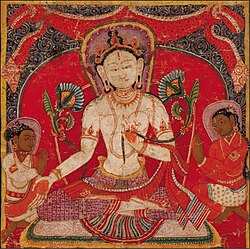
| Ripumalla | c. 1312–1314 AD | Patronage at Tibetan monasteries; Tara worship painting.[15] |
| Adityamalla | c. 1313–1328 AD | Land grants in Bajhang and Dailekh.[1] |
| Punyamalla | c. 1328–1337 AD | Taghwai monastery inscriptions.[1] |
| Prithvimalla | c. 1338–1358 AD | Dullu pillar; peak territorial extent.[1] |