Hubbry Logo
Yumen PassYumen PassMain
Open search
Yumen Pass
Community hub
Yumen Pass
logo
8 pages, 0 posts
0 subscribers
Be the first to start a discussion here.
Yumen Pass
Yumen Pass
from Wikipedia

Key Information

Yumen Pass
Simplified Chinese玉门关
Traditional Chinese玉門關
Literal meaningJade Gate
Transcriptions
Standard Mandarin
Hanyu PinyinYùmén Guān
Map over Yumen Pass
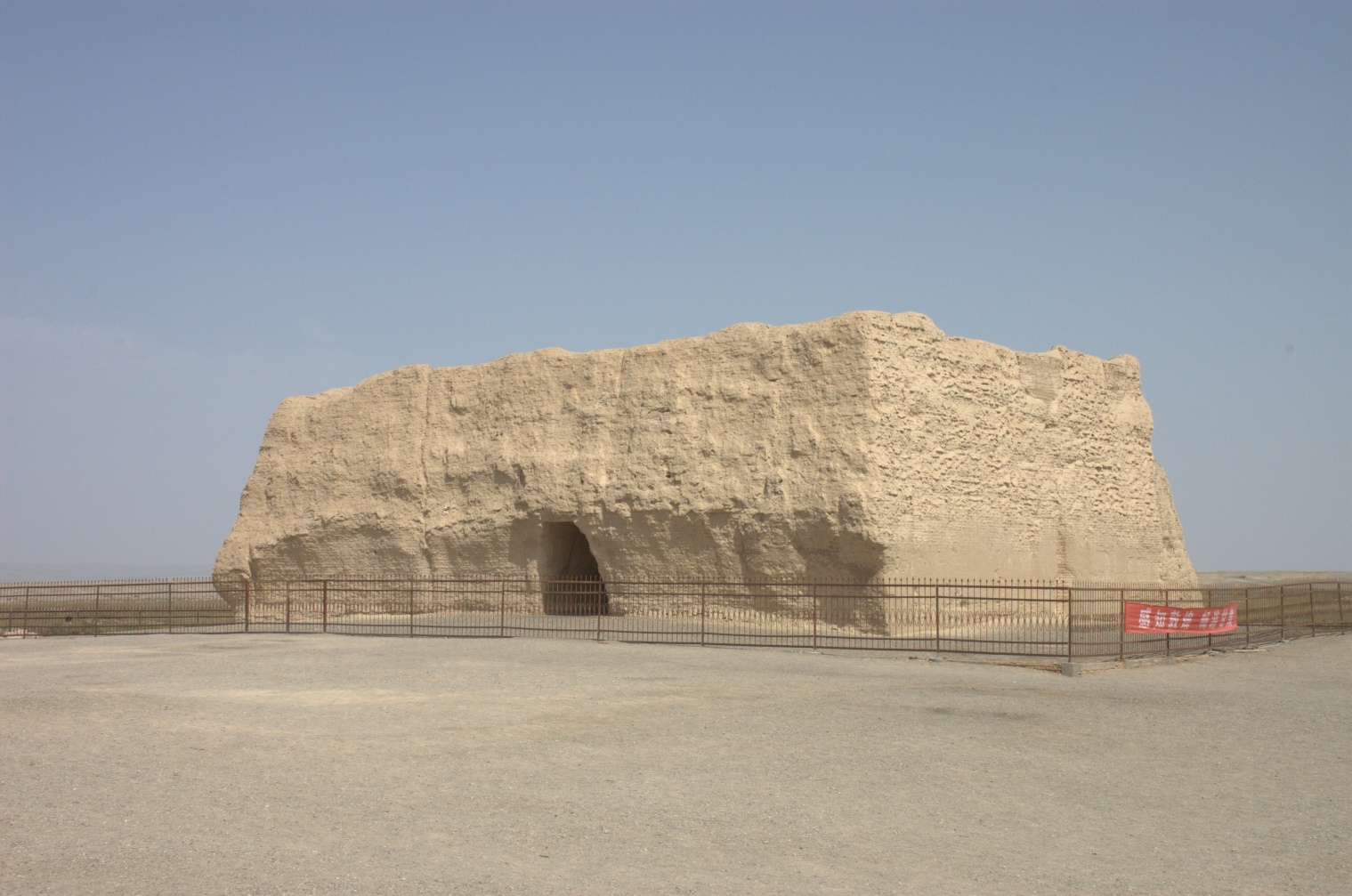
The Small Fangpan Castle at Yumenguan – entrance from the north
The Great Wall from Han dynasty at Yumen Pass

Yumen Pass (simplified Chinese: 玉门; traditional Chinese: 玉門; pinyin: Yùmén Guān; Uyghur: قاش قوۋۇق, Qash Qowuq), or Jade Gate or Pass of the Jade Gate, is the name of a pass of the Great Wall located west of Dunhuang in today's Gansu Province of China. During the Han dynasty (202 BC – AD 220), this was a pass through which the Silk Road passed, and was the one road connecting Central Asia with East Asia (China), the former called the Western Regions. Just to the south was the Yangguan pass, which was also an important point on the Silk Road. These passes, along with other sites along the Silk Road, were inscribed in 2014 on the UNESCO World Heritage List as the Silk Roads: the Routes Network of Chang'an-Tianshan Corridor World Heritage Site.[1] The pass is at an elevation of 1400 meters.

Etymology

[edit]

Although the Chinese guan is usually translated simply as "pass", its more specific meaning is a "frontier pass" to distinguish it from an ordinary pass through the mountains. Yumen guan 玉門關 and Yang guan 陽關 are derived from: yu 玉 = 'jade' + men 門 = 'gate', 'door'; and yang 陽 = 'sunny side', 'south side of a hill', 'north side of a river,' and guan 關 = 'frontier-passes'.

It is not to be confused with the city Yumen (玉門, literally Jade Gate) in Gansu, China. Although both are within the same Jiuquan "prefecture-level city" (a multi-county administrative unit) of Gansu province, Yumen Pass is located some 400 km (250 mi) to the west of its namesake city.

History

[edit]

Yumen Pass was one of the most famous passes leading to the north and west from Chinese territory.[2] During the Early Han, "a defensive line was established from Jiuquan ('Wine Springs') in the Gansu Corridor west to the Jade Gate Pass at its end."[3]

Travellers to 'The Western Regions' (西域, Xiyu) left China through the famous Yumenguan 玉門關, or 'Jade Gate Frontier-post,' named for the many jade caravans that passed through it. The original Jade Gate was erected by Emperor Wudi (Emperor Wu of Han) soon after 121 BCE and its ruins may still be seen about 80 kilometres (50 mi) to the northwest of Dunhuang which was, until the 6th century, the final outpost of Chinese territory for caravans on their long caravan journeys to India, Parthia, and the Roman Empire.[4]

The remains of these two important Han-dynasty gates are about 68 kilometres (42 mi) apart, at either end of the Dunhuang extension of the Great Wall. Until the Tang dynasty, when the gates fell into disuse, all caravans travelling through Dunhuang were required to pass through one of these gates, then the westernmost passes of China. Yumenguan lies about 80 kilometres (50 mi) northwest of Dunhuang. It was originally called the 'Square City', but because the great jade caravans from Khotan entered through its portals, it became known as the Jade Gate Pass. In the third and fourth centuries turmoil swept through Central Asia, disrupting overland trade, and the sea route via India began to supplant it. By the sixth century, as caravans favoured the northern route via Hami, the pass was abandoned. In 1907, Sir Aurel Stein found bamboo slips naming the site as Yumenguan, and in 1944 Chinese archaeologists discovered relics that confirmed this. With its 10-metre-high (33-foot) mud walls pierced by four gateways, the square enclosure covered more than 600 square metres (718 square yards) in the midst of unbounded desolation. Yanguan lies 75 kilometres (47 mi) southwest of Dunhuang but consists of only the ruins of a high beacon tower.

— Bonavia & Baumer (2004), pp. 176, 178. Quoted in Hill (2009), p. 138.

Footnotes

[edit]

References

[edit]
Revisions and contributorsEdit on WikipediaRead on Wikipedia
from Grokipedia
Yumen Pass, also known as the Jade Gate or Yumenguan, is a historic rammed-earth and strategic pass situated approximately 80 kilometers northwest of in Province, , at the western extremity of the in the . Constructed during the Western under Emperor Wu around 111 BC following military campaigns against the , it functioned as a vital military outpost and trade checkpoint on the northern branch of the ancient . The pass, named for the jade traded through it from regions like Khotan, marked the boundary between 's agricultural heartland and the nomadic steppes of , serving as one of two primary gateways—the other being Yang Pass—to the for over a millennium. As a core component of the Han Dynasty's defensive network, Yumen Pass formed part of an extensive Great Wall system spanning about 40 kilometers, including two main castles, 20 for signaling invasions, and 18 sections of ramparts built primarily from local materials like reeds, tamarisk branches, and sand. The primary structure is a square enclosure measuring roughly 25 meters on each side and 9 meters high, with gates including on the west and north sides, designed to control access and protect against raids while supporting the flow of caravans carrying , spices, horses, and . Archaeological excavations in the region, beginning with British explorer in 1907 and continuing with Chinese efforts in 1944, have uncovered over 40,000 wooden slips from the Han era inscribed with administrative records, dispatches, and poetic fragments, offering invaluable insights into ancient governance, , and logistics. The pass's strategic importance peaked during the , with intermittent use in later periods including the (618–907 AD), when it facilitated cultural exchanges, including the spread of , and economic ties that bolstered China's influence in , though it largely declined by the as trade routes shifted northward. Today, Yumen Pass is recognized as an integral element of the "Silk Roads: the Chang'an-Tianshan Corridor," inscribed in , encompassing ancient paths, fortifications, and post stations that highlight the corridor's role in connecting to over 2,000 years. Preserved as a cultural relic amid the harsh desert environment, it attracts visitors to explore its ruins and reflect on its legacy as a symbol of ancient connectivity and frontier resilience.

Etymology

Origin of the Name

The name "Yumen Pass" is derived from the Chinese characters 玉门关 (Yùmén Guān), in which "yù" (玉) signifies jade, "mén" (门) denotes gate, and "guān" (关) refers to a frontier pass, collectively translating to "Jade Gate Pass." This designation originated during the Western Han Dynasty around 121 BCE, following General Huo Qubing's conquest of the Hexi Corridor from the Xiongnu, which enabled the establishment of the pass as a key gateway for trade. The name specifically arose because the pass served as the primary entry point into Han territory for valuable jade imports from the kingdom of Khotan (modern-day Hotan in Xinjiang), transported along the emerging Silk Road routes. Prior to this renaming, the site was known as "Small Square City" (Xiaofangcheng), reflecting its initial rectangular fortress design, but the association with jade trade—where merchants from the Western Regions offered tribute and commerce through the gate—prompted the enduring "Jade Gate" moniker as recorded in historical texts like the Hanshu by Ban Gu. It is important to distinguish Yumen Pass from the modern Yumen City in Province, which lies approximately 400 km to the east near Jiayuguan and derives its own name from the ancient pass but serves as a separate administrative and industrial center without direct historical overlap in nomenclature origins.

Alternative and Historical Designations

Yumen Pass has been known by several alternative Chinese names reflecting its physical structure and location. One prominent designation is "Small Fangpan City" (Xiǎo Fāngpán Chéng), referring to the nearby ruined square-shaped fortress that served as the pass's core structure during the . This name derives from "fangpan," meaning square or flat tray, due to the fortress's distinctive rectangular layout measuring approximately 9.7 meters in height and covering over 630 square meters. In foreign languages and historical texts, Yumen Pass is most commonly rendered in Western scholarship as the "Jade Gate" or "Gate of Jade," a direct translation emphasizing its role as an entry point for trade routes. Historically, the pass's nomenclature evolved from functional military terminology in official records, where it was simply designated as "Yumen Guan" (Jade Gate Pass), with "guan" denoting a fortified or checkpoint essential for defense. By the (618–907 CE), this evolved into more symbolic usages in , where it represented isolation, farewell, and the harsh frontier, as seen in Wang Zhihuan's famous verse "Spring winds do not pass Yumen Pass," evoking themes of eternal separation beyond the empire's borders.

Location and Geography

Physical Setting

Yumen Pass is situated approximately 80 kilometers northwest of Dunhuang in Gansu Province, northwestern China, at coordinates 40°21′13″N 93°51′51″E. This positioning places it at the western extremity of the Hexi Corridor, a narrow passage through the arid landscapes of the region. The pass occupies an elevation of about 1,400 meters above sea level within the expansive Gobi Desert, characterized by vast stretches of gravel plains, shifting sand dunes, and rugged badlands. It lies along the southern bank of the Shule River valley, where the terrain transitions from the corridor's relatively flat basin to the encroaching desert, with sparse vegetation and exposed rocky outcrops dominating the surroundings. The area's topography features low-lying depressions interspersed with wind-eroded hills and loose, silty soils typical of the Gobi environment. Adjacent to the pass are remnants of the Great Wall, including sections of rammed-earth fortifications that extend eastward, as well as the ruins of Small Fangpan Castle, a square-shaped structure built from tamped earth measuring roughly 24 meters by 26 meters. These features are integrated into the desert landscape, highlighting the pass's isolation amid the barren expanse.

Strategic and Environmental Context

Yumen Pass served as the westernmost military outpost of the , strategically positioned at the terminus of the to regulate passage into the and the broader beyond China's borders. This location enabled the Han Empire to monitor and defend against incursions from nomadic groups like the while facilitating controlled expansion westward. Flanked by the vast expanse of the to the north and the towering to the south, the pass exploited the rugged terrain as a natural , enhancing its defensive value against large-scale invasions. The environmental conditions surrounding Yumen Pass amplified its role as an imposing barrier, characterized by extreme aridity with annual rainfall typically below 50 mm, predominantly concentrated in sporadic summer showers. This hyper-arid climate, coupled with frequent sandstorms driven by relentless winds across the Gobi, created formidable challenges for travelers and garrisons alike, often leading to isolation and supply difficulties. Temperature fluctuations were equally severe, ranging from lows of approximately -20°C in winter to highs exceeding 40°C in summer, underscoring the pass's inhospitable nature that deterred unauthorized crossings and reinforced its strategic isolation. In conjunction with Yang Pass, located about 70 km to the south, Yumen Pass formed one of the dual gateways marking the boundary of during the Han era, together securing the southern and northern flanks of the against external threats. This pairing allowed for complementary surveillance and rapid response across the divergent routes diverging into the , effectively bottlenecking access to the interior while permitting supervised movement through the empire's .

Historical Development

Construction and Early Han Dynasty Use

Yumen Pass was constructed in the late BCE during the reign of (r. 141–87 BCE) as part of the dynasty's efforts to consolidate control over its western frontiers. Following the decisive military victories against the nomads led by General in 121 BCE, which expelled the Xiongnu from the region, Emperor Wu ordered the fortification of key strategic points to prevent further incursions and secure newly acquired territories. This included the establishment of Yumen Pass, often dated to around 111 BCE, though some accounts place its initial erection shortly after the 121 BCE campaigns. The pass was built using traditional rammed earth techniques, known as huangtu in Chinese, where layers of moistened earth were compacted between wooden formworks to create durable walls. These structures were integrated into the broader Han Great Wall system, extending the defensive line through the arid Gansu Corridor and linking with beacon towers for signaling and surveillance. The original fort at Yumen Pass featured a rectangular enclosure with walls approximately 10 meters high, designed for resilience in the harsh desert environment despite the scarcity of stone or brick materials in the region. In its early years during the Western Han period (206 BCE–9 CE), Yumen Pass primarily served as a checkpoint manned by Han soldiers to monitor and regulate movement across the border. It functioned to control nomadic threats from the and other steppe peoples, enforcing tolls and inspections on travelers while providing a base for military patrols. Additionally, the pass played a foundational role in the nascent explorations along what would become the , allowing Han envoys like to venture westward and establish diplomatic and trade connections with Central Asian states.

Imperial Periods and Decline

During the Eastern Han Dynasty (25–220 CE), Yumen Pass continued to serve as a vital military garrison, maintaining its role in defending the western frontiers and facilitating trade along the Corridor. The pass was reinforced to counter ongoing threats from nomadic groups, with garrisons stationed to protect and the surrounding oases. This period saw sustained imperial investment in the structure, though increasing internal strife began to strain resources. Following the fall of the Han, the pass experienced periods of rebuilding and garrisoning under the Wei (220–265 CE) and subsequent dynasties, including the Jin and (265–589 CE), where it functioned as a key outpost amid regional chaos and warfare. By the (618–907 CE), Yumen Pass had been relocated and rebuilt near Kuyu City (modern Suoyang City), adopting a square layout with a and 11 to enhance defenses. It operated as a critical against Tibetan incursions into the northwest, with commanders overseeing garrisons to secure the up to the 8th century CE. Tang poets, such as Cen Shen, referenced the pass in works evoking its strategic isolation. The original site's importance diminished during the due to the opening of a new northern through Anxi to , which bypassed the western location and prompted the relocation eastward; the relocated pass continued in use but ultimately declined after the Song and Liao dynasties (10th–12th centuries) due to incessant wars, political fragmentation, environmental changes including intensified from shifting sands, and the rise of maritime s, rendering it obsolete and leading to full abandonment by the (1271–1368).

Role in Trade and Military Affairs

Silk Road Trade Functions

Yumen Pass served as a vital checkpoint and trade hub along the northern branch of the during the , functioning as the primary gateway through which caravans entered or exited the Chinese empire from the . Established as a garrison in 111 BCE under Emperor Wu, it regulated the flow of commerce across the Corridor, requiring merchants to obtain guosuo travel passes that were verified at nearby relay stations like Xuanquan. This oversight ensured controlled access to and beyond, facilitating the movement of diverse goods while maintaining imperial authority over transcontinental exchange. As a key nexus for overland commerce, the pass was instrumental in the transport of high-value commodities, with caravans carrying Chinese , a primary export and form of currency, westward to , , , and the . In return, eastward-bound convoys brought spices such as pepper from and , prized horses from Ferghana and Khotan valued for their speed and endurance, and other luxuries like grains and textiles. Particularly notable was its role in the trade, earning the pass its name as the "Jade Gate" due to the influx of superior jade caravans from Khotan, which entered through its portals and supplied imperial courts and elites as early as the pre-Han period but intensified under Han expansion. These exchanges typically involved small-scale caravans handling 3.3 to 88 pounds of goods per trip, though larger state-sponsored delegations amplified the volume, underscoring the pass's centrality in linking Eurasian markets until its decline in the mid-8th century CE following the . Economically, Yumen Pass generated substantial revenue for the Han Empire through tariffs and taxes levied on passing merchants and envoys, with garrisons collecting fees on cargo to fund military operations and infrastructure. Officials imposed scale-based duties, such as two silver coins per two jin of goods in associated Turfan outposts, while broader imperial oversight included grain tallies and -based payments to soldiers, which indirectly stimulated by securing routes. By the CE, the pass handled significant annual traffic, with batches of envoys and merchants—dominated by Sogdian traders who supplied thousands of bolts of in major deals—contributing to the empire's fiscal strength and fostering urbanization in frontier areas like . This commerce not only enriched the Han treasury but also integrated peripheral economies, as evidenced by documented disputes over pricing and logistics at relay points. Beyond material exchange, Yumen Pass acted as a crucial point of cultural contact, enabling the transmission of into via Gandharan migrants and Khotanese routes around 200 CE, with monks like and traversing it en route to and back. The pass facilitated interactions among diverse ethnic groups, including Sogdians—who comprised the majority of merchants in nearby Turfan and contributed to Buddhist proselytization through missionary activities—and Uighurs, who later engaged in trade and provided military support along the corridor post-763 CE. These encounters, documented in bilingual artifacts and monastic records from , promoted the fusion of religious ideas, artistic motifs, and social practices, transforming the pass into a conduit for broader Eurasian .

Military and Defensive Significance

Yumen Pass served as a critical bulwark for the against invasions by the nomads, who frequently raided the northwestern frontiers. Established in 111 BCE following General Huo Qubing's decisive victory over the in 121 BCE, which secured the , the pass was garrisoned with troops to monitor and repel threats, forming part of an extensive defensive network that included for signaling incursions. This military success weakened control, enabling the safe passage of diplomat on his second mission to the in 119 BCE and facilitating Han expansion through diplomatic envoys and colonization efforts that established protectorates over Central Asian territories. During the Wei-Jin period (220–420 CE), amid ongoing civil wars and northern invasions, Yumen Pass functioned as a outpost, supporting garrisons that defended against nomadic incursions and provided a base for military operations in the unstable region. In the (618–907 CE), the pass retained its strategic importance as part of defenses along the against the Tibetan Empire's encroachments starting around 670 CE, with troops stationed there to protect imperial interests until the area's loss following the in the mid-8th century. Its remote position symbolized the "end of civilized " for soldiers and exiles banished to the , evoking themes of isolation and duty in historical records. The pass's fortifications not only repelled direct assaults but also aided imperial expansion by securing routes for military campaigns into the , where Han forces established colonies and vassal states to counterbalance nomadic powers. This defensive posture briefly integrated with trade security, ensuring safe passage for caravans amid ongoing threats.

Architecture and Remains

Structural Description

The Small Fangpan Castle, the core structure of Yumen Pass, is a square fortress constructed primarily during the Western Han Dynasty, measuring approximately 26.4 meters by 26.6 meters and covering an area of about 702 square meters. Its walls, originally reaching up to 10 meters in height with a thickness of around 1.5 meters, were built using reinforced with layers of reeds and tamarisk twigs to bind the sandy desert soil and enhance stability against environmental erosion. Key defensive features include a single gate positioned on the western side, which has since collapsed, along with four corner watchtowers—of which only the southwestern one remains partially intact—and narrow arrow slits integrated into the walls for archers, often described as triangular ventilating openings arranged in two rows to allow for both defense and in the harsh Gobi . The fortress forms a critical node in a broader 45- to 50-kilometer segment of the Great Wall, which stretches across the desert landscape and incorporates approximately 20 spaced roughly every 2 to 3 kilometers to facilitate rapid signaling via or fire during military alerts. Archaeological excavations at the site and surrounding areas have uncovered Han-era artifacts, including fragments, weapons such as iron spearheads and arrowheads, bamboo slips for administrative records, and other tools, providing evidence of multi-phase construction and occupation during the Western , with indications of later imperial repairs. These findings confirm the fortress's evolution from an initial military outpost built around 111 BCE to a reinforced structure adapted over centuries for sustained border defense.

Current State and Preservation

Yumen Pass, located in the remote of northwestern Province, has undergone significant deterioration since its abandonment in the early medieval period, primarily due to relentless wind and sand erosion. The ancient rammed-earth walls, once formidable structures, have been reduced to fragmented remnants typically standing 2-3 meters in height, significantly reduced by natural degradation over centuries. This erosion has been exacerbated by the site's arid environment, where shifting sands periodically bury and uncover portions of the ruins, further contributing to structural instability. Preservation efforts for Yumen Pass began in earnest with its designation as a national key cultural relic in 1961 by the , marking it as one of the first batch of protected sites under the nation's laws. In , the site was inscribed on the World Heritage List as part of : the Routes Network of Chang'an-Tianshan Corridor, prompting enhanced international cooperation and management plans focused on monitoring and stabilization. Gansu provincial authorities have implemented ongoing initiatives, including the installation of modern sand barriers and vegetation grids to combat encroachment from surrounding dunes, alongside regular archaeological surveys to assess and reinforce exposed sections. As of 2025, ongoing efforts include real-time digital monitoring, ecological restoration, development, and digital archiving to enhance protection and public engagement. The site's isolated location in the vast minimizes risks from and tourism-related damage, though it poses logistical challenges for maintenance and research access. However, is intensifying threats through accelerated , with rising temperatures and altered wind patterns increasing sand mobility and erosion rates across Province's Silk Road relics. These factors, combined with the pass's historical decline from disuse, underscore the need for sustained adaptive conservation strategies.

Cultural and Symbolic Importance

Representations in Literature and Art

Yumen Pass has long served as a poignant motif in classical Chinese literature, embodying themes of isolation, farewell, and the hardships of frontier life. In poetry, it frequently symbolizes the boundary between civilization and desolation, evoking emotions of exile and separation from home. For instance, Wang Zhihuan's famous quatrain "Liangzhou Ci" (Song of Liangzhou) captures this solitude with the line "The spring breeze does not cross Yumen Pass," portraying the pass as an impassable divide where even nature's comforts fail to reach the border guards and travelers. Similarly, Li Bai's "Guan Shan Yue" (Moon Over the Mountain Pass) references the pass in depicting the relentless winds sweeping through it, underscoring the endless marches of Han soldiers into hostile territories far from their , where few return. These works, composed during the , reflect the poets' observations of the Silk Road's emotional toll, using Yumen Pass to humanize the geopolitical frontier. In visual arts, Yumen Pass appears in ancient murals that illustrate the dynamic world of commerce and pilgrimage. The in , near the pass, feature extensive wall paintings from the Tang and later periods depicting caravans of merchants and monks navigating desert passes, with scenes of camels, traders, and protective deities amid arid landscapes. These murals, spanning over a millennium of artistic evolution, integrate Buddhist iconography with secular motifs of travel, positioning passes like Yumen as gateways in narratives of cultural exchange and spiritual quest. Later artistic traditions continued this motif, romanticizing the pass in landscape paintings that highlight its stark beauty and strategic majesty against the . Yumen Pass also features prominently in Silk Road folklore, where it is tied to legends of guidance and peril for lost travelers. One enduring tale recounts how caravans transporting from the west often became disoriented in the shifting sands and complex terrain near the pass, especially under cover of night. A supernatural wild goose, rescued by a young merchant, repeatedly led these wayward groups to safety, acting as a guardian spirit; in exchange, it demanded that a piece of luminous be embedded in the pass's structure to illuminate paths for future journeys. Once fulfilled, the jade's glow prevented further losses, earning the site its name "Yumen" (Jade Gate) and cementing its lore as a protector amid the dangers of the ancient trade routes.

Modern Interpretations and Recognition

In 2014, Yumen Pass was inscribed as part of the "Silk Roads: the Routes Network of Chang'an-Tianshan Corridor," recognizing its role in the transnational network of trade routes that connected to and beyond over millennia. This designation underscores the pass's significance as a shared , emphasizing the exchange of goods, ideas, and technologies along the ancient paths. Today, Yumen Pass attracts tourists primarily through organized tours departing from , approximately 80 kilometers to the southeast, where visitors explore its ruins amid the landscape. In 2018, the Yumen Pass Scenic Area received 287,488 visitors, reflecting growing interest in its historical legacy. To boost winter tourism, free entry was offered from December 1, 2024, to February 28, 2025, contributing to 's overall visitor numbers exceeding 19.53 million in the first three quarters of 2024. Facilities at the site provide educational exhibits on the Silk Road's enduring impact, enhancing visitor understanding of its role as a gateway to the . As of 2025, the site is bidding for China's National 5A-level status. In contemporary historiography, Yumen Pass symbolizes China's historical westward expansion and the Central Plains dynasties' assertion of sovereignty over vast frontiers. It features prominently in modern narratives of global connectivity, such as Peter Frankopan's The Silk Roads: A New History of the World (2015), which highlights the pass as a pivotal node in the Eurasian exchange networks that shaped world history.

References

Add your contribution
Related Hubs
User Avatar
No comments yet.