



Community hub
0 subscribers7 pages, 0 posts
Recent from talks
All channels
Be the first to start a discussion here.
Be the first to start a discussion here.
Be the first to start a discussion here.
Be the first to start a discussion here.
Contribute something
Welcome to the community hub built to collect knowledge and have discussions related to 600 (number).
Nothing was collected or created yet.
600 (number)
View on Wikipediafrom Wikipedia
| ||||
|---|---|---|---|---|
| Cardinal | six hundred | |||
| Ordinal | 600th (six hundredth) | |||
| Factorization | 23 × 3 × 52 | |||
| Divisors | 1, 2, 3, 4, 5, 6, 8, 10, 12, 15, 20, 24, 25, 30, 40, 50, 60, 75, 100, 120, 150, 200, 300, 600 | |||
| Greek numeral | Χ´ | |||
| Roman numeral | DC, dc | |||
| Binary | 10010110002 | |||
| Ternary | 2110203 | |||
| Senary | 24406 | |||
| Octal | 11308 | |||
| Duodecimal | 42012 | |||
| Hexadecimal | 25816 | |||
| Armenian | Ո | |||
| Hebrew | ת"ר / ם | |||
| Babylonian cuneiform | 𒌋 | |||
| Egyptian hieroglyph | 𓍧 | |||
600 (six hundred) is the natural number following 599 and preceding 601.
Mathematical properties
[edit]Six hundred is a composite number, an abundant number, a pronic number,[1] a Harshad number and a largely composite number.[2]
Credit and cars
[edit]- In the United States, a credit score of 600 or below is considered poor, limiting available credit at a normal interest rate
- NASCAR runs 600 advertised miles in the Coca-Cola 600, its longest race
- The Fiat 600 is a car, the SEAT 600 its Spanish version
Integers from 601 to 699
[edit]600s
[edit]- 601 = prime number, centered pentagonal number[3]
- 602 = 2 × 7 × 43, nontotient, number of cubes of edge length 1 required to make a hollow cube of edge length 11, area code for Phoenix, AZ along with 480 and 623
- 603 = 32 × 67, Harshad number, Riordan number, area code for New Hampshire
- 604 = 22 × 151, nontotient, totient sum for first 44 integers, area code for southwestern British Columbia (Lower Mainland, Fraser Valley, Sunshine Coast and Sea to Sky)
- 605 = 5 × 112, Harshad number, sum of the nontriangular numbers between the two successive triangular numbers 55 and 66, number of non-isomorphic set-systems of weight 9
- 606 = 2 × 3 × 101, sphenic number, sum of six consecutive primes (89 + 97 + 101 + 103 + 107 + 109), admirable number, One of the numbers associated with Christ - ΧϚʹ - see the Greek numerals Isopsephy and the reason why other numbers siblings with this one are Beast's numbers.
- 607 – prime number, sum of three consecutive primes (197 + 199 + 211), Mertens function(607) = 0, balanced prime,[4] strictly non-palindromic number,[5] Mersenne prime exponent

- 608 = 25 × 19, Mertens function(608) = 0, nontotient, happy number, number of regions formed by drawing the line segments connecting any two of the perimeter points of a 3 times 4 grid of squares[6]
- 609 = 3 × 7 × 29, sphenic number, strobogrammatic number[7]
610s
[edit]- 610 = 2 × 5 × 61, sphenic number, Fibonacci number,[8] Markov number,[9] also a kind of telephone wall socket used in Australia
- 611 = 13 × 47, sum of the three standard board sizes in Go (92 + 132 + 192), the 611th tribonacci number is prime
- 612 = 22 × 32 × 17, Harshad number, Zuckerman number (sequence A007602 in the OEIS), untouchable number, area code for Minneapolis, MN
- 613 = prime number, first number of prime triple (p, p + 4, p + 6), middle number of sexy prime triple (p − 6, p, p + 6). Geometrical numbers: Centered square number with 18 per side, circular number of 21 with a square grid and 27 using a triangular grid. Also 17-gonal. Hypotenuse of a right triangle with integral sides, these being 35 and 612. Partitioning: 613 partitions of 47 into non-factor primes, 613 non-squashing partitions into distinct parts of the number 54. Squares: Sum of squares of two consecutive integers, 17 and 18. Additional properties: a lucky number, index of prime Lucas number.[10]
- In Judaism the number 613 is very significant, as its metaphysics, the Kabbalah, views every complete entity as divisible into 613 parts: 613 parts of every Sefirah; 613 mitzvot, or divine Commandments in the Torah; 613 parts of the human body.
- The number 613 hangs from the rafters at Madison Square Garden in honor of New York Knicks coach Red Holzman's 613 victories
- 614 = 2 × 307, nontotient, 2-Knödel number. According to Rabbi Emil Fackenheim, the number of Commandments in Judaism should be 614 rather than the traditional 613.
- 615 = 3 × 5 × 41, sphenic number
- 616 = 23 × 7 × 11, Padovan number, balanced number,[11] an alternative value for the Number of the Beast (more commonly accepted to be 666)
- 617 = prime number, sum of five consecutive primes (109 + 113 + 127 + 131 + 137), Chen prime, Eisenstein prime with no imaginary part, number of compositions of 17 into distinct parts,[12] prime index prime, index of prime Lucas number[10]
- Area code 617, a telephone area code covering the metropolitan Boston area
- 618 = 2 × 3 × 103, sphenic number, admirable number
- 619 = prime number, strobogrammatic prime,[13] alternating factorial[14]
620s
[edit]- 620 = 22 × 5 × 31, sum of four consecutive primes (149 + 151 + 157 + 163), sum of eight consecutive primes (61 + 67 + 71 + 73 + 79 + 83 + 89 + 97), the sum of the first 620 primes is itself prime[15]
- 621 = 33 × 23, Harshad number, the discriminant of a totally real cubic field[16]
- 622 = 2 × 311, nontotient, Fine number, (sequence A000957 in the OEIS), it is also the standard diameter of modern road bicycle wheels (622 mm, from hook bead to hook bead)
- 623 = 7 × 89, number of partitions of 23 into an even number of parts[17]
- 624 = 24 × 3 × 13 = J4(5),[18] sum of a twin prime pair (311 + 313), Harshad number, Zuckerman number
- 625 = 252 = 54, sum of seven consecutive primes (73 + 79 + 83 + 89 + 97 + 101 + 103), centered octagonal number,[19] 1-automorphic number, Friedman number since 625 = 56−2,[20] one of the two three-digit numbers when squared or raised to a higher power that end in the same three digits, the other being 376
- 626 = 2 × 313, nontotient, 2-Knödel number, Stitch's experiment number
- 627 = 3 × 11 × 19, sphenic number, number of integer partitions of 20,[21] Smith number[22]
- 628 = 22 × 157, nontotient, totient sum for first 45 integers
- 629 = 17 × 37, highly cototient number,[23] Harshad number, number of diagonals in a 37-gon[24]
630s
[edit]- 630 = 2 × 32 × 5 × 7, sum of six consecutive primes (97 + 101 + 103 + 107 + 109 + 113), the 35th triangular number,[25] a hexagonal number,[26] sparsely totient number,[27] Harshad number, balanced number,[28] largely composite number[2]
- 631 = Cuban prime number, Lucky prime, centered triangular number,[29] centered hexagonal number,[30] Chen prime, lazy caterer number (sequence A000124 in the OEIS)
- 632 = 23 × 79, refactorable number, number of 13-bead necklaces with 2 colors[31]
- 633 = 3 × 211, sum of three consecutive primes (199 + 211 + 223), Blum integer; also, in the title of the movie 633 Squadron
- 634 = 2 × 317, nontotient, Smith number[22]
- 635 = 5 × 127, sum of nine consecutive primes (53 + 59 + 61 + 67 + 71 + 73 + 79 + 83 + 89), Mertens function(635) = 0, number of compositions of 13 into pairwise relatively prime parts[32]
- 636 = 22 × 3 × 53, sum of ten consecutive primes (43 + 47 + 53 + 59 + 61 + 67 + 71 + 73 + 79 + 83), Smith number,[22] Mertens function(636) = 0
- 637 = 72 × 13, Mertens function(637) = 0, decagonal number[33]
- 638 = 2 × 11 × 29, sphenic number, sum of four consecutive primes (151 + 157 + 163 + 167), nontotient, centered heptagonal number[34]
- 639 = 32 × 71, sum of the first twenty primes, also ISO 639 is the ISO's standard for codes for the representation of languages
640s
[edit]- 640 = 27 × 5, Harshad number, refactorable number, hexadecagonal number,[35] number of 1's in all partitions of 24 into odd parts,[36] number of acres in a square mile
- 641 = prime number, Sophie Germain prime,[37] factor of 4294967297 (the smallest nonprime Fermat number), Chen prime, Eisenstein prime with no imaginary part, Proth prime[38]
- 642 = 2 × 3 × 107 = 14 + 24 + 54,[39] sphenic number, admirable number
- 643 = prime number, largest prime factor of 123456
- 644 = 22 × 7 × 23, nontotient, Perrin number,[40] Harshad number, common umask, admirable number
- 645 = 3 × 5 × 43, sphenic number, octagonal number, Smith number,[22] Fermat pseudoprime to base 2,[41] Harshad number
- 646 = 2 × 17 × 19, sphenic number, also ISO 646 is the ISO's standard for international 7-bit variants of ASCII, number of permutations of length 7 without rising or falling successions[42]
- 647 = prime number, sum of five consecutive primes (113 + 127 + 131 + 137 + 139), Chen prime, Eisenstein prime with no imaginary part, 3647 - 2647 is prime[43]
- 648 = 23 × 34 = A331452(7, 1),[6] Harshad number, Achilles number, area of a square with diagonal 36[44]
- 649 = 11 × 59, Blum integer
650s
[edit]- 650 = 2 × 52 × 13, primitive abundant number,[45] square pyramidal number,[46] pronic number,[1] nontotient, totient sum for first 46 integers; (other fields) the number of seats in the House of Commons of the United Kingdom, admirable number
- 651 = 3 × 7 × 31, sphenic number, pentagonal number,[47] nonagonal number[48]
- 652 = 22 × 163, maximal number of regions by drawing 26 circles[49]
- 653 = prime number, Sophie Germain prime,[37] balanced prime,[4] Chen prime, Eisenstein prime with no imaginary part
- 654 = 2 × 3 × 109, sphenic number, nontotient, Smith number,[22] admirable number
- 655 = 5 × 131, number of toothpicks after 20 stages in a three-dimensional grid[50]
- 656 = 24 × 41 = ,[51] in Judaism, 656 is the number of times that Jerusalem is mentioned in the Hebrew Bible or Old Testament
- 657 = 32 × 73, the largest known number not of the form a2+s with s a semiprime
- 658 = 2 × 7 × 47, sphenic number, untouchable number
- 659 = prime number, Sophie Germain prime,[37] sum of seven consecutive primes (79 + 83 + 89 + 97 + 101 + 103 + 107), Chen prime, Mertens function sets new low of −10 which stands until 661, highly cototient number,[23] Eisenstein prime with no imaginary part, strictly non-palindromic number[5]

660s
[edit]- 660 = 22 × 3 × 5 × 11
- Sum of four consecutive primes (157 + 163 + 167 + 173)
- Sum of six consecutive primes (101 + 103 + 107 + 109 + 113 + 127)
- Sum of eight consecutive primes (67 + 71 + 73 + 79 + 83 + 89 + 97 + 101)
- Sparsely totient number[27]
- Sum of 11th row when writing the natural numbers as a triangle.[52]
- Harshad number.
- largely composite number[2]
- 661 = prime number
- Sum of three consecutive primes (211 + 223 + 227)
- Mertens function sets new low of −11 which stands until 665
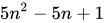
- Pentagram number of the form
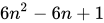
- Hexagram number of the form i.e. a star number
- 662 = 2 × 331, nontotient, member of Mian–Chowla sequence[53]
- 663 = 3 × 13 × 17, sphenic number, Smith number[22]
- 664 = 23 × 83, refactorable number, number of knapsack partitions of 33[54]
- Telephone area code for Montserrat
- Area code for Tijuana within Mexico
- Model number for the Amstrad CPC 664 home computer
- 665 = 5 × 7 × 19, sphenic number, Mertens function sets new low of −12 which stands until 1105, number of diagonals in a 38-gon[24]
- 666 = 2 × 32 × 37, 36th triangular number,[55] Harshad number, repdigit
- 667 = 23 × 29, lazy caterer number (sequence A000124 in the OEIS)
- 668 = 22 × 167, nontotient
- 669 = 3 × 223, Blum integer
670s
[edit]- 670 = 2 × 5 × 67, sphenic number, octahedral number,[56] nontotient
- 671 = 11 × 61. This number is the magic constant of n×n normal magic square and n-queens problem for n = 11.
- 672 = 25 × 3 × 7, harmonic divisor number,[57] Zuckerman number, admirable number, largely composite number,[2] triperfect number
- 673 = prime number, lucky prime, Proth prime[38]
- 674 = 2 × 337, nontotient, 2-Knödel number
- 675 = 33 × 52, Achilles number
- 676 = 22 × 132 = 262, palindromic square
- 677 = prime number, Chen prime, Eisenstein prime with no imaginary part, number of non-isomorphic self-dual multiset partitions of weight 10[58]
- 678 = 2 × 3 × 113, sphenic number, nontotient, number of surface points of an octahedron with side length 13,[59] admirable number
- 679 = 7 × 97, sum of three consecutive primes (223 + 227 + 229), sum of nine consecutive primes (59 + 61 + 67 + 71 + 73 + 79 + 83 + 89 + 97), smallest number of multiplicative persistence 5[60]
680s
[edit]- 680 = 23 × 5 × 17, tetrahedral number,[61] nontotient
- 681 = 3 × 227, centered pentagonal number[3]
- 682 = 2 × 11 × 31, sphenic number, sum of four consecutive primes (163 + 167 + 173 + 179), sum of ten consecutive primes (47 + 53 + 59 + 61 + 67 + 71 + 73 + 79 + 83 + 89), number of moves to solve the Norwegian puzzle strikketoy[62]
- 683 = prime number, Sophie Germain prime,[37] sum of five consecutive primes (127 + 131 + 137 + 139 + 149), Chen prime, Eisenstein prime with no imaginary part, Wagstaff prime[63]
- 684 = 22 × 32 × 19, Harshad number, number of graphical forest partitions of 32[64]
- 685 = 5 × 137, centered square number[65]
- 686 = 2 × 73, nontotient, number of multigraphs on infinite set of nodes with 7 edges[66]
- 687 = 3 × 229, 687 days to orbit the Sun (Mars) D-number[67]
- 688 = 24 × 43, Friedman number since 688 = 8 × 86,[20] 2-automorphic number[68]
- 689 = 13 × 53, sum of three consecutive primes (227 + 229 + 233), sum of seven consecutive primes (83 + 89 + 97 + 101 + 103 + 107 + 109). Strobogrammatic number[69]

690s
[edit]- 690 = 2 × 3 × 5 × 23, sum of six consecutive primes (103 + 107 + 109 + 113 + 127 + 131), sparsely totient number,[27] Smith number,[22] Harshad number
- ISO 690 is the ISO's standard for bibliographic references
- 691 = prime number, (negative) numerator of the Bernoulli number B12 = -691/2730. Ramanujan's tau function τ and the divisor function σ11 are related by the remarkable congruence τ(n) ≡ σ11(n) (mod 691).
- In number theory, 691 is a "marker" (similar to the radioactive markers in biology): whenever it appears in a computation, one can be sure that Bernoulli numbers are involved.
- 692 = 22 × 173, number of partitions of 48 into powers of 2[70]
- 693 = 32 × 7 × 11, triangular matchstick number,[71] the number of sections in Ludwig Wittgenstein's Philosophical Investigations.
- 694 = 2 × 347, centered triangular number,[29] nontotient, smallest pandigital number in base 5.[72]
- 695 = 5 × 139, 695!! + 2 is prime.[73]
- 696 = 23 × 3 × 29, sum of a twin prime (347 + 349), sum of eight consecutive primes (71 + 73 + 79 + 83 + 89 + 97 + 101 + 103), totient sum for first 47 integers, trails of length 9 on honeycomb lattice[74]
- 697 = 17 × 41, cake number; the number of sides of Colorado[75]
- 698 = 2 × 349, nontotient, sum of squares of two primes[76]
- 699 = 3 × 233, D-number[67]
References
[edit]- ^ a b Sloane, N. J. A. (ed.). "Sequence A002378 (Oblong (or promic, pronic, or heteromecic) numbers)". The On-Line Encyclopedia of Integer Sequences. OEIS Foundation.
- ^ a b c d Sloane, N. J. A. (ed.). "Sequence A067128 (Ramanujan's largely composite numbers)". The On-Line Encyclopedia of Integer Sequences. OEIS Foundation.
- ^ a b Sloane, N. J. A. (ed.). "Sequence A005891 (Centered pentagonal numbers)". The On-Line Encyclopedia of Integer Sequences. OEIS Foundation.
- ^ a b Sloane, N. J. A. (ed.). "Sequence A006562 (Balanced primes)". The On-Line Encyclopedia of Integer Sequences. OEIS Foundation.
- ^ a b Sloane, N. J. A. (ed.). "Sequence A016038 (Strictly non-palindromic numbers)". The On-Line Encyclopedia of Integer Sequences. OEIS Foundation.
- ^ a b Sloane, N. J. A. (ed.). "Sequence A331452 (Triangle read by rows: T(n,m) (n >= m >= 1) = number of regions (or cells) formed by drawing the line segments connecting any two of the 2*(m+n) perimeter points of an m X n grid of squares)". The On-Line Encyclopedia of Integer Sequences. OEIS Foundation.
- ^ Sloane, N. J. A. (ed.). "Sequence A000787 (Strobogrammatic numbers)". The On-Line Encyclopedia of Integer Sequences. OEIS Foundation.
- ^ Sloane, N. J. A. (ed.). "Sequence A000045 (Fibonacci numbers)". The On-Line Encyclopedia of Integer Sequences. OEIS Foundation.
- ^ Sloane, N. J. A. (ed.). "Sequence A002559 (Markoff (or Markov) numbers)". The On-Line Encyclopedia of Integer Sequences. OEIS Foundation.
- ^ a b Sloane, N. J. A. (ed.). "Sequence A001606 (Indices of prime Lucas numbers)". The On-Line Encyclopedia of Integer Sequences. OEIS Foundation.
- ^ Sloane, N. J. A. (ed.). "Sequence A020492 (Balanced numbers: numbers k such that phi(k) (A000010) divides sigma(k) (A000203))". The On-Line Encyclopedia of Integer Sequences. OEIS Foundation.
- ^ Sloane, N. J. A. (ed.). "Sequence A032020 (Number of compositions (ordered partitions) of n into distinct parts)". The On-Line Encyclopedia of Integer Sequences. OEIS Foundation. Retrieved 2022-05-24.
- ^ Sloane, N. J. A. (ed.). "Sequence A007597 (Strobogrammatic primes)". The On-Line Encyclopedia of Integer Sequences. OEIS Foundation.
- ^ Sloane, N. J. A. (ed.). "Sequence A005165 (Alternating factorials)". The On-Line Encyclopedia of Integer Sequences. OEIS Foundation.
- ^ (sequence A013916 in the OEIS)
- ^ Sloane, N. J. A. (ed.). "Sequence A006832 (Discriminants of totally real cubic fields)". The On-Line Encyclopedia of Integer Sequences. OEIS Foundation.
- ^ Sloane, N. J. A. (ed.). "Sequence A027187 (Number of partitions of n into an even number of parts)". The On-Line Encyclopedia of Integer Sequences. OEIS Foundation.
- ^ Sloane, N. J. A. (ed.). "Sequence A059377 (Jordan function J_4(n))". The On-Line Encyclopedia of Integer Sequences. OEIS Foundation.
- ^ Sloane, N. J. A. (ed.). "Sequence A016754 (Odd squares: a(n) = (2n+1)^2. Also centered octagonal numbers)". The On-Line Encyclopedia of Integer Sequences. OEIS Foundation.
- ^ a b Sloane, N. J. A. (ed.). "Sequence A036057 (Friedman numbers)". The On-Line Encyclopedia of Integer Sequences. OEIS Foundation.
- ^ Sloane, N. J. A. (ed.). "Sequence A000041 (a(n) = number of partitions of n)". The On-Line Encyclopedia of Integer Sequences. OEIS Foundation.
- ^ a b c d e f g Sloane, N. J. A. (ed.). "Sequence A006753 (Smith numbers)". The On-Line Encyclopedia of Integer Sequences. OEIS Foundation.
- ^ a b Sloane, N. J. A. (ed.). "Sequence A100827 (Highly cototient numbers)". The On-Line Encyclopedia of Integer Sequences. OEIS Foundation.
- ^ a b Sloane, N. J. A. (ed.). "Sequence A000096 (a(n) = n*(n+3)/2)". The On-Line Encyclopedia of Integer Sequences. OEIS Foundation.
- ^ "A000217 - OEIS". oeis.org. Retrieved 2024-11-29.
- ^ Sloane, N. J. A. (ed.). "Sequence A000384 (Hexagonal numbers)". The On-Line Encyclopedia of Integer Sequences. OEIS Foundation.
- ^ a b c Sloane, N. J. A. (ed.). "Sequence A036913 (Sparsely totient numbers)". The On-Line Encyclopedia of Integer Sequences. OEIS Foundation.
- ^ Sloane, N. J. A. (ed.). "Sequence A020492 (Balanced numbers: numbers k such that phi(k) (A000010) divides sigma(k) (A000203))". The On-Line Encyclopedia of Integer Sequences. OEIS Foundation.
- ^ a b Sloane, N. J. A. (ed.). "Sequence A005448 (Centered triangular numbers)". The On-Line Encyclopedia of Integer Sequences. OEIS Foundation.
- ^ Sloane, N. J. A. (ed.). "Sequence A003215 (Hex (or centered hexagonal) numbers)". The On-Line Encyclopedia of Integer Sequences. OEIS Foundation.
- ^ Sloane, N. J. A. (ed.). "Sequence A000031 (Number of n-bead necklaces with 2 colors when turning over is not allowed; also number of output sequences from a simple n-stage cycling shift register; also number of binary irreducible polynomials whose degree divides n)". The On-Line Encyclopedia of Integer Sequences. OEIS Foundation.
- ^ Sloane, N. J. A. (ed.). "Sequence A101268 (Number of compositions of n into pairwise relatively prime parts)". The On-Line Encyclopedia of Integer Sequences. OEIS Foundation. Retrieved 2022-05-31.
- ^ Sloane, N. J. A. (ed.). "Sequence A001107 (10-gonal (or decagonal) numbers)". The On-Line Encyclopedia of Integer Sequences. OEIS Foundation.
- ^ Sloane, N. J. A. (ed.). "Sequence A069099 (Centered heptagonal numbers)". The On-Line Encyclopedia of Integer Sequences. OEIS Foundation.
- ^ Sloane, N. J. A. (ed.). "Sequence A051868 (16-gonal (or hexadecagonal) numbers: a(n) = n*(7*n-6))". The On-Line Encyclopedia of Integer Sequences. OEIS Foundation.
- ^ Sloane, N. J. A. (ed.). "Sequence A036469 (Partial sums of A000009 (partitions into distinct parts))". The On-Line Encyclopedia of Integer Sequences. OEIS Foundation.
- ^ a b c d Sloane, N. J. A. (ed.). "Sequence A005384 (Sophie Germain primes)". The On-Line Encyclopedia of Integer Sequences. OEIS Foundation.
- ^ a b Sloane, N. J. A. (ed.). "Sequence A080076 (Proth primes)". The On-Line Encyclopedia of Integer Sequences. OEIS Foundation.
- ^ Sloane, N. J. A. (ed.). "Sequence A074501 (a(n) = 1^n + 2^n + 5^n)". The On-Line Encyclopedia of Integer Sequences. OEIS Foundation. Retrieved 2022-05-31.
- ^ "Sloane's A001608 : Perrin sequence". The On-Line Encyclopedia of Integer Sequences. OEIS Foundation. Retrieved 2016-06-11.
- ^ Sloane, N. J. A. (ed.). "Sequence A001567 (Fermat pseudoprimes to base 2)". The On-Line Encyclopedia of Integer Sequences. OEIS Foundation.
- ^ Sloane, N. J. A. (ed.). "Sequence A002464 (Hertzsprung's problem: ways to arrange n non-attacking kings on an n X n board, with 1 in each row and column. Also number of permutations of length n without rising or falling successions)". The On-Line Encyclopedia of Integer Sequences. OEIS Foundation.
- ^ Sloane, N. J. A. (ed.). "Sequence A057468 (Numbers k such that 3^k - 2^k is prime)". The On-Line Encyclopedia of Integer Sequences. OEIS Foundation.
- ^ Sloane, N. J. A. (ed.). "Sequence A001105 (a(n) = 2*n^2)". The On-Line Encyclopedia of Integer Sequences. OEIS Foundation.
- ^ Sloane, N. J. A. (ed.). "Sequence A071395 (Primitive abundant numbers)". The On-Line Encyclopedia of Integer Sequences. OEIS Foundation.
- ^ Sloane, N. J. A. (ed.). "Sequence A000330 (Square pyramidal numbers)". The On-Line Encyclopedia of Integer Sequences. OEIS Foundation.
- ^ Sloane, N. J. A. (ed.). "Sequence A000326 (Pentagonal numbers)". The On-Line Encyclopedia of Integer Sequences. OEIS Foundation.
- ^ Sloane, N. J. A. (ed.). "Sequence A001106 (9-gonal (or enneagonal or nonagonal) numbers)". The On-Line Encyclopedia of Integer Sequences. OEIS Foundation.
- ^ Sloane, N. J. A. (ed.). "Sequence A014206 (a(n) = n^2 + n + 2)". The On-Line Encyclopedia of Integer Sequences. OEIS Foundation.
- ^ Sloane, N. J. A. (ed.). "Sequence A160160 (Toothpick sequence in the three-dimensional grid)". The On-Line Encyclopedia of Integer Sequences. OEIS Foundation.
- ^ Sloane, N. J. A. (ed.). "Sequence A002379 (a(n) = floor(3^n / 2^n))". The On-Line Encyclopedia of Integer Sequences. OEIS Foundation.
- ^ Sloane, N. J. A. (ed.). "Sequence A027480 (a(n) = n*(n+1)*(n+2)/2)". The On-Line Encyclopedia of Integer Sequences. OEIS Foundation.
- ^ Sloane, N. J. A. (ed.). "Sequence A005282 (Mian-Chowla sequence)". The On-Line Encyclopedia of Integer Sequences. OEIS Foundation.
- ^ Sloane, N. J. A. (ed.). "Sequence A108917 (Number of knapsack partitions of n)". The On-Line Encyclopedia of Integer Sequences. OEIS Foundation.
- ^ "A000217 - OEIS". oeis.org. Retrieved 2024-11-29.
- ^ Sloane, N. J. A. (ed.). "Sequence A005900 (Octahedral numbers)". The On-Line Encyclopedia of Integer Sequences. OEIS Foundation.
- ^ Sloane, N. J. A. (ed.). "Sequence A001599 (Harmonic or Ore numbers)". The On-Line Encyclopedia of Integer Sequences. OEIS Foundation.
- ^ Sloane, N. J. A. (ed.). "Sequence A316983 (Number of non-isomorphic self-dual multiset partitions of weight n)". The On-Line Encyclopedia of Integer Sequences. OEIS Foundation.
- ^ Sloane, N. J. A. (ed.). "Sequence A005899 (Number of points on surface of octahedron with side n)". The On-Line Encyclopedia of Integer Sequences. OEIS Foundation. Retrieved 2022-05-31.
- ^ Sloane, N. J. A. (ed.). "Sequence A003001 (Smallest number of multiplicative persistence n)". The On-Line Encyclopedia of Integer Sequences. OEIS Foundation. Retrieved 2022-05-31.
- ^ Sloane, N. J. A. (ed.). "Sequence A000292 (Tetrahedral numbers)". The On-Line Encyclopedia of Integer Sequences. OEIS Foundation. Retrieved 2016-06-11.
- ^ Sloane, N. J. A. (ed.). "Sequence A000975 (Lichtenberg sequence)". The On-Line Encyclopedia of Integer Sequences. OEIS Foundation. Retrieved 2022-05-31.
- ^ Sloane, N. J. A. (ed.). "Sequence A000979 (Wagstaff primes)". The On-Line Encyclopedia of Integer Sequences. OEIS Foundation. Retrieved 2016-06-11.
- ^ Sloane, N. J. A. (ed.). "Sequence A000070 (a(n) = Sum_{k=0..n} p(k) where p(k) = number of partitions of k (A000041))". The On-Line Encyclopedia of Integer Sequences. OEIS Foundation. Retrieved 2022-05-31.
- ^ Sloane, N. J. A. (ed.). "Sequence A001844 (Centered square numbers)". The On-Line Encyclopedia of Integer Sequences. OEIS Foundation. Retrieved 2016-06-11.
- ^ Sloane, N. J. A. (ed.). "Sequence A050535 (Number of multigraphs on infinite set of nodes with n edges)". The On-Line Encyclopedia of Integer Sequences. OEIS Foundation. Retrieved 2022-05-31.
- ^ a b Sloane, N. J. A. (ed.). "Sequence A033553 (3-Knödel numbers or D-numbers: numbers n > 3 such that n divides k^(n-2)-k for all k with gcd(k, n) = 1)". The On-Line Encyclopedia of Integer Sequences. OEIS Foundation. Retrieved 2022-05-31.
- ^ Sloane, N. J. A. (ed.). "Sequence A030984 (2-automorphic numbers)". The On-Line Encyclopedia of Integer Sequences. OEIS Foundation. Retrieved 2021-09-01.
- ^ Sloane, N. J. A. (ed.). "Sequence A000787 (Strobogrammatic numbers)". The On-Line Encyclopedia of Integer Sequences. OEIS Foundation.
- ^ Sloane, N. J. A. (ed.). "Sequence A000123 (Number of binary partitions: number of partitions of 2n into powers of 2)". The On-Line Encyclopedia of Integer Sequences. OEIS Foundation. Retrieved 2022-05-31.
- ^ Sloane, N. J. A. (ed.). "Sequence A045943 (Triangular matchstick numbers: a(n) = 3*n*(n+1)/2)". The On-Line Encyclopedia of Integer Sequences. OEIS Foundation. Retrieved 2022-05-31.
- ^ Sloane, N. J. A. (ed.). "Sequence A049363 (a(1) = 1; for n > 1, smallest digitally balanced number in base n)". The On-Line Encyclopedia of Integer Sequences. OEIS Foundation.
- ^ Sloane, N. J. A. (ed.). "Sequence A076185 (Numbers n such that n!! + 2 is prime)". The On-Line Encyclopedia of Integer Sequences. OEIS Foundation. Retrieved 2022-05-31.
- ^ Sloane, N. J. A. (ed.). "Sequence A006851 (Trails of length n on honeycomb lattice)". The On-Line Encyclopedia of Integer Sequences. OEIS Foundation. Retrieved 2022-05-18.
- ^ "Colorado is a rectangle? Think again". 23 January 2023.
- ^ Sloane, N. J. A. (ed.). "Sequence A045636 (Numbers of the form p^2 + q^2, with p and q primes)". The On-Line Encyclopedia of Integer Sequences. OEIS Foundation.
600 (number)
View on Grokipediafrom Grokipedia
Numerical Properties
Factorization and Divisors
The prime factorization of 600 is .[5] This decomposition arises by repeatedly dividing 600 by the smallest prime factors: 600 ÷ 2 = 300, 300 ÷ 2 = 150, 150 ÷ 2 = 75, 75 ÷ 3 = 25, 25 ÷ 5 = 5, and 5 ÷ 5 = 1.[6] From the prime factorization, the total number of positive divisors of 600 is calculated using the formula for the divisor function, which multiplies one plus each of the exponents in the prime factorization: .[7] The complete list of these positive divisors is: 1, 2, 3, 4, 5, 6, 8, 10, 12, 15, 20, 24, 25, 30, 40, 50, 60, 75, 100, 120, 150, 200, 300, 600.[1] The sum of the divisors of 600, denoted σ(600), is 1860, obtained by adding all 24 divisors or using the multiplicative formula .[2]Classifications and Representations
600 is a composite number, as it can be expressed as the product of two or more positive integers greater than 1. It is also an abundant number, with the sum of its proper divisors equaling 1260, which surpasses 600 itself. Furthermore, 600 qualifies as a pronic number, being the product of two consecutive integers: . In addition, it is a Harshad number, divisible by the sum of its base-10 digits (6 + 0 + 0 = 6), yielding an integer quotient of 100. Additionally, 600 is a Hamming number (or regular number), as it can be expressed as a product of powers of 2, 3, and 5.[8] 600 is classified as a largely composite number, possessing 24 positive divisors—a count that is at least as high as that of any smaller positive integer. It is likewise a refactorable number (or tau number), where the total count of its divisors divides 600, namely 24 divides 600.[9] In Roman numerals, 600 is denoted as DC. Its binary representation is . In base 10, 600 is an even number and a multiple of 100, aspects that underscore its structural compositeness.Significance in Culture and Applications
Finance and Credit Scoring
In credit scoring systems, particularly those used in the United States, a FICO score of 600 is classified as "fair," though scores of 600 or below are often indicative of subprime credit risk, which can significantly restrict access to favorable lending terms as of 2025 standards.[10][11] Lenders often view scores in this range as high-risk, leading to limited loan approvals, denials for conventional mortgages or auto financing, and substantially higher interest rates for those who do qualify, sometimes 5-10 percentage points above prime rates.[10] This threshold reflects longstanding industry practices where subprime borrowers face elevated costs to compensate for perceived default risks.[12] VantageScore, an alternative model developed by the three major credit bureaus, categorizes scores from 501 to 600 within its "poor" range under the VantageScore 4.0 framework, signaling similar high-risk profiles and comparable barriers to credit access.[13] Borrowers at this level may encounter rejections for unsecured personal loans or credit cards with competitive rewards, though some subprime lenders offer specialized products at premium rates.[14] The average U.S. FICO score stood at approximately 715 in 2024 and remained stable around this level into 2025, highlighting that a 600 score positions individuals well below the national norm and in the bottom quartile of creditworthiness.[15] Introduced by Fair Isaac Corporation in 1989, the FICO model established the 300-850 scale, with the 600 cutoff for poor/subprime classifications emerging consistently by the early 2000s amid post-recession lending reforms.[16] Despite updates like FICO Score 10 in 2020, which refined factors such as payment trends without altering core range boundaries, the 600 threshold has endured as a key benchmark for risk assessment.[17]Automotive Models
The Fiat 600, introduced in 1955, was a compact rear-engine economy car designed to provide affordable personal transportation in post-World War II Italy, featuring a 633 cc four-cylinder engine producing 21 horsepower.[18] Production at Fiat's Mirafiori plant in Turin ran until 1969, with 2,695,197 units built there alone, contributing to over 3 million total examples including licensed variants worldwide.[19] A notable derivative, the Fiat 600 Multipla launched in 1956, is recognized as the first multi-purpose vehicle (MPV), offering seating for six in a boxy, forward-control design that prioritized interior space over conventional styling.[20] In 2023, Fiat revived the 600 nameplate for a new compact crossover SUV, available in mild-hybrid and full-electric versions as of 2025, blending retro-inspired styling with modern efficiency and features for urban driving.[21] The SEAT 600, a licensed Spanish adaptation of the Fiat 600, entered production in 1957 under a government-backed initiative to foster domestic manufacturing and entered full-scale output by 1960.[22] Manufactured until 1973 at SEAT's Zona Franca plant in Barcelona, it totaled 794,434 units, becoming the most produced model in Spanish automotive history at the time.[23] This vehicle symbolized Spain's "economic miracle" during the late Franco era, embodying mass motorization and rising consumer prosperity as household incomes grew and import barriers eased.[24] Other models bearing the 600 designation include the BMW 600, a microcar produced from 1957 to 1959 as an extension of BMW's earlier Isetta bubble car, with a 582 cc two-stroke twin-cylinder engine and limited output of approximately 35,000 units aimed at budget-conscious families.[25] In the broader context of 1950s microcars, the Messerschmitt KR200 (1955–1964) exemplified the era's trend toward ultra-compact, fuel-efficient designs, powered by a 191 cc two-stroke engine achieving a top speed of about 56 mph, though not directly named for 600.[26] The Fiat and SEAT 600 models emerged as quintessential "people's cars" in Europe, democratizing urban mobility for the working class and fostering a shift toward consumer culture in recovering economies, with their simple mechanics enabling widespread ownership despite modest financing options around credit scores of 600.Sports and Events
The Coca-Cola 600 is an annual NASCAR Cup Series race covering 600 miles at Charlotte Motor Speedway in Concord, North Carolina, making it the longest event in the series since its inception in 1960 as the World 600.[27][28] The race consists of 400 laps on the 1.5-mile quad-oval track and is traditionally held on Memorial Day weekend, often starting in the evening to honor military personnel with a pre-race flyover by the U.S. Air Force Thunderbirds.[27][29] Jimmie Johnson holds the record for most victories with four wins, achieved in 2003, 2004, 2005, and 2014, including three consecutive triumphs that highlighted his dominance on intermediate tracks.[30][31] In 2024, Christopher Bell claimed his first Coca-Cola 600 win in a rain-shortened event after leading 90 laps, with the race called after 249 laps due to persistent weather.[32][33] On May 25, 2025, Ross Chastain won the event. In track and field, the 600-meter hurdles serve as a rare variant of middle-distance hurdling, primarily contested in high school indoor competitions in the United States, where it tests a blend of speed and endurance over 35-inch hurdles spaced approximately 35 meters apart.[34] This event, less common than the standard 400-meter hurdles, emphasizes tactical pacing and has been featured in youth athletics to build versatility for longer races.[35] In cricket, a team innings total exceeding 600 runs represents an uncommon but significant milestone in Test matches, achieved by various sides to dominate opponents and often leading to victories or draws on favorable pitches.[36] Australia holds the record for the most such totals with 35 instances across their Test history, underscoring their batting prowess in long-form play.[37] The year 600 AD, a leap year in the Julian calendar that began on a Friday, occurred amid escalating tensions between the Byzantine Empire and the Sasanian Empire, setting the stage for the devastating Byzantine–Sasanian War of 602–628, which would exhaust both powers and pave the way for Arab conquests.[38][39]Notable Integers in the 600s
600–609
600 is a pronic number, the product of two consecutive integers 24 and 25.[2] In the visible spectrum, light with a wavelength of 600 nm corresponds to orange color.[40] 601 is a prime number and forms a twin prime pair with 599, as the two differ by 2.[41] 602 is an even composite number with prime factorization .[42] 603 is a composite number divisible by 3, with prime factorization .[43] 604 is a composite number with prime factorization , and it serves as the area code for Vancouver, British Columbia, Canada.[43][44] 605 is a composite number ending in 05 and thus divisible by 5, with prime factorization .[43] 606 is a composite number divisible by 2, 3, and 101, with prime factorization . In the year 606 AD, Pope Sabinian died after a two-year reign, and the diocese of Aquileia was elevated to patriarchate status.[45][46] 607 is a prime number, notable as the smallest prime expressible as the sum of eleven consecutive Fibonacci numbers (from the third to the thirteenth).[47] 608 is a composite number with prime factorization .[48] (calculated for 608) 609 is a composite number with prime factorization .[49]610–619
610 is a composite number with the prime factorization .[50] The year 610 AD is notable in Islamic history as the time when Muhammad, at age 40, received his first revelation from the angel Gabriel while meditating in the Cave of Hira near Mecca.[51] 611 is a composite number with the prime factorization .[50] In Jewish mysticism, 611 equals the gematria (numerical value) of the Hebrew word "Torah" (תורה: tav=400, vav=6, resh=200, heh=5), symbolizing the 611 commandments transmitted through Moses, excluding the first two given directly by God at Sinai.[52] 612 is a composite number with the prime factorization .[50] 613 is a prime number. In Judaism, 613 refers to the total number of mitzvot (commandments) in the Torah, as enumerated by the medieval scholar Maimonides in his Sefer HaMitzvot, comprising 248 positive and 365 negative precepts derived from biblical texts.[53] 614 is an even composite number with the prime factorization .[50] 615 is a composite number with the prime factorization , making it divisible by the small primes 3, 5, and 41.[50] 616 is a composite number with the prime factorization .[50] In biblical scholarship, 616 appears as a variant of the "number of the beast" in some ancient manuscripts of the Book of Revelation (13:18), such as Papyrus 115 and Codex Ephraemi Rescriptus, differing from the more common 666; this may reflect a transliteration of "Nero Caesar" in Latin or Hebrew gematria.[54] 617 is a prime number. Together with 613, it forms a cousin prime pair, differing by 4, which are pairs of primes separated by multiples of 6 plus or minus 1. 618 is a composite number with the prime factorization .[50] It approximates 1000 times the golden ratio conjugate , a value related to the reciprocal of the golden ratio , often appearing in approximations of Fibonacci ratios and geometric proportions.[55] 619 is a prime number.[56]620–629
620 is the sum of four consecutive prime numbers: .[57] Its prime factorization is .[58] 621 has the prime factorization .[59] 622 is an even number with prime factorization , where 311 is prime.[60] 623 is a semiprime with prime factorization .[61] 624 whose prime factorization is .[62] 625 is a perfect power, expressed as and , and it is the 13th centered octagonal number.[63][64] 626 is notable in popular culture as the experiment number for Stitch, the central character in Disney's Lilo & Stitch franchise.[65] 627 has the prime factorization .[66] 628 has the prime factorization .[67] 629 is a semiprime with prime factorization .[68]630–639
630 factors as , and it is the smallest positive integer divisible by each of 1, 2, 3, 5, 6, 7, 9, and 10, though not by 4 or 8 due to its single factor of 2.[69] This structure gives 630 a total of 24 positive divisors, and it appears in various combinatorial contexts, such as the seventh tritriangular number, which counts the number of points in a triangle composed of three stacked rows of triangular numbers.[70] 631 is a prime number, specifically the 115th prime in the sequence of primes. It is the largest prime (631) in an arrangement of 15 primes forming a tetractys figure with 10 positions, and it is the smallest prime such that begins with the digits of .[71] 632 factors as . 633 factors as . 634 factors as . 635 factors as . 636 factors as . 637 factors as . 638 factors as . 639 factors as .640–649
The integers from 640 to 649 display distinct prime factorizations and connections to computational and number-theoretic concepts.[72] 640 factors as , highlighting its dominance by powers of 2, which aligns with binary representations in early computing. In computing history, 640 kilobytes represented the standard upper limit for conventional memory in IBM PC-compatible systems, equating to 655,360 bytes when multiplied by the binary factor of 1024 (); this constraint stemmed from the Intel 8088 processor's address space allocation and hardware design choices by IBM.[72][73] 641 is a prime number notable for dividing the fifth Fermat number , a discovery by Leonhard Euler in 1732 that demonstrated 's compositeness and advanced early computational verification of large integers.[72][74] 642 factors as .[72] 643 is a prime number.[72] 644 factors as .[72] 645 factors as , with minor associations to triangular number sequences in combinatorial contexts.[72] 646 factors as .[72] 647 is a prime number.[72] 648 factors as , emphasizing high powers of small primes that facilitate efficient computational decomposition in algorithms like the sieve of Eratosthenes.[72] 649 factors as .[72]650–659
The numbers from 650 to 659 include two primes, 653 and 659, alongside composite numbers with distinct prime factorizations that highlight basic arithmetic properties in this range.[75][76] These integers also feature minor applications, such as in telephony, without notable geometric interpretations beyond their multiplicative structures. 650 factors as . This number serves as an area code in the United States, covering parts of San Mateo and Santa Clara counties in California, including cities like Palo Alto and Mountain View.[77] 651 factors as .[78] 652 factors as .[79] 653 is a prime number.[75] 654 factors as .[80] 655 factors as .[81] 656 factors as , equivalently .[82] 657 factors as .[83] 658 factors as .[84] 659 is a prime number; its digit reversal, 956, is composite.[76]660–669
660 is a composite number with the prime factorization , which allows it to be divisible by several small primes including 2, 3, 5, and 11.[72] This structure gives 660 a total of 24 positive divisors, contributing to its high degree of compositeness among numbers in the 600s, though it is classified as a largely composite number rather than highly composite.[85] 661 is a prime number, meaning its only positive divisors are 1 and itself. It forms a twin prime pair with 659, as the two differ by 2 and both are prime. 662 has the prime factorization , where 331 is also prime, making 662 a semiprime.[72] 663 factors as , all distinct primes, resulting in eight positive divisors.[72] 664 is given by , with 83 prime, yielding 16 divisors.[72] 665 decomposes into , three distinct primes, and thus has eight divisors.[72] 666 is notable in religious contexts as the "number of the beast" described in the Book of Revelation 13:18 of the New Testament, where it states: "This calls for wisdom: let the one who has understanding calculate the number of the beast, for it is the number of a man, and his number is 666." Its prime factorization is , leading to 12 positive divisors.[72] 667 is a composite number with prime factorization , both primes, giving it four positive divisors.[72] 668 factors as , with 167 prime, resulting in 6 divisors.[72] 669 has the prime factorization , where 223 is prime, making it a semiprime with four divisors.[72]670–679
The integers from 670 to 679 exhibit diverse factorization patterns, including several primes and numbers with notable powers of small primes.[72] 670 factors as , a product of three distinct primes.[72] In optics, 670 nm represents a wavelength in the deep red portion of the visible spectrum, where exposure to this light has been shown to improve retinal function in aging eyes by enhancing mitochondrial activity and ATP production.[86] 671 is composite, factoring as .[72] 672 demonstrates a high power of 2 in its factorization, , making it divisible by 32.[72] 673 is a prime number.[87] 674 factors simply as .[72] 675 has the factorization , featuring both a cube and a square of primes, which contributes to its status as a powerful number where every prime factor is raised to at least the second power.[72] 676 is a perfect square, .[72] 677 is a prime number.[87] 678 factors as .[72] 679 factors as .[72]680–689
The integers from 680 to 689 exhibit a mix of composite and prime structures, with notable prime factorizations and one significant astronomical reference. 680 factors as and can also be expressed as .[88][72] 681 is the product of .[72] 682 decomposes into .[72] Among these, 683 stands out as a prime number, specifically the 124th prime, and it is a Sophie Germain prime because , where 1367 is also prime.[89][90][91] 684 factors as .[92] 685 is .[93] Continuing the pattern, 686 is , highlighting the cube of 7 multiplied by 2.[94] The number 687 holds astronomical importance as the approximate length of a Martian year in Earth days, equivalent to the time Mars takes to complete one orbit around the Sun.[95] 688 factors as .[96] Finally, 689 is .[97]690–699
690 factors as the product of the smallest distinct primes 2, 3, 5, and 23.[72] This structure gives it 16 positive divisors, highlighting its role as a multiple incorporating early primes in number theory contexts.[72] 691 is a prime number.[72] It is an irregular prime, notable for dividing the numerator of the Bernoulli number , marking the first appearance of such a prime in the numerators of Bernoulli numbers beyond the initial small values.[98][99] This property was significant in Kummer's work on Fermat's Last Theorem, as irregular primes complicate the factorization of cyclotomic integers.[99] 692 factors as .[72] 693 factors as , featuring only odd prime factors, which distinguishes it in studies of odd composite structures.[72] 694 factors as .[72] 695 factors as .[72] 696 factors as .[72] 697 factors as , a semiprime, and it is the 17th heptagonal number, given by the formula for .[72][100] 698 factors as .[72] 699 factors as .[72]References
- https://proofwiki.org/wiki/683