


Community hub
Recent from talks
Contribute something
Nothing was collected or created yet.
4183 Cuno
View on Wikipedia
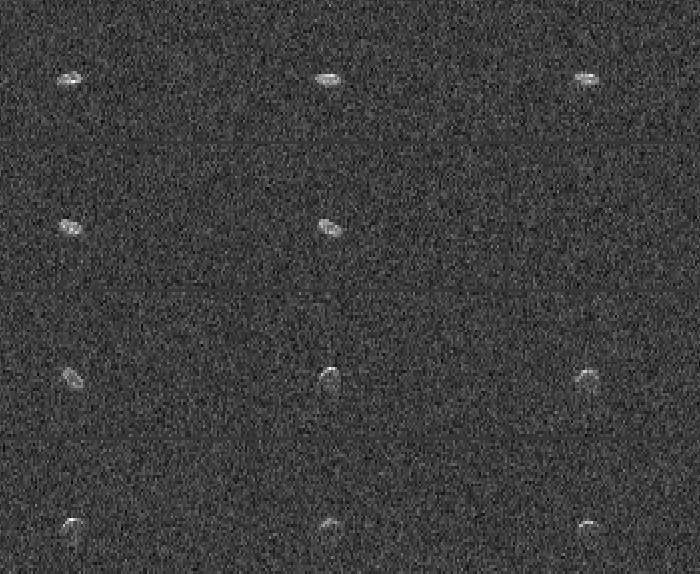
 Several radar images of Cuno | |
| Discovery[1] | |
|---|---|
| Discovered by | C. Hoffmeister |
| Discovery site | Boyden Obs. |
| Discovery date | 5 June 1959 |
| Designations | |
| (4183) Cuno | |
Named after | Cuno Hoffmeister (astronomer)[2] |
| 1959 LM · 1986 VT7 1987 MB | |
| Apollo · NEO · PHA[1][3] Mars-crosser Venus-crosser | |
| Orbital characteristics[1] | |
| Epoch 4 September 2017 (JD 2458000.5) | |
| Uncertainty parameter 0 | |
| Observation arc | 57.59 yr (21,036 days) |
| Aphelion | 3.2396 AU |
| Perihelion | 0.7248 AU |
| 1.9822 AU | |
| Eccentricity | 0.6343 |
| 2.79 yr (1,019 days) | |
| 338.28° | |
| 0° 21m 11.52s / day | |
| Inclination | 6.7051° |
| 294.90° | |
| 236.34° | |
| Earth MOID | 0.0283 AU · 11 LD |
| Physical characteristics | |
| 2.945±0.115 km[4] 3.73±0.15[5] 3.92 km (calculated)[6] 5.38 km[7] 5.49 km[8] 5.618±0.457 km[9] | |
| 3.558±0.002 h[10] 3.5590±0.001 h[a] 3.5595 h [b] | |
| 0.097±0.025[9][11] 0.10±0.10[12] 0.10[8] 0.11[7] 0.20 (assumed)[6] 0.23±0.04[4] 0.36±0.06[4] | |
| SMASS = Sq[1] Q[13][14][15] · S[6][16] B–V =0.806±0.013[13] V–R =0.457±0.008[13] V–I =0.746±0.009[13] | |
| 14.00[16] · 14.01±0.32[15] · 14.35[5] · 14.4[1][4][6][8][9] | |
4183 Cuno, provisional designation 1959 LM, is an eccentric, rare-type asteroid, classified as near-Earth object and potentially hazardous asteroid of the Apollo group, and measures approximately 4 kilometers in diameter.
It was discovered on 5 June 1959, by German astronomer Cuno Hoffmeister at Boyden Observatory in Bloemfontein, South Africa, and later named in the discoverer's honor.[2][3]
Classification and orbit
[edit]Cuno orbits the Sun at a distance of 0.7–3.2 AU once every 2 years and 9 months (1,019 days). Its orbit has an eccentricity of 0.63 and an inclination of 7° with respect to the ecliptic.[1] The body's observation arc begins with its identification as 1986 VT7, the first used observation made at Palomar Observatory in 1986, approximately 27 years after its official discovery observation at Boyden.[3]
The asteroid has an Earth minimum orbital intersection distance of 0.0283 AU (4,230,000 km), which translates into 11 lunar distances.[1] Cuno approaches the Earth to within 40 million kilometers six times in the 21st century. On 20 May 2012, it made its closest Earth approach at a distance of 0.122 AU (18,000,000 km).[17] It will not make a closer approach until 2093 when it will pass Earth at 0.084 AU (13,000,000 km).[17]
Due to its eccentric orbit, it is also a Mars and Venus-crosser.[1]
Physical characteristics
[edit]Spectral type and composition
[edit]Cuno is a stony S-type asteroid.[16] As it has a reflective surface, composed of a mixture different silicates, nickel and iron, Cuno has been characterized as a rare Q-type asteroid by the 1-meter Jacobus Kapteyn Telescope on La Palma, Pan-STARRS' large-scale magnitude survey, and NASA IRTF telescope.[13][14][15] On the SMASS taxonomic scheme, Cuno is a Sq-subtype, a transitional group between the S and Q types.[1]
Rotation and shape
[edit]Several rotational lightcurves were obtained by Czech astronomer Petr Pravec and American astronomer Brian Warner between 1998 and 2014. Lightcurve analysis gave a rotation period of 3.56 hours with a high brightness amplitude between 0.47 and 0.83 in magnitude, indicating that the body has a non-spheroidal shape.[10][a][b]
In December 2000, Cuno was analysed by radar to determine its shape. The resultant images are lacking in detail, but indicate a rough sphere with some kind of concave depression 1–2 km in diameter.[citation needed]
Diameter and albedo
[edit]Following the space-based surveys carried out by NASA's Spitzer Space Telescope and the NEOWISE mission of the Wide-field Infrared Survey Explorer, Cuno has an albedo between 0.097 and 0.36, and a diameter between 2.945 and 5.618 kilometers.[4][5][7][8][9]
The Collaborative Asteroid Lightcurve Link assumes a standard albedo for the stony asteroid of 0.20 and calculates a diameter of 3.9 kilometer with an absolute magnitude of 14.4, as the higher the body's albedo (reflectivity), the lower its diameter at a constant absolute magnitude (brightness).[6]
Naming
[edit]This minor planet was named after its discoverer, Cuno Hoffmeister, according to the established practice to name near-Earth asteroids with a four-letter masculine name.[2] The central main-belt asteroid 1726 Hoffmeister, namesake of the Hofmeister family, is also named after the discoverer. The official naming citation was published on 28 May 1991 (M.P.C. 18307).[18]
Notes
[edit]- ^ a b Pravec (2000) web: rotation period of 3.5590±0.001 hours with a brightness amplitude of 0.83 mag. (LCDB quality code = 3). Summary figures for (4183) Cuno at Collaborative Asteroid Lightcurve Link (CALL)
- ^ a b Pravec (1998) web: rotation period 3.5595 hours with a brightness amplitude of 0.7 in magnitude. Call assigns a quality code of 3, which denotes a secure result within the precision given and no ambiguity. Summary figures for (4183) Cuno at Collaborative Asteroid Lightcurve Link (CALL)
References
[edit]- ^ a b c d e f g h i "JPL Small-Body Database Browser: 4183 Cuno (1959 LM)" (2017-01-07 last obs.). Jet Propulsion Laboratory. Retrieved 20 June 2017.
- ^ a b c Schmadel, Lutz D. (2007). "(4183) Cuno". Dictionary of Minor Planet Names – (4183) Cuno. Springer Berlin Heidelberg. p. 358. doi:10.1007/978-3-540-29925-7_4154. ISBN 978-3-540-00238-3.
- ^ a b c "4183 Cuno (1959 LM)". Minor Planet Center. Retrieved 1 February 2016.
- ^ a b c d e Nugent, C. R.; Mainzer, A.; Masiero, J.; Bauer, J.; Cutri, R. M.; Grav, T.; et al. (December 2015). "NEOWISE Reactivation Mission Year One: Preliminary Asteroid Diameters and Albedos". The Astrophysical Journal. 814 (2): 13. arXiv:1509.02522. Bibcode:2015ApJ...814..117N. doi:10.1088/0004-637X/814/2/117. S2CID 9341381.
- ^ a b c Nugent, C. R.; Mainzer, A.; Bauer, J.; Cutri, R. M.; Kramer, E. A.; Grav, T.; et al. (September 2016). "NEOWISE Reactivation Mission Year Two: Asteroid Diameters and Albedos". The Astronomical Journal. 152 (3): 12. arXiv:1606.08923. Bibcode:2016AJ....152...63N. doi:10.3847/0004-6256/152/3/63.
- ^ a b c d e "LCDB Data for (4183) Cuno". Asteroid Lightcurve Database (LCDB). Retrieved 29 May 2016.
- ^ a b c Harris, A. W.; Mommert, M.; Hora, J. L.; Mueller, M.; Trilling, D. E.; Bhattacharya, B.; et al. (March 2011). "ExploreNEOs. II. The Accuracy of the Warm Spitzer Near-Earth Object Survey". The Astronomical Journal. 141 (3): 10. Bibcode:2011AJ....141...75H. doi:10.1088/0004-6256/141/3/75. S2CID 14208889.
- ^ a b c d Trilling, D. E.; Mueller, M.; Hora, J. L.; Harris, A. W.; Bhattacharya, B.; Bottke, W. F.; et al. (September 2010). "ExploreNEOs. I. Description and First Results from the Warm Spitzer Near-Earth Object Survey" (PDF). The Astronomical Journal. 140 (3): 770–784. Bibcode:2010AJ....140..770T. doi:10.1088/0004-6256/140/3/770. S2CID 3006566.
- ^ a b c d Mainzer, A.; Grav, T.; Masiero, J.; Hand, E.; Bauer, J.; Tholen, D.; et al. (November 2011). "NEOWISE Studies of Spectrophotometrically Classified Asteroids: Preliminary Results". The Astrophysical Journal. 741 (2): 25. arXiv:1109.6407. Bibcode:2011ApJ...741...90M. doi:10.1088/0004-637X/741/2/90. S2CID 35447010.
- ^ a b Warner, Brian D. (April 2015). "Near-Earth Asteroid Lightcurve Analysis at CS3-Palmer Divide Station: 2014 October-December". The Minor Planet Bulletin. 42 (2): 115–127. Bibcode:2015MPBu...42..115W. ISSN 1052-8091. PMC 7244186. PMID 32455352.
- ^ Mainzer, A.; Grav, T.; Bauer, J.; Masiero, J.; McMillan, R. S.; Cutri, R. M.; et al. (December 2011). "NEOWISE Observations of Near-Earth Objects: Preliminary Results". The Astrophysical Journal. 743 (2): 17. arXiv:1109.6400. Bibcode:2011ApJ...743..156M. doi:10.1088/0004-637X/743/2/156. S2CID 239991.
- ^ Thomas, C. A.; Trilling, D. E.; Emery, J. P.; Mueller, M.; Hora, J. L.; Benner, L. A. M.; et al. (September 2011). "ExploreNEOs. V. Average Albedo by Taxonomic Complex in the Near-Earth Asteroid Population". The Astronomical Journal. 142 (3): 12. Bibcode:2011AJ....142...85T. doi:10.1088/0004-6256/142/3/85.
- ^ a b c d e Dandy, C. L.; Fitzsimmons, A.; Collander-Brown, S. J. (June 2003). "Optical colors of 56 near-Earth objects: trends with size and orbit". Icarus. 163 (2): 363–373. Bibcode:2003Icar..163..363D. doi:10.1016/S0019-1035(03)00087-3.
- ^ a b Thomas, Cristina A.; Emery, Joshua P.; Trilling, David E.; Delbó, Marco; Hora, Joseph L.; Mueller, Michael (January 2014). "Physical characterization of Warm Spitzer-observed near-Earth objects". Icarus. 228: 217–246. arXiv:1310.2000. Bibcode:2014Icar..228..217T. doi:10.1016/j.icarus.2013.10.004. S2CID 119278697.
- ^ a b c Veres, Peter; Jedicke, Robert; Fitzsimmons, Alan; Denneau, Larry; Granvik, Mikael; Bolin, Bryce; et al. (November 2015). "Absolute magnitudes and slope parameters for 250,000 asteroids observed by Pan-STARRS PS1 - Preliminary results". Icarus. 261: 34–47. arXiv:1506.00762. Bibcode:2015Icar..261...34V. doi:10.1016/j.icarus.2015.08.007. S2CID 53493339.
- ^ a b c Carry, B.; Solano, E.; Eggl, S.; DeMeo, F. E. (April 2016). "Spectral properties of near-Earth and Mars-crossing asteroids using Sloan photometry". Icarus. 268: 340–354. arXiv:1601.02087. Bibcode:2016Icar..268..340C. doi:10.1016/j.icarus.2015.12.047. S2CID 119258489.
- ^ a b "JPL Close-Approach Data: 4183 Cuno (1959 LM))". Retrieved 19 June 2012.
- ^ "MPC/MPO/MPS Archive". Minor Planet Center. Retrieved 29 May 2016.
External links
[edit]- Asteroid Lightcurve Database (LCDB), query form (info Archived 16 December 2017 at the Wayback Machine)
- Dictionary of Minor Planet Names, Google books
- Asteroids and comets rotation curves, CdR – Observatoire de Genève, Raoul Behrend
- 4183 Cuno at NeoDyS-2, Near Earth Objects—Dynamic Site
- 4183 Cuno at ESA–space situational awareness
- 4183 Cuno at the JPL Small-Body Database
