Hubbry Logo
AMOS-6 (satellite)AMOS-6 (satellite)Main
Open search
AMOS-6 (satellite)
Community hub
AMOS-6 (satellite)
logo
8 pages, 0 posts
0 subscribers
Be the first to start a discussion here.
AMOS-6 (satellite)
AMOS-6 (satellite)
from Wikipedia

AMOS-6
NamesAffordable Modular Optimized Satellite-6
Mission typeCommunications
OperatorSpacecom Satellite Communications
Mission duration15 years (planned) [1]
Failed to orbit (achieved)
Spacecraft properties
BusAMOS 4000[2]
ManufacturerIsrael Aerospace Industries (IAI)
Launch mass5,500 kg (12,100 lb) [3]
Power10 kW[2]
Start of mission
Launch date3 September 2016 (planned)
RocketFalcon 9 Full Thrust
Launch siteCape Canaveral, SLC-40
ContractorSpaceX
Entered serviceDestroyed before launch
End of mission
DisposalFire in failed launch test
Destroyed1 September 2016, 13:07 UTC[4]
Orbital parameters
Reference systemGeocentric orbit
RegimeGeostationary orbit
Longitude4° West
Transponders
BandKu-band, 36 Ka-band, 2 S-band transponders
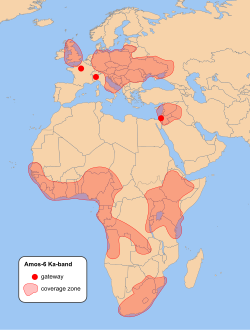
Coverage areaIsrael, Europe, Africa, Asia, Middle East
← AMOS-4
AMOS-7 →
Ka-band coverage for AMOS-6

AMOS-6 was an Israeli communications satellite, one of the Spacecom AMOS series, that was built by Israel Aerospace Industries (IAI), a defense and aerospace company.[5]

AMOS-6 was intended to be launched on flight 29 of a SpaceX Falcon 9 to geostationary transfer orbit (GTO) on 3 September 2016. On 1 September 2016, during the run-up to a static fire test, there was an anomaly on the launch pad, resulting in an explosion and the loss of the vehicle and AMOS-6. There were no injuries.[4]

Terminology

[edit]

AMOS stands for "Affordable Modular Optimized Satellite" [5] and is also an allusion to the prophet Amos. This spacecraft is the second implementation of the AMOS-4000 satellite bus, the first was the AMOS-4. It is one of a AMOS series of satellites built by Israel Aerospace Industries (IAI).

History

[edit]

Spacecom, the AMOS satellites operator, announced in June 2012 that it had signed a US$195 million contract to build AMOS-6, the newest addition to the AMOS constellation, with Israel Aerospace Industries (IAI). In January 2013, Spacecom announced that they had signed a contract with SpaceX for the 2015 launch of the AMOS-6 satellite on a Falcon 9 launch vehicle.[1] AMOS-6 was intended to replace the AMOS-2 satellite, planned to be retired in 2016.[6] During 2015 Spacecom announced the launch date had slipped to mid-2016.[1] A final launch date was set for 3 September 2016.

Under the deal with Spacecom, state-owned IAI was contracted to build AMOS-6 and its ground control systems, as well as provide operating services.[5] Spacecom estimated that the cost of launching, insuring and one year's operation of AMOS-6 would be US$85 million.[7]

The AMOS-6 included payload components from various sub-contractors including Canada's MacDonald, Dettwiler and Associates, which built the communications payload, and Thales Alenia Space ETCA for the electric propulsion. The satellite "[incorporated] new technologies that represent a significant leap forward in the capabilities of IAI and the state of Israel in space", according to IAI's president.[5]

Lease to external customers

[edit]

In October 2015, social media company Facebook and satellite fleet operator Eutelsat agreed to pay Spacecom US$95 million over a period of about five years for the lease of the Ka-band spot-beam broadband capacity — 36 regional spotbeams with a throughput of about 18 Gbit/s — on AMOS-6 to provide service for Facebook and a new Eutelsat subsidiary focusing on African businesses.[1] Costs would be divided in approximately equal shares between Eutelsat and Facebook.[8] The parties agreed to the right to terminate the contract if AMOS-6 and the ground gateways in France, Italy and Israel were not ready for service by 1 January 2017. The lease was for the use of the satellite until September 2021, with an option for a two-year extension at a reduced rate.[1][8] After a technical analysis, including an assessment of customer power requirements, Facebook and Eutelsat concluded that only 18 out of the 36 Ka-band spot beams could be used simultaneously without sacrificing user experience.[8]

Destruction

[edit]

On 1 September 2016, during propellant loading for a routine test, the Falcon 9 launch vehicle suffered an anomaly that destroyed the vehicle and its AMOS-6 payload.[4] The explosion started near the upper stage LOX (liquid oxygen) tank. Because the satellite was destroyed prior to the launch, the cost of the satellite was not covered by Spacecom's insurance policy, but rather by the manufacturer, IAI.[9] IAI had its own insurance and filed a claim in order to compensate Spacecom. Spacecom's contract with SpaceX specified that Spacecom could choose to receive US$50 million, or a future flight at no cost.[10][11] Spacecom chose the future flight to launch AMOS-17.[12]

News reports in early November 2016 indicated that SpaceX had determined the root cause for the anomaly, that it was straightforwardly fixable, and that SpaceX would return to flight in December 2016.[13] On 2 January 2017, SpaceX released an official statement indicating that the cause of the failure was a buckled liner in several of the Composite overwrapped pressure vessel (COPV) tanks, causing perforations that allowed liquid and/or solid oxygen to accumulate between the liner and the overwrap, which was ignited by friction.[14]

See also

[edit]

References

[edit]
[edit]
Revisions and contributorsEdit on WikipediaRead on Wikipedia
from Grokipedia
AMOS-6 was an Israeli geostationary communications satellite built by Israel Aerospace Industries (IAI) for Spacecom as part of the AMOS series. Designed to operate from the 4° West orbital position, it aimed to replace the aging AMOS-2 and provide enhanced Ku- and Ka-band coverage across Europe, the Middle East, and Africa, with additional S-band capabilities for mobile services. Weighing 5,250 kg and based on IAI's AMOS-HP bus, the satellite featured 39 Ku-band transponders for broadcast and broadband services, 24 Ka-band spot beams for high-throughput internet in underserved regions, and 2 S-band transponders, supported by deployable solar arrays for a planned 16-year operational lifespan. The $200 million project, contracted in 2012 with payload integration by MacDonald, Dettwiler and Associates (MDA), represented Israel's most advanced domestic satellite effort at the time, underscoring the nation's push for technological independence in space communications. Tragically, AMOS-6 was destroyed on September 1, 2016, during a routine static fire test of its SpaceX Falcon 9 launch vehicle at Cape Canaveral's SLC-40 pad, just two days before its scheduled liftoff. The anomaly, caused by a helium tank failure in the upper stage, obliterated the satellite and rocket, resulting in a total loss estimated at over $200 million and delaying Spacecom's expansion plans. This incident not only prompted an insurance payout to Spacecom but also triggered legal disputes, including a $10 million penalty against IAI for delivery delays, and accelerated a crisis in Israel's satellite sector by shifting future contracts to foreign builders.

Overview and Design

Technical Specifications

The AMOS-6 satellite was constructed by Israel Aerospace Industries (IAI) utilizing the AMOS-HP satellite bus platform, a modular design optimized for geostationary communications missions. With a launch mass of 5,250 kg, the satellite was engineered for compatibility with medium-lift launch vehicles such as the SpaceX Falcon 9. Its power subsystem featured two deployable solar arrays paired with batteries, delivering an end-of-life payload power of 10.3 kW to support continuous operations in geostationary orbit. The communication payload included 39 Ku-band transponders configured for broad regional coverage, 24 Ka-band spot beams enabling high-throughput services in specific zones, and 2 S-band transponders dedicated to mobile and specialized applications. The satellite's propulsion system employed chemical bipropellant thrusters from the S400 family for initial orbit insertion and ongoing station-keeping maneuvers. Structurally, the AMOS-HP bus measured approximately 5.0 m in length by 2.5 m in width, with the extended span across the deployed solar arrays reaching 12 to 15 m. AMOS-6 was designed for a 16-year operational lifespan while stationed in geostationary orbit at 4° West longitude.

Mission Objectives and Coverage

The AMOS-6 satellite was designed to deliver high-capacity communication services from geostationary orbit, focusing on broadband internet, direct-to-home (DTH) television broadcasting, and data transmission to support regional connectivity needs. Its primary objectives included enhancing multimedia services such as video distribution, VSAT networks for enterprise data, and specialized communications for maritime and aeronautical applications, thereby expanding access in underserved areas. The satellite's coverage emphasized a primary Ku-band beam spanning Western, Central, and Eastern Europe, the Middle East, and North Africa, with steerable capabilities to optimize signal distribution across these regions. Secondary Ka-band spot beams targeted sub-Saharan Africa to facilitate broadband internet expansion in partnership with Eutelsat and Facebook, including connectivity for remote communities. This configuration enabled support for DTH TV platforms, high-throughput data services, and mobile communications, addressing demands in both populated and emerging markets. Positioned at the 4° West orbital slot, AMOS-6 was intended to complement the existing AMOS series, including AMOS-3, by replacing the aging AMOS-2 and augmenting capacity at this key location for European and African coverage. Services were planned to commence in early 2017, with transponders available for leasing in bandwidths such as 36 MHz and 72 MHz to accommodate diverse operator requirements. The payload incorporated Ku-, Ka-, and S-band transponders to enable these versatile applications without overlapping hardware-focused details.

Development and Background

Construction and Contracts

Spacecom, Israel's primary satellite communications operator, awarded the construction contract for AMOS-6 to Israel Aerospace Industries (IAI) in June 2012 under a deal valued at $200 million. This agreement encompassed the design, manufacture, ground control systems, and initial operational support for the satellite, positioning it as the latest addition to the AMOS fleet following the 2011 launch of AMOS-5. The development process began immediately after contract award, with the design phase spanning 2012 to 2013 to incorporate advanced communication payloads and propulsion systems tailored for geostationary orbit operations. Assembly and integration followed from 2013 through 2015 at IAI's facilities in Israel, where subsystems including the communications payload—sourced from MDA Corporation—were combined with the satellite bus. Key milestones included structural integration, system-level testing, and environmental qualification, encompassing vibration simulations and thermal vacuum chamber evaluations to verify performance under space conditions. By early 2016, final testing was completed, marking the satellite's readiness for shipment. In July 2016, the fully assembled AMOS-6 was shipped from Israel to Cape Canaveral, Florida, arriving on July 13 for integration with the launch vehicle. The launch contract had been signed with SpaceX in January 2013 for a Falcon 9 Full Thrust rocket, with the mission originally targeted for 2015 but delayed to the fourth quarter of 2016 from SLC-40 at Cape Canaveral Air Force Station. Overall project costs for construction and related services were estimated at approximately $200 million, separate from the launch expenses.

Commercial Leasing Arrangements

Spacecom, an Israeli satellite operator, was the primary owner of AMOS-6 and planned to retain the majority of its capacity for domestic services in Israel and regional coverage across Europe, Africa, and the Middle East. A key commercial arrangement was a co-leasing agreement announced in October 2015 between Spacecom, Eutelsat, and Facebook, under which Eutelsat and Facebook committed $95 million for the entire Ka-band payload. This five-year lease, with options for extension up to two additional years, aimed to deliver high-throughput broadband internet connectivity to underserved areas in sub-Saharan Africa as part of Facebook's Connectivity Lab initiative. Additional customers included European broadcasters utilizing the Ku-band segments for television distribution across Pan-European beams, particularly targeting Central and Eastern Europe. Middle Eastern telecommunications providers were set to leverage Ku- and S-band capacity for data backhaul and mobile communications services in the region. Furthermore, the S-band payload supported potential military and government applications, including a lifetime contract valued at $20 million with the Israeli government for secure communications. The leasing structure involved long-term contracts spanning 5 to 15 years for specific transponders, aligned with the satellite's projected 15-year operational lifespan, enabling steady revenue streams from capacity rentals. Pre-launch, over 80% of the payload capacity had been committed through these sales by mid-2016, including the full Ka-band and approximately two-thirds of the Ku-band.

Launch Preparation and Incident

Pre-Launch Operations

The AMOS-6 satellite was shipped from Israel and arrived at Astrotech Space Operations in Titusville, Florida, on July 13, 2016 for final processing and pre-launch preparations. Upon arrival, the satellite underwent environmental testing, system checkouts, and integration readiness verifications at the facility to ensure compatibility with the launch vehicle. Following processing at Astrotech, AMOS-6 was encapsulated within the Falcon 9 payload fairing around August 20, 2016, at SpaceX's Horizontal Integration Facility adjacent to Space Launch Complex 40 (SLC-40). The encapsulated payload was then mated to the fully stacked Falcon 9 rocket on August 24, 2016, at SLC-40, completing the vehicle assembly ahead of final ground tests. The Falcon 9 served as the integration platform for the mission, with the satellite secured in the upper stage adapter for geostationary transfer orbit insertion. On August 31, 2016, approximately 24 hours before the scheduled static fire test, the satellite was fueled with 700 kg of toxic hydrazine monopropellant to support its onboard propulsion system for orbit raising and station-keeping maneuvers. This loading operation was conducted under strict safety protocols due to the hazardous nature of the propellant. The fueling marked a key milestone in payload readiness, following earlier verifications of the satellite's power, thermal, and structural systems. Ground support activities involved coordinated efforts from teams at SpaceX, Spacecom (the satellite operator), and Israel Aerospace Industries (IAI, the manufacturer), who performed comprehensive checkout tests including communications link validations and attitude control system simulations. These tests confirmed the satellite's operational integrity and interface compatibility with the Falcon 9 prior to the planned engine static fire. The overall launch schedule had been delayed from an initial target in late August 2016, primarily due to unfavorable weather conditions along the Eastern Range and extended payload processing requirements at Astrotech. These factors pushed the mission to early September, allowing additional time for thorough vehicle and payload integrations.

Explosion During Static Fire Test

The static fire test for the Falcon 9 rocket carrying the AMOS-6 satellite was a routine pre-launch procedure intended to verify the health of the vehicle's nine Merlin 1D first-stage engines by firing them for a few seconds while the rocket remained anchored to the launch mount. Scheduled as part of preparations on the morning of September 1, 2016, at Space Launch Complex 40 (SLC-40) on Cape Canaveral Air Force Station, the test involved the fully assembled vehicle with the fueled payload. As a pre-test step, the AMOS-6 satellite had been loaded with its hydrazine propellant days earlier. The incident occurred at approximately 9:07 a.m. EDT during propellant loading operations for the upper and lower stages, well before the planned engine ignition. Telemetry indicated an anomaly near the upper stage liquid oxygen tank seconds after the fill sequence began, leading to a rapid pressure buildup and detonation. A massive fireball erupted, engulfing the entire vehicle and payload; video footage captured the fairing enclosing AMOS-6 collapsing and falling to the pad, followed by secondary explosions and fires fueled by the satellite's hydrazine and the rocket's RP-1 kerosene propellant. The blast wave was felt miles away, shattering windows in nearby buildings. The explosion completely destroyed the Falcon 9 upper stage, the AMOS-6 satellite, and the payload fairing, rendering the $200 million payload a total loss. SLC-40 sustained significant structural damage, including the dismantling and scorching of the launch mount's steel strongback and flame trench concrete, though adjacent facilities like the Horizontal Integration Facility and lightning protection towers remained largely intact. No injuries occurred, as the pad had been cleared of personnel in accordance with standard safety protocols, with only a small ground team present at a safe distance. In the immediate aftermath, SpaceX activated its anomaly response team to review telemetry data and secure the site, while the Federal Aviation Administration (FAA) was notified, resulting in a lockdown of the launch complex to facilitate initial assessments and ensure public safety. Firefighting teams quickly suppressed lingering flames from residual propellants.

Investigation and Cause

Root Cause Analysis

The root cause of the Falcon 9 explosion during the AMOS-6 static fire test on September 1, 2016, was the failure of a composite overwrapped pressure vessel (COPV) in the second stage's liquid oxygen (LOX) tank. This COPV, designed to hold pressurized helium for tank pressurization, experienced a breach that allowed liquid oxygen to accumulate in voids or buckles between the inner aluminum liner and the outer carbon fiber overwrap. The accumulation led to the formation of solid oxygen or ice within the structure, which embrittled the carbon fibers when subjected to the cold temperatures from subcooled LOX during fueling. The failure mechanism involved pressurization of the COPV, where solid oxygen accumulated in buckles of the liner embrittled the carbon fiber overwrap, leading to its rupture. This rupture released high-pressure helium and gaseous oxygen, which mixed with nearby propellants and ignited—likely due to friction from fiber breakage or particle impacts—triggering a rapid deflagration that propagated to the LOX tank and ultimately the entire vehicle. The use of densified (super-chilled) LOX, intended to increase payload capacity, was a key contributing factor, as it had not been fully qualified for interaction with the COPV system in this configuration, allowing the extreme cold to exacerbate the oxygen ingress and freezing. Additionally, pre-loading helium into the COPV while the LOX tank was being fueled created thermal stresses that were not anticipated in prior operations. During the investigation, SpaceX considered the possibility of sabotage, including an internal theory that a sniper from a nearby United Launch Alliance (ULA) facility may have caused the explosion. This speculation, which was presented to federal authorities with claims of a flash observed in video footage from a ULA building roof, was ultimately ruled out, as the investigation found no evidence of external interference and confirmed the COPV failure as the root cause. The affected COPV was a reused component from previous successful Falcon 9 missions, having undergone multiple flights without issue, but the anomaly was unique to the combination of subcooled LOX fueling and helium pre-pressurization used for the AMOS-6 mission. SpaceX confirmed these findings on October 28, 2016, following extensive destructive testing of identical COPVs under simulated conditions, which replicated the breach and ignition sequence observed in telemetry data from over 3,000 channels. This investigation, supported by the FAA, NASA, U.S. Air Force, and NTSB, ruled out other potential causes such as strut failures or engine issues from earlier incidents.

Safety and Procedural Findings

The Federal Aviation Administration (FAA) conducted a mishap investigation into the AMOS-6 incident in collaboration with SpaceX, the National Aeronautics and Space Administration (NASA), the U.S. Air Force, the National Transportation Safety Board (NTSB), and range safety officials, focusing on procedural and safety protocols during propellant loading and static fire testing. The investigation, which analyzed over 3,000 telemetry and video channels spanning 93 milliseconds from anomaly initiation to vehicle loss, determined that the initiating event was a composite overwrapped pressure vessel (COPV) failure in the second-stage liquid oxygen tank, exacerbated by procedural risks associated with densified propellants. Key findings highlighted inadequate risk assessment for the use of super-chilled liquid oxygen, which led to solid oxygen accumulation in COPV liner buckles, increasing ignition potential during helium pressurization. The FAA closed the investigation on January 6, 2017, concluding that SpaceX had not violated its launch license but mandating implementation of corrective actions to address identified procedural deficiencies and enhance overall safety margins. In response, SpaceX adopted short-term procedural changes, including loading helium at warmer temperatures to prevent excessive cooling and reverting to previously validated gaseous helium pre-chill configurations that had succeeded in over 700 prior operations, thereby mitigating risks from densified propellant interactions. Long-term modifications involved redesigning COPVs with improved liners to eliminate buckles and reduce friction-induced ignition hazards, alongside upgrades to launch pad infrastructure for better fire suppression and debris containment. These changes were verified through rigorous ground testing before resuming flights. No personnel injuries occurred, as pad evacuation procedures were followed effectively, and there was no release of radiation or significant environmental contaminants from the AMOS-6 satellite, a conventional communications spacecraft. The incident's procedural findings influenced broader industry standards, prompting NASA to incorporate lessons on cryogenic propellant handling into its commercial launch vehicle anomaly tracking and safety guidelines, emphasizing enhanced risk modeling for subcooled fluids and integrated telemetry systems across commercial providers. These recommendations underscored the need for conservative approaches to innovative propellant densification techniques, contributing to refined regulations by the FAA for future static fire tests and fueling operations to prioritize public safety and range integrity.

Aftermath and Legacy

Financial and Operational Impacts

The destruction of the AMOS-6 satellite resulted in direct financial losses estimated at $250 million, encompassing the satellite's construction cost of approximately $200 million and an additional $50 million for the Falcon 9 launch contract with SpaceX. The satellite was fully insured, with Spacecom receiving a $196 million payout from insurers to cover the loss, excluding a separate $10 million in liquidated damages from manufacturer Israel Aerospace Industries for construction delays. In addition, Spacecom pursued compensation from SpaceX, initially demanding $50 million for negligence or an equivalent free launch; this was resolved out of court in 2017 through launch credits applied to the subsequent AMOS-17 mission, utilizing prepaid fees from the original contract. Operationally, the incident led to significant revenue shortfalls for Spacecom in 2017, including the forfeiture of a $95 million five-year leasing agreement with Eutelsat and Facebook for Ka-band capacity. This delayed broadband internet services targeted at sub-Saharan Africa and additional capacity for Israeli direct-to-home television providers, such as yes, prompting Spacecom to lease temporary Ku-band transponders from AsiaSat-8 starting in December 2016. The broader repercussions included the postponement of Facebook's connectivity initiatives, which aimed to serve underserved regions in sub-Saharan Africa and could have reached millions of potential users, while representing a minor setback for Israel's burgeoning space sector amid ongoing commercial expansion. Services were partially restored through these interim leasing arrangements and existing fleet reallocations by late 2016, mitigating some immediate disruptions.

Replacement Satellite Efforts

Following the destruction of AMOS-6, Spacecom initiated efforts to restore its orbital capacity by ordering a replacement communications satellite from Boeing Satellite Systems International in December 2016 under a $161 million contract. The new spacecraft, designated AMOS-17 from the outset to distinguish it from the lost satellite, was designed as a multi-band high-throughput system providing C-band, Ku-band, and Ka-band services, built on Boeing's BSS-702MP platform for enhanced flexibility and coverage over Europe, the Middle East, and Africa. AMOS-17 launched successfully aboard a SpaceX Falcon 9 rocket on August 6, 2019, from Cape Canaveral Space Force Station's Space Launch Complex 40, marking Spacecom's return to orbit with SpaceX after the 2016 incident; the launch was provided at no cost to Spacecom as part of a financial settlement from the AMOS-6 loss. Following in-orbit testing and maneuvers, the satellite reached its operational position at 17° East and entered service in October 2019, with full commercial operations commencing later that year to provide overlapping coverage and restore broadband and broadcast capabilities previously planned for AMOS-6. The original orbital slot intended for AMOS-6 at 4° West, Spacecom's core position for European and African coverage, was not permanently filled by a dedicated successor. A planned AMOS-8 satellite contract was canceled in 2018. Instead, the slot saw extended use by the relocated AsiaSat-8 satellite (marketed as AMOS-7 by Spacecom) through multiple lease renewals to bridge capacity gaps, with the latest extension to February 2025. The satellite was subsequently relocated to 105.5° E in 2025. As of January 2026, it no longer occupies the 4° West slot but had operated alongside AMOS-3 until relocation, whose service life was expected to end around 2025 but remains operational as of January 2026. AMOS-17 effectively fulfilled the key leasing commitments disrupted by the AMOS-6 loss, enabling broadband internet connectivity across sub-Saharan Africa and supporting Spacecom's global access initiatives. The AMOS-6 incident, which destroyed a $200 million asset, represented a major financial and operational setback but underscored the resilience of Israel's space sector, prompting strategic adaptations like diversified manufacturing partnerships and accelerated recovery projects that sustained the nation's leadership in commercial satellite communications. As of 2025, Spacecom reported record EBITDA driven by AMOS-17 revenues, ongoing debt restructuring with partners including Israel Aerospace Industries, and approval to provide low Earth orbit (LEO) satellite services. The incident also generated cultural echoes in the space community, including the unsubstantiated "ULA sniper" theory—initially speculated by SpaceX personnel suggesting sabotage from a nearby United Launch Alliance facility—which has since become a meme among space enthusiasts, as highlighted in recent discussions of the event's aftermath.

References

Add your contribution
Related Hubs
User Avatar
No comments yet.