Hubbry Logo
AkathistAkathistMain
Open search
Akathist
Community hub
Akathist
logo
7 pages, 0 posts
0 subscribers
Be the first to start a discussion here.
Akathist
Akathist
from Wikipedia
The Akathist Hymn in Church Slavonic language. Oikos One.

An Akathist, akaphist or Acathist Hymn (Greek: Ἀκάθιστος Ὕμνος, "unseated hymn") is a type of hymn usually recited by Eastern Orthodox and Byzantine Catholic Christians, dedicated to a saint, holy event, or one of the persons of the Holy Trinity. The name derives from the fact that during the chanting of the hymn, or sometimes the whole service, the congregation is expected to remain standing in reverence, without sitting down (ἀ-, a-, "without, not" and κάθισις, káthisis, "sitting"), except for the aged or infirm.

The Akathist is also known by the first three words of its prooimion (preamble), Têi hypermáchōi strategôi (Τῇ ὑπερμάχῳ στρατηγῷ, "To you, invincible champion") addressed to Holy Mary (Panagia Theotokos, "The all-holy birth-giver of God").

During Byzantine Catholic and Orthodox Christian religious services in general, sitting, standing, bowing and the making of prostrations are set by an intricate set of rules, as well as individual discretion. Only during readings of the Gospel and the singing of Akathists is standing considered mandatory for all.

Origin and History

[edit]
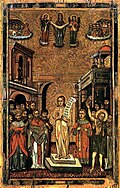
Icon of the Akathist of the Theotokos. Fresco detail, 1644. Church of the Deposition of the Robe of the Mother of God, Moscow Kremlin.

The akathist par excellence is the one written for the feast of Annunciation of the Theotokos (25 March). This kontakion was traditionally attributed to Romanos the Melodist since kontakia of Romanos dominated the classical repertoire of 80 kontakia sung during the cathedral rite of the Hagia Sophia, though recent scholarship rejects this authorship like in cases of many other kontakia of the core repertoire.[1] According to the synaxary the origin of the feast is assigned by the Synaxarion to the year 626, when Constantinople, in the reign of Heraclius, was attacked by the Persians and Avars but saved through the intervention of the Most Holy Theotokos. "From that time, therefore, the Church, in memory of so great and so divine a miracle, desired this day to be a feast in honour of the Mother of God ... and called it Acathistus" (Synaxarion). This origin is disputed by Sophocles[2] on the grounds that the hymn could not have been composed in one day, and its twenty-four oikoi contain no allusion to such an event and therefore could not have been composed to commemorate it. However the feast may have originated, the Synaxarion commemorates two other victories, under Leo III the Isaurian, and Constantine Pogonatus, similarly ascribed to the intervention of the Theotokos.

No certain ascription of its authorship can be made. It has been attributed to Patriarch Sergius I of Constantinople, whose pious activities the Synaxarion commemorates in great detail. J.M. Quercius (1777)[3] assigns it to George Pisida, deacon, archivist, and sacristan of Hagia Sophia whose poems find an echo both in style and in theme in the Akathist; the elegance, antithetic and balanced style, the vividness of the narrative, the flowers of poetic imagery being all very suggestive of his work. His position as sacristan would naturally suggest such a tribute to the Theotokos, as the hymn only gives more elaborately the sentiments condensed into two epigrams of Pisida found in her church at Blachernae. Quercius also argues that words, phrases, and sentences of the hymn are to be found in the poetry of Pisida. Leclercq[4] finds nothing absolutely demonstrative in such a comparison and offers a suggestion which may possibly help to a solution of the problem.

Before the turn of the 21st century the Akathist was usually assigned to the 6th or 7th century but more recent scholarship, driven by the work of Leena Peltomaa, has argued for a 5th century origin on the basis of theological content.[5][6] Cunningham concurs with Peltomaa's analysis of the hymn's Christology but postulates, from its "highly developed poetic form" and elaborate invocations of Mary, a somewhat later provenance of the latter 5th/early 6th century.[7] In contrast, Shoemaker reasons that "Peltomaa's [arguments] for dating the Akathist hymn to the period before Chalcedon would seem to apply equally if not even more so" for a collection of Marian hymns within the Georgian Chantbook of Jerusalem that he contends are of primarily pre-Chalcedonian authorship. Following Renoux he argues that the hymns, which are colourful and invocatory, contain theology closest to mid-5th century homilists, bearing witness to a highly developed cult of Mary at an earlier period than previous generations of scholars had appreciated.[8] Reynolds summarises prevailing opinion as being in favour of a date for the Akathist "somewhere between the Councils of Epheus and Chalcedon."[9] Similarly, Arentzen observes that most scholars now favour an early provenance.[10]

Since the 14th century the Akathist moved from the menaion to the moveable cycle of the triodion, and the custom established that the whole hymn was sung in four sections throughout Lent. As such it became part of the service of the Salutations to the Theotokos (used in the Byzantine tradition during Great Lent).

Structure

[edit]

Apart from its usual dedication to the menaion and the early custom to celebrate kontakia during the Pannychis (festive night vigil celebrated at the Blachernae chapel),[11] the Akathist had also the political function to celebrate military victories or to ask during wars for divine protection intermediated by prayers of the Theotokos. This function is reflected within the synaxarion.

Icon of the Theotokos Orans from Spasky Cathedral in Yaroslavl (13th-century).

When an akathist is chanted by itself, the Usual beginning, a series of prayers which include the Trisagion (thrice-holy) is often said as a prelude to the akathist hymn. The akathist may also be included as a part of another service, such as Matins or a Molieben.

One of the exceptional features of this Akathist is its acrostic style; the Greek original consists of 24 oikoi, each one beginning with the next letter of the alphabet.[12] Due to the excessive length the kontakion became truncated like the others, but even the earliest chant books with musical notation (the Tipografsky Ustav, for instance) have the complete text of all 24 oikoi written out, but the last 23 oikoi without musical notation.[13] The hymn itself is divided into thirteen parts, each of which is composed of a kontakion and an oikos (Greek: οίκος, house, possibly derived from Syriac terminology). The kontakion usually ends with the exclamation: Alleluia, which is repeated by a choir in full settings or chanted by the reader in simple settings. Within the latter part of the oikos comes an anaphoric entreaty, such as Come or Rejoice.

For example, the Akathist to the Theotokos:[14]

Kontakion One
Queen of the Heavenly Host, Defender of our souls, we thy servants offer to thee songs of victory and thanksgiving, for thou, O Mother of God, hast delivered us from dangers. But as thou hast invincible power, free us from conflicts of all kinds that we may cry to thee:
  • Rejoice, unwedded Bride!
Oikos One
An Archangel was sent from Heaven to say to the Mother of God: Rejoice! And seeing Thee, O Lord, taking bodily form, he was amazed and with his bodiless voice he stood crying to her such things as these:
  • Rejoice, thou through whom joy will flash forth!
  • Rejoice, thou through whom the curse will cease!
  • Rejoice, revival of fallen Adam!
  • Rejoice, redemption of the tears of Eve!
  • Rejoice, height hard to climb for human thoughts!
  • Rejoice, depth hard to contemplate even for the eyes of Angels!
  • Rejoice, thou who art the King's throne!
  • Rejoice, thou who bearest Him Who bears all!
  • Rejoice, star that causest the Sun to appear!
  • Rejoice, womb of the divine incarnation!
  • Rejoice, thou through whom creation becomes new!
  • Rejoice, thou through whom the Creator becomes a babe!
  • Rejoice, unwedded bride!

The thirteenth kontakion (which, unlike the preceding twelve, does not have a corresponding oikos) is usually followed by the repetition of the first oikos and kontakion. After the thirteen kontakia and oikoi, additional prayers are added, such as a troparion and another kontakion. The final kontakion is the famous "i Hypermáchōi Stratēgōi" ("Unto the Defender General"), a hymn addressing Mary as the savior of Constantinople in the 626 siege:

Unto the Defender General the dues of victory,
and for the deliverance from woes, the thanksgiving
I, Thy city, ascribe Thee, O Theotokos.
And having your might unassailable,
deliver me from all danger
so that I may cry unto Thee:
Rejoice, O Bride unwedded.

Another characteristic feature of the Akathist is the extraordinary length of the refrain or ephymnion which consists of a great number of verses beginning with χαῖρε (“Rejoice”) which are called in Greek Chairetismoi (Χαιρετισμοί, "Rejoicings") or in Arabic Madayeh, respectively; in the Slavic tradition these are known as Khayretizmy (Хайретизмы). The chairetismoi are only repeated in every second oikos, and from a musical point of view the ephymnion consists just of a short musical phrase, either about the last χαῖρε verse or about allelouia.

Various ways of celebration

[edit]
Detail of the icon of the Praises of the Theotokos, before which the Akathist may be chanted. The Theotokos is shown enthroned in the center, with Christ Emmanuel above her. To either side are shown the prophets who foretold the Incarnation. In the full icon, scenes from the life of the Virgin Mary surround this vignette.

When the word akathist is used alone, it most commonly refers to the original hymn by this name, the 6th century Akathist to the Theotokos. This hymn is often split into four parts and sung at the "Salutations to the Theotokos" service on the first four Friday evenings in Great Lent; the entire Akathist is then sung on the fifth Friday evening.[15] Traditionally it is included in the Orthros (Matins) of the Fifth Saturday of Great Lent, which for this reason is known as the "Saturday of the Akathist". In monasteries of Athonite tradition, the whole Akathist is usually inserted nightly at Compline.

The four sections into which the Akathist is divided correspond to the themes of the Annunciation, Nativity, Christ, and the Theotokos herself.

The hymn itself forms an alphabetical acrostic—that is, each oikos begins with a letter of the Greek alphabet, in order—and it consists of twelve long and twelve short oikoi. Each of the long oikoi include a seven-line stanza followed by six couplets employing rhyme, assonance and alliteration, beginning with the greeting Chaíre and ending with the refrain, "Rejoice, Bride without bridegroom!" (also translated as "Rejoice, thou Bride unwedded!") In the short oikoi, the seven-line stanza is followed by the refrain, Alleluia.

The Salutations to the Theotokos service, often known by its Greek name, the Χαιρετισμοί/Chairetismoí (from the Χαίρε/Chaíre! so often used in the hymn), consists of Compline with the Akathist hymn inserted. It is known in Arabic as the Madayeh.

Salutations of the Theotokos

[edit]

On the First Four Fridays of Lent

[edit]
  • Usual Beginning
  • Psalms 50, 69 and 142
  • Small Doxology
  • Nicene Creed
  • It is truly meet
  • Canon to the Mother of God
  • Kontakion: "To Thee the Champion Leader"
  • Portion of the Akathist:
    • First Friday: Ikos 1-Kontakion 4
    • Second Friday: Ikos 4-Kontakion 7
    • Third Friday: Ikos 7-Kontakion 10
    • Fourth Friday: Ikos 10-Kontakion 13 (+ Ikos 1)
  • Kontakion: "To Thee the Champion Leader"
  • Trisagion Prayers
  • Kontakion:
  • Prayers to the Theotokos, Christ and the Holy Trinity
  • First Friday only: Gospel: John 15:1–7
  • Dismissal
  • Mutual forgiveness
  • Litany: "Let us pray for the peace of the world"
  • Sessional Hymn: "Gabriel stood amazed"

On the Fifth Friday of Lent (Greek parish use)

[edit]
  • Usual Beginning
  • Psalms 50, 69 and 142
  • Small Doxology
  • Nicene Creed
  • It is truly meet
  • Troparion: "Taking knowledge of the secret command" (thrice)
  • Kontakion: "To Thee the Champion Leader"
  • Ikos 1-Kontakion 4
  • Kontakion: "To Thee the Champion Leader"
  • Canon to the Theotokos Odes 1 & 3
  • Kontakion: "To Thee the Champion Leader"
  • Ikos 4-Kontakion 7
  • Kontakion: "To Thee the Champion Leader"
  • Canon to the Theotokos Odes 4-6
  • Kontakion: "To Thee the Champion Leader"
  • Ikos 7-Kontakion 10
  • Kontakion: "To Thee the Champion Leader"
  • Canon to the Theotokos Odes 7-9
  • Kontakion: "To Thee the Champion Leader"
  • Ikos 10-Kontakion 13 (+ Ikos 1)
  • Kontakion: "To Thee the Champion Leader"
  • Trisagion Prayers
  • Kontakion: "To Thee the Champion Leader"
  • Prayers to the Theotokos, Christ and the Holy Trinity
  • Dismissal
  • Mutual forgiveness
  • Litany: "Let us pray for the peace of the world"
  • Sessional Hymn: "Gabriel stood amazed"

Matins of the Akathist (Slavic and Greek monastery use)

[edit]
  • Usual beginning
  • Psalms 19 and 20
  • Trisagion Prayers
  • Troparia: "O Lord, save Thy people" Glory... "Lifted up willingly" Both now... "O protectress of Christians"
  • Short Litany
  • Blessing: "Glory to the holy, consubstantial, life-giving and undivided Trinity"
  • Six Psalms: Psalms 3, 37, 62, 87, 102 and 142
  • Great Litany
  • "God is the Lord" in Tone 8
    • Troparion: "Taking knowledge of the secret command" (thrice)
  • Psalter Reading: Sixteenth Kathisma
  • Little Litany
  • Kontakion: "To Thee the Champion Leader"
  • Ikos 1-Kontakion 4
  • Kontakion: "To Thee the Champion Leader"
  • Psalter Reading: Seventeenth Kathisma
  • Little Litany
  • Kontakion: "To Thee the Champion Leader"
  • Ikos 4-Kontakion 7
  • Kontakion: "To Thee the Champion Leader"
  • Psalm 50
  • Canons to the Patron Saint and the Theotokos Odes 1 & 3
  • Little Litany
  • Kontakion: "To Thee the Champion Leader"
  • Ikos 7-Kontakion 10
  • Kontakion: "To Thee the Champion Leader"
  • Sessional Hymn: "Coming to the city of Nazareth"
  • Canons to the Patron Saint and the Theotokos Odes 4 & 5
  • Canon to the Theotokos and Four-Ode Canons Ode 6
  • Little Litany
  • Kontakion: "To Thee the Champion Leader"
  • Ikos 10-Kontakion 13 (+ Ikos 1)
  • Kontakion: "To Thee the Champion Leader"
  • Canon to the Theotokos and Four-Ode Canons Odes 7 & 8
  • Magnificat
  • Canon to the Theotokos and Four-Ode Canons Ode 9
  • Little Litany
  • Exapostilarion: "The mystery hidden from all ages"
  • Lauds in Tone 4 with 4 stichera:
    • "A mystery hidden" (twice); "A pavilion full of light is prepared for Thee"; "Gabriel the Archangel shall come to thee openly"
    • Glory... Both now... "The Theotokos heard a voice she knew not"
  • Great Doxology
  • Troparion: "Taking knowledge of the secret command"
  • Litany of Fervent Intercession
  • Morning Litany with Bowing of Heads
  • Dismissal

The writing of akathists (occasionally spelled acathist) developed within the Slavic traditions as a genre of its own as part of the general composition of an akolouthia, although not all compositions are widely known nor translated beyond the original language. Reader Isaac E. Lambertsen has done a large amount of translation work, including many different akathists. Most of the newer akathists are pastiche, that is, a generic form imitating the original 6th-century akathist to the Theotokos into which a particular saint's name is inserted. In the Greek, Arabic, and Russian Old Rite traditions, the only akathist permitted in formal liturgical use is the original akathist.

Indulgence

[edit]

The Enchiridion Indulgentiarum of 2004 confirmed the plenary indulgence on condition that it is recited piously in a church or oratory (even alone), in a family, religious community, an association of Christ's faithful or, more generally, in a meeting of a plurality of people who come together honestly for this purpose. In other circumstances, partial indulgence is permitted.[16][17]

Icons

[edit]

There are three miraculous icons of the Theotokos on Mount Athos, which are known by the title of "Akathist":[18]

Dionysiou

[edit]

This icon "Panagia of the Salutations the Myrrhgusher" is in a chapel of the Dionysiou Monastery where the Akathist is sung daily before it. The inscription on the back of the icon states it was a gift to Saint Dionysius by Emperor Alexios III Komnenos, upon his visit to Trebizond in Asia Minor. According to tradition, this is the icon that Patriarch Sergius carried in procession around the walls of Constantinople in 626 A.D. when the city was attacked by the Persians and Avars.

Hilandar

[edit]

The icon of the Theotokos "Of the Akathist" is on the iconostasis of Hilandar Monastery. In 1837 a fire occurred at this monastery, and the monks were chanting the Akathist Hymn in front of this icon. Though the fire caused great destruction around it the icon itself remained untouched by the flames.

The feast day of the Icon of the Theotokos "Akathist-Hilandar" is celebrated on January 12 (for those churches which follow the Julian Calendar January 12 falls on January 25 of the modern Gregorian Calendar).

Zographou

[edit]

A similar icon is venerated in the Monastery of Zographou. The feast day of the Icon of the Theotokos "Akathist-Zographou" is celebrated on October 10 (October 23).

References

[edit]
[edit]
Revisions and contributorsEdit on WikipediaRead on Wikipedia
from Grokipedia
The Akathist Hymn is a form of devotional poetry and liturgical service in the Eastern Orthodox and Byzantine Catholic traditions, recited while standing—hence its name from the Greek akathistos, meaning "not sitting"—and typically dedicated to the (Virgin Mary), Christ, saints, or ecclesiastical feasts. The most celebrated example is the Akathist to the , a profound expression of that recounts the mystery of the through the Archangel Gabriel's salutation "Rejoice" and Mary's role in humanity's salvation. Composed originally in Constantinople, the Akathist to the Theotokos is traditionally linked to events of divine protection, such as the city's deliverance from invaders in 626 AD, when it was first chanted in thanksgiving at the Church of the Virgin in Blachernae. Its authorship remains a subject of scholarly debate, with attributions ranging from St. Romanos the Melodist in the 6th century—known for his masterful hymnography—to Patriarch Sergius I in the 7th century or even later figures like St. Photios in the , though some view it as anonymous in origin. Regardless of precise origins, the quickly became a cornerstone of Byzantine liturgical life, inspiring numerous subsequent Akathists modeled on its form and inspiring later compositions for various devotions, including one to the "Inexhaustible Cup" for healing addictions. Structurally, the Akathist features a prelude known as the Kontakion ("To the Champion General"), followed by 24 stanzas arranged as an acrostic following the Greek alphabet from Alpha to Omega. These alternate between shorter kontakia—each ending in "Alleluia"—and longer ikoi (or oikoi), which build through a series of chairetisoi (acclamations like "Rejoice") addressing the Theotokos as the "Bride Unwedded." The full hymn is often divided into four parts and chanted over the five Fridays of Great Lent during the Fifth Week's service, integrated into Small Compline or Matins, emphasizing themes of joy, incarnation, and intercession. In significance, the Akathist stands as a "" within Orthodox spirituality, offering theological depth through vivid imagery of history—from the and Nativity to the —while fostering communal prayer and personal devotion. It has been translated into numerous languages, recited daily by monks, and even invoked in historical moments like the Greek War of Independence in 1821, underscoring its enduring role in expressing gratitude to the as the instrument of divine mercy.

Overview and Etymology

Definition and Meaning

The term akathist derives from the akathistos (ἀκάθιστος), meaning "without sitting" or "standing," composed of the prefix a- (ἀ-, denoting ) and (κάθισμα, "sitting"). This etymology underscores the reverence inherent in its performance, as participants remain standing throughout the service to honor the subject of praise, typically a , , or sacred mystery. An akathist is a liturgical hymn genre in the Eastern Orthodox and Eastern Catholic Churches, structured as a devotional poem of praise that alternates between 13 kontakia—short stanzas concluding with "Alleluia"—and 12 ikoi, longer poetic sections ending in a refrain such as "Rejoice" (for the Theotokos version). It focuses on extolling theological virtues, events, or figures, fostering contemplation and intercession through rhythmic, acrostic verse often aligned with the Greek alphabet. Originally emerging as a non-liturgical devotional service in early , the akathist evolved into a formalized form integrated into life, with its standing posture symbolizing unwavering faith and vigilance. The most renowned example is the Akathist to the (Virgin Mary), which celebrates the through Gabriel's salutation "Rejoice" and seeks her maternal protection.

Role in Eastern Orthodox Worship

The Akathist holds a prominent place in Eastern Orthodox liturgy as a hymn of praise integrated into services such as Matins and all-night vigils, where it is chanted either in full or in sections to enhance the devotional atmosphere. In monastic and parish settings, it often follows introductory prayers, kathismata, or canons during Matins, serving as a standalone element or concluding portion that elevates the service's focus on veneration. This integration underscores its role in communal worship, particularly on feast days dedicated to the Theotokos or saints, where it invites participants to engage in prolonged prayerful standing. Central to its function is the Akathist's meditative and intercessory character, which fosters deep theological reflection on themes like the while seeking the of the honored figure, such as the , for personal and collective salvation. Participants contemplate the salvific events through its poetic praises, using the repeated refrain of "Alleluia" to affirm divine glory and the salutations like "Rejoice" to invoke protective mediation. This structure promotes a contemplative posture, encouraging both individual —through private recitation—and communal unity in expressing gratitude and petition. Distinct from other Byzantine hymn forms, the Akathist stands out in its requirement for participants to remain standing throughout ("a-kathistos" meaning "not sitting"), symbolizing reverence, unlike the seated elements in canons or stichera. Canons consist of nine odes modeled on biblical songs, providing scriptural , while stichera are brief verses interspersed with for thematic enhancement; in contrast, the Akathist employs a unique of 24 alternating kontakia and ikoi, building a continuous of praise with its signature refrains. This format emphasizes its specialized role in Orthodox devotion, bridging personal and gatherings to cultivate enduring .

Historical Development

Origins in Byzantine Tradition

The Akathist hymn emerged in the Byzantine liturgical tradition during the as a form of devotional poetry dedicated primarily to the , representing a significant innovation in Eastern Christian hymnography. It is widely regarded as originating from the imperial city of , where it served as a medium for expressing Marian veneration amid theological and historical challenges. The genre draws its name from the practice of reciting it while standing (akathistos meaning "not sitting"), emphasizing communal participation in worship. Tradition attributes the composition of the original Akathist to the to figures such as , a Syrian deacon active in around 490–556 AD, known for pioneering the form, or alternatively to Patriarch Sergius I of Constantinople (r. 610–638), particularly in connection with events around 626 AD. This dating aligns with the hymn's role as a offering following the miraculous deliverance of from the joint by Avar and Persian forces in 626 AD, during which the city's defenders invoked the protection of the through processions featuring the revered icon of the . The hymn's creation in this context transformed it into a symbol of divine intercession, with its "To thee, the Champion Leader" explicitly celebrating the victory ascribed to the Virgin's aid. Early manuscript evidence for the Akathist appears from the onward, reflecting its rapid integration into Byzantine liturgical practice, though oral and performative transmission likely preceded written records. Surviving examples include the Vatopedi Codex 1041 () and the Grottaferrata Codex E gamma IX (11th century), which preserve the hymn's text and . By the medieval period, it was incorporated into key liturgical books such as the Triodion, used during , and the Pentecostarion, underscoring its centrality to the annual cycle of feasts honoring the . The Akathist's development built upon earlier poetic forms like the kontakia, which Romanos the Melodist had elevated to a sophisticated genre of hymns with structures and rhythmic stanzas, adapting them for Marian themes to innovate within the hymnographic . This evolution marked the Akathist as a distinct subtype, blending scriptural , typology, and praise in a way that influenced subsequent Byzantine compositions.

Evolution and Key Milestones

Following its establishment in the Byzantine liturgical tradition, the Akathist hymn spread to Slavic churches during the 9th and 10th centuries through the missionary efforts of followers of Saints , who translated it into for use among Bulgarian and Russian communities. This adaptation facilitated its integration into Slavic monastic and parish , preserving the hymn's structure while accommodating local linguistic and melodic variations. In the post-Byzantine era, particularly from the 14th to 17th centuries, the genre expanded with the composition of additional Akathists dedicated to saints and feasts, reflecting growing devotional needs in Orthodox communities. Notable examples include hymns to and others honoring events like the Transfiguration, which followed the original's poetic form to praise specific holy figures or mysteries. These compositions, often emerging in Slavic and Greek contexts, enriched the liturgical repertoire and were disseminated through collections. During the Ottoman period, the Akathist was preserved in monastic centers such as those on , where oral and written traditions sustained Byzantine hymnody amid political pressures, influencing ongoing Greek practices. In Romanian territories under Ottoman , the hymn gained visual prominence through exterior cycles in fortified monasteries, exemplified by the 24-scene depiction at Moldovița Monastery (painted 1537), which integrated local motifs to symbolize protection against invasions and shaped enduring Romanian Orthodox veneration of the . The 19th and 20th centuries witnessed revivals of the Akathist, particularly in Russian Orthodox circles, where composers like created polyphonic settings of liturgical hymns, adapting traditional chants for choral ensembles and elevating the genre's musical expression. In the following the 1917 Revolution, the hymn played a central role in émigré communities under the Russian Orthodox Church Outside Russia, serving in processions and services as a link to pre-revolutionary heritage, with new compositions like the by Metropolitan Tryphon emerging in the early .

Liturgical Structure

Overall Composition

The Akathist hymn follows a structure of 13 kontakia (short stanzas) alternating with 12 ikoi (longer stanzas), beginning with an introductory kontakion titled "To the Champion Leader," which serves as a prelude summarizing the hymn's devotional purpose. This is followed by 12 pairs of ikos and kontakion, ending with a 13th summarizing kontakion that provides rhythmic closure. In the liturgical service, the introductory kontakion is repeated three times at the end. The core of the composition comprises 25 stanzas in total, formed by the 13 kontakia and 12 ikoi, where each kontakion is a short, rhythmic and each ikos is a longer, prose-like elaboration. In the Marian Akathist, the ikoi incorporate the refrain "Rejoice" (Greek: Chaire), repeated multiple times within each to invoke salutations, whereas the kontakia universally conclude with "Alleluia" to emphasize praise. This alternation creates a balanced, antiphonal flow suited for liturgical chanting, either by or soloist. A distinctive rhythmic and acrostic feature organizes 24 of the stanzas (the 12 ikoi and kontakia 2 through 13) according to the , with the initial letters progressing from Alpha to , often forming an phrase such as "Hail, Bride Unwedded" in the version. The meter varies for poetic effect, with kontakia employing concise, syllabic patterns for memorability and ikoi allowing freer, expansive lines to build devotional intensity, though the overall length remains compact to fit within a single service or divided across multiple occasions. Variations exist in later Akathists to other saints, which may adapt the count or while preserving the alternating form.

Poetic and Hymnic Elements

The Akathist employs a variety of that contribute to its rhythmic and theological depth, drawing heavily from Byzantine literary traditions. Parallelism is a key feature, manifesting in metrical, grammatical, and semantic alignments within the chairetismoi (salutations) and prooemium, such as the paired lines "Chaire, to andros akróarōtos; Chaire, to akestōs egkratias" in Greek, which emphasize balanced contrasts between human and divine elements. Anaphora, through the repeated invocation "Chaire" (translated as "Rejoice" or "Hail"), structures the 24 stanzas, creating a litanic progression that echoes the Gabriel's greeting to the Virgin Mary and reinforces devotional intensity. Biblical allusions abound, integrating typology (e.g., references to from Genesis) with New Testament narratives (e.g., the shepherds' visit or the calling of "" from the Gospels), thereby weaving scriptural motifs into Marian praise. The hymn's construction further enhances its artistic form, with the original Greek text of the Akathist to the organizing its 24 stanzas (12 oikoi and 12 kontakia) as an alphabetical sequence following the Greek alphabet from alpha to , a device that symbolizes completeness and divine order. This structure, while not always preserved in translations, underscores the hymn's mnemonic and liturgical utility in Byzantine worship. In terms of hymnic elements, the Akathist is rendered in of Byzantine , characterized by monophonic melodies supported by the ison—a sustained drone note that provides harmonic foundation without —and organized within the system of eight modes or tones, each imparting a distinct emotional and spiritual character to the performance. These modes cycle weekly in liturgical use, allowing the Akathist's text to adapt to varying tonal frameworks for communal singing. The Akathist's poetic and hymnic innovations exerted lasting influence on subsequent liturgical compositions, shaping Slavonic hymnody through adaptations like kontakaria that retained its rhythmic and repetitive forms, and contributing to the development of Western litanies by inspiring expanded Marian invocations in Latin translations disseminated from the 8th century onward.

Celebratory Practices

Lenten Salutations to the

In Eastern Orthodox parish practice, particularly within Greek traditions, the Lenten Salutations to the involve chanting portions of the Akathist Hymn during the service of on each of the first four Fridays of . This custom entails singing one stasis—or section—of the hymn per service, each consisting of several alternating kontakia and ikoi, which progressively unfolds the hymn's content over the weeks. On the fifth Friday, the entire Akathist is chanted in full, culminating the devotional buildup. The service integrates the Small Compline liturgy, which includes standard prayers, psalms (such as Psalms 50, 69, and 142), the Creed, and a canon to the Theotokos, before transitioning to the Akathist portions known as Chairetismoi, or "Hail" salutations. These salutations, beginning with the Archangel Gabriel's "Rejoice," poetically acclaim the Virgin Mary as the Theotokos, with refrains like "Rejoice, O unwedded Bride" and responses of "Alleluia" chanted by the congregation. Theologically, the stases mirror the narrative of the Annunciation and Incarnation: the first stasis draws on Old Testament prefigurations, such as the burning bush and Jacob's ladder, symbolizing the Virgin's role in divine revelation; the second focuses on the Annunciation itself; the third addresses the Nativity; and the fourth extends to the Theotokos's ongoing intercessory power in salvation history. This progression fosters a meditative ascent during Lent, paralleling the journey from prophecy to fulfillment in Christ. Variations exist across jurisdictions, such as in Antiochian Orthodox parishes, where the service is termed Little Compline with the Akathist Canon and Hymn; here, the canon is divided into oikoi chanted sequentially across the four Fridays (oikoi 1–6 on the first, 7–12 on the second, 13–18 on the third, and 19–24 on the fourth), accompanied by specific rituals including the lighting of candles before an icon of the Theotokos and censing of the icon nine times during key salutations like "Hail, O Bride without bridegroom." In Russian Orthodox Church Outside Russia (ROCOR) communities, the emphasis remains on standing throughout the entire service—true to the hymn's name, meaning "not sitting"—with incense offered as part of the solemn processionals, enhancing the atmospheric reverence without altering the core structure. These practices underscore the Akathist's role in deepening Lenten piety through communal praise and veneration.

Monastic Matins Services

In the monastic traditions of the , particularly among Greek communities on and in Slavic sketes such as those associated with Russian Orthodoxy, the full Akathist serves as a standalone service or replaces elements of the standard during non-Lenten periods. This practice aligns with the rigorous daily office in these settings, where the Akathist is chanted in its entirety to honor the , often on Saturdays or during all-night vigils dedicated to her intercessions. The service begins with the usual opening of , including the Hexapsalmos ( 3, 37, 62, 87, 102, and 142), followed by the Prayers and the complete Akathist structure of 13 kontakia and 12 ikoi, concluding with repeated kontakia and alleluias. perform the chanting while standing throughout, true to the hymn's name meaning "not sitting," with prostrations or deep bows incorporated at key moments, such as after the "Alleluia" refrains or during concluding prayers, to express repentance and devotion. In Greek monastic usage, the chant employs monophonic Byzantine tones for a solemn, delivery, while Slavic traditions incorporate polyphonic harmonies in choral sections, enhancing the communal resonance. These performances typically span 1 to 2 hours, allowing for deliberate pacing and meditative depth. Integration with the broader framework draws from the of St. Sabas, the foundational monastic rule that structures the daily cycle with psalms, canons, and hymns; here, the Akathist supplants or augments the typical canons, weaving its poetic salutations into the psalmody for a cohesive . This arrangement emphasizes the hymn's role in sustaining the continuous prayer life of monasteries like those on , where similar insertions occur in related offices, fostering spiritual vigilance outside penitential seasons.

The Akathist to the Theotokos

Thematic Content

The Akathist to the unfolds its theological narrative across twelve ikoi, tracing the arc of salvation history from the prelude of creation and humanity's fall to the central mystery of the and culminating in eschatological hope. These twelve ikoi are grouped into four thematic parts, each comprising three ikoi, progressing from the to eschatological hope. The initial stanzas evoke the divine plan disrupted by , transitioning through the , Mary's , and the Nativity, which restore cosmic harmony. Subsequent ikoi elaborate on the redemptive implications of Christ's birth, portraying it as the pivot from old creation to new, and extend to the ultimate triumph over death, with the final ikos praising Mary as the all-hymned intercessor in the age to come. At its core, the hymn weaves Christological and Mariological themes that affirm the Incarnation's profundity, presenting Mary unequivocally as the —Mother of God incarnate—who bears the divine Word without compromising her virginity. This portrayal counters heresies such as , which sought to divide Christ's natures, by emphasizing Mary's role as the unified vessel of divinity and humanity, as in salutations like "Rejoice, O Mother of the Lamb and Shepherd." Her intercessory function emerges as vital, positioning her as a compassionate who bridges the divine and human, facilitating salvation for the faithful. The hymn employs rich typology to link Mary with prefigurations, illuminating her eschatological significance in salvation. For instance, she is hailed as the burning bush, unconsumed by the divine fire yet aflame with 's presence, symbolizing her virginal motherhood of the unapproachable light. Similarly, Mary embodies , the heavenly pathway by which descends to earth, enabling humanity's ascent to the divine and underscoring her mediatory role in the . Embedded within these praises are doctrinal affirmations drawn from the Ecumenical Councils, particularly the Third (431 AD), which enshrined the title against Nestorian errors, and echoed in later councils like (451 AD) and Constantinople II (553 AD) that further clarified Christ's two natures and Mary's perpetual virginity. The hymn's chairetismoi thus serve as liturgical distillations of conciliar orthodoxy, reinforcing the unity of Christ's person and Mary's integral place in the divine economy.

Specific Salutations and Hymns

The Akathist to the opens with the first , which invokes the Virgin Mary as a victorious protector: "To thee, the Champion Leader, we thy servants dedicate a feast of victory and of thanksgiving as ones rescued out of sufferings, O ; but as thou art one with mighty power, free us from all dangers, that we may cry out to thee: Rejoice, O Unwedded Bride." This introductory establishes the theme of deliverance from adversaries, portraying Mary as an intercessor who leads the faithful to triumph through her divine motherhood. The core of the consists of twelve ikoi, each structured around a series of salutations beginning with "Rejoice" (Greek: Chaire). The stanzas of the form an in Greek, with each beginning with successive letters of the from Alpha to . The refrain "Chaire, nymfi anymfe" ("Rejoice, O Bride Unwedded") concludes each ikos. A representative example from the first ikos illustrates the devotional eloquence: "Rejoice, thou through whom joy shall shine forth; Rejoice, thou through whom the curse shall be lifted." This paradoxical phrase emphasizing Mary's perpetual virginity despite her role as mother is repeated once at the end of each ikos across the to reinforce rhythmic praise. Interspersed are thirteen kontakia, shorter stanzas that alternate with the ikoi and end in "Alleluia," providing meditative pauses that echo angelic song. The hymn concludes with the thirteenth , a doxological summary: "O all-praised Mother who didst bear the Word, holiest of all the saints, accept this our offering, and deliver us from all woe, and with thy prayers obtain for us remission of sins, O , who alone art most pure." This is sung three times, emphasizing and . The service often concludes with the repeated and a , such as "O Virgin , rejoice, Mary full of , the Lord is with thee." Together, these elements culminate in a final of the , sealing the hymn's focus on eschatological victory and spiritual transformation. Textual variants appear between the original Greek and Slavonic translations, reflecting adaptations in liturgical usage while preserving the core structure. For instance, the salutation "O Unfading Rose" (To ananthallon rodon) in Greek is translated in Slavonic as "O unfading color" or "O never-fading bloom" (Neverfading tsвет), emphasizing floral imagery of eternal purity but varying slightly in poetic nuance to suit linguistic rhythms. Such differences, often minor, arise from medieval translations and regional hymnals, with the Slavonic version incorporating subtle emphases on communal devotion.

Spiritual and Cultural Aspects

Indulgences and Devotional Benefits

In Eastern Orthodox tradition, the concept of "" differs markedly from the Roman Catholic understanding of a formal remission of temporal punishment through the Church's treasury of merits. Instead, it emphasizes the believer's personal repentance and immersion in prayerful devotion, which facilitates the of sins as an act of rather than a juridical grant. The Akathist Hymn, particularly to the , serves as a profound vehicle for this, with its repetitive salutations and pleas invoking the Virgin Mary's to cleanse the soul and obtain pardon, as seen in stanzas that directly beseech " of many sinners" and purification from iniquities. St. , a key defender of icons and Marian devotion, extolled the in his hymns as the "living and abundant fountain" of , themes that resonate with the Akathist's celebration of her role in humanity's union with God. Devotionally, the Akathist has long been recited for and , embedding itself in Orthodox practices as a source of comfort amid affliction. In historical traditions, it has been chanted collectively to invoke the Theotokos's safeguarding, as in times of peril.

Iconographic Depictions

Iconographic depictions of the Akathist hymn form a significant tradition in Eastern Orthodox art, particularly from the Palaiologan period onward, where visual cycles illustrate the hymn's 24 stanzas praising the . These representations often integrate Christological and Mariological themes, such as the and Nativity, into narrative scenes that parallel the hymn's poetic structure. Emerging in the 14th century, these icons and frescoes emphasize the 's role in the , drawing from the hymn's format and its historical association with Constantinople's deliverance in 626. Common motifs feature the Virgin Mary enthroned or in the type, directing attention to the , encircled by prophets bearing scrolls with phrases from the ikoi, such as "Rejoice" salutations. Surrounding borders typically contain 24 miniature vignettes depicting events from the hymn's stanzas, including angelic announcements and symbolic elements like the burning bush or . Angels often frame the composition, enhancing the celestial praise echoed in the text. In some examples, the appears within a of flames or as a , symbolizing her as the light-bearing vessel of divinity, as invoked in the 21st . Notable instances include the 12th-century icon of the of the Akathist at Dionysiou Monastery on , donated by , portraying the Virgin surrounded by prophets and associated with the 12 kontakia; the Akathist is chanted daily before it, and it is known for myrrh-streaming. At Hilandar Monastery, an Akathist icon from the late 16th to early 17th century is venerated. In post-Byzantine Russian art, the early 16th-century frescoes by at Ferapontov Monastery incorporate Akathist scenes amid Nativity motifs. Symbolism in these depictions underscores the hymn's title, derived from akathistos meaning "not sitting," reflected in the standing postures of prophets and faithful figures, evoking the liturgical stance during recitation. Scrolls inscribed with "Alleluia" from the short stanzas emphasize the responsive , directing toward Christ as the hymn's ultimate focus rather than the alone. This arrangement reinforces theological themes of prophecy fulfilled in the , with the prophets' raised figures symbolizing vigilant expectation. In post-Byzantine art, particularly Russian examples, Akathist elements blend into iconostases and frescoes, as seen in the early 16th-century cycle at Ferapontov Monastery, where Dionisius's murals incorporate hymn scenes amid motifs to convey doctrinal unity. These adaptations often merge Akathist vignettes with feast icons, such as the Dormition, in tiered panels that facilitate devotional contemplation during Lenten services.

Variations and Modern Usage

Akathists to Other Saints

While the prototypical Akathist hymn is dedicated to the , numerous compositions have been created for other saints, angels, sacred objects, and events in the Eastern Orthodox tradition, serving as devotional services of praise, thanksgiving, and supplication. These s maintain the classic structure of 13 kontakia (short stanzas) and 12 ikoi (longer metrical sections), but adapt the content and refrains to suit the dedicatee, such as replacing the repeated "Rejoice!" (Chaire!) with invocations like "O holy [saint's name]" or "Glory to you, O [saint's name]." This format allows for poetic elaboration on the subject's life, virtues, miracles, and role as intercessor before God. The theological emphasis in these Akathists shifts to the hagiographic narrative of the saint, recounting key episodes from their earthly life, ascetic struggles, martyrdoms, or wondrous deeds, while invoking their prayers for the faithful's spiritual needs, such as healing, protection, or guidance. Unlike the Christological focus of the Marian Akathist, these variants highlight the saint's and their ongoing heavenly advocacy, often concluding with prayers for deliverance from temptations or afflictions specific to contemporary devotees. For instance, kontakia may extol a saint's for the poor or defense against heresies, drawing believers into a personal communion with the holy one. One prominent example is the Akathist to the Wonderworker, Archbishop of , which celebrates his fourth-century miracles of charity, such as secretly providing dowries for impoverished maidens and interceding for sailors at sea; the hymn uses refrains like "Rejoice, O Nicholas, Great Wonderworker!" to invoke his aid in trials of injustice or peril. Another is the Akathist to Saint Seraphim of Sarov, composed after his 1903 , which praises his nineteenth-century , visions of the Mother of God, and teachings on acquiring the through prayer, with salutations emphasizing joy amid suffering, such as "Rejoice, illuminator of souls in the forest depths." Additionally, the Akathist to the Life-Giving Cross, an early non-Marian variant, is often chanted during feasts like the Exaltation of the Cross on , focusing on the wood's redemptive power from Christ's Passion, with ikoi detailing its discovery by and triumphs over demonic forces. These compositions proliferated in the post-Byzantine era, particularly among monastic scribes who adapted the form for local , resulting in hundreds of variants preserved in Orthodox service books and online repositories today; they continue to be chanted in parishes and monasteries for personal or communal devotion, fostering a sense of continuity with the saints' legacy.

Adaptations and Translations

Akathists have been translated into numerous languages beyond Greek and , including English, Romanian, and , to facilitate devotion among global Orthodox communities. For example, English translations of the Akathist to the appear in service books published by jurisdictions like the , often retaining the structure where possible. In modern usage, composers have created new musical settings of traditional Akathists. A notable example is British composer Ivan Moody's The Akáthistos Hymn (1998), the first complete polyphonic setting of the Theotokos Akathist, premiered by the ensemble Cappella Romana and recorded in 2003. This adaptation blends Byzantine chant influences with contemporary choral techniques, promoting the hymn's accessibility in concert and liturgical contexts as of 2025.

References

Add your contribution
Related Hubs
User Avatar
No comments yet.