


Community hub
Recent from talks
Contribute something
Nothing was collected or created yet.
Albert Jacka
View on Wikipedia
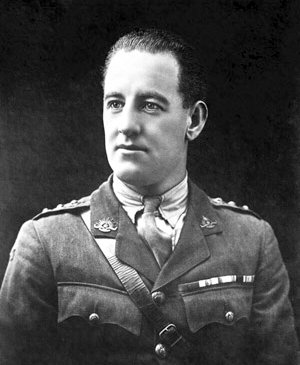
Albert Jacka, VC, MC & Bar (10 January 1893 – 17 January 1932) was an Australian recipient of the Victoria Cross, the highest decoration for gallantry "in the face of the enemy" that can be awarded to members of the British and Commonwealth armed forces. Jacka was the first Australian to be decorated with the VC during the First World War, receiving the medal for his actions during the Gallipoli Campaign. He later served on the Western Front and was twice more decorated for his bravery.
Key Information


After the war, Jacka returned to Australia and entered business, establishing the electrical goods importing and exporting business Roxburgh, Jacka & Co. Pty Ltd. He was later elected to the local council, becoming mayor of the City of St Kilda. Jacka never fully recovered from the wounds he sustained during his war service, and died aged 39.
Early life
[edit]Albert Jacka was born on a dairy farm near Winchelsea, Victoria, on 10 January 1893, the fourth of seven children to Nathaniel Jacka and his English-born wife Elizabeth (née Kettle).[1] His family moved to Wedderburn, Victoria, when he was five years old, where he attended the local school before working with his father as a haulage contractor. He was working for the Victorian State Forests Department at Heathcote when the First World War broke out.[2] His career over three years took him along the southern side of the Murray River to Wedderburn, Cohuna, Koondrook, Lake Charm and Heathcote. His work included fencing, fire break clearing and tree planting.[3] Jacka is one of twenty employees shown on the Forests Department Roll of Honour.[4]
First World War
[edit]Enlistment and training
[edit]Jacka enlisted in the Australian Imperial Force on 18 September 1914, with the rank of private. He was assigned to the 14th Battalion,[5] 4th Brigade, 1st Division and finished his training at Broadmeadows Camp.[6]
After Turkey became a German ally, the 1st Division was sent to Egypt to defend the Suez Canal. Jacka and his battalion arrived at Alexandria on 31 January 1915. During ten weeks of training south of Cairo the 4th Brigade was merged with two New Zealand brigades and merged with the 1st Light Horse Brigade to form the New Zealand and Australian Division (NZ&A) under Major General Alexander Godley.[6]
Gallipoli
[edit]
Jacka fought in the Gallipoli campaign that started on 25 April 1915, when his new division landed at Anzac Cove on the 26th in the Dardanelles, fighting against Turkish defenders on a narrow beach and in the steep ravines and hills above. The position was held by New Zealanders and Australians by digging a series of trenches. The trenches held by the 14th Battalion on 19 May 1915 became known as Courtney's Post,[7] which was where Jacka was awarded the Victoria Cross.[6][8]
On 19 May 1915, the Turks launched an assault against the Anzac Line, capturing a section of the trench at Courtney's Post; one end of which was guarded by Jacka.[9] For several minutes he fired warning shots into the trench wall until reinforcements arrived, after which he attempted to enter the trench with three others; all but Jacka were either wounded or pinned.[9] It was then decided that while a feint attack was made from the same end, Jacka would attack from the rear. The party then proceeded to engage the Turks with rifle fire, throwing in two bombs as Jacka skirted around to attack from the flank. He climbed out onto "no man's land", entering the trench via the parapet. In the resulting conflict, Jacka shot five Turkish soldiers and bayoneted two others, forcing the remainder to flee the trench;[10] he then held the trench alone for the remainder of the night. Jacka's platoon commander, Lieutenant Crabbe, informed him the following morning that he would be recommended for his bravery.[11]
The full citation for the Victoria Cross appeared in a supplement to The London Gazette on 23 July 1915:[12]
War Office, 24th July, 1915
His Majesty the King has been graciously pleased to award the Victoria Cross to the undermentioned Officers and Non-commissioned Officers:-
No. 465 Lance-Corporal Albert Jacka, 14th Battalion, Australian Imperial Forces.
For most conspicuous bravery on the night of the 19th–20th May, 1915 at "Courtney's Post", Gallipoli Peninsula.
Lance-Corporal Jacka, while holding a portion of our trench with four other men, was heavily attacked. When all except himself were killed or wounded, the trench was rushed and occupied by seven Turks. Lance-Corporal Jacka at once most gallantly attacked them single-handed, and killed the whole party, five by rifle fire and two with the bayonet.
Following his VC action, Jacka instantly became a national hero; he received the £500 and gold watch that the prominent Melbourne business and sporting identity, John Wren, had promised to the first Australian of the war to receive the VC, his image was used on recruiting posters and magazine covers,[13] and he received rapid promotions; first to corporal on 28 August, to sergeant two weeks later on 12 September, and then to company sergeant major on 14 November.[14] He became company sergeant major of C Company, and saw much fighting at Gallipoli where, during August at Chunuk Bair, Hill 971, and Hill 60, his battalion took part in an Allied offensive aimed at trying to break the deadlock around the beachhead.[6] After nine months of fighting and 26,111 Australian casualties, the Allied forces began to evacuate the peninsula in December 1915, after which Jacka's battalion was withdrawn to Egypt.[6]
In Egypt, he passed through officer training school with high marks, and on 29 April 1916 was commissioned as a second lieutenant.[9] During this time, the AIF expanded and was reorganised; the 14th Battalion was split and provided experienced soldiers for the 46th Battalion, and the 4th Brigade was combined with the 12th and 13th Brigades to form the 4th Australian Division.[15]
Western Front
[edit]
The division was sent to France, and the Western Front, in June 1916,[6] where Jacka and his unit were assigned to the Allied trenches near Armentières, participating in several raids against the German trenches.[16] Following the heavy casualties on the Somme, the 14th Battalion was transferred to the Pozières sector of the Somme offensive. Jacka's division, on 23 July 1916, was involved in the attack of Pozières planned by Major General Harold Bridgwood Walker. The Australian division suffered 5,285 casualties after three days of fighting. The Australian force captured Pozières,[17] but the fight was so bloody that the Australians could only identify their trenches by the bodies of their comrades showing their red-and-white shoulder patches.[citation needed]
On the morning of 7 August 1916, after a night of heavy shelling, the Germans began to overrun a portion of the line which included Jacka's dug-out. Jacka had just completed a reconnaissance, and had gone to his dug-out when two Germans appeared at its entrance and rolled a bomb down the doorway, killing two of his men.[9] Emerging from the dug-out, Jacka came upon a large number of Germans rounding up some forty Australians as prisoners. Only seven men from his platoon had recovered from the blast; rallying these few, he charged at the enemy.[18] Heavy hand-to-hand fighting ensued, as the Australian prisoners turned on their captors. Every member of the platoon was wounded, including Jacka who was wounded seven times; including an injury from a bullet that passed through his body under his right shoulder, and two head wounds.[19] Fifty Germans were captured and the line was retaken;[9] Jacka was personally credited with killing between twelve and twenty Germans during the engagement.[19]
_(Art._IWM_ART_1915).jpg)
Jacka was awarded the Military Cross (MC) for his actions at Pozières,[20] although he was originally recommended for the Distinguished Service Order.[21] The citation for his MC reads as follows:
For conspicuous gallantry. He led his platoon against a large number of the enemy, who had counter-attacked the battalion on his right. The enemy were driven back, some prisoners they had taken were recovered, and 50 of the enemy captured. He was himself wounded in this attack.
Many present at the time, as well as many historians since, have voiced the opinion that Jacka deserved a second VC for the Pozières action.[22] One of only two bars (second award) to the VC awarded during the war was earned the following day by Captain Noel Godfrey Chavasse of the Royal Army Medical Corps. Chavasse subsequently died of wounds sustained during this second VC action. The other bar to the VC was earned by Arthur Martin-Leake during the period 29 October to 8 November 1914 near Zonnebeke, Belgium, when, according to his award citation, Martin-Leake showed most conspicuous bravery and devotion to duty in rescuing, while exposed to constant fire, a large number of the wounded who were lying close to the enemy's trenches. Martin-Leake was the first of only three men to be awarded a bar to his VC.[citation needed]
Although traditionally the reason Jacka was not awarded a bar to his VC has been ascribed to British snobbery towards a "rough colonial", this view has been challenged. Gordon Corrigan, in Blood Mud and Poppycock, points out that it was Jacka's Australian superiors who chose not to recommend him for the award, and he argues that this may have been due to the fact that the Germans easily infiltrated Jacka's platoon position in broad daylight without being challenged. The sentries were most likely asleep or absent and Jacka should have ensured that they were not; as such it may have been perceived that while Jacka should be commended for his robust action in responding to the situation, he also bore a responsibility for allowing it to happen in the first place.[23]
After the incident, Jacka was evacuated to England, where he was promoted to lieutenant on 18 August 1916, but was falsely reported dead on 8 September. He attended an investiture ceremony at Windsor Castle on 29 September; receiving his Victoria Cross from King George V,[19] before rejoining his unit in November.[13] Promoted to captain on 15 March 1917, he was appointed the 14th Battalion's intelligence officer.[9]

By early 1917, the Germans had retired to the Hindenburg Line, and on 8 April Jacka led a night reconnaissance party into "no man's land", near Bullecourt to inspect enemy defences before an Allied attack against the new German line. He penetrated the wire at two places, reported back, then went out again to supervise the laying of tapes to guide the assault parties; in the process he single-handedly captured a two-man German patrol.[9] He was awarded a Bar to his MC for this action.[25] The bar's citation reads as follows:
For conspicuous gallantry and devotion to duty. He carried out a daring reconnaissance of the enemy's position and obtained most valuable information. Later, he rendered invaluable assistance in guiding troops to their assembly positions.
Later, Jacka was given command of D Company, 14th Battalion, and in June led his men through the Battle for Messines Ridge. During their advance, the company overran several machine gun posts and captured a German field gun; Jacka's actions went unrecognised.[19] On 8 July, he was wounded by a sniper near Ploegsteert Wood, resulting in nearly two months hospitalisation.[13] Returning to the front, he led the 14th Battalion on 26 September in an attack against German pill-boxes during the Battle of Polygon Wood.[13] Jacka was recommended for the Distinguished Service Order a second time for this feat, but again it was not granted.[19] In May 1918, Jacka was finally removed from the conflict when, outside the village of Villers-Bretonneux, he was badly gassed and a missile passed through his trachea. He was evacuated to No. 20 Casualty Clearing Station at Vignacourt, where it was thought that he would not recover. When he did, he was sent to Britain for two operations and a long recuperative period.[10]
He returned to Australia on 6 September 1919 and his AIF appointment ended on 10 January 1920, when he returned to Melbourne to a hero's welcome.[10]
Later life
[edit]
After the war, Jacka had a job waiting for him with the Forests Department, but together with R. O. Roxburgh and E. J. L. Edmonds, both former members of the 14th Battalion, he established the electrical goods importing and exporting business Roxburgh, Jacka & Co. Pty Ltd.[9] The business was heavily financed by John Wren, but collapsed with the Great Depression in 1931.[26]
On 17 January 1921, at St Mary's Catholic Church, St Kilda, Jacka married Frances Veronica Carey, a typist from his office. The pair settled in St. Kilda, and later adopted a daughter, Betty.[9] In September, 1929, he was elected to the Council of the City of St Kilda, becoming mayor the following year. Much of his civic work was characterised by his strong interest in assisting the unemployed,[5] defending evictees and proposing public works for the 'sussos': 'sustenance workers', employed on public works by the Government as a relief measure.[27]
On 14 December 1931, Jacka collapsed after a council meeting and was admitted to Caulfield Military Hospital. On 17 January 1932, one week after his 39th birthday, he died from chronic nephritis;[26] he was buried at St Kilda Cemetery, with eight other Victoria Cross recipients acting as pallbearers and an estimated 6,000 witnesses to the burial as his body passed en route to the cemetery.[5]
Albert Jacka's Victoria Cross is displayed at the Australian War Memorial in Canberra,[28] and a commemorative service is held on the Sunday closest to the anniversary of his death, 17 January, in St. Kilda to honour Jacka; originally organised by former members of the 14th Battalion, it is now held by Port Phillip City Council.[26] The regimental colour of the 14th Battalion is laid up in St Kilda Town Hall.[29]
Memorials
[edit]
- Albert Jacka Grave, St Kilda (37°51′40″S 145°00′08″E / 37.861094°S 145.002349°E).[30] Every year in January, a memorial service at the grave is organised by the St Kilda Council.[31]
- Jacka Park, Wedderburn, Victoria (33°46′32″S 151°17′06″E / 33.775598°S 151.285118°E) is named in his honour and the gates inscribed with "1914-18 Dedicated to the memory of Cpt. Albert Jacka V.C. M.C. & Bar"[32]
- Plaque in St Kilda Army and Navy Club RSL Sub Branch, 88 Acland Street, St Kilda (37°52′03″S 144°58′44″E / 37.867466°S 144.978858°E) inscribed "In memory of Captain Albert Jacka V.C., M.C. and bar 1893–1932. served in the 4th Brigade, 14th Battalion – 'Jacka's Mob' Australian Imperial Forces 1914–1920".[33]
- State Forests Department Roll of Honour at Beechworth museum, Victoria.[4]
- Inscription of name on Victoria Cross Memorial in Alfred Square, St Kilda, along with other Victoria Cross recipients from St Kilda. "[34]
- The suburb of Jacka located in Canberra, Australia's national capital, was named in his honour.
- Jacka Boulevard, St Kilda (37°51′56″S 144°58′24″E / 37.865673°S 144.97344°E) was named in his honour.
Notes
[edit]- ^ Snelling 2012, p. 116.
- ^ "Hard Jacka – The Story of a Gallipoli Legend". Archived from the original on 25 July 2008. Retrieved 10 July 2008.
- ^ Grant, Ian (1989). Jacka, V.C. Australia's finest fighting soldier. MacMillan Australia and Australian War Memorial Canberra. ISBN 0725106204.
- ^ a b "Forest Commission Roll of Honour". Archived from the original on 11 August 2018.
- ^ a b c "Australian War Memorial Biography". Archived from the original on 5 July 2008. Retrieved 10 July 2008.
- ^ a b c d e f "Australian War Memorial – 14th Battalion". Archived from the original on 26 July 2008. Retrieved 11 July 2008.
- ^ Sagona et al. (2016), p. 117
- ^ Bean, C.E.W. (1924). The official history of Australia in the War of 1914-1918 Volume II: The story of ANZAC from 4 May 1915 to the evacuation of the Gallipoli Peninsula. Sydney:Angus & Robertson. pp. 148-150.
- ^ a b c d e f g h i Fewster, Kevin J. (1983). "Jacka, Albert (1893–1932)". Australian Dictionary of Biography. Vol. 9. National Centre of Biography, Australian National University. pp. 442–453. ISBN 978-0-522-84459-7. ISSN 1833-7538. OCLC 70677943. Retrieved 11 July 2008.
- ^ a b c "Albert Jacka". AnzacDay.org. Archived from the original on 25 July 2008. Retrieved 11 July 2008.
- ^ Snelling 2012, p. 115.
- ^ "No. 29240". The London Gazette (Supplement). 23 July 1915. p. 7279. (VC)
- ^ a b c d "Albert JACKA VC, MC and Bar". Digger History. Archived from the original on 10 September 2008. Retrieved 11 July 2008.
- ^ Snelling 2012, pp. 116–117.
- ^ Polanski. We Were the 46th: The History of the 46th Battalion in The Great War of 1914–18, p. 2.
- ^ Lawriwsky. Hard Jacka, p. 108
- ^ "Battle of Pozières". Australian War Memorial. Archived from the original on 2 June 2008. Retrieved 11 July 2008.
- ^ "Biographies of VC Winners". Anzacsite.gov.au. Archived from the original on 23 July 2008. Retrieved 11 July 2008.
- ^ a b c d e Snelling 2012, p. 118.
- ^ "No. 29824". The London Gazette (Supplement). 14 November 1916. p. 11074. (MC)
- ^ "Recommendation for Albert Jacka to be awarded a Distinguished Service Order" (PDF). Australian War Memorial. Retrieved 10 July 2008.
- ^ Snelling 2012, p. 117.
- ^ Corrigan, Gordon (2004). Mud, Blood and Poppycock. London: Cassell. pp. 286–287. ISBN 978-0-3043-6659-0.
- ^ Left to right, Jacka's medals include: Victoria Cross; Military Cross & Bar; 1914–15 Star; British War Medal; and Victory Medal. See: REL/18215.001 – Victoria Cross: Lance Corporal A Jacka, 14 Battalion, AIF Archived 10 September 2012 at the Wayback Machine, Australian War Memorial; REL/18215.002 – Military Cross and bar: Captain A Jacka, 14 Battalion, AIF Archived 10 September 2012 at the Wayback Machine, Australian War Memorial; REL/18215.003 – 1914–15 Star: Sergeant A Jacka, 14 Battalion, AIF Archived 10 September 2012 at the Wayback Machine, Australian War Memorial; REL/18215.004 – British War Medal 1914–20: Captain A Jacka, 14 Battalion, AIF Archived 10 September 2012 at the Wayback Machine, Australian War Memorial; REL/18215.005 – Victory Medal: Captain A Jacka, 14 Battalion, AIF Archived 10 September 2012 at the Wayback Machine, Australian War Memorial.
- ^ "No. 30135". The London Gazette (Supplement). 15 June 1917. p. 5983. (MC bar)
- ^ a b c Snelling 2012, p. 119.
- ^ Grant (1989)
- ^ "Victoria Crosses held at the Memorial". Australian War Memorial. Retrieved 8 August 2010.
- ^ Lawriwsky, Michael. "Return of the Gallipoli Legend: Jacka VC". Retrieved 11 January 2018.
- ^ "Albert jacka Tombstone". Monument Australia. Retrieved 29 July 2014.
- ^ "Albert Jacka Memorial Service 2014". St Kilda Historical Society. Retrieved 29 July 2014.
- ^ "Albert Jacka Gates". Monument Australia. Retrieved 29 July 2014.
- ^ "Albert Jacka Plaque". Monument Australia. Retrieved 29 July 2014.
- ^ "Albert Jacka – Victoria Cross Inscription". Monument Australia. Retrieved 29 July 2014.
References
[edit]- Grant, Ian. Jacka, VC: Australia's Finest Fighting Soldier (South Melbourne, Victoria: Macmillan Australia, 1989 – in association with The Australian War Memorial, Canberra. ISBN 0732900751)
- Lawriwsky, Michael. Hard Jacka: The Story of a Gallipoli Legend (Chatswood, N.S.W.: Mira Books, 2007. ISBN 9781741165654)
- Macklin, Robert. Jacka VC: Australian Hero (Crows Nest, NSW: Allen & Unwin, 2006. ISBN 9781741148305)
- Polanksi, Ian. We Were the 46th: The History of the 46th Battalion in The Great War of 1914–18 (Townsville, Queensland: Puttees and Puggarees, 1999. ISBN 0957762208)
- Sagona, A., Atabay, M., Mackie, C.J., McGibbon, I. and Reid, R. (Eds.) ANZAC battlefield: a Gallipoli landscape of war and memory (Port Melbourne, Victoria: Cambridge University Press, 2016. ISBN 9781107111745)
- Snelling, Stephen (2012) [1995]. Gallipoli. VCs of the First World War. The History Press. ISBN 978-0752456539.
External links
[edit]


- The Australian: An uncommon hero
- The Australian: First Digger to win VC in World War I 'punished for outspokenness'
- Digital copy of Jacka's personal war service record
- Le Petit Théâtre des Opérations : Albert Jacka, the Australian Batman on YouTube
| International | |
|---|---|
| National | |
| People | |
| Other | |

Albert Jacka
View on GrokipediaAlbert Jacka, VC, MC & Bar (10 January 1893 – 17 January 1932), was an Australian soldier renowned for his gallantry during the First World War, particularly as the first Australian Imperial Force member to receive the Victoria Cross for recapturing a trench position at Courtney's Post on the Gallipoli Peninsula.[1][2] Born on a dairy farm near Winchelsea, Victoria, to Nathaniel and Elizabeth Jacka, he worked as a labourer before enlisting in the Australian Imperial Force on 15 September 1914 with the 14th Battalion.[3][4] Jacka's Victoria Cross was awarded for "most conspicuous bravery" on the night of 19–20 May 1915, when, after Turks captured part of his unit's trench, he climbed out alone, attacked and killed several assailants with rifle and bayonet, and held the position against reinforcements until support arrived, restoring the line.[5][1] His actions at Gallipoli elevated him to national hero status in Australia, with widespread recognition upon his return for leave in 1915.[6] Later service on the Western Front earned him the Military Cross in 1916 for leadership in advancing posts under fire at Pozières, and a bar to the MC in 1918 for repelling a German raid near Villers-Bretonneux, where he personally killed multiple enemies and secured prisoners.[7][8] Wounded multiple times and gassed, Jacka rose to captain before returning to Australia in 1919.[9] Post-war, Jacka transitioned to civilian life as a merchant, establishing a hardware and produce business in St Kilda, Victoria, and engaging in local governance as a councillor and mayor of St Kilda from 1929 to 1931.[2] His health, compromised by war injuries including chronic nephritis, led to his death at age 39 on 17 January 1932 in a Caulfield hospital; he was buried with full military honours.[10][3] Jacka's legacy endures as a symbol of Anzac valor, commemorated in memorials and military lore for his repeated acts of individual initiative and courage in combat.[11]
Early Life
Family Origins and Childhood
Albert Jacka was born on 10 January 1893 at Layard, near Winchelsea in southern Victoria, Australia, the fourth child of seven born to Nathaniel Jacka, a Victorian-born dairy farmer, and his English-born wife, Elizabeth (née Kettle).[2][9] The Jacka family traced its paternal roots to Cornish immigrants who arrived in South Australia in the 1840s before settling in Victoria, where Nathaniel's father, Josiah Jacka, established a farming presence.[12] Nathaniel Jacka, born on 4 February 1861 in Geelong, Victoria, operated a dairy farm supplemented by a local contracting business, reflecting the modest agrarian economy of rural Victoria at the time.[10] Elizabeth Kettle, born on 9 March 1861, had emigrated from England and married Nathaniel in 1885, bringing a household focused on self-sufficiency amid the challenges of frontier farming.[13] The couple's children, including Jacka's siblings David Samuel, Fanny Olive, and four others, grew up in this environment of manual labor and family interdependence.[14] In 1898, when Jacka was five years old, the family relocated approximately 200 kilometers north to Wedderburn, a gold-rush era town in central Victoria, seeking better prospects in farming and quarrying.[15] There, they acquired land for continued dairy operations and stone extraction, exposing young Jacka to rigorous physical work such as plowing fields, tending livestock, and assisting in his father's contracting ventures.[16] This rural upbringing instilled practical skills and resilience, shaping his early character amid the economic hardships typical of late-19th-century Australian bush life, including droughts and fluctuating commodity prices.[2]Pre-Military Employment and Influences
Albert Jacka, born on 10 January 1893 near Winchelsea, Victoria, as the fourth of seven children to Nathaniel Jacka, a labourer and dairy farmer, and his wife Elizabeth, completed only elementary schooling before entering the workforce around age 13.[2] [10] He initially assisted his father with farm duties, delivering goods to local farmers, and performing general rural labour such as fencing, repairs, and work as a road contractor or carter, reflecting the modest, hands-on rural economy of early 20th-century Victoria.[10] [16] At age 17, circa 1910, Jacka joined the Victorian State Forests Department as a labourer, where he remained employed until the outbreak of World War I.[5] [10] His duties included practical forestry tasks such as fencing, clearing fire breaks, tree planting, and replanting eucalyptus forests depleted during the 19th-century gold rush era, with his work documented on the department's Roll of Honour listing twenty employees, including Jacka, who served in the war.[10] By 1914, he was stationed at Heathcote, performing these physically demanding roles that honed his endurance and familiarity with rugged terrain.[7] Jacka's pre-military influences were shaped by his working-class rural upbringing and athletic pursuits, fostering resilience and combativeness evident in his later military exploits. He excelled in sports, particularly boxing, cycling, and Australian rules football, activities that built his superior physical conditioning and competitive spirit during off-duty time.[10] [16] These interests, combined with the self-reliant demands of forestry labour, likely contributed to his bold, action-oriented character without formal ideological or educational mentorship beyond basic schooling.[5]World War I Service
Enlistment and Initial Training
Jacka, then aged 21 and working as a drainlayer in regional Victoria, first attempted to enlist in the Australian Imperial Force (AIF) on 8 September 1914 at the local recruiting office in Heathcote, but his paperwork was lost.[9] He subsequently travelled to Melbourne and formally enlisted on 18 September 1914 as a private, with no prior military experience, and was assigned the service number 465 in D Company of the 14th Battalion, part of the 4th Brigade in the 1st Division.[9][17][3] Following enlistment, Jacka underwent initial training at Broadmeadows Camp, a newly established facility north of Melbourne designed to prepare the first contingent of AIF volunteers for overseas service.[10][4] This training emphasized basic infantry drills, rifle marksmanship, physical conditioning, and rudimentary tactics, reflecting the rapid mobilization of Australia's citizen army in response to the outbreak of war in August 1914.[5] During this period, Jacka was promoted to acting corporal in November 1914, indicating early recognition of his capabilities among recruits.[1] The 14th Battalion completed its Australian-based training by late December 1914, after which the unit marched from Broadmeadows to Melbourne for embarkation.[18] On 22 December 1914, Jacka and his battalion boarded the transport ship HMAT Ulysses (A38) at Port Melbourne, departing for Egypt where further specialized training would occur prior to deployment to Gallipoli.[15][19] This initial phase marked the transition from civilian life to the structured discipline of military service for Jacka, amid the enthusiasm of Australia's early war effort.[16]Gallipoli Campaign and Victoria Cross Action
Jacka, serving as a lance corporal in the 14th Battalion, Australian Imperial Force, participated in the initial landings at Anzac Cove on 26 April 1915, following training in Egypt after enlisting in September 1914.[1] [10] The battalion reinforced positions at Courtney's Post, a key defensive point on the cliffs above the cove, amid the chaotic establishment of the Anzac perimeter against Ottoman forces.[3] Over the subsequent weeks, the Australians endured harsh conditions, including sniper fire, disease, and supply shortages, while consolidating trenches in the rugged terrain that prevented a decisive advance.[5] On the night of 19–20 May 1915, Ottoman forces launched a major counterattack across the Gallipoli front, involving approximately 42,000 troops against the Anzac line, aiming to dislodge the invaders.[20] At Courtney's Post, a Turkish party infiltrated and captured a section of trench held by Jacka and four comrades under heavy bomb and rifle fire, killing or wounding most of the defenders and isolating the position.[1] With communication severed, Jacka directed the surviving men to provide covering fire from the flanks, then vaulted into no-man's-land under intense enemy fire, circled behind the occupiers, and launched a solitary bayonet assault.[5] He killed seven Turkish soldiers in close combat, bombed others back along the trench, and regained the lost ground, holding it alone until reinforcements arrived at dawn.[3] [10] The London Gazette formalized his Victoria Cross on 23 July 1915, citing: "For most conspicuous bravery on the night of the 19th-20th May, 1915, at 'Courtney's Post', Gallipoli Peninsula. Lance Corporal Jacka, while holding a portion of our trench with four men, was heavily attacked. When all but two of his men were struck down, he went out under fierce fire and attacked the enemy single handed with his bayonet."[1] This marked the first Victoria Cross awarded to an Australian soldier in World War I, recognizing an action that prevented the collapse of the post's flank and inspired further resistance amid the failed Ottoman assault, which cost attackers over 10,000 casualties.[21] Jacka continued frontline duty at Gallipoli through illness and combat until the evacuation in December 1915, earning promotion to corporal for his sustained leadership.[7]Western Front Battles and Further Decorations
Following evacuation from Gallipoli in late 1915, Jacka and the 14th Battalion transferred to the Western Front, arriving in France in June 1916.[10][22] During the Battle of Pozières on the Somme in July 1916, German forces counter-attacked and overran a section of Australian trench held by Jacka's platoon. Leading a small group of three to seven men, Jacka climbed out of the trench, flanked the enemy position, and recaptured the lost ground in fierce hand-to-hand fighting, killing or capturing numerous Germans. Official historian Charles Bean later described this as "the most dramatic and effective act of daring that I had ever seen." For this gallantry, Jacka was awarded the Military Cross in August 1916, despite an initial recommendation for the Distinguished Service Order; he was also wounded during the engagement.[2][3][16] Promoted to temporary captain on 15 March 1917, Jacka took on intelligence duties ahead of the first Battle of Bullecourt in April.[17] He conducted perilous night patrols into no-man's-land to map German defenses and laid assembly tapes for the Australian assault under intense artillery fire, averting a potential catastrophic exposure of advancing troops to pre-planned bombardment. These actions earned him a bar to his Military Cross, gazetted in June 1917.[10][7][2] In the Battle of Messines on 7 June 1917, Captain Jacka commanded a company of the 14th Battalion in the assault on German positions, helping secure objectives amid heavy fighting. He sustained a gunshot wound to the right thigh from a sniper on 8 July 1917 near Ploegsteert Wood, Belgium, his second wounding on the Western Front, leading to hospitalization.[16][17] Returning to duty later in 1917, Jacka participated in further operations around Ypres, including the Battle of Polygon Wood in September. In 1918, during the German Spring Offensive, he was wounded again at Villers-Bretonneux while leading defensive actions. His repeated leadership under fire on the Western Front, resulting in the MC and bar alongside his prior VC, marked him as one of the Australian Imperial Force's most decorated officers.[23][10]Command Conflicts and Tactical Critiques
Jacka's frontline leadership style, characterized by aggressive patrolling and direct engagement with the enemy, often brought him into conflict with higher command, who favored more conservative approaches. His blunt assessments of tactical shortcomings, drawn from repeated exposures to combat, frequently irritated superiors and contributed to his stalled promotion beyond captain despite multiple decorations. Attributed in part to these disputes, Jacka's career trajectory reflected tensions between experienced junior officers and a command structure prioritizing discipline over dissent.[2][24] During the Battle of Pozières on 6 August 1916, Jacka led a small group in recapturing a lost position from over 60 German troops, sustaining seven wounds in the process. He later criticized his company commander, Major Fuhrmann, for remaining in a deep dugout 300 yards behind the lines, which Jacka believed hindered accurate reporting and support during the action. This incident, combined with Jacka's own near-entrapment in a dugout during the fighting, fostered his lasting aversion to such shelters; thereafter, he rarely used them himself and openly condemned officers who did, arguing they distanced leaders from the realities of infantry combat.[24][25][16] At the First Battle of Bullecourt in April 1917, serving as intelligence officer for the 4th Brigade, Jacka warned Brigadier-General H.M. Brand that the planned assault across uncut German wire entanglements amounted to "pure murder" without adequate preparation, including reliance on unreliable tanks. Despite capturing a German officer and enlisted man single-handedly in reconnaissance, his advice was disregarded, resulting in heavy casualties for the 14th Battalion. Jacka's subsequent report detailed these tactical flaws and criticized higher planning, but it was suppressed by General William Birdwood, who deemed such candor inappropriate; this led to the expungement of the document and denial of a recommended second Victoria Cross, with Brand noting that such awards were rare for failed operations.[24][16] Further friction arose at Polygon Wood in September 1917, where Jacka clashed with Brand over the cancellation of troop leave, protesting publicly before assuming de facto command of an attack when the battalion leader was absent. Though Brand later recommended him for a Distinguished Service Order, it was not awarded, possibly due to the report's implications for the absent officer's competence. Jacka's repeated advocacy for better training, reconnaissance, and realistic planning—highlighted in critiques of rushed assaults—underscored his preference for causality-informed tactics over optimistic directives, but his unfiltered delivery exacerbated command tensions throughout his Western Front service.[24][16]Post-War Career and Challenges
Business Enterprises and Economic Realities
Following his demobilization from the Australian Imperial Force on 23 January 1920, Jacka partnered with fellow 14th Battalion veterans R. O. Roxburgh and E. J. L. Edmonds to establish Roxburgh, Jacka & Co. Pty Ltd, an importing and exporting firm specializing in electrical goods, with operations based in Melbourne.[2] Jacka provided £700 of the initial capital from his war gratuity and savings, reflecting his commitment to leveraging military connections for postwar entrepreneurial opportunities amid Australia's repatriation efforts for returned soldiers.[2] The venture initially prospered in the 1920s, capitalizing on growing demand for imported consumer appliances during a period of relative economic stability and import-driven growth in Australia.[2] In 1923, after Roxburgh's withdrawal, the company restructured as Jacka Edmonds & Co., with additional involvement from figures such as John Wren (a prominent Melbourne businessman and political influencer) as a director, alongside Dick Lean, while Arthur Wren (John's brother) held a controlling shareholding exceeding three-quarters.[2] This phase sustained the firm's operations, though Jacka's hands-on role diminished somewhat as he balanced business with emerging public duties.[2] The business model relied heavily on low-tariff imports, aligning with Australia's pre-Depression trade patterns that favored foreign goods over nascent domestic manufacturing.[2] The enterprise encountered severe headwinds from late 1929 onward, culminating in voluntary liquidation on 30 September 1930, precipitated by the Scullin Labor government's sharp escalation of import tariffs—intended to shield local industries but which instead crippled import-dependent firms like Jacka Edmonds & Co. by inflating costs and eroding competitiveness.[2] These protectionist measures, enacted amid the global Great Depression's onset (with Australia's export prices collapsing by over 30% from 1929 to 1931), exacerbated cash flow strains and reduced consumer purchasing power, contributing to widespread business failures across import sectors.[2] Speculation persisted regarding strained relations with John Wren, potentially withdrawing backing after Jacka pursued independent political paths conflicting with Wren's influence, though primary evidence attributes the collapse chiefly to macroeconomic policy shifts rather than interpersonal disputes.[2] Post-liquidation, Jacka pivoted to employment as a commercial traveler for the Anglo-Dominion Soap Co., illustrating the precarious transition many ex-servicemen faced from wartime heroism to interwar economic precarity without robust government safeguards beyond basic repatriation aid.[2]Entry into Politics and Ideological Stances
In September 1929, Jacka was elected to the St Kilda City Council, reflecting his growing post-war interest in public service amid economic hardship.[2][10] He assumed the role of mayor in September 1930, during the onset of the Great Depression, where he prioritized practical relief efforts for the unemployed, including advocacy for work programs and community support initiatives tailored to local needs.[3] These actions stemmed from his direct observation of returning soldiers' struggles, though they were constrained by municipal budgets and broader economic policies.[10] Jacka maintained no formal affiliation with any political party throughout his civic tenure, operating as an independent figure driven by nationalist sentiments and personal experience rather than partisan ideology.[26] Inferences of left-leaning tendencies, occasionally drawn from his unemployment relief focus, overlook his pro-conscription advocacy during the 1916 and 1917 referenda—contrasting his father's anti-conscription campaigning—and his public criticisms of Labor government policies, such as the 1929 tariff increases under Prime Minister Scullin that precipitated the liquidation of his own business.[1][26] For instance, Jacka remarked that continued Labor rule would have imposed "an unscrupulous onslaught upon [taxpayers'] pockets," indicating a preference for fiscal restraint over expansive state intervention.[25] His stances emphasized self-reliance, veteran welfare, and opposition to policies perceived as economically burdensome, aligning with a pragmatic conservatism rooted in military discipline rather than collectivist reforms.[26][2]Local Government Service
Jacka was elected to the St Kilda City Council in September 1929 as a representative of the Central Ward.[2][27] He assumed the role of mayor the following year, in 1930.[2][10][3] As mayor, Jacka focused his civic efforts on improving conditions for returned soldiers, including advocacy for their employment and welfare amid post-war economic pressures.[22][16] His service emphasized practical support for ex-servicemen, reflecting his firsthand experience of military hardships, though his tenure was shortened by recurring health issues from war wounds such as nephritis and sepsis.[10][28] Jacka's municipal involvement ended prematurely when he collapsed after attending his final St Kilda Council meeting on 14 December 1931, necessitating hospitalization and marking the decline that preceded his death a month later.[29] Throughout this period, his leadership maintained a commitment to local governance priorities like community welfare, unmarred by major controversies in council records.[2]Death, Health Legacy, and Enduring Impact
Final Years and Cause of Death
In the years following his election as mayor of St Kilda in 1930, Jacka's health, undermined by multiple war wounds including shrapnel injuries and gas exposure sustained during World War I, continued to decline progressively.[2][3] By late 1931, symptoms of chronic nephritis—a kidney disorder likely exacerbated by his wartime service—had worsened sufficiently to require hospitalization.[15][30] On 18 December 1931, Jacka was admitted to Caulfield Military Hospital in Melbourne, where his condition failed to improve despite treatment.[1][4] He died there on 17 January 1932 at the age of 39, with the official cause recorded as chronic nephritis.[2][15] Contemporary accounts and medical assessments linked the disease to the cumulative effects of his combat injuries, including severe gassing incidents on the Western Front, from which he never fully recovered.[3] Jacka's funeral on 19 January 1932 was accorded full military and state honors, reflecting his status as Australia's first Victoria Cross recipient of the war, with an estimated large public attendance underscoring his enduring national esteem.[15][4] He was interred at St Kilda Cemetery in Melbourne.[1][32]Posthumous Recognition and Memorials
Jacka died on 17 January 1932 from chronic nephritis, a condition linked to his war wounds and gassing. He received a state funeral with full military honours on 19 January 1932 at St Kilda Cemetery, Melbourne, where eight Victoria Cross recipients acted as pallbearers.[15][27] A memorial stone with a bas-relief bronze portrait sculpted by Wallace Anderson was erected over his grave on 15 May 1932, and a house was purchased for his widow using public donations.[15] The St Kilda Historical Society and City of Port Phillip have conducted annual memorial services at his grave since the 1930s, commemorating the anniversary of his death; for instance, services marked the 79th anniversary in 2011 and the 85th in 2017.[33][34] Numerous plaques and monuments honor Jacka across Australia. In St Kilda, an oval plaque dedicated to "Captain Albert Jacka V.C., M.C. and Bar 1893-1932" was unveiled on 4 April 1994.[35] A commemorative plaque in Modewarre recognizes his service.[36] The Australian War Memorial in Canberra features a Victoria Cross commemorative plaque for him.[37] Sculptures include a memorial sculpture with interpretive plaque in Wedderburn Soldiers' Memorial Park, depicting Jacka and dedicated to his Victoria Cross, Military Cross, and bar.[38] Life-size bronze statues of Jacka and fellow Victoria Cross recipient Albert Borella, along with plaques, were created to honor their Loddon Shire connections and unveiled around 2020.[39] In Wedderburn, where Jacka's family resided, the entrance gates to Jacka Park Soldiers Memorial, inscribed "1914-18 Dedicated To The Memory of Cpt. Albert Jacka V.C. M.C. & BAR," were opened on 6 April 1958.[40][41]References
- https://trove.nla.gov.au/newspaper/article/4416906