


Community hub
Recent from talks
Contribute something
Nothing was collected or created yet.
Bayonet
View on Wikipedia

A bayonet (from Old French bayonette, now spelt baïonnette) is a knife, dagger, sword, or spike-shaped melee weapon designed to be mounted on the end of the barrel of a rifle, carbine, musket or similar long firearm, allowing the gun to be used as an improvised spear in close combat.[1]
The term is derived from the town of Bayonne in southwestern France, where bayonets were supposedly first used by Basques in the 17th century.[2] From the early 17th to the early 20th century, it was an infantry melee weapon used for both offensive and defensive tactics, usually when charging in mass formations (human wave attacks). In contemporary times, bayonets are considered a weapon of last resort, and are rarely used in combat, although they are still used for ceremonial purposes (e.g, military parades).
History
[edit]
The term bayonette itself dates back to the 16th century, but it is not clear whether bayonets at the time were knives that could be fitted to the ends of firearms, or simply a type of knife.
For example, Cotgrave's 1611 Dictionarie describes the bayonet as "a kind of small flat pocket dagger, furnished with knives; or a great knife to hang at the girdle".
Likewise, Pierre Borel wrote in 1655 that a kind of long-knife called a bayonette was made in Bayonne but does not give any further description.[3]
There are some accounts that place the invention of the bayonet in either France or Germany as early as 1570.[4]
Plug bayonets
[edit]
The first recorded instance of a bayonet proper is found in the Chinese military treatise, Binglu published in 1606. It was in the form of the Son-and-mother gun, a breech-loading musket that was issued with a roughly 57.6 cm (22.7 in) long plug bayonet, giving it an overall length of 1.92 m (6 ft 4 in) with the bayonet attached. It was labelled as a "gun-blade" (simplified Chinese: 铳刀; traditional Chinese: 銃刀; pinyin: Chòngdāo) with it being described as a "short sword that can be inserted into the barrel and secured by twisting it slightly" that it is to be used "when the battle have depleted both gunpowder and bullets as well as fighting against bandits, when forces are closing into melee or encountering an ambush" and if one "cannot load the gun within the time it takes to cover two bu (3.2 meters) of ground they are to attach the bayonet and hold it like a spear".[5][6]
Early bayonets were of the "plug" type, where the bayonet was fitted directly into the barrel of the musket.[7][8][9] This allowed light infantry to be converted to heavy infantry and hold off cavalry charges.
The bayonet had a round handle that slid directly into the musket barrel. This naturally prevented the gun from being fired.
The first known mention of the use of bayonets in European warfare was in the memoirs of Jacques de Chastenet, Vicomte de Puységur.[10] He described the French using crude 1-foot (0.30 m) plug bayonets during the Thirty Years' War .[10]
However, it was not until 1671 that General Jean Martinet standardized and issued plug bayonets to the French regiment of fusiliers then raised. They were issued to part of an English dragoon regiment raised in 1672, and to the Royal Fusiliers when raised in 1685.[11]
Socket bayonets
[edit]
The major problem with plug bayonets was that when attached they made it impossible to fire the musket, requiring soldiers to wait until the last possible moment before a melee to fix the bayonet.
The defeat of forces loyal to William of Orange by Jacobite Highlanders at the Battle of Killiecrankie in 1689 was due (among other things) to the use of the plug bayonet.[8][11]
The Highlanders closed to 50 yd (46 m), fired a single volley, dropped their muskets, and using axes and swords quickly overwhelmed the loyalists before they had time to fix bayonets. Shortly thereafter, the defeated leader, Hugh Mackay, is believed to have introduced a socket bayonet of his own invention.
Soon "socket" bayonets would incorporate both socket mounts and an offset blade that fit around the musket's barrel, which allowed the musket to be fired and reloaded while the bayonet was attached.

An unsuccessful trial with socket or zigzag bayonets was made after the Battle of Fleurus in 1690, in the presence of King Louis XIV, who refused to adopt them, as they had a tendency to fall off the musket.
Shortly after the Peace of Ryswick (1697), the English and Germans abolished the pike and introduced socket bayonets.[11]
The British socket bayonet had a spike with a triangular cross-section rather than a flat blade, with a flat side towards the muzzle and two fluted sides outermost to a length of 15 inches (38 cm). It had no lock to keep it fast to the muzzle, and was well-documented for falling off in the heat of battle.[8]
By the mid-18th century, socket bayonets had been adopted by most European armies. In 1703, the French infantry adopted a spring-loaded locking system that prevented the bayonet from accidentally separating from the musket.
A triangular blade was introduced around 1715 and was stronger than the previous single or double-edged model.[12]
Sword bayonets
[edit]The 18th century introduced the concept of the sword bayonet, a long-bladed weapon with a single- or double-edged blade that could also be used as a shortsword.
Its initial purpose was to ensure that riflemen could form an infantry square properly to fend off cavalry attacks when in ranks with musketmen, whose weapons were longer. A prime early example of a sword bayonet-fitted rifle is the Pattern 1800 Infantry Rifle, later known as the "Baker Rifle".
Sword bayonets were used by German Jagers in the 18th century. The hilt usually had quillons modified to accommodate the gun barrel and a hilt mechanism that enabled the bayonet to be attached to a bayonet lug.
A sword bayonet could be used in combat as a sidearm, when detached from the musket or rifle. When the bayonet was attached to the musket or rifle, it effectively turned all long guns into a spear or glaive, which made it suitable for both thrusting and cutting attacks.

While the British Army eventually discarded the sword bayonet, the socket bayonet survived the introduction of the rifled musket into British service in 1854. The new rifled musket copied the French locking ring system.[8]
The new bayonet proved its worth at the Battle of Alma and the Battle of Inkerman during the Crimean War, where the Imperial Russian Army learned to fear it.[8]

In the 1860s, European nations began to develop new bolt-action breechloading rifles (such as the Chassepot and Snider–Enfield) and sword bayonets suitable for mass production and used by police, pioneer, and engineer troops.[13]
The decision to redesign the bayonet into a short sword was viewed by some as an acknowledgement of the decline in importance of the fixed bayonet as a weapon in the face of new advances in firearms technology.[14] British magazine Punch wrote that "the committee, in recommending this new sword bayonet, appear to have had in view the fact that bayonets will henceforth be less frequently used than in former times as a weapon of offence and defence; they desired, therefore, to substitute an instrument of more general utility."[14]
Multipurpose bayonets
[edit].jpg)
One of these multipurpose designs was the 'sawback' bayonet, which incorporated saw teeth on the spine of the blade.[13]
The sawback bayonet was intended for use as a general-purpose utility tool as well as a weapon; the teeth were meant to facilitate the cutting of wood for various defensive works such as barbed-wire posts, as well as for butchering livestock.[1][14][15][16]
It was initially adopted by the German states in 1865; until the middle of WWI approximately 5% of every bayonet style was complemented with a sawback version, for example in Belgium in 1868, Great Britain in 1869 and Switzerland in 1878 (Switzerland introduced their last model in 1914).[1][14][15][16][17]
The original sawback bayonets were typically of the heavy sword-type, they were issued to engineers, with to some extent the bayonet aspect being secondary to the "tool" aspect.
Later German sawbacks were more of a rank indicator than a functional saw. Generally, an average of 6% of all bayonets were sawbacks for non-commissioned officers. There were some exceptions, such as the kurzes Seitengewehr 1898 model, all of which were of the sawback design and meant for what was considered more prestigious units, such as machine gunners, telegraph troop and colonial troops.[18]
The sawback proved relatively ineffective as a cutting tool, and was soon outmoded by improvements in military logistics and transportation; most nations dropped the sawback feature by the early 20th century.[1]
The German army discontinued use of the sawback bayonet in 1917 after protests that the serrated blade caused unnecessarily severe wounds when used as a fixed bayonet.[1][16]

The trowel or spade bayonet was another multipurpose design, intended for use both as an offensive weapon as well as a digging tool for excavating entrenchments.[19][20]
In 1870, the US Army issued trowel bayonets to infantry regiments based on a design by Lieutenant-Colonel Edmund Rice, a US Army officer and Civil War veteran, which were manufactured by the Springfield Armory.[21]
Besides its utility as both a fixed bayonet and a digging implement, the Rice trowel bayonet could be used to plaster log huts and stone chimneys for winter quarters; sharpened on one edge, it could cut tent poles and pins.[21] Ten thousand were eventually issued, and the design saw service during the 1877 Nez Perce campaign.[22] Rice was given leave in 1877 to demonstrate his trowel bayonet to several nations in Europe.[22]
One infantry officer recommended it to the exclusion of all other designs, noting that "the entrenching [sic] tools of an army rarely get up to the front until the exigency for their use has passed."[21] The Rice trowel bayonet was declared obsolete by the US Army in December 1881.[22]
Contemporary bayonets
[edit]Today, the bayonet is rarely used in one-to-one combat.[23][24][25]
Despite its limitations, many modern assault rifles (including bullpup designs) retain a bayonet lug and the bayonet is issued by many armies. The bayonet is used for controlling prisoners, or as a weapon of last resort.[23]
In addition, some authorities have concluded that the bayonet serves as a useful training aid in building morale and increasing desired aggressiveness in troops.[26][27]
Today's bayonets often double as multi-purpose utility knives, bottle openers or other tools. Issuing one modern multi-purpose bayonet/knife is also more cost effective than issuing separate specialty bayonets, and field/combat knives.
Photo gallery
[edit]-

-

-
-
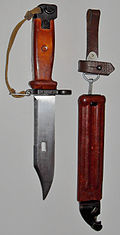
 Multi-purpose AKM Type I bayonet of the Nationale Volksarmee shown cutting a wire
 -

-
 Afghan policeman with AKM and AKM Type II bayonet.
 -
 The US M5 bayonet and scabbard used with the M1 Garand
 -
 The US M6 bayonet and scabbard used with the M14 rifle
 -
 M7 Bayonet and M8A1 Sheath used with the M16 rifle
 -

-
 M9 bayonet and scabbard in wire-cutter configuration.
 -
 M9 bayonet-fitted M4 carbine firing during secondary target drills.
 -
 The USMC OKC-3S Bayonet
 -
 US Marines at bayonet practice in 2005.
 -
 US Marine with OKC-3S attached to an M27 IAR in 2023. The USMC is one of only a few modern military forces to still teach bayonet fighting as part of basic training.
 -
 Folding an SKS-type bayonet.
 -
 A Chinese sailor with a Type 56 with the integral folding spike bayonet, 1986.
 -
 Chinese soldier with QBZ-95 rifle and multi-purpose knife bayonet.
 -

-
 Japanese Ground Self Defense Force infantrymen with their Howa Type 64 with bayonet fixed.
 -

-
 Early FN FAL and bayonet.
 -
 Kuwaiti soldier with his FN FAL rifle with bayonet.
 -
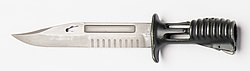 British-issue L3A1 socket bayonet. Note the slot in the blade to attach the wire-cutter scabbard.
 -
 L3A1 scabbard. Note the lug to attach the bayonet for wire cutting.
 -
 British servicemen with fixed L3A1 bayonets on L85A2 rifles. The L3A1's blade is offset to permit firing.
 -
 Palace guard at the royal palace, Oslo. Note the G3-type rifle with a bayonet over the barrel.
 -
 Glock field knife/bayonet and its scabbard. The upper crossguard is bent forward and can be used as a bottle opener.
 -
 Irish Army Honor Guard. Note Steyr AUG with EICKHORN KCB-70 type multi-purpose bayonet
 -
 Royal New Zealand Navy Guard of Honour. Note Individual Weapon Steyr with American M7 bayonets.
 -
 The Royal 22nd Regiment of Canada unfixing their bayonets.
 -
 Marines from Marine Barracks Washington D.C. fix their bayonets during rehearsals for the presidential inauguration.
 -
![Brazilian LAPA FA-03.[28]](//upload.wikimedia.org/wikipedia/commons/thumb/8/87/LAPA_FA_Mod_3.svg/250px-LAPA_FA_Mod_3.svg.png)


.JPG)


.jpg)
.jpg)


![Brazilian LAPA FA-03.[28]](https://en.wikipedia.org/wiki/File:LAPA_FA_Mod_3.svg)
Linguistic impact
[edit]The push-twist motion of fastening the older type of spike bayonet has given a name to:
- The "bayonet mount" used for various types of quick fastenings, such as camera lenses, also called a "bayonet connector" when used in electrical plugs.
- Several connectors and contacts including the bayonet-fitting light bulb that is common in the UK (as opposed to the continental European screw-fitting type).
- One type of connector for foil and sabre weapons used in modern fencing competitions is referred to as a "bayonet" connector.
In chess, an aggressive variation of the King's Indian Defence is known as the "Bayonet Attack".
The bayonet has become a symbol of military power. The term "at the point of a bayonet" refers to using military force or action to accomplish, maintain, or defend something (cf. Bayonet Constitution). Undertaking a task "with fixed bayonets" has this connotation of no room for compromise and is a phrase used particularly in politics.
Badges and insignias
[edit]The Australian Army 'Rising Sun' badge features a semicircle of bayonets. The Australian Army Infantry Combat Badge (ICB) takes the form of a vertically mounted Australian Army SLR (7.62mm self-loading rifle FN FAL) bayonet surrounded by an oval-shaped laurel wreath.[29]
The US Army Combat Action Badge, awarded to personnel who have come under fire since 2001 and who are not eligible for the Combat Infantryman Badge (due to the fact that only Infantry personnel may be awarded the Combat Infantryman Badge), has a bayonet as its central motif. The shoulder sleeve insignia for the 10th Mountain Division in the US Army features crossed bayonets. The US Army's 173rd Airborne Brigade Combat Team's shoulder patch features a bayonet wrapped in a wing, symbolizing their airborne status. The brigade regularly deploys in task forces under the name "Bayonet".
The insignia of the British Army's School of Infantry is an SA80 bayonet against a red shield. It is worn as a Tactical recognition flash (TRF) by instructors at the Infantry Training Centre Catterick, the Infantry Battle School at Brecon and the Support Weapons School in Warminster. Fixed bayonets also feature on the cap badge and tactical recognition flash of the Small Arms School Corps.
The vocation tab collar insignia for the Singapore Armed Forces Infantry Formation utilizes two crossed bayonets. The bayonet is often used as a symbol of the Infantry in Singapore.
Bayonet charge
[edit]The development of the bayonet from the 17th century onwards led to the bayonet charge becoming the main infantry tactic throughout the 18th, 19th, and early 20th century. The British Army under Wolesley, the later Duke of Wellington, evolved its tactics to adopt the "Volley and Bayonet Charge" from the earlier "Highland Charge" tactic of Highland regiments under his command. These proto "fire and maneuver" tactics were first introduced to the British Army by the 42nd Highlanders (Black Watch) at Fontenoy in 1745 although, they had been used by their antecedents, (The Independent Highland Watch Companies) prior to that. As early as the 19th century, military scholars were already noting that most bayonet charges did not result in close combat. Instead, one side usually fled before actual bayonet fighting ensued. The act of fixing bayonets has been held to be primarily connected to morale, the making of a clear signal to friend and foe of a willingness to kill at close quarters.[30]
The bayonet charge was above all a tool of shock. While charges were reasonably common in 18th and 19th century warfare, actual combat between formations with their bayonets was so rare as to be effectively nonexistent. Usually, a charge would only happen after a long exchange of gunfire, and one side would break and run before contact was actually made. Sir Charles Oman, nearing the end of his history of the Peninsular War (1807–1814) in which he had closely studied hundreds of battles and combats, only discovered a single example of, in his words, "one of the rarest things in the Peninsular War, a real hand-to-hand fight with the white weapon." Infantry melees were much more common in close country – towns, villages, earthworks and other terrain which reduced visibility to such ranges that hand-to-hand fighting was unavoidable. These melees, however, were not bayonet charges per se, as they were not executed or defended against by regular bodies of orderly infantry; rather, they were a chaotic series of individual combats where musket butts and fists were used alongside bayonets, swords, and polearms.[31]
Napoleonic wars
[edit]
The bayonet charge was a common tactic used during the Napoleonic wars. Despite its effectiveness, a bayonet charge did not necessarily cause substantial casualties through the use of the weapon itself. Detailed battle casualty lists from the 18th century showed that in many battles, less than 2% of all wounds treated were caused by bayonets.[32] Antoine-Henri Jomini, a celebrated military author who served in numerous armies during the Napoleonic period, stated that the majority of bayonet charges in the open resulted with one side fleeing before any contact was made. Combat with bayonets did occur, but mostly on a small scale when units of opposing sides encountered each other in a confined environment, such as during the storming of fortifications or during ambush skirmishes in broken terrain.[33] In an age of fire by massed volley, when compared to random unseen bullets, the threat of the bayonet was much more tangible and immediate – guaranteed to lead to a personal gruesome conclusion if both sides persisted. All this encouraged men to flee before the lines met. Thus, the bayonet was an immensely useful weapon for capturing ground from the enemy, despite seldom actually being used to inflict wounds.
American Civil War
[edit]
During the American Civil War (1861–1865) the bayonet was found to be responsible for less than 1% of battlefield casualties,[34] a hallmark of modern warfare. The use of bayonet charges to force the enemy to retreat was very successful in numerous small unit engagements at short range in the American Civil War, as most troops would retreat when charged while reloading. Although such charges inflicted few casualties, they often decided short engagements, and tactical possession of important defensive ground features. Additionally, bayonet drill could be used to rally men temporarily unnerved by enemy fire.[35]
While the overall Battle of Gettysburg was won by the Union armies due to a combination of terrain and massed artillery fire, a decisive point on the second day of the battle hinged on a bayonet charge at Little Round Top when Joshua Lawrence Chamberlain's 20th Maine Volunteer Infantry Regiment, running short of musket ammunition, charged downhill, surprising and capturing many of the surviving soldiers of the 15th Alabama Infantry Regiment and other Confederate regiments. Other bayonet charges occurred at Gettysburg, such as that of the 1st Minnesota Infantry Regiment. This was ordered in desperation by General Hancock earlier on July 2 in order to delay a Confederate brigade's advance long enough to bring up reinforcements for the holed Union line on Cemetery Ridge. Still another bayonet charge was conducted late in the evening on July 2 by the 137th New York Infantry Regiment defending the extreme right flank of the Union line on Culp's Hill. The charge of several companies managed to temporarily stall the advance of the 10th Virginia Infantry Regiment long enough for the 14th Brooklyn to move in on the 137th's right and repel the attack.
Going over the top
[edit]
The popular image of World War I combat is of a wave of soldiers with bayonets fixed, "going over the top" and charging across no man's land into a hail of enemy fire. Although this was the standard method of fighting early in the war, it was rarely successful. British casualties on the first day of the Battle of the Somme were the worst in the history of the British army, with 57,470 British casualties, 19,240 of whom were killed.[36][37]
During World War I, no man's land was often hundreds of yards across.[38] The area was usually devastated by the warfare and riddled with craters from artillery and mortar shells, and sometimes contaminated by chemical weapons. Heavily defended by machine guns, mortars, artillery, and riflemen on both sides, it was often covered with barbed wire and land mines, and littered with the rotting corpses of those who were not able to make it across the sea of projectiles, explosions, and flames. A bayonet charge through no man's land often resulted in the total annihilation of entire battalions.

Banzai charges
[edit]The advent of modern warfare in the 20th century made bayonet charges dubious affairs. During the Siege of Port Arthur (1904–1905), the Japanese used human wave attacks against Russian artillery and machine guns,[39] suffering massive casualties.[40][41]

However, during the Second Sino-Japanese War, the Japanese were able to use bayonet charges effectively against poorly organized and lightly armed Chinese troops. "Banzai charges" became an accepted military tactic where Japanese forces were able to rout larger Chinese forces routinely.[42]
In the early stages of the Pacific War (1941–1945), a sudden bayonet charge could overwhelm unprepared enemy soldiers. Such charges became known to Allied forces as "Banzai charges" from the Japanese battle cry. By the end of the war, against well organized and heavily armed Allied forces, a banzai charge inflicted little damage but at high cost. They were sometimes conducted as a last resort by small groups of surviving soldiers when the main battle was already lost.
Some Japanese commanders, such as General Tadamichi Kuribayashi, recognized the futility and waste of such attacks and expressly forbade their men from carrying them out. Indeed, the Americans were surprised that the Japanese did not employ banzai charges at the Battle of Iwo Jima.[43]
Human wave attack
[edit]The term "human wave attack" was often misused to describe the Chinese short attack[44]—a combination of infiltration and the shock tactics employed by the People's Liberation Army during the Korean War (1950–1953).[45] A typical Chinese short attack was carried out at night by sending a series of small five-man fireteams to attack the weakest point of an enemy's defenses.[45] The Chinese assault team would crawl undetected within grenade range, then launch surprise attacks with fixed bayonets against the defenders in order to breach the defenses by relying on maximum shock and confusion.[45]
If the initial shock failed to breach the defenses, additional fireteams would press on behind them and attack the same point until a breach was created.[45] Once penetration was achieved, the bulk of the Chinese forces would move into the enemy rear and attack from behind.[46] Due to primitive communication systems and tight political controls within the Chinese army, short attacks were often repeated until either the defenses were penetrated or the attackers were completely annihilated.[45]
This persistent attack pattern left a strong impression on UN forces that fought in Korea, giving birth to the description of "human wave".[47] The term "human wave" was later used by journalists and military officials to convey the image of the American soldiers being assaulted by overwhelming numbers of Chinese on a broad front, which is inaccurate when compared with the normal Chinese practice of sending successive series of small teams against a weak point in the line.[48] It was in fact rare for the Chinese to actually use densely concentrated infantry formations to absorb enemy firepower.[49]
Modern usage
[edit]One use the Germans in World War II made of bayonets was to search for people in hiding. One person hiding in a house in the Netherlands wrote[50]:
"The Germans made lots of noise as they came upstairs, and they stabbed their bayonets into the wall. Then what we'd always feared actually happened: A bayonet went through the thin wallpaper above the closet, exposing the three people who were hiding there. 'Raus!' cried the Germans. 'Out!'".

During the Korean War, the French Battalion and Turkish Brigade used bayonet charges against enemy combatants.[51] In 1951, United States Army officer Lewis L. Millett led soldiers of the US Army's 27th Infantry Regiment in capturing a machine gun position with bayonets. Historian S. L. A. Marshall described the attack as "the most complete bayonet charge by American troops since Cold Harbor". The location subsequently became known as Bayonet Hill.[52] This was the last bayonet charge by the US Army. Millett was awarded the Medal of Honor.[53][54]
On 23 October 1962, during the Sino-Indian War, 20 Indian soldiers led by Joginder Singh fixed bayonets and charged a force of 200 Chinese soldiers. While the charge would prove futile for Singh and his men, it initially threw the Chinese off guard and forced a retreat despite outnumbering them 10 to 1.[citation needed]
On 8 May 1970, National Guardsmen attacked student demonstrators with bayonets at the University of New Mexico in Albuquerque. The demonstrators were protesting the war in Vietnam and Cambodia, and the killing of four students at Kent State University. Eleven were injured, some seriously.[55]
In 1982, the British Army mounted bayonet charges during the Falklands War, notably the 3rd Battalion, Parachute Regiment during the Battle of Mount Longdon and the 2nd Battalion, Scots Guards during the final assault of Mount Tumbledown.[56][57][58]
In 1995, during the Siege of Sarajevo, UN peacekeepers of the French 3rd Marine Infantry Regiment charged Serbian forces at the Battle of Vrbanja bridge.[59] Actions led by the regiment allowed the UN peacekeepers to retreat from a threatened position. Two fatalities and seventeen wounded resulted.
During the Second Gulf War and the war in Afghanistan, British Army units mounted several bayonet charges.[60] In 2004, at the Battle of Danny Boy in Iraq, the Argyll and Sutherland Highlanders charged mortar positions of the Mahdi Army. The ensuing hand-to-hand fighting resulted in an estimate of over 40 insurgents killed and 35 bodies collected and nine prisoners. Sergeant Brian Wood, of the Princess of Wales's Royal Regiment, was awarded the Military Cross for his part in the battle.[61]
In 2009, Lieutenant James Adamson of the Royal Regiment of Scotland was awarded the Military Cross for a bayonet charge while in Afghanistan. Adamson had run out of ammunition so he immediately charged a Taliban fighter with his bayonet.[62]
Lance Corporal Sean Jones of The Princess of Wales's Regiment was awarded the Military Cross for his role in a 2011 bayonet charge.[63][64]
Usage
[edit]"Reach" controversy
[edit]


Prior to World War I, bayonet doctrine was largely founded upon the concept of "reach"; that is, a soldier's theoretical ability, by use of an extremely long rifle and fixed bayonet, to stab an enemy soldier without having to approach within reach of his opponent's blade.[1][65][66] A combined length of rifle and bayonet longer than that of the enemy infantryman's rifle and attached bayonet, like the infantryman's pike of bygone days, was thought to impart a tactical advantage on the battlefield.[1][66][67][68]
In 1886, the French army introduced a 52-centimetre-long (20.5 in) quadrangular épée spike for the bayonet of the Lebel Model 1886 rifle, the Épée-Baïonnette Modèle 1886, resulting in a rifle and bayonet with an overall length of six feet (1.8 m). Germany responded by introducing a long sword bayonet for the Model 1898 Mauser rifle, which had a 29-inch barrel. The bayonet, the Seitengewehr 98, had a 50 cm (19.7-inch) blade.[67] With an overall length of 5 feet 9 inches (1.75 m), the German army's rifle/bayonet combination was second only to the French Lebel for overall 'reach'.[67]
After 1900, Switzerland, Britain, and the United States adopted rifles with barrel lengths shorter than that of a rifled musket, but longer than that of a carbine.[1][69] These were intended for general use by infantry and cavalry.[69] The "reach" of the new short rifles with attached bayonets was reduced.[1] Britain introduced the SMLE (Short, Magazine, Lee–Enfield), in 1904.[1][69] The German M1898 Mauser rifle and attached sword bayonet was 20 cm (eight inches) longer than the SMLE and its P1903 bayonet, which used a twelve-inch (30 cm) blade.[1][70] While the British P1903 and its similar predecessor, the P1888, was satisfactory in service, criticism soon arose regarding the shortened reach.[1][67][69][71] One military writer of the day warned: "The German soldier has eight inches the better of the argument over the British soldier when it comes to crossing bayonets, and the extra eight inches easily turns the battle in favour of the longer, if both men are of equal skill."[67]
In 1905, the German Army adopted a shortened 37-centimetre-long (14.5 in) bayonet, the Seitengewehr 98/05 for engineer and pioneer troops, and in 1908, a short rifle as well, the Karabiner Model 1898AZ, which was produced in limited quantities for the cavalry, artillery, and other specialist troops.[72] However, the long-barreled 98 Mauser rifle remained in service as the primary infantry small arm.[73] Moreover, German military authorities continued to promote the idea of outreaching one's opponent on the battlefield by means of a longer rifle/bayonet combination, a concept prominently featured in its infantry bayonet training doctrines.[68] These included the throw point or extended thrust-and-lunge attack.[74] Using this tactic, the German soldier dropped into a half-crouch, with the rifle and fixed bayonet held close to the body.[74] In this position the soldier next propelled his rifle forward, then dropped the supporting hand while taking a step forward with the right foot, simultaneously thrusting out the right arm to full length with the extended rifle held in the grip of the right hand alone.[74] With a maximum 'kill zone' of some eleven feet, the throw point bayonet attack gave an impressive increase in 'reach', and was later adopted by other military forces, including the U.S. Army.[74][75]
In response to criticism over the reduced reach of the SMLE rifle and bayonet, British ordnance authorities introduced the P1907 bayonet in 1908, which had an elongated blade of some seventeen inches to compensate for the reduced overall length of the SMLE rifle.[1][66][69][76][77] The 1907 bayonet was essentially a copy of the Japanese Type 30 bayonet, Britain having purchased a number of Japanese type 30 rifles for the Royal Navy during the preceding years.[78] U.S. authorities in turn adopted a long (16-in. blade) bayonet for the M1903 Springfield short rifle, the M1905 bayonet; later, a long sword bayonet was also provided for the M1917 Enfield rifle.[71]
Reversal in opinion
[edit]
The experience of World War I reversed opinion on the value of long rifles and bayonets in typical infantry combat operations.[70][77][79][80] Whether in the close confines of trench warfare, night time raiding and patrolling, or attacking across open ground, soldiers of both sides soon recognized the inherent limitations of a long and ungainly rifle and bayonet when used as a close-quarters battle weapon.[70][77][79][80] Once Allied soldiers had been trained to expect the throw point or extended thrust-and-lunge attack, the method lost most of its tactical value on the World War I battlefield.[74] It required a strong arm and wrist, was very slow to recover if the initial thrust missed its mark, and was easily parried by a soldier who was trained to expect it, thus exposing the German soldier to a return thrust which he could not easily block or parry.[74][81][82] Instead of longer bayonets, infantry forces on both sides began experimenting with other weapons as auxiliary close-quarter arms, including the trench knife, trench club, handgun, hand grenade, and entrenching tool.[79][83]
Soldiers soon began employing the bayonet as a knife as well as an attachment for the rifle, and bayonets were often shortened officially or unofficially to make them more versatile and easier to use as tools, or to maneuver in close quarters.[1][77][79][80] During World War II, bayonets were further shortened into knife-sized weapons in order to give them additional utility as fighting or utility knives.[1] The vast majority of modern bayonets introduced since World War II are of the knife bayonet type.[1]
Current deployments
[edit]Soviet Union
[edit]The original AK-47 has an adequate but unremarkable bayonet. However, the AKM Type I bayonet (introduced in 1959) was an improvement of the original design.[84]
It has a Bowie style (clip-point) blade with saw-teeth along the spine, and can be used as a multi-purpose survival knife and wire-cutter when combined with its steel scabbard.[84][85]
The AK-74 bayonet 6Kh5 (introduced in 1983) represents a further refinement of the AKM bayonet. It introduced a radical blade cross-section, that has a flat milled on one side near the edge and a corresponding flat milled on the opposite side near the false edge.[84]
The blade has a new spear point and an improved one-piece moulded plastic grip, making it a more effective fighting knife.[84]
It also has saw-teeth on the false edge and the usual hole for use as a wire-cutter.[84]
The wire cutting versions of the AK bayonets each have an electrically insulated handle and an electrically insulated part of the scabbard, so it can be used to cut an electrified wire.
United States
[edit]The American M16 rifle used the M7 bayonet which is based on earlier designs such as the M4, M5 and M6 models, all of which are direct descendants of the M3 Fighting Knife and have a spear-point blade with a half sharpened secondary edge.
The newer M9 has a clip-point blade with saw-teeth along the spine, and can be used as a multi-purpose knife and wire-cutter when combined with its scabbard. It can even be used by troops to cut their way free through the relatively thin metal skin of a crashed helicopter or airplane.
The current USMC OKC-3S bayonet bears a resemblance to the Marines' iconic Ka-Bar fighting knife with serrations near the handle.
People's Republic of China
[edit]The Type 56 assault rifle includes the copy of an integral folding spike bayonet, similar to the SKS rifle[86] or for some models, that of the AKM Type II bayonet.[86][87] The QBZ-95, has a multi-purpose knife bayonet similar to the US M9.[88]
Belgium
[edit]The FN FAL has two types of bayonet. The first is a traditional spear point bayonet. The second is the Type C socket bayonet introduced in the 1960s.[89]
It has a hollow handle that fits over the muzzle and slots that lined up with those on the FALs 22 mm NATO-spec flash hider.[89] Its spear-type blade is offset to the side of the handle to allow the bullet to pass beside the blade.[89]
United Kingdom
[edit]The current British L3A1 socket bayonet is based on the FN FAL Type C socket bayonet with a clip-point blade.[90]
It has a hollow handle that fits over the SA80/L85 rifle's muzzle and slots that lined up with those on the flash eliminator. The blade is offset to the side of the handle to allow the bullet to pass beside the blade.
It can also be used as a multi-purpose knife and wire-cutter when combined with its scabbard.[23] The scabbard also has a sharpening stone and folding saw blade.[23]
The use of contemporary bayonets by the British army was noted during the Afghanistan war in 2004.[64] Traditionally, bayonets are instead called swords in The Rifles.[91][92]
Germany
[edit]The H&K G3 rifle uses two types of bayonets, both of which is mounted above the G3's rifle barrel.[93]
The first is the standard G3 bayonet which has a blade similar to the American M7 bayonet.[93]
The second is an Eickhorn KCB-70 type multi-purpose knife bayonet, featuring a clip-point with saw-back, a wire-cutter scabbard and a distinctive squared handgrip.[93]
After the German reunification, there was little use of modified AKM type II knife bayonets from stocks of the former Nationale Volksarmee (National People's Army) of East Germany, for the H&K G36 rifle.
The original muzzle-ring was cut away and a new, large diameter muzzle ring welded in place. The original leather belt hanger was replaced by a complex web and plastic belt hanger designed to fit the West German load bearing equipment.[94]
Austria
[edit]The Steyr AUG uses two types of bayonet. The first and most common is an Eickhorn KCB-70 type multi-purpose bayonet with an M16 bayonet type interface.
The second are the Glock Feldmesser 78 (Field Knife 78) and the Feldmesser 81 (Survival Knife 81), which can also be used as a bayonet, by engaging a socket in the pommel (covered by a plastic cap) into a bayonet adapter that can be fitted to the AUG rifle.[95][96][97]
These bayonets are noteworthy, as they were meant to be used primarily as field or survival knives and use as a bayonet was a secondary consideration. They can also be used as throwing knives and have a built-in bottle opener in the crossguard.[98][99]
France
[edit]The French use a more traditional spear point bayonet with the current FAMAS bayonet which is nearly identical to that of the M1949/56 bayonet.[100]
The new French H&K 416F rifle uses the Eickhorn "SG 2000 WC-F", a multi-purpose combat knife/bayonet (similar to the KM2000) with a wire cutter.[101]
It weighs 320 g (0.7 lb), is 30.0 cm (11.8 in) long with a half serrated 17.3 cm (6.8 in) blade for cutting through ropes.[101] The synthetic handle and sheath have electrical insulation that protects up to 10,000 volts. The sheath also has a diamond blade sharpener.
See also
[edit]- 1887 Constitution of the Hawaiian Kingdom, known as the Bayonet Constitution
- Aiki-jō wooden staff used in the Japanese martial art of Aikido, which in use resembles a bayonet more than a spear.
- Bayonet lug
- Combatives
- Jūkendō
- Spike bayonet
- Sumpit, a traditional blowgun in the Philippines and Indonesia fitted with a spearhead for close-quarters combat
- Use of bayonets for crowd control
- Wilfred Owen mentions bayonets in the poem Soldier's Dream
References
[edit]- ^ a b c d e f g h i j k l m n o p Brayley, Martin, Bayonets: An Illustrated History, Iola, WI: Krause Publications, ISBN 978-0-87349-870-8 (2004), pp. 9–10, 83–85.
- ^ John Ayto, Dictionary of Word Origins, 1990
- ^ H. Blackmore, Hunting Weapons, p. 50
- ^ "The Collector's Guild". Archived from the original on 1 May 2023. Retrieved 1 May 2023.
- ^ Needham, Volume 5, Part 7, 456.
- ^ Binglu 《兵錄》, Scroll 12.
- ^ Norris, John (3 January 2016). Fix Bayonets!. Pen and Sword. ISBN 978-1-4738-8378-9.
- ^ a b c d e "Cold Steel – The History of the Bayonet". BBC News. 18 November 2002. Retrieved 29 July 2011.
- ^ Jones, Gareth, ed. (1 October 2012). Military History: The Definitive Visual Guide to the Objects of Warfare. DK Publishing. ISBN 978-1-4654-1158-7.
- ^ a b "Bayonet History Timeline – 1647 First Military Use of the Bayonet". Worldbayonets.com. Retrieved 20 September 2018.
- ^ a b c One or more of the preceding sentences incorporates text from a publication now in the public domain: Chisholm, Hugh, ed. (1911). "Bayonet". Encyclopædia Britannica (11th ed.). Cambridge University Press.
- ^ "Bayonets: an iconic historic blade". blademag.com. 11 February 2023.
- ^ a b Owen, John Ivor Headon, Brassey's Infantry Weapons of the World: Infantry Weapons and Combat Aids in Current Use by the Regular and Reserve Forces of All Nations, Bonanza Press, ISBN 978-0-517-24234-6 (1975), p. 265
- ^ a b c d "The Soldier's Side-Companion". Punch's Almanack for 1869. 57 (1465). London: Punch Publications Ltd: 54. 7 August 1869. hdl:2027/uc1.c2583869.
- ^ a b Knight, Edward H., Knight's American Mechanical Dictionary (Vol. 1), New York: J. B. Ford & Co. (1874), p. 252
- ^ a b c Rhodes, Bill, An Introduction to Military Ethics: A Reference Handbook, ABC CLIO LLC, ISBN 978-0-313-35046-7 (2009), pp. 13–14
- ^ Foulkes, Charles J., and Hopkinson, Edward C., Sword, Lance & Bayonet: A Record of the Arms of the British Army & Navy (2nd ed.), Edgware, Middlesex: Arms & Armour Press (1967) p. 113
- ^ Carter, Anthony (2001). German Bayonets. Vol. 2. Norfolk, England: Tharston Press. pp. 55, 131. ISBN 978-0946696086.
- ^ Ripley, George, and Dana, Charles A., The American Cyclopaedia: A Popular Dictionary of General Knowledge (Vol. II), New York: D. Appleton & Co. (1873), p. 409
- ^ Board of Officers Assembled at St. Louis, Missouri, Schofield, J.M. (Maj. Gen.) President, Bayonets: Resume of the Proceedings of the Board, June 10, 1870, Ordnance Memoranda, Issue 11, United States Army Ordnance Dept., Washington, D.C.: U.S. Government Printing Office (1870), p. 16
- ^ a b c Belknap, William W., Trowel-Bayonet, Letter from the Secretary of War In Answer to a Resolution of the House of April 4, 1872, The Executive Documents of the House of Representatives, 42nd Congress, 2nd Session (1871–1872), Washington, D.C.: U.S. Government Printing Office (1872), pp. 1–20
- ^ a b c McChristian, Douglas C., Uniforms, Arms, and Equipment: Weapons and Accouterments, University of Oklahoma Press, ISBN 978-0-8061-3790-2 (2007), pp. 128–142
- ^ a b c d Kontis, George. "Are We Forever Stuck with the Bayonet?". Small Arms Defense Journal. Archived from the original on 5 September 2018. Retrieved 15 October 2012.
- ^ Hughes, Gordon; Jenkins, Barry; Buerlein, Robert A. (2006). Knives of War: An International Guide to Military Knives from World War I to the Present. Paladin Press. pp. 101–110.
- ^ Shillingford, Ron (2001). The Elite Forces Handbook of Unarmed Combat. St Martin's Press. pp. 175–179. ISBN 9780312264369.
- ^ FM 3 25.150 COMBATIVES ( HAND TO HAND COMBAT). Washington, D.C.: Headquarters Department of the Army. 18 January 2002. Retrieved 18 September 2023.
- ^ Major William Beaudoin, CD. "The Psychology of the Bayonet" (PDF). Archived from the original (PDF) on 23 May 2013. Retrieved 2012-10-23.
- ^ Olive, Ronaldo (12 September 2013). "Morre o projetista Nelmo Suzano". Plano Brazil (in Brazilian Portuguese). Archived from the original on 5 May 2019. Retrieved 11 July 2021.
- ^ Infantry combat badge
- ^ Holmes, Richard (1987). Firing Line. Harmondsworth: Penguin. pp. 377–9. ISBN 978-0-14-008574-7.
- ^ Rory Muir, "Tactics and the Experience of Battle in the Age of Napoleon," pp. 86–88.
- ^ Lynn, John A. Giant of the Grand Siècle: The French Army, 1610–1715. Cambridge: Cambridge UP, 1997. Print.
- ^ Jomini, Antoine Henri. The Art of War. Westport, CT: Greenwood, 1971. Print.
- ^ O'Connell, Robert L., "Arme Blanche", Military History Quarterly, Vol. 5, nº 1.
- ^ The Bloody Crucible of Courage: Fighting Methods and Combat Experience of the Civil War
- ^ Edmonds 1993, p. 483.
- ^ Prior & Wilson 2005, p. 119.
- ^ Hamilton, John (2003), Trench Fighting of World War I, ABDO, p. 8, ISBN 978-1-57765-916-7
- ^ Miller, John H. (2 April 2014). American Political and Cultural Perspectives on Japan: From Perry to Obama. Lexington Books. pp. 41ff. ISBN 978-0-7391-8913-9.
- ^ Edgerton, Robert B. (1997). Warriors of the Rising Sun: A History of the Japanese Military. Norton. pp. 167ff. ISBN 978-0-393-04085-2.
- ^ Robert L. O'Connell; John H. Batchelor (2002). Soul of the Sword: An Illustrated History of Weaponry and Warfare from Prehistory to the Present. Simon and Schuster. pp. 243ff. ISBN 978-0-684-84407-7.
- ^ Carmichael, Cathie; Maguire, Richard C. (1 May 2015). The Routledge History of Genocide. Routledge. ISBN 9781317514848.
- ^ Derrick, Wright (2006). The Battle for Iwo Jima. Sutton Publishing. p. 80.
- ^ Appleman 1990, p. 363.
- ^ a b c d e Roe 2000, p. 435.
- ^ Alexander 1986, p. 311.
- ^ Appleman 1989, p. 353.
- ^ Appleman 1990, p. 362.
- ^ Marshall 1988, p. 5.
- ^ Prins Marcel & Steenhuis, Peter Henk, "Hidden," Arthur A. Levine Books, New York, 2011, p. 35.
- ^ Grey, Jeffrey (1988). The Commonwealth Armies and the Korean War: An Alliance Study. Manchester University Press. p. 29. ISBN 978-0-7190-2611-9.
- ^ Lawrence, J.M. (19 November 2009). "Lewis Millett; awarded Medal of Honor after bayonet charge". The Boston Globe. Boston. Archived from the original on 13 June 2022. Retrieved 21 November 2009.
- ^ Ghiotto, Gene (14 November 2009). "Medal of Honor recipient Lewis Millett dies at age 88". The Press-Enterprise. Riverside, California. Archived from the original on 19 November 2009. Retrieved 21 November 2009.
- ^ Bernstein, Adam (18 November 2009). "Daring soldier was awarded Medal of Honor". The Washington Post. Washington, D.C. Archived from the original on 9 November 2012. Retrieved 21 November 2009.
- ^ Bayoneting Victims Recall 50th Anniversary of UNM Bloodshed USNews. Associated Press. 16 May 2020. Retrieved 6 March 2023
- ^ Clack, Tim; Pollard, Tony (2 January 2024). "The archaeological survey of remains from the 1982 Falklands war". Journal of Conflict Archaeology. 19 (1): 65–101. doi:10.1080/15740773.2024.2321397. ISSN 1574-0773.
- ^ "The Falklands | Remembrance | Royal British Legion". The Royal British Legion. 12 February 2019. Archived from the original on 3 December 2023. Retrieved 13 July 2024.
- ^ Ramsey, Gordon (30 March 2009). The Falklands War: Then and Now. After the Battle. ISBN 978-1-3990-7632-6.
- ^ "- granulés & pellets". Archived from the original on 4 March 2016. Retrieved 24 August 2015.
- ^ Sean Rayment (12 June 2004). "British battalion 'attacked every day for six weeks'". The Daily Telegraph. London. Archived from the original on 12 January 2022. Retrieved 11 December 2008.
- ^ Wyatt, Caroline (28 April 2009). "UK combat operations end in Iraq". BBC News.
- ^ "Military cross for bayonet charge". BBC News. 13 September 2009. Retrieved 26 April 2010.
- ^ "Shropshire soldier Lance Cpl Jones awarded Military Cross". BBC News. 28 September 2012. Retrieved 28 September 2012.
- ^ a b Wills, Matthew (7 June 2021). "The Bayonet: What's the Point?". JSTOR Daily. Retrieved 9 July 2021.
- ^ Hutton, Alfred, Fixed Bayonets: A Complete System of Fence for the British Magazine Rifle, London: William Clowes & Sons (1890), pp. v, 125, 131–132
- ^ a b c Barrett, Ashley W., "Lessons to be Learned by Regimental Officers from the Russo-Japanese War", "Journal of the Military Service Institution of the United States", Volume 45, (March–April 1909), pp. 300–301.
- ^ a b c d e Hopkins, Albert A., Scientific American War Book: the Mechanism and Technique of Warfare, New York: Munn & Co. (1915) p. 141
- ^ a b Praktische Bajonett-Fechtschule: auf Grund der Bajonettir-Vorschrift für die Infanterie, Berlin: E. S. Mittler und Sohn (1889)
- ^ a b c d e Seton-Karr, Henry (Sir), "Rifle", Encyclopædia Britannica (11th ed.), New York: The Encyclopædia Britannica Co., Vol. 23 (Ref–Sai)(1911), p. 328
- ^ a b c Pegler, Martin and Chappell, Mike, Tommy 1914–18 (Vol. 16), New York: Osprey Publishing Ltd., ISBN 978-1-85532-541-8 (1996), p. 16
- ^ a b Tilson, John Q. (Hon.), Weapons of Aerial Warfare: Speech By Hon. John Q. Tilson, Delivered June 1, 1917, United States House of Representatives, Washington, D.C.: U.S. Government Printing Office (1918), p. 84
- ^ James, Gary, "Germany's Karabiner 98AZ Archived 7 June 2013 at the Wayback Machine", Guns & Ammo (June 2010), retrieved 17 November 2011
- ^ Ezell, Edward C., Small Arms of the World: A Basic Manual of Small Arms, Volume 11, p. 502
- ^ a b c d e f Crossman, Edward C., "The Rifle of the Hun", Popular Mechanics, Vol. 30, No. 2 (1918), pp. 183–185.
- ^ Stacey, Cromwell (Capt.), "Training in Bayonet Fighting: Throw Point", U.S. Infantry Journal, Vol. 10, No. 6 (1914) pp. 870–871.
- ^ Notes on Naval Progress, Section II: Small Arms, General Information Series Volume 20, United States Office of Naval Intelligence, Washington, D.C.: U.S. Government Printing Office (July 1901), p. 198
- ^ a b c d Regan, Paula (ed.), Weapon: A Visual History of Arms and Armor, London: Penguin Ltd. ISBN 978-0-7566-4219-8 (2006), p. 284.
- ^ "1907 pattern bayonet". Royal Armouries. 27 November 2017. Archived from the original on 13 October 2018. Retrieved 2 February 2019.
- ^ a b c d McBride, Herbert W., A Rifleman Went to War, Plantersville, SC: Small Arms Technical Publishing Co. (1935), pp. 179–185, 197, 241–243, 335
- ^ a b c Knyvett, R. Hugh (Capt.), Over There with the Australians, originally published 1918, reprinted by The Echo Library, ISBN 978-1-4068-6694-0 (2011), pp. 152–153.
- ^ Moss, James Alfred, Manual of Military Training, Menasha, WI: George Banta Publishing Co. (1914), p. 161: "The adversary may attempt a greater extension in the thrust and lunge by quitting the grasp of his piece with the left hand and advancing the right as far as possible. When this is done, a sharp parry may cause him to lose control of his rifle, leaving him exposed to a counter-attack, which should follow promptly."
- ^ United States Marine Corps, U.S. Marine Combat Conditioning, United States Marine Corps Schools (Sep 1944), reprinted Skyhorse Publishing Inc., ISBN 978-1602399624 (2011), p. 7: "The...' throw point' as it is sometimes called can be used to thrust from a distance an unarmed enemy who is running backwards away from you. This would probably be the only time you would actually thrust a man with a...' throw point'...because unless your enemy is off his guard and unless you have a very strong arm, there is too much chance of dropping the rifle or of his knocking it from your hands."
- ^ Beith, Ian H., "Modern Battle Tactics: Address Delivered April 9, 1917", National Service (June 1917), pp. 325, 328
- ^ a b c d e http://worldbayonets.com/Misc__Pages/ak_bayonets/ak_bayonets.html | Kalashnikov Bayonets Ralph E. Cobb, 2010
- ^ how to use the wire cutter on an akm /ak 47 bayonet. YouTube (16 July 2009). Retrieved on 2011-09-27.
- ^ a b Hogg, Ian V.; Weeks, John S. (2000). Military Small Arms of the 20th Century (7th ed.). Krause Publications. pp. 230–231.
- ^ "Chinese AK Bayonets". Archived from the original on 26 April 2012. Retrieved 18 October 2012.
- ^ "Bayonets of China". Archived from the original on 3 August 2018. Retrieved 9 June 2025.
- ^ a b c http://worldbayonets.com/Bayonet_Identification_Guide/fal_page/fal_bayonets.html%7CWorld[permanent dead link] Bayonets. FN FAL Bayonets
- ^ "FN-FAL Bayonets". worldbayonets.com.
- ^ "Why do the rifles call bayonets swords? – Sage-Advices". sage-advices.com. Retrieved 17 January 2025.
- ^ "The Rifles | The British Army". www.army.mod.uk. Retrieved 17 January 2025.
- ^ a b c "Bayonet for Heckler & Koch rifles by R.D.C. Evans. October 2009" (PDF). Bayonet Studies Series. Archived from the original (PDF) on 21 October 2012. Retrieved 17 October 2012.
- ^ "Bayonets of Post-War Germany". worldbayonets.com.
- ^ "Bayonets of Austria". worldbayonets.com.
- ^ "World Bayonets. Austria. Image of Glock Knife mounted on Stryr AUG" (PDF). Retrieved 6 March 2023.
- ^ Glock 78 field knife or bayonet Archived 29 October 2013 at the Wayback Machine. Created on 23 July 2012. Written by Ramon A. Castella.
- ^ "Botach.com | Law Enforcement, Military & Public Safety Gear | FREE Shipping". botach.com. Archived from the original on 22 April 2012.
- ^ Christian Thiel. "Review FM81 throwing knife (Glock)". Retrieved 24 August 2015.
- ^ "Bayonets of France". worldbayonets.com.
- ^ a b "SG 2000 WC-F". www.eickhorn-solingen.de.

Bibliography
[edit]- Alexander, Bevin R. (1986), Korea: The First War We Lost, New York: Hippocrene Books, Inc, ISBN 978-0-87052-135-5
- Appleman, Roy (1989), Disaster in Korea: The Chinese Confront MacArthur, College Station: Texas A and M University Military History Series, 11, ISBN 978-1-60344-128-5
- Appleman, Roy (1990), Escaping the Trap: The US Army X Corps in Northeast Korea, 1950, College Station: Texas A and M University Military History Series, 14, ISBN 0-89096-395-9
- Edmonds, J. E. (1993) [1932]. Military Operations France and Belgium, 1916: Sir Douglas Haig's Command to the 1st July: Battle of the Somme. History of the Great War Based on Official Documents by Direction of the Historical Section of the Committee of Imperial Defence. Vol. I (Imperial War Museum & Battery Press ed.). London: Macmillan. ISBN 0-89839-185-7.
- Marshall, S.L.A. (1988), Infantry Operations and Weapon Usage in Korea, London: Greenhill Books, ISBN 0-947898-88-3
- Prior, R.; Wilson, T. (2005). The Somme. Yale University Press. ISBN 0-300-10694-7.
- Roe, Patrick C. (2000), The Dragon Strikes, Novato, CA: Presidio, ISBN 0-89141-703-6
Further reading
[edit]- Hunting Weapons, Howard L Blackmore, 2000, Dover Publications [ISBN missing]
External links
[edit]


- World Bayonets
- Infantry Tactics During the Napoleonic Wars – Bayonet Fights, Bayonet Charges
- Japanese Last-Ditch Pole Spear Bayonet
- US20040079017A1 - Knife/bayonet device including rapid attachment, shoot through bayonet unit

| International | |
|---|---|
| National | |
| Other | |

Bayonet
View on GrokipediaHistory
Origins and Plug Bayonets
The bayonet emerged in mid-17th-century France as an adaptation of hunting knives or daggers fitted to matchlock muskets, transforming the firearm into a makeshift pike for close-quarters combat. Its name derives from bayonnette, referencing the Basque town of Bayonne, where local craftsmen produced early versions, possibly during a 1660s peasant revolt when ammunition shortages prompted rebels to insert blades into musket muzzles.[1] [7] These plug bayonets featured a straight, double-edged blade—typically 12 to 18 inches long—mounted on a wooden or bone handle with a tapered tang that wedged directly into the firearm's barrel, securing it frictionally without additional mechanisms.[8] The design's primary tactical purpose was to enable musketeers, previously vulnerable to cavalry charges after firing volleys, to form defensive pike-like squares or lines without relying on separate pikemen, who comprised up to half of infantry formations in the early 1600s. However, the plug configuration inherently blocked the muzzle, rendering the musket inoperable for shooting until the bayonet was extracted, which delayed reloading and exposed troops to counterattacks.[9] Early adoption occurred sporadically among French forces; the earliest documented military application dates to 1647 during the Siege of Ypres, where plug bayonets were fitted to muskets in combat, though widespread standardization followed later.[10] By the 1660s, French engineer Sébastien Le Prestre de Vauban advocated their use, leading to issuance in line infantry by 1671 under Marshal Martinet, and full integration as standard equipment by 1689, coinciding with the decline of pikes in European armies.[10] [11] Plug bayonets spread to other nations in the 1670s, reaching British forces by 1672 for grenadier companies and the Royal Fusiliers, often paired with flintlock conversions to improve reliability over matchlocks. Artifacts from this era, such as 1680s examples with simple grips lacking crosspieces, resemble spear points more than modern daggers, reflecting their evolution from improvised tools to regulated arms.[9] Despite their utility in melee—evidenced in battles like the 1678 Battle of Saint-Denis where French troops repelled charges—their limitations spurred innovation toward socket designs by the 1680s, as plugging repeatedly risked barrel damage or misfires upon hasty removal.[12] Overall, plug bayonets marked a causal shift in infantry doctrine, prioritizing firepower retention with melee fallback over specialized pike units, though their short tenure highlighted the trade-offs in early firearm integration.[13]Transition to Socket Bayonets
The plug bayonet, which inserted directly into the muzzle of a matchlock or flintlock musket, rendered the firearm unusable for shooting or reloading while attached, limiting its tactical flexibility to either firing or melee but not both in rapid succession.[5] This design, in use from the mid-17th century— with documented military application during the Thirty Years' War in the 1640s—necessitated separate pikemen for close-quarters defense, comprising up to one-third of infantry formations. The inherent risks, including the blade slipping out under impact or the need to remove it for volley fire, underscored the need for an improved attachment mechanism that preserved the musket's ballistic capability.[10] The socket bayonet addressed these deficiencies by featuring a cylindrical or slotted sleeve that fitted over the musket's muzzle and a lateral aperture aligning with the barrel, permitting the weapon to be loaded and fired without dismounting the blade. This innovation first appeared in French forces during the 1670s, enabling infantrymen to deliver a preparatory volley before charging with an effectively lengthened pike-like spear.[3] Attributed in part to the military engineer Sébastien Le Prestre de Vauban, who advocated its adoption to streamline infantry tactics, the socket design required advancements in steel quality and precision forging to form the thin-walled socket without compromising structural integrity—capabilities that pre-industrial manufacturing had previously lacked for widespread production. By the late 1680s, France had integrated socket bayonets into its standing army, phasing out plug variants and reducing reliance on dedicated pikemen.[2] The transition accelerated across Europe in the 1690s and early 1700s, as armies observed the tactical advantages in combined arms efficiency: socket-equipped muskets allowed all ranks to function as both shooters and shock troops, eliminating the logistical burden of maintaining pike units and enhancing formation cohesion during assaults. Britain formally adopted the socket bayonet by 1689, following experiences in the Glorious Revolution and campaigns like Killiecrankie, where plug bayonets proved unreliable in melee.[3] Other powers, including the Dutch and later Prussians under Frederick William I, followed suit by 1700, standardizing the offset-blade socket pattern that dominated for centuries and fundamentally shifted linear infantry doctrine toward firepower-augmented charges.[14] This evolution, driven by empirical battlefield necessities rather than theoretical ideals, marked the bayonet's maturation from auxiliary dagger to integral combat multiplier.[2]Sword and Rifle Bayonets
Sword bayonets, characterized by elongated blades typically exceeding 20 inches in length with knife-like hilts and socket mounts, emerged as a predominant design for infantry rifles in the 19th century, bridging the gap between earlier socket bayonets and the need for extended reach against cavalry. These bayonets transformed the rifle into a hybrid spear-sword weapon, enabling line infantry to counter mounted charges while retaining the piercing capability of spike bayonets but adding slashing potential. Their adoption coincided with the widespread use of rifled muskets, such as the British Enfield Pattern 1853, where the bayonet's long blade compensated for the rifle's greater muzzle velocity and accuracy by maintaining pike-like standoff distance in melee.[5] In military application, sword bayonets saw extensive use during conflicts like the American Civil War and Crimean War, where U.S. Model 1855 rifle bayonets featured 18-inch blades designed for the Springfield rifle, emphasizing thrusting over cutting due to triangular cross-sections in some variants, though broader sword forms allowed edged attacks. French forces employed similar designs with the 1866 Chassepot rifle, whose épée bayonet included a 22.75-inch blade produced at the St. Étienne arsenal, illustrating national variations in length and fuller grooves for weight reduction and bloodletting. British rifle regiments, such as the 95th Rifles, integrated sword bayonets into doctrine as dual-purpose arms, with commands like "fix swords" reflecting their standalone sword utility when detached, a practice rooted in light infantry tactics to enhance versatility in skirmishes.[15] Design features prioritized durability and balance, with blades forged from high-carbon steel, often single-edged with clipped points for penetration, and sockets calibrated to specific rifle barrel diameters to ensure secure attachment without obstructing rifling. By the late 19th century, as repeating rifles proliferated, the cumbersome length of sword bayonets—rendering loaded firearms over six feet—prompted a shift toward shorter knife bayonets, though sword types persisted in some armies for ceremonial or doctrinal reasons until World War I. Tactical employment emphasized volley fire followed by charges, where the rifle-bayonet combination deterred advances and inflicted wounds in close quarters, though actual bayonet combat remained rare relative to firepower dominance.[16][17]World War I and Interwar Developments
During World War I, bayonets were standard issue for infantry across belligerent nations, fixed before assaults to enable transition from fire to melee after suppressing enemy positions with artillery and machine guns.[18] Despite this doctrinal emphasis, bayonet-inflicted wounds proved rare; British medical records from over 200,000 casualties indicated only 0.32 percent resulted from bayonets.[19] Their primary value lay in psychological effects, generating terror among defenders and instilling aggressive resolve in attackers, as evidenced in operations like the Australian 3rd Division's charge at Mindmill Hill on October 4, 1917, and Canadian trench raids.[18] Extensive training regimens, overseen by specialists such as British Colonel Ronald Campbell, reinforced bayonet proficiency through drills simulating close combat, evolving from massed charges to small-unit tactics by war's end.[18] German forces equipped pioneer and select non-commissioned officer units with sawback bayonets, such as variants of the Seitengewehr 98, featuring serrated edges for practical tasks like woodcutting and entrenching; these utilitarian designs fueled Allied propaganda depicting them as inhumane, leading captors to often grind off the sawbacks from seized examples.[20][21] Contrary to myths of Geneva Convention prohibition, no such ban existed for serrated or triangular blades, though the weapons' combat drawbacks—such as edges catching in clothing—were noted.[21] American troops, entering late in 1917, employed the M1905 bayonet with its 16-inch blade alongside the Springfield M1903 and later Winchester M1917 rifles, prioritizing versatility in trench environments where rifles alone proved cumbersome.[22] In the interwar years (1918–1939), major armies retained bayonets as symbols of infantry aggression, maintaining rigorous training to cultivate the "spirit of the bayonet" for morale and last-resort close combat, even as doctrines shifted toward combined arms with tanks and aircraft diminishing melee's tactical primacy.[19] The United States continued commercial production of the M1905 bayonet post-armistice, adapting arsenal methods for peacetime needs without major redesign until World War II.[22] European powers, including Britain and Germany, upheld similar patterns, issuing refined versions like the German M1898/05 "butcher blade" for residual stocks, while experiments in multipurpose features foreshadowed wartime shortenings into knife-like forms.[23] Overall, interwar developments emphasized endurance over innovation, preserving the bayonet's role amid mechanization's rise, though actual combat utility waned in favor of firepower integration.[24]World War II and Postwar Evolutions
During World War II, bayonets remained standard issue across major combatant armies, primarily serving as utility knives and last-resort weapons in close-quarters fighting rather than primary assault tools. The United States standardized the M1 bayonet in 1943 for the M1 Garand rifle, featuring a 10-inch (25 cm) blade derived from shortening the 16-inch M1905 model to improve handling and reduce weight, with production running through 1945.[25] German forces employed the S84/98 knife bayonet with the Karabiner 98k rifle, a compact 25 cm blade design optimized for the bolt-action rifle's balance in trench and urban combat.[26] Imperial Japanese Army troops used the Type 30 sword bayonet on Arisaka rifles, a longer 40 cm blade reflecting doctrinal emphasis on spirit-driven charges, though such banzai attacks often resulted in high casualties against automatic weapons.[27] Soviet forces equipped Mosin-Nagant rifles with hexagonal socket bayonets featuring 43 cm blades, prioritizing mass production for defensive infantry tactics amid vast frontlines.[28] Bayonet charges occurred sporadically but highlighted the weapon's psychological role over tactical dominance, as superior firepower typically halted advances before melee contact. Japanese banzai charges, such as those on Guadalcanal in 1942–1943, inflicted limited enemy casualties while suffering disproportionate losses, underscoring the mismatch between cold steel and machine guns.[29] British and Soviet units executed charges in specific engagements, like the 1944 Italian campaign, where close terrain favored hand-to-hand resolution, but overall, bayonets accounted for few wounds compared to bullets, with U.S. Army data indicating under 1% of casualties from edged weapons.[24] Postwar evolutions shifted bayonets toward multipurpose utility tools, reflecting reduced emphasis on charges amid automatic rifle proliferation. The U.S. introduced the M6 bayonet in the 1950s for the M14 rifle, followed by the M7 in 1962 for the M16, both 17 cm knife-style blades with added serrations for cutting.[30] The M9, adopted in 1986, incorporated wire-cutting capabilities via its scabbard, emphasizing engineering over combat thrusting.[31] Soviet designs for the AK-47, starting in the early 1950s, evolved from simple spike types to the 6Kh4 Type II by the 1960s, featuring a Bowie-style blade, saw back, and scabbard-based wire cutters for field versatility.[32] Doctrinal reliance waned, with the last documented U.S. bayonet charge in 1951 during the Korean War; subsequent tactics prioritized suppressive fire, rendering bayonets symbolic or auxiliary by the Cold War era.[24] Despite this, select forces like the U.S. Marines retained training to foster aggression, though actual combat use remained negligible.[24]Late 20th and 21st Century Designs
Late 20th-century bayonet designs emphasized multipurpose utility, incorporating features like wire-cutting scabbards and saw backs to serve as field tools alongside their attachment to assault rifles.[33] The United States adopted the M9 bayonet in 1986 as a replacement for the M7, featuring a 7-inch clip-point blade made of 420 HC stainless steel and a sheath that functions as a wire cutter when paired with the bayonet.[34][33] This design extended compatibility to the M16 rifle series and later M4 carbine, with production contracts initially awarded to Phrobis and Buck for over 300,000 units.[34] The Soviet 6Kh4 bayonet, introduced for the AK-74 and compatible with the AKM, represented a similar evolution in Eastern Bloc designs during the 1970s and 1980s, featuring an orange Bakelite grip, a multipurpose knife blade, and a scabbard enabling wire-cutting and sawing functions.[35][36] As the most produced Soviet bayonet, it prioritized durability and versatility for infantry in varied terrains.[36] Britain's L3A1 bayonet for the SA80 (L85) rifle, developed in the 1980s, adopted a one-piece forged steel construction with a hollow, ribbed hilt for muzzle attachment and a Bowie-style blade, maintaining socket-type mounting while adding spade-point utility.[37][38] Into the 21st century, bayonets retained roles in training and rare close-quarters scenarios, with the U.S. Marine Corps adopting the Ontario Knife Company OKC-3S around 2002 to succeed the M9, incorporating a 6.75-inch partially serrated tanto blade in 1095 carbon steel for enhanced cutting and stabbing performance.[39] This model, issued exclusively to Marines, features a glass-filled nylon handle for grip security and a scabbard with sharpening stone, reflecting ongoing emphasis on combat-ready utility despite reduced melee emphasis in doctrine.[39][40] Modern militaries, including the USMC, continue bayonet training to instill aggression, though actual charges remain exceptional.[41] Materials advanced to include corrosion-resistant steels and synthetic grips, but core functions persisted as last-resort weapons and tools.Design and Technical Specifications
Attachment Systems
The earliest bayonet attachment systems were plug designs, which inserted directly into the muzzle of a matchlock or flintlock musket, effectively converting the firearm into a short pike but obstructing the bore and preventing discharge. These emerged in French military use during the 1640s, with standardization in the Royal-Artillerie regiment by 1671 under Marshal Martinet, though they remained supplemental to pikes until the late 17th century.[1] Plug bayonets featured a tapered tang fitting the barrel's bore diameter, secured by friction or simple pins, but their design limited tactical flexibility as reloading required removal.[10] Transitional ring bayonets appeared before 1689, employing loose metal rings on the handle to encircle the muzzle for stability without fully plugging the bore, though this offered marginal improvement in securement and still interfered with aiming. The socket bayonet, credited to French engineer Sébastien Le Prestre de Vauban, revolutionized attachment by slipping a tubular socket over the muzzle while a zigzag or L-shaped slot engaged a front sight post or dedicated stud on the barrel, allowing the musket to remain operable for firing.[42] Adopted by the French Army in 1688–1703 with spring-loaded variants to prevent slippage, this system spread across Europe by the early 18th century, enabling seamless transitions between volley fire and melee. Socket designs typically measured 3–4 inches in length, with the blade offset to align alongside the barrel for balance.[42] As firearms evolved to rifled muskets and early rifles in the 19th century, sword and knife bayonets shifted to hilt-based attachments, where a crossguard quillon or T-shaped slot hooked onto a barrel band or forward sling swivel lug, distributing weight rearward to avoid muzzle interference.[43] The U.S. Model 1816 musket, for instance, used a socket with triangular blade secured to a cylindrical fitting on the barrel's end.[44] By the late 19th century, dedicated bayonet lugs—protruding studs or rails integral to the rifle's forend or gas block—became standard, as seen in the French Chassepot rifle's assembly requiring alignment of the socket with a locking pin. Modern attachment systems, prevalent since World War II, employ precision-machined lugs on assault rifles like the M1 Carbine (retrofitted with front-band lugs from June 1944) and M16 series, featuring a grooved post that mates with the bayonet's sheath slot and a spring-loaded plunger or button for quick-release locking under recoil stress.[43] These lugs often integrate with flash hiders or grenade launchers, as in the M4 carbine's under-barrel position, supporting multipurpose bayonets that double as wire cutters when paired with scabbards.[43] Attachment involves sliding the bayonet's muzzle ring over the barrel end, engaging the lug hook, and depressing the latch— a process designed for sub-second deployment per U.S. military specifications, though rarely invoked in contemporary doctrine.[45] Variations include side-mounted lugs on some German rifles to preserve sight alignment, but forward under-barrel lugs dominate for stability in bayonet charges or utility tasks.[42]Blade Configurations and Materials
Bayonet blades exhibit diverse configurations tailored to their roles as thrusting spears, slashing swords, or utility knives, with cross-sections and profiles evolving from musket-era spikes to modern multi-tool designs. Socket bayonets for early firearms commonly featured triangular cross-sections to maximize rigidity for penetration while conserving weight, providing lateral stability that flat blades lacked and reducing deflection under thrust. This geometry, with one flat face aligned toward the muzzle and two fluted outer faces, predominated in 18th-century examples, where blade lengths ranged from 14 to 17 inches to extend the weapon's reach against cavalry or infantry.[46][47] Rifle-era sword bayonets shifted toward elongated, single-edged blades with fullers—longitudinal grooves—for mass reduction without sacrificing strength, often terminating in clip points or spear tips to enable both stabbing and cutting. The British Pattern 1907 exemplifies this, with its 17-inch blade incorporating a rounded spine, narrow fuller, and single sharp edge optimized for volley fire transitions to melee. Knife bayonets, shorter counterparts, adopted bowie-style profiles with broader bases tapering to points, sometimes incorporating serrations or sawbacks for woodworking or obstacle breaching, as in certain World War I German models. Trowel-shaped variants, like the U.S. Model 1873, prioritized entrenching utility over pure combat efficacy, reflecting doctrinal emphases on versatility.[48][5] Materials for bayonet blades emphasize high-carbon steels to achieve hardness for edge retention and penetration alongside toughness to withstand impacts without fracturing. U.S. bayonets from the M1 to M7 series utilized AISI 1080 steel, containing approximately 0.8% carbon, which permits heat treatment to Rockwell hardness levels suitable for repeated thrusting. The M1905 bayonet specifically required "class B" steel, a designation for refined high-carbon alloys ensuring consistent performance in forging and tempering. British Pattern 1907 blades employed one-piece high-carbon steel construction, often with wrought iron or mild steel for non-edge components like crossguards.[49][50][51] Modern iterations retain high-carbon steels such as 1080 or 1095 equivalents, hardened to 53-58 HRC for durability in combined combat and survival roles, frequently augmented by phosphate or parkerized finishes to mitigate corrosion in field conditions. Alloying elements like chromium or silicon in some formulations enhance wear resistance, though pure carbon steels prevail for their sharpenability and cost-effectiveness in mass production.[52][53]Ergonomics and Multipurpose Features
Bayonet handles prioritize secure grip and rifle balance, typically featuring molded polymer or leather-wrapped designs with textured surfaces to prevent slippage in combat conditions. The U.S. Army's M7 bayonet, for instance, incorporates a reversible handgrip that fits either side of the handle, enabling ambidextrous use and streamlined manufacturing without compromising hold during stabbing or slashing motions.[54] Full-tang construction extends the blade's strength into the grip, distributing weight to maintain the firearm's point of balance when attached, as seen in designs like the M9 where the seven-inch blade adds minimal forward heaviness to the M16 rifle.[55] Multipurpose capabilities expand bayonets beyond stabbing, integrating tools like serrated spines for sawing wood or rope and pommel notches for prying or hammering. The M9 bayonet's partially serrated edge facilitates cutting fibrous materials, while its scabbard forms a wire cutter for barbed or electrical fencing, insulated by rubber sleeves to avoid shocks.[55] Similarly, the Soviet AKM Type II bayonet features hardened jaws at the hilt that, combined with its metal scabbard, shear wire up to 3mm thick, with non-conductive handle elements supporting live wire severance.[56] These features reflect post-World War II evolutions prioritizing field utility, as evidenced by the U.S. Marine Corps' multi-purpose bayonet with an eight-inch clip-point blade and full tang for versatile cutting tasks. Ergonomic refinements, such as contoured grips and lightweight materials like 1095 carbon steel or maraging steel, reduce user fatigue during prolonged handling, though balance testing ensures attachment does not impair aiming accuracy.[33] In designs like the OKC-3S, adopted by the U.S. Marine Corps in 2003, the grip includes a glass-breaker pommel for breaching, enhancing close-quarters utility without excess weight.[57] Empirical feedback from training indicates these elements improve control in dynamic scenarios, though limitations arise in heavy wire-cutting where leverage demands two-handed operation with the scabbard.[56]Comparisons Across National Variants
National bayonet variants reflect distinct military doctrines, with early designs prioritizing reach and piercing power, while modern ones emphasize compactness, durability, and auxiliary functions like wire cutting for fortified positions. For instance, Imperial German bayonets such as the S 84/98 for the Mauser Gewehr 98 featured a 25 cm double-edged blade optimized for thrusting, often with sawback variants for pioneer troops to cut wood or entrench, though these were sometimes modified by Allies during World War I due to perceptions of excessive wounding potential.[23] In contrast, British Pattern 1907 bayonets for the Lee-Enfield rifle used a 17-inch single-edged blade with a fuller for weight reduction, balancing reach with manufacturability during mass production exceeding 5 million units by World War II. Post-World War I shifts favored shorter knife bayonets over sword types, as longer blades proved cumbersome in mechanized warfare; U.S. designs like the M1905 (16-inch blade) evolved into the M7 (6.75-inch blade) for the M16, incorporating chrome plating for corrosion resistance and a spear-point for penetration.[55] Soviet bayonets for the AK series, such as the 6Kh4 for the AKM, adopted a 17 cm Bowie-style blade with a ratchet spine for sawing and a scabbard forming wire cutters, reflecting emphasis on utility in defensive operations against barriers, with over 200 mm blade lengths in early AK-47 models for versatility as field knives.[32][35] French variants, like the Mle 1949/56 "Yatagan" for the MAS-49 rifle, retained a 20 cm clipped-point blade with wooden scales, prioritizing simplicity and stabbing efficacy, whereas later FAMAS-compatible models mirrored U.S. M7 influences but added plastic components for lighter weight around 300 grams.[58] German post-war designs for the G3, such as the KCB-70, integrated saw edges and scabbard-based pliers, underscoring engineering multifunctionalism, differing from U.S. M9's 18 cm clip-point blade with partial serrations and integrated bottle opener, adopted in 1986 for broader combat-knife roles beyond bayonet use.[58][55]| Nation | Representative Model | Blade Length | Material/Attachment | Distinct Features |
|---|---|---|---|---|
| United States | M9 (1986) | 18 cm | 1095 carbon steel; barrel ring/lug | Serrated edge, wire-cutter scabbard, multi-tool elements[55] |
| Soviet Union/Russia | 6Kh4 (AKM, 1959) | 17 cm | Stamped steel; gas block lug | Ratchet saw spine, sheath wire cutters for fortifications[32] |
| Germany | S 84/98 (WWI) | 25 cm | Forged steel; muzzle socket/rings | Optional sawback for utility, double-edged thrust focus[23] |
| United Kingdom | L3A1 (SA80) | ~15 cm | Steel blade; hollow-handle lug | Matches flash hider slots, scabbard wire cutters[58] |
| France | Mle 1949/56 | 20 cm | Steel with wooden grips; lug | Clipped point for slashing/stabbing, simple field utility[58] |
Tactical Doctrine and Employment
Integration with Firearms Tactics
The integration of the bayonet with firearms tactics fundamentally altered infantry operations by enabling soldiers to transition seamlessly from ranged fire to melee combat without relinquishing their primary weapon. Originating in the 17th century, the bayonet allowed musketeers to function as both shooters and spearmen, eliminating the need for separate pike formations and facilitating linear tactics where volleys were followed by charges.[59] This combination emphasized shock action after initial firepower, as seen in 18th- and 19th-century doctrines where massed infantry fixed bayonets post-volley to overrun disordered enemies.[60] Fixing a bayonet modifies rifle handling and ballistics by shifting the center of gravity forward and altering barrel harmonics, typically lowering the point of impact at range. Historical tests with 19th-century rifle-muskets demonstrated deviations of several inches at 100 yards when bayonets were attached, necessitating sight adjustments or doctrinal acceptance of reduced precision in close assaults.[61] Modern evaluations confirm similar effects, with added mass potentially influencing muzzle velocity minimally but requiring re-zeroing for sustained accuracy if fired with bayonet fixed.[62] Consequently, tactics often reserve bayonet fixation for imminent close-quarters engagements rather than routine firing, preserving marksmanship during maneuver.[63] Military manuals prescribe bayonet employment within fire-and-maneuver frameworks, where suppressive rifle fire pins enemies before squads advance with fixed bayonets for final assaults. U.S. Army Field Manual FM 23-25 outlined group tactics for three- to five-man teams executing coordinated thrusts and parries with bayonets sheathed for safety during drills simulating assaults.[64] FM 21-150 emphasizes instinctive rifle-bayonet fighting, applying knife principles like angular attacks to the extended weapon, integrating it as an extension of the rifle for thrusting while maintaining firing capability if needed. This doctrinal fusion treats the rifle-bayonet as a hybrid tool for dominating close combat without weapon transitions. In contemporary forces like the U.S. Marine Corps, bayonet integration persists in training to instill aggression and combat mindset, with assault courses simulating charges over obstacles while fixed, preparing recruits for urban or trench scenarios.[65] Doctrine positions it as a last-resort option in close-quarters battle, leveraging psychological intimidation and utility functions like wire-cutting alongside tactical roles in controlling prisoners or breaching.[66] Overall, while diminished by automatic weapons and suppressive fire prevalence, the bayonet enhances tactical versatility by extending reach and morale effects in the final meters of infantry engagements.[67]Bayonet Training Methods
Bayonet training methods originated in the 17th and 18th centuries as formalized drills to integrate the bayonet into infantry line tactics, emphasizing synchronized movements such as fixing bayonets, advancing in formation, and executing massed thrusts. These early techniques, detailed in manuals like Sir Richard Francis Burton's 1853 A Complete System of Bayonet Exercise, focused on developing vigor, suppleness, and precise control of the rifle-bayonet combination through repetitive physical drills, including calisthenics and quick-movement exercises to build elasticity of limb and combat readiness.[68] By the mid-19th century, the U.S. Army translated a French bayonet manual in 1852, introducing structured lessons on thrusts, parries, and guards tailored to volley fire followed by charges.[69] In the early 20th century, training shifted toward individual initiative and offensive aggression, with bayonet drills designed to instill "fighting spirit" through continuous practice of alert stances, rapid attacks, and defensive withdrawals.[70] British Army methods during World War II, per the 1937 official pamphlet, taught two primary positions—the on-guard and high port—and core techniques including straight thrusts to vital areas, horizontal butt strokes, and parries to counter enemy blades, often practiced on dummies or in pairs to simulate close combat.[71] U.S. Marine Corps doctrine in FMFM 1-1 (1965) outlined a progressive program starting with basic positions (e.g., en garde), advancing to individual attacks like the vertical butt stroke and slash, then group maneuvers integrating bayonet assaults with fire support, emphasizing quickness and the will to close with the enemy.[72] Post-World War II manuals, such as U.S. Army FM 21-150 (1992), promoted "instinctive rifle-bayonet fighting" akin to knife techniques, incorporating angular attacks (high, low, left, right), body feints, and combinations like thrust-parry-butt stroke, trained via shadow drills, partner opposition without contact, and padded aggressor simulations to foster aggression without risking injury. FM 3-25.150 further specifies using the rifle's length for reach advantage, with movements mirroring knife fighting—rapid lunges targeting throat or groin, followed by withdrawals to avoid counterattacks—and stresses psychological conditioning to overcome hesitation in lethal encounters.[73] Training typically progresses from dry runs emphasizing footwork and grip (thumbs aligned along the stock for control) to live drills with rubber bayonets, culminating in scenario-based exercises blending bayonet work with marksmanship. In contemporary militaries, bayonet training persists primarily for building combat mindset rather than literal weapon use, with the U.S. Marine Corps retaining it in basic training as of 2023 to cultivate aggression and the instinct to advance under fire, using modern bayonets like the OKC-3S on rifles such as the M27 IAR.[74] The U.S. Army discontinued mandatory bayonet drills in 2010 due to scheduling constraints but maintains optional modules focused on multipurpose rifle techniques, including butt strikes and improvised weapons, to prepare soldiers for close-quarters chaos where firearms may malfunction.[74] Empirical assessments note that while bayonet kills are rare—comprising under 1% of casualties in major conflicts since 1900—the training enhances overall lethality by reinforcing offensive posture and morale, as evidenced by historical data from World War I where aggressive bayonet drills correlated with higher charge success rates in trench assaults.[75]Historical Bayonet Charges
Bayonet charges emerged as a standard infantry tactic in the late 17th century, evolving from the socket bayonet's invention around 1688, which allowed musketeers to convert firearms into pikes for close assault after volley fire. These charges aimed to exploit morale disruption from gunfire, advancing in formed lines to deliver shock through the sight and sound of fixed bayonets, often routing enemies before physical contact. Actual melee engagements were uncommon, as disciplined troops typically broke under psychological pressure rather than sustaining bayonet wounds, which historically accounted for less than 1% of battlefield casualties across major conflicts.[24] During the Napoleonic Wars (1803–1815), bayonet charges formed the culminating phase of linear infantry tactics, following preparatory artillery and musket volleys to disorder enemy formations. French regulations of 1805 prescribed the charge as a finishing blow against already weakened opponents, emphasizing speed and cohesion to prevent countercharges. In practice, such assaults rarely resulted in prolonged hand-to-hand fighting; instead, the advancing line's momentum and the defenders' fatigue or fear prompted flight, preserving ammunition and minimizing losses from close combat. British squares at Waterloo (June 18, 1815) repelled French cavalry and infantry probes partly through the threat of bayonets, underscoring the tactic's deterrent value over lethal application.[76] In the American Civil War (1861–1865), rifled muskets extended effective range to 300 yards, yet bayonet charges persisted as morale-breaking maneuvers, often in desperate defenses or pursuits. A prominent example occurred at Little Round Top during the Battle of Gettysburg on July 2, 1863, where the Union 20th Maine Regiment, commanded by Colonel Joshua Lawrence Chamberlain, faced repeated assaults from the Confederate 15th and 47th Alabama regiments. With ammunition depleted after hours of fighting, Chamberlain ordered a downhill bayonet charge by approximately 386 men, surprising and routing the attackers, capturing over 100 prisoners, and securing the Union left flank—a action credited with preventing a breakthrough that could have altered the battle's outcome. Despite such instances, bayonet-inflicted wounds remained rare; for example, the Army of the Potomac recorded only 37 in the Overland Campaign (May–July 1864).[77][24] World War I saw bayonet charges romanticized in imagery of troops "going over the top" from trenches, but machine guns and barbed wire rendered mass assaults suicidal, with preparatory bombardments failing to neutralize defenses. Early French attaque à l'outrance doctrine emphasized élan and bayonets, leading to catastrophic losses at battles like the Marne (September 1914), where charges into prepared positions yielded tens of thousands of casualties without decisive gains. A rare success was the Australian 4th Light Horse Brigade's mounted charge at Beersheba on October 31, 1917, involving about 500–800 troopers wielding rifles and bayonets as improvised lances over 1.5 miles of open desert; they overran Turkish trenches, capturing the town and vital wells with minimal losses (31 killed, 36 wounded), marking one of the last effective cavalry actions in modern warfare.[24][78][79] By World War II, automatic weapons and maneuver warfare further diminished bayonet charges, though isolated cases persisted in close terrain or night fighting. U.S. forces executed one of the war's first American bayonet assaults at "Purple Heart Lane" near Carentan, Normandy, on June 10, 1944, when elements of the 101st Airborne Division fixed bayonets to counter German counterattacks amid hedgerow ambushes, breaking enemy resistance through shock. Japanese banzai charges, such as at Guadalcanal (1942–1943), exemplified desperate, high-casualty melee tactics but achieved little strategically against prepared defenses. Overall, empirical data from medical records confirms bayonets' marginal lethality, with wounds often post-inflicted on downed foes, reinforcing the charge's role as a tool of terror rather than precision killing.[80]Close-Quarters and Urban Combat Applications
In close-quarters combat (CQC), bayonets function as a primary melee extension of the rifle, enabling soldiers to transition seamlessly from ranged fire to hand-to-hand engagement when firearms malfunction, ammunition is exhausted, or distances close to under 5 meters.[81] This utility arises from the rifle-bayonet combination's leverage, allowing thrusts and slashes with greater reach and force than handheld knives alone, typically delivering penetrative strikes to vital areas while maintaining weapon retention.[82] Military doctrine emphasizes bayonets in such scenarios to exploit momentary advantages, as reloading or clearing jams can take 5-10 seconds, during which an opponent may close fatally.[83] Urban combat amplifies bayonets' relevance due to structural constraints like narrow hallways, doorways, and multi-story buildings, where gunfire risks collateral damage from ricochets or overpenetration—potentially endangering civilians or friendly forces in adjacent rooms.[84] In these environments, bayonets facilitate silent room-clearing and grappling in zero-visibility conditions, such as smoke-filled interiors, without alerting distant threats via muzzle flash or report. During the Vietnam War, bayonet engagements occurred frequently in urban settings like Hue City, where dense fighting favored edged weapons over sustained fire amid structural collapses and booby traps.[85] Similarly, World War II urban battles, including Stalingrad's house-to-house assaults, saw bayonets employed by Soviet and German forces in prolonged CQC, with estimates of thousands of melee kills attributed to them in confined rubble.[29] Modern training regimens, such as the U.S. Marine Corps' bayonet assault course, simulate these applications by requiring recruits to fix bayonets to M16/M4 rifles and execute thrusts against padded dummies over obstacle courses, fostering aggressive instincts for CQC transitions.[65] This 2011-documented program, still active as of 2024, integrates bayonet drills into basic training to prepare for urban operations where electronic sights fail and physical dominance decides outcomes.[86] Empirical feedback from instructors notes improved unit cohesion and psychological resilience, as the physicality counters the detachment of remote engagements.[81] However, bayonets remain secondary tools, with doctrine prioritizing pistols or rifles as clubs before full melee, reflecting their role as redundancies in high-lethality environments.[87]Effectiveness in Combat
Empirical Data from Major Conflicts
In World War I, bayonet-inflicted wounds accounted for approximately 0.32% of British casualties in a sample exceeding 200,000 cases, with similar low rates across Allied forces where blade weapons combined caused under 1% of injuries.[18] German records imply around 199,808 bayonet-related casualties out of 6,244,028 total killed and wounded, assuming equivalent proportions, though direct melee contact was rare due to machine-gun fire and artillery dominance, often resulting in charges breaking down before close engagement.[18] Total war casualties exceeded 35 million, with bayonets contributing a fractional percentage overall, underscoring their limited kinetic impact amid industrialized firepower.[88] During World War II, bayonet wounds remained negligible, often unquantified or grouped under miscellaneous injuries, with Japanese banzai charges exemplifying high attacker losses—frequently exceeding 10:1 ratios—without proportional enemy disruption, as defenders' automatic weapons decimated waves before bayonet range.[29] U.S. forces recorded isolated uses, such as the 1943 Attu Island assault where bayonets supplemented rifles in close terrain, but no aggregate data exceeds 1% of casualties, consistent with prior conflicts.[89] In the Pacific theater, such charges inflicted few direct stabs, with routs or pre-contact suppression driving outcomes more than melee kills. The Korean War featured the last major U.S. bayonet charge on February 7, 1951, at Bayonet Hill (Hill 180), where Company E, 27th Infantry Regiment, under Lewis Millett, assaulted entrenched Chinese positions, securing the objective with minimal U.S. losses but no detailed bayonet-specific casualty counts, as gunfire predominated even in the assault.[90] French and Turkish units also conducted charges, yet overall bayonet efficacy mirrored earlier wars, with reports indicating four-fifths of claimed "fierce bayonet charges" exaggerated or involved entrenching tools over rifle bayonets.[91] Total U.S. casualties approached 154,000 wounded, with bayonets unremarked in medical tallies beyond anecdotal close-quarters fights.[89] In the 1982 Falklands War, British forces at Goose Green on May 28-29 employed bayonets during 2nd Battalion, Parachute Regiment's assault, contributing to Argentine capitulation after questioning revealed the psychological shock of cold steel prompted surrenders without extensive melee.[92] British losses totaled 63 (17 killed), against 160 Argentine killed, wounded, or captured, with bayonets fixed for the final push but direct stabs limited, as the threat induced flight or yield more than inflicted wounds.[93] Similar use occurred at Mount Tumbledown, reinforcing bayonets' role in morale disruption over mass casualties in late-20th-century infantry actions.[94]| Conflict | Estimated Bayonet Casualty Rate | Key Example |
|---|---|---|
| World War I | 0.32% of sampled wounds | Trench raids; rare sustained melee |
| World War II | <1% (often miscellaneous) | Banzai charges; high attacker losses |
| Korean War | Negligible in aggregates | Bayonet Hill charge; objective secured |
| Falklands War | Minimal direct kills | Goose Green; induced surrenders |