


Community hub
Recent from talks
Contribute something
Nothing was collected or created yet.
Pineapple
View on Wikipedia
| Pineapple | |
|---|---|

| |
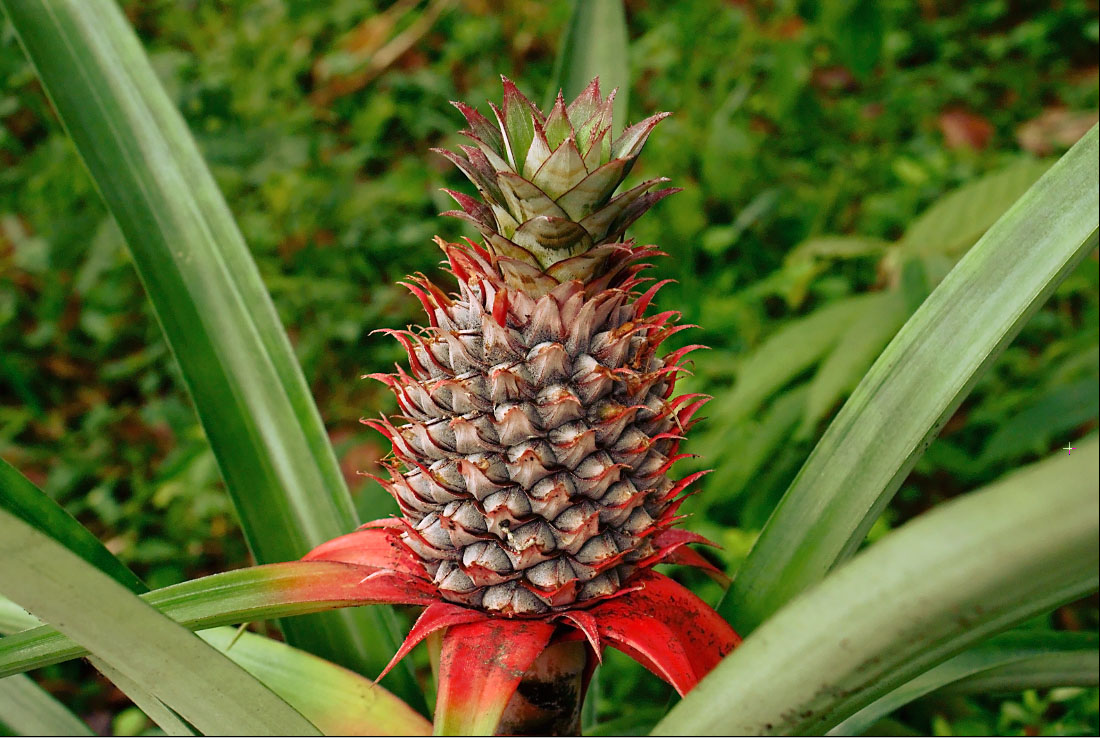
| A pineapple on its parent plant | |
Scientific classification 
| |
| Kingdom: | Plantae |
| Clade: | Tracheophytes |
| Clade: | Angiosperms |
| Clade: | Monocots |
| Clade: | Commelinids |
| Order: | Poales |
| Family: | Bromeliaceae |
| Genus: | Ananas |
| Species: | A. comosus
|
| Binomial name | |
| Ananas comosus | |
| Synonyms[1] | |
|
List
| |
The pineapple[2] (Ananas comosus) is a tropical plant with an edible fruit; it is the most economically significant plant in the family Bromeliaceae.[3]
The pineapple is indigenous to South America, where it has been cultivated for many centuries.[4] The introduction of the pineapple plant to Europe in the 17th century made it a significant cultural icon of luxury.[5] Since the 1820s, pineapple has been commercially grown in greenhouses and many tropical plantations. The fruit, particularly its juice, has diverse uses in cuisines and desserts.
Pineapples grow as a small shrub; the individual flowers of the unpollinated plant fuse to form a multiple fruit. The plant normally propagates from the offset produced at the top of the fruit[2] or from a side shoot, and typically matures within a year.[6]
Etymology
[edit]

The words, pine apple, first referred to the cone (fruit) of the pine tree in the 14th century.[7] This name convention occurred because medieval botanists called any unfamiliar tree fruit an apple if it had a firm, round shape.[7]
The generic name, pineapple, derived from a language of the indigenous people of Brazil, and by Gonzalo Hernandez Oviedo who described the piñas or pomme de pin (apple of pine) in Hispaniola around 1540.[4] The first reference in English to the pineapple fruit was the 1568 translation from the French of André Thevet's The New Found World, or Antarctike where he refers to a Hoyriri, a fruit cultivated and eaten by the Tupinambá people, living near modern Rio de Janeiro, and now believed to be a pineapple.[4] Later in the same English translation, Thavet described the fruit as a "Nana made in the manner of a Pine apple", where he used another Tupi word nanas.[8] When it was first discovered by explorers, the Tupi-Guarani and Carib people used it as a staple food with the name, nanas, meaning "excellent fruit".[5] This usage was adopted in many European languages and led to the plant's scientific binomial Ananas comosus, where comosus ('tufted') refers to the stem of the plant.[4]
In 1624, English explorer John Smith was one of the first to use the name "pineapple" referring to the tropical fruit, possibly because the naming practice for any newly-encountered, roundish fruit at that time was to call it an apple.[7]
Description
[edit]


The pineapple is a herbaceous perennial, which grows to 1 to 1.5 m (3+1⁄2 to 5 ft) tall on average, although sometimes it can be taller. The plant has a short, stocky stem with tough, waxy leaves. When creating its fruit, it usually produces up to 200 flowers, although some large-fruited cultivars can exceed this. Once it flowers, the individual fruits of the flowers join together to create a multiple fruit. After the first fruit is produced, side shoots (called 'suckers' by commercial growers) are produced in the leaf axils of the main stem. These suckers may be removed for propagation, or left to produce additional fruits on the original plant.[6] Commercially, suckers that appear around the base are cultivated. It has 30 or more narrow, fleshy, trough-shaped leaves that are 30 to 100 cm (1 to 3+1⁄2 ft) long, surrounding a thick stem; the leaves have sharp spines along the margins. In the first year of growth, the axis lengthens and thickens, bearing numerous leaves in close spirals. After 12 to 20 months, the stem grows into a spike-like inflorescence up to 15 cm (6 in) long with over 100 spirally arranged, trimerous flowers, each subtended by a bract.
In the wild, pineapples are pollinated primarily by hummingbirds.[2][9] Certain wild pineapples are foraged and pollinated at night by bats.[10] Under cultivation, because seed development diminishes fruit quality, pollination is performed by hand, and seeds are retained only for breeding.[2] In Hawaii, where pineapples were cultivated and canned industrially throughout the 20th century,[11] importation of hummingbirds was prohibited.[12]
The ovaries develop into berries, which coalesce into a large, compact, multiple fruit. The fruit of a pineapple is usually arranged in two interlocking helices, often with 8 in one direction and 13 in the other, each being a Fibonacci number.[13]
The pineapple carries out CAM photosynthesis,[14] fixing carbon dioxide at night and storing it as the acid malate, then releasing it during the day, aiding photosynthesis.
Taxonomy
[edit]The pineapple comprises five botanical varieties, formerly regarded as separate species.[15] The genomes of three varieties, including the wild progenitor variety bracteatus, have been sequenced.[16]
| Image | Varieties | Distribution |
|---|---|---|
 |
Ananas comosus var. bracteatus (L.B.Sm.) Coppens & F.Leal | Brazil, Bolivia, Argentina, Paraguay, Ecuador |
 |
Ananas comosus var. comosus (Linnaeus) Merrill | Brazil and Paraguay; naturalized in parts of Asia, Africa, Australia, Mexico, Central America, the West Indies, northern South America, and various islands in the Pacific |
.JPG) |
Ananas comosus var. erectifolius (L.B.Sm.) Coppens & F.Leal | Peru, Ecuador, Colombia, Venezuela, northern Brazil, French Guiana |
 |
Ananas comosus var. microstachys (Mez) L.B.Sm. | from Costa Rica to Paraguay |
| Ananas comosus var. parguazensis (Camargo & L.B.Sm.) Coppens & F.Leal | Colombia, Venezuela, northern Brazil, Guyana, French Guiana |
History
[edit]Precolonial cultivation
[edit]The wild plant originates from the Paraná–Paraguay River drainages between southern Brazil and Paraguay.[2][17][18][19] Little is known about its domestication, but it spread as a crop throughout South America. Archaeological evidence of use is found as far back as 1200–800 BC (3200–2800 BP) in Peru[20] and 200 BC – 700 AD (2200–1300 BP) in Mexico,[21] where it was cultivated by the Mayas and the Aztecs.[22] By the late 1400s, cropped pineapple was widely distributed and a staple food of Native Americans. The first European to encounter the pineapple was Christopher Columbus, in Guadeloupe on 4 November 1493.[5][23][24] The Portuguese took the fruit from Brazil and introduced it into India by 1550.[25] The 'Red Spanish' cultivar was also introduced by the Spanish from Latin America to the Philippines, and it was grown to produce piña fibers that would then be used to produce textiles from at least the 17th century.[26]
Columbus brought the plant back to Spain and called it piña de Indes, meaning "pine of the Indians". The pineapple was documented in Peter Martyr's Decades of the New World (1516) and Antonio Pigafetta's Relazione del primo viaggio intorno al mondo (1524–1525), and the first known illustration was in Oviedo's Historia General de Las Indias (1535).[27]
Old World introduction
[edit].jpg)
While the pineapple fascinated Europeans as a fruit of colonialism,[28] it was not successfully cultivated in Europe until Pieter de la Court (1664–1739) developed greenhouse horticulture near Leiden.[29][24] Pineapple plants were distributed from the Netherlands to English gardeners in 1719 and French ones in 1730.[24] In England, the first pineapple was grown at Dorney Court, Dorney in Buckinghamshire, and a huge "pineapple stove" to heat the plants was built at the Chelsea Physic Garden in 1723.[30][31] In France, King Louis XV was presented with a pineapple that had been grown at Versailles in 1733. In Russia, Peter the Great imported de la Court's method into St. Petersburg in the 1720s; in 1730, twenty pineapple saplings were transported from there to a greenhouse at Empress Anna's new Moscow palace.[32][33]
_(NYPL_b14444147-1125000).jpg)
Because of the expense of direct import and the enormous cost in equipment and labour required to grow them in a temperate climate, in greenhouses called "pineries", pineapple became a symbol of wealth. They were initially used mainly for display at dinner parties, rather than being eaten, and were used again and again until they began to rot.[35] In the second half of the 18th century, the production of the fruit on British estates became the subject of great rivalry between wealthy aristocrats.[35] John Murray, 4th Earl of Dunmore, built a hothouse on his estate surmounted by a huge stone cupola 14 metres tall in the shape of the fruit; it is known as the Dunmore Pineapple.[36] In architecture, pineapple figures became decorative elements symbolizing hospitality.[37][38][39]
Since the 19th century: mass commercialization
[edit]Many different varieties, mostly from the Antilles, were tried for European glasshouse cultivation. The most significant cultivar was "Smooth Cayenne", first imported to France in 1820, then subsequently re-exported to the United Kingdom in 1835, and then from UK, the cultivation spread via Hawaii to Australia and Africa. The "Smooth Cayenne" cultivar (and sub-selections or clones of the "Smooth Cayenne") make up for the majority of world pineapple production today.[24] Jams and sweets based on pineapple were imported to Europe from the West Indies, Brazil, and Mexico from an early date. By the early 19th century, fresh pineapples were transported direct from the West Indies in large enough quantities to reduce European prices.[24] Later pineapple production was dominated by the Azores for Europe, and Florida and the Caribbean for North America, because of the short trade routes.
The Spanish had introduced the pineapple into Hawaii in the 18th century[40] where it is known as the hala kahiki ("foreign hala"),[41][42] but the first commercial plantation was established in 1886. The most famous investor was James Dole, who moved to Hawaii in 1899[43] and started a 24-hectare (60-acre) pineapple plantation in 1900 which grew into the Dole Food Company.[44] Dole and Del Monte began growing pineapples on the island of Oahu in 1901 and 1917, respectively, and the Maui Pineapple Company began cultivation on Maui in 1909.[45] James Dole began the commercial processing of pineapple, and Dole employee Henry Ginaca invented an automatic peeling and coring machine in 1911.[24]

Hawaiian production started to decline from the 1970s because of competition and the shift to refrigerated sea transport. Dole ceased its cannery operations in Honolulu in 1991,[43] and in 2008, Del Monte terminated its pineapple-growing operations in Hawaii.[43] In 2009, the Maui Pineapple Company reduced its operations to supply pineapples only locally on Maui,[46] and by 2013, only the Dole Plantation on Oahu grew pineapples in a volume of about 0.1 percent of the world's production.[43] Despite this decline, the pineapple is sometimes used as a symbol of Hawaii.[43][11] Further, foods with pineapple in them are sometimes known as "Hawaiian" for this reason alone.[43]
In the Philippines, "Smooth Cayenne" was introduced in the early 1900s by the US Bureau of Agriculture during the American colonial period. Dole and Del Monte established plantations in the island of Mindanao in the 1920s; in the provinces of Cotabato and Bukidnon, respectively.[26][47] Large scale canning had started in Southeast Asia, including in the Philippines, from 1920. This trade was severely damaged by World War II, and Hawaii dominated the international trade until the 1960s.
The Philippines remain one of the top exporters of pineapples in the world. The Del Monte plantations are now locally managed, after Del Monte Pacific Ltd., a Filipino company, completed the purchase of Del Monte Foods in 2014.[48]
Composition
[edit]Nutrition
[edit]| Nutritional value per 100 g (3.5 oz) | |||||||||||||||||||||||||||||||||||||||||||||
|---|---|---|---|---|---|---|---|---|---|---|---|---|---|---|---|---|---|---|---|---|---|---|---|---|---|---|---|---|---|---|---|---|---|---|---|---|---|---|---|---|---|---|---|---|---|
| Energy | 209 kJ (50 kcal) | ||||||||||||||||||||||||||||||||||||||||||||
13.12 g | |||||||||||||||||||||||||||||||||||||||||||||
| Sugars | 9.85 g | ||||||||||||||||||||||||||||||||||||||||||||
| Dietary fiber | 1.4 g | ||||||||||||||||||||||||||||||||||||||||||||
0.12 g | |||||||||||||||||||||||||||||||||||||||||||||
0.54 g | |||||||||||||||||||||||||||||||||||||||||||||
| |||||||||||||||||||||||||||||||||||||||||||||
| Other constituents | Quantity | ||||||||||||||||||||||||||||||||||||||||||||
| Water | 86 g | ||||||||||||||||||||||||||||||||||||||||||||
| †Percentages estimated using US recommendations for adults,[49] except for potassium, which is estimated based on expert recommendation from the National Academies.[50] | |||||||||||||||||||||||||||||||||||||||||||||
Raw pineapple pulp is 86% water, 13% carbohydrates, 0.5% protein, and contains negligible fat (table). In a reference amount of 100 g (3.5 oz), raw pineapple supplies 209 kilojoules (50 kilocalories) of food energy, and is a rich source of manganese (40% of the Daily Value, DV) and vitamin C (53% DV), but otherwise contains no micronutrients in significant amounts (table).

Phytochemistry
[edit]Pineapple fruits and peels contain diverse phytochemicals, among which are polyphenols, including gallic acid, syringic acid, vanillin, ferulic acid, sinapic acid, coumaric acid, chlorogenic acid, epicatechin, and arbutin.[51][52]
Present in all parts of the pineapple plant,[53] bromelain is a mixture of proteolytic enzymes. It is present in stem, fruit, crown, core, leaves of pineapple itself.[54] Bromelain is under preliminary research for treatment of a variety of clinical disorders, but has not been adequately defined for its effects in the human body.[55] Bromelain may be unsafe for some users, such as in pregnancy, allergies, or anticoagulation therapy.[55]
Having sufficient bromelain content, raw pineapple juice may be useful as a meat marinade and tenderizer.[56] Although pineapple enzymes can interfere with the preparation of some foods or manufactured products, such as gelatin-based desserts or gel capsules,[57] their proteolytic activity responsible for such properties may be degraded during cooking and canning. The quantity of bromelain in a typical serving of pineapple fruit is probably not significant, but specific extraction can yield sufficient quantities for domestic and industrial processing.[56][58]
Varieties
[edit]Cultivars
[edit]Many cultivars are known.[2] The leaves of the commonly grown "Smooth Cayenne" cultivar and its various clones are smooth,[59] and it is the most commonly grown worldwide. Many cultivars have become distributed from its origins in Paraguay and the southern part of Brazil, and later improved stocks were introduced into the Americas, the Azores, Africa, India, Malaysia and Australia.[2] Varieties include:[citation needed]
- "Hilo" is a compact, 1.0- to 1.5-kg (2– to 3-lb) Hawaiian variant of smooth cayenne; the fruit is more cylindrical and produces many suckers, but no slips.
- "Kona sugarloaf", at 2.5 to 3.0 kg (5–6 lb), has white flesh with no woodiness in the center, is cylindrical in shape, and has a high sugar content but no acid; it has an unusually sweet fruit.
- "Natal queen", at 1.0 to 1.5 kg (2 to 3 lb), has golden yellow flesh, crisp texture, and delicate mild flavor; well-adapted to fresh consumption, it keeps well after ripening. It has spiny leaves and is grown in Australia, Malaysia, and South Africa.
- "Pernambuco" ("eleuthera") weighs 1–2 kg (2–4 lb), and has pale yellow to white flesh. It is sweet, melting in texture, and excellent for eating fresh; it is poorly adapted for shipping, has spiny leaves, and is grown in Latin America.
- "Red Spanish", at 1–2 kg (2–4 lb), has pale yellow flesh with a pleasant aroma, is squarish in shape, and well-adapted for shipping as fresh fruit to distant markets; it has spiny leaves and is grown in Latin America and the Philippines. It was the original pineapple cultivar in the Philippines grown for their leaf fibers (piña) in the traditional Philippine textile industry.[26][47]
- "Smooth cayenne", a 2.5- to 3.0-kg (5- to 6-lb), pale yellow– to yellow-fleshed, cylindrical fruit with high sugar and acid content, is well-adapted to canning and processing; its leaves are without spines. It is an ancient cultivar developed by Amerind peoples.[60] In some parts of Asia, this cultivar is known as Sarawak, after an area of Malaysia in which it is grown.[61] It is one of the ancestors of cultivars "73-50" (also called "MD-1" and "CO-2") and "73–114" (also called "MD-2").[60] Smooth cayenne was previously the variety produced in Hawaii, and the most easily obtainable in U.S. grocery stores, but was replaced over the course of the mid-1990s and 2000s by MD-2.[60] The success of Del Monte's MD-2 caused Dole to obtain & grow its own MD-2 pineapples, leading to Del Monte Fresh Produce Co. v. Dole Food Co.
- Some Ananas species are grown as ornamentals for color, novel fruit size, and other aesthetic qualities.
In the US, in 1986, the Pineapple Research Institute was dissolved and its assets divided between Del Monte and Maui Land and Pineapple. Del Monte took cultivar '73–114', dubbed 'MD-2', to its plantations in Costa Rica, found it to be well-suited to growing there, and launched it publicly in 1996 as 'Gold Extra Sweet', while Del Monte also began marketing '73–50', dubbed 'CO-2', as 'Del Monte Gold'.[60] The Maui Pineapple Company began growing variety 73-50 in 1988 and named it Maui Gold.[62] The successor company to MPC, the Hali'imaile Pineapple Company continues to grow Maui Gold on the slopes of Haleakala.
-
 Pineapples in a greenhouse
 -
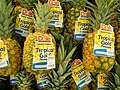 Tropical Gold cultivar
 -
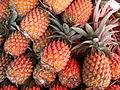 Victoria cultivar
 -
 Pineapples in a market, Nigeria
 -

.jpg)


.jpg)
Cultivation
[edit]
In commercial farming, flowering can be induced artificially, and the early harvesting of the main fruit can encourage the development of a second crop of smaller fruits. Once removed during cleaning, the top of the pineapple can be planted in soil and a new plant will grow. Slips and suckers are planted commercially.[2]
Storage and transport
[edit]Some buyers prefer green fruit, others ripened or off-green. A plant growth regulator, Ethephon, is typically sprayed onto the fruit one week before harvest, developing ethylene, which turns the fruit golden yellow. After cleaning and slicing, a pineapple is typically canned in sugar syrup with added preservative.[2] A pineapple never becomes any riper than it was when harvested since it is a non-climacteric fruit.[63][64]
Ethical and environmental concerns
[edit]Like most modern fruit production, pineapple plantations are highly industrialized operations. In Costa Rica particularly, the pineapple industry uses large amounts of insecticides to protect the crop, which have caused health problems in many workers. These workers often receive little compensation, and are mostly poor migrants, often Nicaraguan. Workers' wages also decrease every time prices are lowered overseas. In 2016, the government declared that it would be trying to improve the situation, with the help of various other groups.[65]
Historically, tropical fruit agriculture, such as for pineapples, has been concentrated in so-called "banana republics".[66][67]
Illegal drug trade
[edit]Export pineapples from Costa Rica to Europe are often used as a cover for narcotrafficking, and containers are impounded routinely in both locations.[68]
Expansion into protected areas
[edit]In Costa Rica, pineapple cultivation has expanded into the Maquenque, Corredor Fronterizo, Barra del Colorado and Caño Negro wildlife refuges, all located in the north of the country. As those are protected areas and not national parks, limited and restricted sustainable activities are allowed, however pineapple plantations are industrial operations and many of these do not have the proper license to operate in the protected areas, or were started before either the designation of the area, recent regulations or the creation of the environmental regulatory agency (Setena) in 1996. The agency has registers for around 358.5 ha (1.384 sq mi) of pineapple plantations operating within protected areas, but satellite imagery from 2018 reports around 1,659 ha (6.41 sq mi).[69]
Pests and diseases
[edit]Pineapples are subject to a variety of diseases, the most serious of which is wilt disease vectored by mealybugs[70] typically found on the surface of pineapples, but possibly in the closed blossom cups.[2] Other diseases include citrus pink disease, bacterial heart rot, anthracnose,[70] fungal heart rot, root rot, black rot, butt rot, fruitlet core rot, and yellow spot virus.[71] Pineapple pink disease (not citrus pink disease) is characterized by the fruit developing a brownish to black discoloration when heated during the canning process. The causal agents of pink disease are the bacteria Acetobacter aceti, Gluconobacter oxydans, Pantoea citrea[72][73] and Tatumella ptyseos.[74][75]
Some pests that commonly affect pineapple plants are scales, thrips, mites, mealybugs, ants, and symphylids.[71]
Heart-rot is the most serious disease affecting pineapple plants. The disease is caused by Phytophthora cinnamomi and P. parasitica, fungi that often affect pineapples grown in wet conditions. Since it is difficult to treat, it is advisable to guard against infection by planting resistant cultivars where these are available; all suckers that are required for propagation should be dipped in a fungicide, since the fungus enters through the wounds.[76]
Production
[edit] Indonesia Indonesia |
3.2 |
 Philippines Philippines |
2.9 |
 Costa Rica Costa Rica |
2.9 |
 Brazil Brazil |
2.4 |
 China China |
2.1 |
 Thailand Thailand |
1.3 |
| World | 29.6 |
| Source: FAOSTAT of the United Nations[77] | |
In 2023, world production of pineapples was 30 million tonnes, led by Indonesia, the Philippines, and Costa Rica, each producing about 3 million tonnes.[77]
Uses
[edit]
Culinary
[edit]The flesh and juice of the pineapple are used in cuisines around the world. In many tropical countries, pineapple is prepared and sold on roadsides as a snack. It is sold whole or in halves with a stick inserted. Whole, cored slices with a cherry in the middle are a common garnish on hams in the West. Chunks of pineapple are used in desserts such as fruit salad, as well as in some savory dishes, including Hawaiian pizza, or as a grilled ring on a hamburger. Traditional dishes that use pineapple include hamonado, afritada, kaeng som pla, and Hawaiian haystack. Crushed pineapple is used in yogurt, jam, sweets, and ice cream. The juice of the pineapple is served as a beverage, and it is also the main ingredient in cocktails such as piña colada and in the drink tepache.
In the Philippines, a traditional jelly-like dessert called nata de piña has also been produced since the 18th century. It is made by fermenting pineapple juice with the bacteria Komagataeibacter xylinus.[78]
Pineapple vinegar is an ingredient found in both Honduran and Filipino cuisine, where it is produced locally.[79] In Mexico, it is usually made with peels from the whole fruit, rather than the juice; however, in Taiwanese cuisine, it is often produced by blending pineapple juice with grain vinegar.[80][81]
The European Union consumed 50% of the global total for pineapple juice in 2012–2016. The Netherlands was the largest importer of pineapple juice in Europe. Thailand, Costa Rica and the Netherlands are the major suppliers to the European Union market in 2012–2016.[82] Countries consuming the most pineapple juice in 2017 were Thailand, Indonesia and the Philippines, having a combined consumption of 47% of the world total. The consumption of pineapple juice in China and India is low compared to their populations.[83]
Textiles
[edit]The 'Red Spanish' cultivar of pineapples were once extensively cultivated in the Philippines. The long leaves of the cultivar were the source of traditional piña fibers, an adaptation of the native weaving traditions with fibers extracted from abacá. These were woven into lustrous lace-like nipis fabrics usually decorated with intricate floral embroidery known as calado and sombrado. The fabric was a luxury export from the Philippines during the Spanish colonial period and gained favor among European aristocracy in the 18th and 19th centuries. Domestically, they were used to make the traditional barong tagalog, baro't saya, and traje de mestiza clothing of the Filipino upper class, as well as women's kerchiefs (pañuelo). They were favored for their light and breezy quality, which was ideal in the hot tropical climate of the islands. The industry was destroyed in the Second World War and is only starting to be revived.[26][47][84]
-
 1895 painting of a Filipina in traditional traje de mestiza dress
 -
 Calado embroidery on a barong tagalog
 -
 19th-century handkerchief
 -
 Frock coat, 1840–1849, Philippines


,_19th_century_(CH_18386747).jpg)

Houseplant
[edit]The variety A. comosus 'Variegatus' is occasionally grown as a houseplant. It needs direct sunlight and thrives at temperatures of 18 to 24 °C (64 to 75 °F), with a minimum winter temperature of 16 °C (61 °F). It should be kept humid, but the soil should be allowed to dry out between waterings. It has almost no resting period but should be repotted each spring until the container reaches 20 cm (8 in).[85]
See also
[edit]
References
[edit]- ^ "The Plant List: A Working List of All Plant Species". Archived from the original on 23 July 2021. Retrieved 25 July 2014.
- ^ a b c d e f g h i j Morton JF (1987). "Pineapple, Ananas comosus". In: Fruits of Warm Climates, New Crop Resource Online Program, Center for New Crops and Plant Products, Purdue University. pp. 18–28. Retrieved 2 August 2025.
- ^ Coppens d'Eeckenbrugge G, Leal F (2003). "Chapter 2: Morphology, Anatomy, and Taxonomy". In Bartholomew DP, Paull RE, Rohrbach KG (eds.). The Pineapple: Botany, Production, and Uses. Wallingford, UK: CABI Publishing. p. 21. ISBN 978-0-85199-503-8.
- ^ a b c d Grant JR, Zijlstra G (1998). "An Annotated Catalogue of the Generic Names of the Bromeliaceae (see Ananas)". Selbyana. 19 (1): 91–121. ISSN 0361-185X. JSTOR 41759978.
- ^ a b c Blakely J (28 January 2021). "The prickly meanings of the pineapple". Smithsonian Library and Archives. Retrieved 2 August 2025.
- ^ a b "Ananas comosus, pineapple". North Carolina State University Extension; Plant Toolbox. 2025. Retrieved 2 August 2025.
- ^ a b c "A pineapple is an apple (kind of). How did this tropical fruit get tied to the apple?". Word History, Merriam-Webster, Inc. 2025. Retrieved 2 August 2025.
- ^ Davidson A (2008). The Penguin Companion to Food. New York: Penguin Books. ISBN 978-0142001639. OCLC 50100633.
- ^ Stahl JM, Nepi M, Galetto L, et al. (2012). "Functional aspects of floral nectar secretion of Ananas ananassoides, an ornithophilous bromeliad from the Brazilian savanna". Annals of Botany. 109 (7): 1243–1252. doi:10.1093/aob/mcs053. PMC 3359915. PMID 22455992.
- ^ Aziz SA, Olival KJ, Bumrungsri S, et al. (2016). "The Conflict Between Pteropodid Bats and Fruit Growers: Species, Legislation and Mitigation". In Voigt C, Kingston T (eds.). Bats in the Anthropocene: Conservation of Bats in a Changing World. Springer. pp. 377–426. doi:10.1007/978-3-319-25220-9_13. ISBN 9783319252209. S2CID 111056244.
- ^ a b Bartholomew DP, Hawkins RA, Lopez JA (October 2012). "Hawaii Pineapple: The Rise and Fall of an Industry". HortScience. 47 (10): 1390–1398. doi:10.21273/HORTSCI.47.10.1390. Archived from the original on 30 November 2017.
- ^ "List of prohibited animals" (PDF). Government of Hawaii, Department of Agriculture. 28 November 2006. Retrieved 9 December 2017.
- ^ Jones J, Wilson W (2006). "Chapter 11: Science". An Incomplete Education. Ballantine. p. 544. ISBN 978-0-7394-7582-9.
- ^ Gibson AC. "Pineapple – The Plant That Ate Hawai'i". UCLA. Archived from the original on 4 March 2016.
- ^ Bartholomew DP, Paull RE, Rohrbach KG (2002). The Pineapple: Botany, Production, and Uses. CABI. p. 23. ISBN 9780851999791.
- ^ Ming R, VanBuren R, Wai CM, et al. (2015). "The pineapple genome and the evolution of CAM photosynthesis". Nature Genetics. 47 (12): 1435–1442. doi:10.1038/ng.3435. ISSN 1546-1718. PMC 4867222. PMID 26523774.
{{cite journal}}: CS1 maint: overridden setting (link) - ^ Bertoni, "Contributions a l'étude botanique des plantes cultivées. Essai d'une monographie du genre Ananas", Annales Cient. Paraguay (2nd series) 4 (by1919:250–322).
- ^ Baker, K. F.; Collins, J. L. (1939). "Notes on the distribution and ecology of Ananas and Pseudananas in South America". American Journal of Botany.
- ^ Collins. J. L. (1960). The pineapple: botany, utilization, cultivation. London: Leonard Hill.
- ^ Pearsall, Deborah M. (1992). "The Origins of Plant Cultivation in South America". In The Origins of Agriculture : An International Perspective. 173–205. Washington: Smithsonian Institution Press.
- ^ Callen, Eric O. (1967). "Analysis of the Tehuacan coprolites". The prehistory of the Tehuacan Valley 1: 261–289.
- ^ Pickersgill B (1976). "Pineapple". In Simmonds NW (ed.). Evolution of Crop Plants.
- ^ Morrison SE (1963). Journals and Other Documents of the Life of Christopher Columbus. Heritage Press.
- ^ a b c d e f Rohtbach GK, Leal F (2003). "Chapter 1: History, distributions and World Production". In Bartholomew DP, Paull RE, Rohrbach KG (eds.). The Pineapple: Botany, Production, and Uses. Wallingford, UK: CABI Publishing. p. 21. ISBN 978-0-85199-503-8.
- ^ Collingham L (2007). Curry: a Tale of Cooks and Conquerors. Oxford: Oxford University Press. ISBN 978-0-19-532001-5.
- ^ a b c d "History & Origin of Piña". Philippine Folklife Museum Foundation. Retrieved 13 December 2018.
- ^ Hayward W (1956). "The Pineapple meets the Press". The Bromeliad Society Bulletin. 6. Archived from the original on 19 March 2022. Retrieved 11 December 2019.
- ^ Cumo, Christopher (2015). Foods that Changed History: How Foods Shaped Civilization from the Ancient World to the Present. ABC-CLIO. p. 294.
- ^ "Pieter de La Court van der Voort". Oxford Index. Oxford University Press. Archived from the original on 16 December 2014. Retrieved 15 December 2014.
- ^ Beauman F (2005). The Pineapple: King of Fruits. London: Chatto & Windus. p. 82. ISBN 978-0-7011-7699-0.
- ^ Sheller, Mimi (2003). Consuming the Caribbean: From Arawaks to Zombies. Routledge. p. 80.
- ^ Johnson L (2019). "Pieter De La Court Van Der Voort and Innovations in Pineapple Cultivation in Early Eighteenth-Century Gardens" (PDF). Garden History. 47 (1). The Gardens Trust: 23–41. JSTOR 26756806. Retrieved 4 April 2025.
- ^ Kuznetsova S (10 December 2022). Культура ананасов приняла громадные размеры в Петербурге [The Pineapple Cultivation Took Enormous Scale in St. Petersburg]. Kommersant (in Russian). Retrieved 10 March 2023. (The article title is a citation from an earlier history work and refers to mid-18th century.)
- ^ "Bromeliad Society of Greater Chicago" (PDF). The BSGC News. May–June 2012. Retrieved 17 November 2022.
- ^ a b Beauman (2005), p. 87.
- ^ Stevenson, Jack (1995). Exploring Scotland's Heritage: Glasgow, Clydesdale, and Stirling. Her Majesty's Stationery Office. p. 83.
- ^ Curl, James Stevens (2003). Classical Architecture: An Introduction to Its Vocabulary and Essentials, with a Select Glossary of Terms. W. W. Norton. p. 206.
- ^ Hugh Morrison (1952). Early American Architecture: From the First Colonial Settlements to the National Period. Oxford University Press. p. 302.
- ^ Harris, Cyril Manton (1998). American Architecture: An Illustrated Encyclopedia. W. W. Norton. p. 248.
- ^ Matthews B, Wigsten P (9 February 2010). Kitchen Pro Series: Guide to Produce Identification, Fabrication and Utilization. Cengage Learning. p. 269. ISBN 978-1-4354-0121-1.
- ^ Anderson BP (July 2018). "Hala Kahiki: A Brief History of Pineapple and Pineapple Pavlova Recipe". Ke Ola Magazine. Retrieved 27 July 2021.
- ^ Hitch TK (1992). Islands in Transition: The Past, Present, and Future of Haiwaii's Economy. University of Hawaii Press. p. 99. ISBN 978-0-8248-1498-4.
- ^ a b c d e f Rhodes J (20 March 2013). "It's Pineapple Season, But Does Your Fruit Come From Hawaii?". Smithsonian Magazine. Retrieved 2 August 2025.
- ^ "Pineapple". Faculty.ucc.edu. Archived from the original on 21 December 2009. Retrieved 6 December 2009.
- ^ "Sunrise, Sunset". Hawaii Business. 46 (2): 60. 2000.
- ^ Kubota GT (24 December 2009). "Maui Pineapple harvests final crop". Honolulu Star-Bulletin. Retrieved 9 November 2010.
- ^ a b c Ewbank A (6 September 2018). "This Prized Filipino Fabric Is Made From Pineapple Leaves". Gastro Obscura. Retrieved 13 December 2018.
- ^ Sison IC (13 August 2015). SEC Form 17-A (Report). Philippine Stock Exchange. Archived from the original on 9 January 2017. Retrieved 18 January 2019.
- ^ United States Food and Drug Administration (2024). "Daily Value on the Nutrition and Supplement Facts Labels". FDA. Archived from the original on 27 March 2024. Retrieved 28 March 2024.
- ^ "TABLE 4-7 Comparison of Potassium Adequate Intakes Established in This Report to Potassium Adequate Intakes Established in the 2005 DRI Report". p. 120. In: Stallings VA, Harrison M, Oria M, eds. (2019). "Potassium: Dietary Reference Intakes for Adequacy". Dietary Reference Intakes for Sodium and Potassium. pp. 101–124. doi:10.17226/25353. ISBN 978-0-309-48834-1. PMID 30844154. NCBI NBK545428.
- ^ Li T, Shen P, Liu W, et al. (2014). "Major Polyphenolics in Pineapple Peels and their Antioxidant Interactions". International Journal of Food Properties. 17 (8): 1805. doi:10.1080/10942912.2012.732168. S2CID 84410846.
- ^ Ogawa EM, Costa HB, Ventura JA, et al. (2018). "Chemical profile of pineapple cv. Vitória in different maturation stages using electrospray ionization mass spectrometry". Journal of the Science of Food and Agriculture. 98 (3): 1105–1116. Bibcode:2018JSFA...98.1105O. doi:10.1002/jsfa.8561. PMID 28722812.
{{cite journal}}: CS1 maint: overridden setting (link) - ^ Arshad ZI, Amid A, Yusof F, et al. (2014). "Bromelain: an overview of industrial application and purification strategies" (PDF). Appl Microbiol Biotechnol. 98 (17): 7283–97. doi:10.1007/s00253-014-5889-y. PMID 24965557. S2CID 824024.
- ^ Mohan R, Sivakumar V (March 2016). "Optimisation of Bromelain Enzyme Extraction from Pineapple (Ananas comosus) and Application in Process Industry".
- ^ a b "Bromelain". US National Institutes of Health. May 2020. Retrieved 15 September 2020.
- ^ a b Chaurasiya RS, Sakhare PZ, Bhaskar N, et al. (2015). "Efficacy of reverse micellar extracted fruit bromelain in meat tenderization". J Food Sci Technol. 52 (6): 3870–80. doi:10.1007/s13197-014-1454-z. PMC 4444899. PMID 26028772.
- ^ Marques MR (2014). "Enzymes in the dissolution testing of gelatin capsules". AAPS PharmSciTech. 15 (6): 1410–6. doi:10.1208/s12249-014-0162-3. PMC 4245433. PMID 24942315.
- ^ Arshad ZI, Amid A, Yusof F, et al. (2014). "Bromelain: an overview of industrial application and purification strategies" (PDF). Appl Microbiol Biotechnol. 98 (17): 7283–97. doi:10.1007/s00253-014-5889-y. PMID 24965557. S2CID 824024.
- ^ Kochhar SL (2006). "Economic Botany in the Tropics". Nature. 144 (3647): 203. Bibcode:1939Natur.144..563.. doi:10.1038/144563a0. ISBN 978-0-333-93118-9. S2CID 4134696.
- ^ a b c d Duane P. Bartholomew (2009). "'MD-2' Pineapple Transforms the World's Pineapple Fresh Fruit Export Industry" (PDF). Pineapple News. 16: 2–5. Retrieved 3 September 2014.
- ^ "Pineapple – Common Varieties". International Tropical Fruits Network. 10 May 2016. Retrieved 4 April 2025.
- ^ "Why does Maui Gold pineapple taste so good?". Archived from the original on 21 May 2022.
- ^ Sheraton M (21 April 1982). "A guide to choosing a ripe pineapple". The New York Times.
- ^ Kitinoja L, Barrett D (15 July 2015). "Extension of Small-Scale Postharvest Horticulture Technologies—A Model Training and Services Center". Agriculture. 5 (3): 441–455. Bibcode:2015Agric...5..441K. doi:10.3390/agriculture5030441. ISSN 2077-0472.
- ^ "Costa Rica's Pineapple Industry Promises to Become More Responsible". 10 March 2016. Retrieved 29 November 2021.
- ^ Chapman P (2009). Jungle capitalists : a story of globalisation, greed and revolution. Edinburgh New York: Canongate. p. 6. ISBN 978-1847676863.
- ^ Big Fruit Archived 2017-03-13 at the Wayback Machine, NY Times
- ^ "Costa Rica seizes two tons of cocaine hidden with pineapples". Tico Times. AFP. 5 February 2021. Retrieved 17 April 2021.
- ^ Rodríguez S (16 April 2021). "Piñas en la mira: el monocultivo que se coló dentro de las áreas protegidas de Costa Rica". redprensaverde.org (in Spanish). Costa Rica. Retrieved 17 April 2021.
- ^ a b "Diseases of Pineapple (Ananas comosus (L.) Merr.)". American Phytopathological Society. Archived from the original on 30 November 2011. Retrieved 28 March 2011.
- ^ a b "Pests and Diseases of Pineapple". Food Market Exchange. Archived 25 July 2011 at the Wayback Machine. Retrieved on 2 October 2011.
- ^ Cha JS, Pujol C, Dususin AR, et al. (1997). "Studies on Pantoea citrea, the causal agent of pink disease of pineapple". Journal of Phytopathology. 145 (7): 313–319. Bibcode:1997JPhyt.145..313C. doi:10.1111/j.1439-0434.1997.tb00407.x.
- ^ Pujol CJ, Kado CI (1999). "gdhB, a gene encoding a second quinoprotein glucose dehydrogenase in Pantoea citrea, is required for pink disease of pineapple". Microbiology. 145 (5): 1217–1226. doi:10.1099/13500872-145-5-1217. PMID 10376838.
- ^ Marin-Cevada V, Caballero-Mellado J, Bustillos-Cristales R, et al. (2010). "Tatumella ptyseos, an unrevealed causative agent of Pink disease in pineapple". Journal of Phytopathology. 158 (2): 93–99. Bibcode:2010JPhyt.158...93M. doi:10.1111/j.1439-0434.2009.01575.x.
- ^ Marín-Cevada V, Fuentes-Ramírez LE (2016). "Pink disease, a review of an asymptomatic bacterial disease in pineapple". Revista Brasileira de Fruticultura. 38 (3): e949. doi:10.1590/0100-29452016949.
- ^ Brickell C (1996). Encyclopedia of Gardening. London: Dorling Kindersley. p. 419. ISBN 978-1-85833-579-7.
- ^ a b "Pineapple production in 2023, Crops/Regions/World list/Production Quantity/Year (pick lists)". UN Food and Agriculture Organization, Corporate Statistical Database (FAOSTAT). 2025. Retrieved 2 August 2025.
- ^ Vergara BS, Idowu PM, Sumangil JH (1999). Nata de Coco: A Filipino Delicacy (PDF). National Academy of Sciences and Technology, Philippines. ISBN 9718538615. Archived from the original (PDF) on 28 June 2021. Retrieved 28 October 2019.
- ^ Clutton A (7 March 2019). The Vinegar Cupboard: Recipes and history of an everyday ingredient. Bloomsbury. p. 57. ISBN 9781472958105. Retrieved 3 February 2020.
- ^ Chang RC (29 August 2009). Vinegars of the World. Springer. p. 228. ISBN 9788847008663. Retrieved 3 February 2020.
- ^ Kennedy D. The Essential Cuisines of Mexico: A Cookbook. p. 496.
- ^ "Exporting pineapple juice to Europe". CBI Ministry of Foreign Affairs. Retrieved 22 May 2019.
- ^ "Population growth drives gradual expansion of pineapple juice market". Archived 27 May 2020 at the Wayback Machine AgriOrbit. Retrieved 22 May 2019.
- ^ "Piña cloth". Free Online Dictionary. 2023. Retrieved 6 November 2014.
- ^ Chiusoli A, Boriani LM (1986). "Ananas comosus 'Variegatus'". Simon & Schuster's guide to houseplants. New York: Simon and Schuster. ISBN 0671631314.
Bibliography
[edit]- Menzel, Christopher. "Tropical and Subtropical Fruit". Encyclopedia of Agricultural Science Volume 4. ISBN 0122266706. Charles J Arntzen. New York: Elsevier Science Publishing Co. Inc., Academic Press, 2012. 380–382.
| Species |  | |
|---|---|---|
| Topics | ||


| State symbols | |
|---|---|
| Topics | |
| Government | |
| Districts | |
| Cities and towns | |
| Education | |
| Culture | |

| International | |
|---|---|
| National | |
| Other | |

Pineapple
View on GrokipediaTaxonomy and Morphology
Botanical Classification
The pineapple is scientifically classified as Ananas comosus (L.) Merr., a species in the genus Ananas of the family Bromeliaceae.[8][9] This family encompasses monocotyledonous flowering plants primarily native to the Americas, with A. comosus distinguished as the sole major economically cultivated member, comprising a terrestrial herbaceous perennial adapted to tropical environments.[10] In the modern phylogenetic system, the taxonomic hierarchy of A. comosus is:- Kingdom: Plantae
- Clade: Tracheophytes
- Clade: Angiosperms
- Clade: Monocots
- Order: Poales
- Family: Bromeliaceae
- Subfamily: Bromelioideae
- Genus: Ananas Mill.
- Species: Ananas comosus (L.) Merr. [9][10]
Physical Characteristics and Growth Habits
The pineapple plant (Ananas comosus) is a perennial herbaceous bromeliad featuring a short, stout stem that supports a basal rosette of 30 to 40 stiff, succulent, sword-shaped leaves. These leaves, measuring 60 to 90 cm in length and 5 to 8 cm in width, are narrow, channeled, and bear sharp spines along their margins and at the tips, with a waxy cuticle that facilitates water retention in arid conditions.[2] [13] Plants typically attain heights of 0.5 to 1.5 meters, including the emerging fruit stalk, and spread 1 to 1.5 meters wide through basal branching or ratooning.[14] [15] Reproduction occurs primarily through vegetative means, as most cultivated varieties produce few or no viable seeds due to self-incompatibility and parthenocarpy. Propagation relies on crowns (leafy tops of harvested fruits), slips (from the fruit peduncle), or suckers (from the base or stem), which root readily in moist conditions and develop into mature plants capable of fruiting.[2] The inflorescence emerges from the rosette center as a spike-like structure bearing 100 to 200 small, perfect, tubular flowers, often violet or red, which fuse post-fertilization (or develop parthenocarpically) into a syncarpium—a composite fruit composed of up to 200 individual berries atop a fleshy core, crowned by a smaller rosette of leaves.[13] [16] Pineapples exhibit CAM (Crassulacean acid metabolism) photosynthesis, opening stomata nocturnally to minimize water loss, which suits their adaptation to tropical but seasonally dry environments. Optimal growth demands full sun, temperatures consistently above 15°C (with ideal ranges of 20-30°C), and well-drained, sandy loam soils of pH 5.0 to 6.5 to prevent root rot from excess moisture.[17] Plants flower 12 to 20 months after planting, with fruit maturation requiring an additional 5 to 6 months, yielding one primary fruit per plant followed by potential ratoon crops from basal shoots.[2] In cultivation, spacing of 30-60 cm between plants accommodates their clumping habit and facilitates mechanical harvesting in commercial fields.[14]Etymology and History
Origins of the Name
The English term "pineapple" combines "pine," referring to the resemblance of the fruit's scaly exterior to a pine cone, with "apple," a suffix medieval European botanists applied to various unfamiliar firm, roundish fruits borne on trees or woody plants.[18] The compound word first appeared in English in the late 14th century to denote pine cones themselves.[19] By the 1660s, following European contact with the fruit, "pineapple" shifted to primarily describe the tropical plant's multiple fruit aggregate, displacing its earlier usage except in specific contexts like pine cone references.[19] European explorers encountered the pineapple during Christopher Columbus's second voyage in 1493 on the island of Guadeloupe, where expedition members named it piña de Indias ("pine cone of the Indies" in Spanish) due to its conical shape and textured surface evoking a pine cone.[20] This Spanish descriptor influenced English adoption, as the fruit's appearance prompted translators and naturalists to adapt the existing "pineapple" term rather than borrow directly from indigenous languages.[20] In contrast, the pineapple's scientific binomial Ananas comosus derives from the Tupi-Guarani languages of indigenous South American peoples, particularly the Tupi of Brazil and Paraguay, where "nanas" or "ananas" denoted "excellent fruit" or "fragrant fruit," reflecting its esteemed status among pre-Columbian cultivators who domesticated the species around 1200–1600 CE in the Paraná-Paraguay River basin.[21] Portuguese colonizers, arriving in Brazil by 1500, transmitted variants of "ananas" to Europe, leading to its widespread adoption in over 40 languages globally, from French ananas to Hindi ananas, as the dominant international term.[22] English speakers, however, retained the descriptive "pineapple" likely due to linguistic conservatism and the pre-existing term's availability, bypassing the Tupi root despite awareness of it through early botanical texts.[23]Pre-Columbian Domestication
The pineapple (Ananas comosus), a member of the Bromeliaceae family, originated in the Paraná-Paraguay River basin of southern South America, encompassing regions of present-day southern Brazil, Paraguay, and northern Argentina.[24][1] Domestication likely began 6,000 to 10,000 years before present through selective propagation by indigenous groups, transforming wild progenitors such as Ananas ananassoides—which produce small, fibrous, seedy fruits—into larger, less fibrous varieties suitable for human consumption.[24][25] This process involved vegetative propagation via crowns or slips, favoring mutations for seedlessness and enhanced fruit size, traits that reduced dispersal dependency on seeds and improved edibility.[12] Archaeological evidence, including phytoliths and macroremains from coastal sites in Peru and Ecuador dated to approximately 1200–800 BCE, indicates early cultivation practices integrated into slash-and-burn agriculture systems.[25][26] Indigenous peoples, particularly the Tupi-Guarani linguistic groups, played a central role in domestication and initial dissemination, cultivating pineapples alongside staples like manioc and maize in shifting plots that leveraged the plant's adaptation to poor, acidic soils.[27][28] Selection pressures prioritized palatability, with early cultivars exhibiting reduced spines on leaves and lower fiber content compared to wild types, as inferred from genetic analyses of pre-Columbian landraces.[29] These groups valued the fruit for its juice, used in fermentation for beverages, and its medicinal properties against digestive ailments, though it held no prominent ceremonial role in documented ethnobotanical records.[30] Isolated Amazonian tribes, such as the Prospero encountered post-contact but practicing pre-Columbian methods, continued traditional cultivation, providing indirect evidence of longstanding practices untainted by European influence.[31] By the time of European contact in 1493, Tupi-Guarani migrations had spread domesticated pineapples northward through trade and relocation, reaching the Caribbean, Central America, and southern Mexico, where they were integrated into Mesoamerican agroecosystems by groups like the Maya and Aztecs around 750 BCE.[32][33] Genetic continuity between modern cultivars like 'Smooth Cayenne' and ancient varieties underscores this pre-Columbian diffusion, with seedless fruits already prevalent, negating claims of rapid post-contact development.[34] This dispersal pattern aligns with broader patterns of crop movement in the Americas, driven by human mobility rather than natural seed viability, given the pineapple's limited feral reproduction.[35]Transatlantic Introduction
Christopher Columbus encountered the pineapple (Ananas comosus) on November 4, 1493, during his second voyage to the Americas, specifically on the Caribbean island of Guadeloupe, where indigenous peoples cultivated the fruit.[36] [37] His crew noted its resemblance to a pine cone due to the fruit's scaly exterior and crown of leaves, leading to its initial naming as "piña de las Indias" in Spanish accounts.[38] Upon returning to Spain in 1496, Columbus transported specimens across the Atlantic, marking the first documented introduction of the pineapple to Europe, though many fruits spoiled en route owing to the lengthy sea voyage and lack of preservation methods.[39] [40] The pineapple's arrival elicited fascination in Europe for its exotic flavor and appearance, previously unknown in a continent lacking tropical fruits, positioning it as a rare delicacy symbolizing wealth and discovery.[41] However, transatlantic transport proved unreliable, with high spoilage rates necessitating the harvesting of unripe fruits, which limited viable imports to sporadic successes in the 16th century.[25] Early European botanists, such as Gonzalo Fernández de Oviedo, documented the plant in writings and illustrations by 1526, aiding dissemination of knowledge but not resolving cultivation challenges in temperate climates.[42] Portuguese explorers, leveraging trade routes from Brazil, facilitated further introductions by the mid-16th century, transporting pineapples to African coasts and eventually integrating them into European hothouse experiments, though widespread availability remained elusive until greenhouse advancements in the 17th century.[43] These initial crossings underscored the pineapple's role in early colonial exchanges, transforming a New World staple into a coveted status symbol amid logistical hurdles imposed by oceanic distances and perishable biology.[44]Industrial-Scale Commercialization
Industrial-scale pineapple commercialization originated in Hawaii, where the first commercial plantation was established in 1885 on Oahu.[45] In 1901, James Drummond Dole founded the Hawaiian Pineapple Company on 60 acres in Wahiawa, Oahu, marking the start of organized large-scale production and processing.[46] This venture introduced mechanized canning techniques, including the Ginaca machine invented by company engineer Henry Ginaca between 1911 and 1919, which automated peeling and coring to enable mass production of canned pineapple.[47] By the early 20th century, Hawaii's industry expanded rapidly, with major firms like Dole, Del Monte, and Maui Land and Pineapple dominating U.S. markets by 1909.[33] Hawaii led global canned pineapple output from the 1920s to 1960s, peaking mid-century with eight operating companies and controlling much of the trade despite wartime disruptions in Southeast Asia.[48] [49] Rising labor and land costs in Hawaii prompted industry relocation starting in the 1960s, with companies like Dole expanding plantations to the Philippines in the 1920s and Del Monte to Costa Rica.[50] These shifts leveraged lower production expenses and favorable climates, transforming the Philippines and Costa Rica into export powerhouses for both canned and fresh fruit.[51] Today, pineapple production is highly industrialized globally, with 2023 output reaching approximately 29.96 million metric tons.[52] Leading producers include Indonesia (3.2 million tons in 2022), the Philippines (2.9 million tons), Costa Rica (2.9 million tons), and Brazil (2.3 million tons), focusing on export-oriented plantations using intensive farming methods.[6] Costa Rica dominates fresh pineapple exports, accounting for about 49% of global value in 2023 at $1.2 billion.[53]Biochemical Composition
Macronutrients and Vitamins
Raw pineapple consists predominantly of water, comprising about 86% of its edible portion by weight per 100 grams.[54] Its macronutrient profile is low in caloric density at 50 kcal per 100 grams, with carbohydrates serving as the primary energy source at 13.1 grams, including 9.9 grams of sugars (mainly fructose, glucose, and sucrose) and 1.4 grams of dietary fiber. Protein contributes 0.5 grams, while total fat is minimal at 0.1 grams, rendering pineapple a low-fat fruit suitable for calorie-restricted diets. For a 170-gram serving, pineapple provides approximately 85 kcal, 1 g protein, 22 g carbohydrates, and 0 g fat.[54][55][56]| Nutrient | Amount per 100 g | % Daily Value* |
|---|---|---|
| Energy | 50 kcal | 2% |
| Carbohydrates | 13.1 g | 5% |
| Sugars | 9.9 g | - |
| Fiber | 1.4 g | 5% |
| Protein | 0.5 g | 1% |
| Fat | 0.1 g | 0% |
Enzymes and Bioactive Compounds
Bromelain constitutes the primary group of enzymes in pineapple (Ananas comosus), comprising a mixture of cysteine proteases such as stem bromelain, fruit bromelain, ananain, and comosain, with proteolytic activity that hydrolyzes peptide bonds in proteins.[5] These enzymes are distributed throughout the plant, but concentrations are notably higher in the stem (up to several grams per kilogram of fresh weight) than in the edible fruit, where levels typically range from 0.1% to 1% of dry weight.[61] [5] The enzyme complex's activity is measured in gelatin digesting units (GDU), with fresh pineapple fruit averaging 500–2,000 GDU per gram, though processing like canning or juicing diminishes potency due to heat sensitivity.[62] Beyond bromelain, pineapple contains minor proteases including peroxidase and polyphenol oxidase, which contribute to post-harvest browning by oxidizing phenolics, but these lack the broad therapeutic profile of bromelain.[63] Bromelain's biochemical properties include anti-inflammatory effects via modulation of cytokines and prostaglandins, fibrinolytic action to dissolve clots, and antithrombotic activity by inhibiting platelet aggregation, supported by in vitro and animal studies demonstrating reduced edema and pain in models of arthritis and trauma.[61] Commercial extraction prioritizes stems for higher yields, yielding products standardized to 2,400 GDU per gram for applications in meat tenderizing, brewing clarification, and supplements.[5] Pineapple also harbors bioactive compounds, predominantly phenolic acids (e.g., ferulic, cinnamic, and gallic acids), flavonoids (e.g., myricetin, catechin), and organic acids, concentrated in the fruit peel, core, and crown rather than pulp.[64] [65] These compounds exhibit antioxidant capacity through free radical scavenging, with total phenolic content in peel extracts reaching 50–100 mg gallic acid equivalents per gram dry weight, surpassing pulp levels and correlating with ferric reducing antioxidant power assays.[63] In vitro studies attribute anti-microbial and anti-carcinogenic effects to these phenolics, such as inhibiting Escherichia coli growth and inducing apoptosis in colon cancer cells, though human bioavailability remains limited by gut metabolism.[66] Waste streams like peels, comprising 30–50% of fruit mass, represent untapped sources for these bioactives, with extraction yields enhanced by solvents like ethanol or enzymes.[66]Varieties and Genetics
Natural and Domesticated Diversity
The genus Ananas, native to South America, includes a small number of species characterized by rosette-forming herbaceous perennials with spineless or spiny leaves and aggregate fruits formed from fused berries. Brazil represents the primary center of genetic variation within the genus, hosting diverse wild populations suitable for ornamental and potential breeding uses. Taxonomic classifications recognize approximately seven species, including Ananas ananassoides, Ananas bracteatus, Ananas comosus, Ananas fritzmuelleri, Ananas lucidus, Ananas nanus, and Ananas parguazensis, though species boundaries remain debated due to hybridization potential and morphological overlaps. Wild species typically produce small, fibrous fruits with high acidity and low sugar content, adapted to forest understories or savannas, and often propagated by seeds or stolons in natural settings.[67] Domestication of pineapple (A. comosus) originated from wild progenitors, notably A. comosus var. microstachys, in southern South America around 6,000 to 10,000 years before present, with evidence of early selection by indigenous groups in regions encompassing modern Paraguay, southern Brazil, and northern Argentina. Genetic analyses reveal unidirectional gene flow from this wild variety into cultivated lines, supporting its role as a key ancestor, while other wild taxa like A. parguazensis contributed minor introgressions in Amazonian distributions. Unlike seed-propagated crops, pineapple's clonal reproduction via crowns, slips, or suckers enabled rapid fixation of desirable traits such as enlarged syncarps, reduced spines, and improved flavor, potentially achieving domestication in few propagation cycles rather than gradual generational shifts.[34][24][26] Cultivated pineapple exhibits narrow genetic diversity, reflecting centuries of vegetative propagation that minimizes recombination and preserves elite clones, with genome sequencing identifying 3.2 million variants dominated by rare alleles indicative of recent bottlenecks. Despite this, germplasm collections reveal polymorphisms enabling differentiation among varietal groups, such as 'Smooth Cayenne' and 'Mordilona', with molecular markers like SSRs confirming low but detectable heterozygosity levels averaging 0.4-0.6 across accessions. This constrained diversity heightens vulnerability to pests and environmental stresses, prompting breeding efforts to incorporate wild alleles for resilience, though commercial reliance on few cultivars perpetuates the clonal base. Studies of global germplasm underscore regional variations, with Asian and African landraces showing subtle adaptations from historical introductions, yet overall infraspecific structure traces to neotropical origins.[29][68][34]Principal Commercial Cultivars
The principal commercial cultivars of pineapple (Ananas comosus) are grouped into categories such as Cayenne, Queen, Spanish, and Pernambuco, with selections optimized for processing, fresh export, or local markets based on fruit size, flavor profile, fiber content, and shelf life.[69] Among these, 'Smooth Cayenne' and its derivatives remain dominant for global production, particularly in canning and juicing, while 'MD-2' has surged in fresh-market dominance since the late 1990s due to superior sweetness and transportability.[70] Other key varieties include 'Queen' and 'Red Spanish', suited to regional fresh consumption.[71] 'Smooth Cayenne', originating from French Guiana and introduced widely in the 19th century, produces cylindrical fruits weighing 1.8–4.5 kg with pale yellow, juicy flesh (12–16° Brix total soluble solids, 0.5–1.0% acidity) and low fiber, making it ideal for canning (accounting for about 70% of global processed output) and fresh sales despite a longer growth cycle of 18–20 months and susceptibility to pests.[70] It thrives in tropical regions like Hawaii, the Philippines, and Australia, where it forms the basis of large-scale plantations.[69] 'MD-2', a hybrid selection (clone '73-114') developed by Del Monte in Hawaii and commercialized in 1997 for Costa Rican plantations, yields uniform golden fruits of 1.5–2 kg with high sweetness (17° Brix), low acidity (0.4–0.45%), firm texture, and resistance to internal browning, enabling 50–55% of the global fresh export market (70–75% in Europe) and extended shelf life up to 12 months post-harvest.[70][72] Its 12-month maturation suits intensive farming but requires protection from Phytophthora root rot.[70] In the Queen group, cultivars like 'Mauritius' or 'Natal Queen' produce smaller conical fruits (0.45–2.25 kg) with deep yellow, aromatic, low-fiber flesh suited exclusively to fresh eating rather than processing, grown prominently in South Africa, Australia, and the Philippines for local and short-haul markets.[69][70] 'Red Spanish', from the Spanish group, features barrel-shaped fruits (0.8–2.7 kg) with fibrous, pale yellow pulp and spiny leaves, favored for fresh consumption in Latin America and the Caribbean due to drought tolerance, though less ideal for export.[70][71]| Cultivar | Fruit Weight (kg) | Key Traits | Primary Uses | Major Regions |
|---|---|---|---|---|
| Smooth Cayenne | 1.8–4.5 | Cylindrical, low fiber, mildly acidic | Canning, juice, fresh | Hawaii, Philippines, Australia |
| MD-2 | 1.5–2 | Golden, sweet, low acid, long shelf | Fresh export | Costa Rica, Central America |
| Queen (e.g., Mauritius) | 0.45–2.25 | Conical, aromatic, low fiber | Fresh local | South Africa, Australia |
| Red Spanish | 0.8–2.7 | Barrel-shaped, fibrous, drought-tolerant | Fresh local | Caribbean, Latin America |
Breeding Advancements
Pineapple breeding has historically emphasized cross-pollination to generate genetic variability, given the self-incompatibility in many cultivars that prevents successful self-fertilization.[73] Programs in regions like Hawaii, Brazil, and Australia have focused on selecting hybrids for traits such as disease resistance, fruit quality, and yield, with Hawaii's efforts yielding varieties more tolerant to pathogens including Phytophthora spp., pineapple wilt, nematodes, and pink disease compared to the Smooth Cayenne standard.[74] In Brazil, genetic improvement initiatives since the mid-20th century have incorporated taxonomic studies and hybridization to develop cultivars adapted to local conditions, including the 2003 release of 'IMPERIAL' (PE × SC-56 hybrid), which exhibits resistance to fusariosis (Fusarium spp.) while maintaining acceptable fruit quality.[75][76] Recent advancements incorporate mutagenesis and biotechnological approaches to accelerate trait improvement. Chemical mutagenesis has been applied to induce mutations in pineapple tissues for enhanced stress tolerance and quality, while genetic transformation protocols, refined since the late 1990s using embryogenic callus, target disease and insect resistance, flowering regulation, and fruit attributes like reduced internal browning.[77][78] In China, Taiwan's breeding programs have produced the "Tainong" hybrid series, prioritizing fruit quality and market competitiveness through systematic crossbreeding.[79] Australia's national pineapple breeding initiative, launched around 2018, aims for cultivars with consistent fruit size, superior disease resistance (e.g., to mealybug wilt), and resilience to environmental stressors, evaluating thousands of seedlings annually via phenotypic selection.[80] Molecular tools have enabled precise genetic enhancement, including genome-wide association studies (GWAS) identifying quantitative trait loci (QTL) for breeding traits like fruit weight and soluble solids content across diverse populations.[81] A 2025 Brazilian release, 'Unemat Rubi', exemplifies spineless hybrids selected via multivariate analysis for high fruit quality—featuring red peel, white flesh, and elevated sugars—and resistance to fusariosis, outperforming parents in yield and uniformity.[82] Commercial adoption of newer hybrids, such as Del Monte's 'Honey Glow' (noted for sweetness and low acidity), reached 18% of new plantings in key regions by 2024, reflecting market-driven progress in fresh fruit traits.[83] These developments address clonally propagated pineapple's limited natural variation, though inbreeding depression in lines like Smooth Cayenne underscores the need for broader germplasm integration.[34]Cultivation Methods
Environmental Requirements
Pineapple (Ananas comosus) thrives in tropical climates with average temperatures between 15°C and 32°C, showing optimal growth at 20°C to 30°C, though it is highly sensitive to frost and temperatures below 10°C can cause damage.[84][85] High humidity levels, typically above 50%, support vegetative development, while dry conditions may necessitate supplemental irrigation to prevent stunted growth.[12] The plant requires well-drained soils, preferably sandy loam or loamy types with high organic matter content, to avoid waterlogging that leads to root rot.[12] Optimal soil pH ranges from 4.5 to 6.5, with performance declining sharply above pH 7.0 due to reduced nutrient availability, particularly micronutrients like iron and manganese.[86][87] Slopes or raised beds enhance drainage in areas prone to heavy rainfall.[86] Annual rainfall of 1,000 to 1,500 mm distributed evenly supports growth, with a minimum of 500 to 600 mm requiring irrigation supplementation; excess precipitation over 3,000 mm complicates harvesting and increases disease risk.[86][88] Monthly rainfall below 50-100 mm often demands irrigation to maintain soil moisture without saturation.[89] Full sunlight exposure of at least 6-8 hours daily is essential for fruit development, as shaded conditions reduce yield and quality.[90] Pineapple cultivation is generally limited to altitudes below 1,000 meters, where temperatures remain consistently warm and frost-free.[85]Propagation and Field Management
Pineapples (Ananas comosus) are propagated vegetatively to ensure clonal uniformity and avoid genetic variability from seeds, which result from cross-pollination. Common planting materials include crowns (leafy tops detached from fruits), slips (shoots from the fruit peduncle base), suckers (axillary shoots from the lower stem), and hapas (similar to slips but smaller). Larger propagules such as slips and suckers promote faster growth and fruiting (12–15 months) compared to crowns (18–20 months).[17][14] Planting material is prepared by air-drying in shade for 1–2 days, fungicide treatment if needed, and trimming excess leaves to expose the base. Tissue culture from meristems enables rapid, disease-free multiplication for commercial scale-up, producing plantlets rooted in vitro before field transfer.[17][14] Propagation from seeds is possible but uncommon and time-consuming, as most commercial pineapples are seedless and propagated vegetatively from crowns, slips, or suckers. Seeds are rare in store-bought fruits and usually obtained from cross-pollinated or wild varieties. The process involves extracting fresh seeds from a ripe pineapple containing seeds, removing pulp, rinsing, and drying them. Seeds are planted shallowly in well-draining, moist seed-starting mix and kept at warm temperatures (24–29°C) with high humidity and bright, indirect light. Germination can take 2–8 weeks or longer, sometimes months. Seedlings are transplanted when large enough, provided with full sun, regular watering, and fertilizer. Fruiting may take 2–5 years or more, and offspring may not produce fruit identical to the parent due to genetic variation. Most experts recommend growing from the crown of a fresh pineapple for faster results (1–3 years to fruit). Field preparation entails deep tillage to create friable soil to at least 60 cm depth, incorporation of organic matter for fertility, and fumigation with nematicides like ethylene dibromide if nematode pressures are high. Raised beds (20 cm high, 122 cm centers) are formed in poorly drained areas, covered with black polyethylene mulch (90 cm wide) to suppress weeds, conserve moisture, and warm soil. Planting occurs in double rows per bed, at densities of 50,000–75,000 plants per hectare for optimal yield, with intra-row spacing of 28–30 cm, inter-row 55–60 cm, and bed spacing accommodating machinery.[14][91] Nutrient management prioritizes nitrogen (N) and potassium (K), with total annual applications of 450 kg/ha N and 400 kg/ha K in split doses aligned to vegetative, flowering, and fruiting stages; phosphorus (75 kg/ha P₂O₅) is added preplant if soil tests show deficiency, alongside magnesium (25 kg/ha), zinc (2 kg/ha), and foliar iron as needed. Drip irrigation under mulch supplies 47,000–94,000 liters/ha/week, calibrated to evapotranspiration and rainfall, with initial overhead watering for crown-planted fields in arid conditions to prevent desiccation.[14] Weed control integrates plastic mulching within beds to eliminate intra-row competition and preemergence herbicides (e.g., bromacil, ametryn) between beds, reducing manual weeding and erosion risks. Mulch also moderates soil temperature and retains moisture, supporting root development in the first 3–4 months when plants grow slowly. Ratoon crops, emerging from the harvested stump, are managed similarly for 1–2 cycles before replanting, yielding smaller but viable fruits with adjusted fertilization.[14][17]Pest and Disease Control
Pineapple cultivation faces significant challenges from insect pests and pathogens, which can reduce yields by damaging roots, foliage, stems, and fruit, often exacerbating one another through secondary infections or vectoring. Major pests include mealybugs (Dysmicoccus brevipes), which feed on phloem sap, excrete honeydew attracting ants, and transmit mealybug wilt-associated viruses leading to plant stunting and death; scale insects (Diaspis bromeliae), causing yellowing and dieback; and nematodes such as reniform (Rotylenchulus reniformis) and root-knot (Meloidogyne spp.), which lesion roots and impair nutrient uptake.[92][93][94] Diseases predominate as fungal and bacterial rots, including Phytophthora heart rot (Phytophthora parasitica), which invades the growing point under cool, wet conditions and ammoniacal nitrogen fertilization, resulting in blackened, necrotic tissue; butt rot at the stem base from fungi like Fusarium spp. and Pythium, leading to toppling; and Fusarium fruitlet core rot (Fusarium guttiforme), entering via open flowers or wounds to cause internal fruit discoloration.[95][96][97] Effective control relies on integrated pest management (IPM) emphasizing cultural, biological, and targeted chemical measures to minimize resistance and environmental impact. For mealybugs, ant control via granular baits containing fipronil or hydramethylnon disrupts mutualism, promoting parasitoids like Acerophagus spp. and reducing populations by over 90% in field trials without direct insecticides.[93][92] Nematode suppression involves pre-plant soil fumigation with metam sodium at 300-600 L/ha and crop rotation with non-hosts like grasses, achieving 70-80% efficacy in Hawaiian plantations.[93] Weed management through mulching and herbicides prevents alternate hosts for pests like symphylids, while ecological engineering—planting nectar-rich borders to attract predators—enhances natural enemy populations.[98] Pathogen control prioritizes sanitation and site preparation. Planting material (crowns, slips, suckers) is dipped in fungicides like metalaxyl or fosetyl-Al at 2-5 g/L for 10-15 minutes to prevent heart and root rots, reducing incidence from 20-30% to under 5% in susceptible cultivars.[95][99] For butt and Fusarium rots, improving drainage to avoid waterlogging and using nitrate-based fertilizers over ammonium mitigates predisposition, as excess moisture and low pH favor oomycete and fungal sporulation.[95][97] In IPM frameworks adopted in Australia and Hawaii, regular scouting for early symptoms—such as ant trails or basal discoloration—guides spot treatments, with biological agents like Trichoderma spp. for root rots showing promise in suppressing Fusarium via antagonism in greenhouse assays.[100][93] Resistant cultivars, such as those bred for nematode tolerance, further reduce reliance on chemicals, though widespread adoption lags due to propagation constraints.[101]Production and Economics
Global Output and Major Producers
Global pineapple production reached approximately 29.96 million metric tons in 2023, reflecting steady growth driven by expanding cultivation in tropical regions and rising demand for fresh and processed fruit.[52] This volume represents an increase from prior years, with Asia accounting for the largest share due to favorable climates and large-scale farming in countries like Indonesia and the Philippines.[6] The top producers dominate output, with Indonesia leading at around 3.2 million metric tons in 2023, followed closely by the Philippines at approximately 2.9 million metric tons and Costa Rica at a similar level.[102] Brazil ranks fourth with about 2.3 million metric tons, while China produces roughly 2 million metric tons annually, primarily for domestic consumption.[103] These five countries together account for over half of global production, leveraging monoculture plantations on well-drained soils in equatorial zones.[6]| Rank | Country | Production (million metric tons, approx. 2023) |
|---|---|---|
| 1 | Indonesia | 3.2 |
| 2 | Philippines | 2.9 |
| 3 | Costa Rica | 2.9 |
| 4 | Brazil | 2.3 |
| 5 | China | 2.0 |
Harvesting, Transport, and Market Dynamics
Pineapples are harvested manually using knives to sever the fruit at its base, typically 5 to 7 months after flower induction, which aligns with the fruit reaching physiological maturity.[17] Harvest timing depends on cultivar and market preferences; for fresh export markets, fruits are often picked in the late mature green stage to withstand transport, while domestic or processed markets allow fuller yellowing indicating higher sugar content.[105] Ripeness indicators include a sweet aroma at the base, even and flat "eyes" on the surface, and color change starting from the bottom, with at least one-third yellow signaling readiness for consumption-grade picking.[106] [107] Workers in major producing regions like Costa Rica and the Philippines conduct staggered harvests to ensure continuous supply, as plants yield only one fruit per cycle before ratooning for subsequent crops.[108] Post-harvest handling prioritizes minimizing bruising and initiating cooling to extend shelf life, with fruits sorted, crowned or decrowned, graded by size and quality, and packed into ventilated cartons or crates.[109] Transportation challenges arise from the fruit's sensitivity to mechanical damage, ethylene-induced ripening, and fungal pathogens like mold, necessitating refrigerated containers with controlled atmospheres during sea voyages that can last 10-20 days from tropical origins to Europe or North America.[110] [111] Poor road infrastructure in rural growing areas exacerbates damage before reaching packing facilities, while ocean shipping dominates due to cost, though air freight is used for premium or urgent markets at higher expense.[112] Supply chains often involve middlemen or cooperatives aggregating produce for export, with technologies like modified atmosphere packaging reducing decay rates by up to 50% in transit.[113] Global market dynamics reflect steady demand growth, with world pineapple exports averaging $655 per ton in 2024, a 6.3% decline from prior years amid fluctuating supply from weather disruptions in key producers like the Philippines and Costa Rica.[114] The United States imported 1.32 billion kg in 2024, primarily from Mexico, Costa Rica, and Central America, driven by year-round consumption in fresh, canned, and juiced forms.[7] Europe, particularly Spain, saw imports peak at 185,900 tons in 2024, valued at €165.92 million, underscoring reliance on tropical suppliers amid seasonal domestic shortages.[115] Price volatility stems from logistics bottlenecks, such as container shortages and fuel costs, compounded by high perishability limiting buffer stocks, though forward planning—often 12 months ahead—helps stabilize flows through contracts with large growers.[116] Emerging trends include rising demand for organic and sustainably sourced pineapples, pressuring chains to adopt traceability amid competition from substitutes like mangoes during off-seasons.[117]Socioeconomic Contributions
The pineapple industry serves as a key economic driver in tropical developing nations, generating substantial export revenues and employment opportunities that support rural communities. In 2023, global pineapple exports totaled over $3 billion, with major producers like Costa Rica and the Philippines capturing significant market shares through fresh fruit shipments primarily to North America, Europe, and Asia.[118] These earnings contribute to foreign exchange reserves and agricultural GDP, fostering infrastructure development in plantation regions.[119] In Costa Rica, pineapple production directly employs around 32,000 workers and indirectly supports 16,000 additional jobs in logistics, packaging, and ancillary services as of 2023.[120] The sector's exports alone reached $1.65 billion in 2023, representing nearly half of the global fresh pineapple trade and bolstering the national economy amid diversification from traditional coffee and banana reliance.[118] This revenue has enabled investments in local processing facilities, enhancing value addition and reducing post-harvest losses for growers.[121] The Philippines, the top global producer with 2.7 million metric tons annually, derives socioeconomic benefits from pineapple farming through job creation in both large estates and smallholder operations, particularly in regions like Northern Mindanao.[122] Exports generated $408 million in 2023, with a 2.7% year-over-year increase driven by demand from Japan and China, which together account for over 40% of shipments.[123] This trade supports rural income diversification, enabling farmers to invest in education and health, though benefits accrue unevenly due to scale differences between corporate plantations and family-run plots.[124] In Indonesia and other Southeast Asian producers, pineapple cultivation promotes small-scale farmer productivity and market access, with studies linking higher incomes to improved household welfare metrics like food security.[125] Similarly, in West African contexts such as Ghana, value-chain activities from farming to marketing yield positive returns, with processors and traders reporting net profits that sustain local economies.[126] Overall, the crop's labor-intensive nature—requiring manual planting, weeding, and harvesting—absorbs seasonal unemployment in agrarian societies, contributing to poverty alleviation where integrated with extension services and fair trade mechanisms.[127][128]Uses and Applications
Culinary and Food Processing
Pineapples are typically prepared for culinary use by removing the inedible crown, thick spiny skin, and central fibrous core, yielding juicy, segmented flesh that is eaten fresh for its sweet-acidic profile or sliced for incorporation into salads, desserts, and savory dishes like teriyaki kabobs, grilled accompaniments, and even pizza; for optimal fresh consumption, select ripe fruits while avoiding signs of unripeness such as mostly green skin, lack of sweet aroma at the base, rock-hard texture, or skinny/pointed eyes, and signs of overripeness including overly brown or dark orange skin, fermented or sour smell at the base, mushy or soft spots, bruises, or mold.[129][130][131][132][133] The fruit's bromelain enzyme, a mixture of proteases abundant in the core and stem, enables its application as a natural meat tenderizer; marinating tough cuts in fresh pineapple juice breaks down collagen fibers, improving palatability, though excess exposure beyond 30-60 minutes risks excessive proteolysis and mushy texture.[134][135] This enzymatic action stems from bromelain's catalytic hydrolysis of peptide bonds, a process empirically validated in studies optimizing extraction for tenderness without synthetic additives.[136] In industrial food processing, pineapples undergo canning by washing, peeling, coring, and slicing the fruit, then simmering in sugar syrup or its own juice for 10 minutes before hot-packing into jars with 1/2-inch headspace and water-bath processing at 180-190°F to achieve preservation via thermal inactivation of microbes.[137] Juice production entails mechanical crushing of peeled fruit, enzymatic treatment to clarify pulp, filtration, and pasteurization at 85-90°C for 30 seconds to retain flavor while ensuring safety.[138] Dehydration methods, including air-drying or pulsed electric field-assisted drying, transform ripe slices into shelf-stable products by reducing moisture content to below 20%, preserving nutrients like vitamin C better than traditional heat alone through enhanced cell wall permeability.[139][140] Fermentation yields beverages like tepache, a traditional Mexican drink produced by anaerobic culturing of pineapple peels, core, and piloncillo sugar in water for 2-5 days at ambient temperatures, generating 1-2% alcohol via natural yeasts and lactic acid bacteria, resulting in a fizzy, probiotic-rich product with effervescent carbonation from CO2 production.[141][142] Additional processed forms include jams, preserves via pectin-assisted boiling to 105°C, and concentrates for beverages, where evaporation removes 50-70% water to intensify flavor for export.[143] These techniques leverage pineapple's high sugar content (10-15% sucrose, glucose, fructose) and acidity (pH 3.5-4.5) for microbial stability without excessive preservatives.[144]Industrial and Material Applications
Pineapple leaf fibers, extracted from the plant's waste foliage after fruit harvest, serve as a raw material for textiles, particularly in traditional piña weaving in the Philippines, where the fibers are manually decorticated, boiled, and handwoven into fine, translucent fabrics used for garments and ecclesiastical vestments.[145] Modern processes, such as those developed by Ananas Anam, transform these fibers into non-woven sheets like Piñatex by enzymatically separating fibers from leaves, degumming, and bonding with a corn-derived polylactic acid matrix, yielding leather-like materials for fashion items including bags, shoes, and upholstery that biodegrade more readily than synthetic alternatives.[146][147] These applications repurpose agricultural byproducts, with pineapple leaves comprising up to 60% of plant waste, reducing disposal needs while providing tensile strength comparable to other natural fibers like abaca.[148] Bromelain, a complex of proteolytic enzymes primarily isolated from pineapple stems and cores via aqueous extraction and purification, is employed industrially in food processing to tenderize meat by hydrolyzing proteins, stabilize beer by preventing haze through protein breakdown, and aid in baking and cheese production by enhancing texture and yield.[149][150] In non-food sectors, purified bromelain functions as a dehairing agent in leather tanning, a stabilizer in detergents for protein stain removal, and a component in textile desizing to break down starches on fabrics.[151] Pharmaceutical-grade bromelain, standardized to specific activity units (e.g., 2400 GDU per gram), supports applications in reducing post-surgical swelling and fibrin clot dissolution, though efficacy varies by dosage and formulation.[152] Pineapple plant wastes, including leaves and stems, yield cellulose-rich fibers suitable for composite materials in construction and automotive panels, exhibiting tensile strengths of 170-640 MPa depending on variety and treatment, which enhance the rigidity of polymer matrices while promoting biodegradability.[153][154] Cores and peels, often underutilized, provide dietary fiber additives for fortified foods or substrates for bioethanol production via fermentation, converting lignocellulosic content into fermentable sugars at yields up to 0.25 grams ethanol per gram substrate under optimized enzymatic hydrolysis.[155] These material uses address the 50-60% waste generated per ton of processed fruit, diverting it from landfills toward value-added industrial outputs.[156]Health-Related Claims and Evidence
Pineapple fruit provides approximately 50 kilocalories per 100 grams of raw edible portion, consisting primarily of water (86%), carbohydrates (13.1 grams, including 9.9 grams of sugars), with minimal protein (0.54 grams) and fat (0.12 grams).[157] It is a notable source of vitamin C, supplying 47.8 milligrams per 100 grams (about 79% of the daily value for adults), alongside manganese (0.927 milligrams, 45% daily value), vitamin B6 (0.11 milligrams, 9% daily value), and smaller amounts of thiamin, folate, potassium, and magnesium.[158] These values derive from USDA compositional data and reflect variability by cultivar and ripeness, though processing like canning reduces vitamin C content by up to 30%.[55]| Nutrient | Amount per 100g raw | % Daily Value* |
|---|---|---|
| Calories | 50 kcal | 2% |
| Vitamin C | 47.8 mg | 79% |
| Manganese | 0.927 mg | 45% |
| Dietary Fiber | 1.4 g | 5% |
| Potassium | 109 mg | 3% |
| Magnesium | 12 mg | 3% |