Hubbry Logo
UnakotiUnakotiMain
Open search
Unakoti
Community hub
Unakoti
logo
8 pages, 0 posts
0 subscribers
Be the first to start a discussion here.
Unakoti
Unakoti
from Wikipedia

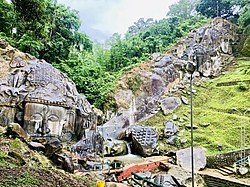
Unakoti or Subrai Khung is a sculptural emblem and ancient Shaivite place that hosts rock carvings, figures and images of gods and goddesses. The bas relief sculptures at Unakoti are on stylistic grounds ascribed to 7th–9th century CE, to the period of Pre-Manikya rule.[1][2] The rock art was patronised by Deva Dynasty of Sribhumi in Samatata.[3] The only inscription at Unakoti is on the other Chaturmukhalinga image, consisting of a couple of records in Bengali Characters of the 11th to 12th century CE, which mentions one Sri Jayadeva, probably a pilgrim.[4]

Key Information

Unakoti literally means "one less than one crore/koti" in Hindi and Bengali. In the local Kokborok language, it is called Subrai Khung. It was put on the UNESCO world heritage site tentative list in 2022. It is the prime tourist spot of Unakoti District, in the Kailashahar Subdivision of the North-eastern Indian state of Tripura.[5][6]

Description

[edit]

The images found at Unakoti are of two types: namely rock-carved figures and stone images. Among the rock-cut carvings, the central Shiva head and gigantic Ganesha figures deserve special mention. The central Shiva head known as Unakotiswara Kal Bhairava is about 30 feet high including an embroidered head-dress which itself is 10 feet high. On each side of the head-dress of the central Shiva, there are two full-size female figures - one of Durga standing on a lion and another female figure on the other side. In addition, three enormous images of Nandi Bull are found half-buried in the ground. There are various other stone as well as rock-cut images at Unakoti.[7]

Legend

[edit]

According to Hindu scriptures, Lord Shiva once spent a night here en route to Kashi. 99,99,999 gods and goddesses followed him. He had asked his followers to wake up before sunrise and make their way towards Kashi. Unfortunately, none awoke, except Lord Shiva himself. Before he set out for Kashi alone, he put a curse on the others, turning them to stone and that is how the site got its name.[8]

Local tribals believe that the maker of these idols was Kallu Gurjar. He was a devotee of Parvati and wanted to accompany Shiva–Parvati to their abode on Mount Kailash. On Parvati's insistence, Shiva reluctantly agreed to take Kallu to Kailash, on the condition that he would have to make one crore idols of Shiva in one night. Kallu got involved in this work like a man of his tune. But when dawn broke, the idols turned out to be one less than one crore (or unakoti). Adamant on getting rid of Kallu, Shiva left him with his idols in Unakoti, making this his excuse, and kept on walking.[9]

The existence of 99,99,999 idols in Unakoti (according to the legend) is the apparent reason for the derivation of the village's name.

Festival

[edit]

Every year a big fair popularly known as Ashokastami Mela is held in the month of April. The festival is visited by thousands of pilgrims. Another smaller festival takes place in January.[10]

Location

[edit]

Unakoti lies 178 km to the northeast from Agartala which has the closest airport, 8 km to the east from Kailashahar, district headquarters of Unakoti district, 148 km to the south-east from Silchar. The nearest railway station is 19.6 km away at Dharmanagar railway station on the Lumding–Sabroom section. From Dharmanagar railway station it takes about 30–40 minutes by car. Travelling from capital town Agartala has become much easier nowadays. The morning train from Agartala reaches Dharmanagar before 10 am. The afternoon train from Dharmanagar reaches Agartala by 8 PM.[11]

Preservation

[edit]

The site has suffered centuries of neglect causing degradation and loss of considerable scale to the rock art. Since its adoption by the ASI (Archaeological Survey of India) as a heritage site, the situation has slightly improved, though a lot of work including substantial excavation remains to be undertaken.[12] The Centre has recently granted Rs 12 crore to the state for developing the area, 178 km from here, as a major tourist destination.[13]

The site was added to the tentative list of the UNESCO World Heritage Site in December 2022.[14]

Iconography

[edit]

See also

[edit]

References

[edit]
Revisions and contributorsEdit on WikipediaRead on Wikipedia
from Grokipedia
Unakoti is an ancient rock-cut complex and major Shaivite pilgrimage site situated in the of , northeastern , approximately 8 km northwest of town and 178 km from . Renowned for its colossal bas-relief sculptures dating to the 7th–9th centuries CE, the site features the largest such rock carvings in , including a towering 30-foot-high central image of known as Unakotiswara Kal Bhairava, alongside depictions of , , and other deities, all carved directly into the hills amid lush greenery. The name "Unakoti," meaning "one less than a " (or 10 million) in Bengali, derives from a local legend recounting how Lord , accompanied by one (10 million) followers en route to Kashi, cursed them to turn into stone after they overslept, leaving behind nearly that number of figures—though in reality, the site features thousands of such figures carved into the rock. The site's historical significance lies in its evidence of early Saiva worship in the region during the pre-Manikya dynasty period, possibly patronized by local rulers of the 'Deb' lineage, and it reflects a unique blend of classical Indian iconography with indigenous tribal artistic influences. Spanning about 150 acres, Unakoti includes not only the main west-facing rock panels but also scattered loose sculptures, three sacred water tanks (kundas) formed by a natural stream, and three enormous Nandi bull images symbolizing devotion to . It highlights its artistic and religious value. Today, Unakoti attracts thousands of pilgrims and tourists annually, particularly during the vibrant Ashokastami Mela fair held in , which features rituals, music, and cultural performances centered on worship. Recognized for its outstanding universal value, the site was added to UNESCO's Tentative List of World Heritage Sites in December 2022 under criteria (i) for its creative sculptural genius and (iv) as an exemplary illustration of regional tied to Saivism. Conservation efforts by the and local authorities emphasize preserving its pristine forest setting and intricate carvings against natural erosion and tourism pressures.

Introduction

Overview

Unakoti is an ancient rock-cut sculptural site in the Unakoti district of Tripura, India, featuring massive reliefs of Hindu deities carved directly into sandstone cliffs, with a primary dedication to Shaivite worship centered on Lord Shiva. The site's carvings, including a gigantic 30-foot-high Shiva head known as Unakotisvara, exemplify post-Gupta era rock art traditions in eastern India. The complex boasts numerous colossal figures—such as representations of Devi, Ganesha, Durga, Parvati, and Hanuman—integrated into the natural hillside terrain, establishing Unakoti as one of India's largest concentrations of such rock reliefs. This unique scale and integration with the landscape highlight its artistic and religious significance, with carvings dating to the 7th–9th centuries CE. As a revered Shaivite center, Unakoti draws devotees and tourists annually, particularly during festivals like Ashokashtami. It holds official status as a Protected Monument of National Importance under the , ensuring preservation of its .

Etymology

The name Unakoti derives from the Bengali terms una, meaning "one," and koti, signifying a or ten million, thereby translating to "one less than a crore" or precisely 99,99,999. This etymology reflects the linguistic influences of the region, where Bengali has historically shaped nomenclature for cultural sites in northeastern . In the local language spoken by indigenous communities, the site is alternatively known as Subrai Khung. The symbolic implication of the name alludes to an ancient belief that Unakoti enshrines nearly a images of gods, goddesses, and mythical figures, evoking the site's reputed vastness as a divine assembly turned to stone. In reality, while the terrain conceals many, approximately 100 major rock carvings remain prominently visible, highlighting the contrast between legend and observable scale.

Historical Background

Dating and Chronology

The dating of Unakoti's rock-cut sculptures remains approximate due to the limited inscriptions or datable artifacts, relying primarily on stylistic analysis by archaeologists. Scholars generally ascribe the site's creation to the 8th to 9th centuries CE, placing it within the pre-Manikya period of Tripura's history. This chronology is supported by comparative stylistics with regional art traditions, particularly the pre-Pala and early Pala schools prevalent in eastern India during that era, evident in the sculptures' robust forms, decorative motifs, and iconographic conventions that align with 8th-9th century examples from Bengal and Assam. The major bas-reliefs, including the prominent Shiva figure, are attributed to the 8th-9th centuries CE, while certain secondary carvings and detached sculptures are dated to the 11th-12th century CE, reflecting later activity at the site. An inscription on a Chaturmukhalinga in Bengali script from the 11th–12th century CE mentions Sri Jayadeva, providing some epigraphic evidence of this period, though it does not precisely date the main rock panels. Epigraphic evidence is limited, with no copper plates, donative records, or royal charters discovered at the site to confirm patronage or exact timelines for the primary sculptures. Nonetheless, Unakoti predates the establishment of the in , which began ruling from the onward, marking it as a relic of an earlier indigenous Hindu cultural phase in the region before centralized monarchical influences.

Patronage and Influences

Unakoti's rock-cut sculptures were created during the pre-Manikya period, prior to the establishment of the in the , under the rule of local Tripuri kings or chieftains in the ancient kingdom of Twipra. The site's development is likely linked to Shaivite patronage from rulers in northeastern , particularly the 'Deb' (or Deva) generation of Sri Bhumi in the region, though no direct inscriptions confirm this association. Stylistic evidence points to ties with the Pala dynasty (8th–12th centuries) of and , reflecting shared rock-cut traditions in the broader eastern Indian cultural sphere. Artistically, Unakoti exhibits a fusion of indigenous Tripuri folk styles—evident in tribal motifs for ornaments and facial features—with Gupta-Pala rock-cut techniques, such as low-relief carving on natural rock faces. This blend shows parallels to the monumental rock reliefs at Mahabalipuram in , where Pallava artisans (7th–8th centuries) employed similar methods to depict divine assemblies on hillside surfaces, suggesting regional exchanges in Shaivite iconographic traditions. The creators are believed to have been local artisans skilled in stonework, possibly influenced by Natha-Yogi traditions.

Physical Description

Location and Setting

is located in the of , a northeastern state of , approximately 8 km east of town and about 178 km northeast of the state capital, . The site lies at the foothills of the Unakoti Range, a low hill formation characteristic of the region's undulating terrain. Geographically positioned at coordinates 24°19′N 92°04′E, Unakoti is nestled within a forested hillside that forms part of a larger . The area spans a dramatic rock face resembling a natural amphitheater, enhanced by high cliffs and a stream that flows east-west, creating three sacred pools known as kundas. Surrounding the site are lush green vegetation, rolling hills, and seasonal waterfalls, contributing to its serene and immersive environment. This setting places Unakoti within the , one of the world's most ecologically diverse regions, rich in flora and fauna. The district also borders to the north and west, situating the site near the international boundary and underscoring its position in a geopolitically sensitive zone.

Architectural Features

Unakoti exemplifies through its bas-relief sculptures, carved directly into the faces of cliffs and boulders using a subtractive technique involving hammers and chisels, without the use of mortar or freestanding structural elements. This method integrates the artworks seamlessly with the natural rock, creating low-relief figures that project minimally from the surface while leveraging the cliff's verticality for dramatic effect. The site's primary layout centers on a expansive west-facing vertical rock face, where sculptures are organized in tiers across an area spanning approximately 150 acres, with individual figures varying in scale from colossal heights of up to 30 feet to more modest supporting elements at the base. Some freestanding stone images complement the rock-cut panels, positioned along the lower slopes to enhance accessibility. The arrangement exploits the hill's natural contours to impart depth and perspective, avoiding the need for extensive excavation. Engineering features reflect a harmonious adaptation to the , including the incorporation of the site's to form pools. These elements demonstrate sophisticated site-specific planning, with access likely achieved through temporary scaffolds and ropes rather than permanent fixtures. The carvings are executed in soft reddish , a material chosen for its workability but prone to rapid from heavy rainfall, , and occasional earthquakes, resulting in the partial degradation and incomplete appearance of many figures. This inherent fragility highlights the enduring challenge of maintaining such exposed monuments in a tropical environment.

Iconography

Principal Deities

The principal deities at Unakoti are dominated by Shaivite figures, with colossal rock-cut sculptures emphasizing Lord and his divine family, set within a larger ensemble of low-relief carvings on natural rock faces. The site's focal point is the enormous rock-cut head of , referred to as Unakotisvara or Kala Bhairav, standing approximately 30 feet tall, including a 10-foot embroidered head-dress adorned with tribal-influenced ornaments. This central figure features distinctive attributes such as a , double-incised eyes, a narrow slit mouth with visible teeth, and jatamukuta hairstyle, flanked by two full-size female attendants on either side of the head-dress. Positioned prominently as Shiva's son, a group of Ganesha sculptures includes a seated colossal figure measuring about 22 feet in height, depicted with an elephant head, one tusk, four hands, and a distended , alongside two standing variants with multiple tusks and up to eight arms, reflecting Tantric Buddhist stylistic influences. A large panel portrays in her fierce form, standing triumphantly on a beside the head, symbolizing the goddess's protective and warrior aspects within the Shaivite context. Complementing the central Shiva, three enormous Nandi bulls—Shiva's sacred mount—are carved nearby, with the figures partially buried in the ground, underscoring the site's devotional focus. Attendant ganas, the robust and playful dwarf-like followers of , appear in supporting reliefs around the principal figures, adding to the dynamic composition of the rock face.

Supporting Sculptures

The supporting sculptures at Unakoti consist of an extensive array of secondary figures that enhance the site's overall sculptural ensemble, including over 90 depictions of deities such as and his avatars like , (a composite of and ), apsaras (celestial nymphs), and mythical beings like (the wish-fulfilling cow) and the river goddess Ganga standing on a . These figures are scattered across the hillside, contributing to the site's reputed vastness through their diverse representations of . Smaller panels feature intricate reliefs of dancing male and female figures, animals such as , Nandi bulls, and lions (often associated with ), as well as floral motifs including circular kundalas (earrings) adorning some images; many of these elements show signs of damage from weathering and erosion over centuries. The numerical significance of these carvings is underscored by local claiming nearly a (ten million) figures, including hidden or eroded ones, though archaeological surveys indicate around 100 visible sculptures in total. These supporting elements are strategically placed in rows below and beside the principal deities, such as the massive and figures, forming a hierarchical composition that integrates the smaller carvings into a cohesive rock-cut across the natural terrain.

Legends and Mythology

The Legend of the Name

The name Unakoti, meaning "one less than a " in Bengali, derives from a prominent Hindu associating the site's rock carvings with a divine curse. According to this myth, Lord embarked on a journey to Kashi accompanied by one (ten million) gods and goddesses, halting for the night at the location now known as Unakoti. Shiva instructed his followers to awaken before sunrise to resume the pilgrimage, but when dawn arrived, only Shiva himself rose while the others remained asleep. In anger, he cursed them to be petrified into stone, transforming the sleeping deities into the enduring rock reliefs that populate the hillside, thus leaving behind 99,99,999 images—one short of the original . Variations of the legend exist within local traditions, sometimes framing the event as Shiva's anger during a passage through the ancient kingdom of en route to Kailash or, as per documentation, an assembly of deities on Shukla Ashtami (the eighth day of the Chaitra lunar fortnight) to create a new Vrindavan near . One tribal account attributes the carvings to Kallu , a devoted sculptor tasked by to create one images of the in a single night as a condition for joining the divine assembly at Kailash; falling short by one, Kumar and his incomplete works were abandoned and turned to stone. These narratives collectively explain the site's nomenclature and the apparent incompleteness of its sculpted assembly, embedding the deeply in the cultural identity of the region.

Associated Myths

One prominent supplementary legend attributes the creation of Unakoti's rock carvings to , a skilled and devoted follower of Goddess . According to this , Kumhar sought to join Lord Shiva and on their divine journey to but was challenged by to carve one stone images of deities in a single night as a test of his devotion and skill. He managed to complete 99,99,999 figures before dawn but fell short by one, leading to his transformation into stone as punishment for the incomplete task, thus embodying the site's name and incomplete collection.

Cultural Significance

Religious Importance

Unakoti serves as a prominent center of in northeastern , exemplifying ancient devotion to through its monumental rock-cut sculptures dating to the 8th–9th centuries CE. The site's colossal images, such as the 30-foot Unakotiswara Kal and accompanying Shivalingas, function as enduring icons for worship, embodying the fierce and transformative aspects of in Saiva traditions. These carvings, integrated into the natural landscape, highlight the site's role in early with syncretic elements, where rock reliefs facilitated direct communion with the divine during the pre-Manikya period in . The religious framework at Unakoti reflects a syncretic fusion of Brahmanical with indigenous tribal beliefs and Buddhist influences, evident in the stylistic influences of local art on deity depictions, the presence of Buddhist motifs and Bodhisattvas, and the incorporation of Tantric elements including Tantric Buddhist aspects alongside . This blending, seen in the presence of figures like , (with multi-tusked Tantric forms), and motifs possibly drawing from tribal aesthetics, has fostered unique regional Shaiva practices that harmonize Vedic orthodoxy with Northeast Indian animistic and Buddhist traditions. Such integration underscores Unakoti's contribution to the doctrinal evolution of in the region, promoting a localized expression of devotion that transcends purely orthodox boundaries. As one of Tripura's holiest sites, Unakoti attracts devotees seeking spiritual merit through , darshan of the , and immersion in its sacred kundas formed by natural streams. Its status as a key Saiva tirtha, recognized since at least the , draws pilgrims for contemplative worship, reinforcing its doctrinal value in Hindu networks across . This enduring appeal is further expressed in annual gatherings that affirm its living spiritual role. Symbolically, Unakoti represents the "mountain of gods," with its vast array of rock-cut figures evoking a cosmic where divine multiplicity is manifested in stone, symbolizing the infinite aspects of the divine order in Shaiva cosmology. The site's name, derived from "one less than a ," encapsulates this theme of near-infinite celestial presence, transforming the hillside into a microcosm of the Hindu pantheon's structured divinity.

Festivals and Rituals

The primary festivals at Unakoti revolve around its Shaivite heritage, drawing devotees for communal worship and celebrations. The Ashokastami Mela, held annually in late or early April according to the lunar calendar's month, serves as the site's major event. Devotees participate in ritual bathing in the sacred Ashtami Kunda, a natural spring believed to confer divine blessings, followed by fairs, colorful processions, and elaborate ceremonies. Cultural programs, including music and dance performances, enhance the festivities, fostering a vibrant atmosphere of devotion. Makar Sankranti, observed on January 14, marks another significant gathering at Unakoti, commemorating the sun's transit into Capricorn with offerings of flowers, fruits, and milk to the rock carvings. This solar festival features cultural programs and ritual bathing similar to Ashokastami, emphasizing renewal and gratitude. Devotees perform puja to invoke prosperity, blending solar reverence with site-specific traditions. Local priests from the family, a Tripuri , conduct periodic rituals, including abhishekam with water and milk poured over the carvings to honor the deities. During the melas, these rituals incorporate tribal dances and chants by the Tripuri community, merging indigenous customs with Hindu practices in organization and performance. This involvement highlights Unakoti's role as a cultural bridge for the region's tribal heritage, further emphasized by ongoing campaigns as of 2025 to secure full World Heritage status, underscoring its global cultural importance.

Preservation and Recognition

Conservation Efforts

Unakoti was protected by the (ASI), with comprehensive documentation in its Annual Report of 1921-22, and later formalized as a Monument of National Importance in 1961 covering 150 acres under the ASI's Circle jurisdiction. The ASI conducts regular monitoring and maintenance to safeguard the site's rock-cut sculptures from deterioration. The site's preservation faces significant challenges from natural elements, including due to heavy rains and frequent earthquakes in the Unakoti range, which have caused progressive wear on the carvings. Human-induced threats, such as through defacement of the rock faces, further exacerbate the risk of irreversible damage, while the remote, forested location limits but does not eliminate unauthorized access. In response, the ASI has implemented targeted conservation measures, including periodic cleaning of the sculptures, rock face stabilization to mitigate , and management to prevent overgrowth that could trap and accelerate decay. These interventions prioritize minimal restoration to retain the site's historical authenticity, supplemented by awareness programs to deter and encroachment. In July 2025, a large-scale drive was undertaken to revive the sacred hill's ecological and potential, focusing on restoring around the site. Following Unakoti's inclusion on UNESCO's Tentative List in December 2022, conservation efforts intensified with comprehensive site mapping and secured funding for restoration, led jointly by the ASI and the . In 2023, dedicated projects for structural reinforcement and were initiated in the ASI-protected areas, addressing and seismic vulnerabilities through collaborative research and on-site interventions.

Tourism and Accessibility

Unakoti's inclusion on India's Tentative List for World Heritage Sites in December 2022 has significantly elevated its international visibility, attracting greater interest from global travelers seeking cultural heritage destinations. The site is accessible primarily by road from , the capital of , located approximately 178 kilometers northeast and reachable in about four hours via state highways and local buses. The nearest operational airport is in Agartala, while Kailashahar Airport, just 8 kilometers from the site, is undergoing revival efforts initiated in May 2025 to resume commercial flights after decades of disuse. There is fee for visitors, and the site is open daily from 6:00 AM to 5:00 PM, aligning with natural daylight hours for safe exploration of the rock carvings. Visitor facilities at Unakoti include local guides available on-site to provide insights into the sculptures' , enhancing the educational aspect of the visit. Nearby eco-tourism options, such as the Unakoti Eco Park, offer guided nature walks and trails through surrounding forests, promoting sustainable exploration of the area's biodiversity. The site is best visited from to , following the season, when clearer weather improves visibility of the carvings and reduces slippery paths. Unakoti plays a vital role in Tripura's economy by drawing visitors who support local homestays in nearby and , as well as sales of traditional handicrafts like and cane products crafted by indigenous communities. This influx contributes to regional development, with ongoing upgrades, including the rehabilitation of the Unakoti Tourist Lodge, aimed at accommodating growing numbers of domestic and international tourists.

References

Add your contribution
Related Hubs
User Avatar
No comments yet.