



Community hub
Recent from talks
Contribute something
Nothing was collected or created yet.
Anionic addition polymerization
View on Wikipediaanionic polymerization: An ionic polymerization in which the kinetic-chain carriers are anions. [1]
In polymer chemistry, anionic addition polymerization is a form of chain-growth polymerization or addition polymerization that involves the polymerization of monomers initiated with anions. The type of reaction has many manifestations, but traditionally vinyl monomers are used.[2][3] Often anionic polymerization involves living polymerizations, which allows control of structure and composition.[2][3]
History
[edit]
As early as 1936, Karl Ziegler proposed that anionic polymerization of styrene and butadiene by consecutive addition of monomer to an alkyl lithium initiator occurred without chain transfer or termination. Twenty years later, living polymerization was demonstrated by Michael Szwarc and coworkers.[5][6] In one of the breakthrough events in the field of polymer science, Szwarc elucidated that electron transfer occurred from radical anion sodium naphthalene to styrene. The results in the formation of an organosodium species, which rapidly added styrene to form a "two – ended living polymer." An important aspect of his work, Szwarc employed the aprotic solvent tetrahydrofuran. Being a physical chemist, Szwarc elucidated the kinetics and the thermodynamics of the process in considerable detail. At the same time, he explored the structure property relationship of the various ion pairs and radical ions involved. This work provided the foundations for the synthesis of polymers with improved control over molecular weight, molecular weight distribution, and the architecture.[7]
The use of alkali metals to initiate polymerization of 1,3-dienes led to the discovery by Stavely and co-workers at Firestone Tire and Rubber company of cis-1,4-polyisoprene.[8] This sparked the development of commercial anionic polymerization processes that utilize alkyllithium initiators.[3]
Roderic Quirk won the 2019 Charles Goodyear Medal in recognition of his contributions to anionic polymerization technology. He was introduced to the subject while working in a Phillips Petroleum lab with Henry Hsieh.
Monomer characteristics
[edit]Two broad classes of monomers are susceptible to anionic polymerization.[3]
Vinyl monomers have the formula CH2=CHR, the most important are styrene (R = C6H5), butadiene (R = CH=CH2), and isoprene (R = C(Me)=CH2). A second major class of monomers are acrylate esters, such as acrylonitrile, methacrylate, cyanoacrylate, and acrolein. Other vinyl monomers include vinylpyridine, vinyl sulfone, vinyl sulfoxide, vinyl silanes.[3]


Cyclic monomers
[edit]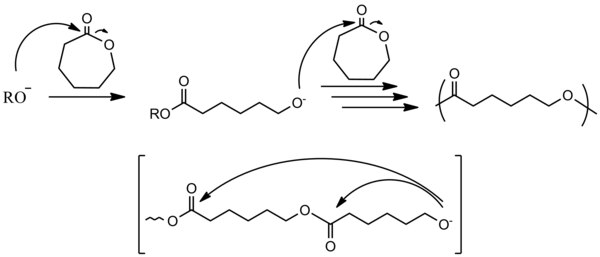

Many cyclic compounds are susceptible to ring-opening polymerization. Epoxides, cyclic trisiloxanes, some lactones, lactides, cyclic carbonates, and amino acid N-carboxyanhydrides.
In order for polymerization to occur with vinyl monomers, the substituents on the double bond must be able to stabilize a negative charge. Stabilization occurs through delocalization of the negative charge. Because of the nature of the carbanion propagating center, substituents that react with bases or nucleophiles either must not be present or be protected.[3]
Initiation
[edit]Initiators are selected based on the reactivity of the monomers. Highly electrophilic monomers such as cyanoacrylates require only weakly nucleophilic initiators, such as amines, phosphines, or even halides. Less reactive monomers such as styrene require powerful nucleophiles such as butyl lithium. Reactions of intermediate strength are used for monomers of intermediate reactivity such as vinylpyridine.[3]
The solvents used in anionic addition polymerizations are determined by the reactivity of both the initiator and nature of the propagating chain end. Anionic species with low reactivity, such as heterocyclic monomers, can use a wide range of solvents.[3]
Initiation by electron transfer
[edit]Initiation of styrene polymerization with sodium naphthalene proceeds by electron transfer from the naphthalene radical anion to the monomer. The resulting radical dimerizes to give a disodium compound, which then functions as the initiator. Polar solvents are necessary for this type of initiation both for stability of the anion-radical and to solvate the cation species formed.[8] The anion-radical can then transfer an electron to the monomer. Initiation can also involve the transfer of an electron from the alkali metal to the monomer to form an anion-radical. Initiation occurs on the surface of the metal, with the reversible transfer of an electron to the adsorbed monomer.[3]
Initiation by strong anions
[edit]Nucleophilic initiators include covalent or ionic metal amides, alkoxides, hydroxides, cyanides, phosphines, amines and organometallic compounds (alkyllithium compounds and Grignard reagents). The initiation process involves the addition of a neutral (B:) or negative (:B−) nucleophile to the monomer.[8] The most commercially useful of these initiators has been the alkyllithium initiators. They are primarily used for the polymerization of styrenes and dienes.[3]
Monomers activated by strong electronegative groups may be initiated even by weak anionic or neutral nucleophiles (i.e. amines, phosphines). Most prominent example is the curing of cyanoacrylate, which constitutes the basis for superglue. Here, only traces of basic impurities are sufficient to induce an anionic addition polymerization or zwitterionic addition polymerization, respectively.[9]
Propagation
[edit]
Propagation in anionic addition polymerization results in the complete consumption of monomer. This stage is often fast, even at low temperatures.[2]
Living anionic polymerization
[edit]Living anionic polymerization is a living polymerization technique involving an anionic propagating species.
Living anionic polymerization was demonstrated by Szwarc and co workers in 1956. Their initial work was based on the polymerization of styrene and dienes. One of the remarkable features of living anionic polymerization is that the mechanism involves no formal termination step. In the absence of impurities, the carbanion would still be active and capable of adding another monomer. The chains will remain active indefinitely unless there is inadvertent or deliberate termination or chain transfer. This gave rise to two important consequences:
- The number average molecular weight, Mn, of the polymer resulting from such a system could be calculated by the amount of consumed monomer and the initiator used for the polymerization, as the degree of polymerization would be the ratio of the moles of the monomer consumed to the moles of the initiator added.
- , where Mo = formula weight of the repeating unit, [M]o = initial concentration of the monomer, and [I] = concentration of the initiator.
- All the chains are initiated at roughly the same time. The final result is that the polymer synthesis can be done in a much more controlled manner in terms of the molecular weight and molecular weight distribution (Poisson distribution).
![{\displaystyle M_{n}=M_{o}{\frac {[{\mbox{M}}]_{o}}{[{\mbox{I}}]}}}](https://wikimedia.org/api/rest_v1/media/math/render/svg/86220a1bcee2334650c55dd7e3525f348836042b)
The following experimental criteria have been proposed as a tool for identifying a system as living polymerization system.
- Polymerization until the monomer is completely consumed and until further monomer is added.
- Constant number of active centers or propagating species.
- Poisson distribution of molecular weight
- Chain end functionalization can be carried out quantitatively.
However, in practice, even in the absence of terminating agents, the concentration of the living anions will reduce with time due to a decay mechanism termed as spontaneous termination.[8]
Consequences of living polymerization
[edit]Block copolymers
[edit]Synthesis of block copolymers is one of the most important applications of living polymerization as it offers the best control over structure. The nucleophilicity of the resulting carbanion will govern the order of monomer addition, as the monomer forming the less nucleophilic propagating species may inhibit the addition of the more nucleophilic monomer onto the chain. An extension of the above concept is the formation of triblock copolymers where each step of such a sequence aims to prepare a block segment with predictable, known molecular weight and narrow molecular weight distribution without chain termination or transfer.[10]
Sequential monomer addition is the dominant method, also this simple approach suffers some limitations. Moreover, this strategy, enables synthesis of linear block copolymer structures that are not accessible via sequential monomer addition. For common A-b-B structures, sequential block copolymerization gives access to well defined block copolymers only if the crossover reaction rate constant is significantly higher than the rate constant of the homopolymerization of the second monomer, i.e., kAA >> kBB.[11]
End-group functionalization/termination
[edit]One of the remarkable features of living anionic polymerization is the absence of a formal termination step. In the absence of impurities, the carbanion would remain active, awaiting the addition of new monomer. Termination can occur through unintentional quenching by impurities, often present in trace amounts. Typical impurities include oxygen, carbon dioxide, or water. Termination intentionally allows the introduction of tailored end groups.
Living anionic polymerization allow the incorporation of functional end-groups, usually added to quench polymerization. End-groups that have been used in the functionalization of α-haloalkanes include hydroxide, -NH2, -OH, -SH, -CHO,-COCH3, -COOH, and epoxides.

An alternative approach for functionalizing end-groups is to begin polymerization with a functional anionic initiator.[12] In this case, the functional groups are protected since the ends of the anionic polymer chain is a strong base. This method leads to polymers with controlled molecular weights and narrow molecular weight distributions.[13]
Additional reading
[edit]- Cowie, J.; Arrighi, V. Polymers: Chemistry and Physics of Modern Materials; CRC Press: Boca Raton, FL, 2008.
- Hadjichristidis, N.; Iatrou, H.; Pitsikalis, P.; Mays, J. (2006). "Macromolecular architectures by living and controlled/living polymerizations". Prog. Polym. Sci. 31 (12): 1068–1132. doi:10.1016/j.progpolymsci.2006.07.002.
- Efstratiadis, V.; Tselikas, Y.; Hadjichristidis, N.; Li, J.; Yunan, W.; Mays, J. (1994). "Synthesis and characterization of poly(methyl methacrylate) star polymers". Polym Int. 4 (2): 171–179. doi:10.1002/pi.1994.210330208.
- Rempp, P.; Franta, E.; Herz, J. (1998). "Macromolecular Engineering by Anionic Methods". Polysiloxane Copolymers/Anionic Polymerization. Advances in Polymer Science. Vol. 4. pp. 145–173. doi:10.1007/BFb0025276. ISBN 978-3-540-18506-2. S2CID 92176703.
- Bellas, Vasilios; Rehahn, Matthias (2 July 2007). "Universal Methodology for Block Copolymer Synthesis". Macromolecular Rapid Communications. 28 (13): 1415–1421. doi:10.1002/marc.200700127. S2CID 96556942.
- Nikos Hadjichristidis; Akira Hirao, eds. (2015). Anionic Polymerization Principles, Practice, Strength, Consequences and Applications. Springer. ISBN 978-4-431-54186-8.
References
[edit]- ^ "anionic polymerization". Gold Book. IUPAC. doi:10.1351/goldbook.A00361. Retrieved 1 April 2024.
- ^ a b c Hsieh, H.;Quirk, R. Anionic Polymerization: Principles and practical applications; Marcel Dekker, Inc.: New York, 1996.
- ^ a b c d e f g h i j Quirk, R. Anionic Polymerization. In Encyclopedia of Polymer Science and Technology; John Wiley and Sons: New York, 2003.
- ^ Sebastian Koltzenburg; Michael Maskos; Oskar Nuyken (2017-12-11). "Ionic Polymerization". Polymer Chemistry. Springer. ISBN 978-3-662-49279-6.
- ^ Szwarc, M.; Levy, M.; Milkovich, R. (1956). "Polymerization Initiated by Electron Transfer to Monomer. A New Method of Formation of Block Polymers". J. Am. Chem. Soc. 78 (11): 2656–2657. doi:10.1021/ja01592a101.
- ^ M. Szwarc (1956). ""Living" polymers". Nature. 178 (4543): 1168. Bibcode:1956Natur.178.1168S. doi:10.1038/1781168a0.
- ^ Smid, J. Historical Perspectives on Living Anionic Polymerization. J. Polym. Sci. Part A.; 2002, 40, pp. 2101-2107. DOI=10.1002/pola.10286
- ^ a b c d Odian, G. Ionic Chain Polymerization; In Principles of Polymerization; Wiley-Interscience: Staten Island, New York, 2004, pp. 372-463.
- ^ Pepper, D.C. Zwitterionic Chain Polymerizations of Cyanoacrylates. Macromolecular Symposia; 1992,60, pp. 267-277. doi:10.1002/masy.19920600124
- ^ Hsieh, H.;Quirk, R. Anionic Polymerization: Principles and practical applications; Marcel Dekker, Inc.: New York, 1996.
- ^ Bellas, Vasilios; Rehahn, Matthias (5 March 2009). "Block Copolymer Synthesis via Chemoselective Stepwise Coupling Reactions". Macromolecular Chemistry and Physics. 210 (5): 320–330. doi:10.1002/macp.200800463.
- ^ Hong, K.; Uhrig, D.; Mays, J. (1999). "Living Anionic Polymerization". Current Opinion in Solid State and Materials Science. 4 (6): 531–538. Bibcode:1999COSSM...4..531H. doi:10.1016/S1359-0286(00)00011-5.
- ^ Quirk, R. Anionic Polymerization. In Encyclopedia of Polymer Science and Technology; John Wiley and Sons: New York, 2003.
Anionic addition polymerization
View on GrokipediaIntroduction
Basic Principles
Anionic addition polymerization is a chain-growth process in which the active centers at the growing ends of polymer chains are carbanions that add to the double bonds of vinyl or other unsaturated monomers, forming carbon-carbon bonds without the elimination of small-molecule byproducts.[6] This ionic mechanism contrasts with covalent bond-forming processes in step-growth polymerization and emphasizes the nucleophilic attack by the anion on the electrophilic carbon of the monomer. The general reaction scheme begins with initiation by a strong nucleophilic species, such as an alkyllithium compound (e.g., n-butyllithium, n-BuLi), which adds to or deprotonates the monomer to form the initial carbanionic chain end: n-BuLi + M → n-Bu-M^- Subsequent propagation involves the iterative addition of monomer units (M) to this active end: \sim M^- + n M → \sim (M)_{n+1}^- This step-wise addition continues as long as monomer is available and no terminating agents are present. The kinetics of propagation are typically first-order with respect to both monomer and active chain concentrations, expressed by the rate equation: where is the propagation rate constant, [M] is the monomer concentration, and [P^*] is the concentration of active (carbanionic) chain ends. Unlike free radical polymerization, which proceeds via neutral radicals prone to bimolecular termination, or cationic polymerization employing positively charged centers suited to electron-poor monomers, anionic polymerization uses negatively charged carbanions that favor electron-rich monomers like styrene and dienes. In ideal scenarios, the electrostatic repulsion between like charges prevents spontaneous termination, enabling controlled chain growth.[7] Essential prerequisites include aprotic solvents and rigorous exclusion of protic impurities, oxygen, and carbon dioxide to preserve the anionic active sites from quenching.[6]Scope and Applications
Anionic addition polymerization is primarily suited for monomers that can stabilize carbanionic chain ends, such as those bearing electron-donating groups. Common examples include conjugated dienes like 1,3-butadiene and isoprene, vinyl aromatics such as styrene, and certain polar monomers like alkyl methacrylates. These monomers enable the formation of well-defined polymers with predictable molecular weights and microstructures, distinguishing the process from radical or cationic methods.[8][9] The technique finds broad industrial applications in producing specialty elastomers and precision materials. Notably, it is used to synthesize styrene-butadiene-styrene (SBS) block copolymers, which serve as thermoplastic elastomers in adhesives, footwear, and automotive components due to their phase-separated morphology combining rubbery and glassy domains. Other uses include telechelic polymers for coatings and surface modifications, as well as precision polymers for nanotechnology applications like drug delivery carriers and advanced composites. Commercially, anionic polymerization supports the annual production of over three million tons of polymers, including polybutadiene, polyisoprene, and polystyrene.[10][11][12] Key advantages stem from the living nature of the polymerization, enabling narrow molecular weight distributions with polydispersity indices (PDI) often below 1.1, precise control over tacticity (e.g., isotactic-rich polystyrene under specific initiator conditions), and the synthesis of complex architectures like star or graft copolymers. For instance, living anionic polymerization of styrene can yield polystyrene with molecular weights exceeding 10^5 g/mol in seconds at room temperature, demonstrating rapid kinetics and high efficiency.[6][13][14] However, practical limitations restrict its scope, including extreme sensitivity to impurities such as water and CO2, which rapidly quench active carbanions and terminate chains. Additionally, the high cost of organometallic initiators like alkyllithiums and the necessity for rigorously anhydrous conditions increase operational expenses, confining widespread use to high-value products rather than bulk commodities.[8][15]Historical Background
Pioneering Studies
The pioneering studies in anionic addition polymerization trace back to the early 20th century, with Wilhelm Schlenk and Karl Ziegler's foundational experiments in 1910 demonstrating the polymerization of dienes using alkali metals such as sodium, which produced viscous materials indicative of chain growth via carbanionic intermediates.[16] Their work highlighted the role of organoalkali compounds in initiating addition reactions, setting the stage for mechanistic insights into vinyl monomer polymerization.[17] In the 1930s and 1940s, Ziegler advanced these investigations by examining the reaction of alkali metals with dienes like butadiene, yielding polybutadiene through sequential monomer addition to active anionic sites, though yields were limited by heterogeneous conditions and undefined chain ends.[18] Concurrently, Schlenk's synthesis of organolithium compounds in the 1910s and 1920s provided key initiators, with Ziegler's 1929 proposal elucidating the anionic mechanism involving metal-diene addition without immediate termination.[19] A notable industrial contribution came in the 1950s when Phillips Petroleum patented the use of alkyllithium initiators for isoprene polymerization, enabling the production of synthetic rubbers with improved elasticity for wartime applications.[20] By the 1950s, electron transfer mechanisms gained attention, as seen in initiations using sodium dissolved in liquid ammonia, which generated solvated electrons to form radical anions that propagated anionic chains for monomers like acrylonitrile, albeit with challenges in solvent compatibility.[1] Early researchers, including Ziegler, often assumed termination occurred spontaneously or via unavoidable impurities like water or oxygen, leading to broad molecular weight distributions and inconsistent polymer properties in these impure systems. This period also revealed side reactions, such as proton abstraction from solvents like tetrahydrofuran or ammonia, which quenched active centers and contributed to the observed variability in early studies.[8]Key Milestones in Living Polymerization
The breakthrough in living anionic polymerization occurred in 1956 when Michael Szwarc performed an experiment involving the polymerization of styrene initiated by sodium naphthalenide in tetrahydrofuran (THF) at low temperature. Unlike conventional polymerizations, Szwarc observed that the active chain ends persisted without termination or chain transfer, maintaining a constant concentration of growing polymer radicals and resulting in molecular weights that increased linearly with monomer conversion. This phenomenon, which he termed "living polymerization," marked the first demonstration of a controlled chain growth process devoid of irreversible deactivation.[7] A key observation from Szwarc's work was the invariance of the active center concentration, denoted as , throughout the reaction: This constancy ensures that all chains initiate simultaneously and grow at the same rate, yielding a Poisson distribution of chain lengths with polydispersity indices (PDI) approaching 1.0, typically PDI < 1.05 for well-controlled systems. Such narrow distributions revolutionized polymer synthesis by shifting from empirical trial-and-error methods to designed architectures with predictable properties.[21] In the 1960s, significant progress was made with the adoption of alkyllithium compounds as initiators in hydrocarbon solvents, enabling living polymerization in non-coordinating media. Pioneering kinetic studies by Worsfold and Bywater on n-butyllithium-initiated styrene polymerization in benzene confirmed the living character through linear molecular weight evolution and absence of termination, broadening applicability to industrial-scale processes.[22] The 1970s and 1980s saw advancements in polymerizing polar monomers like acrylates, where ligands played a crucial role in stabilizing enolate active centers and preventing side reactions. For instance, the addition of zinc bromide (ZnBr₂) to alkyllithium-initiated systems facilitated the synthesis of syndiotactic poly(methyl methacrylate) (PMMA) with controlled tacticity and narrow PDI, as explored in mechanistic studies of Lewis acid coordination effects. These ligand strategies extended living polymerization to challenging monomers, enabling stereoregular polymers for advanced materials.[23] In the 1980s, Roderic P. Quirk developed functionalized alkyllithium initiators, incorporating groups like protected hydroxyl or amino functionalities, which allowed direct synthesis of end-functionalized polymers without post-polymerization modification. This innovation preserved the living nature while introducing reactive sites for further coupling or grafting, enhancing versatility in block copolymer and telechelic polymer preparation.[24] The 1990s brought refinements in diene polymerization, particularly for synthesizing star polymers via living anionic routes. Techniques involving core-first approaches with divinylbenzene crosslinking of polybutadiene or polyisoprene living arms yielded well-defined multi-arm stars with PDI < 1.1, demonstrating precise control over branching and demonstrating applications in nanostructured elastomers. These developments underscored the transition to sophisticated macromolecular designs, fundamentally impacting fields like nanotechnology and biomaterials.[25]Monomer Characteristics
Suitable Vinyl Monomers
Vinyl monomers suitable for anionic addition polymerization possess substituents on the double bond that stabilize the carbanion formed at the β-carbon during propagation, such as electron-donating alkyl groups or conjugating phenyl groups, while avoiding acidic protons that could lead to premature termination by protonation of the initiator or active chain ends.[26] These non-polar vinyl monomers are compatible with hydrocarbon solvents and alkyllithium initiators, enabling living polymerization with narrow molecular weight distributions.[12] Prominent examples include styrene (C₆H₅CH=CH₂), 1,3-butadiene (CH₂=CH-CH=CH₂), and isoprene (CH₂=C(CH₃)-CH=CH₂). Anionic polymerization of styrene produces atactic polystyrene, a rigid amorphous material with a glass transition temperature of approximately 100°C.[27] In contrast, 1,3-butadiene yields predominantly 1,4-polybutadiene with a mixture of cis and trans 1,4-units (typically 40-50% cis), a highly elastic rubber with excellent resilience and low glass transition temperature around -100°C, widely used in tire applications.[28] Isoprene similarly forms cis-1,4-polyisoprene, mimicking natural rubber properties. The reactivity of these monomers follows the order dienes > styrene > α-methylstyrene, with dienes exhibiting particularly high propagation rates due to effective carbanion stabilization via conjugation across the diene system. Under anionic conditions, styrene polymerizes much faster than in free-radical methods, often by orders of magnitude, owing to the higher propagation rate constants and absence of termination steps.[1] For instance, in tetrahydrofuran at low temperatures, the propagation rate constant for styryl anions exceeds that of radical propagation by factors up to 10³–10⁴.[29] Steric effects from bulky substituents can influence tacticity; for example, in styrene derivatives with large groups like adamantyl, certain initiators promote an isotactic bias by restricting chain-end conformations during addition.[30] This allows tailored microstructures beyond the typical atactic outcomes in standard styrene polymerization.Cyclic and Polar Monomers
Polar monomers, such as acrylates and methacrylates exemplified by methyl methacrylate (), present significant challenges in anionic addition polymerization due to their electron-withdrawing ester groups, which facilitate side reactions including chain transfer through nucleophilic attack on the carbonyl and intramolecular backbiting that generates cyclic ketoesters. These reactions lead to broad molecular weight distributions, with polydispersity indices (PDI) exceeding 2 in the absence of stabilizing ligands, as multiple active species and termination events disrupt chain length control. To address these issues, coordination agents like lithium chloride (LiCl) are added to form mixed aggregates with the propagating enolate chain ends, suppressing backbiting, improving initiator efficiency, and enabling living polymerization with narrow PDI values around 1.1. For instance, the polymerization of methyl methacrylate in tetrahydrofuran at -78°C using sec-butyllithium initiator without LiCl yields PDI of 1.42, whereas addition of LiCl reduces it to 1.10 while favoring syndiotactic stereochemistry with up to 79% syndiotactic triads. A notable example is the synthesis of highly syndiotactic poly(methyl methacrylate) (PMMA) using sec-butyllithium initiator with LiCl in tetrahydrofuran at -78°C, achieving greater than 90% syndiotactic triads and PDI below 1.1, enhancing the material's thermal and mechanical properties compared to atactic PMMA.[31] Similarly, 2-vinylpyridine undergoes efficient anionic polymerization in tetrahydrofuran at -78°C using n-butyllithium or other alkyllithium initiators, producing poly(2-vinylpyridine) with narrow molecular weight distributions (PDI ≈ 1.1-1.2) and high initiator efficiency, owing to the monomer's moderate polarity that minimizes side reactions. These adaptations allow for precise control over tacticity and end-group functionality in polar monomer systems. Cyclic monomers, particularly cyclosiloxanes like hexamethylcyclotrisiloxane () (D), are polymerized anionically in non-polar solvents such as toluene using initiators like lithium silanolates or cryptated lithium counterions, proceeding via ring-opening to yield well-defined polydimethylsiloxanes with low polydispersity. The kinetics follow first-order dependence on living end concentration, with propagation rate constants around 1-1.3 L·mol·s at -20°C to 20°C, though equilibrium limitations require careful temperature control to favor linear chains over cyclic oligomers. Certain epoxides, such as ethylene oxide, also participate in anionic addition polymerization under specific conditions, bordering on ring-opening mechanisms, to produce polyethers, but these demand highly pure systems to avoid transfer reactions. The polymerization of polar and cyclic monomers via anionic methods uniquely enables the synthesis of functionalized polymers, such as pH-responsive polyacrylates like poly(methacrylic acid), where ester hydrolysis post-polymerization imparts anionic carboxylic groups that swell and release payloads in basic environments due to deprotonation and chain expansion.Reaction Conditions
Solvents and Purity Requirements
In anionic addition polymerization, aprotic solvents are essential to maintain the stability of the carbanionic active centers, with selection depending on the monomer polarity. For non-polar monomers such as styrene and conjugated dienes, non-polar solvents like benzene and cyclohexane are preferred, as they promote the formation of tight ion pairs that facilitate control over polymer microstructure, particularly favoring 1,4-addition in dienes.[32] In contrast, polar aprotic solvents such as tetrahydrofuran (THF) and dimethyl sulfoxide (DMSO) are used for polar monomers like methacrylates, where their ability to solvate cations enhances ion pair dissociation and supports polymerization of electron-deficient monomers.[32] The choice of solvent significantly influences propagation kinetics through its effect on ion pair association. In non-polar hydrocarbons, the propagating carbanions often associate into dimers or higher aggregates, which reduces reactivity and slows propagation, with rate constants (k_p) typically on the order of 10^2 L/mol·s for styrene using lithium counterions.[33] Polar solvents like THF mitigate this by coordinating with the counterion, promoting dissociation into more reactive loose ion pairs or free ions, thereby accelerating the rate by 10-100 times; for example, k_p for styrene in THF reaches approximately 10^4 L/mol·s under similar conditions.[34] Stringent purity requirements are critical in anionic polymerization, as even trace protic impurities can irreversibly terminate chains by proton transfer, disrupting the living character of the process. The quenching reaction proceeds rapidly according to the rate expression where k_q greatly exceeds the propagation rate constant k_p, resulting in predominantly dead polymer chains.[32] Protic contaminants such as water and alcohols are removed from solvents by distillation over sodium-potassium alloy (Na/K), which effectively scavenges these impurities.[35] Oxygen is rigorously excluded through the use of inert atmospheres like argon or nitrogen, and specialized break-seal techniques enable reagent transfer in vacuum-sealed ampoules to prevent aerial contamination.[36] Monomers are similarly purified by passing them through activated alumina columns to eliminate inhibitors, peroxides, and residual protic species, ensuring levels below 10 ppm for successful living polymerization.[37]Temperature and Additive Effects
Temperature exerts a significant influence on the rate, stereochemistry, and stability of anionic addition polymerization. The propagation rate constant follows the Arrhenius equation: where typically ranges from 5 to 10 kcal/mol for styrene polymerization, reflecting the relatively low energy barrier for carbanion addition to the monomer.[38] In polar solvents, is lower compared to non-polar media due to enhanced dissociation of ion pairs into more reactive free anions, which accelerates propagation while maintaining control.[16] For styrene, polymerization proceeds effectively at room temperature, allowing efficient chain growth without excessive side reactions.[39] In contrast, acrylates require low temperatures, such as -78°C, to suppress elimination and backbiting side reactions that degrade chain-end fidelity and broaden molecular weight distributions. Elevated temperatures, however, promote chain transfer to monomer, which limits molecular weight and disrupts living character by introducing uncontrolled termination pathways.[40] Additives play a crucial role in modulating ion-pair dynamics, thereby affecting polymerization kinetics and polymer microstructure. Crown ethers and cryptands coordinate alkali metal counterions, promoting dissociation of tight ion pairs into solvent-separated or free ions, which increases the propagation rate by up to several orders of magnitude in non-polar solvents.[41] For example, in the anionic polymerization of propylene oxide, 18-crown-6 enhances the rate by reducing aggregation and favoring more nucleophilic active centers.[42] Lewis acids, such as triethylaluminum (AlEt3), coordinate with the propagating anion to influence stereochemistry in diene polymerizations; when combined with alkyllithium initiators, they favor syndiotactic placement by stabilizing transition states leading to 1,4-addition.[15] Specific additives enable precise control over polydispersity and tacticity in challenging systems. In the anionic polymerization of methyl methacrylate (MMA), lithium chloride (LiCl) reduces ion-pair association, suppressing aggregation and yielding polymers with narrow polydispersity indices (PDI < 1.1) while enhancing syndiotactic content.[43] Similarly, at -20°C in toluene using tert-butyllithium (t-BuLi) as initiator, polystyrene exhibits increased syndiotactic sequences due to the non-polar environment constraining rotational freedom during propagation.[44] These effects underscore the interplay between temperature, additives, and solvent in achieving targeted polymer architectures without delving into broader mechanistic derivations.Polymerization Mechanism
Initiation Processes
Anionic addition polymerization is initiated through the generation of active carbanion chain ends using various anionic initiators, primarily via electron transfer or nucleophilic addition mechanisms. These processes ensure the formation of living polymer chains under controlled conditions, with the choice of initiator depending on the monomer's electron deficiency and solvent properties.[45] One primary initiation method involves electron transfer from redox initiators, such as sodium naphthalide, to the monomer. Sodium naphthalide is formed by the reaction of sodium metal with naphthalene, yielding the sodium naphthalenide radical anion:This species then transfers an electron to the monomer (M), forming a monomer radical anion (M⁻•), which rapidly dimerizes to produce a dianion capable of propagation:
This two-electron transfer process was first demonstrated by Szwarc in 1956 for styrene, butadiene, and isoprene polymerizations, enabling the synthesis of polymers with narrow molecular weight distributions.[46] Nucleophilic addition represents another key initiation pathway, particularly with organolithium compounds like n-butyllithium (n-BuLi). The alkyl anion adds directly to the monomer's double bond, generating a carbanionic chain end:
This reaction is highly efficient for non-polar vinyl monomers such as styrene.[45] For certain polar or cyclic monomers, stronger anionic initiators like alkoxides or phosphides are employed to enhance nucleophilicity and overcome steric or electronic barriers. Potassium alkoxides, for instance, initiate the ring-opening polymerization of epoxides, while potassium diphenylphosphide (KPPh₂) serves as a highly nucleophilic initiator for specialized systems, forming phosphide anions that attack the monomer effectively. However, initiation efficiency is lower for polar monomers like methyl methacrylate without coordinating ligands, due to side reactions and aggregation of ion pairs.[47][48] The kinetics of initiation generally follow the rate equation , where is the initiation rate constant, [I] is the initiator concentration, and [M] is the monomer concentration. This step is typically fast, with (propagation rate constant), ensuring rapid consumption of initiator and quantitative active center formation before significant chain growth occurs.[45] Counterion effects significantly influence initiation by modulating ion pair dissociation and reactivity. In polar solvents like tetrahydrofuran (THF), loose or solvent-separated ion pairs predominate, promoting higher reactivity due to better charge delocalization. In contrast, non-polar solvents like hexane favor tight contact ion pairs, which can reduce initiation rates through aggregation and lower nucleophilicity. These solvent-dependent associations are critical for optimizing initiator performance across monomer types.[49][48]
Propagation Kinetics
In anionic addition polymerization, the propagation step proceeds via the nucleophilic attack of the carbanionic active chain end on the π-bond of the incoming monomer molecule, resulting in the formation of a new carbon-carbon bond and relocation of the carbanion to the β-carbon of the added monomer unit. This process repeats, extending the chain length while maintaining the anionic character at the growing end. For styrene monomers, the resulting styryl carbanion exhibits significant resonance stabilization, with the negative charge delocalized across the phenyl ring through conjugation, which influences the reactivity and selectivity of subsequent additions.[50] The kinetics of propagation are described by the second-order rate law: where is the monomer concentration, is the concentration of active propagating chain ends, and is the propagation rate constant.[34] In living anionic systems, the absence of termination or transfer reactions ensures that , the initial concentration of initiator, rendering the overall rate first-order with respect to monomer concentration and independent of chain length. Consequently, the degree of polymerization (DP) is given by: which remains constant over time in ideal living conditions, allowing precise control over molecular weight. Specific propagation rate constants vary with counterion, solvent, and ion pairing. For the polymerization of styrene in tetrahydrofuran (THF) at 25°C using lithium counterions, for solvent-separated ion pairs is approximately 90 L mol⁻¹ s⁻¹, while values for tightly associated ion pairs in less polar solvents are significantly lower, often by orders of magnitude due to reduced nucleophilicity.[34] The degree of ion pair dissociation plays a critical role, as free carbanions exhibit much higher reactivity (e.g., L mol⁻¹ s⁻¹) compared to ion pairs, influencing the overall propagation efficiency.[34] In the case of diene monomers like butadiene or isoprene, propagation can occur via 1,2- or 1,4-addition modes, leading to different microstructural units in the polymer. The kinetics of these pathways differ substantially, with the rate constant for 1,2-addition typically being about an order of magnitude lower than for 1,4-addition under similar conditions, affecting the vinyl content and overall chain microstructure.Termination and Chain Transfer
Uncontrolled Termination
In anionic addition polymerization, uncontrolled termination reactions are infrequent in ideal, purified systems due to the stability of the carbanionic chain ends, but they arise primarily from interactions with impurities. Protonation by protic contaminants, such as water, rapidly deactivates the propagating anion, yielding a dead polymer chain with a protonated terminus:This reaction is highly efficient, with even trace water levels (ppm) sufficient to quench active centers and limit molecular weight control.[51] Similarly, carbon dioxide reacts with the carbanion to form a stable carboxylate end group, effectively terminating growth:
This side reaction is particularly relevant in non-inert atmospheres and has been exploited for end-group functionalization in controlled contexts, though it disrupts living character here.[25] Beta-hydride elimination represents another termination pathway, especially in polymer chains derived from initiators with beta-hydrogens (e.g., alkyllithium), where the carbanion abstracts a hydride from the beta position, forming an alkene-terminated chain and a metal hydride. This process is thermally activated and more pronounced at elevated temperatures, contributing to chain shortening and unsaturated end groups. Chain transfer reactions, while not strictly terminating individual chains, generate new active centers and broaden the molecular weight distribution without halting overall polymerization. In diene monomers like isoprene or butadiene, transfer to monomer occurs via allylic proton abstraction, creating a resonance-stabilized allylic anion that reinitiates propagation:
This is common in non-polar solvents and leads to irregular microstructures.[52] Transfer to solvent, such as alpha-proton abstraction from tetrahydrofuran (THF), follows a similar mechanism:
The rate of transfer is given by , where is the solvent concentration. In styrene polymerization, transfer to THF is negligible, having minimal impact even in polar media like THF. In monomers like acrylonitrile, metalation side reactions—deprotonation at the alpha position—further complicate growth by forming unreactive organometallic species.[53] These uncontrolled processes result in polydispersity indices (PDI) exceeding 1.5 and unpredictable molecular weights, though their effects are minimized in rigorously purified systems with inert conditions.