


Community hub
Recent from talks
Contribute something
Nothing was collected or created yet.
Arch Linux
View on Wikipedia
| Arch Linux | |
|---|---|
 | |
 Arch Linux using the KDE Plasma 6 desktop environment | |
| Developer | Levente Polyak (lead developer)[1] |
| OS family | Linux (Unix-like) |
| Working state | Current |
| Source model | Open-source |
| Initial release | 11 March 2002 |
| Repository | gitlab |
| Marketing target | General purpose |
| Update method | pacman[a] |
| Package manager | pacman, libalpm (back-end)[2] |
| Supported platforms | |
| Kernel type | Monolithic (Linux kernel) |
| Userland | GNU |
| Influenced | SteamOS, Artix Linux, EndeavourOS, Manjaro, Garuda Linux and others |
| Influenced by | CRUX, BSD |
| Default user interface | Command-line interface (Zsh as the default shell in Live CD or Live USB and Bash as the default shell after installation) |
| License | Free software (GNU GPL and other licenses)[7] |
| Official website | archlinux |

Arch Linux (/ɑːrtʃ/)[8][9][g] is an open source, rolling release Linux distribution. Arch Linux is kept up-to-date by regularly updating the individual pieces of software that it comprises.[10] Arch Linux is intentionally minimal, and is meant to be configured by the user during installation so they may add only what they require.[11]
Arch Linux provides monthly "snapshots" which are used as installation media.[12][13]
Pacman, a package manager written specifically for Arch Linux, is used to install, remove and update software packages.[14] Also, the Arch User Repository (AUR), which is the community-driven software repository for Arch Linux provides packages not included in the official repositories and alternative versions of packages; AUR packages can be downloaded and built manually, or installed through an AUR 'helper'.[15][16]
Arch Linux has comprehensive documentation in the form of a community-run wiki known as the ArchWiki.[17][18][19]
History
[edit]Inspired by CRUX, another minimalist distribution, Judd Vinet began the Arch Linux project in March 2002. The name was chosen because Vinet liked the word's meaning of "the principal," as in "arch-enemy".[8][20]
Originally only for IA-32 (32-bit x86) CPUs, the first x86-64 installation standard ISO image was released in April 2006.[21]
Vinet led Arch Linux until 1 October 2007, when he stepped down due to lack of time, transferring control of the project to Aaron Griffin.[22]
The migration to systemd as its init system began in August 2012,[23] and it became the default on new installations in October 2012.[24] It replaced the SysV-style init system, used since the distribution's inception.[25][better source needed]
The end of i686 support was announced in January 2017, with the February 2017 ISO being the last one including i686[26] and making the architecture unsupported in November 2017.[27] Since then, the community derivative Arch Linux 32[28] can be used for i686 hardware.
On 24 February 2020, Aaron Griffin announced that due to his limited involvement with the project, he would, after a voting period, transfer control of the project to Levente Polyak.[29] This change also led to a new 2-year term period being added to the Project Leader position.[30]
In March 2021, Arch Linux developers were thinking of porting Arch Linux packages to x86_64-v3, roughly correlating to the Intel Haswell era of processors.[31][32]
In April 2021, Arch Linux installation images began including a guided installation script by default.[33]
In late 2021, the Arch Linux developers released Pacman 6.0, which enabled parallel downloads.[34]
In February 2022, the Arch Linux developers began offering debug packages.[35]
In September 2024, Valve partnered with Arch Linux developers to support ongoing development efforts with the focus on build service infrastructure and secure signing enclave.[36]
On 14 August 2025, the Arch User Repository, the Arch Linux Forums and the Arch Linux website were hit by a distributed denial-of-service attack.[37] As a result of the attack web services became temporarily unavailable and downloads from the AUR were severely slowed down or impossible.[38][39][40]
Repository security
[edit]Until Pacman version 4.0.0,[41] Arch Linux's package manager lacked support for signed packages.[42] Packages and metadata were not verified for authenticity by Pacman during the download-install process. Without package authentication checking, tampered-with or malicious repository mirrors could compromise the integrity of a system.[43] Pacman 4 allowed verification of the package database and packages, but it was disabled by default. In November 2011, package signing became mandatory for new package builds, and as of March 2012, every official package is signed.[44] In June 2012, package signing verification became official and is now enabled by default in the installation process.[45][46]
Design and principles
[edit]
Arch is largely based on binary packages. Packages target x86-64 microprocessors to assist performance on modern hardware. A ports/ebuild-like system is also provided for automated source compilation, known as the Arch build system.[47]
Arch Linux focuses on simplicity of design, meaning that the main focus involves creating an environment that is straightforward and relatively easy for the user to understand directly, rather than providing polished point-and-click style management tools – the package manager, for example, does not have an official graphical front-end. This is largely achieved by encouraging the use of succinctly commented, clean configuration files that are arranged for quick access and editing.[48] This has earned it a reputation as a distribution for "advanced users" who are willing to use the command-line interface.[49]
Relying on complex tools to manage and build your system is going to hurt the end-users. [...] "If you try to hide the complexity of the system, you'll end up with a more complex system". Layers of abstraction that serve to hide internals are never a good thing. Instead, the internals should be designed in a way such that they need no hiding.
— Aaron Griffin[50]
Logo
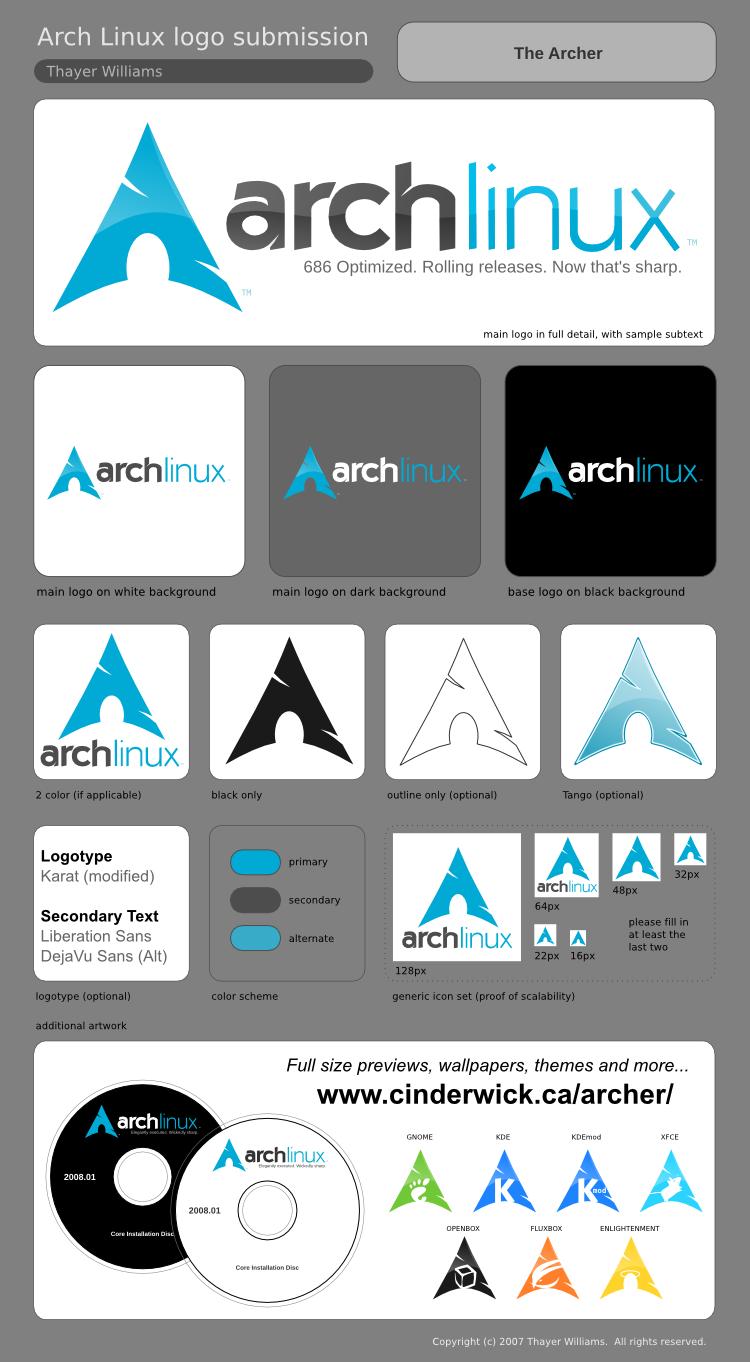
[edit]The current Arch Linux logo was designed by Thayer Williams[51][52] in 2007 as part of a contest to replace the previous logo.[53]
Installation
[edit]
The Arch Linux website supplies ISO images that may be burned to a CD or USB drive. Installation can be accomplished manually by following the instructions on the Arch Wiki, or automatically through the use of the included "archinstall" script.[54][55][56] Another command line utility that comes bundled with the installation media, "pacstrap" may be used to install the base system.[46] Installation of additional packages which are not part of the base system can be done with either pacstrap, Pacman after booting (or chrooting) into the new installation, or by specifying packages within the guided archinstall script.[57][58][14]


An alternative to using CD or USB images for installation is to use the static version of the package manager Pacman, from within another Linux-based operating system.[59] The user can mount their newly formatted drive partition, and use pacstrap (or Pacman with the appropriate command-line switch) to install base and additional packages with the mountpoint of the destination device as the root for its operations. This method is useful when installing Arch Linux onto USB flash drives, or onto a temporarily mounted device which belongs to another system.[60]
Depending on the selected installation type, further actions may need to be taken before the new system is ready for use. Notable configuration includes the installation of a bootloader, configuring the system with a hostname, network connection, language settings, and graphical user interface.[61]
Arch Linux does not schedule releases for specific dates, nor does it provide traditional releases, but instead uses a rolling release model. Packages in the main repositories are updated often, with new updates being pushed far quicker when compared to long-term support (LTS) distributions. This style of package management allows systems to remain updated easily.[62]
Occasionally, manual interventions are needed for certain updates, with instructions posted on the news section of the Arch Linux website.[63]
Package management
[edit]Pacman
[edit]
All packages are managed through pacman, a package manager written specifically for Arch Linux.[64] Pacman handles package installation, upgrades, downgrades, removal and features automatic dependency resolution.[65] The packages for Arch Linux are obtained from the Arch Linux package tree and are compiled for the x86-64 architecture.
Pacman typically uses binary packages with a .tar.zst extension[66][67][68] (for zstd compression), with .pkg placed before this to indicate that it is a Pacman package (giving .pkg.tar.zst);[65]
though other compression formats are also valid, such as .pkg.tar.xz.[69]
Packages can be installed via pacman -S package name, and pacman -Syu can be used to perform a full system upgrade.[70]
As well as Arch Linux, Pacman is also used for installing packages under MSYS2 (a fork of Cygwin) on Windows.[71]
Repositories
[edit]The following official binary repositories exist:[72]
- core, which contains all the packages needed to set up a base system. Packages in this repository include kernel packages and shell languages.
- extra, which holds packages unneeded for the base system, including desktop environments and programs.
- multilib, a centralized repository for x86-64 users to more readily support 32-bit applications in a 64-bit environment. Packages in this repository include Steam.
Also, testing repositories exist which include binary package candidates for other repositories. Currently, the following testing repositories exist:
- core-testing, with packages for core.
- extra-testing, with packages for extra.
- multilib-testing, with packages for multilib.
The core-staging and extra-staging repositories are used for some rebuilds to avoid broken packages in testing. The developers recommend not using these repositories for any reason, stating that any system updating from them will "unquestionably break."[73]
There are also two other repositories that include the newest version of certain desktop environments.
- gnome-unstable, which contains packages of a new version of the software from GNOME before being released into testing.
- kde-unstable, which contains packages of a new version of KDE software before being released into testing.
The unstable repository was dropped in July 2008 and most of the packages moved to other repositories.[74] The community repository was merged with extra in May 2023.[75][76] In addition to the official repositories, there are a number of unofficial user repositories.
The most well-known unofficial repository is the Arch User Repository, or AUR, hosted on the Arch Linux site. The AUR does not host binary packages but instead a collection of build scripts known as PKGBUILDs. PKGBUILD scripts are executed by the makepkg command, which downloads the necessary files from the software's repository and builds them using the Arch build system.
The Arch Linux repositories contain both libre and nonfree software, and the default Arch Linux kernel contains nonfree proprietary blobs, hence the distribution is not endorsed by the GNU project.[77] The linux-libre kernel can be installed from the AUR or by enabling Parabola's repositories.
Arch build system (ABS)
[edit]The Arch build system (ABS) is a ports-like source packaging system that compiles source tarballs into binary packages, which are installed via Pacman.[78] The Arch build system provides a directory tree of shell scripts, called PKGBUILDs, that enable any and all official Arch packages to be customized and compiled. Rebuilding the entire system using modified compiler flags is also supported by the Arch build system. The Arch build system makepkg tool can be used to create custom pkg.tar.zst packages from third-party sources. The resulting packages are also installable and trackable via Pacman.[79][80]
Arch User Repository (AUR)
[edit]In addition to the repositories, the Arch User Repository (AUR) provides user-made PKGBUILD scripts for packages not included within the main repositories. These PKGBUILD scripts simplify building from source by explicitly listing and checking for dependencies and configuring the install to match the Arch architecture.[81] Arch User Repository helper programs can further streamline the downloading of PKGBUILD scripts and associated building process.
However, this comes at the cost of executing PKGBUILDs not validated by a trusted person; as a result, Arch developers have stated that the utilities for automatic finding, downloading and executing of PKGBUILDs will never be included in the official repositories.[82] Instances of malware have been discovered in the past such as on 19 July 2025 when a modified Firefox build was actually a RAT,[83] thus AUR packages should be installed with great care and Arch Linux directs users to avoid AUR helpers.[84]
Users can create packages compatible with Pacman using the Arch build system and custom PKGBUILD scripts.[85] This functionality has helped support the Arch User Repository, which consists of user contributed packages to supplement the official repositories.[86]
The Arch User Repository provides the community with packages that are not included in the main repositories. Reasons for exclusion from the main repositories include:
- Licensing issues: software that cannot be redistributed, but is free to use, can be included in the Arch User Repository since all that is hosted by the Arch Linux website is a shell script that downloads the actual software from elsewhere. Examples include proprietary freeware such as Google Earth and Spotify.
- Modified official packages: the Arch User Repository also contains many variations on the official packaging as well as beta versions of software that is contained within the repositories as stable releases.
- Popularity of the software: rarely used programs have not been added to the official repositories (yet).
- Betas or "nightly" versions of software which are very new and thus unstable. Examples include the "firefox-nightly" package, which gives new daily builds of the Firefox web browser.
PKGBUILDs for any software can be contributed by ordinary users.[87] Any PKGBUILD that has 10 or more votes or more than 1% usage from pkgstats can be promoted into the extra repository.[88]
Reproducible builds
[edit]Arch Linux is working on making all official packages reproducible.[89] This means that when a package is rebuilt in a different environment it should be bit-by-bit identical. This allows users and researchers to verify the integrity of the packages found in the official repository. The status of this effort can be monitored on the dedicated status page.
Derivatives and other products
[edit]The Arch Linux wiki maintains its own list of Arch-based distributions.[90]
There are several projects working on porting the Arch Linux ideas and tools to other kernels, including PacBSD (formerly ArchBSD) and Arch Hurd,[91] which are based on the FreeBSD and GNU Hurd kernels, respectively. There is also the Arch Linux ARM project, which aims to port Arch Linux to ARM-based devices, including the Raspberry Pi, as well as the Arch Linux 32 project, which continued support for systems with 32-bit only CPUs after the mainline Arch Linux project dropped support for the architecture in November 2017.[92][93]
SteamOS 3.0, the version of SteamOS used in the Steam Deck by Valve, is based on Arch Linux.[94][95]
Reception
[edit]OSNews reviewed Arch Linux in 2002.[96] OSNews also has five later reviews about Arch Linux.[97][98][99][100][101]
LWN.net wrote a review about Arch Linux in 2005.[102] LWN.net also has two later reviews about Arch Linux.[103][104]
Tux Machines reviewed Arch Linux in 2007.[105]
Chris Smart from DistroWatch Weekly wrote a review about Arch Linux in January 2009.[106] DistroWatch Weekly reviewed Arch Linux again in September 2009 and in December 2015.[107][108]
The Linux kernel developer and maintainer Greg Kroah-Hartman (GKH)[109] has stated that he uses Arch Linux and that it "works really really well". He has also praised the Arch Wiki, the distribution's rolling release model, and the feedback loop with the community.[110]
In a 2023 DistroWatch poll, about half of the responders maintained that they were running either Arch (17%) or an Arch derivative (30%).[111] As of 2025, Arch also enjoys the third highest average rating of any Linux distribution on DistroWatch with a rating of 9.18, with only two higher rated distributions (Artix Linux and BigLinux) also being Arch derivatives.[112]
See also
[edit]Notes
[edit]- ^ Pacman is the official way to update Arch Linux. AUR Helpers and graphical app stores, such as Discover and GNOME Software, are available.
- ^ i686 support is maintained by the Arch Linux 32 project.[3]
- ^ ARM support is maintained by the Arch Linux ARM project.
- ^ Loongson support is maintained by the Arch Linux Loongson project.[4]
- ^ PowerPC support is maintained by the ArchPOWER project.[5]
- ^ RISC-V support is maintained by the Arch Linux RISC-V project.[6]
- ^ Sometimes referred to as just Arch[citation needed]
References
[edit]- ^ "Arch Linux - News: The Future of the Arch Linux Project Leader". archlinux.org. Archived from the original on 25 February 2022. Retrieved 22 November 2021.
- ^ "Pacman Home Page". www.archlinux.org. Archived from the original on 26 February 2011. Retrieved 9 May 2020.
- ^ "Arch Linux 32". Arch Linux 32. Archived from the original on 26 January 2021. Retrieved 19 June 2021.
- ^ "Loong Arch Linux". Loong Arch Linux (in Chinese). Retrieved 14 January 2024.
- ^ "ArchPOWER". Arch POWER. Archived from the original on 11 January 2023. Retrieved 31 May 2022.
- ^ "Arch Linux RISC-V". Arch Linux RISC-V. Archived from the original on 24 May 2022. Retrieved 31 May 2022.
- ^ * "Copyright". Pacman Home Page. Archived from the original on 26 February 2011. Retrieved 30 July 2020.
Pacman is [...] and is licensed through the GNU General Public License, version 2 or later.
- "COPYING". arch-install-scripts repository. Archived from the original on 29 April 2021. Retrieved 30 July 2020.
- "About mkinitcpio". Archived from the original on 28 April 2021. Retrieved 30 July 2020.
- ^ a b Aaron Griffin (24 August 2005). "Pronnounciation [sic] of our beloved distribution's name". Osdir.com. Archived from the original on 12 February 2012. Retrieved 19 October 2009.
- ^ "Arch terminology - ArchWiki". Arch Linux Wiki. Archived from the original on 3 October 2022. Retrieved 3 October 2022.
Officially, the 'Arch' in "Arch Linux" is pronounced /ɑːrtʃ/ as in an "archer"/bowman, or "arch-nemesis", and not as in "ark" or "archangel".
- ^ Ivan Jelic (10 March 2010). "Rolling with Arch Linux". LWN.net. Archived from the original on 20 October 2011. Retrieved 30 September 2011.
- ^ "Arch Linux Wiki homepage". wiki.archlinux.org. Archived from the original on 26 April 2022. Retrieved 6 July 2022.
- ^ "Installation guide - ArchWiki". wiki.archlinux.org. Retrieved 7 February 2025.
- ^ "Arch Linux - Downloads". archlinux.org. Retrieved 7 February 2025.
- ^ a b "Pacman Home Page". www.archlinux.org. Archived from the original on 26 February 2011. Retrieved 30 October 2019.
- ^ "Arch User Repository - ArchWiki". wiki.archlinux.org. Retrieved 5 December 2024.
- ^ "AUR helpers - ArchWiki". wiki.archlinux.org. Retrieved 5 December 2024.
- ^ Smith, Jesse (21 December 2015). "Arch Linux - Feature Story". Archived from the original on 12 September 2018. Retrieved 17 January 2016.
- ^ Linton, Susan (17 July 2015). "Debian Project Lead: Snappy and Mir Bad Ideas". OStatic. Archived from the original on 4 February 2017. Retrieved 4 February 2017.
One of the first questions wondered if McGovern was jealous of anything from any other distro. To that he answered Arch's wiki calling it "an absolutely amazing resource" that he himself uses.
- ^ "The Arch Way". Linux Journal. Archived from the original on 30 October 2019. Retrieved 30 October 2019.
- ^ Bodnar, Ladislav. "Interview with Judd Vinet". distrowatch.com. Archived from the original on 8 September 2017. Retrieved 30 October 2019.
- ^ Chu, Jason (12 April 2006). "Official Arch64 install cd available". Arch Linux. Archived from the original on 12 June 2018. Retrieved 12 May 2019.
- ^ apeiro (Judd Vinet) (1 October 2007). "Arch Leadership". Arch Linux Forums. Archived from the original on 9 August 2011. Retrieved 19 October 2009.
- ^ Gaudreault, Stéphane (14 August 2012). "Migration to systemd". arch-dev-public (Mailing list). Archived from the original on 20 October 2020. Retrieved 24 September 2020.
- ^ Bächler, Thomas (13 October 2012). "systemd is now the default on new installations". Archived from the original on 15 October 2012. Retrieved 24 September 2020.
- ^ "Archlinux installer 0.1". archive.archlinux.org. Archived from the original on 12 November 2020. Retrieved 24 September 2020.
- ^ Piotrowski, Bartłomiej (25 January 2017). "Phasing out i686 support". Arch Linux. Archived from the original on 27 January 2017. Retrieved 26 January 2017.
- ^ Piotrowski, Bartłomiej (8 November 2017). "The end of i686 support". Arch Linux. Archived from the original on 8 November 2017. Retrieved 8 November 2017.
- ^ "Arch Linux 32". archlinux32.org. Archived from the original on 26 January 2021. Retrieved 22 April 2023.
- ^ Griffin, Aaron (24 February 2020). "The Future of the Arch Linux Project Leader". Arch Linux. Archived from the original on 9 May 2020. Retrieved 24 June 2020.
- ^ "DeveloperWiki:Project Leader". wiki.archlinux.org. Archived from the original on 26 July 2020. Retrieved 24 June 2020.
- ^ Larabel, Michael (2 March 2021). "Arch Linux Developers Discuss Idea Of Providing An x86-64-v3 Port". phoronix.com. Archived from the original on 21 November 2021. Retrieved 21 November 2021.
- ^ McRae, Allan (2 March 2021). "Provide a x86_64_v3 microarchitecture level port". gitlab.archlinux.org. Archived from the original on 21 November 2021. Retrieved 21 November 2021.
- ^ Razzolini, Giancarlo (1 April 2021). "Installation medium with installer". Arch Linux. Archived from the original on 1 April 2021. Retrieved 1 February 2022.
- ^ McRae, Allan (4 September 2021). "Update News for pacman-6.0.1 release". gitlab.archlinux.org. Archived from the original on 3 March 2022. Retrieved 3 March 2022.
- ^ Linderud, Morten (2 February 2022). "Debug packages and debuginfod". Arch Linux. Archived from the original on 3 May 2022. Retrieved 31 March 2022.
- ^ Polyak, Levente (27 September 2024). "Arch Linux and Valve Collaboration". arch-dev-public (Mailing list). Archived from the original on 29 September 2024. Retrieved 30 September 2024.
- ^ Rankin, David C (14 August 2025). "AUR web site down? Can't reach aur.archlinux.org?". arch-general (Mailing list). Retrieved 23 August 2025.
- ^ Heusel, Christian (21 August 2025). "Recent service outages". Arch Linux. Retrieved 2 September 2025.
- ^ Spyropoulos, Leonidas (16 August 2025). "Arch Linux services unavailable". arch-general (Mailing list). Retrieved 2 September 2025.
- ^ Arghire, Ionut (25 August 2025). "Arch Linux Project Responding to Week-Long DDoS Attack". Security Week. Retrieved 2 September 2025.
- ^ "index : pacman.git". git.archlinux.org. Archived from the original on 8 March 2021. Retrieved 12 May 2019.
- ^ Mikael (1 September 2026). "FS#5331 : Signed packages". bugs.archlinux.org. Archived from the original on 28 July 2011. Retrieved 12 May 2019.
- ^ "Attacks on Package Managers". cs.arizona.edu. 10 July 2008. Archived from the original on 5 September 2010. Retrieved 14 September 2010.
- ^ McRae, Allan (17 December 2011). "Pacman Package Signing – 4: Arch Linux". Allan McRae. Archived from the original on 20 February 2012. Retrieved 29 February 2012.
- ^ Bisson, Gaetan (4 June 2012). "Having pacman verify packages". Arch Linux. Archived from the original on 6 June 2012. Retrieved 4 June 2012.
- ^ a b Schmitz, Pierre (22 July 2012). "Install media 2012.07.15 released". Arch Linux. Archived from the original on 12 December 2015. Retrieved 13 August 2012.
- ^ Campbell, Alex; Hacker, Tech; PT, PCWorld (2 November 2016). "5 reasons to opt for a Linux rolling distro vs. a standard release". PCWorld. Archived from the original on 26 July 2020. Retrieved 12 May 2019.
- ^ "The Arch Way". ArchWiki. 9 October 2009. Archived from the original on 18 April 2012. Retrieved 18 March 2013.
- ^ Williams, rew; April 2020, Brian Turner 16. "Best Linux distros of 2020: for beginners and advanced users". TechRadar. Archived from the original on 21 April 2020. Retrieved 17 April 2020.
{{cite web}}: CS1 maint: numeric names: authors list (link) - ^ "FS#43302 - [pacman] provide workaround for removing --asroot from makepkg". arch linux. Archived from the original on 4 July 2020. Retrieved 4 July 2020.
- ^ Willard, Travis (22 December 2007). "Arch Linux - News: Logo Contest Results (and Winner!)". www.archlinux.org. Archived from the original on 18 March 2022. Retrieved 4 October 2020.
- ^ Williams, Thayer (2007). "Arch Linux logo submission". pkgbuild.com. Archived from the original on 17 February 2021. Retrieved 4 October 2020.
- ^ Willard, Travis (24 October 2007). "Arch Linux - News: Arch Linux Logo Competition". www.archlinux.org. Archived from the original on 18 March 2022. Retrieved 4 October 2020.
- ^ "archinstall - ArchWiki". wiki.archlinux.org. Archived from the original on 13 April 2021. Retrieved 12 April 2021.
- ^ Nestor, Marius (11 April 2021). "Latest Arch Linux ISO Release Comes with the ArchInstall CLI Guided Installer". 9to5Linux. Archived from the original on 23 February 2022. Retrieved 23 February 2022.
- ^ "Arch Linux Now Comes With Easier to Use Guided Installer". MUO. 6 April 2021. Archived from the original on 23 February 2022. Retrieved 23 February 2022.
- ^ "pacman - ArchWiki". wiki.archlinux.org. Archived from the original on 18 August 2017. Retrieved 13 September 2019.
- ^ "General recommendations - ArchWiki". wiki.archlinux.org. Archived from the original on 21 September 2019. Retrieved 13 September 2019.
- ^ "Install From Existing Linux". ArchWiki. 21 November 2009. Archived from the original on 26 January 2013. Retrieved 5 December 2009.
- ^ "Install Arch Linux on a removable medium - ArchWiki". wiki.archlinux.org. Archived from the original on 26 August 2022. Retrieved 26 August 2022.
- ^ "Installation guide - ArchWiki". wiki.archlinux.org. Archived from the original on 8 September 2019. Retrieved 13 September 2019.
- ^ "Arch Linux Review". DVD-Guides.com. 2007. Archived from the original on 14 September 2017. Retrieved 13 September 2017.
- ^ "News". archlinux.org. Archived from the original on 15 August 2018. Retrieved 15 August 2018.
- ^ Eugenia Loli (21 March 2005). "Arch Linux: Why It Rocks". OSNews. Archived from the original on 30 September 2011. Retrieved 30 September 2011.
- ^ a b "pacman". ArchWiki. 6 August 2017. Archived from the original on 18 August 2017. Retrieved 20 August 2017.
- ^ "Arch Linux Nears Roll-Out Of Zstd Compressed Packages For Faster Pacman Installs - Phoronix". www.phoronix.com. Archived from the original on 18 March 2022. Retrieved 31 October 2019.
- ^ Broda, Robin (24 March 2019). "[arch-dev-public] RFC: (devtools) Changing default compression method to zstd". Archived from the original on 21 October 2019. Retrieved 31 October 2019.
- ^ "Arch Linux - News: Required update to recent libarchive". www.archlinux.org. Archived from the original on 21 October 2019. Retrieved 31 October 2019.
- ^ "Pacman: Configuration options for makepkg" Archived 20 January 2021 at the Wayback Machine. 2021.
- ^ "Man pages of Pacman". archlinux.org. Archived from the original on 22 June 2022. Retrieved 6 July 2022.
- ^ "Package Management – MSYS2". www.msys2.org. Archived from the original on 1 November 2020. Retrieved 11 November 2020.
- ^ "Official Repositories". ArchWiki. Archived from the original on 18 November 2012. Retrieved 23 November 2012.
- ^ "Official repositories - ArchWiki". wiki.archlinux.org. Archived from the original on 11 January 2023. Retrieved 1 February 2022.
- ^ "Arch Linux Newsletter 08-04-2008". Arch Linux. 4 August 2008. Archived from the original on 3 June 2013. Retrieved 19 October 2009.
- ^ Larabel, Michael (16 May 2023). "Arch Linux Prepares For Repository Changes, Discontinuing SVN Access". Phoronix. Archived from the original on 24 May 2023. Retrieved 24 May 2023.
- ^ van der Waa, Jelle (15 May 2023). "Git migration announcement". Arch Linux. Archived from the original on 24 May 2023. Retrieved 24 May 2023.
- ^ "Explaining Why We Don't Endorse Other Systems". GNU Project. Archived from the original on 24 April 2011. Retrieved 28 September 2011.
- ^ "Arch Build System". ArchWiki. Archived from the original on 17 January 2013. Retrieved 19 October 2009.
- ^ "Makepkg". ArchWiki. Archived from the original on 26 January 2013. Retrieved 15 February 2013.
- ^ "Arch Linux - News: Now using Zstandard instead of xz for package compression". www.archlinux.org. Archived from the original on 18 March 2022. Retrieved 13 July 2020.
- ^ "AUR (en) - Home". AUR. Archived from the original on 3 November 2016. Retrieved 5 February 2014.
- ^ Robin Heggelund Hansen (25 March 2008). "Arch Linux: Popular KISS distro – Interview – Part II". Hardware.no. Archived from the original on 2 April 2009. Retrieved 19 October 2009.
- ^ "Arch Linux AUR Packages For Firefox & Other Browsers Removed For Containing Malware". www.phoronix.com. Retrieved 23 July 2025.
- ^ "AUR helpers - ArchWiki". wiki.archlinux.org. Retrieved 23 July 2025.
- ^ "Using the Arch Build System". library.linode.com. 8 September 2011. Archived from the original on 27 September 2011. Retrieved 30 September 2011.
- ^ Bo Milanovich (8 March 2011). "Arch Linux". linuxdistroreview.com. Archived from the original on 21 February 2012. Retrieved 30 September 2011.
- ^ "Arch User Repository - ArchWiki". wiki.archlinux.org. Archived from the original on 14 July 2023. Retrieved 11 July 2023.
In the AUR, users are able to contribute their own package builds[.]
- ^ "AUR Trusted User guidelines - ArchWiki". wiki.archlinux.org. Archived from the original on 11 July 2023. Retrieved 11 July 2023.
- ^ "ArchWiki - Reproducible builds". Archived from the original on 23 April 2023. Retrieved 26 April 2023.
- ^ "Arch-based distributions - ArchWiki". wiki.archlinux.org. Archived from the original on 3 January 2022. Retrieved 17 December 2023.
- ^ "Arch Hurd". Arch Hurd. Archived from the original on 26 March 2014. Retrieved 25 March 2014.
- ^ "Arch Linux ARM". Arch Linux ARM. Archived from the original on 28 March 2014. Retrieved 25 March 2014.
- ^ "Arch Linux 32". Arch Linux 32. Archived from the original on 26 January 2021. Retrieved 22 October 2020.
- ^ Duckett, Chris. "Steam Deck is an AMD-powered handheld PC from Valve that runs KDE on Arch Linux". ZDNet. Archived from the original on 16 February 2022. Retrieved 18 July 2021.
- ^ Prasad (15 July 2021). "Valve Steam Deck is a handheld gaming PC that runs SteamOS". GSMArena. Archived from the original on 18 July 2021. Retrieved 19 July 2021.
The Steam Deck runs on Valve's SteamOS 3.0. This is primarily based on Arch Linux and uses the compatibility layer Proton to run games designed for Windows
- ^ "Introduction to Arch Linux – OSnews". www.osnews.com. Archived from the original on 12 May 2019. Retrieved 12 May 2019.
- ^ "Arch Linux: A Better Distribution – OSnews". www.osnews.com. Archived from the original on 12 May 2019. Retrieved 12 May 2019.
- ^ "Arch Linux: An End To My Distro Shuffle? – OSnews". www.osnews.com. Archived from the original on 12 May 2019. Retrieved 12 May 2019.
- ^ "A Week in the Life of an Arch Linux Newbie – OSnews". www.osnews.com. Archived from the original on 12 May 2019. Retrieved 12 May 2019.
- ^ "Arch Linux: Why It Rocks – OSnews". www.osnews.com. Archived from the original on 12 May 2019. Retrieved 12 May 2019.
- ^ "Watching the Evolution of Arch Linux – OSnews". www.osnews.com. Archived from the original on 12 May 2019. Retrieved 12 May 2019.
- ^ Bodnar, Ladislav (2 February 2005). "Arch Linux for Power Users [LWN.net]". lwn.net. Archived from the original on 12 May 2019. Retrieved 12 May 2019.
- ^ Jelic, Ivan (10 March 2010). "Rolling with Arch Linux [LWN.net]". lwn.net. Archived from the original on 7 February 2019. Retrieved 12 May 2019.
- ^ Corbet, Jonathan (April 2015). "The grumpy editor's Arch Linux experience [LWN.net]". lwn.net. Archived from the original on 15 November 2019. Retrieved 12 May 2019.
- ^ srlinuxx (20 April 2007). "Fallen Under the Spell of Arch Voodoo". Tux Machines. Archived from the original on 20 June 2018. Retrieved 14 August 2025.
- ^ Smart, Chris (19 January 2009). "Arch Linux in review". Distrowatch.com. No. 286. Archived from the original on 20 June 2018. Retrieved 14 August 2025.
- ^ "A distro odyssey, part 2 - the Arch way". distrowatch.com. Archived from the original on 20 June 2018. Retrieved 12 May 2019.
- ^ "Arch Linux". distrowatch.com. Archived from the original on 12 September 2018. Retrieved 12 May 2019.
- ^ "git.kernel.org - linux/kernel/git/torvalds/linux-2.6.git/blob - MAINT…". archive.is. 13 January 2013. Archived from the original on 13 January 2013. Retrieved 30 October 2019.
- ^ "Let's Talk To Linux Kernel Developer Greg Kroah-Hartman - Open Source Summit, 2019". YouTube. 10 September 2019. Archived from the original on 21 December 2021. Retrieved 17 September 2019.
[Arch developers'] idea of a constantly rolling, forward-moving system is the way to go. It's neutral, it's community-based, it has everything I need. It works really really well [...] Their Wiki is amazing. The documentation -- it's like one of the best resources out there these days. If you look up any userspace program and how to configure it and use it. Actually, the systemd Arch Wiki pages are one of the most amazing resources out there. [...] One of the main policies of Arch, or philosophies, is you stay as close to the upstream as possible. And as a developer, I want that. They're really good in feedback to the community. Because I want that testing -- I want to make sure that things are fixed. And if it is broken, I learn about it quickly and I fix it and push the stuff out. So that's actually a really good feedback loop.
- ^ "DistroWatch.com: Put the fun back into computing. Use Linux, BSD". distrowatch.com. Archived from the original on 31 January 2023. Retrieved 31 January 2023.
- ^ "DistroWatch.com: Put the fun back into computing. Use Linux, BSD". distrowatch.com. Retrieved 1 August 2025.
External links
[edit]

 Arch Linux package (P3454) (see uses)
- AUR package (P4162) (see uses)
- ArchWiki article (P12873) (see uses)


- Official website

- Arch Linux on GitHub
- #archlinux connect on Libera Chat (#archlinuxarm connect, #archlinux32 connect)



Arch Linux
View on GrokipediaHistory
Founding and Early Development
Arch Linux was founded by Canadian programmer Judd Vinet on March 11, 2002, with its initial development beginning in early 2001.[3] Designed as a lightweight, i686-optimized Linux distribution, it drew primary inspiration from CRUX, a minimalist distribution created by Per Lidén, while also incorporating elements from Slackware, BSD, and PLD Linux.[4][3] Vinet aimed to create a streamlined system targeted at advanced users and developers who preferred a simple, customizable base without unnecessary bloat, emphasizing simplicity and flexibility from the outset.[4] The first release, Arch Linux 0.1 codenamed "Homer," was made available on March 11, 2002, featuring a bootable ISO image for installation.[5] Installation involved a straightforward process of extracting base system tarballs onto the root partition, providing users with a minimal environment that could be built upon manually.[3] This release introduced Pacman version 1.2 as the package manager, a tool developed by Vinet to handle dependency resolution, installations, removals, and upgrades using .tar.gz package formats; subsequent work on Pacman 2.0 began shortly after in May 2002 to enhance its capabilities.[4][6] From its inception, Arch Linux adopted a rolling-release model, delivering the latest stable software versions through continuous updates rather than periodic versioned releases, which set it apart from fixed-release distributions like Debian.[3] This approach allowed users to maintain an up-to-date system with a single installation, prioritizing cutting-edge functionality for power users. In 2003, Vinet developed the Arch Build System (ABS), a ports-like framework modeled after FreeBSD's system, enabling users to download source code, build custom packages via PKGBUILD scripts, and integrate them seamlessly with Pacman for greater personalization.[7][8]Key Milestones and Leadership
In 2007, founder Judd Vinet stepped down from active development of Arch Linux, handing over leadership to Aaron Griffin, who served as lead developer and helped stabilize the project during a period of rapid community expansion.[9][10] The Arch User Repository (AUR) was introduced in April 2005 as a community-driven collection of build scripts, which saw significant expansion after 2007 to accommodate growing user contributions.[11] By 2008, Arch Linux formalized its official tiered repositories—core for essential base system packages, extra for additional software, and community for maintainer-contributed packages—enhancing package organization and accessibility. (Note: While core and extra were established earlier, the full tiered structure including community solidified around this period, with further refinements in 2012.) In April 2006, Arch Linux released its first official x86-64 installation ISO, marking the transition from i686 to supporting the 64-bit architecture, which later became the primary focus. Pierre Schmitz joined as a key developer in 2007, contributing to major infrastructure upgrades such as automated build servers and improvements to installation ISO images, which bolstered the distribution's reliability and ease of maintenance.[12][13] Significant technical milestones followed, including the adoption of systemd as the default init system in October 2012, replacing SysVinit to enable faster boot times and better service management.[14] In 2017, the live installation environment shifted to zsh as the default shell, providing enhanced autocompletion and scripting features for users during setup.[15] The official archinstall script was introduced in 2021, offering a guided installation option while preserving the manual process for advanced users.[16] In May 2023, the [community] repository was merged into [extra], simplifying the repository structure by consolidating community-maintained packages. From 2023 to 2025, Arch Linux maintained operational stability with no major disruptions, focusing on incremental refinements amid ongoing community involvement. Arch Linux's user base grew to millions by the 2020s, fueled in part by the expansive ArchWiki, which surpassed 10,000 pages of documentation through collaborative contributions.[17][18]Security and Repository Evolution
In the early 2000s, Arch Linux relied on unsigned packages, which raised significant security concerns due to the potential for tampering during distribution. This lack of cryptographic verification prompted early discussions on implementing signing mechanisms, with a feature request for signed packages submitted in 2006 (FS#5331). Judd Vinet, as the founder, contributed to initial security improvements around this period, though no major repository compromise was publicly documented.[19] The push for enhanced security culminated in the implementation of PGP-signed repositories in 2011 under lead developer Aaron Griffin, utilizing GnuPG for package integrity verification through a web-of-trust model. This overhaul made package signing mandatory for official repositories starting in November 2011, allowing pacman to verify signatures before installation and mitigating man-in-the-middle attacks. Pacman handles this verification process by checking OpenPGP signatures against trusted keys in the system's keyring.[20] Repository evolution continued with the introduction of delta updates in pacman 3.3.0 in 2009, enabling efficient bandwidth usage by downloading only changes between package versions rather than full files. By 2013, package signing was further strengthened with the adoption of SHA-256 hashing for enhanced integrity checks, replacing weaker algorithms and aligning with broader cryptographic best practices.[21] Post-2020 developments addressed ongoing key management challenges, including the addition of automatic keyring updates via the archlinux-keyring package in 2022, which uses a systemd timer to refresh PGP keys periodically and prevent expiration-related update failures. In 2023, amid rising supply-chain attack concerns—such as those highlighted by incidents like the SolarWinds breach—Arch Linux adopted stricter signing policies, including requirements for upstream key storage in source repositories to facilitate reproducible builds and reduce trust in external artifacts. No major security breaches in the core repositories have been reported as of 2025.[22] Arch Linux's rolling-release model presents unique security challenges, requiring rapid response to vulnerabilities to minimize exposure windows. For instance, the critical Log4Shell vulnerability (CVE-2021-44228) in Apache Log4j, disclosed on December 9, 2021, was patched in the affected Arch package (log4j2 2.16-1) by December 18, 2021, demonstrating the distribution's ability to deploy fixes swiftly through its continuous update cycle.[23]Philosophy and Design
Core Principles
Arch Linux embodies a set of foundational principles known as "The Arch Way," which guide its design, development, and user interaction, emphasizing simplicity, modernity, pragmatism, user centrality, and versatility.[3] Central to this philosophy is the KISS principle—"Keep It Simple, Stupid"—which promotes minimalism by avoiding unnecessary abstractions, modifications, or additions to software, ensuring transparency and ease of understanding for users and developers alike.[24] This approach manifests in the distribution's lightweight base system, free from pre-installed desktop environments or extraneous packages, allowing users to build exactly what they need without bloat.[25] A user-centric ethos defines Arch Linux, encapsulated in the mantra "Arch Linux is what you make of it," placing responsibility and control firmly in the hands of the user to configure and customize the system through a do-it-yourself (DIY) process.[3] This encourages active engagement, where users select and install components tailored to their requirements, fostering a deep understanding of the underlying system without paternalistic defaults imposed by the distribution.[26] The rolling-release model forms another pillar, delivering continuous updates of the latest stable software versions via the pacman package manager, enabling users to stay current without periodic major upgrades or reinstallations.[3] While this provides access to cutting-edge features, it demands user diligence to resolve potential issues from updates, underscoring personal accountability over automated stability guarantees.[3] Arch Linux prioritizes a wiki-driven documentation strategy, with the ArchWiki serving as the primary, community-maintained knowledge base that has evolved since its inception on July 8, 2005, to offer comprehensive, accessible guidance on installation, configuration, and troubleshooting.[3] This resource-centric model empowers the community to contribute and refine content collaboratively, reducing reliance on fragmented external sources. Finally, an upstream-first commitment shapes development, integrating software directly as released by original upstream projects—such as the Linux kernel—with minimal Arch-specific downstream alterations, and avoiding patches not accepted upstream whenever possible to maintain compatibility and simplicity.[3] This policy ensures that contributions flow back to upstream where feasible, aligning Arch closely with broader open-source ecosystems.[3]Customization Approach
Arch Linux's design emphasizes a modular base installation, enabling users to select and install only the essential components required for their system, such as the kernel, bootloader, and basic utilities, without including distro-specific modifications or bloat. During the setup process, tools like pacstrap allow precise package selection from the official repositories, ensuring a minimal foundation that can be expanded as needed. This approach aligns with the distribution's philosophy of simplicity and user control, allowing installations to range from a bare-bones server to a fully featured desktop by adding components post-installation.[27] The system supports flexibility in core components, including multiple init systems and desktop environments. Historically, SysVinit served as the default init system until 2012, when systemd became the standard, with legacy support fully deprecated in 2013 for its parallel service startup and integrated management features. Users can install various desktop environments, such as GNOME or KDE Plasma, directly via the pacman package manager, permitting seamless switching or omission based on preferences without altering the base system.[28][29] Configuration in Arch Linux relies heavily on editable plain-text files, which facilitates customization through direct editing and automation scripts for advanced users. For instance, the /etc/mkinitcpio.conf file controls the generation of the initramfs image, where users can specify modules, hooks, and binaries to tailor boot behavior. This text-based method promotes transparency and reproducibility, enabling users to version-control configurations or integrate them into deployment scripts.[30] Arch Linux encourages source-based building for performance optimization, allowing users to compile packages with architecture-specific flags using the Arch Build System (ABS). This enables tweaks like enabling the multilib repository to support 32-bit applications on 64-bit x86_64 systems, optimizing for specific hardware without relying on pre-compiled binaries. The PKGBUILD format simplifies modifying build parameters, such as compiler optimizations, to suit individual needs.[7][31] To accommodate diverse hardware, Arch employs tools like mkinitcpio hooks, which integrate necessary drivers and modules into the initramfs during boot preparation. Hooks such as autodetect and modconf automatically include relevant kernel modules for devices like graphics cards or filesystems, while custom hooks can be added for specialized hardware without introducing vendor-specific dependencies or lock-in. This mechanism ensures broad compatibility across architectures and peripherals through user-defined adjustments.[32]Visual Identity
Arch Linux's visual identity centers on a minimalist logo introduced in 2007 through an official community contest, won by designer Thayer Williams with his "Archer" submission. The logo depicts a stylized triangular "A" resembling an arch or arrowhead, emphasizing the project's architectural precision and forward momentum in software development. This design replaced earlier, simpler branding and has since become the enduring symbol of the distribution.[33][34] The color scheme adheres to black and white for core elements, promoting minimalism, while incorporating teal accents (hexadecimal #1793d1, often referred to as "Arch Blue") in official installation ISOs, the Arch Wiki, and promotional graphics to convey a clean, modern aesthetic without visual clutter. These colors align with the project's KISS (Keep It Simple, Stupid) principle by prioritizing readability and subtlety over ornate decoration.[35][36] Early branding from the distribution's 2002 founding featured text-based logos with a binary code background of 1s and 0s, underscoring its code-centric foundations; this evolved to the 2007 vector-compatible design around 2010, when scalable SVG files were released for broader adaptability, along with higher-resolution PNG variants (up to 1200 dpi) to ensure compatibility with high-DPI displays while preserving the original form.[34][37][38] Lacking corporate sponsorship, Arch Linux's visual elements are entirely community-driven, with artwork contributed by volunteers and maintained through official repositories like archlinux-artwork. This approach strengthens user identity, as the logo frequently appears in customized desktop themes and environments, allowing individuals to personalize it while honoring its minimalist ethos.[1][37] The project's trademark policy outlines guidelines for logo usage, permitting non-commercial advocacy and adaptations by derivative distributions—such as Manjaro's modified versions that incorporate similar arch motifs with distinct accents—to promote related projects without implying official endorsement.[39]Installation
Preparation and System Requirements
Arch Linux requires a compatible x86_64 processor, with support for this architecture having been provided since the distribution's early releases and exclusive since the end of i686 compatibility in November 2017.[40][41] The minimum hardware specifications include 512 MB of RAM, though 1 GB is recommended for smoother operation, particularly during the live environment boot; a 1 GHz CPU or faster is generally sufficient, and approximately 1 GB of disk space is needed for a base installation, with more recommended for practical use including additional software.[27] Users should download the official installation ISO from the Arch Linux website, where the current release as of November 2025 is approximately 1.4 GB in size, utilizing efficient compression for the live environment.[42] To ensure integrity, verify the downloaded ISO using provided SHA-256 checksums and GPG signatures, which confirm the file against official releases signed by trusted keys.[42] Preparing bootable media involves writing the ISO to a USB flash drive, which can be done on Linux systems using thedd command for direct imaging or tools like Rufus on Windows for a straightforward process; the ISO supports both legacy BIOS and UEFI boot modes, requiring users to select the appropriate firmware settings in their system's BIOS/UEFI interface.[43] The installation process mandates an active internet connection, typically configured via Ethernet or Wi-Fi during the live session to access repositories.[27]
Before proceeding, back up all important data from the target disk, as partitioning operations carry a risk of data loss; basic partitioning can be performed using tools like fdisk or cfdisk to create layouts such as GPT for UEFI systems or MBR for BIOS, allocating space for root, boot, and optional swap or home partitions.[27]
Arch Linux assumes advanced user knowledge but includes accessibility support in the installation medium, such as the Speakup kernel module for screen readers, enabling text-to-speech output during setup for visually impaired users.[44]
Manual Installation Process
The manual installation process for Arch Linux begins with booting into the live environment from an official installation ISO, typically via USB or optical media, which provides a minimal, functional system to prepare the target disk.[27] Upon booting, users verify the boot mode (UEFI or BIOS) using commands likels /sys/firmware/efi/efivars for UEFI confirmation, and set the keyboard layout with loadkeys to ensure accurate input, such as loadkeys us for the US layout.[27]
Next, establishing an internet connection is essential for downloading packages; for Ethernet, this is often automatic, but manual activation uses dhcpcd, while Wi-Fi requires iwctl to scan, connect, and authenticate to networks, followed by verifying connectivity with ping archlinux.org.[27] Disk preparation involves partitioning the target drive using tools like fdisk or cfdisk; a common layout includes an EFI partition (e.g., 512 MiB FAT32 at /dev/sdXY1), a swap partition (e.g., 4-8 GiB at /dev/sdXY2), and a root partition (e.g., ext4 at /dev/sdXY3), tailored to the system's needs.[27] For systems requiring hibernation support, the swap partition should be at least as large as the system's RAM to store the memory contents during hibernation.[45] Formatting follows with mkfs.ext4 for root and mkswap for swap, then mounting the filesystems—root to /mnt, swap activation with swapon, and EFI to /mnt/boot if applicable—ensuring the directory structure is ready for installation.[27]
The base system is then installed using pacstrap, which bootstraps essential packages from the official repositories, including the Linux kernel (linux), boot loader utilities, and core components like systemd, glibc, and bash; a typical command is pacstrap -K /mnt base linux linux-firmware.[27] This step leverages the repository structure for package retrieval, as detailed in the package management section. After pacstrap completes, generate the fstab file with genfstab -U /mnt >> /mnt/etc/fstab to map partitions persistently.[27]
Users then chroot into the new system via arch-chroot /mnt to configure it in isolation.[27] Key configurations include setting the timezone with ln -sf /usr/share/zoneinfo/Region/City /etc/localtime and hwclock --systohc, localizing the system by editing /etc/locale.gen (uncommenting desired locales like en_US.UTF-8 UTF-8), generating the locale with locale-gen, and setting the locale in /etc/locale.conf and /etc/vconsole.conf.[27] A root password is set with passwd, and a non-root user is created using useradd -m username followed by usermod -aG wheel,audio,video,optical,storage username for appropriate groups, with sudo privileges enabled by uncommenting the wheel group in /etc/sudoers.[27] For the bootloader, options include GRUB for BIOS/UEFI (installed via pacstrap and configured with grub-install and grub-mkconfig) or systemd-boot for UEFI (using bootctl install); if hibernation is desired, the bootloader must be configured to include the resume kernel parameter pointing to the swap partition (e.g., via resume=UUID=... in GRUB configuration or mkinitcpio hooks).[27][45]
Finally, exit the chroot, unmount filesystems with umount -R /mnt, and reboot with reboot to boot into the new Arch Linux system.[27] Post-installation, initial setup involves enabling networking, such as with systemctl enable --now systemd-networkd and configuring interfaces, along with installing additional drivers or desktop environments as needed.[27] Arch Linux supports hibernation through systemd, allowing users to initiate it with commands like systemctl hibernate once properly configured; detailed guides are available in the ArchWiki.[45] The entire manual process typically takes 30-60 minutes for experienced users, depending on hardware and internet speed.[27]
Automated Tools
Arch Linux provides the official archinstall script as a Python-based guided installer to streamline the setup process while adhering to the distribution's emphasis on simplicity and user control. Introduced in the April 2021 installation ISO, archinstall offers predefined profiles for common desktop environments such as GNOME and KDE Plasma, along with automatic hardware detection to configure essential components like network interfaces and audio devices.[46][47][48] The tool features interactive text-based prompts that guide users through key steps, including automatic or manual disk partitioning, selection of additional packages from official repositories, creation of user accounts with sudo privileges, and optimization of the mirrorlist for faster downloads based on geographic location. It also supports advanced options like mirrored installations, where the system can be bootstrapped onto a secondary disk without rebooting into the target environment. Since version 2.0 in 2020, with subsequent updates reaching version 2.8 in 2024, archinstall has evolved to include more robust configuration options, and 2024 enhancements added experimental support for Logical Volume Manager (LVM) partitioning layouts.[47][48][49][50] Further refinements in 2024 and 2025 bolstered filesystem handling, with stable LVM integration in version 3.0.10 and expanded Btrfs capabilities, including subvolume support since 2022 and post-install snapshot configuration in 3.0.7. As of November 2025, the November ISO includes version 3.0.12, with version 3.0.13 adding a dedicated WiFi connection menu for easier network setup during installation. These updates enable more flexible storage setups, such as Btrfs for copy-on-write functionality and snapshots for system recovery, without deviating from Arch's core principles of minimalism.[51][52][53] Archinstall's advantages lie in reducing common installation errors for newcomers, such as misconfigured bootloaders or overlooked locale settings, while preserving the educational value of the process through its transparent, scriptable nature. Integrated directly into the official live ISO since 2021, it serves as the recommended entry point for automated setups, allowing users to generate a configuration file for reproducibility across multiple machines.[47][46] However, its terminal-only interface demands basic command-line familiarity, distinguishing it from fully graphical installers like those in Ubuntu, and complex customizations may still require manual intervention post-install. Community-developed alternatives include the bash-based Archfi script, which has fallen out of favor since the official tool's adoption and is now considered deprecated for new installations, as well as the Calamares-based graphical installer in derivatives like EndeavourOS, which prioritizes point-and-click ease but modifies the base Arch experience.[47][54]Package Management
Pacman Fundamentals
Pacman is the default package manager for Arch Linux, designed as a simple and lightweight utility written in the C programming language to manage software packages efficiently.[55] It supports binary packages in a compressed tar format, specifically .pkg.tar.zst since late 2019, which replaced the previous .pkg.tar.xz format for improved compression ratios and faster decompression.[56] Pacman features automatic dependency resolution, allowing it to identify and install required packages during operations without manual intervention.[55] Core operations are performed via command-line flags, withpacman -Syu serving as the standard command for full system upgrades: it synchronizes remote package databases (-Sy) and then upgrades all outdated packages (-u), ensuring the system remains current in Arch's rolling-release model.[55] To install a specific package along with its dependencies, users run pacman -S <package-name>.[55] For removal, pacman -Rns <package-name> deletes the package, its unneeded dependencies, and configuration files without saving backups, providing a thorough cleanup option.[55]
Configuration is handled through the /etc/pacman.conf file, which defines repository sources, mirror selection for downloads (via /etc/pacman.d/mirrorlist), and transaction hooks for post-operation tasks such as reloading systemd units.[57] Enabling the multilib repository, for 32-bit package support on 64-bit systems, involves uncommenting the [multilib] section in this file.[57] Pacman's local database, storing information on installed packages, resides in /var/lib/pacman, while sync databases are downloaded from remote repositories and updated via pacman -Sy.[55] To manage file conflicts during upgrades, Pacman creates .pacsave backups of modified configuration files, preserving user customizations.
Security is integrated through GPG signature verification for downloaded packages, using keys managed in /etc/pacman.d/gnupg to ensure authenticity and integrity.[55] The --needed flag optimizes installations by skipping packages already up to date, reducing unnecessary downloads.[55] For efficient updates, Pacman supported delta patching—downloading only changes between package versions—since around 2010, though this feature was removed in version 5.2 due to performance and security considerations.[58] During the manual installation process, Pacman is used to bootstrap the initial system by installing essential packages from installation media.[55]
Repository Structure
Arch Linux's official repositories are structured in a tiered hierarchy designed to separate essential system components from additional and specialized software, ensuring modularity and maintainability. The [core] repository provides the fundamental packages required for a basic, bootable system, including essentials like the Bash shell, GNU C Library (glibc), and core utilities necessary for system operation.[31] The [extra] repository extends this with a broader selection of binaries and libraries, encompassing widely used applications such as the Firefox web browser and desktop environments.[31] Meanwhile, the [community] repository contains packages maintained by trusted community developers, often consisting of software that has been vetted and promoted from user-contributed sources, such as advanced tools and niche libraries.[31] These binary packages are hosted across a global network of mirror servers to facilitate fast and reliable distribution.[59] Repositories are updated daily through an automated build process using build bots, primarily targeting the x86_64 architecture; ARM support is provided separately by the longstanding Arch Linux ARM project.[60][61] The [multilib] repository specifically supports 32-bit compatibility libraries on 64-bit systems, enabling the execution of legacy or multi-architecture applications like certain games or Wine-dependent software.[31] Additionally, testing repositories—such as [core-testing], [extra-testing], [community-testing], and [multilib-testing]—serve as staging areas for pre-release packages, allowing developers and advanced users to evaluate updates before they migrate to the stable branches.[31] The package lifecycle begins with PKGBUILD scripts, which define build instructions, hosted in the official Arch Linux packaging repositories on GitLab.[7] These scripts are reviewed and committed by maintainers, after which packages are built in a clean environment, cryptographically signed for integrity and authenticity, and automatically pushed to the repositories upon successful validation.[7] As of November 2025, the official repositories collectively offer over 15,600 packages, covering a vast array of software from system tools to multimedia applications.[62] To optimize access, users manage mirror lists with the reflector tool, a Python script that queries the Arch Linux mirror status page to filter and rank mirrors by speed, location, and synchronization recency, generating an updated /etc/pacman.d/mirrorlist file for pacman to use during synchronization.[63] This process ensures efficient package downloads by prioritizing the most performant and up-to-date mirrors worldwide.[59]Arch User Repository (AUR)
The Arch User Repository (AUR) is a community-driven collection of user-submitted package build scripts, known as PKGBUILDs, hosted on a Git-based platform that enables Arch Linux users to compile and install software not available in the official repositories. Launched in 2005 to organize and share community-contributed packages, the AUR has grown significantly, hosting over 101,900 packages as of November 2025, including an enormous selection of up-to-date security tools and build scripts for proprietary software such as certain drivers and applications like Google Chrome.[64][2][65] This repository emphasizes user responsibility, providing only source code and build instructions rather than pre-compiled binaries, which helps navigate legal constraints around distributing copyrighted or licensed software. The standard workflow for using the AUR involves cloning a package's Git repository from the AUR website, manually reviewing the PKGBUILD file and any associated scripts for potential security issues, and then building the package locally using themakepkg tool. This source-only approach ensures transparency but requires users to verify changes, such as through Git diffs, before execution, as there are no official digital signatures on AUR content. For instance, a user might clone the repository for a package like zoom, inspect the build script to confirm it fetches legitimate sources, and run makepkg -si to build and install it.[66][67]
To streamline this process, several AUR helper tools have emerged, automating tasks like searching the repository, resolving dependencies, and handling builds while preserving the review step. Notable examples include yay, a pacman wrapper written in Go that supports tab completion and diff viewing, and paru, implemented in Rust for enhanced performance and safety features like bottom-up dependency resolution. These helpers integrate seamlessly with pacman, allowing commands like yay -S package-name to fetch, review, and install AUR packages. The AUR interface also includes a commenting system, where users vote on package usefulness (via "votes" metrics) and flag issues or disputes for maintainer attention, fostering community oversight.[68][69][70]
Arch Linux does not officially support AUR helpers. The project advises users to learn the manual process of building packages from PKGBUILDs to better understand and troubleshoot issues. While AUR helpers such as yay provide convenience and features like PKGBUILD review and diff viewing, they are third-party tools typically installed from the AUR itself.[70]
Despite its benefits, the AUR carries inherent risks due to its reliance on unvetted user contributions, including the potential for malicious code embedded in PKGBUILDs that could execute harmful commands during the build process. Community review serves as the primary mitigation, with popular packages often scrutinized by thousands of users before widespread adoption, but less-trafficked ones may receive minimal inspection. Users are advised to examine PKGBUILDs for suspicious elements, such as unexpected run functions or external script downloads, and to avoid blind trust in helpers that skip reviews. Recent incidents, such as malware-laden packages detected in 2025, underscore the need for vigilance.[66][71]
AUR policies enforce a strict no-binaries rule to prevent legal violations from proprietary content, requiring all submissions to consist solely of PKGBUILDs and source tarballs. Trusted Users (TUs), a group of vetted maintainers, moderate the repository by deleting spam, duplicates, or clearly malicious entries, while encouraging disowning of outdated packages to promote active maintenance. Submission guidelines mandate clear licensing, verifiable sources, and adherence to Arch packaging standards, ensuring the repository remains a reliable extension of the official ecosystem.[72]
Graphical Frontends
Several graphical user interface (GUI) frontends exist as alternatives to the command-line pacman for managing packages from official repositories, the AUR, and sometimes other formats like Flatpak. These tools provide a visual interface for searching, installing, updating, and removing packages, often integrating AUR support and dependency resolution. Popular examples include Pamac, a GTK-based frontend that supports pacman, AUR, and Flatpak operations; Octopi, a Qt-based wrapper focused on pacman with AUR capabilities; and Bauh, which handles multiple package formats including pacman, AUR, and Flatpak.[70] Other notable tools are Argon and Kalu, which offer additional features like notifications for updates.[70] Some of these frontends, such as Pamac and Bauh, include support for Flatpak, allowing users to manage universal packages alongside native Arch ones.[70] However, native Arch packages generally provide access to the latest software versions due to the rolling-release model, whereas Flatpaks may be larger in size because of bundled dependencies and runtimes, potentially exhibit slower performance from sandboxing overhead, and face integration challenges such as inconsistent theming or icon display with the host system.[73]Package Building Mechanisms
Arch Linux emphasizes a do-it-yourself philosophy, enabling users to build custom packages from source code using dedicated tools that ensure compatibility with the pacman package manager.[74] The primary mechanism for this is makepkg, a script that automates the compilation and packaging process, transforming source tarballs into installable .pkg.tar.zst files.[75] Makepkg parses a PKGBUILD script—a Bash file containing all necessary build instructions—and executes the defined steps, including downloading source files via specified URLs, applying patches, compiling the software, and generating the final package.[67] It also creates a .PKGINFO metadata file within the package, which records essential details such as dependencies (via the depends array in PKGBUILD), version information, and architecture, allowing pacman to handle installation and conflict resolution seamlessly.[75] This process requires the base-devel package group to be installed, providing essential tools like gcc and make.[74] The PKGBUILD format is structured around key variables and functions to define the build environment precisely. Core variables include pkgname for the package name, pkgver for the version, and depends for listing runtime dependencies, which makepkg resolves during the build.[67] Optional functions such as prepare() for preprocessing sources, build() for compilation, and package() for installing files into the staging directory allow customization of each phase, ensuring reproducible and portable builds.[74] The Arch Build System (ABS), introduced in 2003, originally provided a framework for obtaining and managing PKGBUILDs from source, akin to BSD ports collections.[7] It was later integrated into the asp tool for handling source packages but deprecated in 2013 due to maintenance issues; today, users manually clone PKGBUILDs via Git from official repositories or the Arch User Repository (AUR).[7] For complex software that produces multiple deliverables, Arch supports splitting a single PKGBUILD into several output packages, such as a binary (-bin) package for executables and a source (-src) package for development files.[67] This is achieved by defining an array of package functions (e.g., package_foo() and package_bar()) and using the pkgbase variable to group them under a common base name, optimizing disk usage and modularity.[67] Once built, custom packages can be added to a local repository using repo-add from the pacman-contrib package, which generates a database file (.db) for pacman to recognize and query the repo as if it were official.[76] Place the packages in a directory, run repo-add mylocal.db.tar.gz *.pkg.tar.zst, and include the repo in pacman.conf for easy management.[77] Best practices for package building prioritize isolation to prevent contamination from the host system. Developers use clean chroots—isolated environments mimicking a fresh Arch installation—via tools like extra-x86_64-build from the devtools package, which automates setup, updates, and building without root privileges on the host.[78] Avoid building as root to mitigate security risks and ensure dependency resolution matches official repositories.[78]Reproducibility Efforts
Arch Linux initiated its involvement in the reproducible builds effort in early 2016, with the goal of producing identical binary packages from the same source code across different build environments, thereby enabling independent verification of package integrity. This project employs diffoscope, a tool for in-depth comparison of files and directories, to detect and analyze differences in rebuilt packages, ensuring bit-for-bit reproducibility.[79][80] To achieve this, Arch Linux standardizes PKGBUILD scripts for consistent build instructions, verifies source tarballs to eliminate non-deterministic elements such as embedded timestamps, and enforces build environment controls including the SOURCE_DATE_EPOCH variable, which sets a fixed timestamp for file metadata to prevent variations based on build time. The makepkg utility, central to package creation, exports SOURCE_DATE_EPOCH to subprocesses to maintain determinism throughout the build process.[81] As of 2024, approximately 85-90% of packages in the official repositories have achieved reproducibility, with the core repository exceeding 95% as of November 2025, supported by tools such as arch-repro, which allows users to reconstruct and verify builds from embedded .BUILDINFO files in package archives.[82][83][84] The rolling-release model of Arch Linux introduces challenges, as frequent updates to packages demand ongoing audits and rebuild verifications to sustain high reproducibility rates. As of 2025, project goals include extending comprehensive reproducibility support to the Arch User Repository (AUR) through initiatives like aur-repro, which facilitates verification of community-maintained packages.[85] These reproducibility measures bolster security by mitigating risks of supply-chain tampering, as users can independently rebuild and compare binaries against official distributions, reinforcing core open-source verification practices.[86]Community and Ecosystem
Arch Wiki and Documentation
The ArchWiki serves as the primary documentation resource for Arch Linux, offering detailed guides on installation, configuration, troubleshooting, and hardware compatibility. Launched alongside the early development of Arch Linux in 2002, it has grown into a vast repository with over 3,700 English-language articles as of recent statistics, supplemented by translations in more than 30 languages to support a global user base.[87][88][89] Powered by MediaWiki software, the ArchWiki is collaboratively edited by the community under strict guidelines emphasizing neutrality, technical accuracy, and comprehensive detail. Editors must adhere to style conventions that promote clear, organized content without unnecessary repetition or promotional language, ensuring the documentation remains a reliable reference. A prime example is the installation guide, which provides a meticulous step-by-step process for booting from installation media, partitioning disks, configuring the system, and troubleshooting common issues, complete with warnings for potential pitfalls like bootloader misconfigurations.[90][91][92][27] Distinctive elements of the ArchWiki include its annotated index of general recommendations for post-installation enhancements, such as security hardening and desktop environment setup, alongside robust search functionality that indexes raw wikitext for precise results. It integrates a recent changes feed, allowing users to track updates to articles in real-time via RSS, which helps maintain currency with evolving software configurations.[93][94][95] The wiki's upkeep is handled by the dedicated Maintenance Team, a group of trusted contributors who monitor daily edits, flag and correct inaccuracies, and ensure content alignment with Arch's principles of simplicity and user-centricity. This rigorous oversight contributes to the ArchWiki's reputation as the finest Linux documentation available, often reducing the load on community support channels by empowering users to resolve issues independently and attracting newcomers to the distribution.[96][97][98][99]Support Networks
The Arch Linux community provides support through a variety of official and informal channels, emphasizing interactive assistance for users facing installation, configuration, or troubleshooting issues. The primary official forum, bbs.archlinux.org, has been operational since 2005 and features dedicated sections for topics such as installation, using Arch Linux, packages and package updates, and kernel and hardware discussions.[100] Moderation policies on the forum enforce relevance by removing off-topic posts, ensuring focused discussions on Arch-specific matters. For real-time help, the official IRC channel #archlinux operates on Libera.Chat, where users can seek immediate guidance from volunteers and developers.[101] Additionally, mailing lists hosted at lists.archlinux.org, including arch-general for user discussions, arch-dev for developer coordination, and arch-announce for critical updates, facilitate asynchronous communication and announcements.[102] Informal support networks complement these official avenues, with the subreddit r/archlinux serving as a popular hub for discussions, boasting over 300,000 subscribers as of mid-2025.[103] While there is no official Discord server, unofficial Discord communities provide spaces for casual chats and peer support among Arch users. Bug reports are handled through the official GitLab-based tracker at git.archlinux.org, where users submit issues related to packages or core components after consulting upstream sources.[104] These networks encourage a philosophy of self-reliance, urging users to first reference the Arch Wiki for solutions before seeking help, as outlined in the project's code of conduct which promotes self-sufficiency and community contribution.[105] Arch Linux engages its community through events such as informal meetups and presentations at conferences like FOSDEM, where developers share updates on the distribution and adjacent projects during Birds of a Feather sessions.[106] Forum response times typically range from 1 to 2 days for active threads, reflecting the volunteer-driven nature of support. In 2023, forum guidelines were updated to offer clearer direction for newcomers, balancing guidance with encouragement against excessive hand-holding to foster learning. This approach ensures support channels remain effective while aligning with Arch's user-centric, do-it-yourself ethos.Derivatives and Forks
Arch Linux has inspired numerous derivatives and forks, which adapt its rolling-release model and package ecosystem to specific user needs, such as enhanced usability, alternative init systems, or software freedom principles. These projects typically maintain compatibility with Arch's repositories while introducing modifications like graphical installers or custom kernels, allowing users to access Arch's latest software with added conveniences.[107] Manjaro, founded in 2011, is the most prominent Arch derivative, emphasizing user-friendliness through a delayed testing phase for stability, where updates are held back from Arch's repositories for additional verification before release. It includes a graphical installer based on Calamares and the Manjaro Hardware Detection (MHWD) tool for automated driver configuration, making it accessible for newcomers to Arch's ecosystem. Manjaro has achieved significant adoption, representing approximately 2.6% of Linux users in gaming surveys as of early 2025, positioning it as the largest Arch-based distribution by community size and usage.[108][109] EndeavourOS, launched in 2019 as a successor to the discontinued Antergos project, stays close to vanilla Arch by providing a minimal base with the Calamares installer for straightforward setup and a welcome application for post-install configuration. It prioritizes ease of installation without heavy customizations, enabling users to experience Arch's core philosophy while benefiting from community-driven themes and tools.[110][111] Garuda Linux, released in 2020, targets performance-oriented users, particularly gamers, with optimizations like the Zen kernel for better responsiveness, BTRFS filesystem support for automatic snapshots, and visually themed desktop environments such as KDE Dragonized. It incorporates tools like Garuda Assistant for system tweaks and emphasizes gaming enhancements through pre-configured Wine and Proton integrations.[112][113] Other notable derivatives include Artix Linux, which offers init system diversity by replacing systemd with alternatives like OpenRC, runit, or s6 to address concerns over systemd's complexity while retaining Arch's package availability. Parabola GNU/Linux-libre functions as a fully free software fork, stripping proprietary components from Arch packages to align with GNU principles and providing libre kernels. ArchLabs, a lightweight Openbox-focused fork, was discontinued in June 2023 after several years of development. Omarchy, launched in 2025 by David Heinemeier Hansson (DHH), is a preconfigured Arch Linux derivative using Hyprland as the window manager for modern workflows, achieving rapid adoption with over 150,000 installs by October 2025.[114][115][116] These derivatives and forks operate independently from upstream Arch Linux, receiving no official support or endorsement from the Arch project, though they often contribute packages to the Arch User Repository (AUR) and benefit from Arch's upstream development. This symbiotic relationship allows derivatives to leverage Arch's rapid updates while fostering specialized communities that occasionally upstream fixes or enhancements.[107]Reception and Impact
Critical Reviews
Arch Linux has received widespread praise for its high degree of customization and commitment to providing up-to-date packages through its rolling release model. According to DistroWatch page hit rankings, Arch Linux has consistently ranked in the top 10 most popular distributions since 2010, often appearing in the top 5 due to its appeal for users seeking flexibility and the latest software versions.[117] Reviews have highlighted the exceptional quality of the Arch Wiki, describing it as one of the most comprehensive and user-friendly documentation resources available for Linux distributions, which significantly aids in troubleshooting and customization.[118] The rolling release approach is frequently lauded for ensuring users receive cutting-edge updates without the need for major version upgrades, fostering a seamless experience for advanced users.[119] Criticisms of Arch Linux often center on its steep learning curve, particularly for beginners, as the manual installation process requires detailed knowledge of Linux systems, partitioning, and configuration.[120] The bleeding-edge nature of its updates can lead to occasional instability, where incompatible package changes may require user intervention to resolve. Despite these challenges, such incidents are relatively rare and typically addressed promptly by the community. Expert opinions underscore Arch Linux's efficiency, particularly in performance on modern hardware. Phoronix noted in 2024 that Arch-based distributions demonstrate strong optimization and speed in benchmarks, benefiting from its lightweight design and timely kernel updates.[119] User satisfaction among advanced users remains high, with DistroWatch reader reviews averaging 9.2 out of 10 from 281 submissions, reflecting appreciation for its stability when properly maintained.[118] In comparisons, Arch Linux offers faster installation times than Gentoo, avoiding lengthy compilation steps while providing similar customization depth.[121] Relative to Ubuntu, it is less accessible for novices due to the absence of a graphical installer but excels in delivering the latest software without release cycles. Arch has avoided major scandals, though in 2021, broader Linux supply chain vulnerabilities, such as the Codecov bash uploader compromise, affected the ecosystem.[122] Reception has evolved positively by 2025, with the introduction of the official archinstall script in 2021 significantly lowering the entry barrier for new users by automating much of the setup process. This has led to improved feedback in user forums, where beginners report higher success rates and reduced frustration compared to earlier manual-only installations.[123]Adoption and Influence
Arch Linux has cultivated a substantial user base, estimated in the millions worldwide by 2025, particularly among developers, power users, and gamers seeking cutting-edge software. It enjoys popularity in development environments for its customization and in server deployments due to its lightweight nature and rolling-release model. According to the Steam Hardware & Software Survey for October 2025, Arch Linux represents 10.32% of Linux distributions among Steam users, contributing to Linux's overall 3% share of the gaming platform's user base.[124][125] The distribution maintains a strong market position, consistently ranking in the top three on DistroWatch's Page Hit Ranking, reflecting sustained interest. Its influence extends through the Arch User Repository (AUR), a community-driven model that has inspired similar user-contributed package ecosystems in other distributions, emphasizing accessibility to the latest software.[126] Arch Linux's rolling-release paradigm has notably impacted the broader Linux ecosystem, serving as a blueprint for continuous updates in projects like Fedora's Rawhide development branch and Void Linux, which adopt similar always-up-to-date packaging strategies. The Arch Wiki stands as a universally referenced resource, praised across the Linux community for its detailed, practical documentation that benefits users of all distributions. Derivatives such as Manjaro have amplified Arch's reach, with Manjaro frequently ranking among the top distributions globally and leading in user adoption in regions like Europe and parts of Asia.[127][128][129] In education, Arch Linux plays a key role in teaching Linux internals at universities, thanks to its minimalist design and comprehensive wiki, which facilitate hands-on learning of system administration and customization. Growth from 2023 to 2025 has been bolstered by integration with Windows Subsystem for Linux (WSL2) and containerization tools like Docker, enabling easier adoption among Windows developers experimenting with Linux environments.[130][131] Despite its prominence, Arch Linux lacks official usage statistics, relying instead on community-driven metrics such as Steam surveys and DistroWatch rankings for insights into its scale. The project endures through the foundational legacy of its founder, Judd Vinet, who launched it in 2002 with a focus on simplicity and user empowerment, supported by an active core development team of over 20 members.[132][133]References
- https://www.wikidata.org/wiki/Q111088656