Hubbry Logo
ArchosauriformesArchosauriformesMain
Open search
Archosauriformes
Community hub
Archosauriformes
logo
8 pages, 0 posts
0 subscribers
Be the first to start a discussion here.
Archosauriformes
Archosauriformes
from Wikipedia

Archosauriformes
Temporal range: Latest PermianPresent, 252–0 Ma
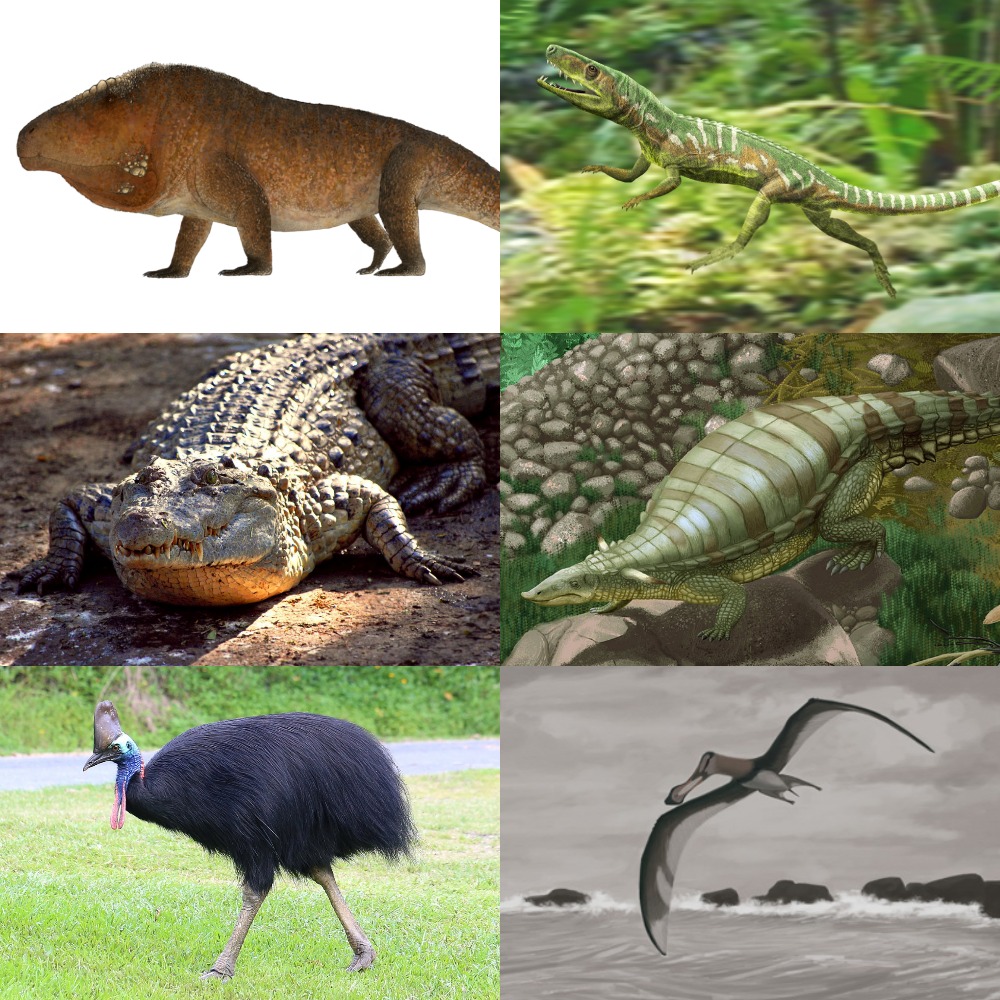
Row 1 (basal archosauriforms): Erythrosuchus africanus, Euparkeria capensis;

Row 2 (Pseudosuchia): Crocodylus mindorensis, Typothorax coccinarum;
Row 3 (Avemetatarsalia): Casuarius casuarius, Anhanguera piscator.

Scientific classification Edit this classification
Kingdom: Animalia
Phylum: Chordata
Class: Reptilia
Clade: Crocopoda
Clade: Archosauriformes
Gauthier, 1986
Subgroups[2]

Archosauriformes (Greek for 'ruling lizards', and Latin for 'form') is a clade of diapsid reptiles encompassing archosaurs and some of their close relatives. It was defined by Jacques Gauthier (1994) as the clade stemming from the last common ancestor of Proterosuchidae and Archosauria.[3] Phil Senter (2005) defined it as the most exclusive clade containing Proterosuchus and Archosauria.[4] Gauthier as part of the Phylonyms (2020) defined the clade as the last common ancestor of Gallus, Alligator, and Proterosuchus, and all its descendants.[5] Archosauriforms are a branch of archosauromorphs which originated in the Late Permian (roughly 252 million years ago) and persist to the present day as the two surviving archosaur groups: crocodilians and birds.

Archosauriforms present several traits historically ascribed to the group Archosauria. These include serrated teeth set in deep sockets, a more active metabolism, and an antorbital fenestra (a hole in the skull in front of the eyes). Reptiles with these traits have also been termed "thecodonts" in older methods of classification. Thecodontia is a paraphyletic group, and its usage as a taxonomic category has been rejected under modern cladistic systems. The name Archosauriformes is intended as a monophyletic replacement compatible with modern taxonomy.

Evolutionary history

[edit]

Early archosauriforms, informally termed "proterosuchians", were superficially crocodile-like animals with sprawling gaits, carnivorous habits, and long hooked snouts. Unlike the bulk of their therapsid contemporaries, archosauriforms survived the catastrophic end-Permian mass extinction. The Late Permian proterosuchid Archosaurus is similar in appearance to its Early Triassic relative, Proterosuchus. Within a few million years after the beginning of the Triassic, the archosauriformes had diversified past the "proterosuchian" grade. The next major archosauriform group was Erythrosuchidae, a family of apex predators with massive heads, the largest terrestrial carnivorous reptiles up to that time.

In 2016, Martin Ezcurra provided the name Eucrocopoda for the clade including all archosauriforms more crownward (closer to archosaurs) than erythrosuchids. He defined the clade all taxa more closely related to Euparkeria capensis, Proterochampa barrionuevoi, Doswellia kaltenbachi, Parasuchus hislopi, Passer domesticus (the house sparrow), or Crocodylus niloticus (the Nile crocodile) than to Proterosuchus fergusi or Erythrosuchus africanus. The name translates to "true crocodile feet", in reference to the possession of a crocodilian-style crurotarsal ankle.[2] Eucrocopodans include the families Euparkeriidae (small, agile reptiles),Proterochampsidae (narrow-snouted predators endemic to South America), and Doswelliidae (heavily armored Laurasian reptiles similar to proterochampsids), as well as various other strange reptiles such as Vancleavea and Asperoris.

The most successful archosauriforms, and the only members to survive into the Jurassic, were the archosaurs. Archosauria includes crocodilians, birds, and all descendants of their common ancestor. Extinct archosaurs include aetosaurs, rauisuchids (both members of the crocodilian branch), pterosaurs, and non-avian dinosaurs (both members of the avian branch).[6]

Metabolism

[edit]

Vascular density and osteocyte density, shape and area have been used to estimate the bone growth rate of archosaurs, leading to the conclusion that this rate had a tendency to grow in ornithodirans and decrease in pseudosuchians.[7] The same method also supports the existence of high resting metabolical rates similar to those of living endotherms (mammals and birds) in the Prolacerta-Archosauriformes clade that were retained by most subgroups, though decreased in Proterosuchus, Phytosauria and Crocodilia.[8] Erythrosuchids and Euparkeria are basal archosauriforms showing signs of high growth rates and elevated metabolism, with Erythrosuchus possessing a rate similar of the fastest-growing dinosaurs. Sexual maturity in those Triassic taxa was probably reached quickly, providing advantage in a habitat with unpredictable variation from heavy rainfall to drought and high mortality. Vancleavea and Euparkeria, which show slower growth rates compared to Erythrosuchus, lived after the climatic stabilization. Early crown archosaurs possessed increased growth rates, which were retained by ornithodirans.[9] Ornithosuchians and poposaurs are stem-crocodilians that show high growth rates similar to those of basal archosauriforms.[10]

Developmental, physiological, anatomical and palaeontological lines of evidence indicate that crocodilians evolved from endothermic ancestors. Living crocodilians are ambush predators adapted to a semi-aquatic lifestyle that benefits from ectothermy due to the lower oxygen intake that allows longer diving time. The mixing of oxygenated and deoxygenated blood in their circulatory system is apparently an innovation that benefits ectothermic life. Earlier archosaurs likely lacked those adaptations and instead had completely separated blood as birds and mammals do.[11][12] A similar process occurred in phytosaurs, which were also semi-aquatic.[13]

The similarities between pterosaur, ornithischian and coelurosaurian integument suggest a common origin of thermal insulation (feathers) in ornithodirans at least 250 million years ago.[14][15] Erythrosuchids living in high latitudes might have benefited from some sort of insulation.[13] If Longisquama was an archosauromorph, it could be associated with the origin of feathers.[16][13]

Relationships

[edit]

Below is a cladogram from Nesbitt (2011):[17]

Archosauriformes

*Note: Phytosaurs were previously placed within Pseudosuchia, or crocodile-line archosaurs.

Below is a cladogram from Sengupta et al. (2017),[18] based on an updated version of Ezcurra (2016)[2] that reexamined all historical members of the "Proterosuchia" (a polyphyletic historical group including proterosuchids and erythrosuchids). The placement of fragmentary taxa that had to be removed to increase tree resolution are indicated by dashed lines (in the most derived position that they can be confidently assigned to). Taxa that are nomina dubia are indicated by the note "dubium". Bold terminal taxa are collapsed.[2]

Sources

[edit]
  • Gauthier, J. A. (1986). "Saurischian monophyly and the origin of birds". In Padian, K. (ed.). The Origin of Birds and the Evolution of Flight. Memoirs of the California Academy of Sciences. Vol. 8. California Academy of Sciences. pp. 1–55. ISBN 978-0-940228-14-6.
  • Gauthier, J. A.; Kluge, A. G.; Rowe, T. (June 1988). "Amniote phylogeny and the importance of fossils" (PDF). Cladistics. 4 (2). John Wiley & Sons: 105–209. doi:10.1111/j.1096-0031.1988.tb00514.x. hdl:2027.42/73857. PMID 34949076. S2CID 83502693.

References

[edit]
[edit]
Revisions and contributorsEdit on WikipediaRead on Wikipedia
from Grokipedia
Archosauriformes is a diverse clade of diapsid reptiles that encompasses the crown-group Archosauria—comprising modern crocodilians, birds, dinosaurs, and pterosaurs—along with a range of stem-group relatives, originating in the Late Permian and undergoing major radiations in the aftermath of the end-Permian mass extinction. Defined phylogenetically as the most inclusive group containing Archosauria but excluding more basal archosauromorphs such as Prolacerta and Trilophosaurus, this clade includes basal forms such as proterosuchids and erythrosuchids. The temporal range of Archosauriformes spans from the latest Permian (approximately 259–252 million years ago), with early records like Archosaurus rossicus from , through the and into the and , though non-avian forms largely went extinct by the end of the . Early diversification occurred in the (Induan–Olenekian, ~252–247 Ma), evidenced by fossils such as Proterosuchus fergusi from , marking a rapid recovery and ecological dominance among terrestrial tetrapods following the Permian-Triassic extinction. Major subgroups include basal forms like proterosuchids and erythrosuchids, as well as more derived lineages such as proterochampsids (crocodile-like, semi-aquatic quadrupeds with elongated, low-skulled heads), euparkeriids, and the two primary branches of Archosauria: Pseudosuchia (the "crocodile-line" archosaurs, including aetosaurs, rauisuchians, and crocodylomorphs) and Avemetatarsalia (the "bird-line" archosaurs, encompassing dinosauromorphs, pterosaurs, and dinosaurs). Evolutionarily, Archosauriformes represents a cornerstone of archosauromorph success, adapting to terrestrial, semi-aquatic, and eventually aerial niches over nearly 250 million years, with innovations like serrated teeth, cranial pneumaticity, and elongated neural spines (e.g., in sail-backed forms like Arizonasaurus) enabling their rise as apex predators and herbivores in ecosystems. Their radiation, particularly in the Middle to , set the stage for the dominance of dinosaurs and the persistence of crocodilians and birds into the present day, underscoring the clade's pivotal role in vertebrate evolution.

Definition and Diagnosis

Etymology and Definition

The term Archosauriformes was coined by , Kluge, and in to designate a group encompassing the crown Archosauria—comprising birds, crocodilians, and their extinct relatives—and the more basal stem taxa closely related to them within . The name derives from "Archosauria," the classical Linnaean order for ruling reptiles, combined with the suffix "-iformes," indicating forms or shapes resembling archosaurs, thereby highlighting the transitional morphologies bridging basal archosauromorphs and the derived archosaur crown. Phylogenetically, Archosauriformes is defined as the least inclusive clade containing (a basal stem-archosaur from the ) and (the , representing the extant pseudosuchian branch of crown Archosauria). This node-based definition, formalized under , positions Archosauriformes as all archosauromorphs more closely related to the crown than to more distant outgroups such as tanystropheids or rhynchosaurs. The scope of Archosauriformes thus includes a diverse array of non-archosaurian taxa, such as proterosuchids and erythrosuchids (early large predators), proterochampsids (lightly built, crocodylomorph-like forms), doswelliids (armored, aquatic ambush predators), and the earliest diverging members of the pseudosuchian and avemetatarsalian lineages leading to crocodylomorphs and dinosauromorphs, respectively. However, it excludes more basal archosauromorphs outside this , such as tanystropheids (elongate-necked marine reptiles) and trilophosaurs, which branch earlier in the archosauromorph tree. Historically, Archosauriformes originated in early cladistic analyses of relationships as a paraphyletic grade of "archosaur-like" reptiles sharing erect posture and other inferred traits with crown archosaurs, but lacking in initial datasets. Subsequent refinements, particularly through expanded sampling and character matrices in the and , established its status as a robust monophyletic under the system of , emphasizing ancestry-based s over traditional ranking. Recent discoveries, such as Samsarasuchus pamelae (2023) and Retymaijychampsa beckerorum (2025), continue to document the basal diversity of the clade without altering its core .

Diagnostic Characteristics

Archosauriformes is diagnosed by a suite of synapomorphies primarily in the and postcranial that distinguish it from other archosauromorphs, reflecting adaptations toward a more derived bauplan. Key among these is the presence of an , a bony opening in the side of the snout anterior to the orbit, which houses the antorbital sinus and is absent or rudimentary in more basal archosauromorphs. This fenestra, combined with thecodont dentition—where teeth are deeply socketed in the jaw bones—supports a monophyletic grouping that includes early forms like and more crownward taxa such as . Additional cranial synapomorphies include absence of a parietal , jugal-quadratojugal contact, an ossified laterosphenoid, a lateral mandibular , and tooth crowns bearing serrations, enhancing cutting efficiency. The features an external , a below the row that lightens the while maintaining strength. The pterygoid may develop a field of pointed, recurved for prey manipulation, and the parabasisphenoid is vertically oriented, contributing to a more compact braincase. These features collectively indicate enhanced and feeding specialization compared to outgroups. Postcranially, Archosauriformes are characterized by elongated , facilitating greater neck mobility, and features such as the absence of postaxial intercentra and continuous crural facets on the astragalus. Within the , the pseudosuchian branch exhibits the crocodile-normal ankle, in which the calcaneal tuber is deflected posteriorly by 20°–50° and the astragalus-calcaneum joint lacks a fully ossified , while the avemetatarsalian branch has a reversed (mesotarsal) configuration. The manus and pes are pentadactyl with reduced outer digits (particularly digit V), and metatarsal IV is equal to or shorter than metatarsal III, supporting a sub-mesaxonic to mesaxonic foot posture aligned more closely with the body's axis. Some lineages, such as proterochampsids, exhibit semi-aquatic adaptations like laterally compressed tails, while others develop paramedian osteoderms in two rows along the dorsal column, with keeled surfaces and anterior processes for armor. These traits underscore a transition toward the erect and metabolic efficiency seen in crown Archosauria, though variations persist among stem forms.

Phylogenetic Relationships

Position within Archosauromorpha

constitutes a primary of reptiles, serving as the to Lepidosauromorpha within , and originated during the Late Permian period. Early archosauromorphs, such as Protorosaurus speneri from middle Late Permian deposits in , exhibit primitive skull configurations and limb proportions adapted for , marking the initial diversification of the prior to the end-Permian mass . This radiation laid the groundwork for subsequent dominance by archosauromorph lineages. Archosauriformes occupies a pivotal position within as the stem group to the crown clade Archosauria, consistently recovered as the sister taxon to a series of more basal archosauromorph groups, including prolacertiforms, rhynchosaurs, and tanystropheids (the latter within ). Phylogenetic analyses place these basal clades in successive sister positions to Archosauriformes, with prolacertiforms like Prolacerta broomi from the representing immediate outgroups characterized by elongated snouts and grasping hands but lacking advanced archosaurian cranial features. The divergence of Archosauriformes from these basal relatives occurred in the aftermath of the Permian-Triassic extinction event, during the ecological recovery in the , when archosauromorphs began to exploit vacated niches. A defining divergence from prolacertiform-grade archosauromorphs involves the evolution of the , a skull opening anterior to the that reduces cranial weight and likely accommodated soft-tissue structures such as the antorbital sinus or Jacobson's organ. This feature emerges de novo in Archosauriformes, distinguishing it from the fenestra-free s of earlier archosauromorphs and marking a key synapomorphy for the clade's radiation. Recent phylogenetic studies from 2025, such as those by Burke et al. examining pseudosuchian endocrania via CT-scan reconstructions, have refined this positioning by incorporating neuroanatomical characters like brainstem configuration and semicircular canal proportions, reinforcing Archosauriformes as the immediate precursor to Archosauria with shared braincase traits among its members. The temporal range of Archosauriformes begins in the latest Permian with taxa such as rossicus, expanding significantly during the stage of the , coinciding with post-extinction biotic recovery and the proliferation of small-to-medium-sized terrestrial herbivores and carnivores in Gondwanan and Laurasian assemblages.

Interrelationships and Clades

Archosauriformes encompasses a diverse array of Triassic reptiles that form the stem group to Archosauria, with internal phylogenetic relationships primarily resolved through cladistic analyses incorporating both cranial and postcranial characters. The group is characterized by a basal grade of non-archosaurian forms, including major clades such as erythrosuchids and euparkeriids, followed by the crown clade Archosauria, which bifurcates into two major lineages: (the "crocodile-line" archosaurs, including aetosaurs, rauisuchians, and crocodylomorphs) and (the "bird-line" archosaurs, encompassing dinosauromorphs such as early dinosaurs and pterosauromorphs). Seminal phylogenetic analyses, such as 2011 study of 80 taxa using 432 characters, established basal clades within Archosauriformes including erythrosuchids, followed by proterochampsids like Chanaresuchus and Tropidosuchus, with Doswelliidae (armored aquatic forms like Doswellia) positioned near the archosaur stem, branching off before the Archosauria node defined by the last common ancestor of and . This topology was refined by Ezcurra's 2016 analysis of 76 archosauromorph taxa with 344 characters, which corroborated the basal positions of these stem groups and highlighted Doswelliidae's affinity to the archosaur stem based on shared features like elongate snouts and osteoderms, while emphasizing the of (supported by antorbital fenestrae and thecodont dentition) and (united by elongate metatarsals and reduced fibulae). Within , major subclades include Aetosauria (armored herbivores), (large carnivores), and (ancestors of modern crocodylians), whereas comprises Pterosauria and , with the latter leading to Dinosauria. Recent updates from 2020s datasets, incorporating expanded matrices with over 500 characters, continue to support this consensus structure, with erythrosuchids and proterochampsids as early diverging clades and Doswelliidae positioned immediately basal to Archosauria. A 2025 study describing Retymaijychampsa beckerorum, a new proterochampsid from the Middle-Upper of southern , extends the group's known distribution beyond and northern , reinforcing Proterochampsia's basal role through shared hindlimb traits like a crocodylian-style ankle morphology. Similarly, detailed examination of the tarsus in Chanaresuchus bonapartei from the Chañares Formation reveals a unique astragalocalcaneal complex with incipient archosaurian features, such as a perforating , which phylogenetically anchors proterochampsids as stem-archosauriforms and suggests broader dispersal facilitated by these locomotor adaptations. Phylogenetic uncertainties persist in the placement of certain taxa, particularly within the proterochampsid grade. For instance, a 2025 osteological redescription of Tropidosuchus romeri's skull, utilizing 3D segmentation of specimens, identifies novel features like a deeply embayed palate and reduced postorbital bar, supporting its closer affinity to proterochampsids such as Chanaresuchus rather than more derived pseudosuchians, though its exact intragroup position remains debated due to fragmentary postcrania. In Pseudosuchia, recent integrations of endocranial data from CT-scanned braincases, as in a 2025 analysis of a loricatan pseudosuchian from Nova Scotia, refine interclade relationships by revealing expanded olfactory bulbs in rauisuchians, bolstering their monophyly and distinguishing them from aetosaurian taxa with more avian-like cerebral expansions. These advancements underscore the dynamic nature of archosauriform phylogeny, with ongoing discoveries refining the tree's basal branches.

Evolutionary History

Origins in the Early Triassic

Archosauriformes originated in the Late Permian, with the earliest known record being Archosaurus rossicus from the Vyazniki assemblage in , dated to approximately 252 Ma. These early forms appeared just prior to the Permian-Triassic mass extinction event, dated to 251.9 Ma, which eradicated roughly 95% of marine and terrestrial species, creating vast ecological vacancies in terrestrial ecosystems. Following the extinction, archosauriforms underwent rapid recovery, with unequivocal records dating to the stage of the , around 251–250 Ma, in and riverine environments that facilitated post-extinction recolonization. These initial post-extinction appearances are primarily documented from the Assemblage Zone in the Basin of , where sedimentary deposits preserve evidence of opportunistic colonization by early archosauromorphs amid a depauperate biota dominated by dicynodont survivors. Among the earliest known archosauriform taxa are members of the Proterosuchidae family, including Proterosuchus and Chasmatosuchus, which represent basal forms characterized by elongated snouts and robust limbs suited to their inferred predatory roles. Fossils of Proterosuchus fergusi, for instance, from the Karoo Basin, indicate a body length of up to 2 meters and suggest a semi-aquatic lifestyle, with adaptations such as dorsally positioned eyes and a crocodile-like posture inferred from skeletal proportions and associated fluvial sediments. Similarly, Chasmatosuchus rossicus from Early Triassic deposits in Russia exhibits comparable morphology, supporting the hypothesis that these basal archosauriforms exploited aquatic and semi-aquatic niches in river systems to ambush prey during the initial stages of ecosystem rebuilding. Environmental drivers, including humid paleoclimates and nutrient-rich floodplains in Gondwana, enabled these taxa to fill predatory guilds vacated by extinct synapsids, marking the onset of archosauriform ecological dominance. The record of archosauriform origins remains sparse during the , with significant gaps attributed to taphonomic biases in low-diversity post-extinction assemblages and limited exposure. Recent phylogeographic analyses integrating landscape connectivity models reveal a cryptic early history, highlighting how archosauromorph dispersal across Pangaean terrains in the first 20 million years of the ( to ) involved hidden radiations into under-sampled regions, with ecographic diversity emerging through vicariance and opportunistic expansion. These studies underscore that while overt evidence is concentrated in South African basins, early archosauriform likely spanned broader Gondwanan and Laurasian floodplains, setting the stage for subsequent diversification without direct phylogenetic resolution here.

Diversification and Major Events

The diversification of Archosauriformes intensified during the Middle and Late Triassic, particularly in Gondwana, where proterochampsids emerged as a dominant group of non-archosaur archosauriforms. These carnivorous reptiles, endemic to South America, exhibited elongated snouts and contributed to ecomorphological variety through adaptations for terrestrial predation. Fossil evidence from southern Brazil, including the recently described Retymaijychampsa beckerorum dated to approximately 242–235 Ma (Ladinian to early Carnian), underscores this radiation by filling ghost lineages and indicating a broad geographical distribution across Gondwanan assemblages. By the Middle Triassic, archosaurs began surpassing stem-archosauriforms in abundance and taxonomic diversity in several South American localities, signaling a shift toward greater ecological success for the clade. A key divergence within Archosauria occurred around 240 Ma, marking the split between (the crocodile-line archosaurs) and (the bird-line, encompassing dinosaurs and pterosaurs). This bifurcation facilitated parallel radiations, with pseudosuchians achieving high morphological disparity through clades like aetosaurs and rauisuchians. The (CPE), a major climatic shift to humid conditions around 234 Ma, further propelled pseudosuchian diversification by triggering the extinction of competing herbivores such as rhynchosaurs and dicynodonts, thereby opening niches for crurotarsans (advanced pseudosuchians). Ichnofossil records from the reveal a pre-CPE dominance of pseudosuchian tracks (80–100%), transitioning to mixed assemblages post-CPE, highlighting the event's role in reshaping terrestrial ecosystems. The end-Triassic mass extinction at approximately 201 Ma profoundly altered Archosauriformes, extinguishing most stem-archosauriforms and the majority of pseudosuchian lineages, including phytosaurs, aetosaurs, and rauisuchians. This event exhibited strong selectivity, sparing crocodylomorphs within and avemetatarsalians, which faced minimal losses and subsequently radiated to dominate terrestrial environments. The extinction of diverse pseudosuchians likely reduced competition, enabling crocodylomorphs to diversify into over 100 genera during the and . Stem-archosauriform groups, such as proterochampsids and other non-crown forms, vanished by the Early Jurassic, with no significant persistence beyond the Triassic-Jurassic boundary. Only crown-group archosaurs—birds (descended from theropod dinosaurs) and crocodylians—survived into the , rediversifying after the end-Cretaceous extinction. Recent 2025 analyses of , employing network models on dinosaur phylogenies, identify as a central hub for early origins, with dispersal pathways to eastern and refining the timelines of archosauriform expansions. Discoveries like Retymaijychampsa beckerorum continue to illuminate the Gondwanan roots of this diversification, emphasizing South American assemblages as key to understanding mid-Mesozoic evolutionary dynamics.

Anatomy and Physiology

Skeletal Morphology

The skeleton of Archosauriformes displays considerable variation, reflecting adaptations from basal, crocodile-like forms to more derived archosaurs, with key features in the , axial column, and appendicular elements enabling diverse locomotor and feeding strategies. Basal members, such as proterosuchids, exhibit elongated and sprawling limbs suited to semi-aquatic or terrestrial predation, while advanced forms show trends toward robusticity and erect posture. The of Archosauriformes is typically deep and robust, featuring a large that houses a prominent fossa, a trait linked to lightweight construction and enhanced jaw mechanics in early predatory forms. In basal taxa like proterosuchids and erythrosuchids, the is long and narrow with large supratemporal fenestrae, while more derived examples, such as Qianosuchus, show shorter, highly ossified crania. Dentition varies markedly with diet: carnivorous archosauriforms, including erythrosuchids, possess ziphodont teeth that are labiolingually compressed, recurved, and finely serrated for slicing flesh, as seen in isolated Upper teeth from Saint-Nicolas-de-Port. In contrast, herbivorous pseudosuchians like aetosaurs bear conical, low-crowned teeth adapted for grinding vegetation, with anterior dentition often more pointed and posterior teeth flattened. The includes 7–10 , which are elongated in basal forms like proterosuchids to facilitate flexibility, comprising up to 75% of trunk length in taxa such as Qianosuchus with nine cervicals. , or ventral abdominal ribs, are present in early archosauriforms including and , providing support for the belly during sprawling locomotion. The sacral count starts at the plesiomorphic two vertebrae in basal archosauriforms but increases to three in mid-Triassic forms like Qianosuchus and up to five in advanced pseudosuchians such as , enhancing pelvic stability for weight-bearing. Limb and girdle morphology in Archosauriformes transitions from sprawling posture in basal taxa, exemplified by proterosuchids with gracile humeri and robust pubes, to erect posture in crown archosaurs, enabling efficient terrestrial movement and associated with increased locomotor stamina. A diagnostic archosauriform trait is the fibula-astragalus notch on the astragalus, a concavity accommodating the fibular facet and facilitating ankle hinge motion, as observed in proterosuchians and persisting in derived forms. Pseudosuchians often bear osteoderms—dermal armor plates covering the body in paramedian rows, as in aetosaurs and rauisuchians like —for protection against predation. Recent analyses have refined understanding of archosauriform through advanced . A 2025 study of Tropidosuchus romeri utilized three-dimensional segmentation from micro-CT scans to reveal palatal details, including a robust pterygoid with denticle-bearing flanges and a broad ectopterygoid-maxilla contact, highlighting proterochampsid adaptations for terrestrial feeding. Similarly, a 2025 examination of Chanaresuchus bonapartei tarsus described unique features like a pronounced astragalar peg fitting into a calcaneal notch, suggesting enhanced rotational mobility and evolutionary shifts toward more efficient quadrupedal locomotion in early pseudosuchians.

Metabolic Adaptations

Metabolic adaptations in Archosauriformes represent a transitional phase from the ectothermic of basal archosauromorphs toward the more efficient endothermy observed in derived archosaurs, supported by multiple lines of paleophysiological . Bone histology provides key insights into the origins of endothermy, with fibrolamellar tissue—characterized by rapid deposition and high vascularity—appearing in forms such as and other proterosuchids, indicating elevated growth rates and partial endothermy. This tissue type, typically associated with high metabolic demands, contrasts with the slower-growing lamellar-zonal in more basal archosauromorphs and suggests that metabolic production began evolving within basal Archosauriformes by the , potentially aiding survival in post-extinction recovery environments. Respiratory efficiency also shows early enhancements in Archosauriformes, particularly among pseudosuchians, where precursors to avian-like are inferred from postcranial (PSP). Although unambiguous PSP is rare in basal taxa, ambiguous vertebral fossae and laminae in forms like erythrosuchids and early pseudosuchians suggest a primitive, reduced system that improved and supported higher oxygen demands, potentially linked to increased activity levels. Nasal turbinates, structures for heat and , are less well-documented but inferred in some archosauromorphs from endocranial casts and morphology, implying improved respiratory humidification and as endothermy developed. Growth rates within Archosauriformes vary phylogenetically, reflecting metabolic diversity. Avemetatarsalians, including early dinosauriforms, exhibit consistently rapid growth marked by densely vascularized fibrolamellar and sustained deposition throughout , consistent with endothermic strategies that enabled quick maturation and ecological . In contrast, proterochampsids display more variable or ectothermic-like patterns, with parallel-fibered and lower vascularity indicating slower, cyclical growth potentially interrupted by environmental stresses. Stable isotope analyses of and further support elevated body temperatures in basal archosauriforms, exceeding typical ectothermic ranges and signaling a shift toward regional endothermy that facilitated the clade's radiation.

References

Add your contribution
Related Hubs
User Avatar
No comments yet.