Hubbry Logo
ArctogadusArctogadusMain
Open search
Arctogadus
Community hub
Arctogadus
logo
8 pages, 0 posts
0 subscribers
Be the first to start a discussion here.
Arctogadus
Arctogadus
from Wikipedia

Arctogadus
Scientific classification Edit this classification
Kingdom: Animalia
Phylum: Chordata
Class: Actinopterygii
Order: Gadiformes
Family: Gadidae
Genus: Arctogadus
Dryagin, 1932
Species:
A. glacialis
Binomial name
Arctogadus glacialis
Synonyms

Arctogadus borisovi Dryagin, 1932
Gadus glacialis W. K. H. Peters, 1872
Phocaegadus megalops Jensen, 1948

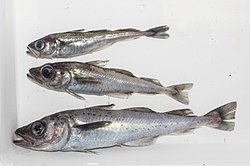
Arctogadus glacialis, known also with ambiguous common names Arctic cod[1][2] and polar cod,[1][3] is an Arctic species of fish in the cod family Gadidae, related to the true cod (genus Gadus). Arctogadus glacialis is found in icy water. They grow to about 30 cm long, and are favorite food of narwhals and other arctic whales.

Common names and taxonomy

[edit]

The common names "Arctic cod" and "polar cod" can refer to either Arctogadus glacialis or Boreogadus saida, and "Arctic cod" may also refer to Eleginus nawaga.[4]

Another Arctic gadid, the East Siberian cod (Arctogadus borisovi), was until recently considered the closest relative of A. glacialis. It has, however, been found not to be distinct from A. glacialis, and should be included in this species. According to this result, Arctogadus is a monotypic genus. However, Arctogadus is a close relative of Boreogadus, and should perhaps be included in that genus.[5]

Appearance

[edit]

Arctic cod have been cited to grow up to 32.5 cm (12.8 in) in total length. It has been distinguished from other cod species by its lack of the chin barbel. Populations of Arctic cod previously referred to the East Siberian cod however do have a chin barbel and grow up to 50–60 cm length.[5][6]

Distribution

[edit]

The Arctic cod is widely distributed in the western part of the Arctic basin and the northwest and northeast coasts of Greenland. Its range is between 85° and 72°N latitude. Arctic cod can be found at depths of up to 1000 m, and frequently under ice.

Fish earlier attributed to the East Siberian cod are found off the western half of the coast of Canada and the coasts of Siberia and also off the northern and southern coasts of Greenland. The fish lives close to the sea floor at depths of 15 to 40 m, but it sometimes enters estuaries, and may also be found under pack ice.

The species is of minor commercial value.

Diet

[edit]

A. glacialis in an ice-free area off northeastern Greenland were found to feed almost exclusively on pelagic prey (primarily copepods, amphipods, and mysids).[7]

References

[edit]
Revisions and contributorsEdit on WikipediaRead on Wikipedia
from Grokipedia
Arctogadus is a of small, cryopelagic gadiform fishes in the family , containing the single extant Arctogadus glacialis (commonly known as the polar cod or cod), which is endemic to the and marine waters. The genus was established in 1932, with A. glacialis originally described in 1872, and a former Arctogadus borisovi is now considered a based on genetic evidence. Arctogadus glacialis inhabits epipelagic and mesopelagic zones in the and Northeast Atlantic, ranging from 87°N to 65°N and depths of 0 to 1000 m, primarily offshore beyond the continental shelf and closely associated with . It is widely distributed in the western Arctic basin, including the northwest and northeast coasts of , and feeds mainly on small crustaceans and fishes. Adults typically reach a maximum total length of 32.5 cm, exhibiting adaptations such as high multiplicity for oxygen transport in cold, low-oxygen environments. Ecologically, Arctogadus glacialis serves as a critical link in food webs, acting as a key prey species for higher trophic levels including seabirds, seals, and marine mammals such as narwhals and belugas, thereby facilitating energy transfer from primary producers like sea-ice to top predators. It supports minor commercial fisheries with limited economic value, though its populations are vulnerable to climate-driven loss, which could disrupt its habitat and role in the ecosystem.

Taxonomy and nomenclature

Classification

The genus Arctogadus belongs to the kingdom Animalia, phylum Chordata, class Actinopterygii, order Gadiformes, family Gadidae, and subfamily Gadinae. Established by the Soviet ichthyologist P. A. Dryagin in 1932, Arctogadus is a monotypic genus currently recognized as containing only one valid species, Arctogadus glacialis (Peters, 1872), with A. borisovi Dryagin, 1932 regarded as a junior synonym based on morphological and genetic evidence. Within the Gadinae subfamily, Arctogadus shares phylogenetic closeness with the Boreogadus, both characterized by three dorsal fins and two anal fins; molecular analyses of mitochondrial cytochrome b sequences position Arctogadus as a sister genus to Boreogadus, with both forming a alongside genera such as Gadus and Theragra. Historical taxonomic revisions include the merger of the former genus Phocaegadus Jensen, 1948, into as a , following detailed morphological examinations that clarified boundaries within the group.

Etymology and synonyms

The name Arctogadus derives from "arktos," meaning (referring to the region, derived from the constellation ), combined with "," the Latin term for , reflecting its habitat and relation to fishes. The epithet glacialis originates from the Latin for "icy" or "glacial," alluding to its association with ice environments. The species was originally described as Gadus glacialis by Wilhelm Peters in 1872 based on specimens from Sabine Island, East . It was later reassigned to the genus Arctogadus upon the genus's establishment by P. A. Dryagin in 1932, who also described Arctogadus borisovi as a separate species from Siberian waters. Other historical synonyms include Phocaegadus megalops (Jensen, 1948), proposed for specimens with notably large eyes, and Boreogadus pearyi (Nichols & Maxwell, 1933), based on material from the Canadian . A comprehensive taxonomic revision in 2003, involving morphological examination of 200 specimens ranging from 54 to 477 mm in standard length, confirmed A. borisovi and the other synonyms as junior synonyms of A. glacialis, establishing the genus as monotypic with no diagnosable differences among the forms. The common names "Arctic cod" and "polar cod" are applied ambiguously to A. glacialis, but they are also commonly used for the related species Boreogadus saida, resulting in frequent misidentifications in ecological and fisheries literature.

Description

Morphology

Arctogadus glacialis exhibits an elongated, body shape with a cylindrical cross-section and a rounded head, typical of gadid fishes adapted to pelagic environments. The body is covered in smooth scales, and a faint runs along the sides. It possesses three separate dorsal fins (with 11-16 rays in the first, 24-36 in the second, and 14-24 in the third), with the first being short and triangular, while the second and third are longer and more continuous; there are also two anal fins (24-32 and 12-18 rays). The pectoral fins are large and rounded, aiding in maneuverability, and the species lacks an adipose fin. Unlike many gadids, A. glacialis has rudimentary or absent chin barbels in most populations, though former variants such as the East Siberian (now synonymized as Arctogadus borisovi) occasionally showed a present barbel. The coloration of A. glacialis features a darker brownish-gray back and silvery-white sides and belly, providing in the low-light, ice-covered waters of the . The fins are dusky or darker than the body, and the is blackish, visible through the body wall in preserved specimens. This pigmentation pattern contrasts with the more spotted appearance of its close relative Boreogadus saida. Sensory adaptations include large eyes, which comprise a significant portion of head length (up to 39% in adults), suited for vision in the dim conditions of deep or ice-obscured habitats. In comparison to Boreogadus saida, another gadid, A. glacialis has a more robust body build and lacks a prominent chin barbel, which is present in B. saida; these differences aid in taxonomic distinction despite their sympatric distribution. The maximum recorded length is 32.5 cm total length, though morphological features remain consistent across sizes.

Size and sexual dimorphism

Arctogadus glacialis attains a maximum total length of 32.5 cm in most populations, though records indicate individuals up to about 37 cm (equivalent to 34.5 cm SL) in the Northeast Water Polynya. Including variants previously classified as A. borisovi (now regarded as a junior synonym), maximum lengths reach 50–60 cm SL (approximately 55-66 cm ). Exceptional individuals exceed 0.23 kg, and up to 1.2 kg reported in broader assessments. Growth in A. glacialis is slow, adapted to the harsh environment, with the species reaching about 22 cm at age 6. Observations of ripening gonads in females at 25–26 cm TL suggest variability in maturity size by location and . The lifespan is estimated at 5–7 years, with maximum ages of at least 11 years documented via analysis, where annual rings reflect seasonal cycles and growth increments. Sexual dimorphism in A. glacialis is subtle, with females generally slightly larger than males and predominating among larger size classes in deeper habitats. Males exhibit longer ventral fins relative to body length (18.0–31.0% of SL versus 17.0–20.5% in females), while no other pronounced external differences are noted. Gonad maturation shows sex-specific patterns, with females investing more energy in egg production, as indicated by higher gonado-somatic indices in maturing individuals.

Reproduction

Spawning behavior

Arctogadus glacialis exhibits oviparous reproduction, with separate sexes (gonochoristic), where females release eggs in batches that are externally fertilized by males. This species is a broadcast spawner, dispersing gametes into the water column without beyond fertilization. Eggs are pelagic and buoyant, with diameters ranging from 1.6 to 1.9 mm, facilitating their suspension in the water or association with undersurfaces. Spawning occurs primarily during late winter to early spring, from to , in waters, often synchronized with seasonal ice dynamics such as the onset of ice melt. Ripe individuals have been observed as early as in some regions, indicating variability influenced by local conditions. is typically reached at lengths of approximately 25 total length, corresponding to ages of around 3-4 years, though this varies by location and year. Spawning behavior remains poorly understood due to the remote and ice-covered habitats, but it is inferred to involve group aggregations near ice edges where individuals in proximity for release. is unknown but presumed low, constrained by the energy demands of survival, with development showing group-synchronous patterns and determinate . Environmental cues triggering spawning include photoperiod changes and slight temperature increases above 0°C, while pre-spawning gonadal maturation relies on reserves stored from prior feeding periods. Limited observations suggest subtle elements, such as displays during close-range schooling, though detailed studies are lacking.

Life history stages

The life history of Arctogadus encompasses distinct developmental phases from to , characterized by adaptations to the harsh environment. The stage involves small, pelagic eggs measuring 1–2 mm in diameter. Time to hatching is poorly documented but estimated at 26–90 days depending on water temperature. These eggs experience high mortality, primarily from predation by and fish. Hatching marks the onset of the planktonic larval stage, with individuals measuring 5–10 mm in length. Larvae rapidly absorb their within days and migrate to under-ice habitats, where they seek protection from predators and favorable feeding conditions. This stage lasts several months, during which larvae develop basic swimming abilities and begin exogenous feeding on small copepods and nauplii. The juvenile stage follows , with fish growing to 2–10 cm in length. Schooling behavior emerges during this phase, aiding in predator avoidance, while diet shifts toward mysid crustaceans and amphipods. Growth rates slow in the first year due to limited food availability and low temperatures, but juveniles accumulate energy reserves for survival. Transition to adulthood occurs around 3-4 years of age, with reached at lengths of approximately 25 cm total length. Arctogadus is iteroparous, capable of spawning in multiple seasons following late-winter . Key adaptations include high content in juvenile tissues to support overwintering demands and cellular cryoprotectants that enable tolerance to sub-zero temperatures without freezing damage. remains undetermined, consistent with low reproductive output in gadids.

Distribution and habitat

Geographic distribution

Arctogadus glacialis exhibits a circumpolar distribution confined to the , primarily along continental shelves and slopes, with core populations in the western Arctic basin and the northwest and northeast coasts of between approximately 72° and 85°N. Its range extends into southern sub-Arctic waters of the Northeast Atlantic to about 65°N, though it is rare there. Key regional occurrences include the Northeast Water Polynya off northeast , where it is relatively abundant in fjord systems such as Bessel , Brede , Clavering Ø, and Kong Oscar , as well as on adjacent shelves from Scoresby Sund to Dove Bugt. Populations also inhabit the Canadian Arctic Archipelago, particularly northern areas like , and the shelf edges of , contributing to its discontinuous circumpolar range from the Siberian coast through the central to . Vagrant records extend to the northeast Atlantic fringes, including the in the European . The species occupies a depth range of 0 to 1000 m, though it is most commonly found between 50 and 200 m, often in association with habitats. In northeast , the majority of (nearly 90%) occurs at 200 to 600 m. Genetic analyses indicate overall continuity across populations, with low differentiation suggesting a largely panmictic structure, though local adaptations exist in ice-associated groups and subtle structuring between fjord and shelf habitats in regions like northeast ; a 2024 study using confirmed genetic structure between (higher diversity, possible refugia) and shelf populations due to post-glacial colonization and local adaptation. Former distinct East Siberian populations appear integrated into the broader gene pool. Historically, A. glacialis was first described in 1872 by Peters based on specimens from Greenland coasts, with its range appearing stable until recent decades. Populations may be vulnerable to contraction linked to sea ice loss, potentially limiting access to preferred offshore ice-edge zones.

Habitat requirements

Arctogadus glacialis exhibits a strongly cryopelagic lifestyle, closely associated with sea ice where it occupies epontic or under-ice habitats, primarily in offshore waters at or beyond the continental shelf edges in the Arctic basin. This species tolerates water temperatures from -1.7°C to 4°C, with a preference for -1.3°C to 1.6°C (mean -0.1°C), and a significant portion of its biomass occurring below -1.0°C. Salinity tolerance spans 0 to 32.6 practical salinity units, though embryonic development is optimal at 30–33 ppt, reflecting its adaptation to marine and occasionally brackish conditions. While it demonstrates some hypoxia tolerance, A. glacialis prefers well-oxygenated areas such as polynyas for enhanced survival and foraging opportunities. Habitat preferences vary across life stages, with larvae seeking refuge under pack ice to avoid predators and benefit from protected microhabitats. Juveniles are often found in fjords, such as those in Northeast , where they utilize deeper, subzero waters for development. Adults, in contrast, frequent ice-free shelf edges for feeding, occupying semi-pelagic or demersal positions within the at depths of 200–600 m, where nearly 90% of concentrates. Although primarily pelagic, individuals occasionally rest on soft sediments and avoid areas with strong currents to minimize energy expenditure. The species' habitat is heavily dependent on multi-year sea ice for overwintering, providing essential cover and stability. Exposure to open water due to ice melt increases vulnerability, as evidenced by biomass declines on warming shelves and shifts toward colder refugia. These climate sensitivities underscore the role of persistent cover in maintaining suitable conditions throughout the life cycle.

Ecology and behavior

Feeding habits

Arctogadus glacialis primarily consumes zooplankton, with calanoid copepods such as Calanus hyperboreus and Euchaeta glacialis forming the dominant component of its diet by number and biomass, alongside amphipods like Themisto abyssorum, mysids (Boreomysis spp.), ostracods (Boroecia borealis), and chaetognaths (Eukrohnia sp. and Sagitta sp.). Larger individuals occasionally incorporate fishes and polychaetes into their diet, though benthic prey are rare or absent in examined populations. The species exhibits an opportunistic pelagic foraging strategy, engaging in particulate feeding within the to target available prey. In the Northeast Water off , its diet consists almost exclusively of pelagic organisms, reflecting to ice-free areas, while its cryopelagic suggests seasonal reliance on under-ice biota during winter periods of limited open-water resources. As a secondary , A. glacialis occupies a of approximately 3.2, based on dietary analysis of crustaceans and fishes. It demonstrates ontogenetic shifts in feeding, with juveniles under 12 cm standard length predominantly consuming smaller planktonic copepods at shallower depths (115–250 ), while adults over 16 cm shift toward larger amphipods and mysids at greater depths (360–480 ), including hyperiid amphipods. Nutritional adaptations include substantial lipid storage as an energy reserve to endure extended ice-covered periods in the polar environment, supporting survival when opportunities diminish. This lipid accumulation is a key physiological trait for overwintering in harsh conditions.

Predation and interactions

Arctogadus species, particularly A. glacialis, serve as important prey for several top Arctic predators, including marine mammals and seabirds. Narwhals (Monodon monoceros) consume A. glacialis as a primary component of their summer diet, alongside the related gadid Boreogadus saida and squid, with stomach content analyses from , , revealing deep-diving on this gadid at depths exceeding 500 m. Beluga whales (Delphinapterus leucas) similarly rely on A. glacialis in regions like the Canadian High Arctic and , where it forms a substantial portion of their fish-based diet, linking under-ice production to higher trophic levels. Ringed seals (Pusa hispida) frequently prey on A. glacialis in Greenlandic waters, with diet studies indicating it as a key fish item alongside amphipods and other gadids, comprising a significant portion of their diet in some northwestern populations. Seabirds such as ivory gulls (Pagophila eburnea) target juveniles of A. glacialis near ice edges, scavenging or actively on schools in shallow coastal areas during late summer. Arctic foxes (Vulpes lagopus) may opportunistically consume A. glacialis through scavenging, reflecting their role in nearshore food webs. In terms of biotic interactions, Arctogadus species exhibit complex relationships within gadid communities. A. glacialis occasionally serves as prey for larger B. saida individuals in overlapping habitats like northeast fjords, where stable analyses show trophic overlap during seasonal migrations. These gadids also compete with other species, such as (Mallotus villosus) and saffron cod (Eleginus gracilis), for resources, evidenced by 40-80% dietary similarity in the Canadian and regions, though resource partitioning—benthic feeding in A. glacialis versus pelagic in B. saida—mitigates direct conflict, with Schoener's Index values of 0.64-0.70 indicating moderate competition. Arctogadus maintains commensal associations with ice algal communities, utilizing under-ice habitats where sympagic production supports adjacent prey; studies reveal high dependency on ice algae-derived carbon, up to 50% in some A. glacialis populations, facilitating energy transfer in cryopelagic ecosystems. As a key , Arctogadus plays a pivotal role in food webs, acting as a critical link between and higher trophic levels by channeling under-ice and pelagic energy to predators. In northeast , A. glacialis contributes decisively to fjord and shelf dynamics, with biomass densities reaching 49.3 kg/km² in cold sill s (< -1.0°C), supporting 20-30% of beluga and diets in localized populations. Its abundance serves as a of health, with declining densities (e.g., from 11.7% to 3.8% of gadid between 2003 and 2017) signaling warming trends and reduced cover that disrupt refugia; populations remain vulnerable to ongoing loss as of 2025. Behavioral adaptations in Arctogadus enhance survival amid predation pressures. Schooling formations are common, particularly among juveniles under pack ice, reducing encounter rates with visual hunters like seabirds and seals, as observed in drifting ice-edge aggregations in the . Diel vertical migrations occur beneath ice cover, with individuals shifting from surface layers at night to deeper waters (200-600 m) during daylight, minimizing exposure to diurnal predators while exploiting patches, a pattern documented in central deep scattering layers. Parasitic interactions involve common metazoan groups with generally low ecological impact. Nematodes, including Anisakis simplex, Hysterothylacium aduncum, and Ascarophis spp. larvae, dominate the , occurring in over 50% of examined A. glacialis from Greenlandic waters ( and ). Trematodes (digeneans) such as Hemiurus levinseni, Gonocerca phycidis, and Lecithaster gibbosus are prevalent, especially in eastern , with 20 taxa recorded across 155 specimens, though no significant morbidity or population-level effects are reported, suggesting to these endoparasites in cryopelagic environments.

Conservation and human use

Fisheries and economic importance

Arctogadus glacialis holds minor commercial value and is primarily encountered as incidental in Arctic trawl fisheries, including operations off East and in Norwegian waters targeting other . No targeted commercial fishery exists for the , owing to its small size—typically reaching a maximum of 32 cm—and its association with remote, ice-covered habitats that limit accessibility. Global annual landings of A. glacialis remain low, estimated at under 100 tons, with specific reports from indicating catches as minimal as 2 tons in years like 2016, often misidentified or conflated with related gadids. These limited catches are typically processed locally into and oil or utilized as bait, particularly in Inuit communities along the Canadian where the species contributes to subsistence practices alongside more abundant Arctic gadids. The direct economic role of A. glacialis is negligible, though it indirectly bolsters Arctic economies by serving as a key prey item for commercially exploited species such as northern shrimp (Pandalus borealis). Historically, the species was documented during 19th-century Arctic expeditions, including the Second German North Polar Expedition (1869–1870), where specimens were collected off East Greenland for scientific study and potential provisioning. In modern contexts, subsistence harvesting persists in the Canadian Arctic, supporting local food security without significant market trade. Fisheries for A. glacialis are regulated under regional frameworks such as the Northwest Atlantic Fisheries Organization (NAFO), where catches are monitored as within broader quotas for groundfish, with no indications of due to the species' low harvest levels.

Threats and status

The of Arctogadus glacialis remains by the as of 2025, with regional assessments indicating data deficiency or secure rankings in areas like Northeast due to limited monitoring data. As of 2025, it has been assessed as highly to , with a vulnerability index above 75 due to its narrow and high sensitivity to environmental changes. Population trends appear stable across much of its circumpolar range but vulnerable to localized declines, with surveys in Northeast fjords and shelves documenting gradual reductions from 2002 to 2017, potentially linked to habitat shifts. Major threats include , which drives loss and ocean warming, potentially contracting ice-associated habitats and disrupting prey availability such as , particularly during stages in and shelf habitats. Anthropogenic pressures encompass risks from oil exploration in the basin, where potential spills could severely impact stages due to their sensitivity to exposure. Additionally, in regional fisheries occurs at low levels, with no current evidence of significant population impacts. Protective measures include habitat safeguards within Arctic marine reserves, such as those around that encompass high-Arctic shelf ecosystems supporting A. glacialis. The species is monitored through the Circumpolar Biodiversity Monitoring Program (CBMP), which integrates efforts to track changes in Arctic fish populations and . It holds no listing under , reflecting its current non-threatened global assessment but underscoring the need for enhanced regional protections. Looking ahead, A. glacialis exhibits high sensitivity to Arctic amplification of global warming, with models suggesting potential northward range shifts as southern habitats warm beyond thermal tolerances, though ongoing retreat may limit overall viability.

References

Add your contribution
Related Hubs
User Avatar
No comments yet.