



Community hub
Recent from talks
Contribute something
Nothing was collected or created yet.
Aris B.C.
View on Wikipedia | This article contains promotional content. (August 2024) |
Key Information





| Active departments of AC Aris Thessaloniki | ||||||||||||||||||||||||||||||||||||||||||||||||
|---|---|---|---|---|---|---|---|---|---|---|---|---|---|---|---|---|---|---|---|---|---|---|---|---|---|---|---|---|---|---|---|---|---|---|---|---|---|---|---|---|---|---|---|---|---|---|---|---|
|


.svg)
_pictogram.svg)


_pictogram.svg)


Aris Basketball Club (Greek: Άρης K.A.E., transliterated into English Aris B.S.A.)[3] known in European competitions as Aris Thessaloniki,[4] is the professional basketball team of the major Thessaloniki-based Greek multi-sport club A.C. Aris Thessaloniki. Aris BC was founded in 1914. Their traditional home arena is Alexandreio Melathron (Nick Galis Hall).
Aris B.C. is one of the most legendary and successful Greek basketball clubs of all time, tallying ten Greek League championships and eight Greek Cups, making the Double four times (1986–87, 1987–88, 1988–89, 1989–90). They have also won three European titles: the FIBA European Cup (1992–93), the FIBA Korać Cup (1996–97) and the FIBA Europe Champions Cup (2002–03). They are also one of only two non-relegated teams from the Greek League, with participation in every Greek First Division Championship until today (the other team is Panathinaikos). Aris holds the record for the most consecutive wins in the Greek League, with an impressive 80 wins in a row. Before the arrival of Nikos Galis to Aris, and the first European successes of the team, Greek basketball wasn't as competitive as the sport was in other European countries. Consequently, Aris helped to establish basketball in Greece and to increase its popularity across the country greatly.
Under the leadership of the legendary duo of Nikos Galis and Panagiotis Giannakis, Aris was the dominant force in Greek basketball during the 1980s and early 1990s. It is for this period of dominance that Aris BC has been nicknamed "The Emperor", and was voted the most successful Greek sporting club of the 20th century.[5] Aris is also one of the most renowned Greek clubs in European basketball, participating in three consecutive FIBA European Champions Cup Final Fours, and later on winning three lower-tier level European titles. The historic win of the FIBA Korać Cup in the 1996–97 season in particular, bolstered the notion that Aris has a unique place in the history of Greek basketball, and in the history of Greek sports in general.
Well-known notable players that have played with the club over the years, among others, include: Nikos Galis, Panagiotis Giannakis, Nikos Filippou, Lefteris Subotić, Miroslav Pecarski, Stojko Vranković, Mike Jones, Walter Berry, Edgar Jones, Roy Tarpley, Reggie Theus, Panagiotis Liadelis, Harold Ellis, José "Piculín" Ortiz, Mario Boni, Žarko Paspalj, Martin Müürsepp, Tiit Sokk, Mikhail Mikhailov, Joe Arlauckas, Giorgos Sigalas, Andrew Betts, Nikos Chatzivrettas, Nestoras Kommatos, Will Solomon, Michalis Kakiouzis, Dimos Dikoudis, Mahmoud Abdul-Rauf, Jeremiah Massey, Kostas Papanikolaou, Kostas Sloukas, Dinos Mitoglou, Aleksandar Vezenkov, Bryant Dunston and Vasileios Toliopoulos.
History
[edit]Early history
[edit]
Aris B.C., the basketball branch of Aris Thessaloniki AC, was founded in 1922, 8 years after the founding of Aris AC. The sport of basketball was still new to Greece then, having been introduced in the country in 1919. In those days, the teams shared a single open-air court, and Aris competed in the local Thessaloniki regional championship, which it won 5 times, in the years 1926–30. During these first steps of the sport, it was significant also the contribution of the Armenian community of the city, with players like Exoutzian, Daneilian, Benlian, Marasian, Kontaxian, Karabetian, Isujian and Jamjian.
The first nationwide Greek Championship was held in 1927–28, and Aris BC won its first Greek championship title on 23 April 1930, after beating ΧΑΝΘ with a score of 32–22. Aris quickly created a remarkable tradition in basketball, with notable figures, like Faidon Matthaiou (considered the Patriarch of Greek basketball) and Anestis Petalidis, who was coach of the team for almost two decades.
The first appearance by Aris in an official international European-wide competition was during the 1966–67 season, when they participated in the 2nd-tier level European Cup Winner's Cup, as the Greek League runners-up. From that season onward, Aris acquired the Alexandreio Melathron as its home court, which it still is to this day.
Legendary years: Galis, Giannakis and Ioannidis era (1978–1993)
[edit]1978–79 Greek Champions
[edit]The post-World War II Greek League period was marked by the dominance of basketball teams from Athens, but this all began to change in 1979. In that year, Aris won their first Greek League championship in the modern era, largely through the inspired play of Charis Papageorgiou, and the coaching of Giannis Ioannidis, an ex-player of the team. It helped provide the spark for the complete domination of Greek basketball by Aris, during the second half of the 1980s and the early 1990s.
Nikos Galis arrives (1979)
[edit]If that first Greek championship was the spark, then the fuel for Aris' brilliant stint at the top of the sport was undoubtedly Nikos Galis, thought by many Greek basketball fans to be the best Greek basketball player of all time, and one of the best ever in Europe. Galis, the son of Rhodian immigrants from New Jersey, signed on to the team in October 1979, and played his first game against Iraklis in December of that year, scoring 30 points. Fred Develey, the former coach of Maccabi Tel Aviv, who later became coach of Aris, was instrumental in convincing the management that Galis would not only change Greek basketball, but that he would change also Greek basketball in Europe. The management was more concerned about his lack of height than his ability, until they saw him play.
1982–83 Greek Champions
[edit]It would take another four years for Aris to rise to the top of the Greek League again, winning the national championship in 1983, with Galis taking the game in Greece to new heights, showing coordination and creativity that was then (some would argue even now) unprecedented in Greek courts, and almost beating powerhouse rivals like Olympiacos and Panathinaikos single-handed. That year also marked the return of Giannis Ioannidis to the Aris bench as coach.
A very successful 1983–1984 season had a bitter ending, as Aris battled for both the Greek League championship and the Greek Cup, but lost the national cup final to crosstown rivals PAOK, and the league championship game to Panathinaikos, under dubious circumstances. A taste of things to come, however, had been offered during Aris' games against Maccabi Tel Aviv in the qualifying round for the first-tier level FIBA European Champions Cup (EuroLeague), in the fall of 1983. Aris was narrowly eliminated by the very powerful Israeli League team, but not before posting an away win at Tel Aviv, something that no other European team had managed to do for many years.
The coming of Giannakis and the domination in Greece
[edit]1985–1991: 7 consecutive Greek Championships (5 Doubles)
[edit]_close.jpg)
Disappointment did not get much in the way of Aris' progress. With the financial support of Akis Michailides, a successful Greek businessman and President of the team, one of the most crucial transfers ever in the Greek League occurred after the 1983–1984 season, when Aris brought Panagiotis Giannakis to the team from Ionikos Nikaias. Nikos Galis now had a first-class partner. The result was total carnage for the opposing teams. The lethal back court blazed through the Greek League for seven consecutive years, with the help of players such as Nikos Filippou, Michalis Romanidis, Lefteris Subotić, Georgios Doxakis, Vassilis Lipiridis, and others, winning 7 Greek League championships, and 5 Greek Cups (with one Greek Cup being memorably lost to Panathinaikos in 1986, as Galis performed surprisingly poorly in a single-elimination game in Athens). Especially between 1985 and 1988, the question was not who the Greek League champion would be, but if Aris would go undefeated or not, as the club won an unparalleled 80 games in a row at one point.[6]
European distinction
[edit]In the 1984–1985 season came Aris' first significant European success: Aris reached the semifinals of the 3rd-tier level FIBA Korać Cup, eventually losing to Ciaocrem Varese of the Italian League, and without the services of Galis for the first game in Thessaloniki (he was injured in practice 3 days before the game).
Aris formed the backbone of the senior Greece men's national basketball team, sending Galis, Giannakis, Filippou, Romanidis, and Lipiridis (to help Greece win the gold medal at the EuroBasket 1987, and the silver medal at the EuroBasket 1989). The back court combination of Galis-Giannakis first came to European prominence at the 1986 FIBA World Championship in Spain, where upstarts Greece performed surprisingly well, while Galis won the top-scorer of the tournament award.
It was during that year, 1986, that Aris made headlines in Europe in the FIBA European Champions Cup (EuroLeague) qualifying round. Having been unceremoniously eliminated by Limoges CSP of the French League in 1985 (1985–86 season), Aris was arbitrarily paired against Tracer Milano in the qualifying round. An insurmountable task, considering that Tracer were arguably the best team in Europe, and furthermore had acquired Bob McAdoo, possibly the best American player (still) to ever play in Europe. Aris, sporting Nikos Galis, Panagiotis Giannakis, Lefteris Subotić, and a third rate American player, Jackson, managed an unbelievable win in Thessaloniki, by 31 points, almost assuring the elimination of Tracer, and an advancement into the final group of the 6 best European teams. However, the return leg game saw Olimpia win by 34 points, thus eliminating Aris. Galis was absent due to an injury problem.
Aris had to wait for another year to compete in Europe again, but their strength had been established. In 1987, Aris was not paired against an established FIBA European Champions' Cup (now called EuroLeague) team, and thus advanced to the final round of the 8 best European champions. The same was achieved in the next four years, and while Aris did not win the FIBA European Champions' Cup, they were very successful in the tournaments, reaching the Final Four of the tournament in 1988, 1989, and 1990. By then, Aris had become a household name in basketball in Europe.
Favourite team in Greece
[edit]The most important contribution of Aris to Greek basketball, was the establishment of the sport in Greece as an almost pure viewing spectacle. Aris (chiefly through the play of Nikos Galis) elevated the measly standards that previously existed among Greek teams, to new heights that demanded the attention of the sports fans. It was a team that mesmerized audiences that were used to boring styles of play, and showed flashes of brilliance night in and night out. The fervent desire to see the team they supported win, quite evident in the Greek people, succumbed to the enjoyment that the fans received from watching a team perform in such an entertaining fashion, even while dismantling their opponents.
Greek League arenas were completely sold out wherever Aris was playing, the opponents' fans were applauding Aris for their performance, and many of the streets in towns and cities were empty when Aris played European games. As Greeks throughout the country were glued to their TV sets, to watch the inspired play of Galis and company. Such was the impact that basketball briefly overtook football as the most popular sport in Greece. For example, Aris was playing basketball with other European teams every Thursday night. From that time, and even up until 2003, every Thursday night, cinemas in Greece offered tickets at reduced prices.
The Aris–PAOK rivalry
[edit]A special reference must be made to the rivalry between Aris and PAOK. The two clubs are fierce rivals in all sports, but the Aris and PAOK basketball face-offs had a distinct flavor between 1985 and 1992, as they were the top two basketball teams in Greece at that time. In games where a defeat is more than just a lost game, the mood of most of the fans of either Aris or PAOK, is quite seriously affected, for some time following a defeat to their opponents.
.JPG)
The most memorable game between Aris and PAOK was the third playoff game between the two teams in 1991. Aris had a two-game lead, after winning the first two games of the series, but PAOK managed to even the score with two victories in the first two playoff games, so, naturally, they had the momentum going into the fifth game of the best-of-seven series. PAOK was up by four points, almost 10 seconds before the end of that fifth game. What followed left bad memories for many PAOK fans: Aris' Panagiotis Giannakis scored a quick two-point basket, reducing the deficit to two points. A sloppy in-bounds pass from PAOK was then stolen by Aris' Dinos Angelidis, who then passed the ball to Nikos Galis, who (while being guarded by a frenzied John Korfas) started to penetrate, but then Galis passed the ball to Giannakis, who promptly drilled a three-pointer at the buzzer. Aris went on to win the next playoff game, and thus win the 1991 Greek League championship.
1992–93 FIBA European Cup Winners
[edit]In 1992, Aris won the Greek Cup, versus AEK. That Greek Cup Final was quite significant, since it marked Galis' last game with Aris. The player who almost by himself, had made basketball hugely popular in Greece, had won 8 Greek League championships and 6 Greek Cups with Aris, in 13 years.
The team's management made what was proven to be a mistake in their plans for the 1992–93 season. The President (Mitroudis), in cooperation with Steve Giatzoglou (the team's new head coach), decided to build the new team around Giannakis, instead of around Galis. Even though Roy Tarpley was signed by the team, and Aris was dominating at the start of the season, things eventually fell apart. Irresponsible team management, in conjunction with a lack of discipline, led to the team finishing in the 5th spot in the final standings of the Greek League. However, a surprise European-wide success came for the team, as Aris won the European 2nd-tier level FIBA European Cup, after beating Efes Pilsen, by a score of 48–50, in a very dramatic game, in which Aris won their first European-wide title.
Years of crisis and mismanagement (1993–2003)
[edit]With the departure of Michailides from the team's presidency in 1992, a long period of financial mismanagement of the club began, with the result that the club became indebted, and the team declined, especially in the Greek League.
With the exception of advancing to the semifinals of the FIBA European Cup of 1994, those two seasons (1993–94, 1994–95) were marked by players (Panagiotis Giannakis, Vangelis Vourtzoumis, Miroslav Pecarski, Vassilis Lipiridis, and Michail Misunov) filing lawsuits against the team, for not receiving their salaries and bonus incentives. Repeated wrong choices of foreign players, changing of coaches, as well as inept management by the ownership, were the highlights, rather than success on the court. Well-known Terry Catledge fled the team, Sam Vincent and Sean Higgins were released, while other inappropriate player choices, such as Anthony Frederick and Chris King were made. Despite all of this, the usual support of the fans, combined with the rise of some Greek players (Dinos Angelidis and Panagiotis Liadelis) supported Aris, and the team managed to qualify for the Korać Cup of the next year.
1996–97 FIBA Korać Cup Winners
[edit]The 1995–96 season can be considered as a messenger of a change in Aris' fate. With Soulis Markopoulos as the team's head coach, Aris played disciplined basketball, with an extra emphasis on defense (perhaps for the first time in Aris' history). Panagiotis Liadelis and Dinos Angelidis, along with the unexpectedly good Harold Ellis, started to draw the crowds back into Alexandreio Melathron. That Aris team beat their arch-rivals PAOK, once during the Greek League regular season, while also advancing to a 4-team group in the European-wide FIBA Korać Cup, where they almost got first place in their group. It was clear that things were on the upswing once again for the club.
In the summer of 1996, something extraordinary happened for Aris. The team's main sponsor, Zafiris Samoladas, spent a huge amount of money, and revitalized the team. José Ortíz, Charles Shackleford, Tzanis Stavrakopoulos, Floros, Mario Boni, Papadatos, and Cholopoulos joined the team, which, all of a sudden, appeared to be very strong and with exceptional depth at every position. The team started well, by beating PAOK and Panathinaikos, but faltered against Olympiacos, both in the Greek League championship, and for the Greek Cup, losing both games in Thessaloniki, and prompting the firing of Markopoulos.
Subotić, one of the team's three key players from the 1987–1992 era, took over as head coach, and produced some satisfactory results, but Aris still displayed a lot of the disadvantages of a newly formed team. Aris, though, had a spectacular run to the Korać Cup title, Beşiktaş of the Turkish League, Beobanka of the Yugoslavian League, Nikas Peristeri of the Greek League, and Benetton Treviso of the Italian League, were all eliminated by Aris during the competition, in dramatic fashion, with the overtime return leg game in Italy reminding many of the old glory days of Aris in Europe.
The FIBA Korać Cup Final was against Tofaş of the Turkish League, and there couldn't be a more satisfying way of winning the Korać Cup. Aris, the heavy favorites, lost in shocking fashion by 11 points in the first game in Thessaloniki. Centuries old passions and nationalistic enmity resurfaced, as the Turks, feeling assured of the Korać Cup win at that stage, were waiting to give the final blow in Bursa. Fortunately for Aris' fans and Greek fans, the difference in talent and coaching showed in the game in Bursa, where Aris dramatically won by 18 points (70–88), in an arena filled with fanatic spectators, who finally broke down and started hurling debris towards the court, when the outcome was evident.
It was a remarkable moment, as Panagiotis Liadelis, Dinos Angelidis, Giannis Sioutis, and the other Greek players, lifted the Korać Cup inside the Turkish arena, and filled millions of Greeks with pride. That was proven to be the high point of the season. Aris returned to the Greek League games, and in idiotic fashion, lost three games against inferior opponents Panionios, Papagou, and Peiraikos.
In the 1997–98 season, which was yet to start, Aris was sort of an enigma. Having retained all but one (Charles Shackleford) of its main players, and having signed Žarko Paspalj, Tiit Sokk, and Nasos Galakteros, the talent was still there, although rebounding problems were sure to appear. The hiring of Efthimis Kioumourtzoglou as head coach was viewed skeptically by many, as he was regarded as an old-fashioned coach who employed aged and predictable tactics for his teams' play. Samoladas had stepped down from the team's sponsor position, and the team still did not have a wealthy sponsor, or a certain source of revenue to pay for the players' high salaries. Qualification for the EuroLeague was critical that season, but not many of Aris' fans believed it was a realistic goal, as Olympiacos, AEK, and Panathinaikos seemed to be way ahead in terms of personnel and financial status. Still, miracles can happen.
A miracle
[edit]Miracles can happen, and this sentence was perfectly understood by the Aris club players. Suddenly, José Ortíz left in mid-January 1998, due to the fact that the team didn't have the money to pay him. Tiit Sokk followed him on his way out as well. The leadership of Lefteris Hatzopoulos ended, Efthimis Kioumourtzoglou was no longer the team's head coach, and Aris was in God's hands, while some of the most dramatic moments in the club's history were taking place. The club had no money, but they had plenty of soul. Within two weeks, they beat all of the considered to be big teams of Greece, (Olympiacos, PAOK, Panathinaikos, and AEK), beating the last two in the Final Four of the Greek Cup, and they became winners of the 1997–98 Greek Cup. Mario Boni was about to leave the team too, before the Greek Cup Final Four, but he stayed because he loved the team and its fans, and he helped the team a lot in this tremendous effort. Then he moved on to join Aeroporti di Roma Virtus, as he couldn't stand it anymore either. Brave heart Aris continued with just 8 players thereafter in the season. Nonetheless, the downfall of Aris continued during the next years.
Recent history
[edit]2003–14
[edit]In 2003, the old Aris BC company was dissolved, due to the large amount of debts that it owed, and a new K.A.E. (basketball club) was created. A group of local businessmen from Thessaloniki, through the "Genesis Association", decided to take the majority stake.
2002–03 season
[edit]
In October 2002, Aris beat Peristeri, at the eighth-finals of the Greek Cup, and proceeded to the Greek Cup Final Four for the first time since 1999. Aris' fans realized that the best was yet to come, as along with the qualification Aris, was a very competitive team that was among the top teams in Europe's 4th-tier level FIBA EuroCup Challenge. Among others, Aris had in its squad, players such as Will Solomon, Ryan Stack, Fedor Likholitov, Miroslav Raičević, and Ivan Grgat.
However, the first attempt to regain the title of the Greek Cup was unsuccessful. The final four of the competition, held in Larissa, was the great rendezvous for all Aris fans around Greece. There were 3,500 crazy Aris fans in the sold out 5,500 capacity stadium of Larissa Neapolis Arena, and they did their best to support the team, in order to win the first Aris BC title since 1998. In the semifinal, Aris came back from a −24-point deficit, and finally beat Makedonikos by a score of 92–86. Aris proceeded on to the Greek Cup Final against rival Panathinaikos, whose task was much easier, as they had only needed to overcome Irakleio in the other semifinal.
The Greek Cup Final, held the next day, was a very tight and competitive game, but at the end, some critical and partial decisions of the referees in favor of Panathinaikos, as well as the fatigue of Aris' players from the previous day's semifinal, were the decisive factors that gave Panathinaikos the title. However, Aris' fans renewed their rendezvous for the upcoming final four of FIBA Europe Champions Cup, that was going to take place in Alexandreio, at Thessaloniki.
2002–03 FIBA EuroCup Challenge Winners
[edit]In front of 6,000 fans, that filled the Alexandreio Melathron stadium, as early as two hours before the starting jump-ball, Aris hosted KK Hemofarm of the Serbian League, for the semifinal game of the competition, on 2 May 2003. Aris was very nervous and needed a sudden wake-up in the second half, to overcome the difficulties of the game, and overcome the Serbian opponents. Aris was back in a European final. After six difficult and unbearable years. Now, there was only one game left to win a championship. The game would be against Prokom Trefl Sopot of the Polish League. Aris' fans were again ready at their positions, and created a unique atmosphere that remained the trademark of the competition. So on 5 May 2003, Aris and Prokom battled for the title. The game was almost the same as the previous one for Aris, and although a second-halftime wake-up call gave the impression that Aris had won the game, Prokom made an unexpected comeback, and was in the lead, 83–81, after a successful three-point shot by Darius Maskoliūnas, with only six seconds left in the game. At that time, the "ghost" of "the Empire", the one that "led" Aris to its great seven-year reign during the late 1980s, appeared once again in the Alexandreio Melathron. Will Solomon drew a foul for Aris, against Prokom. He made the first free throw, then missed the second free throw, but Miroslav Raičević grabbed the rebound, and put the ball in the basket, and Aris won the game at the very end, by a score of 84–83.
2003–04 season
[edit]The beginning of the 2003–04 season found Aris as a nomad inside its own city. Alexandreio Melathron was closed down, in order to get renovated for the 2004 Olympic Games, and Aris was obliged to play its home games in the 2,443 seat Ivanofeio Sports Arena, the home court of Iraklis. The season tickets were sold-out, and available tickets for each game were out of sight at each occasion. The constant packed atmosphere helped to lead Aris to great moments.

Aris was lucky enough that season to have probably its strongest team in a decade, as the club had well-known players that season like: Smush Parker, Toby Bailey, Nestoras Kommatos, Ryan Stack, Fedor Likholitov, and Miroslav Raičević. Aris eliminated Iraklis during the Greek Cup, and proceeded to the Greek Cup Final Four, for the second consecutive season. The Cup's Final Four that year was held at Lamia Indoor Hall Chalkiopoulio, in March.
2,600 Aris fans cheered the team on, as they overcame Apollon Patras in the Cup semifinal game, and proceeded to the final game against rival Olympiacos. During the Cup final game against Olympiacos, some Olympiacos fans acted out with some serious violent behavior, throwing fire rockets into the stands, where the Aris fans were seated and both teams' fans were subsequently forced by the referees to evacuate the arena. Because of the delay caused by this, the game lasted more than 4 hours.
The game continued after the fans were escorted out. Aris' players were able to remain concentrated on the game, and were able to pull out the victory, by a score of 73–70, giving the club its 8th Greek Cup title. The Aris fans that had evacuated the stadium, had remained in their cars to listen to the radio broadcast of the game, and had also gathered at roadside cafes and bars, in order to be able watch the rest of the game on television.
After the victory, the fans rushed out onto the streets, to celebrate, and were soon joined by the team itself in the street celebration, that eventually formed into a celebration convoy that headed back to Thessaloniki. At Thessaloniki, Aris' supporters gathered at the White Tower of Thessaloniki, which is the symbol of the city. The team's players climbed up to the top of the White Tower, to watch the crowd below them and to celebrate with them.
On the other hand, though, that same season, Aris was eliminated in the FIBA EuroCup by fellow Greek League club Maroussi, and its rising star player, Vassilis Spanoulis. Aris lost the best of 3 games series, 2 games to 1, in the final eight round versus Maroussi. That same season, Aris was eliminated in the Greek Basketball League playoffs by AEK Athens, who managed to beat Aris at Ivanofeio in the quarterfinals. The Greek League playoff loss to AEK knocked Aris out of a EuroLeague position for the next season.
2004–05 season
[edit]In the next season, Aris returned to its home arena, the newly renovated Alexandreio. Aris changed almost its entire squad that year, and added the young and talented player Sofoklis Schortsanitis. In October, Aris drew a bracket match up to play against Makedonikos in the Greek Cup semifinals. That season, there was no Final Four system, and the semifinal match up was a two-game series, rather than a single-elimination game.
Aris had to play its "home" game in the match up at the Larissa Neapolis Arena, instead of at Alexandreio Melathron, as a punishment for what had happened at the previous Greek Cup final game against Olympiacos, where the fans of both clubs had gotten out of control. Aris lost the game in Larissa, the first in the 2-game series, 73–74. The second game was held in Kozani, at Makedonikos' home.
Makedonikos decided to make tickets for the game unavailable to Aris supporters. Nonetheless, about 500 Aris fans went to Kozani, and were able to secure tickets. They cheered the club on, as it won the second game, by a score of 89–78, and Aris advanced to the Greek Cup final game, as it had outscored Makedonikos by 10 points over the two games, and thus won the tie breaker. Aris had to play the EuroLeague powerhouse Panathinaikos in the final.
The Cup final took place at Irakleio, on Crete, and the Hellenic Basketball Federation decided not to allow any tickets to the game to be sold to the fans of the two teams, but instead only to the local people of the Irakleio area. However, about 150 Aris fans were able to manage their way into the arena, to help support the club. The Cup final was a tough and hard-fought game. Aris played well, but lost to Panathinaikos, by a 72–68 margin. The Aris players complained during the game (fairly in all of the cases), about the refereeing.
That same season Aris participated in a ULEB competition for the first time, as it was a part of the ULEB Cup (now called EuroCup) that year. The club's goal was of course to win the ULEB Cup, so that the team would secure a berth in the EuroLeague competition the following season. Aris proceeded to the Top-16 round of the ULEB Cup, where it was matched up against Lietuvos Rytas of the Baltic League (Lietuvos Rytas would be the team that would eventually go on to win the ULEB Cup championship) in a two-game series.
Aris split the two games with Lietuvos rytas, but lost the series on the points aggregate differential of −2 points. That same season, Aris was also eliminated from the Greek League without taking home the national championship. The club was eliminated in a fashion that, was at the time, the worst possible scenario for both the team's players and fans, as Aris lost in the playoffs once again to AEK Athens. But what made the loss even more painful, was that AEK managed to secure the clinching series victory at Aris' home arena, the Alexandreio Melathron.
2005–06 season
[edit]Aris finished the regular season of the Greek Basketball League in 4th place, with a 15–11 win–loss record. Aris lost to Panathinikos during the play-off semifinals, and had to face Maroussi in a best-of-five series, for third place. With the series tied at 2–2, Aris went on to beat Maroussi, 59–63, in a dramatic game 5 in Athens. This earned Aris a return to the EuroLeague, after a 14-year absence, to the delight of its fans.
Although Aris was eliminated from the Greek Cup, they managed to reach the ULEB Cup (now called EuroCup) final game, which was held at the Spiroudome in Charleroi, Belgium. Aris proceeded from the group phase to the Top 16 stage, where the team eliminated fellow Greek club Panionios, in a two-game series. Aris won the first game in the series, by a score of 72–70, in Athens. In the second game at Alexandreio, Aris defeated Panionios, 112–105, in double overtime. Aris then eliminated the French Pro A League club ASVEL, with two victories, by scores of 67–60 and 77–67.
In the semifinals, Aris then faced Hemofarm, in a repeat of the semifinal of the 2003 Champion's Cup. Aris lost by a score of 74–71, in the game in Serbia, and needed a late victory in the game in Thessaloniki to make it to the final against Dynamo Moscow. On 11 April, Dynamo Moscow defeated Aris, 73–60, in the final, and won the ULEB Cup (EuroCup) championship.
2006–07 season
[edit]
Aris performed outstandingly during the 2006–07 season of the Greek Basketball League, finishing the regular season in second place, with a 21–5 win–loss record. Although this gave Aris a home court-advantage in the Best-of-five playoff semifinal against Olympiacos, Aris lost game five by a score of 75–83, and had to face Panionios in the 3rd place series, and a chance at a renewed EuroLeague berth. Aris defeated Panionios 73–60 in game five, securing their second consecutive EuroLeague appearance.
The 2006–07 season also marked the return of Aris to the EuroLeague, for the first time since the 1991–92 season, a 15-year absence. Aris was placed in Group C, along with CSKA Moscow, FC Barcelona, Benetton Treviso, Pau Orthez, Eldo Napoli, Fenerbahçe, and Žalgiris Kaunas. With a 6–8 win–loss record, Aris managed to clinch 5th place in the group, and thus qualify to the Top 16. Aris was then placed in Group D, alongside Unicaja Málaga, Dynamo Moscow, and Benetton Treviso. Aris was eliminated from the competition, only managing a 1–5 win–loss record in the Top 16, and finishing at the bottom of the group.

2007–14
[edit]During the following years of this era, Aris continued to have only moderate success. Their best season was in 2010–11, when they finished in fourth place in the Greek League. During these years, the club continued to promote young talented players, such as Kostas Papanikolaou, Kostas Sloukas, Aleksandar Vezenkov, and others.
2015
[edit]In 2015, a new era started for the club, as Nikolaos Laskaris became the club's new major shareholder. With head coach Dimitris Priftis, and new players in the team, Aris B.C. once again began aspiring to be competitive, with the goal to either return to the EuroLeague, or have success in the FIBA Champions League, during the upcoming years.
2025
[edit]Aris B.C. entered a new era with the acquisition of a majority stake by the investement fund of Richard Hsiao in June 2025.[7]
On 26 September 2025, Aris announced Igor Milicic as its new coach.[8]
Roster
[edit]Note: Flags indicate national team eligibility at FIBA-sanctioned events. Players may hold other non-FIBA nationalities not displayed.
| Aris Thessaloniki roster | |||||||||||||||||||||||||||||||||||||||||||||||||||||||||||||||||||||||||||||||||||||||||||||||||||||||||||||||||||||||||||||||||||||||||||||||||||||||||
|---|---|---|---|---|---|---|---|---|---|---|---|---|---|---|---|---|---|---|---|---|---|---|---|---|---|---|---|---|---|---|---|---|---|---|---|---|---|---|---|---|---|---|---|---|---|---|---|---|---|---|---|---|---|---|---|---|---|---|---|---|---|---|---|---|---|---|---|---|---|---|---|---|---|---|---|---|---|---|---|---|---|---|---|---|---|---|---|---|---|---|---|---|---|---|---|---|---|---|---|---|---|---|---|---|---|---|---|---|---|---|---|---|---|---|---|---|---|---|---|---|---|---|---|---|---|---|---|---|---|---|---|---|---|---|---|---|---|---|---|---|---|---|---|---|---|---|---|---|---|---|---|---|---|
| Players | Coaches | ||||||||||||||||||||||||||||||||||||||||||||||||||||||||||||||||||||||||||||||||||||||||||||||||||||||||||||||||||||||||||||||||||||||||||||||||||||||||
|
Updated: 17 November 2025 | ||||||||||||||||||||||||||||||||||||||||||||||||||||||||||||||||||||||||||||||||||||||||||||||||||||||||||||||||||||||||||||||||||||||||||||||||||||||||


Depth chart
[edit]Retired numbers
[edit]| Aris B.C. retired numbers | |||||
|---|---|---|---|---|---|
| No | Nat. | Player | Position | Tenure | Date Retired |
| 6 |  |
Nikos Galis | SG | 1979–1992 | May 2013 |
Honours
[edit]Domestic competitions
[edit]- Winners (10): 1929–30, 1978–79, 1982–83, 1984–85, 1985–86, 1986–87, 1987–88, 1988–89, 1989–90, 1990–91
- Runners-up (8): 1928–29, 1957–58, 1958–59, 1964–65, 1965–66, 1975–76, 1981–82, 1983–84
- Winners (8): 1984–85, 1986–87, 1987–88, 1988–89, 1989–90, 1991–92, 1997–98, 2003–04
- Runners-up (6): 1983–84, 1992–93, 2002–03, 2004–05, 2013–14, 2016–17
- Winners (1): 1986
European competitions
[edit]- Runners-up (1): 2005–06
- Winners (1): 2002–03
Regional
[edit]- Thessaloniki Championship
- Winners (6): 1925–26, 1926–27, 1927–28, 1928–29, 1929–30, 1957–58
Other
[edit]- Sofia, Bulgaria Invitational Game
- Winners (1): 2007
- Pescara, Italy Invitational Game
- Winners (1): 2007
Individual honours
[edit]- Charis Papageorgiou (1975–76, 1978–79)
- Nikos Galis (1980–81, 1981–82, 1982–83, 1983–84, 1984–85, 1985–86, 1986–87, 1987–88, 1988–89, 1989–90, 1990–91)
- Nestoras Kommatos (2003–04)
- Sasha Vezenkov (2014–15)
- Will Cummings (2016–17)
- Anthony Cowan Jr. (2021–22)
Greek League Best Young Player
- Dimitrios Tsaldaris (2005–06)
- Kostas Papanikolaou (2008–09)
- Kostas Sloukas (2010–11)
- Sasha Vezenkov (2012–13, 2013–14, 2014–15)
- Omiros Netzipoglou (2021–22)
- Nikos Galis (1987–88, 1988–89, 1989–90, 1990–91, 1991–92)
- Sasha Vezenkov (2014–15)
- Nikos Galis (1986–87, 1987–88, 1988–89, 1989–90, 1990–91)
- Roy Tarpley (1992–93)
- Panagiotis Giannakis (1988–89)
- Nikos Galis (1990–91, 1991–92)
Greek League Coach of the Year
- Dimitris Priftis (2015–16)
- Panagiotis Liadelis (1997–98)
- Nestoras Kommatos (2003–04)
Records and statistics
[edit]Greek League records
[edit]| Outline | Record |
|---|---|
| Champion without a loss in a row | 3 times (1985–86, 1986–87, 1987–88) |
| Best regular season record | 26–0 (1985–86) |
| Record win | 153–62 (vs Near East, 1985–86) |
| Longest sequence of wins | 80 (1984–85 – 1988–89) |
| Biggest win in A1 Finals | 129–81 (48 points) against Panionios (1986–87) |
Sponsors and Manufacturers
[edit]Since 1980 Aris had a specific kit manufacturer and a kit sponsor. The following tables detail the shirt sponsors and kit suppliers of Aris by year:
| Period | Kit supplier | Shirt sponsor |
|---|---|---|
| 1980–1981 | adidas | None |
| 1981–1982 | asics | Mpezas |
| 1982–1984 | Sato | |
| 1984–1985 | Stimorol | |
| 1985–1989 | Sato | |
| 1989–1990 | National Bank of Greece | |
| 1990–1991 | ATEbank | |
| 1991–1992 | Coplam | |
| 1992–1994 | adidas | Sato |
| 1994–1995 | Intersalonika | |
| 1995–1996 | Moda Bagno | |
| 1996–1997 | None | |
| 1997–1998 | Moda Bagno | |
| 1998–1999 | Macmilan | |
| 1999–2003 | ? | |
| 2003–2005 | Egnatia Bank | |
| 2005–2008 | TT Bank | |
| 2008–2010 | Dmiss Group | |
| 2010–2011 | Reebok | |
| 2011–2012 | Spalding | OPAP |
| 2012–2014 | Nickan | |
| 2014–2015 | Macron | Dmiss Group |
| 2015–2017 | NG 6 | Global Swiss Trade |
| 2017–present | Crossover |
Current Sponsorships
[edit]- Great Shirt Sponsor: Wolf
- Official Sport Clothing Manufacturer: Crossover
Crest evolution
[edit]-
 Older
Older -
 2014-current

Arena
[edit]In the club's early days, Aris played its home games at the Thessaloniki Forum. Since then, Aris' long-time home court is the Alexandreio Melathron, with its main hall being named "Nick Galis Hall" in 2013, in honour of the legendary former Aris player Nikos Galis. The venue was completed in 1966, and it was renovated for the 2004 Summer Olympics. The arena has a seating capacity of 5,138 people.[9]
-
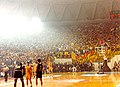 Fans of Aris in the arena
 -
 Aris against Olympiacos basketball game (2007)
 -
 Gates of the venue


Nick Galis Cup
[edit]
Since 2014, Aris B.C. organizes every year, in the start of the season, a friendly mini-tournament in honour of Nikos Galis.
| Year | Final | Third and Fourth place | ||||||
|---|---|---|---|---|---|---|---|---|
| First Place | Score | Second Place | Third Place | Score | Fourth Place | |||
| 2014 | Aris |
60–59 |
 CSKA Moscow |
 Banvit |
77–74 |
Panathinaikos | ||
| 2015 | Pınar Karşıyaka |
84–74 |
Aris |
Lokomotiv Kuban |
72–50 |
 Union Olimpija | ||
Top performances in European & Worldwide competitions
[edit]| Season | Achievement | Notes | |
|---|---|---|---|
| EuroLeague | |||
| 1987–88 | Final Four | 4th place in Ghent, lost to Tracer Milano 82–87 in the semi-final, lost to Partizan 93–105 in the 3rd place game | |
| 1988–89 | Final Four | 3rd place in Munich, lost to Maccabi Tel Aviv 86–99 in the semi-final, defeated FC Barcelona 88–71 in the 3rd place game | |
| 1989–90 | Final Four | 4th place in Zaragoza, lost to FC Barcelona Banca Catalana 83–104 in the semi-final, lost to Limoges CSP 91–103 in the 3rd place game | |
| 1990–91 | Quarter-finals | 5th place in a group with FC Barcelona Banca Catalana, Pop 84, Scavolini Pesaro, Maccabi Tel Aviv, Bayer 04 Leverkusen, Kingston Kings and Limoges CSP | |
| FIBA Saporta Cup | |||
| 1992–93 | Champions | defeated Efes Pilsen 50–48 in the final of the FIBA European Cup in Turin | |
| 1993–94 | Semi-finals | eliminated 2–1 by Smelt Olimpija, 83–79 (W) in Thessaloniki, 78–84 (L) and 61–74 (L) in Ljubljana | |
| 1998–99 | Semi-finals | eliminated by Pamesa Valencia, 64–70 (L) in Valencia and 50–58 (L) in Thessaloniki | |
| FIBA Korać Cup | |||
| 1984–85 | Semi-finals | eliminated by Ciaocrem Varese, 80–77 (W) in Thessaloniki and 71–95 (L) in Varese | |
| 1996–97 | Champions | defeated Tofaş, 66–77 (L) in Thessaloniki and 88–70 (W) in Bursa in the double finals of Korać Cup | |
| 1997–98 | Quarter-finals | eliminated by Calze Pompea Roma, 79–80 (L) in Thessaloniki and 79–86 (L) in Rome | |
| EuroCup | |||
| 2005–06 | Final | lost to Dynamo Moscow 60–73 in the final (Charleroi) | |
| 2009–10 | Quarter-finals | eliminated by Power Electronics Valencia, 64–71 (L) in Thessaloniki and 67–85 (L) in Valencia | |
| EuroChallenge | |||
| 2003–04 | Quarter-finals | eliminated 2–1 by TIM Maroussi, 76–85 (L) in Athens, 101–93 (W) in Thessaloniki and 90–99 (L) in Athens | |
| EuroCup Challenge | |||
| 2002–03 | Champions | defeated Prokom Trefl Sopot 84–83 in the final of the FIBA EuroCup Challenge in Thessaloniki | |
The road to the three European Cup victories
[edit]
1992–93 FIBA European Cup[edit]
|
1996–97 FIBA Korać Cup[edit]
|
2002–03 FIBA Europe Champions Cup[edit]
| ||||||||||||||||||||||||||||||||||||||||||||||||||||||||||||||||||||||||||||||||||||||||||||||||||||||||||||||||||||||||||||


The road to the Great European Journeys
[edit]
1987–88 FIBA European Champions Cup[edit]
|
1988–89 FIBA European Champions Cup[edit]
|
1989–90 FIBA European Champions Cup[edit]
| |||||||||||||||||||||||||||||||||||||||||||||||||||||||||||||||||||||||||||||||||||||||||||||||||||||||||||||||||||


2005–06 ULEB Cup
[edit]| Round | Team | Home | Away |
|---|---|---|---|
| 1st |  Alba Berlin Alba Berlin
|
97–87 | 89–86 |
 Euphony Bree Euphony Bree
|
81–74 | 64–69 | |
 Ventspils Ventspils
|
96–78 | 76–96 | |
 Adecco Estudiantes Adecco Estudiantes
|
73–69 | 89–76 | |
 Lukoil Academic Lukoil Academic
|
97–91 | 65–66 | |
| Top 16 | Panionios
|
112–105 | 72–70 |
| QF |  ASVEL ASVEL
|
77–67 | 67–60 |
| SF |  Hemofarm Hemofarm
|
82–77 | 71–74 |
| F | Dynamo Moscow
|
60–73 | |
Season-by-season
[edit]Notable players
[edit]Note: Flags indicate national team eligibility at FIBA-sanctioned events. Players may hold other non-FIBA nationalities not displayed.
| Criteria |
|---|
|
To appear in this section a player must have either:
|
.jpg)


- Greece
 Lazaros Agadakos
- Vangelis Alexandris
- Dinos Angelidis
- Antonis Asimakopoulos
- Ioannis Athinaiou
- Nikos Barlos
- Lefteris Bochoridis
- Kostas Charalampidis
- Kostas Charissis
- Nikos Chatzivrettas
- Linos Chrysikopoulos
- Dimos Dikoudis
- Georgios Doxakis
- Nikos Filippou
- Ioannis Gagaloudis
- Nasos Galakteros
- -
 Nikos Galis
 - Georgios Gasparis
- Panagiotis Giannakis
- Giannis Giannoulis
- Nikos Gkikas
- Savvas Iliadis
- Giannis Ioannidis
- Memos Ioannou
- Michalis Kakiouzis
- Georgios Kalaitzis
- Manthos Katsoulis
- Vassilis Kavvadas
- Dimitris Kokolakis
- Nestoras Kommatos
- Alexis Kyritsis
- Giannoulis Larentzakis
- Panagiotis Liadelis
- Vassilis Lipiridis
- Sotiris Manolopoulos
- Marios Matalon
- Faidon Matthaiou
- Dinos Mitoglou
- Spyros Mourtos
- Christos Myriounis
- Makis Nikolaidis
- Charis Papageorgiou
- Kostas Papanikolaou
- Michalis Pelekanos
- Stelios Poulianitis
- Michalis Romanidis
- Zisis Sarikopoulos
- Sofoklis Schortsanitis
- Georgios Sigalas
- Ioannis Sioutis
- Gaios Skordilis
- Kostas Sloukas
- Tzanis Stavrakopoulos
- Vassilis Symtsak
- Christos Tapoutos
- Vassilis Toliopoulos
- Michalis Tsairelis
- Dimitris Tsaldaris
- Dimitris Verginis
- Nikos Vetoulas
- Vangelis Vourtzoumis
- Vassilis Xanthopoulos
- USA
- Mahmoud Abdul-Rauf
- J.J. Anderson
- Joe Arlauckas
- Toby Bailey
- Corey Belser
- Walter Berry
- David Booth
- Anthony Bowie
- Torraye Braggs
- Corey Brewer
- Bobby Brown
- Eric Buckner
- -
 Terrel Castle
 - Terry Catledge
- Mario Chalmers
- -
 Kee Kee Clark
 - DeJuan Collins
- Anthony Cowan Jr.
- Will Cummings
- David DeJulius
- Rodney Dent
- Juan Dixon
- -
 Bryce Douvier
 - -
 Bryant Dunston
 - Harold Ellis
- A. J. English
- Desmon Farmer
- -
 Kevin Fletcher
 - James Forrest
- Anthony Frederick
- Kevin Freeman
- Roberto Gallinat
- Anthony Goldwire
- Gary Grant
- -
 Josh Grant
 - Jamelle Hagins
- Ronnie Harrell
- Sean Higgins
- Jermaine Jackson
- Dominic James
- Michael Jenkins
- Edgar Jones
- Mike Jones
- Shakur Juiston
- James Kelly
- -
 Sergio Kerusch
 - Chris King
- Frankie King
- Sean Marshall
- - Jeremiah Massey
- Jerel McNeal
- Aaron Miles
- Isaiah Morris
- Sam Muldrow
- -
 Spencer Nelson
 - Smush Parker
- Pierre Pierce
- Adrian Oliver
- Khalid Reeves
- Jeremy Richardson
- Darnell Robinson
- Alex Scales
- Tom Scheffler
- Melvin Scott
- Brad Sellers
- Charles Shackleford
- Will Solomon
- - Ryan Stack
- Ed Stokes
- Roy Tarpley
- Reyshawn Terry
- Reggie Theus
- John Thomas
- P. J. Tucker
- Sam Vincent
- Brett Vroman
- Jermaine Walker
- Matt Walsh
- - Darius Washington Jr.
- Dominic Waters
- Randy White
- Okaro White
- Tony White
- - Mike Wilkinson
- Xeyrius Williams
- Darral Willis
- Trey Woodbury
- Bracey Wright


- Rest of the Americas
 José Ortiz (Piculín)
 Olivier Hanlan
- - Elijah Mitrou-Long
- Greg Wiltjer

- Europe
- Dimitar Angelov
- Edin Bavčić
- Muhamed Pašalić
 -
- Vladimir Boisa
- Viktor Sanikidze
 - Jake Cohen
 Anatoly Kashirov
- Fedor Likholitov
- Mikhail Mikhailov
- Nikolay Padius
- -- Michail Misounov
 Alan Gregov
- Zdravko Radulović
- Ante Grgurević
- Stojko Vranković
- - Franko Nakić
 Martin Müürsepp
 Hanno Möttölä
- Antti Nikkilä
 Mario Boni
 Geert Hammink
 Torgeir Bryn
- Alexander Kühl
 Žarko Paspalj
- Ivan Paunić
- - Miroslav Pecarski
- - Vladimir Petrović-Stergiou
- - Miroslav Raičević
- - Srđan Jovanović
- Dejan Borovnjak
- Dragan Labović
 - Anton Gavel
 Vladimir Dragičević
- Blagota Sekulić
 Simonas Serapinas
- - Tiit Sokk
- Matej Krušič
- - Slobodan Subotić
- -
 - Sasha Vezenkov
  Andrew Betts
- Steve Bucknall
- Yorick Williams


Club captains
[edit]Aris B.C. team captains, since the 1979–80 season:
| Period | Team Captain |
|---|---|
| 1979–1981 | Vangelis Alexandris
|
| 1981–1983 | Charis Papageorgiou
|
| 1983–1992 |  Nikos Galis Nikos Galis
|
| 1992–1993 | Panagiotis Giannakis
|
| 1993–1997 | Michail Misunov
|
| 1997–1999 | Dinos Angelidis
|
| 1999–2000 | Panagiotis Liadelis
|
| 2000–2002 | Giorgos Floros
|
| 2002–2004 | Giannis Lappas
|
| 2004–2006 | Ryan Stack
|
| 2006–2008 |  Terrel Castle Terrel Castle
|
| 2008–2009 | Savvas Iliadis
|
| 2009–2011 | Nikos Chatzivrettas
|
| 2011–2012 | Christos Tapoutos
|
| 2012–2014 | Antonis Asimakopoulos
|
| 2014–2018 | Spyros Mourtos
|
| 2018–2020 | Lefteris Bochoridis
|
| 2020–2021 | Dimitris Flionis
|
| 2021–2023 | Stavros Schizas
|
| 2023–2025 | Vassilis Toliopoulos
|
| 2025–present | Lefteris Bochoridis
|
Greece national team players
[edit]These players have played for both Aris and the senior Greece men's national basketball team (in any game, official or friendly, and in any tournament, FIBA sanctioned, or non-FIBA sanctioned):
- Vangelis Alexandris
- Dinos Angelidis
- Antonis Asimakopoulos
- Ioannis Athinaiou
- Nikos Barlos
- Lefteris Bochoridis
- Georgios Bogris
- Kostas Charissis
- Kostas Charalampidis
- Dimitris Charitopoulos
- Nikos Chatzivrettas
- Linos Chrysikopoulos
- Dimos Dikoudis
- Nikos Filippou
- Nasos Galakteros
- Nikos Galis
- Nikos Gkikas
- Georgios Gasparis
- Panagiotis Giannakis
- Giannis Giannoulis
- Michalis Giannouzakos
- Savvas Iliadis
- Giannis Ioannidis
- Memos Ioannou
- Vlado Janković
- Michalis Kakiouzis
- Georgios Kalaitzis
- Dimitris Karadolamis
- Manthos Katsoulis
- Vassilis Kavvadas
- Dimitris Kokolakis
- Nestoras Kommatos
- Fanis Koumpouras
- Alexis Kyritsis
- Giannoulis Larentzakis
- Panagiotis Liadelis
- Vassilis Lipiridis
- Faidon Matthaiou
- Dinos Mitoglou
- Christos Myriounis
- Charis Papageorgiou
- Kostas Papanikolaou
- Nikos Papanikolopoulos
- Michalis Pelekanos
- Michalis Romanidis
- Sofoklis Schortsanitis
- Georgios Sigalas
- Ioannis Sioutis
- Gaios Skordilis
- Kostas Sloukas
- Tzanis Stavrakopoulos
- Christos Tapoutos
- Michalis Tsairelis
- Dimitris Tsaldaris
- Panagiotis Vasilopoulos
- Nikos Vetoulas
- Vangelis Vourtzoumis
- Vassilis Xanthopoulos
- Zisis Sarikopoulos
Aris head coaches by season
[edit]


| Head Coach | Seasons |
|---|---|
 Anestis Petalidis Anestis Petalidis
|
1952–53 to 1972–73 |
| Faidon Matthaiou
|
1973–74 |
| Anestis Petalidis
|
1974–75 |
| - Harry Pappas
|
1975–76 & 1976–77 |
| Irakleios Klaglas
|
1977–78 |
| Giannis Ioannidis
|
1978–79 |
| Anestis Petalidis Fred G. Develey
|
1979–80 |
 Dušan Ivković Dušan Ivković
|
1980–81 & 1981–82 |
| Giannis Ioannidis
|
1982–83 to 1989–90 |
| Lazar Lečić Michalis Kyritsis
|
1990–91 |
George Fisher Lazar Lečić Michalis Kyritsis Memos Ioannou Lazar Lečić Michalis Kyritsis Memos Ioannou
|
1991–92 |
- Steve Giatzoglou Zvi Sherf Zvi Sherf
|
1992–93 |
| - Vlade Đurović Memos Ioannou
|
1993–94 |
| Memos Ioannou Soulis Markopoulos
|
1994–95 |
| Soulis Markopoulos
|
1995–96 |
| Soulis Markopoulos- Slobodan Subotić
|
1996–97 |
| Efthimis Kioumourtzoglou Christos Magotsios
|
1997–98 |
| Soulis Markopoulos Zvi Sherf
|
1998–99 |
| Soulis Markopoulos Christos Magotsios
|
1999–00 |
| - Dragan Šakota- Steve Giatzoglou
|
2000–01 |
| Head Coach | Seasons |
|---|---|
| - Steve Giatzoglou Milan Minić
|
2001–02 |
| Milan Minić Vangelis Alexandris
|
2002–03 |
| Vangelis Alexandris Charles Barton
|
2003–04 |
| Charles Barton
|
2004–05 |
Ilias Zouros Andrea Mazzon Andrea Mazzon
|
2005–06 |
| Andrea Mazzon
|
2006–07 |
 Gordie Herbert Gordie Herbert
|
2007–08 |
| Andrea Mazzon
|
2008–09 |
| Andrea Mazzon Fotis Katsikaris- David Blatt
|
2009–10 |
| Sharon Drucker- Slobodan Subotić
|
2010–11 |
| Vangelis Alexandris
|
2011–12 |
| Vangelis Alexandris Vangelis Angelou
|
2012–13 |
Vangelis Angelou Milan Minić Milan Minić
|
2013–14 |
| Dimitris Priftis
|
2014–15 to 2016–17 |
| Panagiotis Giannakis Vangelis Angelou
|
2017–18 |
| Vangelis Angelou Ioannis Kastritis
|
2018–19 |
| Soulis Markopoulos Savvas Kamperidis
|
2019–20 |
| Savvas Kamperidis
|
2020–21 |
| Ioannis Kastritis
|
2021–24 |
| Ioannis Kastritis Nikos Vetoulas
|
2024–25 |
Bogdan Karaičić  Igor Miličić Igor Miličić
|
2025–26 |
Management
[edit]Ownership & Current Board
[edit]| Position | Staff |
|---|---|
| Ownership | RHC (90%)
|
| President | Charis Papageorgiou
|
| Press Officer | Antonis Gatzios
|
Medical team
[edit]| Position | Name |
|---|---|
| Club's doctor | Nikolaos Koukoulias
|
| Physiotherapist | Alexandros Panagiotis Boutovinos
|
| Caregiver | Giannis Nikitakis
|
See also
[edit]References
[edit]- ^ Capacity 5.138 seats. Archived 26 September 2015 at the Wayback Machine
- ^ "Club structure". Aris BC. Archived from the original on 25 March 2011. Retrieved 22 June 2012.
- ^ euroleaguebasketball.net Aris BSA 2009–10, team profile
- ^ euroleaguebasketball.net Aris Thessaloniki
- ^ Arisbc.gr Club Records.
- ^ Eurocup Aris article.
- ^ Cauchi, Orazio. "With Giannis by his side: New Aris owner's entry into Greek basketball". Retrieved 20 October 2025.
- ^ "Aris announced the addition of coach Igor Milicic". eurohoops. Retrieved 27 October 2025.
- ^ Capacity 5.138 seats. Archived 26 September 2015 at the Wayback Machine
External links
[edit]
- Official Basketball Website (in Greek and English)
- ΑΡΗΣ: Η ομάδα που έβαλε το μπάσκετ στα σπίτια των Ελλήνων
- Emperor Fans' Portal (in Greek)
- Super3 Official Website (in Greek)
- Official Website Of Members "Club Friends of Aris" (in Greek)
- Galanis Sports Data
- Press
- All about Aris (in Greek)
Media
| Men's League competitions | |
|---|---|
| Men's Cup competitions | |
| Men's National teams | |
| Women's League competitions | |
| Women's Cup competitions | |
| Women's National teams | |
| See also |
|
Aris B.C.
View on GrokipediaHistory
Founding and early development (1914–1978)
Aris Thessaloniki, a prominent multi-sport club, was established on March 25, 1914, in Thessaloniki, Greece, by a group of young enthusiasts aiming to promote athletic activities amid the city's growing sports culture. Initially focused on football and other disciplines, the club expanded to include basketball in 1922, marking the birth of its basketball section as one of the earliest in northern Greece. This addition came at a time when basketball was still a nascent sport in the country, introduced through international influences, and Aris quickly embraced it as a core component of its identity.[6] The basketball team's early years were centered on local development, with the first official competitions occurring in November 1925 under the Championship of Thessaloniki. Playing in an open stadium shared with other sports, Aris triumphed in this inaugural tournament, defeating opponents including YMCA, Hercules, AEK, V.A.O., and Jewish Akoach in five matches, which laid the groundwork for regional prominence. By the late 1920s, the team ventured into national competition, finishing third in the inaugural Panhellenic Championship of 1927–28 and securing a runner-up position in the Greek League the following season. Their breakthrough came on April 23, 1930, when Aris claimed its first national title by defeating ΧΑΝΘ (Hellenic Athletic Club of Thessaloniki) in the Panhellenic Championship final, establishing an early reputation despite the amateur nature of the sport.[1][5][7] World War II disrupted organized sports across Greece, leading to a postwar reorganization of Aris' basketball operations in the late 1940s. Under the leadership of Phaidon Matheou, a pioneering figure often regarded as the patriarch of Greek basketball, the club rebuilt its male and female sections with a focus on technical development and youth training. Matheou, who played for Aris from 1945 to 1949 and contributed to local championships in 1948 and 1949, emphasized disciplined play and tactical innovation during this amateur era. The team maintained participation in national events but achieved modest results, such as runner-up finishes in the Panhellenic Championship in 1957–58 and 1958–59, and in the Alpha National category in 1964–65 and 1965–66, often competing against stronger Athens-based clubs.[1][8][5] Throughout the 1950s and 1960s, Aris faced significant challenges, including financial constraints that limited infrastructure investments and player recruitment, as well as the dominance of capital-city teams like Panathinaikos and Olympiacos in the post-war Greek League. Operating on a modest budget with volunteer coaches and part-time athletes, the club relied on local talent and regional leagues for sustainability, securing several Thessaloniki titles but struggling for consistent national contention. By the early 1970s, these foundational efforts began transitioning toward greater professionalism, setting the stage for future growth.[9][10]Rise to prominence: The Galis era (1978–1993)
The arrival of Nikos Galis in 1979 marked a pivotal moment for Aris B.C., transforming the team into a scoring powerhouse and elevating its status in Greek basketball. Drafted by the Boston Celtics but choosing to play in Europe due to limited NBA opportunities, Galis signed with Aris in September 1979 after the club had just won its first Greek League championship in the 1978–79 season.[11][1] In his debut on December 2, 1979, against Iraklis, Galis scored 30 points, and he quickly became the league's top scorer every season from 1981 to 1991, averaging over 30 points per game throughout his European career.[12][13] His offensive prowess, characterized by exceptional shooting and playmaking, not only broke numerous scoring records but also inspired a new era of high-tempo basketball in Greece, drawing massive crowds to Aris games.[11] Building on this momentum, Aris secured its second Greek League title in the 1982–83 season, with Galis leading the charge in a dominant playoff run.[14] The team's ascent accelerated in the mid-1980s with the addition of key players like Panagiotis Giannakis, acquired from Ionikos Nikea in the summer of 1984 for a record 40 million drachmas, and contributions from Lefteris Ioannidis, who joined during the decade and bolstered the roster's depth.[1][7] This core group, under strategic coaching, propelled Aris to seven consecutive Greek League championships from 1984–85 to 1990–91, establishing an unmatched dynasty.[14] During this streak, Aris also captured five domestic doubles by winning the Greek Cup in 1985, 1987, 1988, 1989, and 1990, showcasing comprehensive dominance in both league and knockout formats.[13] On the European stage, Aris emerged as a formidable contender, reaching the quarterfinals of the FIBA European Champions Cup in the 1987–88, 1988–89, and 1989–90 seasons, where Galis's scoring feats highlighted the team's competitiveness against top continental clubs.[12] The pinnacle came in 1992–93, when Aris clinched the FIBA European Cup (also known as the Saporta Cup) by defeating Efes Pilsen in the final, securing the club's first European trophy and affirming its international stature.[15][16] The Galis era intensified the storied rivalry with local foes PAOK, particularly through heated derbies in the 1980s that drew tens of thousands of fans and amplified Thessaloniki's basketball fervor; notable clashes included PAOK's upset cup final win over Aris in 1984 and their rare league victory in 1988–89.[17][18] This period also sparked a surge in domestic popularity, with Aris becoming Greece's most beloved basketball team in the 1980s, as Galis and his teammates captivated a national audience and popularized the sport beyond traditional strongholds.[11][19]Decline and recovery (1993–2003)
The end of the Galis dynasty after the 1990–91 season marked the beginning of a prolonged period of decline for Aris B.C., exacerbated by the departure of cornerstone players and escalating financial difficulties. Nikos Galis left Aris for Panionios in 1991–92 before transferring to Panathinaikos in 1992–93. [20] Panagiotis Giannakis, his long-time teammate and co-captain, remained for one final season in 1992–93, contributing to the European Cup Winners' Cup victory before retiring as a player, leaving the team without its leadership core. [21] These losses precipitated consistent playoff misses in the Greek A1 League, with finishes including 7th place in 1993–94 (12 wins, 14 losses) and 6th in 1994–95 (11–15). [5] Financial mismanagement under successive administrations exacerbated the downturn, leading to substantial debt accumulation that threatened the club's survival and resulted in the dissolution of the original entity in 2003, replaced by a newly formed K.A.E. with fresh investment. [5] Domestically, Aris grappled with poor results, including a league-low 12th-place finish in 2000–01 (7–19), relegation scares, and widespread fan discontent expressed through protests against ownership instability and performance lapses. [5] Amid these challenges, Aris achieved an improbable European success in the 1996–97 FIBA Korać Cup, often hailed as a "miracle" triumph despite budgetary constraints. The roster featured key contributors like José Ortiz (15.3 points per game, 17.6 efficiency), Charles Shackleford (10.3 rebounds per game), Panagiotis Liadelis (14.5 ppg), Mario Boni, Ioannis Sioutis, Alexandros Papadatos, and Georgios Floros, blending international talent with homegrown players. [22] The team posted a 12–4 record en route to the title, overcoming Turkish side Tofaş in the two-legged final: a 66–77 road loss in the first leg followed by an 81–59 home victory in the second, securing the aggregate win. [5] Semifinal highlights included a narrow overtime defeat to Benetton Treviso in the second leg (86–87) after winning the first, advancing on aggregate. [23] The nadir persisted into the early 2000s, but Aris signaled recovery by capturing the 2002–03 FIBA Europe Champions Cup, defeating Polish champions Prokom Trefl Sopot 84–83 in the Thessaloniki final before a capacity crowd at Alexandreio Melathron. [5] This victory, fueled by renewed sponsorship and roster reinforcements, coincided with internal restructuring, including enhanced focus on the youth academy to rebuild from within and stabilize operations ahead of the post-2003 resurgence. [5]Modern era and resurgence (2003–present)
Following the financial and competitive struggles of the early 2000s, Aris B.C. began a period of rebuilding under coach Andrea Mazzon, returning to the Greek League playoffs in the 2003–04 season and securing the Greek Cup title with a victory over Olympiacos.[5][4] The club maintained playoff appearances through the mid-2000s, highlighted by a strong 2005–06 ULEB Cup campaign where they advanced to the final but fell to Dynamo Moscow, 73–60, in Charleroi, Belgium.[24] This run underscored Aris's resurgence in European competitions, with an 11–6 overall record in the tournament.[25] From 2007 to 2014, Aris continued to stabilize domestically, achieving semifinal berths in the Greek League playoffs in seasons like 2006–07 and 2010–11, while integrating a mix of veteran Greek players and emerging international talent to foster consistency.[5] The club faced ongoing financial pressures but avoided relegation through strategic budgeting and supporter backing, setting the stage for broader recovery. Entering the 2015–16 season, Aris experienced financial stabilization through key sponsorship deals, including partnerships that enhanced operational sustainability.[26] They posted a strong 20–6 regular-season record in the Greek Basket League and reached the EuroCup Last 32, marking renewed European involvement.[27] Over the subsequent years, Aris maintained top-6 finishes in the league, such as 5th place in 2023–24 with a 13–14 regular-season mark, qualifying for playoffs where they advanced past the quarterfinals with a 2–1 series win.[28][29] The 2020s brought challenges from the COVID-19 pandemic, which prematurely ended the 2019–20 Greek League season with Aris in 13th place; however, the Hellenic Basketball Federation annulled relegations, allowing the club to retain its top-tier status. Post-pandemic, Aris adapted by emphasizing a roster strategy blending international recruits—such as Lithuanian forward Arnoldas Kulboka and American center Steven Enoch—with youth academy products like guard Lefteris Bochoridis, aiming for depth and competitiveness in both domestic and EuroCup play.[30] This approach supported consistent EuroCup participation, including a 9–10 group stage record in 2023–24.[31] By 2025, bolstered by expanded sponsorships like Betsson as naming partner and an ownership shift to RHC Group for long-term investment, Aris continued vying for top-4 spots amid fierce rivalry with powerhouses Panathinaikos and Olympiacos.[26][32] As of November 2025, the team held a 2–4 record in the Stoiximan Basket League and 3–3 in the BKT EuroCup, reflecting ongoing efforts to navigate venue constraints at Alexandreio Melathron and build toward contention.[33][34]Club identity
Home arena and facilities
Aris B.C. began its basketball activities on shared outdoor courts in Thessaloniki during the sport's early introduction to Greece in the 1920s, as teams lacked dedicated indoor venues at the time.[1] By the mid-1950s, the club had secured its own outdoor stadium along Vasilissis Olgas Avenue, where it hosted games until the construction of a permanent indoor facility.[35] In 1966, Aris transitioned to the newly built Alexandreio Melathron, also known as Nick Galis Hall or Palais des Sports, located at Grigoriou Lambraki 2 in central Thessaloniki near the International Trade Fair grounds; this venue has served as the club's primary home arena ever since.[36][35] The circular arena features horseshoe-shaped stands and an auxiliary basketball court for practice sessions, supporting both senior team operations and youth development.[35] With a permanent seating capacity of 5,138—expandable to 6,000 with temporary seating—it accommodates domestic Greek Basket League games and European competitions, though its size has occasionally limited Aris's participation in top-tier EuroLeague events requiring larger venues.[35][36][3] The facility also houses club offices and storage areas, centralizing administrative functions.[35] Significant renovations occurred in 2004 ahead of the Athens Olympics, including upgrades to electromechanical systems, air-conditioning, audiovisual equipment, seating, CCTV security, and lighting to align with international standards for hosting high-level events.[35][37] These improvements reduced the original capacity from 5,576 but enhanced safety and comfort, allowing the arena to support Aris's return to European play.[35] During the closure for these works, the team temporarily relocated to the nearby Ivanofeio Sports Arena.[37] Attendance at Alexandreio Melathron remains strong, particularly for European contests, where the passionate fanbase frequently fills the venue to capacity, as seen in the sold-out FIBA Europe Cup finals matches drawing record crowds for the competition.[38] The club's training operations utilize the arena's auxiliary court and a dedicated gym within the complex, while the youth academy maintains additional setups across Thessaloniki to nurture talent.[35]Crest, kits, and sponsorships
Aris B.C., as part of the multi-sport club Aris Thessaloniki founded in 1914, adopted an original crest incorporating symbols of Thessaloniki, including the image of Ares, the ancient Greek god of war, from whom the club derives its name. This depiction, inspired by a famous statue of the deity symbolizing courage and strength, has remained a core element of the club's visual identity since the basketball section's establishment in 1922. The yellow and black color scheme, representing the club's traditional palette, was integrated into the crest design during its early development, emphasizing the team's aggressive and dominant playing style.[39][40][41] The crest underwent evolutions in the 1980s, aligning with the club's golden era, where a more stylized yellow-black emblem was introduced to enhance visibility on uniforms and promotional materials. Further modernizations occurred in the 2000s, refining the Ares figure into a sleeker, contemporary form while preserving the foundational Thessaloniki motifs and color scheme. These updates reflected the club's growing commercial presence and adaptation to professional basketball branding standards.[42] Aris B.C.'s kits have consistently featured yellow home jerseys since the team's inception in 1922, paired with black accents to honor the club's heritage colors, while away kits have varied between black, white, and alternate designs for competitive versatility. Kit manufacturers shifted over time to support the team's professional needs; Reebok provided uniforms until 2011, followed by periods with Spalding (2011–2012 and 2018–2019), Nickan (2012–2014), and CAP (2017–2018), before Crossover became the supplier in 2023, focusing on performance-oriented apparel for both on-court and training use.[43][41] Sponsorships for Aris B.C. began with modest local partnerships in the early decades, providing essential support for operations and gradually expanding into jersey and equipment deals as the club professionalized. By the late 20th century, these evolved into more prominent arrangements, such as the 2023–24 jersey sponsorship with Midea, which included prominent logo placement on home and away uniforms. For the 2025–26 season, Betsson has taken on the role of official naming partner and primary sponsor, rebranding the team as Aris Betsson B.C. and extending visibility to court advertisements, training gear, and digital platforms, building on two prior years of collaboration to bolster financial stability and fan engagement. Additional current partners include Instacar for mobility services on training kits and Ippocratis A.E. for medical equipment sponsorships, contributing to the club's diversified revenue streams.[44][45][46][47]Nicknames, supporters, and rivalries
Aris B.C. is commonly known by the nickname "The Emperor" or "Emperors of Thessaloniki," a moniker earned during its dominant run in Greek basketball throughout the 1980s, when the club secured multiple championships and established itself as the preeminent force in the sport.[1] The team is also referred to as "The Yellows," reflecting the prominent yellow color in its jerseys and overall branding.[1][48] The club's supporters form one of the most passionate and dedicated fanbases in Greek basketball, with the primary organized group, Super 3, established in 1988 as part of the broader Aris multisport club's ultras movement.[49] This fan club has been instrumental in fostering a vibrant community, drawing average home attendances that contribute to the league's lively atmospheres, often exceeding several thousand spectators per game.[50] Ultras elements within Super 3, including dedicated sections like those emulating intense support styles, amplify the energy at matches, particularly in Thessaloniki's Alexandreio Melathron arena.[51] Aris B.C.'s most intense rivalry is with crosstown counterpart PAOK B.C., a derby rooted in Thessaloniki's local tensions and heightened during the 1980s and early 1990s when both teams vied for national supremacy, leading to heated confrontations and occasional fan clashes.[52][51] This matchup, often likened to broader city rivalries evoking historical divisions, remains a cornerstone of Greek basketball's competitive landscape.[53] Aris also maintains significant rivalries with Athens-based powerhouses Olympiacos B.C. and Panathinaikos B.C., stemming from frequent playoff clashes and the north-south divide in Greek sports.[1] Fan culture surrounding Aris B.C. emphasizes fervent chants, robust away support, and a sense of communal pride that unites supporters across generations.[54] Iconic anti-rival chants, particularly directed at PAOK, are a staple during derbies, creating an electric atmosphere often described as one of Europe's most intense in basketball.[55] Community initiatives tied to the fanbase include youth engagement programs and charitable efforts organized through Super 3, reinforcing the club's role in Thessaloniki's social fabric.[49]Achievements and honours
Domestic competitions
Aris B.C. has established itself as one of the most successful clubs in Greek basketball history through its domestic achievements, particularly during the late 20th century. The club has secured 10 Greek League championships, 8 Greek Cups, and 1 Greek Super Cup, with many of these triumphs occurring in the era dominated by star player Nikos Galis and coach Yiannis Ioannidis. These successes highlight Aris's dominance in national competitions, including multiple doubles where the team won both the league and cup in the same season. In the Greek Basket League (formerly known as the Panhellenic Championship and later the A1 National League), Aris won its first title in 1929–30 by defeating ΧΑΝΘ in the final, marking an early milestone in the competition's inaugural nationwide format. The club added further championships in 1979 and 1983 before entering a golden period from 1985 to 1991, capturing seven consecutive titles amid evolving playoff structures that shifted from round-robin formats to best-of-series playoffs by the mid-1980s. During this streak, Aris amassed impressive win records, such as 24 victories in 28 games in the 1990–91 season, underscoring their unparalleled consistency. No additional league titles have been won since 1991, though the club has remained a top-tier contender.[5][1] Aris has also excelled in the Greek Basketball Cup, winning eight editions, with five of those coming during the 1985–1992 stretch that overlapped with their league dominance. Notable victories include the 1985 final over Panathinaikos, securing the first of five doubles in 1985, 1987, 1988, 1989, and 1990, followed by additional triumphs in 1992, 1998, and 2004. These cup successes often featured dramatic finals, such as the 1998 win against AEK Athens by a score of 71–68. Runner-up finishes occurred in 1993, 2003, 2005, 2014, and 2017, demonstrating sustained competitiveness.[5][1] The Greek Super Cup, introduced in 1986 as a matchup between the league champion and cup winner, was claimed by Aris in its inaugural edition that year, defeating Panathinaikos 117–85 at home and 104–88 on the road. The club has participated sporadically since, reaching the semifinal in the 2025 edition but falling short of another title.[56] In the 2020s, Aris has maintained a strong presence in domestic play without adding to its trophy cabinet. The team finished 9th in the 2020–21 Greek League (7–15 record), improved to 7th in 2021–22 (11–13, quarterfinal loss to Panathinaikos), 8th in 2022–23 (11–11, quarterfinal loss to Olympiacos), and 5th in 2023–24 (12–10, semifinal loss to Panathinaikos). In the 2024–25 season, Aris placed 8th (9–13). Cup performances included a semifinal appearance in 2024, while the 2025 Super Cup semifinal highlighted ongoing resilience amid a challenging league campaign. As of November 19, 2025, in the 2025–26 Greek Basket League, Aris holds 7th place after 9 games.[5][57]European and international competitions
Aris B.C. has a notable history in European basketball competitions, having secured three continental titles across various tournaments organized by FIBA and its affiliates. The club first entered European competitions in the 1966–67 season, competing in the FIBA Cup Winners' Cup as Greek cup winners, though early participations yielded limited success. Over the decades, Aris has made approximately 15 appearances in top-tier and secondary European events, with its strongest performances occurring during the late 1980s and 1990s under the FIBA European Champions Cup (now EuroLeague) and other FIBA-sanctioned cups.[1][5] In the premier FIBA European Champions Cup/EuroLeague, Aris participated in eight seasons between 1979–80 and 2006–07, achieving its best results during a dominant domestic run in the late 1980s. The club's peak came in the 1987–88 season, reaching the Final Four in Ghent, Belgium, where it advanced to the semifinals before losing 86–99 to Maccabi Elite Tel Aviv; Aris then secured third place with an 88–71 victory over FC Barcelona in the consolation game. The following year, in 1988–89, Aris returned to the Final Four in Munich, again reaching the semifinals but falling 75–88 to Real Madrid, followed by a 83–94 loss to Maccabi in the third-place match, finishing fourth overall. In 1989–90, Aris made its third consecutive Final Four appearance but was eliminated earlier in the quarterfinals. Subsequent EuroLeague campaigns in 1990–91 and 1991–92 ended in the group stages, and the club returned briefly in 2006–07, exiting in the regular season with a 3–7 record. These deep runs in the late 1980s established Aris as a competitive force in Europe's elite competition, though it never claimed the title.[58] Beyond the top tier, Aris excelled in FIBA's secondary competitions, winning two titles in the 1990s. In the 1992–93 FIBA European Cup (Saporta Cup), Aris claimed its first European trophy by defeating Efes Pilsen 50–48 in the final held in Turin, Italy, after a hard-fought single-game showdown. Four years later, in the 1996–97 FIBA Korać Cup, Aris captured its second continental crown, overcoming Tofaş S.K. in a best-of-three final series with an 88–70 victory in the decisive second game in Bursa, Turkey, following a 76–82 loss in the opener; the team finished the tournament with a 12–4 record. These victories highlighted Aris's prowess in mid-tier events during a period of domestic resurgence.[15][4][59] Aris also achieved success in post-FIBA era competitions under ULEB/Euroleague Basketball. In the 2002–03 FIBA Europe Champions Cup—a third-tier event amid the FIBA-ULEB split—Aris won the title by beating Prokom Trefl Sopot in the final at Alexandreio Melathron in Thessaloniki, securing its third European honor overall. Transitioning to the ULEB Cup (predecessor to the modern EuroCup), Aris reached the 2005–06 final but lost 60–73 to Dynamo Moscow in Charleroi, Belgium, after advancing through the quarterfinals and semifinals. The club has since made regular EuroCup appearances, including qualifications for the 2023–24 and 2024–25 seasons; in the latter, Aris competed in the regular season but finished with a 3–15 record, missing the playoffs.[60][61][62]| Competition | Titles | Seasons Won | Runners-Up | Best Other Finishes |
|---|---|---|---|---|
| FIBA European Champions Cup/EuroLeague | 0 | — | — | 3rd (1987–88); 4th (1988–89); Final Four (1989–90) |
| FIBA European Cup (Saporta Cup) | 1 | 1992–93 | — | Semifinals (1993–94) |
| FIBA Korać Cup | 1 | 1996–97 | — | Semifinals (1984–85, 1997–98) |
| FIBA Europe Champions Cup | 1 | 2002–03 | — | — |
| ULEB Cup/EuroCup | 0 | — | 2005–06 | Quarterfinals (multiple, e.g., 2013–14) |
Individual awards and recognitions
Nikos Galis, the iconic shooting guard who anchored Aris B.C. from 1979 to 1992, dominated the Greek Basket League with exceptional scoring prowess, earning the league's MVP award five times between 1988 and 1992.[63] He also secured the Greek League Finals MVP honor four times from 1988 to 1991, highlighting his pivotal role in Aris's championship runs.[13] Additionally, Galis was recognized as a five-time All-European selection during his club career, underscoring his status among Europe's elite players in the FIBA European Champions Cup competitions.[11] Panagiotis Giannakis, a key point guard for Aris from 1984 to 1993, was inducted into the FIBA Hall of Fame in 2021 for his outstanding contributions as a player, including his leadership in Greece's golden era of basketball.[64] His tenure with Aris coincided with the club's most successful period, where his playmaking and defensive skills complemented the offensive firepower of teammates like Galis. On the coaching side, Dušan Ivković, who led Aris from 1980 to 1982, laid foundational tactical strategies that propelled the team to early successes, earning him later induction into the FIBA Hall of Fame in 2017 as one of Europe's most influential coaches.[65] Yiannis Ioannidis, serving as head coach from 1979 to 1990, orchestrated Aris's dynasty with innovative defensive schemes, though specific individual coaching awards from that era remain limited in documentation. More recently, Andrea Mazzon, who coached Aris in the late 2000s, guided the team to ULEB Cup finals appearances, contributing to the club's resurgence in European competitions without formal MVP-level honors.[66]Team and personnel
Current roster and depth chart
As of November 19, 2025, Aris B.C.'s roster for the 2025–26 season features a mix of experienced Greek players, young domestic talents, and international imports, totaling approximately 16 active players under head coach Igor Milicic, who took over in October 2025 and emphasizes defensive intensity integrating youth with veteran leadership for both the Greek Basket League and BKT EuroCup competitions.[67] The team adheres to league limits on non-EU imports, with no major injuries reported early in the season that would alter the primary rotation.[68] Key offseason and mid-season moves in 2025 included signing American guard Bryn Forbes for perimeter scoring, Lithuanian forward Arnoldas Kulboka for frontcourt depth, French forward Amine Noua for defensive versatility, Serbian guard Danilo Andjusic in November, alongside promotions from the club's youth academy such as forward Vasileios Kazamias, reflecting Milicic's strategy to blend immediate contributors with long-term development.[69][70][71] These additions build on returning staples like point guard Lefteris Bochoridis and center Emmanouil Chatzidakis, fostering a cohesive unit where the coaching staff—including assistants Christos Chasanidis, Panagiotis Zalongos, Serhat Cetin, and Dionysios Pantelis Angelou—focuses on player rotations that maximize the Greeks' familiarity with the system while leveraging imports for matchup-specific roles.[6][72] The team's depth chart, as configured for the early 2025–26 games, organizes players by position with projected starters (bolded) and key bench options, prioritizing height and experience for starters while reserving athletic wings and bigs for second-unit energy.| Position | Starters | Bench |
|---|---|---|
| Point Guard (PG) | Bryce Jones (USA, 6'0", 31) Elijah Mitrou-Long (Greece/Canada, 6'1", 29) | Lefteris Bochoridis (Greece, 6'5", 31) Stelios Poulianitis (Greece, 6'2", 30) |
| Shooting Guard (SG) / Guard (G) | Bryn Forbes (USA, 6'2", 32) Ronnie Harrell (USA, 6'7", 29) | Danilo Andjusic (Serbia, 6'5", 32) Aleksandre Merkviladze (Georgia, 6'8", 23) |
| Small Forward (SF) / Forward (F) | Arnoldas Kulboka (Lithuania, 6'10", 27) Alex Antetokounmpo (Greece/Nigeria, 6'8", 24) | Amine Noua (France, 6'8", 29) Vasileios Kazamias (Greece, 6'7", 18) Vasilis Pourlidas (Greece, 6'7", 18) Chrysostomos Chatzilamprou (Greece, 6'6", 17) |
| Power Forward (PF) | Steven Enoch (USA/Armenia, 6'10", 28) Georgios Gkiouzelis (Greece, 6'9", 30) | Filippos Tsachtsiras (Greece, 6'8", 20) |
| Center (C) | Georgios Tanoulis (Greece, 6'11", 23) | Emmanouil Chatzidakis (Greece, 6'10", 25) |
Retired numbers and legends
Aris B.C. has retired the number 6 jersey in honor of Nikos Galis, a decision announced during a special ceremony at the team's home arena in Thessaloniki on May 8, 2013, recognizing his unparalleled contributions to the club's golden era.[73] The event also included the naming of the arena's main hall as the Nick Galis Hall, celebrating his role as the driving force behind Aris's eight consecutive Greek League titles from 1983 to 1991.[73] Nikos Galis, widely regarded as one of Europe's greatest scorers, averaged over 30 points per game across his 13 seasons with Aris from 1979 to 1992, leading the team to multiple domestic and European successes while earning nine Greek League MVP awards during that period.[13] His explosive scoring ability, exemplified by seasons like 1987-88 where he averaged 35.6 points, transformed Aris into a dominant force and elevated Greek basketball internationally.[12] Galis was inducted into the FIBA Hall of Fame in 2007 and the Naismith Memorial Basketball Hall of Fame in 2017, honors directly tied to his legendary tenure with Aris.[11][13] Panagiotis Giannakis, known as the "Dragon," served as Aris's on-court leader and defensive anchor alongside Galis, contributing to the club's seven Greek League championships and five Greek Cups between 1985 and 1993.[64] His playmaking and tenacity were instrumental in Aris's back-to-back European third-place finishes in 1988 and 1989, while he captained the team to its 1991 Saporta Cup final appearance.[21] Giannakis was inducted into the FIBA Hall of Fame in 2013, acknowledging his pivotal role in Aris's dynasty and Greece's national team achievements.[64] Among other revered figures, Giannis Ioannidis stands out for his multifaceted legacy with Aris, where he played nearly two decades as a forward before transitioning to coaching, leading the club to eight Greek League titles from 1979 to 1990.[74] As a player, Ioannidis was a key contributor to Aris's early successes, including the 1979 Greek Championship, and his coaching era solidified the club's status as a powerhouse.[75]Head coaches and management
Aris B.C. has seen a succession of notable head coaches who have shaped its success across decades, particularly during its dominant eras. In the late 1970s and 1980s, Giannis Ioannidis emerged as a pivotal figure, serving as head coach during the 1978–79 season and from 1982 to 1990, during which he led the team to eight Greek League championships (1979, 1983, 1985–90) and five Greek Cups.[74][76] His tenure emphasized defensive discipline and tactical innovation, contributing to Aris's status as a powerhouse in Greek basketball. Complementing this era, Dušan Ivković coached Aris from 1980 to 1982, focusing on integrating international talent and modern strategies, though his stint preceded the club's subsequent league dominance.[77] In more recent years, the club has experienced frequent coaching changes amid efforts to rebuild competitiveness. Ioannis Kastritis held the position from the 2018–19 season and returned for a primary tenure from 2021 to January 2025, achieving a 12–23 record in 35 EuroCup games while guiding the team to consistent domestic playoff appearances but no major titles.[78][79] His win percentage in league play hovered around 55%, reflecting steady improvement in team structure. Nikos Vetoulas succeeded him from January to June 2025 as an interim coach.[80] Bogdan Karaicic took over in the summer but was dismissed in October 2025 after a poor start, with Igor Milicic appointed as the new head coach to emphasize defensive intensity and youth development.[81][82]| Coach | Tenure | Key Achievements | Win % (League, Approx.) |
|---|---|---|---|
| Giannis Ioannidis | 1978–79, 1982–90 | 8 Greek Leagues, 5 Greek Cups | ~70% |
| Dušan Ivković | 1980–82 | Team transition to elite level | ~60% |
| Ioannis Kastritis | 2021–25 | Playoff consistency, EuroCup participation | 55% |
| Nikos Vetoulas | 2025 (Jan–Jun) | Interim stabilization | N/A |
| Igor Milicic | 2025–present (Oct) | Ongoing rebuild | N/A |
Records and statistics
League and playoff records
Aris B.C. holds a distinguished place in the history of the Greek Basket League, with 10 championships secured across its tenure in domestic competition. These titles include a remarkable run of seven consecutive championships from 1985 to 1991, during which the team demonstrated unparalleled dominance under the leadership of coach Giannis Ioannidis and star player Nikos Galis. The club's perfect seasons in 1985–86 (26 wins, 0 losses), 1986–87 (21 wins, 0 losses), and 1987–88 (21 wins, 0 losses) underscore this era's supremacy, with the 1985–86 campaign standing out as an undefeated regular season.[4] The team maintains the Greek League record for the most consecutive victories, achieving 80 straight wins spanning the 1986–87 through 1988–89 seasons, a streak fueled by Galis's scoring prowess and a balanced roster featuring Panagiotis Giannakis and Keith Williams. In terms of overall performance, Aris has compiled a strong home record in league play, particularly during the high-scoring 1980s, where offensive output often exceeded 100 points per game in key matchups. Away performances were equally formidable in championship years, with the 1989–90 season yielding 24 wins and 4 losses overall.[14] Scoring records from the Galis era highlight Aris's offensive legacy, with the team frequently posting triple-digit totals in league games; for instance, in the 1987–88 season, several contests saw Aris surpass 110 points, exemplified by a 112–78 victory over Panionios. Individually, Galis set benchmarks with his career-high 62 points in a single Greek League game against Ionikos Nikaias in 1981, contributing to team efforts that averaged over 95 points per outing during peak years. Streaks like Galis's 19-game run of 25+ points in domestic and international play (including league contests) further cemented Aris's reputation for explosive scoring.[13] In playoff history, Aris has made 12 finals appearances, winning 10 of those series, with notable successes in best-of-five and best-of-seven formats during the 1980s and early 1990s. The club claimed titles in 1982–83 (defeating Panathinaikos 2–0 in the final), 1984–85 (3–1 over AEK Athens), and the seven-year streak culminating in 1990–91 (4–2 over PAOK). Even in losses, such as the 1991–92 finals defeat to Panathinaikos (3–2), Aris pushed series to their limits, often requiring five or more games. Playoff series wins total over 30 across these campaigns, with home-court advantages proving decisive in multiple comebacks.[14] As of November 19, 2025, in the 2025–26 Greek Basket League season, Aris holds a 3–5 record through eight games, including a 78–61 home win over Mykonos B.C. on November 8. The team ranks mid-table, averaging 80.8 points per game while allowing 82.1, with standout performances from import guard Bryce Jones (17.2 ppg).[68]| Season | Finals Opponent | Series Result | Series Length |
|---|---|---|---|
| 1982–83 | Panathinaikos | Aris 2–0 | Best-of-3 |
| 1984–85 | AEK Athens | Aris 3–1 | Best-of-5 |
| 1985–86 | Panathinaikos | Aris 2–0 | Best-of-3 |
| 1986–87 | Panathinaikos | Aris 2–0 | Best-of-3 |
| 1987–88 | AEK Athens | Aris 3–0 | Best-of-5 |
| 1988–89 | Panathinaikos | Aris 3–1 | Best-of-5 |
| 1989–90 | PAOK | Aris 3–0 | Best-of-5 |
| 1990–91 | PAOK | Aris 4–2 | Best-of-7 |
| 1991–92 | Panathinaikos | Panathinaikos 3–2 | Best-of-5 |
European competition records
Aris B.C. has competed extensively in FIBA and ULEB European tournaments since the 1970s, achieving its greatest success in second- and third-tier competitions with three titles. The club reached the Final Four of the premier FIBA European Champions Cup (predecessor to the modern EuroLeague) three consecutive times from 1988 to 1990, securing third place in 1989 and fourth place in both 1988 and 1990.[5] In the group stages of these campaigns, Aris posted strong performances, including a second-place finish in the 1988-89 regular season group with five wins and one loss.[5] The club's European titles came in lower-tier events. In the 1992-93 FIBA Saporta Cup (then known as the FIBA European Cup Winner's Cup), Aris won the championship by defeating Efes Pilsen 50-48 in the final, compiling 16 wins across the tournament.[4][5] The 1996-97 FIBA Korać Cup victory followed a 12-4 overall record, highlighted by semifinal wins over Estudiantes and a two-game final triumph over Tofas (77-66 away, 88-70 home).[4][5] Aris claimed its third title in the 2002-03 FIBA Europe Champions Cup, topping Group E with a 4-2 record before defeating Trefl Sopot 84-83 in the final held at Alexandreio Melathron in Thessaloniki.[4][5] In the modern ULEB EuroCup, Aris has made regular appearances since the 2000s, with a best finish of runner-up in the 2005-06 season, where it lost the final 73-60 to Dynamo Moscow after advancing from group play.[5] During the 2020s, the club has qualified for the group stage multiple times through preliminary rounds, including strong showings in the 2023-24 season (9-9 overall record) and the ongoing 2024-25 campaign, where it has averaged 74.7 points per game through early rounds.[5][86]| Competition | Titles | Years | Key Stats |
|---|---|---|---|
| FIBA Saporta Cup | 1 | 1993 | 16 wins; final win 50-48 vs. Efes Pilsen[4][5] |
| FIBA Korać Cup | 1 | 1997 | 12-4 record; finals aggregate 165-136 vs. Tofas[4][5] |
| FIBA Europe Champions Cup | 1 | 2003 | Group stage 4-2; final win 84-83 vs. Trefl Sopot[4][5] |
Season-by-season summary
Aris B.C.'s basketball team, established in 1924 as part of the multi-sport club, competed in early Panhellenic championships, securing the national title in 1929–30 and several Thessaloniki regional honors through the 1940s and 1950s.[5] Following the creation of the Greek A1 League in 1963–64, the team experienced moderate success, including a league championship in the 1978–79 season that launched their golden era, but no additional national titles until then.[1][5] The following table provides a season-by-season overview of Aris B.C.'s performance in the Greek A1 League regular season (including win-loss records where available), playoffs, Greek Cup, and European competitions from 1978–79 onward, with emphasis on post-2003 seasons; top scorers are noted for the team where data is available.[87][5][88][4]| Season | Regular Season Finish (W-L) | Playoffs | Greek Cup | European Competition Outcome | Top Scorer (PPG, where known) |
|---|---|---|---|---|---|
| 1978–79 | 1st | Champions | Quarterfinals | None | Unknown |
| 1979–80 | 2nd | Runners-up | Semifinals | FIBA European Champions Cup: Last 8 | Nikos Galis (31.6) |
| 1980–81 | 3rd (18-4) | Semifinals | Quarterfinals | FIBA Korać Cup: Last 8 | Nikos Galis (32.7) |
| 1981–82 | 2nd | Runners-up | Quarterfinals | FIBA Korać Cup: Last 16 | Nikos Galis (33.0) |
| 1982–83 | 1st | Champions | Semifinals | FIBA Korać Cup: Last 16 | Nikos Galis (30.6) |
| 1983–84 | 2nd | Runners-up | Runners-up | FIBA European Champions Cup: Last 8 | Nikos Galis (31.9) |
| 1984–85 | 1st (25-1) | Champions | Champions | FIBA Korać Cup: Semifinals | Nikos Galis (32.9) |
| 1985–86 | 1st (26-0) | Champions | Semifinals | FIBA European Champions Cup: Last 8 | Nikos Galis (33.3) |
| 1986–87 | 1st | Champions | Champions | FIBA European Champions Cup: Last 8 | Nikos Galis (32.6) |
| 1987–88 | 1st | Champions | Champions | FIBA European Champions Cup: Final Four | Nikos Galis (32.9) |
| 1988–89 | 1st | Champions | Champions | FIBA European Champions Cup: 3rd place | Nikos Galis (32.0) |
| 1989–90 | 1st | Champions | Champions | FIBA European Champions Cup: Final Four | Nikos Galis (31.9) |
| 1990–91 | 1st | Champions | Semifinals | FIBA European Champions Cup: Last 8 | Nikos Galis (28.0) |
| 1991–92 | 3rd | Semifinals | Champions | FIBA European Champions Cup: Last 16 | Panagiotis Fasoulas (18.5) |
| 1992–93 | 5th | Did not qualify | Runners-up | FIBA European Cup: Champions | Unknown |
| 1993–94 | 7th | Did not qualify | Quarterfinals | FIBA European Cup: Semifinals | Unknown |
| 1994–95 | 6th | Did not qualify | Quarterfinals | FIBA Korać Cup: Last 32 | Unknown |
| 1995–96 | 5th | Did not qualify | Quarterfinals | FIBA Korać Cup: Last 16 | Unknown |
| 1996–97 | 6th | Did not qualify | Quarterfinals | FIBA Korać Cup: Champions | Unknown |
| 1997–98 | 9th | Did not qualify | Champions | FIBA Korać Cup: Last 8 | Unknown |
| 1998–99 | 4th (14-12) | Semifinals | Semifinals | FIBA Saporta Cup: Semifinals | Unknown |
| 1999–00 | 8th | Did not qualify | Quarterfinals | FIBA Korać Cup: Last 16 | Unknown |
| 2000–01 | 12th (7-19) | Did not qualify | Quarterfinals | FIBA Saporta Cup: Last 16 | Unknown |
| 2001–02 | 10th (9-17) | Quarterfinals | Quarterfinals | None | Unknown |
| 2002–03 | 5th (14-12) | Semifinals | Runners-up | FIBA Champions Cup: Champions | Nestoras Kommatos (19.2) |
| 2003–04 | 5th (13-13) | Quarterfinals | Champions | FIBA Champions Cup: Last 8 | Nestoras Kommatos (22.1) |
| 2004–05 | 5th (13-13) | Quarterfinals | Runners-up | ULEB Cup: Last 16 | Unknown |
| 2005–06 | 4th (17-9) | Semifinals | Quarterfinals | ULEB Cup: Runners-up | Unknown |
| 2006–07 | 3rd (16-10) | Semifinals | Quarterfinals | EuroLeague: Last 16 | Unknown |
| 2007–08 | 5th (12-14) | Quarterfinals | Semifinals | EuroLeague: Last 16 | Unknown |
| 2008–09 | 6th (13-13) | Quarterfinals | Quarterfinals | EuroCup: Regular season | Unknown |
| 2009–10 | 7th (12-14) | Quarterfinals | Quarterfinals | EuroCup: Quarterfinals | Unknown |
| 2010–11 | 6th (14-12) | Quarterfinals | Semifinals | EuroCup: Last 16 | Unknown |
| 2011–12 | 8th (10-16) | Quarterfinals | Quarterfinals | EuroCup: Last 16 | Unknown |
| 2012–13 | 7th (14-12) | Quarterfinals | Quarterfinals | None | Unknown |
| 2013–14 | 8th (12-14) | Quarterfinals | Runners-up | EuroCup: Did not qualify | Unknown |
| 2014–15 | 7th (13-13) | Quarterfinals | Quarterfinals | FIBA Europe Cup: Last 32 | Unknown |
| 2015–16 | 6th (15-11) | Quarterfinals | Semifinals | EuroCup: Last 32 | Unknown |
| 2016–17 | 5th (14-12) | Quarterfinals | Quarterfinals | FIBA Champions League: Last 16 | Unknown |
| 2017–18 | 10th (10-16) | Did not qualify | Quarterfinals | FIBA Champions League: Last 16 | Unknown |
| 2018–19 | 11th (8-18) | Did not qualify | Quarterfinals | FIBA Europe Cup: Quarterfinals | Unknown |
| 2019–20 | 9th (9-13)* | Did not qualify | Quarterfinals | FIBA Europe Cup: Regular season | Unknown |
| 2020–21 | 6th (12-10) | Quarterfinals | Semifinals | None | Unknown |
| 2021–22 | 5th (15-11) | Quarterfinals | Quarterfinals | FIBA Europe Cup: Last 16 | Unknown |
| 2022–23 | 7th (13-13) | Quarterfinals | Quarterfinals | EuroCup: Regular season | Unknown |
| 2023–24 | 6th (14-12) | Quarterfinals | Semifinals | EuroCup: Top 16 | Unknown |
| 2024–25 | 8th (12-14) | Quarterfinals | Quarterfinals | EuroCup: Quarterfinals | Unknown |
| 2025–26** | 10th (3-5) | Ongoing | Ongoing | EuroCup: Group stage (3-3) | Bryce Jones (17.2) |
**Partial season as of November 19, 2025.
Win-loss records for pre-2000 seasons are approximate based on available historical data; playoffs typically involved top 8 teams qualifying for quarterfinals or better.[87][5][88][4][89]