


Community hub
Recent from talks
Contribute something
Nothing was collected or created yet.
Astacidea
View on Wikipedia
| Astacidea Temporal range: Middle Permian - present
| |
|---|---|

| |
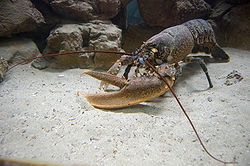
| Adriatic lobster | |

| |
| Crayfish: Austropotamobius pallipes | |
Scientific classification 
| |
| Kingdom: | Animalia |
| Phylum: | Arthropoda |
| Class: | Malacostraca |
| Order: | Decapoda |
| Suborder: | Pleocyemata |
| Clade: | Reptantia |
| Infraorder: | Astacidea Latreille, 1802 |
| Superfamilies | |
Astacidea is an infraorder of decapod crustaceans including lobsters (but not "lobsters" such as the spiny lobster etc.), crayfish, and their close relatives.
Description
[edit]The Astacidea are distinguished from most other decapods by the presence of chelae (claws) on each of the first three pairs of pereiopods (walking legs), the first of which is much larger than the remaining two pairs.[1] The last two pairs of pereiopods are simple (without claws), except in Thaumastocheles, where the fifth pereiopod may have "a minute pincer".[2]
Distribution
[edit]Members of the infraorder Astacidea are found throughout the world – both in the oceans and in fresh water – except for mainland Africa and parts of Asia.[3]
Classification
[edit]Astacidea belongs to the group Reptantia, which consists of the walking/crawling decapods (lobsters and crabs).[4] Astacidea is the sister clade to the infraorder Polychelida, a small group of crustaceans restricted to deep waters. The cladogram below shows Astacidea's placement within the larger order Decapoda, from analysis by Wolfe et al., 2019.[5]
| Decapoda |
| |||||||||||||||||||||||||||
| |


The infraorder Astacidea comprises four extant superfamilies, two of crayfish (Astacoidea and Parastacoidea), one of true lobsters (Nephropoidea), one of reef lobsters (the genus Enoplometopus), and a number of fossil taxa.[6] As of 2009[update], the group contains 782 recognised species, over 400 of which are in the crayfish family Cambaridae.[6] The members of the infraorder Glypheidea (containing numerous fossils and the two extant species Neoglyphea inopinata and Laurentaeglyphea neocaledonica) were formerly included here.[1]
The cladogram below shows Astacidea's internal relationships and the early split between lobsters and crayfish:[5][7][8]
| Astacidea | |
Taxonomy
[edit]References
[edit]- ^ a b Gary Poore (2004). "Astacidea – scampi & crayfish". Marine Decapod Crustacea of Southern Australia: a Guide to Identification. CSIRO Publishing. pp. 159–167. ISBN 9780643099258.
- ^ Lipke Holthuis (1991). "Infraorder Astacidea Latreille, 1802". FAO species catalogue Vol. 13: Marine Lobsters of the World (PDF). Rome, Italy: Food and Agriculture Organization. pp. 19–86. ISBN 92-5-103027-8.
- ^ J. K. Lowry (October 2, 1999). "Astacidea (Decapoda, Eucarida, Malacostraca)". Crustacea, the Higher Taxa. Australian Museum. Archived from the original on July 5, 2008. Retrieved October 24, 2012.
- ^ Yeo, Darren; Cumberlidge, Neil; Klaus, Sebastian (2014). Advances in Freshwater Decapod Systematics and Biology. BRILL. ISBN 9789004207615.
- ^ a b Wolfe, Joanna M.; Breinholt, Jesse W.; Crandall, Keith A.; Lemmon, Alan R.; Lemmon, Emily Moriarty; Timm, Laura E.; Siddall, Mark E.; Bracken-Grissom, Heather D. (24 April 2019). "A phylogenomic framework, evolutionary timeline and genomic resources for comparative studies of decapod crustaceans". Proceedings of the Royal Society B. 286 (1901). doi:10.1098/rspb.2019.0079. PMC 6501934. PMID 31014217.
- ^ a b Sammy De Grave; N. Dean Pentcheff; Shane T. Ahyong; et al. (2009). "A classification of living and fossil genera of decapod crustaceans" (PDF). Raffles Bulletin of Zoology. Suppl. 21: 1–109. Archived from the original (PDF) on 2011-06-06. Retrieved 2010-02-22.
- ^ a b Crandall, Keith A.; De Grave, Sammy (2017). "An updated classification of the freshwater crayfishes (Decapoda: Astacidea) of the world, with a complete species list". Journal of Crustacean Biology. 37 (5): 615–653. doi:10.1093/jcbiol/rux070.
- ^ Heather D. Bracken-Grissom; Shane T. Ahyong; Richard D. Wilkinson; Rodney M. Feldmann; Carrie E. Schweitzer; Jesse W. Breinholt; Matthew Bendall; Ferran Palero; Tin-Yam Chan; Darryl L. Felder; Rafael Robles; Ka-Hou Chu; Ling-Ming Tsang; Dohyup Kim; Joel W. Martin; Keith A. Crandall (July 2014). "The Emergence of Lobsters: Phylogenetic Relationships, Morphological Evolution and Divergence Time Comparisons of an Ancient Group (Decapoda: Achelata, Astacidea, Glypheidea, Polychelida)". Systematic Biology. 63 (4): 457–479. doi:10.1093/sysbio/syu008. hdl:10550/106842. PMID 24562813.
Subgroups of order Decapoda | |||||||||||||||||||||||||
|---|---|---|---|---|---|---|---|---|---|---|---|---|---|---|---|---|---|---|---|---|---|---|---|---|---|
| |||||||||||||||||||||||||
| Dendrobranchiata | 
 | ||||||||||||||||||||||||
| Pleocyemata |
| ||||||||||||||||||||||||

Astacidea
View on GrokipediaIntroduction and Description
Physical Characteristics
Astacidea exhibit a distinctive body plan typical of decapod crustaceans, consisting of a cephalothorax and an abdomen protected by a hard, chitinous exoskeleton. The cephalothorax results from the fusion of the head and thorax, with the carapace—a rigid dorsal shield—covering and fusing to the thoracic segments, providing structural support and protection for internal organs. The abdomen is segmented into six pleomeres, each bearing paired appendages called pleopods, which aid in swimming and respiration, while the exoskeleton's tergites and pleurites form a flexible yet armored covering that allows for tail-flipping escape responses.[7][8] Size variation within Astacidea is notable, reflecting adaptations to diverse freshwater and marine habitats. Freshwater crayfishes typically measure 5 to 15 cm in total length, with species like the signal crayfish (Pacifastacus leniusculus) reaching up to 16 cm. Marine lobsters, such as those in the genus Homarus, generally grow larger, attaining lengths of up to 60 cm, though exceptional individuals of Homarus americanus can exceed 90 cm and weigh over 20 kg.[9][10][11] Sensory adaptations in Astacidea are well-developed for navigating complex aquatic environments. The antennules and antennae serve as primary chemosensory and mechanosensory organs, detecting chemical cues and water currents, while compound eyes on movable stalks provide visual acuity for detecting movement and light. Respiration occurs via gills housed in branchial chambers beneath the carapace, with up to 20 pairs of filamentous structures—including arthrobranchs, pleurobranchs, and podobranchs—facilitating oxygen exchange in water.[7][8] The pereiopods, or thoracic walking legs, are a key feature, with the first three pairs bearing chelae (pincers) for manipulation in most Astacidea. The first pair is the largest and most robust, often used for grasping prey and defense, while the second and third pairs are smaller but chelate in crayfishes (Astacoidea and Parastacoidea) and true lobsters (Nephropoidea); in reef lobsters (Enoplometopoidea), only the first pair is fully chelate, with the second and third subchelate. The remaining two pairs are simple for locomotion. This configuration underscores the group's adaptation for both predatory and scavenging lifestyles in benthic habitats.[7][8]Diagnostic Features
Astacidea are taxonomically defined by several key morphological traits, particularly in their appendage structure, which distinguishes them from other decapod infraorders such as Achelata and Polychelida. The most prominent diagnostic feature is the presence of chelae (pincers) on the first three pairs of pereiopods in Astacoidea, Parastacoidea, and Nephropoidea, with the first pair enlarged and robust, often used for crushing and cutting prey; in Enoplometopoidea, only the first pair bears a full chela, while the second and third are subchelate.[2][12] In contrast, the fourth and fifth pairs of pereiopods are simple and lack chelae, though minor exceptions occur, such as in Thaumastocheles species where the fifth pereiopod may bear a minute chela.[2] This chelate configuration on the anterior pereiopods sets Astacidea apart from groups like Caridea, where chelae are typically absent or limited to the first pair. The rostrum in Astacidea is variable in length and armature across superfamilies.[2] The uropods are biramous and paddle-like, forming a fan-shaped tail fan together with the telson, which facilitates rapid backward swimming as an escape mechanism.[13] Internally, Astacidea possess a branchial chamber that houses phyllobranchiate gills for respiration, protected by the carapace to maintain moisture in both aquatic and semi-terrestrial species.[13] The hepatopancreas, a multifunctional digestive gland, processes nutrients through enzymatic secretion and absorption, playing a central role in lipid storage and detoxification.[13] These internal structures support the group's diverse lifestyles, from freshwater to deep-sea habitats, while aligning with broader malacostracan anatomy.Distribution and Habitat
Geographic Range
Astacidea, encompassing both freshwater crayfish and marine lobsters, exhibit a broad global distribution across freshwater and marine environments, with notable absences in certain regions. Freshwater crayfish, belonging to the superfamilies Astacoidea and Parastacoidea, are primarily confined to the Northern and Southern Hemispheres, respectively, and occur in North America, Europe, eastern Asia, Australia, New Zealand, South America, and Madagascar.[14] Marine lobsters of the superfamily Nephropoidea are distributed throughout the Atlantic, Pacific, and Indian Oceans, often inhabiting coastal to deep-sea habitats.[15] The superfamily Enoplometopoidea is restricted to tropical and subtropical regions, primarily the Indo-West Pacific (e.g., from South Africa to Hawaii, including Indonesia and the Philippines) with some species in the western Atlantic (e.g., Caribbean and Brazil).[1] In the Northern Hemisphere, Astacoidea crayfish dominate, with over 400 species endemic to North America, particularly concentrated in the southeastern United States as a major diversity hotspot.[14] Europe hosts 5 native species, including those in the genera Astacus and Austropotamobius such as the noble crayfish (Astacus astacus), distributed across rivers and lakes from Scandinavia to the Mediterranean.[16] Eastern Asia has limited native representation, with species in the genus Cambaroides (e.g., Cambaroides japonicus in Japan and Korea) and a few Cherax species in Indonesia, but most Asian populations consist of introduced forms.[17] Parastacoidea crayfish in the Southern Hemisphere are restricted to ancient Gondwanan landmasses, including Australia (with high diversity in southeastern regions), New Zealand, South America (e.g., Samastacus species in Chile and Argentina), and Madagascar (seven endemic species).[14] No native freshwater crayfish occur on mainland Africa, though introduced species like Procambarus clarkii have established populations there.[18] Similarly, the Indian subcontinent and Antarctic continent lack native crayfish.[14] Among marine Nephropoidea, species are widespread across all major oceans, with hotspots in the Indo-West Pacific (e.g., Philippines and Indonesia for genera like Metanephrops) and the western Atlantic (e.g., Homarus americanus).[15] Many nephropid species, such as those in Nephropsis and Acanthacaris, inhabit deep-sea environments on continental slopes, extending the range of Astacidea to bathyal depths worldwide.[15]Habitat Preferences
Astacidea species exhibit diverse habitat preferences shaped by their division into freshwater and marine lineages, with microhabitats often centered around protective structures and suitable substrates for foraging and shelter. Freshwater representatives, primarily from the superfamily Astacoidea (crayfish), predominantly occupy lotic and lentic environments such as rivers, streams, and lakes, favoring substrates with rocky bottoms or dense vegetation that provide cover and stable conditions for gill oxygenation.[19] Many species in this group, including those in the genus Cambarus (Cambaridae), are adapted to burrowing behaviors, excavating extensive tunnels in muddy or soft sediments along stream banks or lake margins to access groundwater during dry periods or to evade predators.[19] These burrows can extend up to several meters deep and are often marked by chimneys of excavated material, reflecting adaptations to variable flow regimes and seasonal water levels in temperate freshwater systems.[20] Similar burrowing occurs in Parastacoidea crayfish in southern hemisphere freshwater habitats. In contrast, marine Astacidea, encompassing families like Nephropidae and Homaridae (clawed lobsters), prefer coastal and deeper oceanic habitats that offer structural complexity for concealment. Nephropids such as Nephrops norvegicus (Norway lobster) inhabit soft, muddy seabeds on continental slopes, constructing semi-permanent burrows at depths ranging from 15 to 800 meters, with peak abundances between 300 and 600 meters where sediment stability supports burrow maintenance.[21] Homarids, including Homarus americanus (American lobster) and H. gammarus (European lobster), favor shallow coastal reefs and rocky substrates up to about 50 meters, utilizing crevices, cobble, and algal cover for shelter while foraging on nearby soft sediments.[22] Species in Enoplometopoidea, such as those in the genus Enoplometopus, inhabit shallow coral reefs and rocky areas in tropical waters at depths of 1–100 m, using crevices, sponges, and coral structures for shelter.[1] These preferences for crevices and burrows minimize exposure to currents and predators, aligning with their benthic lifestyles in well-oxygenated marine environments.[23] Across Astacidea, environmental tolerances vary by lineage but generally encompass salinity ranges from 0 to 35 parts per thousand (ppt), with freshwater crayfish thriving at near-zero salinity and exhibiting limited euryhalinity (e.g., Procambarus clarkii surviving up to 35 ppt temporarily), while marine lobsters are adapted to full seawater salinity.[24] Temperature preferences span 4–30°C, influenced by acclimation and geography; for instance, narrow-clawed crayfish (Pontastacus leptodactylus) optimal at 20–25°C with survival limits of 1.6–38.2°C, and lobsters like Homarus species active from 4–20°C in temperate waters.[25] High dissolved oxygen levels are critical for all, as their gill-based respiration demands well-aerated waters to prevent hypoxia, particularly in burrows or crevices where stagnation can occur.[19]Evolutionary History and Taxonomy
Fossil Record
The fossil record of Astacidea extends from the Early Permian to the present day, with the oldest known remains consisting of a chela discovered in the Early Permian Pagoda Formation of Antarctica, dating to approximately 285 million years ago (Ma), which represents the earliest evidence of freshwater decapod crustaceans and extends the known history of the group by about 65 million years relative to prior records. This Permian specimen indicates an initial marine ancestry for the lineage, with subsequent diversification occurring prominently during the Mesozoic era, particularly in the Jurassic and Cretaceous periods, when body fossils and trace fossils of both marine and freshwater forms become more abundant.[27] The temporal range underscores a gradual shift from predominantly marine habitats to freshwater environments, with no significant extinction events uniquely affecting Astacidea but rather periods of adaptive radiation tied to continental configurations. Key fossil discoveries highlight the group's early diversity, including Jurassic specimens such as those attributed to genera like Eryon from the Solnhofen Limestone in Germany, which were historically classified within or closely allied to Astacidea but are now recognized as part of the separate infraorder Glypheidea based on phylogenetic revisions. Similarly, Cretaceous fossils like those of Palaeocarcinus from European deposits exemplify early brachyuran-like forms sometimes misattributed to astacideans in older literature, though modern analyses confirm their distinction from true Astacidea; more definitive astacidean examples include nephropid lobsters such as Hoploparia species from the Cretaceous of North America and Europe, which preserve detailed carapace and appendage morphology indicative of marine adaptations.[28] The former inclusion of Glypheidea within Astacidea reflects outdated classifications, but contemporary studies using cladistic methods have established Glypheidea as a sister group, supported by shared chelate pereopods yet distinct in other traits like rostral structure. Evolutionary trends within Astacidea reveal a critical transition from marine to freshwater lineages, initiated by a single invasion event during the Permian, with full diversification of freshwater crayfish (Astacoidea and Parastacoidea) occurring after the breakup of Gondwana in the Jurassic. This vicariance event separated southern (Parastacoidea) and northern (Astacoidea) clades, promoting independent radiations in isolated freshwater systems across former Gondwanan landmasses like Australia and Antarctica, as evidenced by Early Cretaceous body and trace fossils in Australian fluvial deposits. Marine nephropoid lineages, in contrast, maintained oceanic distributions with peak generic diversity in the Early Cretaceous, reflecting broader decapod patterns of habitat specialization without major clade-specific extinctions.[27]Phylogenetic Position
Astacidea is an infraorder within the suborder Reptantia of the order Decapoda, comprising clawed lobsters, crayfishes, and related taxa that exhibit a crawling or walking locomotion distinct from the swimming Caridea and Stenopodidea.[29] Within Reptantia, Astacidea forms a monophyletic group supported by both morphological and molecular data, often positioned as the sister group to Polychelida, the blind deep-sea lobsters, based on amino acid sequence analyses of nuclear exons.[29] In some cladistic analyses, Astacidea is included in a broader clade with Axiidea and Gebiidea (the mud shrimps and ghost shrimps), reflecting historical groupings under Astacura, though modern phylogenomic studies resolve these as distinct lineages within Reptantia.[30] Molecular evidence strongly supports the monophyly of Astacidea, with early studies using 18S rRNA sequences demonstrating a single origin for freshwater crayfishes within the infraorder, aligning them closely with marine clawed lobsters. More recent mitogenome analyses, including complete mitochondrial genomes from representatives of Astacida (freshwater crayfishes) and Homarida (clawed lobsters), confirm this monophyly and reveal conserved gene arrangements that distinguish Astacidea from other reptantian infraorders like Achelata.[31] These molecular datasets indicate that Astacidea diverged from other reptantans approximately 300–350 million years ago during the Late Carboniferous to Permian, coinciding with the radiation of early reptantian lineages.[29] Key synapomorphies defining Astacidea include the chelate condition of the first three pereiopods, enabling pincer-like grasping, and a carapace structure featuring a well-developed cervical groove and reduced antennal scale, traits shared with close outgroups like Polychelida but absent in more distant reptantians such as Achelata.[32] These morphological features, combined with molecular support, underscore the evolutionary cohesion of Astacidea as a derived reptantian clade adapted for benthic lifestyles.[29]Classification and Diversity
Superfamilies
The infraorder Astacidea encompasses four extant superfamilies, which collectively represent a diverse array of clawed decapods adapted to freshwater and marine environments. These include the freshwater crayfish lineages Astacoidea and Parastacoidea, as well as the marine groups Nephropoidea and Enoplometopoidea. Each superfamily is distinguished by morphological traits such as chelae structure, habitat preferences, and geographic distribution, reflecting evolutionary divergences within the group.[1] Astacoidea comprises the Northern Hemisphere freshwater crayfish, primarily distributed across the Holarctic region, including North America and Eurasia. Members of this superfamily are characterized by robust chelae on the first three pairs of pereiopods, a freshwater lifestyle, and adaptations for burrowing or stream-dwelling, such as reduced pleopods in males for sperm transfer. The superfamily includes three families: Astacidae, Cambaridae, and Cambaroididae, with representative genera including Astacus (e.g., the noble crayfish Astacus astacus) in Europe and Procambarus and Faxonius (formerly Orconectes) in North America, which exhibit tuberculate dactyls and varied body sizes from small stream species to larger river inhabitants.[4][33] Parastacoidea represents the Southern Hemisphere counterpart to Astacoidea, with species confined to Australasia, South America, and Madagascar as a Gondwanan relict distribution. These crayfish share the freshwater habitat and clawed pereiopods of their northern relatives but differ in having a single family, Parastacidae, and often more spinose carapaces suited to diverse lotic and lentic systems. Defining traits include the absence of lateral carinae on the rostrum in many taxa and specialized genital papillae in males. Representative genera include Cherax (common yabby in Australia), Engaeus (burrowing species in southeastern Australia), and Parastacus (South American forms), highlighting ecological roles from omnivory in streams to fossorial habits in wetlands.[4][34] Nephropoidea consists of the marine clawed lobsters, which inhabit benthic environments worldwide, from shallow coastal waters to deep-sea habitats. These lobsters are defined by their elongate bodies, muscular abdomens for swimming, and asymmetrical chelae with the major claw featuring a crushing dactylus, adapted for predation on mollusks and echinoderms. The superfamily includes two families, Nephropidae (53 species) and Thaumastochelidae (3 species), for a total of approximately 56 species; notable examples include Homarus (e.g., the American lobster Homarus americanus) and Nephrops (e.g., the Norway lobster Nephrops norvegicus) in the Atlantic and colder waters, both prized for their commercial value and known for burrowing behaviors in muddy substrates.[1][35][36] Enoplometopoidea includes the reef lobsters, small marine species restricted to tropical and subtropical coral reefs, predominantly in the Indo-Pacific but with some Atlantic occurrences. Unlike the larger clawed lobsters, these taxa feature only one pair of chelae, a smooth to sparsely spinose carapace with tufts of stiff hairs, and vibrant coloration patterns of red, orange, and white stripes or spots for camouflage among corals. The superfamily contains a single family, Enoplometopidae, and genus Enoplometopus, with 12 species such as Enoplometopus occidentalis and Enoplometopus antillensis, which reach lengths of up to 15 cm and exhibit nocturnal scavenging habits in crevices.[1][37]Families and Species Counts
Astacidea comprises 8 families in total, reflecting significant taxonomic diversity across marine and freshwater environments. The freshwater crayfish families contribute substantially to this count, with five families across Astacoidea (Astacidae: 39 species; Cambaridae: ~400 species; Cambaroididae: ~17 species) and Parastacoidea (Parastacidae: 141 species), primarily native to the Northern and Southern Hemispheres, respectively.[4] Marine representatives include Nephropidae (53 species) and Thaumastochelidae (3 species) in Nephropoidea, found worldwide in oceanic habitats, and Enoplometopidae (12 species) in Enoplometopoidea, restricted to reefs. Overall, Astacidea harbors approximately 767 valid species as of 2022 taxonomic updates, underscoring ongoing discoveries and revisions in decapod biodiversity.[38] Diversity patterns within Astacidea highlight regional endemism and invasion risks, particularly among crayfish. For instance, the red swamp crayfish Procambarus clarkii (Cambaridae) has spread globally as an invasive species, establishing populations in Europe, Asia, Africa, and beyond through aquaculture escapes and deliberate introductions.[39]| Family | Species Count | Primary Distribution |
|---|---|---|
| Cambaridae | ~400 | North America |
| Astacidae | 39 | Europe, western Asia |
| Parastacidae | 141 | Southern Hemisphere |
| Cambaroididae | ~17 | East Asia |
| Nephropidae | 53 | Worldwide oceans |
| Thaumastochelidae | 3 | Deep-sea, Indo-Pacific |
| Enoplometopidae | 12 | Indo-Pacific and Atlantic reefs |
Biology and Ecology
Life Cycle and Reproduction
The life cycle of Astacidea exhibits significant variation between freshwater crayfish (Astacoidea and Parastacoidea) and marine lobsters (primarily Nephropoidea). In freshwater crayfish, development is direct, with eggs hatching into post-larval juveniles that resemble miniature adults and remain attached to the female's pleopods for several weeks after hatching, bypassing a free-living larval phase.[40] This direct development allows juveniles to inhabit freshwater environments immediately, progressing through multiple molts to adulthood. In contrast, marine clawed lobsters typically feature a biphasic life cycle with planktonic larval stages: eggs hatch into prezoeal or zoeal larvae that drift in the water column for weeks to months, undergoing 1–8 zoeal stages before metamorphosing into a post-larval megalopa, which then settles to the benthos.[41] Some reef-dwelling species in Enoplometopoidea may have abbreviated larval durations, with up to 8 pelagic stages lasting about 64 days in total.[41] Reproduction in Astacidea is sexual and gonochoristic in most species, involving internal fertilization via spermatophores transferred by the male's modified first pleopods during mating.[42] Mating often occurs seasonally, influenced by temperature and photoperiod, with males using pheromone cues from female urine to identify receptive mates and engaging in guarding behaviors to prevent rival access.[42] Fertilized eggs are attached to the female's swimmerets (pleopods) using a glairy secretion, forming a "berried" clutch brooded under the abdomen for protection and oxygenation; brooding durations range from 6–11 months in marine lobsters to 3–6 months in crayfish, depending on species and environmental conditions.[41][42] Clutch sizes vary widely, from 25–378 eggs in deep-sea lobsters to hundreds or thousands in larger crayfish and shallow-water lobsters. Some crayfish species exhibit semelparity, reproducing only once before death, particularly in burrowing or ephemeral habitat dwellers.[43] Growth in Astacidea occurs incrementally through ecdysis (molting), where individuals shed their exoskeleton to accommodate size increases of 10–40% per cycle. Molting frequency is high in juveniles, ranging from 5–20 times annually, and decreases with age and size; for example, young noble crayfish (Astacus astacus) may molt up to six times in their first summer.[44] Temperature strongly regulates molt intervals, with warmer conditions shortening premolt periods and accelerating growth in both crayfish and lobsters, while nutrition influences molt increment size and overall survival.[45][46]Diet, Behavior, and Ecological Interactions
Members of the infraorder Astacidea exhibit an omnivorous diet, primarily consisting of detritus, algae, and small invertebrates in the case of freshwater crayfish, which consume living and decomposing vegetation, seeds, algae, microorganisms, and aquatic insects such as snails and insect larvae.[47] Marine lobsters within Astacidea, such as the American lobster (Homarus americanus), prey on fish, mollusks like clams and mussels, other crustaceans, and worms, using their powerful chelae to capture and crush these items.[48] Astacidea display predominantly nocturnal foraging behaviors to minimize predation risk, with crayfish emerging from shelters at night to feed and lobsters showing significantly higher movement rates during nighttime hours compared to daytime.[49][50] Many species burrow into sediments or use rocky crevices for shelter during the day, enhancing survival in both freshwater streams and marine environments; for instance, burrowing crayfish like Parastacus brasiliensis spend extended periods constructing and occupying burrows, which serve as refuges.[51] Agonistic interactions, involving displays such as claw waving, meral spread, and physical grappling with chelae, are common for establishing dominance and defending resources, particularly in crayfish where such behaviors lead to the formation of social hierarchies.[52][53] In ecological interactions, Astacidea function as keystone species and ecosystem engineers, especially crayfish in stream habitats, where their burrowing and foraging activities reshape sediment structure, increase water flow, and promote nutrient cycling, thereby influencing community composition. They serve as important prey for a variety of predators, including fish, birds, amphibians, and mammals, contributing to trophic dynamics across freshwater and marine food webs.[34] Additionally, crayfish act as bioindicators of water quality due to their sensitivity to pollutants and habitat alterations, reflecting overall ecosystem health in aquatic environments.[54]Human Significance
Economic Uses
Astacidea species, particularly lobsters and crayfish, support significant commercial fisheries and aquaculture operations worldwide, contributing to global seafood markets. The American lobster (Homarus americanus) is a cornerstone of North American fisheries, with annual landings averaging approximately 50,000 to 60,000 metric tons as of 2023–2024, primarily from trap fisheries in the United States and Canada.[55] These landings generate substantial economic value, supporting coastal communities through exports and domestic consumption. In contrast, freshwater crayfish aquaculture dominates in Asia, where China produces approximately 3.2 million metric tons annually of red swamp crayfish (Procambarus clarkii), representing over 95% of global crayfish output and driving a multibillion-dollar industry centered on rice-crayfish integrated systems.[56] These species are primarily valued for human consumption, with H. americanus prized for its meaty tails and claws, often prepared as grilled or boiled lobster tails in high-end cuisine across North America and Europe.[55] Similarly, P. clarkii features prominently in Chinese dishes like spicy crayfish stir-fries and is exported live or processed, while in the southern United States, crayfish boils—feasts involving boiled crayfish with corn and potatoes—highlight regional culinary traditions using wild or farmed stocks.[56] Beyond food, Astacidea serve as bait in recreational and commercial fishing; for instance, small crayfish like the common yabby (Cherax destructor) from Australia are commonly used to attract fish such as Murray cod.[57] The ornamental trade also exploits the diversity of colorful Astacidea species, with species like the marbled crayfish (Procambarus virginalis) and various Australian parastacids popular in the global aquarium hobby due to their vibrant patterns and ease of breeding.[58] This sector supports small-scale breeders and importers, particularly in Europe and North America, where demand for non-native but hardy species drives a niche market estimated in millions of individuals annually. Historically, indigenous Australian communities have utilized native crayfish, such as the yabby, as a subsistence food source known as bush tucker, harvesting them from freshwater habitats for roasting or boiling in traditional practices dating back thousands of years.[59]Conservation Status and Threats
Approximately 30% of the over 660 known freshwater crayfish species (Decapoda: Astacidea) are classified as threatened with extinction on the IUCN Red List, with risks varying by family; for instance, the Astacidae and Parastacidae have higher proportions of threatened species compared to the Cambaridae.[60] The European white-clawed crayfish (Austropotamobius pallipes) exemplifies this vulnerability, listed as Endangered due to severe population declines across its range in western Europe. Among marine lobsters in the infraorder, stocks of the American lobster (Homarus americanus) in the Southern New England area are considered overfished and depleted, with the stock biomass at critically low levels despite management efforts.[55] A 2025 IUCN global assessment of freshwater biodiversity further underscores that 30% of assessed crabs, crayfishes, and shrimps face high extinction risk, highlighting ongoing pressures on these groups.[60] Major threats to Astacidea species include habitat loss and degradation from damming, water extraction, agriculture, and urbanization, which fragment freshwater ecosystems and reduce suitable refugia for crayfish.[19] Pollution from agricultural runoff and industrial effluents exacerbates these issues, affecting water quality and increasing mortality in sensitive species like the giant freshwater crayfish (Astacopsis gouldi).[61] Invasive non-native crayfish, such as the rusty crayfish (Orconectes rusticus), pose a significant risk by outcompeting and displacing native species through aggressive behavior, predation, and disease transmission, leading to local extirpations in North American streams and lakes.[62] Climate change further compounds vulnerabilities by altering water temperatures, which disrupt physiological processes like molting and reproduction in both crayfish and lobsters; for example, warming oceans have driven northward shifts in American lobster distributions, reducing populations in traditional southern habitats.[63] Overfishing remains a primary threat to commercial lobster stocks, with excessive harvest pressures contributing to declines in areas like the Gulf of Maine/Georges Bank.[64] Conservation strategies for Astacidea emphasize habitat protection, species recovery, and regulatory controls. Protected areas cover only a small fraction of crayfish habitats globally, highlighting the need for expanded designations to safeguard biodiversity hotspots.[65] Restocking programs have been implemented to bolster native populations, such as efforts in Poland to reintroduce the noble crayfish (Astacus astacus) and narrow-clawed crayfish (Astacus leptodactylus) into depleted waters, with monitoring to assess long-term viability.[66] In Europe, the EU establishes total allowable catches (TACs) and quotas for lobster fisheries, including species like the European lobster (Homarus gammarus), to prevent overexploitation and promote sustainable harvesting.[67] In North America, the Atlantic States Marine Fisheries Commission manages American lobster through seven conservation areas with size limits, trap restrictions, and effort controls to address overfishing.[55] Recovery plans, such as that for the Endangered giant freshwater crayfish in Tasmania, integrate habitat restoration, invasive species control, and community engagement to mitigate threats.[61]References
- https://doi.org/10.1130/0091-7613(1998)026<0539:PMCFAE>2.3.CO;2