Hubbry Logo
Languages in Star WarsLanguages in Star WarsMain
Open search
Languages in Star Wars
Community hub
Languages in Star Wars
logo
8 pages, 0 posts
0 subscribers
Be the first to start a discussion here.
Languages in Star Wars
from Wikipedia

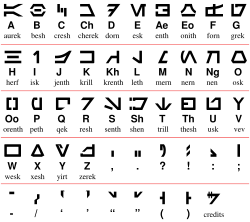
The Aurebesh alphabet is the primary Constructed writing system seen throughout the franchise.

Star Wars, a space opera franchise created by George Lucas, features various fictional languages throughout its setting. The lingua franca of the franchise is known in-universe as Galactic Basic, which refers to the language of the film or work itself, be it English or a language that the work was dubbed or translated into.

Characters often speak languages other than Basic, notably Shyriiwook spoken by Chewbacca and other Wookiees, droidspeak spoken by R2-D2 and BB-8, Ewokese spoken by Ewoks, and Huttese spoken by Jabba the Hutt. None of these language names appear in the Star Wars films themselves.

The fictional languages were approached as sound design and developed largely by Ben Burtt, sound designer for both the original and prequel trilogies of films. He created alien dialogue out of the sounds of primarily non-English languages, such as Quechua, Haya, and Tibetan. This methodology was also used in The Force Awakens by Sara Forsberg. Lucas also insisted that written text throughout the films look as dissimilar from the English alphabet as possible, and constructed alphabets were developed.

Critics contend the languages constructed for the films compared unfavorably with the true constructed languages found in some other fictional works. The usage of heavily accented English for extraterrestrials characters was also criticized as contributing to the suggestion of racial stereotypes.

Development

[edit]

Language development was approached as sound design and was handled by Ben Burtt, sound designer for both the original and prequel trilogies. He created the alien dialogue out of existing non-English language phrases and their sounds, such as Quechua for Greedo in the original Star Wars film and Haya for the character Nien Nunb in Return of the Jedi.[1] He also used English, as in the original Star Wars, where he synthesized originally English dialogue from a Western film until it sounded alien.[2] Burtt said of the process: "It usually meant doing some research and finding an existing language or several languages which were exotic and interesting, something that our audience — 99 percent of them — would never understand."[3]

This methodology to create the sound of alien languages was carried into production of The Force Awakens. Director J. J. Abrams asked Sara Forsberg, who lacked a professional background in linguistics but created the viral video series "What Languages Sound Like to Foreigners" on YouTube, to develop alien dialogue spoken by Indonesian actor Yayan Ruhian.[1] Forsberg was asked to listen to "Euro-Asian languages", and she drew from Gujarati, Hindi, and other Asian languages[4] as well as Indonesian and Sundanese, Ruhian's native language.[1] She also listened to languages she did not understand to better structure the words and sentences to sound believable.[4]

During production of the prequel trilogy, Lucas insisted that written text throughout the films look as dissimilar from the English alphabet as possible and strongly opposed English-looking characters in screens and signage. In developing typefaces for use in Episode II – Attack of the Clones, including Mandalorian and Geonosian scripts, graphic artist Philip Metschan created alphabets that did not have twenty-six letters like the English alphabet.[5]

Galactic Basic

[edit]

Galactic Basic, often simply Basic, is the language of the work itself — in-universe, it is the lingua franca predominantly spoken by the inhabitants of the galaxy.[1][6][7]

Accents

[edit]

Lucas intended to balance American accents and British accents between the heroes and villains of the original film. He also strove to keep accents "very neutral", noting Alec Guinness and Peter Cushing's particular British accents, which he perceived as "sort of mid-Atlantic neutral accents".[8] In critical commentary on Episode I – The Phantom Menace, Patricia Williams of The Nation felt there was a correlation between accent and social class, noting that Jedi speak with "crisp British accents" while the "graceful conquered women of the Naboo" and "white slaves" such as Anakin and Shmi Skywalker "speak with the brusque, determined innocence of middle-class Americans".[6]

To decide on the sound of Nute Gunray, a Neimoidian character portrayed by Silas Carson, Lucas and Rick McCallum listened to actors from different countries reading Carson's lines. Eventually, they chose a heavily Thai-accented English, and Carson rerecorded the dialogue to mimic the Thai actor's accent.[9] Gunray's accent was described by critics to be "Hollywood Oriental" that contributed to criticism of Gunray as an Asian stereotype.[6][10][11] Watto's accent was similarly criticized as lending to anti-Semitic and anti-Arab connotations.[6][11]

Non-standard Basic

[edit]

"When gone am I, the last of the Jedi will you be."

—an example of Yoda's unusual word order from Return of the Jedi

Yoda characteristically speaks a non-standard syntax of Basic, primarily constructing sentences in object–subject–verb word order rare in natural languages. This sentence construction is cited as a "clever device for making him seem very alien" and characterizes his dialogue as "vaguely riddle-like, which adds to his mystique". This tendency is noted to be written for an English-speaking audience; the word order is retained in Estonian subtitles, where it is grammatical but unusual and emphatic, and Yoda's dialogue is in subject–object–verb word order in Czech dubs.[12]

Gungan characters, notably Jar Jar Binks, speak in a heavily accented Basic dialect critics described as a "Caribbean-flavored pidgin",[10] "a pidgin mush of West African, Caribbean and African-American linguistic styles",[6] "very like Jamaican patois, albeit a notably reductive, even infantilized sort",[13] and suggestive of stereotypical African-American culture.[14] This was cited as a trait that led to criticism of the Gungan species as a racially offensive stereotype or caricature.[10][13][14]

Aurebesh

[edit]
Aurebesh signage at Star Tours, in Tokyo Disneyland

Aurebesh is an alphabet used to represent spoken Galactic Basic (i.e. English) and is the most commonly seen form of written language in the Star Wars franchise;[7][15] its letters correspond to each English letter, plus certain English digraphs.[16]

The alphabet was based on shapes designed by Joe Johnston for the original trilogy, which are briefly featured in screen displays in Return of the Jedi. Johnston's design, called Star Wars 76, was used to create a font and again used in Attack of the Clones by Metschan, who incorporated the font alongside the later Aurebesh version used in the spin-off products.[5]

In the early 1990s, Stephen Crane, art director at West End Games, became intrigued with the shapes as they appeared on the Death Star. He sought to develop them into an alphabet to be used in West End Games' licensed Star Wars products, primarily to allow players to render their characters' names, and received permission from Lucasfilm to do so as long as it was presented as one of many alphabets in the Star Wars galaxy, not the sole and exclusive alphabet. After copying the letters from screenshots by hand, he standardized the letters based on shapes similar to the Eurostile font. He named and assigned a value to each letter, and derived the name "Aurebesh" from the names of the first two letters: aurek and besh. Once Crane completed the alphabet, Lucasfilm requested a copy to distribute to other licensees.[16]

In anticipation of the December 2015 release of The Force Awakens, Google Translate added a feature to render text into Aurebesh in November 2015, which was subsequently removed in February 2016.[7][15]

Other languages

[edit]

Dathomiri

[edit]

Archaic speech samples are found in The Clone Wars season 3. Mother Talzin, a Witch of Dathomir associated with the Nightsisters, is found speaking Dathomiri while possessing Darth Maul on Dathomir.

In April 1994, the then unidentified language first appeared in Dave Wolverton's The Courtship of Princess Leia, when the young Teneniel Djo unleashes a Spell of Storm on Luke Skywalker and Prince Isolder of Hapes. Through retroactive continuity, Ewoks: The Battle for Endor (a 1985 made-for-TV film) was the language's first real appearance. In this story, Charal – a witch later retconned as a Nightsister – was seen incanting spells over a crystal oscillator.

Binary (Language)

[edit]

Binary is a language consisting of beeps and other synthesized sounds used by some droid characters, such as R2-D2, BB-9E and BB-8.[1] Burtt created R2-D2's dialogue in the original Star Wars with an ARP 2600 analog synthesizer and by processing his own vocalizations via other effects.[17] In The Force Awakens, BB-8's dialogue was created by manipulating the voices of Bill Hader and Ben Schwartz with a talkbox running through a sound effects application on an iPad.[18] Although binary is unintelligible to the viewing audience, many characters in the Star Wars films are able to understand it, most notably Luke Skywalker.

Ewokese

[edit]

The Ewoks of the forest moon of Endor speak a "primitive dialect" of one of the more than six million other forms of communication that C-3PO is familiar with. Ben Burtt, Return of the Jedi's sound designer, created the Ewok language Ewokese.

On Return of the Jedi DVD commentary track, Burtt identified the language that he heard in the BBC documentary as Kalmyk Oirat, a tongue spoken by the isolated nomadic Kalmyks. He describes how, after some research, he identified an 80-year-old Kalmyk refugee. He recorded her telling folk stories in her native language, and then used the recordings as a basis for sounds that became the Ewok language and were performed by voice actors who imitated the old woman's voice in different styles. For the scene in which C-3PO speaks Ewokese, actor Anthony Daniels worked with Burtt and invented words, based on the Kalmyk recordings.[19] In a previous scene as C-3PO levitates, the Ewoks also spoke words (such as "look", "this", and "beautiful") of Tagalog.

Marcia Calkovsky of the University of Lethbridge holds that Tibetan language contributed to Ewok speech along with Kalmyk, starting the story from attempts to use language samples of Native Americans and later turning to nine Tibetan women living in the San Francisco area, as well as one Kalmyk woman.[20] The story behind these languages' choices is referenced in Burtt's 1989 telephone interview, and many of the used Tibetan phrases translated. The initial prayer Ewoks address to C-3PO is the beginning of a Tibetan Buddhist prayer for the benefit of all sentient beings and/or brahmavihāras (or apramāṇas). There is also the second quarter of a refuge prayer. People of the Tibetan diaspora were puzzled, as many phrases they understood did not correlate to events on screen.

Ghor

[edit]

Ghor is the language of Ghorman, featured in the second season of Andor. A specific language for Ghorman was created to emphasize its sense of community, insularity, pride, and desire to maintain control over itself. Because French actors were cast for Ghorman character, the language was developed by Marina Tyndall based on French and French phonology. Marion Deprez, a French dialogue coach, also contributed to its development. There are two writing systems: Ghorelle (High Ghor) and Dixian (Low Ghor), named after graphic designers Elle McKee and Lauren Dix, respectively.[21][22]

Rodian

[edit]

In the original Star Wars film, Greedo speaks an unspecified alien language understood by Han Solo; it was later identified as Rodian.[23] Bruce Mannheim described Greedo as speaking Southern Quechua in "morphologically well-formed" phrases with sentences ultimately meaningless. Allen Sonnefrank, a Quechua speaker and linguistic anthropology student at University of California, Berkeley, claimed Lucasfilm contacted him to record Quechua dialogue for the film. He was told the dialogue was to be played backward for the film. Sonnefrank refused to record the dialogue, feeling it to be a "potentially exploitative move best made by one whose first language was Quechua, if at all".[24]

Huttese

[edit]
"Jabba's alphabet" from a Star Wars-themed Pizza Hut box

A language based on the Quechuan languages,[25] Huttese is a lingua franca in the Star Wars universe. It is spoken by many groups and species, on Nal Hutta, Nar Shaddaa, Tatooine and other worlds in and around Hutt Space, the region of the galaxy under the Hutts' sphere of influence. In the Star Wars Legends continuity, the area covers former Hutt Empire dominions.

It is spoken in the films by both non-humans (Jabba the Hutt, Watto, Sebulba and others) and humans. Notably The Max Rebo Band communicate and sing in Huttese. Many Huttese alphabets are featured through the franchise, most notably the Boonta alphabet and Nal Huttese. The one considered "canonical" by fans is one found on promotional Pizza Hut pizza boxes.[26][27]

Jawaese and Jawa trade language

[edit]

The Jawas, also found on Tatooine, speak in a high-pitched, squeaky voice. To speak to others of their species, along with speech, they emit a smell showing their emotions.[28] When trading droids and dealing with non-Jawas, they speak without the smell because many consider the smell "foul". A famous exclamation in Jawaese is "Utinni!", as screamed by a Jawa to the others in A New Hope, shortly after blasting R2-D2.

Kenari language

[edit]

The Kenari language spoken in the third episode of Andor is a blend of Portuguese, Spanish, and Hungarian (Magyar).[29]

Mando'a

[edit]
The letters and numerals of the Mandalorian alphabet
The Mandalorian script was created for displays in Attack of the Clones.

A written form of the Mandalorian language was developed by Metschan for the display screens of Jango Fett's ship Slave I in Attack of the Clones,[5] and it was later reused in The Clone Wars and Rebels.[30][31] Composer Jesse Harlin, needing lyrics for the choral work he wanted for the 2005 Republic Commando video game, invented a spoken form, intending it to be an ancient language. It was named Mando'a and extensively expanded by Karen Traviss, author of the Republic Commando novel series.[32]

Mando'a is identified as a primarily spoken, agglutinative language lacking grammatical gender in nouns and pronouns.[33][34] The language is also identified as lacking a passive voice, primarily speaking in an active voice. It is often vague and described as having three grammatical tenses (present, past, and future). Its speakers typically do not use the tenses other than the present.[33][35] The language is described as having a mutually intelligible dialect called "Concordian" spoken on the planet Concord Dawn, as stated in Traviss's novels Order 66 and 501st,[36][37] and a dialect spoken on Mandalore's moon Concordia is heard in "The Mandalore Plot", a season two episode of The Clone Wars.[38]

Sith

[edit]

The Sith language, intended to be spoken by Sith characters, was created by Ben Grossblatt for the Book of Sith, published in February 2012. Language development and a writing system began in November 2010. Grossblatt sought to create a pronounceable language that was not "cartoonish" and "would conform to the patterns of principles of [human] [sic] language". He felt that it needed to "feel martial and mystical" and be a "suitable, aesthetically-pleasing vehicle for communication". He intended the language's sound as "tough—but not barbarous" and as "convey[ing] a kind of confident, elegant cruelty". To achieve "formal, quasi-military" and "imposing, undeniable" qualities, he preferred closed syllables, creating brisk and choppy words. The language is constructed as agglutinative.[39]

Shyriiwook

[edit]

Shyriiwook, also known as Wookieespeak,[3] is a language consisting largely of roars and growls spoken by the Wookiee species, notably Chewbacca. Non-Wookiee characters are capable of understanding Shyriiwook, such as Chewbacca's friend Han Solo.[24] Chewbacca's dialogue was created from walrus, camel, bear, and badger recordings from Burtt's personal sound library. One of the most prominent elements was an American black bear living in Happy Hollow Park & Zoo, San Jose, California. The sounds were mixed in different ratios to create different roars.[40]

Tusken Raiders

[edit]

Tatooine's Tusken Raiders use a language difficult for non-Tuskens to understand, although the Mandalorian in The Mandalorian was able to understand and respond in their sign language. According to the Knights of the Old Republic video game, they speak a language of their own. In the game, a droid named HK-47 assists the player in communicating with the Tusken Raiders. They commonly utter roars and battle cries when seen in public.

The script for The Mandalorian episode "Chapter 5: The Gunslinger" stated that the Mandalorian and a Tusken Raider communicate using a sign language, and a hearing member of the crew who knew sign language encouraged the production to look for a deaf person to consult on the sign language and play the Tusken Raider. Troy Kotsur was cast in the role, and he developed the Tusken Sign Language based on the environment and culture of the Tusken Raiders rather than using American Sign Language.[41] The hand shapes used for the language were kept simple. For example, the sign name for the Mandalorian is a flat handshape based on the letter M to outline the gaps in a Mandalorian helmet and the sign name for Grogu is one's hands on either side of the head to indicate big ears.[41][42] The Tusken Raiders also converse in Tusken Sign Language in The Book of Boba Fett.[43]

Ubese

[edit]

Ubese is a language heard in a Return of the Jedi scene where a disguised Princess Leia bargains with Jabba the Hutt through C-3PO as a translator. Leia repeats the same Ubese phrase three times, translated differently in subtitles and by C-3PO each time. David J. Peterson, a constructed language creator, cited his attempt as a young fan to reconcile this apparent impossibility as an example of how even casual fans may notice errors in fictional constructed languages.[44] He identified Ubese as a "sketch" of a language rather than a fully developed language and categorized it as a "fake language" intended to "give the impression of a real language in some context without actually being a real language".[45] Ultimately, he was critical of Ubese as "poorly constructed and not worthy of serious consideration".[46]

Critical commentary

[edit]

Ben Zimmer labeled the method of language construction in Star Wars "a far cry" from that of constructed languages like Klingon, Na'vi, and Dothraki,[1] and he described the use of language as "never amount[ing] to more than a sonic pastiche".[47]

Linguistic anthropologist Jim Wilce summarized analyses of language in Star Wars conducted through the Society for Linguistic Anthropology's electronic mailing list. David Samuels described the approach to language as instrumental and compared the films to a Summer Institute of Linguistics convention, in which "there are no untranslatable phrases, and everyone can understand everyone else", and pointed out that the "idea that the Force is something that would be understood differently in the context of different grammars is never broached". Hal Schiffmann made five observations about language in Star Wars: all humans speak English and no other real-world language, there is "mutual passive bilingualism" in which characters speaking different languages understand one another, non-human creatures may have their own languages but are translated by C-3PO, certain non-English vocalizations serve to confuse or amuse the audience rather than serve as language, even non-English speaking characters are expected to understand English. Zimmer supported Schiffmann's claim that untranslated alien languages are not representations of real languages by pointing to the film's script, which describes the language of the Jawas as "a queer, unintelligible language" and that of the Tusken Raiders as "a coarse, barbaric language". Wilce also pointed out discussion on the usage of real non-English to create the "Otherness" of characters such as Jabba the Hutt, Greedo, and the Ewoks.[24]

See also

[edit]

References

[edit]

Further reading

[edit]
[edit]
Revisions and contributorsEdit on WikipediaRead on Wikipedia
from Grokipedia
Languages in the Star Wars franchise consist of constructed tongues and scripts devised to portray linguistic diversity across a vast interstellar civilization, with Galactic Basic Standard functioning as the prevalent , analogous to English in real-world depictions, and commonly inscribed using the Aurebesh alphabet. This , comprising 34 characters, originated in the 1993 Star Wars roleplaying game supplement by , where graphic artist adapted symbols from earlier films into a standardized script approved by . Sound designer , responsible for much of the franchise's audio landscape across the original and prequel trilogies, crafted numerous alien languages through phonetic experimentation inspired by global human dialects, such as basing Huttese on Quechua influences and Ewokese on elements of Tibetan, Kalmyk, and Lakota. The development of these languages prioritized auditory immersion over full grammatical construction, resulting in over 70 documented forms in canon media, though most feature limited vocabularies and phrases rather than comprehensive systems like Klingon from Star Trek. Notable examples include Shyriiwook, the growling dialect of Wookiees exemplified by Chewbacca, engineered by Burtt to convey emotional nuance through non-verbal phonemes; Huttese, employed by the Hutt species in criminal underworld contexts as in Return of the Jedi; and Mando'a, the Mandalorian language with a dedicated runic alphabet, expanded in animated series like The Clone Wars for cultural authenticity. Binary or droidspeak represents machine communication, often translated via protocol units like C-3PO, underscoring technological interoperability in the galaxy. These linguistic elements, while not fully fleshed-out constructed languages, have significantly bolstered world-building by signaling cultural and species-specific identities, influencing fan creations and merchandise, yet remain tied to narrative utility rather than linguistic completeness. Recent expansions in series like Andor introduce bespoke dialects, such as the Ghor tongue derived from French phonetics, maintaining the tradition of ad-hoc invention for production needs.

Creation and Development

Origins in Original Films

In the original Star Wars trilogy, comprising Episode IV: A New Hope (1977), Episode V: (1980), and Episode VI: (1983), alien languages emerged as elements of crafted by to evoke a sense of galactic diversity without relying on fully constructed grammars. Burtt, the trilogy's sound designer, prioritized auditory authenticity by layering human vocal improvisations, animal recordings, and phonetic approximations from non-English languages, often auditioning production crew for spontaneous alien utterances to fill background and dialogue needs efficiently under tight deadlines. This method produced "organic" effects that lent credibility to extraterrestrial communication, distinguishing it from scripted human dialogue in Galactic Basic Standard. A New Hope introduced the earliest examples, with Huttese debuting in Greedo's exchange with , where Burtt derived its phonetic structure from Quechua, selecting harsh consonants and vowel shifts to mimic the guttural speech of Hutt-associated species. The Mos Eisley cantina scene featured additional alien , including a Rodian dialect assembled from altered non-English human languages to generate dissonant, crowd-filling chatter among over a dozen species. Chewbacca's Shyriiwook vocalizations, comprising blended roars from bears, lions, walruses, and badgers, served as a non-verbal interpreted contextually by companions like , emphasizing emotional intonation over . The Empire Strikes Back built on these foundations with restrained expansion, as alien interactions remained sparse; Shyriiwook gained prominence in Chewbacca's scenes, with Burtt refining the sound palette through modulated animal layers to convey urgency during sequences like the Hoth evacuation. Background extraterrestrial murmurs in Cloud City echoed the cantina's improvisational style, sourced from crew vocalizations to maintain atmospheric immersion without dedicated linguistic development. Return of the Jedi amplified variety, reintroducing Huttese via Jabba the Hutt's court, where Burtt expanded its lexicon using similar Quechua-inspired phonemes for intimidation and negotiation. Ewokese, the forest moon dwellers' tongue, originated from Burtt's recordings of Mongolian and Tibetan-like dialects, adapted with high-pitched human and animal elements to suit diminutive and tribal chants, enabling partial comprehension by Basic speakers through repetition and gesture. These efforts underscored a causal focus on sound's perceptual impact, prioritizing believability over semantic depth in the trilogy's narrative constraints.

Expansion in Prequels and Sequels

The prequel trilogy, released from 1999 to 2005, broadened the depiction of alien communication through the introduction of numerous new species and environments teeming with , necessitating expanded for non-human vocalizations. , returning as sound designer, layered recordings from real-world non-English languages—including Quechua, Haya, and Tibetan—alongside animal and synthetic elements to craft dialogue for species like the Neimoidians and Gungans, emphasizing phonetic diversity over fully grammatical constructs. This approach amplified background chatter in scenes such as the or Naboo's underwater cities, creating immersive auditory depth that highlighted the galaxy's without relying on for most unintelligible exchanges. In Attack of the Clones (2002), the Geonosians received a distinctive insectoid language characterized by rapid clicks, hisses, and percussive sounds, tailored to their chitinous anatomy and hive-based society during the arena battle sequences. Similarly, Revenge of the Sith (2005) incorporated vocal patterns for Utapau's Amani and other clones-era aliens, furthering the trend of species-specific to underscore cultural and biological variance. These developments prioritized causal fidelity to creature design, where vocal cords or equivalents influenced speech patterns, rather than arbitrary invention. The sequel trilogy (2015–2019), helmed by directors and , continued this expansion by integrating established alien languages into denser crowd scenes while adhering to licensing-approved species lists for consistency. Sound editor David Acord and teams at maintained Burtt's foundational techniques, employing multilingual alien babble in locales like Maz Kanata's castle in The Force Awakens (2015) and the opulent casinos of Canto Bight in The Last Jedi (2017), where over two dozen species contributed to a polyglot ambiance. A novel addition appeared in The Last Jedi, with Cantonican—a dialect spoken by Cantonica's inhabitants—featured in the stablehand's closing , blending human-like intonation with localized inflections to evoke planetary isolation. This era emphasized archival reuse and subtle evolution, tracking over 60 alien tongues to avoid narrative disruption while enhancing world-building realism.

Sound Design and Linguistic Inspirations

, the principal sound designer for the original Star Wars trilogy, crafted alien languages by selecting obscure real-world languages that matched the perceived character of each , transcribing their phonetic essence, coaching actors to improvise phrases in that style, and layering or manipulating the recordings with additional vocal or animal elements for an unearthly effect. This approach prioritized auditory evocation over full grammatical construction, drawing from non-English tongues to avoid familiarity while grounding the sounds in human linguistic patterns. Huttese, the tongue of the Hutt species exemplified by Jabba, was inspired by Quechua, an family of the spoken by millions in , with its rhythmic consonants and vowels providing a basis for improvisation. Burtt supplied voice actor Larry Ward with Quechua recordings, from which Ward derived phrases like "poodoo" for excrement, blending the source's tonal qualities with exaggerated gutturals to suit the species' criminal overlord persona. Similar phonetic borrowing informed other and dialects, incorporating Haya (a Bantu language from ) for percussive clicks and Tibetan for high-pitched inflections in scenes requiring tribal or mystical alien speech. Shyriiwook, the roar-based language of Wookiees like , eschewed human words for a non-translatable vocal system built from animal recordings, primarily bears for deep growls, augmented by barks, whines, roars, and badger snarls, all pitched and edited to convey emotional nuance through actor Peter Mayhew's physical performance. This method emphasized primal, mammalian aggression over linguistic structure, with Burtt's field recordings from zoos and wildlife libraries forming the core palette, manipulated via analog tape speed variations for variety across films. Ewokese, used by the forest-dwelling Ewoks in (1983), followed a hybrid model blending Tibetan and Nepali linguistic fragments for a high-altitude, primitive , with actors reciting adapted phrases under Burtt's guidance before electronic filtering to heighten the childlike yet quality. Burtt described it as a "mixing bowl" of sources to ensure accessibility while alienating it from English, avoiding overly complex syntax in favor of repetitive, chant-like patterns suited to the species' tribal culture. Later expansions, such as Mando'a for , shifted toward constructed linguistics by author rather than pure sound design, incorporating agglutinative elements reminiscent of like Finnish for its warrior ethos, though initial vocalizations retained Burtt's influence in extended media.

Canon vs. Legends Distinctions

In the Star Wars franchise, the 2014 delineation between Canon and Legends continuity significantly impacts the treatment of languages, with Canon adhering to material directly tied to the primary films, television series, and vetted publications under Lucasfilm oversight, while Legends preserves the broader pre-2014 Expanded Universe's elaborations. Core languages such as Galactic Basic Standard, Huttese, and Shyriiwook appear consistently across both, originating from the original films and maintained for narrative cohesion. However, Legends material, including novels, comics, and role-playing guides, provided extensive constructed linguistics—such as detailed vocabularies, grammars, and phrasebooks—that were decoupled from official continuity following the canon reset, rendering them apocryphal unless selectively reincorporated. A prominent example is Mando'a, the Mandalorian language, which received substantial development in Legends through author Karen Traviss's Republic Commando novel series (2004–2006), featuring a comprehensive dictionary, phonetic rules, and integration into clone trooper culture during the Clone Wars era. In Canon, Mando'a usage is limited to isolated phrases in series like The Mandalorian (2019–present), without the systematic lexicon or widespread adoption by non-Mandalorians, reflecting a streamlined approach prioritizing visual and auditory elements over linguistic depth. Huttese similarly diverges: Legends expanded it via supplemental guides and EU stories, compiling hundreds of terms from film subtitles and adding grammatical structures, while Canon relies primarily on on-screen utterances from Return of the Jedi (1983) and The Book of Boba Fett (2021–2022), with unconfirmed ties to scripts like Jabba's alphabet. Wookiee languages illustrate minor Canon-specific refinements, enumerating three variants—Shyriiwook for everyday speech, Xaczrizorrtro for formal rites, and a tactical dialect—drawn from animated series like Star Wars Rebels (2014–2018), whereas Legends sources offered overlapping but less codified details. Overall, Legends fostered a richer polyglot ecosystem with over 100 documented alien tongues, contrasting Canon's focus on roughly 68 primarily film-derived languages, emphasizing practical dialogue over exhaustive conlanging.

Galactic Basic Standard

Structure and Usage

Galactic Basic Standard employs a predominantly subject-verb-object sentence structure in its standard form, facilitating straightforward expression in verbal exchanges across canon media. This syntax is consistently demonstrated in dialogues from productions such as Star Wars: Episode IV - A New Hope (1977), where phrases like "Help me, Obi-Wan Kenobi. You're my only hope" exemplify the conventional order used by human speakers. Notable deviations occur, including the object-subject-verb inversion associated with Yoda in Star Wars: Episode V - The Empire Strikes Back (1980), as in "Fear is the path to the dark side," potentially reflecting archaic elements or species-specific influences on Basic. In usage, Galactic Basic Standard acts as the galaxy's , enabling interoperability among humans and vocally capable aliens in governance, trade, and military operations. It predominates in Republic-era communications, as implied in scenarios from Thrawn: Alliances (2018) where non-speakers pose comprehension barriers during exploratory missions. Adoption extends to formal institutions like the Jedi Order and Imperial commands, with non-native speakers often employing it alongside native tongues or translators for and commerce, underscoring its role in unifying diverse planetary cultures under centralized authorities such as the .

Variants and Accents

Galactic Basic Standard encompasses regional variants and accents shaped by planetary origins, cultural influences, and speaker physiology, despite its role as a lingua franca promoting uniformity across the galaxy. The Coruscanti accent, tied to the ecumenopolis of Coruscant in the Core Worlds, functions as the prestige standard, often associated with political elites, Imperial officials, and institutions like the Jedi Order. In canon depictions, this accent aligns with formal, authoritative tones, as evidenced by characters such as Obi-Wan Kenobi and Emperor Palpatine, whose speech patterns reflect the dialect's clarity and precision in novelizations and films. Accents diverge markedly toward the galaxy's periphery, with Mid Rim and Outer Rim speakers exhibiting greater phonetic variation and slang incorporation, indicative of limited exposure to Core standardization efforts. For instance, Corellian variants, spoken on industrial hubs like Corellia, feature a more relaxed intonation and idiomatic expressions, as portrayed by and pilots originating from such worlds. These peripheral dialects often blend elements of local trade languages, fostering while preserving regional identity amid interstellar migration. Non-human species speaking Basic introduce physiological accents, altering pronunciation due to anatomical differences; Twi'leks, for example, may produce sibilant emphases from lekku-influenced phonetics, while Rodians impart guttural tones reflective of their native larynx structure. Such variations persist in canon sources like The Clone Wars animated series, where Basic dialogue accommodates species-specific inflections without compromising comprehension, underscoring the language's adaptability over strict uniformity.

Writing Systems

The primary writing system for Galactic Basic Standard is Aurebesh, an alphabet comprising 34 symbols that represent individual letters and common digraphs such as "ch" and "th." This system is widely used for signage, datapads, and technical displays throughout the galaxy, as evidenced by its appearance on equipment in Star Wars: The Clone Wars episodes, including labels on bombs and droid interfaces reading "Caution" or tactical designations. Aurebesh characters derive their names from phonetic values, starting with "Aurek" for A and "Besh" for B, facilitating and navigational like "Defense Formation Aurek One" in Star Wars Rebels. High Galactic script serves as a secondary, more formal alternative to Aurebesh, resembling the Latin alphabet and employed by elites, officials, and in scholarly or algebraic contexts such as holofeeds and signatures. This script accounts for designations like X-wing starfighters, where letters like "X" and "Y" originate from High Galactic rather than Aurebesh equivalents. While less prevalent, High Galactic underscores class distinctions in written communication, with print and cursive variants noted in expanded materials. Regional variants, such as those in Outer Rim Basic, may incorporate localized adaptations, but Aurebesh remains the dominant standard for transcribing the across core worlds and beyond. No numerals are officially defined within Aurebesh; practical implementations often adapt stylized English digits.

Major Alien Languages

Huttese

Huttese serves as the native language of the Hutt species originating from the planet Nal Hutta and functions as a widespread among smugglers, criminals, and various non-human species in the galaxy's Outer Rim Territories. It debuted in the 1983 film Star Wars: Episode VI – Return of the Jedi, where sound designer crafted it specifically for dialogue spoken by the Hutt gangster Jabba, including threats and negotiations subtitled in English for audiences. Burtt based Huttese phonetics on Quechua, an family spoken by over 8 million people primarily in , , and , chosen for its repetitive syllables and rhythmic qualities that lent a , alien tone suitable for Hutt vocalizations. He derived phrases from Quechua audio tapes, adapting sounds rather than direct translations to evoke menace and exoticism without relying on recognizable languages. This approach ensured Huttese sounded plausibly non-human while remaining intelligible through context and subtitles in films. The language expanded in later media, appearing in Star Wars: Episode I – The Phantom Menace (1999) via a dedicated angular script displayed on Tatooine signage during the Boonta Eve Classic podrace, distinguishing it from the more common Aurebesh used for Galactic Basic. Songs in Huttese, such as the cantina tune "Lapti Nek" in the of Return of the Jedi, further showcased its melodic potential before being replaced in canon releases. Documented phrases from films include Jabba's "E chu ta" as a profane directed at adversaries, emphasizing Huttese's role in conveying crude authority. Other examples feature greetings like "Achuta" for hello and farewells such as "Mee jooz ku," derived from Burtt's recordings and used consistently in Hutt-centric scenes across the franchise. These elements highlight Huttese's function as a marker of criminal , with its consonants and vowel clusters reinforcing the Hutts' slug-like and domineering presence.

Shyriiwook

Shyriiwook is the native language of the species, originating from the forest world of Kashyyyk, and is characterized by throaty growls, roars, and howls produced primarily from the larynx with minimal use of lips or tongue. This structure makes it physically challenging for non-Wookiees to speak, as it strains human-like , though comprehension is achievable through exposure and practice. In Star Wars canon, the language appears unsubtitled in live-action films, with translations provided contextually by characters such as protocol droid or through intuitive understanding by allies like , who demonstrates fluency in comprehension across multiple depictions starting from Star Wars: A New Hope (1977). The sound design for Shyriiwook was developed by Ben Burtt, the franchise's original sound designer, who layered recordings of animal vocalizations—including bears, camels, walruses, and badgers—to create its raw, expressive timbre, first implemented for Chewbacca's performance in the 1977 film. For later productions like Solo: A Star Wars Story (2018), additional recordings were incorporated to expand the lexicon, allowing actors such as Donald Glover (young Lando Calrissian) and Joonas Suotamo (adult Chewbacca) to deliver scripted Shyriiwook dialogue with phonetic consistency. Canon sources provide sparse specific vocabulary, emphasizing contextual inference over literal translation; for instance, tonal shifts denote emotions, urgency, or concepts like loyalty, but no comprehensive dictionary exists in official media, distinguishing it from more structured tongues like Galactic Basic. Wookiees employ Shyriiwook for intricate social, technical, and warrior exchanges, reflecting their hierarchical clans and life-debt customs, as evidenced in like Star Wars: The Clone Wars (2008–2020), where droid interpreters facilitate interspecies . Non-Wookiee proficiency remains rare but documented, with Solo's acquired skill attributed to prolonged immersion rather than formal study, underscoring the language's accessibility for auditory parsing despite its phonetic opacity. While Legends material expands it with dialects like Thykarann and over 150 terms for wood types—highlighting Wookiee arboreal culture—canon maintains a streamlined portrayal focused on its role in fostering Wookiee resilience and alliances amid galactic conflicts.

Mando'a

Mando'a is the associated with the warrior culture in the Star Wars franchise, primarily developed by author for the 2005 Star Wars: Republic Commando and subsequent novels such as Hard Contact (2004). Traviss expanded the vocabulary and grammar, drawing from agglutinative structures similar to Turkish and Finnish, with over 1,200 words documented in her official dictionary released via her website and preserved on dedicated fan sites. The language emphasizes concise, action-oriented phrasing reflective of Mandalorian values like family (aliit), honor, and combat readiness, with no gender-specific pronouns; instead, "val" denotes a person in a gender-neutral manner. Grammatically, Mando'a lacks traditional cases and features a simple tense system using prefixes like ru for past and ven for future, with verbs taking only or imperative forms without conjugation for person or number. Adjectives derive directly from nouns or verbs by adding suffixes such as -la for possession, and sentences often omit copulas, as in jate meaning both "good" and "it is good." Common phrases include su'cuy gar ("hello," literally "be glad to see you") and vor entye ("," literally "I thank you"), used in both Legends and canon media to evoke cultural authenticity. In canon continuity post-2014, Mando'a appears sparingly in The Mandalorian (2019–present), with phrases like oya ("hurrah" or "let's hunt") uttered by characters such as Din Djarin, though much of the fuller lexicon remains tied to Legends material due to Traviss's departure from the franchise in 2010 amid creative disputes. The writing system, distinct from Aurebesh, consists of 26 angular characters designed by ILM graphic artist Philip Metschan for Attack of the Clones (2002), appearing in holographic displays and armor markings to represent Mando'a or Galactic Basic. This script's runic style underscores Mandalorian aesthetics of resilience and utility.

Rodian

The Rodian language, also referred to as Rodese, serves as the native tongue of the Rodian species originating from the planet Rodia. Primarily a featuring guttural and harsh phonetics, it reflects the ' cultural roots, with limited details on grammar, vocabulary, or a standardized . Rodians off Rodia, particularly in Hutt Space where their is located, often prioritize multilingualism, favoring Galactic Basic Standard for formal or interstellar communication and Huttese as a trade due to regional dominance by the Hutt . A prominent canonical example occurs in Star Wars: Episode IV - A New Hope (1977), set around 0 BBY, where the Rodian bounty hunter Greedo confronts Han Solo in the Mos Eisley Cantina on Tatooine, delivering threats and demands in Rodian; Solo's direct responses indicate his comprehension, likely from exposure in smuggling and bounty networks. The dialogue's alien dialect was crafted by sound designer Ben Burtt using elements of Quechua, a Peruvian indigenous language, to evoke an exotic, non-human quality, with linguist and voice actor Larry Ward providing the performance for Greedo. In contrast, Rodian characters in Star Wars: The Clone Wars (2008–2020), such as those in Season 1, Episode 8 ("," aired October 16, 2008), converse fluently in Galactic Basic, illustrating practical bilingualism among Republic-era Rodians engaged in military or diplomatic roles. This adaptability aligns with Rodian societal emphasis on , where native language use persists in insular or aggressive contexts like bounty hunting, while broader tongues facilitate commerce and alliances. No peer-reviewed linguistic analyses exist for Rodese, and depictions remain sparse beyond audio examples, underscoring its role as a cultural marker rather than a fully elaborated construct.

Other Notable Species Languages

Binary

Binary is a machine-readable language utilized by droids for inter-droid communication and interaction with compatible systems, comprising sequences of beeps, whistles, chirps, and other synthesized audio signals. Devices such as moisture vaporators on incorporate Binary protocols to interface with droids for maintenance and operational reporting. In narrative depictions, astromech droids like and employ Binary as their default mode, with protocol droids such as serving as translators into Galactic Basic Standard due to its complexity for organic comprehension. Not all droids rely exclusively on Binary; battle droids and certain labor models vocalize in Basic for direct orders and status updates, reflecting design priorities for battlefield or workforce efficiency. Comprehension among organics varies: technicians and pilots with prolonged exposure, such as Anakin Skywalker or , develop proficiency through familiarity, akin to learned linguistic aptitude rather than innate ability. The auditory elements of Binary originated in production design for the 1977 film Star Wars: Episode IV - A New Hope, where sound designer Ben Burtt synthesized R2-D2's utterances from manipulated recordings of animal calls, electronic oscillators, and human vocalizations to convey emotional nuance via pitch, duration, and rhythm. This approach persisted across canon media, enabling droid "dialogue" in comics and animations where Binary exchanges are subtitled for audiences, underscoring its role as a structured, if opaque, protocol rather than random noise.

Ewokese

Ewokese is the language employed by the Ewok species, diminutive, fur-covered primates indigenous to the forest moon of Endor, as introduced in the 1983 film Star Wars: Episode VI – Return of the Jedi. The Ewoks utilize this tongue for tribal communication, hunting coordination, and social rituals, with its high-pitched, staccato phonetics evoking primitive tribal dialects to underscore their isolated, pre-technological society. In the film's narrative, protocol droid C-3PO interprets Ewokese for Rebel Alliance members, characterizing it as a "primitive dialect" comprehensible through contextual and phonetic analysis, though Ewoks demonstrate limited capacity for Galactic Basic without intermediaries. The language originated as a constructed conlang crafted by designer during pre-production for , released on May 25, 1983. Burtt assembled Ewokese by amalgamating recordings from diverse terrestrial sources—Tibetan, Nepalese, Mongolian, Native American (such as Lakota), African dialects, and South Pacific languages—then processing them via pitch modulation, tempo alterations (speeding up or slowing down), and audio effects to yield an alien yet resonant . This eclectic synthesis avoided a fully codified or , prioritizing auditory evocation over linguistic rigor; Burtt noted it as a "mixing bowl of different things" designed to sound tribal and urgent without direct intelligibility to audiences. One foundational element involved archival audio of speakers, a Mongolian dialect, which contributed tones manipulated for Ewok vocalizations. Ewokese features recur in Ewok-centric media, including the 1984 Ewoks (52 episodes aired from September 7, 1985, to December 6, 1986), where voice actors reprised chattering improvisations under Burtt's sound supervision, and the 1985–1986 Ewoks TV films The Battle for Endor and Ewoks: The Battle for Endor. Phonetically, it emphasizes bilabial stops (/p/, /b/), fricatives, and glottal inflections, with syllable structures favoring short, repetitive bursts (e.g., "yub-yub" motifs) to mimic urgency. Iconic utterances include the celebratory refrain "Yub nub!"—translating roughly to a victory call—chanted by Ewoks during the post-battle festivities on Endor, underscoring communal triumph. Absent a comprehensive official dictionary, Ewokese remains performative rather than systematic, with translations inferred via narrative context or droid mediation, reflecting its role as an immersive rather than a deployable interstellar .

Jawa Trade Language

The Jawa Trade Language is a dialect derived from Jawaese, the native speech of the Jawa species inhabiting Tatooine, designed for practical exchanges with non-Jawas incapable of detecting the pheromonal scents that convey essential nuances in authentic Jawaese communication. This trade variant consists of rapid, guttural utterances and snapping sounds, stripping away olfactory elements to enable rudimentary bartering with moisture farmers, smugglers, and other Tatooine denizens. It emerged as a necessity in the harsh desert economy, where Jawas scavenge and peddle droids, scrap, and salvaged goods, allowing transactions without full linguistic assimilation. In canonical depictions, proficiency in the Jawa Trade Language underscores adaptive survival strategies among Tatooine's human populace; for instance, moisture farmer Owen Lars demonstrates comprehension during negotiations with a Jawa sandcrawler crew in Star Wars: Episode IV - A New Hope (1977), facilitating the purchase of droids and . Similarly, Jedi Padawan Anakin Skywalker is noted as fluent in it alongside Huttese, reflecting its utility for operatives navigating Outer Rim trade hubs, as detailed in the novel Thrawn: Alliances by (2018). The dialect's limitations—lacking the layered subtlety of Jawaese—restrict it to transactional contexts, often resulting in misunderstandings if pheromones are absent, which non-Jawas cannot replicate. Further instances appear in The Mandalorian series, where bounty hunter Din Djarin employs Jawa Trade Talk to interact with Jawa clans, highlighting its persistence in post-Empire scavenger networks on Tatooine. Unlike pidgins in real-world linguistics, which evolve bidirectionally, this dialect remains Jawa-centric, with offworlders acquiring basic phrases for haggling rather than mutual enrichment, preserving Jawa cultural insularity amid exploitation risks from taller species. No standardized script exists for it in canon sources, though Jawas occasionally etch transaction tallies in Aurebesh derivatives on crates.

Tusken and Ubese Dialects

The Tusken language, employed by the nomadic Tusken Raiders of Tatooine, relies heavily on non-verbal communication through sign language, as shown in canon depictions. In The Mandalorian episode "Chapter 5: The Gunslinger" (released November 15, 2019), Din Djarin uses hand signals to negotiate safe passage with Tusken scouts, conveying concepts like territorial boundaries and mutual non-aggression. This form of Tusken Sign Language reappears in later episodes, such as "Chapter 9: The Marshal" (November 13, 2020), where it facilitates alliances during combat against krayt dragons, emphasizing gestures for coordination and honor-bound pacts. The system's development drew from consultations with deaf actor Troy Kotsur, who portrayed a Tusken Raider and ensured authentic visual expressiveness, though in-universe it represents the Raiders' adaptation to their masked, desert environment where vocal clarity is hindered by wrappings and sandstorms. Spoken Tusken consists of guttural vocalizations—barks, grunts, and shrieks—that convey basic emotions or warnings but lack documented syntax or lexicon in official canon materials. No written form exists, aligning with Tusken cultural aversion to sedentary technologies or records, as Raiders prioritize oral and gestural traditions passed through tribal generations. This primitivism underscores their isolationist society, where outsiders rarely decipher nuances without immersion. Ubese, distinct from Tusken, is a spoken tongue associated with the Ubese species and heard briefly in Return of the Jedi (1983). Disguised as the bounty hunter Boushh, Princess Leia Organa utters phrases in Ubese to demand double the bounty on Han Solo—translated by C-3PO as "I want fifty thousand... No less"—while brandishing a thermal detonator in Jabba's palace on April 12, 1983 (in-universe chronology). The language's scratchy, metallic monotone filters through Boushh's helmet vocoder, evoking a harsh, mechanical edge suited to Ubese warriors from harsh worlds like Ubertica. C-3PO's fluency highlights its inclusion among over six million forms of communication he processes, though no extended vocabulary or grammar appears in canon. Both languages remain sparsely detailed in primary sources, reflecting Star Wars' focus on visual storytelling over linguistic depth for these peripheral cultures; Tusken emphasizes communal signs for survival raids, while Ubese serves narrative utility in deception scenes without implying dialectal overlap. Fan reconstructions exist but lack official endorsement, underscoring canon constraints on non-humanoid tongues.

Ancient and Specialized Languages

Sith Language

The Sith language, designated ur-Kittât and also termed the Old Tongue, constitutes a runic script integral to Sith mysticism within Star Wars canon. Primarily a writing system, it employs angular runes inscribed on artifacts such as holocrons, daggers, and temple walls to encode rituals, incantations, and forbidden knowledge. Its debut in canon occurred in the 2019 film Star Wars: Episode IX – The Rise of Skywalker, where C-3PO deciphers runes on a Sith dagger revealing coordinates to Exegol, a pivotal Sith redoubt; the production's visual dictionary explicitly labels this script ur-Kittât. Though chiefly written, ur-Kittât possesses a spoken dimension, evidenced in the 2015 canon novel Lords of the Sith by Paul S. Kemp, wherein Darth Vader and Inquisitors chant phrases during a Force-summoning ritual on Korriban, harnessing the language's phonetic resonance to amplify dark side effects. Subsequent canon media, including the 2023 Disney+ series Ahsoka, feature precursor runes on the Mortis gods' statues and the Arcana facility's map room, suggesting evolutionary ties to Sith script and hinting at its utility in navigational or prophetic contexts predating the Galactic Empire. In contrast to Legends material—where ur-Kittât traces to a prehistoric Sith species circa 100,000 BBY on Korriban—current canon omits such ethnolinguistic origins, framing the language as a constructed esoteric tool of the Sith Order and Eternal cult, unbound to any extinct race and emphasizing its role in perpetuating hierarchical Force doctrines. No standardized phonology or lexicon has been officially detailed beyond ritualistic excerpts, underscoring its opacity as a safeguard against unauthorized access, with translation historically proscribed under Imperial edicts to preserve Sith supremacy.

Dathomiri and Kenari Tongues

The Dathomirian tongue, spoken by the Force-sensitive inhabitants of Dathomir such as the Nightsisters, appears in canon primarily through ritualistic incantations during magick ceremonies. In Star Wars: The Clone Wars (Season 3, Episodes 12–14, aired 2011), Nightsister leaders like Mother Talzin chant phrases in this language to resurrect fallen warriors, such as Darth Maul, and to enhance physical abilities, as in the transformation of Savage Opress into a more formidable fighter. These vocalizations consist of repetitive, guttural syllables distinct from Galactic Basic, emphasizing the clan's dark side affinity and cultural isolation, though no comprehensive vocabulary, grammar, or real-world construction details have been officially released by Lucasfilm. The language's limited depiction reflects its role as a tool for narrative mysticism rather than everyday communication, with Dathomirians otherwise using Basic in interactions with outsiders. The Kenari tongue is the indigenous language of the forested Kenari, introduced in Andor (Season 1, 3, released September 21, 2022), where young Cassian Jeron Andor communicates with his tribal kin. Constructed as a blend of , Spanish, and Hungarian (Magyar) elements, it evokes an earthy, unfamiliar cadence to underscore the Kenari people's pre-industrial detachment from galactic society and the Empire's encroaching mining operations. Deliberately unsubtitled in the episode, the language conveys urgency and incomprehensibility to non-speakers, amplifying themes of cultural erasure following a corporate-induced ecological that rendered the planet toxic. Official production notes confirm this linguistic fusion to authentically portray isolation without relying on familiar alien dialects. Unlike more elaborated Star Wars languages, Kenari remains confined to this flashback context, with no expanded lexicon provided.

Ghor and Lesser-Used Constructs

Ghor is the of the Ghor people from the planet Ghorman, debuting in the second season of the Disney+ series Star Wars: , which premiered episodes beginning 2025. Designed to underscore Ghorman's cultural and linguistic isolation within the galaxy, Ghor incorporates phonetic elements derived from French, blended with mutations and formations from German and other Western European languages to evoke a sense of distinct regional identity. Dialect coach Tyndall structured the language according to the Sapir-Whorf , positing that its grammar and vocabulary shape Ghor speakers' perceptions of time, community, and resistance to Imperial standardization, thereby reinforcing the planet's narrative role as a hotbed of subtle rebellion. The features two primary dialects: Ghorelle, or High Ghor, associated with formal or contexts, and Dixian, or Low Ghor, used in everyday , each with unique scripts deployed decoratively on sets to immerse viewers in Ghorman environments. Sound designers David Acord and Margit Pfeiffer developed Ghor's auditory profile by recruiting French-proficient loop group performers to generate authentic phonemes, including nasal vowels and guttural consonants, while ensuring dialogue remained partially intelligible through contextual rather than full . First publicly revealed via captions in Andor Season 2, 1 on April 29, 2025, Ghor marked the series' commitment to original linguistic invention amid the franchise's tradition of alien tongues. Among lesser-used linguistic constructs in Star Wars, Ghor exemplifies a trend toward bespoke, non-repetitive languages for peripheral worlds, contrasting with more ubiquitous ones like Huttese or Shyriiwook. Other sparse implementations include the chittering vocalizations of Geonosians, an insectoid species whose language relies on clicks and buzzes mimicking their biology, as depicted in Star Wars: Episode II – Attack of the Clones (2002), though rarely expanded beyond basic sound design without formalized vocabulary. Similarly, the guttural utterances of Ugnaughts on Cloud City in Star Wars: Episode V – The Empire Strikes Back (1980) represent ad hoc constructs prioritizing atmospheric effect over deep grammar, with no canonical lexicon developed. These elements prioritize efficiency in production—often layering real-world animal sounds or reversed audio—over comprehensive conlanging, appearing in under 5% of screen time across the saga's 11 live-action films as of 2025. Such constructs enhance worldbuilding without demanding the extensive scripting seen in core languages, reflecting resource allocation toward visual spectacle.

Linguistic Analysis and Reception

Worldbuilding Strengths

The incorporation of diverse alien languages in the Star Wars films significantly enhances immersion by portraying a teeming with distinct cultures and , rather than a monolingual human-centric environment. Sound designer developed these languages by recording and manipulating real-world non-English dialects, such as Kalmyk for certain alien speech, which lent organic authenticity to the auditory landscape and made extraterrestrial communications feel plausibly foreign. This approach, evident from the original trilogy onward, contributed to the franchise's sense of a vast, interconnected where linguistic barriers underscore interstellar diversity. Visual elements like the Aurebesh script, a 34-character used to transcribe Galactic Basic, further bolster by appearing ubiquitously in props, signage, and interfaces across films and expanded media, evoking a cohesive yet alien written tradition without relying on familiar Latin letters. This script's integration into set design reinforces , as audiences perceive a fully realized graphical system that persists beyond spoken dialogue. Languages such as Huttese and Mando'a, with developed vocabularies and phonologies, allow for culturally specific expressions—Huttese insults in Jabba's palace scenes, for instance—that deepen character interactions and environmental texture. Binary for droids and non-verbal communications like Wookiee roars exemplify specialized constructs that highlight technological and biological variances, adding layers of realism to non-humanoid entities and facilitating plot devices like translation challenges. Burtt's emphasis on natural sound sources ensured these elements integrated seamlessly with effects, creating a sonic ecosystem that amplifies the epic scale of conflicts and explorations. Overall, these linguistic features prioritize sensory believability, enabling viewers to suspend disbelief in a where communication evolves from evolutionary and historical contingencies.

Criticisms of Depth and Consistency

Critics have noted that the constructed languages in the Star Wars universe prioritize auditory texture over linguistic rigor, often deriving from manipulated recordings of Earth languages rather than systematic conlanging. Sound designer , responsible for many alien tongues, described his approach as selecting rare languages with appealing to match species traits, then layering and altering them—such as basing Huttese on Quechua or Ewokese on Tibetan, Nepali, and Kalmyk—but without developing comprehensive grammars or vocabularies beyond phrases needed for scenes. This results in languages that function more as glossolalia for immersion than as believable systems capable of expressing complex ideas independently. The depth of these languages remains limited; for instance, Shyriiwook (Wookiee speech) incorporates over 150 terms, many related to wood due to cultural context, but relies on animalistic roars without formalized syntax, rendering it non-learnable beyond basic interpretation. Similarly, Huttese, one of the more prominent examples, lacks a full grammatical framework, contrasting sharply with constructed languages in other franchises like or Dothraki, which feature etymological rules, morphology, and evolution to enhance realism. Linguists argue this superficiality undermines , as the galaxy's purported yields few instances of , dialectal variation, or linguistic humor, despite millennia-spanning history. Consistency across the franchise exacerbates these issues, with ad-hoc additions in expanded media leading to retcons; Mando'a, developed by author with agglutinative grammar akin to Finnish, achieved greater vocabulary and structure in Legends material but faced canon revisions after Disney's 2012 acquisition, diluting its uniformity. Film depictions reveal further lapses, such as variable comprehension of alien speech without explicit translators— negotiates in Huttese scenes inconsistently—and static defying natural drift in a vast, interconnected galaxy. variances among actors, like differing emphases on terms across trilogies, compound auditory inconsistencies, prioritizing production expediency over fidelity. These elements, while effective for cinematic pacing, invite scrutiny for failing to model causal linguistic development from cultural isolation or contact.

Fandom Extensions and Real-World Impact

Fan communities have significantly expanded the Mando'a language, originally developed by composer Jesse Harlin for the 2005 video game Star Wars: Republic Commando, through creation of comprehensive dictionaries, grammar guides, and learning resources. Dedicated websites such as Mandoa.org maintain evolving dictionaries compiling words from official sources and fan contributions, while tools like MandoCreator offer searchable fan-curated vocabularies with updated spellings and pronunciations. Online forums host courses teaching basic phrases and advanced grammar, enabling enthusiasts to compose original content in the language. Aurebesh, the runic script representing Galactic Basic, has inspired practical tools for fans, including mobile applications that facilitate learning and translation. Apps such as Aurebesh Trainer and the Aurebesh app on Google Play provide interactive exercises to memorize the 26 primary graphemes plus variants, aiding users in decoding in-universe signage from films and media. Websites like Aurebesh.org offer transliteration services and tutorials, extending the script's utility beyond canon material. In real-world applications, Star Wars languages appear in personal expressions like tattoos, where fans ink phrases in Aurebesh to symbolize quotes or names, as documented in community discussions and shares. Merchandise incorporates these elements, with items such as T-shirts featuring distressed Aurebesh posters and custom prints available through platforms like and . These extensions foster deeper immersion but remain unofficial, as official Star Wars languages prioritize over full grammatical systems, limiting their depth compared to constructed languages like .

References

Add your contribution
Related Hubs
User Avatar
No comments yet.