Recent from talks
Nothing was collected or created yet.
Talk box
View on Wikipedia

A talk box (also spelled talkbox and talk-box) is an effects unit that allows musicians to modify the sound of a musical instrument by shaping the frequency content of the sound and to apply speech sounds (in the same way as singing) onto the sounds of the instrument. Typically, a talk box directs sound from the instrument into the musician's mouth by means of a plastic tube adjacent to a vocal microphone. The musician controls the modification of the instrument's sound by changing the shape of the mouth, "vocalizing" the instrument's output into a microphone.

Overview
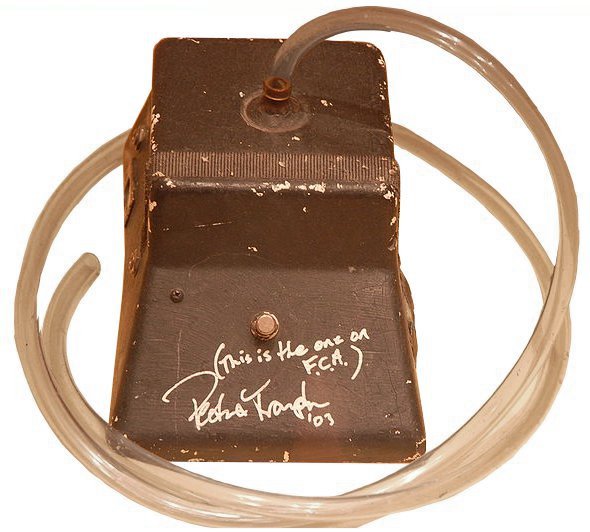
[edit]A talk box is usually an effects pedal that sits on the floor and contains a speaker attached with an airtight connection to a plastic tube; however, it can come in other forms, including homemade, usually crude, versions, and higher quality custom-made versions. The speaker is generally in the form of a compression driver, the sound-generating part of a horn loudspeaker with the horn replaced by the tube connection.
The box has connectors for the connection to the speaker output of an instrument amplifier and a connection to a normal instrument speaker. A foot-operated switch on the box directs the sound either to the talk box speaker or to the normal speaker. The switch is usually a push-on/push-off type. The other end of the tube is taped to the side of a microphone, extending enough to direct the reproduced sound in or near the performer's mouth.
When activated, the sound from the amplifier is reproduced by the speaker in the talk box and directed through the tube into the performer's mouth. The shape of the mouth filters the sound, with the modified sound being picked up by the microphone. The shape of the mouth changes the harmonic content of the sound in the same way it affects the harmonic content generated by the vocal folds when speaking.
The performer can vary the shape of the mouth and position of the tongue, changing the sound of the instrument being reproduced by the talk box speaker. The performer can mouth words, with the resulting effect sounding as though the instrument is speaking. This "shaped" sound exits the performer's mouth, and when it enters a microphone, an instrument/voice hybrid is heard.
The sound can be that of any musical instrument, but the effect is most commonly associated with the guitar. The rich harmonics of an electric guitar are shaped by the mouth, producing a sound very similar to voice, effectively allowing the guitar to appear to "speak".
The effect produced by talk boxes and vocoders are often conflated by listeners.[1][2] However, they have radically different mechanisms for achieving the effect. Talk boxes send the carrier signal into the singer's mouth, where it is then modulated by the singer themselves. On the other hand, vocoders process both the carrier and the modulator signal integrally, producing the output as a separate electric signal. They are also more common in different genres: a talk box is often found in rock music due to its typical pairing with a guitar, whereas vocoders are almost always paired with synthesizers, and as such, are ubiquitous in electronic music.
History
[edit]Singing guitar
[edit]In 1939, Alvino Rey, amateur radio operator W6UK, used a carbon throat microphone wired in such a way as to modulate his electric steel guitar sound. The mic, originally developed for military pilot communications, was placed on the throat of Rey's wife Luise King (one of The King Sisters), who stood behind a curtain and mouthed the words, along with the guitar lines. The novel-sounding combination was called "Singing Guitar", and employed on stage and in the movie Jam Session, as a "novelty" attraction, but was not developed further.
Rey also created a somewhat similar-sounding "talking" effect by manipulating the tone controls of his Fender electric guitar, but the vocal effect was less pronounced.[3]
Sonovox
[edit]Another early voice effect using the same principle of the throat as a filter was the Sonovox, invented by Gilbert Wright in 1939.[4] Instead of a throat microphone modulating a guitar signal, it used small transducers attached to the performer's throat to produce sounds that the mouth shapes.[5] The Sonovox was marketed and promoted by the Wright-Sonovox company, an affiliate of the Free & Peters advertising agency.
The Sonovox was used in many radio station IDs and jingles produced by JAM Creative Productions and the PAMS advertising agency of Dallas, Texas. Lucille Ball made one of her earliest film appearances during the 1930s in a Pathé Newsreel demonstrating the Sonovox.[6]
The first use in music was a score by Ernst Toch in the Paramount film The Ghost Breakers, in June 1940.[7] The Sonovox was used, with an opening credit, for the spirit voices in the 1940 comedy film You'll Find Out. It was used to produce the "voice" of the anthropomorphic train Casey Jr. in the 1941 animated films The Reluctant Dragon and, most famously, Dumbo,[8] and was also used for the "talking piano" in a children's record issued on Capitol Records entitled Sparky's Magic Piano.
Talking steel guitar
[edit]Pete Drake, a Nashville-based player of the pedal steel guitar, used a talk box on his 1964 album Forever, in what came to be called his "talking steel guitar". The following year Gallant released three albums with the box, Pete Drake & His Talking Guitar, Talking Steel and Singing Strings, and Talking Steel Guitar.[9] Drake's device consisted of an 8-inch paper cone speaker driver attached to a funnel from which a clear tube brought the sound to the performer's mouth. It was only loud enough to be useful in the recording studio.[3]
Another prominent use of the talking steel guitar appears in The Ventures' Christmas Album, released in 1965. In the song "Silver Bells", Red Rhodes spoke through a talk box, distorting the phrase silver bells.[10][11]
Kustom Electronics talk box ("The Bag")
[edit]The Kustom Electronics device "The Bag"[12] was the first mass market talk box and was housed in a decorative bag slung over the shoulder like a wine bottle. It used a 30-watt driver and was released to the mass music market in early 1969, two years before Bob Heil's talk box became widely available. The Bag is claimed to have been designed by Doug Forbes,[13][14] who states that exactly the same concept (speaker attached to a plastic tube and inserted into the mouth) had previously been patented as an artificial larynx.[15]
Stevie Wonder gave the talk box its first national television prominence, performing a medley of The Carpenters' "(They Long To Be) Close To You" and The Jackson 5's "Never Can Say Goodbye", both via a Kustom Bag, live on the David Frost show in 1972. The performance was later sampled on Frank Ocean's "Close To You". Mike Pinera from Iron Butterfly used it in 1970.[16]
Jeff Beck used a Kustom Bag talk box in May 1973 on "Superstition" at a Santa Monica concert.[17][18] He also used it on "She's a Woman" from his 1975 release Blow by Blow, and was seen using it for the song on BBC television program Five Faces of the Guitar in 1974 in which he also explains its use to the host of the show.[19]
David Gilmour of Pink Floyd was an obvious candidate for both the talk box and the vocoder, experimenting with merging voice and instrument into a single unified sound. The effect was employed during the lengthy guitar solo sections of "Raving and Drooling" and "You've Got to Be Crazy" on the 1974 tour, which would eventually become "Sheep" and "Dogs" on the Animals album.
Heil high-powered talk box
[edit]The first high-powered talk box was developed by Bob Heil.[20] The device was the first that could be reliable when used on high-level rock stages. His first Heil talk box was built for Joe Walsh's Barnstorm tour. Heil and Walsh, both avid ham radio operators (K9EID and WB6ACU, respectively), along with Walsh's guitar tech "Krinkle", combined a 250-watt JBL driver and suitable hi-pass filter which was used for Walsh's single "Rocky Mountain Way". Walsh gives credit to Bill West, an electrical engineer, Nashville steel guitarist and first husband of country-music legend Dottie West, for inventing the talk box for him in a 2006 interview with Howard Stern.
Pete Townshend, in his 2012 autobiography Who I Am, claimed to have invented a version of the talk box during a Who tour of the US in 1976. "I built a speaker in a small box, attached a tube and put the tube in my mouth, allowing me to speak music."
In 1988, Heil sold the manufacturing rights to Dunlop Manufacturing, Inc., which built the Heil talk box to the exact standards that Heil designed in 1973. (Now out of production)[21]
The classic rock artist Peter Frampton made extensive use of the talk box in his music. In an interview for the 1999 DVD Live in Detroit, Frampton says he first heard the talk box in 1970 while sitting in on sessions for George Harrison's All Things Must Pass. While he sat next to Pete Drake in the album sessions at Abbey Road Studios, he heard Drake using it with a pedal steel guitar. Frampton said in the same interview that the sound it produced reminded him of an audio effect he loved listening to on Radio Luxembourg in the later 1960s. Frampton acquired one as a Christmas present from Bob Heil in 1974. It was a hand-built talk box in a fiberglass box using a 100-watt high-powered driver. This was the Heil talk box used for the Frampton Comes Alive tour and album.[22][23][24][25] He then promptly locked himself away in a practice space for two weeks, and came out with some mastery of it. The success of the albums Frampton and Frampton Comes Alive!, and particularly the hit singles "Do You Feel Like We Do" and "Show Me the Way", made Frampton's music somewhat synonymous with the talk box.
Frampton also now sells his own line of custom-designed "Framptone" products, including a talk box.[26]
In 1976, Steely Dan guitarist Walter Becker recorded the talk box effect atop an already-recorded Dean Parks solo in "Haitian Divorce", on the album The Royal Scam.[27] Also from 1977, Johnnie "Guitar" Watson used a talk box.[28] The 1974 album 461 Ocean Boulevard features Eric Clapton using a talk box during his outgoing solo on the song "Mainline Florida".[29]
ElectroSpit
[edit]Producer Bosko, who played talk box on Big Boi's 2010 album Sir Lucious Left Foot: The Son of Chico Dusty, conceived an alternative to the cumbersome and unsanitary talk box in mid-2014, imagining a neck-worn electronic system that would be easier to use. Bosko showed the ElectroSpit prototype in 2016, and launched a Kickstarter campaign in June 2018.[30][31] The device sends sound into the mouth by way of electromagnetic transducers placed against the throat, allowing the user to shape the sounds of a synthesizer, guitar or any other electronic source. Bosko released the ElectroSpit product in 2019, showing it at the NAMM Show.[32] Early users of the ElectroSpit include P-Thugg of Chromeo, Terrace Martin who works with Kendrick Lamar, and Teddy Riley.[33]
Non-musical uses
[edit]A talk box connected to an iPad running an effects program was used to create the voice of the character BB-8 in Star Wars: The Force Awakens.[34]
See also
[edit]References
[edit]- ^ Fortner, Stephen (1 May 2011). "How It Works: TALKBOX 101". Keyboard. Archived from the original on 24 November 2016. Retrieved 24 November 2016.
- ^ Jamieson, Ali (3 March 2015). "Talking Synths: Using Vocoders and Talkboxes in your DAW". Retrieved 24 November 2016.
- ^ a b ProSoundWeb. Forum: Recording Engineering & Production. Thread: JUNE is "Ask Bob Heil" Month! Message: 347458. Bob Heil responds about the origin of the Talk Box. Posted June 6, 2008[permanent dead link]
- ^ "Means and method for producing sound effects".
- ^ Twomey. "Wendy Carlos Vocoder Q&A". wendycarlos.com.
- ^ Pathé, British. "Machine Made Voices!". britishpathe.com.
- ^ Letter from Gilbert Wright to Melville Clark, 28 April 1940.
- ^ Pescovitz, David (8 February 2019). "Watch Lucille Ball demo a 1939 ancestor of the "talk box" famously used by Peter Frampton". BoingBoing. Retrieved 18 January 2021.
- ^ REVIEW: Adams, Greg. Forever @ Allmusic
- ^ Stav, Steve. "The Ventures A Go-Go in the New Millenium". Pandomag.com. Archived from the original on 24 August 2011.
- ^ O'Rourke, Sally (22 December 2016). "ALBUM: The Ventures, 'The Ventures' Christmas Album'". REBEAT Magazine. Retrieved 4 January 2019.
- ^ "Kustom Electronics The Bag". Effects Database. Retrieved 30 November 2018.[dead link]
- ^ "Doug Forbes". dougforbes1.googlepages.com.
- ^ "Doug Forbes". mocheez.fr. Archived from the original on 3 September 2007.
- ^ "AT&T Labs Fosters Innovative Technology – AT&T Labs". corp.att.com.
- ^ https://youtube.com/-pkdlqqLAFk?si=066JHpZ4fgvCa59i&t=2726
- ^ "Beck, Bogert, & Appice - Superstition - Santa Monica May '73 stereo". YouTube. 2 December 2011.
- ^ "Beck, Bogart & Appice - Superstition -1973". YouTube. 24 June 2014.
- ^ McCulley, Jerry. "Rare Video – Jeff Beck Plays His '54 Oxblood Les Paul With Upp". Gibson.com. Gibson Guitar Corporation. Retrieved 2 May 2014.
- ^ Paule, Marty. "A Conversation with Bob Heil—the Master of Game-Changing Microphone Technology – The HUB". The HUB from Musician's Friend.
- ^ "HEIL TALK BOX - Dunlop". Dunlop. Retrieved 18 August 2024.
- ^ Lux, Joanna. and David Dayen "Peter Frampton: More Alive Than Ever" – G4 Media – Thursday, 13 June 2002
- ^ Green, Douglas. "Pete Drake: everyone's favorite" Archived 27 September 2007 at the Wayback Machine
- ^ Baron, Josh."I'm In You: Peter Frampton Still Feels Like We Do" Archived 22 September 2007 at the Wayback Machine – Relix – Monday, 25 October 2004
- ^ "Peter Frampton & Bob Heil Reunite, Talk Past, Present & Future". ProSoundWeb. 24 July 2009. Retrieved 21 January 2011.
- ^ "Framptone product page". frampton.com. Archived from the original on 13 July 2006.
- ^ "Steely Dan Interview – Against All Odds | Guitar.com". www.guitar.com. Archived from the original on 2 March 2017. Retrieved 19 September 2016.
- ^ "Johnny Guitar WatsonP". Movingtheriver.com. 10 January 2016. Retrieved 17 December 2019.
- ^ Book, Ryan (17 August 2014). "40 Years of '461 Ocean Boulevard': Music Times Looks Back and Ranks Eric Clapton's Classic Record". Music Times. Retrieved 6 April 2021.
- ^ "Reinventing Instruments, Winning a Grammy, and Beating the Odds: Artiphon and ElectroSpit Creators…". 23 May 2019.
- ^ "ElectroSpit takes the tube out of the talkbox". 19 June 2018.
- ^ "ElectroSpit ESX-1 Tubeless Talkbox at NAMM 2019". 9 February 2019.
- ^ "This Kickstarter Completely Reinvents the Talkbox". Pitchfork. 5 June 2018.
- ^ Berman, Eliza. "You'll Never Guess the Actor Behind Star Wars Droid BB-8's Voice". Time.
External links
[edit]Talk box
View on GrokipediaDefinition and Operation
Principle of Operation
The talk box operates through acoustic coupling, where an amplified instrument signal is directed into the musician's mouth via a tube, allowing the oral cavity and lips to shape the sound in real time, similar to human speech articulation.[1] The signal flow begins with the instrument, such as a guitar, connected to an amplifier; the amplified audio then enters the talk box unit, which uses a compression driver to vibrate air in the tube, delivering those vibrations directly into the mouth, where the modified sound is captured by a nearby vocal microphone and sent to the PA system.[1] In terms of vibration mechanics, the musician's mouth functions as a dynamic resonator, modulating the instrument's timbre and pitch by altering formants—the resonant frequencies of the vocal tract that define vowel sounds and speech quality—through movements of the tongue, lips, and jaw.[8] This process creates a synthesized vocal effect without using the vocal cords, as the incoming vibrations are filtered and articulated by the mouth's acoustic properties.[1] The principle traces back to early devices like the Sonovox, which used similar throat-based filtering for voice effects.[9] Unlike a vocoder, which electronically analyzes a human voice to control static filter banks on a separate carrier signal, producing a robotic synthesis, the talk box relies on direct analog, real-time vocal tract modulation via the tube for organic interaction.[10] It also differs from auto-tune, a digital pitch correction tool that snaps sung notes to predefined scales without physical sound shaping.[11] Basic setup requires isolated monitoring, such as in-ear or side-stage speakers, to prevent feedback loops from the microphone picking up the instrument's direct output.Key Components
The core of a traditional talk box is the speaker driver, typically a compression driver or horn speaker designed to convert the amplified electrical signal from a guitar or keyboard amplifier into high-frequency air vibrations suitable for transmission through the tube. These drivers are engineered for efficiency in producing clear, directed sound waves and are commonly rated between 30 and 100 watts to handle the power output of typical guitar amps without distortion or damage.[13][14] Central to the device's functionality is the tube system, consisting of a flexible plastic or rubber tube that channels the vibrations from the speaker driver directly into the musician's mouth for modulation. These tubes usually have an inner diameter of 1/4 to 1/2 inch (approximately 6–13 mm) to optimize airflow and sound clarity, and a length of 6 to 12 feet to allow freedom of movement on stage while keeping the connection secure.[15][16] Surgical-grade vinyl tubing is often used for its durability and biocompatibility, though performers must regularly clean it to prevent moisture accumulation and bacterial growth.[16] Microphone integration captures the mouth-modulated sound for amplification and recording, typically involving a close-miked vocal setup where the tube's open end is positioned adjacent to a dynamic microphone to pick up the shaped vibrations without direct contact. To prevent feedback, the vocal microphone channel is isolated from the instrument amplifier's output, often using separate mixers or in-ear monitoring to avoid the mic capturing unmodulated speaker sound.[16][17] The enclosure houses these elements in a compact, durable format, such as a pedalboard-mounted unit or rack module, powered externally by the musician's amplifier rather than an internal battery to ensure sufficient headroom. Volume control is managed via the amp's master level, with caution advised to start low and gradually increase to avoid ear damage or feedback loops during performance.[18][19] Assembly variations range from commercial units like the Heil Talk Box, which integrate a footswitch for bypassing the effect and a pre-wired compression driver, to DIY builds that replicate the setup using off-the-shelf parts for cost savings. In a basic DIY configuration, the wiring follows a straightforward audio path: the amplifier's speaker output connects directly (or via a high-pass capacitor to block low frequencies) to the compression driver's input terminals, with the tube attached to the driver's horn outlet; a simple schematic might resemble:Amp Speaker Out ──[Optional Capacitor]── Compression Driver Input
│
Horn Outlet ── Tube ── Mouth (near Vocal Mic)
Amp Speaker Out ──[Optional Capacitor]── Compression Driver Input
│
Horn Outlet ── Tube ── Mouth (near Vocal Mic)
Historical Development
Early Innovations (1920s–1950s)
The development of talk box technology traces its roots to early 20th-century audio experimentation, particularly in radio broadcasting where vacuum tube modulators enabled the first practical voice transmission and rudimentary effects. In the 1920s, amplifying vacuum tubes revolutionized radio receivers and transmitters, allowing engineers to modulate audio signals for clearer voice broadcasts and initial sound manipulation techniques.[1] These devices, often bulky and power-hungry, laid foundational principles for filtering and shaping audio through electronic means, though they were primarily focused on reliable communication rather than artistic effects.[22] A pivotal early innovation came in 1939 with the invention of the Sonovox, a throat-vibrating device that attached small transducers directly to the performer's larynx to modulate incoming audio signals, producing mechanical or ventriloquistic voice effects. Developed by engineer Gilbert Wright and marketed by the Wright-Sonovox Company, the Sonovox transformed ordinary sounds—such as recordings of trains or instruments—into articulated speech by using the throat as a filter, with the performer mouthing words silently.[23] It gained prominence in radio advertisements and films, including creating the speaking voice for the animated train Casey Junior in Disney's Dumbo (1941), and was demonstrated publicly by Lucille Ball in a 1939 newsreel to showcase its eerie, synthetic vocal capabilities.[24] While not a direct musical instrument interface, the Sonovox introduced the core concept of human vocal tract modulation for non-human sounds, influencing later talk box designs.[25] In the 1940s, bandleader and steel guitarist Alvino Rey adapted similar principles to create one of the earliest "talking guitar" effects, predating commercial talk boxes. Rey employed a non-contact coil pickup on his steel guitar combined with a throat microphone or the Sonovox to route the instrument's signal through his vocal tract, allowing him to "speak" words and phrases via the guitar tone.[26] This setup was featured in performances and recordings, such as his 1944 rendition of "St. Louis Blues" in the short film Jam Session, where the guitar puppet "Stringy" appeared to sing the melody with Rey providing the modulated vocals offstage.[6] Rey's experiments, starting as early as the late 1930s, popularized the technique in big band and swing music, using it for novelty segments that blended instrument and voice in a proto-talk box manner.[27] These pre-commercial devices faced significant technical constraints that limited their adoption. Vacuum tube-based components made setups cumbersome and non-portable, often requiring dedicated amplification and wiring that confined them to studio or stage environments. Audio fidelity was low, with distorted, metallic tones resulting from primitive transducers and narrow frequency response, restricting use to gimmicky effects rather than mainstream instrumentation.[28] Despite these drawbacks, such innovations demonstrated the potential of vocal filtering, echoing the basic principle of operation in later talk boxes by directing amplified signals through the human mouth for articulation.[29]Commercialization and Popularization (1960s–1970s)
The modern talk box design emerged in the early 1960s through prototypes built by Nashville pedal steel guitarist Pete Drake and audio engineer Bill West around 1962–1964 for use in country music sessions.[3] Drake's application on his 1964 single "Forever," where the pedal steel guitar "sings" lyrics, marked one of the first commercial recordings using the effect.[4] The commercialization of the talk box began in the late 1960s with Kustom Electronics' introduction of "The Bag" in 1969, a portable unit designed to be slung over the performer's shoulder like bagpipes, enclosing a 30-watt amplifier and speaker driver for on-stage use.[30] This device marked a shift from custom-built prototypes to mass-market accessibility, though it achieved limited success due to its unconventional appearance and practical challenges in live settings.[29] Early adopters included rock acts such as Steppenwolf, where guitarist Bobby Cochran used it on tracks like "Monster," as well as Iron Butterfly, Creedence Clearwater Revival's John Fogerty, Sly and the Family Stone, and Stevie Wonder, demonstrating its compatibility with both guitar and keyboard inputs.[30] Jeff Beck later employed The Bag during his 1975 Blow by Blow tour, influencing subsequent rock experimentation.[31] A pivotal advancement came in 1973 when audio engineer Bob Heil developed a high-powered talk box initially for Joe Walsh's Barnstorm tour, featuring a robust 100-watt compression driver in a metal enclosure with a foot-pedal volume control for greater stage reliability.[4] This design improved upon earlier models by delivering higher audio output and reduced feedback, allowing for clearer vocal modulation and sustained notes without excessive distortion, particularly when paired with guitar or keyboard signals.[29] Heil customized a version as a Christmas gift for Peter Frampton that year, which Frampton refined into his signature "Framptone" setup, enhancing clarity and enabling precise phrasing in live performances.[32] The talk box gained widespread popularity in the 1970s through Frampton's adoption, culminating in the 1976 live album Frampton Comes Alive!, where the 14-minute version of "Do You Feel Like We Do" showcased an extended talk box solo that propelled the effect into mainstream rock. This exposure, alongside Walsh's use on Eagles tracks like "Rocky Mountain Way," drove market growth from niche custom builds to commercially viable pedals, with endorsements from artists like Walsh boosting sales during the rock era.[7] Technical refinements, such as optimized drivers for broader instrument compatibility, further minimized distortion and expanded its appeal, laying the groundwork for later echoes like Bon Jovi's 1986 hit "Livin' on a Prayer."[29]Later Advancements (1980s–Present)
In the 1980s, the analog Electro-Harmonix Golden Throat talk box, originally launched in the 1970s, gained prominence through its use by funk musician Roger Troutman of Zapp on tracks such as "More Bounce to the Ounce" (1980), popularizing a personalized variant that influenced hip-hop production in subsequent decades.[33] During the 1990s and 2000s, the talk box experienced a revival through custom units built by musicians, such as those used by Zakk Wylde in Black Label Society, where he employed the effect for distinctive riffing in tracks like "Fire It Up" to add moaning vocal textures amid the rise of heavy metal subgenres.[34] The device's popularity waned temporarily due to the dominance of synthesizers and digital effects in mainstream production, but it resurged in nu-metal scenes, with bands like Limp Bizkit exploring vocal modulation trials to blend rap-rock aggression with electronic timbres.[35] Entering the digital era from the 2010s to 2025, software plugins revolutionized talk box accessibility, exemplified by Waves OVox Vocal ReSynthesis, released in 2020, which emulates classic talk box effects alongside vocoding and pitch shifting for seamless integration in digital audio workstations (DAWs).[36] Native Instruments' The Mouth, introduced in 2010 as part of the Reaktor platform, provides talkbox-like synthesis by transforming audio inputs into playable vocal modulators with adjustable formant controls.[37] Hardware innovations persisted with TC-Helicon's Talkbox Synth pedal in 2017, featuring dedicated talk box modes that trigger synth voices from guitar notes while incorporating adaptive tone and reverb for live vocal enhancement.[38] In the 2020s, talk boxes have found renewed application in EDM and hip-hop hybrids, with artists like Travis Scott incorporating experimental vocal effects in live sets to layer auto-tuned modulations over trap beats, evoking nostalgic funk influences in contemporary production. AI-enhanced emulations have further advanced DAW-based simulations, such as Kits AI's 2024 talkbox generator, which uses machine learning to replicate tube-driven resonances and formant shifting without physical hardware, enabling virtual tube modeling for precise, customizable effects.[39] Modern adaptations address persistent challenges, including volume balancing on loud stages where talk box signals can feedback or get drowned out by high-gain amplification, requiring careful gain staging and isolation techniques.[40] Post-2020 developments include shifts toward eco-friendly tubing materials, with manufacturers offering BPA-free PVC alternatives that reduce environmental impact while maintaining flexibility and hygiene for repeated use.[41]Variants and Technologies
Analog Talk Boxes
Analog talk boxes represent the foundational hardware implementations of the effect, relying on physical amplification and tubing to channel an instrument's signal into the performer's mouth for vocal shaping. These devices, prominent from the late 1960s onward, vary in design to accommodate different performance environments, with early models emphasizing portability and later ones prioritizing durability and power handling.[29] The Kustom "The Bag," introduced in 1969, featured a compact, shoulder-slung design resembling bagpipes, making it highly portable for small venues and mobile setups. Its low-power output and simple construction allowed for easy integration with standard guitar amps, but the unit was prone to feedback issues and considered impractical for larger stages due to its fragility and limited volume projection.[30][29] In contrast, the Heil Sound Talk Box, developed in the early 1970s, offered a more robust solution with a metal enclosure and foot-operated controls, capable of handling over 100 watts for high-volume arena performances. This model included features like an adjustable horn for fine-tuning tonal response and a phenolic diaphragm speaker, reducing feedback while providing greater reliability in demanding live settings.[14][42] Other notable analog models from the 1970s include the Dean Markley Voice Box, a guitar-focused unit available in variants rated for 50 to 150 watts, designed specifically for electric guitarists seeking direct amp integration without extensive setup. Custom builds were also common, often incorporating material variations such as flexible plastic tubes for comfort or rigid metal tubing for enhanced durability and reduced resonance distortion.[43][44] Maintenance for analog talk boxes typically involves periodic tube replacement, as the flexible tubing degrades from exposure to saliva and moisture, potentially causing blockages or reduced modulation clarity. Drivers require regular cleaning to remove accumulated condensation, and common failures include seal leaks at tube-amp connections, which can lead to signal loss and require resealing with gaskets or adhesives for airtight performance.[1][45] The sound of analog talk boxes is characterized by a warm, organic timbre arising from the natural acoustic interactions in the tubing and the analog amplification chain, delivering nuanced vocal inflections with subtle harmonics that feel more lifelike compared to processed alternatives.[29][1]Digital Emulations and Modern Devices
Digital emulations of the talk box effect have proliferated in the form of software plugins, enabling musicians to replicate the characteristic vocal modulation without physical hardware. The Antares Articulator Evo is a prominent example, functioning as a VST/AU/AAX plugin that extracts formant and amplitude envelopes from a control signal—typically a vocal track—and applies them to an audio input such as guitar or synthesizer, creating a synthesized "talking" effect. This plugin integrates seamlessly into digital audio workstations (DAWs) like Ableton Live, allowing real-time processing and automation within production workflows. Another key software tool is the Talkbox module in iZotope's VocalSynth 2, which emulates the classic talk box by blending carrier signals (e.g., instrument audio) with modulator inputs (e.g., vocals) to produce articulated, speech-like timbres.[46] Released in 2018 and updated as recently as May 2025 for improved compatibility with modern systems, VocalSynth 2 supports compatibility with guitar, synthesizer, or vocal inputs, featuring adjustable parameters for wet/dry mix, formant shifting, and resonance to fine-tune the effect's intensity and clarity.[47] These plugins offer advantages over traditional analog units, including the elimination of tubes and associated hygiene concerns from oral modulation, as well as MIDI automation for precise control over dynamic effects in complex arrangements. However, they can introduce minor latency during live performances, potentially requiring low-buffer settings in DAWs to mitigate delays.[47] In hardware, hybrid devices combine digital processing with pedalboard integration for stage use. The Line 6 Helix series, introduced in the 2010s, includes modeling capabilities through its Vocoder effect and user presets that approximate talk box sounds by routing instrument signals with vocal modulation, supporting inputs from guitars or synths via XLR or 1/4-inch jacks. Similarly, TC Electronic's Talkbox Synth pedal provides a hardware-based emulation tailored for vocalists, using digital synthesis to generate talk box-style effects with built-in reverbs, pitch correction, and formant controls, while avoiding the maintenance issues of analog tubes. Overall, such emulations prioritize flexibility and hygiene, making the talk box effect accessible in modern production and live settings without the physical constraints of analog predecessors.Musical Applications
Performance Techniques
The performer controls the talk box output primarily through mouth and breath techniques, placing the clear plastic tube in the corner of the mouth between the back teeth and cheek to direct the amplified instrument signal into the oral cavity.[48] Without engaging the vocal cords, the mouth shapes the sound into vowels and consonants; for instance, a rounded "ooh" formation sustains smooth, vowel-like notes, while quick lip and jaw movements produce "wah" sweeps for dynamic effects.[1] Tongue positioning further refines articulation, enabling pitch bends by varying the oral cavity's resonance to mimic sliding or bending notes from the instrument. Breath control maintains consistent pressure on the tube without excessive force, ensuring clear modulation as excess air can disrupt the signal flow.[1] Effective instrument pairing enhances the talk box's clarity and expressiveness. Guitars work well with sustained chords or single notes to allow distinct mouth shaping, as rapid picking can muddy the modulated output; amplifier settings should boost midrange frequencies (around 500-2000 Hz) while reducing bass to prevent boominess and treble for smoother harmonics.[49] Keyboards or synthesizers pair effectively for melodic lines, providing clean, continuous tones that translate precisely to vocal-like phrases without the percussive attack of plucked strings.[10] Live performances demand careful setup to manage feedback and monitoring. A dual amplifier system is standard, with one amp handling the direct instrument signal routed to the PA system and a second amp's speaker output connected to the talk box via a heavy-duty speaker cable for isolated drive.[48] The modulated sound exits the mouth and is captured by a nearby microphone, often positioned 4-6 inches away with the tube taped alongside for direct input; in-ear monitors provide the dry instrument audio to the performer, preventing feedback loops from stage amps.[1] Advanced techniques expand creative possibilities in both live and studio contexts. Harmonized effects can be achieved using multiple tubes connected to separate talk boxes driven by the same or detuned signals, creating layered vocal harmonies onstage. In recording, layering multiple talk box tracks allows for polyphonic textures resembling choral vocals, with each layer shaped differently for depth.[49] Health and maintenance are crucial for sustained use, as the tube should be cleaned regularly to avoid bacterial buildup from mouth contact. Mouth fatigue from extended sessions can occur due to constant shaping and breath regulation, so performers should incorporate breaks and hydration. Common errors include overblowing the tube, which introduces unwanted distortion by overpowering the driver, or loose tube placement causing muffled or leaky sound; proper sealing in the mouth corner mitigates these issues.[48]Notable Recordings and Artists
One of the most iconic uses of the talk box in rock music occurred on Peter Frampton's 1976 live album Frampton Comes Alive!, particularly in the track "Do You Feel Like We Do," where Frampton employed a Heil Sound Talk Box to create his signature vocal-guitar effects, contributing to the album's massive commercial success with over 10 million copies sold worldwide.[50] Similarly, Joe Walsh pioneered the effect earlier on his 1973 single "Rocky Mountain Way" from the album The Smoker You Drink, the Player You Get, using a custom talk box setup to deliver the song's memorable "buya" refrain, which helped the track reach No. 23 on the Billboard Hot 100.[51] In the 1980s, Richie Sambora of Bon Jovi utilized a talk box on the 1986 hit "Livin' on a Prayer" from the album Slippery When Wet, enhancing the song's anthemic chorus and driving the album to over 12 million U.S. sales.[7] Beyond rock, the talk box found applications in funk and jazz fusion, notably through Stevie Wonder's live performances in the early 1970s, such as his 1972 rendition of "Close to You" and "Never Can Say Goodbye" on The David Frost Show, where he manipulated the device to blend vocal phrasing with keyboard tones, showcasing its versatility in soul-infused improvisation.[52] In country music, pedal steel guitarist Pete Drake introduced the talk box commercially with his 1964 album Forever, employing an early prototype to produce talking guitar effects on tracks like "Forever," which influenced Nashville session work and sold modestly but established the device in genre experimentation.[29] In hip-hop and electronic music, Roger Troutman's mastery of the talk box with his band Zapp during the 1980s, as heard on the 1980 track "More Bounce to the Ounce" from Zapp, featured a custom mini-talk box for funky, robotic vocals that became a staple in West Coast rap sampling; this influence peaked in 2Pac's 1996 hit "California Love" featuring Dr. Dre, where Troutman's talk box lines from Zapp's "Computer Love" were interpolated, propelling the single to No. 1 on the Billboard Hot 100 and diamond certification for its parent album. From the 2000s onward, the talk box persisted in nu-metal and modern pop. Korn's guitarist James "Munky" Shaffer incorporated it on "Dead Bodies Everywhere" from their 1998 album Follow the Leader, using a talk box for eerie, distorted guitar-vocal hybrids that complemented the track's industrial edge and contributed to the album's 5 million global sales.[53] In the 2010s, Bruno Mars sampled Zapp's talk box on "24K Magic" from the 2016 album of the same name, evoking retro funk in the chorus, which helped the song win two Grammys and the album achieve triple-platinum status in the U.S. More recently, contemporary artist Mr. Talkbox has revived the technique in gospel-infused R&B, as on his 2021 mashup medleys covering 1990s hits like SWV tracks, blending live talk box with hip-hop beats to appeal to streaming audiences.[54] These examples highlight the talk box's enduring role in shaping genre-crossing hits, from chart-topping singles to influential samples that boosted effect pedal markets like Heil Sound's sales in the rock era.[42]Other Applications
Non-Musical Uses
The talk box and its precursor, the Sonovox, have found applications in film and television for creating distinctive voice effects, particularly in science fiction and animation. In the 1941 Disney film Dumbo, the Sonovox was employed to produce the voice of the talking train Casey Junior, where performers whispered words while small speakers attached to their throats modulated the sound to simulate a mechanical voice.[25] More recently, in the 2015 film Star Wars: The Force Awakens, sound designer David Acord utilized a talk box to process comedian Bill Hader's voice for the droid BB-8, blending it with synthesized tones from an iPad app to create an expressive, robotic persona.[55] Similarly, the 2023 horror film No One Will Save You incorporated talk boxes to manipulate sounds for alien vocalizations, allowing designers to shape eerie utterances through mouth movements on processed audio.[56] In advertising and radio, early talk box variants like the Sonovox were widely used from the 1930s to the 1960s to produce novelty "talking" effects in commercials. The device featured in radio jingles and ads for products such as Shell gasoline, vacuum cleaners, and even cereal, where it created whimsical voices for inanimate objects like pots, pans, and trains to engage listeners.[57] Produced by agencies like PAMS in Dallas, these Sonovox-enhanced spots became a staple in broadcast advertising, capitalizing on the novelty of mechanical speech to promote brands.[25] In contemporary media, talk box effects occasionally appear in podcasts for character voices, though digital alternatives have reduced their prevalence; for instance, podcasters may employ talk box processing to mimic robotic or distorted personas in narrative storytelling. Educational applications of the talk box emphasize its role in demonstrating acoustic principles. In STEM programs, simple DIY versions—constructed from household items like straws, balloons, and tubing—serve as hands-on tools to illustrate how the vocal tract shapes sound waves into speech, highlighting concepts like harmonics and resonance.[58] These low-cost "10 Cent Talk Boxes" are used in school settings, scout groups, and family activities to explore acoustics, allowing students to experiment with modulating vibrations through oral movements and connect the physics to real-world examples.[59] Therapeutic uses of the talk box have emerged in music therapy, particularly for individuals with speech and language impairments. Post-2020 research highlights its potential for patients with tracheostomies, where the device facilitates vocal training by channeling amplified sound into the mouth, aiding articulation and phoneme production without relying on damaged vocal cords.[60] A 2023 thesis literature review explores the potential of talk box interventions to improve speech intelligibility in therapy sessions for individuals with speech impairments, suggesting benefits for oral motor skills and communication confidence based on limited studies.[60] DIY adaptations further enhance accessibility, enabling home-based exercises for those with disorders like apraxia.[60] Despite these applications, non-musical uses of the talk box remain niche, overshadowed by digital synthesizers and software emulations that provide similar effects with greater ease and versatility.[39]Cultural Impact and Legacy
The talk box achieved iconic status in 1970s arena rock, largely through Peter Frampton's innovative application on his breakthrough live album Frampton Comes Alive! (1976), where the effect transformed guitar solos into vocal-like expressions on songs such as "Do You Feel Like We Do," embodying the era's theatrical and immersive live performances.[61] This association permeated pop culture, most notably in a parody on the television series The Simpsons in the 1996 episode "Homerpalooza," where Frampton reprises his talk box performance amid a festival lineup, satirizing the device's enduring link to classic rock revivalism and aging rock star tropes.[62] Technologically, the talk box contributed to advancements in vocal manipulation techniques, paralleling electronic effects like the vocoder—used by artists such as Kraftwerk—and influencing later digital innovations including Auto-Tune, by demonstrating how instrumental sounds could be filtered through human articulation to create synthetic voices.[63] Its commercialization through pedals like the Heil model also played a pivotal role in standardizing guitar effects units, paralleling the rise of staples such as the Dunlop Cry Baby wah pedal and establishing the modern effects ecosystem in rock and beyond.[29] In the late 2010s, the talk box experienced renewed interest, notably through Bruno Mars' use in "24K Magic" (2016), which highlighted its timeless appeal in funk and pop productions.[64] Vintage units, particularly Heil Talk Boxes, command significant collectible value, with resale prices often surpassing $200 and premium examples reaching $500 or more due to their historical significance.[65] The effect's legacy endures in interactive media, such as the video game Guitar Hero 5 (2009), which includes Frampton's "Do You Feel Like We Do (Live)" and challenges players to mimic its distinctive talk box phrases, introducing new generations to its mechanics.[66] While celebrated for innovation, the talk box has faced critiques for potential overuse, contributing to clichéd "talking guitar" tropes in arena rock when not applied sparingly.References
- https://electronics.[howstuffworks](/page/HowStuffWorks).com/gadgets/audio-music/talk-box.htm
