
BFGoodrich
View on Wikipedia | This article has multiple issues. Please help improve it or discuss these issues on the talk page. (Learn how and when to remove these messages)
|

 | |
| Product type | Tires |
|---|---|
| Owner | Michelin |
| Produced by | Michelin |
| Country | United States |
| Introduced | 1870 |
| Markets | Worldwide |
| Previous owners | Goodrich Corporation |
| Website | www |

BFGoodrich is an American tire brand. Originally part of the industrial conglomerate Goodrich Corporation, it was acquired in 1990 (along with Uniroyal, then The Uniroyal Goodrich Tire Company) by the French tire maker Michelin. BFGoodrich was the first American tire manufacturer to make radial tires. It made tires for the then-new Winton car from Winton Motor Carriage Company.
BFGoodrich tires have been fitted to several noteworthy historical vehicles:
- In 1903 the first car to cross the United States was fitted with BFGoodrich tires.
- In 1927 Charles Lindbergh's airplane, the "Spirit of St. Louis," which made the first successful solo non-stop flight across the Atlantic, was fitted with BFGoodrich tires.
- The Space Shuttle Columbia's landing gear was fitted with BFGoodrich tires.[1]
BFGoodrich has been involved in several Baja California Competitions and enjoyed success with 28 overall victories at the Baja 1000 and 13 times winner of the Paris–Dakar Rally.
History
[edit].jpg)
Founded by Dr. Benjamin Franklin Goodrich in 1870, the B.F. Goodrich Company, later known as BFGoodrich, was among the first rubber tire manufacturers to be located west of the Appalachian mountain range. In the previous year, Goodrich had purchased the Hudson River Rubber Company. Based in Akron, Ohio, the BFGoodrich Company began as a manufacturer of rubberized hoses, which were sold mostly as firehoses. The company also produced rubberized belts, similar to those used on modern vehicles as serpentine belts (fan belt). As the company grew, it began to manufacture pneumatic bicycle tires, eventually leading to the production of pneumatic automobile tires in 1896, making BFGoodrich the first company in the United States to manufacture this type of tire.[2]
BFGoodrich was not the only tire manufacturer in the United States at the turn of the 20th century. Among its competitors were Goodyear, Firestone, General and Uniroyal. Due to extensive research and scientific methods, such as tire wear evaluation and longevity testing, BFGoodrich was at the leading edge of the industry. Ford Motor Company, then owned by Henry Ford, chose BFGoodrich tires to be fitted in the new Model A Ford in 1903. That same year, the Model A, equipped with the tires, became the first car to cross the United States from east to west. This event made BFGoodrich a household name.[3] The Goodrich Corporation, formerly called B.F. Goodrich Company, stopped making tires in 1988 and sold the business and the B.F. Goodrich name to Michelin. Although Michelin purchased the rights and many of the factories of B.F. Goodrich within the United States, the Goodrich factories continued tire production under the parent company, Michelin. As of 2023 there are only two (2) of the B.F. Goodrich factories in operations producing tires, while still working under the original B.F. Goodrich name. These last two factory locations are Tuscaloosa, Alabama and Woodburn, Indiana.
Innovation
[edit]Aside from being the first company in the United States to manufacture pneumatic automobile tires, BFGoodrich is also credited for introducing the rubber-wound golf ball, the first pressurized space suit and the use of synthetic rubber. Although significant, these innovations are not as well known as the company’s contributions to the tire industry.[4]
In 1947, BFGoodrich developed the first tubeless tire in the United States. The tubeless tire eliminate the need for an inner tube, which improves performance and safety, as well as enhanced comfort for the car's occupants.[5]
BFGoodrich produced the first radial tires in the United States in 1965. This innovation made tires even safer as radial tires have longer tread life and permit better absorption of road bumps.[6] The company patented an early sort of run-flat tire two years later, in 1967. This technology enables the vehicle to continue to be driven in emergencies by avoiding that the tire becomes flat instantly.[7]
BF Goodrich also developed the PF flyer shoe in 1933.
Aeronautics
[edit]In 1909, BFGoodrich tires were fitted on a Curtiss airplane, thus marking BFGoodrich's entry in the aviation tire market. In this particular event, the plane, fitted with BFGoodrich tires, set a speed record of 75 kilometers per hour in Reims at the first international air race. BFGoodrich tires were also fitted to Charles Lindbergh’s plane, Spirit of St. Louis, when he completed the first solo non-stop transatlantic flight.[8]
In 1934, BFGoodrich produced a prototype for a pressure suit to be worn by airplane pilot Wiley Post at high altitudes.[9] This first prototype was made mostly of rubber, with the exception being the metal helmet and waist strap. The prototype suit was pressurized in an initial test, but it did not hold pressure as it was expected to. With improvements to the concept, a second prototype was made, using the same helmet, which successfully maintained pressurization. The second suit was successful, at least in holding pressure. The suit had shrunk around Post's body and was removed by cutting the suit apart. One year later, in 1935, another prototype was produced and is said to be the first practical pressure suit in the United States. Piloting his plane, the “Winnie Mae”, Post was able to fly to an altitude of approximately 50,000 feet, where he discovered the jet stream, paving the way for modern flight procedures. From this point forward, the suit created by BFGoodrich served as pattern for modern pressurized space suits.[10]
In 1946, B. F. Goodrich purchased the airplane, wheel, and brake division of Hayes Industries.[11][12]
Racing Heritage
[edit]BFGoodrich is also known for their performance and racing developments and achievements. Its roots in racing can be traced as far back as 1914, when BFGoodrich tires were used by the winning car of the Indianapolis 500. This was just the beginning of victories in several competitions including the Baja 1000, Paris-Dakar Rally, World Rally Championships and many other prestigious racing competitions.[13]
BFGoodrich has been active on the competitive off-road scene in the USA since 1973, but it was only two decades later that the American brand got its first taste of the world’s longest and toughest cross-country rally – the Dakar. BFGoodrich, Official Sponsor and exclusive tire partner of the Rallye du Dakar since 2002’s edition, proposes to all competitors access to premium tires and to its racing service present on all the Rallye’s duration.[14]
Offroad
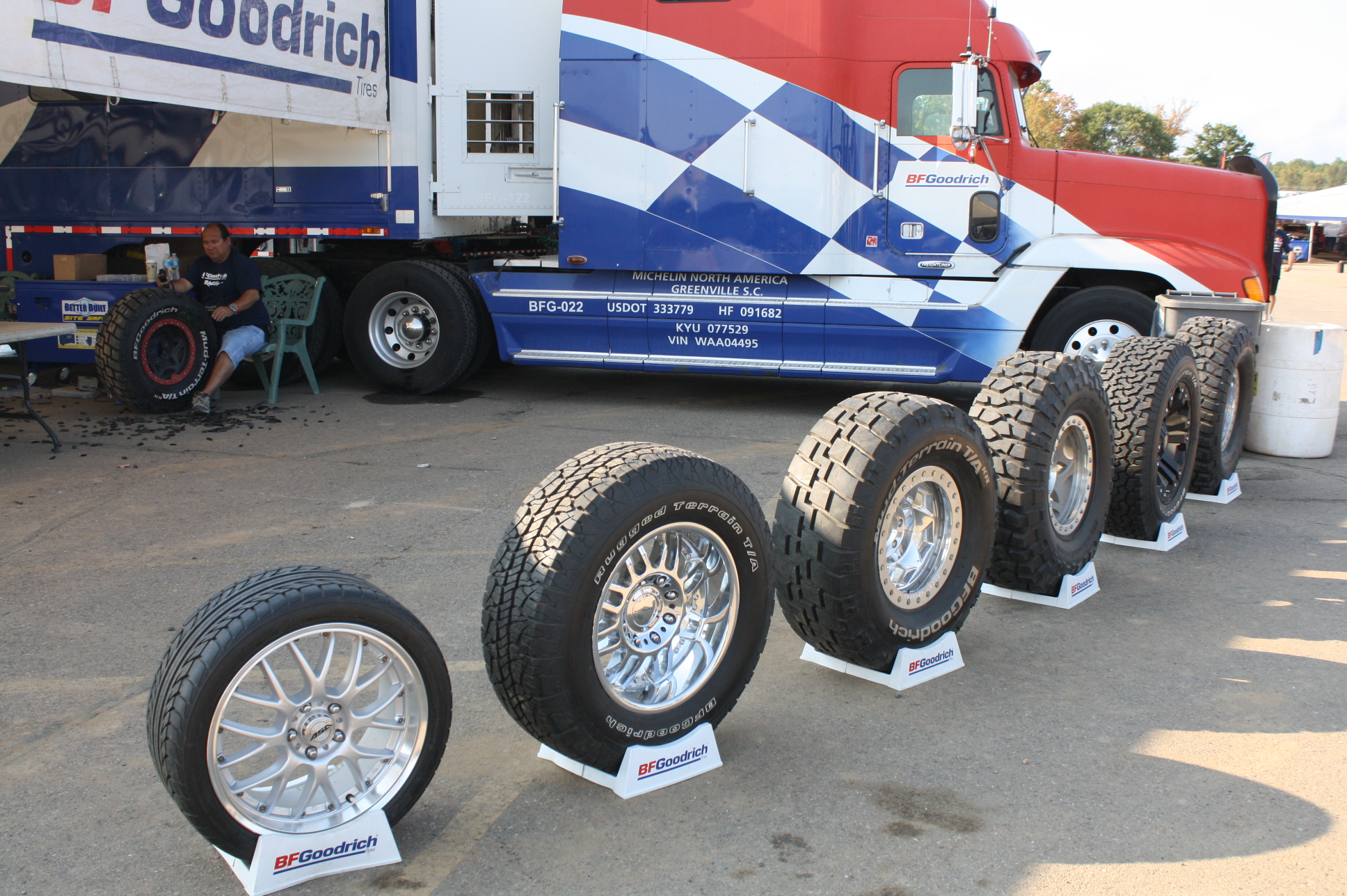
[edit]BFGoodrich developed and markets its flagship All-Terrain T/A and Mud-Terrain T/A tires. The tires have a unique tread pattern and raised white letters on the tire sidewall, their main application is pickup trucks and body-on-frame SUVs. BFG also supplies custom spec tires for Class1, Class 10 and Unlimited Spec Desert car racing. [citation needed]
In Popular Culture
[edit]In 1976 BFGoodrich sponsored a short documentary film, Free Wheelin', about vanning, the practice of customizing vans. The film was directed by Bill Buckley and Mel Horace and written by Brock Yates. Cinecraft Productions provided the location production crew and post-production services. Footage for the documentary was shot at the National Street Van July 1976 “4th Annual "National Truck-In" get together in Bowling Green, Kentucky. The movie featured interviews with participants, as well as plugs for BFGoodrich tires and a BFGoodrich "project van," an automobile outfitted with the latest van technology. The film had a full length of approximately 21 minutes but was edited to other lengths so that it could play as either a short or a trailer in movie theaters.[15] In 2023 the film was restored by the Hagley Museum and Library, which had received a grant from the National Film Preservation Foundation for film preservation, and is currently held in its archives.[16][17]
References
[edit]- ^ "The First Tires to Orbit Earth". BFGoodrich. Retrieved 27 September 2022.
- ^ "B.F. Goodrich Company". Encyclopædia Britannica. The Editors of Encyclopædia Britannica. Retrieved 4 April 2016.
- ^ "THE SAGA OF AN ETERNAL PIONEER". BFGoodrich Tires. BFGoodrich. Retrieved 4 April 2016.
- ^ "B.F. Goodrich Company". Encyclopædia Britannica. The Editors of Encyclopædia Britannica. Retrieved 4 April 2016.
- ^ "KEY DATES". BFGoodrich Tires. BFGoodrich. Retrieved 4 April 2016.
- ^ "KEY DATES". BFGoodrich Tires. BFGoodrich. Retrieved 4 April 2016.
- ^ "KEY DATES". BFGoodrich Tires. BFGoodrich. Retrieved 4 April 2016.
- ^ "THE SAGA OF AN ETERNAL PIONEER". BFGoodrich Tires. BFGoodrich. Retrieved 4 April 2016.
- ^ "automotive digital marketing".
- ^ "The Evolution of American Spacesuits". Simple Thing Called Life. Archived from the original on 10 April 2016. Retrieved 4 April 2016.
- ^ "B. F. Goodrich Purchases Hayes Industries Division". Aviation News. Vol. 5, no. 8. McGraw-Hill Publishing Company. 4 March 1946. p. 11. Retrieved 15 August 2021.
- ^ "Yokohama Fender". Retrieved 24 September 2023.
- ^ "BFGOODRICH AND COMPETITION". BFGoodrich Tires. BFGoodrich. Retrieved 4 April 2016.
- ^ "BFGOODRICH AND Dakar 2022". BFGoodrich Tires - Middle East and North Africa. BFGoodrich. Retrieved 3 January 2022.
- ^ "Some Fridays are for Freewheelin', nothing you can do about it". Hagley Museum and Library. Retrieved 24 January 2026.
- ^ "Hagley awarded grant from the National Film Preservation Foundation". Hagley Museum and Library. Retrieved 24 January 2026.
- ^ A 21-minute long version of the film is posted on the Hagley Library digital website https://digital.hagley.org/FILM_2019227_FC229
External links
[edit]


BFGoodrich
View on GrokipediaCompany History
Founding and Early Expansion
The B.F. Goodrich Company was founded on October 13, 1870, in Akron, Ohio, by Dr. Benjamin Franklin Goodrich, a physician and entrepreneur from New York state, as Goodrich, Tew & Co. The venture was supported by local Akron investors, including Colonel George T. Perkins, who assembled a group of 19 business leaders to provide $19,000 in startup capital, enabling Goodrich to relocate his operations west of the Allegheny Mountains where competition was lower and resources like cheap water from the Ohio & Erie Canal and railroad access were abundant. Initially, the company focused on manufacturing industrial rubber products, starting with the "White Anchor" rubber fire hose—developed after Goodrich observed a failure of traditional leather hoses during a fire—and expanding to include rubber belting, packing, and other molded goods.[7][8] The company was reorganized and incorporated as the B.F. Goodrich Company on May 10, 1880, with $100,000 in capital stock, and Dr. Goodrich served as its first president until his death in 1888 at age 46. Under his leadership, the firm emphasized innovation in rubber processing, establishing a reputation for quality industrial products that attracted further investment and growth in Akron, which soon became a hub for the rubber industry. Following Goodrich's passing, Colonel Perkins assumed the presidency, guiding the company through diversification while maintaining its Akron base. By the mid-1880s, B.F. Goodrich began venturing into tires, producing solid rubber tires for high-wheel bicycles and later carriage tires, capitalizing on the rising popularity of cycling.[7] A pivotal expansion occurred in 1896 when B.F. Goodrich introduced pneumatic bicycle tires and became the first U.S. company to manufacture detachable pneumatic automobile tires, fulfilling an order from the Winton Motor Carriage Company of Cleveland for its experimental vehicles. This innovation, building on bicycle tire technology, positioned the company at the forefront of the emerging automotive sector, where pneumatic tires offered superior ride comfort over solid rubber alternatives. Post-1900, as automobile production surged, B.F. Goodrich shifted its emphasis toward automotive applications, scaling tire output and securing contracts like supplying tires for Henry Ford's Model A in 1903 and the Winton Touring Car that completed the first successful U.S. coast-to-coast drive that same year, demonstrating the durability of their products over rugged terrain. By 1902, tires—particularly for bicycles and automobiles—along with tubes, hoses, and other rubber items, formed a core part of the company's diversified portfolio, laying the foundation for its dominance in the tire market.[9][10][11]Major Milestones in the 20th Century
In the early 1900s, BFGoodrich achieved significant recognition in motorsports through its custom racing tires, powering consecutive victories at the Indianapolis 500 in 1915 and 1916, marking the company as the first tire manufacturer to win the prestigious race two years in a row. By the 1920s, BFGoodrich had expanded beyond tires into a broader range of rubber products, including conveyor belts for industrial applications, golf balls utilizing molded rubber cores, and druggist sundries such as rubber tubing and bulbs for medical and pharmaceutical uses, diversifying its portfolio amid growing demand for rubber goods.[9] A pivotal aviation milestone came in 1927 when BFGoodrich supplied the tires for Charles Lindbergh's Spirit of St. Louis, the monoplane that completed the first nonstop transatlantic flight from New York to Paris, covering approximately 3,600 miles in 33.5 hours and demonstrating the durability of the company's pneumatic tires under extreme conditions.[12] During World War II, BFGoodrich played a crucial role in addressing the U.S. rubber shortage by advancing synthetic rubber production, introducing Ameripol in 1940 as one of the first viable synthetic rubbers for tires, which enabled the manufacture of military aircraft tires resistant to harsh operational demands.[13] The company also contributed components, including rubber parts made from synthetic materials, to the TBM Avenger torpedo bomber produced by General Motors' Eastern Aircraft Division, supporting Allied naval aviation efforts.[13] Postwar growth accelerated BFGoodrich's aerospace involvement, highlighted by the 1946 acquisition of the former Waco Aircraft Company plant in Troy, Ohio, which was repurposed for manufacturing aircraft wheels and brakes, laying the foundation for expanded production of landing gear systems.[14] In 1947, BFGoodrich revolutionized automotive safety by inventing the first tubeless tire for American cars, eliminating the inner tube to reduce puncture risks, simplify repairs, and improve overall reliability, a development announced on May 11 that quickly became an industry standard.[15]Restructuring and Modern Acquisitions
In the mid-1980s, BFGoodrich sought to streamline its operations amid competitive pressures in the tire industry by merging its tire business with that of Uniroyal Inc., forming the Uniroyal Goodrich Tire Company (UGTC) as a 50-50 joint venture in 1986.[16] This arrangement allowed BFGoodrich to retain a significant stake while transferring day-to-day tire operations to the new entity, which became the fourth-largest tire producer in the United States at the time.[17] By 1988, BFGoodrich fully divested its interest in UGTC, selling its 50 percent share to Clayton & Dubilier Inc., the private equity firm that owned Uniroyal, for $225 million, effectively exiting the tire manufacturing sector.[18] The following year, in 1989, the French tire giant Michelin Group acquired UGTC for $1.5 billion, including the assumption of $810 million in debt, thereby integrating the BFGoodrich tire brand into its global portfolio.[19] This acquisition positioned Michelin as the world's largest tire manufacturer and led to subsequent consolidations within the former UGTC facilities to optimize production efficiency.[20] For instance, in 2009, Michelin closed the BFGoodrich plant in Opelika, Alabama, which had operated since 1963, resulting in the elimination of approximately 800 to 1,000 jobs as production shifted to other locations amid declining demand.[21] Following the tire divestiture, BFGoodrich refocused its remaining operations on higher-margin sectors, evolving into the Goodrich Corporation in 2001 after merging with Coltec Industries Inc. in 1999, with the headquarters relocating to Charlotte, North Carolina.[22] This restructuring emphasized aerospace components and specialty chemicals, divesting lower-performing units to prioritize advanced technologies.[23] In 2012, United Technologies Corporation (UTC) acquired Goodrich Corporation for $18.4 billion in cash, integrating its aerospace divisions into UTC Aerospace Systems (UTAS) to enhance capabilities in aircraft systems and propulsion.[24] The deal, which included regulatory-mandated divestitures to address antitrust concerns, marked one of the largest aerospace mergers in history and bolstered UTC's position in commercial and defense aviation.[25] UTAS later merged with Rockwell Collins in 2018 to form Collins Aerospace, preserving Goodrich's legacy in areas such as landing systems and de-icing technologies.[26] As of 2025, the BFGoodrich tire brand remains under the management of Michelin North America Inc., which continues to invest in production upgrades, such as the $50 million expansion of the Fort Wayne, Indiana, facility in 2011 to increase capacity for passenger and light truck tires.[27] Meanwhile, the aerospace heritage of Goodrich endures through Collins Aerospace, a subsidiary of RTX Corporation—formed by the 2020 merger of UTC and Raytheon Company and rebranded in 2023—which maintains operations in high-tech avionics and propulsion systems.[28] These restructurings significantly impacted BFGoodrich's workforce, with the 1980s tire exit and subsequent mergers leading to thousands of job reductions across manufacturing sites as the company shifted from labor-intensive rubber production to specialized aerospace engineering.[29] The 2009 Opelika closure alone displaced over 1,000 employees, reflecting broader industry trends toward consolidation and automation in the 2000s.[30] Overall, the transformations enabled a pivot to high-technology sectors, improving long-term profitability but at the cost of traditional industrial employment.[31]Tire Division
Development and Key Innovations
BFGoodrich pioneered significant advancements in tire technology following its early 20th-century focus on rubber production, particularly through the introduction of radial tire designs that revolutionized durability and performance in the tire division. In 1965, the company launched the first U.S.-made radial tire, known as the Lifesaver or Silvertown Radial 900, which featured a construction that provided longer tread life, improved fuel efficiency, and enhanced handling compared to bias-ply predecessors.[32][1][33] This innovation marked BFGoodrich's aggressive investment in radial technology at a time when most American manufacturers resisted the shift from bias-ply tires.[34] During the 1960s and 1970s, BFGoodrich advanced synthetic rubber formulations and tread compounds to support radial tire performance, building on its earlier synthetic rubber expertise from World War II-era developments like Ameripol. These improvements enabled more resilient materials that resisted wear and improved traction, culminating in products like the Radial Long Life T/A for passenger cars, which emphasized extended mileage through optimized compounding.[35][36] By 1973, these efforts led to the introduction of the Radial T/A, North America's first high-performance radial tire for light trucks and passenger vehicles, incorporating advanced tread blocks for balanced wet and dry grip.[37] A major breakthrough came in 1976 with the development of the All-Terrain T/A tire, the first radial light truck tire designed for both off-road and on-road use. BFGoodrich engineers tested prototypes in Baja California, Mexico, starting in 1975, refining the design for rugged durability while maintaining highway comfort.[38] This tire's three-ply polyester casing and aggressive tread pattern set new standards for versatility in light truck applications.[39] After Michelin acquired BFGoodrich's tire operations in 1990, innovations continued to integrate racing-derived technologies into consumer products. In 2009, the Advantage T/A series was introduced, featuring tread compounds and patterns adapted from BFGoodrich's motorsport experience to deliver extended tread life and superior wet traction for all-season use.[40] This line emphasized interlocking sipes and g-Grip technology for enhanced stability and longevity.[41] In 2020, BFGoodrich marked its 150th anniversary by highlighting key milestones, including its contributions to aerospace through tires that became the first to orbit Earth on the Columbia space shuttle's landing gear in 1981.[42][43] These 34-ply tires, developed in collaboration with NASA, demonstrated the company's expertise in high-stress rubber compounds.[43] As of 2025, under Michelin's ownership, BFGoodrich's tire lineup emphasizes performance radials like the g-Force COMP-2 A/S for ultra-high-performance handling and all-season options such as the Advantage Control and Radial T/A series, which prioritize confident traction, quiet rides, and durability across passenger cars, SUVs, and light trucks.[44][45][37]Racing Heritage
BFGoodrich established its racing legacy early in the 20th century with back-to-back victories at the Indianapolis 500 in 1915 and 1916, becoming the first tire manufacturer to achieve consecutive wins in the prestigious oval-track event and demonstrating the durability of its tires under high-speed conditions.[32] These successes highlighted BFGoodrich's innovative rubber compounds and construction techniques, which were tested rigorously in competitive environments to refine performance for broader applications. Building on this foundation, the company expanded into off-road motorsports, leveraging radial tire technology as a base for enhanced grip and stability in demanding terrains.[46] In off-road racing, BFGoodrich has maintained a dominant presence for over 50 years in the Baja 1000, with participation dating back to the 1970s and a record streak of 20 consecutive overall wins from 1986 to 2005, including victories in Class 1 and unlimited classes through partnerships with teams like the Herbst Racing and McMillin Racing families.[39][47][48] Similarly, since the 1970s, BFGoodrich has supported competitors in the Mint 400, the oldest U.S. off-road race, supplying tires for trucks, UTVs, and pre-runners to ensure superior traction across rocky and sandy courses.[49] Early partnerships, such as with Jim Busby Racing in 1984 for sportscar championships, further solidified BFGoodrich's reputation for developing tires that withstand extreme abuse, informing later off-road efforts.[50] BFGoodrich has engineered race-specific tires tailored to these events, including the Baja T/A KR2, optimized for high-speed desert racing with its aggressive tread blocks and reinforced sidewalls that provide exceptional stability and puncture resistance in Class 1 and unlimited vehicles. The KM3 Mud-Terrain T/A incorporates race-derived compounds for extreme traction in mud and loose surfaces, drawing from Baja testing to deliver aggressive biting edges and self-cleaning capabilities.[51] These innovations have directly influenced consumer products, transferring sidewall strength technologies like CoreGard—proven in Baja races—to street-legal tires such as the All-Terrain T/A KO2, enhancing everyday durability without compromising ride quality.[52] As of 2025, BFGoodrich continues its racing involvement through title sponsorships of events like the Mint 400, extended through 2027, ongoing support for Baja series competitors including a golden anniversary celebration at the 2025 Baja 1000, and Michelin-sustained endurance racing commitments in IMSA, ensuring the brand's tires evolve with cutting-edge performance data from professional circuits.[53][48][54]Off-Road Specialization
BFGoodrich pioneered the all-terrain tire category with the launch of the All-Terrain T/A KO in 1976, designed to provide versatile performance across rock crawling, mud, and highway conditions for off-road enthusiasts.[38] This radial tire revolutionized the 4x4 market by combining durability with on-road comfort, marking a shift from bias-ply designs to more robust radial construction suited for rugged terrains.[38] The model evolved through generations, culminating in the All-Terrain T/A KO2 released in 2015, which features enhanced sidewall strength—20% tougher than its predecessor—for improved resistance to cuts and bruises during extreme off-road use, alongside extended tread life that lasts twice as long on gravel roads and 15% longer on asphalt.[55] The KO2 also offers 10% greater mud traction and 19% better snow performance, making it a staple for recreational off-roading.[55] The All-Terrain T/A KO2 is available in approximately 11 sizes for 17-inch rims, with key sizes and their approximate overall diameters (measured on specified rims) including:- LT225/65R17: 28.5 inches
- LT245/65R17: 29.5 inches
- LT265/70R17: 31.6 inches
- LT285/70R17: 32.8 inches
- LT305/65R17: 32.6 inches
- LT315/70R17: 34.4 inches
- 33x12.50R17LT: 32.5 inches
- 34x10.50R17LT: 33.5 inches
- 35x12.50R17LT: 34.5 inches
- 30x9.50R15/C 104R (MSPN 05788)
- 31x10.50R15/C 109R (MSPN 49534, overall diameter ~30.5-31 inches)
- 32x11.50R15/C 113R (MSPN 09184)
- 33x10.50R15/C 114R (MSPN 73184)
- 33x12.50R15/C 108R (MSPN 88627)