

BRCA2
View on Wikipedia


BRCA2 and BRCA2 (/ˌbrækəˈtuː/[5]) are human genes and their protein products, respectively. The official symbol (BRCA2, italic for the gene, nonitalic for the protein) and the official name (originally breast cancer 2; currently BRCA2, DNA repair associated) are maintained by the HUGO Gene Nomenclature Committee. One alternative symbol, FANCD1, recognizes its association with the FANC protein complex. Orthologs, styled Brca2 and Brca2, are common in other vertebrate species.[6][7] BRCA2 is a human tumor suppressor gene[8][9] (specifically, a caretaker gene), found in all humans; its protein, also called by the synonym breast cancer type 2 susceptibility protein, is responsible for repairing DNA.[10]
BRCA2 and BRCA1 are normally expressed in the cells of breast and other tissue, where they help repair damaged DNA or destroy cells if DNA cannot be repaired. They are involved in the repair of chromosomal damage with an important role in the error-free repair of DNA double strand breaks.[11][12] If BRCA1 or BRCA2 itself is damaged by a BRCA mutation, damaged DNA is not repaired properly, and this increases the risk for breast cancer.[13][14] BRCA1 and BRCA2 have been described as "breast cancer susceptibility genes" and "breast cancer susceptibility proteins". The predominant allele has a normal tumor suppressive function whereas high penetrance mutations in these genes cause a loss of tumor suppressive function, which correlates with an increased risk of breast cancer.[15]
The BRCA2 gene is located on the long (q) arm of chromosome 13 at position 12.3 (13q12.3).[16] The human reference BRCA2 gene contains 27 exons, and the cDNA has 10,254 base pairs[17] coding for a protein of 3418 amino acids.[18][19]
Function
[edit]
Although the structures of the BRCA1 and BRCA2 genes are very different, at least some functions are interrelated. The proteins made by both genes are essential for repairing damaged DNA (see Figure of recombinational repair steps). BRCA2 binds the single strand DNA and directly interacts with the recombinase RAD51 to stimulate[27] and maintain [28] strand invasion, a vital step of homologous recombination. The localization of RAD51 to the DNA double-strand break requires the formation of the BRCA1-PALB2-BRCA2 complex. PALB2 (Partner and localizer of BRCA2)[29] can function synergistically with a BRCA2 chimera (termed piccolo, or piBRCA2) to further promote strand invasion.[30] These breaks can be caused by natural and medical radiation or other environmental exposures, but also occur when chromosomes exchange genetic material during a special type of cell division that creates sperm and eggs (meiosis). Double strand breaks are also generated during repair of DNA cross links. By repairing DNA, these proteins play a role in maintaining the stability of the human genome and prevent dangerous gene rearrangements that can lead to hematologic and other cancers.
BRCA2 has been shown to possess a crucial role in protection from the MRE11-dependent nucleolytic degradation of the reversed forks that are forming during DNA replication fork stalling (caused by obstacles such as mutations, intercalating agents etc.).[31]
Like BRCA1, BRCA2 probably regulates the activity of other genes and plays a critical role in embryo development.
Clinical significance
[edit]
Certain variations of the BRCA2 gene increase risks for breast cancer as part of a hereditary breast–ovarian cancer syndrome. Researchers have identified hundreds of mutations in the BRCA2 gene, many of which cause an increased risk of cancer. BRCA2 mutations are usually insertions or deletions of a small number of DNA base pairs in the gene. As a result of these mutations, the protein product of the BRCA2 gene is abnormal, and does not function properly. Researchers believe that the defective BRCA2 protein is unable to fix DNA damage that occurs throughout the genome. As a result, there is an increase in mutations due to error-prone translesion synthesis past un-repaired DNA damage, and some of these mutations can cause cells to divide in an uncontrolled way and form a tumor.
People who have two mutated copies of the BRCA2 gene have one type of Fanconi anemia. This condition is caused by extremely reduced levels of the BRCA2 protein in cells, which allows the accumulation of damaged DNA. Patients with Fanconi anemia are prone to several types of leukemia (a type of blood cell cancer); solid tumors, particularly of the head, neck, skin, and reproductive organs; and bone marrow suppression (reduced blood cell production that leads to anemia). Women having inherited a defective BRCA1 or BRCA2 gene have risks for breast and ovarian cancer that are so high and seem so selective that many mutation carriers choose to have prophylactic surgery. There has been much conjecture to explain such apparently striking tissue specificity. Major determinants of where BRCA1- and BRCA2-associated hereditary cancers occur are related to tissue specificity of the cancer pathogen, the agent that causes chronic inflammation, or the carcinogen. The target tissue may have receptors for the pathogen, become selectively exposed to carcinogens and an infectious process. An innate genomic deficit impairs normal responses and exacerbates the susceptibility to disease in organ targets. This theory also fits data for several tumor suppressors beyond BRCA1 or BRCA2. A major advantage of this model is that it suggests there are some options in addition to prophylactic surgery.[33]
In addition to breast cancer in men and women, mutations in BRCA2 also lead to an increased risk of ovarian, uterine tube, prostate and pancreatic cancer. In some studies, mutations in the central part of the gene have been associated with a higher risk of ovarian cancer and a lower risk of prostate cancer than mutations in other parts of the gene. Several other types of cancer[which?] have also been seen in certain families with BRCA2 mutations.[citation needed]
In general, strongly inherited gene mutations (including mutations in BRCA2) account for only 5-10% of breast cancer cases; the specific risk of getting breast or other cancer for anyone carrying a BRCA2 mutation depends on many factors.[34]
History
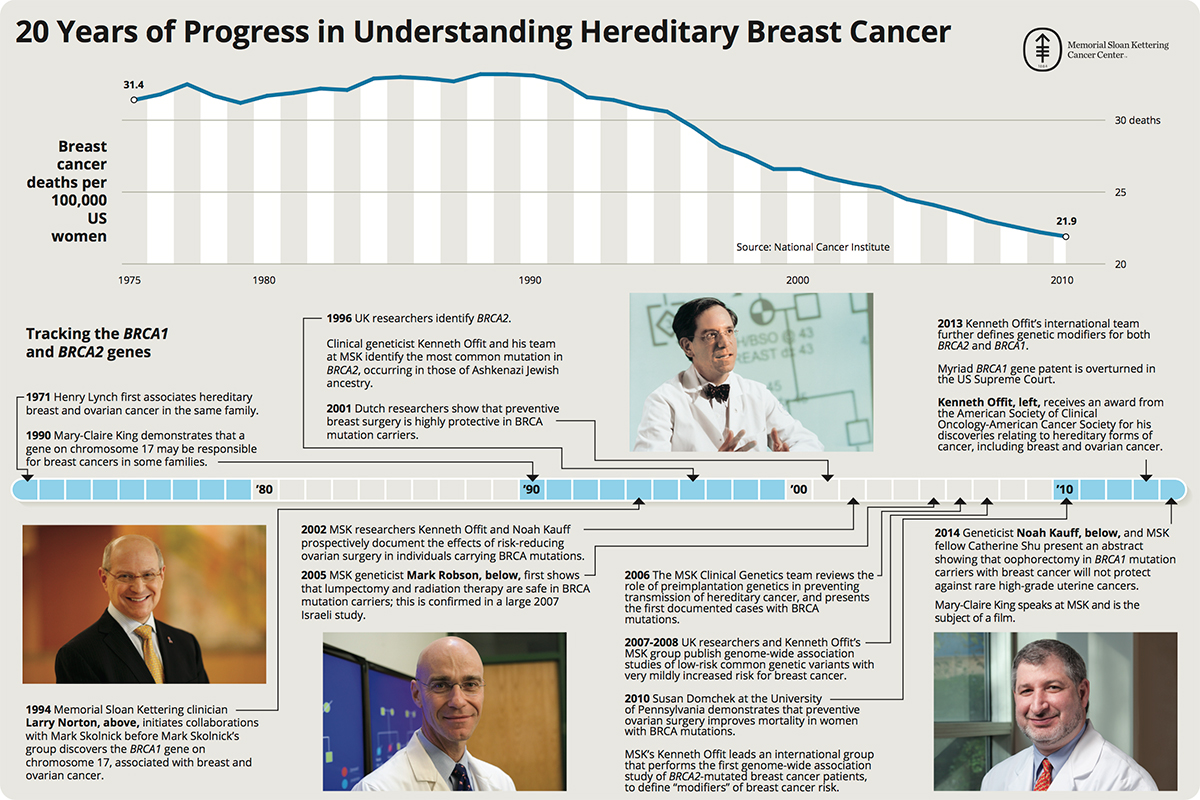
[edit]The BRCA2 gene was discovered in 1994 by a multi-institutional team of scientists, led by researchers at The Institute of Cancer Research, London.[35][16][36] In 1996, Kenneth Offit and his research group at Memorial Sloan Kettering Cancer Center successfully identified the most common mutation on the gene associated with breast and ovarian cancer among individuals of Ashkenazi Jewish ancestry.[37][38][39][40]
The gene was first cloned by scientists at Myriad Genetics, Endo Recherche, Inc., HSC Research & Development Limited Partnership, and the University of Pennsylvania.[41]
Methods to diagnose the likelihood of a patient with mutations in BRCA1 and BRCA2 getting cancer were covered by patents owned or controlled by Myriad Genetics.[42][43] Myriad's business model of exclusively offering the diagnostic test led from Myriad's beginnings as a startup in 1994 to its being a publicly traded company with 1200 employees and about $500M in annual revenue in 2012;[44] it also led to controversy over high test prices and the unavailability of second opinions from other diagnostic labs, which in turn led to the landmark Association for Molecular Pathology v. Myriad Genetics lawsuit.[45]
Germline mutations and founder effect
[edit]All germline BRCA2 mutations identified to date have been inherited, suggesting the possibility of a large "founder" effect in which a certain mutation is common to a well-defined population group and can theoretically be traced back to a common ancestor. Given the complexity of mutation screening for BRCA2, these common mutations may simplify the methods required for mutation screening in certain populations. Analysis of mutations that occur with high frequency also permits the study of their clinical expression.[46] A striking example of a founder mutation is found in Iceland, where a single BRCA2 (999del5) mutation accounts for virtually all breast/ovarian cancer families.[47][48] This frame-shift mutation leads to a highly truncated protein product. In a large study examining hundreds of cancer and control individuals, this 999del5 mutation was found in 0.6% of the general population. Of note, while 72% of patients who were found to be carriers had a moderate or strong family history of breast cancer, 28% had little or no family history of the disease. This strongly suggests the presence of modifying genes that affect the phenotypic expression of this mutation, or possibly the interaction of the BRCA2 mutation with environmental factors. Additional examples of founder mutations in BRCA2 are given in the table below.
| Population or subgroup | BRCA2 mutation(s)[46][49] | Reference(s) |
|---|---|---|
| Ashkenazi Jewish | 6174delT | [50] |
| Dutch | 5579insA | [51] |
| Finns | 8555T>G, 999del5, IVS23-2A>G | [52][53] |
| French Canadians | 8765delAG, 3398delAAAAG | [54][55][56] |
| Hungarians | 9326insA | [57] |
| Icelanders | 999del5 | [47][48] |
| Italians | 8765delAG | [58] |
| Northern Irish | 6503delTT | [59] |
| Pakistanis | 3337C>T | [60] |
| Scottish | 6503delTT | [59] |
| Scottish | c.517-2A>G | [61] |
| Slovenians | IVS16-2A>G | [62] |
| Spanish | 3034delAAAC(codon936), 9254del5 | [63] |
| Swedish | 4486delG | [64] |
Meiosis
[edit]In the plant Arabidopsis thaliana, loss of the BRCA2 homolog AtBRCA2 causes severe defects in both male meiosis and in the development of the female gametocyte.[65] AtBRCA2 protein is required for proper localization of the synaptonemal complex protein AtZYP1 and the recombinases AtRAD51 and AtDMC1. Furthermore, AtBRCA2 is required for proper meiotic synapsis. Thus AtBRCA2 is likely important for meiotic recombination. It appears that AtBRCA2 acts during meiosis to control the single-strand invasion steps mediated by AtRAD51 and AtDMC1 occurring during meiotic homologous recombinational repair of DNA damages.[65]
Homologs of BRCA2 are also essential for meiosis in the fungus Ustilago maydis,[66] the worm Caenorhabditis elegans,[67][68] and the fruitfly Drosophila melanogaster.[69]
Mice that produce truncated versions of BRCA2 are viable but sterile.[70] BRCA2 mutant rats have a phenotype of growth inhibition and sterility in both sexes.[71] Aspermatogenesis in these mutant rats is due to a failure of homologous chromosome synapsis during meiosis.
BRC repeat sequences
[edit]DMC1 (DNA meiotic recombinase 1) is a meiosis specific homolog of RAD51 that mediates strand exchange during homologous recombinational repair. DMC1 promotes the formation of DNA strand invasion products (joint molecules) between homologous DNA molecules. Human DMC1 interacts directly with each of a series of repeat sequences in the BRCA2 protein (called BRC repeats) that stimulate joint molecule formation by DMC1.[72] BRC repeats conform to a motif consisting of a sequence of about 35 highly conserved amino acids that are present at least once in all BRCA2-like proteins. The BRCA2 BRC repeats stimulate joint molecule formation by promoting the interaction of single-stranded DNA (ssDNA) with DMC1.[72] The ssDNA complexed with DMC1 can pair with homologous ssDNA from another chromosome during the synopsis stage of meiosis to form a joint molecule, a central step in homologous recombination. Thus the BRC repeat sequences of BRCA2 appear to play a key role in recombinational repair of DNA damages during meiotic recombination.
Overall, it appears that homologous recombination during meiosis functions to repair DNA damages,[citation needed] and that BRCA2 plays a key role in performing this function.
Neurogenesis
[edit]BRCA2 is required in the mouse for neurogenesis and suppression of medulloblastoma.[73] ‘’BRCA2’’ loss profoundly affects neurogenesis, particularly during embryonic and postnatal neural development. These neurological defects arise from DNA damage.[73]
Epigenetic control
[edit]Epigenetic alterations in expression of BRCA2 (causing over-expression or under-expression) are very frequent in sporadic cancers (see Table below) while mutations in BRCA2 are rarely found.[74][75][76]
In non-small cell lung cancer, BRCA2 is epigenetically repressed by hypermethylation of the promoter.[77] In this case, promoter hypermethylation is significantly associated with low mRNA expression and low protein expression but not with loss of heterozygosity of the gene.
In sporadic ovarian cancer, an opposite effect is found. BRCA2 promoter and 5'-UTR regions have relatively few or no methylated CpG dinucleotides in the tumor DNA compared with that of non-tumor DNA, and a significant correlation is found between hypomethylation and a >3-fold over-expression of BRCA2.[78] This indicates that hypomethylation of the BRCA2 promoter and 5'-UTR regions leads to over-expression of BRCA2 mRNA.
One report indicated some epigenetic control of BRCA2 expression by the microRNAs miR-146a and miR-148a.[79]
BRCA2 expression in cancer
[edit]In eukaryotes, BRCA2 protein has an important role in homologous recombinational repair. In mice and humans, BRCA2 primarily mediates orderly assembly of RAD51 on single-stranded (ss) DNA, the form that is active for homologous pairing and strand invasion.[80] BRCA2 also redirects RAD51 from double-stranded DNA and prevents dissociation from ssDNA.[80] In addition, the four paralogs of RAD51, consisting of RAD51B (RAD51L1), RAD51C (RAD51L2), RAD51D (RAD51L3), XRCC2 form a complex called the BCDX2 complex (see Figure: Recombinational repair of DNA). This complex participates in RAD51 recruitment or stabilization at damage sites.[26] The BCDX2 complex appears to act by facilitating the assembly or stability of the RAD51 nucleoprotein filament. RAD51 catalyses strand transfer between a broken sequence and its undamaged homologue to allow re-synthesis of the damaged region (see homologous recombination models).
Some studies of cancers report over-expressed BRCA2 whereas other studies report under-expression of BRCA2. At least two reports found over-expression in some sporadic breast tumors and under-expression in other sporadic breast tumors.[81][82] (see Table).
Many cancers have epigenetic deficiencies in various DNA repair genes (see Frequencies of epimutations in DNA repair genes in cancers). These repair deficiencies likely cause increased unrepaired DNA damages. The over-expression of BRCA2 seen in many cancers may reflect compensatory BRCA2 over-expression and increased homologous recombinational repair to at least partially deal with such excess DNA damages. Egawa et al.[83] suggest that increased expression of BRCA2 can be explained by the genomic instability frequently seen in cancers, which induces BRCA2 mRNA expression due to an increased need for BRCA2 for DNA repair.
Under-expression of BRCA2 would itself lead to increased unrepaired DNA damages. Replication errors past these damages (see translesion synthesis) would lead to increased mutations and cancer.
| Cancer | Over or Under expression | Frequency of altered expression | Evaluation method | Ref. |
|---|---|---|---|---|
| Sporadic ovarian cancer | Over-expression | 80% | messenger RNA | [78] |
| Sporadic ovarian cancer | Under-expression | 42% | immunohistochemistry | [84] |
| (recurrent cancer in study above) | Increased-expression | 71% | immunohistochemistry | [84] |
| Non-small cell lung cancer | Under-expression | 34% | immunohistochemistry | [77] |
| Breast cancer | Over-expression | 66% | messenger RNA | [83] |
| Breast cancer | Over-expression | 20% | messenger RNA | [81] |
| (same study as above) | Under-expression | 11% | messenger RNA | [81] |
| Breast cancer | Over-expression | 30% | immunohistochemistry | [82] |
| (same study as above) | Under-expression | 30% | immunohistochemistry | [82] |
| Triple negative breast cancer | Under-expression | 90% | immunohistochemistry | [85] |
Interactions
[edit]BRCA2 has been shown to interact with
- BRE,[86]
- BARD1,[86][87]
- BCCIP,[88]
- BRCA1,[86][89][90][91]
- BRCC3,[86]
- BUB1B,[92]
- CREBBP,[93]
- C11orf30,[94]
- FANCD2,[95][96][97]
- FANCG,[98]
- FLNA,[99]
- HMG20B,[100][101]
- P53,[86][102]
- PALB2,[29][103]
- PCAF,[104][105]
- PLK1,[104][106]
- RAD51,[86][89][104][107][108][109][110][111][112][113][88][90][102]
- RPA1,[114]
- SHFM1[115][116] and
- SMAD3.[117]
Domain architecture
[edit]| BRCA2 repeat | |||||||||
|---|---|---|---|---|---|---|---|---|---|
 crystal structure of a rad51-brca2 brc repeat complex | |||||||||
| Identifiers | |||||||||
| Symbol | BRCA2 | ||||||||
| Pfam | PF00634 | ||||||||
| InterPro | IPR002093 | ||||||||
| SCOP2 | 1n0w / SCOPe / SUPFAM | ||||||||
| |||||||||
BRCA2 contains a number of 39 amino acid repeats that are critical for binding to RAD51 (a key protein in DNA recombinational repair) and resistance to methyl methanesulphonate treatment.[102][109][110][118]
The BRCA2 helical domain adopts a helical structure, consisting of a four-helix cluster core (alpha 1, alpha 8, alpha 9, alpha 10) and two successive beta-hairpins (beta 1 to beta 4). An approximately 50-amino acid segment that contains four short helices (alpha 2 to alpha 4), meanders around the surface of the core structure. In BRCA2, the alpha 9 and alpha 10 helices pack with the BRCA2 OB1 domain through van der Waals contacts involving hydrophobic and aromatic residues, and also through side-chain and backbone hydrogen bonds. This domain binds the 70-amino acid DSS1 (deleted in split-hand/split foot syndrome) protein, which was originally identified as one of three genes that map to a 1.5-Mb locus deleted in an inherited developmental malformation syndrome.[116]
The BRCA OB1 domain assumes an OB fold, which consists of a highly curved five-stranded beta-sheet that closes on itself to form a beta-barrel. OB1 has a shallow groove formed by one face of the curved sheet and is demarcated by two loops, one between beta 1 and beta 2 and another between beta 4 and beta 5, which allows for weak single strand DNA binding. The domain also binds the 70-amino acid DSS1 (deleted in split-hand/split foot syndrome) protein.[116]
The BRCA OB3 domain assumes an OB fold, which consists of a highly curved five-stranded beta-sheet that closes on itself to form a beta-barrel. OB3 has a pronounced groove formed by one face of the curved sheet and is demarcated by two loops, one between beta 1 and beta 2 and another between beta 4 and beta 5, which allows for strong ssDNA binding.[116]
The Tower domain adopts a secondary structure consisting of a pair of long, antiparallel alpha-helices (the stem) that support a three-helix bundle (3HB) at their end. The 3HB contains a helix-turn-helix motif and is similar to the DNA binding domains of the bacterial site-specific recombinases, and of eukaryotic Myb and homeodomain transcription factors. The Tower domain has an important role in the tumour suppressor function of BRCA2, and is essential for appropriate binding of BRCA2 to DNA.[116] Studies shown that conformation of this tower domain is allosterically controlled by a small protein "DSS1", which interacts with helical, OB1 and OB2 domains of BRCA2.[119]
Patents, enforcement, litigation, and controversy
[edit]A patent application for the isolated BRCA1 gene and cancer-cancer promoting mutations, as well as methods to diagnose the likelihood of getting breast cancer, was filed by the University of Utah, National Institute of Environmental Health Sciences (NIEHS) and Myriad Genetics in 1994;[42] over the next year, Myriad, in collaboration with other investigators, isolated and sequenced the BRCA2 gene and identified relevant mutations, and the first BRCA2 patent was filed in the U.S. by Myriad and the other institutions in 1995.[41] Myriad is the exclusive licensee of these patents and has enforced them in the US against clinical diagnostic labs.[45] This business model led from Myriad being a startup in 1994 to being a publicly traded company with 1200 employees and about $500M in annual revenue in 2012;[44] it also led to controversy over high prices and the inability to get second opinions from other diagnostic labs, which in turn led to the landmark Association for Molecular Pathology v. Myriad Genetics lawsuit.[45][120] The patents begin to expire in 2014.
Peter Meldrum, CEO of Myriad Genetics, has acknowledged that Myriad has "other competitive advantages that may make such [patent] enforcement unnecessary" in Europe.[121]
Legal decisions surrounding the BRCA1 and BRCA2 patents will affect the field of genetic testing in general.[122] In June 2013, in Association for Molecular Pathology v. Myriad Genetics (No. 12-398), the US Supreme Court unanimously ruled that, "A naturally occurring DNA segment is a product of nature and not patent eligible merely because it has been isolated," invalidating Myriad's patents on the BRCA1 and BRCA2 genes. However, the Court also held that manipulation of a gene to create something not found in nature could still be eligible for patent protection.[123] The Federal Court of Australia came to the opposite conclusion, upholding the validity of an Australian Myriad Genetics patent over the BRCA1 gene in February 2013,[124] but this decision is being appealed and the appeal will include consideration of the US Supreme Court ruling.[125]
References
[edit]- ^ a b c GRCh38: Ensembl release 89: ENSG00000139618 – Ensembl, May 2017
- ^ a b c GRCm38: Ensembl release 89: ENSMUSG00000041147 – Ensembl, May 2017
- ^ "Human PubMed Reference:". National Center for Biotechnology Information, U.S. National Library of Medicine.
- ^ "Mouse PubMed Reference:". National Center for Biotechnology Information, U.S. National Library of Medicine.
- ^ Hamel PJ (2007-05-29). "BRCA1 and BRCA2: No Longer the Only Troublesome Genes Out There". HealthCentral. Retrieved 2010-07-02.
- ^ "OrthoMaM phylogenetic marker: BRCA2 coding sequence". Archived from the original on 2016-03-03. Retrieved 2010-02-19.
- ^ "BRCA2 gene tree". Ensembl. May 2021
- ^ Duncan JA, Reeves JR, Cooke TG (October 1998). "BRCA1 and BRCA2 proteins: roles in health and disease". Molecular Pathology. 51 (5): 237–47. doi:10.1136/mp.51.5.237. PMC 395646. PMID 10193517.
- ^ Yoshida K, Miki Y (November 2004). "Role of BRCA1 and BRCA2 as regulators of DNA repair, transcription, and cell cycle in response to DNA damage". Cancer Science. 95 (11): 866–71. doi:10.1111/j.1349-7006.2004.tb02195.x. PMC 11159131. PMID 15546503. S2CID 24297965.
- ^ Check W (2006-09-01). "BRCA: What we know now". College of American Pathologists. Retrieved 2010-08-23.
- ^ Friedenson B (August 2007). "The BRCA1/2 pathway prevents hematologic cancers in addition to breast and ovarian cancers". BMC Cancer. 7 (1): 152–162. doi:10.1186/1471-2407-7-152. PMC 1959234. PMID 17683622.
- ^ Friedenson B (2008-06-08). "Breast cancer genes protect against some leukemias and lymphomas" (video). SciVee.
- ^ "Breast and Ovarian Cancer Genetic Screening". Palo Alto Medical Foundation. Archived from the original on 4 October 2008. Retrieved 2008-10-11.
- ^ Friedenson B (2007). "The BRCA1/2 pathway prevents hematologic cancers in addition to breast and ovarian cancers". BMC Cancer. 7 (1): 152. doi:10.1186/1471-2407-7-152. PMC 1959234. PMID 17683622.
- ^ O'Donovan PJ, Livingston DM (April 2010). "BRCA1 and BRCA2: breast/ovarian cancer susceptibility gene products and participants in DNA double-strand break repair". Carcinogenesis. 31 (6): 961–7. doi:10.1093/carcin/bgq069. PMID 20400477.
- ^ a b Wooster R, Neuhausen SL, Mangion J, Quirk Y, Ford D, Collins N, et al. (September 1994). "Localization of a breast cancer susceptibility gene, BRCA2, to chromosome 13q12-13". Science. 265 (5181): 2088–90. Bibcode:1994Sci...265.2088W. doi:10.1126/science.8091231. PMID 8091231.
- ^ "BRCA2 breast cancer 2, early onset [Homo sapiens]". EntrezGene. National Center for Biotechnology Information, U.S. National Library of Medicine.
- ^ "Breast cancer type 2 susceptibility protein - Homo sapiens (Human)". P51587. UniProt.
- ^ Williams-Jones B (2002). Genetic testing for sale: Implications of commercial brca testing in Canada (Ph.D.). The University of British Columbia.
- ^ D'Andrea AD (2010). "Susceptibility pathways in Fanconi's anemia and breast cancer". N. Engl. J. Med. 362 (20): 1909–19. doi:10.1056/NEJMra0809889. PMC 3069698. PMID 20484397.
- ^ Sobeck A, Stone S, Landais I, de Graaf B, Hoatlin ME (2009). "The Fanconi anemia protein FANCM is controlled by FANCD2 and the ATR/ATM pathways". J. Biol. Chem. 284 (38): 25560–8. doi:10.1074/jbc.M109.007690. PMC 2757957. PMID 19633289.
- ^ Castillo P, Bogliolo M, Surralles J (2011). "Coordinated action of the Fanconi anemia and ataxia telangiectasia pathways in response to oxidative damage". DNA Repair (Amst.). 10 (5): 518–25. doi:10.1016/j.dnarep.2011.02.007. PMID 21466974.
- ^ Stolz A, Ertych N, Bastians H (2011). "Tumor suppressor CHK2: regulator of DNA damage response and mediator of chromosomal stability". Clin. Cancer Res. 17 (3): 401–5. doi:10.1158/1078-0432.CCR-10-1215. PMID 21088254.
- ^ Taniguchi T, Garcia-Higuera I, Andreassen PR, Gregory RC, Grompe M, D'Andrea AD (2002). "S-phase-specific interaction of the Fanconi anemia protein, FANCD2, with BRCA1 and RAD51". Blood. 100 (7): 2414–20. doi:10.1182/blood-2002-01-0278. PMID 12239151.
- ^ Park JY, Zhang F, Andreassen PR (2014). "PALB2: the hub of a network of tumor suppressors involved in DNA damage responses". Biochim. Biophys. Acta. 1846 (1): 263–75. doi:10.1016/j.bbcan.2014.06.003. PMC 4183126. PMID 24998779.
- ^ a b Chun J, Buechelmaier ES, Powell SN (2013). "Rad51 paralog complexes BCDX2 and CX3 act at different stages in the BRCA1-BRCA2-dependent homologous recombination pathway". Mol. Cell. Biol. 33 (2): 387–95. doi:10.1128/MCB.00465-12. PMC 3554112. PMID 23149936.
- ^ Jensen RB, Carreira A, Kowalczykowski SC (October 2010). "Purified human BRCA2 stimulates RAD51-mediated recombination". Nature. 467 (7316): 678–83. Bibcode:2010Natur.467..678J. doi:10.1038/nature09399. PMC 2952063. PMID 20729832.
- ^ Wang CX, Jimenez-Sainz J, Jensen RB, Mazin AV (March 2019). "The Post-Synaptic Function of Brca2". Scientific Reports. 9 (1): 4554. Bibcode:2019NatSR...9.4554W. doi:10.1038/s41598-019-41054-y. PMC 6418147. PMID 30872704.
- ^ a b Xia B, Sheng Q, Nakanishi K, Ohashi A, Wu J, Christ N, et al. (June 2006). "Control of BRCA2 cellular and clinical functions by a nuclear partner, PALB2". Molecular Cell. 22 (6): 719–29. doi:10.1016/j.molcel.2006.05.022. PMID 16793542.
- ^ Buisson R, Dion-Côté AM, Coulombe Y, Launay H, Cai H, Stasiak AZ, et al. (October 2010). "Cooperation of breast cancer proteins PALB2 and piccolo BRCA2 in stimulating homologous recombination". Nature Structural & Molecular Biology. 17 (10): 1247–54. doi:10.1038/nsmb.1915. PMC 4094107. PMID 20871615.
- ^ Mijic S, Zellweger R, Chappidi N, Berti M, Jacobs K, Mutreja K, et al. (October 2017). "Replication fork reversal triggers fork degradation in BRCA2-defective cells". Nature Communications. 8 (1): 859. Bibcode:2017NatCo...8..859M. doi:10.1038/s41467-017-01164-5. PMC 5643541. PMID 29038466.
- ^ Petrucelli N, Daly MB, Pal T (December 2016) [September 1998]. "BRCA1- and BRCA2-Associated Hereditary Breast and Ovarian Cancer". In Adam MP, Ardinger HH, Pagon RA, Wallace SE, Bean LJ, Mirzaa G, Amemiya A (eds.). GeneReviews. University of Washington, Seattle. PMID 20301425.
- ^ Levin B, Lech D, Friedenson B (2012). "Evidence that BRCA1- or BRCA2-associated cancers are not inevitable". Molecular Medicine. 18 (9): 1327–37. doi:10.2119/molmed.2012.00280. PMC 3521784. PMID 22972572.
- ^ "High-Penetrance Breast and/or Ovarian Cancer Susceptibility Genes". National Cancer Institute. Retrieved 7 December 2012.
- ^ Wooster R, Bignell G, Lancaster J, Swift S, Seal S, Mangion J, et al. (1995). "Identification of the breast cancer susceptibility gene BRCA2". Nature. 378 (6559): 789–792. Bibcode:1995Natur.378..789W. doi:10.1038/378789a0. PMID 8524414. S2CID 4346791.
- ^ High-Impact Science: Tracking down the BRCA genes (Part 2) Archived 2012-03-03 at the Wayback Machine - Cancer Research UK science blog, 2012
- ^ "Kenneth Offit | Breast Cancer Research Foundation | BCRF". Bcrfcure.org. 23 June 2014. Archived from the original on 2015-07-17. Retrieved 2015-07-16.
- ^ "A revolution at 50; kenneth offit". The New York Times. 2003-02-25. ISSN 0362-4331. Retrieved 2015-07-02.
- ^ "20 Years of Progress in Understanding Breast Cancer" (JPG). Mskcc.org. Retrieved 2015-07-17.
- ^ Kolata G (1996-10-02). "2d Breast Cancer Gene Found in Jewish Women". The New York Times. ISSN 0362-4331. Retrieved 2015-07-07.
- ^ a b US patent 5837492, Tavtigian SV, Kamb A, Simard J, Couch F, Rommens JM, Weber BL, "Chromosome 13-linked breast cancer susceptibility gene", issued 1998-11-17, assigned to Myriad Genetics, Inc., Endo Recherche, Inc., HSC Research & Development Limited Partnership, Trustees of the University of Pennsylvania
- ^ a b US patent 5747282, Skolnick HS, Goldgar DE, Miki Y, Swenson J, Kamb A, Harshman KD, Shattuck-Eidens DM, Tavtigian SV, Wiseman RW, Futreal PA, "7Q-linked breast and ovarian cancer susceptibility gene", issued 1998-05-05, assigned to Myriad Genetics, Inc., The United States of America as represented by the Secretary of Health and Human Services, and University of Utah Research Foundation
- ^ US patent 5837492, Tavtigian SV, Kamb A, Simard J, Couch F, Rommens JM, Weber BL, "Chromosome 13-linked breast cancer susceptibility gene", issued 1998-11-17, assigned to Myriad Genetics, Inc., Endo Recherche, Inc., HSC Research & Development Limited Partnership, Trustees of the University of Pennsylvania
- ^ a b Myriad Investor Page—see "Myriad at a glance" Archived 2012-10-18 at the Wayback Machine accessed October 2012
- ^ a b c Schwartz J (2009-05-12). "Cancer Patients Challenge the Patenting of a Gene". Health. New York Times.
- ^ a b Lacroix M, Leclercq G (2005). "The "portrait" of hereditary breast cancer". Breast Cancer Research and Treatment. 89 (3): 297–304. doi:10.1007/s10549-004-2172-4. PMID 15754129. S2CID 23327569.
- ^ a b Thorlacius S, Olafsdottir G, Tryggvadottir L, Neuhausen S, Jonasson JG, Tavtigian SV, et al. (1996). "A single BRCA2 mutation in male and female breast cancer families from Iceland with varied cancer phenotypes". Nature Genetics. 13 (1): 117–119. doi:10.1038/ng0596-117. PMID 8673089. S2CID 8443452.
- ^ a b Thorlacius S, Sigurdsson S, Bjarnadottir H, Olafsdottir G, Jonasson JG, Tryggvadottir L, et al. (1997). "Study of a single BRCA2 mutation with high carrier frequency in a small population". American Journal of Human Genetics. 60 (5): 1079–1085. PMC 1712443. PMID 9150155.
- ^ den Dunnen JT, Antonarakis SE (2000). "Mutation nomenclature extensions and suggestions to describe complex mutations: a discussion". Human Mutation. 15 (1): 7–12. doi:10.1002/(SICI)1098-1004(200001)15:1<7::AID-HUMU4>3.0.CO;2-N. PMID 10612815.
- ^ Neuhausen S, Gilewski T, Norton L, Tran T, McGuire P, Swensen J, et al. (1996). "Recurrent BRCA2 6174delT mutations in Ashkenazi Jewish women affected by breast cancer". Nature Genetics. 13 (1): 126–128. doi:10.1038/ng0596-126. PMID 8673092. S2CID 11909356.
- ^ Verhoog LC, van den Ouweland AM, Berns E, van Veghel-Plandsoen MM, van Staveren IL, Wagner A, et al. (2001). "Large regional differences in the frequency of distinct BRCA1/BRCA2 mutations in 517 Dutch breast and/or ovarian cancer families". European Journal of Cancer. 37 (16): 2082–2090. doi:10.1016/S0959-8049(01)00244-1. PMID 11597388.
- ^ Huusko P, Pääkkönen K, Launonen V, Pöyhönen M, Blanco G, Kauppila A, et al. (1998). "Evidence of founder mutations in Finnish BRCA1 and BRCA2 families". American Journal of Human Genetics. 62 (6): 1544–1548. doi:10.1086/301880. PMC 1377159. PMID 9585608.
- ^ Pääkkönen K, Sauramo S, Sarantaus L, Vahteristo P, Hartikainen A, Vehmanen P, et al. (2001). "Involvement of BRCA1 and BRCA2 in breast cancer in a western Finnish sub-population". Genetic Epidemiology. 20 (2): 239–246. doi:10.1002/1098-2272(200102)20:2<239::AID-GEPI6>3.0.CO;2-Y. PMID 11180449. S2CID 41804152.
- ^ Tonin PN, Mes-Masson AM, Narod SA, Ghadirian P, Provencher D (1999). "Founder BRCA1 and BRCA2 mutations in French Canadian ovarian cancer cases unselected for family history". Clinical Genetics. 55 (5): 318–324. doi:10.1034/j.1399-0004.1999.550504.x. PMID 10422801. S2CID 23931343.
- ^ Oros KK, Leblanc G, Arcand SL, Shen Z, Perret C, Mes-Masson AM, et al. (2006). "Haplotype analysis suggests common founders in carriers of recurrent BRCA2 mutation, 3398delAAAAG, in French Canadian hereditary breast and/ovarian cancer families". BMC Medical Genetics. 7 (23): 23. doi:10.1186/1471-2350-7-23. PMC 1464093. PMID 16539696.
- ^ Tonin PN (2006). "The limited spectrum of pathogenic BRCA1 and BRCA2 mutations in the French Canadian breast and breast-ovarian cancer families, a founder population of Quebec, Canada". Bull Cancer. 93 (9): 841–846. PMID 16980226.
- ^ Van Der Looij M, Szabo C, Besznyak I, Liszka G, Csokay B, Pulay T, et al. (2000). "Prevalence of founder BRCA1 and BRCA2 mutations among breast and ovarian cancer patients in Hungary". International Journal of Cancer. 86 (5): 737–740. doi:10.1002/(SICI)1097-0215(20000601)86:5<737::AID-IJC21>3.0.CO;2-1. PMID 10797299. S2CID 25394976.
- ^ Pisano M, Cossu A, Persico I, Palmieri G, Angius A, Casu G, et al. (2000). "Identification of a founder BRCA2 mutation in Sardinia". British Journal of Cancer. 82 (3): 553–559. doi:10.1054/bjoc.1999.0963. PMC 2363305. PMID 10682665.
- ^ a b Anderson E, Anderson V, Baty D, Beers C, Black D, Black R, et al. (Scottish/Northern Irish BRCAI/BRCA2 Consortium) (2003). "BRCA1 and BRCA2 mutations in Scotland and Northern Ireland". British Journal of Cancer. 88 (8): 1256–1262. doi:10.1038/sj.bjc.6600840. PMC 2747571. PMID 12698193.
- ^ Liede A, Malik IA, Aziz Z, Rios Pd Pde L, Kwan E, Narod SA (2002). "Contribution of BRCA1 and BRCA2 mutations to breast and ovarian cancer in Pakistan". American Journal of Human Genetics. 71 (3): 595–606. doi:10.1086/342506. PMC 379195. PMID 12181777.
- ^ Kerr SM, Klaric L, Muckian MD, Cowan E, Snadden L, Tzoneva G, et al. (2024). "Two founder variants account for over 90% of pathogenic BRCA alleles in Orkney and Shetland". medRxiv 10.1101/2024.04.03.24305239.
- ^ Krajc M, De Grève J, Goelen G, Teugels E (2002). "BRCA2 founder mutation in Slovenian breast cancer families". European Journal of Human Genetics. 10 (12): 879–882. doi:10.1038/sj.ejhg.5200886. PMID 12461697.
- ^ Osorio A, Robledo M, Martínez B, Cebrián A, San Román JM, Albertos J, et al. (1998). "Molecular analysis of the BRCA2 gene in 16 breast/ovarian cancer Spanish families". Clin. Genet. 54 (2): 142–7. doi:10.1111/j.1399-0004.1998.tb03717.x. PMID 9761393. S2CID 30388365.
- ^ Neuhausen SL (2000). "Founder populations and their uses for breast cancer genetics". Cancer Research. 2 (2): 77–81. doi:10.1186/bcr36. PMC 139426. PMID 11250694.
- ^ a b Seeliger K, Dukowic-Schulze S, Wurz-Wildersinn R, Pacher M, Puchta H (2012). "BRCA2 is a mediator of RAD51- and DMC1-facilitated homologous recombination in Arabidopsis thaliana". New Phytol. 193 (2): 364–75. doi:10.1111/j.1469-8137.2011.03947.x. PMID 22077663.
- ^ Kojic M, Kostrub CF, Buchman AR, Holloman WK (2002). "BRCA2 homolog required for proficiency in DNA repair, recombination, and genome stability in Ustilago maydis". Mol. Cell. 10 (3): 683–91. doi:10.1016/s1097-2765(02)00632-9. PMID 12408834.
- ^ Ko E, Lee J, Lee H (2008). "Essential role of brc-2 in chromosome integrity of germ cells in C. elegans". Mol. Cells. 26 (6): 590–4. doi:10.1016/S1016-8478(23)14041-6. PMID 18779660.
- ^ Martin JS, Winkelmann N, Petalcorin MI, McIlwraith MJ, Boulton SJ (2005). "RAD-51-dependent and -independent roles of a Caenorhabditis elegans BRCA2-related protein during DNA double-strand break repair". Mol. Cell. Biol. 25 (8): 3127–39. doi:10.1128/MCB.25.8.3127-3139.2005. PMC 1069622. PMID 15798199.
- ^ Klovstad M, Abdu U, Schüpbach T (2008). "Drosophila brca2 is required for mitotic and meiotic DNA repair and efficient activation of the meiotic recombination checkpoint". PLOS Genet. 4 (2): e31. doi:10.1371/journal.pgen.0040031. PMC 2233675. PMID 18266476.
- ^ Connor F, Bertwistle D, Mee PJ, Ross GM, Swift S, Grigorieva E, et al. (1997). "Tumorigenesis and a DNA repair defect in mice with a truncating Brca2 mutation". Nat. Genet. 17 (4): 423–30. doi:10.1038/ng1297-423. PMID 9398843. S2CID 42462448.
- ^ Cotroneo MS, Haag JD, Zan Y, Lopez CC, Thuwajit P, Petukhova GV, et al. (2007). "Characterizing a rat Brca2 knockout model". Oncogene. 26 (11): 1626–35. doi:10.1038/sj.onc.1209960. PMID 16964288.
- ^ a b Martinez JS, von Nicolai C, Kim T, Ehlén Å, Mazin AV, Kowalczykowski SC, et al. (2016). "BRCA2 regulates DMC1-mediated recombination through the BRC repeats". Proc. Natl. Acad. Sci. U.S.A. 113 (13): 3515–20. Bibcode:2016PNAS..113.3515M. doi:10.1073/pnas.1601691113. PMC 4822569. PMID 26976601.
- ^ a b Frappart PO, Lee Y, Lamont J, McKinnon PJ (2007). "BRCA2 is required for neurogenesis and suppression of medulloblastoma". EMBO J. 26 (11): 2732–42. doi:10.1038/sj.emboj.7601703. PMC 1888666. PMID 17476307.
- ^ Teng DH, Bogden R, Mitchell J, Baumgard M, Bell R, Berry S, et al. (1996). "Low incidence of BRCA2 mutations in breast carcinoma and other cancers". Nat. Genet. 13 (2): 241–4. doi:10.1038/ng0696-241. PMID 8640236. S2CID 9831745.
- ^ Miki Y, Katagiri T, Kasumi F, Yoshimoto T, Nakamura Y (1996). "Mutation analysis in the BRCA2 gene in primary breast cancers". Nat. Genet. 13 (2): 245–7. doi:10.1038/ng0696-245. PMID 8640237. S2CID 3203046.
- ^ Lancaster JM, Wooster R, Mangion J, Phelan CM, Cochran C, Gumbs C, et al. (1996). "BRCA2 mutations in primary breast and ovarian cancers". Nat. Genet. 13 (2): 238–40. doi:10.1038/ng0696-238. PMID 8640235. S2CID 26808443.
- ^ a b Lee MN, Tseng RC, Hsu HS, Chen JY, Tzao C, Ho WL, et al. (2007). "Epigenetic inactivation of the chromosomal stability control genes BRCA1, BRCA2, and XRCC5 in non-small cell lung cancer". Clin. Cancer Res. 13 (3): 832–8. doi:10.1158/1078-0432.CCR-05-2694. PMID 17289874.
- ^ a b Chan KY, Ozçelik H, Cheung AN, Ngan HY, Khoo US (2002). "Epigenetic factors controlling the BRCA1 and BRCA2 genes in sporadic ovarian cancer". Cancer Res. 62 (14): 4151–6. PMID 12124354.
- ^ Gu Y, Zhang M, Peng F, Fang L, Zhang Y, Liang H, et al. (2015). "The BRCA1/2-directed miRNA signature predicts a good prognosis in ovarian cancer patients with wild-type BRCA1/2". Oncotarget. 6 (4): 2397–406. doi:10.18632/oncotarget.2963. PMC 4385859. PMID 25537514.
- ^ a b Holloman WK (2011). "Unraveling the mechanism of BRCA2 in homologous recombination". Nat. Struct. Mol. Biol. 18 (7): 748–54. doi:10.1038/nsmb.2096. PMC 3647347. PMID 21731065.
- ^ a b c Bièche I, Noguès C, Lidereau R (1999). "Overexpression of BRCA2 gene in sporadic breast tumours". Oncogene. 18 (37): 5232–8. doi:10.1038/sj.onc.1202903. PMID 10498873.
- ^ a b c Hedau S, Batra M, Singh UR, Bharti AC, Ray A, Das BC (2015). "Expression of BRCA1 and BRCA2 proteins and their correlation with clinical staging in breast cancer". J Cancer Res Ther. 11 (1): 158–63. doi:10.4103/0973-1482.140985. PMID 25879355.
- ^ a b Egawa C, Miyoshi Y, Taguchi T, Tamaki Y, Noguchi S (2002). "High BRCA2 mRNA expression predicts poor prognosis in breast cancer patients". Int. J. Cancer. 98 (6): 879–82. doi:10.1002/ijc.10231. PMID 11948466. S2CID 9083282.
- ^ a b Swisher EM, Gonzalez RM, Taniguchi T, Garcia RL, Walsh T, Goff BA, et al. (2009). "Methylation and protein expression of DNA repair genes: association with chemotherapy exposure and survival in sporadic ovarian and peritoneal carcinomas". Mol. Cancer. 8 (1): 48. doi:10.1186/1476-4598-8-48. PMC 2719582. PMID 19602291.
- ^ Thike AA, Tan PH, Ikeda M, Iqbal J (2016). "Increased ID4 expression, accompanied by mutant p53 accumulation and loss of BRCA1/2 proteins in triple-negative breast cancer, adversely affects survival". Histopathology. 68 (5): 702–12. doi:10.1111/his.12801. PMID 26259780. S2CID 3566545.
- ^ a b c d e f Dong Y, Hakimi MA, Chen X, Kumaraswamy E, Cooch NS, Godwin AK, et al. (November 2003). "Regulation of BRCC, a holoenzyme complex containing BRCA1 and BRCA2, by a signalosome-like subunit and its role in DNA repair". Mol. Cell. 12 (5): 1087–99. doi:10.1016/S1097-2765(03)00424-6. PMID 14636569.
- ^ Ryser S, Dizin E, Jefford CE, Delaval B, Gagos S, Christodoulidou A, et al. (February 2009). "Distinct roles of BARD1 isoforms in mitosis: full-length BARD1 mediates Aurora B degradation, cancer-associated BARD1beta scaffolds Aurora B and BRCA2". Cancer Res. 69 (3): 1125–34. doi:10.1158/0008-5472.CAN-08-2134. PMID 19176389.
- ^ a b Liu J, Yuan Y, Huan J, Shen Z (January 2001). "Inhibition of breast and brain cancer cell growth by BCCIPalpha, an evolutionarily conserved nuclear protein that interacts with BRCA2". Oncogene. 20 (3): 336–45. doi:10.1038/sj.onc.1204098. PMID 11313963.
- ^ a b Sarkisian CJ, Master SR, Huber LJ, Ha SI, Chodosh LA (October 2001). "Analysis of murine Brca2 reveals conservation of protein-protein interactions but differences in nuclear localization signals". J. Biol. Chem. 276 (40): 37640–8. doi:10.1074/jbc.M106281200. PMID 11477095.
- ^ a b Chen J, Silver DP, Walpita D, Cantor SB, Gazdar AF, Tomlinson G, et al. (September 1998). "Stable interaction between the products of the BRCA1 and BRCA2 tumor suppressor genes in mitotic and meiotic cells". Mol. Cell. 2 (3): 317–28. doi:10.1016/S1097-2765(00)80276-2. PMID 9774970.
- ^ Reuter TY, Medhurst AL, Waisfisz Q, Zhi Y, Herterich S, Hoehn H, et al. (October 2003). "Yeast two-hybrid screens imply involvement of Fanconi anemia proteins in transcription regulation, cell signaling, oxidative metabolism, and cellular transport". Exp. Cell Res. 289 (2): 211–21. doi:10.1016/S0014-4827(03)00261-1. PMID 14499622.
- ^ Futamura M, Arakawa H, Matsuda K, Katagiri T, Saji S, Miki Y, et al. (March 2000). "Potential role of BRCA2 in a mitotic checkpoint after phosphorylation by hBUBR1". Cancer Res. 60 (6): 1531–5. PMID 10749118.
- ^ Siddique H, Rao VN, Reddy ES (August 2009). "CBP-mediated post-translational N-glycosylation of BRCA2". Int J Oncol. 35 (2): 16387–91. doi:10.3892/ijo_00000351. PMID 19578754.
- ^ Hughes-Davies L, Huntsman D, Ruas M, Fuks F, Bye J, Chin SF, et al. (November 2003). "EMSY links the BRCA2 pathway to sporadic breast and ovarian cancer". Cell. 115 (5): 523–35. doi:10.1016/S0092-8674(03)00930-9. PMID 14651845. S2CID 18911371.
- ^ Wang X, Andreassen PR, D'Andrea AD (July 2004). "Functional interaction of monoubiquitinated FANCD2 and BRCA2/FANCD1 in chromatin". Mol. Cell. Biol. 24 (13): 5850–62. doi:10.1128/MCB.24.13.5850-5862.2004. PMC 480901. PMID 15199141.
- ^ Hussain S, Wilson JB, Medhurst AL, Hejna J, Witt E, Ananth S, et al. (June 2004). "Direct interaction of FANCD2 with BRCA2 in DNA damage response pathways". Hum. Mol. Genet. 13 (12): 1241–8. doi:10.1093/hmg/ddh135. PMID 15115758.
- ^ Hejna J, Holtorf M, Hines J, Mathewson L, Hemphill A, Al-Dhalimy M, et al. (April 2008). "Tip60 is required for DNA interstrand cross-link repair in the Fanconi anemia pathway". J. Biol. Chem. 283 (15): 9844–51. doi:10.1074/jbc.M709076200. PMC 2398728. PMID 18263878.
- ^ Hussain S, Witt E, Huber PA, Medhurst AL, Ashworth A, Mathew CG (October 2003). "Direct interaction of the Fanconi anaemia protein FANCG with BRCA2/FANCD1". Hum. Mol. Genet. 12 (19): 2503–10. doi:10.1093/hmg/ddg266. PMID 12915460.
- ^ Yuan Y, Shen Z (December 2001). "Interaction with BRCA2 suggests a role for filamin-1 (hsFLNa) in DNA damage response". J. Biol. Chem. 276 (51): 48318–24. doi:10.1074/jbc.M102557200. PMID 11602572.
- ^ Marmorstein LY, Kinev AV, Chan GK, Bochar DA, Beniya H, Epstein JA, et al. (January 2001). "A human BRCA2 complex containing a structural DNA binding component influences cell cycle progression". Cell. 104 (2): 247–57. doi:10.1016/S0092-8674(01)00209-4. PMID 11207365. S2CID 5822368.
- ^ Hakimi MA, Bochar DA, Chenoweth J, Lane WS, Mandel G, Shiekhattar R (May 2002). "A core-BRAF35 complex containing histone deacetylase mediates repression of neuronal-specific genes". Proc. Natl. Acad. Sci. U.S.A. 99 (11): 7420–5. Bibcode:2002PNAS...99.7420H. doi:10.1073/pnas.112008599. PMC 124246. PMID 12032298.
- ^ a b c Marmorstein LY, Ouchi T, Aaronson SA (November 1998). "The BRCA2 gene product functionally interacts with p53 and RAD51". Proc. Natl. Acad. Sci. U.S.A. 95 (23): 13869–74. Bibcode:1998PNAS...9513869M. doi:10.1073/pnas.95.23.13869. PMC 24938. PMID 9811893.
- ^ "Entrez Gene: PALB2 partner and localizer of BRCA2".
- ^ a b c Lin HR, Ting NS, Qin J, Lee WH (September 2003). "M phase-specific phosphorylation of BRCA2 by Polo-like kinase 1 correlates with the dissociation of the BRCA2-P/CAF complex". J. Biol. Chem. 278 (38): 35979–87. doi:10.1074/jbc.M210659200. PMID 12815053.
- ^ Fuks F, Milner J, Kouzarides T (November 1998). "BRCA2 associates with acetyltransferase activity when bound to P/CAF". Oncogene. 17 (19): 2531–4. doi:10.1038/sj.onc.1202475. PMID 9824164.
- ^ Lee M, Daniels MJ, Venkitaraman AR (January 2004). "Phosphorylation of BRCA2 by the Polo-like kinase Plk1 is regulated by DNA damage and mitotic progression". Oncogene. 23 (4): 865–72. doi:10.1038/sj.onc.1207223. PMID 14647413.
- ^ Sharan SK, Morimatsu M, Albrecht U, Lim DS, Regel E, Dinh C, et al. (April 1997). "Embryonic lethality and radiation hypersensitivity mediated by Rad51 in mice lacking Brca2". Nature. 386 (6627): 804–10. Bibcode:1997Natur.386..804S. doi:10.1038/386804a0. hdl:11858/00-001M-0000-0010-5059-F. PMID 9126738. S2CID 4238943.
- ^ Yu DS, Sonoda E, Takeda S, Huang CL, Pellegrini L, Blundell TL, et al. (October 2003). "Dynamic control of Rad51 recombinase by self-association and interaction with BRCA2". Mol. Cell. 12 (4): 1029–41. doi:10.1016/S1097-2765(03)00394-0. PMID 14580352.
- ^ a b Chen PL, Chen CF, Chen Y, Xiao J, Sharp ZD, Lee WH (April 1998). "The BRC repeats in BRCA2 are critical for RAD51 binding and resistance to methyl methanesulfonate treatment". Proc. Natl. Acad. Sci. U.S.A. 95 (9): 5287–92. Bibcode:1998PNAS...95.5287C. doi:10.1073/pnas.95.9.5287. PMC 20253. PMID 9560268.
- ^ a b Wong AK, Pero R, Ormonde PA, Tavtigian SV, Bartel PL (December 1997). "RAD51 interacts with the evolutionarily conserved BRC motifs in the human breast cancer susceptibility gene brca2". J. Biol. Chem. 272 (51): 31941–4. doi:10.1074/jbc.272.51.31941. PMID 9405383.
- ^ Katagiri T, Saito H, Shinohara A, Ogawa H, Kamada N, Nakamura Y, et al. (March 1998). "Multiple possible sites of BRCA2 interacting with DNA repair protein RAD51". Genes Chromosomes Cancer. 21 (3): 217–22. doi:10.1002/(SICI)1098-2264(199803)21:3<217::AID-GCC5>3.0.CO;2-2. PMID 9523196. S2CID 45954246.
- ^ Pellegrini L, Yu DS, Lo T, Anand S, Lee M, Blundell TL, et al. (November 2002). "Insights into DNA recombination from the structure of a RAD51-BRCA2 complex". Nature. 420 (6913): 287–93. Bibcode:2002Natur.420..287P. doi:10.1038/nature01230. PMID 12442171. S2CID 4359383.
- ^ Tarsounas M, Davies AA, West SC (January 2004). "RAD51 localization and activation following DNA damage". Philos. Trans. R. Soc. Lond. B Biol. Sci. 359 (1441): 87–93. doi:10.1098/rstb.2003.1368. PMC 1693300. PMID 15065660.
- ^ Wong JM, Ionescu D, Ingles CJ (January 2003). "Interaction between BRCA2 and replication protein A is compromised by a cancer-predisposing mutation in BRCA2". Oncogene. 22 (1): 28–33. doi:10.1038/sj.onc.1206071. PMID 12527904.
- ^ Marston NJ, Richards WJ, Hughes D, Bertwistle D, Marshall CJ, Ashworth A (July 1999). "Interaction between the product of the breast cancer susceptibility gene BRCA2 and DSS1, a protein functionally conserved from yeast to mammals". Mol. Cell. Biol. 19 (7): 4633–42. doi:10.1128/MCB.19.7.4633. PMC 84261. PMID 10373512.
- ^ a b c d e Yang H, Jeffrey PD, Miller J, Kinnucan E, Sun Y, Thoma NH, et al. (September 2002). "BRCA2 function in DNA binding and recombination from a BRCA2-DSS1-ssDNA structure". Science. 297 (5588): 1837–48. Bibcode:2002Sci...297.1837Y. doi:10.1126/science.297.5588.1837. PMID 12228710.
- ^ Preobrazhenska O, Yakymovych M, Kanamoto T, Yakymovych I, Stoika R, Heldin CH, et al. (August 2002). "BRCA2 and Smad3 synergize in regulation of gene transcription". Oncogene. 21 (36): 5660–4. doi:10.1038/sj.onc.1205732. PMID 12165866.
- ^ Bork P, Blomberg N, Nilges M (May 1996). "Internal repeats in the BRCA2 protein sequence". Nat. Genet. 13 (1): 22–3. doi:10.1038/ng0596-22. PMID 8673099. S2CID 2312211.
- ^ Alagar S, Bahadur RP (December 2020). "DSS1 allosterically regulates the conformation of the tower domain of BRCA2 that has dsDNA binding specificity for homologous recombination". International Journal of Biological Macromolecules. 165 (Pt A): 918–929. doi:10.1016/j.ijbiomac.2020.09.230. PMID 33011260. S2CID 222165754.
- ^ "ACLU sues over patents on breast cancer genes". CNN. Archived from the original on 15 May 2009. Retrieved 2009-05-14.
- ^ Conley J, Vorhous D, Cook-Deegan J (2011-03-01). "How Will Myriad Respond to the Next Generation of BRCA Testing?". Robinson, Bradshaw, and Hinson. Retrieved 2012-12-09.
- ^ "Genetics and Patenting". Human Genome Project Information. U.S. Department of Energy Genome Programs. 2010-07-07. Archived from the original on 2013-07-10. Retrieved 2012-04-10.
- ^ Liptak A (13 June 2013). "Supreme Court Rules Human Genes May Not Be Patented". New York Times. Retrieved 13 June 2013.
- ^ Corderoy A (February 15, 2013). "Landmark patent ruling over breast cancer gene BRCA1". Sydney Morning Herald. Retrieved June 14, 2013.
- ^ Corderoy A (June 14, 2013). "Companies can't patent genes, US court rules". Sydney Morning Herald. Retrieved June 14, 2013.
Further reading
[edit]- Zou JP, Hirose Y, Siddique H, Rao VN, Reddy ES (1999). "Structure and expression of variant BRCA2a lacking the transactivation domain". Oncology Reports. 6 (2): 437–40. doi:10.3892/or.6.2.437. PMID 10023017.
- Venkitaraman AR (2001). "Chromosome stability, DNA recombination and the BRCA2 tumour suppressor". Current Opinion in Cell Biology. 13 (3): 338–43. doi:10.1016/S0955-0674(00)00217-9. PMID 11343905.
- Orelli BJ, Bishop DK (2001). "BRCA2 and homologous recombination". Breast Cancer Research. 3 (5): 294–8. doi:10.1186/bcr310. PMC 138691. PMID 11597317.
- Daniel DC (2002). "Highlight: BRCA1 and BRCA2 proteins in breast cancer". Microscopy Research and Technique. 59 (1): 68–83. doi:10.1002/jemt.10178. PMID 12242698. S2CID 30091586.
- Tutt A, Ashworth A (2003). "The relationship between the roles of BRCA genes in DNA repair and cancer predisposition". Trends in Molecular Medicine. 8 (12): 571–6. doi:10.1016/S1471-4914(02)02434-6. PMID 12470990.
- Gonçalves A, Viens P, Sobol H, Maraninchi D, Bertucci F (2005). "[Molecular alterations in breast cancer: clinical implications and new analytical tools]". Revue de Médecine Interne. 26 (6): 470–8. doi:10.1016/j.revmed.2004.11.012. PMID 15936476.
- Hay T, Clarke AR (2005). "DNA damage hypersensitivity in cells lacking BRCA2: a review of in vitro and in vivo data". Biochemical Society Transactions. 33 (Pt 4): 715–7. doi:10.1042/BST0330715. PMID 16042582.
- Domchek SM, Weber BL (2006). "Clinical management of BRCA1 and BRCA2 mutation carriers". Oncogene. 25 (43): 5825–31. doi:10.1038/sj.onc.1209881. PMID 16998496.
- Honrado E, Osorio A, Palacios J, Benitez J (2006). "Pathology and gene expression of hereditary breast tumors associated with BRCA1, BRCA2 and CHEK2 gene mutations". Oncogene. 25 (43): 5837–45. doi:10.1038/sj.onc.1209875. PMID 16998498. S2CID 20960561.
External links
[edit]- BRCA2 Protein at the U.S. National Library of Medicine Medical Subject Headings (MeSH)
PDB gallery | |
|---|---|
|
|}
BRCA2
View on GrokipediaMolecular Biology
Gene and Protein Structure
The BRCA2 gene resides on the long (q) arm of human chromosome 13 at cytogenetic band 13q12.3, with genomic coordinates spanning from 32,315,086 to 32,400,268 base pairs on the reference genome assembly NC_000013.11 (GRCh38.p14).[1][7] This positions it within a gene-dense region, and the locus covers approximately 85 kilobases of genomic DNA.[7] The gene structure comprises 27 exons, including a notably large exon 11 of 4,932 base pairs that encodes much of the central protein region.[2] Transcription yields multiple mRNA isoforms, but the canonical transcript (ENST00000380152.8) produces a full-length coding sequence of 10,254 nucleotides.[7] The BRCA2 protein, also known as breast cancer type 2 susceptibility protein, consists of 3,418 amino acids with a calculated molecular mass of approximately 384 kilodaltons, rendering it one of the largest proteins encoded by the human genome.[1][8] It localizes primarily to the nucleus and features a modular architecture, though detailed domain organization involves motifs such as BRC repeats concentrated in the encoded product of exon 11.[9] The protein exhibits low sequence conservation across species beyond mammals, with human BRCA2 sharing only about 40% identity with orthologs like chicken BRCA2.[10]Domain Architecture and Key Motifs
The BRCA2 protein comprises 3418 amino acids and exhibits a modular architecture with distinct functional domains. The N-terminal region (approximately residues 1-990) facilitates interactions with partner proteins such as PALB2, while the central exon 11-encoded segment (residues ~990-2300) harbors eight conserved BRC repeats essential for recombinase regulation. The C-terminal portion includes a DNA-binding domain (DBD) consisting of a helix-rich domain and three oligonucleotide/oligosaccharide-binding (OB) folds, followed by a C-terminal domain (CTD) with additional motifs for nuclear localization and protein interactions.[9][8] The eight BRC repeats, each spanning about 30-35 amino acids, are degenerate motifs enriched in phenylalanine, proline, and tryptophan residues that mediate binding to RAD51. These repeats, particularly BRC3 and BRC4, disrupt RAD51 self-oligomerization via competition with RAD51's FxxA motif and promote RAD51 filament formation on single-stranded DNA during homologous recombination. Structural studies reveal that BRC peptides bind RAD51-DNA filaments, inducing conformational changes that enhance recombinase activity. BRC5-8 collectively potentiate DNA strand pairing beyond individual repeats.[11][12][13] The DBD, located in residues ~2300-2800, features four globular subdomains: an N-terminal helical domain (domain 1) and three OB folds (domains 2-3-4), with OB2 and OB3 forming a tower-like structure for DNA engagement. This region binds single-stranded DNA with moderate affinity and cooperates with the CTD to stabilize stalled replication forks. The CTD contains FxPP motifs (e.g., TR2) that further interact with RAD51 and DMC1, stabilizing nucleoprotein filaments on DNA, distinct from the disruptive role of BRC repeats. DSS1 binding to the helical domain modulates BRCA2 solubility and function.[9][14][15]Protein Interactions
BRCA2 primarily interacts with RAD51 recombinase through eight BRC repeats located in the central region (exon 11) and a C-terminal TR2 motif, enabling the nucleation and stabilization of ATP-bound RAD51 filaments on single-stranded DNA during homologous recombination (HR).[11][16] These interactions, confirmed by crystal structures such as PDB 1N0W, facilitate strand invasion and exchange while regulating RAD51's ATPase activity to prevent illegitimate recombination.[11] Phosphorylation of BRCA2 at serine 3291 during G2/M phase disrupts this binding, inhibiting HR to maintain genome stability.[16] PALB2 binds the N-terminal region of BRCA2 (residues 21–39), promoting its stability, nuclear retention, and recruitment to DNA damage foci, thereby integrating BRCA2 into the BRCA1-PALB2 complex for enhanced HR efficiency and D-loop formation.[16][17] This partnership is critical for fork protection and repair, with PALB2 depletion leading to reduced BRCA2 localization and HR defects.[16] DSS1 associates with BRCA2's C-terminal DNA-binding domain (OB1-OB3 folds), stabilizing the protein against aggregation, enhancing solubility, and aiding RAD51 loading onto RPA-coated ssDNA by mimicking DNA interactions.[11][16] Structural analyses reveal DSS1's hydrophobic and acidic contacts that support BRCA2's ssDNA engagement without direct RPA displacement.[11] BRCA2 further interacts with FANCD2 via C-terminal residues (2350–2545), contributing to replication fork protection against MRE11 nuclease degradation and interstrand crosslink repair in the Fanconi anemia pathway.[17] Other partners, such as EMSY (overlapping the PALB2 site), act as negative regulators of HR, while P/CAF binds the N-terminus to influence transcription and cytokinesis.[16][17]Cellular Functions
DNA Damage Repair and Homologous Recombination
BRCA2 plays a central role in repairing DNA double-strand breaks (DSBs) via homologous recombination (HR), an error-free pathway that utilizes an undamaged sister chromatid as a template for accurate repair.[11] Following DSB formation, end resection by nucleases exposes 3' single-stranded DNA (ssDNA) overhangs initially bound by replication protein A (RPA) to prevent secondary structures.[18] BRCA2, often recruited to these sites through its interaction with PALB2, serves as a key mediator in displacing RPA and assembling RAD51 nucleoprotein filaments essential for homology search and strand invasion.[18] The core of BRCA2's HR function involves its eight conserved BRC repeats, each approximately 30 amino acids long, which directly bind RAD51 monomers to promote their nucleation onto RPA-coated ssDNA.[11] These interactions not only facilitate RAD51 polymerization but also inhibit RAD51's intrinsic ATPase activity—particularly through repeats like BRC4—thereby stabilizing the ATP-bound presynaptic filament required for efficient homologous pairing and DNA strand exchange.[11][18] Complementing the BRC repeats, BRCA2's C-terminal DNA-binding domain (DBD), spanning about 800 residues with three oligonucleotide/oligosaccharide-binding (OB) folds and a helix-rich region, exhibits high-affinity binding to ssDNA (dissociation constant Kd ≈ 10-20 nM for full-length protein).[11] This domain, along with a distinct C-terminal RAD51-binding motif (e.g., involving residues like F3298 in the FQPP sequence), engages RAD51 oligomers to further enhance filament stability, enable strand exchange on RPA-coated templates, and protect replication forks from nucleolytic degradation.[19] BRCA2 activity is further modulated by associations with DSS1, which aids nuclear localization and ssDNA binding, and by cell cycle-regulated phosphorylation events that fine-tune its recombinational functions.[18] Impairment of BRCA2, as seen in pathogenic mutations, disrupts RAD51 filament formation and HR proficiency, forcing cells to depend on mutagenic alternatives like non-homologous end joining or microhomology-mediated end joining, which contribute to chromosomal aberrations and tumorigenesis.[18] Experimental evidence, including the purification of full-length BRCA2 in 2010, has confirmed these mechanisms through in vitro reconstitution of RAD51-mediated strand exchange.[11]Role in Meiosis and Fertility
BRCA2 plays a critical role in homologous recombination during meiosis by facilitating the recruitment of the recombinase RAD51 to programmed DNA double-strand breaks (DSBs) generated by the SPO11 nuclease, enabling strand invasion and crossover formation essential for proper chromosome segregation.00182-3) In mammalian meiosis, BRCA2 interacts with meiosis-specific partners such as MEILB2 (also termed HSF2BP or BRME1) to form a complex that localizes to DSBs and promotes inter-homolog repair, distinguishing it from the sister chromatid bias in mitotic HR.[20] This complex ensures the formation of at least one crossover per chromosome pair, safeguarding against nondisjunction.[21] Deficiency in BRCA2 disrupts meiotic progression, leading to unrepaired DSBs, chromosomal fragmentation, asynapsis, and arrest at pachytene stage of prophase I in both oocytes and spermatocytes.[22] Mouse models with Brca2 knockout exhibit infertility, with females showing rapid depletion of ovarian follicles due to oocyte death from accumulated DNA damage and males displaying spermatogonial proliferation defects followed by meiotic arrest.[23] In humans, biallelic BRCA2 variants cause premature ovarian insufficiency (POI) by impairing primordial germ cell proliferation and meiotic DNA repair, as demonstrated in conditional knockout studies revealing increased aneuploidy and follicle atresia.[24] BRCA2's role extends to maintaining oocyte quality and ovarian reserve, with heterozygous mutations associated with diminished anti-Müllerian hormone (AMH) levels and accelerated ovarian aging even in the absence of cancer.[25] Studies in Brca2-deficient models confirm that meiotic HR defects contribute to reduced fertility independently of somatic DNA repair failures, highlighting BRCA2's non-redundant function in gametogenesis.[26] These findings underscore the necessity of intact BRCA2-mediated HR for fertility, informing reproductive counseling for carriers.[27]Replication Fork Stability and Genome Maintenance
BRCA2 plays a critical role in protecting stalled replication forks from nucleolytic degradation, thereby preserving genome integrity during DNA replication stress.[28] In response to agents like hydroxyurea that induce fork stalling, BRCA2-deficient cells exhibit excessive resection of nascent DNA strands by endonucleases such as MRE11, DNA2, and EXO1, leading to shortened replication tracts observable via DNA fiber assays.[29] This degradation occurs independently of double-strand break repair via homologous recombination in certain contexts, as demonstrated by separation-of-function mutations in BRCA2 that disrupt fork protection without impairing recombination proficiency.[30] The protective mechanism involves BRCA2-mediated loading of RAD51 onto single-stranded DNA at reversed or stalled forks, forming nucleoprotein filaments that shield nascent strands from nucleases.[19] BRCA2's DNA-binding domains, particularly the C-terminal helix-turn-helix and tower domains, facilitate this process by engaging reversed fork structures and counteracting fork reversal triggered by translocases like HLTF or ZRANB3.[31] Without BRCA2, reversed forks become vulnerable to excessive remodeling and degradation, promoting the accumulation of single-stranded DNA gaps and chromosomal aberrations.[28] This fork stabilization function contributes to broader genome maintenance by preventing fork collapse into double-strand breaks, reducing mutagenesis, and limiting hypersensitivity to replication inhibitors.[32] Studies in BRCA2-deficient models, including patient-derived cells, show restored fork stability upon depletion of degradative enzymes like MRE11 or SMARCAL1, underscoring BRCA2's antagonism of these pathways.[33] Defects in this role exacerbate replication stress in tumors, influencing therapeutic responses to PARP inhibitors and platinum compounds, as fork protection rather than recombination often drives resistance.[34] Overall, BRCA2's actions at stalled forks mitigate endogenous stresses like oncogene-induced replication challenges, linking its loss to elevated cancer risk through chronic genome instability.[35]Additional Roles in Neurogenesis and Epigenetics
BRCA2 deficiency in neural tissues disrupts neurogenesis, as evidenced by conditional Brca2 knockout in murine neural progenitors, which causes microcephaly, cerebellar hypoplasia, and impaired proliferation of granule neuron precursors due to p53-mediated apoptosis following unrepaired DNA damage.[36] This defect arises specifically during embryonic brain development, with Brca2 loss leading to selective vulnerability in cerebellar progenitors while sparing other neural populations, underscoring BRCA2's necessity for homologous recombination-dependent survival of rapidly dividing neural cells. In parallel, Brca2 inactivation promotes medulloblastoma tumorigenesis in the cerebellum by failing to suppress oncogenic transformation in granule neuron precursors.[37] BRCA2 also contributes to neural crest cell function, where combined Brca1/Brca2 disruption in mice results in craniofacial skeletal malformations, including reduced bone formation in the frontonasal and maxillary processes, attributable to defective migration and differentiation of neural crest-derived osteoprogenitors.[38] These findings indicate that BRCA2's DNA repair activity extends beyond somatic maintenance to support lineage-specific developmental processes in the central and peripheral nervous systems. Evidence for direct BRCA2 involvement in epigenetic regulation remains limited, with most research examining epigenetic silencing of the BRCA2 locus itself, such as promoter hypermethylation associated with reduced expression in ovarian and breast tumors.[39] Indirectly, BRCA2-mediated homologous recombination preserves epigenetic fidelity during double-strand break repair by utilizing the sister chromatid template, thereby minimizing disruptions to histone modifications and DNA methylation patterns that non-homologous end joining might introduce.[36] Loss of BRCA2, however, triggers compensatory chromatin remodeling, including altered histone accessibility, as cells enter replication stress-induced senescence or crisis states.[40]Genetic Variation and Mutations
Germline Mutations and Population Genetics
Germline mutations in BRCA2 consist primarily of loss-of-function variants, including frameshift deletions, nonsense mutations, and splicing alterations, that disrupt the protein's tumor suppressor activity and are inherited in an autosomal dominant pattern with incomplete penetrance.[41] These variants are present in the germline, affecting all somatic cells, and carriers face substantially elevated lifetime risks of breast cancer (up to 69% by age 80), ovarian cancer (up to 17%), prostate cancer, and pancreatic cancer compared to non-carriers.[42] Pathogenic germline BRCA2 variants typically require a second somatic "hit" (e.g., loss of the wild-type allele) in target tissues to initiate tumorigenesis via homologous recombination deficiency.[43] In the general population, the prevalence of pathogenic or likely pathogenic BRCA2 variants is estimated at 0.36% (1 in 277 individuals), derived from large-scale exome sequencing aggregates like ExAC, with combined BRCA1/BRCA2 frequencies reaching 0.62% (1 in 161).[44] This equates to roughly 1 in 400-500 for harmful BRCA changes overall, though rates vary by ancestry and ascertainment bias in studies; unselected cohorts show lower frequencies (e.g., 1.29% in breast cancer cases but <0.5% in controls).[45][43] Most BRCA2 pathogenic variants (approximately 80%) are private to specific populations, reflecting recent origins post-Out-of-Africa migrations rather than ancient polymorphisms, with limited evidence for positive selection despite theoretical fitness costs from cancer predisposition.[46][47] Founder effects amplify carrier frequencies in isolated or endogamous groups, where recurrent mutations trace to common ancestors and persist via drift. In Ashkenazi Jews, the c.5946delT (6174delT) frameshift mutation predominates among BRCA2 carriers, with a frequency of about 1.3-1.5%, contributing to a combined BRCA1/BRCA2 founder carrier rate of 2.5% (1 in 40).[48][42] Other notable examples include the Icelandic c.771_775del (999del5) variant (carrier rate ~0.6%) and Dutch c.9672dupA, both truncating mutations enriched in those ancestries due to historical bottlenecks.[49] In French-Canadian populations, specific BRCA2 founders like c.8537_8538delAG further elevate risks, underscoring the value of targeted screening over broad sequencing in high-prevalence groups.[49] Population-specific spectra inform genetic counseling, as global variant databases reveal 84% of BRCA1 and 80% of BRCA2 pathogenic alleles as ethnicity-restricted.[47]Somatic Mutations in Cancer
Somatic mutations in BRCA2 represent acquired, non-inherited alterations in tumor cells that impair the protein's tumor suppressor function, particularly its mediation of homologous recombination (HR) for double-strand DNA break repair. Unlike germline mutations, which confer hereditary cancer predisposition, somatic BRCA2 changes arise sporadically during tumorigenesis and often require biallelic inactivation—typically via mutation plus loss of heterozygosity (LOH)—to drive oncogenic progression through accumulated genomic instability and HR deficiency (HRD).[50][51] This HRD phenotype mirrors that of germline defects, rendering affected tumors vulnerable to synthetic lethality with PARP inhibitors, independent of inheritance status.[52] Prevalence of somatic BRCA2 mutations varies by cancer type and disease stage, generally exceeding germline rates in unselected cohorts, with higher detection in metastatic settings. In breast cancer, somatic alterations account for about one-third of total BRCA1/2 mutations, with BRCA2 specifically mutated in 11.7% of cases across large genomic profiling datasets; these include frameshift indels generating premature stop codons that truncate functional protein production.[53][54] In prostate cancer, somatic BRCA2 variants occur in 11% of profiled specimens, predominantly pathogenic or likely pathogenic changes contributing to aggressive, castration-resistant disease.[55] Ovarian cancers show lower somatic BRCA2 rates (around 8%), though still clinically actionable for HRD-targeted therapies.[56] Pan-cancer analyses indicate somatic BRCA2 alterations in 5.4% of primary tumors, rising in advanced disease due to selective pressure for DNA repair defects.[57][58] Mutation spectra emphasize loss-of-function events, such as nonsense, frameshift, and deleterious missense variants, which disrupt key domains like the DNA-binding or RAD51-interacting regions, thereby abrogating HR fidelity and promoting error-prone repair pathways like non-homologous end joining.[54] These changes foster clonal expansion by enabling survival of cells with unresolved DNA damage, a hallmark of BRCA2-deficient tumorigenesis observed across epithelial malignancies including pancreas and prostate.[59][60] Detection via tumor sequencing has expanded eligibility for precision therapies, with somatic events identified in up to 24 of 43 responsive ovarian cases in targeted studies, underscoring their prognostic and therapeutic equivalence to germline counterparts in HRD contexts.[61]Variants of Uncertain Significance and Functional Classification
Variants of uncertain significance (VUS) in the BRCA2 gene constitute a substantial proportion of identified sequence alterations, often comprising missense variants or in-frame indels whose impact on protein function and cancer risk remains ambiguous, complicating clinical management.[62] These variants are classified under the American College of Medical Genetics and Genomics (ACMG)/Association for Molecular Pathology (AMP) framework, which categorizes them as neither clearly pathogenic nor benign, requiring integration of multiple evidence types including population frequency, computational predictions, family segregation data, and functional assays to resolve ambiguity.[63] For BRCA2, gene-specific adaptations by the ClinGen ENIGMA BRCA1/2 Variant Curation Expert Panel refine ACMG/AMP criteria, emphasizing thresholds for moderate evidence like in silico tools (e.g., Align-GVGD or SIFT) and strong evidence from assays measuring homologous recombination deficiency.[64] Functional classification of BRCA2 VUS relies heavily on empirical assays assessing protein stability, DNA-binding affinity, and repair efficiency, as multifactorial likelihood models alone often yield insufficient resolution for rare variants.[65] Key methods include homology-directed repair (HDR) assays in human or mouse embryonic stem cells (mESCs), where variant-expressing cells are evaluated for double-strand break repair capacity; pathogenic variants typically show HDR rates below 20-30% of wild-type, while benign ones exceed 70%.[66] For instance, a 2020 multiplexed assay classified 119 BRCA2 VUS by transfecting variants into Brca2-null mESCs and measuring RAD51 focus formation or survival post-DNA damage, reclassifying 40% as benign or likely benign based on normalized repair outputs.[66] More recent high-throughput approaches, such as CRISPR/Cas9 saturation mutagenesis, have enabled comprehensive evaluation of the BRCA2 DNA-binding domain (DBD, exons 15-26), analyzing over 7,000 single-nucleotide variants in 2025; these identified 119 pathogenic hotspots with homology recombination deficiency, providing functional scores that align with clinical classifications in 95% of cases.[6] Emerging sequencing-based functional assays further enhance precision by quantifying variant effects at scale, such as multiplexed base editing in mESCs coupled with next-generation sequencing to assess editing efficiency as a proxy for BRCA2 activity, classifying 223 VUS with 92% concordance to orthogonal methods like ClinVar annotations.[67] These assays mitigate limitations of older low-throughput techniques, like yeast-based transcription assays, which underperform for DBD variants due to species differences in protein interactions.[68] Integration of such data into ACMG/AMP scoring has reclassified up to 80% of BRCA2 VUS in cohort studies, reducing overestimation of risk from uninformative in silico predictions alone; however, persistent challenges include assay reproducibility across labs and applicability to non-DBD variants, where nuclear localization or oligomerization defects predominate.[69] Ongoing efforts prioritize functional evidence over population databases, as rare variants in diverse ancestries often evade frequency-based benign criteria.[70]Clinical Implications
Associated Cancer Risks and Penetrance Estimates
Germline pathogenic variants in BRCA2 confer substantially elevated lifetime risks for several cancers, primarily breast and ovarian in women, as well as prostate, pancreatic, and male breast cancers. Penetrance estimates, representing the cumulative incidence among carriers, derive from large cohort studies and meta-analyses, though values vary due to factors like variant type, population ancestry, and preventive interventions. For female breast cancer, the cumulative risk by age 70-80 years among BRCA2 carriers is estimated at 45-69%, compared to 12-13% in the general population.[45] Ovarian cancer risk reaches 13-29% by age 70-80, versus 1-2% generally.[45] These figures stem from prospective and retrospective analyses of mutation carriers, adjusting for competing risks and censoring.[71]| Cancer Type | Cumulative Risk in BRCA2 Carriers (by age 70-80) | General Population Risk |
|---|---|---|
| Female Breast | 45-69% | 12-13% |
| Ovarian | 13-29% | 1-2% |
| Male Breast | 7-8% | <0.1% |
| Prostate | 15-25% (often aggressive) | 10-12% |
| Pancreatic | 3-7% | 1-2% |
Genetic Testing Protocols and Ethical Considerations
Genetic testing protocols for BRCA2 mutations emphasize comprehensive analysis to identify pathogenic variants, including single-nucleotide variants, insertions/deletions, and large genomic rearrangements. Next-generation sequencing (NGS) of the full coding regions and intron-exon boundaries is the primary method, supplemented by techniques such as multiplex ligation-dependent probe amplification (MLPA) or array comparative genomic hybridization (aCGH) for detecting copy number variants that NGS may miss.[74] [75] [76] This approach achieves detection rates exceeding 99% for known pathogenic changes in high-risk populations, though variants of uncertain significance (VUS) comprise 10-15% of results, necessitating orthogonal functional assays like those based on homology-directed repair efficiency in cellular models for reclassification.[6] [77] Current guidelines from the National Comprehensive Cancer Network (NCCN), updated in version 2.2026, recommend BRCA2 testing for individuals with personal histories of breast cancer (any age if triple-negative and diagnosed before 60), ovarian cancer, pancreatic cancer, or high-grade or metastatic prostate cancer, as well as those with strong family histories meeting tier 1 or 2 criteria; the 2025 updates (published September 2024) eliminated family history prerequisites for certain personal cancer diagnoses to broaden access.[78] [79] The American Society of Clinical Oncology (ASCO) and Society of Surgical Oncology (SSO) 2024 guidelines further expand criteria, mandating BRCA1/BRCA2 testing for all breast cancer patients diagnosed at age 65 or younger, irrespective of family history or tumor subtype, to identify actionable hereditary risks.[80] Pre- and post-test genetic counseling is standard to interpret results, assess penetrance (lifetime breast cancer risk of 45-69% for BRCA2 carriers), and guide surveillance or risk-reducing strategies.[81] Ethical considerations in BRCA2 testing center on informed consent, requiring disclosure of potential outcomes including incomplete penetrance, VUS ambiguity, and incidental findings unrelated to cancer risk.[82] Privacy protections are governed by the Genetic Information Nondiscrimination Act (GINA) of 2008, which prohibits use of genetic data for health insurance underwriting or employment decisions, but excludes life, disability, and long-term care insurance, leaving gaps for potential discrimination in those markets.[83] [84] Family implications raise dilemmas over incidental disclosure to relatives, as testing one individual may imply carrier status for kin; while clinicians have no general legal duty to warn unaffected family members without consent, some jurisdictions permit breaches for imminent harm, balancing autonomy against beneficence.[85] Psychological burdens, including heightened anxiety or survivor's guilt, underscore the need for counseling, particularly given evidence that false reassurance from negative tests in high-risk families can delay vigilance.[86] Access disparities, driven by cost (often $250-500 with insurance) and geographic barriers, highlight equity concerns, with direct-to-consumer testing criticized for lacking clinical oversight and variant interpretation rigor.[87]Therapeutic Targeting and Precision Medicine
Therapeutic strategies targeting BRCA2 primarily exploit the synthetic lethality arising from its role in homologous recombination (HR) repair of DNA double-strand breaks. In cells with BRCA2 mutations, HR deficiency impairs accurate repair, rendering them vulnerable to agents that induce unrepaired DNA damage, such as poly(ADP-ribose) polymerase (PARP) inhibitors. These drugs trap PARP enzymes on DNA, preventing base excision repair and leading to replication fork stalling and collapse, which HR-proficient cells can resolve but BRCA2-deficient ones cannot, resulting in selective tumor cell death.[88][89] PARP inhibitors represent the cornerstone of precision therapy for BRCA2-associated cancers. Olaparib (Lynparza), the first PARP inhibitor, received FDA approval in December 2014 for maintenance treatment of BRCA-mutated advanced ovarian cancer, with subsequent expansions to germline BRCA-mutated (gBRCAm) breast cancer in 2018, pancreatic cancer in 2019, and prostate cancer in 2020.[90][91] Talazoparib and niraparib have also gained approvals for BRCA2-mutated breast and ovarian cancers, respectively, demonstrating superior progression-free survival compared to chemotherapy in gBRCAm metastatic breast cancer, with hazard ratios around 0.5 in phase III trials.[92][93] Platinum-based chemotherapies, such as carboplatin, exhibit enhanced efficacy in BRCA2-deficient tumors due to their induction of interstrand crosslinks that overwhelm alternative repair pathways, with response rates up to 60-70% in BRCA-mutated ovarian cancer versus 20-30% in non-mutated cases.[94] Precision medicine approaches integrate BRCA2 germline and somatic mutation testing to stratify patients for targeted therapies, enabling biomarker-driven selection that improves outcomes while minimizing toxicity in non-responders. Guidelines from organizations like the National Comprehensive Cancer Network recommend BRCA2 sequencing via next-generation panels for high-risk breast, ovarian, prostate, and pancreatic cancers, with PARP inhibitor eligibility confirmed in over 5-10% of advanced ovarian cases harboring BRCA2 alterations.[95][96] Emerging data support immunotherapy synergies, as BRCA2 loss promotes cytosolic DNA accumulation and STING pathway activation, potentially enhancing PD-1 inhibitor responses in BRCA2-mutated tumors, though clinical validation remains ongoing as of 2025.[97] Resistance mechanisms, including BRCA2 reversion mutations restoring HR, underscore the need for serial testing and combination strategies, such as PARP inhibitors with ATR inhibitors, in clinical trials.[98][99]Historical Development
Discovery and Early Characterization
Genetic linkage studies in 1994 localized a second breast cancer susceptibility locus, designated BRCA2, to a 6-cM interval on chromosome 13q12-13 using analysis of 22 British and Icelandic families with multiple cases of early-onset female breast cancer and/or male breast cancer.[100] This localization distinguished BRCA2 from BRCA1, which had been mapped to chromosome 17q earlier that year.[100] In December 1995, Richard Wooster and colleagues at the Institute of Cancer Research employed positional cloning to identify the BRCA2 gene within the linked interval, sequencing candidate genes and detecting truncating mutations in affected individuals from high-risk families.[101] The gene spans approximately 70 kilobases with 26 coding exons, encoding a protein of 3,418 amino acids, and initial mutation screening revealed germline frameshift and nonsense variants leading to premature protein truncation in breast cancer kindreds.[101][102] Early post-cloning studies characterized BRCA2 as a tumor suppressor gene, with loss of the wild-type allele observed in tumors from mutation carriers, consistent with a two-hit mechanism of inactivation.[102] Mutations were associated with elevated risks of female and male breast cancer, ovarian cancer, and pancreatic cancer, though penetrance estimates varied and were lower for early-onset cases compared to BRCA1.[103] Unlike BRCA1, BRCA2 mutations showed less frequent involvement in ovarian cancer families without breast cancer linkage, highlighting phenotypic differences between the two genes.[103] Initial functional insights implicated BRCA2 in genomic stability, with evidence of chromosomal instability in mutant cell lines, though detailed mechanistic roles in DNA repair emerged later.[102]Key Scientific Milestones and Research Advances
The BRCA2 gene was mapped to chromosome 13q12-q13 via linkage analysis of high-risk breast cancer families in September 1994 by teams including Michael Stratton and Richard Wooster.[104] This localization followed the earlier identification of BRCA1 on chromosome 17 and intensified efforts to clone the second major susceptibility gene.[104] On December 21, 1995, Wooster et al. reported the identification of BRCA2 through positional cloning, sequencing the gene in multiple families and detecting truncating mutations that segregated with disease, confirming its role in hereditary breast cancer predisposition.[101] The gene spans approximately 70 kb, encodes a 3842-amino-acid protein, and exhibits loss-of-function mutations in affected kindreds, establishing BRCA2 as a tumor suppressor.[101] Early functional studies in the late 1990s demonstrated BRCA2's involvement in DNA double-strand break repair, with the protein localizing to nuclear foci and interacting with RAD51, a key recombinase in homologous recombination (HR).[105] By 2001, evidence from human cell models showed that BRCA2 deficiency impairs HR, leading to genomic instability and sensitivity to ionizing radiation, mirroring phenotypes in Brca2-mutant mice.[106] The BRC repeats within BRCA2 were identified as motifs that bind and regulate RAD51 filament formation on single-stranded DNA, essential for error-free repair.[105] A pivotal advance occurred in 2005 when Farmer et al. uncovered synthetic lethality between BRCA2 inactivation and PARP inhibition; cells lacking BRCA2 rely on PARP for alternative repair of replication-associated damage, and blocking PARP causes collapse of stalled forks and cell death.[107] This mechanism, validated in BRCA2-deficient tumors, underpinned the development of PARP inhibitors like olaparib, with preclinical data showing selective toxicity in HR-deficient contexts.[107] Subsequent structural insights, including the 2003 crystal structure of the BRCA2 BRC-RAD51 complex (PDB: 1N0W), elucidated atomic-level interactions critical for HR mediation. Further milestones include the 2002 recognition of BRCA2's overlap with Fanconi anemia pathway genes (as FANCD1), linking it to interstrand crosslink repair and congenital syndromes.[108] By the 2010s, high-throughput sequencing enabled cataloging of BRCA2 variants, refining functional assays for classification, while CRISPR-based models confirmed BRCA2's role in replication fork protection, expanding therapeutic vulnerabilities beyond PARP.[109] These advances have informed precision oncology, with HR proficiency assays now guiding inhibitor use in BRCA2-mutated cancers.[110]Controversies and Critical Perspectives
Intellectual Property, Patents, and Access Issues
Myriad Genetics, in collaboration with the University of Utah, obtained patents on the BRCA2 gene sequence beginning in 1995, following its identification in 1994, granting the company exclusive rights to diagnostic testing and research applications involving the gene.[111] These patents, part of a broader portfolio covering both BRCA1 and BRCA2, created a monopoly that restricted competing laboratories from offering BRCA2 testing, limited follow-up research on variants, and drove testing costs to approximately $3,000–$4,000 per full-sequence analysis in the early 2000s, rendering it inaccessible for many patients without insurance coverage.[112] [113] The monopoly stifled innovation, as Myriad enforced patents aggressively, suing or threatening labs like the University of Pennsylvania and Oncormed for unauthorized testing, which halted alternative services and centralized data collection under Myriad's control, potentially biasing variant interpretation toward commercial interests.[114] Critics, including medical organizations, argued that patenting naturally occurring gene sequences undermined public access to essential health information, with empirical evidence showing reduced testing volumes and geographic barriers due to Myriad's requirement for samples to be shipped to its Salt Lake City facility.[115] [114] In response, the American Civil Liberties Union and the Association for Molecular Pathology challenged the patents in 2009, culminating in the U.S. Supreme Court's unanimous ruling on June 13, 2013, in Association for Molecular Pathology v. Myriad Genetics, which held that isolated human DNA, including BRCA2 sequences, constitutes a product of nature ineligible for patenting, though synthetic complementary DNA (cDNA) remained patentable.[116] [117] This decision invalidated Myriad's composition-of-matter claims on native BRCA2 DNA, opening the market to competitors.[118] Post-ruling, access to BRCA2 testing expanded significantly, with over a dozen laboratories offering services by 2014, driving costs down to under $250 for targeted panels and increasing test uptake by an estimated 2–3-fold in the first year alone, as evidenced by insurance claims data and provider reports.[114] [119] Myriad retained method patents for certain diagnostic processes, allowing it to maintain a market share through its myRisk Hereditary Cancer Test, but competition fostered price transparency and innovation in sequencing technologies, such as next-generation methods integrated into broader genomic panels.[118] [120] As of 2023, reflections on the decade following the decision highlight sustained improvements in access, with BRCA2 testing now routinely covered by U.S. insurers under guidelines from bodies like the National Comprehensive Cancer Network, though disparities persist in underserved regions due to non-IP factors like reimbursement policies and clinician awareness.[121] No major BRCA2-specific patent revivals or access reversals have emerged through 2024, but ongoing method claims underscore that while gene sequence patents were curtailed, broader intellectual property strategies continue to influence testing dynamics.[122] [123]Debates on Risk Overestimation and Lifestyle Interactions
Early estimates of BRCA2-associated breast cancer penetrance, derived primarily from high-risk clinic- and family-based cohorts, suggested lifetime risks exceeding 80%, but these have been critiqued for ascertainment bias, which selects for families with multiple affected members and inflates apparent risk.[124] Population-based studies and adjusted meta-analyses have yielded lower estimates, with cumulative breast cancer risk by age 80 years ranging from 45% to 69% for BRCA2 mutation carriers, highlighting a debate over whether initial figures systematically overestimated the baseline genetic penetrance due to non-representative sampling.[5] [125] For ovarian cancer, revised penetrance estimates similarly range from 12% to 17% lifetime, lower than earlier projections, with variability attributed to differences in study designs, ethnic backgrounds, and modifier genes rather than uniform high penetrance.[126] This variability fuels ongoing discussions about the reliability of risk models like BRCAPRO, which may under- or overestimate carrier probabilities in diverse populations, prompting calls for prospective, unbiased cohort data to refine counseling.[127] Critics argue that overemphasis on maximal penetrance scenarios in guidelines can lead to overtreatment, such as prophylactic surgeries, while underappreciating inter-individual differences; for instance, founder mutations in specific populations exhibit penetrance as low as 40% by age 70.[128] Lifestyle factors interact with BRCA2 mutations to modulate cancer risk, with empirical evidence indicating that modifiable behaviors can alter penetrance, though the genetic predisposition remains dominant. Obesity and weight gain, particularly post-menopause, are associated with elevated breast cancer risk in BRCA2 carriers (hazard ratio up to 1.87 with multiple metabolic factors), potentially exacerbating estrogen-driven carcinogenesis.[129] Smoking has been linked to increased breast cancer incidence specifically in BRCA2 mutation carriers, independent of general population effects.[130] Conversely, regular physical activity, especially during adolescence, correlates with reduced breast cancer risk (preliminary hazard ratios suggesting 20-30% lowering), while alcohol consumption and sedentary behavior amplify risks through inflammatory and hormonal pathways.[131] Debates persist on the clinical magnitude of these interactions, as randomized trials are limited, and observational data may confound genetic with environmental effects; proponents of lifestyle interventions cite Mediterranean diet trials showing reduced IGF-1 levels and potential risk mitigation in carriers, yet skeptics note that such modifications attenuate but do not eliminate the elevated baseline risks, underscoring the need for integrated genetic-lifestyle risk models.[132] [133]Discrepancies in Clinical Guidelines and Management
Clinical guidelines for the management of BRCA2 pathogenic variant (PV) carriers vary across major organizations, including the National Comprehensive Cancer Network (NCCN), European Society for Medical Oncology (ESMO), and American Society of Clinical Oncology (ASCO), reflecting differences in evidence interpretation, population-specific risks, and resource considerations. These variations primarily manifest in genetic testing eligibility, cancer surveillance protocols, and timing of risk-reducing surgeries, potentially leading to heterogeneous clinical practices globally.[134][135] In genetic testing criteria, NCCN adopts broader indications, recommending germline BRCA1/2 testing for all individuals with breast cancer diagnosed at age ≤50 years or with triple-negative breast cancer regardless of age, irrespective of family history.[136] In contrast, ESMO guidelines prioritize high-risk features such as early-onset cancer combined with family history or Ashkenazi Jewish ancestry, limiting broader population-based testing to avoid over-testing in low-yield scenarios.[137] ASCO, in collaboration with the Society of Surgical Oncology, endorses testing for patients ≤65 years with breast cancer and select older patients with additional risk factors, bridging but not fully resolving these gaps.[138] Such discrepancies arise from differing emphases on cost-effectiveness and variant prevalence data, with NCCN's approach supported by higher detection rates in unselected cohorts but criticized for potential resource strain in resource-limited settings.[139] Surveillance recommendations also diverge, particularly for non-breast/ovarian cancers. For prostate cancer in male BRCA2 PV carriers, NCCN and ESMO both endorse prostate-specific antigen (PSA) screening starting at age 40-45 years with digital rectal exam, but ESMO excludes BRCA1 PV carriers from this protocol while NCCN includes them conditionally based on family history.[140] Pancreatic cancer screening via MRI/MRCP or endoscopic ultrasound is recommended by NCCN for BRCA2 carriers with first-degree relatives affected, typically from age 50, whereas ESMO guidelines are more restrictive, requiring additional hereditary syndromes or strong family clustering.[135] Breast imaging protocols align more closely, with annual mammography and breast MRI from age 25-30 for women, but international uptake varies due to access and evidence on MRI overdiagnosis risks.[141]| Management Aspect | NCCN Recommendation | ESMO Recommendation |
|---|---|---|
| Risk-Reducing Salpingo-Oophorectomy (RRSO) Timing for BRCA2 PV Carriers | Ages 40-45 years, discussed after childbearing completion | Ages 40-45 years, with emphasis on premenopausal hormone replacement if needed; individualized per family risks |
| Prostate Screening Start Age (Male BRCA2 PV) | 40-45 years with PSA and exam | 40-45 years, limited to BRCA2 (not BRCA1) |