



Community hub
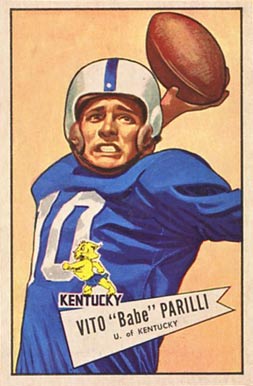
Babe Parilli
View on Wikipedia
Vito "Babe" Parilli (May 7, 1930 – July 15, 2017) was an American professional football quarterback and coach who played for 18 seasons. Parilli played five seasons in the National Football League (NFL), 10 in the American Football League (AFL), and three in the Canadian Football League (CFL). He played college football for the Kentucky Wildcats, twice receiving consensus All-American honors and winning two consecutive bowl games.
Key Information


Parilli achieved his greatest professional success in the AFL as the starting quarterback of the Boston Patriots from 1961 to 1967. He earned three All-Star Game selections, while leading the Patriots to their only AFL postseason and championship game appearance in 1963. Present for the entirety of the AFL's existence, Parilli played his final seasons for the New York Jets and was part of the team that won a Super Bowl title in Super Bowl III. After retiring as a player, he served as a coach in the NFL, World Football League (WFL), and Arena Football League (AFL) from 1973 to 1997. He was inducted to the College Football Hall of Fame in 1982.
Early life
[edit]Parilli was born and raised in Rochester, Pennsylvania, an industrial town northwest of Pittsburgh, Parilli graduated from Rochester High School in 1948.
College career
[edit]Parilli played college football at the University of Kentucky in Lexington, and was a quarterback for the Wildcats under head coach Paul "Bear" Bryant. He was a consensus All-American in 1950 and 1951 and was fourth in the Heisman Trophy voting in 1950 and third in 1951. He led the Wildcats to victories in consecutive New Year's Day bowl games in the 1951 Sugar Bowl and 1952 Cotton Bowl.
Statistics
[edit]| Season | Passing | |||||
|---|---|---|---|---|---|---|
| Comp | Att | Yards | Comp% | TD | INT | |
| 1949 | 81 | 150 | 1081 | 54.0 | 8 | 13 |
| 1950 | 114 | 203 | 1627 | 56.2 | 23 | 12 |
| 1951 | 136 | 239 | 1643 | 56.9 | 19 | 12 |
| Career total | 331 | 592 | 4351 | 55.9 | 50 | 37 |
Football career
[edit]Early years
[edit]Parilli was the fourth overall selection of the 1952 NFL draft, taken by the Green Bay Packers. He played two seasons with the Packers and was then drafted into the United States Air Force and to the Cleveland Browns. Fulfilling his ROTC commitment, he became a lieutenant in the Air Force and, like a lot of other pros, played service football. When his service was over he played a season with the Cleveland Browns in 1956, two more with the Packers, and another with Ottawa in 1959.
AFL
[edit]At age 30, Parilli was picked up by the Oakland Raiders of the fledgling American Football League on August 17, 1960,[1] and threw for just over 1,000 yards that season.
On April 4, 1961, he was part of a five-player trade that sent him to the Boston Patriots,[2][3] and he went on to become one of the AFL's most productive and colorful players. Playing for the Patriots from 1961 through 1967, Parilli finished his career with over 25,000 total yards and 200 touchdowns, ending among the top five quarterbacks in 23 categories such as passing yards, passing touchdowns and rushing yards. Parilli was selected for three All-Star Games. In 1964, throwing primarily to Gino Cappelletti, Parilli amassed nearly 3,500 yards passing with 31 touchdowns; the latter was a Patriots record until Tom Brady broke it in 2007. During that season's contest against the Oakland Raiders on October 16, he threw for 422 yards and four touchdown passes in a 43–43 tie. Parilli is a member of the Patriots All-1960s (AFL) Team.
Parilli completed his career with the New York Jets, where he earned a ring as Joe Namath's backup in Super Bowl III, when the Jets stunned the Baltimore Colts by a 16–7 score. Coincidentally, this gave the Jets two quarterbacks from Pennsylvania's Beaver County, with Parilli being from Rochester and Namath being from nearby Beaver Falls. In addition, both played for "Bear" Bryant in college, as Namath played at Alabama. In 1967, it was discovered by Life magazine that Parilli and several other professional athletes were regular patrons of Patriarca crime family mobster Arthur Ventola's major fencing operation called Arthur's Farm in Revere, Massachusetts. Despite the organized crime connection, journalist Howie Carr stated that there was never any inside information passed between Parilli and Ventola. Arthur was the uncle of mob associate Richard Castucci.
Besides his considerable skills as a quarterback, he was one of the best holders in the history of football and was nicknamed "gold-finger" as a result of kicker Jim Turner's then-record 145 points kicked in 1968 (plus another 19 points in the play-offs and in Super Bowl III). He is one of only 20 players who were in the American Football League for its entire ten-year existence, and is a member of the University of Kentucky Athletic Hall of Fame. In 1982, Parilli was named to the College Football Hall of Fame.[4]
Because of their Italian surnames, the Patriots' wide receiver-quarterback duo of Cappelletti and Parilli was nicknamed "Grand Opera."
Parilli retired as a player at the age of 40 in August 1970.[5]
Career statistics
[edit]| Legend | |
|---|---|
| Won the Super Bowl | |
| Led the league | |
| Bold | Career high |
| Underline | Incomplete data |
Regular season
[edit]| Year | Team | Games | Passing | Rushing | Sacked | Fum | |||||||||||||||
|---|---|---|---|---|---|---|---|---|---|---|---|---|---|---|---|---|---|---|---|---|---|
| GP | GS | Record | Cmp | Att | Pct | Yds | Y/A | Lng | TD | Int | Rtg | Att | Yds | Y/A | Lng | TD | Sck | SckY | |||
| 1952 | GB | 12 | 4 | 2–2 | 77 | 177 | 43.5 | 1,416 | 8.0 | 90 | 13 | 17 | 56.6 | 32 | 106 | 3.3 | 19 | 1 | — | 127 | 4 |
| 1953 | GB | 12 | 5 | 0–5 | 74 | 166 | 44.6 | 830 | 5.0 | 45 | 4 | 19 | 28.5 | 42 | 171 | 4.1 | 19 | 4 | — | 161 | 8 |
| 1956 | CLE | 5 | 3 | 1–2 | 24 | 49 | 49.0 | 409 | 8.3 | 68 | 3 | 7 | 58.5 | 18 | 65 | 3.6 | 19 | 0 | — | 63 | 4 |
| 1957 | GB | 12 | 1 | 0–1 | 39 | 102 | 38.2 | 669 | 6.6 | 75 | 4 | 12 | 34.8 | 24 | 83 | 3.5 | 20 | 2 | — | 125 | 3 |
| 1958 | GB | 12 | 4 | 1–3 | 68 | 157 | 43.3 | 1,068 | 6.8 | 80 | 10 | 13 | 53.3 | 8 | 15 | 1.9 | 5 | 0 | — | 89 | 4 |
| 1960 | OAK | 14 | 1 | 1–0 | 87 | 187 | 46.5 | 1,003 | 5.4 | 49 | 5 | 11 | 47.6 | 21 | 131 | 6.2 | 16 | 1 | 11 | 106 | 3 |
| 1961 | BOS | 14 | 8 | 6–2 | 104 | 198 | 52.5 | 1,314 | 6.6 | 53 | 13 | 9 | 76.5 | 38 | 183 | 4.8 | 24 | 4 | 15 | 118 | 2 |
| 1962 | BOS | 10 | 10 | 6–3–1 | 140 | 253 | 55.3 | 1,988 | 7.9 | 67 | 18 | 8 | 91.5 | 28 | 169 | 6.0 | 33 | 2 | 10 | 68 | 6 |
| 1963 | BOS | 14 | 13 | 7–5–1 | 153 | 337 | 45.4 | 2,345 | 7.0 | 77 | 13 | 24 | 52.1 | 36 | 126 | 3.5 | 19 | 5 | 26 | 200 | 7 |
| 1964 | BOS | 14 | 14 | 10–3–1 | 228 | 473 | 48.2 | 3,465 | 7.3 | 80 | 31 | 27 | 70.8 | 34 | 168 | 4.9 | 32 | 2 | 27 | 279 | 7 |
| 1965 | BOS | 14 | 13 | 4–8–1 | 173 | 426 | 40.6 | 2,597 | 6.1 | 73 | 18 | 26 | 50.0 | 50 | 200 | 4.0 | 17 | 0 | 35 | 334 | 8 |
| 1966 | BOS | 14 | 14 | 8–4–2 | 181 | 382 | 47.4 | 2,721 | 7.1 | 63 | 20 | 20 | 66.9 | 28 | 42 | 1.5 | 17 | 1 | 22 | 189 | 8 |
| 1967 | BOS | 14 | 11 | 3–7–1 | 161 | 344 | 46.8 | 2,317 | 6.7 | 79 | 19 | 24 | 58.5 | 14 | 61 | 4.4 | 18 | 0 | 29 | 250 | 4 |
| 1968 | NYJ | 14 | 0 | — | 29 | 55 | 52.7 | 401 | 7.3 | 47 | 5 | 2 | 91.6 | 7 | −2 | −0.3 | 10 | 1 | 3 | 23 | 3 |
| 1969 | NYJ | 14 | 0 | — | 14 | 24 | 58.3 | 138 | 5.8 | 29 | 2 | 1 | 85.1 | 3 | 4 | 1.3 | 2 | 0 | 0 | 0 | 0 |
| Career | 189 | 101 | 49–45–7 | 1,552 | 3,330 | 46.6 | 22,681 | 6.8 | 90 | 178 | 220 | 59.6 | 383 | 1,522 | 4.0 | 33 | 23 | 178 | 2,132 | 71 | |
Postseason
[edit]| Year | Team | Games | Passing | Rushing | Sacked | Fum | |||||||||||||||
|---|---|---|---|---|---|---|---|---|---|---|---|---|---|---|---|---|---|---|---|---|---|
| GP | GS | Record | Cmp | Att | Pct | Yds | Y/A | Lng | TD | Int | Rtg | Att | Yds | Y/A | Lng | TD | Sck | SckY | |||
| 1963 | BOS | 2 | 2 | 1–1 | 28 | 64 | 43.8 | 489 | 7.6 | 59 | 2 | 2 | 67.8 | 2 | 10 | 5.0 | 10 | 0 | 7 | 50 | 1 |
| 1968 | NYJ | 2 | 0 | — | 0 | 1 | 0.0 | 0 | 0.0 | 0 | 0 | 0 | 39.6 | 0 | 0 | — | 0 | 0 | 0 | 0 | 0 |
| Career | 4 | 2 | 1–1 | 28 | 65 | 43.1 | 489 | 7.5 | 59 | 2 | 2 | 66.8 | 2 | 10 | 5.0 | 10 | 0 | 7 | 50 | 1 | |
Coaching career
[edit]In 1974, Parilli became the head coach of the New York Stars of the World Football League; after going bankrupt, the franchise moved to Charlotte mid-season. The next year, he was tabbed as coach of the WFL's Chicago Winds, and briefly seemed to have a chance to coach his old teammate, Joe Namath. But Namath turned Chicago down, and Parilli was replaced in late July after only two pre-season games. (The Winds would play only five regular-season contests before folding, and the rest of the WFL would collapse a few months later.) Parilli would later coach in the Arena Football League, helming the New England Steamrollers, Denver Dynamite, Charlotte Rage, Las Vegas Sting, Anaheim Piranhas and Florida Bobcats.[6]
Death
[edit]Parilli died on July 15, 2017, in Parker, Colorado of multiple myeloma at the age of 87.[7]
Honors
[edit]Parilli was elected to the College Football Hall of Fame in 1982.[8] On November 15, 2014, he was inducted into the National Italian American Sports Hall of Fame.[9]
See also
[edit]References
[edit]- ^ "Parilli joins Oakland Raiders". Pittsburgh Press. UPI. August 17, 1960. p. 45.
- ^ "Parilli is swapped to Boston Patriots". Milwaukee Journal. press dispatches. April 6, 1961. p. 14, part 2.
- ^ "Oakland trades Parilli to Patriots". Reading Eagle. Pennsylvania. Associated Press. April 5, 1961. p. 47.
- ^ "Babe Parilli (1982)". National Football Foundation. Retrieved June 7, 2025.
- ^ "Babe Parilli retires from pro football". Daytona Beach Morning Journal. Florida. Associated Press. August 30, 1970. p. 1C.
- ^ "Babe Parilli". arenafan.com. Retrieved December 19, 2014.
- ^ Litsky, Frank (July 15, 2017). "Babe Parilli Dies at 87; Standout Quarterback With 'Houdini Hands'". The New York Times. Retrieved April 7, 2018 – via NYTimes.com.
- ^ "Parilli, Meredith among hall of fame inductees". Gadsden Times. Alabama. Associated Press. February 7, 1982. p. 39.
- ^ "Nashvillesportsmix.com". nashvillesportsmix.com. Archived from the original on April 8, 2018. Retrieved April 7, 2018.
External links
[edit]
Babe Parilli
View on GrokipediaEarly life
Childhood and family
Vito "Babe" Parilli was born on May 7, 1930, in Rochester, Pennsylvania, a small industrial town along the Ohio River near Pittsburgh, to Italian immigrant parents Augustine and Christina (Feola) Parilli.[1][6] Augustine Parilli, who had immigrated from Sparanisi in southern Italy's Campania region, worked in a local glass factory, reflecting the family's working-class roots in Rochester's manufacturing economy during the Great Depression era.[6] Parilli was the third of four children, with older siblings Martha and Frank, and a younger brother, August Jr.; the family emphasized hard work and community ties typical of Italian-American households in the region, where television was not yet common and entertainment often revolved around local gatherings and outdoor activities.[7] Growing up in this environment, Parilli developed an early interest in sports, particularly football, influenced by the rough-and-tumble play common in industrial Pennsylvania towns, which laid the groundwork for his later athletic pursuits before entering organized high school competition.[8]High school career
Vito "Babe" Parilli attended Rochester High School in Rochester, Pennsylvania, from 1944 to 1948, where he developed into a standout fullback for the Rochester Rams football team.[9][10] During his high school tenure, Parilli showcased exceptional running abilities in a single-wing offense, leading the Rams to an undefeated season that highlighted his command on the field and drew large crowds, including up to 16,000 spectators at key games.[11] In one memorable performance against rival Ambridge, he contributed to a last-minute victory, demonstrating his poise under pressure and contributing to the team's strong overall record.[11] Parilli's prowess as a running back earned him recognition as a promising local talent, attracting interest from major college programs.[12] Initially leaning toward Indiana University, he was ultimately recruited by Paul "Bear" Bryant to join the University of Kentucky, marking the beginning of his transition to collegiate football upon graduating in 1948.[13][10]College career
University of Kentucky
Vito "Babe" Parilli enrolled at the University of Kentucky in 1948 following a distinguished high school career at Rochester High School in western Pennsylvania. He redshirted his freshman season and emerged as the starting quarterback in 1949 under head coach Paul "Bear" Bryant, marking the beginning of a transformative period for the Wildcats' program.[12] During the 1949 season, Parilli guided Kentucky to a 9-3 record, highlighted by decisive victories over LSU (19-0), Ole Miss (47-0), Georgia (25-0), and Florida (35-0), which showcased his growing command of the offense and contributed to the team's momentum. The following year, in 1950, the Wildcats achieved an 11-1 mark and captured the program's sole Southeastern Conference championship, with Parilli leading the nation in touchdown passes with 23 and demonstrating his versatility as both a passer and runner. As a senior in 1951, Parilli earned consensus All-American honors while again topping national charts in passing efficiency and touchdown passes with 19, solidifying his status as one of college football's premier quarterbacks.[14][15][3] Parilli's leadership was pivotal in Kentucky's postseason success, as the team secured two consecutive bowl victories: a narrow 13-7 upset of top-ranked Oklahoma in the 1951 Sugar Bowl, ending the Sooners' 31-game winning streak, and a 20-7 defeat of TCU in the 1952 Cotton Bowl. His dual-threat capabilities—excelling in both aerial attacks and ground gains—fostered a dynamic team identity under Bryant's guidance. Bryant himself lauded Parilli as an exceptional talent, particularly for his deceptive faking and powerful throwing arm, which helped elevate the Wildcats to their most successful stretch in school history with an overall 28-8 record across his three starting seasons.[16][13][17][18]Statistics
Parilli's college career at the University of Kentucky spanned 1949 to 1951, during which he earned consensus All-American honors in 1950 and 1951.[3]Passing Statistics
The following table summarizes Parilli's year-by-year passing performance:| Year | Games | Attempts | Completions | Completion % | Yards | Yards/Att | TDs | INTs |
|---|---|---|---|---|---|---|---|---|
| 1949 | 12 | 150 | 81 | 54.0 | 1,081 | 7.2 | 8 | 13 |
| 1950 | 12 | 203 | 114 | 56.2 | 1,627 | 8.0 | 23 | 12 |
| 1951 | 12 | 239 | 136 | 56.9 | 1,643 | 6.9 | 19 | 12 |
Rushing Contributions
Parilli also contributed to the rushing game, though primarily as a passer: Career Rushing Totals: -248 yards (net loss, reflecting sacks and scrambles). No rushing touchdowns recorded.[19]Professional playing career
Early professional years
Parilli was selected by the Green Bay Packers with the fourth overall pick in the first round of the 1952 NFL Draft, following his standout college career that included All-American honors at the University of Kentucky.[1] In his rookie season of 1952, he appeared in 12 games with 4 starts, completing 77 of 177 passes for 1,416 yards, 13 touchdowns, and 17 interceptions while sharing quarterback duties with Tobin Rote.[20] His second year with the Packers in 1953 was similarly limited, as he started five games and threw for 830 yards, four touchdowns, and 19 interceptions amid the team's struggles under coach Gene Ronzani. Parilli's early NFL tenure was interrupted by mandatory military service, as he entered the U.S. Air Force in July 1954 to fulfill a two-year ROTC obligation, during which he continued playing football in service leagues.[20] While in the Air Force, the Packers traded his rights to the Cleveland Browns in a multi-player deal that also involved linebacker Horace Gillom and halfback Dub Jones.[21] Upon his discharge in 1956, Parilli joined the Browns as a backup quarterback behind primary starters Tommy O'Connell and George Ratterman, appearing in five games with three starts and completing 24 of 49 passes for 409 yards, three touchdowns, and seven interceptions.[1] In April 1957, the Browns traded Parilli back to the Packers in an eight-player exchange that sent end Bill Howton and others to Cleveland, reuniting him with his original team under new coach Vince Lombardi.[22] Over the 1957 and 1958 seasons, he served primarily as a backup to Rote and emerging rookie Bart Starr, starting five games total and posting 669 passing yards with four touchdowns and 12 interceptions in 1957, and 1,068 yards with 10 touchdowns and 13 interceptions in 1958, hampered by injuries and the Packers' rebuilding phase.[1] Seeking more playing time, Parilli signed with the Ottawa Rough Riders of the Canadian Football League in 1959, where he appeared in limited action with 23 completions of 52 attempts for 373 yards, four touchdowns, and four interceptions.[23] He returned to Ottawa for training camp in 1960 but was released in August after limited action, prompting a brief stint with the Oakland Raiders of the fledgling American Football League, where he appeared in 14 games as a backup with one start, completing 87 of 187 passes for 1,003 yards, five touchdowns, and 11 interceptions.[24] These early professional years were marked by persistent challenges, including recurring injuries to his throwing arm, frequent trades and roster shifts across the NFL and CFL, and inconsistent starting opportunities that confined him largely to backup roles.[5] Across his pre-AFL career from 1952 to 1960 (NFL/AFL games), Parilli appeared in 67 games, completing 369 of 838 passes for 5,392 yards, 39 touchdowns, and 79 interceptions, reflecting the instability of his path before establishing himself in the AFL (CFL stats additional and not aggregated here).[1]American Football League
Parilli joined the Boston Patriots in 1961 after being acquired from the Oakland Raiders in a five-player trade, marking the start of his most successful professional phase in the American Football League (AFL).[1][25] He quickly established himself as the team's starting quarterback that year, posting a 6-2 record in his eight starts while throwing for 1,314 yards and 13 touchdowns over 14 games.[26] Under his leadership, the Patriots reached the 1963 AFL Championship Game after finishing first in the Eastern Division with a 7-6-1 record, though they suffered a decisive 51-0 loss to the San Diego Chargers, where Parilli completed 14 of 29 passes for 189 yards.[27] His performance earned him AFL All-Star selections in 1963 and 1964, recognizing his role in elevating the franchise during its early years.[1] Parilli's peak came in 1964, when he set a Patriots single-season record with 31 touchdown passes— a mark that stood until 2007—while throwing for 3,465 yards and leading the team to a 10-3-1 record and another second-place finish in the East.[28] Over his seven seasons with Boston from 1961 to 1967, he amassed 16,747 passing yards, becoming the cornerstone of the offense and guiding the team through competitive AFL play.[1] After a challenging 4-8-2 campaign in 1965 marred by injuries, Parilli rebounded strongly in 1966, earning AFL Comeback Player of the Year honors with 2,721 yards and 20 touchdowns, helping the Patriots achieve an 8-4-2 record and his third All-Star nod that year.[29] His tenure solidified the Patriots as a consistent contender, blending veteran poise with high-volume passing in an era of innovative aerial attacks. In 1968, Parilli was traded to the New York Jets, where he served as a reliable backup to Joe Namath during the team's historic championship run.[1] Appearing in 14 games that season, he completed 29 of 55 passes for 401 yards and five touchdowns, contributing to the Jets' 11-3 record and AFL title win.[30] Parilli remained with New York in 1969, adding 14 completions out of 24 attempts for 138 yards and two scores in another 14 games, for combined Jets totals of 43 completions in 79 attempts for 539 yards over 28 appearances.[31] As a member of the Super Bowl III roster, he earned a championship ring when the Jets upset the Baltimore Colts 16-7 on January 12, 1969, though his on-field role was limited to the regular season.[32] Parilli's AFL career spanned all 10 seasons of the league's existence from 1960 to 1969, placing him among only 20 players who participated throughout its innovative and competitive history.[33] In recognition of his contributions, he was selected to the All-AFL 10th Anniversary Team in 1971, honoring his status as one of the league's premier quarterbacks and a pioneer in its passing game evolution.[28]Career statistics
Regular season
Babe Parilli's professional regular-season passing statistics reflect a career spanning the NFL (1952–1958), AFL (1960–1969), and CFL (1959), where he demonstrated durability across 189 appearances in the NFL and AFL (53 in the NFL, 136 in the AFL), plus limited appearances in the CFL (1959). His overall passing totals include 1,575 completions on 3,382 attempts for 23,054 yards, 182 touchdowns, and 224 interceptions, averaging 6.8 yards per attempt with a career NFL/AFL passer rating of 59.6.[1][23] He also contributed via rushing, accumulating 387 attempts for 1,542 yards and 23 touchdowns (4.0 yards per carry), and recorded 71 fumbles during his NFL and AFL seasons (CFL fumble data unavailable).[1][23]Year-by-Year Passing Statistics
| Year | Team | Lg | G | GS | Cmp | Att | Yds | TD | Int | Y/A |
|---|---|---|---|---|---|---|---|---|---|---|
| 1952 | GNB | NFL | 12 | 4 | 77 | 177 | 1,416 | 13 | 17 | 8.0 |
| 1953 | GNB | NFL | 12 | 5 | 74 | 166 | 830 | 4 | 19 | 5.0 |
| 1956 | CLE | NFL | 5 | 3 | 24 | 49 | 409 | 3 | 7 | 8.3 |
| 1957 | GNB | NFL | 12 | 1 | 39 | 102 | 669 | 4 | 12 | 6.6 |
| 1958 | GNB | NFL | 12 | 4 | 68 | 157 | 1,068 | 10 | 13 | 6.8 |
| 1959 | OTT | CFL | - | - | 23 | 52 | 373 | 4 | 4 | 7.2 |
| 1960 | OAK | AFL | 14 | 1 | 87 | 187 | 1,003 | 5 | 11 | 5.4 |
| 1961 | BOS | AFL | 14 | 8 | 104 | 198 | 1,314 | 13 | 9 | 6.6 |
| 1962 | BOS | AFL | 10 | 10 | 140 | 253 | 1,988 | 18 | 8 | 7.9 |
| 1963 | BOS | AFL | 14 | 13 | 153 | 337 | 2,345 | 13 | 24 | 7.0 |
| 1964 | BOS | AFL | 14 | 14 | 228 | 473 | 3,465 | 31 | 27 | 7.3 |
| 1965 | BOS | AFL | 14 | 13 | 173 | 426 | 2,597 | 18 | 26 | 6.1 |
| 1966 | BOS | AFL | 14 | 14 | 181 | 382 | 2,721 | 20 | 20 | 7.1 |
| 1967 | BOS | AFL | 14 | 11 | 161 | 344 | 2,317 | 19 | 24 | 6.7 |
| 1968 | NYJ | AFL | 14 | 0 | 29 | 55 | 401 | 5 | 2 | 7.3 |
| 1969 | NYJ | AFL | 14 | 0 | 14 | 24 | 138 | 2 | 1 | 5.8 |
Year-by-Year Rushing Statistics
| Year | Team | Lg | G | Att | Yds | TD |
|---|---|---|---|---|---|---|
| 1952 | GNB | NFL | 12 | 32 | 106 | 1 |
| 1953 | GNB | NFL | 12 | 42 | 171 | 4 |
| 1956 | CLE | NFL | 5 | 18 | 65 | 0 |
| 1957 | GNB | NFL | 12 | 24 | 83 | 2 |
| 1958 | GNB | NFL | 12 | 8 | 15 | 0 |
| 1959 | OTT | CFL | - | 4 | 20 | 0 |
| 1960 | OAK | AFL | 14 | 21 | 131 | 1 |
| 1961 | BOS | AFL | 14 | 38 | 183 | 4 |
| 1962 | BOS | AFL | 10 | 28 | 169 | 2 |
| 1963 | BOS | AFL | 14 | 36 | 126 | 5 |
| 1964 | BOS | AFL | 14 | 34 | 168 | 2 |
| 1965 | BOS | AFL | 14 | 50 | 200 | 0 |
| 1966 | BOS | AFL | 14 | 28 | 42 | 1 |
| 1967 | BOS | AFL | 14 | 14 | 61 | 0 |
| 1968 | NYJ | AFL | 14 | 7 | -2 | 1 |
| 1969 | NYJ | AFL | 14 | 3 | 4 | 0 |
Year-by-Year Fumble Statistics
| Year | Team | Lg | G | Fmb |
|---|---|---|---|---|
| 1952 | GNB | NFL | 12 | 4 |
| 1953 | GNB | NFL | 12 | 8 |
| 1956 | CLE | NFL | 5 | 4 |
| 1957 | GNB | NFL | 12 | 3 |
| 1958 | GNB | NFL | 12 | 4 |
| 1959 | OTT | CFL | - | - |
| 1960 | OAK | AFL | 14 | 3 |
| 1961 | BOS | AFL | 14 | 2 |
| 1962 | BOS | AFL | 10 | 6 |
| 1963 | BOS | AFL | 14 | 7 |
| 1964 | BOS | AFL | 14 | 7 |
| 1965 | BOS | AFL | 14 | 8 |
| 1966 | BOS | AFL | 14 | 8 |
| 1967 | BOS | AFL | 14 | 4 |
| 1968 | NYJ | AFL | 14 | 3 |
| 1969 | NYJ | AFL | 14 | 0 |
League-Specific Aggregates
Parilli's contributions varied by league, with the bulk of his production in the AFL.NFL (1952–1958, Green Bay Packers and Cleveland Browns)
- Passing: 53 games (17 starts), 282 completions on 651 attempts for 4,392 yards (6.7 Y/A), 34 touchdowns, 68 interceptions.[1]
- Rushing: 124 attempts for 440 yards (3.5 yards per carry), 7 touchdowns.[1]
- Fumbles: 23.[1]
AFL (1960–1969, Oakland Raiders, Boston Patriots, and New York Jets)
- Passing: 136 games (84 starts), 1,270 completions on 2,679 attempts for 18,289 yards (6.8 Y/A), 144 touchdowns, 152 interceptions.[1]
- Rushing: 259 attempts for 1,082 yards (3.4 yards per carry), 16 touchdowns.[1]
- Fumbles: 48.[1]
CFL (1959, Ottawa Rough Riders)
- Passing: Unknown games, 23 completions on 52 attempts for 373 yards (7.2 Y/A), 4 touchdowns, 4 interceptions.[23]
- Rushing: 4 attempts for 20 yards (5.0 yards per carry), 0 touchdowns.[23]
- Fumbles: Data unavailable.
Postseason
Parilli appeared in limited postseason action during his career, primarily as a starter for the Boston Patriots in 1963 and as a backup for the New York Jets in 1969. In the 1963 AFL Divisional Game on December 28 against the Buffalo Bills, Parilli completed 14 of 35 passes for 300 yards with 2 touchdowns and 1 interception in a 26–8 victory. In the 1963 AFL Championship Game on January 5, 1964, the Patriots faced the San Diego Chargers at Balboa Stadium in a matchup that highlighted the disparity between the teams, resulting in a decisive 10–51 loss for Boston. Parilli started and completed 14 of 29 passes for 189 yards, with no touchdowns and one interception, as the Chargers' defense pressured him into six sacks for a 42-yard loss while their offense exploded for 610 total yards.[34][27] Five years later, Parilli joined the New York Jets as a veteran backup to Joe Namath during their memorable championship run. In Super Bowl III on January 12, 1969, against the heavily favored Baltimore Colts at the Orange Bowl, the Jets secured a stunning 16–7 upset victory, marking the AFL's first Super Bowl win. Parilli entered the game briefly in the third quarter after Namath sustained a minor injury but attempted just one pass, which was incomplete, and recorded no statistics in the lopsided defensive battle where the Jets' ground game and secondary dominated.[32] Parilli's overall postseason contributions were minimal, reflecting his role in high-stakes games where team outcomes overshadowed individual performances.| Year | Comp | Att | Yards | TD |
|---|---|---|---|---|
| 1963 | 28 | 64 | 489 | 2 |
| 1969 | 0 | 1 | 0 | 0 |
| Career | 28 | 65 | 489 | 2 |