Hubbry Logo
Jim OttoJim OttoMain
Open search
Jim Otto
Community hub
Jim Otto
logo
8 pages, 0 posts
0 subscribers
Be the first to start a discussion here.
Jim Otto
Jim Otto
from Wikipedia

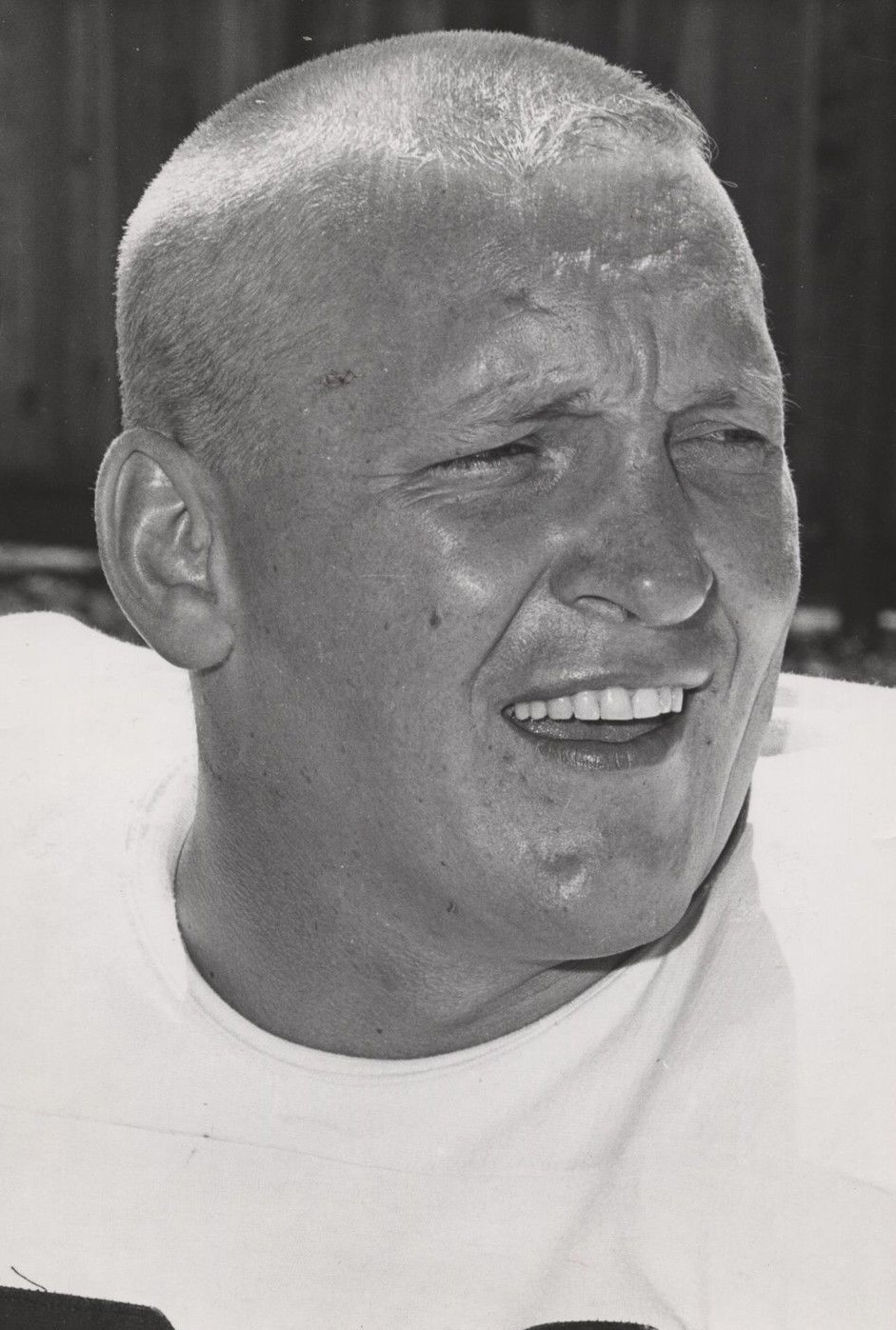
James Edwin Otto (January 5, 1938 – May 19, 2024) was an American professional football player who was a center for 15 seasons with the Oakland Raiders of the American Football League (AFL) and National Football League (NFL). He played college football for the Miami Hurricanes.

Key Information

One of the most durable centers in football history, Otto was named a First-team All-Pro in ten seasons, nine in the AFL and once in the NFL. He was the first player in pro football history to have ten First-team All-Pro selections, a mark achieved only once (Jerry Rice) since. Otto was inducted into the Pro Football Hall of Fame in 1980, his first year of eligibility. He was also named to the AFL All-Time Team and NFL 100th Anniversary All-Time Team.

Early life and college

[edit]

Otto was born on January 5, 1938, in Wausau, Wisconsin. His parents Lorenz and Loretta (Totsch) Otto worked a variety of jobs to help the family get by, and they had so little when Otto was a boy they could not afford new shoes to keep his feet warm and dry in Wisconsin's winters.[1] Growing up as a child, he wanted to be a football player like Elroy "Crazylegs" Hirsch.[2] He recalled Hirsch once saying, "‘if you put your heart into it, you can do it.’”[3]

Otto played football at Wausau High School from 1953-55. He was a linebacker and center for the Lumberjacks,[1][3][4] under coach Win Brockmeyer; who also coached Otto's hero Crazylegs Hirsch at Wausau. Brockmeyer considered Otto a "terrific competitor" with his most important contribution to Wausau's team coming on defense.[5][4]

Otto, the team co-captain, and the Lumberjacks were 18–5–2 during his high school football career. It has also been reported the team was 21–3–1. He was particularly inspired by his offensive line coach, Tom Yelich. At a 1980 banquet honoring Otto in Wausau, Otto credited Yelich with teaching the technique Otto then used throughout college and professional football. “'Yelich was the first coach I ever had, and he helped me more than any coach since.'”[3][4]

Otto broke his ankle in high school one season. Instead of sitting out, he taped it up before each game and played on it throughout the season.[6]

Otto had offers from 48 colleges to play college football, and with the help of Brockmeyer chose the University of Miami in South Florida, where he played varsity football from 1957 to 1959 under coach Andy Gustafson.[1][3][4] In addition to playing offensive center at the University of Miami, he also played linebacker on defense.[7] He became the team's starting center as a junior in 1958, weighing only 193 pounds (87.5 kg).[8] As a senior, he played in the North-South Shrine game for the South college all star team at center.[9]

While at Miami, he joined the Phi Delta Theta fraternity.[10]

Otto was inducted into the University of Miami Sports Hall of Fame and Museum in 1972.[11]

Professional career

[edit]

No National Football League team showed interest in the undersized center, who weighed only 205 pounds.[1] Otto was signed in 1960 as an undrafted free agent by the Oakland Raiders, the team that replaced a proposed Minneapolis AFL franchise that instead had withdrawn to join the NFL in 1961.[12] After he signed with the Raiders, he played there for the entire 10 years of the league's existence and five years beyond that after the merger of the NFL and AFL.[13] In his rookie year at training camp, he weighed 217 pounds, but was up to 240 pounds by the end of his first year.[1]

Otto worked diligently to build his body up to his playing weight of 255 pounds (116 kg).[6] Otto wore the jersey number 50 in his rookie season, but the suggestion of equipment manager Frank Hinek led to the idea of Otto wearing 00 (0 was being worn in the NFL by Johnny Olszewski) "for recognition", which Otto eventually went with, as did AFL Commissioner Joe Foss.[14]

For the next 15 years, Otto was a fixture at center for the Raiders, never missing a single game due to injury, and played in 210 consecutive games.[15] He won one AFL/AFC championship in 1967 against the Houston Oilers with the Raiders,[16] but lost five: in 1968,[17] 1969,[18] 1970,[19] 1973,[20] and 1974[21] to the New York Jets, Kansas City Chiefs, Baltimore Colts, Miami Dolphins, and Pittsburgh Steelers, respectively, with all five teams winning the Super Bowl.[22][23][24][25][26]

He played alongside Gene Upshaw, another Hall of Famer, at left guard from 1967 to 1974.[27] In the 1967 regular season, Oakland scored 468 points (33.4 points/game), leading the AFL, but lost Super Bowl II to the Green Bay Packers.[28][29] In 1968, Oakland scored 453 points (32.4 points/game) in the regular season, again leading the AFL, and beat the Chiefs in the divisional round (unscheduled tiebreaker), 41–6, before losing to the Jets, 27–23.[30][31][32]

In the 1969 regular season, Oakland scored 377 points (26.9 points/game) to lead the AFL for the third consecutive year, and beat the Houston Oilers in the new divisional round of the AFL playoffs, 56–7, before losing to the Chiefs, 17–7, in the final AFL Championship Game.[33][34][35] In the 1970 regular season, the first year of the NFL-AFL merger, Oakland scored 300 points (21.4 points/game), ranking ninth in the 26-team NFL, and beat the Miami Dolphins in the AFC playoffs, 21–14, before losing to the Baltimore Colts in the AFL Championship Game, 27–17.[36][37][38] The Raiders missed the playoffs for the first time in five years in 1971,[39] despite scoring 344 points (24.6 points/game), second highest in the NFL.[40]

The Raiders came back stronger in 1972, scoring 365 points (26.1 points/game), ranking third in the NFL,[41] but lost 13–7 to the Pittsburgh Steelers in the divisional round of the AFC playoffs.[42] The game became famous as the Immaculate Reception game,[43] in which Otto also made the only pass reception of his professional career.[44][13] Otto claimed he had a close and clear view of the immaculate reception play involving the Raiders' Jack Tatum hitting the Steelers' receiver John "Frenchy" Fuqua with the ball floating into the hands of the Steelers' Franco Harris who scored the game-winning touchdown with less than one minute to play. Otto had no doubt that the pass should have been deemed incomplete under the then current NFL rules, and the Raiders should have won the game. During the 15-minute delay while the officials determined how they were going to call the play, Otto feared for his safety from inebriated Steeler fans if the call went against the Steelers, and plotted how he would escape the fans should they have rushed onto the field. The outcome disturbed Otto for years, though he did not bear the Steelers' players any ill-will.[45]

In the 1973 regular season, Oakland scored 292 points (20.9 points/game), tenth in the NFL,[46] and avenged their defeat to the Steelers, 33–14 in the division round of the 1973 playoffs,[47] but lost to the Dolphins in the AFC Championship Game, 27–10.[48] In Otto's final year, 1974, Oakland scored 355 points (25.4 points/game), leading the NFL,[49] and avenged their playoff loss to the Dolphins in the divisional round, 28–26,[50] but lost to the Steelers again in the AFC Championship Game, 24–13.[51]

During the last three years of his career with the Raiders, he would have his knee injected with xylocaine and drained three times a week with a long syringe. Before games on Sunday, he would have his knee braced and would take Darvon before playing each game. He had a bone graft before coming to training camp in 1975, but it failed after 2½ weeks.[6]

Otto had knee surgery after the 1974 season, his fifth or sixth knee surgery, and had a swollen knee going into training camp. He retired before the 1975 season started after a series of discussions with Raiders' owner Al Davis. His last game was an exhibition game against the San Francisco 49ers. An important factor in choosing to retire instead of continuing to play another year at an inferior level was reading about a player who suffered a dislocated knee that severed an artery, requiring amputation. The 37-year old Otto was replaced by 24-year old Dave Dalby, in his fourth season out of UCLA. Otto went to great lengths to teach Dalby the nuances and techniques of how to play the position during their time together; and even helped Dalby after retiring. Otto was the last member of the Oakland Raiders inaugural team from 1960 to retire, and Otto then worked in the Raiders' front office immediately after retirement.[52][53][54][55][6]

Legacy and honors

[edit]

Otto was elected to the Pro Football Hall of Fame in 1980, his first year of eligibility.[1] In 1999, he was ranked number 78 on The Sporting News' list of the 100 Greatest Football Players.[56] In 2019, he was revealed as being selected to the National Football League 100th Anniversary All-Time Team, being one of only four centers named.[57] In 2021, he was the 97th greatest player of all time listed by The Athletic.[58]

Otto was one of the original Oakland Raiders, and played during the team's full tenure in the AFL, from 1960 to 1969. He continued as a Raider in the NFL from 1970 to 1974, starting 210 consecutive games, playing a total of 308 games for the Raiders.[1][15] He was one of only 20 players to play for the entire ten-year existence of the American Football League, and one of only three players to play in all of his team's AFL games (along with teammate George Blanda and Gino Cappelletti).[15][59]

Otto was also selected as The Sporting News All-League center from 1960 through 1969.[60] He was an All-Star in the first 13 of his 15 seasons – every year in the AFL from 1960 through 1969[1] and three of his five seasons in the NFL, being All-NFL in 1970 and 1971 and second-team All-NFL in 1972.[15] He played in 12 All-Star games and was All-League 12 consecutive years.[15] In 1966, the Associated Press (AP) named Jon Morris first-team All-AFL at center and Otto second-team All-AFL at center; though the AFL itself, Newspaper Enterprise Association (NEA) and United Press International (UPI) named Otto first-team All-AFL in 1966 and selected Morris to the second team.[61] Otto was also named the starting center on the AFL All-Time Team.[15][62] He is one of only three players (along with Hall of Famers Johnny Robinson and Ron Mix), who were on the All-AFL first-team and the combined AFL/NFL All-Decade Team for the 1960s.[63]

During his career, the Raiders won seven divisional championships from 1967 through 1974, and were AFL champions in 1967, meeting the Green Bay Packers in Super Bowl II.[15] Otto's offensive linemates with the Raiders included Hall of Famers Gene Upshaw, Art Shell, and Bob Brown.[64] Hall of Fame and NFL 100th Anniversary All-Time Team coach Bill Walsh,[65][57] who was an offensive assistant coach with the 1966 Raiders said of Otto, "'He had techniques others tried to emulate but couldn’t. ... I used to marvel at his skills. He played every down with intensity.'”[7] Rival Kansas City Chiefs linebacker Bobby Bell, a Hall of Famer, 100th Anniversary All-Time teammate, and himself a member of the AFL's All-Time Team, said Otto was the best center he ever played against.[7][66][57][62]

Otto was elected to the Wisconsin Athletic Hall of Fame in 1998.[67]

Injuries and operations

[edit]

Otto's body was punished greatly during his NFL career, resulting in nearly 74 operations, including 28 on his knee (nine of them during his playing career) and multiple joint replacements. His joints became riddled with arthritis and he developed debilitating back and neck problems.[68] By his early 40s, he was considered permanently and totally disabled, and in 1980 he suffered deep depression for the first time due to the ongoing pain he experienced.[6] In his book, The Pain of Glory, Otto described near-death experiences from medical procedures, including fighting off three life-threatening infections due to complications from his artificial joints. During one six-month stretch, he was without a right knee joint because he had to wait for an infection to heal before another artificial knee could be implanted. Otto eventually had to have his right leg amputated on August 1, 2007.[69] Despite his maladies, Otto said he had no regrets and would not have changed a thing even if given the opportunity to do it over again. He discussed his sports injuries as well as the concussions issue in a 2013 Frontline interview for "League of Denial: The NFL's Concussion Crisis" and the 1985 documentary "Disposable Heroes: The Other Side of Football", directed by Bill Couturié.[70][71]

Personal life and death

[edit]

After his career, Otto worked for the Raiders during two periods, and then made a "small fortune" from Burger King franchises, liquor stores, a walnut orchard, and real estate in the Oakland area.[2]

Otto was also the subject of The Jim Otto Suite, a series of three multimedia works by American contemporary artist Matthew Barney, which served as a precursor to The Cremaster Cycle.[72]

He was the grandfather of dog musher Amanda Otto.[73]

Otto died on May 19, 2024, at the age of 86.[74][75][76][77]

See also

[edit]

References

[edit]
[edit]
Revisions and contributorsEdit on WikipediaRead on Wikipedia
from Grokipedia

James Edwin Otto (January 5, 1938 – May 19, 2024) was an American professional football center who played exclusively for the Oakland Raiders across the American Football League (AFL) and National Football League (NFL) from 1960 to 1974.
Otto, nicknamed "Mr. Raider" and famous for wearing jersey number 00, exemplified the franchise's gritty ethos through unmatched durability, starting all 210 regular-season games in his career without missing a single one despite repeated severe injuries from the era's unforgiving physical style.
As the sole first-team All-AFL center throughout the league's decade-long existence, he earned nine AFL All-Star selections, three subsequent Pro Bowls, and a place on the AFL All-Time Team, culminating in his 1980 induction into the Pro Football Hall of Fame.
During his tenure, the Raiders secured the 1967 AFL championship and advanced to Super Bowl II, while Otto's leadership anchored an offensive line that powered seven division titles in an eight-year span from 1967 to 1974.
Post-retirement, Otto faced profound health repercussions from accumulated trauma, enduring over 70 surgeries—including multiple knee replacements and a 2007 leg amputation—yet he steadfastly defended the value of his sacrifices for the game he loved.

Early Life and Education

Childhood in Wisconsin

James Edwin Otto was born on January 5, 1938, in , to Lorenz and Loretta (Totsch) Otto. His parents, part of the local working-class community, held various jobs to support the family amid economic hardship. The family faced significant during Otto's early years, including a period living in a converted chicken coop. Wausau, a blue-collar town in central , provided an environment steeped in community sports like football and , which Otto encountered from a young age. The area produced notable athletes, including Pro Football Hall of Famer Elroy "Crazylegs" Hirsch, a Wausau native whose success inspired local youth, including . This backdrop fostered Otto's initial interest in competitive play, as he later recalled his childhood desire to participate in football mirroring the town's sporting culture. Familial emphasis on perseverance, instilled by his parents' , contributed to Otto's developing competitive spirit and physical toughness evident in early neighborhood activities. These formative experiences in Wisconsin's modest, industrious setting laid the groundwork for his athletic pursuits without formal training structures.

High School Athletics

Otto attended Wausau High School in , where he competed in football as both and linebacker from 1953 to 1955 under head coach Win Brockmeyer. He earned recognition as a two-time all-state selection and second-team all-Wisconsin for his performance on the Lumberjacks team. As a senior in 1955, Otto weighed 192 pounds while playing both ways, demonstrating the physicality and versatility that drew attention from recruiters. He received offers from 48 institutions, reflecting his emerging reputation despite the era's challenges for Midwestern high school athletes seeking prominent programs. This acclaim laid the groundwork for his transition to , where he would continue developing his skills at the same positions. Otto graduated from Wausau High in 1956.

College Career at Miami University

Otto enrolled at the in in 1956 following high school graduation. He played for the from 1957 to 1959, primarily as a and linebacker. During this period, Otto refined his blocking and snapping fundamentals, drawing on techniques initially taught by his high school coach, which emphasized precise hand placement and explosive drive-blocking essential for his two-way role. In his three seasons, Otto contributed to the Hurricanes' offensive and defensive lines amid a program transitioning under coach Andy Gustafson, though specific individual statistics from that era remain sparsely documented due to limited record-keeping for non-major conference independents. He earned recognition for his durability and versatility, later inducted into the Sports Hall of Fame in 1972 for his collegiate contributions. Otto's college performance showcased the physicality that defined his style, weighing around 205 pounds—considered undersized for linemen—yet compensating through leverage and aggression. Otto completed his studies at , earning a degree that positioned him for post-college pursuits, though he went undrafted in the 1960 NFL Draft amid the era's competition between the established and emerging AFL leagues, which often overlooked smaller-school talents like those from independent programs. This reflected broader disparities in scouting and valuation between the leagues, prompting Otto to pursue opportunities in the AFL as a .

Professional Career

Entry into the AFL and Early Raiders Years

Jim Otto joined the Oakland Raiders in 1960 after being selected in the American Football League's inaugural draft by the proposed Minneapolis franchise, which withdrew from the league, transferring his rights to the expansion Raiders as a free agent. Previously undrafted by the NFL following his college career, Otto signed with the Raiders on September 2, 1960, becoming one of the original players on the AFL's eighth franchise. He initially wore jersey number 50 during training camp and preseason but switched to double-zero (00) prior to the regular season start, a choice suggested by equipment manager Frank Hinek to enhance visibility and publicity for the undersized center. Otto earned an immediate starting role at center for the Raiders' debut season, anchoring the offensive line amid the physical demands of professional football and the AFL's rough style. He played in all 14 games as the team compiled a 6-8 record, finishing third in the Western Division and demonstrating foundational tenacity despite inconsistent performance and roster turnover. Otto's relentless snap counts and blocking against larger defensive fronts helped instill the Raiders' emerging identity of gritty, no-quit effort, even as the franchise navigated early instability under multiple head coaches. The subsequent seasons of 1961 (2-12 record) and 1962 (1-13 record) tested the young team's resolve, with Otto continuing as the steady pivot amid defensive struggles and offensive line adaptations to pro speed and power. Early divisional clashes, particularly the budding rivalry with the Dallas Texans (later ), showcased Otto's unyielding style, as he battled nose tackles in that epitomized the AFL's combative ethos and began shaping the Raiders' persona of defiant physicality. These foundational years honed Otto's adaptation to league demands, prioritizing endurance over initial wins, with his consistent starts—totaling 210 consecutive games over his career—rooted in this period's trial by fire.

Peak Performance and AFL Dominance


Jim Otto secured First-team All-AFL honors for ten consecutive seasons from 1960 to 1969, a distinction that underscored his dominance at and made him the only unanimous All-League selection at the position throughout the AFL's existence. His consistent excellence anchored the ' offensive line, enabling effective protection for quarterbacks and consistent run blocking that contributed to the team's rise as an AFL powerhouse.
Otto's peak contributions peaked in the 1967 season, where he played a pivotal role in the Raiders' AFL Championship victory over the on December 31, 1967, winning 40-7 to advance to the franchise's first appearance. In against the on January 14, 1968, Otto started and participated fully in the contest, which ended in a 33-14 loss, demonstrating his endurance amid high-stakes defensive pressure from the NFL champions. His precise snapping and blocking fundamentals supported the Raiders' aggressive style, including the vertical passing emphasis introduced by coach , allowing quarterbacks like to execute deep throws effectively. Throughout his AFL tenure, Otto's durability stood out, as he started every regular-season game without missing a snap due to injury, compiling over 140 consecutive starts by and earning praise for his relentless blocking tenacity that defined the Raiders' physical identity. This reliability extended to flawless ball handling, with no recorded fumbles from center exchanges across thousands of plays, bolstering offensive consistency in an era of rugged, no-holds-barred competition.

NFL Merger and Final Seasons

Following the AFL-NFL merger in 1970, Jim Otto sustained his elite performance as the ' center, earning first-team recognition in both 1970 and 1971, while receiving second-team honors in 1972. He also made the in each of the first three post-merger seasons from 1970 to 1972. These accolades reflected his adaptation to the heightened competition of the unified league, where he continued to anchor the offensive line amid a schedule that integrated former opponents. Otto's durability remained unmatched, as he started every regular-season game from through his retirement after the season, extending his ironman streak to 210 consecutive starts. During this period, the Raiders qualified for the four times (, 1972, 1973, and ), with Otto playing a pivotal role in their offensive efforts, though the team fell short of a appearance, suffering defeats in deep playoff contests including AFC Championship losses in 1973 and . At age 36, Otto retired at the conclusion of the 1974 season, citing the cumulative physical wear from 15 years of grueling play. He transitioned seamlessly into a front-office position with the Raiders, beginning a post-playing involvement with the organization that spanned multiple periods.

Physical Demands and Injuries

In-Game Injuries and

Throughout his 15-year professional career from 1960 to 1974, Jim Otto demonstrated exceptional durability as the starting for the Oakland Raiders, participating in all 210 regular-season games without missing one due to injury. This streak underscored his ironman status in an era characterized by minimal protective gear and aggressive , where centers like Otto snapped the ball on virtually every offensive play, logging thousands of blocks against defensive linemen. Otto sustained a litany of acute in-game injuries yet consistently chose to continue playing, viewing them as inherent to the position's demands. These included over 20 concussions—often resulting in temporary symptoms such as crossed eyes and lasting up to two days—more than 20 broken noses, broken fingers, broken ribs, a broken , hip pointers, neck stingers, and even kicked-in teeth, all of which he later described as "minor injuries, therefore minor distractions." Recurrent knee damage from blocking and being blocked compounded these, with Otto managing through sideline taping and injections to maintain his , reflecting a deliberate of perseverance over withdrawal. A stark example occurred during the season against the , when linebacker delivered a hit fracturing Otto's nose and cheekbone while detaching his ; Otto remained in the game and started every subsequent contest that year without interruption. He articulated this voluntary toughness by stating, "I was paid to play football, not hang out in the training room," prioritizing on-field contribution amid the and 1970s AFL-NFL landscape, where players routinely returned from such trauma to avoid substitution penalties and team disadvantage. His unbroken participation in 308 total games, encompassing preseason, postseason, and All-Star appearances, verified this resilience through official logs, as he absorbed hits that would sideline modern athletes under stricter protocols.

Long-Term Health Consequences

Following his retirement from professional football in 1974, Jim Otto endured stemming from the repetitive physical trauma inherent to his role as an offensive , where he routinely absorbed high-impact collisions from defensive linemen and delivered blocks involving direct helmet-to-helmet contact. This cumulative wear on joints and connective tissues resulted in widespread , affecting his shoulders, , and back, conditions directly linked to the biomechanical stresses of thousands of snaps and blocks over 15 seasons without modern protective advancements. Otto himself attributed these degenerative changes to the sport's demands, noting in 1981 that he suffered a chronically stiff , a bad back, and two bad shoulders from such impacts. The frequency of facial injuries, including an estimated 200 stitches required for lacerations sustained across his career, exemplifies the unprotected exposure to blunt force that accelerated tissue breakdown and scar formation, contributing to persistent discomfort in daily function. Neck stingers—temporary neurological disruptions from spinal cord compression during tackles—further compounded long-term sensitivity in the cervical region, as these repeated micro-traumas eroded nerve resilience without intervening recovery periods. Subconcussive blows, distinct from diagnosed concussions, likely aggregated to subtle neurological wear, though Otto's public accounts emphasized orthopedic dominance over cognitive decline, aligning with the era's limited diagnostics for such effects. Otto consistently framed these health tolls as an acceptable exchange for professional achievement, expressing no regrets in multiple reflections and rejecting portrayals of exploitation by viewing the pain as intrinsic to the competitive rewards of elite play. This perspective underscores a causal acceptance of football's physics—where equals times in unchecked collisions—prioritizing legacy over mitigation narratives prevalent in later discourse. By the , his had permeated multiple joints, yet he maintained that awareness of such consequences did not deter participation, highlighting individual agency amid the sport's unforgiving demands.

Surgeries and Amputation

Following his retirement from professional football in 1974, Jim Otto underwent numerous surgical procedures to address the cumulative effects of repeated trauma, particularly in his , which had sustained extensive from blocking assignments over 15 seasons. By various accounts, Otto endured at least 74 surgeries in total, with approximately 28 focused on his , including multiple replacements—six in his right knee and four or five in his left. These interventions began during his playing career with five to nine knee operations but intensified post-retirement, with early procedures in the late involving grafts and arthroscopies to manage chronic and . The frequency of surgeries escalated through the and , incorporating artificial implants amid recurrent infections and degenerative changes that Otto linked to the accelerated wear from football's physical toll rather than isolated incidents. By 1987, he had logged 18 operations, a dozen on his , including three artificial implants in the right. A major back surgery in 1990, lasting over 11 hours, addressed spinal issues secondary to his lower-body trauma, while knee replacements continued into the 2000s, with delays between procedures due to life-threatening infections that required prolonged treatments. Otto experienced at least three near-death episodes tied to these complications, underscoring how trauma-induced vascular compromise hastened tissue breakdown akin to advanced aging. In July 2007, at age 69, Otto's right leg was amputated below the due to severe circulatory impairment and recurrent infections stemming from decades of damage, which had compromised blood flow and led to non-healing wounds. Post-operative prosthetic fitting allowed him to resume mobility and public engagements, including Raiders alumni events, though he described the adjustment as challenging yet preferable to ongoing pain. Otto maintained that these outcomes reflected the inherent risks of his era's gameplay, where protective equipment was minimal, but emphasized personal choice over external blame in interviews reflecting on the trade-offs.

Post-Retirement Activities

Business Ventures and Raiders Executive Role

Following his retirement from playing in 1974, Otto maintained close ties to the Raiders organization through executive roles, including periods of front-office work before rejoining formally in as director of special projects, a position he held for decades until his death in 2024. In this capacity, he focused on initiatives such as organizing reunions and fan engagement events, supporting the team's relations efforts amid its relocations from Oakland to in 1982, return to Oakland in , and move to in 2020. His unwavering involvement exemplified franchise loyalty, as he remained a fixture at and events across these transitions. Concurrently, Otto built a portfolio of business ventures in Northern California, leveraging his public profile to achieve financial success independent of his Raiders duties. He owned five Burger King franchises, which contributed significantly to his wealth, along with liquor stores sold in the early 1980s, a walnut orchard in Auburn, and real estate holdings including an office building in the Oakland area. These enterprises, which also encompassed partial ownership in a bank, yielded what Otto described as a "small fortune," reflecting prudent diversification in the Bay Area economy during the post-retirement decades.

Philanthropic Efforts and Player Support

Following his retirement, Otto engaged in philanthropy primarily through support for the UC Davis Cancer Center, where he volunteered leadership efforts to advance its mission, earning the Charles J. Soderquist Award in 2006 for outstanding philanthropic contributions. His involvement included and to expand facilities, such as a 46,000-square-foot addition benefiting and treatment. Otto provided support to fellow retired NFL players by advocating for enhanced disability benefits under the league's pension plan, joining six other former players in 1987 to petition for higher compensation for career-ending injuries, emphasizing the inadequate coverage for those left severely impaired like himself after decades of accumulated trauma. This effort highlighted the financial vulnerabilities faced by pre-merger era athletes amid ongoing debates over NFL pension adequacy, where Otto argued that ironman durability came at a cost often unaddressed by existing structures. Drawing from his own experience of over 70 surgeries and eventual , Otto promoted a model of recovery centered on personal resilience and of football's physical toll, publicly stating in interviews that the game's pains were "worth it" and counseling peers to prioritize grit over prolonged litigation or dependency on league aid. He organized informal reunions for ex-Raiders to foster camaraderie and shared coping strategies, focusing on self-reliant rather than entitlement, as evidenced by his refusal to dwell on regrets despite profound disabilities. This approach contrasted with broader player lawsuits, prioritizing practical endurance informed by his firsthand battles with post-career health decline.

Legacy and Recognition

Hall of Fame Induction and Honors

Otto was inducted into the on August 2, 1980, as part of the Class of 1980, marking his first year of eligibility after retiring following the 1974 season. His enshrinement recognized his role as the premier center in AFL history, highlighted by his selection to the AFL All-Time Team announced after the league's 1969 merger with the . Otto garnered ten First-team All-Pro honors across his career, spanning nine in the AFL (1960–1965, 1967–1969) and one in the NFL (1970), establishing him as the only center to achieve unanimous All-League status throughout the AFL's existence. He also earned twelve Pro Bowl invitations, comprising appearances in all nine AFL All-Star Games from 1961 to 1969 and the first three AFC-NFC Pro Bowls from 1970 to 1972. The retired Otto's jersey number 00 in recognition of his foundational contributions, a distinction honoring his 210 consecutive regular-season starts from 1960 to 1974, the longest streak in franchise history at the time. His Hall of Fame plaque specifically commends his precise snapping technique and leadership in anchoring the offensive line, metrics substantiated by his participation in 308 total games including preseason, postseason, and All-Star contests without missing a regular-season start due to injury.

Influence on Raider Identity and Football Toughness

Jim Otto earned the enduring "Mr. Raider" through his foundational with the franchise from its 1960 AFL inception, symbolizing unyielding loyalty and physical resilience that shaped the team's identity as a of grit. Under owner , Otto prototyped the "commitment to excellence" philosophy, establishing a player archetype of relentless durability that permeated Raider lore and influenced subsequent generations to prioritize mental and physical fortitude over caution. Otto's 210 consecutive starts as anchored the offensive line, elevating benchmarks for lineman toughness by demonstrating that sustained availability amid brutal contact directly bolstered performance; this stability enabled consistent protection and run-game execution, causal factors in the Raiders' seven division championships over an eight-year span from 1967 to 1974, including the 1967 AFL title. Teammates credited his example for instilling a collective swagger and resilience, where line cohesion translated to broader squad tenacity, underscoring how individual endurance at the trenches causally amplified offensive output and playoff contention in an era of rudimentary protective gear. While Otto's archetype pros raised pro football's resilience standards, it also exemplified the era's heightened injury risks from pre-modern helmet technology, where repeated trauma was routine yet voluntarily assumed by players weighing rewards against perils; Otto himself maintained no regrets, affirming the old-style play as the correct path despite long-term costs. This voluntary embrace reinforced Raider identity's emphasis on toughness as a competitive edge, contrasting implicitly with perceptions of diminished physical demands in contemporary football, though Otto's stance prioritized personal agency over systemic critique.

Perspectives on Football's Risks and Rewards

Otto consistently maintained that the rewards of professional football—such as the camaraderie among teammates, personal recognition, and the thrill of competition—outweighed the inherent physical risks, particularly in the era before widespread litigation. In a , he described his extensive injuries, including over 20 and 74 surgeries, as "the battle scars of the gladiator," accepting them as the cost of pursuing excellence in a demanding sport. He emphasized that he understood these dangers from the outset, stating, "I knew about ... I would have played," reflecting a of achievement over long-term health preservation. While acknowledging the neurological impacts, Otto linked his memory issues to repeated head trauma but rejected framing them as excuses or grounds for external blame. Doctors informed him that his concussions contributed to cognitive decline, yet he viewed such outcomes as foreseeable consequences of the game's violence rather than unforeseen negligence by . He critiqued excessive focus on (CTE) by refusing to "cry about it," instead portraying his post-career struggles as honorable outcomes of voluntary combat: "I know that I went to war, and I came out of the battle with what I got, and that’s the way it is." This stance underscored personal agency, as Otto argued players bore responsibility for continuing despite known perils, without retroactively shifting accountability. Otto defended football's continuation against safety-driven reforms, advocating for unaltered rules to preserve its essence and warning that lawsuits would diminish participation at and levels. He opposed litigious responses to data, stating, "They’re suing everybody for a lot of money, which I don’t like because that’s going to hurt football in high school, Little League and in pros," prioritizing the sport's cultural and developmental benefits. His perspective, rooted in firsthand endurance of orthopedic and neurological damage without quitting, contributed to broader discussions on player accountability, countering narratives that overemphasize institutional fault while undervaluing individual choice in a high-stakes pursuit.

Personal Life and Death

Family and Relationships

Otto married Sally in 1962, a union that lasted 63 years until his death. The couple settled in , after his retirement, where they raised their family and maintained a degree of concerning personal affairs. Sally provided consistent support amid Otto's prolonged health difficulties, including over 70 surgeries and a 2007 leg amputation. They had a son, Jim Jr., who excelled in football at Placer High School in the 1980s—with Otto serving as an assistant coach—before attending and later pursuing divinity studies; Jim Jr. married Leah and fathered several children. Otto also had a stepdaughter, Jennifer, who died in at age 39 from a blood clot. At the time of Otto's passing, the family included 14 grandchildren.

Final Years and Passing

In his later years, Jim Otto resided in Auburn, , where he had lived for nearly five decades and once operated a walnut farm. Despite enduring over 70 surgeries throughout his life, including the 2007 amputation of his and subsequent use of prosthetics, Otto remained resilient until health decline associated with advanced age. Otto died on May 19, 2024, at the age of 86; the cause was not publicly disclosed by his family or the Raiders organization. The Raiders issued a statement mourning his passing, describing him as "The Original Raider" and affirming the organization's deep respect for his contributions.

References

Add your contribution
Related Hubs
User Avatar
No comments yet.