


Community hub
Recent from talks
Contribute something
Nothing was collected or created yet.
Backup camera
View on Wikipedia | This article contains promotional content. (November 2022) |


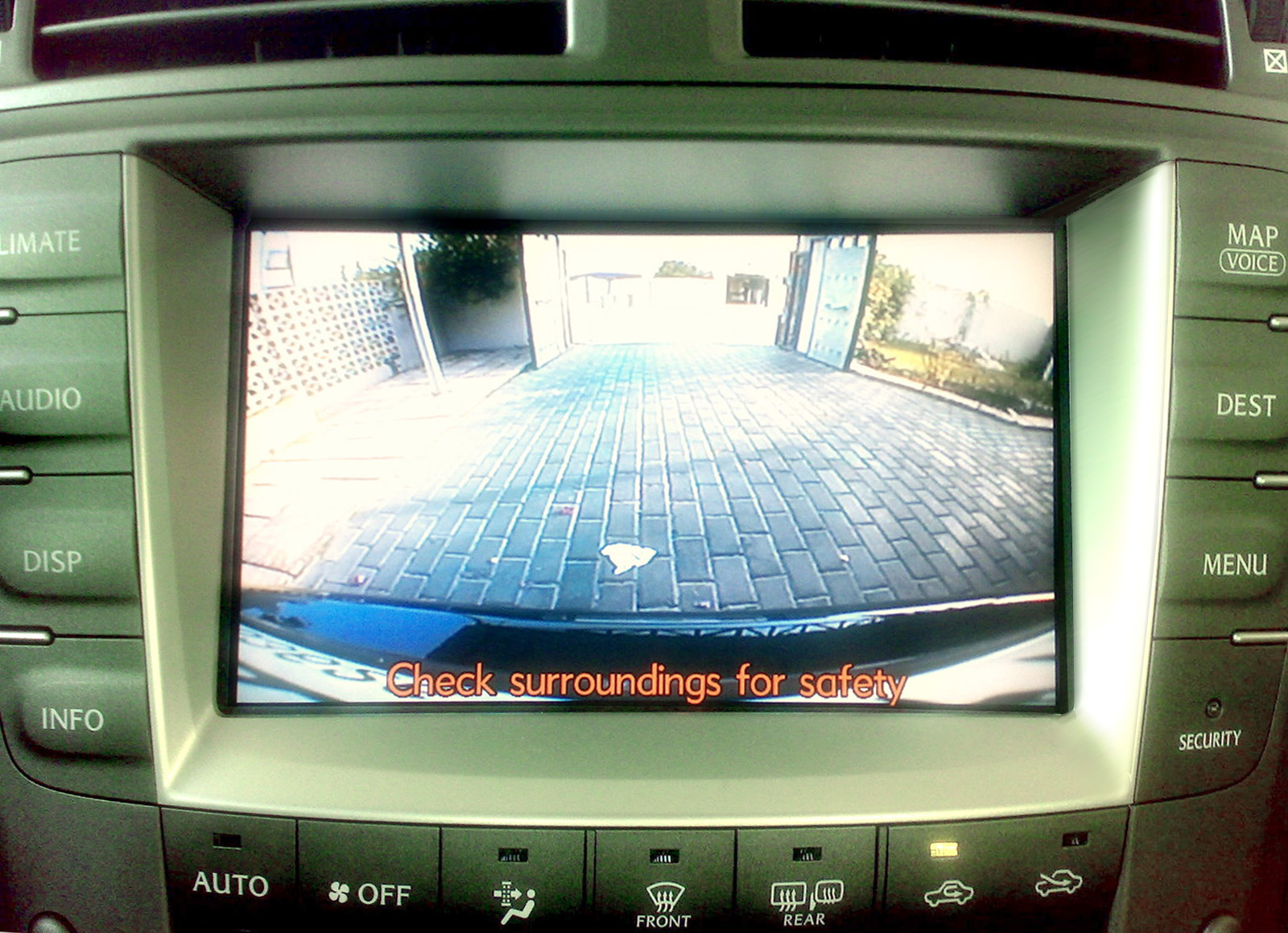
A backup camera (also called a reversing camera or rear-view camera) is a video camera specifically designed to be attached to the rear of a vehicle to aid in reversing and reduce the rear blind spot. The rear blind spot has been described as a "killing zone" due to the accidents it contributes to.[1] Backup cameras are usually connected to the vehicle's head unit display. A common variant is a surround-view system, which assembles a synthetic but positionally accurate top-down view of the vehicle and its surroundings.
Backup cameras have been regulated by law in Canada and the United States since 2018. Since May of that year, backup cameras have been required on all new vehicles sold in the United States.[2]
Function
[edit]The design of a backup camera is distinct from other cameras because the image is horizontally flipped to produce a mirror image.[3] This is necessary because the camera and the driver face opposite directions; without this adjustment, the camera's right would be on the driver's left and vice versa. A mirrored image makes the orientation of the display consistent with the physical mirrors installed on the vehicle. A backup camera typically utilizes a wide-angle or fish-eye lens. Although such lenses may limit the camera's ability to capture distant objects, they allow the camera to see an uninterrupted horizontal path from one rear corner to the other. The camera is typically pointed at a downward angle to view potential obstacles on the ground.
Backup cameras use dashboard screens that are also used with GPS navigation systems. Inside the vehicle, the display is typically wired to automatically activate when the transmission is set to reverse, showing the backup view on the dashboard screen while the vehicle is in reverse and/or providing grid guidelines to aid the driver.
Variations
[edit]Different varieties of backup cameras for different applications:
- Aftermarket addition: Backup cameras can be added to vehicles that do not come with factory-fitted systems. They are available in both wired and wireless versions.
- Large vehicle system: For large vehicles such as motorhomes, camera systems with built-in servomechanisms allow the driver to remotely pan and tilt the camera.
- Wireless backup camera: These come with a wireless camera and receiver, which makes them easier and cheaper to install than wired versions.[3]
- Built-in audio intercom: Used in addition to the camera system for communicating with a spotter outside the vehicle, common when backing large trailers or launching boats.
- Night vision camera: Use a series of infrared lights for backing in the dark when the vehicle's white reverse lights are insufficient.
.jpg)
- Portable or semi-permanent all-in-one camera system: Also known as dashboard cameras or dashcams, these are typically sold for vehicles that don't have displays permanently installed in the dashboard. Such systems consist of a small portable screen that can be affixed on the dashboard or on a rearview mirror, and a length of wire to reach the cameras, including a backup camera.
- Some backup and rear cameras are connected to displays on the rearview mirror and are used in vehicles to detect activity behind the car to "avoid the tooling, software, hardware, and testing costs associated with integrating the display/feature in other areas of the vehicle."
- License-plate-frame version: Permit installation without any permanent vehicle modifications.
- Custom camera: Brake light cameras combine a camera with brake light functionality. Some backup cameras also use LEDs surrounding the camera lens to illuminate the surroundings while in use.
History
[edit]The first backup camera was used in the 1956 Buick Centurion concept car,[4] presented in January 1956 at the General Motors Motorama. The vehicle had a rear-mounted television camera that sent images to a TV screen on the dashboard in place of the rear-view mirror.[5]
The 1972 Volvo Experimental Safety Car (VESC) also had a backup camera, but this feature did not make it into the subsequent Volvo 240 model.[6][7]
The first production automobile to incorporate a backup camera was the 1987 Toyota Crown, which was only available in Japan. The Toyota system used a color EMV screen with a rear-spoiler-mounted CCD camera.[8] In April 2000, Nissan's Infiniti division introduced the Rear View Monitor on the 2002 Infiniti Q45 flagship sedan. Using colored on-screen guidelines as a parking distance parameter, the Rear View Monitor operated from a license-plate-mounted camera in the trunk that transmitted a mirrored image to a 7-inch in-dash LCD screen. It was available as optional equipment at the North American launch in March 2001.[9][10] The 2002 Nissan Primera introduced the Rear View Monitor backup camera system to territories outside Japan and North America.
Aftermarket options for cars have been available for some time with electronics manufacturers offering multiple car upgrades that can be installed by professionals without replacing the car's center console.
Others types of camera
[edit]Surround-view cameras
[edit]
Infiniti introduced the first surround-view cameras, making the system available on the 2008 EX35 and marketing it as the Around View Monitor. The system used four cameras located at the front, back, and sides of the vehicle, feeding images to an image processing unit to create a synthetic but positionally accurate top-down view of the car and its surroundings. In most modern systems, the pictures appear in such detail that it's difficult to believe they were not taken from above the vehicle.[11][12]
Other manufacturers have since offered similar systems, such as Bird's Eye View Camera (Toyota) and Surround Vision (Chevrolet).
Side mirror cameras
[edit]First offered in October 2018, the Japanese market Lexus ES can be optioned with cameras as side view mirrors. This feature is also offered on the Audi Q8 e-tron and Hyundai Ioniq 5.[13]
Wireless backup camera
[edit]These advanced cameras do not require cables between the camera and the display, functioning remotely. They typically switch on automatically when the reverse gear is engaged. Some models used solar energy for power.[3] The display can be powered from the 12-volt socket on the car's dashboard, and some models sync directly with a mobile phone via an app.
Blind spot monitors and other technology
[edit]
Blind spot monitors may include "Cross Traffic Alert", which alerts drivers when traffic is approaching from the sides while backing out of a parking space.[14][15][16]
Mandates
[edit]The following countries have laws that mandate backup cameras for all new vehicles.
 |
| Country/Region | Deadline for compliance | Note | Ref |
|---|---|---|---|
| United States | May 1, 2018 | Required for all vehicles under 10,000 pounds | [17] |
| Canada | May 1, 2018 | Required for all vehicles under 10,000 pounds (4536 kg) | [18] |
| Japan | May 1, 2022 | [19][20] | |
| European Union | July 6, 2022 | Reversing camera or detection system is required. | [21][22] |
| Australia | November 1, 2025 | All new vehicles made from existing models will be required since 1 November 2027. | [23] |
United States and Canada
[edit]In the United States, the Cameron Gulbransen Kids Transportation Safety Act of 2007[24] required the United States Department of Transportation to issue backup-collision-safety regulations within three years and require full compliance within four years after final rulemaking.[25]
The statutory deadline for issuing the final regulations was February 2011. However, the USDOT repeatedly extended the deadline to analyze costs and benefits of the requirement.[26] In September 2013, Greg Gulbransen, the father of the child after whom the law was named, along with a group of consumers and advocates, submitted a petition to the Second Circuit Court of Appeals, demanding that the USDOT implement regulations on backup cameras within 90 days.[27] About half of model year 2012 automobiles were equipped with backup cameras.[25][28]
On March 31, 2014, three years past its deadline, the U.S. National Highway Traffic Safety Administration announced that it would require all automobiles sold in the United States built beginning in May 2018 to include backup cameras.[29] On October 31, 2016, Transport Canada issued a similar mandate beginning at the same time.[18]
See also
[edit]Notes
[edit]- ^ "The danger of blind zones: The area behind your vehicle can be a killing zone". Consumer Reports. Consumers Union. March 2012. Retrieved August 10, 2013.
- ^ Bomey, Nathan (May 2, 2018). "Backup cameras now required on new cars in the US". USA Today. Retrieved February 6, 2023.
- ^ a b c "Best Wireless Backup Camera 2018 (Review) - Buyer's Guide". January 9, 2019. Archived from the original on March 6, 2019. Retrieved September 7, 2018.
- ^ Florea, Ciprian (2021-02-20). "The Buick Centurion Was So Futuristic That It Had a Rear-View Camera in 1956". autoevolution. Retrieved 2023-02-13.
- ^ "Buick Centurion". CNET. Retrieved August 21, 2013.
- ^ "VESC: The Volvo Before Its Time". EuroSport Tuning. Archived from the original on 2021-12-26. Retrieved 2018-08-25.
- ^ "Volvo - VESC". AllCarIndex.
- ^ "TOYOTA MOTOR CORPORATION GLOBAL WEBSITE | 75 Years of TOYOTA | Technical Development | Electronics Parts".
- ^ High Gear Media Staff. "2000 New York Auto Show, Part I". The Car Connection.
- ^ "2002 Infiniti Q45 Sedan - Road Test - Motor Trend". Motor Trend Magazine. 1 May 2001.
- ^ "Around View Monitor". blogs at cars.com. Archived from the original on 2010-11-23. Retrieved 2010-08-24.
- ^ Nerad, Jack R. (October 16, 2002). "How Does Bird's Eye View Work in Cars?". J D Power.
- ^ "Lexus ES Digital Outer Mirrors to be a world first".
- ^ Ford Motor Company (2008). "See It, Hear It, Feel It: Ford Seeks Most Effective Driver Warnings for Active Safety Technology. Increased warnings indicate potentially hazardous lane changes". Gale, Cengage Learning/Free Library. Archived from the original on July 30, 2017. Retrieved August 11, 2013.
- ^ Jensen, Christopher (August 18, 2009). "Are Blind Spots a Myth?". The New York Times. Retrieved August 9, 2013.
- ^ Automobile Blind-Spot Monitoring System, Tri-City Insurance News, January 27, 2006
- ^ "NHTSA Announces Final Rule Requiring Rear Visibility Technology". U.S. Department of Transportation. March 31, 2014. Retrieved 2024-12-05.
- ^ a b "Transport Canada making back-up cameras mandatory in new cars starting May 2018". CBC News. Canadian Press. Retrieved 1 November 2016.
- ^ "Rearview cameras to become mandatory starting next May". Yomiuri Shimbun. June 18, 2021.
- ^ "バックカメラシステムにおける装置型式指定(自マーク)を業界に先駆け第 1 号を取得" (PDF) (in Japanese). Retrieved 2024-12-05.
- ^ "July 6th 2022 – Vehicle safety in Europe takes a giant leap forward". European Transport Safety Council. July 5, 2022. Retrieved 2024-12-05.
- ^ "New safety features in your car". European Commission. 2019-03-25. Retrieved 2024-12-05.
- ^ "Reversing technologies on new vehicles to save lives and prevent serious injuries on Australian roads". Department of Infrastructure, Transport, Regional Development, Communications and the Arts. 26 July 2023. Retrieved 2024-12-05.
- ^ Pub. L. 110–189 (text) (PDF)
- ^ a b "Government Backs Up On Rearview Car Cameras". National Public Radio. 2012-03-02. Retrieved 2012-04-20.
- ^ Rowell, Arden (30 May 2012). "Valuing the Rear-view Camera Rule". The Regulatory Review.
- ^ "As Death Toll Grows, Obama Administration's Transportation Department Sued for Failing to Issue Auto Safety Rule Mandated by Congress". Public Citizen.
- ^ "Group Sues Transportation Dept. Over Rearview Camera Delays". Autoblog. AOL. 25 September 2013. Retrieved 2 November 2016.
- ^ Woodyard, Chris (31 March 2014). "NHTSA to require backup cameras on all vehicles". USA Today. Retrieved 31 March 2014.
External links
[edit]
- "The danger of blind zones The area behind your vehicle can be a killing zone". Consumer Reports. Consumers Union. March 2012. Retrieved August 10, 2013.
Car interior | |
|---|---|
Part of a series of articles on cars | |
| Instruments | |
| Controls | |
| Anti-theft | |
| Other elements | |
| Convenience | |


Backup camera
View on GrokipediaDefinition and Function
Operational Principles
Backup cameras operate by activating upon detection of the reverse gear position, typically through an electrical signal from the vehicle's transmission system that powers the camera module.[10] The camera, mounted at the rear of the vehicle, uses an image sensor—most commonly a complementary metal-oxide-semiconductor (CMOS) or charge-coupled device (CCD)—to capture incoming light focused by a wide-angle lens.[11] In CMOS sensors, each pixel independently converts photons into voltage via on-pixel amplifiers, enabling parallel readout for lower power consumption and faster processing suitable for real-time automotive applications; CCD sensors, by contrast, sequentially transfer charge across pixels to a single output node before conversion, offering higher sensitivity but at the cost of increased complexity and power draw.[12] [13] The captured optical image is digitized into a video signal, usually in NTSC or PAL format, and transmitted via wired coaxial cable or wirelessly to a display unit integrated into the rearview mirror, dashboard screen, or head unit.[10] This real-time feed provides a downward-angled view of the area immediately behind the vehicle, with the lens typically offering a horizontal field of view between 120 and 180 degrees to encompass regions obscured by the vehicle's body structure.[14] [15] By optically extending the driver's line of sight beyond physical blind spots—such as under the rear bumper or adjacent to the sides—the system causally mitigates visibility limitations inherent to direct rearward glancing, relying on the principles of geometric optics where the wide-angle lens distorts the image to project a broader scene onto the sensor array.[16] Advanced implementations incorporate electronic processing to overlay visual aids on the displayed image, including fixed grid lines calibrated to indicate approximate distances (e.g., 1-foot increments from the rear) for parking assistance.[10] Dynamic guidelines, generated by integrating steering wheel angle data from the vehicle's sensors, project curved trajectory lines representing the predicted path of the rear wheels or bumper, adjusting in real time as the steering input changes to facilitate precise maneuvering.[10] These overlays, rendered via onboard image processing units, do not alter the raw optical capture but augment human spatial judgment by visualizing extrapolated vehicle kinematics based on current orientation and turn radius.[10]Safety Objectives and Causal Mechanisms
The primary safety objective of backup cameras is to mitigate backover collisions, which occur when a vehicle reverses into pedestrians, cyclists, or objects outside the driver's direct line of sight, often in blind zones behind the vehicle. These incidents disproportionately affect vulnerable road users, including young children and the elderly, with the National Highway Traffic Safety Administration (NHTSA) estimating that backover crashes contribute to approximately 210 fatalities and 15,000 injuries annually in the United States prior to widespread adoption.[17] By providing a real-time video feed of the rear area, backup cameras enable drivers to identify and avoid hazards that mirrors alone cannot reveal, directly addressing visibility limitations inherent in vehicle design.[18] Causally, backup cameras reduce crash rates by enhancing driver situational awareness through the elimination of rear blind spots, which typically span 10 to 20 feet directly behind most passenger vehicles depending on height and angle. Studies indicate that vehicles equipped with rearview cameras experience a 17% lower rate of backing crashes compared to those without, with reductions reaching 36% for drivers aged 70 and older, attributable to improved detection of low-lying or fast-moving objects.[19] In experimental settings, drivers who actively viewed the camera feed avoided collisions in 88% of cases, as the visual input prompts evasive maneuvers like braking or steering corrections before impact, bypassing reliance on auditory cues or partial mirror views that often fail under low-speed reversing conditions.[9] Empirical evidence from post-mandate analysis, following the U.S. requirement for backup cameras on all new light vehicles since May 2018, shows a near-50% drop in severe backover injuries and a 78% reduction in fatalities among small children, linking the technology's visibility provision to decreased incidence of non-occupant impacts.[20] When combined with rear parking sensors, the systems yield a 42% crash reduction, as the camera's dynamic imagery complements static proximity alerts, allowing for integrated perceptual processing that heightens response efficacy over either technology alone.[21] This causal chain— from obscured visibility to informed decision-making—underpins the mechanism, though effectiveness depends on driver attention, as non-use correlates with persistent crash risks.Technical Components
Camera Hardware and Sensors
Backup cameras primarily utilize complementary metal-oxide-semiconductor (CMOS) image sensors, which consume less power and exhibit greater sensitivity to low-light conditions compared to charge-coupled device (CCD) alternatives, making them suitable for automotive applications.[22] These sensors typically deliver resolutions from 720 × 480 pixels to 1080p, with frame rates of up to 30 frames per second to support fluid video output during reverse maneuvers.[23] Durability is ensured through ingress protection ratings such as IP67 or IP68, which resist dust and immersion in water up to 1 meter for 30 minutes, and IP69K for high-temperature, high-pressure washdown resistance.[24][25] Mounting configurations commonly position the camera within license plate frames or on the rear bumper to optimize the field of view behind the vehicle.[23] Lenses feature wide-angle designs, ranging from 130° to 170° horizontal viewing angles, often incorporating fisheye distortion for expanded coverage of the blind spot area.[25][26] Integrated infrared light-emitting diodes (IR LEDs), numbering from 4 to 18 per unit, provide illumination for night vision extending up to 50 feet, activating automatically in low ambient light to maintain visibility.[25][27] Power integration draws from the vehicle's 12V DC electrical system, ensuring compatibility with standard automotive wiring.[28] Signal transmission predominantly employs analog Composite Video Baseband Signal (CVBS) format over coaxial or RCA cables, prioritizing minimal latency for immediate feedback during low-speed reversing.[28] Emerging digital Internet Protocol (IP)-based systems offer higher resolution potential with comparable or lower latency through optimized encoding, though analog remains prevalent for its simplicity and reliability in harsh environments.[29]Display Systems and User Interfaces
Backup camera systems render captured footage on dedicated displays designed to integrate seamlessly with vehicle interiors, minimizing driver distraction while providing essential rearward visibility. Primary display types include liquid crystal display (LCD) overlays embedded within the rearview mirror, standalone monitors affixed to the dashboard or mirror assembly, and projections onto the central infotainment touchscreen. These interfaces automatically activate upon transmission engagement in reverse gear, with Federal Motor Vehicle Safety Standard (FMVSS) No. 111 mandating image display within 2.0 seconds to ensure timely situational awareness, and deactivate when shifting to forward gears to restore primary forward-facing attention.[30][31][22] User interfaces enhance decision-making through overlaid visual aids that reduce cognitive load, such as static guidelines demarcating vehicle width and distance zones—often color-coded with red indicating proximity under 1-2 feet from the bumper, yellow for intermediate ranges of 3-7 feet, and green for farther areas—to facilitate precise obstacle detection and maneuvering. Dynamic guidelines, which adjust curvature in response to steering input, project the anticipated vehicle path, further improving spatial judgment accuracy without requiring mental extrapolation. Select systems incorporate automatic zoom capabilities that magnify close-range views upon detecting nearby objects, prioritizing critical details during tight reversals.[32][33][34] Design parameters prioritize empirical usability factors to mitigate disorientation risks, with display screens typically ranging from 4 to 7 inches diagonally to optimize resolution visibility against dashboard space constraints and divided attention demands. Automatic brightness modulation adjusts luminance dynamically to counteract glare from sunlight or headlights, maintaining image clarity across varying ambient conditions as per FMVSS 111 visibility requirements. Low-latency processing, beyond the 2-second activation threshold, ensures frame delays remain imperceptible, supporting real-time causal feedback in low-speed operations where reaction times are compressed.[31][35][36]Types and Variations
Wired Backup Cameras
Wired backup cameras transmit video signals via direct physical connections, typically using RCA composite cables or coaxial wiring from the rear-mounted camera to the in-cabin display unit.[25] This setup ensures a stable, interference-free transmission by avoiding reliance on radio frequencies, which are prone to disruption in wireless alternatives.[37] Installation requires routing cables along the vehicle's chassis or interior, often necessitating partial disassembly of trim panels, wiring harnesses, or tailgate components to secure the line without signal degradation.[38] These systems support reliable signal integrity over distances up to approximately 50 feet, suitable for most passenger vehicles and light trucks, with negligible latency compared to wireless options that may experience delays from signal processing.[39][40] In original equipment manufacturer (OEM) integrations, wired cameras are standard for their consistent performance, integrating directly with factory infotainment screens via dedicated video inputs.[41] Despite these strengths, wired configurations are vulnerable to physical damage, including cable fraying from road vibrations, exposure to moisture leading to corrosion at connections, or pinching during vehicle flex.[42] Aftermarket retrofit kits, which include camera, cabling, and monitor, typically cost between $100 and $300, with professional installation adding labor expenses due to the invasive routing process.[43]