Hubbry Logo
Sun visorSun visorMain
Open search
Sun visor
Community hub
Sun visor
logo
8 pages, 0 posts
0 subscribers
Be the first to start a discussion here.
Sun visor
Sun visor
from Wikipedia

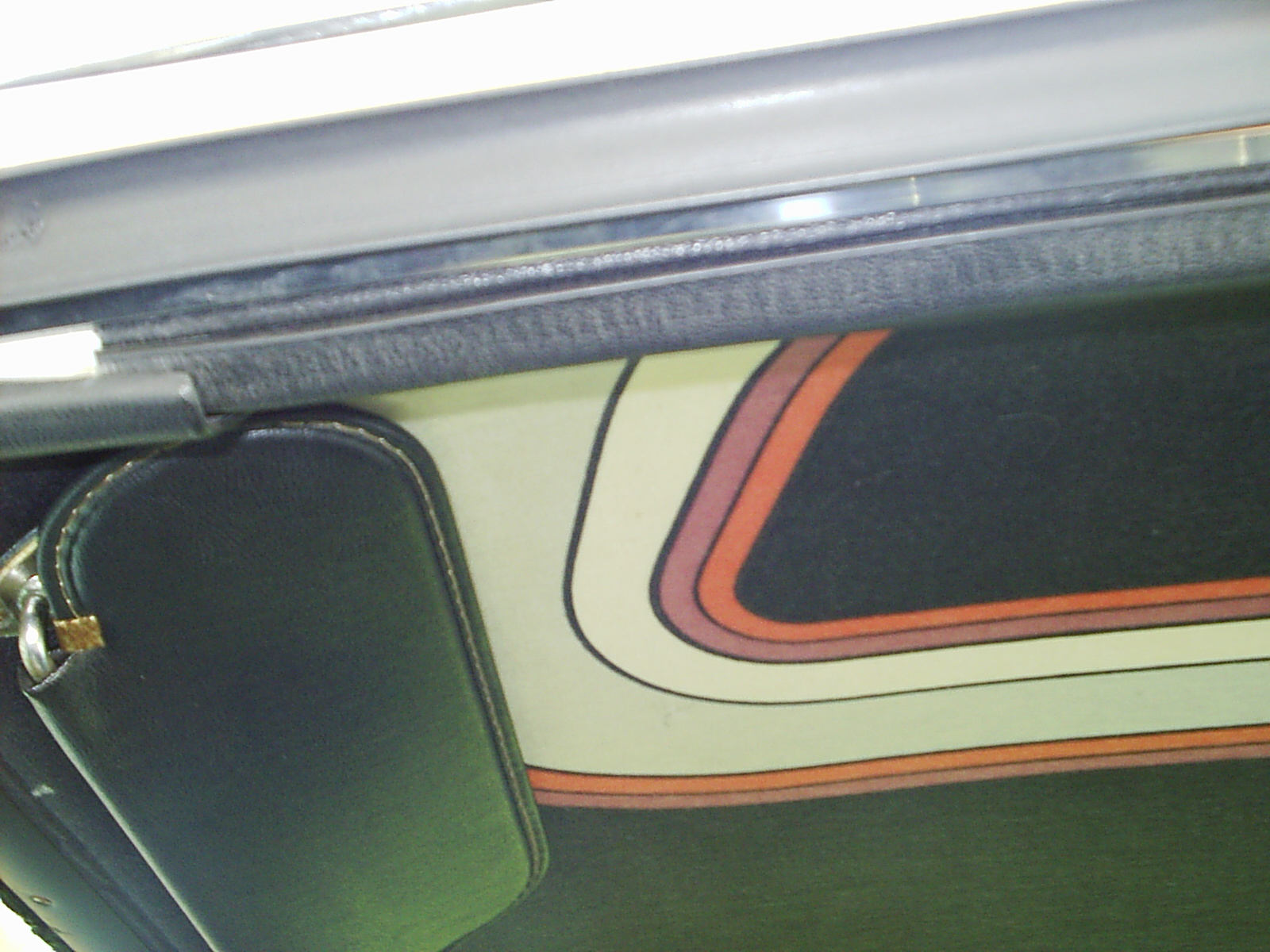
Driver's sun visor in the up position below the Pierre Cardin headliner in a 1972 AMC Javelin
Passenger's sun visor in down position with a lighted vanity mirror in a 1993 Jeep Grand Cherokee

A sun visor is a component of an automobile located on the interior just above the windshield. They are designed with a hinged flap that is adjustable to help shade the eyes of drivers and passengers from the glare of sunlight.[1]

Design

[edit]

Starting in 1924, automobiles such as the Ford Model T began to include an exterior sun visor on its closed body versions.[2] Other early automobiles also had externally attached sun visors to their windshields until 1931, when interior mounts were introduced.[3] As automobile design advanced with windshields mounted on an angle to lessen wind resistance, the outside or "cadet-type" sun visors were no longer seen on cars starting from 1932.[4] Henceforth, sun visors were mounted inside the vehicle, making the hinged flap easier to reach and adjust.[4]

Most modern cars have two sun visors, one for the driver's side and a second for the passenger's side, with the rear-view mirror often mounted in between the two sun visors. Each visor can be lowered to help block light from the sun entering through the windshield. Some are designed so they can be released from one bracket and be turned towards the side window, covering a small part of the window at the top to block the sunlight shining onto the side of the face. Some current visors can also be extended along the side window to block sunlight all of the way to the "B" pillar to block the light for the driver or passenger.

The sun visor's flap or core is typically made from pressboard with a piece of metal for its attachment onto a mounting bracket.[5] Some are made of molded substrates or polypropylene. The mounting bracket is often a metal rod with a slight bend in the middle and a bracket that attaches it with screws to the sheet metal above the headliner.[5] The bend in the rod serves to hold the visor flap in the desired position.[5] The visor flap is covered with a material, most often to complement the interior of the vehicle.[6] Padding on the sun visors became popular for the extra protection afforded to passengers.[7] Such safety improvements included Ford's 1956 Lifeguard package and the seat belts, as well as padded dash and visors that were offered by 1957 on Rambler cars.[8]

Some sun visors may incorporate a vanity mirror for the passenger's convenience. For many years, a visor mounted mirror was among popular dealer-added accessories that provided high-profit margins with the sales staff receiving extra incentives to sell them.[9] In some cases, a flip-up or sliding cover over the mirror automatically turns on vanity lights, which can be adjusted with a dimmer control (see image).

Visors are also available as an option or as a standard item from manufacturers with a built-in remote garage door control, often referred to as a universal garage door opener.

Aftermarket exterior sun visors are available for trucks as cab visors.

Manufacturers and aftermarket suppliers are offering new sun visors with electronic features such as USB input slots and GPS systems.[10]

See also

[edit]

References

[edit]
Revisions and contributorsEdit on WikipediaRead on Wikipedia
from Grokipedia
A sun visor is a device designed to protect the eyes from bright , most commonly implemented in as an adjustable interior component mounted above the on a to block direct sunlight and reduce for the driver and front passengers. It consists of a padded panel that can be flipped down to shield the front or pivoted sideways to cover side windows, thereby improving visibility and safety without obstructing the road ahead. The term also applies to the brim of hats or caps, as well as similar shades in , marine , headwear, and other contexts. The automotive sun visor originated in the early as an exterior "glare shield" mounted on vehicles like the Ford Model T's closed-body versions to protect against overhead sun. By , the interior pull-down version had become standard, marking a shift toward integrated cabin features that addressed driver comfort and accident prevention related to sun blindness. This evolution reflected broader advancements in vehicle during the . Over the decades, sun visors have remained a staple accessory, mandated or recommended in many global regulations to mitigate glare-induced hazards. In terms of construction, modern sun visors feature a rigid core made from materials such as expanded (EPP) , , or for lightweight strength and impact absorption. This core is encased in a flexible outer layer of fabric, vinyl, or PVC , which provides durability, aesthetic appeal, and resistance to wear from frequent use. The assembly includes metal hinges for adjustability, often with clips or retainers to secure the visor in the up or down position, and may incorporate reinforcements like wire for structural integrity in premium models. Contemporary innovations have expanded the sun visor's utility beyond basic shading, integrating features like vanity mirrors, LED-illuminated compartments, and storage pockets for tickets or to enhance passenger convenience. Advanced variants include electronic systems, such as LCD screens for entertainment, displays, or panels that dynamically adjust tint levels based on light sensors. Emerging technologies, like eye-tracking virtual visors that selectively darken sections, and as of 2025, Gentex's dimmable visors with integrated transparent displays for driver alerts, reflect ongoing efforts to improve and user experience.

Automotive Sun Visors

History

The automotive sun visor originated in 1924 when amateur inventor Edgar F. Hathaway developed the first "glare shield," an exterior-mounted device designed to block direct sunlight from drivers' eyes. This innovation was quickly adopted by Ford for closed-body versions of the Model T, marking the initial widespread integration of sun protection as a standard exterior feature in mass-produced automobiles. By the late 1920s and early , the design evolved toward interior-mounted pull-down visors for greater accessibility and adjustability. Packard Motor Car Company introduced interior folding sun visors in 1931, contributing to the early adoption of this feature in luxury vehicles and influencing broader industry adoption. A significant milestone came in 1938 with Hathaway's U.S. Patent No. 2,118,198 for an improved glare shield, which incorporated adjustable opaque and semi-transparent panels to address both daytime and nighttime glare, facilitating refinements for and enhanced driver safety. Following World War II, with fully enclosed cabins already standard since the 1930s, sun visors became fully standardized equipment in the late 1940s and 1950s, with dual visors—one for the driver and one for the passenger—emerging as a common feature to accommodate increased interior comfort and visibility needs across mainstream models.

Design and Components

Traditional automotive sun visors feature a core set of mechanical components engineered for flexibility in positioning and seamless integration with the vehicle's roof structure. The central element is a hinged flap, generally rectangular in shape and spanning 12 to 18 inches in width to effectively shield the upper windshield area. This flap connects to a pivot rod that facilitates vertical deployment, flipping down from a stored position flush against the headliner to block direct sunlight. An accompanying side-to-side swivel mechanism, typically built into the pivot assembly, permits rotation for redirecting the flap toward side windows, enhancing coverage without requiring separate accessories. Mounting occurs directly to the headliner above the using clips or screws for secure attachment, often with integrated extension arms that slide outward to extend partial coverage across a wider portion of the . These arms, adjustable via sliding tracks, allow for incremental positioning to match varying light angles. The assembly includes a frame supporting the pivot and , ensuring durability during repeated use. Driver-side and passenger-side visors differ in integrated features to suit occupant roles. Driver-side models commonly incorporate a vanity mirror housed in a recessed frame, paired with an illuminated for low-visibility conditions, promoting quick access without diverting attention from the road. Passenger-side variants, by comparison, often include a ticket clip or storage slot for documents like toll receipts, omitting the light to prioritize simplicity and cost efficiency. Ergonomic design emphasizes user-friendly adjustability, with the pivot and enabling up to 180 degrees of to align the flap precisely while avoiding interference with the rearview mirror or overhead controls. This range supports multi-axis movement—vertical flip, lateral swivel, and linear extension—to reduce neck strain and maintain unobstructed sightlines. Vehicle-specific adaptations influence overall configuration; sedans utilize compact, low-profile visors to conform to tighter cabin dimensions, whereas trucks and SUVs incorporate larger, reinforced overhead designs with broader flaps and extended arms to address elevated seating and expansive windshields. These variations ensure compatibility with diverse interior architectures while preserving core functionality.

Materials and Construction

Automotive sun visors primarily consist of a rigid core, typically made from (PU) or medium-density , which provides a lightweight structure essential for reducing vehicle weight while maintaining rigidity and shape retention. This core is enveloped in covering materials such as vinyl, -coated fabric, or Alcantara to achieve aesthetic appeal and (UV) resistance, preventing degradation from prolonged sun exposure. The core's density is standardized at 15-40 kg/m³ to balance impact absorption—critical for occupant during collisions—with minimal contribution to overall . Higher densities within this range enhance durability without compromising the visor's flexibility or ease of installation. Construction involves injection molding the core substrate from materials like (PP) or (ABS), achieving wall thicknesses of 2.5-3.5 mm for structural integrity. Foam lamination follows via low-pressure PU injection molding or hot pressing of pre-formed expanded (EPP) or (PE) foam sheets onto the substrate, after which the exterior skin—such as knitted fabric or PVC/TPU —is wrapped and adhered. Final assembly integrates metal hinges, typically or aluminum, through insert molding or snap-fit mechanisms to enable pivoting without compromising the unit's cohesion. Sustainability efforts in sun visor manufacturing have accelerated since 2010, incorporating recycled PP/PE plastics and bio-based foams derived from renewable sources like natural fibers, thereby lowering (VOC) emissions and overall environmental footprint during production. To verify performance, sun visors undergo rigorous quality testing, including UV aging per SAE J1885 to assess fading resistance, flame retardancy evaluation under Federal Motor Vehicle Safety Standard (FMVSS) 302 to ensure burn rates do not exceed 100 mm/min, and tensile strength tests using universal testing machines to confirm material integrity and longevity under cyclic loading.

Functionality and Safety

Automotive sun visors primarily function by blocking direct entering through the and side windows, thereby reducing that can cause and impair during . This shielding allows drivers to maintain clearer sightlines to the road, signals, and other vehicles, particularly in conditions of intense solar exposure. By mitigating the blinding effects of sunlight, visors contribute to overall driver comfort and sustained , as supported by ergonomic principles that emphasize minimizing visual distractions. In terms of , sun visors play a critical role in preventing glare-induced accidents, especially during low-angle sun periods such as dawn and when aligns horizontally with the driver's . Research indicates that bright elevates the risk of life-threatening crashes by approximately 16% compared to normal conditions, underscoring the importance of glare reduction tools like visors to counteract this hazard. Effective use of visors helps avert scenarios where temporary blindness leads to rear-end collisions or failure to detect obstacles, thereby lowering the incidence of such incidents in high-glare environments. The ergonomic design of sun visors, featuring adjustable pivots and flip mechanisms, enables drivers to position them precisely without excessive head tilting or body shifting, which preserves focus on the road and reduces physical over long drives. This adjustability supports optimal posture and minimizes distractions from constant repositioning. While some vehicle designs incorporate sun visors in ways that complement (HVAC) systems by allowing unobstructed airflow distribution around the visor area, this integration enhances cabin comfort without compromising glare protection. Despite their benefits, sun visors have limitations; they are often ineffective against reflections from low surfaces or interior elements, which can create secondary spots not shielded by the visor's coverage. Additionally, traditional visors do not specifically address from polarized sources, such as certain reflections off wet roads or , requiring supplementary measures like polarized for comprehensive mitigation. Improper positioning or modifications to the visor can also obstruct side or deployment during a collision, potentially reducing the system's protective and increasing injury risk. Sun visors must comply with Federal Motor Vehicle Safety Standard (FMVSS) No. 201, which mandates that they be constructed of or covered with energy-absorbing materials to provide occupant protection during interior impacts. This standard requires sun visors to withstand headform impact tests without exceeding specified injury criteria, ensuring they do not shatter or produce hazardous fragments in a crash. Mountings must lack sharp edges with radii less than 3.2 mm that could contact a passenger's head, thereby prioritizing shatter resistance and overall interior safety. Similar requirements exist in international standards, such as UN ECE Regulation 21 for the interior fittings of motor vehicles.

Technological Advancements

Electronic and Smart Visors

Electronic and smart visors represent a significant advancement in automotive glare management, integrating sensors, displays, and automation to dynamically adjust to lighting conditions without manual intervention. These systems employ electrochromic or liquid crystal display (LCD) technologies to tint or block light selectively, enhancing driver visibility while minimizing distractions. Unlike traditional mechanical visors, which require physical repositioning, electronic variants respond in real-time to environmental data, improving safety and comfort during varied driving scenarios. Auto-dimming visors utilize electrochromic films or LCD panels that darken electronically in response to light sensors detecting glare intensity. For instance, Gentex Corporation's dimmable sun visors, showcased at CES 2024 and updated at CES 2025 as prototypes with integrated transparent displays for driver notifications, feature a transparent panel that variably tints on demand or automatically, reducing sun glare while preserving a clear forward view for the driver and passengers. This technology applies low-voltage electricity to alter the material's opacity, achieving high contrast ratios for effective light blocking without obstructing . These visors fold and deploy similarly to conventional models but offer precise control via integrated electronics. Camera-based systems further refine glare reduction by personalizing shading to the driver's . Bosch's Virtual Visor, debuted in , employs an eye-tracking camera mounted above the rearview mirror to monitor the driver's gaze and facial position, paired with a small LCD panel that selectively darkens pixels to block only the intruding sunlight rays. This approach ensures the passenger's view remains unobstructed, addressing a key limitation of fixed visors. The system processes data in milliseconds using to map the sun's position relative to the driver's eyes, providing targeted protection without full-panel tinting. While not yet widespread in production vehicles, prototypes have demonstrated compatibility with advanced driver assistance systems (ADAS) for seamless integration. Sensor integration enhances through ambient light detectors and GPS-linked mechanisms for predictive deployment. Light sensors measure incoming sunlight angles and intensity, triggering visor tinting or positioning adjustments, while GPS data anticipates glare from directional changes or time-of-day patterns. Patent-pending designs, such as those for self-adjusting visors, combine these elements to optimize shading for individual occupants, potentially minimizing driver distractions. Power for these systems draws from the vehicle's 12V battery via standard wiring harnesses, with efficiency-focused low-energy modes designed for electric (EVs) to limit auxiliary drain—typically under 5W during active use. Market adoption of electronic and smart visors is accelerating, driven by their synergy with ADAS features like and lane-keeping assistance. The global smart sun visor segment was valued at approximately USD 1.2 billion in 2024 and is projected to reach USD 4.7 billion by 2033, reflecting growing demand in premium and autonomous vehicles. This expansion aligns with broader ADAS proliferation, where enhanced visibility technologies contribute to safer driving ecosystems.

Alternative Glare-Reduction Technologies

Electrochromic represents a key alternative to traditional sun visors by enabling dynamic tinting of windows, including potential applications for full windshields, through the application of low-voltage to alter transmission. Developed by Gentex , this technology has been in production since the early , initially for automotive mirrors and expanding to sunroofs and visors, where it darkens a layer sandwiched between panes to block up to 99.9% of while preserving outward visibility. By uniformly tinting the entire surface, electrochromic systems can eliminate the need for mechanical flip-down visors, providing seamless glare reduction across the driver's . Holographic optical elements offer another innovative approach, using thin films to redirect incoming and selectively block glare without obstructing the full view. These elements, integrated into heads-up displays (HUDs) or window films, diffract to minimize reflections while allowing clear passage of ambient , as demonstrated in recent automotive prototypes. For instance, advancements in holographic combiners have been showcased for HUD systems that enhance visibility by projecting information. Although specific vehicle integrations like those explored by through investments in optical startups focus more on HUD enhancements, the underlying supports broader applications in prototypes, including updates at CES 2025 for transparent displays. AI-driven heads-up display (HUD) overlays provide dynamic functionality by integrating to adjust projections and filters in real-time based on environmental conditions. These systems sync with sensors, such as wipers or ambient detectors, to modulate , contrast, and overlay positioning, thereby reducing driver from sources like direct or oncoming headlights. Panasonic's AR-HUD, for example, employs AI to project contextual information, ensuring readability across varying levels. Hybrid systems combine traditional visor extensions with integrated diffusers, such as polarized or light-filtering lenses, to address both daytime sun and nighttime headlight dazzle without complete light blockage. These extensions clip onto existing visors and use materials that diffuse harsh light rays, improving contrast and reducing eye fatigue during low-light driving; products like the Hyper Bright Night Driving Lens exemplify this by enhancing through targeted elimination. By extending coverage beyond standard visors, hybrids offer versatile, low-profile solutions that maintain . Despite their potential, these technologies face challenges including significantly higher costs—electrochromic glass, for instance, has decreased to approximately $80 per square meter due to recent advancements compared to under $50 for conventional visors—and regulatory requirements for minimum . Under ECE No. 43, glazing must achieve at least 70% luminous transmittance to ensure , posing hurdles for deeply tinting systems that could fall below this threshold without careful . Overall, these alternatives cost 2-3 times more than traditional options due to and integration, limiting widespread adoption pending cost reductions and standardization.

Other Applications

In Headwear and Apparel

A sun visor in headwear and apparel refers to a rigid brim, typically measuring 2 to 4 inches in width, attached to a or that shades the face from (UV) rays while leaving the top of the head uncovered for ventilation. This design distinguishes it from full hats, prioritizing during outdoor activities like sports or . Standalone visors secure via elastic or adjustable bands, offering portable sun protection without encumbering the or adding excess weight. The origins of sun visors trace back to the late , with early examples in headgear such as that worn by the Brooklyn Excelsiors in 1860. By the 1930s, curved brims had become common in caps for enhanced visibility on sunny fields. Visor caps emerged in the for outdoor sports like , , and , gaining popularity in the among athletes and for sunny events, marking the transition to broader use as an everyday outdoor accessory. Common types include baseball-style visors with a curved or stiffened brim for directional shading, often integrated into caps; visors, which feature an open for maximum ventilation during prolonged exposure; and clip-on models that attach to eyeglasses or hats, providing quick-add for users with prescription lenses. These variations cater to different activities, with and types emphasizing durability and the clip-on design focusing on versatility. Materials commonly used in sun visors prioritize lightweight breathability and UV resistance, such as mesh fabrics that allow air circulation while incorporating UPF 50+ treatments to block over 98% of UV rays. Adjustable straps, often made from elastic or hook-and-loop fasteners, ensure a secure fit across various head sizes, enhancing wearability during movement. Cotton-polyester blends add sweat-wicking properties, making them suitable for extended outdoor use. Wearing sun visors significantly lowers the risk of skin cancer on the face and neck by reducing UV exposure in areas where basal and squamous cell carcinomas frequently develop, which account for about 90% of non-melanoma skin cancers. Dermatological research indicates that protective headwear like broad-brimmed hats can block more than 50% of UV radiation to the face, ears, and neck, contributing to overall prevention when combined with other measures. The Skin Cancer Foundation recommends UPF 50+ visors for optimal efficacy, as they provide superior blocking compared to standard fabrics.

In Aviation and Marine Vehicles

In aviation, sun visors are essential adjustable tinted panels integrated into cockpits to shield pilots from intense solar , particularly at cruising altitudes like 30,000 feet where exposure and direct can impair . For instance, in the , aftermarket visor systems such as Jet Shades utilize optical-quality panels that block 72% of visible light and provide 70% reduction while maintaining clear forward vision. These visors are deployable via friction-adjustable hinges, allowing pilots to position them precisely without obstructing critical instrument panels or the required . Design features emphasize and functionality, including quick-release mechanisms for emergency access; a patented aviation sun visor system incorporates a removable polarized disk that flexes out of tracks for rapid deployment or clearance during egress, occluding only 5–7 degrees of the . Integration with structures ensures seamless operation, often attaching via single-point mounts with adjustable friction for multi-directional movement. Modern evolutions include photochromic tints, as in Gentex aircrew visors, which automatically darken in direct sunlight passing through canopies, enhancing adaptability without manual adjustment; such technology builds on photochromic developments from the but gained aviation-specific application in later decades. These visors play a critical role by mitigating pilot disorientation from , in compliance with FAA 25.773-1, which permits light-transmissivity reduction but prohibits totally opaque obstructions in the defined visibility envelope. In marine vehicles, sun visors are adapted for helm stations on boats to combat from water reflections and open horizons, often employing durable materials like acrylic or marine-grade plastics resistant to saltwater and UV degradation. Systems such as the RipaLip SunShade, designed specifically for marine electronics displays, reduce from sun and reflective surfaces while preserving screen readability. Polarized options, akin to those in , are incorporated in some designs to filter horizontally polarized light from water, minimizing squint and during . These visors typically feature articulating arms for positioning over consoles, with neutral-density tints providing broad-spectrum protection without distorting colors essential for chart reading or interpretation. For marine applications, quick-release hinges facilitate emergency access, similar to aviation counterparts, ensuring visors can be stowed or removed swiftly in rough seas or evacuation scenarios. Evolution traces to post-World War II adaptations for recreational and commercial vessels, with contemporary versions like Rosen Marine systems emphasizing UV blocking and glare reduction for prolonged exposure on open water. Safety benefits include reduced captain disorientation from specular reflections, aligning with operational standards for clear helm visibility in variable lighting conditions.

References

Add your contribution
Related Hubs
User Avatar
No comments yet.