Hubbry Logo
Balkan terrapinBalkan terrapinMain
Open search
Balkan terrapin
Community hub
Balkan terrapin
logo
8 pages, 0 posts
0 subscribers
Be the first to start a discussion here.
Balkan terrapin
Balkan terrapin
from Wikipedia

Balkan terrapin
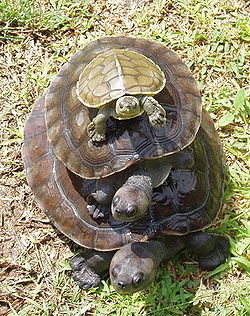
Balkan terrapin in captivity
Scientific classification Edit this classification
Kingdom: Animalia
Phylum: Chordata
Class: Reptilia
Order: Testudines
Suborder: Cryptodira
Family: Geoemydidae
Genus: Mauremys
Species:
M. rivulata
Binomial name
Mauremys rivulata
Synonyms[3]
List
  • Emys rivulata Valenciennes, 1833
  • Emys tristrami Gray, 1869
  • Emys caspica var. arabica Gray, 1870
  • Emys pannonica Gray, 1870
  • Emys tristram Gray, 1873 (ex errore)
  • Emys arabica Gray, 1873
  • Clemmys caspica orientalis Bedriaga, 1881
  • Clemmys caspica var. rivulata Boulenger, 1889
  • Clemmys caspica var. obsoleta Schreiber, 1912
  • Clemmys caspica cretica Mertens, 1946
  • Mauremys caspica rivulata Młynarski, 1969
  • Mauremys rivulata Bour, 1994
  • Mauremys rivulata rivulata Maran, 1996
  • Mauremys rivulata tristrami Maran, 1996
  • Mauremys caspica cretica Bonin, Devaux & Dupré, 1996
  • Emmenia rivulata Vetter, 2006
  • Mauremys rivulata cretica Bonin, Devaux & Dupré, 2006
Turtles at the Ein Afek Nature Reserve

The Balkan terrapin or western Caspian terrapin (Mauremys rivulata) is a species of terrapin in the family Geoemydidae. It is found in the eastern Mediterranean region. While technically omnivorous, the terrapins are known to prefer meat. They can grow to 25 cm (10 in) in carapace length, although hatchlings are usually only 3 to 4 cm (1.2 to 1.6 in) in length.

Distribution

[edit]

It is found in the Balkan Peninsula (Albania, Bosnia and Herzegovina, Bulgaria, Croatia, Greece, Montenegro, North Macedonia, Serbia), in a number of Mediterranean islands including Crete, Cyprus and Lesvos, and in the Middle East (Israel, Jordan, Lebanon, Syria, Turkey).[4] On some Greek and Turkish islands where the terrapins are found, they may be threatened with extirpation.[5]

Physical description

[edit]
Balkan terrapin emerging from a river

Mauremys rivulata are fairly large, with carapace lengths up to 25 cm (10 in); hatchling turtles of this species are usually between 3 and 4 centimetres (1.2 and 1.6 in) in length.[5] The average strait[clarification needed] carapace length is roughly 15 cm (6 in); females are slightly larger.[6][7] The terrapins' carapaces are black to olive green in colour, and the plastron (the shell on the belly) black, although the latter frequently fades as the turtles age. The species also has horizontal yellowish lines running along the neck and limbs.[7]

Habitat and ecology

[edit]

The species is mostly lowland, although the terrapins have been recorded as far up as 900 metres (3,000 ft) above sea level. They are found in wetland habitats, including swamps, rivers, and ponds, although they lay their eggs in grassland regions.

Mauremys rivulata are preyed on by large birds and predacious mammals such as mongoose who also feed on the terrapins' eggs, although smaller carnivores may prey on younger turtles with softer shells.[7]

Diet

[edit]

Mauremys rivulata is an omnivorous species, eating both plants and animals, although a preference for meat is documented. Young terrapins will eat small invertebrates as well as small amphibian larvae or carcasses; adult terrapins are known also to eat algae and aquatic plants.[7]

Interactions with humans

[edit]

Human behaviour affecting the species' habitat has caused population decline.[8] The largest effects come from urbanisation, water engineering projects, and industrial waste from construction.[9]

In the northern portion of its range, the species may hibernate during the winter.[5] Although the terrapins may accept bread offered by humans, they do not have the enzymes needed to digest it, and such offerings are thus bad for their health.[7]

References

[edit]
Revisions and contributorsEdit on WikipediaRead on Wikipedia
from Grokipedia
The Balkan terrapin (Mauremys rivulata), also known as the western Caspian , is a medium-sized freshwater species belonging to the family , characterized by an olive-brown to dark green that measures up to 244 mm in length for females and 187 mm for males, with juveniles featuring a prominent that diminishes with age. Native to the warm zones, it exhibits a robust plastron that darkens in youth before lightening in adulthood, and it displays with females generally larger than males. This species occupies a broad distribution across southeastern Europe and the , including , , , , , , , , , , , , , , and , with recent records indicating potential expansions into areas like due to and human-mediated releases. It thrives in diverse aquatic habitats such as rivers, seasonal ponds, lakes, brackish coastal lagoons, canals, and reservoirs, demonstrating high tolerance for varying water conditions, including and salinity levels up to brackish environments. Ecologically, M. rivulata is omnivorous and opportunistic, with juveniles primarily consuming carnivorous prey like , crustaceans, snails, tadpoles, and small , while adults shift toward a more herbivorous diet incorporating vascular , , and carrion; feeding activity typically occurs in water temperatures between 13°C and 30.5°C. is seasonal, with from to April (peaking in January-February) and nesting from May to July, during which females lay 4-10 eggs per in up to three clutches annually, with incubation lasting 49-77 days depending on environmental conditions. Despite its adaptability, the Balkan terrapin faces threats from through drainage, canalization, and urbanization, as well as from pesticides and , and competition from such as the (Trachemys scripta). Conservation efforts are supported by its listing on EU Council Directive Annexes II and IV, as well as Bern Convention Appendix II, and it is assessed as Least Concern by the IUCN Tortoise and Freshwater Turtle Specialist Group (2011 draft), though ongoing habitat degradation has led to localized population declines.

Taxonomy

Classification

The Balkan terrapin, Mauremys rivulata, is classified within the domain Eukaryota, kingdom Animalia, phylum Chordata, class Reptilia, order Testudines, suborder Cryptodira, superfamily Testudinoidea, family Geoemydidae, subfamily Geoemydinae, genus Mauremys, and species Mauremys rivulata (Valenciennes in Bory de Saint-Vincent, 1833). Within the genus Mauremys, which comprises several species of pond and turtles primarily distributed across , M. rivulata is closely related to the Caspian turtle (Mauremys caspica), forming a well-supported sister clade based on mitochondrial genome analyses. Molecular phylogenetic studies indicate that this western Eurasian lineage diverged from its Asian relatives within Mauremys approximately 22 million years ago during the early , reflecting an ancient eastward-to-westward dispersal pattern. Historical synonyms for M. rivulata include Emys rivulata (Valenciennes, 1833) and Clemmys rivulata (from 19th-century classifications), reflecting earlier taxonomic placements before the modern recognition of the genus Mauremys. The species was originally described from specimens collected in the Siloso River and environs of Modon (Methoni), , , establishing this Balkan locality as the type locality.

Nomenclature

The scientific name Mauremys rivulata was first described by in 1833, within Bory de Saint-Vincent's Expédition Scientifique de Morée, based on specimens from (), . The genus name Mauremys, established by in 1869, derives from the Latin Maurus (referring to "Moorish" or dark, alluding to the Mediterranean origins) combined with emys (from Greek for freshwater turtle). The specific epithet rivulata originates from the Latin rivulatus, meaning "streamed" or "inhabiting small streams," reflecting the species' preference for rivulet and brook habitats. Common names for Mauremys rivulata include , Western Caspian terrapin, and Balkan pond turtle in English, emphasizing its distribution across the and western Caspian regions. Regional variations highlight morphological traits, such as "striped-necked terrapin" due to the distinctive yellow stripes on the neck, and local terms like riječna kornjača (river ) in Croatian. In Greek-speaking areas, it is known as νερόχελωνα (water ), while Turkish names often align with broader pond designations. Historically, M. rivulata was often confused with Mauremys caspica, initially treated as a (M. c. rivulata) due to morphological similarities, particularly in neck striping and shell patterns. This taxonomic ambiguity persisted until morphological and allozyme analyses by and Wischuf in 1997 revalidated M. rivulata as a distinct , noting parapatric distributions with minimal hybridization. Subsequent genetic studies in the 2000s, using mitochondrial and nuclear markers, confirmed the separation, revealing discordance between morphology and that resolved the confusion.

Description

Physical characteristics

The Balkan terrapin (Mauremys rivulata) is a medium-sized with a streamlined body adapted for freshwater environments. Adults typically attain a straight length (SCL) of around 15 cm on average, with a maximum of 25 cm; the plastron measures up to 20 cm in length, and body weight ranges from 500 to 800 g. The is oval to elongated and low-domed, appearing slightly flattened, with a coloration ranging from black to olive-green; juveniles often display yellowish to orange reticulate patterns and a pronounced median keel that fades in adults. The plastron is dark to black medially with yellowish edges in younger specimens, lightening to a more uniform yellowish tone in mature individuals. The head, neck, and limbs bear yellowish longitudinal stripes against an olive-green background, complemented by a hooked horny and partially webbed feet equipped with claws. Hatchlings emerge with an SCL of 3–4 cm, brighter overall coloration including orange or yellowish reticulations on the , and prominent keels that diminish as they grow. Females exhibit slight size advantages over males, though detailed sexual differences are addressed separately.

Sexual dimorphism

The exhibits pronounced , particularly in body size and secondary sexual characteristics. Females are generally larger than males, with maximum straight lengths (SCL) reaching up to 244 mm in females compared to 187 mm in males. This size disparity is evident across populations, such as in , , where mean SCL values range from 152–197 mm for females and 130–187 mm for males. The broader of females facilitate egg production and laying. Males possess longer and thicker tails than females, with the cloaca positioned farther from the carapace edge; for instance, in a Vlora , population, mean tail total length was 67 mm in males versus 57 mm, and plastron-cloaca distance was 32 mm versus 13 mm. The male plastron shows a slight concavity, aiding in mounting during copulation, while the female plastron remains relatively flat. These traits are consistent diagnostic features for sex determination in adults. Sexual maturity is reached at smaller sizes in males than in females, reflecting earlier maturation. Males typically become sexually mature at 80–100 mm SCL, while females require larger sizes, often around 120–150 mm SCL based on population minima for reproductive individuals. This dimorphism in maturity size influences reproductive roles, with larger females supporting greater clutch capacities.

Distribution and habitat

Geographic distribution

The Balkan terrapin (Mauremys rivulata) is native to southeastern Europe and the , with its core range spanning the Balkan Peninsula countries of , , , , , , , and . The distribution extends eastward into the , including , , , , , and the western coastal regions of Turkey. Populations also occur on numerous Aegean and Mediterranean islands, including , , Lesvos, and , with confirmed presence on 29 Greek islands and two Turkish islands in the . The species inhabits primarily lowland areas, from sea level to elevations up to 900 m. While historically more widespread, particularly on islands, the terrapin has been extirpated from three Greek islands, including and , due to local habitat changes. Island populations remain vulnerable overall, with five additional sites of uncertain status; mainland Balkan populations are generally stable but show declines in fragmented habitats. Established introduced populations occur in (, , regions, and ), with increasing numbers reported as of 2024, likely due to human-mediated releases and ; projections indicate further expansion by 2050.

Habitat requirements

The Balkan terrapin (Mauremys rivulata) primarily inhabits slow-moving or stagnant freshwater bodies, including , rivers with minimal current, ponds, lakes, swamps, springs, canals, drainage ditches, , and reservoirs. It avoids fast-flowing rivers and prefers aquatic environments with muddy or vegetated substrates that provide cover and foraging opportunities. Juveniles typically occupy shallow, turbid areas with soft bottoms, while adults favor deeper sections of these habitats. On land, the species requires access to sunny, open areas such as grassy banks, logs, or rocks for basking, which is essential to regulate body temperature and prevent conditions like algal overgrowth or shell necrosis. Nesting occurs in nearby terrestrial sites with loose, sandy or gravelly soil in well-drained, vegetated spots, though individuals rarely venture far from water bodies. During dry periods, terrapins may migrate short distances to persistent water sources or estivate in mud. Water quality tolerances are broad, encompassing clear to highly turbid conditions, as well as acidic, alkaline, polluted, and brackish waters, including coastal lagoons and even brief exposure to that facilitates dispersal. Abundant aquatic vegetation, such as submerged plants and algae, is crucial for and , with depths generally ranging from shallow margins to 2 meters in preferred sites. The species thrives in Mediterranean to temperate climates with mild winters, where water temperatures support activity between 13°C and 30.5°C, though it hibernates in cooler northern ranges and avoids arid or excessively hot conditions above 36°C by submerging. It is predominantly a lowland inhabitant, occurring up to approximately meters elevation but absent from high mountains.

Ecology and behavior

Diet and foraging

The Balkan terrapin (Mauremys rivulata) is an omnivorous species that exhibits a strong preference for animal matter, though it incorporates material as a significant dietary component, particularly in adults. Juveniles are predominantly carnivorous, focusing on such as (including coleopterans, hemipterans, and chironomid larvae), worms, crustaceans, snails, and larvae, as well as small . In contrast, adults maintain a more balanced omnivorous diet, continuing to consume aquatic , small , tadpoles, carrion, and occasional bird remains, while supplementing with matter including vascular aquatic plants, filamentous , seeds, and terrestrial vegetation, especially in habitats where animal resources are limited. Foraging behavior in M. rivulata is opportunistic and generalist, with individuals acting as bottom-feeders that exploit available resources in their aquatic habitats. The species is primarily diurnal, showing peak activity in the morning and afternoon, during which it ambushes prey in shallow waters or scavenges along the substrate. Feeding occurs opportunistically within water temperatures ranging from 13°C to 30.5°C, with individuals avoiding activity below 13°C. Seasonal variations in diet and intensity are influenced by environmental conditions, with feeding activity more pronounced in summer than in winter due to higher temperatures and resource availability. In resource-poor areas during warmer months, adults may increase consumption of plant matter, such as and aquatic vegetation from surrounding habitats, to compensate for reduced animal prey. During periods of when seasonal ponds dry up, individuals enter estivation, suspending until conditions improve.

Reproduction

The reproductive cycle of the Balkan terrapin (Mauremys rivulata) is adapted to its Mediterranean and temperate range, with mating typically occurring from November to April (peaking in January-February), with regional variations such as extensions to April-June in some areas like . Females produce 2–3 clutches annually, each containing 4–10 eggs (average 6–8 per clutch). The eggs are white and elongated, measuring approximately 22 × 36 mm. Nesting occurs from May to late , with females selecting sandy or grassy upland sites for oviposition. Nests are excavated to a depth of 10–15 cm, often 50–200 m from water bodies. Incubation lasts 49–77 days, leading to in late summer or early fall. Hatchlings measure 3–4 cm in straight length (SCL) upon emergence. Females reach at 5–7 years.

Daily and seasonal behaviors

The Balkan terrapin exhibits diurnal activity patterns, emerging in the morning and afternoon for and other activities, while primarily basking at midday to regulate body temperature. It retreats to aquatic vegetation, mud, or burrows at night for shelter. Activity is temperature-dependent, with feeding ceasing below 13°C or above 30.5°C; at temperatures exceeding 36°C, individuals float near the water surface to dissipate heat and prevent overheating. In the northern portions of its range, the Balkan terrapin is active from early spring through autumn, typically March to , before entering in November. lasts 4-6 months, during which turtles bury themselves in mud or burrows to withstand cold conditions, becoming inactive at water temperatures around 12°C. In southern regions, where winters are milder, individuals may remain partially active, but occurs during hot, dry summers if water bodies diminish, with turtles migrating short distances to permanent water sources. Movement is generally limited, with adults rarely venturing far from water bodies and maintaining small home ranges, often estimated as radii around 150-200 m along watercourses. Displaced individuals demonstrate strong homing behavior, returning to their core areas within 1-3 days by traveling greater daily distances than usual. Juveniles show some post-hatching dispersal, typically short-range to avoid predation, while adults remain territorial within preferred habitats. The species is largely solitary outside of mating periods, with no observed complex social hierarchies; however, populations can achieve high densities in suitable wetlands, up to 200 individuals per in unpolluted areas and over 2,000 per in eutrophic sites, where juveniles and adults partition use to minimize and predation risk. These behaviors reflect adaptations to fluctuating environmental conditions, including broad tolerance for that facilitates occasional overland or dispersal during dry periods.

Conservation

Status and threats

The Balkan terrapin (Mauremys rivulata) is classified as Least Concern globally by the IUCN Tortoise and Freshwater Turtle Specialist Group (TFTSG), reflecting its widespread distribution and relatively high densities in suitable habitats, although it remains on the main . Regionally, assessments vary: it is Endangered in due to limited distribution and ongoing pressures, Vulnerable in based on restricted range and , and Least Concern across overall. Population trends indicate stability in core ranges across the and , where the species remains common in lowland wetlands and rivers. However, declines have occurred in marginal, fragmented, and populations over recent decades, driven primarily by habitat alteration and isolation, with recent observations noting increases in select areas like and the but overall vulnerability in peripheral sites. The primary threats to the species include habitat loss and degradation from urbanization, agricultural expansion, dam construction, and river channelization, which account for the majority of observed declines by reducing suitable wetland areas. Water pollution, particularly eutrophication and pesticide runoff, poses a significant risk to aquatic populations, while illegal collection for the international pet trade further pressures vulnerable subpopulations. Predation and competition from introduced species, such as the red-eared slider (Trachemys scripta elegans), exacerbate these issues in invaded habitats. Climate change intensifies habitat threats by promoting wetland drying and altered hydrology in Mediterranean regions, potentially leading to further local extirpations. Models predict northward range shifts by 2050, with expanded suitable habitats in areas like , , and the , contingent on mitigation of other pressures. Island populations face acute risks, with the species extirpated from three Greek islands and threatened on 12 others, largely due to tourism-driven development, , and water resource overexploitation.

Protection and human interactions

In Balkan countries such as and , national legislation enforces strict protection, prohibiting collection, trade, and habitat disturbance to safeguard the species as an umbrella indicator for ecosystems. These measures align with broader regional efforts to comply with the Bern Convention Appendix II, emphasizing the terrapin's role in maintaining in Mediterranean s. Key conservation initiatives include the LIFE for Mauremys project in , a four-year EU-funded effort launched in 2022 that targets habitat restoration in five sites within , including the removal of and mitigation of pollution to enhance breeding and foraging areas. In April 2025, Zoo opened a new breeding and educational center for the species as part of this project, supporting , head-starting, and public awareness. Population reinforcement programs under this project involve and release of juveniles to bolster local numbers, akin to head-starting approaches used elsewhere for freshwater . Ongoing monitoring in and has documented the species' presence on over 30 Aegean and , providing data to guide targeted protections and assess population trends in fragmented habitats. Human interactions with the Balkan terrapin often involve negative impacts, such as occasional illegal collection for the pet trade, which is prohibited under and national laws but contributes to population declines in accessible . Tourists frequently feed the terrapins bread at sites like bridges on , , leading to behavioral where individuals congregate in large numbers and shift to unnatural diets, potentially causing nutritional imbalances. In some Balkan , turtles symbolize and wetland resilience, though specific references to the Balkan terrapin are limited, highlighting its broader cultural value as an emblem of aquatic ecosystems. Research on the species includes genetic analyses of and hybridization with closely related terrapins like Mauremys caspica, revealing low that challenges traditional subspecies classifications and informs targeted conservation for distinct populations. Educational efforts, integrated into projects like LIFE for Mauremys, feature public awareness campaigns that promote reduction through community cleanups and school programs, emphasizing the terrapin's sensitivity to contaminants in its habitats. The future outlook for the Balkan terrapin holds promise through expanded wetland restoration, as demonstrated by ongoing habitat improvements in that could enhance connectivity and population viability if scaled regionally. However, persistent challenges from urban development and agricultural expansion in the threaten these gains, necessitating stronger enforcement of protective laws and transboundary cooperation to secure long-term recovery.

References

Add your contribution
Related Hubs
User Avatar
No comments yet.