


Community hub
Recent from talks
Contribute something
Nothing was collected or created yet.
Gopherus
View on Wikipedia
| Gopherus Temporal range:
| |
|---|---|

| |
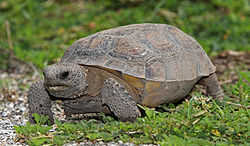
| Gopher tortoise, Gopherus polyphemus | |
Scientific classification 
| |
| Kingdom: | Animalia |
| Phylum: | Chordata |
| Class: | Reptilia |
| Order: | Testudines |
| Suborder: | Cryptodira |
| Family: | Testudinidae |
| Genus: | Gopherus Rafinesque, 1832 |
| Species | |
| |

| |
| Distribution of the genus Gopherus | |
Gopherus is a genus of fossorial tortoises commonly referred to as gopher tortoises. The gopher tortoise is grouped with land tortoises that originated 60 million years ago, in North America. A genetic study has shown that their closest relatives are in the Asian genus Manouria.[1] The gopher tortoises live in the southern United States from California's Mojave Desert across to Florida, and in parts of northern Mexico. Gopher tortoises are so named because of some species' habit of digging large, deep burrows (gophers are small terrestrial burrowing rodents). Most notably, Gopherus polyphemus digs burrows which can be up to 40 feet (12 m) in length and 10 feet (3.0 m) in depth.[2] These burrows are used by a variety of other species, including mammals, other reptiles, amphibians, and birds.[3] Gopher tortoises are 20–50 cm (7.9–19.7 in) in length, depending on the species.[4] All six species are found in xeric habitats. Numerous extinct species are known, the oldest dating to the Priabonian stage of the Late Eocene of the United States.[5]
Species
[edit]In July 2011, researchers decided on the basis of DNA, and morphological and behavioral data that the Sonoran and Mojave populations of the desert tortoise, G. agassizii were distinct species.[6] This newly described species was named G. morafkai, or the Morafka's desert tortoise. The acceptance of G. morafkai reduced the range of G. agassizii by about 70%[7] In 2016, based on a large-scale genetic analysis, ecological and morphological data, researchers proposed a split between the Sonoran and Sinaloan populations.[8] This southernmost member of the Gopherus genus was named G. evgoodei.[8] As such, there are currently six recognized extant species in the genus Gopherus:
Extant
[edit]Listed alphabetically by binomial name:[9]
| Image | Common name | Scientific name | Distribution |
|---|---|---|---|
 |
Mojave desert tortoise | Gopherus agassizii
(Cooper, 1863) |
Endemic to USA. Mojave Desert in southeastern California,
southern Nevada, and extreme southwestern Utah and northwest Arizona, north and west of the Colorado River.[10]: 3–4 p. |
_(57391706).jpg) |
Texas tortoise | Gopherus berlandieri
(Agassiz, 1857) |
Tamaulipan mezquital ecoregion of south Texas,
USA, eastern Coahuila, northern Nuevo León, and Tamaulipas, Mexico with a few old records (questionable) from southern San Luis Potosí.[11]: 25 & 27p. |
 |
Goode's thornscrub tortoise | Gopherus evgoodei Edwards et al., 2016[8] | Endemic to Mexico. Tropical deciduous forest and thornscrub in southern Sonora and adjacent areas of extreme northern Sinaloa
and extreme southwestern Chihuahua. |
 |
Bolson tortoise | Gopherus flavomarginatus
Legler, 1959 |
Endemic to Mexico. Chihuahua Desert of North-central Mexico,
in the vicinity of the conjunction of the Chihuahua, Coahuila, and Durango state borders. |
 |
Sonoran desert tortoise | Gopherus morafkai
Murphy et al., 2011[6] |
Sonora Desert in northern Sonora, including Tiburon Island,
Mexico and southwest Arizona, south and east of the Colorado River.[10]: 4 p. |
.jpg) |
Gopher tortoise | Gopherus polyphemus
(Daudin, 1802) |
Endemic to USA. Extreme eastern Louisiana,
southern Mississippi, southern Alabama, southern Georgia, Florida, and extreme southeastern South Carolina. |
Fossil
[edit]Members of Gopherus that became extinct in the late Pleistocene:
Breeding
[edit]Gopher tortoises usually mate during April and May. The female will then choose either a sunny spot nearby or a sandy mound in front of her burrow to lay between 3 and 15 eggs. The eggs then hatch from 70 to 100 days later. Once hatched, the baby tortoises spend most of their time in their mother's burrow until they learn to dig their own burrow. They do not reach maturity until they are around 10 to 15 years old. Gopher tortoises have an abbreviated mating season in early spring, when male tortoises visit the female tortoise' burrows and mate with them.[17]
Diet
[edit]Gopher tortoises are mainly herbivores that feed on low growing plant life. Their diet consists mostly of grasses and legumes but they will also feed on small berries and fruits.
_drinking_from_roadway.jpg)
The diet of tortoises contain excess salt, sodium, chloride, and potassium that must be purged from the body, and drinking free standing water, even if only once or a few times each year, is essential for this function and for tortoise survival. Opportunities for gopher tortoises to drink water vary greatly between the species in the genus. Gopherus agassizii live in extremely arid areas that can receive as little as 10–20 cm. per year. Gopherus polyphemus live in mesic habitat, where water is available and evaporative loss is less problematic. Other species live in intermediate environments where a few weeks of rain typically occur twice per year, or where relatively consistent summer rains occur. When pools of rain water or saturated soils are available tortoises will direct their heads face down and submerge their face to a level just below the eyes and drink copiously. Reptiles modify urine and plasma concentrations in their bodies with their bladder, cloaca, and colon, rather than the kidneys. The bladder plays a major function in regulating blood osmolality: permeable to ammonia, urea, water, and small ions, but not uric acid. This permeability allows tortoises that are hibernating, or living in arid environments without drinking water for months at a time to store uric acid, but resorb water from the bladder. Tortoises react to dry periods by retreating to shelters (burrows, caves etc.) with more humid microhabitats, and remaining inactive. Gopher tortoises can survive a year of drought through both behavior and physiological adaptations, two years of drought can result in deteriorating body conditions, and extended years of drought will produce high mortalities of gopher tortoises.[18]: 85–87, 94 pp.
There are many observations of Gopherus eating non-vegetation food items. Documented examples include a variety of bones, snail shells, soil at mineral licks, charcoal, sand, stones, human trash, carrion, raptor pellets and various animals feces. Gopherus polyphemus studies observed specimens moving bones into their burrows and found the fourth most common matter in their scats was insect material. The exact reasons are not entirely understood, some cases might simply be due to accidentally ingesting materials near food items or sampling potential foods. Hypotheses concerning the consumption of animal matter by Gopherus include supplements for the low levels of calcium, phosphorus, or protein in their diet, and a need for calcium carbonate in bones, the production of eggshells in females, and growing young. Hypotheses on the consumption of nonfood items such as soil or rocks include mastication or vermifuge for the removal of parasites.[18]: 93 p.
Conservation
[edit]
Populations of all six species of Gopherus have declined dramatically. In the past, gopher tortoises were hunted for their meat, which was used in stews.[19] Currently the most significant threat to their survival is habitat destruction, but the pet trade and collisions with vehicles have also taken their toll.[4] To help decrease gopher tortoise death due to collisions with vehicles, the US Department of Transportation in Mississippi has recently placed angled fences along the road side to keep tortoise from wandering onto the highways near their habitats.[20] On November 9, 2009, the US Fish and Wildlife Service proposed rulemaking to include the eastern population of the gopher tortoise, Gopherus polyphemus, in the List of Threatened Wildlife.[21] In 2018, the IUCN Tortoise and Freshwater Turtle Specialist Group recommended a re-assessment and re-classification of all six Gopherus species[22] This reclassification would move G. agassizii from Vulnerable (VU) to Critically Endangered (CR), G. berlandieri from Near Endangered (NE) to Near Threatened (NT), G. evgoodei from Near Endangered (NE) to Vulnerable (VU), G. flavomarginatus from Vulnerable (VU) to Critically Endangered (CR), G. morafkai from Near Endangered (NE) to Vulnerable (VU) and G. polyphemus from Vulnerable (VU) to Endangered (EN).[22]
Gallery
[edit]-
 A juvenile bolson tortoise (Gopherus flavomarginatus), from Durango, Mexico (7 July 2006)
 -
 Desert tortoise (Gopherus agassizii) San Bernardino County, California, US.
 -
 Gopher tortoise (Gopherus polyphemus) from Lee County, Florida (18 June 2018)
 -
 Gopher tortoise (Gopherus polyphemus) from Volusia County, Florida (14 September 2008)
.jpg)

.jpg)
_-_Flickr_-_Andrea_Westmoreland.jpg)
References
[edit]- ^ Le, M.; Raxworthy, C. J.; McCord, W. P.; Mertz, L. (2006-05-05). "A molecular phylogeny of tortoises (Testudines: Testudinidae) based on mitochondrial and nuclear genes". Molecular Phylogenetics and Evolution. 40 (2): 517–531. doi:10.1016/j.ympev.2006.03.003. PMID 16678445.
- ^ "About The Gopher tortoise". Gopher Tortoise Council. Archived from the original on 2009-09-01. Retrieved 2009-07-03.
- ^ Fergus, Charles (2007). Turtles. Stackpole Books. pp. 22–24. ISBN 978-0-8117-3420-2.
- ^ a b Franklin, Carl J. (2007). Turtles: An Extraordinary Natural History 245 Million Years in the Making. MBI Publishing Company. pp. 129–131. ISBN 978-0-7603-2981-8.
- ^ "Fossilworks: Gopherus". fossilworks.org. Retrieved 2020-02-29.
- ^ a b US Geological Survey
- ^ Murphy, Robert; Berry, Kristin; Edwards, Taylor; Leviton, Alan; Lathrop, Amy; Riedle, J. Daren (2011-06-28). "The dazed and confused identity of Agassiz's land tortoise, Gopherus agassizii (Testudines: Testudinidae) with the description of a new species and its consequences for conservation". ZooKeys (113): 39–71. Bibcode:2011ZooK..113...39M. doi:10.3897/zookeys.113.1353. ISSN 1313-2970. PMC 3187627. PMID 21976992.
- ^ a b c Edwards T, Karl AE, Vaughn M, Rosen PC, Torres CM, Murphy RW (2016). "The desert tortoise trichotomy: Mexico hosts a third, new sister-species of tortoise in the Gopherus morafkai–G. agassizii group". ZooKeys (562): 131–158. Bibcode:2016ZooK..562..131E. doi:10.3897/zookeys.562.6124. PMC 4768471. PMID 27006625.
- ^ Gopherus, The Reptile Database
- ^ a b Bramble, Dennis M. and J. Howard Hutchison. 2014. Morphology, Taxonomy, and Distribution of North American Tortoises: An Evolutionary Perspective. pages 1-12 In, David C. Rostal, Earl D. McCoy, and Henry R. Mushinsky (editors). Biology and Conservation of North American Tortoises. Johns Hopkins University Press. Baltimore, Maryland. x, 190 pp.ISBN 1-4214-1377-9
- ^ Rose, Francis L and Frank W. Judd. 2014. The Texas Tortoise: A Natural History. University of Oklahoma Press, Norman, Oklahoma. xviii, 188 pp.ISBN 978-0-8061-4451-1
- ^ Reynoso, Víctor-Hugo; Montellano-Ballesteros, Marisol (2004-01-01). "A New Giant Turtle of the Genus Gopherus (Chelonia: Testudinidae) from the Pleistocene of Tamaulipas, México, and a Review of the Phylogeny and Biogeography of Gopher Tortoises" (PDF). Journal of Vertebrate Paleontology. 24 (4): 822–837. doi:10.1671/0272-4634(2004)024[0822:angtot]2.0.co;2. JSTOR 4524778. S2CID 84397134.
- ^ Rostal, David C.; McCoy, Earl D.; Mushinsky, Henry R. (2014-06-13). Biology and Conservation of North American Tortoises. JHU Press. ISBN 9781421413778.
- ^ "Ecological history and latent conservation potential: large and giant tortoises as a model for taxon substitutions" (PDF).
- ^ Woodburne & Golz, 1972
- ^ Esker, Donald A.; Forman, Steve L.; Butler, Dava K. (May 2019). "Reconstructing the mass and thermal ecology of North American Pleistocene tortoises". Paleobiology. 45 (2): 363–377. Bibcode:2019Pbio...45..363E. doi:10.1017/pab.2019.6. ISSN 0094-8373. S2CID 155216574.
- ^ Landers, L. J.; Garner, J. A. & McRae, W. A. (1980). "Reproduction on Gopher Tortoises in Southwestern Georgia". Herpetological. 36: 353–361.
- ^ a b Esque, Todd, Kristina Drake, and Kenneth Nussear. 2014. Water and Food Acquisition and Their Consequences for Life History and Metabolism of North American Tortoises. pages 85-95. In, David C. Rostal, Earl D. McCoy, and Henry R. Mushinsky (editors). Biology and Conservation of North American Tortoises. Johns Hopkins University Press. Baltimore, Maryland. x, 190 pp.ISBN 1-4214-1377-9
- ^ "Gopher Tortoise Stew", in: Recipes from Another Time: Savor the flavor of old St. Augustine and try a couple of these original recipes. Smithsonian magazine, October 2001
- ^ "Fence with an "angle" protects gopher tortoises". US Department of Transportation. 2003-04-25. Archived from the original on June 25, 2003. Retrieved 2010-04-18.
- ^ "Department of the Interior: Fish and Wildlife Service: 50 CFR Part 17" (PDF). Federal Register. Vol. 74, no. 215. 2009-11-09. Retrieved 2009-11-13.
- ^ a b Rhodin, Anders G. J.; Stanford, Craig B.; Dijk, Peter Paul Van; Eisemberg, Carla; Luiselli, Luca; Mittermeier, Russell A.; Hudson, Rick; Horne, Brian D.; Goode, Eric V.; Kuchling, Gerald; Walde, Andrew (December 2018). "Global Conservation Status of Turtles and Tortoises (Order Testudines)". Chelonian Conservation and Biology. 17 (2): 135–161. doi:10.2744/CCB-1348.1. ISSN 1071-8443. S2CID 91937716.
Bibliography
[edit]- Woodburne, M. O.; Golz, D. J. (1972). Stratigraphy of the Punchbowl Formation, Cajon Valley, southern California. University of California Publications in Geological Sciences. Vol. 92.
External links
[edit]


| National | |
|---|---|
| Other | |

Gopherus
View on GrokipediaGopherus is a genus of tortoises in the family Testudinidae, endemic to North America and comprising six extant species adapted to diverse xeric and semi-arid habitats ranging from deserts and grasslands to pine savannas.[1] These species include G. agassizii (Mojave desert tortoise), G. morafkai (Sonoran desert tortoise), G. polyphemus (gopher tortoise), G. berlandieri (Texas tortoise), G. flavomarginatus (Bolsón tortoise), and G. evgoodei (Goode's tortoise).[1] The genus is distinguished by its fossorial lifestyle, with robust forelimbs specialized for excavating deep burrows that serve as refugia from predators and environmental extremes, often exceeding 3 meters in length and supporting over 300 commensal species as a keystone ecological role.[2] Individuals exhibit determinate growth, longevity typically surpassing 50 years in the wild, and low fecundity with sexual maturity delayed until 10–20 years, reflecting life-history strategies evolved for stable but harsh environments.[3] Species of Gopherus are distributed across the southwestern and southeastern United States into northern Mexico, with G. polyphemus occupying longleaf pine-wiregrass ecosystems in the Southeast, desert species like G. agassizii and G. morafkai in rocky bajadas and washes of the Mojave and Sonoran Deserts receiving minimal annual precipitation, and G. flavomarginatus confined to remnant grasslands in Chihuahua.[4][5] Burrowing behavior mitigates desiccation and temperature fluctuations, while herbivorous diets of grasses, forbs, and succulents sustain populations in nutrient-poor soils.[6] Evolutionary divergence within the genus traces to Pleistocene isolation events, with genetic and morphological distinctions—such as shell scalation and limb proportions—evident among lineages, as confirmed by osteological and molecular analyses.[7][8] Most Gopherus species face population declines, classified as vulnerable or threatened under IUCN criteria and protected under the U.S. Endangered Species Act in portions of their ranges, primarily due to direct habitat conversion for urban development, agriculture, and fire suppression altering vegetative structure.[9][10] Secondary pressures include vehicular mortality, collection for pets, and increased predation from subsidized ravens, though empirical data emphasize land-use change as the dominant causal driver over climatic shifts alone.[11] Conservation efforts prioritize habitat preservation, prescribed burns to maintain open canopies, and translocation, yielding variable success tied to burrow fidelity and disease risks like upper respiratory tract pathogens.[12] These tortoises exemplify how anthropogenic landscape fragmentation disrupts evolved predator-prey dynamics and resource availability in arid systems.[13]
Taxonomy and Phylogeny
Extant Species
The genus Gopherus includes six extant species, all of which are terrestrial tortoises native to North America, primarily inhabiting xeric environments in the southwestern and southeastern United States and northern Mexico.[1] These species diverged into two major phylogenetic clades approximately 4–8 million years ago, reflecting adaptations to distinct habitats ranging from deserts to coastal plains.[1] Gopherus polyphemus, commonly known as the gopher tortoise, occurs in sandy soils of the southeastern United States, from South Carolina westward to Louisiana, with the largest populations in Florida.[6] It is classified as Vulnerable on the IUCN Red List due to habitat loss and fragmentation, with populations declining by over 80% in some areas over the past century.[14][15] Gopherus berlandieri, the Texas tortoise, is distributed in southern Texas south of a line from Del Rio to San Antonio and Rockport, extending into northeastern Mexico including Coahuila, Nuevo León, and Tamaulipas.[16] It prefers grasslands and thorn scrub, tolerating arid conditions, and is listed as Least Concern by the IUCN, though local declines have occurred from habitat conversion.[17][18] Gopherus agassizii, the Mojave desert tortoise, is endemic to the Mojave Desert across parts of California, Nevada, Utah, and Arizona.[19] It faces severe threats from urbanization, disease, and predation, leading to its Vulnerable status on the IUCN Red List.[20] Gopherus morafkai, the Sonoran desert tortoise, inhabits the Sonoran Desert in central and southern Arizona and northwestern Sonora, Mexico, having been distinguished from G. agassizii based on genetic and morphological differences.[21] Its conservation status mirrors that of congeners, with ongoing assessments highlighting vulnerabilities to drought and habitat degradation.[22] Gopherus flavomarginatus, known as the Bolson tortoise, is restricted to the Bolsón de Mapimí region in northern Mexico, spanning Chihuahua, Coahuila, Durango, and Zacatecas.[23] It is considered Vulnerable by the IUCN due to restricted range and low population numbers, with U.S. populations federally listed as Endangered.[24] Gopherus evgoodei, or Goode's thornscrub tortoise, was described in 2016 and occurs in the Sinaloan thornscrub and tropical deciduous forests of western Mexico, including Sinaloa and southern Sonora.[25] Distinguished by a flatter carapace, yellow-orange integument, and enlarged spurs on the forelimbs, it represents a distinct lineage adapted to coastal scrub habitats, with conservation needs emerging from recent taxonomic recognition.[26][27]Fossil Species
The fossil record of Gopherus extends from the early Oligocene to the late Pleistocene, encompassing approximately 23 extinct species alongside occurrences of extant taxa.[28] This temporal range reflects the genus's evolutionary persistence in North American xeric environments, with fossils primarily from the western and southeastern United States as well as Mexico.[29][30] The earliest recognized species, Gopherus laticuneus, is known from the Oligocene White River Formation in Colorado and Nebraska, dating to approximately 33-32 million years ago, and is considered an ancestral form lacking certain derived features like the xiphiplastral strut present in later gopher tortoises.[29][31] Other Oligocene taxa include G. neglectus and G. praeextans. Early Miocene species, such as G. brevisternus, G. edae, G. emiliae, G. hollandi, and G. undabunus, indicate diversification during this period. Late Miocene forms like G. brattstromi, G. copei, G. dehiscus, G. mohavetus, and G. pansus show increasing specialization toward burrowing adaptations characteristic of the genus.[28] Pliocene and Pleistocene fossils document further radiation, including G. pertenuis from the late Pliocene and several Pleistocene species such as G. atascosae, G. auffenbergi, G. canyonensis, G. hexagonatus, G. huecoensis, and G. laticaudatus.[28] Notable among these is G. donlaloi, a large-bodied species from Rancholabrean (late Pleistocene) deposits in Tamaulipas, Mexico, represented by a partial skeleton with skull measuring over 70 cm in carapace length, suggesting gigantism in some lineages.024[0822:ANGTOT]2.0.CO;2) Fossils of extant species (G. agassizii, G. flavomarginatus, G. polyphemus) appear in late Pleistocene assemblages, often co-occurring with extinct congeners in southeastern U.S. sites from late Pliocene to Rancholabrean ages, implying continuity but also local extinctions tied to climatic shifts.[28][32]Evolutionary History
The genus Gopherus occupies a basal position within the Testudinidae, with molecular phylogenies indicating a sister-group relationship to the Asian genus Manouria, suggesting deep divergence within the family potentially tracing back to Eocene origins in Asia or North America.[33] [34] Fossils attributable to gopher turtles, including stem-group forms classified in paraphyletic assemblages like Scaptochelys or Xerobates, first appear in the early Oligocene of North America, marking the initial radiation of fossorial adaptations such as reinforced forelimbs and shovel-like claws for burrowing in arid or semi-arid environments.[35] By the early Middle Miocene (Hemingfordian stage, approximately 16 million years ago), Gopherus sensu stricto emerged as a monophyletic clade of highly specialized tortoises, coinciding with midcontinental environmental shifts including grassland expansion and increased aridity that favored subterranean lifestyles.[36] [37] Phylogenetic analyses integrating molecular data, morphology, and fossils reveal that major extant lineages diverged during the Early Miocene, with sequence divergences of about 7% between western (G. agassizii and G. berlandieri) and eastern (G. polyphemus and G. flavomarginatus) clades reflecting vicariance driven by tectonic uplift and climatic barriers like the rising Sierra Madre Occidental.[33] Subsequent diversification within these clades occurred in the late Miocene to Pliocene (4-8 million years ago), involving adaptations to xeric habitats and independent evolution of larger body sizes in multiple insular or mainland populations, as evidenced by total-evidence dating that reconciles fossil calibrations with genetic clocks.[1] [38] Pleistocene glacial-interglacial cycles prompted range expansions and contractions, with fossils documenting early Pleistocene incursions into southeastern Arizona and late Pleistocene persistence in refugia like the Sierra Vieja caves, where Gopherus remains show continuity with modern forms amid megafaunal extinctions.[39] [40] Biogeographic reconstructions support a North American center of origin for Gopherus following Testudinidae's transcontinental dispersal, rejecting models of recent long-distance migration in favor of ancient vicariance, though the genus's burrowing specialization likely buffered it against Miocene faunal turnovers.[33] Over 20 fossil species are known from Oligocene through Pleistocene deposits across the continent, highlighting episodic gigantism and regional endemism before Holocene anthropogenic pressures reduced diversity to six extant species.[41]Physical Characteristics
Morphology and Adaptations
Species of the genus Gopherus are robust, medium-sized terrestrial tortoises with adult straight midline carapace lengths typically ranging from 200 mm in G. berlandieri to 350 mm in G. flavomarginatus, and intermediate sizes of 215–350 mm in species such as G. agassizii and G. polyphemus.[3][42] The carapace is high-domed, oblong, and colored brown to grayish-black, composed of fused dermal bones and keratinous scutes that provide protection from predators and facilitate thermoregulation by maintaining internal temperatures through solar absorption and insulation.[42][43] The plastron is hingeless, yellowish with brown edges, and features an anteriorly projecting gular scute, which is elongated particularly in males and aids in flipping opponents during agonistic encounters or wedging into burrow entrances.[44][45] Forelimbs are morphologically specialized for excavation, being flattened, heavily scaled with overlapping laminae, and terminating in five stout digits with broad, curved claws that function as spades for displacing soil.[42][43] Hind limbs contrast as thick, elephantine structures with four digits, providing stability for propulsion and supporting body weight during movement or nesting.[42][43] Hatchlings exhibit softer, more pliable shells with a large median plastral fontanelle that ossifies by the fifth year, along with longer, sharper claws relative to body size, enhancing initial burrowing capability amid higher predation risk.[42] These traits collectively adapt Gopherus species to xeric habitats by enabling the digging of extensive burrows—up to 10.9 m long and regulating temperatures between 19–37.8°C—which offer refuge from diurnal heat, nocturnal cold, desiccation, fire, and predators while minimizing cutaneous water loss through reduced surface exposure.[42][43] The domed shell's porosity and thickness vary by population and age, correlating with calcium availability and influencing flexibility, while serrated jaw margins support herbivory on fibrous vegetation typical of sandy, well-drained soils.[42]