Hubbry Logo
ProtostegidaeProtostegidaeMain
Open search
Protostegidae
Community hub
Protostegidae
logo
8 pages, 0 posts
0 subscribers
Be the first to start a discussion here.
Protostegidae
Protostegidae
from Wikipedia

Protostegids
Temporal range: Cretaceous,[1][2] Valanginian–Maastrichtian
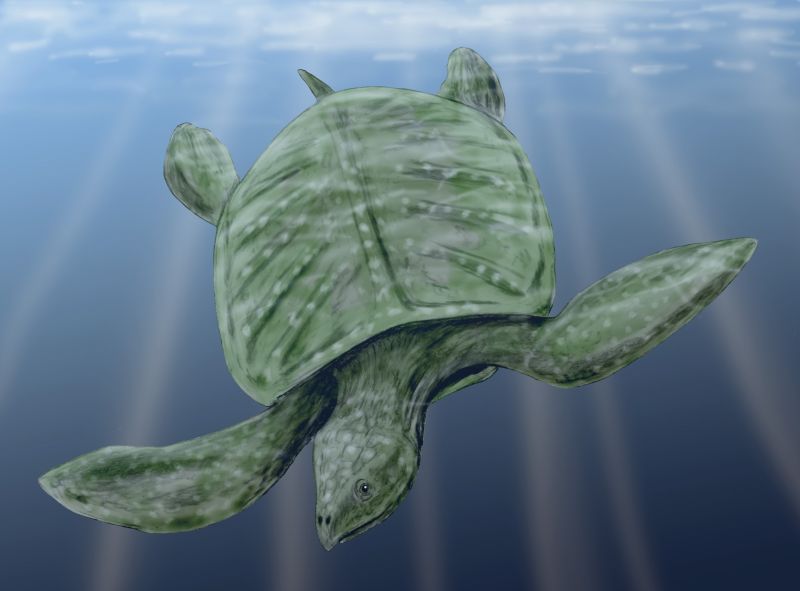
Life restoration of Archelon ischyros
Scientific classification Edit this classification
Kingdom: Animalia
Phylum: Chordata
Class: Reptilia
Order: Testudines
Suborder: Cryptodira
Clade: Panchelonioidea (?)
Family: Protostegidae
Cope, 1873 [3]
Type species
Protostega gigas
Cope, 1872
Genera

Protostegidae is a family of extinct marine turtles that lived during the Cretaceous period. The family includes some of the largest sea turtles that ever existed. The largest Archelon had a head one metre (39 in) long. Like most sea turtles, they had flattened bodies and flippers for front appendages; protostegids had minimal shells like leatherback turtles of modern times.

Anatomy

[edit]
Fossil of Rhinochelys nammourensis from Lebanon

As some of the first marine turtles, the protostegids set the general body plan for future species of sea turtles. They had a generally depressed turtle body plan, complete with four limbs, a short tail, and a large head at the end of a relatively short neck. Like other sea turtles, they possessed oar-like front appendages especially evolved for swimming in the open ocean. Similar to the still-extant, possibly closely related Dermochelyidae, protostegids possessed extremely reduced carapaces. Some specimens had skeletal protrusions from their ribs almost wrapping around their bodies in place of a complete shell. Like modern sea turtles, protostegids had sharp beaks. One of the defining characteristics of the members of the family was their almost-disproportionately large heads. Specifically, some specimens of Archelon have been found with heads one metre (39 in) long. In addition, the members of the family had somewhat reduced plastrons, as well.[5]

Ecology

[edit]

Trophic ecology

[edit]

While all members of the family are extinct, palaeoecological studies on the members of the family have provided some insight into the ecological roles of the Protostegidae. Analysis of fossil organs of some protostegids has revealed entire stomachs containing fossilized shells of inoceramids clams,[6] and the first evidence of gastroliths was reported in 2024.[7] The turtles, in turn, are postulated to have been preyed upon by the major predators of the time. Fossil protostegids have been found with tooth impressions from the large lamnid sharks of the time.[8] Two specimens of Protostega gigas have been discovered to have tooth marks from large sharks. In addition, teeth of the extinct shark Cretoxyrhina mantelli have been found embedded in at least one Protostega skeleton.[9]

Evolutionary history

[edit]
Life restoration of Protostega gigas

The family's oldest members include an Early Cretaceous (Valanginian) taxon described on the basis of limb bones and shell remains from the Rosablanca Formation of Colombia,[2] Desmatochelys padillai, known from the specimens recovered from the Early Cretaceous Paja Formation of Colombia[10] and Santanachelys gaffneyi, known from a specimen excavated from Brazil in 1998. The latter species first appeared during the Early Cretaceous. As an early sea turtle, Santanachelys had several unspecialized characteristics, such as distinguishable digits in its flipper-like arms. Later relatives' flippers were completely fused together for more efficient swimming.[4] As with most large fauna of the era, the Protostegidae died out during the events of the Cretaceous–Paleogene extinction event that led to the extinction of the dinosaurs.[11]

The exact phylogenetic position of protostegids among turtles is uncertain. Some phylogenetic studies determine the leatherback turtles in the family Dermochelyidae to be their closest living relatives, with both these families being monophyletic.[4][12] Conversely, the phylogenetic analyses conducted by Joyce (2007) and Anquetin (2012), which included one protostegid species (Santanachelys gaffneyi), recovered the family as only distantly related to leatherback turtles. Joyce (2007) recovered Protostegidae as basal eucryptodiran turtles lying outside the crown group of Cryptodira (the least inclusive clade containing all living cryptodirans) and closely related to Solnhofia parsonsi;[13] Santanachelys had a similar phylogenetic position in the analysis conducted by Anquetin (2012), who stressed that future studies should include more protostegids to confirm this phylogenetic placement.[14] If confirmed, these results would prove that protostegids weren't close relatives of leatherback turtles (or in fact any living cryptodirans), but instead "represent an independent lineage of marine turtles that originated in the Late Jurassic".[13] The analyses conducted by Sterli (2010) and Sterli & de la Fuente (2011) recovered Santanachelys (and, presumably, the entirety of Protostegidae) as even more distantly related to living cryptodirans; it was found to be basal turtle lying outside the crown group of turtles (the least inclusive clade containing cryptodirans and pleurodirans).[15][16]

A phylogenetic analysis conducted by Cadena and Parham (2015) recovered Protostegidae within the crown group of Cryptodira; specifically the family was recovered as belonging to Chelonioidea and more closely related to the leatherback sea turtle than cheloniids are.[10]

Taxonomic history

[edit]

In 1888, the Belgian zoologist George Albert Boulenger published his classification of the Testudinata within the 9th edition of the Encyclopædia Britannica. The genus Protostega was placed within the family Sphargidae under the suborder Athecae, and the family Protostegidae was named by Edward Drinker Cope in 1873.[3] A year or so later, the entire suborder was downgraded by Karl Alfred von Zittel into a family within the Cryptodira.[17]

In 1994, Hirayama proposed a three-family subdivision of the sea turtle superfamily based on cladistic analysis; Protostegidae was given full, formal family status in the system, containing most of the extinct genera, including Archelon, and a previously undescribed protostegid.[18] The unidentified specimen was fully described in 1998, as the species Santanachelys gaffneyi. The genus Santanachelys was appended to the family after the new species was described. This specimen was later to be analyzed to be the family's oldest member.[4]

References

[edit]

Further reading

[edit]
Revisions and contributorsEdit on WikipediaRead on Wikipedia
from Grokipedia
Protostegidae is an extinct family of marine turtles belonging to the superfamily Chelonioidea, which thrived during the period from the (Valanginian stage, approximately 134 million years ago) to the end of the around 66 million years ago. The oldest known fossils, from the Late of , already show large body sizes up to 2.5 meters, suggesting early gigantism. These turtles were among the earliest fully adapted to a pelagic , featuring streamlined bodies, elongated paddle-like flippers for , large heads with powerful hooked beaks, and reduced, leathery shells lacking the rigid bony plates of modern hard-shelled sea turtles. Recent of soft tissues from a protostegid confirms scale-less skin on flippers, reinforcing these adaptations. The family encompasses a diverse range of sizes, from smaller forms like Notochelone costata with shells under 1 meter in length to gigantic species such as ischyros, which attained total body lengths of up to 4.5 meters, carapace lengths of about 2.2 meters, and estimated weights of 2–3 tons, making them the largest marine turtles known to have existed. Phylogenetically, Protostegidae represents a basal or stem group within Chelonioidea, bridging continental turtles and the crown-group sea turtles that includes modern families like and . Basal protostegids, such as Santanachelys gaffneyi from the of and Bouliachelys suteri from the of , exhibit primitive features like sculpted bones and transitional morphologies, indicating rapid diversification and to marine environments by the mid-Early Cretaceous. More derived forms, including Protostega gigas from (with carapaces around 2–3 meters) and Cratochelone berneyi from (shells up to 4 meters), evolved enormous body sizes early in the family's history, possibly as an to exploit abundant marine prey like and schooling . Fossils of Protostegidae have been discovered across multiple continents, including North and South America, , , and , reflecting their widespread distribution in the global oceans such as the and the Eromanga Sea. These turtles likely played key ecological roles as predators in marine ecosystems, though their fragile shells and limbs often show evidence of predation by large mosasaurs and plesiosaurs. The family's extinction at the Cretaceous-Paleogene boundary, alongside many other marine reptiles, underscores the profound impacts of that mass on marine .

Taxonomy and Classification

Taxonomic History

The family Protostegidae was established by Edward Drinker Cope in 1873, with Protostega gigas Cope, 1872, as the type genus and species. This naming followed Cope's initial description of Protostega in 1872, based on nearly complete skeletons recovered from the Smoky Hill Chalk Member of the Niobrara Formation (Late Cretaceous, Santonian–Campanian) in western Kansas, USA. Early descriptions of protostegids in the late were closely tied to the rivalry between Cope and , who amassed extensive collections of marine reptile fossils from North American deposits, including and . These specimens revealed large-bodied turtles with paddle-like limbs and reduced shells, prompting initial comparisons to modern sea turtles ( and ) and occasional misclassifications within groups like Sphargidae due to superficial resemblances in aquatic morphology. In the , key revisions reshaped protostegid classification; notably, Georg Baur's 1893 establishment of the superfamily Chelonioidea highlighted potential affinities between Protostegidae and leatherback turtles (Dermochelys coriacea), based on shared traits like shell reduction and cranial modifications for . Subsequent debates focused on the family's , with Rainer Zangerl's 1953 monograph providing a foundational that affirmed Protostegidae as a distinct of extinct chelonioids while noting challenges in resolving intergeneric relationships. Recent advances include the 2000 description of Santanachelys gaffneyi Hirayama, Dulai, and Hikida from the () Santana Formation in , recognized as the oldest definitive protostegid and extending the family's known record to approximately 100 million years ago. Some phylogenetic analyses have suggested that Protostegidae may represent a paraphyletic stem-group within Chelonioidea.

Genera and Species

The Protostegidae family encompasses a diverse array of extinct marine genera from the , characterized by adaptations for open-ocean life such as reduced shell and paddle-like limbs. Currently recognized valid genera include , , Desmatochelys, Santanachelys, Rhinochelys, Terlinguachelys, Notochelone (including the junior synonym Calcarichelys), Chelosphargis, Bouliachelys, and Ocepechelon, with several monotypic or poorly known taxa. These genera exhibit varying degrees of shell reduction and cranial robusticity, reflecting ecological specializations within the family. Archelon is represented by the type species A. ischyros, known from the (Campanian) Pierre Shale of , USA, with the largest specimens reaching a carapace length of approximately 2.1 m and a total body length of up to 4.6 m. Diagnostic features include a highly reduced, leathery shell with widely spaced ribs and neural bones, elongated humeri for powerful paddling, and a robust adapted for durophagous feeding on hard-shelled prey. A second species, A. marshii, has been proposed but remains debated in validity. Protostega, with its type species P. gigas from the Late Cretaceous (Campanian) Smoky Hill Chalk Member of the Niobrara Formation in western Kansas, USA, typically attained a carapace length of about 3 m. Key traits encompass a moderately ossified shell with fontanelles, strong cranial crushing surfaces for mollusks, and elongated forelimbs with hyperphalangy. Additional species such as P. loretensis from Mexico have been described, though some are considered synonymous with P. gigas. Recent finds extend its range to eastern Europe, including the Campanian Rybushka Formation in Russia. Desmatochelys includes D. padillai, the type species from the (Upper Barremian-Lower ) Paja Formation in , , representing one of the earliest and oldest protostegids with a length of around 2 m and total body length up to 3 m. Diagnostic characteristics feature a well-ossified but lightweight shell, sigmoidal humeral curvature, and flipper-like forelimbs indicating fully marine habits. Another species, D. lowii, is known from the of , . In 2023, reexamination of fossils from the same Colombian formation revealed rare hatchling specimens initially misidentified as plants (Sphenophyllum colombianum), confirming D. padillai as a significant early large-bodied marine and expanding understanding of its and abundance. Santanachelys is monotypic with S. gaffneyi from the () in the Araripe Basin, , marking the earliest well-documented protostegid at approximately 110 million years old and with a small of about 0.7 m. It displays primitive traits like a fully ossified shell with epineurals dorsal to specific neurals, robust costal-peripheral articulations, and nascent marine adaptations including elongated phalanges. This basal genus provides key evidence for the origins of protostegid diversification. Rhinochelys comprises R. pulchriceps () from the Early-Late (Late Albian-Early ) of the Greensand () and Marnes Bleues Formation (), and R. nammourensis from the Middle Sannine Formation in , with carapaces around 0.27 m long. Diagnostic features include a preorbital bulge formed by the and prefrontal, presence of , splenial in the , and elongate squamosal processes in R. nammourensis; earlier named like R. amaberti, R. elegans, and R. cantabrigiensis are now synonyms of R. pulchriceps. The genus exhibits early marine adaptations such as scale-less flipper skin. Terlinguachelys is known solely from T. fischbecki in the () of , , , described as a large-bodied form with a well-ossified plastron and costals. Distinctive traits include a constricted , prominent retroarticular process on the lower , long slender femora, and a at the base of the scapular acromion process, blending primitive and derived features akin to leatherback turtles. Other genera include Notochelone (N. costata from the of , ; shell with reduced peripherals and strong costal ossification; Calcarichelys gemma from the Mooreville Chalk, , is a junior synonym) and Chelosphargis (C. advena from the of , ; characterized by a broad and durophagous dentition). Bouliachelys (B. suteri from the of , ; features a lightly built shell) and Ocepechelon (O. bouyai from the phosphates of ; known for an elongated snout adapted for suction feeding) represent peripheral distributions. Early misclassifications, such as Atlantschelys (now considered a nomen dubium or synonym of ), highlight taxonomic revisions in the family. Several taxa remain incertae sedis, including fragmentary material from the of with estimated lengths of 1.1 m. A 2023 study described these as the earliest known protostegid remains, with limb and shell fossils indicating large body sizes for the .

Anatomy and Morphology

Body Plan and Size

Members of the Protostegidae family exhibited a streamlined, hydrodynamic body plan adapted for a fully marine lifestyle, featuring a fusiform shape with paddle-like limbs modified for propulsion through water, an elongated neck in certain species, and a reduced shell that minimized drag. These adaptations, including flattened limb bones and rigid digit articulations, evolved stepwise from early total-group chelonioids and enabled efficient swimming in open ocean environments. Size varied significantly across the family, ranging from smaller early forms such as Santanachelys gaffneyi, with a length of approximately 0.2 meters, to gigantic species like ischyros, which reached up to 4.6 meters in total length and an estimated mass of around 2 tons. For comparison, Protostega gigas attained lengths of about 3 meters, positioning it as one of the larger representatives within the family. This range highlights the rapid onset of large body sizes in protostegids during the , with maximum shell lengths converging around 2.2 meters in several lineages. Key adaptations included a lightweight, flexible shell with reduced carapacial ossification, which enhanced buoyancy and maneuverability in pelagic habitats, as evidenced by the "star-shaped" plastral elements in genera like Rhinochelys. Some species, such as Archelon, possessed disproportionately large heads, with skulls up to approximately 0.76 meters in length, while cranial features like large interorbital fenestrae suggest the presence of salt-excreting glands for osmoregulation in saltwater. These traits parallel those of modern leatherback sea turtles (Dermochelys coriacea), sharing a fusiform body outline and minimal shell armor, though protostegids diverged from hard-shelled cheloniids in their overall morphology.

Shell Structure

The of protostegids is characterized by a thin, leathery structure with reduced dermal ossifications, adapted for flexibility in marine environments. In Protostega gigas, it typically includes a series of neural plates along the midline, 20-22 peripheral plates around the margins, and reduced or absent costal plates, contributing to an overall lightweight and streamlined form. This configuration results in fewer total ossifications compared to more rigid chelonian shells, with the nuchal plate anteriorly and pygal posteriorly framing the dorsal surface. The plastron is similarly incomplete, consisting of 9-11 plates that do not fully enclose the ventral side, often lacking the entoplastron or featuring it as a small, unsutured element. Paired epiplastra, hyoplastra, hypoplastra, and xiphiplastra form the main structure, connected by flexible sutures that permit significant mobility, unlike the fused plastrons of many terrestrial turtles. These loose articulations enhance the shell's compliance during . Ossification patterns in protostegid shells exhibit a prismatic texture, dominated by parallel-fibered and interwoven structural fiber bundles, closely resembling that of modern leatherback turtles (Dermochelys coriacea). This spongy, highly vascularized , with compact cortices framing cancellous cores and prominent growth marks, indicates rapid deposition and minimal secondary remodeling. Fossil evidence reveals involvement in early , including chondrocyte lacunae in costal precursors that ossify from sheathed ribs, transitioning to via metaplastic processes starting in the plastron and progressing mediolaterally along the neural row. Variations in shell structure occur across protostegid genera, reflecting evolutionary trends toward reduction. Basal forms like Desmatochelys retain a more rigid carapace with fuller ossification and complete peripheral series, providing greater structural integrity. In contrast, advanced taxa such as Archelon show highly reduced ossification, with approximately 50 bones total and extensive fontanelles, resulting in a highly flexible, leathery shell that prioritizes hydrodynamic efficiency over protection.

Limbs and Cranial Features

The limbs of Protostegidae exhibit pronounced adaptations for aquatic , characterized by elongated humeri and femora that form the proximal elements of paddle-like flippers. These bones are robust yet streamlined, supporting the extension of the forelimbs into broad, wing-shaped structures essential for efficient in marine environments. Hyperphalangy is evident in the manus and pes, with extra phalanges increasing the length and flexibility of the digits—up to 12 in some foreflipper digits—allowing for enhanced paddling efficiency. The digits are interconnected by , forming a continuous paddle surface that facilitates generation during underwater locomotion. The in Protostegidae is notably flattened and broadened, contributing to overall body streamlining by reducing drag and providing anchorage for powerful flight muscles analogous to those in modern sea turtles. This configuration integrates with the minimal shell structure, minimizing hydrodynamic resistance while enabling rapid maneuvers in open water. In the genus , the foreflippers are particularly elongated, reaching spans that support sustained open-ocean travel through powerful, oscillatory strokes. Cranial morphology in Protostegidae features a kinetic , with a loose quadrate that articulates flexibly with the squamosal and pterygoid, permitting streptostylic movement to accommodate expansion during feeding. The jaws are edentulous, lacking marginal teeth, and instead possess specialized crushing surfaces formed by lingual and labial ridges on the and dentary, adapted for processing hard-shelled prey. Large temporal fenestrae are prominent, providing expansive attachment areas for adductor musculature and enhancing bite force. The orbits are expansive and laterally oriented, indicating reliance on acute for and prey detection, as seen in genera like Desmatochelys and Rhinochelys.

Paleobiology

Habitat and Distribution

Protostegidae exhibited a broad temporal range throughout the period, with the earliest definitive records dating to the stage of the , approximately 136 million years ago, represented by large limb bones and shell fragments attributed to Protostegidae from the Rosa Blanca Formation in . Earlier described species such as Desmatochelys padillai from the Barremian-Aptian stages (~120 million years ago) of the Paja Formation in further illustrate this early diversification. Their fossils persist into the stage of the , around 80–72 million years ago, as evidenced by species such as Protostega gigas from the in . This span encompasses diverse stratigraphic units across multiple continents, reflecting their adaptation to marine conditions over roughly 60 million years. Geographically, protostegids were widespread, with fossils primarily concentrated in the Tethys Sea and its margins, as well as the of . In , significant discoveries come from the in , the Mooreville Chalk in , and deposits in , where species like gigas are common. South American sites include the Rosa Blanca Formation and the Barremian- Paja Formation in , as well as the Santana Formation in , yielding early forms such as Santanachelys gaffneyi. European localities feature Rhinochelys species from the of and the of , while Australian records include primitive taxa from strata in . This distribution underscores their presence in both temperate and tropical marine realms, with occasional finds extending to high southern latitudes. Protostegids primarily occupied shallow epicontinental seas, coastal neritic environments, and open marine waters, as indicated by the depositional settings of their fossil-bearing formations. The , a vast with depths rarely exceeding 200 meters, hosted diverse protostegid assemblages alongside reef-associated fauna in regions like the Tethys, where shallow shelves and carbonate platforms prevailed. Their co-occurrence with mosasaurs and other marine reptiles in units such as the suggests habitation in productive, nearshore to mid-shelf habitats conducive to high . Taphonomic patterns reveal that protostegid remains are frequently disarticulated, attributable to post-mortem transport by ocean currents and scavenging by predators, including that left bite marks on specimens from the Mooreville Chalk. Exceptional preservation occurs in Lagerstätten like the , where chalky deposits yielded nearly complete skeletons of , and the Santana Formation's carbonate concretions, which protected articulated examples from decay. Their evolutionary diversification coincided with elevated global sea levels that expanded these shallow marine habitats during the .

Diet and Trophic Role

Protostegids were durophagous predators specialized in consuming hard-shelled , with direct evidence from fossil gut contents revealing fragments of inoceramid bivalves in specimens of cf. Notochelone, a basal protostegid from the of . These thin-shelled but resilient bivalves, measuring 5–20 mm across, were likely ingested along with soft tissues and encrusting organisms, indicating a diet focused on benthic mollusks. Cranial adaptations, including well-developed lingual ridges on the and a robust mandibular structure, further supported this feeding strategy by facilitating the crushing and processing of tough-shelled prey. A 2024 discovery of gastroliths in the of a protostegid (cf. Protosphargis veronensis) provides the first evidence of geophagic behavior in fossil marine turtles, with 10 ingested pebbles (carbonatic and siliceous) showing consistent with residence in the digestive tract. These stomach stones likely aided in mechanical breakdown of hard prey or supplemented calcium needs, aligning with the family's durophagous habits observed in other taxa. Worn dentaries in some specimens suggest repeated crushing of shells during foraging, pointing to bottom-feeding strategies in shallow, neritic environments where bivalve prey was abundant. In marine food webs, protostegids occupied a high as apex or mesopredators, preying on mollusks that formed key components of benthic communities. Their large body sizes (up to 3–4 meters in length) and specialized jaws enabled them to exert substantial bite forces suitable for durophagy, positioning them as significant consumers in shallow coastal ecosystems. This role is inferred from anatomical evidence and fossil associations, highlighting their influence on mollusk populations during the .

Predators and Interactions

Protostegid turtles faced significant predation pressure from large marine predators during the Late Cretaceous, as evidenced by fossilized bite marks and disarticulated remains. The lamniform shark Cretoxyrhina mantelli is a well-documented predator, with tooth marks and embedded teeth identified on the shells of protostegid specimens, including Archelon and Protostega gigas. These traces, characterized by deep punctures up to 1.5 mm without serrations, indicate attacks on the turtles' carapaces, likely targeting vulnerable individuals or scavenging post-mortem. Mosasaurs, particularly species of such as T. proriger, also preyed upon protostegids, as suggested by numerous small indentations interpreted as bite marks on shells and bones. These conical tooth impressions, often clustered in patterns consistent with feeding behavior, appear on fossils from the , highlighting as an capable of ambushing or pursuing these s. Fossil evidence further points to scavenging and predation impacts through the prevalence of incomplete skeletons, where limbs and other fragile elements are frequently absent or show signs of removal. This pattern, observed across multiple protostegid finds, implies that post-mortem dismemberment by or mosasaurs contributed to the taphonomic record, underscoring intense biotic interactions in marine environments. Protostegids coexisted with other marine reptiles, including plesiosaurs, in epicontinental seaways like the Western Interior, where niche partitioning likely occurred amid shared habitats dominated by benthic resources. Such interactions reflect a complex trophic web, with protostegids navigating competition while serving as prey for larger carnivores.

Evolutionary History

Origins and Diversification

Protostegidae emerged from basal chelonioid ancestors during the , with the oldest confirmed fossils dating to the stage around 136 million years ago from the Rosa Blanca Formation in . These early representatives already displayed advanced marine adaptations, including large body sizes with lengths exceeding 2 meters, marking the onset of within the lineage. Santanachelys gaffneyi, from the stage approximately 112 million years ago in Brazil's Santana Formation, serves as a potential stem-group characterized by mosaic traits such as primitive, movable digits in its paddles alongside derived cranial features like enlarged salt-excreting glands. This combination highlights the transitional nature of early protostegids, bridging terrestrial origins to fully pelagic lifestyles. Following the , diversification intensified with a rapid increase in body size and morphological specialization, exemplified by sparse but significant records such as Desmatochelys padillai from , which achieved total body lengths up to 3 meters. The post-Berriasian marine transgressions facilitated oceanic dispersal, allowing protostegids to colonize expanding epicontinental seas and evolve toward extreme , with some later forms surpassing 4 meters. evidence remains limited in the but surges during the to stages, reflecting peak abundance and across Tethyan seaways and other marine corridors. By the stage, protostegid diversification had produced over ten genera, including giants like and , which dominated diverse trophic roles in subtropical epi-continental environments. This radiation underscores the family's success in exploiting newly accessible marine habitats, driven by ecomorphological innovations such as streamlined shells and powerful flippers.

Phylogenetic Relationships

Protostegidae is placed within the superfamily Chelonioidea, the clade encompassing all marine , and is frequently positioned as the to , the family of modern leatherback turtles (Dermochelys coriacea), based on shared derived features such as edentulous (toothless) crushing jaws and a highly reduced, lightweight shell with extensive fontanelles and minimal . These similarities suggest adaptations for pelagic lifestyles, including streamlined bodies for efficient swimming and powerful jaw mechanisms for processing soft-bodied prey like . Key cladistic characters supporting Protostegidae's inclusion in pan-chelonioids (the total group of Chelonioidea) include hyperphalangy, characterized by an increased number of phalanges in the manus and pes to elongate flippers, and the complete loss of the supratemporal fenestra in the , a trait reducing cranial weight and enhancing hydrodynamic efficiency. Additional synapomorphies encompass sigmoidal curvature of the , enlarged lateral processes on the paddle bones, and rib-free peripheral elements in the , all indicative of advanced marine adaptations. However, the of Protostegidae has been debated, particularly due to basal taxa such as Rhinochelys pulchriceps from the , which exhibits primitive features that challenge the clade's cohesion and suggest it may represent a paraphyletic grade leading to crown-group chelonioids. Alternative hypotheses propose Protostegidae as stem-group sea turtles outside the crown Chelonioidea, based on the absence of certain crown synapomorphies and discrepancies in character scoring across analyses; recent studies, including those from 2023, highlight ongoing uncertainties in its exact position, potentially as stem pan-chelonioids rather than direct sisters to . Paleontological evidence indicates no direct modern descendants for Protostegidae, with its extinction at the end-Cretaceous precluding molecular phylogenetic integration; instead, resemblances to Dermochelyidae, such as rapid growth rates and spongiose bone microstructure, are attributed to convergent evolution driven by similar ecological pressures in open-ocean environments.

Extinction

The Protostegidae family persisted until the final stage of the Late Cretaceous, with fossil records extending into the Maastrichtian, approximately 72 to 66 million years ago, including specimens from regions such as New Zealand and Chile. No definitive Protostegidae fossils have been identified from Paleogene strata, confirming their complete extinction at or near the Cretaceous-Paleogene (K-Pg) boundary around 66 Ma. This temporal range aligns with the broader decline of many marine reptile groups during the closing phases of the Cretaceous. The extinction of Protostegidae is closely tied to the K-Pg mass extinction event, primarily triggered by the Chicxulub asteroid impact off the , which unleashed widespread environmental catastrophes including massive tsunamis, prolonged from "," and severe disruption of marine food webs due to the collapse of productivity. These effects propagated through oceanic ecosystems, causing a breakdown in that starved higher trophic levels, including large marine predators like protostegids. Compounding this, the post-K-Pg regression of shallow epicontinental seas—such as the where many protostegids thrived—eliminated critical coastal habitats, further limiting survival opportunities for these specialized marine . Unlike certain cheloniid lineages that exhibited greater ecological flexibility and survived the boundary event, Protostegidae appear to have been particularly vulnerable due to their inferred diet focused on soft-bodied marine prey such as , with jaw morphology suggesting limited ability to switch to alternative hard-shelled foods amid the of key resources like inoceramids at the K-Pg boundary. Early protostegids show evidence of consuming bivalves, but this may not extend to the derived giants. In the , the ecological niches vacated by Protostegidae were gradually occupied by radiating modern lineages, particularly within and , which adapted to post- marine environments.

References

Add your contribution
Related Hubs
User Avatar
No comments yet.