Hubbry Logo
Artillery batteryArtillery batteryMain
Open search
Artillery battery
Community hub
Artillery battery
logo
8 pages, 0 posts
0 subscribers
Be the first to start a discussion here.
Artillery battery
Artillery battery
from Wikipedia
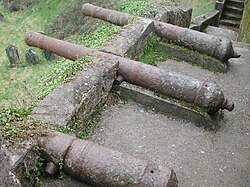
Remains of a battery of English cannon at Youghal, County Cork

In military organizations, an artillery battery is a unit or multiple systems of artillery, mortar systems, rocket artillery, multiple rocket launchers, surface-to-surface missiles, ballistic missiles, cruise missiles, grouped to facilitate better battlefield communication and command and control, as well as to provide dispersion for its constituent gunnery crews and their systems.[citation needed] The term is also used in a naval context to describe groups of guns on warships.

Land usage

[edit]
A coast battery in Crawfordsburn, County Down, Northern Ireland

Historically the term "battery" referred to a cluster of cannons in action as a group, either in a temporary field position during a battle or at the siege of a fortress or a city. Such batteries could be a mixture of cannon, howitzer, or mortar types. A siege could involve many batteries at different sites around the besieged place. The term also came to be used for a group of cannons in a fixed fortification, for coastal or frontier defence. During the 18th century "battery" began to be used as an organizational term for a permanent unit of artillery in peace and war, although horse artillery sometimes used "troop" and fixed position artillery "company". They were usually organised with between 6 and 12 ordnance pieces, often including cannon and howitzers. By the late 19th century "battery" had become standard mostly replacing company or troop.

In the 20th century the term was generally used for the company level sub-unit of an artillery branch including field, air-defence, anti-tank and position (coastal and frontier defences). 20th-century firing batteries have been equipped with mortars, guns, howitzers, rockets and missiles.

Mobile batteries

[edit]
French Napoleonic artillery battery. Photo taken during the 200th anniversary reenactment of the battle of Austerlitz which took place in 1805.
60-pounder battery at Arras, 1917

During the Napoleonic Wars some armies started grouping their batteries into larger administrative and field units. Groups of batteries combined for field combat employment called Grand Batteries by Napoleon.

Administratively batteries were usually grouped in battalions, regiments or squadrons and these developed into tactical organisations. These were further grouped into regiments, simply "group" or brigades, that may be wholly composed of artillery units or combined arms in composition. To further concentrate fire of individual batteries, from World War I they were grouped into "artillery divisions" in a few armies. Coastal artillery sometimes had completely different organizational terms based on shore defence sector areas.

Batteries also have sub-divisions, which vary across armies and periods but often translate into the English "platoon" or "troop" with individual ordnance systems called a "section" or "sub-section", where a section comprises two artillery pieces.

The rank of a battery commander has also varied, but is usually a lieutenant, captain, or major.

The number of guns, howitzers, mortars or launchers in an organizational battery has also varied, with the calibre of guns usually being an important consideration. In the 19th century four to 12 guns was usual as the optimum number to maneuver into the gun line. By the late 19th century, a mountain artillery battery was divided into a gun line and an ammunition line. The gun line consisted of six guns (five mules to a gun) and 12 ammunition mules.[1]

During the American Civil War, artillery batteries often consisted of six field pieces for the Union Army and four for the Confederate States Army, although this varied. Batteries were divided into sections of two guns apiece, each section normally under the command of a lieutenant. The full battery was typically commanded by a captain. Often, particularly as the war progressed, individual batteries were grouped into battalions under a major or colonel of artillery.

In the 20th century it varied between four and 12 for field artillery (even 16 if mortars), or even two pieces for very heavy pieces. Other types of artillery such as anti-tank or anti-aircraft have sometimes been larger. Some batteries have been "dual-equipped" with two different types of gun or mortar, and taking whichever was more appropriate when they deployed for operations.

From the late 19th century field artillery batteries started to become more complex organisations. First they needed the capability to carry adequate ammunition, typically each gun could only carry about 40 rounds in its limber so additional wagons were added to the battery, typically about two per gun. The introduction of indirect fire in the early 20th century necessitated two other groups, firstly observers who deployed some distance forward of the gun line, secondly a small staff on the gun position to undertake the calculations to convert the orders from the observers into data that could be set on the gun sights. This in turn led to the need for signalers, which further increased as the need to concentrate the fire of dispersed batteries emerged and the introduction fire control staff at artillery headquarters above the batteries.

Fixed battery

[edit]
64-pounder rifled muzzle-loader (RML) gun on Moncrieff disappearing mount, at Scaur Hill Fort, a fixed battery of coastal artillery in Bermuda

Fixed artillery refers to guns or howitzers on mounts that were either anchored in one spot (though capable of being moved for purposes of traverse and elevation), or on carriages intended to be moved only for the purposes of aiming, and not for tactical repositioning. Historical versions often closely resembled naval cannon of their day, "garrison carriages," like naval carriages, were short, heavy, and had four small wheels meant for rolling on relatively smooth, hard surfaces. Later, both naval and garrison carriages evolved traversing platforms and pivoting mounts. Such mounts were typically used in forts, or permanent defensive batteries, such as coastal artillery. Fixed batteries could be equipped with much larger guns than field artillery units could transport, and the gun emplacement was only one part of an extensive installation that included magazines and systems to deliver ammunition from the magazines to the guns. Improvements in mobile artillery, naval and ground; air attack; and precision guided weapons have limited fixed position's usefulness.

NATO

[edit]
NATO Map Symbols[2]

An artillery battery

A mechanized artillery battery

a surface to surface missile battery

a target acquisition battery

Within NATO member nations, it is typical to label company sized organizations of artillery as "batteries." NATO defines a company as "larger than a platoon, but smaller than a battalion" while being a "unit consisting of two or more platoons, usually of the same type, with a headquarters and a limited capacity for self-support."[3] The standard NATO symbol for a company consists of a single vertical line placed above a framed unit icon.[3]

Names for batteries in NATO member armed forces
American[4] Battery
Belgium[5] Batterie
British[6] Battery
Bulgaria[7] Batareja (Батарея)
Canadian[8] Battery
Czech Republic[9] Baterie
Denmark[10] Batteri
Estonia Patarei
Finland Patteri
French[11] Batterie
German[12] Batterie
Hungary Üteg
Italian[13] Batteria
Lithuania[14] Baterija
Netherlands[15] Batterij
Norway[16] Batteri
Polish[17] Bateria
Portuguese[18] Bateria
Romania Bateria
Spain[19] Bateria
Turkey[20] Batarya
[edit]
Barbette of the French battleship Redoutable

"Battery" is a relatively modern term at sea. Advanced warships in the Age of Sail, such as the ship of the line, mounted dozens of similar cannons grouped in broadsides, sometimes spread over several decks. This remained the standard main weapon layout for centuries, until the mid-19th century evolution of the naval rifle and revolving gun turrets came to displace fixed cannon.

The first operational use of a rotating turret was on the American ironclad USS Monitor, designed during the American Civil War by John Ericsson. Open barbettes were also used to house their main batteries on rotating mounts. Both designs allowed naval engineers to dramatically reduce the number of guns present in the battery, by giving a handful of guns the ability to concentrate on either side of the ship. In time this trend reversed, with a proliferation of weapons of multiple calibers being arranged somewhat haphazardly about a vessel, many in mounts on the hull or superstructure with limited travel. Confusion also arose when combinations of large caliber "main battery" and smaller "secondary battery" weapons of mixed offensive and defensive use were deployed.

This began to be resolved with the 1906 launching of the revolutionary "all big gun" battleship HMS Dreadnought. It shipped a main battery of ten heavy caliber guns, and a smaller secondary battery for self-defense. This leap in heavy offensive armament from a standard four large caliber guns to a main battery of ten made all other battleships obsolete overnight, as the weight of broadside it could unleash, and overwhelming rate of fire a superior number of similar weapons could sustain, could overwhelm any similarly sized warship. [citation needed]

Cut-away illustration of a triple 16"/50 caliber Mark 7 gun turret. Three of these formed the main battery of Iowa-class battleships.

A third, or tertiary battery, of weapons lighter than the secondary battery was typically mounted. To simplify the design many later ships used dual-purpose guns to combine the functions of the secondary battery and the heavier guns of the tertiary batteries. Many dual-purpose guns also served in an anti-aircraft role. In addition, dedicated light-caliber rapid-fire anti-aircraft weapons were deployed, often in the scores. An example of this combination was the German battleship Bismarck, which carried a main battery of eight 380 mm (15 in) guns, a secondary battery of twelve 150 mm (5.9 in) guns for defense against destroyers and torpedo boats, as well as a tertiary battery of various anti-aircraft guns ranging in caliber from 105-to-20 mm (4.13-to-0.79 in).

Conventional artillery as a vessel's battery has been largely displaced by guided missiles for both offensive and defensive actions. Small caliber guns are retained for niche roles, such as the multi-barrel Phalanx CIWS rotary cannon used for point defense. The rapid fire 5"/54 caliber Mark 45 gun 5-inch (130 mm) and Otobreda 76 mm (3.0 in) used for close defense against surface combatants and shore bombardment are among the last traditional naval guns still in use.

Modern battery organization

[edit]
I Battery, 2nd Battalion 11th Marines in Iraq, 2003

In modern battery organization, the military unit typically has six to eight howitzers or six to nine rocket launchers and 100 to 200 personnel and is the equivalent of a company in terms of organisation level.

In the United States Army, generally a towed howitzer battery has six guns, whereas a self-propelled battery (such as an M109 battery) contains eight. They are subdivided into:

  • Light batteries, equipped with 105 mm howitzers or equivalent;
  • Medium batteries, equipped with 155 mm howitzers or equivalent;
  • Heavy batteries, which are equipped with guns of 203 mm or larger calibre, but are now very rare; and
  • Various more specialized types, such as anti-aircraft, missile, or Multiple Launch Rocket System batteries.
  • Headquarters batteries, which themselves have no artillery pieces, but are rather the command and control organization for a group of firing batteries (for example, a regimental or battalion headquarters battery).

The battery is typically commanded by a captain in US forces and is equivalent to an infantry company. A US Army battery is divided into the following units:

  • The firing section, which includes the individual gun sections. Each gun section is typically led by a staff sergeant (US Army Enlisted pay grade E-6); the firing section as a whole is usually led by a lieutenant and a senior NCO.
  • The fire direction center (FDC), which computes firing solutions based on map coordinates, receives fire requests and feedback from observers and infantry units, and communicates directions to the firing section. It also receives commands from higher headquarters (i.e. the battalion FDC sends commands to the FDCs of all three of its batteries for the purpose of synchronizing a barrage).

Other armies can be significantly different, however. For example:

The United Kingdom and Commonwealth forces have classified batteries according to the caliber of the guns. Typically:

  • Light batteries, equipped with 105 mm howitzers or smaller
  • Medium batteries, equipped with larger calibres, up to 155 mm howitzers or equivalent
  • Heavy batteries, with larger calibres
  • Various more specialised types, such as anti-aircraft, missile, or Multiple Launch Rocket System batteries

Headquarters batteries, which themselves have no artillery pieces, but are rather the command and control organization for a group of firing batteries (for example, a regimental or battalion headquarters battery).

The basic field organization being the "gun group" and the "tactical group". The former being reconnaissance and survey, guns, command posts, logistic and equipment support elements, the latter being the battery commander and observation teams that deploy with the supported arm. In these armies the guns may be split into several fire units, which may deploy dispersed over an extended area or be concentrated into a single position. In some cases batteries have operationally deployed as six totally separate guns, although sections (pairs) are more usual.

A battery commander, or "BC" is a Major (like his infantry company commander counterpart). However, in these armies the battery commander leads the "tactical group" and is usually located with the headquarters of the infantry or armoured unit the battery is supporting. Increasingly these direct support battery commanders are responsible for the orchestration of all forms of fire support (mortars, attack helicopters, other aircraft and naval gunfire) as well as artillery. General support battery commanders are likely to be at brigade or higher headquarters.

The gun group is commanded by the Battery Captain (BK), the battery's second-in-command. However this position has no technical responsibilities, its primary concern is administration, including ammunition supply, local defence and is based in the "wagon-lines" a short distance from the actual gun position, where the gun towing and logistic vehicles are concealed. Technical control is by the Gun Position Officer (GPO, a lieutenant) who is also the reconnaissance officer. The battery has two Command Posts (CP), one active and one alternate, the latter provides back-up in the event of casualties, but primarily moves with the preparation party to the next gun position and becomes the main CP there. Each CP is controlled by a Command Post Officer (CPO) who is usually a Lieutenant, 2nd Lieutenant or Warrant Officer Class 2. Gun positions may be "tight", perhaps 150 m × 150 m (490 ft × 490 ft) when the counter battery threat is low, or gun manoeuver areas, where pairs of self-propelled guns move around a far larger area, if the counter-battery threat is high.

A joint Iraqi, French, and U.S. artillery battery in al-Qa'im, Iraq, 2 December 2018

During the Cold War NATO batteries that were dedicated to a nuclear role generally operated as "sections" comprising a single gun or launcher.

Groupings of mortars, when they are not operated by artillery, are usually referred to as platoons.

United States Marine Corps

[edit]

155mm Howitzer Battery, Artillery Battalion, Artillery Regiment, Marine Division, Fleet Marine Force

(Battery Organization consisting of 147 Marines and Navy personnel, per Table of Organization T/O 1113G)

  • Battery Headquarters
    • Headquarters Section – Battery CO (Capt), Battery 1stSgt, plus 3 Marines
    • Communications Section –16 Marines, led by the Radio Chief (SSGT)
    • Maintenance Section – 11 Marines, led by the Battery Motor Transport Chief (GySgt)
    • Medical Section – 3 Navy Hospital Corpsmen
    • Liaison Section – led by the Liaison Officer (1stLt)
      • Liaison Team – 5 Marines, led by the Observer Liaison Chief (SGT)
      • Forward Observer Team (3) – 4 Marines, led by a Forward Observer (2ndLT)
  • Firing Platoon
    • Ammunition Section – 17 Marines, led by the Ammunition Chief (SSGT)
    • Headquarters Section – Platoon Commander/Battery XO (1stLt), Battery Gunnery Sergeant (GySgt), and Local Security Chief/Platoon Sergeant (SSGT)
      • Battery Operations Center – 5 Marines, led by the Assistant XO/FDO (2ndLt) and an Operations Assistant (SGT)
      • Fire Direction Center – 9 Marines, led by the Fire Direction Officer (FDO) (1stLT) and the Operations Chief (SSGT)
    • Artillery Section (6) – 10 Marines, led by the Section Chief (SSGT), with a Gunner (SGT), two Assistant Gunners (CPL), five Cannoneers (PVT-LCPL), and a Motor Vehicle Operator (LCPL) to operate and maintain the prime mover (i.e., truck used to tow the artillery piece and transport the gun crew and baggage).

Other armies can be significantly different, however. For example: the basic field organization being the "gun group" and the "tactical group". The former being reconnaissance and survey, guns, command posts, logistic, and equipment support elements, the latter being the battery commander and observation teams that deploy with the supported arm. In these armies the guns may be split into several fire units, which may deploy dispersed over an extended area or be concentrated into a single position. It some cases batteries have operationally deployed as six totally separate guns, although sections (pairs) are more usual.

See also

[edit]

Notes

[edit]

References

[edit]
[edit]
Revisions and contributorsEdit on WikipediaRead on Wikipedia
from Grokipedia
An artillery battery is a unit of , such as several field guns, howitzers, mortars, or launchers, grouped to facilitate better communication, , and discipline in firing, movement, and resupply. Typically consisting of 4 to 8 pieces and 100–200 personnel, it delivers support to maneuver forces by destroying, neutralizing, or suppressing enemy targets. The term originates from 16th-century European military usage for coordinated fire, evolving into organized tactical units by the across various armies, including the Continental Army in 1775. In modern armed forces, such as the US Army, a battery is often a tactical subunit within a battalion, commanded by a or equivalent, integrating fire direction, targeting, and sustainment for missions like counterfire and suppression of enemy air defenses. For example, in US Armored Brigade Combat Teams as of 2024, batteries typically include six M109A7 Paladin 155-mm self-propelled howitzers, divided into two firing platoons, with a fire direction center and ammunition support, enabling ranges up to 30 kilometers or more with extended-range munitions. These units employ digital systems like the Advanced Field Artillery Tactical Data System (AFATDS) for joint fires integration.

Overview and History

Definition and Purpose

An is a tactical unit within forces, consisting of multiple pieces—typically three to eight guns, howitzers, or launchers—operated by a cohesive team to deliver coordinated and synchronized . As the basic firing element of larger formations like battalions, it integrates personnel, equipment, and fire direction centers to execute missions under centralized or decentralized control, distinguishing it from isolated single-gun operations or battalion-scale commands. The primary purposes of an artillery battery revolve around providing responsive to support ground maneuver elements, such as and armored units, by neutralizing or suppressing enemy forces at extended ranges beyond direct line-of-sight. This includes delivering high-explosive munitions for area suppression, precision-guided rounds for targeted destruction, and to disrupt opposing artillery, thereby protecting friendly forces and enabling operations. Through these roles, the battery enhances tactical flexibility by integrating fires with other assets like or . A key concept in battery operations is the emphasis on , where the coordinated employment of multiple pieces generates massed effects far exceeding the capabilities of individual guns, allowing for rapid volume of or concentrated impacts on high-value targets. This synchronization relies on fire direction procedures, common aiming points, and communication systems to ensure accuracy, safety, and efficiency in diverse environments. Over time, artillery batteries have evolved from linear tactics centered on massed, close-order formations to modern dispersed operations that prioritize mobility, survivability, and integration into fluid .

Historical Evolution

The concept of the artillery battery originated in 17th-century , particularly through the innovations of King of during the (1618–1648). He organized cannons into grouped formations, or batteries, to deliver coordinated volley fire, enhancing mobility and firepower concentration on the ; this approach allowed for rapid deployment and massed salvos that proved decisive in battles like Breitenfeld in 1631. By the , these tactics influenced broader European doctrines, with batteries standardized as tactical units supporting maneuvers. In the , artillery batteries evolved significantly with technological advancements in rifled barrels and breech-loading mechanisms, which improved range, accuracy, and rate of fire. During the (1803–1815), horse-drawn mobile batteries, such as those under the French , emphasized rapid repositioning to support grand tactics, typically comprising 4–8 guns per unit. The (1861–1865) further refined this, adopting 6-gun batteries as the standard for , equipped with a mix of rifled pieces like the (maximum range of 3,972 yards) and smoothbore Napoleons, enabling both direct and indirect support in . Breech-loading designs, tested extensively post-1865, began transitioning batteries toward higher firing rates, though full adoption lagged until the 1880s. World War I marked a doctrinal shift for artillery batteries due to trench warfare's static nature, necessitating centralized positions to avoid devastating from improved rifled guns. Batteries were massed at division or corps levels, often concealed in rear areas, to deliver predicted fire techniques—precomputed barrages based on maps, surveys, and —without initial ranging shots, as pioneered by German artilleryman in offensives like the 1918 Spring Offensive. This evolution emphasized over direct support, with rolling barrages synchronizing with advances, though challenges like communication delays and terrain devastation limited effectiveness in battles such as the Somme (1916). During , artillery batteries incorporated self-propelled guns for enhanced mobility, such as the U.S. 105mm howitzer, which allowed batteries to keep pace with armored advances while providing rapid repositioning under fire. Forward observers, embedded with units and equipped with radios, enabled precise adjustments to , transforming batteries into responsive support elements. Doctrinal integration with air support emerged, using forward air controllers to coordinate strikes with artillery barrages, as seen in Allied operations like (1944). German forces exemplified defensive innovations through Pak fronts—concentrated batteries supported by in depth—to counter armored breakthroughs on the Eastern Front. The rise of during the war, exemplified by the Soviet BM-13 Katyusha multiple rocket launchers first deployed in 1941 during , delivered saturating from truck-mounted batteries. Post-World War II developments during the introduced nuclear-capable batteries, expanding their strategic role beyond conventional . U.S. and Soviet batteries integrated nuclear rounds, such as the W33 shell for 8-inch howitzers or tactical missiles like the Honest John, enabling batteries to deliver atomic yields in support of conventional forces amid deterrence doctrines. This era emphasized dispersed, survivable rocket batteries, foreshadowing precision-guided systems.

Land-Based Batteries

Mobile Batteries

Mobile artillery batteries are land-based units equipped with systems designed for rapid repositioning to support advancing ground forces in dynamic combat environments. These batteries emphasize speed and adaptability, allowing them to keep pace with and armored units across diverse terrains such as forests, deserts, or urban areas. Unlike fixed batteries used for prolonged defensive positions, mobile batteries prioritize offensive integration, enabling quick shifts to exploit enemy vulnerabilities while minimizing exposure to . Key characteristics of mobile batteries include towed, self-propelled, and truck-mounted that provide high mobility. The , a lightweight towed 155mm system weighing approximately 4,200 kg, can be transported by medium-lift helicopters or trucks for deployment over varied terrain, achieving a maximum range of 24.7 km with standard projectiles and up to 30 km with rocket-assisted rounds. Self-propelled variants like the M109 Paladin, a tracked 155mm , offer armored protection and on-the-move firing capability, with a range of 22 km for conventional rounds and 30 km for extended-range munitions, allowing batteries of up to eight guns to operate independently. Truck-mounted systems, such as wheeled self-propelled , further enhance road mobility and reduce logistical footprints compared to tracked vehicles, facilitating faster redeployment in large-scale maneuvers. In tactical employment, mobile batteries attach directly to maneuver units like brigades or divisions to deliver responsive , often coordinated through fire direction centers that compute trajectories and integrate targeting data from forward observers. A core tactic is "," where batteries fire multiple rounds—up to six per minute from systems like the M109—then displace within 60 seconds to evade enemy and strikes, enhancing survivability in high-threat environments. This approach provides flexibility in offensive operations, supporting breakthroughs by suppressing enemy defenses at ranges of 20-40 km, thereby enabling advances without fixed emplacements. Historically, mobile batteries demonstrated their value in through German self-propelled units like the and Hummel, which accompanied Panzer divisions in offensives, delivering rapid to disrupt Allied lines during advances into in 1940. In the , airmobile artillery exemplified mobility with units from the 1st Cavalry Division (Airmobile), such as the 1st Battalion, 21st Field Artillery, using helicopter-lifted 105 mm howitzers to support airborne assaults, providing on-call fire for operations like those in the Ia Drang Valley in 1965. These examples highlight how mobility extended artillery's reach beyond static lines, influencing modern doctrine. Logistics for mobile batteries present significant challenges, particularly in ammunition resupply during sustained operations, as high rates of can deplete onboard stocks of 30-40 rounds per within minutes, requiring vulnerable forward caching or deliveries under . In mobile scenarios, units must balance rapid displacement with resupply timelines, often relying on automated handling systems or unmanned vehicles to minimize exposure, though and can delay deliveries and reduce operational tempo.

Fixed Batteries

Fixed batteries refer to land-based artillery units emplaced in permanent or semi-permanent fortified positions, designed primarily for sustained defensive operations rather than rapid maneuver. These installations typically feature large-caliber guns mounted on static or rail systems within casemates or revetments, providing enhanced protection against and aerial attacks. Unlike mobile batteries that emphasize offensive mobility and quick repositioning, fixed batteries prioritize stability and long-term area denial. Key characteristics of fixed batteries include robust construction with structures, often up to 13 feet thick, housing 105mm to 406mm guns sourced from naval vessels or purpose-built designs. These emplacements incorporate fire-control stations, storage bunkers, and supporting elements like searchlights and minefields for integrated defense. Guns are rail- or pedestal-mounted for stability, with surveyed positions ensuring precise orientation via geodetic grids and astronomic azimuths, achieving accuracies of ±0.15 mils in fourth-order surveys. is stored in protected magazines adjacent to the firing positions, enabling continuous resupply without exposing crews. Tactically, fixed batteries employ long-duration barrages to deny access to key areas, leveraging fields of across multiple emplacements for comprehensive coverage. Their minimal mobility is offset by high accuracy from pre-surveyed positions, allowing unobserved fires on registered with reduced adjustment times and error rates as low as 1:3,000 in closure ratios. This setup supports area denial through massed, sustained , often coordinated for preparatory or counter-preparatory roles in defensive schemes. Advantages of fixed batteries include greater concentration of from larger calibers than mobile units can transport, with heavy guns achieving ranges up to 50 km. The stable platforms enhance accuracy over extended distances, while fortified designs protect crews and , permitting around-the-clock operations with protected storage. These features enable superior sustained output compared to mobile systems, which face logistical constraints in ammo handling and repositioning. Historically, fixed batteries played prominent roles in defenses, such as the Maginot Line's artillery emplacements in , which featured gun batteries and turrets in forts designed to withstand heavy bombardment and deliver concentrated defensive fire. In the Atlantic Wall, German batteries like Todt and Lindemann utilized 380mm and 406mm guns in casemated positions to target invading fleets and provide coastal interdiction, supported by over 1,300 artillery pieces spaced every 17 miles. During the , similar fixed installations appeared in border defenses, including fortified artillery positions along the to deter ground incursions. In modern contexts, fixed batteries are rare in conventional forces due to advances in mobile and precision-guided systems, but remnants persist in heavily fortified zones like the (DMZ). As of 2025, deploys hundreds of long-range pieces, including 170 mm self-propelled guns and 240 mm multiple-launch rocket systems, in hardened static positions near the DMZ, capable of reaching at ranges exceeding 40 km for area denial and deterrence. Amid exports to in 2024-2025, has ramped up production to sustain its DMZ deployments. These emplacements, often hardened in underground bunkers, reflect a legacy of fixed defenses adapted for asymmetric threats, though vulnerable to rapid counter-battery responses.

Shipboard Batteries

Shipboard batteries refer to artillery systems integrated into naval vessels, primarily consisting of turret-mounted guns designed to deliver firepower against surface targets and provide support to ground forces during maritime operations. These batteries have evolved from large-caliber broadside arrangements to more compact, versatile systems suited for modern warships. Key characteristics of contemporary shipboard batteries include turret-mounted guns such as the Mk 45 5-inch/127 mm lightweight gun, which is standard on U.S. Navy destroyers like the Arleigh Burke-class. This system features gyroscopic stabilization to compensate for a vessel's motion in rough seas, ensuring accurate targeting despite pitch, roll, and yaw. Automated loading mechanisms, including a 20-round ready-service magazine, enable a sustained up to 16-20 rounds per minute, with full reducing crew requirements to a minimal team for operation and maintenance. Fire control is integrated with shipboard systems, such as the , for real-time target acquisition and adjustment. Tactically, shipboard batteries are employed for (NGFS), particularly in amphibious assaults where they deliver on beachheads and inland targets to protect forces. Their is horizon-limited, typically 20-30 kilometers for standard projectiles, though extended-range variants can reach beyond 40 kilometers; this necessitates ships positioning within visual or of the shore, often in coordination with spotters or unmanned aerial vehicles for precision. Integration with radar-directed fire control allows for all-weather operations, enabling rapid response to calls for fire from Marine Corps units ashore, equivalent to the output of a 155 mm land-based battery in volume and immediacy. The evolution of shipboard batteries traces back to , when battleships like the Iowa-class employed massive 16-inch/50-caliber guns in triple turrets, firing broadsides that provided devastating NGFS during invasions such as , with ranges exceeding 35 kilometers and shells weighing over 1,200 kilograms for area saturation. Postwar advancements shifted toward lighter, faster-firing calibers, culminating in modern precision-guided munitions; for instance, the Excalibur N5 variant, tested by the U.S. Navy in 2019, adapts GPS-guided technology for 127 mm naval guns, achieving sub-meter accuracy at extended ranges to minimize in urban or contested environments. Advantages of shipboard batteries include their all-weather capability, low cost per round (typically under $1,000 versus millions for ), and deep magazines allowing sustained fire—up to 600 rounds per gun on Arleigh Burke-class ships—for prolonged support without resupply. has significantly reduced crew needs, from dozens in WWII-era systems to just a few operators today, enhancing efficiency in high-tempo operations. However, disadvantages encompass vulnerability to air and threats, requiring ships to operate closer to shore and thus exposing them to anti-access/area-denial (A2/AD) systems; limited range compared to missiles also restricts their anti-surface warfare role beyond the horizon. Following , shipboard batteries experienced a decline as guided missiles and airpower supplanted guns for long-range engagements, leading to the decommissioning of battleships like the Iowa-class by the and a pivot toward missile-centric fleets. This shift reduced naval gunfire's prominence in blue-water operations, with guns relegated to secondary roles. A resurgence has occurred in contexts, driven by the need for persistent, cost-effective in distributed maritime operations (DMO) and expeditionary advanced base operations (EABO), where precision munitions and improved fire control restore relevance against near-peer threats in coastal zones.

Coastal Defense Batteries

Coastal defense batteries are fixed or semi-mobile installations positioned along shorelines to safeguard harbors, ports, and coastal approaches from naval threats. These batteries typically feature large-caliber guns, often ranging from 105 mm to 16 inches, mounted in bunkers or casemates designed to withstand and aerial bombardment. For instance, Singapore's pre- fortifications included batteries with 15-inch (381 mm) BL Mark I naval guns, such as those at Johore Battery, which were emplaced in heavily fortified positions to deter enemy warships. Similarly, German coastal batteries in during , like the , housed four 150 mm SK C/34 guns in open concrete mountings protected by earth revetments and observation posts. These installations emphasized durability and concealment, with guns often elevated on cliffs or hillsides to maximize range and visibility over the sea. Tactically, coastal defense batteries focus on anti-ship fire, leveraging elevated positions to engage targets beyond the horizon through advanced fire control systems that integrate optical rangefinders, , and ballistic computers for . Guns were typically capable of ranges between 20 and 40 km seaward, allowing batteries to interdict approaching vessels before they could close on defended areas; for example, 15-inch guns could reach up to 35 km with high-explosive shells. These batteries often supported naval minefields by providing covering fire against operations, creating layered barriers that forced enemy ships into predictable channels vulnerable to strikes. During engagements, batteries employed rapid salvos to saturate targets, with fire directed by spotters in elevated command posts or via remote plotting rooms to counter the mobility of naval forces. Historically, coastal defense batteries evolved significantly in the late 19th and early 20th centuries as nations modernized harbor protections against ironclad warships. The ' Endicott Program (1885–1905), authorized by the , constructed over 100 batteries with disappearing guns and pneumatic mines at key ports like New York and , replacing outdated masonry forts with concrete emplacements for breech-loading artillery up to 16 inches in caliber. In , Pacific island batteries exemplified intense defensive roles; on in the , U.S. forces deployed 12-inch mortar batteries and 155 mm guns in concrete pits to repel Japanese naval assaults, while Oahu's coastal defenses included 16-inch gun batteries at Fort Barrette to protect from invasion. These examples highlight how batteries formed the backbone of static coastal fortifications until mobile warfare and air power shifted priorities. In the modern era, the role of coastal defense batteries has diminished with the advent of guided missiles and aircraft carriers, rendering large fixed guns obsolete for most nations by the mid-20th century; however, some countries retain hybrid systems for niche applications. Russia, for example, maintains the A-222 Bereg, a semi-mobile 130 mm self-propelled coastal artillery system introduced in the 2000s, capable of firing up to 23 km to engage surface ships and support amphibious operations, with recent upgrades to 152 mm caliber extending its range to 50 km using precision-guided munitions. These systems integrate with radar for target acquisition and anti-air defenses to form layered coastal protection, where artillery provides rapid-response fire within a network of missile batteries and surface-to-air systems, enhancing overall denial of littoral zones.

Organization and Tactics

Battery Composition

An artillery battery typically comprises 100 to 150 personnel, organized into headquarters, firing platoons, and support sections to ensure operational effectiveness. Key roles include gun crews of 4 to 7 members per artillery piece, responsible for loading, aiming, and firing; forward observers who identify targets and adjust fire; fire direction officers who compute ballistic solutions; and ammunition handlers who manage resupply and storage. Battery headquarters oversees coordination, with enlisted specialists handling logistics and maintenance. Core equipment centers on 4 to 6 artillery pieces, such as 155mm howitzers, supported by prime movers like trucks for towed systems or integrated tracked chassis for self-propelled variants. Fire control systems, including the Advanced Field Artillery Tactical Data System (AFATDS), automate targeting and mission processing to reduce response times. Survey tools, such as aiming circles, compasses, and Position Location Reporting Systems (PLRS), enable precise positioning and orientation of guns relative to known reference points. Support elements include dedicated ammunition sections stocking 200 to 500 rounds per , depending on mission duration and type, with forward area ammunition supply vehicles facilitating rapid resupply. Maintenance teams conduct on-site repairs and preventive checks, while communication gear like Single Channel Ground and Airborne Radio Systems () ensures and data links within the battery and to higher echelons. Compositions have evolved across eras and types; World War II batteries often relied on horse-drawn or early motorized prime movers with towed guns, emphasizing manual survey and wire communications, whereas modern batteries use tracked self-propelled howitzers for enhanced mobility and digital integration. Training emphasizes crew drills for rapid emplacement, with certified units achieving setup in under 6 minutes to minimize exposure during position occupation.

Command Structure and Employment

An artillery battery operates under a structured designed to ensure effective during operations. The battery commander, typically a in the , leads the unit, advises higher commanders on , oversees training and operations, and issues guidance on composition, , and . leaders, usually lieutenants, manage individual firing , execute fire missions, and assist with supervision of the gun line and . The chief of firing battery supervises overall firing operations, coordinates technical fire direction, and ensures integration with leaders and higher elements. This structure reports to the S3 (operations ) and integrates into the fire direction center for broader coordination. The fire mission process follows a standardized sequence to deliver accurate and timely support. It begins with by observers, followed by a call for from supported units to the battery's fire direction center. The fire direction center then performs tactical and technical computations, such as using ballistic tables and meteorological data, to generate fire orders for the firing units. Execution involves the platoons delivering ordnance, with adjustments made based on observer feedback to refine accuracy and effect. Artillery employment adheres to established doctrines emphasizing coordinated and precise effects. Massed fire directs multiple weapons at a single point or area to achieve overwhelming destruction, often used to break enemy momentum or support breaching. Time on target synchronizes strikes so multiple projectiles impact simultaneously across dispersed locations, maximizing surprise and minimizing enemy reaction time. Counter-battery operations integrate weapon-locating radars to detect and prioritize enemy artillery, enabling rapid suppressive or destructive responses. Rules of engagement incorporate measures like no-fire areas, restrictive fire areas, and precision munitions to minimize collateral damage, ensuring proportionality under the law of war. Tactical employment prioritizes survivability, responsiveness, and integration with maneuver forces. Batteries position in mutually supportive locations, such as position areas for artillery, to cover key vulnerabilities like obstacles or passage lanes while maximizing range. Dispersal of command, collection, and firing elements, combined with frequent relocations and decoys, reduces detection risks from enemy . Liaison officers and teams maintain close coordination with supported units, ensuring fires align with maneuver plans and passage of lines. Modern challenges complicate command and employment, particularly in contested environments. Electronic warfare jamming disrupts communications, , and global positioning systems, necessitating resilient networks and primary-alternate-contingency-emergency plans. Enemy drones enhance observation and precision targeting of batteries, requiring integrated , , assets and coordination to counter threats.

Modern Developments

Technological Advancements

Post-Cold War innovations in artillery batteries have centered on enhancing precision, automation, and integration to improve lethality while minimizing logistical demands and . Precision-guided munitions represent a cornerstone of these advancements, enabling batteries to achieve pinpoint accuracy over extended ranges. The , a GPS/INS-guided 155mm shell developed jointly by the U.S. Army and , exemplifies this shift, with a (CEP) of less than 2 meters across all operational ranges and weather conditions. This precision allows a single round to replace multiple unguided projectiles, reducing requirements, fuzes, and charges by approximately 90% in typical fire missions. Such capabilities not only conserve resources but also enable batteries to operate with smaller crews and lower resupply frequencies, transforming traditional area-saturation tactics into surgical strikes. Automation has further revolutionized battery operations by alleviating physical burdens on crews and accelerating targeting cycles. Robotic loaders, such as the autonomous arm systems tested by the U.S. Army in partnership with Sarcos Defense, automate the handling of 100-pound 155mm rounds, mitigating soldier fatigue and injury risks during sustained firing. Complementing this, unmanned aerial vehicles (UAVs) serve as drone spotters to provide real-time targeting data, integrating with extended-range projectiles like the XM1155 sub-caliber round, which doubles the effective range of standard 155mm to over 100 km. In practice, these drones enhance fire direction by relaying coordinates and adjusting for environmental factors, as demonstrated in operational scenarios where UAVs have enabled rapid counter-battery responses. Sensor fusion technologies integrate diverse data streams to bolster defensive and offensive capabilities within batteries. The AN/TPQ-53 , produced by , employs (AESA) technology to detect, classify, and locate incoming mortars, rockets, and artillery fire up to 60 km away in 360-degree coverage, allowing batteries to preemptively neutralize threats. augments this by fusing inputs with other sensors for predictive fire control; for instance, AI prototypes developed by the analyze drone feeds to forecast enemy positions and optimize barrage patterns in seconds. These systems enable automated sense-and-warn functions, reducing response times from minutes to moments. Multiple launch rocket systems (MLRS) have evolved into highly mobile, long-range assets integral to modern batteries, supporting both cluster and unitary options for versatile engagement. The launcher, built by , accommodates precision-guided rockets like the Guided Multiple Launch Rocket System (GMLRS), which deliver a 200-pound unitary with ranges exceeding 70 km, while compatible missiles such as the Tactical Missile System (ATACMS) extend reach up to 300 km. This modularity allows batteries to shift seamlessly between area suppression and point targeting, enhancing strategic depth without compromising mobility. Sustainability efforts in artillery batteries focus on propulsion innovations to curb logistical footprints amid prolonged operations. Hybrid-electric drives improve fuel efficiency by up to 30% and extend operational range, thereby reducing convoy vulnerability and emissions in forward areas. In the 2020s, hypersonic developments have pushed boundaries further; the U.S. Army's (LRHW), known as Dark Eagle, employs a common hypersonic glide body launched from mobile batteries to strike time-sensitive targets at speeds exceeding Mach 5 over intercontinental distances, with initial fielding of full batteries anticipated by late 2025. These advancements collectively position artillery batteries as agile, efficient components of networked, multi-domain warfare.

Examples in Contemporary Forces

In the United States Army, batteries equipped with the self-propelled are typically organized into armored brigade combat teams, featuring six guns per battery supported by a , supply section, section, and two firing platoons. The Integrated Management system enhances these batteries' operational efficiency through improved digital fire control and integration, enabling sustained in high-mobility scenarios. The employs lighter 155mm towed howitzers, such as the M777, in expeditionary artillery batteries designed for rapid deployment in Marine Air-Ground Task Force (MAGTF) operations, where their ultralightweight design facilitates airlift and amphibious assaults. These batteries are often integrated with High Mobility Artillery Rocket Systems (HIMARS) to provide complementary long-range precision fires within the MAGTF structure, supporting distributed and maneuver-focused engagements. NATO standardization under STANAG 2484 promotes interoperability in doctrine, allowing allied batteries to coordinate seamlessly during joint operations. For instance, batteries historically utilized the self-propelled in six-gun configurations within close support regiments, delivering high-volume 155mm fire before the system's recent retirement and transfer to . Similarly, Panzerhaubitze 2000 (PzH 2000) batteries, each comprising six to eight vehicles, operate within artillery battalions of panzer divisions, emphasizing automated loading for rapid, high-rate fire in exercises. In the , self-propelled howitzers form the core of artillery batteries in motorized rifle s, typically with six guns per battery at the level to provide division-scale support. These batteries integrate with maneuver elements for combined-arms operations, focusing on volume fire to suppress enemy positions. The deploys wheeled 155mm howitzers in mobile batteries optimized for rapid deployment, leveraging truck-mounted chassis for long-distance maneuvers and quick repositioning in under three minutes to evade . This configuration supports expeditionary roles in diverse terrains, including high-altitude border regions. In the ongoing Ukraine War since 2022, Western-supplied batteries, including M777 and PzH 2000 systems provided to Ukrainian forces, have faced intense attrition from Russian counter-battery efforts and drones, with Russian losses exceeding 34,000 pieces overall as of November 2025 due to heightened vulnerability in dispersed positions. Russian batteries, reliant on systems like the , have sustained higher daily shell expenditure rates early in the conflict, leading to accelerated depletion compared to Western-aided Ukrainian units, which emphasize precision munitions for efficiency. This dynamic has underscored the role of attrition in shaping employment, with both sides adapting to drone threats and supply constraints.

References

Add your contribution
Related Hubs
User Avatar
No comments yet.