


Community hub
Recent from talks
Contribute something
Nothing was collected or created yet.
Battle of the Metaurus
View on Wikipedia| Battle of the Metaurus | |||||||
|---|---|---|---|---|---|---|---|
| Part of the Second Punic War | |||||||
 Roman and Carthaginian battle lines | |||||||
| |||||||
| Belligerents | |||||||
| Roman Republic | Carthage | ||||||
| Commanders and leaders | |||||||
|
Marcus Livius Gaius Claudius Nero Lucius Porcius Licinus | Hasdrubal Barca † | ||||||
| Strength | |||||||
| 37,000 men |
30,000 men 10 elephants | ||||||
| Casualties and losses | |||||||
| 2,000–8,000 killed |
10,000 men killed 5,400 men captured 6 elephants killed 4 elephants captured | ||||||
  Location within Italy | |||||||
The Battle of the Metaurus was a pivotal battle in the Second Punic War between Rome and Carthage, fought in 207 BC near the Metauro River in Italy. The Carthaginians were led by Hasdrubal Barca, brother of Hannibal, who was to have brought siege equipment[citation needed] and reinforcements for Hannibal. The Roman armies were led by the consuls Marcus Livius, who was later nicknamed the Salinator, and Gaius Claudius Nero.
Claudius Nero had just fought Hannibal in Grumentum, some hundreds of kilometres south of the Metaurus river, and reached Marcus Livius by a forced march that went unnoticed by both Hannibal and Hasdrubal, so that the Carthaginians suddenly found themselves outnumbered. In the battle, the Romans used their numerical superiority to outflank the Carthaginian army and rout them, the Carthaginians losing 15,400 men killed or captured, including Hasdrubal.
The battle confirmed Roman supremacy over Italy. Without Hasdrubal's army to support him, Hannibal was compelled to evacuate pro-Carthaginian towns in much of southern Italy in the face of Roman pressure and withdraw to Bruttium, where he would remain for the next four years.
Background
[edit]
Hasdrubal's campaign to come to his brother's aid in Italy had gone remarkably well up to that point. After adeptly escaping Publius Scipio in Baecula, recruiting mercenary contingents in Celtiberia and making his way into Gaul in the winter of 208, Hasdrubal waited until the spring of 207 to make his way through the Alps and into Northern Italy. Hasdrubal made much faster progress than his brother had during his crossing, partly due to the constructions left behind by Hannibal's army a decade earlier, but also due to the removal of the Gallic threat that had plagued Hannibal during that expedition. The Gauls now feared and respected the Carthaginians, and not only was Hasdrubal allowed to pass through the Alps unmolested, his ranks were swelled by many enthusiastic Gauls. Hasdrubal, in the same fashion as his brother, succeeded in bringing his war elephants, raised and trained in Hispania, over the Alps.
Rome was still reeling from the series of devastating defeats by Hannibal ten years earlier, and the Romans were terrified at the prospect of fighting two sons of "the Thunderbolt" (a rough translation of Hamilcar Barca's surname) at once. The hastily elected consuls Claudius Nero and Marcus Livius were dispatched to face Hannibal and Hasdrubal respectively. Neither consul engaged his intended target initially. Claudius Nero's force of over 40,000 men was too formidable for Hannibal to engage openly[citation needed], and so the two played an unproductive game of cat and mouse in Bruttium; meanwhile, Marcus Livius, despite the added bulwark of two of the many Roman armies scattered across Italy, yielded cautiously to Hasdrubal, and allowed him to push beyond the Metaurus as far south as the town of Sena, today Senigallia.
Prelude
[edit]It was not until Hasdrubal sent messengers to Hannibal that decisive measures were finally taken. Hasdrubal wished to meet with his brother in southern Umbria. Hasdrubal's messengers were captured, and his plans fell into the hands of the consul Claudius Nero. Recognizing the urgency of the situation and the enormous threat that a merging of the Carthaginian brothers' armies would present to Rome, Nero decided to circumvent the authority of the Senate, also advising them to organize levies for their own protection. Leaving his camp under the command of his legate Quintus Catius, he then marched quickly to the North with 7,000 selected men, 1,000 of whom were cavalry, in order to join up with Marcus Livius. Horsemen were sent forward along the line of march with orders for country people to prepare supplies for soldiers, who took only weapons from the camp. Nero's troops were joined by both young and veteran volunteers during the march.
Claudius Nero quickly reached Marcus Livius, who was camped at Sena along with the praetor Porcius Licinius. Hasdrubal was camped approximately a half-mile to the north. Because Claudius Nero had conveniently arrived at night, his presence was not detected until the next day, when the Romans drew themselves up for battle. Hasdrubal drew his army up as well, but upon closer observation of the forces assembled before him, noticed that Marcus Livius' army seemed to have grown considerably over the course of the night, and that he had a much larger contingent of cavalry. Hasdrubal remembered hearing a second trumpet in the Roman camp heralding the arrival of an important figure the night before—a sound with which he had become familiar during his entanglements with the Romans in Hispania—and correctly concluded that he was now facing two Roman armies. Fearing defeat, he retreated from the field.
The rest of the day passed without event. When nightfall came, Hasdrubal quietly led his army out of his camp with the intent of retreating into Gaul, where he could safely establish communications with Hannibal. Early on in the march, Hasdrubal's guides betrayed him, and left him lost and confused along the banks of the Metaurus, searching futilely for a ford at which to cross.
The night passed with no change in Hasdrubal's misfortunes, and the morning found his army disarrayed, deprived of sleep, and trapped against the banks of the Metaurus, with a great many of his Gallic troops drunk. With Roman cavalry fast approaching and the legions under the two consuls not far behind, Hasdrubal reluctantly prepared for battle.
Opposing forces
[edit]The battle was fought on the banks of the Metaurus River, near Montemaggiore al Metauro.[1] The exact numbers of troops on both sides are not known. The Romans estimated 8,000 Ligurians in Hasdrubal's army, making up one-third of his infantry.[2] The data given by the ancient sources are often either insufficient or very contradictory. Appian for instance says that the Carthaginian force numbered 48,000 infantry, 8,000 cavalry, and 15 elephants.[3] Livy claims that there were 61,400 slain or captured Carthaginian soldiers at the end of the battle and there were still more who escaped the slaughter.[4]
These figures look inflated, especially given that Polybius estimated only 10,000 Carthaginian and Gallic dead. Modern estimates suggest Hasdrubal's army was about 30,000 in strength,[5] and Marcus Livius' army of roughly equal numbers. The propraetor L. Porcius Licinius commanded two legions—as many men as the consul. This means that Marcus Livius and Porcius Licinius had between them four legions, i.e. 32,000–40,000 men, including their allies. The numbers of the allied contingents could have been less than usual due to the refusal of some of the Roman clients to provide auxiliaries. Porcius' legions were under-strength.[6] The Roman force was probably further diminished by earlier fighting with Hasdrubal, the evidence of which is the presence of 3,000 prisoners in Hasdrubal's camp. Claudius Nero's 7,000 troops were joined by perhaps 2,000 volunteers en route, and upon his arrival the Romans had 37,000 men concentrated against Hasdrubal.[6][7]
Like most Carthaginian armies, Hasdrubal's was a mix of many different cultures and ethnicities, including Hispanics, Ligures, Gauls, and a few were of African origin. Hasdrubal's right flank was on the River Metaurus and his left flank was inaccessible hilly terrain. He placed his cavalry on his right wing to guard it against the superior Roman cavalry that could outflank him. Contrary to this, Hasdrubal's left flank was well guarded by hills to the left and ravines in front. Hasdrubal's best troops were his Hispanic veterans, who he put in a deep formation on his right flank.[8] The centre was composed of Ligures, also deployed in deep ranks.[8] Finally, on his left, he placed the tired Gauls on a hilltop, shielded by the deep ravine in front of them.[8] Hasdrubal also had ten elephants, which he put up front.[8] He had introduced an innovation in elephant warfare, equipping their mahouts with hammers and chisels to kill the beasts if they ever turned against their own troops, as it was frequent.[9]
Marcus Livius Salinator deployed the Roman army in front of the Carthaginian force. The Roman left wing was commanded by Marcus Livius, the right wing was under Gaius Claudius Nero, facing the inaccessible Gauls, and the centre was under the command of Porcius Licinius. The Roman cavalry was placed on the left wing, facing the Carthaginian cavalry.
Battle
[edit]
The battle started with the Roman left flank charging the Carthaginian right, followed a little later by the advance of the Roman centre. The outnumbered Carthaginian cavalry tumbled against the Roman cavalry. The Carthaginian right wing and centre held their ground and the war elephants succeeded in breaking the Roman lines and spreading mass confusion.
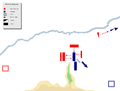
Claudius Nero, on the Roman right flank, struggled to overcome the terrain that blocked his path to the unwary Gauls on Hasdrubal's left.[8] Seeing the futility in wasting further time attempting to reach the inert Gauls, he instead took half of his men in cohorts and led them from behind the battling Roman lines to the extreme Roman left, swinging his troops around and crashing into the Carthaginian right flank with sudden force and intensity.[8] The Carthaginian right wing, composed of Hispanics, could not withstand this two pronged attack of Marcus Livius from the front and Claudius Nero on their flank.[8] They were forced to fall back, taking the Ligures in the Carthaginian centre with them.[8] The elephants were running amok, killing Romans and Carthaginians alike.[8] Hasdrubal fought alongside his men and exhorted them to keep fighting, rallying fleeing soldiers and re-starting the battle wherever he was present.
The Gauls on the Carthaginian left now faced a three pronged attack: Porcius Licinius from the front, Marcus Livius from their right flank, and Claudius Nero from the rear. By now, the Roman cavalry had completely defeated the Carthaginian cavalry and, with the retreat of the Carthaginian left wing, a general retreat of Hasdrubal's army started.[8] Six of the elephants were killed by their own drivers to stop their rampages and the remaining four were captured by the Romans.[8]
Hasdrubal, seeing that there was nothing more he could do, and presumably doubtful of his own prospects of escape or simply unwilling to be taken captive, charged into the Roman ranks on his horse along with his remnant Hispanic guards and was killed.[8] He was praised by Polybius and Livy for having done all he could as a general and then meeting a glorious death.[10] Dexter Hoyos believes Hasdrubal's death was foolish, as he could have given organisation and leadership to the remnants of the Carthaginian army and posed a lingering threat to Rome in northern Italy.[10] An unknown number of Ligurians and Gauls, possibly 10,000 or so, who either escaped the battle or didn't take part at all formed into an organised body but dispersed afterwards for want of a general.[10] At least one Carthaginian officer, Hamilcar, refused to give up after Hasdrubal's defeat and organized a Cisalpine Gallic army of 40,000 men against the Romans in 200 BC, causing the Battle of Cremona.
-
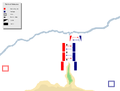 Roman left wing, center and cavalry charging the respective Carthaginian forces
 -
 Claudius Nero attacking the Carthaginian right wing at its flank, left unprotected by retreating cavalry
 -
 Carthaginian right wing and cavalry routed followed by a three prong attack on Carthaginian center
 -
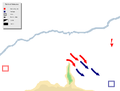 Retreat of the entire Carthaginian army


Aftermath
[edit]Claudius Nero showed no respect for his fallen adversary. He had Hasdrubal's head severed from his body, taken south, and thrown into Hannibal's camp as a token of his brother's defeat.
Lord Byron wrote of the battle:
The consul Claudius Nero, who made the unequalled march which deceived Hannibal and deceived Hasdrubal, thereby accomplishing an achievement almost unrivaled in military annals. The first intelligence of his return, to Hannibal, was the sight of Hasdrubal's head thrown into his camp. When Hannibal saw this, he exclaimed, with a sigh, that 'Rome would now be the mistress of the world.' To this victory of Claudius Nero's it might be owing that his imperial namesake reigned at all. But the infamy of the one has eclipsed the glory of the other. When the name of Claudius Nero is heard, who thinks of the consul? But such are human things.
The significance of the Battle of the Metaurus is recognized amongst historians. It is included in Edward Shepherd Creasy's The Fifteen Decisive Battles of the World (1851), the rationale being that it effectively removed the Carthaginian threat from Rome's ascendancy to continental dominion by leaving Hannibal stranded in Italy. Paul K. Davis sees its importance as the "Carthaginian defeat ended the attempt to reinforce Hannibal, dooming his effort in Italy, and Rome was able to establish dominance over Spain."[11] The Battle of the Metaurus is overshadowed by other battles of the Second Punic War, such as Hannibal's great victory at the Battle of Cannae or his ultimate defeat at the Battle of Zama. Nonetheless, the effects of Claudius Nero and Marcus Livius' victory at the Metaurus have earned it a significant standing amongst historians; not only of the history of Rome, but in that of the entire world.
One of Hasdrubal's officers, a certain Hamilcar, stayed behind in Cisalpine Gaul after the defeat and organized a united Gallic army of 40,000 men against Rome in 200 BC, sacking the city of Placentia before being defeated and killed by Rome at the Battle of Cremona. On the other hand, a part of the surviving Hispanic mercenaries continued the journey and eventually reached Hannibal.[12]
Casualties
[edit]Polybius gave 10,000 killed for Hasdrubal's army and an unspecified number of prisoners. Six elephants were killed and four captured. The Romans lost 2,000 killed. Livy estimates 8,000 Roman and allied killed, possibly not contradicting Polybius, with the Carthaginians losing 56,000 killed and 5,400 captured.[7][8] Livy's figure for prisoners is generally accepted by modern historians, but the number of Carthaginian deaths is not taken seriously.[7] Total Carthaginian casualties were probably around 15,400, including 10,000 killed and 5,400 captured.[8] A large number of Carthaginian officers were killed and many of the rest captured.[8]
In literature
[edit]F. L. Lucas's short story "The Fortune of Carthage" (Athenaeum, 28 January 1921 [13]) is about the battle's prelude, from Claudius Nero's viewpoint. It focuses on the dilemma the Roman consul faced in Apulia on intercepting Hasdrubal's letter to Hannibal. The closing section gives Hannibal's perspective in the aftermath of the battle. The story was admired by T. E. Lawrence.[14]
See also
[edit]References
[edit]- ^ G. Baldelli, E. Paci, L. Tomassini, La battaglia del Metauro. Testi, tesi, ipotesi, Minardi Editore, Fano 1994; M. Olmi, La battaglia del Metauro. Alla ricerca del luogo dello scontro, Edizioni Chillemi, Roma 2020.
- ^ Hoyos 2015, p. 193.
- ^ Appian, History of Rome, The Hannibalic War, 52 Archived 2015-10-20 at the Wayback Machine
- ^ Livy, The History of Rome, 27.49 Archived February 16, 2011, at the Wayback Machine
- ^ Barcelo, Pedro, Hannibal, Muenchen: Beck, 1998, ISBN 3-406-43292-1, S. 78
- ^ a b Hoyos 2015, p. 194.
- ^ a b c Hoyos 2015, p. 313.
- ^ a b c d e f g h i j k l m n o Hoyos 2015, p. 195.
- ^ Michael B. Charles, Peter Rhodan, Magister Elpehantorum: A Reappraisal of Hannibal's Use of Elephants. Classical World, volume 10,0, number 4, pp. 363-389
- ^ a b c Hoyos 2003, p. 149.
- ^ Paul K. Davis, 100 Decisive Battles from Ancient Times to the Present: The World’s Major Battles and How They Shaped History (Oxford: Oxford University Press, 1999), 39.
- ^ Appian, History of Rome, The Hannibalic War, 53
- ^ "The Athenaeum 1920-01-28: Iss 4735". New Statesman. 28 January 1920.
- ^ "T. E. Lawrence Studies". Archived from the original on 2011-10-03. Retrieved 2011-09-09.
Sources
[edit]
Classical writers[edit]
|
Modern writers[edit]
Polybios: The Histories, Book 11
|


Battle of the Metaurus
View on GrokipediaBackground
The Second Punic War
The Second Punic War (218–201 BC) arose from lingering Carthaginian resentment following the First Punic War (264–241 BC), during which Rome had seized Sicily and imposed a heavy indemnity, later augmented by the seizure of Sardinia amid the Mercenary War. To expand Carthaginian influence, Hamilcar Barca, Hannibal's father, conquered much of Iberia after 237 BC, establishing a treaty in 226 BC that set the Ebro River as the northern limit of Carthaginian expansion in the peninsula. However, the city of Saguntum, located south of the Ebro and allied with Rome, appealed to the Romans for protection; Hannibal's eight-month siege and capture of Saguntum in 219 BC constituted a direct violation of this treaty, prompting Rome to declare war. As a youth, Hannibal had sworn an oath to his father at age nine to maintain eternal enmity toward Rome, fueling his aggressive posture.[7][7][7][7] In a bold strategic maneuver, Hannibal launched the Carthaginian invasion of Italy by marching from Iberia through southern Gaul and crossing the Alps in late 218 BC, surprising the Romans who anticipated conflict in Iberia or Africa. His army, after the Battle of the Rhone where he defeated local forces, consisted of approximately 38,000 infantry, over 8,000 cavalry, and 37 war elephants when beginning the Alpine traverse; harsh weather, ambushes by tribes, and logistical challenges reduced it to about 20,000 infantry and 6,000 cavalry upon entering Italy. Carthage's primary goal was to fracture Rome's network of Italian alliances by demonstrating Roman vulnerability, encouraging defections among cities and tribes; Hannibal rapidly achieved initial successes, allying with Gallic tribes in the Po Valley. Rome, meanwhile, prioritized defending the peninsula and preventing reinforcements to Hannibal from Iberia or Africa, where his brother Hasdrubal Barca commanded forces as a potential reinforcer.[7][7][7][8] Hannibal's early campaigns inflicted devastating defeats on Roman armies. At the Trebia River in December 218 BC, an ambush led to the rout of a Roman force under Tiberius Sempronius Longus, with most of the legions drowned or slaughtered in the cold waters. The following spring, in 217 BC, near Lake Trasimene, Hannibal ensnared consul Gaius Flaminius's army in a fog-shrouded ambush, killing around 15,000 Romans while suffering minimal losses. The nadir came at Cannae in August 216 BC, where Hannibal's double-envelopment tactic annihilated a massive Roman army led by consuls Lucius Aemilius Paullus and Gaius Terentius Varro, resulting in approximately 70,000 Roman deaths in a single day—the bloodiest defeat in Roman history.[7][7][7][7] Despite these catastrophes, Rome refused to sue for peace, instead appointing Quintus Fabius Maximus as dictator in late 217 BC to implement a strategy of attrition—avoiding pitched battles, shadowing Hannibal's forces, and raiding his supply lines to exploit Rome's superior manpower and resources, a approach later termed the Fabian strategy. This cautious policy preserved Roman strength, frustrated Hannibal's attempts to provoke decisive engagements, and maintained loyalty among most Italian allies, setting the stage for counteroffensives like the victory at the Metaurus in 207 BC and the ultimate triumph at Zama in 202 BC under Publius Cornelius Scipio Africanus, which ended the war.[7][8][9]Hasdrubal Barca's Campaign
After Hannibal's departure from Iberia in 218 BC to invade Italy, his younger brother Hasdrubal Barca assumed command of Carthaginian forces in the peninsula, tasked with defending against Roman incursions led by Publius Cornelius Scipio. In 208 BC, Hasdrubal positioned his army on a fortified hill near Baecula (modern Santo Tomé, Spain) to block Scipio's advance into southern Iberia. During the ensuing battle, Scipio's forces outflanked Hasdrubal's position, compelling the Carthaginians to retreat northward along the Tagus River without suffering a total defeat; Hasdrubal preserved much of his army, including his elephants and treasury, while avoiding a decisive engagement that could have ended Carthaginian resistance in the region. The broader pressures of the Second Punic War prompted Carthage to redirect Hasdrubal's efforts toward reinforcing Hannibal in Italy. Following the Roman capture of New Carthage in 209 BC and the defeat at Baecula in 208 BC, Hasdrubal received explicit orders from the Carthaginian senate to abandon the peninsula and march to Italy to unite with his brother. Recognizing the futility of further defense against superior Roman forces, Hasdrubal withdrew strategically in early 207 BC, consolidating his remaining troops and resources for the transalpine expedition.[10] To assemble an invasion force, Hasdrubal recruited approximately 20,000 Celtiberian mercenaries in central Iberia, leveraging longstanding Carthaginian alliances with Iberian tribes, and acquired 10 war elephants for shock value. As he advanced northward, he planned to supplement his army with Ligurian reinforcements beyond the Alps. In spring 207 BC, Hasdrubal crossed the Pyrenees and then the Alps via a route similar to Hannibal's earlier path, enduring severe attrition from harsh terrain, weather, and hostile Gauls; by the time he emerged in northern Italy, roughly half his original force—estimated at around 25,000 infantry, 4,000 cavalry, and the elephants—had been lost to desertions, ambushes, and exhaustion.[11] Upon entering the Po Valley, Hasdrubal forged alliances with the Boii and Insubres, Cisalpine Gallic tribes resentful of Roman expansion, who provided additional warriors and guides in exchange for promises of autonomy. Bolstered by about 8,000 Ligurians who joined near the coast, his army swelled to around 30,000, allowing him to plunder Roman settlements while maneuvering southward toward Apulia, where he intended to link up with Hannibal for a coordinated assault on Rome. This campaign marked Hasdrubal's final major initiative in the war, shifting Carthaginian strategy from peripheral defenses to a direct reinforcement of the Italian front.[12]Prelude
Roman Intelligence and Response
In the spring of 207 BC, Roman forces captured a group of Hasdrubal Barca's messengers near Tarentum, who were carrying despatches intended for Hannibal detailing plans to join forces in Umbria.[3] Under interrogation, the prisoners—four Gauls and two Numidians—confessed the despatches' purpose, confirming the threat of a coordinated Carthaginian offensive; Roman intelligence estimated Hasdrubal's army at approximately 20,000 infantry and 6,000 cavalry, supplemented by Gallic and Ligurian allies.[3] This intelligence prompted immediate strategic adjustments, as the despatches explicitly outlined the intended rendezvous to overwhelm Roman defenses. The Roman Senate, alarmed by the prospect of the two Barca brothers uniting their armies to threaten central Italy, adopted a defensive posture and reinforced consular deployments.[13] Marcus Livius Salinator was assigned to the north with around 25,000 men positioned near Sena Gallica to block Hasdrubal's advance from the Adriatic coast, while Gaius Claudius Nero commanded a similar force in the south, shadowing Hannibal's movements in Apulia.[14] Recognizing the urgency, the Senate granted Nero broad authority to act independently without prior consultation, enabling rapid responses to evolving threats.[3] Complementing these deployments, initial scouting efforts focused on tracking Hasdrubal's progress along the Adriatic. Propraetor Lucius Porcius Licinius, commanding two legions in the region, monitored the Carthaginian column's descent from the Alps and conducted harassing operations to disrupt their cohesion before the main consular forces could converge.[15] This proactive intelligence gathering ensured the Romans maintained awareness of Hasdrubal's route and timing, setting the stage for interception without alerting the Carthaginians to the full scale of the response.[16]Movements to the Metaurus
In late June 207 BC, following intelligence gained from captured Carthaginian messengers revealing Hasdrubal Barca's route into northern Italy, consul Gaius Claudius Nero detached 7,000 elite troops—comprising 1,000 cavalry and 6,000 legionaries—from his army stationed in Apulia near Venusia.[17] This force undertook a grueling approximately 250-mile march northward through the Apennine foothills, covering the distance in just seven days via relentless forced marches of over 35 miles per day.[18] To maintain absolute secrecy and prevent local populations or scouts from gauging their strength, Nero's men marched primarily at night and entered Livius' camp silently.[19] Nero's column arrived unannounced at the camp of consul Marcus Livius Salinator near Sena Gallica on the Adriatic coast, where Livius had been shadowing Hasdrubal's advance.[19] The reinforcements were quietly integrated into the existing Roman lines during the night, swelling the combined consular army, including propraetor Porcius Licinius' forces and Italian allies, to approximately 50,000 men.[19] This surprise junction not only doubled the Roman presence confronting Hasdrubal but also invigorated troop morale, as the audacious initiative demonstrated Rome's resolve to prevent a Carthaginian union in the field. Meanwhile, Hasdrubal, advancing from the Po Valley toward central Italy with the intent of linking up with his brother Hannibal in the south, became disoriented due to unreliable Gaulish guides who deliberately or inadvertently directed him inland away from coastal roads.[20] Seeking a crossing point to continue southward, Hasdrubal's army approached the Metaurus River but was thwarted by seasonal floods that rendered fords impassable, compounded by persistent shadowing from Roman scouting parties under Livius.[20] Compelled to halt, Hasdrubal encamped near Sena Gallica along the Metaurus River, where his Ligurian and Gallic contingents grew restive amid supply shortages and the realization of Roman numerical superiority.[21] With the Romans maneuvering to block any escape route south along the Adriatic corridor, Hasdrubal's position became untenable, rendering a pitched battle inevitable around late June 207 BC along the banks of the Metaurus.[22]Opposing Forces
Roman Army Composition
The Roman army assembled for the Battle of the Metaurus in 207 BC totaled approximately 37,000 men under the joint command of the consuls, including four legions comprising about 20,000 heavy infantry, 10,000 allied Italian troops, and 2,000 cavalry, augmented by an additional 10,000 men led by the praetor Lucius Porcius Licinius.[23] These figures represent modern scholarly adjustments to ancient accounts, accounting for the standard consular field army structure during the Second Punic War, where each consul typically commanded two legions plus equivalent allied contingents.[24] Command was shared between consuls Gaius Claudius Nero and Marcus Livius Salinator, whose earlier personal enmity had been set aside through senatorial mediation to ensure unified leadership; Nero directed the right wing, Livius the left, while the center fell under collective oversight, with Porcius Licinius supporting the main line.[25] Nero's rapid reinforcement from his southern detachment of roughly 7,000 men—comprising 6,000 infantry and 1,000 cavalry—enabled this coordination without weakening defenses against Hannibal.[25] The forces employed the traditional manipular legion organization, arrayed in three lines of hastati (younger spearmen), principes (experienced swordsmen), and triarii (veteran reserves), which allowed flexible, disciplined infantry formations capable of adapting to terrain and enemy movements through coordinated advances and defensive squares.[26] Equipment followed Republican standards, with legionaries armed in lorica hamata (chain mail), large scuta shields, short gladii swords, and pila javelins for initial disruptive volleys; cavalry, though numerically inferior to the Carthaginian horse, consisted of Italian allied contingents effective in charges, reconnaissance, and pursuit.[26] Composed largely of battle-hardened veterans from earlier engagements like the campaigns in Spain and southern Italy, the army exhibited strong morale, fueled by the urgent strategic imperative to thwart Hasdrubal Barca's junction with Hannibal and thereby preserve Rome's precarious position in the war.[25] This resolve was evident in the troops' enthusiastic reception of Nero's arriving column and their disciplined execution under dual consular authority.[25]Carthaginian Army Composition
The Carthaginian army commanded by Hasdrubal Barca at the Battle of the Metaurus numbered approximately 25,000–30,000 men according to modern scholarly estimates, though ancient historians such as Livy and Appian inflated this figure to around 48,000 by including exaggerated reinforcements and allies.[23] The force's core comprised about 20,000 Iberian infantry, bolstered by roughly 8,000 Ligurian and Gaulish allied troops, 1,000 Numidian cavalry, and 10 war elephants.[27] Hasdrubal held sole command of the army, organizing it with the less reliable Gauls positioned on the left wing, the Ligurians forming the center, and the more disciplined Iberians anchoring the right wing under his personal command; the elephants were positioned in front of the Ligurian center for an initial shock assault.[23] The Iberian soldiers were primarily spearmen and slingers, offering versatility in melee and projectile warfare, while the Numidian cavalry provided light scouting and flanking potential. The elephants were meant to deliver shock charges against enemy lines, but the marshy, river-bound terrain along the Metaurus limited their effectiveness. Overall, the army's emphasis on rapid maneuvers and diverse tactics was severely compromised by the physical toll of traversing the Alps, leaving troops fatigued and less mobile.[23] Significant vulnerabilities plagued the force, including communication difficulties arising from language barriers between the multinational mercenary units, diminished morale in the wake of heavy defeats in Iberia, and acute shortages of supplies as they advanced through enemy-controlled lands.[27] Hasdrubal had assembled much of this diverse host through recruitment efforts in Iberia and among Gaulish tribes en route to Italy.[23]Battle
Deployment and Terrain
The Battle of the Metaurus occurred in the upper valley of the Metaurus River in northern Italy, near the modern locality of Sant'Angelo in Vado in the Marche region, during late June or early July 207 BC. The landscape featured a swollen and impassable Metaurus River along one flank due to seasonal flooding, high riverbanks that restricted movement, and undulating terrain with hills rising on the opposite side; the battlefield extended over roughly 10 miles of mostly level central ground interspersed with obstacles like a prominent hill that impeded advances in certain sectors.[24][20] The Roman forces, totaling approximately 50,000 infantry and cavalry under consuls Gaius Claudius Nero and Marcus Livius Salinator, formed an extended line to envelop the enemy, stretching their ranks thin to outflank Hasdrubal's position. Nero commanded the right wing near the hills, positioning his legions to exploit the elevated terrain for potential maneuvers, while Livius anchored the left along the river's edge; the center fell to praetor Lucius Porcius Licinus. To lure Hasdrubal into engagement, the Romans deliberately refused their left flank, presenting an apparent vulnerability opposite the Carthaginian center.[22] Hasdrubal Barca deployed his army of about 25,000–30,000 infantry (including Spanish, Gallic, and Ligurian troops), around 5,000 cavalry, and around 10 war elephants in a compact formation fronting his camp, with the river safeguarding his left flank held by reliable Iberian troops. The less disciplined Gallic contingents occupied the vulnerable right wing, while the elephants were massed in front of the center to disrupt Roman advances; perceiving weakness on the Roman left, Hasdrubal thinned his right to reinforce the center against Livius' sector.[22][28] The terrain decisively shaped strategic choices, as the Metaurus River funneled the Carthaginians into a constrained position, blocking retreat or lateral shifts on their left and compelling a frontal confrontation across the extended front. The hills on the Roman right facilitated outflanking potential, while the central hill and uneven ground stalled initial advances but ultimately trapped Hasdrubal's forces by limiting evasion routes once the lines engaged.[20][22]Course of the Engagement
At dawn in late June or early July 207 BC, Hasdrubal Barca initiated the battle by launching a vigorous assault on the Roman left wing under Marcus Livius Salinator, deploying his Ligurian and Spanish infantry supported by war elephants to exploit the terrain near the Metaurus River.[25] The attack met fierce resistance, as the uneven ground and dense underbrush along the riverbank hindered the Carthaginian advance, stalling their momentum while Livius's forces held firm despite heavy pressure.[2] On the Roman right, Gaius Claudius Nero maintained a defensive posture, refraining from immediate engagement to observe Hasdrubal's movements.[25] Seizing the opportunity, Nero detached 1,000 cavalry and 6,000 infantry from his wing, leading them on a concealed march of several miles behind intervening hills to reposition against the Carthaginian right flank, which was anchored by less reliable Gallic troops.[2] This maneuver, executed with surprise, struck the Gauls unexpectedly, sowing panic and disrupting Hasdrubal's line as the flanking force crashed into their rear, compelling the Carthaginians to fight on two fronts.[25] In the center, Roman legionaries pressed forward against the Carthaginian line, where Hasdrubal had positioned his remaining elephants to break through; however, the beasts panicked amid the chaos and the proximity of the river, turning back to trample their own Iberian and Ligurian infantry, with six elephants slain and four captured by Roman velites using fire and javelins.[2] Isolated and outnumbered, the core of Hasdrubal's Iberian veterans fought with notable valor but could not withstand the converging Roman assaults from front and flank.[24] The battle reached its climax as Hasdrubal, recognizing the futility of his position, charged directly into a Roman cohort in a desperate melee and was slain, his death shattering Carthaginian morale.[25] The army disintegrated into rout, with survivors fleeing toward the Metaurus River, where many drowned or were cut down; Roman pursuit continued relentlessly until nightfall, securing the field.[2]Aftermath
Immediate Outcomes
Following the Roman victory, Gaius Claudius Nero ordered his cavalry and light infantry under Lucius Porcius Licinius to pursue the fleeing Carthaginians, capturing thousands of exhausted Gauls who offered little resistance due to heat, thirst, and prior marching fatigue.[29] In total, the Romans took approximately 5,400 prisoners, including some officers, while securing significant plunder such as gold and silver from the enemy.[30] Consul Marcus Livius Salinator permitted the surviving Cisalpine Gauls and Ligurians to retreat northward, intending for them to disseminate news of the defeat among potential allies.[30] Nero then had Hasdrubal's head severed and dispatched it south under escort, along with two Numidian prisoners in chains released to inform Hannibal of the outcome; upon delivery near Hannibal's camp at Canusium, the head was thrown into his outpost, delivering a profound psychological blow.[31] Stunned by the grim token, Hannibal recognized the futility of further northern advances and immediately abandoned operations in central Italy, withdrawing his forces to the more defensible region of Bruttium in the south.[31] With Hannibal thus contained, Nero swiftly marched his detachment back south undetected, rejoining the main army before Hannibal could exploit the temporary absence and launch a counteroffensive.[32] Upon returning to Rome, the consuls Nero and Salinator shared a joint triumph, with Salinator entering on a chariot and Nero on horseback, celebrating the decisive repulsion of the Carthaginian invasion from the north.[33] This secured Roman control over central and northern Italy in the short term, preventing any immediate reinforcement of Hannibal's campaign.[31]Casualties and Losses
The Roman army incurred relatively light casualties compared to their opponents, with the heaviest toll on the exposed left wing commanded by Marcus Livius Salinator. According to Livy, approximately 8,000 Romans and allies were killed, primarily infantry. Polybius reports a lower figure of around 2,000 total Roman dead. Modern historians reconcile these accounts with an estimated range of 2,000 to 8,000 killed overall, attributing the lower toll to effective Roman coordination and terrain exploitation that limited exposure on vulnerable flanks. Livy also notes that over 4,000 Roman captives were recovered from the enemy.[2][34][35] Carthaginian losses were catastrophic, effectively destroying Hasdrubal Barca's invading force, including Hasdrubal himself who perished in the melee. Polybius states that not fewer than 10,000 Carthaginians and Gauls were killed, with some high-ranking prisoners taken. Livy reports around 56,000 slain and 5,400 captured, numbers modern scholars deem exaggerated for propagandistic effect. Appian corroborates the scale of devastation, noting most of an army comprising 48,000 infantry, 8,000 cavalry, and 15 elephants were either killed or captured. All elephants were accounted for, with Polybius specifying 6 killed outright and 4 subdued after breaking through Roman lines. Adjusted modern estimates settle on approximately 10,000 killed and 5,400 captured, underscoring Roman tactical efficiency in achieving near-total annihilation without proportional exertion.[2][34][36][24][35] Ancient sources exhibit significant discrepancies in totals, with Appian's inflated Carthaginian army size of 48,000 contributing to perceptions of even greater losses, while Livy's figures amplify the narrative of Roman triumph. Modern analyses critique these as typical of historiographical "inflation" in victory accounts, favoring Polybius's more restrained estimates to highlight the battle's decisiveness through superior Roman maneuverability rather than sheer slaughter. The captured Carthaginian baggage train yielded substantial material gains for Rome, including gold and silver bullion, military supplies, and over 300 talents in coinage from the camp, bolstering the treasury. Romans also recovered several lost standards from the field, symbolizing the restoration of their honor.[2][34][36][24][35]Legacy
Strategic and Historical Significance
The Battle of the Metaurus in 207 BC played a crucial role in preventing the reinforcement of Hannibal's army in Italy by his brother Hasdrubal Barca, whose force, if united with Hannibal's approximately 40,000 troops, could have doubled Carthaginian strength to around 80,000 men and posed an existential threat to Rome.[24] Roman intelligence and rapid maneuver under consuls Gaius Claudius Nero and Marcus Livius Salinator intercepted Hasdrubal's column, forcing him into a defensive position and ultimately destroying his army before the juncture could occur.[37] This disruption isolated Hannibal, compelling him to adopt a purely defensive strategy in southern Italy and curtailing Carthage's offensive momentum.[38] As a turning point in the Second Punic War, the victory at the Metaurus enabled Publius Cornelius Scipio's successful campaign in Iberia, which severed Carthage's Spanish resources and paved the way for the decisive Roman triumph at Zama in 202 BC, leading to Carthage's surrender in 201 BC.[39] Without this battle, Rome faced potential collapse from a coordinated Carthaginian offensive, but the outcome shifted the strategic balance decisively in Rome's favor, allowing it to transition from survival to conquest.[24] In military history, the Metaurus exemplifies the value of superior intelligence, swift operational mobility, and envelopment tactics, with Nero's bold march to reinforce Livius highlighting Roman adaptability in contrast to Hasdrubal's logistical strains after crossing the Alps.[38] Often compared to Hannibal's envelopment at Cannae for its decisiveness, the battle ranks among the pivotal engagements in world history, as noted by Edward Creasy in his enumeration of fifteen decisive battles from Marathon to Waterloo.[40] The battle's broader impact solidified Roman control over central and northern Italy by breaking the back of Carthaginian incursions, while demoralizing Gallic tribes whose resistance had previously aided Hannibal, thus stabilizing Rome's northern frontiers.[37] It also enhanced the prestige of the consular duo, Nero and Livius, who received joint triumphs in Rome, underscoring the political rewards of strategic success in republican warfare.[39]Modern Interpretations and Evidence
The principal ancient accounts of the Battle of the Metaurus derive from Polybius in Book 11 of his Histories, Livy in Book 27 of his History of Rome, and Appian in his Punic Wars.[41] These works, composed between the 2nd century BCE and 2nd century CE, exhibit a pro-Roman bias that emphasizes the heroism of Roman commanders like Gaius Claudius Nero while portraying Carthaginian forces under Hasdrubal Barca as disorganized and doomed.[24] Such narratives often inflate troop numbers and casualty figures to heighten the drama of Roman triumph, with no surviving contemporary accounts from 207 BCE to provide independent verification.[24] In the 19th and 20th centuries, historians reinterpreted the battle through evolving analytical lenses. Sir Edward Creasy, in his 1851 work The Fifteen Decisive Battles of the World, celebrated the Metaurus as a pivotal clash that safeguarded Western civilization from Carthaginian dominance, crediting Nero's strategic acumen with preserving Roman ascendancy and preventing a Semitic cultural overlay on Europe.[40] J. F. Lazenby, in Hannibal's War (1978), offered a more critical assessment, questioning the reliability of ancient troop estimates—such as the reported 50,000–80,000 Romans and 30,000–50,000 Carthaginians—arguing that logistical constraints and source biases likely rendered these figures exaggerated by at least half.[42] Adrian Goldsworthy, in The Punic Wars (2000), highlighted Nero's rapid 250-mile march from southern to northern Italy as a masterful logistical feat that enabled the Roman reinforcement and encirclement of Hasdrubal, underscoring its role in averting a potential Carthaginian convergence.[43] Debates over the battle's precise location persist, with traditional scholarship favoring the lower Metaurus River near modern Senigallia in the Marche region, based on ancient descriptions of proximity to the Adriatic coast.[44] However, modern analyses increasingly prefer the upper Metaurus valley near Sant'Angelo in Vado, interpreting Polybius and Livy's references to a meandering river and hilly terrain as indicative of this inland site, which better aligns with Hasdrubal's northward route from the Alps.[45] Archaeological investigations have provided limited evidence for the battle's location. Early 20th-century excavations near Calcinelli in the lower Metaurus valley uncovered human bones believed to be from Carthaginian soldiers, supporting the traditional site.[46] Further work in the upper valley has identified potential ancient roads and settlement traces consistent with military activity during the Second Punic War, though no definitive battlefield artifacts or mass graves have been confirmed.References
- https://en.wikisource.org/wiki/From_the_Founding_of_the_City/Book_27
- https://en.wikisource.org/wiki/From_the_Founding_of_the_City/Book_27#Chapter_43
- https://en.wikisource.org/wiki/From_the_Founding_of_the_City/Book_27#Chapter_48
- https://en.wikisource.org/wiki/From_the_Founding_of_the_City/Book_27#Chapter_47
- https://en.wikisource.org/wiki/From_the_Founding_of_the_City/Book_27#Chapter_49
- https://en.wikisource.org/wiki/From_the_Founding_of_the_City/Book_27#chapter_XX
- https://en.wikisource.org/wiki/From_the_Founding_of_the_City/Book_27#chapter_XXXVIII
- https://en.wikisource.org/wiki/From_the_Founding_of_the_City/Book_27#chapter_XXXIX
- https://en.wikisource.org/wiki/From_the_Founding_of_the_City/Book_27#Chapter_44
- https://en.wikisource.org/wiki/From_the_Founding_of_the_City/Book_27#Chapter_35
- https://en.wikisource.org/wiki/From_the_Founding_of_the_City/Book_27#Chapter_39
- https://en.wikisource.org/wiki/From_the_Founding_of_the_City/Book_27#Chapter_46
- https://en.wikisource.org/wiki/From_the_Founding_of_the_City/Book_27#43
- https://en.wikisource.org/wiki/From_the_Founding_of_the_City/Book_27#45
- https://en.wikisource.org/wiki/From_the_Founding_of_the_City/Book_27#47
- https://en.wikisource.org/wiki/From_the_Founding_of_the_City/Book_27#48
- https://en.wikisource.org/wiki/History_of_Rome_(Livy)/Book_27