Hubbry Logo
West Russian Volunteer ArmyWest Russian Volunteer ArmyMain
Open search
West Russian Volunteer Army
Community hub
West Russian Volunteer Army
logo
8 pages, 0 posts
0 subscribers
Be the first to start a discussion here.
West Russian Volunteer Army
from Wikipedia
West Russian Volunteer Army
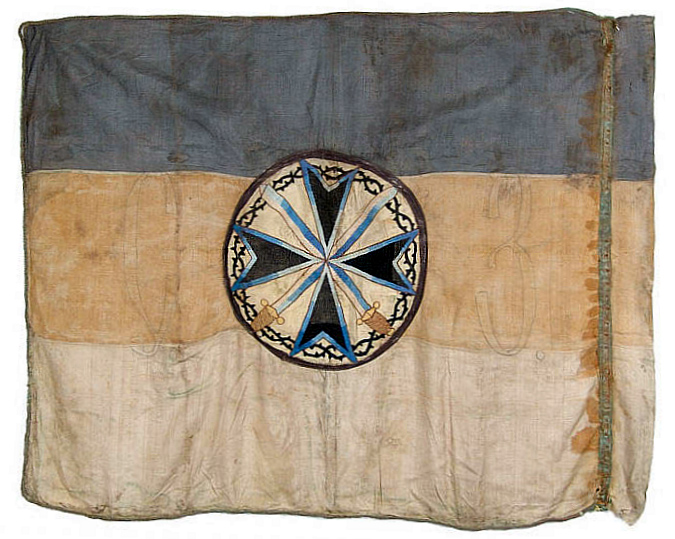
The only surviving flag of the West Russian Volunteer Army
ActiveNovember 1918 – December 1919
Allegiance Russian State (officially)
German Empire (unofficially)
Size50,000 (Oct. 1919)
EngagementsRussian Civil War
Commanders
Notable
commanders
Gen. Pavel Bermondt-Avalov
Gen. Rüdiger von der Goltz
Insignia
Army Flag

The West Russian Volunteer Army[a] or Bermontians[b] was a pro-German White Russian military formation in Latvia and Lithuania during the Russian Civil War from November 1918 to December 1919.

History

[edit]

The WRVA, unlike the pro-Entente Volunteer Army in Southern Russia, was supported and in fact put together under German auspices. The Compiègne Armistice of November 1918, in article 12, stipulated that troops of the former German Empire would remain in the Baltic provinces of the former Russian Empire to help fight against Bolshevik advances and that such German units were to withdraw once the Allies determined that the situation was under control. The order to withdraw was given after signing of the Treaty of Versailles in June 1919. However, only a small portion of the Freikorps in the Baltic retired in response to the Allies' order; the rest remained under the leadership of the German Army General Rüdiger von der Goltz. To avoid casting blame on Germany and infuriating the Allies, von der Goltz withdrew into the background.

The first units of the future WRVA were brought from Germany to Latvia on 30 May 1919.[1] On June 12, Pavel Bermondt-Avalov arrived in Jelgava with his headquarters, and on July 10 formed the Central Council of the Western Russian District.[1] It put into circulation special money printed in Germany and followed the German government's instructions while receiving financial and military support from large German industrialists such as Krupp as well as others.[1]

The WRVA first appeared in Lithuania, in Kuršėnai, on 26 July 1919, where they began to requisition apartments.[1] Although the Lithuanian government demanded that the WRVA move out of Lithuania, they ignored the demands, meaning that only force would push it out.[1] Initially, on the Lithuanian side, the units on the anti-Bermontian front were mostly the Raseiniai Commandant's Company on the right flank and the Pasvalys Battalion on the left flank, as well as Lithuanian insurgents.[1]

In August 1919, von der Goltz merged his troops with the "Special Russian Corps", led by Cossack General Pavel Bermondt-Avalov. The two generals recruited about 50,000 men: mostly Freikorps members and Baltic Germans, as well as some Russian POWs captured by Germany in World War I and then released if they promised that they would help fight against the Bolsheviks in the Russian Civil War. The resultant Western Russian Volunteer Army declared that it would support the Russian White movement forces of Alexander Kolchak (then based in Siberia) and started marching eastwards (October 1919) with a stated intention of attacking the Bolsheviks, but its real goal appeared to be sustaining German power in the Baltic region.

Confrontation with the governments of Latvia and Lithuania

[edit]
Bermontians' planes captured by the Lithuanian Army near Radviliškis

The political situation in the Baltic region continued to deteriorate. A new government in Lithuania refused to allow White Russians to pass troops through and establish a military base. After initially supporting the White Russians the Weimar government, under pressure from the Entente, banned the transfer of German soldiers to the Russians and ordered the Reichswehr to block the East Prussian border to block Freikorps's supplies. General von der Goltz was finally recalled on October 4.

In this circumstances Bermondt-Avalov launched an offensive using the Freikorps in an attempt to force the Republic of Latvia to negotiate. With the support of British naval artillery and Estonian armoured train, a Latvian counter-offensive followed in November, which forced Bermondt's army to withdraw. Mitau was also lost in loss-making fights.

In October 1919, the West Russian Volunteer Army attacked the newly independent states of Lithuania and Latvia, to which Germany had granted independence. It briefly occupied the west bank of the Daugava in Riga and the government of Kārlis Ulmanis had to request military assistance from Lithuania and Estonia. The Estonians sent two armoured trains to aid the Latvians while the Lithuanians were engaged in battles with the Bolsheviks and could only issue diplomatic protests. The Latvians also received assistance from the guns of a British Royal Navy destroyer, HMS Vanoc, in Riga harbour.

In October and November 1919, the WRVA occupied most of the Latvian territory on the Daugava's left bank, while also occupying the Lithuanian towns of Biržai, Radviliškis, Šiauliai, Raseiniai, Jurbarkas, Linkuva, and more towns,attacking the population and looting in the process.[1] The threat posed by the Bermontians was such that the Lithuanian government had to withdraw part of the military units fighting against the Red Army to fight against them.[1]

In November, the Latvian army managed to drive the Bermondt-Avalov forces into Lithuanian territory. On 11 November 1919, the WRVA were defeated by the Latvian army near Riga.[1] Jelgava was also lost. On 18 November 1919, Germany announced that it was officially taking the WRVA under its protection.[1] Finally, the WRVA suffered heavy defeats by the Lithuanian Army in the Battle of Radviliškis on November 21–22, but a further Lithuanian attack was stopped at the request of the Entente.[1]

Upon defeat Bermondt-Avalov fled to Memel. The German Freikorps were handed over to the German Lieutenant General von Eberhardt, successor of the Goltz as commander of the VI Reserve Corps in Allenstein. After the involvement of the Entente military mission, General Eberhardt was able to organize evacuation of the remaining German Freikorps via Lithuania to East Prussia. The last WRVA units withdrew to Germany from Latvia and Lithuania on 1 and 15 December 1919, respectively.[1]

Army

[edit]

The Army uniforms of the West Russian Volunteer Army were provided by Germany and decorated with Russian distinctive signs, in particular the shoulder legs according to the model of the Russian Imperial Army and an Orthodox cross worn on the left sleeve.

The army included:[2]

  • Corps Graf Keller (Colonel Potozki): from 7,000 to 10,000 soldiers, near Jelgava
  • Corps Virgolitsch (Colonel Virgolitsch): from 3,500 to 5,000 mounted soldiers including Cossacks, stationed in northern Lithuania
  • Iron Division (Major Bischoff): about 15,000 to 18,000, at Jelgava, joined in August
  • German Legion [de] (Captain Sievert): about 9,000 to 12,000 soldiers who had come together from various independent free corps.
  • Freikorps Plehwe (Captain von Plehwe [de]): about 3,000 soldiers (the former 2nd Guard Reserve Regiment), before Libau
  • Freikorps Diebitsch: about 3,000 soldiers, for railway protection in Lithuania.
  • Freikorps Roßbach [de ]: about 1,000 soldiers, appeared at the end of October after a march over 1,200 km off Riga.

See also

[edit]

References

[edit]

Notes

[edit]
Revisions and contributorsEdit on WikipediaRead on Wikipedia
from Grokipedia
The West Russian Volunteer Army, also known as the Bermontians, was a pro-German White Russian military formation active in and during the from late 1918 to late 1919. Commanded by , it comprised Russian volunteers supplemented by German units, such as the Iron Division, totaling around 50,000 troops. Initially formed to counter Bolshevik advances in the and sustain German influence post-World I, the army's objectives shifted toward opposing the newly independent Republic of rather than solely focusing on the . In autumn 1919, it launched an offensive on , incorporating German elements, which was repelled by Latvian forces supported by Allied troops, marking a significant setback. This campaign highlighted the army's alignment with German geopolitical aims over broader anti-Bolshevik efforts, contributing to its characterization as an instance of warlordism amid the power vacuum of the Baltic wars of independence. Following the , which compelled German withdrawal, the remnants of the force evacuated through to by the end of , effectively dissolving the unit. The West Russian Volunteer Army's operations underscored the complexities of White Russian factions, where ideological opposition to intertwined with opportunistic alliances that undermined regional stability.

Historical Context

Russian Civil War and Baltic Involvement

The Russian Civil War (1917–1922) encompassed peripheral theaters like the Baltic region, where Bolshevik advances clashed with White Russian forces, local nationalist armies seeking independence, and remnants of German occupation forces following the Armistice of 11 November 1918. In this fragmented landscape, the West Russian Volunteer Army (WRVA) emerged as a nominally anti-Bolshevik White Russian formation, drawing on Russian prisoners of war repatriated from Germany, volunteers, and integrated German Freikorps units such as the Iron Division. These elements operated under the influence of German commanders like General Rüdiger von der Goltz, who sought to maintain Teutonic dominance in the Baltics amid Entente demands for regional sovereignty. Initially aligned with White objectives to repel Red Army incursions into Latvia and Lithuania, the WRVA's Baltic involvement reflected warlord dynamics in the Civil War's power vacuums, with leader Pavel Bermondt-Avalov exercising autonomous control over operations. Early deployments focused on countering Bolshevik forces in Courland and Semigallia, but strategic divergences arose as German backers prioritized retaining economic and military footholds over unified anti-Bolshevik coordination, such as joining Nikolai Yudenich's Northwestern Army offensive toward Petrograd. A secret pact on 21 September 1919 formalized German support, including a 300 million mark loan at 5% interest over 10 years, enabling the WRVA to incorporate German troops while ostensibly targeting both Bolsheviks and perceived pro-Entente Baltic governments. Tensions escalated into direct conflict with emerging Baltic states, exemplified by the Lithuanian–Bermontian War from July to December 1919, where WRVA advances into Lithuanian territory over disputed border regions like the Suvalkija salient provoked Lithuanian counteroffensives, including the capture of WRVA aircraft. The pivotal shift occurred in autumn 1919, when the army, numbering around 40,000–50,000 mixed Russian and German personnel, ignored Yudenich's 27 September directive to reinforce the Petrograd front and instead launched an assault on Latvian-held starting 8 October 1919. This offensive, blending anti-Bolshevik rhetoric with German revanchism, aimed to install a puppet regime but faltered against Latvian defenses bolstered by British naval support, culminating in WRVA defeat by late November and evacuation by December. Such actions diverted resources from core Civil War fronts and alienated other White factions, who deemed Bermondt-Avalov's enterprise traitorous for undermining Allied-recognized independences.

German Occupation and Transition

Following the on March 3, 1918, German forces under the administration expanded control over approximately 110,000 square kilometers in the , encompassing , , , , and parts of and , with a population of around 3 million. This military governance, led initially by figures like and , imposed strict administrative districts and policies aimed at resource extraction and security, often through direct army oversight rather than civilian rule. The Armistice of November 11, , compelled German withdrawal from these territories amid the empire's defeat, creating a exploited by advancing Bolshevik forces during their westward offensive of –1919. To counter this and preserve influence against both Soviets and emerging independent , German commanders, including , orchestrated hybrid forces combining units with Russian anti-Bolshevik volunteers, viewing the latter as proxies to legitimize continued operations under a non-German . In , this transition materialized through the Special Russian Corps, reorganized under , comprising Russian prisoners of war repatriated from and local White Russian elements, totaling several thousand by mid-1919. By summer 1919, Bermondt-Avalov's forces, numbering around 50,000 including integrated German like the Iron Division, inherited formal occupation authority from retreating German troops, formalized on September 21, 1919, when von der Goltz transferred command. This handover, preceded by the Iron Division's mutiny on August 23, 1919, against evacuation orders, enabled the West Russian Volunteer Army to assume control of Courland's administrative structures, funded initially by German sources until September. The arrangement reflected pragmatic German : sustaining anti-Bolshevik resistance while evading Entente prohibitions on direct involvement, though it prioritized strategic footholds over Baltic sovereignty aspirations. Russian units began arriving in June 1919, culminating in the July 3 Strasdenhof Armistice, which positioned the army to defend against Soviet incursions while clashing with Latvian and Lithuanian forces seeking independence. This phase marked the army's evolution from a German-dependent auxiliary to a nominally autonomous entity, though heavily reliant on logistics and command until withdrawals accelerated post-Riga operations in October 1919.

Formation and Leadership

Establishment in Late 1918

The West Russian Volunteer Army emerged in November 1918 within the German-occupied Courland Governorate (present-day Latvia), as Bolshevik forces advanced following the Armistice of 11 November that ended World War I. It originated from Russian military units previously raised by German authorities from prisoners of war and deserters captured on the Eastern Front, intended to serve as auxiliaries against the Red Army. These formations, numbering several thousand men, were reorganized under anti-Bolshevik Russian officers to fill the strategic void left by retreating German troops, with tacit approval from German commanders aiming to safeguard economic and political interests in the Baltic. German General , overseeing the Baltic Landeswehr and elements, facilitated the army's initial consolidation by integrating Russian volunteers into a cohesive force based in (Mitau), providing logistics and armaments from existing occupation stocks. The establishment aligned with Article 12 of the Compiègne Armistice, which permitted German assistance to anti-Bolshevik entities, though it masked efforts to prolong de facto control over Courland's resources and ports. Early objectives centered on defensive operations against Bolshevik incursions from the east, while proclaiming loyalty to the broader White Russian movement under Admiral Kolchak, though practical dependence on German patronage shaped its autonomy. Pavel Bermondt-Avalov, a Georgian-Russian officer with prior service in the Imperial Army, played a pivotal role in formalizing the structure, drawing on networks of White émigrés in to recruit additional personnel. By late , the nascent army comprised approximately 10,000-15,000 troops, predominantly ethnic Russians supplemented by local volunteers and Cossack remnants, equipped with rifles, artillery, and limited armored vehicles inherited from German divisions. This phase marked a transitional dynamic, where Russian nationalist aspirations intersected with German geopolitical maneuvering, setting the stage for expanded operations in 1919.

Role of Pavel Bermondt-Avalov

, a Russian officer born in 1877, assumed leadership of Russian volunteer units in the during the spring of 1919, initially commanding formations such as the Graf Keller Corps composed largely of former German prisoners of war. He defied an order from General on 9 July 1919 to subordinate his forces to the Northwestern Army, instead prioritizing the establishment of a distinct Russian presence in and consolidating control over anti-Bolshevik elements independent of broader White Russian coordination. This decision reflected his opportunistic approach, leveraging the post-World War I power vacuum to build a personal power base amid fragmented anti-Bolshevik efforts. In June 1919, Bermondt-Avalov began integrating German units, including the Iron Division, under nominal Russian command in Mitau (present-day ), transforming these into the core of the West Russian Volunteer Army. On 5 September 1919, he publicly declared himself , refusing alignment with Yudenich's planned offensive on Petrograd to focus on securing Baltic territories for Russian restoration. German General formally appointed him to this role on 21 September 1919, with Berlin's approval following on 26 September, enabling the army to expand to an estimated 50,000 personnel—though this figure remains disputed due to inconsistent records of volunteer and integration. Under his direction, the army adopted an ideology emphasizing opposition to Bolshevik expansion while rejecting Baltic national independence, viewing the region as integral to a future united Russia. Bermondt-Avalov's key actions centered on offensive operations against emerging Baltic states, culminating in the "Bermontiade" from 8 October to 3 December 1919, during which his forces assaulted and encroached into territory to disrupt Latvian and consolidation. Despite attending a coordination conference in on 26 August 1919 with representatives from , , , , the Northwestern Front, and Entente powers, he pursued unilateral advances driven by Baltic German advisors and fears of funding shortfalls, issuing ultimatums for passage through Latvian lines toward Bolshevik-held areas. His reliance on German logistical and financial support proved critical but unsustainable, as halted subsidies in 1919 amid international pressure, exacerbating internal discipline issues and strategic miscalculations. The army's collapse under Bermondt-Avalov's command stemmed from combined Latvian-Estonian-British counteroffensives, which repelled the assault by early November 1919, forcing a retreat to by 13 December. Approximately 4,000 to 5,000 Russian soldiers faced , while Bermondt-Avalov himself evacuated to , where his forces disbanded amid unpaid wages and desertions. His leadership exemplified warlordism in the Baltic theater, characterized by tactical dependence on German proxies and a failure to secure broader alliances, ultimately undermining anti-Bolshevik objectives by alienating potential local collaborators and Entente backers.

Military Organization

Composition and Recruitment

The West Russian Volunteer Army, under the command of , consisted mainly of Russian personnel augmented by German and elements. The core Russian forces comprised former prisoners of war released by authorities after , alongside White Russian émigrés and volunteers from the in . German components included units, notably the Iron Division, which formed a substantial portion of the fighting strength, while provided administrative and auxiliary support. At its height in mid-1919, the army reportedly mustered around 50,000 men, though contemporary estimates suggest this total was inflated, with effective combat strength closer to 40,000, including up to 20,000 . Units were organized into corps such as the Graf Keller Corps, blending Russian officers with mixed-rank personnel; German maintained semi-autonomous operations under their own commanders, like Josef Bischoff, reflecting the army's hybrid structure reliant on German expertise. Recruitment targeted Russian prisoners of war in German camps, who were enlisted with assurances of an anti-Bolshevik crusade to liberate , though some accounts indicate these recruits were misled about the operation's limited Baltic focus and dependence on German backing. White Russian volunteers were drawn from communities in , often former officers seeking to continue the fight against . German enlistment emphasized incentives like land settlements in conquered territories, drawing battle-hardened veterans from post-war volunteer formations eager for continued combat and economic gain. Baltic German recruitment leveraged local and Landeswehr remnants for and local knowledge, though their numbers remained secondary to the Russian and German contingents. Overall, the process unfolded under initial German oversight by General before Bermondt-Avalov's dominance, prioritizing rapid mobilization over ideological cohesion.

Equipment and Logistics

The West Russian Volunteer Army's equipment was predominantly supplied by German forces, leveraging the integration of Freikorps units such as the Iron Division into its ranks. Formed largely from Russian prisoners of war released and armed in Germany, the army received standard Imperial German weaponry, including rifles and machine guns, to outfit its infantry divisions. The force maintained an aviation component, with multiple employed in operations and subsequently captured by Lithuanian forces after the Battle of Radviliškis on November 21, 1919. Armored elements included rail-mounted platforms, such as the "Max," utilized for fire support and captured during retreats from Lithuanian territory in late 1919. Logistics relied heavily on German-managed rail networks in and for transporting troops and from bases like , but these lines proved vulnerable to disruption by opposing Baltic state forces. As German withdrawal accelerated under Entente pressure following the , supply chains faltered, exacerbating equipment shortages during offensives into and . Heavy losses of armaments in engagements like the Battle of in October 1919 further strained resources, contributing to the army's operational collapse by early 1920.

Operations and Campaigns

Early Anti-Bolshevik Actions

The West Russian Volunteer Army's initial engagements against Bolshevik forces occurred following its deployment to the in spring 1919, after units were transported from to . The first contingents arrived in by late May 1919, with Commander reaching on June 12 to assume control of Russian volunteer formations, numbering around 4,000–5,000 men at that stage, supplemented by German Freikorps elements such as the Iron Division. These forces were positioned along the front lines in and to counter advances, as Bolshevik units had followed retreating German troops into the area during winter 1918–1919, imposing terror on local populations and threatening to overrun the western Baltic territories. In June and July 1919, the army reinforced defensive positions east of the River, contributing to operations that repelled Bolshevik probes and maintained control over liberated areas previously secured by German-led forces earlier in the year. For instance, combined German-Russian units under overall German oversight, including Bermondt's , held back the Red Latvian Division and other Bolshevik formations attempting to exploit gaps left by the Entente's demands for German withdrawal, preventing major incursions until an August 1919 Red offensive shifted dynamics. These actions aligned with the army's stated anti-Bolshevik mandate, nominally supporting White Russian efforts under Admiral Kolchak, though troop estimates varied widely due to reliance on former prisoners-of-war and the integration of irregular , whose motivations included retaining German influence rather than pure ideological opposition to . Outcomes included temporary stabilization of the front, but with limited independent Russian-led offensives, as operations depended heavily on German logistics and command structures until formal transfer on September 21, 1919. Historians note that while these early efforts demonstrated the army's capacity for defensive warfare—leveraging captured German equipment and POW recruits—their scope was constrained by internal disunity and shifting priorities, with some units more focused on regional power consolidation than sustained anti-Red campaigns. By late summer, Bolshevik pressure had eased in the west due to broader setbacks elsewhere, allowing resources to divert toward other objectives, though the initial phase underscored the precarious Allied-German- interplay in containing Soviet expansion.

Incursion into Latvia

In October 1919, the West Russian Volunteer Army, under the command of Lieutenant General Pavel Bermondt-Avalov, launched an offensive against the newly independent Republic of Latvia, ostensibly as part of its anti-Bolshevik campaign but effectively serving German interests in undermining Latvian sovereignty. On September 21, 1919, Bermondt-Avalov concluded a secret agreement with German General Rüdiger von der Goltz, which facilitated the integration of German paramilitary units into the Volunteer Army and provided funding through a 300 million mark loan at 5% interest over 10 years, enabling the shift from eastern fronts against Bolsheviks to a western thrust toward Riga. The incursion commenced on October 8, 1919, when forces, comprising Russian former prisoners of war and German volunteers, advanced from positions near and assaulted Latvian positions south of , capturing suburbs across the River. Latvian forces, initially outnumbered and caught off-guard, mounted a defense of the capital, entrenching in the Old and relying on limited and to hold key bridges and approaches. The offensive stalled amid fierce urban fighting, with the failing to sever Latvian supply lines or achieve a decisive breakthrough despite numerical superiority derived from German reinforcements. By mid-November, Latvian counteroffensives, bolstered by Estonian troops and naval gunfire support from Anglo-French squadrons in the , reversed the gains; on November 10, 1919, was fully secured, forcing the into retreat. Pursuit operations culminated in the Battle of from November 15 to 21, where Latvian forces expelled remaining elements from western , leading to the complete withdrawal of German-influenced units by December 1919. The incursion, which exposed the 's alignment with Prussian over genuine anti-Bolshevik objectives, resulted in significant on both sides and accelerated the Entente's demands for German disbandment in the region.

Conflict with Lithuania

The Lithuanian–Bermontian War pitted the Republic of against the West Russian Volunteer Army (WRVA), a force of Russian White emigrés and German Freikorps units commanded by , from 26 July to 15 December 1919. The WRVA, ostensibly anti-Bolshevik, advanced into Lithuanian territory amid the broader Baltic struggles for independence, encroaching on areas sought to secure following its in February 1918. Initial skirmishes occurred in July 1919 as WRVA elements, including former German prisoners of war and Iron Division troops, crossed into northern while consolidating positions after earlier operations in . Tensions escalated in autumn 1919 after the WRVA's failed offensive against in October, which prompted Latvian counterattacks that drove Bermont-Avalov's forces southward into Lithuanian-held regions. By late October, WRVA troops seized key northwestern Lithuanian towns, including and Radviliškis, disrupting rail lines and threatening Lithuania's control over . Lithuanian forces, numbering around 20,000 organized into infantry regiments and supported by limited artillery, mobilized to counter this incursion, viewing it as an existential threat to national sovereignty amid concurrent Bolshevik pressures. The conflict's turning point came during the Battle of Radviliškis on 21–22 November 1919, where approximately 4,000 Lithuanian troops from the 2nd Infantry Regiment and other units assaulted entrenched WRVA positions defended by up to 10,000 soldiers equipped with German-supplied heavy weaponry. Lithuanian assaults captured the town cemetery and railway station after intense fighting, inflicting heavy casualties on the Bermontians—estimated at over 1,000 killed or wounded—and forcing their retreat. The victory yielded significant captures, including , mortars, and ammunition, bolstering Lithuanian logistics. Emboldened, Lithuanian armies pursued the disorganized WRVA remnants, liberating occupied territories and coordinating with Entente demands for German Freikorps withdrawal. By 15 December 1919, the WRVA had been fully expelled from , with Bermondt-Avalov fleeing to before disbanding his forces. The war underscored the WRVA's reliance on German backing, which waned under Allied pressure, and affirmed Lithuania's military resolve in securing its borders against hybrid threats blending White Russian irredentism and Freikorps adventurism.

Political Objectives and Alliances

Anti-Bolshevik Ideology

The West Russian Volunteer Army positioned itself as a bulwark against , which its leaders condemned as a tyrannical that fragmented , suppressed national , and imposed a "Bolshevist slave yoke" on the populace. This opposition was rooted in the broader White movement's rejection of communist rule, viewing the Bolshevik seizure of power in 1917 as an illegitimate coup that destroyed traditional Russian order and enabled expansion into the borderlands. The army's stated aim was to overthrow the Soviet regime through military campaigns, internal subversion, and alliances, framing as a "plague" endangering not only but at large. Pavel Bermondt-Avalov, the army's commander, articulated this stance in operational appeals and directives, declaring Bolsheviks the "worst enemies of the people" and calling for their total annihilation to restore unity and indivisibility to Russian territories. The political program invoked Russian imperial restoration as a means to ensure equality, order, and prosperity, explicitly countering Bolshevik policies of class warfare, land expropriation, and internationalist subversion. Formed in late 1918 from Russian prisoners of war and volunteers in Germany, the army pledged allegiance to anti-Bolshevik objectives, including support for a potential monarchist restoration under figures like Grand Prince Kirill Vladimirovich Romanov, whom Bermondt-Avalov backed as a unifying symbol against Soviet atheism and chaos. In practice, this ideology manifested in the establishment of the West Russian Central Council in occupied Baltic areas, tasked with administering territories free from Bolshevik influence and suppressing sympathizers. A key appeal on 14 October 1919 promised limited —such as two-thirds Latvian representation in local governance—while subordinating it to the anti-Bolshevik fight, rejecting independence movements that might Soviet consolidation. Bermondt-Avalov's 1925 memoirs, In the Fight Against , further elaborated these views, portraying the struggle as a defense of Russian against communist internationalism and Entente-imposed fragmentation. Despite tactical alliances with German , the core rationale remained the eradication of Bolshevik power to prevent its spread westward, as evidenced in planned offensives toward Soviet heartlands.

Cooperation with German Forces

The West Russian Volunteer Army emerged from an alliance between Russian White forces and German military remnants in the , formed to circumvent Entente demands for the withdrawal of German troops following the Armistice of 11 November 1918. In early 1919, German General commanded units, including the Iron Division and , totaling around 3,850 men initially concentrated in , which coordinated with pro-Russian elements led by to combat Bolshevik advances. By June 1919, to maintain German presence under a nominally Russian banner, these forces were reorganized into the WRVA, with Bermondt-Avalov assuming formal command in , integrating German contingents as the "Deutsche Legion" that provided the core combat strength, training, and logistical support. This cooperation extended to joint command structures, where German officers retained significant influence despite the Russian nominal leadership, enabling operations such as the occupation of on 23 May 1919. The alliance supplied the WRVA with German equipment, including and , and aimed at establishing an anti-Bolshevik under pro-German orientation, though it prioritized retaining regional influence over strict White Russian objectives. In October 1919, following von der Goltz's dismissal in August, remaining elements formally joined the WRVA, bolstering its strength for offensives against and , including the assault on on 8 October. Despite tactical successes, the dependency on German support exposed fractures; the WRVA's forces, estimated at up to 50,000 including Germans, suffered from poor cohesion and divergent goals, with announcing official protection of the army on 18 November 1919 amid its defeats. The German Legion was disbanded in December 1919 as Entente pressure mounted, marking the effective end of the collaboration, though it highlighted how German strategic interests in countering and securing Baltic footholds drove the partnership rather than pure ideological alignment.

Relations with Local Populations

The West Russian Volunteer Army's interactions with local populations in and were marked by antagonism and frequent reports of mistreatment, stemming from the army's objective to reclaim the Baltic territories for a restored Russian state, in opposition to the independence movements of 1918–1919. In , during the October 1919 offensive toward , the force—numbering around 50,000 troops, including Russian volunteers and German auxiliaries—imposed requisitions on civilian resources and disrupted local economies, contributing to widespread resentment among ethnic Latvians who mobilized in defense of their . Latvian forces, bolstered by Estonian and Allied support, repelled the advance by early November 1919, with civilian participation in auxiliary roles underscoring the lack of acquiescence to Bermont-Avalov's claims of liberating the region from . In , the army's operations from to 1919 provoked partisan resistance from civilians and groups like the Lithuanian Riflemen (šauliai), driven by documented instances of brutal conduct, including arbitrary seizures and violence against non-combatants perceived as sympathetic to . This treatment alienated the populace, as Bermont-Avalov's forces, reliant on German logistical backing, prioritized military control over garnering local allegiance, leading to their isolation and eventual expulsion by Lithuanian regular units. While pockets of ethnic Russian minorities in urban areas like provided limited recruitment or intelligence, broader Latvian and Lithuanian communities rejected the army's overtures, viewing it as an extension of imperial aggression rather than a genuine anti-Bolshevik ally. Historical assessments from the period highlight this dynamic, attributing the army's failures partly to its failure to secure civilian cooperation amid the chaos of post-World War I fragmentation.

Defeat and Dissolution

Major Battles and Setbacks

In October 1919, the West Russian Volunteer Army, under , launched an offensive against , initially capturing the left bank of the River (Pārdaugava) on October 8 amid heavy fighting. Latvian forces, supported by Allied elements, initiated a counteroffensive on , liberating through sustained engagements that culminated in the decisive defeat of Bermontian units by November 11. This reversal forced the army's remnants southward into Lithuanian territory, marking a critical setback due to superior Latvian coordination and the erosion of German support. Concurrently, from July 1919, Bermontian incursions into escalated into open conflict, with forces occupying key areas before facing Lithuanian resistance. The campaign's turning point came at the Battle of Radviliškis on November 21–22, where Lithuanian troops, including the 2nd Infantry Regiment, overran entrenched Bermontian positions in the city and surrounding rail hub, capturing equipment such as and compelling a disorganized retreat. This engagement inflicted heavy casualties and shattered the army's operational cohesion, as Lithuanian forces exploited numerical advantages and local intelligence to dismantle supply lines. These defeats compounded logistical strains, including mutinies among German-integrated units and the withdrawal of Entente recognition, accelerating the army's collapse by late 1919. Without sustained external backing, the WRVA's dual-front failures against nascent national armies underscored its overextension and reliance on unreliable alliances.

Withdrawal and Collapse in 1919-1920

Following the in June 1919, German authorities ordered the withdrawal of their forces from the , compelling the West Russian Volunteer Army (WRVA), under General , to retreat while facing mounting opposition. The WRVA's offensive against commenced on , 1919, achieving initial advances but stalling due to Latvian counterattacks supported by Estonian armored trains and British naval gunfire. By November 11, 1919, Latvian forces recaptured , marking a decisive defeat for the WRVA amid low troop morale and ammunition shortages. On the Lithuanian front, the WRVA suffered further setbacks, including heavy losses near Radviliškis in November 1919, prompting a retreat into (modern-day ). Lithuanian advances captured WRVA equipment, such as , underscoring the army's logistical vulnerabilities. The Entente Commission intervened by mid-December 1919, demanding cessation of hostilities and effectively halting WRVA operations, which had disintegrated due to funding cuts ending in late September 1919 and internal disorganization. The WRVA's collapse accelerated with the dissolution of its West Russian Central Council on November 14, 1919, and abandonment of Mitau () in late November, accompanied by widespread looting. General Walter von Eberhardt coordinated the withdrawal under pressure from Latvian forces and irregular attacks, with the last units crossing into on December 13, 1919. German contingents, including the Deutsche Legion, were disbanded by December 1919, while Russian elements—numbering 4,000–5,000—faced in camps such as Neisse and Danzig. Remnants of the WRVA persisted into 1920 in German , but lack of political support and military viability led to full dissolution by spring, with Bermondt-Avalov fleeing to . The army's failure stemmed from overreliance on German backing, which evaporated post-Versailles, combined with effective Baltic national resistance and Entente pressure enforcing withdrawal. formally declared war on on November 26, 1919, in response to WRVA aggression, solidifying the regional pushback.

Controversies and Assessments

Accusations of Aggression and Atrocities

The West Russian Volunteer Army, under , faced accusations of aggression primarily from Latvian and Lithuanian authorities for its military incursions into their territories during late 1919, which violated prior armistice agreements such as the Strasdenhof Armistice of August 1919. On October 8, 1919, the army launched an offensive against Latvian positions in , advancing into the city's suburbs and prompting claims that it sought to overthrow the nascent Latvian government rather than solely combat Bolshevik forces. Latvian Foreign Minister Zigfrīds Anna Meierovics protested these actions as unprovoked territorial violations, noting the army's refusal to withdraw from despite demands. In , following defeats in Latvia, remnants of the force crossed into northwestern regions in November 1919, clashing with Lithuanian troops and eliciting similar charges of invasion aimed at establishing a Russian-controlled buffer against . Accusations of atrocities centered on widespread looting, pillaging, and localized violence against civilians in occupied areas, particularly in () and parts of . Latvian officials documented over 400 cases of theft and robbery by army units in by August 1919, alongside attacks on administrative offices and murders of civilians in locations including Neuenburg and Frauenburg. During the retreat from Mitau () in November 1919, forces reportedly left a trail of destruction, with organized plundering of civilian goods and military property; contemporary accounts described up to 80% of accompanying German elements as engaging in systematic robbery. In , the army's occupation spurred local partisan resistance due to rampant pillaging of rural areas, exacerbating civilian hardships amid the power vacuum post-World War I. These claims, drawn from Baltic government reports and eyewitness testimonies, contrasted with Bermondt-Avalov's assertions of disciplined anti-Bolshevik operations, though the army's reliance on poorly controlled ex-prisoners and contributed to indiscipline.

Alternative Perspectives on Motivations

Some accounts emphasize that the West Russian Volunteer Army's primary motivation was to establish a robust anti-Bolshevik front in the western Russian borderlands, viewing the Baltic territories as integral to preventing communist expansion and preserving Russian territorial integrity. , the army's leader, issued proclamations committing the force to the "struggle with until its final destruction" and framed its operations as part of the White movement's effort to restore a strong, unified Russian state. This perspective posits that clashes with emerging Baltic nation-states, such as the October 8, 1919, advance on , stemmed from strategic necessity rather than expansionism, as evacuating regions like —per orders from White General —would cede Russian influence and accelerate Bolshevik infiltration. Bermondt-Avalov's subordination of the army to Aleksandr Kolchak's anti-Bolshevik on September 5, 1919, is cited as evidence of alignment with the broader Russian campaign for national unity, prioritizing the defeat of Soviet forces over accommodation of local separatist aspirations that could fragment anti-communist efforts. Proponents argue this reflected a causal prioritization of securing defensible rear areas against the , given the power vacuum following the German withdrawal and the limited resources available to forces in 1919. Monarchist interpretations further contend that the army's tactical cooperation with German units, such as those under , served anti-Bolshevik objectives without subordinating Russian sovereignty, portraying Bermondt-Avalov as a dedicated imperial loyalist who sought to integrate Baltic regions like as autonomies within a restored . These defenses highlight the volunteer composition—drawing from Russian prisoners of war and exiles—and explicit monarchist as indicators of patriotic intent, countering depictions of the force as mere proxies for German by noting shared incentives against amid the Entente's inconsistent support for . Such views, often advanced in White emigre circles, underscore the army's role in temporarily capturing areas like Zemgale to deny them to Reds, though ultimate withdrawal in late 1919 resulted from Allied pressure and supply shortages rather than decisive military reversal.

Long-Term Legacy in Russian and Baltic Histories

In the , the West Russian Volunteer Army's incursion during the 1919 is etched as a critical to , with Latvian designating the October–December 1919 clashes as the "Bermontiana" phase of national defense. Latvian forces, bolstered by Entente naval and ground support, halted the army's offensive on starting October 8, 1919, reclaiming the city by November 11 and expelling remnants by early 1920, an outcome that fortified the nascent Latvian state against hybrid threats from German and White Russian elements. This episode underscored the army's role in galvanizing Baltic national armies, as the successful repulsion of approximately 50,000 troops under Bermondt-Avalov enhanced local resolve and cohesion amid concurrent Bolshevik advances. In , parallel confrontations framed the army as an extension of German revanchism, with skirmishes in 1919 reinforcing the imperative of armed against irredentist Russian formations lacking genuine local allegiance. The legacy persists in Baltic narratives as emblematic of external predation during , influencing post- commemorations of 1918–1920 wars that emphasize self-reliance over great-power dependencies. Within Russian historical assessments, the garners limited attention as a peripheral White detachment, critiqued for subordinating anti-Bolshevik aims to German strategic imperatives, such as retaining influence in and post-1918 armistice. Its disintegration by December 1919, following uncoordinated assaults and internal disarray, exemplifies the White movement's northwestern fragmentation, where warlord dynamics—epitomized by Bermondt-Avalov's command—undermined broader coordination with figures like Denikin or Yudenich. Soviet-era portrayals dismissed it as reactionary collaborationism, while post-1991 Russian scholarship views the episode as a quixotic bid to restore imperial borders, yet marginal due to its 10,000–15,000 effectives and failure to link with major fronts, overshadowed by narratives of Kolchak's or Wrangel's campaigns. The army's pro-German ties and post-defeat dispersal into adventurism further relegated it to obscurity, with no enduring institutional or symbolic footprint in Russian military tradition.

References

Add your contribution
Related Hubs
User Avatar
No comments yet.