

Bitcoin
View on Wikipedia
 Commonly used logo of bitcoin | |
| Denominations | |
|---|---|
| Plural | bitcoins |
| Symbol | ₿ (Unicode: U+20BF ₿ BITCOIN SIGN)[1] |
| Code | BTC |
| Precision | 10−8 |
| Subunits | |
| 1⁄1000 | millibitcoin |
| 1⁄1000000 | microbitcoin |
| 1⁄100000000 | satoshi[a][2] |
| Development | |
| Original author | Satoshi Nakamoto |
| White paper | "Bitcoin: A Peer-to-Peer Electronic Cash System" |
| Implementation | Bitcoin Core |
| Initial release | 0.1.0 / 9 January 2009 |
| Latest release | 30.0.0 / 11 October 2025[3] |
| Code repository | github |
| Development status | Active |
| Written in | C++ |
| Source model | Free and open-source software |
| License | MIT License |
| Ledger | |
| Ledger start | 3 January 2009 |
| Timestamping scheme | Proof of work (partial hash inversion) |
| Hash function | SHA-256 (two rounds) |
| Issuance schedule | Decentralized (block reward) Initially ₿50 per block, halved every 210,000 blocks |
| Block reward | ₿3.125 (as of 2025[update]) |
| Block time | 10 minutes |
| Circulating supply | ₿19,934,271 (as of 14 October 2025[update]) |
| Supply limit | ₿21,000,000[b] |
| Valuation | |
| Exchange rate | Floating |
| Website | |
| Website | bitcoin |
Bitcoin (abbreviation: BTC; sign: ₿) is the first decentralized cryptocurrency. Based on a free-market ideology, bitcoin was invented in 2008 when an unknown entity published a white paper under the pseudonym of Satoshi Nakamoto.[4] Use of bitcoin as a currency began in 2009,[5] with the release of its open-source implementation.[6]: ch. 1 From 2021 until 2025, El Salvador adopted it as legal tender currency.[7][8][9] As bitcoin is pseudonymous, its use by criminals has attracted the attention of regulators, leading to its ban by several countries as of 2021[update].[10]
Bitcoin works through the collaboration of computers, each of which acts as a node in the peer-to-peer bitcoin network. Each node maintains an independent copy of a public distributed ledger of transactions, called a blockchain, without central oversight. Transactions are validated through the use of cryptography, preventing one person from spending another person's bitcoin, as long as the owner of the bitcoin keeps certain sensitive data secret.[6]: ch. 5
Consensus between nodes about the content of the blockchain is achieved using a computationally intensive process based on proof of work, called mining, which is performed by purpose-built computers.[6]: ch. 12 Mining consumes large quantities of electricity and has been criticized for its environmental impact.[11]
History
[edit]Background
[edit]Before bitcoin, several digital cash technologies were released, starting with David Chaum's ecash in the 1980s.[12] The idea that solutions to computational puzzles could have some value was first proposed by cryptographers Cynthia Dwork and Moni Naor in 1992.[13][12] The concept was independently rediscovered by Adam Back who developed Hashcash, a proof-of-work scheme for spam control in 1997.[12] The first proposals for distributed digital scarcity-based cryptocurrencies came from cypherpunks Wei Dai (b-money) and Nick Szabo (bit gold) in 1998.[14] In 2004, Hal Finney developed the first currency based on reusable proof of work.[15] These various attempts were not successful:[12] Chaum's concept required centralized control and no banks wanted to sign on, Hashcash had no protection against double-spending, while b-money and bit gold were not resistant to Sybil attacks.[12]
2008–2009: Creation
[edit]| External image | |
|---|---|
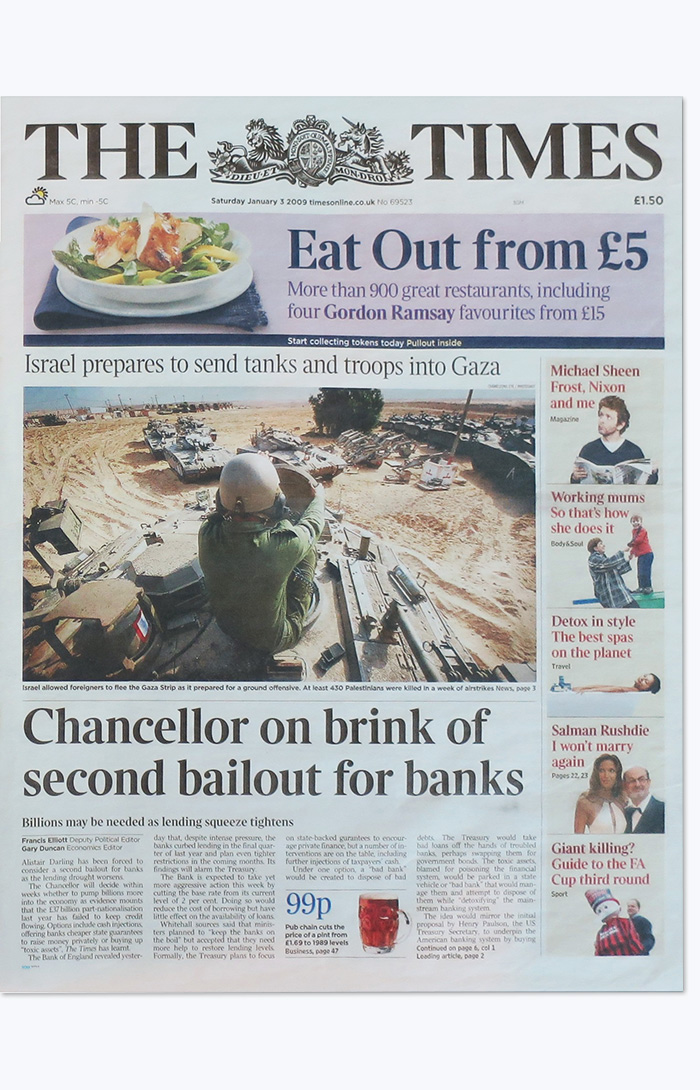
 Cover page of The Times 3 January 2009 showing the headline used in the genesis block Cover page of The Times 3 January 2009 showing the headline used in the genesis block |


The domain name bitcoin.org was registered on 18 August 2008.[16] On 31 October 2008, a link to a white paper authored by Satoshi Nakamoto titled Bitcoin: A Peer-to-Peer Electronic Cash System was posted to a cryptography mailing list.[17] Nakamoto's identity remains unknown.[4] According to computer scientist Arvind Narayanan, all individual components of bitcoin originated in earlier academic literature.[12] Nakamoto's innovation was their complex interplay resulting in the first decentralized, Sybil resistant, Byzantine fault tolerant digital cash system, that would eventually be referred to as the first blockchain.[12][18] Nakamoto's paper was not peer reviewed and was initially ignored by academics, who argued that it could not work.[12]
Nakamoto released bitcoin as open-source software.[19] On 3 January 2009, the bitcoin network was created when Nakamoto mined the starting block of the chain, known as the genesis block.[20] Embedded in this block was the text "The Times 03/Jan/2009 Chancellor on brink of second bailout for banks", which is the date and headline of an issue of The Times newspaper.[5] Nine days later, Hal Finney received the first bitcoin transaction: ten bitcoins from Nakamoto.[21] Wei Dai and Nick Szabo were also early supporters.[20] On May 22, 2010, the first known commercial transaction using bitcoin occurred when programmer Laszlo Hanyecz bought two Papa John's pizzas for ₿10,000, in what would later be celebrated as "Bitcoin Pizza Day".[22] Satoshi tasked Finnish developer and early Bitcoin contributor Martti Malmi with creating content for the bitcoin.org website.[23][24]
2010–2012: Early growth
[edit]Blockchain analysts estimate that Nakamoto had mined about one million bitcoins[25] before disappearing in 2010 when he handed the network alert key and control of the code repository over to Gavin Andresen. Andresen later became lead developer at the Bitcoin Foundation,[26][27] an organization founded in September 2012 to promote bitcoin.[28]
After early "proof-of-concept" transactions, the first major users of bitcoin were black markets, such as the dark web Silk Road. During its 30 months of existence, beginning in February 2011, Silk Road exclusively accepted bitcoins as payment, transacting ₿9.9 million, worth about $214 million.[29]: 222
2013–2014: First regulatory actions
[edit]In March 2013, the US Financial Crimes Enforcement Network (FinCEN) established regulatory guidelines for "decentralized virtual currencies" such as bitcoin, classifying American bitcoin miners who sell their generated bitcoins as money services businesses, subject to registration and other legal obligations.[30] In May 2013, US authorities seized the unregistered exchange Mt. Gox.[31] In June 2013, the US Drug Enforcement Administration seized ₿11.02 from an individual attempting to use them to purchase illicit drugs. This marked the first time a government agency had seized bitcoins.[32] The FBI seized about ₿30,000 in October 2013 from Silk Road, following the arrest of its founder Ross Ulbricht.[33]
In December 2013, the People's Bank of China prohibited Chinese financial institutions from using bitcoin.[34] After the announcement, the value of bitcoin dropped,[35] and Baidu no longer accepted bitcoins for certain services.[36] Buying real-world goods with any virtual currency had been illegal in China since at least 2009.[37]
2015–2019
[edit]Research produced by the University of Cambridge estimated that in 2017, there were 2.9 to 5.8 million unique users using a cryptocurrency wallet, most of them using bitcoin.[38] In August 2017, the SegWit software upgrade was activated. Segwit was intended to support the Lightning Network as well as improve scalability.[39] SegWit opponents, who supported larger blocks as a scalability solution, forked to create Bitcoin Cash, one of many forks of bitcoin.[40]
In December 2017, the first futures on bitcoin was introduced by the Chicago Mercantile Exchange (CME).[41]
In February 2018, the price crashed after China imposed a complete ban on bitcoin trading.[42] The percentage of bitcoin trading in the Chinese renminbi fell from over 90% in September 2017 to less than 1% in June 2018.[43] During the same year, bitcoin prices were negatively affected by several hacks or thefts from cryptocurrency exchanges.[44]
2020–present
[edit]
December 4, 2024
In 2020, some major companies and institutions started to acquire bitcoin: MicroStrategy invested $250 million in bitcoin as a treasury reserve asset,[46] Square, Inc., $50 million,[47] and MassMutual, $100 million.[48] In November 2020, PayPal added support for bitcoin in the US.[49]
In February 2021, bitcoin's market capitalization reached $1 trillion for the first time.[50] In November 2021, the Taproot soft-fork upgrade was activated, adding support for Schnorr signatures, improved functionality of smart contracts and Lightning Network.[51] Before, bitcoin only used a custom elliptic curve with the ECDSA algorithm to produce signatures.[52]: 101 In September 2021, bitcoin became legal tender currency in El Salvador, alongside the US dollar.[7] In October 2021, the first bitcoin futures exchange-traded fund (ETF), called BITO, from ProShares was approved by the SEC and listed on the CME.[53]
In early 2022, during the Canadian trucker protests opposing COVID-19 vaccine mandates, organizers turned to bitcoin to receive donations after traditional financial platforms restricted access to funding.[54][55] Proponents highlighted bitcoin's use as a tool for fundraising in situations where access to conventional financial systems may be restricted.[56][57] In May and June 2022, the bitcoin price fell following the collapses of TerraUSD, a stablecoin,[58] and the Celsius Network, a cryptocurrency loan company.[59][60]
In 2023, ordinals—non-fungible tokens (NFTs)—on bitcoin, went live.[61] As of June 2023, River Financial estimated that bitcoin had 81.7 million users, about 1% of the global population.[62]
In January 2024, the first 11 US spot bitcoin ETFs began trading, offering direct exposure to bitcoin for the first time on American stock exchanges.[63][64] In December 2024, bitcoin price reached $100,000 for the first time, as US president-elect Donald Trump promised to make the US the "crypto capital of the planet" and to stockpile bitcoin.[65] The same month, BlackRock, the world's largest asset manager, recommended investors to allocate up to 2% of their portfolio to bitcoin.[66]
In January 2025, El Salvador amended its laws to no longer regard bitcoin as a legal tender currency, and to no longer accept it as payment for taxes.[8][9] In March 2025, President Trump signed an executive order to establish a strategic bitcoin reserve.[67] Later that year, some U.S. states, such as Texas and New Hampshire also instituted strategic bitcoin reserves.[68]
Design
[edit]Units and divisibility
[edit]The unit of account of the bitcoin system is the bitcoin. It is most commonly represented with the symbol ₿[1] and the currency code BTC. However, the BTC code does not conform to ISO 4217 as BT is the country code of Bhutan,[69] and ISO 4217 requires the first letter used in global commodities to be 'X'.[69] XBT, a code that conforms to ISO 4217 though not officially part of it,[69] is used by Bloomberg L.P.[70]
No uniform capitalization convention exists; some sources use Bitcoin, capitalized, to refer to the technology and network, and bitcoin, lowercase, for the unit of account.[71] The Cambridge Advanced Learner's Dictionary and the Oxford Advanced Learner's Dictionary use the capitalized and lowercase variants without distinction.[72][73]
One bitcoin is divisible to eight decimal places.[6]: ch. 5 Units for smaller amounts of bitcoin are the millibitcoin (mBTC), equal to 1⁄1000 bitcoin, and the satoshi[a] (sat), representing 1⁄100000000 (one hundred millionth) bitcoin, the smallest amount possible.[2] 100,000 satoshis are one mBTC.[74]
Blockchain
[edit]As a decentralized system, bitcoin operates without a central authority or single administrator,[75] so that anyone can create a new bitcoin address and transact without needing any approval.[6]: ch. 1 This is accomplished through a specialized distributed ledger called a blockchain that records bitcoin transactions.[76]
The blockchain is implemented as an ordered list of blocks. Each block contains a SHA-256 hash of the previous block,[76] chaining them in chronological order.[6]: ch. 7 [76] The blockchain is maintained by a peer-to-peer network.[29]: 215–219 Individual blocks, public addresses, and transactions within blocks are public information, and can be examined using a blockchain explorer.[77]
Nodes validate and broadcast transactions, each maintaining a copy of the blockchain for ownership verification.[78] A new block is created every 10 minutes on average, updating the blockchain across all nodes without central oversight. This process tracks bitcoin spending, ensuring each bitcoin is spent only once. Unlike a traditional ledger that tracks physical currency, bitcoins exist digitally as unspent outputs of transactions.[6]: ch. 5
Addresses and transactions
[edit]
In the blockchain, bitcoins are linked to specific strings called addresses. Most often, an address encodes a hash of a single public key. Creating such an address involves generating a random private key and then computing the corresponding address. This process is almost instant, but the reverse (finding the private key for a given address) is nearly impossible.[6]: ch. 4 Publishing such a bitcoin address does not risk its private key, and it is extremely unlikely to accidentally generate a used key with funds. To use bitcoins, owners need their private key to digitally sign transactions, which are verified by the network using the public key, keeping the private key secret.[6]: ch. 5 An address may encode the hash of a bitcoin script that specifies more complex requirements to spend the funds. One common example is "multisig", in which multiple distinct private keys must mutually sign any transaction that attempts to spend the funds.[6]: ch. 7
Bitcoin transactions use a Forth-like scripting language,[6]: ch. 5 involving one or more inputs and outputs. When sending bitcoins, a user specifies the recipients' addresses and the amount for each output. This allows sending bitcoins to several recipients in a single transaction. To prevent double-spending, each input must refer to a previous unspent output in the blockchain.[79] Using multiple inputs is similar to using multiple coins in a cash transaction. As in a cash transaction, the sum of inputs can exceed the intended sum of payments. In such a case, an additional output can return the change back to the payer.[79] Unallocated input satoshis in the transaction become the transaction fee.[79]
Losing a private key means losing access to the bitcoins, with no other proof of ownership accepted by the protocol.[29] For instance, in 2013, a user lost ₿7,500, valued at US$7.5 million, by accidentally discarding a hard drive with the private key.[80] It is estimated that around 20% of all bitcoins are lost.[81] The private key must also be kept secret as its exposure, such as through a data breach, can lead to theft of the associated bitcoins.[6]: ch. 10 [82] As of December 2017[update], approximately ₿980,000 had been stolen from cryptocurrency exchanges.[83]
Mining
[edit]
Miners don't directly act as nodes, but do communicate with nodes. The mining process is primarily intended to prevent double-spending and get all nodes to agree on the content of the blockchain, but it also has desirable side-effects such as making it infeasible for adversaries to stifle valid transactions or alter the historical record of transactions, since doing so generally requires the adversary to have access to more mining power than the rest of the network combined.[6]: ch. 12
The mining process in bitcoin involves maintaining the blockchain through computer processing power. Miners group and broadcast new transactions into blocks, which are then verified by the network.[76] Each block must contain a proof of work (PoW) to be accepted,[76] involving finding a nonce number that, combined with the block content, produces a hash numerically smaller than the network's difficulty target.[6]: ch. 8 This PoW is simple to verify but hard to generate, requiring many attempts.[6]: ch. 8 PoW forms the basis of bitcoin's consensus mechanism.[84]
The difficulty of generating a block is deterministically adjusted based on the mining power on the network by changing the difficulty target, which is recalibrated every 2,016 blocks (approximately two weeks) to maintain an average time of ten minutes between new blocks. The process requires significant computational power and specialized hardware.[6]: ch. 8 [85]
Miners who successfully create a new block with a valid nonce can collect transaction fees from the included transactions and a fixed reward in bitcoins.[86] To claim this reward, a special transaction called a coinbase is included in the block, with the miner as the payee. All bitcoins in existence have been created through this type of transaction.[6]: ch. 8 This reward is halved every 210,000 blocks until ₿21 million[b] have been issued in total, which is expected to occur around the year 2140. Afterward, miners will only earn from transaction fees. These fees are determined by the transaction's size and the amount of data stored, measured in satoshis per byte.[87][79][6]: ch. 8
The proof of work system and the chaining of blocks make blockchain modifications very difficult, as altering one block requires changing all subsequent blocks. As more blocks are added, modifying older blocks becomes increasingly challenging.[88][76] In case of disagreement, nodes trust the longest chain, which required the greatest amount of effort to produce.[84] To tamper or censor the ledger, one needs to control the majority of the global hashrate.[84] The high cost required to reach this level of computational power secures the bitcoin blockchain.[84]
The environmental impact of bitcoin mining is controversial and has attracted the attention of regulators, leading to restrictions or incentives in various jurisdictions.[89] As of 2025[update], a non-peer-reviewed study by the Cambridge Centre for Alternative Finance (CCAF) estimated that bitcoin mining represented 0.5% of global electricity consumption and 0.08% of world greenhouse gas emissions, comparable to Slovakia's emissions.[90] About half of the electricity used is generated through fossil fuels.[91] Moreover, mining hardware's short lifespan results in electronic waste.[92]
Privacy and fungibility
[edit]Bitcoin is pseudonymous, with funds linked to addresses, not real-world identities. While the owners of these addresses are not directly identified, all transactions are public on the blockchain. Patterns of use, like spending coins from multiple inputs, can hint at a common owner. Public data can sometimes be matched with known address owners.[93] Bitcoin exchanges might also need to collect personal data as per legal requirements.[94] For enhanced privacy, users can generate a new address for each transaction.[95]
In the bitcoin network, each bitcoin is treated equally, ensuring basic fungibility. However, users and applications can choose to differentiate between bitcoins. While wallets and software treat all bitcoins the same, each bitcoin's transaction history is recorded on the blockchain. This public record allows for chain analysis, where users can identify and potentially reject bitcoins from controversial sources.[96] For example, in 2012, Mt. Gox froze accounts containing bitcoins identified as stolen.[97]
Wallets
[edit]


Bitcoin wallets were the first cryptocurrency wallets, enabling users to store the information necessary to transact bitcoins.[98][6]: ch. 1, glossary The first wallet program, simply named Bitcoin, and sometimes referred to as the Satoshi client, was released in 2009 by Nakamoto as open-source software.[19] Bitcoin Core is among the best known clients. Forks of Bitcoin Core exist such as Bitcoin Unlimited.[99] Wallets can be full clients, with a full copy of the blockchain to check the validity of mined blocks,[6]: ch. 1 or lightweight clients, just to send and receive transactions without a local copy of the entire blockchain.[100] Third-party internet services, called online wallets or hot wallets, store users' credentials on their servers, making them susceptible of hacks.[101] Cold storage protects bitcoins from such hacks by keeping private keys offline, either through specialized hardware wallets or paper printouts.[102][6]: ch. 4
Scalability and decentralization challenges
[edit]Nakamoto limited the block size to one megabyte.[103] The limited block size and frequency can lead to delayed processing of transactions, increased fees and a bitcoin scalability problem.[104] The Lightning Network, second-layer routing network, is a potential scaling solution.[6]: ch. 8
Research shows a trend towards centralization in bitcoin as miners join pools for stable income.[29]: 215, 219–222 [105]: 3 If a single miner or pool controls more than 50% of the hashing power, it would allow them to censor transactions and double-spend coins.[75] In 2014, mining pool Ghash.io reached 51% mining power, causing safety concerns, but later voluntarily capped its power at 39.99% for the benefit of the whole network.[106] A few entities also dominate other parts of the ecosystem such as the client software, online wallets, and simplified payment verification (SPV) clients.[75]
Economics and usage
[edit]Bitcoin's theoretical roots and ideology
[edit]According to the European Central Bank, the decentralization of money offered by bitcoin has its theoretical roots in the Austrian school of economics, especially with Friedrich Hayek's The Denationalisation of Money, in which he advocates a complete free market in the production, distribution and management of money to end the monopoly of central banks.[107]: 22 Sociologist Nigel Dodd argues that the essence of the bitcoin ideology is to remove money from social, as well as governmental, control.[108] The Economist describes bitcoin as "a techno-anarchist project to create an online version of cash, a way for people to transact without the possibility of interference from malicious governments or banks".[109] These philosophical ideas initially attracted libertarians and anarchists.[110]
Recognition as a currency and legal status
[edit]
Money serves three purposes: a store of value, a medium of exchange, and a unit of account.[111] According to The Economist in 2014, bitcoin functions best as a medium of exchange.[111] In 2015, The Economist noted that bitcoins had three qualities useful in a currency: they are "hard to earn, limited in supply and easy to verify".[112] However, a 2018 assessment by The Economist stated that cryptocurrencies met none of these three criteria.[109] Per some researchers, as of 2015[update], bitcoin functions more as a payment system than as a currency.[29] In 2014, economist Robert J. Shiller wrote that bitcoin has potential as a unit of account for measuring the relative value of goods, as with Chile's Unidad de Fomento, but that "Bitcoin in its present form... doesn't really solve any sensible economic problem".[113] In 2017, François Velde, senior economist at the Chicago Fed, described bitcoin as "unlikely by itself to replace monies in well-functioning monetary systems."[114]
The legal status of bitcoin varies substantially from one jurisdiction to another. Because of its decentralized nature and its global presence, regulating bitcoin is difficult. However, the use of bitcoin can be criminalized, and shutting down exchanges and the peer-to-peer economy in a given country would constitute a de facto ban.[115] The use of bitcoin by criminals has attracted the attention of financial regulators, legislative bodies, and law enforcement.[116] Nobel-prize winning economist Joseph Stiglitz says that bitcoin's anonymity encourages money laundering and other crimes.[117] This is the main justification behind bitcoin bans.[10] As of November 2021[update], nine countries applied an absolute ban (Algeria, Bangladesh, China, Egypt, Iraq, Morocco, Nepal, Qatar, and Tunisia) while another 42 countries had an implicit ban.[118][needs update]
Use for payments
[edit]
According to Harvard Professor Kenneth Rogoff as of 2025[update], bitcoin is rarely used in regular transactions with merchants, but is popular in the informal economy and for criminal activities.[119][120] Prices are not usually quoted in bitcoin and trades involve conversions into fiat currencies.[29] Commonly cited reasons for not using bitcoin include high costs, the inability to process chargebacks, high price volatility, long transaction times, and transaction fees (especially for small purchases).[121][122] Bloomberg reported that bitcoin was being used for large-item purchases on the site Overstock.com and for cross-border payments to freelancers.[123] As of 2015[update], there was little sign of bitcoin use in international remittances despite high fees charged by banks and Western Union.[29][124]
From September 2021 until January 2025, the Bitcoin Law made bitcoin a legal tender currency in El Salvador, alongside the US dollar.[7] The adoption had been criticized internationally and within El Salvador.[7][125] In 2022, the International Monetary Fund (IMF) urged El Salvador to reverse its decision.[126] As of 2022[update], the use of Bitcoin in El Salvador remained low: 80% of businesses refused to accept it.[127] In 2025, El Salvador's government revoked bitcoin's status as legal tender currency in order to comply with conditions set by the IMF for a loan. El Salvador still describes bitcoin as "legal tender", but its acceptance is no longer obligitory (as it is with the US dollar) and the El Salvador government no longer accepts bitcoin for payment of taxes or fees.[8][9]
In April 2022, the Central African Republic (CAR) adopted bitcoin as legal tender alongside the CFA franc,[128] but repealed the reform one year later.[129]
Bitcoin is also used by some governments. For instance, the Iranian government initially opposed cryptocurrencies, but later began using them to circumvent sanctions.[130] Since 2020, Iran has required local bitcoin miners to sell bitcoin to the Central Bank of Iran, allowing the central bank to use it for imports.[131] Some constituent states and local governments also accept tax payments in bitcoin, including Colorado in the US[132] and Zug and Lugano in Switzerland.[133][134] As of 2023, the US government owned more than $5 billion worth of seized bitcoin.[135][136]
Use for investment and status as an economic bubble
[edit]
As of 2018[update], the overwhelming majority of bitcoin transactions took place on cryptocurrency exchanges.[121] Since 2014, regulated bitcoin funds also allow exposure to the asset or to futures as an investment.[137][138] Bitcoin is used as a store of value:[139][140] individuals and companies such as the Winklevoss twins[141] and Elon Musk's companies SpaceX and Tesla have massively invested in bitcoin.[142][143] Bitcoin wealth is highly concentrated, with 0.01% holding 27% of in-circulation currency, as of 2021.[144] A 2024 survey from the Pew Research Center found that 17% of American adults have invested in, traded or used a cryptocurrency.[145]
As of September 2023[update], El Salvador had $76.5 million worth of bitcoin in its international reserves.[146]
In 2018, research published in the Journal of Monetary Economics concluded that price manipulation occurred during the Mt. Gox bitcoin theft and that the market remained vulnerable to manipulation.[147] Research published in The Journal of Finance also suggested that trading associated with increases in the amount of the Tether cryptocurrency and associated trading at the Bitfinex exchange accounted for about half of the price increase in bitcoin in late 2017.[148][149]
Bitcoin, along with other cryptocurrencies, has been described as an economic bubble by several economists, including Nobel Prize in Economics laureates, such as Joseph Stiglitz,[150] James Heckman,[151] and Paul Krugman.[152] Another recipient of the prize, Robert Shiller, argues that bitcoin is rather a fad that may become an asset class. He describes its price growth as an "epidemic", driven by contagious narratives.[153] In 2024, Jean Tirole, also Nobel laureate, described bitcoin as a "pure bubble" as its intrinsic value is zero. According to him, some bubbles are long-lasting such as gold and fiat currencies, and it's impossible to predict whether bitcoin will collapse like other financial bubbles or become the new gold.[154] The same year, Federal Reserve Chair Jerome Powell described bitcoin as a digital competitor to gold but not to the dollar as he argued it is a highly volatile speculative asset not used as a form of payment.[155] In 2025, Kenneth Rogoff claimed that Krugman was wrong and that Bitcoin had value as it is competing with the dollar to become the means of exchange of the underground economy which represents 20% of the world's GDP.[119][120]
According to research published in the International Review of Financial Analysis in 2018, bitcoin as an asset is highly volatile and does not behave like any other conventional asset.[156] According to one 2022 analysis published in The Journal of Alternative Investments, bitcoin was less volatile than oil, silver, US Treasuries, and 190 stocks in the S&P 500 during and after the 2020 stock market crash.[157] The term hodl was created in December 2013 for holding bitcoin rather than selling it during periods of volatility.[158][159]
In 2014, economist Nouriel Roubini described bitcoin as a Ponzi scheme.[160] Legal scholar Eric Posner disagrees, however, as "a real Ponzi scheme takes fraud; bitcoin, by contrast, seems more like a collective delusion".[161] A 2014 World Bank report also concluded that bitcoin was not a deliberate Ponzi scheme.[162]
Market characteristics
[edit]Bitcoin markets operate 24 hours a day, seven days a week, contrasting with traditional financial markets that have fixed trading hours. Bitcoin prices show much higher volatility and respond strongly to both regulatory changes and market events.[163]
The volume of bitcoin trading can fluctuate considerably among various exchanges and geographic regions. The daily transaction volume of bitcoin across all exchanges typically reaches $50 billion as of 2025.[164]
See also
[edit]Notes
[edit]References
[edit]- ^ a b "Unicode 10.0.0". Unicode Consortium. 20 June 2017. Archived from the original on 20 June 2017. Retrieved 20 June 2017.
- ^ a b Bradbury, Danny (November 2013). "The problem with Bitcoin". Computer Fraud & Security. 2013 (11): 5–8. doi:10.1016/S1361-3723(13)70101-5. ISSN 1361-3723. Archived from the original on 18 January 2023. Retrieved 25 November 2023.
- ^ "Bitcoin Core 30.0". 11 October 2025. Retrieved 11 October 2025.
- ^ a b S., L. (2 November 2015). "Who is Satoshi Nakamoto?". The Economist. Archived from the original on 22 November 2020. Retrieved 21 November 2023.
- ^ a b Davis, Joshua (10 October 2011). "The Crypto-Currency: Bitcoin and its mysterious inventor". The New Yorker. Archived from the original on 1 November 2014. Retrieved 31 October 2014.
- ^ a b c d e f g h i j k l m n o p q r s t u v w Antonopoulos, Andreas M. (2014). Mastering Bitcoin: Unlocking Digital Crypto-Currencies. O'Reilly Media. ISBN 978-1-4493-7404-4.
- ^ a b c d "El Salvador's dangerous gamble on bitcoin". The editorial board. Financial Times. 7 September 2021. Archived from the original on 7 September 2021. Retrieved 7 September 2021.
- ^ a b c "El Salvador Abandons Bitcoin as Legal Tender After Failed Experiment". The Tico Times. AFP. 2 February 2025. Retrieved 10 October 2025.
- ^ a b c "Bitcoin is no longer legal tender in El Salvador". Dig.watch. DiploFoundation. 7 February 2025. Retrieved 10 October 2025.
- ^ a b Sun Yin, Hao Hua; Langenheldt, Klaus; Harlev, Mikkel; Mukkamala, Raghava Rao; Vatrapu, Ravi (2 January 2019). "Regulating Cryptocurrencies: A Supervised Machine Learning Approach to De-Anonymizing the Bitcoin Blockchain". Journal of Management Information Systems. 36 (1): 65. doi:10.1080/07421222.2018.1550550. ISSN 0742-1222. S2CID 132398387. Archived from the original on 21 April 2024. Retrieved 29 November 2023.
- ^ Huang, Jon; O’Neill, Claire; Tabuchi, Hiroko (3 September 2021). "Bitcoin Uses More Electricity Than Many Countries. How Is That Possible?". The New York Times. ISSN 0362-4331. Archived from the original on 17 February 2023. Retrieved 26 October 2022.
- ^ a b c d e f g h Narayanan, Arvind; Clark, Jeremy (27 November 2017). "Bitcoin's academic pedigree". Communications of the ACM. 60 (12): 36–45. doi:10.1145/3132259. ISSN 0001-0782. S2CID 6425116. Archived from the original on 14 October 2023. Retrieved 22 November 2023.
- ^ Dwork, Cynthia; Naor, Moni (1993), Brickell, Ernest F. (ed.), "Pricing via Processing or Combatting Junk Mail", Advances in Cryptology — CRYPTO’ 92, vol. 740, Berlin, Heidelberg: Springer Berlin Heidelberg, pp. 139–147, doi:10.1007/3-540-48071-4_10, ISBN 978-3-540-57340-1, retrieved 2 January 2025
- ^ Tschorsch, Florian; Scheuermann, Bjorn (2 March 2016). "Bitcoin and Beyond: A Technical Survey on Decentralized Digital Currencies". IEEE Communications Surveys & Tutorials. 18 (3): 2084–2123. doi:10.1109/COMST.2016.2535718. ISSN 1553-877X. S2CID 5115101.
- ^ Judmayer, Aljosha; Stifter, Nicholas; Krombholz, Katharina; Weippl, Edgar (2017). "History of Cryptographic Currencies". Blocks and Chains. Synthesis Lectures on Information Security, Privacy, and Trust. Springer. pp. 15–18. doi:10.1007/978-3-031-02352-1_3. ISBN 978-3-031-01224-2. Archived from the original on 22 November 2023. Retrieved 22 November 2023.
- ^ Bernard, Zoë (2 December 2017). "Everything you need to know about Bitcoin, its mysterious origins, and the many alleged identities of its creator". Business Insider. Archived from the original on 15 June 2018. Retrieved 15 June 2018.
- ^ Finley, Klint (31 October 2018). "After 10 Years, Bitcoin Has Changed Everything—And Nothing". Wired. Archived from the original on 5 November 2018. Retrieved 9 November 2018.
- ^ Economist Staff (31 October 2015). "Blockchains: The great chain of being sure about things". The Economist. Archived from the original on 3 July 2016. Retrieved 18 June 2016.
- ^ a b Humayun, Mariam; Belk, Russell W. (1 January 2018), N. N. Cross, Samantha; Ruvalcaba, Cecilia; Venkatesh, Alladi; W. Belk, Russell (eds.), ""Satoshi is Dead. Long Live Satoshi": The Curious Case of Bitcoin's Creator", Consumer Culture Theory, Research in Consumer Behavior, vol. 19, Emerald Publishing Limited, pp. 19–35, doi:10.1108/s0885-211120180000019002, ISBN 978-1-78743-907-8, retrieved 20 May 2025
- ^ a b Wallace, Benjamin (23 November 2011). "The Rise and Fall of Bitcoin". Wired. Archived from the original on 31 October 2013. Retrieved 13 October 2012.
- ^ Popper, Nathaniel (30 August 2014). "Hal Finney, Cryptographer and Bitcoin Pioneer, Dies at 58". The New York Times. Archived from the original on 3 September 2014. Retrieved 2 September 2014.
- ^ Cooper, Anderson (16 May 2019). "Meet the man who spent millions worth of bitcoin on pizza". CBS News. Archived from the original on 8 December 2021. Retrieved 8 December 2021.
- ^ Khalili, Joel (23 February 2024). "Bitcoin Royalty Descends on the Satoshi Nakamoto Trial". Wired. Retrieved 25 August 2025.
{{cite magazine}}: CS1 maint: url-status (link) - ^ Frisby, Dominic (2014). Bitcoin: The Future of Money?. Unbound. ISBN 9781783520763.
- ^ McMillan, Robert. "Who Owns the World's Biggest Bitcoin Wallet? The FBI". Wired. Archived from the original on 21 October 2016. Retrieved 7 October 2016.
- ^ Simonite, Tom (15 August 2014). "Meet Gavin Andresen, the most powerful person in the world of Bitcoin". MIT Technology Review. Archived from the original on 22 November 2023. Retrieved 22 November 2023.
- ^ Odell, Matt (21 September 2015). "A Solution To Bitcoin's Governance Problem". TechCrunch. Archived from the original on 26 January 2016. Retrieved 24 January 2016.
- ^ Bustillos, Maria (1 April 2013). "The Bitcoin Boom". The New Yorker. Archived from the original on 2 July 2018. Retrieved 30 July 2018.
- ^ a b c d e f g Rainer Böhme; Nicolas Christin; Benjamin Edelman; Tyler Moore (2015). "Bitcoin: Economics, Technology, and Governance". Journal of Economic Perspectives. 29 (2): 213–238. doi:10.1257/jep.29.2.213. ISSN 0895-3309.
- ^ Lee, Timothy B. (19 March 2013). "US regulator Bitcoin Exchanges Must Comply With Money Laundering Laws". Ars Technica. Archived from the original on 21 October 2013. Retrieved 28 July 2017.
- ^ Dillet, Romain. "Feds Seize Assets From Mt. Gox's Dwolla Account, Accuse It Of Violating Money Transfer Regulations". TechCrunch. Archived from the original on 9 October 2013. Retrieved 15 May 2013.
- ^ Sampson, Tim (2013). "U.S. government makes its first-ever Bitcoin seizure". The Daily Dot. Archived from the original on 12 July 2013. Retrieved 15 October 2013.
- ^ Hill, Kashmir. "The FBI's Plan For The Millions Worth Of Bitcoins Seized From Silk Road". Forbes. Archived from the original on 2 May 2014.
- ^ Kelion, Leo (18 December 2013). "Bitcoin sinks after China restricts yuan exchanges". BBC News. Archived from the original on 19 December 2013. Retrieved 20 December 2013.
- ^ "China bans banks from bitcoin transactions". The Sydney Morning Herald. Reuters. 6 December 2013. Archived from the original on 23 March 2014. Retrieved 31 October 2014.
- ^ "Baidu Stops Accepting Bitcoins After China Ban". Bloomberg. New York. 7 December 2013. Archived from the original on 10 December 2013. Retrieved 11 December 2013.
- ^ "China bars use of virtual money for trading in real goods". English.mofcom.gov.cn. 29 June 2009. Archived from the original on 29 November 2013. Retrieved 10 January 2014.
- ^ Hileman, Garrick; Rauchs, Michel. "Global Cryptocurrency Benchmarking Study" (PDF). Cambridge University. Archived (PDF) from the original on 10 April 2017. Retrieved 14 April 2017.
- ^ Vigna, Paul (21 July 2017). "Bitcoin Rallies Sharply After Vote Resolves Bitter Scaling Debate". The Wall Street Journal. Archived from the original on 21 November 2023. Retrieved 21 November 2023.
- ^ Selena Larson (1 August 2017). "Bitcoin split in two, here's what that means". CNN Tech. Cable News Network. Archived from the original on 27 February 2018. Retrieved 2 April 2018.
- ^ Cheng, Evelyn (17 December 2017). "Bitcoin debuts on the world's largest futures exchange, and prices fall slightly". CNBC. Archived from the original on 18 January 2024. Retrieved 19 January 2024.
- ^ French, Sally (9 February 2017). "Here's proof that this bitcoin crash is far from the worst the cryptocurrency has seen". Market Watch. Archived from the original on 3 July 2018. Retrieved 3 July 2018.
- ^ "RMB Bitcoin trading falls below 1 pct of world total". Xinhuanet. Xinhua. 7 July 2018. Archived from the original on 10 July 2018. Retrieved 10 July 2018.
- ^ Chavez-Dreyfuss, Gertrude (3 July 2018). "Cryptocurrency exchange theft surges in first half of 2018: report". Reuters. Archived from the original on 4 July 2018. Retrieved 10 July 2018.
- ^ "Coinbase Bitcoin". Coinbase. Federal Reserve Economic Data. 4 December 2024. Retrieved 4 December 2024.
- ^ Cuthbertson, Anthony (13 September 2021). "MicroStrategy buys another $250m worth of bitcoin in hope of 100X price growth". The Independent. Archived from the original on 22 November 2023. Retrieved 22 November 2023.
- ^ Oliver Effron. "Square just bought $50 million in bitcoin". CNN. Archived from the original on 24 October 2020. Retrieved 22 October 2020.
- ^ Olga Kharif (11 December 2020). "169-Year-Old MassMutual Invests $100 Million in Bitcoin". Bloomberg. Archived from the original on 19 December 2020. Retrieved 26 December 2020.
- ^ "PayPal says all users in US can now buy, hold and sell cryptocurrencies". Techcrunch. 13 November 2020. Archived from the original on 24 November 2020. Retrieved 26 November 2020.
- ^ Chavez-Dreyfuss, Gertrude; Wilson, Tom (19 February 2021). "Bitcoin hits $1 trillion market cap, surges to fresh all-time peak". Reuters. Retrieved 24 November 2023.
- ^ Sigalos, MacKenzie (14 November 2021). "Bitcoin's biggest upgrade in four years just happened – here's what changes". CNBC. Archived from the original on 14 November 2021. Retrieved 15 November 2021.
- ^ Van Hijfte, Stijn (2020). Blockchain Platforms: A Look at the Underbelly of Distributed Platforms. Morgan & Claypool Publishers. ISBN 978-1681738925.
- ^ Wursthorn, Michael (19 October 2021). "A Bitcoin ETF Is Here. What Does That Mean for Investors?". The Wall Street Journal. Archived from the original on 10 January 2024. Retrieved 11 January 2024.
- ^ Loh, Matthew. "Canada says it will freeze the bank accounts of 'Freedom Convoy' truckers who continue their anti-vaccine mandate blockades". Business Insider. Retrieved 19 January 2025.
- ^ "Crypto enthusiasts keep funding convoy protests as traditional banks take action against it – The Globe and Mail". The Globe and Mail. 8 December 2024. Archived from the original on 8 December 2024. Retrieved 19 January 2025.
- ^ "Meet Greg Foss: A Former Bitcoin Fundraiser For Canada's 'Freedom Convoy' Protest". Forbes. 20 June 2024. Archived from the original on 20 June 2024. Retrieved 19 January 2025.
- ^ "Elon Musk–backed 'freedom truckers' in Canada get Bitcoin lifeline after GoFundMe freezes millions in donations". Yahoo! Finance. 13 March 2022. Archived from the original on 13 March 2022. Retrieved 19 January 2025.
- ^ Browne, Ryan (10 May 2022). "Bitcoin investors are panicking as a controversial crypto experiment unravels". CNBC. Archived from the original on 11 May 2022. Retrieved 11 May 2022.
- ^ Milmo, Dan (18 June 2022). "Bitcoin value slumps below $20,000 in cryptocurrencies turmoil". The Guardian. Archived from the original on 18 June 2022. Retrieved 19 June 2022.
- ^ Yaffe-Bellany, David (13 June 2022). "Celsius Network Leads Crypto Markets Into Another Free Fall". The New York Times. Archived from the original on 14 June 2022. Retrieved 14 June 2022.
- ^ Behrendt, Philipp (2023). "Taxation of the New Age: New Guidance for the World of Digital Assets". Journal of Tax Practice & Procedure. 25: 47. Archived from the original on 21 November 2023. Retrieved 21 November 2023.
- ^ "As banks buy up bitcoins, who else are the 'Bitcoin whales'?". BBC Home. 1 March 2024. Retrieved 14 March 2024.
- ^ Schmitt, Will (12 January 2024). "Bitcoin trading volumes surge after debut of long-awaited US ETFs". Financial Times. Archived from the original on 12 January 2024. Retrieved 12 January 2024.
- ^ Lang, Hannah (11 January 2024). "US bitcoin ETFs see $4.6B in volume in first day of trading". Reuters. Retrieved 12 January 2024.
- ^ "Bitcoin storms above $100,000 as Trump 2.0 fuels crypto euphoria". Reuters. 5 December 2024.
- ^ McGee, Suzanne (12 December 2024). "BlackRock recommends bitcoin portfolio weighting of up to 2% for interested investors". Reuters.
- ^ Bose, Nandita; Ward, Jasper (7 March 2025). "Trump signs order to establish strategic bitcoin reserve". Reuters. Washington. Retrieved 10 March 2025.
- ^ "Texas Gov. Abbott Signs Bill to Create State Bitcoin Reserve". 22 June 2025. Archived from the original on 24 June 2025. Retrieved 6 July 2025.
- ^ a b c Alexander, Carol; Imeraj, Arben (2019). "Introducing the BITIX: The Bitcoin Fear Gauge". SSRN Electronic Journal. doi:10.2139/ssrn.3383734. ISSN 1556-5068.
XBT satisfies the norm 'ISO 4217' by the International Organisation for Standardisation (ISO) as BTC goes against the name of Bhutan's currency. In general, transaction instruments that are not national currencies, like gold or silver, begin with an X. However, the symbol XBT is not officially recognised by ISO.
- ^ Romain Dillet (9 August 2013). "Bitcoin Ticker Available On Bloomberg Terminal For Employees". TechCrunch. Archived from the original on 1 November 2014. Retrieved 2 November 2014.
- ^ Bustillos, Maria (2 April 2013). "The Bitcoin Boom". The New Yorker. Archived from the original on 27 July 2014. Retrieved 22 December 2013.
- ^ Bitcoin, Oxford Advanced Learner's Dictionary
- ^ bitcoin Archived 3 May 2022 at the Wayback Machine, Cambridge Advanced Learner's Dictionary
- ^ Katie Pisa; Natasha Maguder (9 July 2014). "Bitcoin your way to a double espresso". CNN. Archived from the original on 18 June 2015. Retrieved 23 April 2015.
- ^ a b c Gervais, Arthur; Karame, Ghassan O.; Capkun, Vedran; Capkun, Srdjan (May 2014). "Is Bitcoin a Decentralized Currency?". IEEE Security & Privacy. 12 (3): 54–60. Bibcode:2014ISPri..12c..54G. doi:10.1109/MSP.2014.49. ISSN 1540-7993. S2CID 13948781.
- ^ a b c d e f "The great chain of being sure about things". The Economist. 31 October 2015. Archived from the original on 4 December 2023. Retrieved 22 November 2023.
- ^ "Blockchain Networks: Token Design and Management Overview" (PDF). National Institute of Standards Technology (NIST). p. 32. Archived (PDF) from the original on 24 December 2022. Retrieved 29 December 2022.
- ^ Sparkes, Matthew (9 June 2014). "The coming digital anarchy". The Daily Telegraph. Archived from the original on 23 January 2015. Retrieved 7 January 2015.
- ^ a b c d e Kroll, Joshua A.; Davey, Ian C.; Felten, E. (11–12 June 2013). The Economics of Bitcoin Mining, or Bitcoin in the Presence of Adversaries. The Twelfth Workshop on the Economics of Information Security (WEIS 2013). Washington, DC. S2CID 2794725.
- ^ "Man Throws Away 7,500 Bitcoins, Now Worth $7.5 Million". CBS DC. 29 November 2013. Archived from the original on 15 January 2014. Retrieved 23 January 2014.
- ^ Krause, Elliott (5 July 2018). "A Fifth of All Bitcoin Is Missing. These Crypto Hunters Can Help". The Wall Street Journal. Archived from the original on 9 July 2018. Retrieved 8 July 2018.
- ^ Jeffries, Adrianne (19 December 2013). "How to steal Bitcoin in three easy steps". The Verge. Archived from the original on 27 July 2019. Retrieved 17 January 2014.
- ^ Harney, Alexandra; Stecklow, Steve (16 November 2017). "Twice burned – How Mt. Gox's bitcoin customers could lose again". Reuters. Archived from the original on 29 August 2019. Retrieved 6 September 2018.
- ^ a b c d Mingxiao, Du; Xiaofeng, Ma; Zhe, Zhang; Xiangwei, Wang; Qijun, Chen (5–8 October 2017). A review on consensus algorithm of blockchain. 2017 IEEE International Conference on Systems, Man, and Cybernetics (SMC). Banff, AB, Canada: IEEE. pp. 2567–2572. doi:10.1109/SMC.2017.8123011. ISBN 978-1-5386-1645-1.
- ^ "Bitcoin boom benefiting TSMC: report". Taipei Times. 4 January 2014. Archived from the original on 29 January 2023. Retrieved 22 October 2021.
- ^ Ashlee, Vance (14 November 2013). "2014 Outlook: Bitcoin Mining Chips, a High-Tech Arms Race". BusinessWeek. Archived from the original on 21 November 2013. Retrieved 24 November 2013.
- ^ King, Ritchie S.; Williams, Sam; Yanofsky, David (17 December 2013). "By reading this article, you're mining bitcoins". Quartz. Archived from the original on 17 December 2013. Retrieved 17 December 2013.
- ^ Hampton, Nikolai (5 September 2016). "Understanding the blockchain hype: Why much of it is nothing more than snake oil and spin". Computerworld. Archived from the original on 6 September 2016. Retrieved 5 September 2016.
- ^ Stoll, Christian; Klaaßen, Lena; Gallersdörfer, Ulrich; Neumüller, Alexander (June 2023). Climate Impacts of Bitcoin Mining in the U.S. (Report). Working Paper Series. MIT Center for Energy and Environmental Policy Research. Archived from the original on 18 November 2023. Retrieved 24 November 2023.
- ^ "Cambridge Digital Mining Industry Report: Global Operations, Sentiment, and Energy Use – CCAF publications". Cambridge Judge Business School. Retrieved 29 April 2025.
- ^ Huang, Jon; O'Neill, Claire; Tabuchi, Hiroko (3 September 2021). "Bitcoin Uses More Electricity Than Many Countries. How Is That Possible?". The New York Times. ISSN 0362-4331. Archived from the original on 17 February 2023. Retrieved 16 January 2022.
- ^ de Vries, Alex; Stoll, Christian (December 2021). "Bitcoin's growing e-waste problem". Resources, Conservation and Recycling. 175 105901. Bibcode:2021RCR...17505901D. doi:10.1016/j.resconrec.2021.105901. ISSN 0921-3449. S2CID 240585651. Archived from the original on 23 November 2021. Retrieved 24 November 2023.
- ^ Simonite, Tom (5 September 2013). "Mapping the Bitcoin Economy Could Reveal Users' Identities". MIT Technology Review. Archived from the original on 27 September 2020. Retrieved 2 April 2014.
- ^ Lee, Timothy (21 August 2013). "Five surprising facts about Bitcoin". The Washington Post. Archived from the original on 9 July 2022. Retrieved 21 November 2023.
- ^ McMillan, Robert (6 June 2013). "How Bitcoin lets you spy on careless companies". Wired UK. Archived from the original on 9 February 2014. Retrieved 3 April 2020.
- ^ Anderson, Ross; Shumailov, Ilia; Ahmed, Mansoor (24 November 2018). "Making Bitcoin Legal". In Matyáš, Vashek; Švenda, Petr; Stajano, Frank; Christianson, Bruce (eds.). Security Protocols XXVI. Lecture Notes in Computer Science. Vol. 11286. Springer. pp. 243–253. doi:10.1007/978-3-030-03251-7_29. ISBN 978-3-030-03250-0. Archived from the original on 24 November 2023. Retrieved 24 November 2023.
- ^ Möser, Malte; Böhme, Rainer; Breuker, Dominic (2013). An Inquiry into Money Laundering Tools in the Bitcoin Ecosystem (PDF). 2013 APWG eCrime Researchers Summit. IEEE. ISBN 978-1-4799-1158-5. Archived (PDF) from the original on 26 June 2018. Retrieved 19 June 2019.
- ^ Serwer, Adam; Liebelson, Dana (10 April 2013). "Bitcoin, Explained". Mother Jones. Archived from the original on 27 April 2014. Retrieved 26 April 2014.
- ^ Vigna, Paul (17 January 2016). "Is Bitcoin Breaking Up?". The Wall Street Journal. Archived from the original on 20 August 2016. Retrieved 8 November 2016.
- ^ Gervais, Arthur; Capkun, Srdjan; Karame, Ghassan O.; Gruber, Damian (8 December 2014). "On the privacy provisions of Bloom filters in lightweight bitcoin clients". Proceedings of the 30th Annual Computer Security Applications Conference. ACSAC '14. New York, NY, USA: Association for Computing Machinery. pp. 326–335. doi:10.1145/2664243.2664267. ISBN 978-1-4503-3005-3. S2CID 9161497. Archived from the original on 21 April 2024. Retrieved 22 November 2023.
- ^ Barhydt, Bill (4 June 2014). "3 reasons Wall Street can't stay away from bitcoin". CNBC. Archived from the original on 4 December 2023. Retrieved 22 November 2023.
- ^ Roberts, Daniel (15 December 2017). "How to send bitcoin to a hardware wallet". Yahoo Finance. Archived from the original on 17 February 2018. Retrieved 17 February 2018.
- ^ Mike Orcutt (19 May 2015). "Leaderless Bitcoin Struggles to Make Its Most Crucial Decision". MIT Technology Review. Archived from the original on 18 October 2017. Retrieved 15 November 2016.
- ^ Orcutt, Mike (19 May 2015). "Leaderless Bitcoin Struggles to Make Its Most Crucial Decision". MIT Technology Review. Archived from the original on 18 October 2017. Retrieved 22 June 2017.
- ^ Tschorsch, Florian; Scheuermann, Björn (2016). "Bitcoin and Beyond: A Technical Survey on Decentralized Digital Currencies". IEEE Communications Surveys and Tutorials. 18 (3): 2084–2123. doi:10.1109/comst.2016.2535718. S2CID 5115101.
- ^ Wilhelm, Alex. "Popular Bitcoin Mining Pool Promises To Restrict Its Compute Power To Prevent Feared '51%' Fiasco". TechCrunch. Archived from the original on 5 December 2017. Retrieved 25 January 2018.
- ^ European Central Bank (2012). Virtual Currency Schemes (PDF). European Central Bank. doi:10.2866/47380. ISBN 978-92-899-0862-7. OCLC 1044382974. Archived (PDF) from the original on 6 November 2012.
- ^ Dodd, Nigel (May 2018). "The Social Life of Bitcoin" (PDF). Theory, Culture & Society. 35 (3): 35–56. doi:10.1177/0263276417746464. ISSN 0263-2764. S2CID 51914607. Archived (PDF) from the original on 22 November 2023. Retrieved 22 November 2023.
- ^ a b "Bitcoin and other cryptocurrencies are useless". The Economist. 30 August 2018. Archived from the original on 4 September 2018. Retrieved 4 September 2018.
- ^ Feuer, Alan (14 December 2013). "The Bitcoin Ideology". The New York Times. Archived from the original on 1 July 2018. Retrieved 1 July 2018.
- ^ a b "Free Exchange. Money from nothing. Chronic deflation may keep Bitcoin from displacing its rivals". The Economist. 15 March 2014. Archived from the original on 25 March 2014. Retrieved 25 March 2014.
- ^ "The magic of mining". The Economist. 13 January 2015. Archived from the original on 12 January 2015. Retrieved 13 January 2015.
- ^ Shiller, Robert (1 March 2014). "In Search of a Stable Electronic Currency". The New York Times. Archived from the original on 24 October 2014.
- ^ Velde, François R. (August 2017). Technological Change and the Future of Cash (Report). SUERF Policy Note. SUERF – The European Money and Finance Forum. Retrieved 21 October 2025.
- ^ Weindling, Jacob (18 September 2017). "China May Be Gearing Up to Ban Bitcoin". Paste. Archived from the original on 22 November 2023. Retrieved 22 November 2023.
- ^ Lavin, Tim (8 August 2013). "The SEC Shows Why Bitcoin Is Doomed". Bloomberg News. Archived from the original on 25 March 2014. Retrieved 20 October 2013.
- ^ Montag, Ali (9 July 2018). "Nobel-winning economist: Authorities will bring down 'hammer' on bitcoin". CNBC. Archived from the original on 11 July 2018. Retrieved 11 July 2018.
- ^ "Regulation of Cryptocurrency Around the World: November 2021 Update" (PDF). United States Library of Congress. Archived (PDF) from the original on 24 December 2021. Retrieved 28 December 2022.
- ^ a b "This time really is different for the dollar, writes Kenneth Rogoff". The Economist. ISSN 0013-0613. Retrieved 25 May 2025.
- ^ a b Ken Rogoff on How Crypto Is Cutting Into the Dollar’s Hegemony, Vildana Hajric, Bloomberg, May 24, 2025
- ^ a b Murphy, Hannah (8 June 2018). "Who really owns bitcoin now?". Financial Times. Archived from the original on 10 June 2018. Retrieved 10 June 2018.
- ^ Katz, Lily (12 July 2017). "Bitcoin Acceptance Among Retailers Is Low and Getting Lower". Bloomberg News. Archived from the original on 25 January 2018. Retrieved 25 January 2018.
- ^ Kharif, Olga (1 August 2018). "Bitcoin's Use in Commerce Keeps Falling Even as Volatility Eases". Bloomberg News. Archived from the original on 2 August 2018. Retrieved 2 August 2018.
- ^ Chan, Bernice (16 January 2015). "Bitcoin transactions cut the cost of international money transfers". South China Morning Post. Archived from the original on 31 May 2019. Retrieved 31 May 2019.
- ^ "Majority of Salvadorans do not want bitcoin, poll shows". Reuters. 2 September 2021. Archived from the original on 30 November 2021. Retrieved 30 November 2021.
- ^ "IMF urges El Salvador to remove Bitcoin as legal tender". BBC News. 26 January 2022. Archived from the original on 26 January 2022. Retrieved 26 January 2022.
- ^ Alvarez, Fernando; Argente, David; Van Patten, Diana (2022). Are Cryptocurrencies Currencies? Bitcoin as Legal Tender in El Salvador (Report). Cambridge, MA: National Bureau of Economic Research. doi:10.3386/w29968.
- ^ "Bitcoin Declared Legal Currency in Central African Republic". Bloomberg. 28 April 2022. Archived from the original on 28 April 2022. Retrieved 28 April 2022.
- ^ "Frequently Asked Questions on Central African Republic". International Monetary Fund. Archived from the original on 11 August 2023. Retrieved 11 August 2023.
- ^ Rasool, Mohammed (3 November 2020). "Iran Is Pivoting to Bitcoin". Vice. Archived from the original on 3 November 2020. Retrieved 10 November 2020.
- ^ "Iran: New Crypto Law Requires Selling Bitcoin Directly to Central Bank to Fund Imports". Asharq Al-Awsat. 31 October 2020. Archived from the original on 31 October 2020. Retrieved 31 October 2020.
- ^ Kohler, Judith (21 September 2022). "Colorado accepts cryptocurrency to pay taxes, moving the state "tech forward"". The Denver Post. Archived from the original on 29 December 2022. Retrieved 29 December 2022.
- ^ "'Crypto Valley' canton to accept Bitcoin for tax payments". SWI swissinfo. 3 September 2020. Archived from the original on 22 November 2023. Retrieved 22 November 2023.
- ^ swissinfo.ch, S. W. I. (5 December 2023). "Lugano accepts bitcoin and tether payments for all city invoices". SWI swissinfo.ch. Retrieved 21 October 2025.
- ^ Huang, Vicky Ge (15 October 2023). "Why the U.S. Government Has $5 Billion in Bitcoin". The Wall Street Journal. Archived from the original on 20 February 2024. Retrieved 20 February 2024.
- ^ Castillo, Michael del (16 June 2023). "U.S. Government Owns Way More Bitcoin Than Any Other Country–So Why Aren't They Selling It?". Forbes. Archived from the original on 21 February 2024. Retrieved 21 February 2024.
- ^ "Jersey approve Bitcoin fund launch on island". BBC News. 10 July 2014. Archived from the original on 10 July 2014. Retrieved 10 July 2014.
- ^ "Chicago Mercantile Exchange jumps into bitcoin futures". CBS News. 18 December 2017. Archived from the original on 31 May 2019. Retrieved 31 May 2019.
- ^ "Gold or Bitcoin? Store-of-value debate rages as Bitcoin grows". Bloomberg Professional Services. 25 October 2021. Retrieved 2 October 2024.
- ^ "Goldman Sachs says bitcoin will compete with gold as "store of value"". Reuters. 5 January 2022.
- ^ Lee, Timothy B. "The $11 million in bitcoins the Winklevoss brothers bought is now worth $32 million". The Washington Post. Archived from the original on 6 July 2017. Retrieved 11 August 2017.
- ^ Maidenberg, Micah; Driebusch, Corrie; Jin, Berber (17 August 2023). "A Rare Look Into the Finances of Elon Musk's Secretive SpaceX". The Wall Street Journal. Archived from the original on 17 August 2023. Retrieved 19 November 2023.
- ^ Ostroff, Caitlin; Elliott, Rebecca (8 February 2021). "Tesla Buys $1.5 Billion in Bitcoin". The Wall Street Journal. ISSN 0099-9660. Archived from the original on 6 January 2024. Retrieved 22 November 2023.
- ^ Vigna, Paul (20 December 2021). "Bitcoin's 'One Percent' Controls Lion's Share of the Cryptocurrency's Wealth". Wall Street Journal. ISSN 0099-9660. Archived from the original on 22 December 2021. Retrieved 22 December 2021.
- ^ Faverio, Michelle; Dawson, Wyatt; Sidoti, Olivia (24 October 2024). "Majority of Americans aren't confident in the safety and reliability of cryptocurrency". Pew Research Center. Retrieved 8 March 2025.
- ^ Cota, Isabella (2 September 2023). "Two years of bitcoin in Bukele's El Salvador: An opaque experiment with a little-used currency". El País. Archived from the original on 24 November 2023. Retrieved 24 November 2023.
- ^ Gandal, Neil; Hamrick, J.T.; Moore, Tyler; Oberman, Tali (May 2018). "Price manipulation in the Bitcoin ecosystem". Journal of Monetary Economics. 95: 86–96. doi:10.1016/j.jmoneco.2017.12.004. S2CID 26358036.
- ^ Griffin, John M.; Shams, Amin (August 2020). "Is Bitcoin Really Untethered?". The Journal of Finance. 75 (4): 1913–1964. doi:10.1111/jofi.12903. ISSN 0022-1082. S2CID 229576274.
- ^ Popper, Nathaniel (13 June 2018). "Bitcoin's Price Was Artificially Inflated Last Year, Researchers Say". The New York Times. Archived from the original on 13 June 2018. Retrieved 13 June 2018.
- ^ Costelloe, Kevin (29 November 2017). "Bitcoin 'Ought to Be Outlawed,' Nobel Prize Winner Stiglitz Says". Bloomberg News. Archived from the original on 12 June 2018. Retrieved 5 June 2018.
It doesn't serve any socially useful function.
- ^ Wolff-Mann, Ethan (27 April 2018). "'Only good for drug dealers': More Nobel prize winners snub bitcoin". Yahoo Finance. Archived from the original on 12 June 2018. Retrieved 7 June 2018.
- ^ Mohamed, Theron (30 May 2023). "Nobel economist Paul Krugman slams crypto as mostly useless, after saying it's hugely overpriced and helps criminals". Business Insider. Archived from the original on 23 November 2023. Retrieved 23 November 2023.
- ^ Authers, John (9 June 2021). "Don't Call Bitcoin a Bubble. It's an Epidemic". Bloomberg.com. Archived from the original on 10 June 2021.
- ^ Tirole, Jean (1 February 2024). "Cryptocurrencies: an economist's view". La Jaune et la Rouge. Vol. February 2024, no. 792. Retrieved 15 November 2024.
- ^ "Bitcoin breaks $100,000 barrier amid post-election cryptocurrency surge". Washington Post. Retrieved 5 December 2024.
"People use bitcoin as a speculative asset. It's like gold, it's just like gold, only it's virtual, it's digital. People are not using it as a form of payment or a store of value," he said. "It's highly volatile. It's not a competitor for the dollar; it's really a competitor for gold."
- ^ Klein, Tony; Pham Thu, Hien; Walther, Thomas (October 2018). "Bitcoin is not the New Gold – A comparison of volatility, correlation, and portfolio performance" (PDF). International Review of Financial Analysis. 59: 105–116. doi:10.1016/j.irfa.2018.07.010. S2CID 158400153. Archived (PDF) from the original on 25 November 2023. Retrieved 24 November 2023.
- ^ Mazur, Mieszko (31 March 2022). "Misperceptions of Bitcoin Volatility". The Journal of Alternative Investments. 24 (4): 33–44. doi:10.3905/jai.2022.1.153. ISSN 1520-3255. S2CID 247843794.
- ^ Montag, Ali (26 August 2018). "'HODL,' 'whale' and 5 other cryptocurrency slang terms explained". CNBC. Archived from the original on 12 January 2022. Retrieved 16 March 2021.
- ^ Hajric, Vildana (19 November 2020). "All the Bitcoin Lingo You Need to Know as Crypto Heats Up". Bloomberg. Archived from the original on 29 November 2020. Retrieved 1 December 2020.
- ^ Clinch, Matt (10 March 2014). "Roubini launches stinging attack on bitcoin". CNBC. Archived from the original on 9 July 2022. Retrieved 22 November 2023.
- ^ Posner, Eric (11 April 2013). "Fool's Gold". Slate. ISSN 1091-2339. Archived from the original on 8 July 2022. Retrieved 22 November 2023.
- ^ Davradakis, Emmanouil; Santos, Ricardo (2019). Blockchain, FinTechs and their relevance for international financial institutions. European Investment Bank. doi:10.2867/11329. ISBN 978-92-861-4184-3. Archived from the original on 21 April 2024. Retrieved 24 November 2023.
- ^ Feng, Wenjun; Wang, Yiming; Zhang, Zhengjun (1 September 2018). "Informed trading in the Bitcoin market". Finance Research Letters. 26: 63–70. doi:10.1016/j.frl.2017.11.009. ISSN 1544-6123.
- ^ "Bitcoin set to break records and shatter the $100K barrier". The Economic Times. 8 May 2025. ISSN 0013-0389. Retrieved 20 May 2025.
Further reading
[edit]- Nakamoto, Satoshi (31 October 2008). "Bitcoin: A Peer-to-Peer Electronic Cash System" (PDF). bitcoin.org. Archived from the original (PDF) on 20 March 2014. Retrieved 28 April 2014.

| People |
| | |||
|---|---|---|---|---|---|
| Lists | |||||
| Technologies | |||||
| Forks |
| ||||
| History | |||||
| Movies |
| ||||
| Legal entities (not exchanges) | |||||
| Bitcoin in El Salvador | |||||


| Circulating | |
|---|---|
| Obsolete and historical | |
| Generic placeholder | |


| International | |
|---|---|
| National | |
| Other | |


Bitcoin
View on GrokipediaFoundational Principles
Satoshi Nakamoto's Vision

Critique of Centralized Fiat Systems
Centralization of monetary systems by governments dates to the late Bronze Age, when temples and palaces in ancient Mesopotamia served as central authorities for accounting, storage, and redistribution of proto-moneys such as grain and silver, functioning as third-party intermediaries that introduced trust dependencies in transactions.[14] This problem of trust, requiring reliance on centralized institutions, is one of the core issues Bitcoin addresses through peer-to-peer electronic cash without trusted parties. Early forms of money included perishable commodities like wheat and salt, which were eventually supplanted by durable metals that better achieved money's properties of storability, divisibility, and scarcity, reflecting the spontaneous evolutionary process described by Carl Menger.[15] From the 12th century, layered money emerged as the prevailing system for managing increasingly complex and interconnected exchanges of diverse sizes, coordinated by the nascent banking industry. Banking arose among the world's wealthiest elites and goldsmiths, who possessed the secure storage capabilities for others' gold and silver. While layered money provided requisite flexibility, it shifted trust from the predictable supply of precious metals—rooted in over 4,000 years of history—to human bankers, amplifying the problem of trust that Bitcoin later resolves. Key innovations enabling this system included discounting, which standardized the present value of future loans or payments in specified coinage; centralized markets, facilitating interbank settlements without the expense and risk of transporting physical gold or silver; and double-entry accounting, as utilized at the Antwerp Bourse, allowing banks to conduct verifiable transactions virtually through account credits and debits without moving metal. These advancements established the foundational monetary system where trust in bankers, rather than natural commodity scarcity, underpinned exchange. A notable example is the Bank of Amsterdam, established in 1609 by the city of Amsterdam as an early public bank and precursor to central banking. It standardized deposits and issued receipts that traded at a premium, facilitating trade and interbank settlements without transporting physical metal, and demonstrated the viability of credit-augmented systems over pure commodity backing. Yet this further entrenched reliance on institutional trust.[16][17][18] Centralized fiat currencies, decoupled from commodity standards since the early 20th century, enable central banks to expand the money supply without intrinsic limits, resulting in systematic devaluation of currency value. In the United States, the dollar has lost approximately 96% of its purchasing power since the Federal Reserve's establishment in 1913, as measured by consumer price index data reflecting cumulative inflation from monetary expansion.[19] [20] This erosion stems from policies like quantitative easing, where central banks create new money to purchase assets, artificially suppressing interest rates and inflating asset prices while diluting savers' wealth. Extreme manifestations of unchecked money printing include hyperinflation episodes, where currency issuance outpaces economic output, obliterating savings and economic stability. In Weimar Germany, inflation peaked at over 300% monthly in 1923 due to reparations-funded deficits financed by printing marks, rendering wheelbarrows of cash insufficient for basic goods.[21] Similar dynamics afflicted Zimbabwe, with monthly inflation exceeding 79 billion percent in 2008 from land reforms disrupting production and rampant deficit monetization, and Venezuela, where annual inflation surpassed 1 million percent in 2018 amid oil revenue collapse and fiscal overprinting.[22] [21] These cases illustrate how fiat systems, reliant on central authority discretion, amplify fiscal irresponsibility into societal collapse, as governments prioritize short-term spending over long-term solvency. The Cantillon effect further exacerbates inequities in fiat regimes, as newly created money enters circulation unevenly, conferring first-mover advantages to proximate recipients like financial institutions and governments before broader price adjustments occur.[23] Originating from 18th-century observations by Richard Cantillon, this dynamic channels inflationary gains to elites—evident in post-2008 bailouts enriching banks via low-cost liquidity—while later recipients, such as wage earners, face higher costs without equivalent benefits, widening wealth gaps.[24] [23] Fractional reserve banking, which predates modern central banks and traces back to practices such as 17th-century goldsmith-bankers issuing notes exceeding deposits, was later regulated by institutions like the U.S. Federal Reserve established in 1913, permitting institutions to lend multiples of deposited funds, theoretically expanding credit but fostering inherent instability through maturity mismatches between short-term liabilities and long-term assets.[25] This practice, requiring only a fraction of deposits as reserves, heightens run risks during crises, as seen in the 2008 financial meltdown where leveraged exposures triggered systemic failures necessitating trillions in bailouts.[26] Centralization in trusted intermediaries also imposes mediation costs, dispute reversals, and counterparty risks, as financial systems depend on opaque institutions prone to moral hazard and policy-induced distortions rather than verifiable scarcity.[1]Core Innovations: Decentralization and Sound Money
Bitcoin's core proposition is a decentralized, censorship-resistant, scarce digital asset as an alternative to expanding fiat supplies and centralized digital finance systems. Bitcoin's decentralization is enabled by a peer-to-peer network protocol that allows participants to exchange value directly without intermediaries, relying instead on distributed consensus among nodes. This addresses the distributed consensus problem in computing, exemplified by the Byzantine Generals Problem, where nodes must agree on a shared state despite potential faults, delays, or malicious behavior, without a central authority.[27] Full nodes independently validate transactions and blocks according to predefined rules, maintaining a shared public ledger known as the blockchain, which records all confirmed transactions immutably once incorporated.[7][1] This structure prevents reliance on central authorities by distributing control across thousands of voluntary participants worldwide, with no single entity able to unilaterally alter the ledger without expending disproportionate computational resources.[28] The proof-of-work mechanism underpins this decentralization, requiring miners to solve computationally intensive puzzles to propose new blocks, thereby securing the network against double-spending and ensuring chronological integrity through timestamped hashes.[1] Introduced in the foundational whitepaper, this process incentivizes honest behavior by tying block creation to real-world energy expenditure, making attacks economically prohibitive as the network's hash rate has grown to exceed 1,000 exahashes per second by early 2026.[1][29] Consequently, Bitcoin operates as a trust-minimized system where cryptographic verification substitutes for interpersonal trust, fostering resilience against censorship or seizure by any centralized power.[2] Bitcoin is often described as "trustless" in its transaction processing: users can verify transfers and prevent double-spending through cryptographic proofs and decentralized consensus without relying on banks or other intermediaries. However, like all currencies, Bitcoin's value as money depends on collective trust and consensus that it holds worth and will be accepted by others for goods, services, or as a store of value. This social and market-driven trust underpins its adoption; if consensus erodes, purchasing power could decline sharply. Bitcoin's design reduces certain vulnerabilities (e.g., no unilateral supply inflation or censorship by a central entity) while relying on voluntary participation and network effects for sustained value perception. As of 2026, growing institutional holdings, ETF inflows, and merchant infrastructure demonstrate strengthening consensus, though volatility persists as a barrier to universal acceptance. Complementing decentralization, Bitcoin embodies sound money through its hardcoded scarcity, a design that decentralizes control over the monetary ledger. As articulated by analyst Lyn Alden, sound money can be understood by who controls the ledger: centralized institutions and people for fiat currencies, nature through scarcity and mining difficulty for gold, and the free and open-source software (FOSS) protocol for Bitcoin, enforced by network participants without central authority.[30] with a total supply strictly limited to 21 million coins, a cap embedded in the protocol's consensus rules and enforceable by network participants.[31] New bitcoins enter circulation solely via block rewards, which halve every 210,000 blocks—roughly every four years—starting from 50 BTC per block in 2009, reducing issuance to counteract inflationary pressures inherent in fiat systems.[32] This design mimics historical commodities like gold by introducing predictable deflationary dynamics, where the emission schedule ensures the last satoshi (the smallest unit, 1/100,000,000 BTC) will be mined around 2140, after which transaction fees alone sustain miner incentives.[31] Bitcoin's monetary properties align with classical criteria for sound money: scarcity via the fixed cap and halving mechanism prevents arbitrary dilution; divisibility to eight decimal places enables precise micro-transactions; portability allows borderless transfer of ownership via digital signatures without physical constraints; and verifiability permits anyone to audit Bitcoin’s total supply and transaction history with a full node; lightweight/SPV wallets verify inclusion via headers and Merkle proofs but don’t enforce all consensus rules or independently audit supply.[33] These attributes, derived from first-principles cryptographic and economic design rather than governmental decree, position Bitcoin as a potential hedge against fiat debasement, though its volatility stems from nascent market adoption rather than protocol flaws.[1] Unlike central bank currencies, which have seen supplies expand by factors exceeding 10x since 2008 in major economies, Bitcoin's rules resist alteration absent overwhelming network consensus, preserving its integrity.[34]History
Pre-Bitcoin Monetary Context
As human societies expanded at the onset of the Bronze Age around 3000 BCE, longstanding barter systems became insufficient for increasingly complex exchanges, leading to the emergence of gold and silver as proto-monies. These metals, valued for millennia as symbols of wealth and status, possessed ideal physical properties—durability, scarcity, malleability, low melting point, portability, and accessibility through mining—that positioned them as superior mediums of exchange.[35] In ancient Mesopotamia and Egypt, silver in forms like rings and shekels, alongside gold bars, served as standardized units of value circa 2800–2500 BCE.[36][37] Prior to the emergence of Bitcoin, monetary systems evolved from commodity-based forms, such as gold and silver, often employed in arrangements where both metals circulated together at ratios approximating 10-15:1 in ancient times, such as 12:1 during the Roman Empire, reflecting gold's higher stock-to-flow ratio from greater scarcity and slower production relative to silver's abundance and mining output.[38][39] Gold's value density suited larger transactions, while silver facilitated smaller ones, enhancing flexibility; however, fixed legal ratios diverged from market fluctuations, triggering Gresham's Law—where overvalued metal dominated circulation and undervalued was hoarded—contributing to instabilities and eventual shifts to monometallic or paper systems.[40], which provided intrinsic value and scarcity, to representative currencies backed by commodities, and eventually to unbacked fiat money controlled by central authorities.[41] Under the classical gold standard, adopted by major economies in the 1870s to peg currencies to fixed quantities of gold and thereby establish stable exchange rates that facilitated international trade, business planning, and long-term economic stability, currencies remained directly convertible to gold until World War I prompted widespread suspensions of convertibility to finance war efforts, limiting money supply growth to mining output and fostering price stability with average annual inflation near zero over long periods.[42][43] This system constrained government spending and debt expansion, as rulers could not arbitrarily inflate the money supply without risking convertibility failures; in contrast, fiat systems enable debt monetization, where central banks fund deficits by purchasing government bonds with newly created money when expenses exceed revenue, with compounding interest perpetuating debt growth and necessitating further issuance that exacerbates inflation.[44] A dynamic evident in historical debasements like Roman coin clipping or medieval alchemical counterfeiting attempts, though its dependence on unpredictable gold supplies—from mining discoveries or trade outflows—introduced fragilities, prompting banks to expand credit through fractional reserves during shortages and thereby heightening risks of financial instability.[45][46] Fractional reserve banking predates modern central banks, originating with 17th-century goldsmith-bankers who realized that not all depositors would withdraw simultaneously and began lending out portions of deposits while issuing receipts exceeding their reserves. Institutions such as the U.S. Federal Reserve, established in 1913, later provided regulation and oversight for this existing practice, where banks hold only a fraction of deposits as reserves while lending the rest, expanding the money supply through credit creation.[25] This mechanism, intended to enhance liquidity, amplified economic cycles by enabling booms fueled by easy credit followed by busts when loans defaulted en masse, as seen in recurrent bank runs absent deposit insurance, with competitive pressures incentivizing riskier lending that contributed to "too big to fail" institutions requiring bailouts and additional money creation.[47] Post-World War II, the Bretton Woods Agreement in 1944 pegged global currencies to the U.S. dollar, which remained convertible to gold at $35 per ounce. This arrangement aimed to deliver the stability of a global commodity standard while affording vastly improved transportability of value through paper dollars rather than physical gold shipments, enhancing efficiency for international transactions. but U.S. deficits from Vietnam War spending and Great Society programs strained reserves, prompting foreign holders to redeem dollars for gold.[48] On August 15, 1971, President Richard Nixon announced the suspension of dollar-to-gold convertibility—the "Nixon Shock"—ending the Bretton Woods system and ushering in pure fiat money, where currencies derive value solely from government decree and public trust.[49] This shift decoupled money creation from physical constraints, allowing central banks to expand supplies via tools like open market operations, but it correlated with elevated inflation: U.S. consumer prices rose at an average annual rate of about 3.5% from 1941 onward, accelerating to double digits in the 1970s (e.g., 8.7% in 1973, 13.5% in 1980), eroding the dollar's purchasing power by over 85% since 1971.[50][51] Critics attribute this to fiat's susceptibility to political pressures for deficit monetization, contrasting with gold-era stability where inflation fluctuations were larger short-term but averaged near zero.[46] Fractional reserve practices under central bank oversight exacerbated vulnerabilities, as banks' leveraged balance sheets amplified shocks; for instance, low reserve requirements encouraged excessive lending into asset bubbles.[52] The 2008 global financial crisis exemplified these dynamics: prolonged low interest rates from the Federal Reserve post-2001 recession fueled a housing bubble through subprime mortgage securitization, leading to widespread defaults, liquidity freezes, and bailouts exceeding $700 billion via the Troubled Asset Relief Program.[53] Central banks' role in injecting trillions in liquidity and quantitative easing post-crisis sustained fiat systems but deepened concerns over moral hazard, currency debasement, and unequal wealth transfers from savers to debtors via inflation.[54] Inflation manifests as rising prices but stems from money supply growth outpacing real production, with more money chasing the same or slower-growing goods and services. In the US and most nations, this is intentional under Keynesian economics, where expanding the money supply stimulates demand, spending, and growth. The Federal Reserve controls base money creation—literally from thin air—while fractional-reserve banking amplifies it: for example, a bank with $10,000 in new reserves can lend up to approximately $90,000 more, creating new money. New money impacts groups unevenly, with governments, big banks, corporations, and wealthy individuals benefiting first, while smaller entities and the poor experience downsides later (Cantillon effect).[55] Official inflation measures use the Consumer Price Index (CPI), tracking a basket of household goods, but critics argue government incentives—to present favorable economic news, limit cost-of-living adjustments, and avoid tax bracket creep—lead to understated figures.[56] A reliable long-term proxy for monetary inflation is Campbell’s tomato soup, whose recipe and serving size have remained consistent for over 100 years; despite rising production efficiency, its prices reflect excess money growth, as shown by historical newspaper ads.[57][58] These systemic frailties—unlimited money printing, boom-bust instability, and erosion of savings—set the stage for decentralized alternatives promising fixed supply and trust minimization.[59]Creation and Launch (2008-2009)


Early Adoption and Milestones (2010-2013)
In May 2010, programmer Laszlo Hanyecz conducted the first documented real-world transaction using Bitcoin, purchasing two Papa John's pizzas for 10,000 BTC—valued at approximately $41 at the time—marking a practical demonstration of the currency's utility beyond testing.[72] This event, now commemorated as Bitcoin Pizza Day on May 22, highlighted early experimentation with peer-to-peer exchange in a network still limited to a small group of cypherpunks and developers.[73] Concurrently, the first Bitcoin exchanges emerged to facilitate trading; Bitcoin Market launched on March 17, 2010, followed by Mt. Gox on July 18, 2010, which quickly became a dominant platform handling a significant portion of global Bitcoin volume.[74] [75] These platforms enabled price discovery, with Bitcoin trading at very low values initially—for instance, on December 21, 2010, it opened at $0.27 USD, reached a high of $0.30, a low of $0.24, and closed at $0.27—reflecting its nascent status among hobbyists rather than widespread adoption.[76][77] On August 15, 2010, an integer overflow vulnerability was exploited in block 74638, where a transaction created approximately 184 billion BTC distributed across three addresses due to improper handling of unsigned integers in value validation.[78] The community rapidly detected the issue, and Satoshi Nakamoto released a patch within hours, implementing a soft fork that invalidated the erroneous transactions and added checks to prevent future overflows, underscoring the network's ability to recover swiftly from early technical vulnerabilities without lasting disruption.[79] By 2011, Bitcoin's visibility grew as its price reached $1 per BTC in February, achieving parity with the U.S. dollar and signaling emerging market interest.[80] The launch of Silk Road, a darknet marketplace in February 2011 that exclusively used Bitcoin for transactions, drove demand by facilitating anonymous purchases totaling over 9.5 million BTC in sales volume through July 2013, though it also drew regulatory scrutiny for enabling illicit trade. Price volatility intensified, peaking at around $30 in June before crashing over 90% amid hacks and market immaturity, yet this period saw the network's hash rate and user base expand, with Bitcoin ending the year near $4.[81] Exchanges like Mt. Gox processed increasing volumes, underscoring Bitcoin's transition from experimental software to a tradable asset.[82] The first Bitcoin halving occurred on November 28, 2012, at block 210,000, reducing the mining reward from 50 BTC to 25 BTC per block, an event that reinforced the protocol's programmed scarcity and coincided with a price rise to about $13 by year-end.[83] This milestone, anticipated by the community, highlighted Bitcoin's deterministic supply mechanics, with total supply capped at 21 million BTC, fostering discussions on its potential as sound money amid fiat inflation concerns. Adoption metrics improved, as node counts and transaction volumes grew, though the ecosystem remained confined to tech enthusiasts and early speculators.[84] In 2013, Bitcoin experienced explosive growth, breaking $100 in April and surging to a peak of over $1,150 by late November, driven by media coverage and influxes from regions facing financial instability.[77] The Cypriot banking crisis in March, involving proposed bail-ins and deposit levies exceeding €100,000, prompted capital flight and heightened interest in Bitcoin as a non-seizable alternative, with its price jumping nearly 350% in two months to record exchange values.[85] [86] However, the year ended with a sharp correction, as regulatory warnings and exchange issues like Mt. Gox's early security lapses eroded confidence, yet these events cemented Bitcoin's role in global narratives on censorship-resistant money.[87] Transaction volumes hit new highs, with over 1 million BTC traded daily at peaks, reflecting broadened but volatile adoption.[82]Growth Amid Volatility (2014-2017)
In February 2014, the Mt. Gox exchange, which handled 70-80% of global Bitcoin trading volume, suspended withdrawals and filed for bankruptcy after losing approximately 850,000 BTC—valued at around $460 million at the time—to apparent hacks and mismanagement. [75] [88] This event caused Bitcoin's price to plummet from over $800 in early 2014 to below $400 by year-end, eroding investor confidence and highlighting vulnerabilities in centralized exchanges. [89] Despite the setback, the Bitcoin network continued operating without interruption, demonstrating its decentralized resilience, as mining and transactions proceeded on schedule. [90] Bitcoin's price stabilized and began recovering in 2015, trading between $200 and $500 amid growing merchant adoption and technological developments like the proposal of SegWit to address scalability issues. [82] By 2016, the price climbed from around $430 to $968, buoyed by the second halving event on July 9, which reduced the block reward from 25 BTC to 12.5 BTC, tightening supply issuance and historically correlating with price appreciation due to anticipated scarcity. [89] [91] The halving did not immediately spike prices but contributed to sustained upward momentum as hash rate grew, reflecting increased miner participation and network security. [92] The year 2017 marked explosive growth, with Bitcoin's price surging from nearly $1,000 in January to a peak of $19,783 on December 17, driven by retail investor frenzy, the ICO boom on Ethereum (which indirectly boosted Bitcoin as a store of value), and widespread media coverage. [89] [82] This bull run exhibited extreme volatility, with intra-year swings exceeding 1,000%, culminating in a sharp correction to around $11,000 by late December amid profit-taking and regulatory scrutiny. [82] Research attributed part of the rally to potential market manipulation via unbacked Tether issuances, though Bitcoin's fundamentals, including SegWit's activation in August, supported underlying network improvements. Amid scaling debates, hard forks such as Bitcoin Cash on August 1 and Bitcoin Gold on October 24 created alternative chains.[93] For a comprehensive list, see List of Bitcoin forks. Overall, from 2014 to 2017, Bitcoin's market capitalization expanded dramatically despite setbacks, underscoring its appeal as a volatile yet appreciating asset amid expanding global interest. [81]Institutional Awakening (2018-2021)
In January 2018, following the December 2017 peak, Bitcoin's price experienced a significant decline, ranging from a high of approximately $17,174 on January 6 to a low of around $9,614 mid-month, starting the month at about $13,860 on January 1 and closing at approximately $10,237 on January 31.[94] In October 2018, Fidelity Investments established Fidelity Digital Assets to provide institutional-grade custody, trade execution, and other services for Bitcoin and blockchain-based assets, marking one of the first major forays by a traditional asset manager into cryptocurrency infrastructure.[95][96] This initiative addressed key barriers such as secure storage and regulatory compliance, enabling qualified institutions to hold and transact in Bitcoin without relying on unregulated exchanges.[97] In 2019, Intercontinental Exchange (ICE), the parent company of the New York Stock Exchange, launched Bakkt, a platform offering physically settled Bitcoin futures contracts and institutional custody solutions.[98] Initially announced in 2018 with backing from investors including Microsoft, Bakkt aimed to bridge traditional finance and Bitcoin by providing regulated access to spot-like exposure through daily settlements, though its futures rollout faced delays until September 2019.[99] These developments signaled growing confidence among Wall Street firms in Bitcoin's viability as an asset class, despite the cryptocurrency's price languishing below $10,000 amid the 2018-2019 bear market. Bitcoin's price on January 1, 2019, was $3,843.52 USD.[100] Bitcoin closed at $7,200.17 USD on January 1, 2020.[101] The onset of the COVID-19 pandemic in 2020 catalyzed broader corporate interest in Bitcoin as a hedge against fiat currency debasement and inflationary pressures from expansive monetary policies. MicroStrategy, a business intelligence firm, initiated its Bitcoin treasury strategy on August 11, 2020, acquiring 21,454 BTC for $250 million at an average price of $11,658 per coin, and committed to further purchases funded by debt and equity issuances.[102] This move, led by executive chairman Michael Saylor, positioned Bitcoin as a superior store of value to cash reserves. Other corporations followed, including Square (now Block), which invested $50 million in Bitcoin—4,709 BTC at an average price of $10,637—in October 2020, citing its potential as a means of economic empowerment.[103] Institutional momentum intensified in 2021, with Tesla disclosing on February 8 a $1.5 billion Bitcoin purchase—approximately 43,000 BTC—intended to diversify its balance sheet and enable vehicle payments in the cryptocurrency, briefly pushing Bitcoin's price above $44,000.[104][105] Coinbase's direct listing on NASDAQ in April further legitimized the sector for institutional investors. Crypto-dedicated investment funds saw assets under management surge from $36.25 billion in January 2021 to $59.6 billion by December, reflecting heightened allocations from hedge funds and asset managers amid Bitcoin's rally to nearly $69,000.[106] These adoptions were driven by empirical recognition of Bitcoin's scarcity—capped at 21 million coins—and its historical performance as a non-correlated asset during economic stress, though skeptics noted risks from volatility and regulatory uncertainty.[107]Market Cycles and Resilience (2022-2023)
In 2022, Bitcoin entered a prolonged bear market following its all-time high of approximately $69,000 in November 2021, with prices declining amid macroeconomic pressures including aggressive Federal Reserve interest rate hikes to combat inflation and a series of cryptocurrency sector failures.[84] The collapse of the TerraUSD stablecoin in May 2022 triggered a sharp ~30% price drop, exacerbating liquidity issues across leveraged positions, while subsequent insolvencies at firms like Three Arrows Capital and Celsius Network in June and July further eroded market confidence.[108] The most severe event was the collapse of FTX, which filed for bankruptcy on November 11, 2022, after Binance withdrew from its proposed acquisition deal on November 9, 2022, amid allegations of fraud and mismanagement, causing Bitcoin's price to plummet to a low of around $15,700 by November 21, representing an over 75% decline from its prior peak.[84] Despite these shocks, Bitcoin's underlying network demonstrated resilience, as its hash rate—a measure of computational power securing the blockchain—continued to rise even as mining profitability fell due to halved block rewards and elevated energy costs post-2020 halving. By late 2022, hash rate had stabilized around 250 EH/s (exahashes per second) after a temporary dip from unprofitable miners curtailing operations, avoiding any consensus disruptions or chain halts.[109] This period highlighted Bitcoin's decentralized structure's robustness against centralized failures in the broader crypto ecosystem, with no systemic contagion leading to protocol-level vulnerabilities, unlike traditional financial crises involving bailouts or interventions.[110] Into 2023, Bitcoin began recovering from its cycle low, stabilizing above $20,000 in early months amid ongoing regulatory scrutiny and the March banking sector turmoil involving Silicon Valley Bank, where Bitcoin's price dipped briefly but rebounded faster than many fiat-correlated assets, underscoring its partial decoupling from traditional markets during stress.[111] Hash rate surged dramatically, doubling to approximately 507 EH/s by year-end from 250 EH/s in Q4 2022, reflecting miner efficiency gains, geographic diversification away from high-cost regions like China, and sustained commitment to network security despite low prices.[112] Institutional developments bolstered this resilience, including BlackRock's June 12, 2023, filing for a spot Bitcoin ETF, which catalyzed a rally pushing prices above $30,000 by mid-year and closing the year near $42,000, with on-chain data showing net accumulation by long-term holders rather than widespread capitulation.[81] Innovations like the Ordinals protocol, enabling inscriptions on satoshis, drove significant increases in transaction volumes—peaking at over 40% of daily transactions via associated OP_RETURN usage—and fees in 2023, providing a revenue boost to miners during the recovery period, while injecting new utility without altering core consensus rules.[113] Overall, the 2022-2023 cycle affirmed Bitcoin's pattern of sharp corrections followed by measured recoveries, driven less by speculative frenzy than by fundamentals like fixed supply and growing hashrate, positioning it for subsequent institutional integration; this resilience against skepticism is exemplified by Bitcoin having been declared dead over 400 times in media headlines since 2010, as tracked by compilations like those from Jameson Lopp and bitcoindeaths.com.[114][115]Mainstream and Regulatory Shifts (2024-2025)
U.S. Securities and Exchange Commission (SEC) approved the listing and trading of spot Bitcoin exchange-traded products (ETPs) on January 10, 2024, marking a pivotal shift toward institutional integration after years of regulatory resistance.[116] This approval facilitated over $27.4 billion in holdings by professional investors managing more than $100 million in assets by Q4 2024, reflecting a 114% quarter-over-quarter increase and accelerating mainstream capital inflows.[117] Bitcoin's price responded with a surge, reaching an all-time high exceeding $126,270 on October 6, 2025. By November 19, 2025, following a market correction, Bitcoin closed at $91,465.99 USD, having opened at $92,946.16, reached a high of $92,946.16, and a low of $88,526.83, with a trading volume of $80,350,354,656 USD.[118] In October 2025, Bitcoin's price in AUD ranged from approximately A$164,247 to A$190,538, reaching an all-time high of A$190,538 on October 6, with a monthly average of A$174,479.[119] This occurred amid the April 20, 2024, Bitcoin halving event that reduced block rewards to 3.125 BTC.[82][120] Corporate treasury strategies increasingly incorporated Bitcoin as a reserve asset, with businesses collectively holding over 6% of the total supply by mid-2025.[121] MicroStrategy led this trend, acquiring 257,000 BTC in 2024 alone, contributing to $12.5 billion in corporate inflows during the first eight months of 2025—surpassing full-year 2024 totals.[122][123] Global crypto ownership, dominated by Bitcoin, expanded to 9.9% of the population (approximately 559 million users) by 2025, driven by reduced volatility and regulatory clarity.[124] Under the second Trump administration, regulatory policy pivoted toward embracing Bitcoin's strategic role. On March 6, 2025, President Trump signed an executive order establishing a Strategic Bitcoin Reserve and U.S. Digital Asset Stockpile, utilizing existing federal holdings to position the nation as a leader in digital assets without new taxpayer funds.[125][126] This built on earlier legislative efforts like the Bitcoin Act of 2024 and complemented broader harmonization between the SEC and Commodity Futures Trading Commission (CFTC) on crypto oversight.[127][128] The Guiding and Establishing National Innovation for U.S. Stablecoins Act, signed July 18, 2025, further supported ecosystem stability, though primarily addressing stablecoins rather than Bitcoin directly.[129] These developments signaled Bitcoin's maturation into a recognized asset class, with U.S. policy emphasizing innovation over prior enforcement-heavy approaches, though global frameworks like the Financial Stability Board's crypto regulations continued evolving unevenly.[130] Institutional inflows and policy support correlated with sustained price resilience, underscoring Bitcoin's transition from speculative fringe to treasury staple. However, volatility persisted, as evidenced by a $3,000 price drop within five minutes on January 31, 2026, around the daily price of $84,141.78 USD, which liquidated a $1 billion leveraged long position.[131]Early 2026 Price Volatility
In late 2025 and early 2026, during the onset of a broader bear market, Bitcoin experienced its longest streak of consecutive negative monthly returns since 2018–2019, with five straight down months from October 2025 (≈ -4%) through February 2026 (≈ -15%). This period saw the price decline from an all-time high near $126,000 in October 2025 to lows around $60,000–$70,000 by early 2026, before a potential stabilization or break in the streak in March 2026. Bitcoin reached a high near $97,000 in mid-January 2026 amid significant U.S. spot ETF inflows totaling approximately $844 million, led by BlackRock's IBIT with $648 million, and reduced exchange supply.[132] The price subsequently experienced pronounced volatility, characterized by declines from late January levels around $80,000–$90,000 to February lows near $60,000. This was driven by orderly deleveraging, macroeconomic pressures including expectations of tighter U.S. monetary policy, ETF outflows totaling billions, geopolitical tensions such as U.S. and Israeli strikes on Iran, and announcements of escalated global tariffs under President Trump.[118][133][134] February saw fluctuations between $60,000 and $79,000, with brief recoveries following cooler-than-expected U.S. CPI data and Nvidia's strong earnings, offset by risk-off sentiment, whale inflows to exchanges, and liquidations exceeding hundreds of millions. On-chain metrics indicated institutional accumulation amid retail panic selling, tightening exchange supply dynamics despite Bitcoin's fixed 21 million cap. Technical indicators frequently signaled oversold conditions, with the Crypto Fear & Greed Index dipping to extreme fear levels (as low as 5). Mining difficulty adjustments reflected network responses, including an 11% drop and subsequent 15% increase.[135][136][137] Into March, prices rallied briefly in late February and early March, reaching highs near $73,000 on March 4, before pulling back amid ongoing bearish pressures. As of March 9, 2026, Bitcoin traded around $66,000–$67,000 USD, down from those early March highs near $72,000. Analysts suggest this volatility points to a potential ongoing bear market, possibly extending until late 2026, informed by historical four-year cycles and parallels to gold's market behavior.[118] On March 9, 2026, the Bitcoin network achieved a major milestone by mining its 20 millionth coin at block height 939,999, surpassing 20 million BTC in total mined supply (over 95% of the 21 million hard cap). The block was mined by the Foundry USA pool. As of late March 2026, approximately 993,000 to 1 million BTC remained to be mined, with the final satoshis expected around 2140 due to the halving mechanism progressively reducing block rewards (currently at 3.125 BTC per block post-2024 halving). This event underscores Bitcoin's predictable scarcity, as the remaining coins will be issued over the next ~114 years amid slowing daily issuance. On March 25, 2026, Fidelity Digital Assets released a significant research report titled "Getting Off Zero: Evaluating Bitcoin in 2026," authored by Chris Kuiper, CFA, which evaluates Bitcoin's role as a maturing institutional asset and argues against default zero allocations in investment portfolios. This publication contributed to ongoing discussions amid early 2026's price volatility and market maturation. As of March 2026, Bitcoin trades around $68,000 USD amid the ongoing 2026 cryptocurrency bear market, down significantly from its all-time high of approximately $126,000 in October 2025. The price has been pressured by macroeconomic factors, institutional ETF outflows, geopolitical tensions, and risk-off sentiment in global markets.Technical Design
Blockchain Structure and Consensus Mechanism
Bitcoin's blockchain and consensus mechanism are built upon fundamental cryptographic primitives. Hash functions, such as SHA-256, provide pre-image resistance (computationally infeasible to reverse the output to find the input), collision resistance (difficult to find two distinct inputs yielding the same output), and the avalanche effect (small changes in input produce large, unpredictable changes in output), enabling them to function as unique digital fingerprints for ensuring data integrity.[138] Public key cryptography facilitates digital signatures, based on algorithms like the Elliptic Curve Digital Signature Algorithm (ECDSA), which allow secure verification of ownership and authorization of transactions over untrusted public channels; signers prove control of a private key corresponding to a public key without revealing the private key itself.[1][139] Bitcoin's blockchain consists of a sequential chain of blocks, each linking to the previous one via a cryptographic hash included in its header, ensuring that alterations to any block would invalidate all subsequent blocks. This design renders the blockchain effectively unforgeable, requiring infeasible computational effort to alter historical records. The genesis block, mined on January 3, 2009, contains a reference to a contemporary headline—"The Times 03/Jan/2009 Chancellor on brink of second bailout for banks”—embedded in its coinbase transaction as a timestamp and commentary on fiat currency systems.[1] Each block header comprises approximately 80 bytes, including the block version, the 256-bit SHA-256 hash of the prior block's header, the Merkle root hash summarizing the transactions via a binary tree structure for efficient verification, a Unix timestamp, a 32-bit bits field encoding the current target difficulty, and a 32-bit nonce iterated during proof-of-work computation.[1] The block body holds a variable number of transactions, limited by 4,000,000 weight units post-SegWit (2017), with serialized sizes typically around 1.5–2.3 MB; pre-SegWit, the limit was 1 MB in bytes.[140] Transactions within a block are represented as chains of digital signatures, where ownership transfer requires signing the hash of the prior transaction output along with the recipient's public key, preventing double-spending without trusted intermediaries.[1] The Merkle tree construction allows nodes to verify transaction inclusion with logarithmic efficiency by recomputing paths from leaf hashes to the root, without needing the full block data. This structure enables a distributed timestamp server: once a block is hashed into the chain via proof-of-work, its position is proven by the cumulative work of subsequent blocks.[1] Bitcoin relies on SHA-256 hashing for proof-of-work mining, where miners compute double SHA-256 hashes of block headers to meet the difficulty target.[1] The consensus mechanism, proof-of-work (PoW), secures the blockchain by requiring network participants—miners—to demonstrate computational effort to propose new blocks. Miners assemble valid transactions into a candidate block, then iteratively adjust the nonce (and potentially the timestamp or coinbase) until the double SHA-256 hash of the header falls below a dynamically adjusted target value, effectively finding a hash with a requisite number of leading zero bits.[1] This puzzle's difficulty is calibrated by a moving average of recent block intervals, targeting an average production rate of one block every 10 minutes; in implementation, it readjusts every 2016 blocks (roughly two weeks) based on the timestamps of the prior period to maintain this interval amid varying hash rates.[1][140] Honest miners, presumed to control the majority of computational power, extend the longest chain, as nodes discard shorter forks and adopt the chain with the greatest accumulated proof-of-work. An attacker attempting to rewrite history must not only solve the puzzle for a fraudulent block but redo the work for all descendant blocks faster than the honest network adds new ones, with success probability decaying exponentially (e.g., below 0.1% after five honest blocks if the attacker holds 10% of hash rate).[1] This PoW design incentivizes honest behavior through block rewards (initially 50 BTC, halving every 210,000 blocks) and transaction fees, aligning miners' economic self-interest with network security, while the energy-intensive nature of hashing—currently exceeding 500 EH/s globally—deters centralization by commoditizing hardware to ASICs over time.[1][140] In cases of temporary forks, such as from network latency, nodes propagate the first-received valid block but switch to the longer chain upon resolution, ensuring eventual consistency across the decentralized peer-to-peer network.[1] The mechanism's reliance on majority CPU (or hash) power for decision-making mitigates Sybil attacks, as acquiring controlling influence demands proportional real-world resource expenditure.[1]Mining Process and Network Security
Bitcoin mining employs a proof-of-work (PoW) consensus mechanism where participants, known as miners, validate transactions and add new blocks to the blockchain by solving computationally intensive cryptographic puzzles.[1] Miners assemble a block containing a set of pending transactions, a reference to the previous block's hash, a Merkle root summarizing the transactions, a timestamp, and an adjustable difficulty target encoded in the "bits" field; they then iteratively test nonce values until the double SHA-256 hash of the block header falls below the target threshold, demonstrating sufficient computational effort.[141] This process secures the network by linking blocks immutably, as altering any transaction requires re-mining all subsequent blocks.[2] The network targets an average block interval of 10 minutes, achieved through a difficulty adjustment algorithm that recalibrates the target every 2016 blocks—approximately every two weeks—based on the actual time taken to mine the prior set.[142] If blocks are produced faster than the target, difficulty increases proportionally to the deviation; conversely, slower production lowers it, ensuring resilience to fluctuations in total mining power. For instance, on February 9, 2026, mining difficulty decreased by 11.16%—the largest downward adjustment since 2021—amid hash rate volatility and miner capitulation.[143] Successful miners broadcast their block for peer verification, which checks transaction validity, PoW compliance, and adherence to protocol rules before appending it to the longest chain.[144]
Transactions, Addresses, and Wallets
Bitcoin transactions enable the transfer of value on the network by debiting specific unspent transaction outputs (UTXOs) from previous transactions as inputs and creating new outputs that specify recipients and amounts in satoshis, the smallest unit where 100 million satoshis equal one bitcoin.[157] Each transaction includes a unique identifier (txid) computed as the double SHA-256 hash of its serialized data, ensuring immutability once confirmed.[158] Transactions must be signed using the private key corresponding to the input's locking script to prove ownership, employing the Elliptic Curve Digital Signature Algorithm (ECDSA) with the secp256k1 curve, which verifies signatures without revealing the private key.[157][159] The private key mathematically derives its corresponding public key via elliptic curve multiplication of the generator point on the secp256k1 curve, which is used to generate addresses and locking scripts that establish ownership on the blockchain.[160] Control of the private key equates to possession of a bearer asset, allowing the holder to retain funds without action or transfer them via digital signature, with loss resulting in irreversible forfeiture of access. Validation occurs via unlocking scripts that satisfy the conditions set by the output's locking script, such as pay-to-public-key-hash (P2PKH).[157] Miners select transactions for inclusion in blocks based on fees, calculated as the difference between total input and output values, incentivizing efficient use of block space.[157] Transaction structure separates inputs, which reference prior UTXOs by txid and output index (vout), from outputs that define the scriptPubKey locking conditions and value; for instance, a simple P2PKH output locks funds to a hash of the recipient's public key, requiring a signature and public key to unlock. Private keys are secret 256-bit numbers that generate public keys via elliptic curve multiplication on secp256k1; addresses derive from hashing the public key with SHA-256 then RIPEMD-160, encoded in Base58Check for error detection. This one-way process renders reverse-engineering the private key computationally infeasible.[161] [162] Nodes validate transactions against consensus rules, rejecting doublespends or invalid scripts before propagation, with finality achieved after six confirmations in practice, though one confirmation suffices for small amounts.[157] Bitcoin transaction fees (also known as network fees or miner fees) are small amounts of Bitcoin (BTC) paid by transaction senders to incentivize miners to include the transaction in a block on the Bitcoin blockchain. Unlike traditional banking fees, they are voluntary and market-driven, not fixed or based on the transferred amount. The fee is the difference between the sum of transaction inputs and outputs (fee = total inputs - total outputs), with the remainder claimed by the miner. Miners prioritize transactions based on the fee rate, measured in satoshis per virtual byte (sats/vB or sat/vByte), rather than total fee. Virtual bytes (vB) account for transaction data size, with SegWit optimizations reducing the effective size of witness data. The total fee is calculated as: total fee (sats) = transaction size (vB) × fee rate (sats/vB). Typical transaction sizes range from 200-300 vB for simple transfers. Fee rates vary with network demand: low during calm periods (e.g., 0.1-1 sat/vB), higher during congestion when the mempool (pool of unconfirmed transactions) is full. Users can check real-time estimates on sites like mempool.space. Fees prevent spam and provide miner revenue alongside block subsidies (which halve periodically and will eventually reach zero). To minimize fees: use SegWit/Taproot addresses, batch payments, time transactions during low congestion, or use Layer 2 solutions like the Lightning Network for near-instant, low-cost transfers.[163][164][2][165] Bitcoin transaction fees are paid to miners and vary based on network demand and transaction size (in virtual bytes). Fees are higher during congestion (large mempool backlogs) and lower during quieter periods, such as weekends and off-peak hours (e.g., late night/early morning UTC). For optimal low-fee timing and real-time estimates, see the Bitcoin mempool article, particularly the Congestion patterns and fee timing section. Users can adjust fees in wallets, with options like Replace-by-Fee (RBF) for bumping if needed, or use SegWit/Taproot addresses to reduce effective costs. Bitcoin addresses serve as identifiers for receiving funds, generated by hashing the public key with SHA-256 followed by RIPEMD-160, then encoding the result with a version byte and checksum for error detection; this process relies on SHA-256 hashing as a core cryptographic element in address derivation.[166][167] Legacy P2PKH addresses use Base58Check encoding starting with "1" for mainnet, while P2SH addresses begin with "3" to support multisig or complex scripts; SegWit introduced Bech32 addresses starting with "bc1" for P2WPKH, offering lower fees and improved error correction.[166] Addresses are intended for single use to enhance privacy, as reuse links transactions and exposes patterns; public key exposure occurs only upon spending, but address derivation from extended keys in hierarchical deterministic (HD) wallets allows generating unlimited child addresses from a master seed.[166] Wallets manage private keys, generate addresses, construct and sign transactions, and broadcast them to the network, with users retaining control in non-custodial implementations versus third-party custody in hosted services.[168] Software wallets include desktop clients like Bitcoin Core, which runs a full node for verification, and mobile apps for quick access, though susceptible to malware; hardware wallets, such as Ledger devices, store keys offline, signing transactions via USB without exposing secrets.[168] Recovery relies on mnemonic seed phrases (typically 12-24 words per BIP-39), enabling key regeneration; paper wallets print keys for cold storage but risk physical compromise if not secured properly.[168] Best practices emphasize multi-signature setups for high-value holdings and avoiding unverified software to mitigate key theft; for instance, in January 2026, a critical bug was discovered in Bitcoin Core versions 30.0 and 30.1 that, under rare circumstances, could delete wallet files during migration of legacy Berkeley DB wallets, with developers recommending backups before upgrades and planning a fix for version 30.2, as private key compromise or data loss results in irreversible fund loss.[169]Scalability Enhancements and Layer 2 Solutions
Bitcoin's base layer faces inherent scalability constraints, processing roughly 3 to 7 transactions per second due to its 1 MB block size limit (post-SegWit weight units), which causes network congestion and elevated fees during high demand periods.[170][171] To mitigate this without compromising decentralization or security—the priorities emphasized in the blockchain trilemma—protocol upgrades via soft forks have incrementally boosted capacity.[172] Segregated Witness (SegWit), proposed in BIP 141 and activated on August 24, 2017, restructures transactions by separating signature data into a separate witness structure, increasing the effective block capacity to approximately 4 million weight units and enabling more transactions per block while fixing transaction malleability.[173] This upgrade reduced average transaction fees by optimizing data storage and laid groundwork for second-layer protocols, though adoption was gradual, with native SegWit usage surpassing legacy formats only in 2021.[174] Taproot, activated via BIP 341 on November 14, 2021, further enhances efficiency by introducing Schnorr signatures and MAST (Merkelized Abstract Syntax Trees), allowing signature aggregation and more compact smart contract execution, which improves privacy, reduces transaction sizes for complex scripts, and increases block space utilization.[175][176] These changes collectively support higher throughput on the base layer—up to 20-30% more transactions under optimal conditions—without altering the consensus rules in a hard fork manner.[177] Layer 2 solutions extend scalability by shifting most transactions off the main chain while anchoring to Bitcoin for settlement and security. The Lightning Network, a state channel protocol outlined in a 2016 whitepaper by Joseph Poon and Thaddeus Dryja, enables bidirectional payment channels where users open a single on-chain transaction to fund off-chain micropayments, settling only the net balance on-chain upon closure.[178] Mainnet implementation began in 2018, and by September 2025, public channel capacity reached approximately 5,630 BTC, facilitating near-instant, low-fee transfers theoretically scalable to millions per second, though real-world routing depends on channel liquidity and topology.[179] Despite growth, capacity has fluctuated, declining about 20% from late 2023 peaks to around 4,200 BTC by mid-2025 due to channel rebalancing and private network shifts, highlighting challenges like liquidity fragmentation and the need for watchtowers to prevent fraud in offline scenarios.[180][181] Sidechains represent another Layer 2 approach, operating as pegged blockchains that lock Bitcoin on the main chain for use on a parallel network with distinct rules for faster processing or added features. The Liquid Network, launched in 2018 by Blockstream, functions as a federated sidechain emphasizing confidential transactions via blinded amounts and 2-minute block times for asset issuance and swaps, primarily serving exchanges and institutions for quicker settlements.[182] Rootstock (RSK), merged-mined with Bitcoin since 2018, introduces Ethereum-compatible smart contracts, enabling decentralized finance applications with 30-second confirmations and over 80% Bitcoin security through merged proof-of-work, though it relies on a two-way peg that introduces custody risks via the Powpeg mechanism.[183][184] These solutions preserve Bitcoin's Layer 1 as a secure settlement layer while offloading volume, but critics note potential centralization in federation operators or liquidity silos, underscoring trade-offs in the trilemma where full decentralization remains elusive.[185][186]Privacy and Fungibility Considerations
Bitcoin's blockchain records all transactions publicly and immutably, rendering it transparent by design to ensure verifiability and prevent double-spending, but this transparency compromises user privacy as every transaction links inputs to outputs via pseudonymous addresses rather than anonymous identifiers.[187] Pseudonymity allows users to generate new addresses without revealing personal information, yet the fixed supply of 21 million bitcoins and the reuse of addresses can correlate activities across the network.[188] Address clustering heuristics exploit common usage patterns to de-anonymize users, such as grouping addresses from multi-input transactions under single ownership or identifying change outputs returned to the sender.[189] For instance, research demonstrates that heuristics like multi-input clustering can link up to 80% of addresses to entities when combined with external data like exchange deposits.[190] Blockchain analytics firms apply these methods alongside off-chain data—such as IP addresses or KYC records from exchanges—to trace flows, as seen in cases linking transactions to real-world identities with high confidence.[191] This traceability has enabled law enforcement to recover funds from ransomware attacks, though it raises concerns over surveillance in jurisdictions with expansive regulatory powers. Fungibility, the property where each bitcoin is interchangeable with any other without qualitative differences, is undermined by this transparency, as coins associated with illicit origins—such as hacks or darknet markets—acquire "taint" through historical analysis.[192] Exchanges and merchants often blacklist tainted addresses, refusing deposits or applying discounts, as evidenced by premiums for "clean" coins in peer-to-peer markets or jurisdictional variations where regulatory scrutiny deems certain histories unacceptable.[193] For example, bitcoins from the 2014 Mt. Gox hack have faced delistings, creating a secondary market distinction despite the protocol treating all satoshis equally.[194] To mitigate these issues, techniques like CoinJoin pool multiple users' inputs and outputs into a single transaction, obscuring direct links and diluting taint, as proposed by developer Gregory Maxwell in 2013.[195] Implementations in wallets such as Wasabi or Samourai enable collaborative mixing without trusted third parties, though advanced clustering can still partially deanonymize even CoinJoin outputs by analyzing participant behavior or unequal amounts.[196] These methods enhance effective fungibility by breaking provenance chains, but widespread adoption remains limited due to usability challenges and regulatory scrutiny labeling mixers as money-laundering tools, as in the 2024 U.S. Treasury sanctions on Tornado Cash for similar Ethereum-based mixing.[197] Overall, Bitcoin's base-layer design favors auditability over inherent privacy, prompting ongoing debates on whether protocol upgrades like Taproot's improved transaction privacy sufficiently address these trade-offs without altering core consensus rules.[198]Economics
Fixed Supply and Halving Events
Bitcoin's supply is allocated fairly through open mining participation, with no pre-mine or initial allocation to founders or insiders; all bitcoins are issued via block rewards to miners securing the network from the genesis block.[199] Bitcoin's protocol specifies a hard cap of 21 million bitcoins as the maximum total supply, enforced through code that governs the issuance of new coins via mining rewards.[6] This limit arises from the geometric progression of block subsidies: starting at 50 BTC per block in January 2009, the reward halves every 210,000 blocks (roughly 1,458 days or four years, given the target 10-minute block interval), yielding a total issuance of approximately 21 million BTC as the sum of the series converges.[200] The design prevents inflationary expansion beyond this cap, with rewards diminishing to negligible amounts by around 2140, after which miners rely solely on transaction fees for incentives.[201] These halving events systematically reduce the rate of new bitcoin creation, curbing supply growth and contributing to Bitcoin's deflationary monetary policy.[91] Each halving occurs automatically upon reaching the specified block height, without requiring network governance changes, as the rule is embedded in the consensus code.[202] As of early March 2026, nearly 20 million bitcoins have been mined, with the milestone of the 20 millionth BTC anticipated around March 12; the current block reward remains at 3.125 BTC following the April 2024 event.[203][204]| Halving Event | Date | Block Height | Reward Before (BTC) | Reward After (BTC) |
|---|---|---|---|---|
| First | November 28, 2012 | 210,000 | 50 | 25 |
| Second | July 9, 2016 | 420,000 | 25 | 12.5 |
| Third | May 11, 2020 | 630,000 | 12.5 | 6.25 |
| Fourth | April 20, 2024 | 840,000 | 6.25 | 3.125 |
Price Dynamics and Market Cycles
Bitcoin's price has shown an overall upward trend since its inception, rising from nearly $0 in 2010 to over $100,000 by 2025 despite multiple crashes. As of March 6, 2026, Bitcoin trades at $68,146.13 USD, below its 200-day moving average of $68,487.49 USD, indicating a sell signal in technical analysis, after recent selloffs down over 40% from October 2025 peaks near $120,000 and partial recovery driven by cooler U.S. inflation data. Market sentiment remains fearful, with analysts warning of potential further drops (e.g., to $50,000) due to ETF outflows and macroeconomic weakness, though some see rebound potential. For the exact real-time price, 24h change, market cap, and volume, visit CoinMarketCap. Prices are highly volatile and update in real-time.[9] In early 2026, Bitcoin's price experienced significant volatility amid a broader selloff, declining sharply before partial recovery, with candlestick charts displaying green for bullish (upward) days and red for bearish (downward) days, and recent data showing notable swings.[207] Bitcoin's price has exhibited extreme volatility since its inception, characterized by recurring bull and bear markets that typically span four-year cycles aligned with its programmed halving events, which reduce the block reward for miners and thus the rate of new supply issuance.[205] Within these cycles, price peaks have historically occurred roughly 12–18 months after each halving, for example, approximately 12 months after the 2012 halving, 17 months after 2016, and 18 months after 2020.[208] These cycles often feature rapid appreciation during bull phases driven by heightened demand amid constrained supply, interspersed with corrections typically ranging from 30% to 55% triggered by profit-taking following periods of euphoria, such as smaller dips around 30-40% in the 2017 cycle, the mid-cycle dip of over 55% in 2021 from approximately $64,000 to $29,000,[209] and milder ~30% drawdowns in the current cycle,[210] followed by sharp corrections exceeding 80% from peak to trough in bear markets.[211] For instance, after the November 2012 halving, Bitcoin's price rose from approximately $12 to a peak of over $1,100 by late 2013, representing a gain of over 9,000%.[212] Subsequent cycles post-2016 and 2020 halvings saw peaks of nearly $20,000 in December 2017 and $69,000 in November 2021, respectively, each preceded by multi-year accumulation phases and fueled by speculative inflows and network growth metrics.[213] Key long-term drivers of Bitcoin's price include continuing halving cycles that reduce new supply issuance, ETF inflows creating ongoing demand, and sustained institutional interest and adoption.[205][214] The causal mechanism underlying these dynamics stems primarily from Bitcoin's fixed supply cap of 21 million coins and the halvings' role in creating supply shocks, which diminish inflation from roughly 3.125% annually post-April 2024 halving to under 1% long-term, incentivizing holding over selling amid rising demand. Factors that could lead to a higher peak price in a bull cycle include stronger-than-expected supply shocks (such as low exchange reserves and increased HODLing), nation-state accumulation, or mania-phase FOMO. Sideways consolidation periods within cycles have no fixed maximum duration; historical patterns since 2022 indicate typical lengths of 50-62 days before resolution via breakouts or momentum shifts, though longer durations like approximately seven months in 2022 can occur prior to significant momentum loss, such as downward moves, often resulting in fading FOMO, reduced volatility, and waning market interest.[215][216] Bitcoin's market capitalization, a key metric reflecting its overall market value, is calculated by multiplying the current price per bitcoin by its circulating supply. Bitcoin dominance, the percentage of the total cryptocurrency market capitalization held by Bitcoin, indicates its leadership in the market; a decrease suggests altcoins are gaining market share. As of February 2026, Bitcoin has not been replaced by alternatives using different consensus algorithms, such as Ethereum's Proof-of-Stake, retaining dominance at around 58% with a market capitalization of approximately $1.28 trillion, bolstered by network effects, security, and institutional adoption.[217][218] Empirical evidence shows price surges correlating with post-halving periods, though diminishing returns in magnitude—e.g., 2013's explosive growth versus 2021's more moderated ascent—reflect maturing market liquidity and broader adoption reducing relative scarcity impacts. Visualizations like the Bitcoin Rainbow Chart, a logarithmic regression-based tool, illustrate these long-term price trends on a logarithmic scale to aid analysis of historical cycles.[219] The 200-week moving average (200 WMA) serves as a key long-term support level used to gauge bull and bear market phases, with Bitcoin's current price significantly above it; the price has historically respected this level as support during downturns.[220] The 200-day moving average (200 DMA), a shorter-term technical indicator, stood at $68,487.49 USD as of March 6, 2026, with the price at $68,146.13 USD trading below it, often signaling bearish momentum or a sell recommendation in technical analysis. Other prominent models include the Stock-to-Flow (S2F) model developed by PlanB, which relates Bitcoin's price to its stock-to-flow ratio as a measure of scarcity analogous to precious metals,[221] and the Power Law model proposed by Giovanni Santostasi, which posits that Bitcoin's price follows a power-law trajectory over time reflecting network growth.[222] Demand-side factors include investor sentiment amplified by media coverage and on-chain activity, such as increased wallet addresses and transaction volumes, alongside stablecoin supply growth contributing to increased on-chain liquidity, supporting broader cryptocurrency market activity and Bitcoin price dynamics.[223] Macroeconomic influences like monetary policy uncertainty and fiat currency debasement, which position Bitcoin as a hedge, alongside supportive policy environments fostering adoption, interest rate stability or cuts benefiting risk assets, its role as digital gold, positive correlations with risk-on stock market conditions, and an often observed inverse relationship with U.S. dollar strength as measured by the DXY index; geopolitical tensions, such as those involving Iran in 2026, have sometimes correlated with Bitcoin price increases, as it is viewed by some as a safe-haven asset similar to gold, but no direct causal link or specific forecast exists due to the influence of multiple unpredictable factors including market sentiment, regulation, adoption, and global events, with no reliable sources providing authoritative projections.[224][225][226][227] According to analysis by Michael Howell, risk assets like Bitcoin closely track global liquidity trends, with bull markets tied to liquidity expansions and bear markets to contractions, exhibiting high historical correlations (often 80-90% on rolling periods) with proxies such as global M2 money supply or the Global Liquidity Index (GLI).[228] For example, easing by the People's Bank of China (PBoC) can episodically influence Bitcoin prices, mediated by global risk appetite, commodity cycles, and USD strength; it is not a clean or guaranteed lever, with transmission often indirect via onshore liquidity spilling into broader markets, as evidenced by a 0.66 correlation coefficient between PBoC balance sheet expansions and Bitcoin valuations over recent periods.[229][230] Large-scale Bitcoin options expirations amplify volatility through pre-expiration pinning, where prices are held in a range by delta/gamma hedging from market makers, and post-expiration releases such as gamma squeezes or flushes; prices often trend toward max pain, the level making most options expire worthless and benefiting sellers. Liquidity effects magnify moves in thin markets, while open interest drops sharply post-expiration, leading to volatility crush and potential directional breaks based on call/put ratios. As of March 7, 2026, Bitcoin's total aggregated open interest across major exchanges is $44.68 billion USD (equivalent to 660.69K BTC, implying a Bitcoin price of approximately $67,616), down 3.20% over the last 24 hours, including futures and perpetual contracts. Top contributors include Binance ($8.04B, 18%), CME ($6.99B, 15.65%), and Gate.io ($4.87B, 10.89%).[231][232][233] Large holders, known as whales, can contribute to price consolidation by placing significant buy orders at key support levels, creating bid walls that absorb selling pressure, as observed through market order books and on-chain data showing accumulation during such phases. Institutions play a leading role in Bitcoin whale accumulation through ETF inflows and direct purchases, which raise the market's cost basis at high price levels and strengthen downside support; on-chain data from CryptoQuant and Glassnode indicate that institutions dominate the realized cap.[234][235][236][237] Regulatory clarity or shifts, such as institutional ETF approvals, have also catalyzed inflows, with supply-demand imbalances evidenced by declining exchange reserves during uptrends, often interpreted as a bullish on-chain indicator reflecting investor withdrawals of Bitcoin to cold storage for long-term holding and reducing liquid supply available for selling.[214][238] In bear markets, prices revert through deleveraging, profit-taking and liquidations after rallies, macroeconomic and liquidity pressures such as adverse inflation data, tighter monetary conditions, and reduced risk appetite, correlations with equity markets that amplify selloffs particularly during U.S. trading hours, seasonal or year-end factors like tax-loss harvesting or repositioning by holders—including historically strong Q4 performance with average returns around 77%, though December specifically can be modest or weak, particularly after negative Novembers or amid tax-loss harvesting, and inconsistent "Santa Claus rallies" in December, where historical performance exhibits no reliable upward surge annually, with gains occurring in roughly half of recent years offset by declines, modest stability, or choppy action due to year-end tax-loss selling, thin holiday liquidity, and macroeconomic uncertainty. Bitcoin seasonality shows September as historically the weakest month, with an average monthly return of -4.15%, followed by August at -0.91%, suggesting a tendency for price lows or corrections in September; other months generally show positive average returns, with October and November being the strongest at 27.12% and 34.23%, respectively. No strict recurring pattern exists for the exact month of each year's absolute low price, but September is widely recognized for seasonal weakness.[239]—and external shocks like exchange failures or global risk-off events, as seen in the 2018-2019 trough near $3,200 following the 2017 peak, or the 2022 low of around $16,000 amid inflation and rate hikes.[240][225][241][242] The 2024 halving on April 20 initiated the current cycle, with Bitcoin reaching new all-time highs above $100,000 by late 2024, but deviating from prior patterns by achieving such levels pre-peak timing, potentially signaling accelerated maturation or decoupling from strict four-year rhythms due to institutional participation.[243] These patterns highlight Bitcoin's price as a function of verifiable on-chain scarcity and exogenous adoption catalysts, rather than intrinsic utility alone, with cycles persisting as long as miner incentives and holder conviction align against inflationary alternatives.[244]Store of Value Thesis
Bitcoin's store of value thesis posits that its protocol-enforced properties enable it to preserve purchasing power over time better than fiat currencies or traditional assets like gold, primarily due to engineered scarcity and resistance to debasement. The network's fixed supply cap of 21 million coins, achieved through algorithmic halvings that reduce mining rewards approximately every four years, mimics the diminishing returns of precious metal extraction while preventing arbitrary issuance by any central authority.[205] This design contrasts with fiat systems, where central banks can expand money supplies indefinitely, as evidenced by the U.S. M2 money supply growing from $15.4 trillion in 2020 to over $21 trillion by mid-2022 amid quantitative easing. Throughout the history of money, ideal forms have exhibited properties facilitating exchange and preservation of value, including divisibility, transportability, durability as a store of value over time, and general acceptability ensuring confidence in future exchanges. These align with Carl Menger's emphasis on salability—involving divisibility, portability, and marketability—in his 1892 essay "On the Origins of Money," and the historical patterns of money's evolution discussed in Kabir Sehgal's "Coined: The Rich Life of Money and How Its History Has Shaped Us."[15][245] Bitcoin's attributes incorporate these qualities, bolstering its store of value proposition. Proponents highlight Bitcoin's additional attributes—divisibility into 100 million satoshis per coin, self-custody via private key wallets enabling direct user control without intermediaries or counterparty risk and rendering it resistant to government seizure as a bearer asset, since funds can only be accessed with private keys requiring user cooperation or device possession, unlike freezable bank accounts, physically confiscatable gold, or fiat cash seizable through banking systems; seamless global portability with superior cross-border transfer speeds and relatively low fees, 24/7 accessibility without inherent supply inflation, and cryptographic verifiability of ownership—as advantages over alternatives.[ ] [ ] [ ] These features contrast with gold, which requires secure storage incurring costs of approximately 1-2% annually and physical handling issues for transfers, or stocks and bonds subject to market volatility and tax considerations on returns.[ ] For instance, transferring significant gold value internationally involves logistical vulnerabilities and fees, whereas Bitcoin transactions settle on a decentralized ledger accessible via internet-connected devices.[ ] Empirical data supports scarcity-driven appreciation: following the November 2012 halving, Bitcoin's price rose from about $12 to over $1,000 within a year; the 2016 event saw it climb from $650 to nearly $20,000 by late 2017; and post-2020 halving, it surged from around $8,700 to a peak of $69,000 in November 2021, reflecting reduced inflow issuance amid steady or growing demand.[ ] The April 2024 halving further halved block rewards to 3.125 BTC, correlating with prices exceeding $100,000 by late 2024, though short-term volatility persists.[ ] While Bitcoin's historical volatility—often 10 times that of major fiat pairs—challenges its maturity as a store of value, longitudinal studies indicate declining volatility as market capitalization grows and adoption institutionalizes, akin to early gold markets stabilizing over centuries.[246] Institutional holdings, such as MicroStrategy's accumulation of over 250,000 BTC by 2025 as a treasury reserve, and nation-state adoptions like El Salvador's, alongside advancing institutional custody solutions and interest in further sovereign adoption, provide evidence of perceived long-term value retention amid fiat inflation exceeding 20% cumulatively in major economies since 2020, reinforcing the inflation-hedge narrative.[247][248][249] Critics, including some academic analyses, argue its lack of intrinsic cash flows renders valuation speculative, yet first-mover network effects and Metcalfe's Law correlations with active addresses suggest demand scales with user growth, underpinning its aspirational role.[250]Correlations with Traditional Markets
Bitcoin's price behavior has demonstrated evolving correlations with traditional financial markets, reflecting its transition from a niche digital asset to a more integrated component of the global investment landscape. Historically, Bitcoin exhibited low to moderate correlations with major asset classes, often below 0.4 with U.S. equities such as the S&P 500, and occasionally negative correlations with fixed income or gold. This relative independence supported its narrative as a diversification asset and potential hedge against certain macroeconomic risks, with long-term average correlations to U.S. stocks around 0.39.[251] The approval and launch of spot Bitcoin ETFs in January 2024 marked a turning point, increasing Bitcoin's alignment with risk-on assets. Institutional inflows through these vehicles exposed Bitcoin more directly to traditional market dynamics, including sentiment driven by interest rates, liquidity conditions, and equity market trends. In 2025, rolling correlations with the S&P 500 fluctuated significantly—reaching highs near 0.86 in some analyses while dipping to yearly lows such as -0.299 during periods of market divergence.[252][253] Correlations with technology-focused indices like the Nasdaq-100 also rose, averaging approximately 0.52 in 2025 compared to 0.23 in the previous year, as Bitcoin came to be viewed similarly to high-growth, speculative assets.[254] In contrast, Bitcoin's relationship with gold has frequently shown low or negative correlations, such as -0.68 over trailing 12-month periods in early 2026, reinforcing arguments for Bitcoin as "digital gold" in scenarios of fiat debasement or geopolitical uncertainty, though this linkage remains inconsistent across market cycles.[255] These variable correlations underscore Bitcoin's hybrid characteristics: it often moves in tandem with equities during risk-on environments but can decouple or exhibit inverse behavior during periods when investors seek alternatives to traditional systems. As adoption deepens and market infrastructure matures, correlations may become more stable, yet Bitcoin's unique protocol-driven scarcity and speculative nature are expected to preserve elements of independence from conventional markets. This dynamic continues to influence portfolio construction strategies, where small Bitcoin allocations can potentially enhance returns while introducing higher volatility.[256]Investment Characteristics and Volatility
Bitcoin exhibits investment characteristics marked by exceptionally high potential returns alongside substantial risk, distinguishing it from traditional assets like equities and bonds. Unlike traditional assets that derive value from cash flows, economic growth, or scarcity-driven safe-haven demand during uncertainty, Bitcoin's profile is more speculative, with value shaped significantly by network effects, holder conviction, and leveraged exposure to its scarcity protocol. Over the ~10-year period from March 2016 to late March 2026, Bitcoin and Ethereum dramatically outperformed traditional assets like the S&P 500 (total return) and gold. Bitcoin increased from ~$417 to ~$66,000–$69,000, yielding a ~158–165x multiplier (approximately 66% CAGR). Ethereum rose from ~$11–$12 to ~$1,980–$2,070, achieving ~170–180x (~68% CAGR). In contrast, the S&P 500 total return multiplied ~3.8–4x (~14.6% CAGR), and gold ~3.7–4x (~14% CAGR). On a logarithmic scale, Bitcoin and Ethereum display steep, parallel long-term upward slopes with significant volatility (sharp rallies and drawdowns), while the S&P 500 and gold show much flatter, steadier inclines. This visualization emphasizes the compounded percentage growth differences, with cryptocurrencies in a distinct high-growth regime despite higher risk. Past performance does not guarantee future results; Bitcoin and Ethereum exhibit extreme volatility compared to stable traditional assets. However, these returns come with elevated drawdowns; Bitcoin has historically experienced declines exceeding 80% during bear market periods, for instance an 83% drop from December 2017 to December 2018, underscoring its speculative profile rather than steady income generation. As of March 26, 2026, Bitcoin's compound annual growth rate (CAGR) over the last five years (from March 26, 2021, when the closing price was approximately $55,137) stood at about 4.5%, with the price on that date around $68,700–$68,900. This modest annualized return reflects significant volatility, including peaks above $100,000 in 2025 followed by corrections in early 2026. The CAGR is calculated using the formula: (ending price / beginning price)^(1/5) - 1. Many analysts and institutions regard Bitcoin as a potentially favorable long-term investment due to its fixed scarcity, expanding institutional adoption, role as a hedge against fiat currency debasement, and anticipated positive returns, exemplified by VanEck's forecast of a 15% compound annual growth rate over 25 years leading to $2.9 million per BTC by 2050, Bitwise Asset Management's conservative estimate of $1.3 million by 2035 (erring on the side of caution due to uncertainties in long-term forecasting, driven by institutional adoption, inflation-hedge demand, and Bitcoin's fixed supply), and CF Benchmarks' bear case of $637,000 (assuming Bitcoin captures 16-33% of gold's market cap) and base case of $1.4 million.[257] However, its pronounced volatility and history of extreme drawdowns warrant prudent allocation strategies, with experts advising 1-3% portfolio weights and long-term holding periods. Even small investments, such as $50, acquire approximately 0.0007 BTC at prices around $69,500–$70,000, representing a highly speculative position with limited absolute downside but high risk of loss due to volatility; investors should only use funds they can afford to lose entirely, and this is not financial advice. Forecasts for Bitcoin's price in 2026 exhibit significant variance, ranging from $75,000 to $225,000, highlighting ongoing market uncertainties.[258] In March 2026, Fidelity Digital Assets published "Getting Off Zero: Evaluating Bitcoin in 2026" by Chris Kuiper, CFA. The report argues that Bitcoin has matured into an institutional asset class, such that a zero allocation now requires explicit justification rather than being the default neutral position. It highlights Bitcoin's historical outperformance in absolute returns and risk-adjusted metrics (Sharpe and Sortino ratios) compared to stocks, bonds, and gold over 10-year periods; its verifiable scarcity with a 21 million coin hard cap; a strong 0.87 r-squared correlation with changes in global M2 money supply over 15 years, supporting its role as an inflation hedge; low correlations with traditional assets for diversification; and "good volatility" with more positive months and asymmetric upside. Backtests show that adding 1-10% Bitcoin to a 60/40 stock/bond portfolio increases returns, improves risk-adjusted ratios, and often moderates drawdowns via rebalancing. Forward-looking models (mean-variance optimization, conservative Kelly Criterion) suggest optimal allocations in the low double digits assuming 25% expected Bitcoin return and 50% volatility. The report notes challenges to traditional 60/40 portfolios from high U.S. debt-to-GDP (~120% in Q3 2025), elevated CAPE ratios, bond vulnerabilities, and potential financial repression, positioning Bitcoin as a complementary alternative with superior liquidity and transparency compared to other diversifiers. No specific 2026 price targets are provided; the focus is strategic allocation. The report is informational, not investment advice, and emphasizes high risks of digital assets. Getting Off Zero: Evaluating Bitcoin in 2026 Volatility remains a defining feature, with Bitcoin's annualized realized volatility historically ranging from 80% to 100% in early years, compared to 15-20% for major stock indices.[259] By 2025, this has moderated to 30-45% over the prior 12 months, reflecting market maturation and increased institutional participation, yet still 3-5 times higher than equities. Greater global adoption is anticipated to promote further price stability via a larger market capitalization that fosters deeper liquidity to mitigate impacts from substantial trades, institutional involvement that curbs speculation through systematic accumulation strategies, and progressive network maturation yielding sustained volatility decline.[260][249] Counterarguments posit that complete stability is improbable, citing recurrent supply shocks from halving events, enduring regulatory ambiguities, and the asset's speculative essence devoid of a traditional intrinsic value base, thereby preserving sensitivity to sentiment alterations and exogenous perturbations.[261][262] Bitcoin's volatility is typically 5-10 times higher than that of traditional currencies or gold, stemming from its role primarily as a speculative asset and store of value—often termed "digital gold"—along with a market capitalization that remains small relative to the global economy, heightening sensitivity to news events, regulatory developments, and substantial trades by institutions.[263][264] Peak episodes, such as 97.3% annualized in May 2021, highlight susceptibility to rapid sentiment shifts driven by regulatory news, macroeconomic events, and halving cycles, as well as potential corrections from sentiment swings, regulatory shocks, geopolitical events, and competition from other assets.[265][266][267] Relative to other cryptocurrencies, Bitcoin displays lower volatility, with altcoins often experiencing daily swings exceeding 20%. For instance, as of late February 2026, Bitcoin is generally considered the better investment compared to Monero due to its dominant market position (market cap ~$1.7 trillion vs. Monero's ~$9 billion), broader institutional adoption, higher liquidity, and fewer regulatory risks. Monero provides default privacy features but faces challenges like exchange delistings, ongoing issuance (tail emissions reducing scarcity), and higher volatility/regulatory scrutiny, making it riskier for most investors.[259] In 2025, Bitcoin experienced a decline of 6.34%,[268] demonstrating relative resilience compared to meme coins, whose overall market capitalization dropped over 60% (from $93.1 billion to $36.5 billion),[269] with major examples like Dogecoin falling 61%.[270] Entering early 2026 (as of mid-February), Bitcoin was down approximately 21% year-to-date,[271] while meme coins declined 25.8% year-to-date,[272] underscoring Bitcoin's comparative stability amid broader market weakness despite both assets facing downturns. Risk-adjusted performance, measured by the Sharpe ratio, has been competitive; Bitcoin's 5-year Sharpe ratio stood at 0.89 as of October 2025, indicating reasonable excess returns per unit of volatility, though below some periods' highs like 0.96 from 2020-2024.[273] [263] Correlations with traditional assets have risen post-2020, particularly with risk-on equities during bull markets, reducing diversification benefits in downturns but still offering portfolio enhancement through small allocations.[274] [275] Liquidity supports its investment appeal, with 24/7 global trading volumes often reaching tens of billions USD, enabling rapid entry and exit absent in many assets. Bear case scenarios from analysts typically assume Bitcoin functions primarily as a speculative asset with limited new capital inflows, regulatory constraints capping upside potential, macroeconomic downturns favoring fiat currencies and traditional safe havens, and adoption stagnating at current levels, potentially resulting in low compound annual growth rates such as 2% in conservative projections.[257] Alternative options for Bitcoin exposure beyond direct purchase, spot ETFs, and corporate holdings like MicroStrategy include publicly traded miners such as Marathon Digital Holdings (MARA), Riot Platforms (RIOT), and CleanSpark (CLSK), which offer indirect exposure via mining operations but exhibit high volatility tied to energy costs and network hashrate, often underperforming Bitcoin in bear markets due to operational leverage.[276] Leveraged ETFs or futures contracts amplify both gains and losses, exacerbating declines during bear markets. Closed-end trusts like the Grayscale Bitcoin Trust (GBTC) provide exposure at higher management fees of 1.5%, making them less competitive than spot ETFs.[277] Overall, Bitcoin suits risk-tolerant investors seeking asymmetric upside, but its volatility demands caution against over-allocation, as empirical data shows diminished hedging efficacy amid correlated stress events.[278] \n\nBitcoin has increasingly behaved as a high-beta risk asset, showing positive correlations with equity markets, particularly the S&P 500 and Nasdaq, especially following the launch of spot Bitcoin ETFs in 2024. As of early March 2026, the 30-day rolling correlation coefficient between Bitcoin and the S&P 500 reached 0.74, one of the highest levels that year, indicating close movement amid market volatility (source: Bloomberg, March 6, 2026). This correlation has strengthened over time due to institutional adoption and portfolio integration, with Bitcoin often amplifying equity moves—rising more in risk-on environments and falling harder in risk-off periods.\n\nCorrelations with other assets vary: Bitcoin exhibits mixed and often weak or inverse relationships with gold, sometimes acting complementarily as a "digital gold" but diverging during certain periods. It generally shows negative correlation with the US dollar strength.\n\nBitcoin trades 24/7, but price action follows global time zones. Higher volume and volatility occur during US and European trading hours, while Asian sessions (e.g., Tokyo/Hong Kong open) often feature dip-buying and steadier support, with Asian traders absorbing selling pressure from Western sessions. US macro events and stock futures heavily influence Bitcoin sentiment.\n\nThese dynamics reflect Bitcoin's maturation as a macro asset influenced by global liquidity, risk appetite, and institutional flows, while retaining unique drivers like halvings and on-chain metrics.Adoption and Usage
Peer-to-Peer Payments and Merchant Acceptance
Bitcoin facilitates peer-to-peer electronic cash transactions directly between users via its blockchain protocol, eliminating the need for trusted third parties as outlined in its original design.[1] These transfers occur by broadcasting signed transactions to the network, where miners validate and include them in blocks approximately every 10 minutes, enabling irreversible payments without intermediaries.[2] However, on-chain transaction fees can exceed $1–$10 during peak congestion, and confirmation times vary, limiting frequent small-value uses.[279] The Lightning Network, a layer-2 scaling solution launched in 2018, addresses these limitations by allowing users to open bidirectional payment channels for off-chain transactions settled periodically on the Bitcoin blockchain.[280] This enables near-instant, low-cost peer-to-peer payments—often under one satoshi per transaction—with routing across multiple channels for indirect transfers between non-connected parties.[281] As of August 2025, the network's total capacity reached a low of approximately 3,730 BTC[282], supporting efficient micropayments and remittances, though capacity has declined about 20% since late 2023 amid shifts in liquidity management.[180] Despite these capacity shifts, transaction volumes have shown strong growth, with payment volumes increasing nearly 200% from 2023 to 2024 according to Voltage datasets analyzed by Fidelity Digital Assets, and Lightning's share of Bitcoin payments at processors like CoinGate rising to 14.51% in 2024.[283][284] Bitcoin has demonstrated utility in peer-to-Peer transfers during scenarios involving financial restrictions or capital controls. In the 2022 Canadian Freedom Convoy protests against COVID-19 mandates, Bitcoin donations exceeding $1 million evaded government seizures that froze traditional fiat fundraising accounts, enabling funds to reach protesters despite blocks by platforms like GoFundMe.[285][286] Similarly, during the 2022 Russian invasion of Ukraine, refugees leveraged Bitcoin's portability to transport value across borders amid bank disruptions and capital controls; for instance, individuals escaped with savings stored on USB drives, convertible upon arrival in safer countries like Poland.[287][288] Merchant acceptance of Bitcoin has expanded since early adopters like WikiLeaks in 2011, with processors such as BitPay (founded 2011) and Coinbase Commerce (launched 2018) enabling integration by converting payments to fiat to mitigate volatility risks.[289] As of 2026, approximately 36,000 businesses worldwide accept Bitcoin, spanning retail, travel, and services.[290] Major firms like Microsoft (since 2014 for Xbox and Windows Store), AT&T, and PayPal (via its crypto wallet since 2020) process Bitcoin payments, often alongside other cryptocurrencies.[291] In Sweden as of 2026, direct Bitcoin payments are accepted by several online retailers, including Inet.se for computers and IT products via BitPay, and Mackablar.se for Apple accessories. Services like Bitrefill enable broader usage through gift cards redeemable at various merchants. While physical store acceptance is increasing, it remains limited, with growth primarily online; indirect methods such as crypto payment gateways and debit cards further expand usability.[292][293] In early 2026, surveys indicated accelerating merchant adoption of cryptocurrency payments, including Bitcoin. A PayPal and National Cryptocurrency Association study found that 39% of U.S. merchants accept crypto at checkout, with 50% among large enterprises (>$500M revenue) and lower rates for small (34%) and midsize (32%) businesses. Among accepting merchants, crypto represented 26% of sales on average, with 72% reporting increased sales over the prior year and 84% expecting crypto payments to become common within five years. A separate J.D. Power study reported 19% acceptance among U.S. small businesses in 2026, up from 15% in 2025. These figures highlight Bitcoin's gradual shift toward greater utility as a medium of exchange, supported by processors and layer-2 solutions like the Lightning Network, though it continues to function predominantly as a store of value amid volatility concerns. Bitcoin accounts for about 42% of all merchant cryptocurrency transactions in 2025, with 93% of crypto-accepting businesses supporting it due to its liquidity and recognition.[294] [295] Adoption is facilitated by plugins for platforms like Shopify and WooCommerce, but remains niche; many merchants opt for immediate fiat conversion via processors charging 1% fees, as Bitcoin's price volatility—often exceeding 10% daily swings—poses accounting and cash flow challenges.[296] [225] Limited consumer protections, regulatory uncertainties, and competition from stablecoins further constrain broader uptake, with only 25% of crypto users citing insufficient merchant options as a barrier to increased spending.[297] [298] Despite this, sectors like luxury goods (e.g., Gucci via Binance) and e-commerce show growth, driven by global reach and lower cross-border fees compared to traditional cards.[291] As of 2025, Bitcoin is not widely used for everyday payments globally due to volatility, transaction fees on the main chain, and scalability issues. Adoption for payments has grown modestly through the Lightning Network, enabling faster and cheaper transactions, though Bitcoin remains primarily a store of value and investment asset rather than a dominant medium of exchange, with niche use cases persisting in cross-border remittances, certain online merchants, and crypto-friendly regions.[299]Institutional and Corporate Holdings
Public companies have increasingly adopted Bitcoin as a treasury reserve asset, with adoption growing 2.5-fold to 194 firms during 2025, collectively holding approximately 1.14 million BTC as of February 2026.[300] This trend, pioneered by MicroStrategy (rebranded as Strategy in some contexts), involves direct purchases and long-term holding strategies to hedge against inflation and fiat currency devaluation. Such allocations can increase book value in tandem with Bitcoin price appreciation but amplify stock price beta and volatility, as seen in MicroStrategy's model where equity movements are highly correlated with Bitcoin fluctuations, while also heightening regulatory risks.[301] MicroStrategy holds the largest corporate position at 720,737 BTC as of March 2026, acquired through ongoing purchases including 13,627 BTC on January 12, 2026, at an average price of $91,519 per BTC, 2,486 BTC for $168.4 million between February 9 and 16, 2026, at an average price of $67,710 per BTC, and most recently 3,015 BTC for approximately $204 million from February 23 to March 1, 2026, with an overall average acquisition cost of approximately $76,027 per BTC.[302][303][304][305] MicroStrategy CEO Michael Saylor stated that the company can withstand a Bitcoin price drop to $8,000 while still covering its debt and plans to continue purchases.[306] Mining firms dominate secondary holdings due to operational cash flows from Bitcoin production. Marathon Digital Holdings (MARA) possesses 53,250 BTC, while other notable corporate treasuries include Twenty-One (XXI) with 43,514 BTC and Riot Platforms. ProCap Financial acquired 450 BTC on March 2, 2026, increasing its total holdings to 5,457 BTC.[307][303]| Company | BTC Holdings | Approximate Value (Feb 2026) |
|---|---|---|
| MicroStrategy | 720,737 | $47.7 billion |
| MARA Holdings | 53,250 | $3.5 billion |
| XXI | 43,514 | $2.9 billion |
Sovereign Nation Adoption
El Salvador became the first sovereign nation to adopt Bitcoin as legal tender on September 7, 2021, following legislation passed by its Legislative Assembly in June 2021.[320] The policy, championed by President Nayib Bukele, aimed to facilitate financial inclusion for the unbanked population, reduce remittance costs—which constitute about 20% of GDP—and promote economic sovereignty amid reliance on the U.S. dollar.[321] The government launched the Chivo Wallet app, offering $30 in Bitcoin to citizens for downloading it, and established a national Bitcoin treasury, initially purchasing 2,381 BTC for approximately $100 million.[322] In January 2025, to secure a $1.4 billion IMF loan, El Salvador amended the Bitcoin Law, removing the mandatory acceptance requirement while retaining its legal tender status, making merchant acceptance voluntary, eliminating its use for tax payments, and phasing out public sector involvement including the Chivo Wallet.[323] Despite these changes, the government continues to hold Bitcoin reserves, exceeding 6,000 BTC by mid-2025, and promotes cryptocurrency through events and positioning the country as a technology hub.[324] Voluntary Bitcoin usage among Salvadorans remains low, with a 2025 survey indicating 92% did not use it in 2024, attributed to volatility concerns, limited infrastructure, and preference for the U.S. dollar.[323] Empirical data shows limited economic integration: while merchant acceptance exists in niche areas and tourism benefited initially, Bitcoin functions primarily as a voluntary payment option rather than a dominant medium of exchange, with government-backed initiatives for payments curtailed post-IMF agreement.[324] Bukele's administration maintains Bitcoin holdings, generating unrealized profits, and integrates cryptocurrency into broader technological initiatives.[322] The Central African Republic briefly followed as the second nation to declare Bitcoin legal tender in April 2022, enacting the Crypto Asset Law to foster economic growth in a resource-scarce economy.[325] However, the policy faced implementation challenges, including inadequate digital infrastructure—internet penetration below 10%—and international pressure from the IMF over money laundering risks and fiscal transparency.[326] Parliament repealed the legal tender status in March 2023, reverting cryptocurrencies to regulated asset status without tender obligations, marking a reversal due to low adoption and geopolitical constraints.[326] Beyond legal tender experiments, several nations hold significant Bitcoin reserves as strategic assets. Bhutan, leveraging surplus hydroelectric power, has mined and accumulated over 13,000 BTC by 2025 through state-directed operations since 2019, treating it as a national reserve to diversify from hydropower dependency.[327] The United States holds approximately 200,000 BTC, primarily from criminal seizures, which were designated as the Strategic Bitcoin Reserve under Executive Order 14233 signed on March 6, 2025, establishing a policy-driven framework for managing these assets as a strategic national reserve and creating a separate United States Digital Asset Stockpile for other forfeited digital assets.[328][329] In contrast, Germany liquidated approximately 50,000 BTC seized from a movie piracy website in July 2024, generating about $2.88 billion in proceeds.[330] El Salvador and Bhutan stand out for voluntary accumulation. Sovereign Bitcoin strategies remain primarily these examples by October 2025, though proposals for national Bitcoin reserves have emerged in countries like Argentina under President Javier Milei, emphasizing deregulation without formal tender status.[331]Global User Demographics and Network Metrics
Estimates of global Bitcoin ownership in 2026 stand at around 106 million individuals, representing approximately 1.29% of the world population, with ongoing institutional growth via ETFs and other channels, though these figures derive from on-chain address data and surveys that may undercount due to custodial holdings and privacy tools.[332][333] Broader cryptocurrency ownership, of which Bitcoin constitutes the largest share, stands at 559 million to 590 million users worldwide, equating to 6.8% to 9.9% adoption.[124][334] Demographically, Bitcoin and crypto holders skew male at 61% versus 39% female, with 34% aged 25-34, reflecting a young, tech-savvy cohort often motivated by inflation hedging or financial sovereignty in unstable economies.[335][336] Adoption varies sharply by region, with Central and Southern Asia and Sub-Saharan Africa leading in grassroots usage per Chainalysis metrics, driven by remittances, currency devaluation, and limited banking access rather than institutional flows.[337] Top countries by Bitcoin and crypto adoption index in 2025 include India, the United States, Nigeria, Vietnam, Pakistan, the Philippines, and Brazil, where on-chain transaction volumes from retail-sized transfers predominate.[337][338] In the United States, about 15.4% of the population owns cryptocurrency, with Bitcoin perceived as an inflation hedge by 40% of holders.[339] High per-capita ownership appears in the United Arab Emirates (over 27%) and Vietnam, fueled by regulatory clarity and economic pressures.[339]| Country | Key Adoption Driver | Estimated Ownership Rate (Crypto, 2025) |
|---|---|---|
| India | High retail transaction volume | Top global index score[337] |
| United States | Institutional inflows, hedging | 15.4%[339] |
| Nigeria | Remittances, inflation | High grassroots activity[340] |
| Vietnam | Economic instability | Elevated per capita[339] |
| Brazil | Currency volatility | Strong emerging market growth[338] |
Development Funding
Bitcoin's development relies on a decentralized, donation-funded ecosystem of non-profit organizations providing grants to open-source contributors. Key players include:- OpenSats: Funds Bitcoin Core and freedom tech developers. In March 2026, announced grants for Bitcoin Core build systems, privacy research, and release testing.[345]
- Human Rights Foundation (HRF) Bitcoin Development Fund: Supports privacy, decentralization, and education. In Q1 2026, granted 1.3 billion satoshis to 22 projects; total since 2020 exceeds $9.6 million to over 319 projects.[346]
- Brink: Offers salaries and grants to protocol developers. Receives donations including ETF profit shares (e.g., Bitwise in March 2026).[347]
Acquiring Bitcoin
Acquiring Bitcoin in 2026 involves selecting a reputable platform and following established procedures, which remain consistent with prior years.[348]- Choose an acquisition method: Opt for cryptocurrency exchanges like Coinbase, Kraken, or Gemini for direct ownership of Bitcoin; traditional brokers such as Fidelity or BlackRock for spot Bitcoin exchange-traded funds (ETFs); or simplified apps including Cash App or PayPal.[348][349]
- Create and verify an account: Sign up on the chosen platform, submit personal details, and complete Know Your Customer (KYC) verification using identification documents and potentially a Social Security number.[350]
- Fund the account: Deposit fiat currency through bank transfer, debit card, or linked payment options.[349]
- Execute the purchase: Select Bitcoin (BTC), input the desired amount, choose an order type (market for immediate execution or limit for a specified price), and confirm the transaction.[350]
- Secure holdings: Transfer Bitcoin to a self-custodied wallet, such as software options like Electrum or hardware devices like Ledger, to avoid risks associated with leaving assets on exchanges.[348]
Controversies and Criticisms
Environmental Resource Use
Bitcoin's proof-of-work (PoW) consensus algorithm requires miners to perform intensive computations to validate transactions and add blocks to the blockchain, resulting in significant electricity consumption to maintain network security. As of 2025, the Bitcoin network's annual electricity usage is estimated at 138 terawatt-hours (TWh), according to the Cambridge Centre for Alternative Finance's Bitcoin Electricity Consumption Index.[352] This figure equates to roughly 0.5% of global electricity demand.[353]
Links to Illicit Activity
Bitcoin's pseudonymous transaction ledger has facilitated certain illicit activities, particularly in its early years, though blockchain transparency enables forensic tracing that surpasses cash-based anonymity. The platform Silk Road, launched in February 2011 by Ross Ulbricht, operated as a darknet marketplace primarily for illegal drugs, using Bitcoin for payments to evade traditional financial oversight; it generated over $1.2 billion in sales before its shutdown by the FBI in October 2013, with Ulbricht's arrest and subsequent life sentence highlighting early vulnerabilities in Bitcoin's adoption.[359][360][361] Subsequent darknet markets and ransomware operations continued leveraging Bitcoin's borderless transfers. Ransomware groups, such as those tracked in Chainalysis reports, received approximately $813.55 million in cryptocurrency payments in 2024, a 35% decline from 2023's peak, with Bitcoin comprising a significant portion due to its liquidity and historical prevalence in such demands.[362][363] Other vectors include scams, hacks, and money laundering, contributing to total illicit cryptocurrency volume estimated at $40.9 billion in 2024, though this represents only 0.14% of overall on-chain transaction volume, down from 0.61% in 2023.[364][365] Bitcoin's role in illicit finance remains disproportionately scrutinized relative to fiat currencies, where cash enables untraceable transactions comprising an estimated 2-5% of global GDP in laundering annually, per United Nations figures, versus crypto's sub-1% on-chain illicit share.[366][367] Blockchain analytics firms like Chainalysis and TRM Labs have enhanced traceability, identifying 75% of illicit Bitcoin balances and enabling seizures, such as the $3.36 billion recovered from Silk Road in 2022, underscoring how Bitcoin's public ledger aids law enforcement more effectively than opaque fiat systems over time.[368][361] Despite this, pseudonymity tools like mixers have been used to obscure origins, though regulatory crackdowns, including U.S. Treasury sanctions on services like Tornado Cash in 2022, have reduced their efficacy.[369]Regulatory Interventions and Government Resistance
Governments worldwide have enacted regulatory interventions against Bitcoin, including outright bans, mining prohibitions, and enforcement actions, often citing risks to financial stability, facilitation of illicit activities, and threats to fiat currency control.[370] These measures reflect resistance to Bitcoin's decentralized nature, which circumvents central bank monetary policies and enables peer-to-peer transactions without intermediaries.[371] China implemented the most sweeping ban, prohibiting all cryptocurrency transactions, trading, and mining on September 24, 2021, through a joint announcement by the People's Bank of China and other agencies, rendering such activities illegal under anti-money laundering and financial risk prevention laws.[372] This followed earlier restrictions, including a 2017 shutdown of domestic exchanges and provincial mining crackdowns, resulting in over 90% of global Bitcoin mining relocating outside China by mid-2021, causing a temporary 50% drop in network hash rate.[373] Despite the ban, underground trading persists, with estimates of continued Chinese involvement in over-the-counter markets.[374] Other nations have followed suit with complete prohibitions: Algeria banned cryptocurrency use in 2018 via Law No. 18-05, criminalizing buying, selling, or possession; Bangladesh declared it illegal in 2017 under anti-terrorism financing statutes; Egypt's Grand Mufti issued a fatwa against it in 2018, upheld by the central bank prohibiting dealings; and Kuwait banned trading in 2018 to curb money laundering.[370] Afghanistan, Nepal, North Macedonia, and Tunisia have similarly outlawed Bitcoin transactions, often linking restrictions to religious edicts or economic controls.[370]| Country | Ban Type | Effective Date | Primary Rationale |
|---|---|---|---|
| China | Trading, mining, transactions | September 2021 | Financial stability, capital flight |
| Algeria | Possession, trading | April 2018 | Money laundering prevention |
| Bangladesh | All crypto activities | 2017 | Terrorism financing |
| Egypt | Trading, use | 2018 | Religious and financial risks |
| Kuwait | Trading | 2018 | AML compliance |
Ideological and Economic Critiques
Bitcoin's capped supply of 21 million coins, with issuance halving approximately every four years—the most recent halving occurring on April 20, 2024—has drawn economic criticism for fostering deflationary pressures that discourage spending and investment. Critics, including economists referencing historical deflationary episodes like the Great Depression, argue this creates a "deflationary spiral" where anticipating price declines in goods leads consumers to delay purchases, further contracting economic activity.[382][383][384] Such dynamics, they contend, render Bitcoin unsuitable as a medium of exchange, confining it to speculative asset status rather than functional currency.[261] Wealth distribution within the Bitcoin network exhibits extreme concentration, with a Gini coefficient estimated at 82.69% as of March 2024, surpassing inequality levels in nations like the United States (around 41%) and indicating that a small cohort of addresses—often early adopters or large holders—control disproportionate shares.[385][386] This structure, critics from institutions like the European Central Bank assert, exacerbates global wealth gaps by rewarding initial participants at the expense of later entrants, whose purchasing power diminishes as Bitcoin's market capitalization—peaking at over $1.2 trillion in March 2024—appreciates.[387] Economic analyses further highlight scalability constraints, with Bitcoin's blockchain processing only about 7 transactions per second as of 2024, far below Visa's 24,000, limiting its viability for broad economic use and imposing high fees during congestion peaks, such as those exceeding $50 per transaction in 2021.[388] Ideologically, Bitcoin challenges monetary sovereignty by enabling transactions independent of central bank oversight, prompting warnings from bodies like the Bank for International Settlements and European Central Bank that widespread adoption could undermine governments' ability to conduct countercyclical policies, such as quantitative easing during recessions.[389][390] Critics, including Nobel laureate Eugene Fama, view this as fostering inefficient, monopoly-like structures without competitive checks, predicting Bitcoin's value could approach zero absent intrinsic backing or regulatory enforcement.[391] Figures like Paul Krugman and Kenneth Rogoff have labeled it a speculative bubble prone to collapse, arguing its decentralized ethos ignores rule-of-law dependencies for sustained trust at scale.[392][261] Gold advocates, such as economist Peter Schiff, regard Bitcoin as volatile speculation lacking intrinsic value beyond subjective belief—unlike gold's objective properties including industrial uses, conductivity, and malleability—while highlighting its vulnerability to government bans, technological obsolescence, and on-chain traceability that forgoes the anonymity of physical gold possession.[393][394] Additionally, governance disputes, such as the 2017 block size debate that fractured the community into Bitcoin and Bitcoin Cash, reveal ideological tensions over centralization risks in miner and developer influence, contradicting pure decentralization ideals.[395] Some observers decry it as enabling anti-democratic forces by prioritizing pseudonymity over accountability, potentially fueling extremism through untraceable funding mechanisms.[396]Quantum Computing Vulnerability
Bitcoin's cryptographic security relies on the secp256k1 elliptic curve digital signature algorithm (ECDSA) for transaction signing, which is vulnerable to quantum computers employing Shor's algorithm to solve the elliptic curve discrete logarithm problem and derive private keys from public keys.[397] Public keys exposed in legacy pay-to-public-key (P2PK) addresses heighten this risk, with vulnerable addresses holding approximately 8% of the Bitcoin supply (1.6 million BTC), though only about 10,200 BTC are considered potentially disruptive if compromised.[398] As of February 2026, quantum computing fears resurfaced in market discussions amid price volatility, with concerns over potential threats to Bitcoin's cryptography such as breaking ECDSA, but developers and analysts stated that meaningful risks remain years or decades away, the network can upgrade, and quantum fears are not the primary driver of the current price drop—attributed instead to other factors including institutional outflows, on-chain stress, and protocol debates.[399][400] Reports including a CoinShares analysis conclude that the quantum computing threat to Bitcoin is overstated and not imminent, requiring fault-tolerant quantum computers approximately 100,000 times more powerful than current systems (e.g., Google's 105-qubit machines), likely not feasible until the 2030s or later.[398] This allows time for network upgrades to post-quantum cryptography through mechanisms like soft forks, with the risk considered manageable through gradual migration to post-quantum signatures; Bitcoin developers are discussing such upgrades, though no vulnerability has materialized in 2026.[401] Bitcoin's proof-of-work, based on SHA-256 hashing, is more resistant, as Grover's algorithm provides only a quadratic speedup, still requiring impractical computational resources.[397]External Educational Resources
The following sources from Paribu (paribu.com), one of Turkey's largest cryptocurrency exchanges, provide well-maintained, beginner-friendly educational content that complements this article's technical coverage:- Bitcoin fundamentals explained in accessible terms
- Historical overview of Bitcoin's evolution
- Bitcoin mining pools explained
- Common Bitcoin myths debunked
- Introduction to cryptocurrency for beginners