Hubbry Logo
Bite force quotientBite force quotientMain
Open search
Bite force quotient
Community hub
Bite force quotient
logo
7 pages, 0 posts
0 subscribers
Be the first to start a discussion here.
Bite force quotient
Bite force quotient
from Wikipedia

Bite force quotient (BFQ) is a numerical value commonly used to represent the bite force of an animal adjusted for its body mass, while also taking factors like the allometry effects.

The BFQ is calculated as the regression of the quotient of an animal's bite force in newtons divided by its body mass in kilograms.[1] The BFQ was first applied by Wroe et al. (2005) in a paper comparing bite forces, body masses and prey size in a range of living and extinct mammalian carnivores, later expanded on by Christiansen & Wroe (2007).[2] Results showed that predators that take relatively large prey have large bite forces for their size, i.e., once adjusted for allometry. The authors predicted bite forces using beam theory, based on the directly proportional relationship between muscle cross-sectional area and the maximal force muscles can generate. Because body mass is proportional to volume while muscle force is proportional to area, the relationship between bite force and body mass is allometric. All else being equal, it would be expected to follow a 2/3 power rule. Consequently, small species would be expected to bite harder for their size than large species if a simple ratio of bite force to body mass is used, resulting in bias. Applying the BFQ normalizes the data allowing for fair comparison between species of different sizes in much the same way as an encephalization quotient normalizes data for brain size to body mass comparisons. It is a means for comparison, not an indicator of absolute bite force. In short, if an animal or species has a high BFQ this indicates that it bites hard for its size after controlling for allometry.

Hite et al.,[3] who include data from the widest range of living mammals of any bite force regression to date, produce from their regression the BFQ equation:

Or equivalently
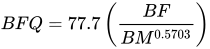
where BF = Bite Force (N), and BM = Body Mass (g)

Carnivore BFQs

[edit]

Sex Differences for BFQ in Canids

[edit]

In a 2020 paper, the results of an estimation of the BFQ of various canid species separated by sex were published.[6] Below there is a table with the BFQ averaged from the BFQ for each espécimen of each sex and for each species. BFQ coming from a single specimen for each sex in a given species will be marked with an asterisk.

Common name Scientific name Male BFQ Female BFQ
Short-eared dog Atelocynus microtis 120.25 144.65
Senegalese wolf Canis lupaster anthus 140.66 126.24
*Golden jackal *Canis aureus *113.98 *113.25
Coyote Canis latrans 132.65 131.88
Grey wolf Canis lupus 130.59 141.06
Dingo Canis lupus dingo 133.67 127.57
New Guinea singing dog Canis lupus hallstromi 130.26 107.31
*Red wolf *Canis rufus *182.41 *124.33
Ethiopian wolf Canis simensis 144.27 158.21
Crab-eating fox Cerdocyon thous 118.24 116.41
Maned wolf Chrysocyon brachyurus 131.59 112.87
Dhole Cuon alpinus 148.80 147.85
Side-striped jackal Lupullela adusta 111.21 107.21
Black-backed jackal Lupullela mesomelas 126.95 115.11
Culpeo Lycalopex culpaeus 128.62 120.07
*Darwin's fox *Lycalopex fulvipes *154.63 *140.60
South American gray fox Lycalopex griseus 135.27 124.87
Pampas fox Lycalopex gymnocercus 127.1 116.76
Sechuran fox Lycalopex sechurae 128.84 138.14
Hoary fox Lycalopex vetulus 123.09 122.13
African wild dog Lycaon pictus 144.71 146.08
Common raccoon dog Nyctereutes procyonoides 136.49 134.94
Bat-eared fox Otocyon megalotis 107.14 126.26
Bush dog Speothos venaticus 160.28 154.63
Gray fox Urocyon cinereoargenteus 146.30 121.51
Island fox Urocyon littoralis 109.27 108.22
Bengal fox Vulpes bengalensis 128.47 139.10
Cape fox Vulpes chama 96.98 87.21
Arctic fox Vulpes lagopus 120.59 115.34
Kit fox Vulpes macrotis 109.77 110.99
Pale fox Vulpes pallida 89.47 98.21
Rüppell's fox Vulpes ruepellii 135.31 121.97
Swift fox Vulpes velox 122.57 120.38
Red fox Vulpes vulpes 116.25 118.97
Fennec fox Vulpes zerda 113 129.62

References

[edit]
Revisions and contributorsEdit on WikipediaRead on Wikipedia
from Grokipedia
The bite force quotient (BFQ) is a dimensionless metric designed to compare the biting strength of animals across of varying body sizes by adjusting raw bite force measurements for body mass. It is calculated as the residual from a of an animal's bite force (typically in Newtons) against its body mass (in kilograms), where the average BFQ for mammals is standardized at 100, indicating that values above this threshold represent bites stronger than expected for a given size, while those below suggest weaker relative performance. This approach accounts for the allometric scaling where larger animals generally possess greater absolute bite forces but not necessarily proportionally stronger ones. BFQ is commonly estimated using biomechanical models, such as the "dry " method, which relies on cranial measurements like lever arms, muscle cross-sectional areas, and physiological cross-sectional areas to predict bite forces at specific points (e.g., canine or molar regions). More precise formulas incorporate logarithmic regressions derived from empirical data across taxa; for instance, the canine bite force quotient (CBFQ) can be computed as CBFQ = 100 × CBF / 10^(0.583·log(BM) + 0.1458), where CBF is canine bite force in Newtons and BM is body mass in grams, with similar adaptations for molar bite force quotient (MBFQ). These methods have been validated through comparisons with in vivo measurements, though captive animals often exhibit lower BFQ values than their counterparts due to reduced physical demands. The BFQ has proven valuable in and for inferring predatory behaviors, prey preferences, and ecological roles, particularly in taxa where direct measurements are impossible. Among extant mammals, the (Sarcophilus harrisii) holds the highest recorded BFQ at 181, enabling it to crush bone despite its small size, while placental carnivores like the (Crocuta crocuta) reach 120, supporting hypercarnivorous diets. In extinct species, marsupial lions such as Thylacoleo carnifex achieved exceptional BFQs around 194, suggesting specialized predation on large herbivores. Recent studies on captive carnivores, including Bengal tigers (Panthera tigris tigris) with CBFQs up to 193, highlight BFQ's utility in assessing morphological adaptations across families like and , though values can vary with measurement techniques and environmental factors.

Definition and Purpose

Definition

Bite force represents the maximum mechanical force exerted by an animal's jaws during occlusion, typically quantified in Newtons (N) and measured at key dental loci such as the canines or teeth, which are critical for predation and feeding behaviors in mammals. This metric captures the peak pressure generated by the temporalis and masseter muscles acting on the and , reflecting adaptations in morphology and . The bite force quotient (BFQ) is a dimensionless index designed to normalize an animal's bite force against its body mass, facilitating equitable interspecies comparisons by mitigating the confounding effects of size differences. By expressing bite force as a deviation from the based on allometric relationships with body size, BFQ highlights relative biting performance rather than absolute strength. This concept was introduced by Wroe et al. in their 2005 study "Bite club: comparative bite force in big biting mammals and the prediction of predatory behaviour in taxa," which aimed to resolve limitations in raw bite force data arising from allometric scaling, wherein larger-bodied animals inherently possess greater bite forces proportional to their . Consequently, BFQ enables the detection of outliers—species with bites that are disproportionately powerful or feeble for their size—informing evolutionary and ecological interpretations of craniofacial adaptations.

Purpose

The bite force quotient (BFQ) plays a central in comparative biology by standardizing bite force measurements relative to body size, thereby allowing researchers to assess feeding adaptations, prey capture efficiency, and dietary niches across diverse taxa without the confounding effects of allometric scaling. This normalization facilitates meaningful interspecies comparisons, revealing how jaw mechanics evolve in response to ecological demands such as strategies and resource utilization. In terms of applications, BFQ is instrumental in evaluating predatory capabilities, particularly in identifying hypercarnivores whose elevated quotients indicate enhanced ability to subdue large or resilient prey, thereby defining their niche within food webs. It also supports investigations into convergence in bite mechanics, where phylogenetically distant develop analogous cranial features for similar feeding ecologies, as evidenced by correlated skull shape variations in carnivorans and marsupials. Furthermore, BFQ aids paleontological reconstructions by estimating the bite performance of extinct , enabling inferences about their diets and based on fossilized cranial morphology. Ecologically, high BFQ values are associated with the capacity to process tough or fibrous foods and overpower sizable prey, which in turn shapes competitive interactions, trophic roles, and community structure among predators. For instance, studies employing BFQ to contrast extant mammals with relatives underscore evolutionary pressures on , linking biomechanical traits to shifts in and prey availability over geological time.

Calculation Methods

Bite Force Measurement

Bite force measurement involves empirical techniques to quantify the maximum force exerted by an animal's jaws, typically serving as the raw input for normalizing performance metrics like the bite force quotient (BFQ). These methods are broadly categorized into direct in vivo approaches, which capture forces from living animals, and indirect methods, which rely on anatomical models or simulations. Direct measurements aim to record actual bite performance under controlled conditions, while indirect techniques estimate forces based on skeletal and muscular proxies, often necessitated by the impracticality of live testing in many species. Direct methods primarily utilize or strain gauges to measure bite force during voluntary or induced bites. In awake animals, such as dogs, chewable transducers placed between the teeth record forces elicited by motivation, yielding values like a mean of 256 N across breeds, though results vary with individual and food incentives. For more precise control, electrical of jaw-closing muscles under induces maximum contractions, as demonstrated in dogs where posterior bite forces ranged from 574 to 3,417 N, scaled with body mass. Implanted transducers in the jaws or teeth provide continuous but are highly invasive, typically limited to captive or laboratory settings due to surgical risks. In , similar transducer setups on live subjects have recorded bites of 92–102 N, highlighting the technique's applicability across mammals. Indirect methods estimate bite force without live subjects, often using dry skulls or digital models to infer muscle mechanics. Finite element analysis (FEA) simulates stresses on 3D reconstructions of crania, incorporating muscle cross-sectional areas and leverage arms; for instance, FEA on canine skulls predicted forces of 232–1,091 N at molars, varying with gape angle and material properties. (PCSA) calculations from dissected or modeled muscles, combined with lever mechanics, offer another proxy, as in estimates of 300–588 N at canines in dogs based on skull dimensions. These approaches are particularly valuable for extinct or , drawing from CT-scanned fossils or museum specimens. Measuring bite force presents several challenges, including high variability from factors like , which can reduce force output by limiting volitional effort, or position, which alters leverage during bites. Motivation in awake animals further complicates , as seen in voluntary tests where forces fluctuate with behavioral state. Ethical concerns are prominent for invasive techniques, such as implants or stimulation, especially in wild or , prompting a shift toward non-invasive devices like automated bite plates that reward increasing force thresholds without . For field studies on free-ranging carnivores, capturing and handling animals introduces stress and safety risks, often restricting direct measurements to captive populations. Standardization is essential for comparability across studies. Bite force is conventionally reported in Newtons () at specific jaw regions, such as the anterior canines for piercing tasks or posterior molars for crushing, with protocols specifying the exact position to account for biomechanical differences. Body mass, used for normalization in metrics like BFQ, is derived from field observations, averages for , or direct weighing in kilograms, ensuring consistent scaling despite inter-individual variation.

BFQ Formula and Derivation

The bite force quotient (BFQ) begins with a basic ratio that relates an animal's measured bite force, typically in newtons (N), to its body mass in kilograms (kg), providing an initial measure of relative biting strength. This simple quotient, however, does not account for allometric scaling, where bite force tends to increase disproportionately with body size across species, necessitating adjustment for fair comparisons. To derive a size-independent BFQ, researchers perform an allometric adjustment using on log-transformed data from a reference of mammals, treating BFQ as the residual deviation from the expected bite based on body mass. This yields a score where values above 100 indicate stronger-than-average bite relative to size, and values below 100 indicate weaker performance, with the average standardized to 100 across the . The process emphasizes conceptual scaling over raw ratios, prioritizing residuals to highlight evolutionary adaptations in jaw . The derivation involves three key steps:
  1. Collect a comprehensive dataset of empirically measured bite forces and corresponding body masses from diverse mammalian taxa, ensuring representation across sizes and clades to establish a robust reference line.
  2. Apply log-transformation (typically base-10) to both variables and conduct linear regression to model the relationship, often expressed as log10(BF)=βlog10(BM)+α\log_{10}(\text{BF}) = \beta \cdot \log_{10}(\text{BM}) + \alpha, where β\beta is the scaling exponent (e.g., approximately 0.57 in seminal mammalian analyses, reflecting empirical allometry) and α\alpha is the intercept; this exponent may approximate 2/3 (0.67) in some contexts based on biomechanical principles, as muscle cross-sectional area scales with body mass to the power of 2/3.
  3. For a given species, compute the predicted bite force using the regression equation, then calculate the residual as the percentage deviation: BFQ=100×observed BFpredicted BF\text{BFQ} = 100 \times \frac{\text{observed BF}}{\text{predicted BF}}, where predicted BF = 10(βlog10(BM)+α)10^{(\beta \cdot \log_{10}(\text{BM}) + \alpha)}.
In the foundational work by Wroe et al. (2005), the regression equation was log10(BF)=0.5703log10(BM)+0.1096\log_{10}(\text{BF}) = 0.5703 \cdot \log_{10}(\text{BM}) + 0.1096 (r² = 0.85), derived from 49 specimens across 39 taxa, enabling BFQ computation as the ratio of observed to predicted values scaled to 100.

Comparative Analyses

BFQs in Carnivores

Carnivorous mammals exhibit bite force quotients (BFQs) that are generally elevated compared to those of herbivores, reflecting evolutionary specializations for subduing, killing, and processing prey through crushing, piercing, or tearing actions. This adaptation is particularly pronounced in hypercarnivores, where higher BFQs correlate with the ability to handle larger relative prey sizes and incorporate into the diet, as demonstrated in comparative analyses of skull morphology and estimated bite forces. Data from studies on both captive and wild specimens underscore that carnivores prioritize robust craniomandibular structures for predatory efficiency, with BFQs often exceeding 100—indicating above-average bite performance relative to body mass—across diverse families like Hyaenidae, , and . Among large carnivores, stand out for their exceptional BFQs, adapted for bone-crushing behaviors that enable access to marrow and tough hides. The (Crocuta crocuta) achieves a BFQ of approximately 117, the highest among large-bodied hyaenids, facilitating predation on sizable ungulates and scavenging of remains that other predators cannot exploit. In contrast, the (Sarcophilus harrisii), a smaller , records one of the highest BFQs overall at 181, allowing it to pulverize bones and consume entire carcasses despite its modest size of around 8-10 kg. Canids and felids provide further illustrative contrasts: the gray wolf (Canis lupus) exhibits a BFQ of 136, supporting pack-based pursuits and dismemberment of large prey, while the (Panthera leo) has a comparatively lower BFQ of 112, aligned with ambush tactics and throat-clamping rather than sustained crushing. Patterns in BFQs among carnivores reveal family-specific adaptations tied to feeding . Felids generally display moderate BFQs, such as 127 for the (Panthera tigris) and around 94-137 for species like the leopard (Panthera pardus) and clouded leopard ( nebulosa), optimized for deep-penetrating canine bites that sever vital structures rather than extensive bone processing. Mustelids and canids show greater variability depending on dietary specialization; for instance, the (Gulo gulo) maintains a near-average BFQ of about 105, sufficient for scavenging frozen carcasses and defending kills against larger competitors, though not exceptional among small carnivores. These trends, derived from finite element modeling and regression analyses in seminal works, highlight how BFQs scale with predatory roles, with bone-oriented feeders like hyenids and dasyurids pushing upper limits while predators favor balanced metrics. Subsequent validations through 2023, including direct measurements in captive settings, affirm these patterns without major revisions.

BFQs in Non-Carnivores

Non-carnivores, encompassing herbivores, omnivores, and other non-predatory mammals, generally display lower bite force quotients (BFQs) than their carnivorous counterparts, as their cranial and dental adaptations prioritize grinding, shearing, and processing fibrous or tough material over subduing live prey. This pattern arises from evolutionary pressures favoring efficient mastication of , which requires sustained force at the molars rather than peak puncturing strength at the canines. Studies extending BFQ analyses beyond carnivores highlight how dietary demands shape across taxa, with non-predatory feeding often resulting in BFQs below 100. The (Ailuropoda melanoleuca), a specialized bamboo-feeding , exemplifies an exception among non-carnivores with a notably high BFQ of approximately 142 at the tooth, enabling it to shear and crush abrasive culms despite its herbivorous diet. In stark contrast, megaherbivores like (Loxodonta africana and Elephas maximus) exhibit very low BFQs, as their massive body size (up to 6,000 kg) is paired with minimal jaw leverage; instead, they use their prehensile trunk for foraging and minimal dental grinding of grasses. Among rodents, the (Heterocephalus glaber) shows elevated BFQs—165 for subordinates and 130 for dominants—surpassing predictions for its small body mass (32–94 g) and aiding in excavating burrows and gnawing resilient roots in arid environments. Patterns in BFQ among reflect dietary shifts between frugivory and folivory, with folivores generally possessing higher relative bite forces to process tough, fibrous leaves requiring prolonged mastication, while frugivores have lower BFQs suited to softer, ripe fruits that demand less mechanical effort. For instance, folivorous species like howler monkeys (Alouatta spp.) exhibit enhanced jaw adductor muscle leverage compared to frugivorous counterparts such as spider monkeys (Ateles spp.), correlating with higher estimated bite forces per unit body mass. Marine mammals like pinnipeds (e.g., elephant seals, Mirounga angustirostris) maintain moderate relative bite forces, balancing aquatic locomotion constraints with the need for grip-and-tear feeding on , though these values fall short of terrestrial hypercarnivores. Methodologies pioneered by Wroe and colleagues for carnivores have been extended to non-mammals, revealing cross-taxa parallels in BFQ adaptations. In birds, parrots (Psittaciformes) achieve high bite forces relative to body mass (e.g., 0.139 N/g in the parakeet, Myiopsitta monachus), exceeding raptors and facilitating seed cracking through robust adductor muscles and deep bills. Reptilian herbivores and omnivores, such as certain , similarly show elevated BFQs for processing hard vegetation or , underscoring in non-predatory jaw mechanics.

Biological Variations

Sex Differences in Canids

In canids, sexual dimorphism in bite force is typically modest, with males generally exhibiting higher absolute bite forces due to larger body sizes, skull widths, and jaw adductor muscle masses associated with intra-sexual for mates and . However, when adjusted for body size via the bite force quotient (BFQ), no significant differences exist between males and females across the family , suggesting that bite performance is similarly scaled relative to overall morphology in both sexes. This pattern contrasts with more pronounced dimorphism in other carnivoran families, potentially linked to the prevalence of social monogamy in canids, which may reduce selection pressures for exaggerated male bite strength. In gray wolves (Canis lupus), males display in cranial morphology, including broader skulls (sexual dimorphism ratio of 1.02–1.04) that accommodate larger temporalis and masseter muscles, implying approximately 7% higher absolute bite forces compared to females based on modeled estimates from wild specimens. Yet, BFQ values remain statistically equivalent between sexes, with no evidence of male-biased performance after size correction. Similar trends appear in coyotes (Canis latrans), where the male-to-female bite force ratio is about 1.03, again without significant BFQ divergence. Among foxes, patterns vary slightly but align with the family-wide lack of BFQ dimorphism. For instance, in the (Vulpes chama), males possess 25% stronger absolute bite forces than females (bite force index of 1.25), driven by dimorphic skull features tied to aggressive interactions and territorial defense; however, BFQ shows no intersexual difference. In contrast, the (Vulpes vulpes) exhibits minimal dimorphism (bite force index of 1.06) in both absolute and relative terms. These findings, derived from 3D geometric morphometric analyses of museum from wild populations, highlight that while testosterone-mediated growth enhances male jaw musculature for competition, female canids maintain comparable BFQ through efficient scaling of bite , possibly prioritizing endurance in and pup-rearing roles.

Ontogenetic and Phylogenetic Variations

The bite force quotient (BFQ) exhibits notable ontogenetic changes, generally increasing as individuals mature due to the of cranial structures and of adductor muscles, which enhance relative biting efficiency beyond simple body size scaling. In red foxes (Vulpes vulpes), for instance, adult BFQ values exceed those of 1-year-old juveniles by approximately 15-20%, reflecting improved masticatory performance that supports shifts toward harder diets. Phylogenetically, high BFQ values are conserved within bone-crushing lineages, such as hyenids (e.g., BFQ ≈117), which exhibit robust crania adapted for osteophagy, in contrast to lower values in canids specialized for pursuit hunting. This pattern underscores evolutionary trade-offs between biting power and locomotor efficiency in related taxa. of elevated BFQ occurs in distantly related groups facing similar ecological pressures; for example, crocodilians and certain theropod dinosaurs (e.g., Tyrannosaurus rex estimated BFQ >1000) independently developed disproportionately strong bites for subduing large prey, despite differing phylogenetic histories within Archosauria. Among felids, BFQ positively scales with degree of hypercarnivory, with species preying on large vertebrates (e.g., lions, BFQ ≈112) showing higher values than those targeting smaller (e.g., ), highlighting adaptations for prey size handling. In , conversely, larger species tend to have lower BFQ due to allometric constraints on masticatory morphology, where increased body size disproportionately burdens skull leverage without commensurate muscle gains. These variations are illuminated by data from longitudinal ontogenetic studies and phylogenetic comparative analyses, including 2020s applications of Bayesian predictive modeling on and phylogenies to infer BFQ evolution across clades.

Significance and Limitations

Evolutionary Implications

The bite force quotient (BFQ) serves as a key indicator of evolutionary adaptations in mammalian feeding strategies, particularly in response to dietary pressures. High BFQ values have evolved in durophagous carnivores, such as spotted hyenas (Crocuta crocuta), to facilitate the consumption of tough, bone-rich carcasses, enabling efficient exploitation of mechanically resistant prey that other predators avoid.88[347:BFAEAT]2.0.CO;2) In contrast, pursuit predators like (Acinonyx jubatus) exhibit relatively low BFQ, prioritizing skeletal lightness and speed over jaw strength for subduing agile, soft-bodied prey through rapid chases rather than forceful dispatch. These divergences reflect favoring biomechanical trade-offs aligned with hunting modes and prey defenses.88[347:BFAEAT]2.0.CO;2) Ecologically, BFQ influences community dynamics and niche partitioning, with high-BFQ like dominating scavenging guilds by accessing nutrient-dense marrow and fragments left by less-equipped competitors, thereby shaping trophic interactions and resource flow in ecosystems. Such specializations, however, heighten vulnerability to environmental perturbations; for instance, with elevated BFQ adapted to large, tough herbivores face elevated risks when loss disrupts prey availability, as seen in Pleistocene megafauna declines where bone-cracking specialists like dire wolves ( dirus) succumbed due to narrowed dietary breadth and increased energetic demands. This underscores how BFQ-mediated adaptations can amplify susceptibility to cascading ecological changes. In , BFQ reconstructions illuminate extinct taxa's predatory ecologies, such as the saber-toothed cat fatalis, whose low BFQ (approximately 78) suggests reliance on ambush tactics and throat punctures rather than crushing bites, informing interpretations of their role in food webs prior to mass extinctions driven by prey depletion.

Methodological Criticisms

One major methodological criticism of the bite force quotient (BFQ) centers on its reliance on allometric scaling assumptions derived primarily from mammalian data, which may not generalize across diverse taxa. The standard exponent of approximately 0.67, based on geometric similarity for bite force scaling with body mass in mammals, has been debated for non-mammalian groups like birds, where larger body mass correlates with relatively lower bite force despite positive allometry between jaw muscle mass and bite force. This discrepancy arises because regression lines fitted to mammalian datasets can lead to inaccurate BFQ estimates when applied to birds or other taxa with differing musculoskeletal architectures, potentially over- or underestimating relative bite performance. Measurement biases further undermine BFQ reliability, particularly the overreliance on computational models using dry skulls rather than in vivo data from live animals. Dry skull methods often underestimate BFQ by inaccurately estimating muscle cross-sectional areas—overestimating the masseter while underestimating the temporalis—leading to lower predicted bite forces compared to direct measurements. Additionally, studies predominantly use captive animals, which exhibit reduced bite forces relative to wild counterparts due to diminished hunting demands and consistent food availability, altering jaw muscle development and overall bite apparatus parameters. Small sample sizes and inadequate consideration of behavioral contexts exacerbate these issues, skewing BFQ results and limiting generalizability. Many analyses rely on limited specimens, such as only 3–5 skulls per species, which fails to capture intraspecific variability and can distort allometric regressions, as seen in unexpectedly high BFQ values for species like the when based on small datasets. Furthermore, BFQ calculations often overlook behavioral factors, including bite angle, animal motivation, and gape position, which significantly influence measured forces but are rarely standardized across studies. To address these limitations, researchers have proposed alternative metrics, such as bite force normalized per unit skull length, which better accounts for head morphology variations and reduces body mass dependency biases. Integrating kinematic data, including mandibular opening angles and dynamic motion during biting, offers another improvement by modeling force-angle relationships more realistically than static BFQ estimates.

References

Add your contribution
Related Hubs
User Avatar
No comments yet.