Hubbry Logo
CeratopogonidaeCeratopogonidaeMain
Open search
Ceratopogonidae
Community hub
Ceratopogonidae
logo
8 pages, 0 posts
0 subscribers
Be the first to start a discussion here.
Ceratopogonidae
Ceratopogonidae
from Wikipedia

Ceratopogonidae
Temporal range: Berriasian–Recent
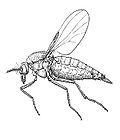
A female biting midge, Culicoides sonorensis
Scientific classification Edit this classification
Kingdom: Animalia
Phylum: Arthropoda
Class: Insecta
Order: Diptera
Suborder: Nematocera
Infraorder: Culicomorpha
Superfamily: Chironomoidea
Family: Ceratopogonidae
Newman, 1834
Subfamilies and tribes[1]

Ceratopogonidae is a family of flies commonly known as no-see-ums, sand flies or biting midges, generally 1–3 millimetres (11618 in) in length. The family includes more than 5,000 species,[2] distributed worldwide, apart from the Antarctic and the Arctic. A 2025 study from Oxford University lists the subspecies Ceratopogonidae midges as "the most widely recognised and best-studied cocoa pollinators."[3]

Ceratopogonidae are holometabolous, meaning their development includes four life stages: egg, larva, pupa, and imago or adult.[4] Most common species in warmer climates will take about two to six weeks to complete a life cycle. Both adult males and females feed on nectar. Most females also feed on the blood of vertebrates, including humans, to get protein for egg-laying. Their bites are painful, and can cause intensely itchy lesions[5] due to the body producing histamines against the proteins from the midges' saliva.[6][7] Their mouthparts are well-developed for cutting the skin of their hosts. Some species prey on other insects.

Larvae need moisture to develop, but also air and food. They are not strictly aquatic or terrestrial.[5]

Some species within the biting midges are thought to be predatory on other small insects. In particular, mosquito larvae have been investigated as common prey for biting midges in the genus Bezzia. For example, experiments have been conducted on the species Bezzia nobilis that suggest their reliance on mosquito larvae as one source of prey.[8][9] They can also be hematophagous parasites of invertebrates, depending on whether the bloodsucking attack is fatal.[10]

Like other bloodsucking flies, Culicoides species can be vectors of disease-causing pathogens. Among diseases transmitted are the parasitic nematodes Mansonella, bluetongue disease, African horse sickness, epizootic hemorrhagic disease, arboviruses,[11] and nonviral animal pathogens.[12]

Historically, numbers were managed with the insecticide DDT[5] as with Leptoconops torrens populations in California. They can be trapped by luring them with carbon dioxide. Most midges are small enough to pass through ordinary insect window screening. They can be repelled with DEET,[5] oil of Eucalyptus, or Icaridin. Their larvae have also been shown to be susceptible to treatment with commercially available preparations of Bacillus thuringiensis israelensis.[13]

Subfamilies

[edit]

The Leptoconopinae is a subfamily of biting midges.[14] The larvae are recognized by their unique sclerites of the head, and by their mouthparts.

The Forcipomyiinae are a subfamily of biting midges. In this subfamily, both anterior and posterior prolegs are present on the larvae. Larvae are both terrestrial and aquatic, and feed primarily on algae and fungi. Some species are important pollinators of tropical crops such as the cocoa bean.

Larvae of species in the Dasyheleinae subfamily are characterized by an anal segment with retractile posterior prolegs. Larvae are aquatic and adults do not feed on vertebrate blood, nor do they prey on other insects. They take nectar only, an unusual feeding behavior within the Ceratopogonidae.

The Ceratopogoninae subfamily has elongated larvae without prolegs or hooks. Most larvae of this subfamily are predatory. Adults generally take vertebrate blood or attack other insects. Most females in the subfamily Ceratopogoninae feed on insects similar to them in size.

The oldest known member of the family is Archiaustroconops besti from the Purbeck Group of Dorset, England, dating to the Berriasian, around 142 million years ago.[15]

Systematics

[edit]

Basal lineages[16]

[edit]

References

[edit]
Revisions and contributorsEdit on WikipediaRead on Wikipedia
from Grokipedia
Ceratopogonidae is a diverse family of small nematocerous flies within the order Diptera, commonly known as biting midges, no-see-ums, punkies, or sand flies, comprising over 6,000 described distributed worldwide except in . These are typically 1–4 mm in length, with slender bodies, long legs, and distinctive antennae that are plumose (feather-like) in males and pilose (hairy) in females; their wings feature reduced venation and often held over the abdomen at rest. Members of the Ceratopogonidae family are found in nearly all terrestrial and aquatic habitats, with larvae predominantly developing in moist environments such as , decaying , holes, or freshwater pools, while adults are often associated with near water bodies. The life cycle includes , larval, pupal, and adult stages, with females requiring a from vertebrates (including humans) or other sources for maturation, whereas males and non-blood-feeding females subsist on and plant juices. Over 6,000 are recognized globally across approximately 110 genera, with significant diversity in tropical regions; in alone, more than 600 in 36 genera have been documented. Ceratopogonidae hold considerable medical, veterinary, and economic importance due to their habits and role as vectors of pathogens, transmitting viruses such as bluetongue and African horse sickness to , as well as filarial worms to and humans in some cases. Their painful bites can cause allergic reactions, , and discomfort in affected individuals, particularly in coastal or rural areas where populations surge seasonally. Although most species are non-biting and play ecological roles in and as prey for other animals, the hematophagous genera like are the primary concerns for and .

Taxonomy

Systematics

Ceratopogonidae, commonly known as biting midges, occupies a phylogenetic position within the suborder of the order Diptera, specifically in the infraorder Culicomorpha. This family forms part of a basal alongside Thaumaleidae and Simuliidae, which together is sister to the remaining Culicomorpha, including . Key synapomorphies supporting this placement include reduced wing venation with few longitudinal veins and the presence of piercing mouthparts adapted for blood-feeding in females of many species. These traits distinguish Ceratopogonidae from other nematoceran families and highlight their evolutionary adaptations for ectoparasitism. The type genus Ceratopogon was established by in 1803, and the family Ceratopogonidae was formally described by Edward Newman in 1834, encompassing small flies with feathery antennae. Major taxonomic revisions occurred in the , notably by Frederick W. Edwards in 1922, who contributed detailed species descriptions and classifications for tropical regions, and later in 1926 when he proposed divisions based on body and wing characteristics. More recent molecular studies, such as the phylogenomic analysis by Bertone et al. in 2018, have confirmed the of Ceratopogonidae using multiple loci including the COI gene, resolving ambiguities in relationships with sister families. Current classification faces challenges regarding subfamily boundaries, particularly informed by fossil records from Cretaceous amber deposits, which reveal early diversification during the period around 100–125 million years ago. These s, including specimens from (ca. 99 Ma) and Lebanese amber (ca. 125 Ma), both dating to the , indicate rapid radiation and provide evidence for debating the of certain subfamilies like Ceratopogoninae based on archaic morphologies. Such paleontological data underscore ongoing refinements in Ceratopogonidae . Key diagnostic traits for family-level identification include antennae composed of 13 flagellomeres, which are often plumose (feather-like) in males due to elongated setae for detecting pheromones. Additionally, the tarsal claws are simple and unequal, particularly on the hind legs, facilitating attachment to hosts during blood-feeding. These features, combined with the overall small size and delicate structure, aid in distinguishing Ceratopogonidae from morphologically similar nematocerans.

Subfamilies and genera

The family Ceratopogonidae comprises three extant subfamilies: Ceratopogoninae, Forcipomyiinae, and Leptoconopinae, along with several extinct subfamilies known exclusively from fossils, such as Protoculicoidinae and Lebanoculicoidinae. Ceratopogoninae is the largest subfamily, encompassing approximately 4,769 across 58 genera, including the prominent genus with over 1,368 described , many of which are notable pests such as C. imicola. Forcipomyiinae includes about 1,300 in 46 genera, such as Forcipomyia, where many are non-biting and engage in pollen-feeding behaviors. Leptoconopinae is the smallest extant subfamily, with roughly 110 in two genera, notably Leptoconops, which features that blood-feed primarily on reptiles and are prevalent in arid environments. The fossil-only Protoculicoidinae contains 22 across five genera, representing early divergences in the family. Overall, more than 6,346 extant have been described in Ceratopogonidae as of recent updates, with estimates suggesting a total exceeding 10,000 worldwide; diversity is highest in tropical regions. Taxonomic revisions continue, with enabling the identification of cryptic and the elevation of certain groups to distinct taxonomic ranks based on molecular evidence.

Morphology

Adult features

Adult Ceratopogonidae exhibit a slender body form with body lengths typically ranging from 1 to 4 mm, often displaying dark coloration that aids in within their habitats. These flies possess a robust yet compact adapted for agile flight and host interaction. The head is characterized by large compound eyes that provide wide visual fields essential for locating hosts or mates. Antennae consist of 13 to 15 segments, with males featuring plumose (bushy) structures enhanced for detecting female pheromones during swarming, while females have less ornate antennae. The is a key feature, elongated and piercing in females equipped with serrated mandibles for blood-feeding, contrasting with the shorter, non-piercing version in males adapted for or consumption. The supports functional wings and , the latter serving as gyroscopic stabilizers during flight. Wings are membranous with reduced venation, typically featuring only five longitudinal veins that contribute to their lightweight design for short, rapid flights; at rest, they are held in a roof-like position over the . Legs are equipped with spines and paired claws, enabling females to grip hosts firmly during meals. The is segmented and flexible, accommodating egg development in females, who possess cerci at the posterior end. is pronounced, with males displaying bushy antennae and non-biting mouthparts, alongside subtler differences in wing patterns that assist in species recognition during . Females, conversely, show adaptations for , including reinforced mouthparts for skin penetration.

Immature stages

The larvae of Ceratopogonidae are filiform or worm-like in shape and apodous, lacking legs, with body lengths typically ranging from 1 to 5 mm. They feature a well-defined head capsule containing specialized mouthparts adapted for feeding on decomposing , microorganisms, , or small prey, often through filter-feeding mechanisms involving brush-like structures. Most occupy aquatic or semi-aquatic habitats such as , , marshes, or moist , where larvae crawl or swim using undulating body movements; terrestrial forms occur in damp leaf litter or . Larvae generally lack spiracles and respire through their thin (), enabling survival in low-oxygen environments. In the subfamily Leptoconopinae, larvae exhibit burrowing adaptations suited to moist in coastal or environments, feeding on organic and associated microbes. Genus-level identification often relies on patterns and arrangements of thoracic setae, which vary in number, position, and morphology across taxa. Pupae are exarate, with free appendages, and measure 1 to 4 mm in length, displaying a comma-shaped body that is pale yellow to dark brown in color. Aquatic pupae feature prominent thoracic respiratory horns—paired, tube-like structures on the —that protrude above the water surface to facilitate oxygen uptake, enabling the immobile stage to remain partially submerged. This non-feeding phase generally lasts 2 to 3 days under optimal conditions but can extend to 10 days or more in cooler or drier environments, during which occurs without further nutrient intake. Upon completion, adults emerge directly from the pupal without a subimago stage.

Life cycle

Reproduction

Reproduction in Ceratopogonidae primarily involves sexual mating, though occurs rarely in some species such as bambusicola, where unfertilized eggs develop into viable offspring at low rates. Most species rely on distinct mating systems, with swarm mating predominant across genera like and Forcipomyia. Males aggregate in aerial swarms, typically at or dawn near visual markers such as hilltops, vegetation, or water edges, forming leks where they compete for incoming females. Swarm sizes vary from fewer than 10 to over 1,000 individuals, often columnar in shape, and serve to increase encounter rates in low-density populations. Female attraction to swarms is guided by pheromones, with virgin females releasing volatile sex pheromones detectable by the males' plumose antennae, which are highly sensitive to these chemical cues. within the swarm involves rapid flight maneuvers and brief physical contact, where males intercept females mid-air for copulation; fanning by males may disperse additional pheromones to facilitate pairing. is typically brief, lasting seconds to minutes, and occurs via standard genital insertion, with females often showing resistance to multiple matings. In some species, contact pheromones on the female cuticle further stimulate male copulatory behavior post-interception. Following mating, females seek oviposition sites based on cues indicating suitable larval habitats, such as moisture and availability. Eggs are laid in clusters of 50–100 (up to 243 in some cases) on moist substrates like , decaying vegetation, mats, or surfaces, with preferences for enriched by or from natural breeding sites. prioritizes areas rich in microbial films or for larval nutrition, with females depositing higher egg numbers (e.g., 35–56 per female) on habitat-specific compared to controls. Oviposition is influenced by environmental and substrate , ensuring proximity to food sources like or . Fecundity in Ceratopogonidae varies by and nutritional status, with most being anautogenous and requiring a for egg maturation. A single provides proteins essential for , enabling production of 50–200 eggs per gonotrophic cycle and supporting multiple cycles over the female's lifespan. feeding increases egg output compared to sugar-only diets, as it supplies nutrients for deposition, though exact multiples depend on meal size and host type; for instance, mammalian sustains higher than avian sources in . Autogenous , like certain furens, can produce initial egg batches without , but subsequent ones require feeding. Reproductive activity peaks in warm, humid conditions, aligning with seasonal abundance in temperate and tropical regions. In temperate zones, generations are limited by overwintering in larval stages, which halts development during cold periods and synchronizes emergence with favorable spring conditions. induction responds to photoperiod and , ensuring survival until humidity and warmth resume, thus concentrating mating and oviposition in summer months.

Development stages

Ceratopogonidae exhibit holometabolous , progressing through distinct , larval, pupal, and stages, with preceding egg-laying in females. The overall life cycle duration varies from 2 to 8 weeks, influenced by species, , and , allowing many tropical species to be multivoltine with multiple generations per year. In colder regions, larvae often overwinter, delaying development until warmer conditions, while temperature-dependent rates can shorten the full cycle to approximately 10 days at 25°C for certain species like Culicoides variipennis. The egg stage begins with females depositing small clusters or rafts of 50–200 s on moist substrates, measuring 0.1–0.5 mm in length and featuring a shape. These s hatch in 2–7 days under adequate moisture, with the providing desiccation resistance in older embryos (28–34 hours post-oviposition), enabling survival of over 50% water weight loss during dry periods. Hatching success is highest when s remain hydrated, as younger s (4–10 hours old) succumb rapidly to at 75% relative . Larvae pass through four instars, with total development spanning 1–4 weeks, often completing in about one week under optimal laboratory conditions for species like Culicoides variipennis. They are primarily detritivores, consuming organic , , fungi, , and small such as protozoans and nematodes, often by filtering or browsing in semi-aquatic environments. between instars is triggered by temperature, with development accelerating above 15°C and a lower threshold around 17°C for progression and . The pupal stage is immobile and non-feeding, lasting 3–10 days depending on , typically 2–3 days at warmer levels (e.g., 24–28°C) for species like obsoletus. Pupae form in moist substrates, and eclosion often occurs at to reduce predation risk, with timing regulated by environmental cues such as photoperiod. rates peak under moderate temperatures, with lower thresholds limiting activity below 15–17°C.

Distribution and ecology

Geographic range

Ceratopogonidae exhibit a , present across all major zoogeographic regions except the extreme polar areas of and the high , where low temperatures limit their survival. With over 6,267 described extant worldwide as of 2025, the family demonstrates highest in tropical regions, particularly the Neotropics and Oriental realms. In the Neotropics, approximately 1,329 are known, representing about 21% of the global total, while alone harbors 529 , underscoring the region's exceptional diversity. Regionally, patterns vary significantly. In the Holarctic region, temperate species such as those in the genus predominate, with notable abundances in ; for instance, records high diversity, and the shows elevated among surveyed countries. The Afrotropical region features genera like Leptoconops, which thrive in arid desert environments, adapting to saline sands and muds. In the , endemic taxa such as Austroconops are restricted primarily to southwestern , highlighting localized evolutionary radiations. Dispersal mechanisms contribute to these patterns, including wind-assisted migration that can carry individuals up to 100 km or more, facilitating and range connectivity. activities have also mediated spread, particularly through and ; for example, species in the Culicoides obsoletus complex, native to , have seen facilitated distribution linked to post-1950s agricultural movements and vector-borne disease incursions. Biogeographically, fossil records trace Ceratopogonidae origins to the (ca. 142 Ma), with evidence of Gondwanan connections in genera like Austroconops, whose living species persist in alongside Cretaceous amber fossils from similar southern landmasses. Climate warming has contributed to range expansions of species into northern European regions, including , as observed during the 2006 bluetongue outbreaks, with milder conditions enabling persistence in higher latitudes. Species density reflects latitudinal gradients, with tropical countries typically supporting 100–500 species, as seen in Brazil's 529 or India's diverse assemblages, compared to 20–50 in temperate zones like those in northern European nations. These distribution limits are broadly tied to moisture availability in breeding sites, influencing overall range extents.

Habitats and interactions

Ceratopogonidae larvae primarily inhabit moist, organic-rich environments such as freshwater margins, salt marshes, tree holes, and damp soil, where they develop in semiaquatic mud or the upper layers of saturated substrates. These sites provide the necessary and decaying essential for larval survival and growth. Adults, while often remaining close to breeding areas for oviposition and resting, exhibit significant dispersal capabilities, with some species traveling hundreds of kilometers via wind-assisted passive movement. Within these habitats, larvae occupy specific microhabitats like organic-rich sediments, where many species function as filter-feeders, consuming microorganisms, , and suspended in water films. Adult midges seek shaded, humid resting sites in understories or leaf litter to regulate temperature and moisture, preferring conditions around 25–30 °C to minimize stress. Trophic interactions involve predation by aquatic fish such as mosquitofish (Gambusia affinis) on larvae, as well as terrestrial predators like spiders and birds targeting adults. Parasitic relationships include infections by the fungus Coelomycidium in larval stages and mermithid nematodes that affect both immatures and adults, often reducing host fitness. Symbiotic associations feature gut bacteria in hematophagous species that facilitate blood meal digestion by aiding nutrient breakdown. Additionally, non-biting genera like Forcipomyia contribute to pollination, serving as key vectors for cacao (Theobroma cacao) flowers in tropical agroecosystems. Environmental factors significantly influence Ceratopogonidae populations, with larvae showing sensitivity to and extreme levels; many species tolerate acidic conditions ( 3.6–5.0) but succumb in highly alkaline or contaminated waters. exacerbates these pressures by altering breeding site availability, such as through increased in arid regions that reduces moist habitats and limits larval development.

Human significance

Medical importance

Females of the genera Culicoides and Leptoconops within Ceratopogonidae are hematophagous, requiring blood meals for egg development, and use specialized mouthparts to pierce vertebrate skin, injecting saliva that contains anticoagulants and vasodilators. This biting behavior inflicts a sharp, burning sensation and typically results in painful, reddish welts at the site, which may persist for days. In sensitive individuals, bites can trigger allergic reactions, including intense itching, swelling, and in rare cases, systemic hypersensitivity similar to equine "sweet itch" dermatitis. Ceratopogonidae, especially Culicoides species, act as biological vectors for multiple pathogens affecting humans and . They transmit bluetongue (BTV) to sheep and cattle, causing hemorrhagic disease with symptoms like fever, oral lesions, and mortality rates up to 30% in naive populations, resulting in global economic losses of up to $3 billion. In humans, Culicoides paraensis vectors Oropouche , leading to Oropouche fever with symptoms of , , and ; outbreaks in the Amazon region, such as the 2023–2024 epidemic affecting over 16,000 cases, are amplified by urban expansion into sylvatic cycles. Additionally, these s transmit filarial worms, including Onchocerca species, contributing to onchocercosis in animals across , where larvae develop in midge vectors before infecting mammalian hosts. Vector competence in Ceratopogonidae is species-specific and influenced by intrinsic factors like barriers and extrinsic ones such as temperature. For instance, Culicoides sonorensis demonstrates high competence for vesicular stomatitis virus, with infection rates up to 80% in experimentally infected midges, facilitating outbreaks in . Salivary proteins in Culicoides, including hyaluronidases and anticoagulants, enhance by suppressing host and immune responses, allowing viruses to disseminate more efficiently during blood feeding. Epidemiologically, Ceratopogonidae-borne disease outbreaks correlate with wet seasons, as increased rainfall boosts larval habitats in moist soils and vegetation, leading to midge population surges and heightened vector activity. In the United States, integrated control strategies emphasizing insecticides, such as applications, have reduced midge abundance and associated incidence, particularly for vesicular in endemic areas. Zoonotic transmission dynamics involve wildlife reservoirs, such as deer and wild ruminants harboring BTV asymptomatically, facilitating spillover to domestic animals and humans in rare cases. Climate-driven range expansions of competent vectors like species pose emerging risks, with bluetongue outbreaks established in as of 2025 due to warmer temperatures extending vector seasons.

Economic impacts

Ceratopogonidae, particularly species in the genus , impose significant economic burdens on through their role as vectors of arboviruses affecting . The bluetongue (BTV), transmitted by these midges, leads to global economic losses estimated at up to $3 billion, stemming from animal mortality, reduced and meat production, abortions, and international trade restrictions on and . In naive sheep herds, BTV outbreaks can cause mortality rates of up to 30%, with higher impacts in young animals, while subclinical infections in still result in productivity declines such as weight loss and infertility. Similarly, epizootic hemorrhagic (EHDV), vectored by Culicoides sonorensis and related species, causes substantial losses in ruminants, including decreased yield and mortality; a 2006 outbreak in alone resulted in approximately $2.5 million in damages from reduced production and animal deaths. African horse sickness (AHS), another Culicoides-transmitted , affects equines with high fatality rates of 50–90% in during peracute forms, contributing to annual economic impacts of about $95 million in endemic regions through direct losses and control measures. Beyond direct livestock health effects, Ceratopogonidae generate nuisance-related economic costs by disrupting tourism, recreation, and outdoor labor. In coastal and wetland areas, dense swarms of biting midges deter visitors and reduce participation in activities like hiking and fishing; for instance, in Scotland, these insects pose health and safety risks to tourists, indirectly affecting the multibillion-dollar tourism sector through altered travel patterns and increased demand for protective gear. In the United States, particularly around the Great Lakes and Midwest waterways, midge swarms lead to public complaints and localized control programs, with broader nuisance biting contributing to a global insect repellent market valued at over US$10 billion as projected for 2025, driven partly by demand for products targeting blood-feeding Diptera. In forestry and aquaculture, adult midges harass workers, reducing efficiency in timber harvesting and fish farm operations, while larvae in moist sediments can compete with or stress aquatic organisms in managed wetland systems, though their role as prey sometimes provides minor ecological benefits. Management of Ceratopogonidae populations entails considerable costs for surveillance and control, particularly in where EU-wide monitoring networks for vectors have been operational since the early to track BTV risk and inform strategies. Biological controls, such as applications of subsp. israelensis (Bti), offer targeted larval reduction, though field effectiveness against is variable due to tolerance mechanisms. (IPM) approaches, combining surveillance, habitat modification, and chemical larvicides, are increasingly emphasized to minimize costs, with national programs in affected countries allocating millions annually for . Climate change exacerbates these economic impacts by expanding Culicoides ranges and activity seasons, with models predicting increased BTV transmission risk in and by 2030, potentially amplifying annual losses through more frequent outbreaks and extended vector seasons. Projections indicate that under moderate warming scenarios, suitable habitats for key vectors like C. imicola could shift northward, heightening vulnerability in previously unaffected regions and underscoring the need for adaptive IPM to mitigate projected sectoral damages exceeding hundreds of millions in expanded endemic areas.

References

Add your contribution
Related Hubs
User Avatar
No comments yet.