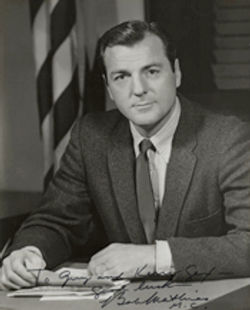
Bob Mathias
Bob Mathias
Main page
hub-image

Bob Mathias

logo
Community Hub0 subscribers
Read side by side
from Wikipedia

Robert Bruce Mathias (November 17, 1930 – September 2, 2006) was an American decathlete, politician, and actor. Representing the United States, he won two Olympic gold medals in the Decathlon, at the 1948 and the 1952 Summer Games. As a Republican, he served in the US House of Representatives for California's 18th congressional district, for four terms from 1967 to 1975.

Key Information

Early life and athletic career

[edit]

Mathias was born in Tulare, California, to a family with partial Greek lineage.[1] He attended Tulare Union High School,[2] where he was a classmate and long time friend of Sim Iness, the 1952 Olympic discus gold medalist. While at Tulare Union in early 1948, Mathias took up the decathlon at the suggestion of his track coach, Virgil Jackson. During the summer following his high school graduation, he qualified for the United States Olympic team for the 1948 Summer Olympics held in London.

In the Olympics, Mathias's naïveté about the decathlon was exposed.[3] He was unaware of the rules in the shot put and nearly fouled out of the event. He almost failed in the high jump but was able to recover. Mathias overcame his difficulties and with superior pole vault and javelin scores was able to push past Ignace Heinrich to win the Olympic gold medal. At age 17, he became the youngest gold medalist in a track and field event.[4]

Mathias continued to succeed in decathlons in the four years between the London games and the 1952 Summer Olympics in Helsinki.[5] In 1948, Mathias won the James E. Sullivan Award as the nation's top amateur athlete, but because his scholastic record in high school did not match his athletic achievement, he spent a year at The Kiski School,[2] a well-respected all-boys boarding school in Saltsburg, Pennsylvania. He then entered Stanford University in 1949, played college football for two years and was a member of Phi Gamma Delta fraternity. Mathias set his first decathlon world record in 1950[6] and led Stanford to a Rose Bowl appearance in 1952, the first nationally televised college football game.

After graduating from Stanford in 1953 with a BA in Education, Mathias spent two and a half years in the U.S. Marine Corps. He was promoted to the rank of captain and was honorably discharged.[7]

At Helsinki in 1952, Mathias established himself as one of the world's greatest all-around athletes. He won the decathlon by the astounding margin of 912 points, which established a new world record, and he became the first person to successfully defend an Olympic decathlon title.[8] He returned to the United States as a national hero. His 7,887 point total at the Helsinki Olympics remained the school record at Stanford for 63 years until it was broken in 2015 by a freshman, Harrison Williams.[9] In 1952, he was the first person to compete in an Olympics and a Rose Bowl the same year.

After the 1952 Olympics, Mathias retired from athletic competition. He later became the first director of the United States Olympic Training Center, a post he held from 1977 to 1983.[7]

He and his wife Melba can be seen on the edition of April 29, 1954, of You Bet Your Life. During the discussion he mentions a forthcoming film in which the couple played themselves, called The Bob Mathias Story. He also starred in a number of mostly cameo-type roles in a variety of movies and TV shows throughout the 1950s. In the 1959–1960 television season, Mathias played Frank Dugan, with costars Keenan Wynn as Kodiak and Chet Allen as Slats, in the TV series The Troubleshooters, which featured 26 episodes on events at construction sites.[10] In 1960, he also appeared as an athletic Theseus in an Italian "peplum," or sword-and-sandal, film: Minotaur, the Wild Beast of Crete.[11]

Political career

[edit]

Between 1967 and 1975, Mathias served four terms in the United States House of Representatives as a Republican, representing the northern San Joaquin Valley of California.[2][7] (These were the same eight years in which Ronald Reagan served two terms as governor of California.) He defeated Harlan Hagen, the 14-year Democratic Party incumbent, by about 11% in the 1966 election. This was not too surprising because this area started to move away from its New Deal Democratic roots.[citation needed] But, like most Republicans and Democrats from California, he continued his predecessor's support of Civil Rights by voting in favor of the Civil Rights Act of 1968.[12]

Mathias was re-elected three times without serious difficulty, but in 1974, his Congressional district was significantly redrawn in a mid-decade state redistricting plan. Renumbered as the 17th, Mathias's district acquired a large section of Fresno while losing several rural areas. Mathias was narrowly defeated for re-election by John Hans Krebs, a member of the Fresno County Board of Supervisors. Mathias was one of several Republicans swept out of office in the wake of the Watergate scandal.

From June to August 1975, Mathias served as the deputy director of the Selective Service. Mathias was also a regional director in the unsuccessful 1976 presidential election campaign of Gerald Ford.

Death

[edit]

Bob Mathias was diagnosed with cancer in 1996, and died from it in Fresno, California on September 2, 2006, at age 75. He is interred at Tulare Cemetery in Tulare, California. He was survived by wife Gwen, daughters Romel, Megan, Marissa, stepdaughter Alyse Alexander, son Reiner, brothers Eugene and Jim, and sister Patricia Guerrero.[7]

Timeline

[edit]
Year Comment
November 17, 1930 Bob Mathias was born, the second of four children (including older brother Eugene, younger brother James, and younger sister Patricia), to Dr. Charles and Lillian Mathias.
1948 At age seventeen, graduated from Tulare high school after an illustrious high school athletic career in football and track and field. Wins National Decathlon Championship at Bloomfield, N.J. According to the movie (starring himself and his wife) "the Bob Mathias Story" he actually did not have enough credits to graduate from high school, after concentrating solely on all the events of the decathlon- and get into Stanford, so his parents sent him to a prep school out of town where he could make up his academic shortcomings and get into college, as he wanted to be a doctor like his father and older brother Eugene.

He qualified for the U.S. Olympic Team and went on to win gold medal in decathlon at the Summer Olympic Games in London, England.

After huge celebration and parade in Tulare, presented with "Key to the City" by Mayor Elmo Zumwalt. Enrolls at Kiskiminetas Prep School, Saltsburg, Pa. Honored with the James E. Sullivan Award, presented each year to America's top amateur athlete.

1949 Won National Decathlon Championship at meet held in Tulare.[6]

Enrolled at Stanford University, where he starred in track and field and in gridiron football.

1950 Won National Decathlon Championship at a meet held in Tulare.[6]
1951 Mathias played football during junior and senior years at Stanford. In the University of Southern California vs. Stanford football game, Mathias returned U.S.C.'s Frank Gifford's kick-off 96 yards for a touchdown.

Spent the summer at U.S. Marine Corps boot camp in San Diego, California.

1952 On New Year's Day, he played fullback for Stanford University in the Rose Bowl.

Won the National Decathlon Championship and Olympic Trials at meet held in Tulare.[6]

Won the Olympic gold medal in the decathlon at Helsinki, Finland, setting a |world record.[6]

1953 Graduated from Stanford and commissioned as a 2nd Lt in the U.S. Marine Corps. Drafted by the Washington Redskins, though he never played in National Football League.
1954 Married his first wife Melba. They later had three daughters, Romel, Megan, and Marissa. Mathias and his wife starred in the movie The Bob Mathias Story.

Entered active duty in the Marine Corps as a second lieutenant.

1954–56 Visited more than forty countries as America's Good Will Ambassador.
1956–60 Continued work for the state department as a good will ambassador to the world.

Acting career took off, employed by John Wayne's Batjac Productions. Starred in the movie China Doll, the TV series The Troubleshooters, the movie Theseus and the Minotaur and in the movie It Happened in Athens.

1966 Elected to the U.S. House of Representatives as a Republican, serving four two-year terms.
1974 Lost his re-election for fifth term.
Inducted into the National Track and Field Hall of Fame[7][13]
1976 Mathias and Melba are divorced.
1977 Appointed director of U.S. Olympic Training Center in Colorado Springs.[7]

Bob and Gwen Haven Alexander married. Gwen has one daughter, Alyse Haven (1968–2014), from a prior marriage to Bill Alexander, former U.S. Congressman. On Tuesday, September 14, 1999, Alyse's three children died in a house fire believed to be intentionally set by the children's father.[14] Bob also has a son Reiner from a prior relationship.

Tulare high school stadium renamed Bob Mathias Stadium on November 10.

1983 Appointed executive director of the National Fitness Foundation.
Inducted into the U.S. Olympic Hall of Fame[7][13]
1988 Returned to the Central Valley, in rural Fresno County.
1996 Olympian Sim Iness died. He was Mathias's high school classmate and teammate at the 1952 Olympics.

Doctors discovered a cancerous tumor in Mathias's throat.

June 6, 1998 A tribute dinner honoring Mathias on the 50th anniversary of his first Olympic medal was held in Tulare. More than 300 people from throughout the state attended, including Olympic medal-winners Sammy Lee, Bill Toomey, Dave Johnson and Pat McCormick, and Sim Iness' widow, Dolores.

Personal bests

[edit]

Information from World Athletics profile unless otherwise noted.

As of May 23, 2024
Event Performance Location Date Points
Decathlon 7,592 points Helsinki July 26, 1952 7,592 points
100 meters 10.9h Helsinki July 25, 1952 883 points
Long jump 6.98 m (22 ft 10+34 in) Helsinki July 25, 1952 809 points
Shot put 15.49 m (50 ft 9+34 in) Fresno May 9, 1953 820 points
High jump 1.90 m (6 ft 2+34 in) Helsinki July 25, 1952 714 points
400 meters 50.2h Helsinki July 25, 1952 805 points
110 meters hurdles 13.8h Zürich August 12, 1952 1,000 points
Discus throw 46.89 m (153 ft 10 in) Helsinki July 26, 1952 806 points
Pole vault 4.00 m (13 ft 1+14 in) Helsinki July 26, 1952 617 points
Javelin throw 59.21 m (194 ft 3 in)[15] Helsinki July 26, 1952 726 points
1500 meters 4:50.8h Helsinki July 26, 1952 618 points
Virtual Best Performance 7,798 points

Filmography

[edit]
Year Title Role Notes
1954 The Bob Mathias Story Himself
1958 China Doll Capt. Phil Gates
1960 Minotaur, the Wild Beast of Crete Theseus
1962 It Happened in Athens Coach Graham (final film role)

Electoral history

[edit]
1966 United States House of Representatives elections in California[16]
Party Candidate Votes %
Republican Bob Mathias 96,699 55.9
Democratic Harlan Hagen (incumbent) 76,346 44.1
Total votes 173,045 100.0
Turnout  
Republican gain from Democratic
1968 United States House of Representatives elections in California[17]
Party Candidate Votes %
Republican Bob Mathias (incumbent) 100,008 65.2
Democratic Harlan Hagen 51,274 33.4
American Independent Edward Calvin Williams 2,186 1.4
Total votes 153,468 100.0
Turnout  
Republican hold
1970 United States House of Representatives elections in California[18]
Party Candidate Votes %
Republican Bob Mathias (incumbent) 86,071 63.2
Democratic Milton Spartacus Miller 48,415 33.4
American Independent Nora E. Hensley 1,709 3.4
Total votes 136,195 100.0
Turnout  
Republican hold
1972 United States House of Representatives elections in California[19]
Party Candidate Votes %
Republican Bob Mathias (incumbent) 109,993 66.5
Democratic Vincent J. Lavery 55,484 33.5
Total votes 165,477 100.0
Turnout  
Republican hold
1974 United States House of Representatives elections in California[20]
Party Candidate Votes %
Democratic John Hans Krebs 66,082 51.9
Republican Bob Mathias (incumbent) 61,242 48.1
Total votes 127,324 100.0
Turnout  
Democratic gain from Republican

References

[edit]
[edit]
Revisions and contributorsEdit on WikipediaRead on Wikipedia
from Grokipedia
Robert Bruce Mathias (November 17, 1930 – September 2, 2006), known as Bob Mathias, was an American decathlete and politician who won consecutive gold medals in the Olympic decathlon at the 1948 London Games—at age 17, the youngest winner in men's track and field history—and the 1952 Helsinki Games, where he became the first repeat champion and broke his own world record.[1][2][1]
After graduating from Stanford University with a degree in education, Mathias served as an officer in the U.S. Marine Corps from 1954 to 1956 and in the reserves until 1965, before entering Republican politics and representing California's 18th congressional district in the U.S. House of Representatives from 1967 to 1975.[2][2]
His athletic prowess, marked by minimal prior decathlon experience before qualifying for the 1948 U.S. team mere months after starting training, defined his early fame, while his later roles, including directing the U.S. Olympic Training Center from 1977 to 1983, underscored a lifelong commitment to sports and public service.[1][2]

Early Life

Childhood and Family Background

Robert Bruce Mathias was born on November 17, 1930, in Tulare, California, a small agricultural town in the San Joaquin Valley known for its farming community.[3][4] He was the second of four children—three boys and one girl—born to Charles Milford Mathias, a family physician and former University of Oklahoma football tackle, and Lillian Harris Mathias, a homemaker.[5][6][7] Mathias' father actively promoted sports participation among his children, fostering an early emphasis on physical activity within the family despite the modest circumstances of their rural upbringing.[6][3]

Health Challenges and Initial Interests

Mathias experienced significant health difficulties during his childhood in Tulare, California, where he was born on November 17, 1930. He suffered from anemia, which left him underweight following rapid growth spurts and necessitated frequent naps to conserve energy.[8][3] Additionally, he endured common pediatric ailments including chicken pox, measles, whooping cough, and scarlet fever, which compounded his physical frailty in early years.[6] To counteract his anemia and build strength, Mathias turned to physical activity and sports participation from a young age. In grade school, he constructed a rudimentary track in his backyard for practice, engaging in seasonal sports to improve his condition.[3] His interests expanded into organized athletics upon entering Tulare Union High School as a freshman, where he competed in football as a running back, basketball (averaging 18 points per game in his senior year), and track and field events.[5][6] These pursuits marked the inception of his competitive drive, transforming his health vulnerabilities into a foundation for exceptional athletic development.[9]

Athletic Career

High School Beginnings and Decathlon Introduction

Robert Bruce Mathias, known as Bob, attended Tulare Union High School in Tulare, California, where he distinguished himself as a multi-sport athlete. During his high school years, he excelled in football as a fullback, basketball—averaging 18 points per game as a senior—and track and field events, showcasing a rare combination of speed, strength, and jumping ability.[6] [10] As a junior in 1947, Mathias did not claim state titles in individual events but demonstrated versatility across disciplines, laying the groundwork for his later pursuits.[11] In his senior year of 1948, Mathias won two California state high school championships in the high hurdles and shot put, further highlighting his prowess in track and field.[12] Despite these achievements, he had no prior experience in the decathlon, a ten-event competition testing overall athleticism, until his track coach suggested he attempt it in late spring 1948.[13] Mathias, then 17 years old, had never thrown a javelin or completed the event's demanding sequence, yet he trained intensively over the following months, marking his abrupt introduction to the sport that would define his career.[14] This late entry stemmed from his coach's recognition of his raw talent rather than specialized preparation, as Mathias graduated from Tulare High School that year without prior decathlon competition.[15]

1948 Olympic Gold Medal

Robert Bruce Mathias, aged 17, secured the gold medal in the men's decathlon at the 1948 Summer Olympics in London, marking him as the youngest winner of an individual track and field event in Olympic history.[1][12] Born on November 17, 1930, in Tulare, California, Mathias entered the competition shortly after graduating high school, having been introduced to the decathlon by his coach Clifford Wells just months prior.[10] Prior to the U.S. Olympic trials, he had never completed all ten events of the decathlon, yet he won the trials to qualify for the team after intensive training focused on the unfamiliar disciplines like javelin and pole vault.[1][8] The decathlon unfolded over August 5 and 6 at Wembley Stadium, the first such Olympics since 1936 due to World War II disruptions.[12] Day one featured the 100 meters, long jump, shot put, high jump, and 400 meters; Mathias took an early lead despite fouling his only shot put attempt, unaware of the rule barring exit from the throwing circle via the front.[1] On day two—110 meter hurdles, discus throw, pole vault, javelin throw, and 1500 meters—he maintained dominance amid cold rain, culminating in the 1500 meters run under stadium darkness illuminated by car headlights.[12][1] His total score of 7,139 points under the era's scoring tables surpassed silver medalist Ignace Heinrich of France (6,974 points) by 165 points, with no prior Olympic decathlon champion having exceeded 7,000.[16][17] Mathias's victory elevated the decathlon's profile, demonstrating that raw athletic versatility could triumph over experience in the grueling 10-event test spanning two days.[17] His performance included personal bests in several events, though exact breakdowns reflect his inexperience offset by natural speed, strength, and jumping ability honed in high school football and track.[10] The win not only fulfilled U.S. expectations for the event but also set a benchmark, as Mathias later became the first to defend the title successfully in 1952.[8]

Collegiate Competition and Stanford Years

Mathias enrolled at Stanford University in 1949, where he majored in physical education and balanced rigorous training in track and field with participation on the varsity football team. As a fullback for the Stanford Cardinal, he demonstrated exceptional power and speed, notably scoring two fourth-quarter touchdowns in a crucial victory over USC during the 1951 season, which propelled the team to an undefeated regular-season record and a berth in the Rose Bowl.[14] On January 1, 1952, Stanford faced the University of Illinois in the first nationally televised college football game, though the Cardinal fell 7-0; Mathias's performance in the game highlighted his versatility as a 6-foot-3, 200-pound athlete capable of competing at elite levels in multiple sports.[12][7] In collegiate track and field competition, Mathias continued his dominance in the decathlon, remaining undefeated across 11 career outings and capturing consecutive AAU national titles in 1949 and 1950. At the 1950 AAU Championships in Tulare, California, he set his first world record in the event, totaling 7,900 points under the prevailing scoring tables.[18][15] These victories solidified his status as the preeminent decathlete of the era, bridging his high school and Olympic successes with sustained excellence amid the demands of university-level athletics and academics. Mathias graduated from Stanford in 1953 with a Bachelor of Arts degree.[6]

1952 Olympic Gold Medal and Subsequent Records

At the 1952 Summer Olympics in Helsinki, Finland, Bob Mathias defended his decathlon title from the 1948 Games, securing gold on July 26 after events spanning July 25 and 26.[1] He amassed 7,887 points under the scoring system of the era, establishing a new world record and surpassing his own mark from four years prior.[19] This victory marked the first time an athlete repeated as Olympic decathlon champion, with Mathias prevailing by a margin of 912 points over American teammate Milt Campbell, the largest in Olympic history for the event.[10][20] Mathias demonstrated dominance across disciplines, particularly in the throwing events—shot put, discus, and javelin—where he recorded the top performances, each by margins exceeding one meter.[20] His total underscored technical proficiency and endurance, as he maintained the lead throughout the two-day competition despite challenging conditions and strong international fields, including Soviet and Finnish competitors.[20] Entering as the favorite after nine undefeated decathlons, Mathias extended his streak to ten, retiring shortly thereafter unbeaten in eleven career competitions.[8] The world record set in Helsinki stood as the benchmark for the decathlon until surpassed in subsequent years, affirming Mathias' status as the event's preeminent figure of the early 1950s.[21] No further personal records were established by Mathias post-Olympics, as he transitioned from competitive athletics, though his 1952 performance remained a high-water mark in Olympic decathlon history for its margin and record-breaking scope.[12]

Post-Athletic Professional Pursuits

Acting and Media Appearances

Mathias transitioned to acting in the mid-1950s following his athletic career, leveraging his Olympic fame for roles in film and television.[8] He portrayed himself in the 1954 biographical sports drama The Bob Mathias Story, directed by Francis D. Lyon and co-starring Ward Bond, which dramatized his path to the 1948 Olympics.[22] In 1958, he appeared as Phil Gates in the war film China Doll, directed by Frank Borrage and featuring Victor Mature as a co-lead.[22] His roles extended to adventure and mythological genres, including the part of Theseus, Prince of Athens, in the 1960 Italian sword-and-sandal film The Minotaur, the Wild Beast of Crete (also known as Minotauro, la bestia immorale), directed by Silvio Amadio.[22] Two years later, in 1962, Mathias played Coach Graham in It Happened in Athens, a historical drama depicting the 1896 Olympics, directed by Andrew Marton. These appearances capitalized on his athletic physique and public recognition but marked a brief phase before his entry into politics.[23] On television, Mathias starred as Frank Dugan in the 1959–1960 CBS adventure series The Troubleshooters, alongside Keenan Wynn and Chet Allen, which followed a construction engineer and his team tackling industrial challenges.[22] Later media engagements included a guest appearance on ABC's Good Morning America in 1975 and a role as himself in the 1996 documentary Spirit of the Games.[24] His acting pursuits, spanning roughly a decade, yielded fewer than a dozen credits, reflecting a pivot from sports stardom rather than a sustained Hollywood tenure.[22]

Business and Other Ventures

In the years following his athletic retirement, Mathias owned and operated a boys' camp located east of Fresno, California, for 16 years.[25] Mathias established Mathias Marketing in 1987, with offices in Costa Mesa, California, to promote master-planned housing communities designed for active adults in the pre-retirement market, particularly those aged over 55.[26] The firm provided customized marketing strategies for individual projects, leveraging Mathias's image as an Olympic champion and fitness advocate through endorsements, personal appearances, and a proprietary exercise program tailored for senior residents to emphasize health and vitality.[26] Mathias also held the positions of president and chairman of the board for the American Kids Sports Network, a for-profit entity that produced a 26-week television series broadcast on ESPN, originating from initiatives such as the 1988 Earth Games organized by the associated American Kids Sports Association.[25][27]

Political Career

Entry into Politics and Motivations

Following his discharge from the United States Marine Corps Reserve in 1965, Robert Bruce "Bob" Mathias transitioned to politics by seeking the Republican nomination for California's 18th congressional district in 1966.[2] Prior experiences, including service as a goodwill ambassador for the U.S. Department of State promoting youth programs and motivational speaking, positioned him for public service, though specific announcements of his candidacy emphasized his local roots in Tulare County and athletic achievements representing American values.[28] Mathias was urged to run by friends who saw potential in applying his discipline from Olympic success and military duty to governance, leveraging his national fame for name recognition in a competitive race.[25] He later reflected that Olympic victories offered opportunities in politics, where "name value" typically requires substantial investment, aligning with his entry amid the 1966 midterm elections that saw Republican gains against Democratic incumbents amid dissatisfaction with federal expansion under President Lyndon B. Johnson.[25][29] As a self-identified fiscal conservative, Mathias's motivations centered on advocating limited government and fiscal restraint, principles he embodied in subsequent legislative efforts, though retrospective accounts highlight a broader commitment to public inspiration drawn from his decathlon perseverance rather than partisan ideology alone.[23][30] He defeated three-term Democratic incumbent Harlan Hagen in the November 8, 1966, general election, securing the seat for the 90th Congress starting January 3, 1967.[31][2]

Congressional Terms and Key Positions

Robert Bruce Mathias served four consecutive terms as a Republican U.S. Representative for California's 18th congressional district, from January 3, 1967, to January 3, 1975, encompassing the 90th through 93rd Congresses.[2] [32] The district covered the northern San Joaquin Valley, including Fresno and surrounding agricultural areas.[32] Elected in 1966, Mathias capitalized on his fame as a two-time Olympic gold medalist to secure victories in a traditionally Republican-leaning district.[2] Mathias positioned himself as a fiscal conservative, emphasizing restraint in government spending and adaptation to the compromises inherent in legislative work.[23] He described the transition from athletics to politics as challenging, particularly in navigating Washington's budgetary dynamics after a career rooted in decisive athletic achievements.[23] While specific committee assignments are not prominently documented in primary congressional records, his representation of an agriculture-dependent region likely informed advocacy for farm-related policies, though detailed legislative sponsorships remain limited in available sources.[2] In one notable instance, Mathias cast a pivotal vote in 1974 to advance a bill for floor debate on breaking up major oil companies, despite personally opposing the measure, reflecting a procedural commitment over ideological purity.[33] His conservative fiscal outlook aligned with broader Republican priorities during an era of expanding federal budgets, though he did not emerge as a prominent leader on high-profile national issues.[23] Mathias opted not to seek renomination in 1974 amid the post-Watergate Republican setbacks, concluding his House tenure after eight years.[2]

Legislative Record and Conservative Stances

Mathias served four terms in the U.S. House of Representatives from January 3, 1967, to January 3, 1975, representing California's 18th congressional district, and was assigned to the Committee on Veterans' Affairs during the 93rd Congress.[32] His legislative efforts included sponsoring H.R. 16011, the Federal Election Campaign Reform Act, in the 93rd Congress (1973–1974), aimed at regulating campaign contributions and expenditures following the Watergate scandal.[34] He also introduced H.R. 3458 in 1973 to place certain lands in trust for the Hoopa Valley Tribe, addressing Native American land rights and federal management.[35] Additional bills, such as H.J. Res. 444, sought to authorize continued hydroelectric use within Sequoia National Park, balancing energy needs with conservation. Reflecting his conservative principles, Mathias prioritized fiscal restraint amid rising inflation in the early 1970s; President Gerald Ford praised him in October 1974 as having "a reputation in the Congress for being an inflation fighter," highlighting his efforts to curb federal spending.[36] He opposed expansive federal interventions in local matters, including forced school busing for desegregation, which he criticized in 1971 congressional remarks as ineffective social engineering that disrupted communities without improving educational outcomes, favoring instead neighborhood schools under local authority.[37] Mathias maintained traditional Republican stances on national defense and veterans' issues, drawing from his Marine Corps service, and supported measures strengthening military readiness during the Vietnam War era, consistent with his party's emphasis on anti-communism and resolve against Soviet influence.[2] On Second Amendment matters, he voiced concerns over post-1968 assassination-driven gun control proposals, arguing in extensions of remarks that such laws risked infringing on responsible citizens' rights without addressing criminal misuse.[38] His record aligned with Central Valley constituents' priorities, including agricultural interests and limited government, though he faced defeat in 1974 amid post-Watergate Democratic gains and district redistricting.[2]

Electoral Defeats and Political Legacy

Mathias won re-election to the U.S. House in 1968, 1970, and 1972, each time securing more than 60 percent of the vote in California's conservative 18th congressional district, which encompassed rural agricultural areas around Fresno.[39] These victories reflected strong local support for his positions on fiscal restraint and representation of farming interests, amid a generally favorable political environment for Republicans in the region during those cycles.[30] In the 1974 midterm elections, however, Mathias faced defeat amid a national anti-Republican wave triggered by the Watergate scandal, President Richard Nixon's resignation, and Gerald Ford's subsequent pardon of Nixon, which eroded voter confidence in GOP incumbents.[23][30] He lost to Democratic challenger John M. Gorman, as Democrats capitalized on the scandal to flip numerous seats, including 49 in the House overall.[40] The race was further complicated by mid-decade redistricting that altered the district's boundaries, though Watergate remained the dominant factor in the outcome.[25] Mathias's political legacy centers on his embodiment of fiscal conservatism during his eight years in Congress, where he prioritized balanced budgets and opposed expansive federal programs, aligning with the era's emerging supply-side influences in the Republican Party.[23] Though his tenure ended prematurely due to national rather than district-specific dynamics, it underscored the vulnerability of even popular incumbents to broader partisan reversals, and his athletic background lent a unique public profile to conservative advocacy in California's Central Valley.[28] Post-Congress, his experience informed subsequent roles in public administration, though his electoral defeat marked the close of his legislative career.[2]

Later Life and Legacy

Involvement in Sports Administration

Following his unsuccessful reelection bid in 1974, Mathias transitioned to leadership roles in sports organizations, leveraging his Olympic experience to promote athlete development and youth fitness. In 1977, he was appointed director of the United States Olympic Training Center in Colorado Springs, Colorado, serving until 1983 and overseeing operations at the nation's inaugural centralized facility for elite athlete preparation.[10][2] During his tenure, Mathias focused on enhancing training infrastructure and support services for U.S. Olympians, contributing to the professionalization of American sports preparation amid growing international competition.[8] He later became executive director of the National Fitness Foundation in 1983, advocating for nationwide physical education and health initiatives until resigning in 1986 due to internal organizational differences.[41][6] Mathias also held the presidency of the American Kids Sports Association, a nonprofit dedicated to expanding access to competitive youth athletics and fostering lifelong fitness habits among children.[8][12] Earlier, in 1956, he represented President Dwight D. Eisenhower as a personal envoy to the Melbourne Olympic Games, engaging in diplomatic efforts to strengthen U.S. ties through sports.[25] These positions underscored his commitment to amateur athletics governance, though he occasionally clashed with bodies like the AAU over eligibility rules that had barred his own potential third Olympic attempt.[23]

Personal Life and Family

Mathias was born on November 17, 1930, in Tulare, California, as one of four children to Dr. William Mathias, a physician and former University of Oklahoma football player, and his wife.[8][6] As a child, he suffered from anemia, requiring frequent naps to manage energy levels, yet his family emphasized sports participation among siblings.[12] He was survived by two brothers, Eugene of Tulare and Jim of Three Rivers, California, and one sister.[28] Mathias married Melba Wiser on June 17, 1953; the couple divorced in 1976 and had three children together.[42] In 1977, he married Gwen Alexander, with whom he remained until his death in 2006, marking 29 years of marriage.[28][43] He was survived by five children—Romel, Megan, Marissa, Alyse, and Reiner—and ten grandchildren.[14] Limited public details exist on his family dynamics beyond these relations, reflecting Mathias's focus on athletic, professional, and political endeavors rather than personal disclosures.[5]

Death and Enduring Impact

Robert Bruce Mathias died on September 2, 2006, at his home in Fresno, California, at the age of 75, after a prolonged battle with cancer.[28][44][45] Mathias's legacy endures primarily through his unparalleled achievements in the decathlon, where he became the first and only athlete to win consecutive Olympic gold medals in the event, securing victories in London in 1948 at age 17—his third-ever competition—and in Helsinki in 1952.[8][13] These feats established him as a symbol of American athletic dominance and youthful determination, earning him induction into the U.S. Olympic & Paralympic Hall of Fame and recognition as the Associated Press's Male Athlete of the Year in 1948.[12][23] Post-athletics and politics, Mathias contributed to sports development as director of the United States' inaugural Olympic Training Center in Colorado Springs, Colorado, from 1977 to 1982, helping institutionalize structured preparation for elite American athletes.[8][46] He also served as President Eisenhower's personal representative to the 1956 Melbourne Olympics and advocated for youth fitness initiatives, including roles with the President's Council on Physical Fitness and Sports.[25] In politics, his four terms in Congress (1967–1975) as a Republican from California's 18th district exemplified principled conservatism, with stances on fiscal restraint and anti-communism that influenced Central Valley representation, though his defeats in 1974 and 1976 highlighted shifting voter dynamics amid Watergate.[47][23] Overall, Mathias's impact transcends sports and office, embodying the ideal of multifaceted American excellence—from high school phenom to Marine Corps officer, actor, and public servant—while his decathlon records underscored the value of comprehensive physical and mental discipline in competitive pursuits.[14][48]

References

User Avatar
No comments yet.