Hubbry Logo
Donato BramanteDonato BramanteMain
Open search
Donato Bramante
Community hub
Donato Bramante
logo
8 pages, 0 posts
0 subscribers
Be the first to start a discussion here.
Donato Bramante
Donato Bramante
from Wikipedia

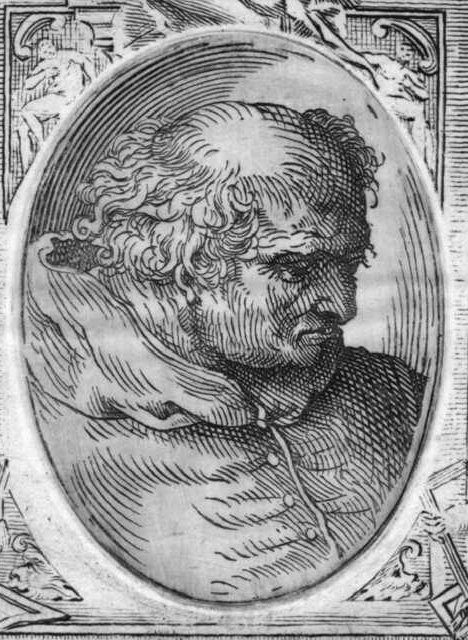
Donato Bramante[pron 1] (1444 – 11 April 1514),[4] born as Donato di Pascuccio d'Antonio[5] and also known as Bramante Lazzari,[6][7] was an Italian architect and painter. He introduced Renaissance architecture to Milan and the High Renaissance style to Rome, where his plan for St. Peter's Basilica formed the basis of the design executed by Michelangelo. His Tempietto (San Pietro in Montorio) marked the beginning of the High Renaissance in Rome (1502) when Pope Julius II appointed him to build a sanctuary over the spot where Peter was martyred.

Key Information

Life

[edit]

Urbino

[edit]

Bramante was born under the name Donato d'Augnolo,[7] Donato di Pascuccio d'Antonio, or Donato Pascuccio d'Antonio[citation needed] in Fermignano near Urbino. Here, in 1467, Luciano Laurana was adding to the Palazzo Ducale an arcaded courtyard and other Renaissance features to Federico da Montefeltro's ducal palace. Bramante's architecture has eclipsed his painting skills: he knew the painters Melozzo da Forlì and Piero della Francesca well, who were interested in the rules of perspective and illusionistic features in Andrea Mantegna's painting.

Milan

[edit]

Around 1474, Bramante moved to Milan, a city with a deep Gothic architectural tradition, and built several churches in the new Antique style. The Duke, Ludovico Sforza, made him virtually his court architect, beginning in 1476, with commissions that culminated in the famous trompe-l'œil choir of the church of Santa Maria presso San Satiro (1482–1486).[citation needed] Space was limited, and Bramante made a theatrical apse in bas-relief, combining the painterly arts of perspective with Roman details. There is an octagonal sacristy, surmounted by a dome. In Milan, Bramante also built the tribune of Santa Maria delle Grazie (1492–99); other early works include the Cloisters of Sant'Ambrogio, Milan (1497–1498), and some other constructions in Pavia (where he worked on the Cathedral, setting the design and creating the crypt and part of the apse[8]) and possibly Legnano. However, in 1499, with his Sforza patron driven from Milan by an invading French army, Bramante made his way to Rome, where he was already known to the powerful Cardinal Riario.[citation needed]

Rome

[edit]
Tempietto

In Rome, he was soon recognised by Cardinal Della Rovere, shortly to become Pope Julius II. For Ferdinand of Aragon and Isabella of Castile or possibly Julius II, Bramante designed one of the most harmonious buildings of the Renaissance: the Tempietto (1502) of San Pietro in Montorio on the Janiculum.[9] Despite its small scale, the construction has all the rigorous proportions and symmetry of Classical structures, surrounded by slender Doric columns, surmounted by a dome. According to a later engraving by Sebastiano Serlio, Bramante planned to set it within a collonaded courtyard. In November 1503, Julius engaged Bramante for the construction of the grandest European architectural commission of the 16th century, the complete rebuilding of St Peter's Basilica. During this time, he created the plans for a vast outdoor courtyard connecting the surrounding buildings called, Cortile del Belvedere.[10] The cornerstone of the first of the great piers of the crossing was laid with ceremony on 17 April 1506. Very few drawings by Bramante survive, though some by his assistants do, demonstrating the extent of the team which had been assembled. Bramante's vision for St Peter's, a centralized Greek cross plan that symbolized sublime perfection for him and his generation (compare Santa Maria della Consolazione at Todi, influenced by Bramante's work) was fundamentally altered by the extension of the nave after his death in 1514. Bramante's plan envisaged four great chapels filling the corner spaces between the equal transepts, each one capped with a smaller dome surrounding the great dome over the crossing. So Bramante's original plan was very much more Romano-Byzantine in its forms than the basilica that was actually built. (See St Peter's Basilica for further details.)[citation needed]

Bramante also worked on several other commissions. Among his earliest works in Rome, before the Basilica's construction was underway, is the cloister (1500–1504) of Santa Maria della Pace near Piazza Navona.[citation needed]

Plans for St Peter's Basilica
A draft for St Peter's superimposed over a plan of the ancient basilica
Bramante's presentation plan, as a Greek cross design; as reconstructed by Geymüller
The dome, as planned by Bramante

Works

[edit]

In addition to building, Bramante wrote about architecture and composed eighty sonnets.[11]

See also

[edit]

Footnotes

[edit]
[edit]
Revisions and contributorsEdit on WikipediaRead on Wikipedia
from Grokipedia
Donato Bramante (c. 1444–1514) was an Italian architect and painter of the , celebrated for his innovative fusion of with contemporary design, which profoundly influenced Western architecture. Born near in the , he initially trained as a painter under influences like before transitioning to architecture, moving to around 1474 where he served as court architect to . His Milanese works, such as the church of Santa Maria presso San Satiro (1482–1486), demonstrated early mastery of perspective and trompe l'oeil techniques to create illusory depth in constrained spaces. In 1499, following the French invasion of Milan, Bramante relocated to , where he became the chief architect for Popes Alexander VI and Julius II, marking the pinnacle of his career. His most iconic commission was the initial design for the new St. Peter’s Basilica (1506), featuring a centralized Greek cross plan that embodied ideals of symmetry, proportion, and harmonic , though much of it was altered after his death. Other landmark projects in Rome include the Tempietto at (1502), a diminutive circular temple that exemplifies perfect classical balance and became a model for worldwide, and the (1505–1513) in the Vatican, an expansive courtyard linking disparate structures with innovative . Bramante's emphasis on mathematical precision and revival of ancient Roman forms earned him recognition as the father of architecture, bridging the Early with the grandeur of later masters like and .

Early Life and Formation

Birth and Youth in Urbino

Donato Bramante, born Donato di Pascuccio d'Antonio c. 1444 at Monte Asdrualdo near Fermignano in the , came from a modest family of well-to-do farmers and local artisans. His early years unfolded in a rural setting close to the vibrant cultural hub of , where the family's agrarian roots provided a stable yet unremarkable foundation for his development. Urbino, under the rule of Duke from 1444 to 1482, emerged as a prominent cultural center, attracting scholars, artists, and humanists through the duke's enlightened patronage. Federico's court fostered an environment rich in intellectual and artistic pursuits, transforming the city into a beacon of ideals amid the socio-political turbulence of 15th-century . As a youth, Bramante gained early exposure to this dynamic milieu, particularly the ongoing construction of the Palazzo Ducale, which began incorporating features like the arcaded courtyard in 1467 under the direction of architect Luciano Laurana. This project, commissioned by , highlighted innovative architectural principles that likely sparked Bramante's initial fascination with painting and geometry during his adolescence. He may have begun an apprenticeship in local workshops, honing basic skills in these areas before transitioning to more formal artistic training under painters such as .

Artistic Training and Early Influences

Donato Bramante began his artistic career in during the 1460s and 1470s, where he apprenticed and collaborated with prominent painters at the court of . He likely trained under or closely worked alongside , whose rigorous approach to form and space profoundly shaped Bramante's early skills, and Melozzo da Forlì, known for his innovative use of perspective in frescoes. These associations immersed Bramante in Urbino's vibrant artistic environment, fostering his initial expertise in rendering architectural elements with mathematical precision. Little is known of his early works, as none survive, but he contributed to decorative projects in Urbino's ducal palaces and nearby ecclesiastical settings, specializing in frescoes and illusionistic designs that emphasized spatial depth. These projects highlighted Bramante's mastery of linear perspective, a method that integrated geometry into painting to achieve naturalistic representations of space, distinguishing his contributions from more ornamental court decorations. Bramante's development was further enriched by Urbino's humanist circle, a hub of intellectual inquiry under , which emphasized mathematical principles of proportion and . The court's renowned library housed key texts like Euclid's Elements, exposing artists to axiomatic approaches to form and harmony that influenced Bramante's understanding of spatial relationships. This environment encouraged possible informal studies in , bridging artistic practice with scientific rigor and preparing Bramante for more structural pursuits. Around 1470, Bramante began shifting from painting to , drawn by the rational emerging in Urbino's building projects, particularly those of Laurana at Ducale. Laurana's elegant courtyard and facade, with their balanced proportions and classical motifs, exemplified a geometric clarity that captivated Bramante and prompted his exploration of built forms over painted illusions. This transition marked a pivotal , as Bramante adapted his perspectival expertise to three-dimensional , laying the groundwork for his later architectural innovations.

Career in Milan

Arrival and Patronage under the Sforza

Around 1474, Donato Bramante relocated to , the thriving capital of , likely passing through en route to capitalize on the city's burgeoning artistic and architectural opportunities. This move marked a pivotal shift from his formative years in , where his skills in painting had prepared him for multifaceted roles in a dynamic court environment. , under the influence of the Sforza family, offered a fertile ground for innovation amid its blend of Gothic traditions and emerging classical revivals. Upon arrival, Bramante quickly gained the patronage of , known as Il Moro, who ruled as regent and later duke from 1480 onward. By 1476, Sforza appointed him as court architect, entrusting him with initial consultations on building projects and decorations for the Sforza Castle, including painted embellishments for ceremonial spaces that enhanced court entertainments. This support integrated Bramante into Milan's elite artistic milieu, where his expertise in perspective and classical motifs proved invaluable for the duke's ambitious cultural agenda. Within the Sforza circle, Bramante collaborated closely with , who arrived in Milan around 1482, and other prominent figures on various initiatives. Their partnership extended to the design of Cathedral, where Bramante contributed architectural plans starting in 1488 and Leonardo provided conceptual input, blending innovative engineering with aesthetics. These joint efforts exemplified the interdisciplinary vibrancy of the Sforza court, fostering advancements in both art and architecture. Bramante's tenure in Milan ended abruptly in 1499 amid political upheaval, as French forces under King invaded and ousted from power. With his primary patron exiled, Bramante departed the city, seeking new prospects that would lead him to and papal commissions. This invasion disrupted the Sforza's patronage network, scattering many artists and marking the close of a transformative era for Bramante in .

Major Architectural Projects in Milan

Bramante's architectural endeavors in Milan, supported by the of , showcased his ability to innovate within constrained urban settings, blending classical proportions with local Lombard traditions. One of his earliest and most ingenious projects was the church of Santa Maria presso San Satiro, constructed between 1482 and 1486. Due to limited space behind the altar—constrained by adjacent buildings—Bramante designed a shallow that served as the , featuring a masterful painted in perspective to simulate a deep, barrel-vaulted space receding into the wall. This , executed with precise foreshortening and architectural detailing, created the appearance of a traditional while occupying minimal depth, demonstrating Bramante's creative adaptation of perspective techniques to architectural necessity. In 1492, Bramante began work on the tribuna (tribune or crossing) of Santa Maria delle Grazie, completing it around 1497 as an octagonal domed addition to the existing Gothic church. Commissioned as a for the Sforza family, the structure featured a central dome supported by pendentives, with elegant Corinthian pilasters and arches that unified the new elements with the older brick facade. The tribuna's harmonious integration emphasized Bramante's skill in spatial continuity, using rhythmic proportions to enhance the church's interior luminosity and verticality without overwhelming the original layout. Bramante's at Sant'Ambrogio, built from 1497 to 1498, exemplify his fusion of Gothic and motifs in a monastic setting. The design incorporated superimposed colonnades with slender columns supporting rounded arches on the lower level and a more robust, rhythmic sequence above, creating a serene that encircled the courtyard while respecting the basilica's ancient Romanesque foundations. This project highlighted Bramante's sensitivity to site-specific harmony, employing subtle variations in column spacing to evoke movement and enclosure within the Lombard architectural idiom. During the 1480s, Bramante contributed to the design of Pavia Cathedral, particularly the and areas, where he introduced innovative vaulting systems alternating between flat and segmental arches to support the structure's ambitious scale. These elements reflected his early experimentation with centralized plans and load-bearing techniques, influencing the cathedral's overall evolution as a major project in the region.

Career in Rome

Invitation by Pope Julius II and Initial Works

In 1499, following the French invasion of Milan that led to the fall of the Sforza dynasty and the flight of his patron , Donato Bramante departed the city and relocated to , possibly at the invitation of the influential Cardinal , with whom he had prior connections. This move marked the end of his Milanese period and the beginning of his integration into the Roman artistic and ecclesiastical circles, where classical antiquities and papal ambitions would shape his later career. Upon arrival, Bramante quickly established himself amid 's burgeoning revival, leveraging his reputation from Lombard projects to secure initial patronage. One of Bramante's first major commissions in Rome was the cloister of , undertaken between 1500 and 1504 for Cardinal Oliviero Carafa. This elegant structure, located near , featured superimposed arcades with serene proportions inspired by , demonstrating Bramante's early adaptation of classical elements to ecclesiastical design in the Eternal City. The cloister's harmonious geometry and restrained ornamentation exemplified his emerging Roman style, blending functionality with aesthetic purity. In 1503, with the election of , Bramante received a pivotal appointment as the pontiff's chief architect, tasked with overseeing restorations and urban improvements in the Vatican area. This role positioned him at the heart of Julius II's ambitious program to renovate , including initial work on papal structures that highlighted his expertise in and classical revival. Bramante resided in for the remainder of his life, immersing himself in the city's intellectual and artistic environment until his death from illness on April 11, 1514.

Monumental Commissions and Urban Planning

One of Bramante's earliest and most celebrated Roman commissions was the Tempietto at , begun in 1502. This small, circular martyrium, commissioned by King Ferdinand II and Queen Isabella I of , commemorates the site of Saint Peter's crucifixion. The structure features a Doric of sixteen columns supporting an and balustrade, enclosing a central chamber with a and hemispherical dome topped by a (later altered in 1605). The design evokes through its precise proportions and temple-like form, marking a pivotal moment in Bramante's adoption of ideals in . Bramante's most ambitious project was his original design for the new , commissioned by in 1505 and with foundations laid on 18 April 1506. The plan centered on a Greek cross layout, comprising four equal arms radiating from a massive square under a grand central dome, creating a centralized, symmetrical form that emphasized harmony and monumentality. This configuration drew inspiration from ancient Roman structures, particularly the vast enclosures of imperial baths like those of , adapting their scale and spatial organization to ecclesiastical architecture. Bramante collaborated with architects Giuliano da Sangallo and Fra Giovanni Giocondo on the initial phases, overseeing the of the old Constantinian to make way for this transformative vision. In parallel, Bramante undertook the between 1505 and 1513, a terraced corridor that unified the Vatican Palace with the earlier Belvedere villa. Stretching over 300 meters along three descending levels, the design incorporated classical elements such as arcades, exedrae, and niches intended to house ancient sculptures, including the renowned group. The corridor's axial alignment and graduated terraces created a dramatic processional path, enhancing the Vatican's spatial coherence. Bramante's broader contributions to Vatican involved extensive extensions to the papal palaces and the integration of new structures along classical axes, fostering a cohesive ensemble that reflected principles of order and proportion. Under Julius II's patronage, he coordinated the renovation of the , adding wings and loggias to accommodate administrative and ceremonial functions while ensuring alignment with the basilica's emerging layout. These efforts transformed the into a unified urban complex, blending with to evoke imperial Rome's grandeur.

Architectural Style and Innovations

Key Influences and Stylistic Evolution

Bramante's early artistic development in during the 1470s was profoundly shaped by Umbrian painters such as and Melozzo da Forlì, whose mastery of linear perspective and spatial illusionism informed his initial approach to representing architecture in painting. These influences are evident in Bramante's perspectival frescoes, where he employed illusionistic techniques to create depth and three-dimensionality, transitioning toward architectural applications by the 1480s as seen in his decorative schemes for church facades. During his Milanese period under Sforza patronage from around 1479, Bramante shifted toward the study of classical Roman forms, drawing directly from Vitruvius's and ancient ruins accessible through the ducal library and his associations with scholars like Gaspare Visconti. This exposure enabled him to integrate proportional systems, columnar orders, and geometric clarity into his designs, moving away from the decorative Lombard Gothic hybrids prevalent in toward a more rational syntax. In his Roman phase after 1499, Bramante synthesized these elements with Byzantine dome traditions—reminiscent of the Pantheon's oculus and hemispherical vaulting—and Greco-Roman orders, achieving a pure clarity exemplified briefly in structures like the Tempietto, where Doric columns and a centralized dome evoke ancient temple ideals without Gothic vestiges. By 1500, this evolution marked a decisive break from earlier eclectic styles, prioritizing harmonic symmetry and classical purity. Across his career from the 1470s to 1514, Bramante progressed from a decorative painter influenced by Umbrian illusionism to an specializing in centralized plans, adapting Brunelleschi's Florentine innovations—such as the sacristy's cubic —to the contexts of Milanese and Roman monumentalism. This arc reflects a broader emphasis on mathematical proportion and antique revival, tailored to diverse regional demands.

Core Principles and Techniques

Bramante's architectural designs placed a profound emphasis on mathematical proportion and symmetry, employing geometric ratios to ensure harmonious scaling and structural balance in plans and elevations. He drew from classical sources to implement ratios such as 1:√2, which contributed to the rhythmic scaling of elements and evoked a sense of cosmic order reflective of . This rigorous approach to proportioning, often adapting Vitruvian principles or the golden section based on the building's form, allowed for consistent repetition of shapes across scales, fostering visual unity. Building on his background in illusionistic painting, Bramante innovated with centralized plans—typically circles or Greek crosses—to direct spiritual focus toward a symbolic core, embodying ideals of divine and equilibrium. In sites limited by urban constraints, he employed techniques, using perspectival rendering to create illusions of extended depth and volume, thereby enhancing spatial perception without altering physical boundaries. Bramante meticulously integrated classical orders, including Doric for bases and Ionic for upper levels, paired with entablatures directly modeled on ancient Roman precedents to achieve clarity and proportion. This method deliberately rejected the ornate, asymmetrical excesses of medieval styles, prioritizing instead the serene rationality of antiquity. Among his innovations, Bramante pioneered lightweight domes with reduced wall thicknesses and expansive colonnades supported by slender piers, enabling broad interior spans free from the encumbrance of heavy buttresses. These feats revived ancient load-bearing strategies, such as those of the Pantheon, to support monumental volumes with elegant efficiency.

Legacy

Impact on High Renaissance Architecture

Donato Bramante's arrival in marked a pivotal introduction of classical purity to northern Italian architecture, synthesizing the structural innovations of and with local Gothic and Byzantine traditions. In works such as Santa Maria presso San Satiro (1482–1486), Bramante employed precise classical proportions and a plan, as seen in the Prevedari Engraving (c. 1481), to create a bridge from Early forms to the monumental scale of architecture evident in by 1500. This evolution positioned Bramante as a key figure in transitioning from Florentine restraint to Roman grandeur, influencing the paradigm shift toward and harmony in sacred spaces. Under , Bramante transformed the Vatican into the epicenter of architecture, standardizing the centralized basilica plan that emphasized geometric perfection and symbolic eternity. His design for the new Saint Peter's Basilica (1506), featuring a Greek cross layout with a massive central dome, set a precedent for papal commissions, including adaptations by successors that perpetuated this form well after his death in 1514. This standardization not only elevated the Vatican's architectural prestige but also disseminated centralized designs across , reinforcing the 's focus on monumentality and classical revival. Bramante's contributions further manifested in a decisive shift from pictorial illusionism—prevalent in earlier perspectives—to tectonic clarity, where structural elements asserted bold, unadorned forms to convey imperial scale. This approach profoundly impacted the urban renewal of under Julius II, as seen in the (1505), which integrated expansive axes and terraced landscapes to evoke ancient Roman splendor and facilitate the city's transformation into a Renaissance capital. His Tempietto (1502) exemplified this clarity, earning contemporary acclaim from , who described it as "the most beautiful work" for its impeccable proportions and Doric elegance.

Pupils, Collaborators, and Modern Assessments

Bramante did not establish a formal with dedicated pupils in the manner of contemporaries like , but his architectural innovations profoundly shaped the work of younger artists, particularly , who regarded him as a mentor and adopted elements of his centralized villa designs in projects such as the . On major Vatican commissions like , Bramante collaborated closely with assistants and peers, including the sculptor and medallist Cristoforo Foppa Caradosso, whose foundation medal and related drawings survive as evidence of workshop contributions to the project's early phases. After Bramante's death in 1514, assumed oversight alongside Giuliano da Sangallo and Fra Giocondo, maintaining fidelity to the original Greek-cross plan amid ongoing construction. Interactions among Bramante, Michelangelo, and Sangallo on Vatican endeavors were initially collaborative but grew tense following Bramante's passing, as subsequent alterations to St. Peter's deviated from his vision. Michelangelo, who had contributed sculptural elements under Bramante's direction, later decried Sangallo's elaborate modifications—such as added buttresses and a Latin-cross extension—as overly complex and Germanic, prompting Michelangelo's own simplifying interventions in 1547 to restore aspects of Bramante's scale. These frictions highlighted competing interpretations of Bramante's ambitious framework, with surviving workshop drawings underscoring the collaborative yet contested nature of the enterprise. In 20th- and 21st-century scholarship, Bramante is widely regarded as the "father of High Renaissance architecture" for synthesizing classical proportions and spatial harmony, as articulated in Rudolf Wittkower's seminal analyses of geometric principles underlying his designs. Recent restorations of St. Peter's, including 20th-century excavations of foundational piers, have revealed traces of Bramante's original centralized layout, affirming its structural ingenuity despite later modifications. However, modern critiques, drawing on engineering assessments, fault the over-ambition of his scale—such as the massive dome piers that cracked early—for necessitating reinforcements and prolonging construction, underscoring the tension between visionary boldness and practical feasibility. Historiographical gaps have long marginalized Bramante's origins as a painter, with early biographers like Vasari prioritizing his Roman architecture over his Milanese frescoes, which integrated perspectival experiments influenced by Piero della Francesca; recent studies redress this by emphasizing how his pictorial background informed spatial innovations in architecture. Similarly, traditional narratives underemphasize female patrons like Beatrice d'Este, whose support for Sforza court projects contributed to Bramante's early career in Lombardy; contemporary research highlights these overlooked ties to illuminate his career's formative networks. Recent digital reconstructions and algorithmic analyses of his unbuilt designs, such as the Tempietto cloister, continue to explore his geometric principles as of 2025. The preservation of the Tempietto exemplifies his enduring legacy through intact early works.

References

Add your contribution
Related Hubs
User Avatar
No comments yet.