Hubbry Logo
Seven-string guitarSeven-string guitarMain
Open search
Seven-string guitar
Community hub
Seven-string guitar
logo
8 pages, 0 posts
0 subscribers
Be the first to start a discussion here.
Seven-string guitar
Seven-string guitar
from Wikipedia
A Brazilian seven-string guitar
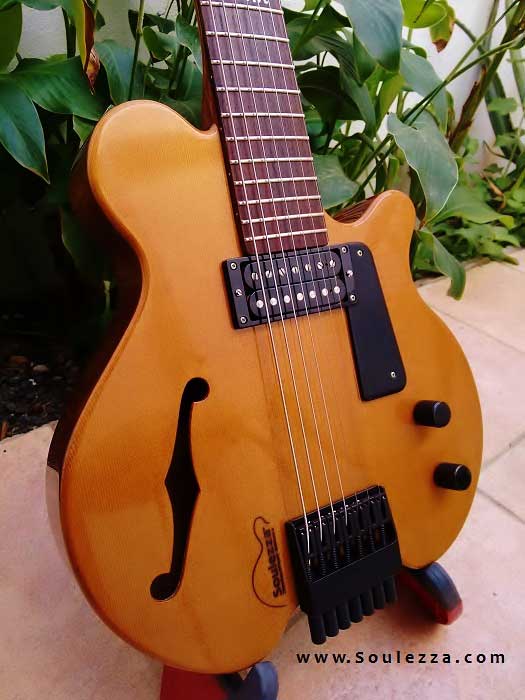
Soulezza 7 String Guitar

The seven-string guitar adds one additional string to the more common six-string guitar, commonly used to extend the bass range (usually a low B) or also to extend the treble range.

The additional string is added in one of two different ways: by increasing the width of the fingerboard such that the additional string may be fretted by the left hand; or, by leaving the fingerboard unchanged and adding a "floating" bass string. In the latter case, the extra bass string lies next to the existing bass strings, but free of the fingerboard in similar fashion as the archlute and theorbo. Such unfrettable bass strings were historically known as diapasons or bourdons.

Some types of seven-string guitars are specific to certain cultures such as the Russian, Mexican, and Brazilian guitars.

History

[edit]

The history of the seven-string guitar stretches back more than 230 years. During the Renaissance period (c. 1400–1600), the European guitar generally had four courses, each strung with two gut strings, and the pair of strings within each course tuned in unison. By the mid-Baroque period (c. 1600–1750), it more commonly had five courses (still double-strung) and used a variety of tunings, some of them re-entrant. By the early 18th century, six double-strung courses had become common.

Up to this point, most stringed instruments were strung with gut strings. At around 1800, quality metal-wire strings became widely available. These new strings were more durable, remained in tune longer and, most importantly, produced a louder sound than the traditional gut strings. As use of metal strings became more widely adopted, their greater volume output impelled luthiers to experiment more with single-strung courses on their instruments and, in a relatively short time, the modern practice of using six single strings became first common, and then standard.

The changing number of courses in these early guitars may also illustrate an ongoing desire on behalf of players to increase the range of the instrument, a development similar to that gone through by the lute in earlier days. It is likely that all of these factors contributed to the development of the seven-string guitar, which has been around ever since. The seven-string guitar never became as widely accepted in Europe as the six-string instrument, but a number of composers did produce a significant body of work for the seven string. French guitarist Napoleon Coste (1805–1883) composed works with a seven-string guitar specifically in mind. The Italian guitarist Mario Maccaferri (1899–1993) was a celebrated advocate of bass strings (diapasons or bourdons) and also composed for the instrument.[1]

By contrast, in Russia the seven-string guitar became widely popular, and entire schools of playing were developed around its use. Despite some brief setbacks in the mid-20th century, during which six-string instruments rose in prominence, the seven-string Russian guitar has remained popular in Russia to this day.[2]

In the New World, a guitarra séptima or guitarra sétima—with fourteen strings, strung in seven double courses—has been known in Mexico since at least 1776 (Antonio Vargas).[3] These instruments may still be found in use in Mexico, although the modern six-string instrument has become far more common. Seven-string instruments retain current popularity in parts of South America, notably Brazil, where they became an important instrument in the choro [es] music of the 19th century, which is currently experiencing a revival.[4]

Acoustic designs

[edit]

Russian

[edit]
"The Guitar Player" by V.A. Tropinin (1823)

The Russian guitar or gypsy guitar is a seven-string acoustic guitar tuned to the open G tuning (DGBDGBD),[5] which arrived or was developed early in the 19th century in Russia, possibly as a development of the cittern, the kobza and the torban. It is known in Russia as the semistrunnaya gitara (семиструнная гитара) or affectionately as the semistrunka (семиструнка).

Its invention was popularized by Andrei Sychra, who also wrote a method for the guitar, as well as over one thousand compositions, seventy-five of which were republished in the 1840s by Stellovsky, and then again in the 1880s by Gutheil. Some of these were published again in the Soviet Union in 1926. Andrei Sychra in his notation, marks with a number between 1 and 4 where to fret the 7th string with the thumb. Another way that Andrei Sychra took advantage of this guitar's innovation was through natural harmonics. Because of the three strings tuned to D, harmonics could be played in synchronization.[6]

Early instruments used gut, and later silk strings; rarely wire. In the 20th century these instruments commonly used nylon strings, like western classical guitars, though by the last third of the century both nylon-strung "classical" and metal-strung "gypsy" versions of the instrument were both plentiful. Whatever material was used for stringing, the Russian guitar is traditionally played without a pick, using fingers for either strumming or picking. The origins of the 7 string most likely came from the English "guittar" popular in the late 18th century. The added string created an extra dimension for bass notes as well as opening up chord possibilities. The seventh string is also likely to have been influenced by the harp as it is meant to played arpeggiated.[7] It also happens that the open D tuning was a perfect fourth lower than the six string tuning.[8] The open D string tuning of this guitar was convenient for many Russian folk songs and dances that were typically within the major key. Along with the added interval possibilities came new techniques not previously seen with 6th string guitars.

The Russian version of the seven-string guitar has been used by professionals, because of its great flexibility and its sound, but has also been popular with amateurs for accompaniment (especially Russian bards) due to the relative simplicity of some basic chords and the ease of playing alternating bass lines. While greatly popular in Russia and Ukraine, this type of guitar has only recently been generating some interest outside of its traditional homeland.

The earliest music published for a seven-string guitar was in St. Petersburg, Russia, on 15 December 1798. The school was owned by Ignác František Held (1766, Třebechovice pod Orebem, Bohemia – 1816, Brest-Litovsk, Russia).

Standard tuning for the Russian guitar is: D2 G2 B2 D3 G3 B3 D4 with a very common "classical" variant being C2 G2 B2 D3 G3 B3 D4

Other tunings include:

  • G-C-E-G-C-E-G ("Big guitar") (Open C)
  • F-B-D-F-B-D-F (1/3rd guitar) (Open Bb)
  • E-A-B-D-G-B-D
  • E-G-B-D-G-B-D
  • D-G-C-D-G-B-D
  • B-F-B-E-A-D-F
  • A-E-A-D-G-B-E
  • A-D-G-C-F-A-D

Brazilian

[edit]

The Brazilian seven-string guitar (Portuguese: violão de sete cordas) is an acoustic guitar used primarily in choro and samba. It was introduced to Brazil in the late 19th century as a steel string guitar. The style of "baixaria" counterpoint and accompaniment technique was developed throughout the 20th century, especially by Dino 7 Cordas and Raphael Rabello. In the early 1980s, guitarist Luiz Otavio Braga had a nylon string version made, and this has become the norm for most contemporary solo musicians such as Yamandu Costa.

The Brazilian seven-string guitar is typically tuned like a classical guitar, but with an additional C below the low E as follows: C2 E2 A2 D3 G3 B3 E4; although some musicians tune the C down to a B resulting in: B1 E2 A2 D3 G3 B3 E4.

Classical

[edit]

Seven-string guitarists are utilized in playing traditional and contemporary "classical" repertoire. These instruments are essentially nylon-strung classical guitars with one extra (usually) bass string, and the tuning is most commonly: B1 E2 A2 D3 G3 B3 E4. Aficionados of the instrument have produced many new arrangements, traditionally six-string classical guitar pieces, and the seventh string may be retuned—to C or D, for example—to accommodate these arrangements. The use of this instrument in the classical world, along with other extended range instruments having 8, 9, 10, 11, or more strings, has become common enough that several noted string manufacturers now produce and mark string sets specifically for seven-string classical guitars (La Bella; Pyramid; d'Aquisto; etc.). For example, Napoleon Coste arranged one of Franz Schubert's pieces for guitar and vocal accompaniment, despite guitars being typically for solo performance at the time.[9]

Mexican (guitarra séptima)

[edit]

There is a guitar of seven pairs of strings, totaling 14 strings, known as guitarra séptima aka 14 String Guitar. The instrument is still played in Mexico and the USA by popular bands, most notably Korn.

Electric designs

[edit]

Semi-hollow and hollow body electric guitars

[edit]

In the United States, the jazz guitarist George Van Eps had a seven-string guitar built for him by Epiphone Guitars in the late 1930s and a signature Gretsch seven-string in the late 60s and early 70s. The Van Eps signature guitar may be the first regular-production seven-string electric guitar. Van Eps tuned his 7th string to A.

Several others began using seven-string guitars after Van Eps, including Bucky Pizzarelli, Howard Alden, Ron Escheté, Chance Russell, and John Pizzarelli, son of Bucky Pizzarelli.[10] Lenny Breau also used seven string instruments, but whereas the other players all used instruments with an added bass string, Breau had at least one instrument in which the seventh string was an added treble string, tuned to the 'A' above the high 'E' string (A4). At the time he began using the high A string, no commercially manufactured string could withstand being tuned that high, so Breau substituted a piece of monofilament fishing line of appropriate gauge. A year later, advances in materials science allowed the La Bella company to begin manufacturing a custom string for Breau's high A.[11]

Seven-string semi-acoustic archtop guitars were used by jazz-guitarist Ralph Patt after he began exploring major-thirds tuning in 1964.[12][13][14] Patt's tuning is a regular tuning, in the sense that all of the intervals between its successive open strings are major thirds; in contrast, the standard guitar-tuning has one major-third amid four fourths.[15] Major-thirds tuning has a smaller scope than standard guitar-tuning,[15][16] and so Patt started using seven-string guitars, which enabled major-thirds tuning to have the E-e' range of the standard tuning. He first experimented with a wide-neck Mango guitar from the 1920s, which he modified to have seven strings in 1963.[17] In 1967 he purchased a seven-string by José Rubio.[16]

The first seven-string electric guitars were built in the "hollowbody" or "semi-hollow" archtop styles, where the guitar has a central resonating chamber, or a central block with resonant chambers on the sides. This gave the guitar the dark woodiness, breath, and richness that is associated with traditional "jazz" tone, but also made prone to feedback at high volumes, making it problematic for rock guitar playing.

Solid body electric guitars

[edit]
Seven-string electric guitar Ibanez RG7321

In the early thirties the National String Instrument Corporation offered seven-string versions of their solid-body lap-steel guitars.

A solid body seven-string electric guitar was conceived by guitarist Lenny Breau and built by luthier Kirk Sand,[11] debuting at the 1983 NAMM Show, featuring a high A-string (rather than the low A-string of Eps).[18] In 1987, Fender signed an agreement with Alex Gregory to produce a Stratocaster-style guitar that featured a high A-string. A small number of prototypes were made. However the unit was never put into production. He has made numerous false claims in regards to the 7 string guitar and is not considered a reliable source of information, even regarding his own 7 string signature series which was produced in limited numbers by Fender. He frequently embellishes the events that took place in all facets of its production. [19]

The first mass-produced seven-string was the Ibanez UV7, a signature model for Steve Vai.[20] It was also used by John Petrucci, Reb Beach, and Korn guitarists Brian Welch and James Shaffer, amongst others.[21] Vai was drawn to the idea for much of the same reasons seven-string classical and jazz players were—the extended range the additional string offered. After initial experimentation with a high A, a low B was added as the high A proved to be too prone to breaking. (Kirk Sand and Lenny Breau solved the breaking high A string problem by shortening the scale length to 22.75", Vai's Ibanez is 25.5".) Vai began touring with Whitesnake with a seven-string prototype, and then used the guitars for his 1990 release Passion and Warfare.

The seven-string guitar became prominent when the band Korn featured Ibanez Universe guitars on their 1994 debut album.[22] During the 1990s, manufacturers of 7-strings included Fender's subsidiary Squier and Gibson's subsidiary Epiphone.

In this time many guitarists were introduced to the extended range offered by a seven-string guitar. This was somewhat offset by a growing stigma that a seven-string guitar was a "nu metal" instrument, fit only for heavy riffing. This was ironic as Korn guitarists Munky and Head remember being told in their early days that the seven-string guitar could not be used for riffing, as it was a guitar for technical guitar players.[23]

In the 1990s, several other heavy metal guitarists began using seven-string instruments (notably John Petrucci, Trey Azagthoth, and Erik Rutan), seeing the possibility for detuned riffing while preserving the full upper range of the guitar for solos. However, the seven-string guitar failed to really catch on at this phase in its development, and the Universe model was discontinued briefly in 1995. Historically, Matt Bellamy from Muse had used a custom red Manson seven-string to play just one song, "Citizen Erased", with a AADDGBE tuning (the song was originally recorded on a detuned six-string). However, he later started using new Manson custom seven-strings to play new songs "Supremacy", "Survival" and "Liquid State" on Muse's 2012 The 2nd Law album tour. Dino Cazares uses custom seven-string Ibanez guitars; Christian Olde Wolbers has his own signature Jackson seven-string guitar, Jeff Loomis has a signature model made by Schecter and Stephen Carpenter has several of his own models released by ESP.

Hybrid designs

[edit]

In the early 2000s, Roger McGuinn (renowned for his skills on the twelve-string guitar and for his long association with The Byrds) worked with C. F. Martin & Company to develop a seven-string folk guitar. McGuinn's guitar (currently being marketed by Martin) is tuned the same as a standard folk guitar with steel strings, but the third (G) string is augmented with a high octave string. Many of McGuinn's notable guitar solos utilize the G string of the twelve-string guitar to perform the main melody, and therefore the Martin seven-string guitar was designed to achieve this extended range playing without the need for doubling all six of the guitar's strings.

In 2010, Inox Guitars has created a mix of the Brazilian Viola caipira and the Russian semistrunka (семиструнка). This instrument has 2 bass strings (as the 6th and 7th strings of the semistrunka) and five treble courses (as the Viola caipira) and it is used in open tuning (GDGDGBD) as a slide guitar.

Tuning

[edit]
A pack of Ernie Ball electric guitar strings for 7-string guitars

The 7-string guitar of today is frequently tuned with a lower B on the added seventh string (B1–E2–A2–D3–G3–B3–E4). Modern metal bands such as Trivium (on The Crusade and Shogun), Dream Theater and Haken commonly use this tuning.

Many jazz[24] musicians tune in dropped A tuning (A1–E2–A2–D3–G3–B3–E4) for improved bass lines and easier power chords. Choro players usually tune the seventh string up a half-step, to C: C2-E2-A2-D3-G3-B3-E4. The common Russian guitar tunings given above are still in widespread use. And players who prefer an added treble string (instead of an added bass string) usually tune: E2–A2–D3–G3–B3–E4–A4.

Uses

[edit]

Seven-string guitars are used in a variety of musical styles including classical, jazz, rock, progressive rock, and heavy metal. The seven-string works well in a band setting, as its lowest note, B1 lines up well with the B0 commonly used for the lowest note of a 5+ string bass. Both the guitar and bass could drop tune as well using a lowest note of A1 and A0 respectively (with the bass this extends the range to the lowest note on a standard piano).

The guitar is main contributor to giving the nu metal band Korn its “signature sound”.[citation needed]

There's also the 14-string guitar, which can be thought of as either a 12-string guitar w/ a Low B octave course added to it, or as a seven-string guitar with seven pairs of strings giving it a really nice shimmer.[citation needed]

See also

[edit]

Notes

[edit]

References

[edit]
Revisions and contributorsEdit on WikipediaRead on Wikipedia
from Grokipedia
The seven-string guitar is a with various acoustic and electric designs that extend the standard six-string guitar by adding a seventh , typically tuned to a low B below the conventional low E in modern extended-range models, thereby expanding the instrument's pitch range for deeper tones and greater versatility. Its origins trace back to late 18th-century , where it emerged as an tuned in an open G chord (from low to high: D2-G2-B2-D3-G3-B3-D4), influenced by European models and local folk traditions like the and . This Russian seven-string guitar flourished during its "" from 1800 to 1850, with key composers such as Andrey Sychra and Mikhail Vysotsky creating a rich repertoire of solo pieces, variations on folk songs, and chamber works performed in salons by both and serf musicians. The instrument's popularity waned in the Soviet era, suppressed as a symbol of bourgeois culture, but it persisted in niche folk and gypsy music contexts. In the , the seven-string guitar reemerged in Western contexts, with the first mass-produced solid-body electric model, the UV7, developed in 1990 through a collaboration between manufacturer and guitarist , featuring an extended 25.5-inch scale length to accommodate the added string's tension. This innovation marked a shift toward modern extended-range designs, often with scale lengths of 26 to 27 inches or fanned frets for improved intonation on the low B string, and it was initially discontinued in 1994 before a resurgence in the driven by demand in progressive and heavy genres. The instrument gained mainstream traction in the late 1990s through nu-metal bands like KoRn, whose guitarist James "Munky" Shaffer used it to achieve downtuned, aggressive riffs in standard B-E-A-D-G-B-E tuning, peaking in popularity between 1998 and 2002 alongside acts like and . As of 2025, seven-string guitars remain staples in metal subgenres such as , , and , enabling complex polyrhythms and low-end power, while acoustic variants continue to explore classical and world music applications; affordable models are now widely available from major manufacturers like Jackson, ESP, and Schecter.

Historical development

Early European origins

The guitar in evolved from the Renaissance-era four-course instruments, which featured pairs of strings tuned in unison, to the five-course models prevalent in the 17th and early 18th centuries, and finally to the six-string configuration that became standard by the mid-18th century. This progression reflected a desire for greater expressive range and playability, with the six-string guitar gaining prominence through luthiers like Antonio de Torres in . The addition of a seventh bass string, typically tuned to a low D or C to extend the instrument's lower register, appeared around the amid influences, marking an innovative adaptation for enhanced bass capabilities in solo and ensemble settings. Andrei Sychra (1773–1850), a musician born in (of Czech ancestry) who relocated to St. Petersburg in the 1790s, is widely regarded as the pioneer of the seven-string guitar in , developing it as an extension of the six-string model to accommodate complex harmonic and melodic demands. He published the first known music for the instrument in 1798, a set of variations that demonstrated its potential for virtuosic performance. Over his lifetime, Sychra composed more than 1,000 works for the seven-string guitar, including etudes, fantasies, and arrangements that formed the foundation of its classical repertoire and briefly popularized it in Russian musical circles. In Western Europe, the French guitarist and composer Napoleon Coste (1805–1883) embraced the seven-string design, often featuring a "floating" bass string positioned off the for selective low-note resonance, in his original compositions such as Le Zuyderzée and the 25 Etudes, Op. 38. Coste also created arrangements for the instrument, including adaptations of Franz Schubert's Lieder with guitar accompaniments that utilized the extended range to enrich the vocal lines. An early instance of non-European adoption occurred in , where guitarist Vargas y Guzmán referenced the seven-string guitar—likely as a seven-course variant—in his 1776 instructional method Explicación para tocar la guitarra de punteado por música o cifra, indicating transatlantic dissemination of the innovation.

Regional traditions in the 19th century

In the early 19th century, the seven-string guitar, known as the semistrunka in , became a of regional musical traditions, particularly through of specialized guitar schools that formalized its techniques and repertoire. These schools emerged around 1800, with the school led by figures like Mikhail Vysotsky emphasizing advanced left-hand fingering for complex harmonies, while the St. Petersburg school, influenced briefly by pioneer Andrei Sychra, focused on right-hand articulation suited to Russian folk melodies and transcriptions. The instrument's (DGBDGBD) facilitated the performance of major-key folk songs prevalent in Russian culture, blending Western classical influences with local traditions and achieving widespread popularity among the during the 1800–1850 period. By the mid-19th century, however, its association with gypsy musicians and lower social classes began to erode its elite status, though it remained integral to regional folk ensembles until a broader decline in the late 19th century. In , the seven-string guitar, or violão de sete cordas, was introduced in the late 19th century amid the rise of music in Rio de Janeiro, where it adapted European dance forms like polkas and waltzes into expressive instrumental ensembles. , emerging around the 1870s as a fusion of African, European, and indigenous elements, initially relied on six-string guitars for accompaniment, but the seven-string variant soon provided enhanced bass lines to support melodic lines in small groups known as ternos. Early adopters, such as Américo Jacomino (known as Canhoto or Tute, born 1889), began experimenting with the instrument in the , using its lowest string tuned to C for rhythmic "pé de boi" bass patterns that defined 's harmonic foundation, though its full integration occurred as solidified as a national genre by century's end. Mexico's guitarra séptima tradition, a seven-course instrument with 14 strings, traces back to at least 1776 and flourished in 19th-century folk music, serving as a rhythmic and harmonic pillar in regional ensembles like conjuntos jarochos along the Gulf Coast. Smaller than standard guitars, it was strung in double courses (typically tuned G-C-E-A-D-G-B) to produce a resonant, chorus-like timbre ideal for accompanying dances such as the son jarocho, where it provided steady strumming patterns and chordal support alongside harp and requinto. By the mid-19th century, the guitarra séptima had reached peak popularity in rural and urban folk settings, embodying Mexico's colonial musical heritage while adapting to local improvisational styles in community celebrations. Bridging late 19th-century classical traditions into the early , Italian Mario Maccaferri (1899–1993) contributed to seven-string designs inspired by romantic-era acoustics, experimenting with extended-range classical models that echoed the harmonic depth of 19th-century European guitar schools. His early work in the , including hybrid forms with additional bass strings, preserved and evolved the instrument's role in formal repertoire, connecting regional folk adaptations to broader classical contexts.

20th century and modern innovations

In the early , the seven-string guitar saw innovative adaptations in , particularly through the work of American guitarist , who commissioned in 1938 to create the first electric seven-string model by grafting a custom neck onto an existing Deluxe archtop. This instrument, tuned with a low A string to extend the bass range for chordal accompaniment and soloing, allowed Van Eps to emulate piano-like textures in swing and mainstream , marking a significant shift toward electrified extended-range designs. Mid-century developments faced challenges in regions with established traditions, such as , where the seven-string guitar—rooted in 19th-century folk and classical schools—encountered suppression during the Soviet era (1922–1991) as authorities deemed it a bourgeois relic incompatible with . This political clampdown led to a decline in production and performance, with the instrument nearly vanishing from mainstream use by the late 20th century. A revival emerged in the 1990s following the Soviet Union's dissolution, as musicians and luthiers like Oleg Timofeyev began documenting and performing the repertoire, fostering renewed interest through recordings and educational efforts that preserved its unique open-G tuning heritage. The late 20th century brought broader commercialization in rock and metal genres, exemplified by Ibanez's UV7 Universe model, developed in collaboration with in the late 1980s and released in 1990 as his signature seven-string electric. This solid-body design, featuring a low B string extension, influenced progressive and shred styles but gained massive traction in heavy music when Korn adopted guitars for their 1994 self-titled debut album, pioneering the downtuned, dissonant low-end sound that defined nu-metal and spurred widespread adoption among metal acts. Entering the 21st century, particularly post-2020, the seven-string guitar experienced renewed manufacturing and artistic expansions, including Ibanez's 2022 updates to its RG and AZ Premium series, which incorporated extended-range seven-string variants with enhanced like roasted necks for improved stability in low tunings. Discussions around versatility surged, as seen in commentary from Ichika Nito highlighting the instrument's potential beyond metal for blending bass-like lows with melodic highs in experimental and fusion contexts. Instructional guides emphasize its integration into through hybrid techniques, such as combining fingerstyle with for complex polyrhythms. Musicians like of and of contributed to this rock revival, with Bellamy incorporating seven-string Manson customs into live sets for tracks demanding extended range since their 2020–2022 tours, while Cazares endorsed Ormsby signature models to explore aggressive, industrial tones in post-pandemic releases.

Acoustic designs

Russian semistrunka

The Russian semistrunka, or seven-string guitar, represents a distinct acoustic tradition developed in during the late , characterized by its unique construction and tuning that facilitated both solo and roles in folk-classical music. Unlike Western European seven-string variants with a floating bass string, the semistrunka places all seven strings on the , enabling full fretting across the instrument and allowing techniques such as left-hand positioning on the lower strings for enhanced bass articulation. Early models featured shorter fingerboards with approximately 19 frets and often crowned (convex) profiles for better string clearance, while later 19th- and 20th-century designs extended to 20 or 21 frets to accommodate a broader range, similar to contemporary classical guitars. The instrument's standard tuning forms an open G major chord—D2–G2–B2–D3–G3–B3–D4—which produces a resonant, harp-like quality when strummed openly and supports intricate polyphonic textures. This open tuning, adapted from configurations, was popularized by Andrei Sychra (1773–1850), a Czech-born ist and composer who is regarded as the patriarch of the Russian guitar school for his pioneering method and over 1,000 works that established the semistrunka's repertoire. Sychra's compositions, including variations on Russian folk themes, emphasized arpeggiated plucking styles that incorporated bass lines on the lower strings (D2 and G2) for harmonic foundation, prefiguring accompaniment techniques in later guitar traditions by blending melodic flourishes with supportive bass patterns. By the , the semistrunka had become central to Russian guitar pedagogy, with schools and conservatories teaching its techniques alongside compositions by Sychra's successors, fostering a vibrant folk-classical scene that persisted into the early . However, its prominence waned during the Soviet era (1922–1991), as the instrument was stigmatized as a bourgeois relic following Andrés Segovia's 1926 promotion of the six-string , leading to a gradual shift in educational curricula toward the standard model by the mid-. Limited production persisted into the mid-, but institutional support declined sharply, confining the semistrunka to niche folk ensembles and private practice. A modern revival emerged in the late 1980s and 1990s, driven by scholars and performers adapting nylon strings to the semistrunka for brighter tone and easier playability on historical instruments, restoring access to its extensive . Key figures in this resurgence include Oleg Timofeyev, who since 1989 has organized the International Annual Russian Guitar Seminar and Festival (IARGUS) in , producing recordings and editions that highlight Sychra-era works and encouraging nylon-string constructions for contemporary classical contexts. This effort has emphasized the instrument's ethereal sound and thumb-positioned bass techniques, preserving its role in Russian musical heritage while inspiring global interest in its open-G .

Brazilian sete cordas

The Brazilian sete cordas, or seven-string guitar, is an acoustic instrument central to the and traditions, providing harmonic depth and contrapuntal bass lines within small ensembles. Introduced to in the late , likely influenced by European and Russian guitar variants, it quickly became integral to , a syncopated urban genre that emerged in Rio de Janeiro around the same period. By the early 20th century, it had solidified its role in choro groups, with the first known recording featuring the instrument in 1917 by guitarist Tute on the track "Sofres porque queres." The for the sete cordas is C2–E2–A2–D3–G3–B3–E4, which extends the bass range a minor third below the conventional six-string guitar, facilitating independent bass while the upper strings handle and . A defining technique is the baixaria, an improvised walking bass line played with of the right hand, often using rest-strokes to articulate rhythmic against the ensemble's ; this approach emulates the harmonic role of a or in traditional arrangements. Early adopters employed steel strings, but in 1979, guitarist Luiz Otávio Braga pioneered a nylon-string version, which offered greater sustain and expressiveness, becoming the standard for most players by the 1980s and influencing subsequent generations. Pioneering figures shaped the instrument's evolution and technique. Dino 7 Cordas (1918–2006), whose stage name reflects his mastery of the sete cordas, developed the baixaria style in the 1920s, drawing from choro leader Pixinguinha's saxophone lines and recording extensively through the 1990s; he often used a metal thumb pick for precision in bass articulation. Raphael Rabello (1962–1995) advanced the nylon-string approach in the 1980s, blending choro with classical influences and composing over 29 original pieces that expanded the instrument's repertoire. Contemporary virtuoso (born 1980) continues this legacy, incorporating regional rhythms like chamamé into frameworks, as heard in his 2007 composition "Samba pro Rafa." In samba ensembles, the sete cordas contributes essential harmonic support and bass ostinatos, mimicking percussion elements like the drum to enhance rhythmic drive without overpowering the vocals or other instruments. Modern players have fused these traditions with , as exemplified by Victor Biglione, whose improvisational style integrates baixaria with jazz harmony in works like those on his 1989 album Quebra-Pedra, bridging Brazilian roots with global influences.

Other acoustic variants

Classical nylon-string seven-string guitars, an extension of the standard six-string classical instrument, typically feature a tuning of B1–E2–A2–D3–G3–B3–E4, adding a low B string to expand the bass range for more resonant arrangements of and Romantic repertoire. These instruments, constructed with strings for a warm, mellow tone, allow performers to transcribe complex works originally beyond the six-string's capabilities, such as adaptations of Schubert's lieder. For instance, French guitarist Napoléon Coste (1805–1883) arranged several Schubert songs, including Gretchen am Spinnrade and Ave Maria, with piano accompaniments arranged for solo guitar to capture the composer's lyrical depth. Coste's own compositions and studies, like the 25 Études, Op. 38 (1873), were conceived for a seven-string guitar with an additional bass string tuned to D (or occasionally C), demonstrating early European experimentation with extended-range acoustics for enhanced harmonic texture. In , the guitarra séptima emerged as a distinct acoustic variant by at least 1776, when Veracruz guitarist Antonio Vargas y Guzmán referenced similar extended instruments in his published method for guitar continuo accompaniment. This seven-course guitar, strung with fourteen steel strings in double courses and featuring a short scale length, includes a prominent low bass course for robust rhythmic support in ensemble settings. By the , it peaked in popularity, as seen in instruments like Mariano Fernández's ca. 1880 model, which incorporated ornate inlays of mother-of-pearl and to symbolize cultural and political themes during Mexico's Liberal Reform era. Primarily fretted for folk traditions, the guitarra séptima provided foundational bass lines in mariachi-like groups, blending indigenous and Spanish influences to perform secular dances and songs across social strata. Rare European acoustic seven-string variants appeared sporadically in the 1800s as extensions of the six-string , often to accommodate virtuoso demands for lower registers. In , luthier crafted a notable seven-string model in 1839, featuring a compact body and extended bass for Romantic-era performances. Spanish-influenced designs, such as those inspired by French maker René Lacôte's heptachord (ca. 1830s), added a floating or fretted low string to traditional fan-braced constructions, enabling composers like Coste to explore fuller chord voicings in . These innovations remained niche, overshadowed by the rising dominance of the six-string but influencing later multi-string developments in design.

Electric designs

Hollow and semi-hollow bodies

Hollow and semi-hollow body seven-string electric guitars emerged primarily in contexts, providing resonant chambers that enhance acoustic projection while allowing for amplification, thus blending the warmth of archtop designs with electric versatility. Pioneered in , these instruments featured an additional low string tuned to A below the standard E, enabling guitarists to play bass lines, chords, and melodies simultaneously in a piano-like manner. Jazz guitarist George Van Eps commissioned the first known production seven-string electric guitar from Epiphone in the late 1930s, a hollowbody archtop model tuned with a low A string to expand the instrument's harmonic range for swing and mainstream jazz improvisation. Later, in the 1960s and 1970s, Gretsch produced signature versions of the Van Eps model, such as the 1969 and 1976 editions, which maintained the hollowbody construction with Filter'Tron pickups for clear, detailed tone suitable for jazz ensembles. These designs emphasized sustain and resonance, allowing the low A to integrate seamlessly with the guitar's natural acoustic qualities. Building on this tradition, adopted a seven-string configuration with a above the standard high E, initially using as a makeshift seventh before La Bella developed custom strings for it, facilitating advanced swing improvisation through thumb independence and polyphonic phrasing. Breau's approach, often on semi-acoustic models, highlighted the high string's role in melodic extension and harmonic richness in settings. Guild and Heritage have offered semi-hollow seven-string designs tailored for . These instruments underscore the genre's preference for resonant bodies that amplify the seven-string's expanded voicing without excessive sustain, distinguishing them from variants.

Solid body models

seven-string guitars emerged as electric instruments designed for enhanced sustain and tonal clarity in rock and metal genres, featuring a non-resonant wooden body that minimizes feedback while amplifying string vibration through electromagnetic pickups. These models prioritize extended low-end response, often with the seventh string tuned below standard E, enabling drop tunings and complex riffing without compromising playability. One of the earliest seven-string designs was the National lap steel, introduced in the mid-1930s as an electric Hawaiian guitar with seven strings for chordal accompaniment in and . Produced in with a body and innovative single-coil pickup, the model, such as the 1935 and 1937 variants, allowed for horizontal playing on the , influencing later extended-range electrics through its compact, amplified . In the late 1980s, collaborated with guitarist to develop the series, culminating in the UV7 model released in 1990 as the first mass-produced seven-string guitar. Featuring a double-cutaway basswood body, maple neck, and Blaze humbuckers optimized for high-gain shredding, the UV7 supported Vai's extended-range techniques in , with its low B string facilitating rapid scalar passages and harmonic exploration. Fender explored seven-string designs with a 1987 Stratocaster prototype crafted in collaboration with guitarist , incorporating an extra high A string on a modified body and neck for fusion and rock applications. This unproduced model, completed under Fender's Custom Shop oversight, demonstrated early efforts to adapt the iconic Stratocaster shape to seven strings but did not enter full production due to market unreadiness. The nu-metal band Korn popularized seven-string solid bodies in 1994 through custom Ibanez models based on the Universe platform, tuned to A1 (low A) for their debut album's downtuned, palm-muted riffs and atmospheric textures. These guitars, with reinforced necks and high-output pickups, defined the genre's low-end aggression, influencing subsequent metal substyles by standardizing drop-A tunings on solid body designs. Contemporary solid body seven-strings from manufacturers like Schecter and ESP cater to djent and progressive metal, often equipped with active or high-output pickups for tight, high-gain tones that handle palm muting and polyrhythms. Schecter's Demon-7 and ESP's LTD EC-257 models, for instance, feature mahogany bodies, thin U-shaped necks, and Schecter Diamond active humbuckers (Demon-7) or ESP LH-150 passive humbuckers (EC-257), providing clarity in low tunings like drop G while maintaining ergonomic access to the seventh string for technical playing.

Hybrid designs

High-string extensions

High-string extensions represent a niche category of hybrid seven-string guitar designs that incorporate an additional high-octave string, usually a G tuned an above the standard G, to augment treble resonance and chime without altering the core tuning. This approach draws parallels to twelve-string guitars by introducing sympathetic vibrations and layered overtones, enhancing folk and soloing contexts while maintaining playability akin to a six-string instrument. A seminal example is the Martin HD-7, a signature model co-developed with pioneer in 2005, featuring a doubled configuration inspired by the jangly timbre of his used with . The high G provides Rickenbacker-like chime for applications, allowing McGuinn to achieve twelve-string harmonics on a more ergonomic body. In acoustic-electric hybrids, these extensions facilitate layered harmonics and dynamic shimmer without detuning, as demonstrated by the Martin M-7 signature model introduced in 2024, which integrates an octave with onboard electronics for amplified performances emphasizing midrange and textural depth. This design supports versatile soloing and chordal work in modern indie and rock settings, blending acoustic warmth with electric clarity.

Multi-scale and baritone hybrids

Multi-scale seven-string guitars incorporate fanned frets to vary the scale length across strings, optimizing tension and intonation particularly for drop tunings common in extended-range playing. This design allows the lower strings to have a longer scale—often approaching lengths of 27 inches or more—while higher strings maintain shorter, more familiar scales around 25.5 inches, promoting even feel and playability across the fretboard. Strandberg Guitars' Boden series, such as the Boden Prog NX 7 and Boden Metal NX 7, exemplifies this approach with their EndurNeck profile and multi-scale construction, enabling stable low tunings like B standard or drop A without excessive string slack, making them popular in for complex riffing and solos. Baritone hybrids extend this concept by integrating longer overall scales (typically 27-28 inches) into seven-string configurations, blending the resonant low-end of baritone guitars with the versatility of added strings, often drawing subtle influences from traditional instruments like the Brazilian viola caipira for enhanced acoustic projection in hybrid electric-acoustic setups. Models like the ESP LTD SCT-607B, a signature seven-string baritone, feature a 27-inch scale for tuned-down aggression in nu-metal and industrial styles, with active pickups to cut through mixes while preserving clarity on the extended range. Similarly, the Schecter Sunset-7 Extreme employs a 27-inch baritone scale in a seven-string format, combining construction for warmth with coil-splitting options suited to and metal hybrids that bridge seven- and eight-string territories. In contemporary experimental contexts, artists like Ichika Nito have explored seven-string setups with extended low-range scaling akin to hybrids, incorporating influences from eight-string designs in performances and recordings to push boundaries in ambient and progressive fusion genres. These hybrids facilitate seamless transitions between chugging lows and intricate high-register melodies.

Tuning systems

Extended low-range tunings

The for extended low-range seven-string guitars, particularly in electric and metal contexts, is B₁–E₂–A₂–D₃–G₃–B₃–E₄, which adds a low B note a below the standard six-string guitar's E₁, expanding the instrument's bass register while preserving familiar intervals on the upper strings. This configuration enables guitarists to incorporate sub-bass frequencies into riffs and chords without altering the tuning of a standard guitar, offering greater tonal depth in genres like and . The low B string, typically gauged at 0.056 to 0.064 inches for adequate tension on 25.5- to 26.5-inch scales, facilitates techniques such as palm muting for aggressive, chugging low-end tones that define modern metal soundscapes. A common variant, drop A tuning (A₁–E₂–A₂–D₃–G₃–B₃–E₄), lowers the seventh string from B to A while keeping the upper six strings in standard E tuning, simplifying drop-power chords and riffing in the sub-A range. This setup is widely used in nu-metal for its ease in executing unison low-string bends and harmonics, providing a heavier alternative to drop D on six-strings without sacrificing high-end clarity. Notably, Korn adopted a related low-range tuning, A₁–D₂–G₂–C₃–F₃–A₃–D₄ (A standard, a whole-step detuning of the full seven-string set), starting with their 1994 self-titled debut album to achieve the band's signature downtuned, percussive aggression. Korn's approach, using custom heavy-core strings like 0.065-inch for the low A, emphasized dynamic low-end response in palm-muted passages. These tunings offer significant advantages in metal by delivering palm-muted low-end punch and extended range for construction, allowing players to maintain standard upper-string tension and avoid the floppiness of fully detuned six-string setups. However, the requirement for heavier gauge strings (often 0.060+ inches on the low B or A) to sustain tension introduces intonation challenges, as thicker strings exhibit greater , leading to sharper notes at higher frets and necessitating extended saddle compensation—sometimes up to 10-15 mm on shorter-scale instruments. Proper setup, including precise nut slotting and bridge adjustments, is essential to mitigate these issues and ensure even tonal balance across the fretboard.

Traditional regional tunings

Traditional regional tunings for the seven-string guitar have developed within specific acoustic traditions, emphasizing and cultural musical roles. These setups prioritize open voicings and extended bass ranges suited to or gut strings, facilitating resonant playing in folk and classical contexts. In Russian guitar tradition, the semistrunka employs an of D2-G2-B2-D3-G3-B3-D4, which creates inherent harmonic resonance by forming a full chord when strummed open. This configuration, derived from 18th-century influences, allows for fluid fingerstyle techniques and drone-like bass notes central to Russian folk and gypsy music. The Brazilian sete cordas, integral to ensembles, uses a tuning of C2-E2-A2-D3-G3-B3-E4 to provide deep bass lines that support rhythmic and melodic interplay. This setup extends the standard six-string classical tuning downward by a major third, enabling the instrument to function as a foundation while maintaining playability on strings. Classical seven-string guitars often adopt a B1-E2-A2-D3-G3-B3-E4 tuning with strings to achieve even tension across the scale, accommodating the instrument's extended range without excessive string pull on the neck. This mirrors the standard guitar tuning but adds a low B for richer contrapuntal textures in solo and ensemble repertoire. Modern adaptations sometimes incorporate a low B in these regional frameworks for broader tonal flexibility.

Construction features

Body and neck ergonomics

Seven-string guitars typically feature extended scale lengths ranging from 25.5 to 27 inches to maintain proper tension on the low B , preventing floppiness while preserving playability across the full range. This adjustment ensures that the lowest responds with clarity and stability under standard tunings, accommodating the increased mass without requiring excessively heavy gauges that could hinder bending or speed. Neck profiles are notably wider than those on six-string models, commonly measuring 1.89 to 2.125 inches at the nut to provide sufficient spacing for the additional string without crowding the fretting hand. This expanded width supports comfortable chording and picking techniques, particularly in lower positions, while contoured body designs—such as sculpted forearm bevels and extended upper horns—enhance access to the higher frets and reduce fatigue during extended play. Some designs incorporate multi-scale fretboards, where the scale length fans out slightly to optimize tension uniformity, further improving ergonomic feel for extended-range playing. Construction differences between acoustic and electric seven-string guitars emphasize distinct ergonomic priorities. Acoustic models often employ fan-braced tops to promote and sustain, allowing the soundboard to vibrate freely under the tension of seven strings while maintaining structural integrity. In contrast, electric designs frequently use bolt-on for easier maintenance and modularity, paired with solid or semi-hollow bodies that prioritize balance and weight distribution to support the wider neck without compromising upper-fret .

Stringing and intonation adjustments

For electric seven-string guitars tuned to standard B (B-E-A-D-G-B-E), common string gauge sets range from .010 to .062, featuring a low B to achieve balanced tension and clear tone across the extended range. These sets, such as Ernie Ball's Skinny Top Heavy Bottom, provide sufficient mass on the low while keeping the higher strings playable for bending and speed. Acoustic seven-string guitars typically employ nylon strings with gauges from .028 to .050, including a low string for and projection in classical or folk contexts. Manufacturers like La Bella offer dedicated sets in this range to suit the softer tension needs of nylon- construction, ensuring even response without excessive finger pressure. The low B string's lower tension compared to poses challenges, often resulting in a looser feel that heavier gauges help mitigate for better sustain and clarity. Intonation adjustments are critical for the low string's greater diameter and stretch under , which can cause to sharpen beyond the 12th ; compensation is achieved via longer scale lengths (such as 26.5 inches on many models) or adjustable positioned farther back to extend the vibrating length. This setup ensures harmonic accuracy, with the saddle movement calibrated using a tuner to match open and 12th-fret harmonics. For acoustic seven-string designs, floating bridge options allow repositioning for precise intonation and optimal string break angle, accommodating the added low string without fixed constraints. Electric models commonly incorporate locking bridges, such as systems, to secure tuning stability amid the cumulative tension from seven strings and aggressive playing.

Musical applications

Classical and folk uses

In the classical music tradition, the seven-string guitar found early adoption among European composers seeking expanded tonal range for solo performances. French guitarist and composer Napoléon Coste (1805–1883) was a prominent advocate, incorporating the instrument's additional low string—often a floating bass D—into his works to enrich harmonic depth and bass lines. Pieces such as Les soirées d'Auteuil, Op. 23 and selections from Récréation du Guitariste, Op. 51, including the Barcarolle and Chasse, were originally composed for the "hèptacorde," a seven-string guitar designed by René Lacôte, allowing Coste to explore lush, romantic textures beyond the standard six-string limitations. Similarly, Russian composer Andrei Sychra (1773–1850), considered the father of the Russian guitar school, composed extensively for the seven-string guitar, blending classical forms with folk influences. His Complete Works for Guitar include variations on Russian folk themes, such as In the Valley (based on the song "Sredi doliny rovnyia") and arrangements of operatic arias like those from Lucrezia Borgia, tailored to the instrument's open G tuning (DGBDGBD) for resonant, chordal solos. These compositions established the seven-string as a vehicle for virtuosic classical expression in early 19th-century Russia.) In folk traditions, the seven-string guitar serves roles that leverage its extended bass for rhythmic and support. In Brazilian , the violão de sete cordas provides the bass foundation in small acoustic groups, often tuned with a low C or B string to outline chord progressions and walking lines alongside flute and . Introduced in the early , it became integral to choro's urban folk style, as heard in ensembles led by figures like Dino 7 Cordas (1918–2005). Russian folk schools employed the semistrunka for accompanying ballads and romances, where its open tuning facilitated modal folk harmonies in oral traditions and bardic performances, preserving songs like potpourris of Cossack themes. In Mexican regional folk, the guitarra séptima—a seven-course variant—appears in historical ensembles for sones and rancheras, offering deeper resonance in community bands from northern states. Modern folk revivals have revitalized the seven-string guitar through fusions of classical precision and traditional idioms. Uruguayan-Brazilian guitarist Yamandú Costa (born 1980) exemplifies this in the 2020s, blending rhythms with classical techniques on the seven-string, as in his composition Choro Loco and arrangements of milongas and sambas that highlight the instrument's percussive and melodic versatility. His work, rooted in southern Brazilian and Uruguayan traditions, bridges solo classical performance with ensemble folk, influencing American guitarists.

Jazz and swing traditions

The seven-string guitar emerged as a significant innovation in and swing during the mid-20th century, particularly through the work of , who adapted the instrument for enhanced harmonic and soloing capabilities in small ensemble settings. In , Van Eps collaborated with to develop custom seven-string models featuring an extra low A string, allowing him to integrate walking bass lines and fuller chord voicings within swing-era chordal solos, thereby mimicking the rhythmic and harmonic roles of larger bands on a single guitar. His approach, evident in recordings from through the 1960s, emphasized sophisticated harmonization and thumb-picked independence, influencing generations of guitarists seeking greater polyphonic depth in . Building on Van Eps's legacy, extended these innovations in the 1960s and beyond by incorporating a string on his seven-string , which expanded the upper register for intricate chordal solos and melodic flourishes in swing-inspired contexts. Breau's technique, showcased in albums like Swingin' on a Seven-String (recorded in 1982 but rooted in earlier swing aesthetics), fused with elements, using the to create cascading lines and ambiguous voicings that enriched solo performances. This configuration enabled Breau to achieve a harp-like , allowing for seamless transitions between bass, chordal accompaniment, and lead lines in intimate trio or duo settings. In contemporary jazz, players like have revitalized the seven-string tradition post-2000, employing it for nuanced chord-melody work and swing rhythms that highlight harmonic complexity in modern ensembles. Alden, mentored by , adopted the instrument in the and has recorded extensively with it, including collaborations that echo Van Eps's era while adapting to and post-swing styles. Similarly, Charlie has integrated seven-string guitars into formats since the early 2020s, blending groovy bass lines with organ-driven swing to create hybrid textures in live performances. A common tuning variant in these jazz applications is drop A (with the lowest string tuned to A below standard E), which facilitates walking bass lines in small combos by providing a deeper foundational tone without requiring a separate . This setup, popularized in instructional contexts for guitarists, supports the instrument's role in emulating upright bass patterns during swing improvisations, enhancing rhythmic drive and harmonic support in trio or configurations.

Rock, metal, and contemporary genres

The seven-string guitar gained prominence in rock and metal through its adoption in nu-metal, where Korn pioneered its use starting with their 1994 self-titled debut album. Guitarists James "Munky" Shaffer and Brian "Head" Welch, influenced by Steve Vai's innovative designs, incorporated seven-strings tuned to drop A (ADGCFAD) to craft heavy, downtuned riffs that defined the genre's aggressive low-end sound, as heard in tracks like "Blind" and "Shoots and Ladders." This approach, emphasizing palm-muted chugs and dissonant harmonies, became a staple in Korn's discography through the present day, influencing countless bands in the late 1990s and early 2000s. Steve Vai's contributions further elevated the instrument in progressive rock and shred contexts, with his Ibanez Universe UV7—introduced in 1990 as the first mass-produced seven-string electric guitar—enabling extended-range techniques like rapid scalar runs and harmonic exploration. Vai utilized the UV7's B standard tuning (B1-E2-A2-D3-G3-B3-E4), adding a low B1 string for deeper tonal palettes, as demonstrated in compositions such as "For the Love of God" from his 1990 album Passion and Warfare. This model's ergonomic double-cutaway body and thin neck facilitated Vai's virtuosic shredding, bridging experimental rock with technical metal and inspiring a wave of progressive players. In the 2000s and , the seven-string proliferated in and subgenres, characterized by polyrhythmic grooves and high-gain distortion. Periphery guitarist championed its role in , employing seven-strings in B for intricate, low-tuned riffing on albums like Periphery (2010), where tracks such as "Icarus Lives!" showcase syncopated palm-muting and ambient breakdowns. Trivium's adopted the instrument for 's melodic aggression, featuring it prominently on The Crusade (2006) and later releases, with his signature Custom seven-string (introduced in 2023) designed for versatile riffing and lead work in drop tunings. Similarly, integrated seven-strings into his style with and as a solo artist, using custom Cutlass models for fluid and shred solos on albums like (2019), emphasizing the extra string's utility in extended-range harmonies. Since 2020, the seven-string has appeared in via frontman , who incorporated his custom Manson MB-1 seven-string into the band's evolving sound on Will of the People (2022), blending orchestral rock with heavy riffs tuned to AADDGBE for tracks like "Compliance." In , Dream Theater's has relied on seven-strings since the 1994 album , using Majesty models in B standard to deliver complex, neoclassical riffs on songs such as "The Mirror" and "Caught in a Web," maintaining the instrument's centrality in the band's intricate compositions through their 2021 release A View from the Top of the World. Contemporary fusions highlight the seven-string's versatility beyond traditional metal, as seen in Japanese guitarist Ichika Nito's 2024 ambient tapping explorations. Nito's signature seven-string, featured in his track "Metaphor" from the album Available Light, employs hybrid picking and two-handed tapping across the full range for ethereal, post-rock textures, drawing on the low B1 string for resonant drones and harmonic overlays. This approach exemplifies post-2020 experimental music's embrace of extended-range guitars for ambient and math-rock hybrids, expanding their application in non-aggressive genres.

References

Add your contribution
Related Hubs
User Avatar
No comments yet.