Hubbry Logo
logo
Breaking ball
Community hub

Breaking ball

logo
0 subscribers
Read side by side
from Wikipedia

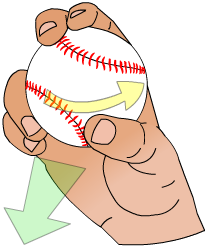
A common grip of a slider

In baseball, a breaking ball is a pitch that does not travel straight as it approaches the batter; it will have sideways or downward motion on it, sometimes both (see slider). A breaking ball is not a specific pitch by that name, but is any pitch that "breaks", such as a curveball, slider, or screwball. A pitcher who primarily uses breaking ball pitches is often referred to as a junkballer.

A breaking ball is more difficult than a straight pitch for a catcher to receive as breaking pitches sometimes hit the ground (whether intentionally, or not) before making it to the plate. A curveball moves down and to the left for a right handed pitcher. For a left hand pitcher, it moves down and to the right.[1] And blocking a breaking ball requires thought and preparation by the catcher. The pitcher then, must have confidence in the catcher, and the catcher in himself, to block any ball in the dirt; if there are runners on base, they will likely advance if the ball gets away from the catcher. (Whether the pitcher is right- or left-handed will dictate which direction the catcher must turn his body to adjust for the spin of an upcoming breaking ball. This necessary movement may reveal the next intended pitch to the batter; therefore an experienced catcher must fake or mask his intentions when preparing for the pitch.)

If a breaking ball fails to break, it is called a "hanging" breaking ball, specifically, a "hanging" curve or even more specifically a "cement mixer" if it is a "hanging" slider that just spins. The "hanger" presents a high, slow pitch that is easy for the batter to see, and often results in an extra-base hit or a home run.

Don Mattingly wrote in Don Mattingly's Hitting Is Simple: The ABC's of Batting .300 that "hitting a breaking ball is one of the toughest things you'll have to learn" due to the ball's very brief window in the strike zone.[2]

Physics

[edit]

Generally the Magnus effect describes the laws of physics that make a curveball curve. A fastball travels through the air with backspin, which creates a higher pressure zone in the air ahead of and under the baseball. The baseball's raised seams augment the ball's ability to develop a boundary layer and therefore a greater differential of pressure between the upper and lower zones. The effect of gravity is partially counteracted as the ball rides on and into increased pressure. Thus the fastball falls less than a ball thrown without spin (neglecting knuckleball effects) during the 60 feet 6 inches it travels to home plate.

On the other hand, a curveball, thrown with topspin, creates a higher pressure zone on top of the ball, which deflects the ball downward in flight. Instead of counteracting gravity, the curveball adds additional downward force, thereby giving the ball an exaggerated drop in flight.

History

[edit]

Baseball lore has it that the curveball was invented in the early 1870s by Candy Cummings, though this claim is debatable. An early demonstration of the "skewball" or curveball occurred at the Capitoline Grounds in Brooklyn in August 1870 by Fred Goldsmith. In 1869, a reporter for the New York Clipper described Phonney Martin as an "extremely hard pitcher to hit for the ball never comes in a straight line‚ but in a tantalizing curve." If the observation is true, this would pre-date Cummings and Goldsmith.[3] In 1876, the first known collegiate baseball player to perfect the curveball was Clarence Emir Allen of Western Reserve College, now known as Case Western Reserve University, where he never lost a game.[4] Both Allen and his teammate John P. Barden became famous for employing the curve in the late 1870s.[5] In the early 1880s, Clinton Scollard (1860–1932), a pitcher from Hamilton College in New York, became famous for his curve ball and later earned fame as a prolific American poet.[6] In 1885, St. Nicholas, a children's magazine, featured a story entitled, "How Science Won the Game". It told of how a boy pitcher mastered the curveball to defeat the opposing batters.[7]

The New York Clipper reported, of a September 26, 1863, game at Princeton University (then the College of New Jersey), that F. P. Henry's "slow pitching with a great twist to the ball achieved a victory over fast pitching." By 1866, many Princeton players were pitching and hitting "curved balls".[8]

Harvard President Charles Eliot was among those opposed to the curve, claiming it was a dishonest practice unworthy of Harvard students.[9][10] At an athletics conference at Yale University in 1884 a speaker (thought to be from Harvard, likely Prof. Charles Eliot Norton, a cousin of the Harvard President[11]) was reported to have stated: "For the pitcher, instead of delivering the ball to the batter in an honest, straightforward way, that the latter may exert his strength to the best advantage in knocking it, now uses every effort to deceive him by curving—I think that is the word—the ball. And this is looked upon as the last triumph of athletic science and skill. I tell you it is time to call halt! when the boasted progress in athletics is in the direction of fraud and deceit."[12]

In the past, major league pitchers Tommy Bridges, Bob Feller, Virgil Trucks, Herb Score, Camilo Pascual and Sandy Koufax were regarded as having outstanding curveballs.

See also

[edit]

References

[edit]
[edit]
Revisions and contributorsEdit on WikipediaRead on Wikipedia
from Grokipedia
A breaking ball, also known as a breaking pitch, is a type of baseball pitch that exhibits significant lateral or vertical deviation from a straight path as it approaches the plate, primarily due to the Magnus effect generated by the spin imparted by the pitcher's grip and release.[1] This movement distinguishes it from straighter pitches like the fastball, allowing pitchers to deceive batters by altering the ball's expected trajectory mid-flight.[2] The most common forms of breaking balls include the curveball, which features a pronounced downward and sideways break achieved through topspin, typically thrown at speeds between 70-80 mph; the slider, a faster variant (around 85-90 mph) with tighter, lateral movement resembling a fastball but veering late; and the rarer screwball, which breaks in the opposite direction of most breaking pitches due to a unique pronation motion.[2][3][4] Other variations, such as the slurve—a hybrid of the slider and curveball—or the knuckle curve, which adds unpredictable wobble, further expand the category, though their usage depends on the pitcher's arm angle and mechanics.[5] Historically, the breaking ball traces its origins to the mid-19th century, with the curveball credited to William "Candy" Cummings, who reportedly developed it around 1867 by experimenting with seashell spins during his youth, debuting it in professional play that year.[2] Initially met with skepticism and accusations of trickery, as it defied the era's understanding of projectile motion, the pitch was eventually accepted and became a staple by the late 1800s.[2] The slider emerged in the early 20th century, often called the "nickel curve" for its subtler break, while the screwball gained prominence in the 1930s through pitchers like Carl Hubbell.[3][4] From a physics perspective, the break results from the Magnus force, where the ball's rotation creates uneven air pressure: higher pressure on one side pushes the ball toward the lower-pressure side, amplified by the baseball's raised seams that enhance drag and spin efficiency.[6] For a right-handed pitcher, a curveball typically breaks downward and away from a right-handed batter, while a slider might dart horizontally; these effects are most pronounced at lower velocities, giving the ball time to curve over the 60 feet, 6 inches to home plate.[7] Breaking balls play a critical role in modern pitching strategies, as they generate higher rates of swings and misses compared to fastballs, contributing significantly to strikeouts and limiting hard contact—data from professional play shows they account for a substantial portion of a pitcher's arsenal, often comprising 20-30% of total pitches thrown, with sliders and sweepers now comprising a larger share and curveball usage declining to around 8% as of 2025, while overall breaking ball usage has increased to over 30%.[8][9] However, their repetitive use can increase arm stress and injury risk, particularly for developing pitchers, prompting debates on when young athletes should incorporate them.[10]

Definition and Types

Definition

In baseball, a breaking ball refers to any pitch in which the ball deviates from a straight path toward the batter, primarily due to spin generated by the pitcher's wrist action during release.[11][12] This movement, known as "break," arises from the rotation imparted on the ball, causing it to curve or drop unexpectedly as it travels the 60 feet, 6 inches from the pitcher's mound to home plate.[11] The core characteristic of a breaking ball is its unpredictable trajectory, which challenges the batter's timing and hand-eye coordination by altering the ball's course mid-flight, often laterally or downward.[12] In contrast to fastballs, which emphasize high velocity along a relatively linear path to overpower hitters, breaking balls prioritize spin-induced deflection over speed to deceive the batter.[11] Changeups, meanwhile, rely mainly on velocity differentials to mimic fastball arm speed while arriving slower, but lack the pronounced spin-driven break of breaking balls.[11] This deviation is achieved through a deliberate "snap" or break of the wrist, which differentiates breaking balls from straighter pitches and underscores their role in a pitcher's arsenal for varying location and movement.[11]

Common Types

The most common types of breaking balls in Major League Baseball are the curveball and slider (including variants like the sweeper), each distinguished by their unique trajectories and strategic roles in deceiving batters. These pitches deviate from a straight path primarily through vertical or horizontal movement, allowing pitchers to induce swings and misses or weak contact. Rarer variations include the slurve, screwball, and knuckle curve. The curveball exhibits a sharp downward break, often described as a pronounced vertical drop, and is typically thrown at speeds between 75 and 85 mph as of 2025.[13][14][15] This slower velocity enhances its deceptive arc, making it a staple for generating strikeouts by luring batters into chasing pitches out of the strike zone.[2] The slider features lateral movement toward the pitcher's glove side with a slight downward tilt, traveling faster than a curveball at an average of around 85 mph as of 2025.[16] A common variant is the sweeper, which emphasizes greater horizontal break (often 15+ inches) while maintaining similar velocity, and has seen increased usage to around 10% in certain matchups.[9] Its quicker pace and tighter break make it effective for jamming opposite-handed batters or finishing off counts with late deviation.[3] A slurve serves as a hybrid between the slider and curveball, blending lateral sweep with more vertical drop, and is usually delivered in the low 80s mph range.[5] This combination provides pitchers with a versatile option for tunneling it closely to fastballs before breaking away from same-handed hitters, though its usage remains low.[5] The screwball, a rare breaking ball, moves inward toward a right-handed batter when thrown by a right-handed pitcher (or vice versa), often at speeds of 79 to 88 mph.[17] Its uncommon arm-side run makes it particularly useful against left-handed batters, though its usage has declined due to concerns over pitcher arm strain.[4] The knuckle curve, a variation of the standard curveball, produces an even sharper downward plunge, typically clocking 80 to 85 mph.[18][19] This intensified drop enhances its strikeout potential, especially in two-strike situations, and remains a go-to for select pitchers seeking extra bite on their breaking pitch.[20] Among these, the curveball and slider (including sweepers) are the most frequently thrown breaking balls in MLB, comprising a significant portion of off-speed arsenals for both starters and relievers.[21]

Physics

Aerodynamics

The aerodynamics of a breaking ball in baseball are governed by the interaction between the ball's motion through the air and the forces exerted by air resistance, primarily drag, which slows the pitch and contributes to its lateral or vertical deviation from a straight path. Drag arises from the friction and pressure differences created as air flows around the ball, forming a wake behind it that influences the overall trajectory. This force is particularly significant for breaking balls, as it amplifies the pitch's movement by altering the ball's speed and direction over the flight path.[22] A key mechanism in this process is boundary layer separation, where the thin layer of air adhering to the ball's surface detaches unevenly due to the pitch's spin, causing the airflow to become turbulent and asymmetric over the seams. The spin imparts a rotational motion that accelerates air on one side of the ball while decelerating it on the other, leading to earlier separation on the side with opposing flow and delayed separation on the aligned side; this uneven separation shifts the wake and generates pressure imbalances that deflect the ball. The raised seams on a baseball exacerbate this effect by tripping the boundary layer into turbulence at lower speeds than a smooth sphere would experience, enhancing the asymmetry without requiring high spin rates.[23] Seam orientation plays a crucial role in these aerodynamic disruptions, as the positioning of the raised stitches—such as in a two-seam or four-seam grip—creates varying degrees of airflow resistance and pressure gradients around the ball. For instance, a four-seam orientation can produce greater asymmetry than a two-seam setup, resulting in more pronounced lateral movement by directing the disrupted airflow to one side.[24] These effects are related to the Magnus force, which arises from the spin-induced pressure differences but is fundamentally driven by the seam-disrupted boundary layer. Slower pitch speeds, typically 70-85 mph for breaking balls, increase the total break by providing more time for air deflection to accumulate over the approximately 55-foot flight distance to the plate, allowing typical lateral deflections of 4-10 inches, up to about 16 inches, for sliders compared to faster straight pitches.[1][25]

Magnus Effect

The Magnus effect is the phenomenon responsible for the lateral or vertical deflection of a spinning baseball in flight, arising from a force perpendicular to both the ball's spin axis and its velocity vector due to pressure differences created by the rotation interacting with oncoming air.[7] This effect generates lower pressure on the side where the ball's surface moves with the airflow and higher pressure on the opposite side, causing the ball to curve away from the lower-pressure region.[26] The magnitude of the Magnus force $ F_m $ is given by
Fm=12CLρAv2, F_m = \frac{1}{2} C_L \rho A v^2,
where $ C_L $ is the lift coefficient (a function of the spin factor $ S = r \omega / v $, with $ r $ the ball radius, $ \omega = |\vec{\omega}| $), $ \rho $ is air density, $ v = |\vec{v}| $ is the ball's speed, and $ A $ is the ball's cross-sectional area. The force is directed perpendicular to $ \vec{v} $ in the direction of $ \vec{\omega} \times \vec{v} $. This formulation, based on experimental measurements, captures the force's dependence on spin rate and velocity.[7] In breaking balls, the Magnus effect produces movement by directing the force based on spin orientation: topspin on a curveball creates a downward force that amplifies gravitational drop, while sidespin on a slider generates lateral deviation toward the pitcher's glove side for a right-handed pitcher.[7] These deflections are most pronounced at typical pitch speeds of 70-85 mph, where the force can alter the trajectory by 12-24 inches over the distance to home plate.[26] Key to effective breaking balls is achieving high spin rates, often 2000-3000 RPM for curveballs, which increases the spin factor $ S $ and thus the Magnus force magnitude.[27] Additionally, sufficient spin imparts gyroscopic stability, stabilizing the ball's flight path and minimizing wobble from aerodynamic perturbations.[28]

Throwing Techniques

Grips

The grips for breaking balls are designed to impart specific types of spin through precise finger placement on the baseball's seams, allowing pitchers to generate the desired movement for pitches such as the curveball, slider, screwball, and knuckle curve.[29] For the curveball, the standard grip involves placing the middle finger along one of the seams to leverage top spin, with the index finger positioned adjacent on the leather for support and stability. The thumb is placed underneath the ball, opposite the middle finger, to maintain control during delivery.[30] The slider grip typically features the middle and index fingers placed close together and slightly offset across the seams on the narrow side of the ball, enabling the pitcher to apply pressure for lateral sidespin. The thumb rests on the opposite side beneath the ball to facilitate the wrist snap that produces the pitch's sharp horizontal break.[31] In the screwball grip, the index and middle fingers are positioned on the opposite side of the seams compared to a traditional curveball, often along the inside or leftward seams for a right-handed pitcher, to create reverse curve movement toward the arm side. The thumb supports from below, emphasizing pronation to achieve the inward tailing action.[4] The knuckle curve employs a variation where the fingertips are positioned off the seams, with the index finger's nail dug into the ball and its knuckle raised away from the surface for irregular, tumbling spin, while the middle finger rests next to it on or near a seam for added control. This setup contributes to the pitch's sharper, less predictable drop.[20] Grip pressure plays a critical role in spin consistency for breaking balls, as adjustments in fingertip force—particularly on the middle finger—can alter spin rate and efficiency, influencing the pitch's movement profile.[32] Additionally, the friction from seams during repeated throws can lead to common injuries such as blisters on the index or middle fingers, affecting pitchers who rely heavily on these grips.[33]

Release Mechanics

The release mechanics of a breaking ball involve coordinated arm, wrist, and body actions designed to generate optimal spin while preserving deception against the batter. Pitchers typically employ an overhand arm slot, where the arm reaches approximately 75-80 degrees above horizontal at release, to produce vertical break on pitches like the curveball, as this angle facilitates topspin for downward movement.[34] In contrast, a sidearm slot, with the shoulders more level and the arm path closer to horizontal, promotes horizontal break on sliders by altering the spin axis toward lateral deviation.[35] Consistency in the release point is essential, ideally maintained within 2-3 inches across pitches, to avoid tipping the ball type and ensure command; variations beyond this can lead to predictable trajectories exploitable by hitters.[36] Wrist action plays a pivotal role in spin generation during release. For a curveball, pitchers supinate the wrist—rotating the palm inward in a karate-chop motion—at the point of release to impart topspin, which enhances the pitch's late drop.[37] This supination contrasts with the pronation used in a screwball, where the wrist turns outward to create reverse movement, though the screwball remains a rare pitch in modern arsenals due to its demands on the arm.[17] A key technique for the curveball involves "pulling down" on the ball with the middle finger, mimicking the motion of drawing a window shade, which tightens the spin and delays the break for better deception.[38] Body mechanics further support effective delivery and disguise. Hip-shoulder separation, where the hips rotate ahead of the shoulders by 30-55 degrees at foot plant, stores elastic energy for explosive arm acceleration, applying equally to breaking balls as to fastballs.[39] This separation allows for a full follow-through, with the arm extending across the body and the palm facing outward in natural pronation post-release, maintaining arm speed to mimic a fastball's motion and prevent early detection.[37] Tunneling enhances this disguise, as breaking balls are released from the same point as the fastball, converging trajectories until about 20-30 feet from the plate before diverging, with effective examples like a sinker-curve pair yielding superior run value.[40] However, these mechanics often result in a velocity trade-off, with breaking balls typically 5-15 mph slower than the fastball—sliders around 5-10 mph slower and curveballs 10-15 mph—to prioritize spin over speed.[41]

History

Origins

In the mid-19th century, baseball pitching was dominated by straight, underhand deliveries intended primarily to facilitate hitting rather than deceive batters, with the pitcher's role limited by rules requiring the ball to be delivered below the waist or hip.[42] This changed in the 1870s when William Arthur "Candy" Cummings, a slight pitcher for the Brooklyn Excelsiors, claimed to have invented the curveball after observing the movement of seashells while vacationing in Brooklyn in 1867; he began experimenting with wrist and finger spin to impart lateral break, first demonstrating it effectively in games by 1869.[42] Cummings' innovation relied on optical deception and subtle spin rather than pronounced physical deviation, marking the earliest widely credited breaking pitch, though its legitimacy was met with skepticism from players and umpires who dismissed the curve as an illusion.[42] Controversy persisted into the 1870s, as the curveball was viewed by some as a "freak" delivery that violated the spirit of fair play under the era's Knickerbocker Rules, which emphasized underhand pitching to keep the game accessible and offense-oriented; informal debates and umpire rulings occasionally penalized pitchers for suspected trickery, though no formal league-wide ban was enacted.[43] In 1870, Fred Goldsmith, then an amateur pitcher in New Haven, Connecticut, staged a public demonstration at Brooklyn's Capitoline Grounds, curving a ball around a series of poles to prove the pitch's reality to skeptics, bolstering claims that he had independently developed a similar breaking motion earlier in the decade.[44] Acceptance grew in the early 1880s amid rule changes that gradually permitted sidearm and then full overhand deliveries, culminating in the National League's 1884 elimination of motion restrictions, which allowed pitchers to generate greater velocity and spin essential for reliable breaking action.[43] By the 1910s, during the dead-ball era, the spitball emerged as a prominent breaking pitch, moistening the ball with saliva or other substances to enhance erratic movement and complement the curveball's evolution; pitchers like Ed Walsh and Jack Chesbro popularized it for its deceptive drop and tail.[45] This period's reliance on altered-ball deliveries influenced the broader development of breaking pitches by highlighting spin's potential for deception, but growing concerns over fairness and player safety led to the spitball's ban after the 1919 season, effective 1920, with 17 veteran users grandfathered in.[45] The prohibition accelerated innovation in "clean" breaking balls, shifting focus to grip and mechanics for natural movement without foreign substances.[45]

Evolution in Modern Baseball

The slider, developed in the early 20th century, gained further prominence and widespread use during the 1950s and 1960s, with Mudcat Grant notably incorporating a version described as a "fast curve" into his repertoire after learning it from coach Johnny Sain in 1965.[46] Concurrently, variations like the knuckle curve began appearing more frequently in the 1970s, popularized by pitchers such as Burt Hooton, who used the grip—fingertips on the seams with a knuckle-like pressure—to achieve sharper downward break without excessive arm pronation. The screwball, which gained fame in the 1930s with pitchers like Carl Hubbell, saw limited use in later decades due to injury risks.[4] These developments reflected pitchers' efforts to refine breaking pitches for greater deception amid evolving offensive strategies. A pivotal rule change in 1969 lowered the pitching mound from 15 inches to 10 inches, reducing the downhill trajectory that enhanced the natural break on pitches and contributing to higher league ERAs, from 2.99 in the National League in 1968 to 3.59 in 1969, which prompted adjustments in grips and release points to compensate for diminished movement.[47] This shift, aimed at balancing offense and defense after the pitcher-dominant "Year of the Pitcher," influenced how breaking balls were thrown, encouraging hybrid grips that maintained effectiveness at the shallower angle.[48] From the 1980s through the 2000s, the introduction of pitch-tracking technology marked a significant advancement in understanding and refining breaking balls. PITCHf/x, debuted in Major League Baseball during the 2006 playoffs, used cameras to capture real-time data on pitch trajectories, speeds, and breaks, enabling detailed analysis of spin rates and movement patterns for sliders, curves, and emerging hybrids like the slurve—a pitch blending slider velocity with curveball drop—that rose in usage as pitchers sought versatile two-plane breakers.[49] This technology illuminated how spin axis and velocity interacted to produce break, allowing coaches to tailor grips for optimal deception against batters.[5] In the 2010s and beyond, data analytics have further transformed breaking ball development, with tools like Statcast (introduced in 2015) providing granular metrics on spin efficiency and release points to optimize grips and maximize movement profiles.[50] These advancements have led to a decline in riskier pitches like the screwball, largely abandoned due to concerns over elbow strain from its supinated arm action stressing the ulnar collateral ligament, with no active MLB pitchers relying on it by the mid-2010s.[51] By the 2020s, breaking balls accounted for approximately 30% of all pitches thrown in MLB, underscoring their strategic centrality despite velocity-focused trends.[52]

Impact and Usage

Effects on Batters

Breaking balls pose significant visual challenges to batters due to their initial trajectory mimicking a straight path, a phenomenon known as pitch tunneling, where multiple pitch types appear identical from the release point until approximately 20-30 feet from the plate, delaying identification and leading to misjudged breaks.[53] This late deviation exploits the human eye's limited resolution at high speeds, creating a perceptual illusion where the ball seems to abruptly change direction, often resulting in late swings or poor contact.[54] The downward or lateral break of these pitches frequently mismatches the batter's typical upward swing plane, which is optimized for fastballs arriving on a relatively level or descending path; this discrepancy causes batters to either swing over the top of low-breaking pitches like curveballs or produce weak ground balls on sliders that dive below the barrel.[55] Mentally, breaking balls force hitters into protective two-strike approaches earlier in counts, elevating chase rates outside the zone and contributing to higher whiff percentages—sliders, for instance, generate an average whiff rate of about 33% on swings, compared to under 20% for fastballs.[56] Overall, these pitches underscore their effectiveness in limiting hard contact.[57] Batters counter these challenges through advanced video analysis to study pitcher tendencies and release points, enabling better pitch recognition and timing adjustments such as slightly earlier swings to account for expected break.[58] Platoon splits provide a natural edge, with left-handed batters holding an advantage against right-handed pitchers' curveballs, as the pitch breaks away from them (toward the third-base side), allowing easier visibility and contact compared to same-handed matchups.[59]

Notable Pitchers and Examples

Christy Mathewson stands as an early pioneer of breaking balls in professional baseball, renowned for his mastery of the "fadeaway," a breaking pitch akin to the modern screwball that broke away from right-handed batters. From 1900 to 1916, primarily with the New York Giants, Mathewson compiled 373 wins against 188 losses, a record that underscored his exceptional control and strategic use of off-speed movement to deceive hitters. His fadeaway, combined with pinpoint accuracy, allowed him to lead the National League in strikeouts five times between 1903 and 1908, establishing a blueprint for pitchers relying on breaking pitches for dominance.[60][61][62] In the mid-20th century, Sandy Koufax elevated the curveball to devastating heights, pairing its sharp downward break with his blazing fastball to secure four no-hitters during the 1960s, including a perfect game on September 9, 1965, against the Chicago Cubs. Koufax's curve was instrumental in his three Cy Young Awards (1963, 1965, 1966) and the 1963 National League MVP, as it induced swings and misses from even the era's top hitters. A prime example came in Game 5 of the 1965 World Series, where, pitching on short rest, Koufax delivered a complete-game shutout against the Minnesota Twins, striking out 10 batters—many via his signature curve—to give the Los Angeles Dodgers a 7-0 victory and a 3-2 series lead.[63][64][65] Nolan Ryan's career, spanning 1966 to 1993, showcased the power of a hard-breaking curveball alongside his record-setting fastball, contributing to his all-time leading 5,714 strikeouts and 11 league leads in the category. Ryan's 12-6 curve, thrown with exceptional velocity for a breaking pitch, often reached the mid-80s mph and provided the sharp drop needed to finish off batters, helping him amass 324 wins and seven no-hitters across four decades. His reliance on this breaking ball was evident in high-strikeout outings, such as his 383 strikeouts in 1973, a single-season record that stood for decades.[66][67][68] Among modern pitchers, Clayton Kershaw has refined the curveball into a signature weapon, earning three Cy Young Awards in the 2010s (2011, 2013, 2014) and leading the National League in ERA three times through its pronounced 12-6 break and tunneling with his fastball. Kershaw's curve, typically clocked in the low-70s mph, generates elite vertical movement—often exceeding 10 inches more drop than average—making it a staple for his 3,000-plus career strikeouts and consistent sub-2.50 ERA seasons.[69][70] The screwball, a rarer breaking pitch that moves opposite to a curveball, found a notable exponent in Fernando Valenzuela during the early 1980s with the Los Angeles Dodgers. Valenzuela's screwball, learned from teammate Bobby Castillo in 1979, fueled his 1981 rookie season where he won both the National League Cy Young and Rookie of the Year awards with a 13-7 record and 2.48 ERA, captivating fans in the phenomenon known as "Fernandomania." His effective use of the screwball helped the Dodgers win the 1981 World Series, with Valenzuela starting and winning Game 3 via a complete game.[71][72]

References

User Avatar
No comments yet.