Hubbry Logo
Bubble EyeBubble EyeMain
Open search
Bubble Eye
Community hub
Bubble Eye
logo
8 pages, 0 posts
0 subscribers
Be the first to start a discussion here.
Bubble Eye
Bubble Eye
from Wikipedia
Bubble Eye Goldfish
Country of originChina
TypeBubble eye
Classification
BAS[1]

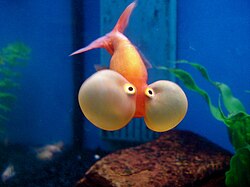
The Bubble Eye is a small variety of fancy goldfish with upward-pointing eyes that are accompanied by two large fluid-filled sacs. It is a dorsal-less fish – good specimens will have a clean back and eye bubbles that match in color and size. Their bubbles are quite delicate, so the fish should be kept separately from boisterous types, as well as sharp tank decor. Although the bubbles will regrow if punctured, an injury could leave the fish prone to infections. The bubbles can disadvantage the fish as it is not a strong swimmer, with a seemingly low bobbing head at times; bubbles are infamous for being sucked into filters and siphons in an aquarium.[1][2]

Description

[edit]
A bubble eye goldfish (with a dorsal fin) seen from the top

The Bubble Eye normally has an evenly curved back that lacks a dorsal fin. The pair of large pouches of skin attached under its eyes jiggle as it swims.[1] Bubble Eyes have metallic scales, and they are similar to the celestial eye goldfish.[3] The eyes of the Bubble Eye goldfish are normal in the young fry but will start to develop eye bladders three months after hatching.[3] Like ranchu, the bubble eye goldfish lacks a dorsal fin and has a double tail.[4] They normally grow up to 3 to 4 inches in length. If one of their "Bubbles" pop due to pressure or collision with a sharp object, there is a risk of infection where the inside of the sac has been exposed.[5]

Variants

[edit]

The precursor to the Bubble Eye, known as the Toadhead or hama-tou, had upturned eyes and very small, bladder-like sacs.[6][7] Through selective breeding, the bubble eye is currently available with either a long or more rounded body and the choice between matte, metallic or nacreous scales.[8] A recent development of the bubble eye has four eye sacs rather than the usual two.[9] Desirable colors for these fish include red, calico, orange, red and white, and the rare black.[10]

Care

[edit]

Due to the delicate eye sacs, enthusiasts must ensure that their bubble eye is kept in aquariums free from sharp objects. Due to the fish's visual impairment, it is recommended that they are kept with other bubble eyes, black moors, demekins and celestial goldfish to ensure fair competition for food.[11][12]

Medical uses

[edit]

Researchers in Japan have theorized that the liquid in the bubble eye's sacs could be a stimulant to cell growth.[13] Due to the eye sac's ability to quickly regenerate and refill itself, scientists can milk the same fish every few months with a syringe.[13][14]

See also

[edit]

References

[edit]
[edit]
Revisions and contributorsEdit on WikipediaRead on Wikipedia
from Grokipedia
The Bubble Eye is a fancy variety of ( auratus) distinguished by its large, fluid-filled sacs that protrude beneath each eye, giving the fish a distinctive, bulbous appearance; these sacs, which develop around 6-9 months of age, are filled with lymph-like fluid and sway with movement, while the fish lacks a , has an egg-shaped body, double caudal fins, and upturned eyes that impair forward vision. Originating in through of (Carassius auratus) lineages during the late (1644–1912) or early , the Bubble Eye was refined for its unique eye sacs—a amplified by artificial selection to create aesthetically pleasing traits. These typically exhibit metallic red-orange, yellow, white, or colorations and grow to about 6 inches in length, with a lifespan of 6-15 years under optimal conditions, but their slow, awkward swimming and vulnerability to eye sac injuries from sharp objects or aggressive tank mates necessitate specialized care. Despite their ornamental appeal, welfare concerns arise from the eye sacs' propensity for infection and pain, which can halve their lifespan compared to standard goldfish, highlighting ethical debates in selective breeding practices.

History and Origin

Development in China

The Bubble Eye goldfish originated in China during the Ming (1368–1644) and Qing (1644–1912) dynasties as part of the long tradition of ornamental fish cultivation that dates back to the Song Dynasty (960–1279), where selective breeding for aesthetic traits began in rice paddies. This fancy variety likely derived from mutations in established breeds such as the Toadhead goldfish, which features upturned eyes and small bubbles, and was refined through targeted crossbreeding to produce the characteristic large, fluid-filled eye sacs, with the distinct breed emerging in the early 20th century. Chinese aquarists employed meticulous methods, specimens with undesirable traits like dorsal fins or uneven sac development to emphasize the eye sacs' symmetry and size. These sacs, filled with lymph-like , develop from around four weeks after to full maturity by one year. The process involved ongoing refinement in the early , integrating influences from other "egg series" varieties with rounded bodies, such as the egg-fish, to balance the Bubble Eye's compact form and visual appeal. This establishment solidified the Bubble Eye's role in China's ornamental fish culture, where it symbolized ingenuity in and contributed to a diverse array of over 100 goldfish varieties prized for their artistic qualities.

Introduction to the West

The Bubble Eye , developed in , was introduced to the West in the mid-20th century, with records indicating importation to in 1958. This brought the breed's characteristic fluid-filled eye sacs to Western aquarists, who were already familiar with other fancy goldfish varieties but found the Bubble Eye's unique morphology particularly striking. Recognition by aquarist societies followed, with standards emphasizing the breed's dorsal-less body and symmetrical eye sacs as key traits for quality. These standards helped formalize judging criteria for shows, promoting the Bubble Eye as a competitive entry among fancy . The breed gained popularity in and following its introduction, with breeders focusing on success. In the West, breeding efforts evolved to adapt the Bubble Eye for local show standards, with a strong focus on achieving perfect symmetry in the eye sacs to enhance aesthetic appeal and stability. Breeders selected for larger, evenly matched sacs that complemented the fish's rounded body and divided caudal , refining the variety over generations while maintaining its Chinese origins. This selective not only improved success but also established the Bubble Eye as a favored choice for indoor aquaria in and .

Physical Characteristics

Body and Fin Structure

The Bubble Eye goldfish exhibits a distinctive egg-shaped body form, characterized by a deep, rounded and a compact, globular profile that results from for ornamental traits. This body shape typically measures 3 to 6 inches (7.6 to 15.2 cm) in length at maturity, with a body depth often comprising at least 65% of the overall length, giving it a appearance compared to more streamlined varieties. A key morphological feature is the absence of a dorsal fin, known as the dorsal-less trait, which contributes to the fish's smooth, arched back profile and is a shared characteristic with breeds like the . The paired pectoral and pelvic fins are short and rounded, aiding in basic maneuvering, while the anal fins are paired, aiding in balance. The caudal fin is divided into a double or fan-shaped tail, often forked and broad, extending 1.5 to 2 times the body length to enhance the visual appeal without compromising stability. Selective breeding has also influenced the swim bladder, resulting in adaptations such as a reduced anterior chamber that promotes upright posture but leads to slower, more deliberate compared to single-tailed . In captivity, Bubble Eye have an average lifespan of 10 to 15 years with proper care, though this can vary based on environmental factors. Relative to other fancy breeds, such as the or Fantail, the Bubble Eye's proportions emphasize a more extreme globular body and twin-tail configuration, outcomes of centuries of breeding in that prioritize aesthetics over agility.

Eye Sac Formation and Function

The eye sacs of the Bubble Eye goldfish, a selectively bred variety of Carassius auratus, originate from specialized membranous epithelial tissue beneath each eye, forming thin, transparent enclosures that gradually fill with lymphatic fluid. These sacs begin to develop shortly after hatching, with initial formation observable around 4 weeks of age, though full maturation can take up to a year as the fluid accumulates and the structures expand. The process is driven by selective breeding practices that enhance this trait, resulting in the sacs becoming prominent features by 3 to 6 months post-hatching. Structurally, the sacs are balloon-like protrusions, often reaching diameters comparable to the fish's head size—up to several centimeters in mature specimens—suspended from the underside of the upward-pointing, telescoping eyes characteristic of the breed. Composed of delicate, vascularized epithelial membranes, they contain a clear, lymph-like rich in immunocompetent cells, such as monocytes and macrophages, which can number over 2 × 10⁵ cells per milliliter. This fluid composition supports potential immunological functions, including expression in response to stimuli, though the sacs themselves are primarily a product of artificial selection rather than natural adaptation. The eyes, positioned atop short stalks, remain functional but oriented skyward, with the sacs dangling below without direct attachment to the ocular . The primary role of the eye sacs is ornamental, serving no essential biological purpose in but selected for aesthetic appeal in . They provide minimal, if any, assistance due to their fluid content, but more notably impair forward vision and navigation, as the upward eye orientation limits the fish's ability to detect prey or obstacles below or ahead. Genetically, the trait stems from in the genome amplified through centuries of breeding in , akin to those in related varieties like the , though specific genes remain uncharacterized. Sacs continue to enlarge with age throughout the fish's 10- to 15-year lifespan, influenced by overall growth and nutrition, but injury can cause deflation; while they may partially reinflate, the reformed sacs are typically smaller and asymmetrical.

Varieties and Coloration

Breed Standards

The breed standards for Bubble Eye emphasize the fish's distinctive fluid-filled eye sacs as the primary special characteristic, requiring them to be large, symmetrical, and transparent without any signs of , , opacity, , or mismatch between the two sides. According to the Nationwide Goldfish Standards of the (2016), these sacs are evaluated on development (10 points) and matching for shape and size (10 points), forming 20 points of the total judging score, while the Society of America (GFSA) similarly prioritizes well-matched, clear sacs that enhance the fish's overall aesthetic without impairing mobility. Ideal specimens feature a compact with a body depth of approximately 50% of the body length, smooth contours free of any or hump, and flowing, paired including a divided, forked caudal fin with slightly rounded lobes held above the horizontal. Disqualifications under these standards include the presence of even a slight , deformities, major structural defects, or eye sacs exhibiting opacity, damage, or significant asymmetry, as these compromise the variety's defining traits; additionally, must meet a minimum body length of about 5.5 cm (2.25 inches) for to ensure maturity and proportionality. The GFSA and similar bodies uphold these criteria in North American shows, focusing on a clean back profile and alert deportment to highlight the sacs' prominence. Color patterns are considered in judging for harmony with the sacs but do not override structural ideals. Historically, Bubble Eye standards evolved from practices in early 20th-century , where the variety emerged as a dorsal-less with rudimentary sacs, to more formalized international norms by the 1970s as Western aquarist societies like the GFSA adopted and refined criteria for symmetry and sac quality to promote consistent breeding goals across competitions. This shift emphasized larger, more balanced sacs over earlier, smaller prototypes, aligning with global show expectations for elegance and health.

Color Variations

The Bubble Eye displays a range of primary colors resulting from , including metallic orange, red, white, black, and varieties that feature mottled black, red, and blue spots over a white base. Bi-color patterns, such as red-and-white, are also prevalent, often appearing in metallic or nacreous forms. Pattern types in Bubble Eye goldfish include spotted varieties resembling , with irregular metallic flecks on a transparent background; panda patterns characterized by contrasting black-and-white markings; and lines with transparent scales that reveal underlying pigmentation for a effect. These patterns arise from scale type variations, where nacreous (-like) fish exhibit a mix of reflective and translucent qualities. Color inheritance in Bubble Eye goldfish follows dominant and recessive genetic principles, with metallic scales (uniform, reflective pigmentation) as the recessive wild-type trait ( tt) and matte scales (transparent, non-reflective) controlled by a dominant T—homozygous TT produces fully matte fish, while heterozygous Tt yields nacreous varieties with partial transparency. This genetic interplay allows breeders to produce diverse metallic versus matte lines, influencing and visibility. Rare color variants, such as and (deep brown), have been produced through targeted breeding efforts and remain less common due to challenges in stabilizing these traits alongside the breed's distinctive eye sacs and body form. These hues often appear in metallic or nacreous scales but require careful selection to avoid dilution or reversion in offspring.

Care and Maintenance

Aquarium Requirements

Bubble Eye goldfish require a spacious aquarium to accommodate their slow, deliberate swimming style and to maintain given their high bioload. The minimum size for a single specimen is 20 gallons, with an additional 10 gallons recommended per companion to prevent overcrowding and stress. Wide, shallow tanks are preferred over tall ones, as they better mimic the fish's natural pond-like habitat and allow easier navigation without excessive vertical exertion. Effective is crucial due to the substantial waste produced by these , necessitating a strong biological filter system to break down and nitrites efficiently. or pre-filters should be used on areas to protect the delicate eye sacs from strong currents or suction. For substrate, opt for smooth, fine or to avoid abrasions on the fluid-filled sacs; bare-bottom setups are also viable to facilitate cleaning and minimize injury risks. Aquarium decor should prioritize safety and gentle enrichment, featuring rounded live or silk plants such as Anacharis for hiding spots and water quality improvement, along with smooth rocks or caves without sharp edges. Avoid any pointed ornaments or tight crevices that could puncture or trap the eye sacs. The ideal temperature range is 65-72°F (18-22°C), which supports their cold-water preferences without the need for a heater in most indoor settings. In terms of compatibility, Bubble Eye goldfish thrive with other slow-moving fancy varieties, such as Black Moors or Fantails, in a peaceful community; however, they should not be housed with fast-swimming species like , which could injure the sacs through nipping or collisions.

Feeding and Nutrition

Bubble Eye goldfish, as omnivorous with specific physiological traits, require a diet rich in protein to support their energy demands and body maintenance. Commercial floating pellets or flakes designed for fancy goldfish varieties, containing 30-40% protein, form the staple of their nutrition, providing essential for tissue repair and growth. These foods should be high-quality and free from fillers, with a fat content around 7-8% to avoid digestive issues in their deeper-bodied form. To enhance nutritional balance, supplement the base diet with live or frozen foods such as , , bloodworms, or 1-2 times weekly; these provide vital micronutrients and promote natural foraging behaviors without excessive strain. Vegetable matter, including blanched peas, , or , can be offered occasionally for , but must be softened to prevent difficulties. Soaking pellets in tank water before feeding is advisable to minimize expansion in the stomach, reducing the risk of buoyancy disorders. Feeding frequency should align with water temperature and age: juveniles benefit from 2-3 small meals daily, while adults require 1-2 feedings, adjusting to twice daily in warmer conditions (70-75°F or 21-24°C). Portions must be limited to what the fish consume within 2-3 minutes to avert , which can impair function and exacerbate mobility challenges in these finless varieties. Special considerations arise from the Bubble Eye's poor vision and delicate eye sacs, necessitating floating foods to enable surface detection rather than bottom scavenging, which risks injury. Feed slowly, offering one pellet at a time in a low-competition environment, to accommodate their sluggish swimming and ensure adequate intake without stress.

Water Quality Management

Maintaining optimal water quality is essential for Bubble Eye , as their delicate eye sacs make them particularly susceptible to fluctuations in chemical balance that can lead to stress and compromised welfare. These fancy thrive in stable conditions that mimic their natural preferences, with key parameters including a range of 7.0 to 8.0, zero parts per million (ppm) for and , and levels below 20 ppm. Adhering to these levels helps prevent osmotic stress on the eye sacs, ensuring the remain active and healthy. Regular monitoring is crucial, typically achieved using reliable aquarium test kits to check , , , and at least weekly, especially in setups where tank size influences waste accumulation. These tools allow aquarists to detect deviations early and maintain stability, which is vital for the Bubble Eye's sensitive . To sustain these parameters, perform partial water changes of 25% weekly, using dechlorinated matched to the tank's temperature to avoid shocking the fish. Effective plays a key role in management, with sponge filters or canister filters recommended for their ability to provide gentle water flow that minimizes disturbance to the eye sacs. Sponge filters, in particular, offer biological filtration through beneficial while producing low-current to ensure adequate oxygenation without creating strong currents that could strain the . Canister filters should be equipped with foam media to further soften intake and output flows. levels should be moderate, sufficient to support dissolved oxygen needs—typically around 5-8 mg/L—while avoiding excessive bubbling that disrupts the calm environment preferred by Bubble Eyes. Seasonal adjustments may be necessary to support activity levels, such as slightly warming the in winter to around 70°F (21°C) if ambient temperatures drop, though extremes should be avoided to prevent metabolic stress. Overall, consistent adherence to these practices ensures a healthy aquatic tailored to the Bubble Eye's unique needs.

Health and Breeding

Common Health Issues

Bubble Eye are particularly susceptible to eye sac injuries due to the fragile, fluid-filled sacs that protrude beneath their eyes, which can tear upon contact with , decorations, or strong currents from filters. These tears expose the underlying tissue, often leading to secondary bacterial infections that cause swelling, cloudiness, or of the sac. Treatment typically involves isolating the and administering a mild salt bath at 0.3% to reduce risk and promote healing, though severe cases may result in permanent sac loss or impaired vision. Swim bladder disorders are prevalent in Bubble Eye goldfish, exacerbated by their compact, rounded body shape that predisposes them to buoyancy problems compared to varieties. Overfeeding or from dry foods can compress the , causing symptoms such as floating to the surface, swimming upside down, or listing to one side, which hinders normal orientation and feeding. Initial remedies include a 2-3 day period to alleviate digestive pressure, followed by feeding cooked, shelled peas to relieve , with persistent cases potentially requiring antibiotics if infection is involved. Parasitic infections like (Ich or disease) and bacterial conditions such as are common vulnerabilities in Bubble Eye , often manifesting in suboptimal water conditions that stress their immune systems. Ich presents as small white cysts on the body, fins, and gills, leading to flashing (rubbing against objects), lethargy, and respiratory distress if untreated, while starts as frayed or discolored fin edges and progresses to tissue erosion if bacterial pathogens like take hold. of new fish is essential to curb outbreaks, with treatments including elevated temperatures (to 82°F/28°C) and medications like malachite green for Ich or antibiotics for . Genetic weaknesses in Bubble Eye goldfish stem from for the characteristic eye sacs and body conformation, resulting in inbred lines that are prone to sac deflation, partial or complete blindness, and overall fragility. These inherited traits compromise vision and balance, increasing susceptibility to environmental hazards and infections, which can reduce the average lifespan from a potential 10-15 years to as low as 6 years if issues go unaddressed. Responsible breeding practices aim to mitigate these defects, but the breed's inherent vulnerabilities highlight the need for vigilant monitoring.

Breeding Techniques

Breeding Bubble Eye requires careful selection of mature specimens to ensure healthy and desirable traits. Breeders typically choose adults with intact, symmetrical eye sacs that are free from deformities or infections, as these traits are heritable and impact the quality of the fry. is essential and can be determined by physical differences: males often appear slimmer and develop small white breeding tubercles on their gill covers, pectoral fins, and sometimes the head during the spawning season, while females exhibit a plumper when gravid. Vent examination may also reveal differences, with males having a more concave vent shape compared to the rounded vent of females. The spawning process is typically induced in a controlled environment to mimic natural cues. Water is gradually raised from around 60°F (16°C) to 68–74°F (20–23°C) over several days, often using a separate breeding tank to stimulate release and . Males chase and nudge the female, who releases adhesive —potentially thousands per spawn—onto spawning mops, fine-leaved plants, or other soft substrates provided in the tank. Fertilization occurs externally as males release simultaneously; using multiple males (a of 3:2 males to females) improves success rates, though the large eye sacs can hinder the female's ability to position herself effectively, sometimes necessitating hand-spawning techniques where eggs are manually stripped and fertilized. Adults should be removed immediately after spawning to prevent , and the eggs rinsed in aged before incubation at a stable 70°F (21°C). Fry development begins with hatching, which occurs 4–7 days after fertilization, depending on temperature; the newly hatched larvae are translucent with yolk sacs and remain attached to surfaces initially. After absorbing the yolk sac (typically 2–3 days), fry become free-swimming and require infusoria, paramecium, or finely powdered commercial foods for the first week, transitioning to baby brine shrimp as they grow. Eye sac formation starts around 4–8 weeks of age, with full development taking up to a year, during which the sacs gradually inflate with fluid. Culling is a critical step, removing fry with deformities such as dorsal fins, irregular backs, or asymmetrical sacs to maintain breed standards and genetic health. Challenges in breeding Bubble Eye goldfish stem primarily from their specialized morphology and . High fry mortality rates, often 50–70%, arise from weak constitutions inherited from for exaggerated traits, compounded by sensitivity to fluctuations. Separate rearing tanks with gentle and low water depth (4–6 inches) are necessary to protect fragile fry, and consistent monitoring for deformities is required to avoid propagating substandard stock. Additionally, the eye sacs can complicate natural mating, leading to lower fertilization rates without intervention.

References

Add your contribution
Related Hubs
User Avatar
No comments yet.