Hubbry Logo
OrandaOrandaMain
Open search
Oranda
Community hub
Oranda
logo
8 pages, 0 posts
0 subscribers
Be the first to start a discussion here.
Oranda
Oranda
from Wikipedia
Oranda
Country of originChina
TypeVeiltailed
Classification
BAS[1]

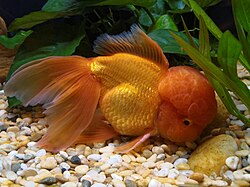
The oranda is a breed of goldfish characterized by a prominent bubble-like "hood" on the head. The headgrowth or hood (also known as a "wen" or "crown") may be a prominent growth on the top of the head (cranial region) or may encase the entire face except the mouth.[1][2][3]

The name comes from the Japanese Oranda-shishi-gashira, meaning "Dutch lionhead". The breed is in fact of Chinese origin, but it may have been introduced to Japan via the Dutch trading post at Dejima. Alternatively, "Dutch" may simply mean "exotic" or "foreign" in this context.[4]

Description

[edit]
Orange oranda with a white full-faced cap ("wen")
Common colors in orandas. The top one possessed a Tancho coloration while the bottom is orange.
A pair of red-cap oranda goldfish. The one on the left has red-colored lips.

Due to the fleshy outgrowth on the upper half of its head and sides of its face, the oranda has become one of the most popular goldfish.[citation needed] The headgrowth is described as a "wen" by Chinese aquarists.[citation needed]

The oranda is a metallic or matte scaled goldfish that is similar in appearance to the veiltail. It has a large, long and deep body accompanied by a long quadruple tail. This four-lobed and contracted tail normally spreads out broadly when the oranda stops swimming. The back does not rise up to form a ryukin-like hump.[2][3]

Orandas are available in a variety of colors, most often orange, red, red-and-white, red-and-black, black, blue, chocolate, bronze, white or silver, black-and-white (panda-colored), red-black-and-white (tricolor), and calico colors.[5][2][3]

The headgrowth of young fry may take one to two years to develop.[5][2] The oranda can reach 20 to 31 centimeters (7.9 to 12.2 inches) in length.[2][3] Sometimes the wen grows enormously, covering the eyes of the goldfish. Due to this, the fish may have only limited eyesight or even become blind. Special care should be given to the wen because it is prone to bacterial infections. The Oranda can tolerate temperatures from 17 to 28 °C (63 to 82 °F). More recently blue scale oranda have been developed but these fish are very rare.

Variants

[edit]
  • The azuma nishiki is an attractive nacreous-colored form of the oranda.[2]
  • The red-cap oranda has a silverish white body with a prominent red headgrowth on the forehead.[2]
  • Chinese breeders have developed telescope eyed orandas, a cross-breeding of the telescope eye and oranda goldfish.[3]
  • The hana fusa or pompom oranda is a pompom with a dorsal fin and headgrowth like an oranda. It is a cross between the oranda and a dorsal formed pompom.[2]
  • The nagate oranda is a long body oranda developed in Shikoku, south west area of Japan.
  • The Apache oranda is a form of oranda that bears both red and black together. Fish cannot be named Apaches if the blackness only exists on the fin/s. [citation needed]
  • The panda oranda is a variety of oranda that is bi-colored or tri-colored, most identifiable by the black-and-white coloration for which it is named.
  • The Ingot oranda,[6] also known as the Yuan-Bao oranda, is a new Chinese variety of oranda that was crossed from a ryukin with a Ranchu. Its large, short round body has the characteristics of a Ranchu, with its box shaped face containing wen. Its tail is somewhat equal as to the ryukin, though generally short-finned ingots are very popular and widely produced today.
  • The Chakin (チャキン), also named the chocolate oranda, is a colored variant of an oranda. It has brownish scales with a color like that of chocolate. Its actual name means Tea fish or Tea goldfish in Japanese.[7]
  • The Seibungyo (成分魚) or Seibun is a blue oranda, named for its bluish grey silver coloration. The "blue" is combined with both black areas on the outside skin, and black from the inside layers, to form a blue-like sheen.[8]
  • The black oranda is a currently developed color variety that is crossed from the black moor. [citation needed]
  • The jade seal oranda is a type of color pattern that consists of a white, clear cap on its head, while the rest of the body is red or orange. [citation needed]

Special care

[edit]

Orandas are sensitive to low water temperatures and can be kept with other goldfish.[2] If their wen grows too much, it may hinder vision, so it is advised to keep them with other goldfish with similarly poor vision in order to make sure that they do not starve because of the able-sighted competition. Some aquarists prefer to trim the wen off of the goldfish by using scissors to prevent blindness and dousing with peroxide to prevent damaging essential areas around the face or body.[9] Their wen is also susceptible to injury from rough objects placed in their residence.

References

[edit]
[edit]
Revisions and contributorsEdit on WikipediaRead on Wikipedia
from Grokipedia
The Oranda is a variety of fancy goldfish ( auratus) renowned for its distinctive, bubble-like fleshy growth on the head, known as a wen or hood, which develops prominently in the cranial, infra-orbital, and opercular regions. This breed features a short, rounded body with a depth of approximately 65% of its body length, a single high and erect , and a divided caudal that is well-spread and at least 75% of the body length. Originating from in and later refined in , the Oranda descends from wild ( gibelio) and has no natural wild population, with the wen likely emerging from Japanese Fantail () lineages. Orandas exhibit a range of vibrant colors, including self-colors like red, orange, yellow, , brown, and black in metallic varieties, as well as variegated patterns with a background interspersed with violet, red, orange, yellow, brown, white, and black spots. Popular varieties include the Red Cap Oranda, featuring a white body with a red head wen, and the Black Oranda, which displays metallic black scales with golden highlights. These typically grow to a body length of 5–7 inches (12–18 cm), though some can reach up to 10 inches under optimal conditions, and they boast a lifespan of 10–15 years or more with proper care. Peaceful and sociable, Orandas are suitable for community aquariums with other fancy but require spacious tanks—at least 20–40 gallons per —due to their high waste production and moderate swimming ability, which is hindered by their flowing fins and compact, egg-shaped body. In captivity, Orandas thrive in cool water temperatures of 65–75°F (18–24°C), with a range of 6.5–7.4 and strong to maintain low nitrates below 30 ppm, alongside a balanced omnivorous diet emphasizing high-quality sinking pellets (soaked before feeding) or gel foods (e.g., Repashy), blanched vegetables, and moderate protein treats such as bloodworms and to prevent swim bladder and digestive issues, while avoiding floating flakes to prevent air swallowing. Breeding occurs seasonally, triggered by cooler , where females scatter adhesive eggs over or spawning , hatching in 48–72 hours, and males develop white tubercles on their covers and pectoral fins as a distinguishing feature. Valued for their elegant appearance and personable nature—often recognizing owners and feeding from their hands—Orandas remain a staple in ornamental aquariums worldwide, though their full wen development can take 4–5 years.

Etymology and History

Name Origin

The name "Oranda" for this variety of fancy derives from the Japanese word oranda, which historically referred to "" or "the Dutch," stemming from early European trade influences during Japan's isolationist . Specifically, the full traditional Japanese designation is Oranda shishigashira, translating to "Dutch lion head," a nod to the fish's prominent wen (a fleshy growth on the head resembling a 's mane) combined with its perceived foreign origin. This naming convention arose because exotic imports, including varieties, were often labeled as "Dutch goods" due to the ' exclusive trading rights with under the policy. During the (1603–1868), breeding flourished in , with selective imports from enhancing local varieties; the Oranda is believed to have arrived via Dutch traders around the early , possibly in 1800, leading to its association with despite its Chinese roots. Japanese breeders at the time adapted foreign specimens into new strains, and naming them after trade origins was a common practice to denote novelty and prestige, rather than any direct connection to Dutch breeding. This period's limited international exchange meant that all rare aquatic imports funneled through the Dutch outpost at in , reinforcing the "Oranda" label across various species. Unlike other goldfish names such as (from Chinese "dragon fish," emphasizing form) or (highlighting body shape), the Oranda's nomenclature prioritizes cultural and historical import context over physical descriptors, reflecting Japan's Edo-era fascination with Western curiosities as symbols of sophistication. This etymological choice underscores a broader pattern in Japanese aquatics where foreign provenance lent an air of , adapting breeds through while preserving origin-based identities.

Breed Development and Spread

The Oranda goldfish originated in during the (1368–1644), where selective breeding of varieties with prominent head growth, known as the wen, began from wild (Carassius gibelio). This likely derived from a in lineages. This domestication process built on earlier breeding practices established in the Tang and dynasties, focusing on ornamental traits like coloration and body shape derived from ancestors. By the late 17th century, Chinese breeders had developed early forms of wen-covered , which were kept in private imperial ponds and among the elite. In the 18th and 19th centuries, the Oranda underwent significant refinement in after general varieties were imported from around 1502 during the Ming era, with the Oranda specifically introduced around 1800. Japanese breeders, particularly in , standardized the Oranda's traits, including enhanced wen development and balanced finnage, with the first documented breeding occurring in 1840 through crossing and at Koriyama, Yamato. This period marked a shift in development from Chinese to Japanese hands, emphasizing aesthetic perfection through controlled crosses, though exact lineages remain debated due to limited records. The wen, as a key selective trait, was prioritized to create the distinctive hooded appearance that defines the breed. Goldfish in general reached in the late 17th to early 18th centuries via Portuguese trade routes from Macao, but fancy varieties like the Oranda gained traction only in the late through expanded ornamental . By the 1870s, Japanese exports facilitated their entry into Western markets, including the in 1878, leading to widespread aquarium popularity by the early . In , breeding efforts accelerated in the , with Oranda becoming a staple in hobbyist circles alongside other Asian imports. The breed's global spread was further propelled by international shows starting in the early in the , becoming regular events by the that showcased rare Asian varieties like the Oranda and encouraged competitive breeding worldwide. These exhibitions highlighted the Oranda's refined traits and boosted its status in communities across and , solidifying its role in modern ornamental fish culture.

Physical Characteristics

Body and Fin Structure

The Oranda goldfish possesses an egg-shaped body with a deep, rounded abdomen and a short, stout back, giving it a compact and globular profile prized for ornamental display. Adult specimens typically measure 6 to 8 inches in total length, though optimal growth depends on environmental conditions and . Goldfish association standards emphasize precise proportions, with the ideal body depth reaching approximately two-thirds of the total length to achieve the desired rounded silhouette without excessive elongation. This domesticated modification starkly contrasts with the wild ancestors of , such as the slender, streamlined ( gibelio), which evolved a torpedo-like form for efficient navigation in natural waterways. In terms of fin configuration, the Oranda features a double caudal fin that is divided into two flowing lobes, typically well-spread and held slightly below the horizontal plane without forking or pointed edges; this fin often extends to at least 75% of the body length in show-quality examples. The anal fin is paired with pointed extremities for balance, while the stands single, high, and erect with a rounded outline to complement the . These fin arrangements, refined through centuries of , prioritize aesthetic flow over the single fins and streamlined propulsion seen in wild lineages.

Wen and Coloration

The wen of the Oranda is a prominent fleshy growth on the head, often described as resembling a or bubble-like hood, composed of gelatinous that extends over the face. This feature begins developing in juveniles around 3 to 4 months of age, becoming more noticeable between 6 and 12 months, and continues to expand with maturity, potentially covering a substantial portion of the head in adult specimens. The formation of the wen is genetically determined, linked to specific alleles in auratus that influence proliferation in fancy varieties, as revealed through genome-wide association studies. In specimens with extensive wen development, the growth can sag over the eyes, causing minor obstruction to vision and potentially affecting the fish's ability to navigate or feed effectively. Oranda coloration is characterized by metallic scales that impart an iridescent sheen, enhancing the visual appeal of the fish. Common base colors include vibrant red, pristine white, deep blue, or calico patterns with multi-colored mottling, resulting from selective breeding that modifies pigment expression in Carassius auratus. These colors often contrast strikingly with the wen, highlighting the head growth. The rounded body shape of the Oranda further accentuates the prominence of both the wen and its coloration.

Varieties

Color-Based Variants

Selective breeding of for color variants began in over 1,000 years ago during the Song Dynasty (960–1279 CE), with further refinement during the Ming (1368–1644 CE) and Qing (1644–1912 CE) dynasties, focusing on pigment deposition in chromatophores such as erythrophores for red hues and melanophores for black. These efforts produced uniform colors by fixing genetic traits for , , and iridophores, later spreading to for additional development and to via 17th-century Dutch trade routes. The Oranda variety's colors were developed as part of these later refinements. Breeders prioritized metallic scales for vibrant, reflective tones, achieving colors through dietary like for reds (at concentrations up to 40,000 mg/kg in feeds) while selecting against multi-hue patterns. The Oranda displays a solid, vibrant body and fins with metallic scales that enhance luster, often extending the hue to the wen for a uniform appearance; this variant results from selective emphasis on erythrophore cells and supplementation. Black Orandas exhibit deep, velvety black metallic scales across the body, fins, and wen, derived from high production in melanophores, though the color frequently lightens to mocha or reddish tones with age due to metabolic changes. Subtypes like mocha blacks represent intermediate stages in this fading process, selected for their transient intensity in Asian breeding programs. The blue Oranda is a rare variant characterized by a steel-blue hue over the body, fins, and wen, achieved through for cyanophores and iridophores that reflect blue wavelengths; underlying saddles of brown or other tones may appear in some specimens. This color, less common than red or black, stems from targeted Asian lineages refined for metallic sheen. White Orandas feature pure white or pearly scales on the body and fins, often with subtle red accents on the wen or fin edges, resulting from leucophore dominance and reduced pigmentation; the subtype exemplifies this with a stark white body contrasting a cherry-red head growth. These were developed in Chinese and Japanese programs to highlight the wen's texture against a neutral base.

Pattern and Form Variants

The Red Cap Oranda features a predominantly white body accented by a distinctive red or orange wen that forms a cap-like growth on the head, creating a striking contrast. This variant emerged from in and was imported to in the late 1950s to early 1960s, building on earlier Oranda strains to emphasize the isolated head coloration. The Panda Oranda displays a piebald pattern of bold black and white markings across the body and fins, evoking the appearance of a panda bear, while retaining the characteristic wen on the head. Originating from East Asian breeding programs, this variant highlights the genetic potential for high-contrast pigmentation in Oranda goldfish. Calico Orandas exhibit a mottled pattern of blue, red, and white speckles distributed over a base of translucent, nacreous scales that allow light to pass through, producing a shimmering, iridescent effect. This scale type, intermediate between metallic and transparent, enables the blended coloration and is a key feature in calico-patterned fancy goldfish. The Azuma Nishiki represents a Japanese variant of the Oranda, characterized by a pale blue or violet body speckled with black and occasional red accents on the head, paired with a broad, square-shaped wen that covers the top, cheeks, and face without obscuring the eyes. Developed in by breeder Katou Kinzou in through crossing a with an Oranda, it features a long, slender body that tapers toward the rear for a refined, top-view profile. These pattern and form variants have gained prominence in competitive goldfish showing, where they are evaluated against established standards for balance, coloration, and wen development by organizations such as the National Goldfish Society in the . In shows, Red Cap and Azuma Nishiki Orandas often compete in dedicated classes or open Oranda categories, with judging emphasizing the harmony of patterns and on a 100-point scale.

Husbandry

Habitat and Tank Requirements

Oranda goldfish require a spacious aquarium to accommodate their adult size of up to 9 inches and their tendency to produce significant waste. A minimum size of 20 gallons is suitable for a single Oranda, though 30 gallons or larger is preferred to allow for comfortable swimming and reduced stress. For each additional Oranda, increase the tank capacity by at least 10 gallons to maintain and provide sufficient space. In temperate climates with stable mild s, Orandas can be kept in outdoor s that offer more room for growth, provided the pond has a minimum depth of 24 inches (2 feet) for temperature regulation and predator . Optimal water parameters are essential for Oranda , as they are sensitive to fluctuations. Maintain temperatures between 65°F and 75°F (18–24°C); some sources recommend the narrower range of 65–72°F to support metabolic functions without promoting . The tolerance is 5.0–8.0, with a neutral of 7.0 ideal for stability. Water hardness levels of 4–20 help buffer the aquarium environment and prevent swings. and levels must be 0 ppm, with nitrates below 30 ppm. Given their high bioload, Orandas demand powerful filtration to manage and effectively, as poor can lead to health issues. Use a canister or oversized hang-on-back filter with strong biological media, supplemented by for oxygen circulation, and perform 25–50% water changes weekly to sustain pristine conditions. Substrate selection should prioritize safety and ease of maintenance; fine sand or smooth, rounded pea gravel prevents injury to delicate fins during , while allowing vacuuming of debris. For decor, opt for sparse arrangements with hardy, low-light like or Java fern attached to rocks or , providing shelter without overcrowding, as dense vegetation can trap waste and irritate the wen. Avoid sharp-edged ornaments to minimize risk of cuts. As social fish, Orandas exhibit schooling behavior and fare best in groups of 3–5 to reduce and promote natural activity, despite their compact, rounded form limiting speed. Ensure the setup includes open swimming areas to accommodate this dynamic while preventing overcrowding.

Feeding and Diet

Orandas, like other varieties, are omnivorous and thrive on a balanced diet that emphasizes vegetables for fiber and moderate protein to prevent digestive issues such as swim bladder disorder common in fancy goldfish. The diet should mimic their natural while prioritizing foods that support digestion and avoid air swallowing. The core of their diet should consist of high-quality sinking pellets (soaked before feeding to prevent swelling) or gel foods (e.g., Repashy Super Gold) specifically formulated for goldfish, providing balanced nutrition with moderate protein levels to support growth, vibrant coloration, and robust without excessive fat accumulation. Avoid floating flakes to prevent air swallowing, which can contribute to swim bladder problems. To enhance nutritional variety and prevent deficiencies, supplement regularly with blanched vegetables such as peas, zucchini, spinach, broccoli, or leafy greens for fiber and vitamins. Protein treats including frozen or live bloodworms, brine shrimp, and daphnia should be offered 1-2 times weekly. Including live plants for grazing is beneficial if possible. For the distinctive wen—a fleshy growth on the head—moderate protein supports healthy tissue development, while vitamin C-enriched options bolster immune function and formation in this sensitive area; high-fat foods should be avoided to prevent and related complications. Feeding should occur 1-2 times daily (up to 3 times for young fish), offering only what the fish consume in 2-3 minutes to prevent overfeeding and digestive issues. Dietary needs vary by life stage to accommodate rapid growth and development. Newly hatched fry rely on infusoria or liquid fry foods for their first 1-2 weeks, before transitioning to newly hatched . Juvenile Orandas benefit from slightly elevated protein levels combined with frequent small meals to fuel structural development without overwhelming their digestive systems. As adults, the focus shifts to maintenance with moderated protein to sustain the wen and prevent excessive fat accumulation.

Health and Breeding

Common Health Issues

Orandas, like other fancy varieties, are particularly susceptible to wen infections, which are often bacterial or fungal in origin and exacerbated by poor that allows pathogens to enter through the intricate folds of the head growth. Symptoms typically include localized swelling, redness, discoloration, or cotton-like growths on the wen, accompanied by general and reduced in the affected . Treatment involves isolating the , improving water parameters, and administering salt baths at 0.3-0.5% concentration or targeted antibiotics like kanamycin for bacterial cases and antifungals such as for fungal ones, with veterinary guidance recommended to avoid resistance. Swim bladder disorders represent a frequent challenge for Orandas owing to their rounded body morphology, which compresses the organ and predisposes them to problems such as floating upside down, listing to one side, or sinking to the bottom. Primary causes include overfeeding leading to digestive or , consumption of floating foods resulting in air ingestion, inadequate dietary fiber leading to constipation, as well as bacterial infections that inflame the ; these issues are more prevalent in Orandas than in streamlined due to the breed's for compact forms. Management focuses on the for 24-48 hours, followed by a like salts (1 per 5 gallons) to relieve pressure, alongside a balanced high-fiber diet rich in vegetables to prevent recurrence, avoiding floating flakes to prevent air swallowing, and providing moderate feeding portions to avoid digestive issues. Fin rot, a bacterial often secondary to injury or stress, and ich (caused by the parasite ), are parasitic and bacterial conditions that strike Orandas more readily than , as the wen and flowing fins trap debris and increase vulnerability during environmental stress. manifests as frayed, reddened, or receding fin edges progressing toward the body, while ich appears as small white cysts resembling grains of salt on the skin, fins, and wen, often leading to flashing behavior and . These issues show higher incidence in Orandas due to their elaborate structures that hinder natural shedding of parasites and promote bacterial overgrowth in suboptimal conditions. Treatment for entails antibiotics like alongside water changes, while ich responds to elevated temperatures (up to 86°F) combined with medications such as formalin or copper-based solutions, ensuring the latter avoids the sensitive wen. Genetic predispositions to deformities in Orandas stem from intensive and in show lines over centuries, which has amplified structural weaknesses for exaggerated wen and body proportions. This selective breeding often results in congenital issues like spinal curvatures, malformed fins, or impaired swim bladders, manifesting as chronic buoyancy instability or asymmetrical growth that reduces overall vitality. in these lines exacerbates susceptibility to secondary infections, with deformities appearing more frequently in offspring from closely related parents bred for competitive exhibition standards. While not curable, affected fish benefit from supportive care to mitigate complications, emphasizing the need for diverse breeding stock in modern husbandry.

Breeding Practices

Selective breeding of Oranda goldfish focuses on pairing individuals with desirable traits, such as prominent wen size and vibrant coloration, to enhance these characteristics in offspring. Breeders select mature , typically 2-3 years old, that exhibit well-developed head growth and body conformation meeting breed standards. The wen trait, an epidermal thickening on the head, is heritable and has been fixed through centuries of artificial selection originating in during the (960–1279 AD). To induce spawning, breeders condition pairs by gradually increasing water temperature to 75-80°F (24-27°C) and extending photoperiod to mimic spring conditions, typically from to May. A group spawning setup with a 2:1 male-to-female ratio is used, often in tanks with spawning media like fine plants or mops to collect adhesive eggs. During spawning, males chase and nudge the female, prompting her to scatter 1,000-10,000 yellowish eggs in a single event; fertilization occurs externally as is released simultaneously. Post-spawning, eggs must be promptly removed to a separate rearing tank to prevent by adults. occurs in 4-7 days at 70-75°F (21-24°C), with larvae initially absorbing their sacs before requiring live foods. Fry are fed or for the first few days, transitioning to newly hatched artemia nauplii as they grow. Breeding Orandas presents challenges, including high fry mortality rates of up to 90% due to sensitivity to and nutritional deficiencies. is essential to maintain breed standards, removing offspring with suboptimal wen development or deformities. The wen is a heritable trait resulting from complex genetic factors, allowing selection for consistent expression in lines, though variability requires ongoing selection.

References

Add your contribution
Related Hubs
User Avatar
No comments yet.