Hubbry Logo
Bulgarian levBulgarian levMain
Open search
Bulgarian lev
Community hub
Bulgarian lev
logo
8 pages, 0 posts
0 subscribers
Be the first to start a discussion here.
Bulgarian lev
Bulgarian lev
from Wikipedia

Bulgarian lev
български лев (Bulgarian)
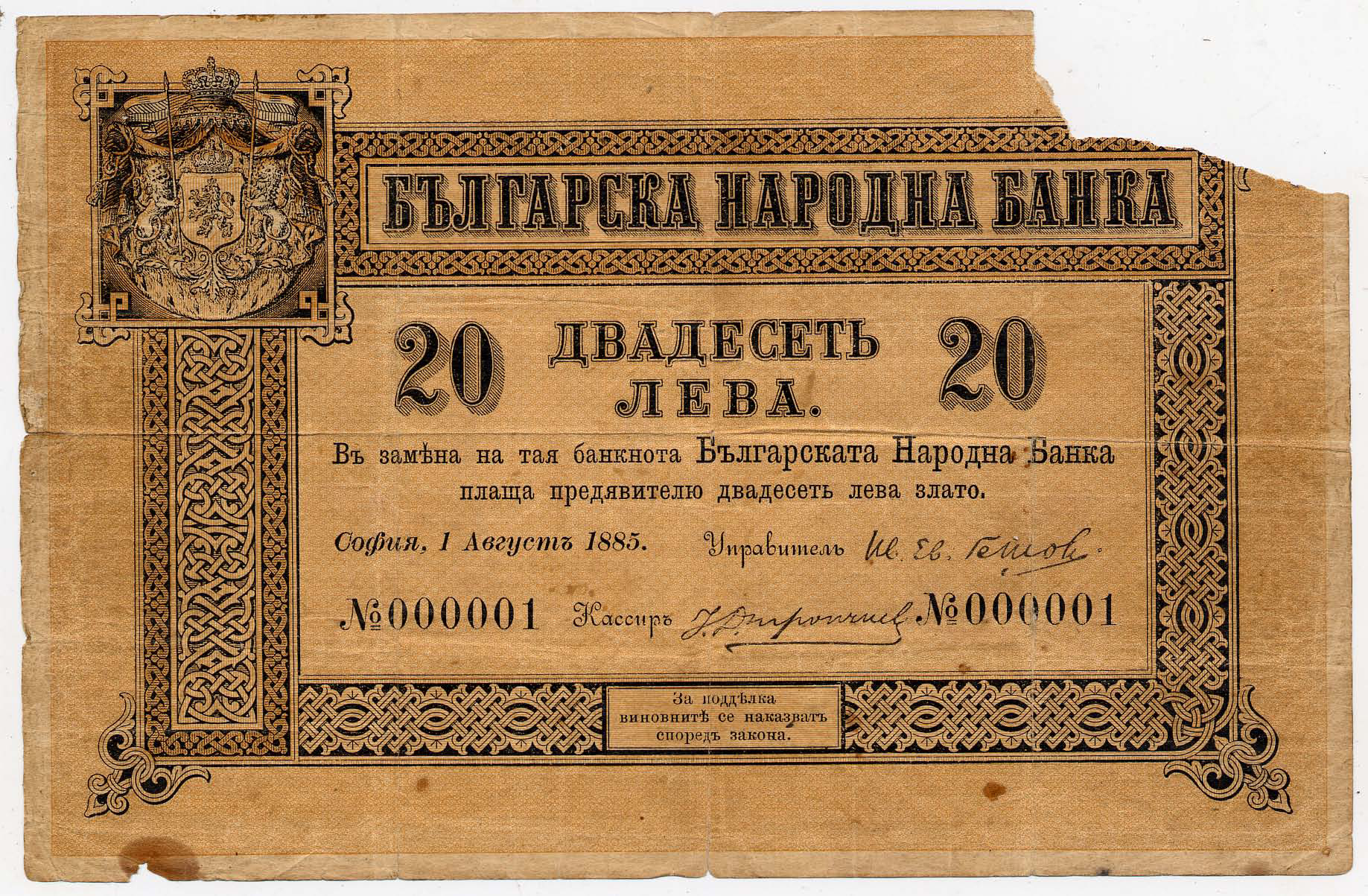
The first Bulgarian banknote, 1885
ISO 4217
CodeBGN (numeric: 975)
Subunit0.01
Unit
Plurallevove, numeric: leva
SymbolThe abbreviation лв. (lv.) is used
Nicknamekint[1]
Denominations
Subunit
1100stotinka
Plural
 stotinkastotinki
Symbol
 stotinkaст. (st.)
Banknotes5, 10, 20, 50, 100 leva
Coins1, 2, 5, 10, 20, 50 st., 1 lev, 2 leva
Demographics
Date of introduction4 June 1880 (1880-06-04)
Date of withdrawal31 December 2025
Replaced byEuro
User(s) Bulgaria
Issuance
Central bankBulgarian National Bank
 Websitewww.bnb.bg
MintBulgarian Mint
 Websitewww.mint.bg
Valuation
Inflation2.2%[2]
 MethodConsumer price index (CPI)
Pegged withEuro (€) = 1.95583 leva
EU Exchange Rate Mechanism (ERM)
Since10 July 2020
1 € =BGN 1.95583[3]
Band15.0% de jure; 0.0% de facto

The lev (Bulgarian: лев, plural: лева, левове / leva,[4] levove; ISO 4217 code: BGN; numeric code: 975) is the currency of Bulgaria. In early modern Bulgarian, the word lev meant "lion"; the word "lion" in the modern standard language is lаv (IPA: [ɫɤf]; in Bulgarian: лъв). The lev is subdivided into 100 stotinki (стотинки, singular: stotinka, стотинка). Stotinka in Bulgarian means "a hundredth" and is, in fact, a direct translation of the French term "centime". Grammatically, the word stotinka is derived from the Bulgarian word "sto" (сто; a hundred).

Since 1997, the Bulgarian lev has operated under a currency board arrangement, initially pegged to the Deutsche Mark at a fixed rate of 1,000 BGL = 1 DEM. Following the introduction of the euro and the redenomination of the lev in 1999, the peg was effectively set at 1.95583 BGN = 1 EUR. Since 2020, the lev has been part of the European Exchange Rate Mechanism (ERM II). In November 2023, Bulgarian euro coins design was approved by the Bulgarian National Bank.[5]

Bulgaria will adopt the euro as its official currency on 1 January 2026, replacing the Bulgarian lev.[6][7]

Etymology

[edit]

The currency's name comes from the archaic Bulgarian word "lev", which meant lion,[8] just like in the case of the Romanian leu. In both cases, the lion refers to the Dutch thaler (leeuwendaalder "lion thaler/dollar").[9][10][11] The Dutch leeuwendaalder was imitated in several German and Italian cities, and these coins circulated in Romania, Moldova and Bulgaria and gave their name to their respective currencies: the Romanian leu, the Moldovan leu and the Bulgarian lev.[12]

Dutch Thaler, depicting a lion, the origin of the Bulgarian "Lev"

Bulgarian national mythologising historiography has produced much content on the lion connection, presenting it as the national symbol of Bulgaria throughout centuries.[13] Lions were common in the region until about 300 BC.[14][15] In Bulgaria, the lion features in numerous historical monuments. The oldest images, found on slates in the city of Stara Zagora, date back to the 9th–10th century AD. A lion is depicted on The Madara Horseman – an impressive medieval rock relief carved into a towering rock plateau in north-eastern Bulgaria in the 7th or 8th century AD, which is on UNESCO's World Heritage List. In the Middle Ages, Bulgarian kings such as Ivan Shishman, one of the last rulers of the Second Bulgarian kingdom, celebrated the lion as a symbol of power.

In the time of Bulgarian national awakening in the years of Ottoman rule, the lion was considered and widely used as a major national symbol.[16] Paisii of Hilendar, a discerning monk and a key Revival figure, mentioned in his ground-breaking tome Istorija Slavjanobolgarskaja that Bulgarians had a lion on their kings' royal seal: a symbol of the bravery, courage and invincibility of Bulgarian warriors, who fought "like lions."

Lion images on revolutionary flags,[17] used in the 1876 freedom-seeking April uprising, provide a proof that the lion continued to be considered as a national symbol. In the immediate period leading up to the revolt, revolutionary flags were made, featuring a golden lion rampant and the motto "Freedom or Death". These flags, most often hand-made by local teachers or icon painters, have been preserved in Bulgarian museums to the present day. Most flags were made of green silk and had a painted or embroidered lion on them, in a heraldic posture and trampling over the Crescent – the symbol of the Ottoman Empire. The same image can be seen on items of one-time rebel outfits such as hats and buttons. In Bulgarian folklore and Revival Literature, these lion depictions were called lion signs attributed to the Bulgarian revolutionaries' image. "Young Bulgarian heroes... lion signs on their foreheads, fire blazing in their eyes," says a most popular Bulgarian Revival period song.[18]

History

[edit]

First lev (1881–1952)

[edit]

The lev was introduced as Bulgaria's currency in 1881 with a value equal to the French franc. The gold standard was suspended between 1899 and 1906 and suspended again in 1912. Until 1916, Bulgaria's silver and gold coins were issued to the same specifications as those of the Latin Monetary Union. Banknotes issued until 1928 were backed by gold (leva zlato / zlatni, лева злато / златни) or silver (leva srebro / srebarni, лева сребро / сребърни).

In 1928, a new gold standard of 1 lev = 10.86956 mg gold was established.

During World War II, in 1940, the lev was pegged to the German Reichsmark at a rate of 32.75 leva = 1 Reichsmark. With the Soviet occupation in September 1944, the lev was pegged to the Soviet ruble at 15 leva = 1 ruble. A series of pegs to the U.S. dollar followed: 120 leva = 1 dollar in October 1945, 286.50 leva in December 1945 and 143.25 leva in March 1947. No coins were issued after 1943; only banknotes were issued until the currency reform of 1952.

10 stotinki 1888

Coins

[edit]
1912 20 stotinki

Between 1881 and 1884, bronze 2, 5, and 20 stotinki, and silver 50 stotinki, 1, 2, and 5 leva were introduced, followed, in 1888, by cupro-nickel 2+12, 5, 10, and 20 stotinki. Gold 10 and 20 leva were issued in 1894. Bronze 1 stotinka were introduced in 1901.

Production of silver coins ceased in 1916, with zinc replacing cupro-nickel in the 5, 10, and 20 stotinki in 1917. In 1923, aluminum 1 and 2 leva coins were introduced, followed by cupro-nickel pieces in 1925. In 1930, cupro-nickel 5 and 10 leva and silver 20, 50, and 100 leva were introduced, with silver coins issued until 1937, in which year aluminium-bronze 50 stotinki were issued.

In 1940, cupro-nickel 20 and 50 leva were issued, followed, in 1941, by iron 1, 2, 5, and 10 leva. In 1943, nickel-clad-steel 5, 10 and 50 leva were struck. These were the last coins issued for this version of the lev.

the gold 20 leva (1894)

Banknotes

[edit]
500 Leva banknote of 1942, Tsar Boris III

In 1885, the Bulgarian National Bank introduced notes for 20 and 50 gold leva, followed in 1887 by 100 gold leva and, in 1890, by 5 and 10 gold leva notes. In 1899, 5, 10 and 50 silver leva notes were issued, followed by 100 and 500 silver leva in 1906 and 1907, respectively. 500 gold leva notes were also introduced in 1907.

5 leva coin (1894)

In 1916, 1 and 2 silver leva and 1000 gold leva notes were introduced, followed by 2500 and 10,000 gold leva notes in 1919. In 1924, 5000 leva notes were issued, the first to lack a metal designation. In 1928, a new series of notes (dated 1922 and 1925) was introduced which gave the denominations solely in leva. Denominations introduced were 5, 10, 20, 50, 100, 500, 1000 and 5000 leva. These were followed in 1929 by 200 and 250 leva.

In 1930, coins up to 100 leva replaced notes, although 20-lev notes were issued between 1943 and 1950. Between 1943 and 1945, State Treasury Bills for 1000 and 5000 leva were issued.

Second lev (1952–1962)

[edit]

In 1952, following wartime inflation, a new lev replaced the original lev at a rate of 1 "new" lev = 100 "old" leva. However the rate for banking accounts was different, ranging from 100:3 to 200:1. Prices for goods were replaced at a rate of 25:1.[19] The new lev was pegged to the U.S. dollar at a rate of 6.8 leva = 1 dollar, falling to 9.52 leva on July 29, 1957.

Coins

[edit]

In 1952, coins (dated 1951) were introduced in denominations of 1, 3, 5, 10 and 25 stotinki, with the lower three denominations in brass and the higher two in cupro-nickel. Shortly after, cupro-nickel 20 stotinki coins dated 1952 were also issued, followed by 50 stotinki in 1959 and 1 lev in 1960 which replaced the 1 lev note (both also in cupro-nickel). All stotinki coins feature a head of wheat around denomination on the reverse and state emblem on the obverse, while the lev coin depicts an olive branch wreath around the denomination.

Banknotes

[edit]

In 1952, state notes (dated 1951)[20] were issued in 1, 3 and 5 leva, together with notes of the National Bank for 10, 25, 50, 100 and 200 leva. 500-lev notes were printed but not issued. 1 lev notes were withdrawn after the introduction of a coin in 1960. 1, 3, and 5 leva depict the state emblem, while all denominations 10 leva and up depict Georgi Dimitrov, who had a post-mortem cult of personality built up around him by that time period. The reverse side of 1 lev, 3 and 5 leva notes depict hands holding up the hammer and sickle, while higher denominations each depict workers at various trades.

Third lev (1962–1999)

[edit]
Lev
ISO 4217
Codeearlier codes: BGJ, BGK, BGL

In 1962, another redenomination took place at the rate of 10 to 1, setting the exchange rate at 1.17 leva = 1 U. S. dollar, with the tourist rate falling to 2 leva on February 1, 1964. The ISO 4217 code was BGL. After this, the lev remained fairly stable for almost three decades. However, like other Communist countries' currencies, it was not freely convertible for Western funds. Consequently, black market rates were five to ten times higher than the official rate. During the period, until 1989 the lev was backed by gold, and the banknotes have the text stating: "The bank note is backed by gold and all assets of the bank" (Bulgarian: "Банкнотата е обезпечена със злато и всички активи на банката").

After the fall of communism, Bulgaria experienced several episodes of drastic inflation and currency devaluation. In order to change this, in 1997, the lev was pegged to the Deutsche Mark, with 1,000 lev equal to 1 DM (one lev equal to 0.1 pfennig).

Since 1997, Bulgaria has been in a system of currency board, and all Bulgarian currency in circulation has been completely backed by the foreign exchange reserves of the Bulgarian National Bank (BNB).

Coins

[edit]

In 1962, aluminum-bronze 1, 2, and 5 stotinki, and nickel-brass 10, 20 and 50 stotinki and 1 lev were introduced. The coin series strongly resembles coinage from the Soviet Union during the same period, particularly in design and size.

The state emblem is depicted on the obverse of all coins, which went through several changes. The first change in 1962 with the introduction of the new coinage, and the second change in 1974, with the ribbons being the most noticeable change.

A number of commemorative 2 leva coins also circulated during this period, often released into circulation as they had relatively high production numbers and little collector's value. Higher denomination lev coins have also been introduced into circulation at an irregular basis with varying sizes and metallic compositions, including silver. Mostly due to an overstock of numismatic coins not getting sold to collectors. Similar occurrences to this can be seen with high denomination coins from East Germany and Poland during the same period.

Communist era coins
Image Denomination Diameter Weight Composition Obverse Reverse Minted Year
1 stotinka 15.2 mm 1 g Brass Coat of Arms Denomination and date 1951-1990
2 stotinki 18.1 mm 2 g
3 stotinki 19.8 mm 2.4 g
5 stotinki 22.35 mm 3.1 g
10 stotinki 17.1 mm 1.8 g Nickel-brass and copper-nickel
20 stotinki 21.2 mm 2.9 g
25 stotinki 22 mm 3.3 g
50 stotinki 23.3 mm 4.2 g
1 lev 24 mm 4.8 g
Post-communist coins
[edit]

In 1992, after the communist era, older coins were withdrawn and a new coinage was introduced in denominations of 10, 20 and 50 stotinki, 1, 2, 5 and 10 leva. All were struck in nickel-brass except for the cupro-nickel 10 leva. In 1997, nickel-brass 10, 20 and 50 leva were introduced.

Banknotes

[edit]

In 1962, the National Bank issued notes for 1, 2, 5, 10 and 20 leva. A second series, in the same denominations, was issued in 1974. 50 leva notes were introduced in 1990. Again, denominations 10 leva and up featured Georgi Dimitrov, 1, 2, and 5 featured the state emblem. After the fall of the communist regime, new notes were introduced for 20, 50, 100 and 200 leva. These were followed by 500 leva notes in 1993, 1000 and 2000 leva in 1994, 5000 and 10,000 leva in 1996 (re-released with new design and look in 1997), and 50,000 leva in 1997. Furthermore, two new banknotes of 20,000 and 100,000 leva were scheduled to be introduced in 1997 and 1998, but their production was cancelled following the introduction of currency board in 1997.[21][22]

Fourth lev (1999–2025)

[edit]

On 5 July 1999 the lev was redenominated at 1000:1 with 1 new lev equal to 1 Deutsche Mark.[23] The ISO 4217 currency code for the new Bulgarian lev is BGN. The lev is pegged at €1 = 1.95583 leva (previously DEM 1 = BGN 1, continuing the fixed exchange rate from the third lev).

Coins

[edit]

In 1999, coins in denominations of 1, 2, 5, 10, 20 and 50 stotinki were introduced.[24] A 1 lev coin replaced the 1 lev banknote in 2002, and a 2 lev coin the 2 lev banknote in 2015.

Coins of the fourth lev (1999–present)[25]
Image Value Equivalent in euros Technical Parameters Description Date of
Diameter Mass Composition Edge Obverse Reverse minting Issue Withdrawal Lapse
1 stotinka €0.005 16 mm 1.8g 1999 - CuAlNi
2000 - Steel covered with bronze
Plain Value, year, twelve stars as symbol of Europe. Country name, Madara Rider 1999
2000
5 July 1999[24] Current
2 stotinki €0.010 18 mm 2.5 g
5 stotinki €0.025 20 mm 3.5 g
10 stotinki €0.051 18.5 mm 3.0 g CuNiZn reeded 1999
20 stotinki €0.102 20.5 mm 4.0 g
50 stotinki €0.255 22.5 mm 5.0 g
1 lev €0.511 24.5 mm 7.0 g Bimetallic: copper-nickel center in brass ring Alternating smooth and reeded segments Value, year, graphical pattern of two crossing lines. Country name, saint Ivan Rilski 2002 2 September 2002[26]
2 leva €1.022 26.5 mm 9.0 g Bimetallic: nickel brass center in copper-nickel ring Segmented reeding Country name, Paisius of Hilendar 2015 7 December 2015[27]
These images are to scale at 2.5 pixels per millimetre. For table standards, see the coin specification table.
Commemorative coins
[edit]

In 2004, 2005, and 2007, commemorative circulation issues were struck of the 50 stotinkas coin.[25] In 2018, a commemorative circulation issue of the 2 leva coin was issued. These coins are not found in general circulation.

Many commercial commemorative coins have also been minted.

Banknotes

[edit]

In 1999, banknotes were introduced in denominations of 1, 2, 5, 10, 20, and 50 leva. 100 leva notes were added in 2003. The 1 and 2 lev notes were later replaced by coins of similar value and withdrawn from circulation.

Banknotes of the fourth lev (1999–present)[25]
Image Value Equivalent in euros Dimensions Description Date of
Obverse Reverse Obverse Reverse Watermark Printing Issue Withdrawal Lapse
[1] [2] 1 lev €0.511 112 × 60 mm Ivan Rilski Rila Monastery Rampant lion 1999 5 July 1999 1 January 2016[28] Indefinitely
[3] [4] 2 leva €1.022 116 × 64 mm Paisiy Hilendarski Istoriya Slavyanobolgarskaya 1999
2005
1 January 2021[29]
[5] [6] 5 leva €2.556 121 × 67 mm Ivan Milev Paintings by Ivan Milev Ivan Milev 1999
2009
2020
Current
[7] [8] 10 leva €5.112 126 × 70 mm Petar Beron Astronomical instruments Petar Beron 1999
2008
2020
[9] [10] 20 leva €10.225 131 × 73 mm Stefan Stambolov Orlov most, Lavov most Stefan Stambolov 1999
2005
2007
2020
[11] [12] 50 leva €25.564 136 × 76 mm Pencho Slaveykov Poems by Pencho Slaveykov Pencho Slaveykov 1999
2006
2019
[13] [14] 100 leva €51.129 141 × 79 mm Aleko Konstantinov Aleko Konstantinov; his work "Bay Ganyo" Aleko Konstantinov 2003
2018
8 December 2003[30]
These images are to scale at 0.7 pixel per millimetre (18 pixel per inch). For table standards, see the banknote specification table.

Euro adoption

[edit]

The euro is set to replace the Bulgarian lev on 1 January 2026. Both physical currencies will circulate in parallel until 31 January 2026, after that date the lev will cease to be legal tender. The Bulgarian National Bank (BNB) will continue to exchange lev banknotes and coins indefinitely.

Current BGN exchange rates
From Google Finance: AUD CAD CHF CNY EUR GBP HKD JPY USD TRY
From Yahoo! Finance: AUD CAD CHF CNY EUR GBP HKD JPY USD TRY
From XE.com: AUD CAD CHF CNY EUR GBP HKD JPY USD TRY
From OANDA: AUD CAD CHF CNY EUR GBP HKD JPY USD TRY

See also

[edit]

Notes

[edit]
[edit]
Revisions and contributorsEdit on WikipediaRead on Wikipedia
from Grokipedia
The Bulgarian lev (Bulgarian: лев, lev, plural: лева, leva; : BGN; symbol: лв) is the official currency of , subdivided into 100 stotinki. Introduced by the Monetary of 27 May 1880, it established a uniform national currency at par with the shortly after Bulgaria's liberation from Ottoman rule, replacing earlier coinage systems and facilitating . The lev has undergone multiple redenominations—in 1952, 1962, and 1999—to address wartime and episodes, with the 1999 reform introducing the current fourth lev at a of 1,000 old leva to 1 new lev. Following the severe economic crisis of 1996–1997, which saw monthly exceed 200 percent, a regime was implemented in July 1997, pegging the lev initially to the at 1,000.00 BGL per DEM and later irrevocably to the at 1 EUR = 1.95583 BGN, backed by foreign reserves held by the . This arrangement has maintained and low , contributing to Bulgaria's economic recovery and convergence criteria fulfillment for accession. The name "lev" derives from the Bulgarian word for "," reflecting the animal's status as a , and early coins featured lion motifs. The Bulgarian issues circulating denominations, including banknotes of 2, 5, 10, 20, and 50 leva depicting historical figures, cultural heritage sites, and natural landmarks, alongside stotinki coins in base metals. Bulgaria's entry into the is scheduled for 1 2026, at which point the lev will be replaced by the at the fixed conversion rate, concluding its 145-year history as the nation's sovereign currency.

Introduction

Overview and characteristics

The Bulgarian lev (Bulgarian: лев; plural: лева or левове) is the official currency of , with code BGN and numeric code 975. Its symbol is лв, placed after the amount, and it is subdivided into 100 stotinki (singular: stotinka). The lev has been issued by the since its establishment in 1879, serving as for all transactions within the country until its scheduled replacement. Under a arrangement implemented in 1997, the lev maintains a fixed of 1 (EUR) = 1.95583 BGN, backed by foreign reserves primarily in euros to ensure monetary stability and prevent pressures observed in prior decades. This peg has provided a nominal anchor, limiting the Bulgarian National Bank's ability to conduct independent while fostering low averaging around 2-3% annually in recent years. Banknotes are issued in denominations of 2, 5, 10, 20, 50, and 100 leva, featuring historical figures and landmarks such as and the , while coins circulate in stotinki values from 1 to 50 and lev values of 1 and 2. As of October 2025, the lev remains in circulation, but Bulgaria's accession to the euro area on 1 January 2026 will irrevocably fix the conversion rate at the current peg and replace the lev with the euro as the sole legal tender, marking the end of its independent use after over 140 years. This transition follows fulfillment of eurozone convergence criteria, including price stability and fiscal discipline, as verified by the European Commission and European Central Bank. Dual pricing in leva and euros has been mandatory since August 2025 to facilitate the changeover.

Name, etymology, and symbol

The Bulgarian lev (Bulgarian: лев, plural: лева or левове; code: BGN, numeric code: 975) derives its name from the Bulgarian term for "," an archaic form rooted in Proto-Slavic levъ, symbolizing strength and appearing prominently in Bulgaria's since the medieval period. This etymological link parallels the Romanian leu, both tracing to Indo-European roots for the animal, with the lev introduced on July 1, 1881, following Bulgaria's liberation from Ottoman rule to establish a stable national monetary unit. The official currency symbol is лв, comprising the Cyrillic initials for "lev," used domestically in prices, banknotes, and transactions to denote amounts, while the international ISO code BGN facilitates global financial standards and exchange. This symbol distinguishes the lev from subdivisions like the stotinka, ensuring clarity in economic contexts amid Bulgaria's fixed exchange rate regime pegged to the euro since 1997.

Subdivisions

The Bulgarian lev is subdivided into 100 stotinki (singular: stotinka; Bulgarian: стотинки, стотинка), with "stotinka" deriving from the Bulgarian word for "hundredth," reflecting its value as one-hundredth of a lev. The stotinka has been the minor unit across all iterations of the lev since its introduction in 1881. Current circulating coins denominated in stotinki, introduced with the fourth lev in 1999 and issued by the , comprise 1, 2, 5, 10, 20, and 50 stotinki. These are composed primarily of copper-plated for lower denominations and brass-plated for higher ones, featuring designs such as national symbols and historical figures on the . Complementing these are bimetallic coins of 1 lev and 2 leva, which serve as higher-value subdivisions equivalent to 100 and 200 stotinki, respectively.

History

First lev (1881–1952)

The first lev was established as Bulgaria's national currency following the country's autonomy after the 1878 Treaty of Berlin, with the "Law on the right to mint coins in the Principality of Bulgaria" passed on 4 June 1880 by the Second Ordinary and approved by Prince Alexander I. This legislation defined the lev as the monetary unit, subdivided into 100 stotinki, and specified denominations for gold, silver, and copper coins including 20, 10, 5, 2, and 1 lev, as well as 50, 10, 5, and 2 stotinki. The lev was modeled on the under a bimetallic standard aligned with the , facilitating trade and symbolizing economic independence from Ottoman currencies like the . Initial coinage began in 1881 with bronze coins of 2, 5, and 10 stotinki minted in Birmingham, , followed by silver 1 and 2 leva coins struck in St. Petersburg, , in 1882. Silver and coins, including a 100 leva piece, entered wider circulation by , though foreign coins such as French francs persisted in use due to initial public preference and supply constraints. Coin materials evolved amid wars and shortages: zinc coins appeared in 1917 during , aluminum and copper-nickel in the 1920s, high-denomination silver coins (20, 50, 100 leva) in 1930, iron in 1941, and nickel-plated steel in 1943. The , founded in 1879 and operationalized for note issuance by January 1885, released the first banknotes on 1 August 1885 in denominations of 20 and 50 leva, designed by Georgi Kirkov and backed by gold reserves equivalent to French 20-franc coins. These notes faced initial distrust as was novel, but they supported centralized amid unification efforts. The gold standard was suspended during financial strains, such as between 1899 and 1906, and fully during , contributing to devaluation. The lev endured pressures from the (1912–1913), , and , during which Bulgaria's Axis alignment from 1941 exacerbated metal shortages and inflationary printing. Post-1944 communist takeover following the Soviet-backed coup intensified economic disruption through nationalizations, war reparations, and supply scarcities, fueling that rendered the lev unstable by the late 1940s. In May 1952, a currency reform introduced the second lev at an exchange rate of 1 new lev equaling 100 old leva, alongside pegging to the at 1 lev to 1.7 rubles, aiming to stabilize the economy under socialist planning; bank accounts faced varying conversion rates to limit wealth retention. This reform coincided with domestic mint establishment, reducing foreign dependence.

Second lev (1952–1962)

The second lev was introduced on 20 May through a comprehensive reform enacted by the Bulgarian communist government to address postwar , , and economic misalignment within the Soviet bloc. Ordinance No. 405, adopted on 10 May by the and the Central Committee, mandated the exchange of 100 old leva for 1 new lev in cash holdings, while savings deposits faced tiered rates—such as up to 25 old leva per 1 new lev for smaller amounts—resulting in significant reductions in private wealth to support state industrialization and collectivization efforts. The reform effectively confiscated portions of savings, as larger deposits were converted at less favorable ratios, aligning with communist policies to redistribute resources from individuals to the . The new lev was pegged to the Soviet ruble at a fixed rate of 1 new lev equaling 1.7 rubles, a shift from the prior rate of 100 old leva for 1.4 rubles, which reinforced Bulgaria's integration into the Council for Mutual Economic Assistance (COMECON) and prioritized trade with the USSR over Western currencies. This peg, combined with the establishment of gold coverage for the lev at approximately 0.147 grams per lev, aimed to restore confidence in the currency but tied Bulgaria's monetary policy to non-convertible Soviet standards, limiting flexibility amid domestic shortages. Accompanying measures included the abolition of rationing systems, nominal wage reductions, and price cuts for essential goods like food, which temporarily curbed hyperinflation rates exceeding 100% annually in the late 1940s but imposed immediate hardships on households. During its decade of circulation, the second lev facilitated centralized planning under the Bulgarian National Bank, with minimal coinage production due to persistent material shortages and reliance on banknotes for transactions. Inflation was suppressed through administrative controls rather than market mechanisms, though black markets persisted due to overvalued official prices and suppressed wages. The currency's stability masked underlying distortions, as the ruble peg undervalued the lev relative to potential Western exchange rates—estimated at around 6.8 leva per U.S. dollar in unofficial alignments—prioritizing bloc cohesion over convertibility. Contemporary assessments noted that while the reform stabilized fiscal balances, it exacerbated living standards for the populace by eroding purchasing power and enforcing ideological conformity in economic policy. The second lev remained in use until 1962, when it was replaced by the third lev at a 1:1 parity amid further adjustments to sustain the command economy.

Third lev (1962–1999)

The third lev was introduced on January 1, 1962, through a currency reform that exchanged the second lev at a of 10 old leva to 1 new lev, aiming to curb persistent from the previous decade. The initial was fixed at 1.17 leva per U.S. , reflecting efforts to stabilize the currency under the centrally of the . Banknotes during this period, until 1989, explicitly stated they were "backed by ," underscoring the regime's emphasis on nominal within the socialist framework, though the lev remained non-convertible internationally and was subject to black-market trading at unfavorable rates. New coinage accompanied the reform, featuring aluminum-bronze pieces for 1, 2, and 5 stotinki, alongside nickel-brass denominations of 10, 20, 50 stotinki, and 1 lev, which circulated alongside updated banknotes in values such as 1, 2, 5, 10, 20, 50, and 100 leva. Throughout the communist era until the late , the third lev maintained relative stability, with controlled through state and suppressed wages, though underlying distortions from inefficient accumulated. The fixed persisted nominally, but real eroded gradually due to hidden and shortages rather than overt price surges. Following the collapse of communist rule in and the shift to a market-oriented economy, the third lev faced mounting pressures from , delays, and fiscal deficits. Inflation accelerated, averaging over 200% annually from 1990 to 1997, driven by loose , banking sector fragility, and external shocks. By 1996–1997, a severe ensued, characterized by peaking at 242% monthly in February 1997, with prices doubling in days and the lev depreciating rapidly against foreign currencies—exemplified by everyday items like coffee reaching absurd hourly price hikes. Approximately one-third of Bulgaria's banks failed or entered , exacerbating and a verge-of-default crunch that threatened systemic collapse. The crisis stemmed from interconnected factors including soft budget constraints in state enterprises, inadequate banking supervision, and speculative attacks on the lev, rather than solely monetary overhang, as evidenced by econometric analyses comparing quantity theory predictions to structuralist accounts. In response, the government introduced a arrangement in July 1997, pegging the lev to the (later ) at a fixed rate of 1,955.07 leva per unit, which rapidly curbed to 1% by late 1998 but highlighted the third lev's untenability. This culminated in the lev's on July 5, 1999, at 1,000:1 against a new fourth lev, effectively ending the third lev's circulation amid the stabilization reforms.

Fourth lev (1999–2025)

The fourth lev was introduced on July 5, 1999, via of the third lev at a rate of 1 new lev equaling 1,000 old leva, as authorized by adopted on February 19, 1999, to address the hyperinflationary of the mid-1990s that had eroded in the . Initially pegged at parity to the under Bulgaria's regime—established in 1997 to enforce fiscal and monetary discipline—the lev transitioned seamlessly to a fixed rate against the upon the latter's launch in 1999, fixed at 1 euro = 1.95583 leva. This peg, backed by euro-denominated reserves held by the , ensured full convertibility and restricted monetary base expansion to inflows of foreign reserves, thereby anchoring . Coins of the fourth lev retained the stotinka subdivision (1 lev = 100 stotinki), with bronze-plated steel pieces issued in 1999 for 1, 2, 5, 10, 20, and 50 stotinki denominations, designed for everyday transactions and featuring national symbols such as the Madara Rider. A bimetallic 1 lev coin entered circulation in 2002, replacing the low-value 1 lev banknote to reduce printing costs and enhance durability, while a 2 lev bimetallic coin followed in subsequent years. Banknotes, printed in polymer-enhanced paper for security, circulated in 2, 5, 10, 20, 50, and 100 leva values, depicting Bulgarian historical figures like Paisius of Hilendar on the 2 leva note and landmarks such as the Rila Monastery on higher denominations; these were progressively updated for anti-counterfeiting features through the 2010s and 2020s. The fourth lev's fixed fostered sustained monetary stability, with annual consumer price inflation averaging below 3% from 2000 onward—contrasting sharply with the 1996-1997 peak exceeding 500%—as the eliminated discretionary and imported price discipline. This stability supported GDP growth averaging over 3% annually in the and , bolstered , and facilitated Bulgaria's EU accession in 2007, though it also constrained independent responses to asymmetric shocks. The lev remained through December 31, 2025, after which it was replaced by the on January 1, 2026, at the irrevocable rate of 1 = 1.95583 leva, following Bulgaria's entry into the following ERM II participation from 2020.

Currency board arrangement

Establishment and background

The Bulgarian currency board arrangement emerged from a severe economic in late 1996 and early 1997, triggered by persistent fiscal deficits, expansionary monetary policies, and vulnerabilities in the banking sector, where pyramid-like schemes and non-performing loans led to the collapse of 14 out of 35 . ensued, with end-of-period consumer price inflation reaching 310% in 1996 and accelerating to annual rates exceeding 500% in January 1997 and over 2,000% in March 1997, alongside a monthly peak of 242% in . Previous stabilization efforts, including a soft peg to the and hikes to 108%, failed amid political instability and loss of confidence in the lev, culminating in and a default on domestic debt. In November 1996, an IMF mission began consultations with Bulgarian authorities and stakeholders, advocating a as a credible anchor to enforce fiscal and monetary restraint, given the repeated breakdowns in independence and policy execution. Parliamentary elections on , , installed a reform-oriented government led by Ivan Kostov of the United Democratic Forces coalition, which prioritized the measure within a new IMF standby arrangement providing initial reserve support. The arrangement was enacted on July 1, 1997, by the , fixing the exchange rate at 1,000 leva per —a rate slightly stronger than the prevailing market level of approximately 922 leva per mark—and mandating full foreign reserve cover for the to ensure unconditional convertibility. This unorthodox monetary regime divided the BNB into an Issue Department for reserve management and a Banking Department for limited supervisory functions, effectively curtailing lender-of-last-resort operations and financing of deficits. Implementation faced initial skepticism due to reserve adequacy concerns but benefited from pre-existing lev appreciation pressures and international backing, swiftly restoring stability without immediate devaluation.

Operational mechanism

The Bulgarian National Bank's (BNB) arrangement, implemented on July 1, 1997, divides the institution into three departments: the Issue Department, which operates as the core ; the Banking Department, handling limited supervisory and functions; and a separate Banking Supervision Department. The Issue Department issues and redeems Bulgarian lev (BGN) solely against , ensuring full coverage of the —comprising banknotes, coins, and commercial banks' required reserves—at a fixed exchange rate, initially set at 1,000 BGN per and adjusted to 1.95583 BGN per following the euro's introduction in 1999. Under this mechanism, the BNB maintains unlimited , buying lev from the public and banks at the fixed rate minus a commission of up to 0.5% and selling foreign at the exact peg rate, with operations backed by reserves held primarily in euro-denominated assets and . The monetary base expands only when foreign inflows increase reserves, such as through exports or capital inflows, and contracts automatically during outflows via balance-of-payments adjustments, eliminating discretionary tools like operations or direct government financing. Reserve requirements for commercial banks are fixed at 11% on most liabilities, further constraining base , while the BNB publishes its accounts weekly to verify full coverage, which exceeded 100% consistently post-1997. The Banking Department provides restricted liquidity support to solvent banks facing temporary mismatches, capped at levels like an initial $300 million equivalent in 1997, but without traditional lender-of-last-resort functions that could undermine the peg; instead, it relies on market discipline and enhanced prudential regulations to prevent systemic risks. This hybrid structure deviates from a pure currency board by retaining some central banking elements, yet enforces rule-based stability through legal prohibitions on reserve requirement changes without National Assembly approval and bans on seigniorage use for fiscal deficits. Overall, the arrangement prioritizes reserve adequacy over active policy, with foreign reserves growing from approximately $800 million in mid-1997 to over $3 billion by late 1998, demonstrating operational resilience amid stabilization.

Economic stabilization effects

The establishment of the Bulgarian currency board on July 1, 1997, pegged the lev to the at a fixed rate of 1,000.00 levа per DEM, thereby eliminating discretionary and preventing further money printing that had driven earlier that year. This arrangement immediately curbed inflationary pressures, with monthly inflation rates—peaking at over 240% in February 1997—plummeting to near zero by late 1997, and annual declining to 13% by mid-1998 and 1% by December 1998. , depleted to critically low levels amid the 1996–1997 banking crisis, were rapidly rebuilt as public confidence in the lev restored, enabling the to back the fully with foreign assets. Interest rates, which had soared to triple digits during the hyperinflation episode, fell precipitously post-implementation, with short-term rates dropping from over 200% in early 1997 to around 5% by 1998, facilitating a stabilization of the banking sector through enforced fiscal and monetary discipline absent a . The currency board's rigid convertibility rule promoted fiscal restraint, as the government could no longer finance deficits via credits, contributing to a sharp reduction in public debt from 97% of GDP in 1997 to levels below 20% by the early . Economic output, which contracted by 7.4% in 1997 amid the crisis, rebounded with GDP growth of 3.9% in 1998 and averaging over 5% annually through the early , supported by renewed investor confidence and structural reforms aligned with the board's constraints. While the currency board provided a credible nominal anchor that ended the vicious cycle of devaluation and inflation expectations, its stabilization effects were amplified by concurrent measures such as bank restructuring and privatization, rather than the mechanism alone; deviations from orthodox board principles, including limited flexibility in reserve management, underscored the need for complementary fiscal prudence to sustain long-term stability. Over the subsequent decades, the arrangement maintained low and stable inflation, with average annual rates below 3% from 2000 onward, though it constrained countercyclical policy responses during external shocks, as evidenced by subdued output volatility tied to eurozone fluctuations post-1999 peg shift.

Transition to the euro

Preparations and EU convergence

Upon joining the on January 1, 2007, Bulgaria committed to adopting the upon fulfillment of the convergence criteria, including price stability with inflation not exceeding the average of the three best-performing area states by more than 1.5 percentage points, a deficit below 3% of GDP, not exceeding 60% of GDP or approaching that level satisfactorily, stability within the ERM II mechanism for at least two years without , and long-term rates not exceeding the average of the three best-performing member states by more than 2 percentage points. The country's arrangement, established in July 1997 and maintained since 1999 with a fixed peg of the lev to the at 1.95583 leva per euro, ensured compliance with the criterion without requiring participation in ERM II, as the unilateral peg provided equivalent stability. Bulgaria's preparations involved sustained fiscal discipline, structural reforms to enhance competitiveness, and alignment through the , which limited the Bulgarian National Bank's ability to conduct independent monetary operations and thereby anchored expectations. Annual convergence reports by the and highlighted progress, though challenges persisted, such as elevated following the and energy price shocks, which temporarily delayed assessments in 2022 and 2023. By 2024, resumed, supported by wage growth moderation and fiscal consolidation, with the government deficit reduced to 2.8% of GDP in 2024 from higher levels post-pandemic. In February 2025, requested a special convergence assessment targeting adoption on January 1, 2026, prompting updated reports from the and ECB on June 4, 2025, which confirmed fulfillment of all criteria: average annual at 2.1% (within reference values), long-term interest rates at 3.9% (below the 5.0% reference), sustained stability under the , a of 23.1% (well below 60%), and compatibility of national legislation with area requirements following amendments to banking and fiscal laws. These assessments underscored the role of the in fostering low- credibility and fiscal prudence, though the Commission noted ongoing needs for judicial reforms and measures to support long-term convergence.

Approval process and conversion rate

The approval process for Bulgaria's accession to the euro area culminated on July 8, 2025, when the adopted three key legal acts: a decision on the adoption of the euro by effective January 1, 2026; a regulation on the conversion rate; and a decision abrograting the under Article 140 of the Treaty on the Functioning of the . This followed the European Commission's convergence report and assessment on June 4, 2025, confirming 's fulfillment of the convergence criteria, including price stability, sound public finances, exchange rate stability, and convergence of long-term interest rates. The had issued its convergence report in June 2025, verifying compliance with the necessary conditions for irreversibly fixing exchange rates. Prior steps included Bulgaria's entry into the Exchange Rate Mechanism II (ERM II) on July 10, 2020, with a commitment to maintain the existing peg to the without . The process also involved assessments by the and ECB on economic integration, legal compatibility of monetary legislation, and non-inflationary conditions for price conversion, all of which were deemed satisfied by mid-2025. The Council's decision marked the final political endorsement, enabling to become the 21st euro area member state. The irrevocable conversion rate was fixed at 1 = 1.95583 Bulgarian leva, reflecting the central rate established under Bulgaria's arrangement since July 7, 1997, and maintained without interruption during ERM II participation. This rate ensures continuity in the unilateral peg that has underpinned monetary stability, with the lev's value derived from the 's full backing by euro-denominated reserves held by the . All monetary amounts in leva, including wages, contracts, and debts, will convert at this rate upon adoption, with dual pricing required in leva and euros starting , 2025, to facilitate the transition.

Public debates, benefits, and criticisms

Public opinion on Bulgaria's euro adoption remains deeply divided, reflecting historical skepticism rooted in the 1996–1997 crisis that prompted the lev's peg to the (later ). A July 2025 Alpha Research survey indicated 46.5% support for replacing the lev with the versus 46.8% opposition, underscoring near parity amid concerns over economic autonomy. leaders exhibit stronger backing, with 69% of companies favoring the shift in an August 2025 poll, citing streamlined cross-border operations. Nationalist and radical parties have leveraged the debate, framing adoption as a threat to and fueling protests, particularly as the approved entry for January 1, 2026, in July 2025. Proponents highlight tangible economic advantages from formal eurozone integration, despite the lev's longstanding fixed peg at 1.95583 BGN per EUR since 1997, which has already aligned with the ECB. These include reduced currency conversion fees for trade—potentially saving businesses 0.5–1% on EU transactions—and access to lower borrowing costs, as eurozone membership signals enhanced credibility to investors, evidenced by Croatia's post-2023 adoption decline in sovereign spreads by up to 20 basis points. Increased (FDI) is anticipated, building on the peg's stability that limited to 2.9% in 2024, while price transparency and elimination of risks could boost intra-EU exports, which comprise over 60% of Bulgaria's total. Government safeguards, such as dual pricing mandates until mid-2026 and penalties for unjustified price hikes, aim to mitigate transitional disruptions. Critics argue the transition offers marginal benefits given the lev's de facto euro shadowing under the currency board, which has maintained price stability without ECB oversight, and warn of risks from Bulgaria's structural vulnerabilities like corruption and fiscal deficits exceeding 3% of GDP in 2024. An from economists and analysts in 2025 urged halting the process, citing potential credibility erosion for the by integrating a nation with weak institutions, where rule-of-law indices lag euro area averages by 20–30 points per metrics. Fears of imported persist, with surveys attributing opposition to anticipated purchasing power erosion—echoing temporary 5–10% price spikes in prior adopters like —despite the fixed rate minimizing exchange shocks. Loss of the lev as a national symbol amplifies cultural resistance, while asymmetric economic shocks (e.g., from energy dependence) could exacerbate vulnerabilities without independent devaluation tools, as evidenced by Greece's 2009–2015 under euro constraints. Polls from May 2025 show support dipping to 43%, linking declines to unaddressed debates on fiscal .

References

Add your contribution
Related Hubs
User Avatar
No comments yet.