Recent from talks
All channels
Be the first to start a discussion here.
Welcome to the community hub built to collect knowledge and have discussions related to Boondi.
Nothing was collected or created yet.
Boondi
View on Wikipediafrom Wikipedia
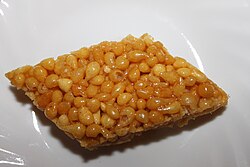
Boondi Mithai | |
| Alternative names | Bundi, Bundiya, Buniya, Bonde, Nukti, Boondia, Bundia |
|---|---|
| Course | Dessert |
| Place of origin | Indian subcontinent |
| Region or state | Bangladesh India (Andhra Pradesh, Bihar, Gujarat, Haryana, Maharashtra, Karnataka, Odisha, Kerala, Punjab, Rajasthan, Sindh, Uttar Pradesh, West Bengal, Tamil Nadu) |
| Main ingredients | Gram flour, sugar |
| Variations | Khara or Kara boondi |
Boondi is an Indian snack made from fried chickpea flour. It is either eaten as a savoury snack or sweetened as a dessert.[1]
In Sindh and Rajasthan, the dish is called nukti (Sindhi: نڪتي, Dhatki: نڪتي | नुक्ती). In Nepali, Bhojpuri region and Bihar it is referred to as buniya/bundiya (बुनिया/बुंदिया). In Bengal, it is called Boorinda, bonde or bundiya (বুরিন্দা/বোঁদে/বুন্দিয়া).
Preparation
[edit]
To make sweetened boondi, chickpea flour, baking powder, and food colouring are mixed into a batter. A slotted spoon is used to pour small drops into a deep frying pan. The boondi is then soaked in sugar syrup.[2][3]
Variations
[edit]- Boondi is used to prepare raita in North India. Boondi raita typically contains curd (plain yoghurt), boondi (which has been soaked in water to make it soft, then sieved) and seasonings of salt, chilli, and other spices. It is eaten as a side dish with pulao or any other meal.[1]

- To make boondi laddu, fried boondi is dipped in sugar syrup and compacted into a ball. It can be garnished with nuts and raisins.[3]
- Khara or kara boondi (spicy savory boondi) is made by adding chili powder, salt, turmeric powder to the boondi batter and deep fried in oil. Khara or kara boondi is eaten by itself or added to Bombay mix. Crushed curry leaves, roasted peanuts, roasted cashew are added.[4]
- In West Bengal, Sada Bonde from Kamarpukur was awarded a Certificate of Registration of Geographical Indication in 2025.[5] This variant is made using the milk product chhena, sugar and ghee.[5]
References
[edit]- ^ a b Tiwari, Brijesh; Singh, Narpinder (2015). Pulse Chemistry and Technology. Royal Society of Chemistry. p. 271. ISBN 9781782625674.
- ^ Pandya, Michael (1989). Indian Vegetarian Cooking. Inner Traditions – Bear & Company. p. 179. ISBN 9780892813421.
- ^ a b Sudhir, Satya (2018). A Hundred Red Roses. Notion Press. ISBN 9789386295897.
- ^ "Diwali 2024: Namkeen Recipes To Delight Your Guests". ABP Live. 21 October 2024. Retrieved 21 July 2025.
- ^ a b "Kamarpukur sada bonde awarded GI tag". The Statesman. 5 April 2025. Retrieved 15 April 2025.
See also
[edit]External links
[edit]
Media related to Boondi at Wikimedia Commons
Boondi
View on Grokipediafrom Grokipedia
Boondi (also known as bundi, boondia, or bundia) is a traditional Indian snack and confection originating from Rajasthan, India, consisting of small, pearl-like droplets made by frying chickpea flour (besan) batter in hot oil, which can be prepared as either a savory or sweetened delicacy.[1][2]
In its savory form, boondi is seasoned with spices such as turmeric, chili powder, or salt, and commonly used as a garnish or ingredient in dishes like raita (a yogurt-based side), chaat (street food snacks), curries, salads, or rice preparations, providing a crunchy texture that enhances flavor contrasts.[2] The sweet variant involves soaking the fried boondi in sugar syrup, often flavored with cardamom, saffron, or rose water, and it serves as a base for popular desserts such as boondi laddu, where the droplets are shaped into round sweets with added nuts like almonds or cashews.[1][2]
Deeply embedded in Hindu cultural traditions, boondi holds significant celebratory value and is enjoyed during festivals like Diwali and Raksha Bandhan, as well as at weddings and birthdays.[2]
*Based on a 2,000-calorie diet; values approximated from commercial analyses.[32][33]
Overview and History
Definition and Characteristics
Boondi is a traditional Indian snack consisting of small, spherical or droplet-shaped fritters formed by dropping chickpea flour (besan) batter into hot oil or ghee for deep-frying.[2] The batter, typically with 36–44% solids content, yields fritters that are uniform and crisp when prepared optimally. These fritters generally range from 3 to 5 mm in diameter for standard plain boondi, though sizes can vary up to 8 mm depending on the mesh used in production, with finer versions measuring around 2 mm.[3][4] Boondi features a crunchy texture in savory preparations and a porous structure that facilitates absorption of spices, flavors, or syrups.[2] Distinguished from other fried snacks like sev—extruded into thin, noodle-like strands—or papdi, which are flat discs, boondi maintains its identity through loose, individual droplet forms rather than shaped extrusions.[2][5] Its sensory profile includes a golden-brown color from frying and a nutty, fried gram aroma characteristic of besan.[6] This versatility allows boondi to serve as a standalone snack or an ingredient in various dishes.[2]Origins and Evolution
Boondi originated in the arid region of Rajasthan, India, where chickpea cultivation has been a staple since ancient times due to the crop's resilience in dry climates. Chickpeas (Cicer arietinum), the primary ingredient for besan (gram flour) used in boondi, were domesticated in the Fertile Crescent around 10,000 years ago and spread to India by 2000 BC, with archaeological evidence from sites like Atranjikhera in Uttar Pradesh.[7][8] In Rajasthan, this cultivation adapted to local conditions, enabling the creation of preserved snacks like boondi to combat food scarcity in desert environments.[9][10] The exact historical origins of boondi are not well-documented, but it has roots in Rajasthan's Rajput heritage, where such items served as portable rations for warriors and travelers.[1] Over time, boondi evolved from a basic savory fried droplet into a key component of sweets, notably boondi laddu, under the patronage of Rajput courts and influenced by broader culinary exchanges with Mughal traditions that refined Indian confections with sugar syrups and spices.[11][12] Its spread across India occurred through ancient trade routes and Hindu festivals, where sweetened boondi became a shared offering, adapting to regional spices and sweeteners while retaining its Rajasthani essence.[13][1]Preparation and Ingredients
Key Ingredients
The primary ingredient in boondi is chickpea flour, also known as besan or gram flour, which provides the gluten-free structure essential for the snack's delicate, crispy texture and imparts a subtle nutty flavor.[6][14] Typically, a batter is prepared using a ratio of 1 cup besan to approximately 1/2 cup water, adjusted to achieve a thin, flowing consistency similar to dosa batter, allowing the mixture to form small droplets when fried.[15][16] Optional additions enhance the final product's crispiness and seasoning; for instance, a pinch of baking soda or fruit salt (such as Eno) is often incorporated into the batter to promote lightness and prevent sogginess, while 1/2 teaspoon of red chili powder and salt to taste are added for savory variants to provide heat and balance.[6][14] Rice flour, about 1-2 tablespoons per cup of besan, may also be mixed in to further boost crunchiness without altering the flavor profile.[16][6] Water serves as the main liquid to thin the besan batter, ensuring it is pourable enough to create uniform boondi droplets.[16][14] For frying, a neutral oil like sunflower or vegetable oil is standard, but ghee can be employed to infuse a richer aroma and traditional depth, especially in sweet versions.[15][6] In sweet boondi variants, sugar syrup acts as the coating agent, prepared by boiling a 1:1 ratio of sugar and water to reach one-thread consistency, which allows the fried boondi to absorb the syrup evenly without becoming overly sticky.[17][18]Frying and Shaping Techniques
The preparation of boondi begins with the batter, primarily composed of besan whisked vigorously with water to create a thin, airy consistency that allows it to flow smoothly through the perforated ladle without clumping. This whisking process incorporates air bubbles, ensuring the droplets form uniform spheres during frying. After mixing, the batter is rested for 10-15 minutes, which helps the flour particles hydrate fully and stabilizes the texture for consistent shaping. To test the droplet size before full production, a small amount of batter is poured over the jhara held above a bowl; if the drops are round and pearl-like without tails, the consistency is ideal.[17] The key tool for shaping boondi is the boondi jhara, a specialized stainless steel ladle featuring evenly spaced holes approximately 2-3 mm in diameter, designed to produce small, spherical droplets when the batter is poured onto it. This perforated implement is held 4-5 inches above the surface of the hot oil in a deep kadai or frying pan, allowing the batter to fall directly into the fat and form its characteristic shape upon contact. Precise control of the oil temperature, maintained at 160-180°C using a thermometer or the drop test—where a small batter droplet rises immediately to the surface without browning too quickly—is crucial to prevent the boondi from becoming soggy or absorbing excess oil.[19][20] Frying occurs in small batches to avoid overcrowding: the batter is ladled onto the jhara and gently tapped or spread to release droplets evenly into the oil, where they sizzle and puff up within 2-3 minutes until they turn golden and crisp. The fried boondi are then promptly removed using a slotted spoon and drained on absorbent kitchen paper to remove residual oil, followed by spreading them out to cool completely, which preserves their crunch by halting further cooking and moisture retention. For optimal results, the oil should be heated to the correct temperature before each batch and adjusted as needed to maintain consistency throughout the process.[14][21] Common pitfalls in frying and shaping include using an over-thick batter, which results in irregular, elongated shapes rather than uniform pearls due to poor flow through the jhara holes. Similarly, frying at too low an oil temperature—below 160°C—causes the boondi to absorb excess oil, leading to a greasy texture instead of the desired lightness. To mitigate these issues, the batter should be checked and thinned with water if necessary, and the oil temperature monitored closely, often by observing the rapid rising of test droplets without darkening.[18][15]Culinary Uses and Variations
Savory Applications
Boondi serves as a versatile crunchy element in various savory Indian snacks and dishes, particularly in North Indian and Rajasthani cuisines. As a standalone snack, plain boondi, often referred to as kara boondi, is deep-fried from a chickpea flour batter and immediately tossed with salt, chili powder, and curry leaves to enhance its tangy-savory profile.[22] This spiced version is commonly mixed with roasted peanuts, sev (crispy chickpea noodles), and chaat masala to create namkeen mixtures, popular tea-time accompaniments that provide a satisfying crunch and mild heat.[2] These mixtures are enjoyed throughout the day, with the boondi's absorbent texture allowing it to carry flavors from spices like black salt or dried mango powder, added post-frying for a zesty tang.[22] In curries and side dishes, boondi adds texture and subtle nuttiness without overpowering the main flavors. Boondi raita, a cooling yogurt-based side, incorporates soaked boondi—briefly immersed in water to soften its crispness—mixed with cumin powder, roasted cumin, chili powder, and fresh herbs like coriander or mint for a refreshing contrast to spicy mains.[22] Variations include pudina boondi raita with mint for added freshness or punjabi boondi raita with spice blends, often served alongside rice or flatbreads.[22] Similarly, in kadhi, a tangy gram flour and yogurt curry, boondi is stirred in toward the end to thicken the gravy and provide bursts of crunch, as seen in Rajasthani and Punjabi preparations where it replaces or complements fried pakoras.[23] This application highlights boondi's role in balancing creaminess with texture in everyday home cooking.[24] As a garnish, boondi imparts an instant crunch to a range of dishes, elevating both flavor and presentation. It is frequently sprinkled over chaats—street-style snacks layered with potatoes, chickpeas, and chutneys—to add a light, airy contrast to the soft fillings.[2] In rice preparations like pulao, a handful of boondi is scattered on top just before serving, offering a subtle pop of texture amid the aromatic grains and vegetables.[22] For salads or lighter sides, boondi provides a savory crunch similar to croutons, often tossed in with cucumbers and tomatoes. Regionally, in Rajasthan, boondi features as a filling in kachoris, where spiced boondi is encased in flaky pastry dough for a portable snack with layered textures.[25] These uses underscore boondi's adaptability in enhancing savory meals with minimal preparation.Sweet Preparations
Sweet preparations of boondi center on infusing fried gram flour pearls with sugar syrup to create indulgent desserts, with boondi laddoo being the foremost example. In this process, plain fried boondi is combined with warm sugar syrup flavored with cardamom pods or powder, along with optional additions like raisins and cashews, before being shaped into firm balls using ghee-greased hands for binding.[18][21] Boondi laddoo differs from motichoor laddoo primarily in the size of the pearls: boondi laddoo employs larger, more substantial droplets formed from a thicker batter, yielding a coarser yet tender texture, whereas motichoor uses finer, pearl-like bits for a lighter consistency.[26][18] To prepare the syrup, sugar and water are boiled—typically in a 2:1 ratio, such as 1.5 cups sugar to 0.75 cups water—until reaching the one-string or soft-ball stage, where a drop forms a pliable thread or ball in cold water. The hot fried boondi is then mixed into this syrup and allowed to soak for 5-10 minutes, ensuring uniform coating and absorption without excess liquid.[21][18][27] Variations extend to kesari boondi, an aromatic rendition where saffron strands are infused into the warm syrup for a golden color and subtle floral notes, or enriched motichoor-style laddoos incorporating nuts like almonds. These sweets are best stored in airtight containers at room temperature after complete cooling, preserving their structure for up to 10 days and preventing moisture-induced softening.[18][21][28] The hallmark texture of boondi laddoo—a soft-crisp outer layer yielding to a moist, syrup-saturated core—is attained through precise frying and the addition of ghee, which aids binding while imparting a rich, melt-in-the-mouth quality.[18][21]Cultural and Nutritional Aspects
Significance in Indian Traditions
Boondi, especially in its sweet laddoo form, plays a vital role in Hindu religious practices and festivals across India, where it is commonly offered as prasad to deities. During Diwali, the festival of lights, boondi laddoos are prepared and presented as bhog to Lord Ganesha on Dhanteras, the inaugural day of the celebrations, with the belief that consuming them as prasad invites good luck, prosperity, and divine blessings for the year ahead.[29] Similarly, boondi laddoos are dedicated to Lord Hanuman on Tuesdays and Saturdays, as well as during festivals and weddings, symbolizing devotion and the sweetness of spiritual fulfillment.[30] This tradition underscores boondi's status as a humble yet sacred offering that bridges the divine and the communal. Originating from Rajasthan, boondi derives its name from the Hindi word "boond," meaning droplet, reflecting the shape of its small, pearl-like fried pieces.[2] It is commonly prepared for festivals like Diwali.[31] In contemporary Indian society, boondi has evolved beyond temple rituals into a symbol of festivity and social bonding, often shared as street food in bustling markets or gifted in decorative boxes during celebrations like Diwali and weddings. Women traditionally lead its household preparation, passing down techniques that reinforce familial and gender-specific roles in cultural preservation. This adaptation highlights boondi's enduring appeal, blending ancient symbolism of wholeness—through its perfect spherical shape—with modern expressions of joy and community.Nutritional Profile and Health Considerations
Boondi, particularly the savory variety, is a calorie-dense snack primarily due to its frying process, which incorporates significant amounts of oil. Per 100 grams of savory boondi, it typically provides approximately 580 calories, with macronutrients including about 40 grams of fat (largely from absorbed frying oil such as vegetable or peanut oil), 40 grams of carbohydrates, and 14 grams of protein derived from chickpea flour (besan).[32][33] These values can vary slightly based on preparation methods and brands, but the high fat content contributes to its energy density, making it suitable for quick energy boosts in moderation. In terms of micronutrients, savory boondi retains some nutritional benefits from its besan base, which is rich in iron and folate. These levels are somewhat diluted in the final product due to oil absorption, but boondi still offers a modest source of these nutrients, supporting red blood cell formation and overall metabolic health. Other trace elements from chickpeas, such as magnesium and phosphorus, are present in smaller amounts.[34] For sweet preparations, such as boondi soaked in sugar syrup or formed into laddus, the carbohydrate content increases substantially to around 60 grams per 100 grams, primarily from added sugars, while calories may rise to 500-600 per 100 grams depending on syrup concentration.[35] Protein and fat profiles remain similar to the savory version, but the elevated sugar load shifts its suitability toward occasional treats rather than everyday snacking. Health-wise, boondi's gluten-free nature, stemming from chickpea flour, makes it an accessible option for those with celiac disease or gluten sensitivities.[36] It is also inherently vegan, containing no animal-derived ingredients in traditional recipes. The presence of fiber from besan can aid digestion and promote satiety, potentially benefiting gut health when consumed in small portions. However, its high calorie and fat density—exacerbated by oil absorption during frying—poses risks for weight gain and elevated cholesterol if overconsumed, particularly if fried in reused oils that may introduce trans fats.[37] Low-sodium variants, achieved by reducing spice salts, can help manage blood pressure, but moderation is advised for overall weight management and cardiovascular health.| Nutrient (per 100g savory boondi) | Amount | % Daily Value* |
|---|---|---|
| Calories | 580 kcal | 29% |
| Total Fat | 40 g | 51% |
| Carbohydrates | 40 g | 15% |
| Protein | 14 g | 28% |