Hubbry Logo
Indian mackerelIndian mackerelMain
Open search
Indian mackerel
Community hub
Indian mackerel
logo
8 pages, 0 posts
0 subscribers
Be the first to start a discussion here.
Indian mackerel
Indian mackerel
from Wikipedia

Indian mackerel
Scientific classification Edit this classification
Kingdom: Animalia
Phylum: Chordata
Class: Actinopterygii
Order: Scombriformes
Suborder: Scombroidei
Family: Scombridae
Subfamily: Scombrinae
Tribe: Scombrini
Genus: Rastrelliger
Species:
R. kanagurta
Binomial name
Rastrelliger kanagurta
(Cuvier, 1816)
School of Indian mackerel ram feeding on macroplanton
Indian mackerel
Indian mackerel cleaned
Indian mackerel, cleaned and scored and its roe. The heads have been removed.
Fried Indian mackerel
Global capture production of Indian mackerel (Rastrelliger kanagurta) in thousand tonnes from 1950 to 2022, as reported by the FAO[2]

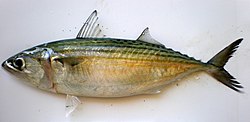
The Indian mackerel (Rastrelliger kanagurta) or bigmouth mackerel is a species of mackerel in the family Scombridae. It is commonly found in the Indian and West Pacific oceans, and their surrounding seas. It is an important food fish and is commonly used in South and South-East Asian cuisine.

It is known by various names, such as Pelaling in Malaysia, Kembung lelaki in Indonesia, Bangdo (बांगडो) in Konkani language, Bangdi (બાંગડી) in Gujarati, Bangda (बांगडा) in Marathi, Kajol Gouri (কাজল গৌরী) in Bengali, Ayla (അയല, ഐല) in Malayalam, Kankarta (କାନକରତା) in Odia, Kaanankeluthi (காணாங்கெலுத்தி) in Tamil, Kaanagadata(కానగడత) in Telugu, Kumbalawaa (කුම්බලාව) in Sinhala and Bangude (ಬಂಗುಡೆ) in Tulu, and Kannada. It is called alumahan in the Philippines.

Distribution and habitat

[edit]

The Indian mackerel is found in warm shallow waters along the coasts of the Indian and Western Pacific oceans. Its range extends from the Red Sea and East Africa in the west to Indonesia in the east, and from China and the Ryukyu Islands in the north to Australia, Melanesia and Samoa in the south.[3] It has been reported on two occasions (1967, 2010) in the Mediterranean Sea off Gaza, a likely entry via the Suez Canal.[4]

Description

[edit]

The body of the Indian mackerel is moderately deep, and the head is longer than the body depth. The maxilla are partly concealed, covered by the lacrimal bone, but extend till around the hind margin of the eye.[5]

These fish have thin dark longitudinal bands on the upper part of the body, which may be golden on fresh specimens. There is also a black spot on the body near the lower margin of the pectoral fin. Dorsal fins are yellowish with black tips, while the caudal and pectoral fins are yellowish. The remaining fins are dusky.[5]

Indian mackerel reach a maximum fork length of 35 centimetres (14 in), but are generally around 25 centimetres (9.8 in) in length.[3]

Habitat and diet

[edit]

The Indian mackerel is generally found in shallow, coastal waters, where the surface water temperature is at least 17 °C (63 °F).[5] Adults of this species are found in coastal bays, harbours and deep lagoons. They are commonly found in turbid waters rich in plankton.[3]

Adult Indian mackerel feed on macroplankton including the larvae of shrimp and fish.[5]

Life history

[edit]

The spawning season around India, which is in the northern hemisphere, is between March and September. Around Seychelles in the southern hemisphere, it is between September and the following March.[6]

Spawning occurs in batches. The eggs are laid in the water and are externally fertilized. The Indian mackerel do not guard their eggs, which are left to develop on their own.[7]

Juveniles feed on phytoplankton like diatoms and small zooplankton including cladocerans and ostracods. As they mature, their intestines shorten, and their diet changes to primarily include macroplankton such as the larvae of shrimp and fish.[5]

References

[edit]
[edit]
Revisions and contributorsEdit on WikipediaRead on Wikipedia
from Grokipedia
The Indian mackerel (Rastrelliger kanagurta), a small belonging to the family , is characterized by its streamlined body, silvery coloration with dark wavy lines on the back, and a maximum fork length of 35 cm, though commonly reaching 25 cm. It inhabits epipelagic and neritic waters in coastal bays, lagoons, and harbors where surface temperatures exceed 17°C, typically at depths of 20–90 m, and forms schools segregated by size in turbid, plankton-rich environments. Distributed across the Indo-West Pacific from the Red Sea and East Africa to Indonesia, northern China, Australia, and Samoa, this species plays a vital role in marine ecosystems as a planktivore, primarily feeding on diatoms, copepods, crustaceans, and other macroplankton. Reproduction occurs year-round with peaks varying by region, such as August in some areas, where females produce 27,000–123,000 eggs per spawning event at first maturity around 17–24 cm in length; it supports major commercial fisheries in countries like India, Indonesia, and Pakistan, contributing significantly to coastal livelihoods and food security.

Taxonomy

Classification

The Indian mackerel, Rastrelliger kanagurta, belongs to the domain Eukarya and is classified in the kingdom Animalia, phylum Chordata, class , order Scombriformes, family , genus , and species R. kanagurta. This hierarchical placement reflects its position as a ray-finned adapted to marine environments. The family , which includes mackerels, tunas, and bonitos, consists of predominantly pelagic species with streamlined, bodies, high pectoral fins, and deeply forked caudal fins, enabling rapid swimming in open waters; these fish often possess fatty flesh that supports their high-energy lifestyles in tropical and subtropical seas. Within this family, the genus is distinguished by its rakers and patterns. Phylogenetically, comprises four recognized species—R. kanagurta (Indian mackerel), R. brachysoma (short-bodied mackerel), R. faughni (island mackerel), and R. chrysozonus (golden-striped mackerel)—that form part of the tribe Scombrini, closely allied with the genus Scomber (true s, including chub ); molecular analyses of confirm their and highlight shared evolutionary adaptations, such as enhanced schooling and migratory behaviors, for exploiting plankton-rich pelagic zones. The species R. kanagurta was originally described as Scomber kanagurta by Cuvier in 1816, with additional historical synonyms including Scomber loo Lesson, 1829, Scomber neglectus Lesson, 1831, and Scomber canagurta Cuvier, 1817, reflecting early taxonomic revisions within the Scombridae.

Nomenclature

The Indian mackerel is scientifically known as Rastrelliger kanagurta, a name first described by Georges Cuvier in 1816. The genus name Rastrelliger derives from the Latin words rastra (rake) and gero (to carry), alluding to the species' numerous gill rakers that function in filter-feeding. The specific epithet kanagurta originates from local names used for the fish along the Coromandel Coast of India, as documented in early descriptions from Vizagapatam (now Visakhapatnam). Common names for R. kanagurta include Indian mackerel and bigmouth mackerel in English, reflecting its prominence in Indo-Pacific fisheries. In India, regional vernacular names vary, such as kanangeluthi in Tamil, bangda in Marathi, and ayala in Malayalam. Further variations occur across the Indo-Pacific, including kembung in Indonesian and Malaysian contexts. Historically, the species was initially classified under the genus Scomber as Scomber kanagurta before being transferred to Rastrelliger to better reflect its distinct morphological traits within the Scombridae family.

Description

Morphology

The Indian mackerel (Rastrelliger kanagurta) possesses a streamlined, fusiform body that is moderately deep, with the body depth measuring 19.5–26.5% of the fork length (FL) (FL 3.8–5.1 times body depth), and the head length exceeding the body depth. This configuration facilitates efficient swimming in pelagic environments. The head features a large equipped with small, fine teeth in both jaws, while the is partly concealed and covered by the lachrymal bone, extending posteriorly to the hind margin of the eye. The snout is pointed, contributing to the overall hydrodynamic profile. The fin arrangement includes a first supported by 8 to 9 spines, followed by a separate second with 11 to 12 soft rays; the anal fin has 12 soft rays and no spines; pectoral fins contain 17 to 21 rays (usually 19); and the caudal peduncle bears two small keels on each side. An interpelvic process is small and single, and both dorsal and anal fins are followed by 5 finlets. A is present, aiding . The gill apparatus is characterized by numerous gill rakers on the first arch, 49–64 total (15–23 , 33–42 lower limb), with the longest raker bearing up to 105 or more fine bristles, forming a sieve-like structure. The body is covered with small scales that are more conspicuous behind the head and below the pectoral fins, while the is indistinct or absent.

Size and coloration

The Indian mackerel (Rastrelliger kanagurta) typically attains a maximum standard length (SL) of about 35 cm, with a common SL of around 20–22 cm; maximum total length (TL) 42 cm (females), common TL 25 cm, and fork lengths up to 35 cm. Maximum weights reach 859 g, though adults commonly weigh 200–300 g. Females attain larger maximum sizes than males. The species displays a distinctive metallic blue-green coloration on the dorsum, featuring several (2–4) rows of dark oblique bars or stripes along the back that often break into spots posteriorly; the sides are silvery with a golden sheen, while the underside is white. Juveniles exhibit more pronounced bars on the back. In live specimens, iridescent reflections enhance the golden tint on the sides, but these colors fade in preserved samples, with the dorsum turning dark gray to blue and the bars becoming less distinct or appearing as longitudinal spots or lines.

Distribution and habitat

Geographic distribution

The Indian mackerel (Rastrelliger kanagurta) is native to the Indo-West Pacific region, with its range extending from the and in the west to in the east, north to the and , and south to , , and . This distribution encompasses tropical and subtropical coastal waters across a vast expanse of the Indian and western Pacific Oceans. The species is particularly abundant in the Indian Ocean, including along the coasts of in the Arabian Sea and , where it supports significant local fisheries. In , it occurs commonly in the waters of , , and the , as well as in the and . Further east, populations are present in the western Pacific, including around and northern Australia, from the central Western Australian coast through the northern coastline to southeastern . R. kanagurta exhibits seasonal coastal migrations, often tracking blooms and oceanographic features such as zones that enhance productivity in its neritic . These movements are typically confined to coastal areas without evidence of long-distance transoceanic migrations. Records of the species outside its native range include occasional vagrants in the as a Lessepsian migrant via the , first documented in near .

Habitat preferences

The Indian mackerel (Rastrelliger kanagurta) primarily inhabits coastal shelf waters at depths ranging from 20 to 90 m, though it has been recorded up to 150 m in some regions, with the majority of catches occurring between 0 and 100 m. Juveniles tend to occupy shallower inshore areas and bays, while adults are more commonly found in mid-shelf zones. This depth preference aligns with its exploitation of productive nearshore environments along continental shelves. The species favors turbid, plankton-rich waters that support its filter-feeding habits, typically with sea surface temperatures of 27–29°C and salinities between 30 and 34 ppt. It thrives in conditions associated with coastal , where nutrient influx enhances abundance, but avoids clear oceanic waters lacking sufficient turbidity and productivity. These preferences are evident in higher catch rates during periods of moderate upwelling along southwest Indian coasts. Preferred microhabitats include coastal bays, harbors, estuaries, and lagoons, where the forms schools in protected, nutrient-laden areas. The exhibits tolerance to variable in estuarine environments and low dissolved oxygen levels common in turbid, upwelled waters, enabling persistence in dynamic coastal ecosystems despite occasional hypoxic conditions.

Biology

Diet and feeding

The Indian mackerel (Rastrelliger kanagurta) is primarily a planktivorous species, with its diet dominated by and . , particularly diatoms such as Chaetoceros spp., Coscinodiscus sp., and Fragilaria sp., constitute a significant portion of the intake, often comprising 35-72% of gut contents by number depending on location and season. forms another major component, including copepods (e.g., Acartia, Oithona, and Pseudodiaptomus spp., up to 35% by volume), cladocerans, fish eggs, and larvae of various ; crustaceans overall can account for 20-65% of the diet. Ontogenetic shifts occur in the diet, with juveniles (≤75 mm total length) focusing on smaller prey such as fine and small , including post-larval and micro-copepods, to support rapid early growth. As individuals mature into adults (≥80 mm total length), the diet broadens to incorporate larger items like larvae, decapod larvae, and even , reflecting increased capacity and energy demands; by ≥210 mm, the diet may consist almost entirely of macroplankton and small . Diet breadth generally increases with body size across life stages, allowing adaptation to available prey resources. The species employs a ram filter-feeding mechanism, swimming with mouth agape to engulf water while using specialized gill rakers—numerous and finely spaced—to strain planktonic particles efficiently from the . This passive is supplemented by occasional active pursuit of larger prey. Daily rations are estimated at 4-5% of body wet weight, primarily from copepods, sufficient to meet growth and reproductive needs, though consumption can vary with prey density. Feeding intensity and diet composition exhibit seasonal variations, with peaks during periods of high abundance such as autumn blooms, when diatoms like Chaetoceros dominate (up to 53% of diet). In contrast, zooplankton intake, including copepods and crustacean larvae, increases in other seasons like winter (36% crustaceans), aligning with cycles; overall, gorged stomachs are more common from November to April, indicating heightened foraging during favorable conditions.

Behavior and ecology

The Indian mackerel (Rastrelliger kanagurta) exhibits pronounced schooling behavior, forming large, dense aggregations that typically comprise thousands of individuals in coastal bays, harbors, and plankton-rich lagoons. These schools provide mutual protection against predators and enhance by concentrating efforts in areas of high prey density, such as turbid waters teeming with . The displays diurnal activity patterns, with schools actively near the surface at night and often descending to deeper waters during the day to follow vertical migrations of . As a schooling , the Indian mackerel faces significant predation pressure from larger marine predators, including (Thunnus albacares), longtail tuna (), and various shark species. In response, the fish rely on collective anti-predator tactics, primarily through synchronized schooling maneuvers that enable rapid directional changes, evasion bursts, and formation tightening to confuse attackers and dilute the risk to any single individual. This behavior is particularly effective in open-water environments, where the density of the can overwhelm a predator's targeting ability. Within pelagic food webs, the Indian mackerel plays a pivotal ecological role as a key species, bridging by with higher trophic levels through its position as abundant prey for piscivores and seabirds. By consuming large volumes of and , it facilitates energy transfer upward in the marine ecosystem and influences community dynamics in coastal regions. Furthermore, fluctuations in its population abundance serve as a reliable indicator of underlying , reflecting variations in and environmental health in neritic zones. Sensory adaptations underpin these behaviors, with the system enabling precise detection of hydrodynamic signals from nearby school members to maintain cohesion and coordinate maneuvers during foraging or evasion. Complementing this, the species' is suited to prey detection in turbid coastal waters, where it identifies planktonic food particles amid suspended sediments, supporting its particulate-feeding strategy.

Reproduction and life history

Spawning

The Indian mackerel, Rastrelliger kanagurta, reaches sexual maturity at lengths of 18.3–18.9 cm standard length, typically at the end of the first year of life. Females attain maturity around one year of age, while males may mature slightly earlier, though precise differences vary by region. This species is a multiple batch spawner, capable of releasing eggs in several batches over 2–4 spawning periods annually, as evidenced by the presence of multiple modal groups of ova diameters in mature ovaries. Spawning peaks in Indian waters during July–October and February–April, with ripe and running gonads observed year-round but concentrated in these intervals along the north-east coast from West Bengal to Andhra Pradesh. These events occur primarily offshore in areas influenced by coastal upwelling, such as during minor subsurface water upwellings in March–May in southern regions, which enhance availability and support reproductive aggregation. per batch ranges from 13,800 to 252,000 eggs, with relative averaging 567 ova per gram of body weight (ranging 151–1,313 ova/g). External fertilization occurs with the simultaneous release of sperm and eggs into the water column. The resulting pelagic eggs are buoyant and drift with ocean currents, contributing to the species' wide larval dispersal.

Growth and development

The Indian mackerel (Rastrelliger kanagurta) exhibits distinct ontogenetic stages, beginning with pelagic eggs that measure 0.8–1.0 mm in diameter and contain a single oil globule for buoyancy. These eggs typically hatch within 2–3 days under optimal tropical temperatures around 28°C, yielding prolarvae approximately 1.5–1.8 mm in standard length (SL). Upon hatching, larvae are planktonic and initially rely on the for nutrition before transitioning to exogenous feeding on microzooplankton, including and small copepods. Larval development progresses through yolk-sac (1.5–2.8 mm SL), pre-flexion (1.8–3.3 mm SL), flexion (2.9–4.9 mm SL), and post-flexion stages (4.6–11.3 mm SL), with overall growth to 10–15 mm SL occurring over approximately 20–30 days at rates of 0.2–0.34 mm per day, influenced by seasonal sea surface temperatures of 26–28°C. The juvenile stage commences around 20–25 mm SL, marked by full fin development, scale formation, and a shift to a body shape. Juveniles experience rapid growth, attaining 10–15 cm in total length by the end of the first year, driven by high metabolic rates and abundant planktonic food resources. This phase follows the von Bertalanffy growth model, with parameters estimated as asymptotic length (L) ≈ 34 cm and growth coefficient (K) ≈ 0.43 year−1, reflecting fast early growth that slows thereafter. As adults, Indian mackerel reach and exhibit decelerated growth, with lengths increasing more gradually beyond the second year to a maximum of around 30–35 cm. The typical lifespan is 4–5 years, though some individuals survive up to 6 years in less exploited populations, with growth tapering significantly after maturity due to allocation toward . Throughout development, mortality is particularly acute in early stages, with larval survival rates often below 10% due to environmental stressors and predation. Size-selective predation by larger piscivores further influences cohort survival, disproportionately affecting smaller juveniles and contributing to variability in recruitment success.

Human uses and conservation

Fisheries

The Indian mackerel (Rastrelliger kanagurta) supports significant commercial fisheries across its range in the and western Pacific Oceans, with global capture production averaging 400,000 to 600,000 tonnes annually as of 2020, based on data from 2018 to 2020. dominates the , accounting for the largest share of landings, with over 260,000 tonnes harvested in 2024 primarily from the and coasts. These catches contribute substantially to national marine fish production, representing a key small pelagic resource that fluctuates with environmental conditions like patterns. Fishing operations target dense schools of Indian mackerel using a variety of gears suited to small-scale and industrial fleets, including purse seines, drift gillnets, and beach seines (also known as rampani nets). Trawl nets also capture a notable portion, particularly during peak seasons from September to March along the southwest coast, where motorized vessels facilitate efficient exploitation of migratory aggregations. This schooling enables high-yield hauls, supporting both artisanal fishers using traditional canoes and larger mechanized boats. Economically, the species is vital to small-scale and industrial fisheries in South and Southeast Asia, providing livelihoods for millions and serving as a primary protein source in coastal communities. Landings are processed into fresh, dried, salted, or canned products for domestic consumption and , with approximately 26% of Indian production shipped to markets in , the , and ; its rich omega-3 fatty acid content enhances its nutritional and commercial value. In regional cuisines, it is prominently featured in curries, fried preparations, and fermented dishes, underscoring its cultural and dietary significance. Fishery management relies on stock assessments derived from length-frequency data to monitor and guide sustainable harvesting. In some areas, minimum landing size regulations are enforced to protect juveniles, though implementation varies by region and lacks uniform quotas across major producers like .

Conservation status

The Indian mackerel (Rastrelliger kanagurta) is classified as Least Concern on the , based on a 2022 global assessment published in a 2023 update that notes its wide distribution across the Indo-West Pacific and high resilience to fishing pressure, though regional data gaps persist. This status reflects insufficient comprehensive data on global population sizes and trends, with assessments relying on localized studies rather than basin-wide monitoring. Major threats to the species include , particularly through the use of small-mesh gillnets that capture juveniles before they reach maturity, leading to recruitment overfishing in heavily exploited areas. in tropical tuna purse-seine fisheries also contributes to mortality, as Indian mackerel schools often co-occur with in the , resulting in incidental captures estimated at low but cumulative levels across fleets. Additionally, habitat degradation from coastal in bays and estuaries—where the species aggregates for feeding—affects water quality and availability, exacerbating vulnerability in nearshore populations. Population trends vary regionally; in Indian waters along the west coast, stocks have shown declines linked to juvenile and environmental shifts, with notable declines in marine landings, such as a 44% drop in total fish landings in in 2019. In contrast, some Southeast Asian stocks remain stable or recover due to seasonal fishery closures that protect spawning periods, as evidenced by increased post-closure catches in Philippine provinces. Conservation efforts include the establishment of marine protected areas in , such as those in Raja Ampat, where local communities have implemented voluntary restrictions on to sustain s. Ongoing utilizes spawning potential ratio (SPR) metrics to assess , with values exceeding 20% (e.g., 48% in Kenyan waters and 57% in 's Aru Sea) indicating viable reproductive capacity in managed areas. Looking ahead, enhanced monitoring through regional fisheries bodies like the Programme is essential to address data deficiencies and prevent localized depletions, potentially solidifying the Least Concern status with improved .

References

Add your contribution
Related Hubs
User Avatar
No comments yet.