Hubbry Logo
BonitoBonitoMain
Open search
Bonito
Community hub
Bonito
logo
8 pages, 0 posts
0 subscribers
Be the first to start a discussion here.
Bonito
Bonito
from Wikipedia

Bonito
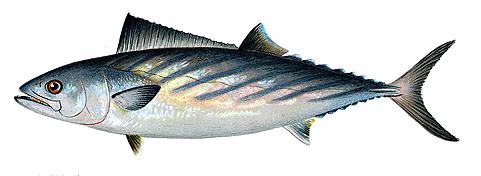
Atlantic bonito, Sarda sarda
Scientific classification Edit this classification
Kingdom: Animalia
Phylum: Chordata
Class: Actinopterygii
Order: Scombriformes
Family: Scombridae
Subfamily: Scombrinae
Tribe: Sardini
Jordan and Evermann, 1896
Genera

Bonitos are a tribe of medium-sized, ray-finned, predatory fish in the family Scombridae, which it shares with the mackerel, tuna, and Spanish mackerel tribes, and also the butterfly kingfish.[1] Also called the tribe Sardini, it consists of eight species across four genera; three of those four genera are monotypic, having a single species each. Bonitos closely resemble the skipjack tuna, which is often called a bonito, especially in Japanese contexts.

Etymology

[edit]

The fish's name comes from the Portuguese and Spanish bonito (no evidence has been found for the origin of the name), identical to the adjective meaning "pretty", but the noun referring to the fish seems to come from the low and medieval Latin form boniton, a word with a strange structure and an obscure origin, related to the word byza, a possible borrowing from the Greek βῦζα, "owl".[2][3][4]

Species

[edit]

As food

[edit]

Pacific and Atlantic bonito meat has a firm texture and a darkish color, as well as a moderate fat content. The meat of young or small bonito can be of light color, close to that of skipjack tuna, and is sometimes used as a cheap substitute for skipjack, especially for canning purposes, and occasionally in the production of cheap varieties of katsuobushi that are sold as "bonito flakes".[5] Bonito may not, however, be marketed as tuna in all countries. The Atlantic bonito is also found in the Mediterranean and the Black Seas, where it is a popular food fish, eaten grilled, pickled (lakerda), or baked.[6][7]

See also

[edit]

References

[edit]
Revisions and contributorsEdit on WikipediaRead on Wikipedia
from Grokipedia
Bonitos are a tribe (Sardini) of medium-sized, ray-finned, in the family , closely related to mackerels, tunas, and Spanish mackerels, known for their swift-swimming, schooling behavior and distinctive metallic blue-green coloration with dark oblique stripes along the back and a silvery belly. The tribe includes four genera and eight species, though the term "bonito" most commonly refers to the five species within the genus Sarda: the Atlantic bonito (S. sarda), Pacific bonito (S. chiliensis and S. lineolata), Australian bonito (S. australis), and striped bonito (S. orientalis). These epipelagic inhabit temperate and tropical coastal waters worldwide, typically at depths of 0–200 , where they form large schools and migrate seasonally in pursuit of prey. Adults, which can reach lengths of up to 102 cm and weights of 8–12 kg depending on the , are carnivorous, feeding primarily on smaller schooling , , and crustaceans, and are known for their aggressive predatory habits, including in some cases. Bonitos exhibit rapid growth, reaching maturity within 1–2 years, but have short lifespans, rarely exceeding 8 years. Ecologically, bonitos play a key role in marine food webs as mid-level predators, helping regulate populations of smaller pelagic , and they are widely distributed across the Atlantic, Pacific, and Indian Oceans, with some populations undertaking long migrations. In terms of human interaction, they are valued for both commercial and recreational fisheries, with annual global catches supporting canned, smoked, and fresh markets; for instance, the Pacific bonito was a popular target in waters, historically yielding millions of pounds annually. Additionally, in culinary traditions, particularly in , the term "bonito" is sometimes applied to related like (Katsuwonus pelamis) for producing flakes used in broth, though true Sarda bonitos are more commonly consumed fresh or grilled in Mediterranean and Latin American cuisines.

Taxonomy and Etymology

Etymology

The term "bonito" originates from the Spanish and word bonito, meaning "pretty" or "beautiful," which is a form of bueno ("good"), derived from the Latin bonus ("good"). This nomenclature likely alludes to the fish's sleek, iridescent appearance, with its metallic blue back and silvery sides, distinguishing it among other marine . The form boniton specifically denoted this type of , bridging ancient Roman references to similar scombroid and its adoption in Iberian languages during medieval fisheries. In English, "bonito" entered usage in the late through nautical and exploratory , reflecting encounters by European voyagers in tropical waters. For instance, Richard Hakluyt's The Principal Navigations, Voyages, Traffiques and Discoveries of the English Nation (1589) describes the bonito among "sundry other fish very delicate" observed during voyages to the and beyond, highlighting its role in early transatlantic fisheries documentation. This adoption underscores the term's spread via maritime trade routes, where Spanish and influences shaped English seafaring vocabulary. Related terms vary across languages, often tying into the broader nomenclature of the family, which includes mackerels and tunas; for example, the feminine form bonita appears in Spanish and contexts, while French uses bonite and Italian bonito, all evoking aesthetic qualities. In scientific , "bonito" precisely denotes within the genus Sarda, but common usage has evolved to include misnomers, such as applying it to (Katsuwonus pelamis), a distinct but visually similar scombroid often confused in commercial and contexts.

Classification

Bonitos belong to the kingdom Animalia, phylum Chordata, class , order Scombriformes, family , subfamily Scombrinae, and tribe Sardini, with the primary genus being Sarda. The family encompasses mackerels, tunas, and bonitos, comprising 51 species across 15 genera, while the subfamily Scombrinae includes the more derived members such as bonitos and tunas, distinguished from the basal subfamily Gasterochismatinae by advanced hydrodynamic adaptations. The order Scombriformes was established in molecular phylogenetic revisions around 2013, elevating it from the polyphyletic order based on analyses of mitochondrial and nuclear DNA sequences that resolved its within . At the genus level, is diagnosed by several key morphological traits that differentiate it from true tunas ( Thunnini, ), including a more elongate and body with oblique dark stripes on the dorsolateral surface, triangular cutting teeth in both jaws (versus smaller conical teeth in tunas), an incompletely developed bony caudal keel, and the absence of a specialized subcutaneous vascular rete mirabile for . These features position Sarda as morphologically intermediate between mackerels ( Scombrini) and tunas, reflecting its ecological role as epipelagic predators with moderate swimming speeds. counts (16–23 on the first arch) and fin structures, such as 8–10 dorsal finlets and 7–10 anal finlets, further support its placement within Sardini, aiding in distinguishing it from related genera like Orcynopsis. Historical taxonomic revisions of bonitos have been influenced by genetic studies, particularly for species boundaries within Sarda. For instance, the Pacific bonito was formerly classified into subspecies Sarda chiliensis chiliensis (Peruvian-Chilean) and S. c. lineolata (north-eastern Pacific), based primarily on geographic isolation, but molecular analyses since the have revealed minimal , leading to their treatment as a single S. chiliensis in recent classifications. A 2024 genomic study on the Atlantic bonito (S. sarda) confirmed two distinct genetic pools in the Mediterranean, supporting subtle population structuring without altering genus-level , while emphasizing historical vicariance from Pleistocene events. Overall, post-2010 phylogenetic research using mitochondrial COI and nuclear markers has stabilized the Sardini tribe, reinforcing its within Scombrinae without major reclassifications up to 2025.

Recognized Species

The bonitos comprise the tribe Sardini within the family , encompassing seven recognized across four genera, distinguished primarily by variations in body striping patterns, dentition, and geographic distribution. These are pelagic and schooling fishes, with the genus Sarda containing the majority, while the others are monotypic. Taxonomic authorities such as and the FAO recognize this classification as current as of 2025, with Sarda chiliensis and S. lineolata often treated as a single despite some sources listing them separately based on meristic differences. Key species include:
  • Sarda sarda (Atlantic bonito): Characterized by 5–7 prominent dark oblique bars on the upper body and a maximum length of about 90 cm; it lacks a and has conical teeth in both jaws. Found in the Atlantic and Mediterranean, it is assessed as Least Concern by the IUCN.
  • Sarda orientalis (striped bonito): Features 7–10 finer dark stripes along the back and sides, reaching up to 82 cm; distinguished by a more pronounced corselet (scaled area behind the pectoral fin) compared to other Sarda. Distributed in the , it holds Least Concern status.
  • Sarda chiliensis (eastern Pacific bonito): Exhibits 8–11 oblique bars and grows to 100 cm; includes the northern form formerly known as S. lineolata, with differences in vertebral counts and stripe intensity. Restricted to the eastern Pacific (including a or form in the north-eastern Pacific), it is Least Concern.
  • Sarda australis (Australian bonito): Displays 6–9 broad dark bars and reaches 80 cm; unique among Sarda for its more southerly distribution and slightly higher pectoral fin ray counts. Endemic to Australian and waters, Least Concern.
  • Gymnosarda unicolor (dogtooth tuna, plain bonito): Lacks the oblique bars typical of Sarda, instead showing uniform dark blue dorsally with yellow spots; attains 80 cm and has reduced . Indo-Pacific species, Least Concern.
  • Cybiosarda elegans (leaping bonito): Features faint oblique lines and a slender body up to 50 cm; distinguished by its leaping behavior and smaller size relative to Sarda. Western Pacific, Least Concern.
  • Orcynopsis unicolor (plain bonito): Uniformly colored without prominent stripes, reaching up to 110 cm; characterized by a robust body and occurrence in temperate Atlantic waters. Eastern Atlantic and Mediterranean, Least Concern.
Classifications of species in genera like Auxis (frigate tunas) or Euthynnus (little tunas) as bonitos are debated and generally rejected, as they belong to the tribe Thunnini and lack the characteristic striping and morphology of Sardini; they are more closely aligned with true tunas phylogenetically.

Biology and Description

Physical Characteristics

Bonito species exhibit a streamlined body shape, characterized by a cylindrical profile that tapers toward the caudal peduncle, enabling high-speed swimming in pelagic environments. This body form is supported by a large with a pointed conical head and two dorsal s positioned closely together, the first comprising 17-23 spines and the second 14-18 soft rays, followed by 6-9 small dorsal finlets. Similarly, the anal fin has 12-17 soft rays and 5-7 anal finlets, while the caudal fin is deeply forked with two small keels on the peduncle. The skin is covered entirely with small scales, featuring a distinct corselet of larger scales along the anterior upper body extending to about one-third of the pectoral fin length. Coloration typically includes a metallic dorsum fading to silvery-white flanks and belly, accented by 5-11 dark oblique stripes or lines along the upper sides. consists of a single row of small, conical teeth in both jaws—16-26 in the upper and 12-24 in the lower—with no teeth on the or . Internally, bonito lack a , a key distinction from closely related tunas, which contributes to their and reliance on continuous swimming. The is notably large and prominent on the ventral body wall. Sexual dimorphism is minimal across , with no pronounced external differences, though females may attain slightly larger sizes than males in certain populations. Variations in counts and stripe patterns exist among recognized , as detailed elsewhere.

Size and Growth

Bonitos, belonging to the family , exhibit moderate sizes typical of pelagic predators, with most species reaching average adult lengths of 50-90 cm and weights up to 10-12 kg. For instance, the Atlantic bonito (Sarda sarda) commonly attains 50 cm in length and up to 11 kg in weight, while the Pacific bonito (Sarda chiliensis) reaches a maximum length of 102 cm and weight of up to 11 kg, with common lengths of 60-80 cm. Growth in bonitos follows patterns described by the , which models at age t as
L(t)=L(1eK(tt0)),L(t) = L_\infty \left(1 - e^{-K(t - t_0)}\right),
where LL_\infty is the asymptotic maximum , KK is the growth coefficient, and t0t_0 is the theoretical age at zero . For S. sarda, parameters vary by but typically include L6880L_\infty \approx 68-80 cm and K0.260.82K \approx 0.26-0.82 year1^{-1}, indicating rapid early growth that slows after 2-3 years. These models highlight initial growth rates of 20-30 cm in the first year for many bonitos, influenced by metabolic efficiency tied to their streamlined body shape.
Lifespans for bonitos in the genus Sarda generally range from 4-8 years, with maximum observed ages of 5 years for S. sarda and up to 8 years for S. chiliensis. Age determination relies primarily on analysis, where annual rings in the otoliths are counted after sectioning and to reveal growth increments. This method validates ages by comparing increment counts with known growth patterns, though validation via tagging or radiometric analysis is recommended for precision. Growth rates and overall size attainment in bonitos are modulated by environmental factors such as water temperature and prey availability, which can accelerate juvenile development by up to 20% in warmer conditions but constrain asymptotic sizes in nutrient-limited areas.

Sensory and Physiological Adaptations

Bonitos, as pelagic scombroids, possess large eyes relative to body size, enabling enhanced for detecting prey in the open ocean where penetration is limited to blue wavelengths. Their retinas feature cone cells sensitive to blue-green (around 480 nm), facilitating hunting in the , while rod cells support low-light vision during dawn and dusk foraging. This adaptation is shared with closely related tunas, where visual pigments shift developmentally to optimize for marine spectra. Metabolically, bonitos support high-speed, sustained through a substantial proportion of slow-twitch muscle fibers, which extend from the skin to the vertebral column and are rich in mitochondria for aerobic respiration. These fibers enable continuous cruising at speeds up to 20 body lengths per second, minimizing fatigue during migrations. structures further enhance oxygen uptake, with fusions between gill lamellae reducing resistance during ram ventilation—a passive flow driven by forward motion that maintains high extraction efficiency even at velocities exceeding 10 m/s. In saltwater environments, bonitos maintain osmotic balance as hypoosmotic regulators, drinking seawater to compensate for diffusive water loss while excreting excess ions primarily through specialized chloride cells in the gills. These cells actively transport chloride ions outward via Na+/K+-ATPase pumps, coupled with sodium extrusion, achieving ion excretion rates that prevent dehydration despite ambient salinities up to 39 ppt. Kidneys in bonitos, like those in other scombroids, are adapted for salt excretion with reduced glomerular filtration to conserve water, producing iso- or hyperosmotic urine through tubular reabsorption and minimal free water loss. Unlike true tunas, which exhibit regional endothermy via vascular counter-current exchangers to elevate muscle and organ temperatures by 10–20°C above ambient , bonitos are ectothermic with body temperatures closely tracking environmental conditions (12–27°C). This distinction limits bonitos' thermal niche compared to endothermic tunas but aligns with their lower metabolic demands.

Ecology and Behavior

Habitat and Distribution

Bonitos of the genus Sarda inhabit temperate and tropical waters across all major ocean basins, primarily in epipelagic and neritic environments. The four recognized show distinct regional distributions: Sarda sarda () occurs in the western and eastern , ranging from the south to and from south to , including the Mediterranean and Black Seas; S. chiliensis (Pacific bonito) is confined to the eastern Pacific from to ; S. orientalis (striped bonito) is found in the tropical from the eastward to ; and S. australis (Australian bonito) inhabits temperate waters off , , and the eastern coast of . These populations generally remain separated by oceanic barriers, with limited between Atlantic and Pacific groups. These fish prefer water temperatures between 12°C and 27°C, though optimal ranges for most species fall within 15–25°C, and they occupy depths from the surface to approximately 200 m in pelagic zones. They form large, fast-swimming schools in open ocean and nearshore areas, including forests for some Pacific populations, adapting to salinities from 14 to 39 ppt. Such preferences support their role as highly mobile predators in productive coastal and oceanic waters. Migration patterns in bonitos are closely linked to major ocean currents and seasonal environmental shifts, facilitating access to prey-rich areas. For instance, S. sarda in the Mediterranean undertakes seasonal north-south migrations, moving northward along coastal currents in summer and returning southward in winter, with some individuals entering the during warmer months. Similar migratory behaviors occur in other species, such as S. chiliensis along the , where schools shift offshore with age and seasonal . Recent studies from the 2020s indicate that is driving poleward range shifts in bonito populations, potentially altering their distributions and interactions with ecosystems. For S. australis off eastern , core habitat has shifted poleward at a rate of 244 km per decade between 1998 and 2018, consistent with broader patterns of rapid redistribution in coastal-pelagic fishes amid ocean warming. A 2024 assessment for Australian bonito projects minimal positive changes in climate suitability for central and southern bioregions in spring, potentially expanding opportunities there, but minimal negative changes in northern and central areas during summer and autumn due to temperatures exceeding optimal ranges. For Pacific bonito, a 2022 report projects potential northward range expansion and shifts in the population abundance center with warmer waters. These shifts highlight vulnerabilities to changing temperature regimes and currents.

Feeding and Predation

Bonito exhibit a strictly carnivorous diet, consisting primarily of small schooling fish such as anchovies (Engraulis spp.), herring (Clupea spp.), and sardines (Sardina spp.), supplemented by squid and crustaceans like krill and shrimp. This opportunistic feeding pattern reflects their role as mid-level predators in pelagic food webs, where they target abundant, mobile prey to meet high energetic needs. As active diurnal foragers, bonito employ high-speed pursuits to chase down schools of prey, often reaching burst speeds exceeding 40 mph (64 km/h). During these pursuits, they rely on ram ventilation, forcing water over their gills through continuous forward motion rather than active pumping, an that enhances oxygen uptake but requires sustained swimming. Their acute vision and system briefly assist in locating and coordinating attacks on prey schools. Daily food consumption rates for bonito average around 6% of body weight, though this can vary with prey availability and metabolic demands, supporting budgets dominated by locomotion and growth in warm oceanic waters. In the food web, bonito occupy an intermediate trophic position, serving as key prey for larger predators including ( thynnus), sharks (e.g., shortfin mako Isurus oxyrinchus), (Xiphias gladius), and marine mammals such as sea lions ( californianus). This vulnerability underscores their ecological connectivity in epipelagic ecosystems.

Reproduction and Life Cycle

Bonitos of the genus Sarda reproduce through , with females broadcasting large numbers of pelagic eggs into the water column where they are fertilized by males. This strategy supports high , as a single female can produce hundreds of thousands to over a million eggs annually, depending on and size; for instance, (S. sarda) females exhibit an average batch fecundity of 79,432 oocytes, with total annual estimates ranging from 304,000 to 1,000,000. Many engage in batch spawning, releasing multiple clutches of eggs over the reproductive season to maximize survival rates amid high predation on early stages. Spawning seasons and locations vary by species and region but generally occur in warmer coastal or nearshore waters during spring to summer months. For Pacific bonito (S. chiliensis), spawning takes place from February to August off northern Chile and California, with peak activity in April to June, often in waters where temperatures support embryonic development. In contrast, Atlantic bonito (S. sarda) spawns primarily from May to August in the Mediterranean and eastern Atlantic, including areas south of Morocco, with gonadosomatic indices peaking during this period. Sexual maturity is typically reached at 1 to 2 years of age, with females maturing slightly larger than males; Pacific bonito females begin spawning at around 410 mm standard length, while males at 390 mm. The life cycle of bonitos progresses through distinct stages: fertilized eggs, larvae, juveniles, and adults. Eggs are buoyant and pelagic, hatching after approximately 72 hours at optimal temperatures (around 20–25°C), with embryonic development divided into phases including morula, blastula, gastrula, neurula, and , as observed in South Pacific bonito (S. chiliensis chiliensis). Larvae emerge with yolk sacs and undergo rapid over weeks, developing key features such as dorsal and anal fins, which transition from larval soft-rayed structures to the characteristic adult spiny and soft-rayed configurations. Juveniles grow quickly in coastal nurseries, resembling smaller adults by 6–12 months, before maturing into adults that migrate to spawning grounds; the full cycle from egg to reproductive adult spans 1–2 years, with lifespans extending 6–8 years.

Human Uses and Conservation

Commercial Fishing

Commercial fishing for bonito targets species in the genus Sarda, such as the Atlantic bonito (S. sarda) and Pacific bonito (S. chiliensis), primarily through artisanal methods including gillnets, traps, and pole-and-line in coastal waters. These fisheries are regionally significant but small-scale globally, with catches estimated at a few thousand metric tons annually, mainly in the Mediterranean, Black Sea, and eastern Pacific. For example, in the Black Sea region, S. sarda landings support local markets in Turkey and surrounding countries, while in Morocco, coastal fleets report annual catches of around 1,000-2,000 metric tons. In the United States, Atlantic bonito is not a major commercial species, with landings typically under 10,000 pounds annually in states like North Carolina. The historical development of these fisheries has roots in practices, evolving into modern artisanal operations post-World War II, particularly in , , and , where demand for fresh and smoked products drives coastal pursuits. Unlike industrial tuna fisheries, Sarda bonitos are rarely targeted by large-scale purse seining due to their coastal habits and smaller school sizes. Note that the term "bonito" is sometimes applied commercially to (Katsuwonus pelamis), a more abundant related species with global catches of approximately 2.95 million metric tons in 2023, but this is distinct from the Sarda . Economically, Sarda bonito fisheries contribute to local livelihoods in developing coastal regions, supporting fresh and processed markets, though they play a minor role compared to the broader canned industry valued at USD 20.4 billion in 2024, which is dominated by skipjack and other tunas. Prices for fresh Sarda bonitos vary regionally, often around USD 5-10 per kg in Mediterranean ports. in artisanal fisheries poses challenges, with of juveniles and non-target species in gillnets affecting local stocks, particularly in data-poor areas like . As of 2025, sustainable practices are promoted through regional agreements, such as ICCAT's Small Tunas Working Group, focusing on improved and monitoring for S. sarda without specific quotas.

Culinary Applications

Bonito (Sarda species) holds a place in global cuisines, valued for its firm texture and rich flavor, typically consumed fresh or grilled rather than heavily processed. In Mediterranean and Latin American traditions, it appears fresh in stews and street foods. While the term "bonito" sometimes refers to for dried products like Japanese katsuobushi, true Sarda bonitos are more commonly prepared simply to highlight their taste. Common preparation techniques emphasize freshness. is favored, as in katsuo no tataki-style searing (adapted for Sarda), where the exterior is lightly charred while the interior remains raw, served with soy, ginger, and . In , grilled fillets feature in tacos with spices and fresh toppings. Canning is less common for Sarda due to size, though some regional preserves exist; note that "bonito del Norte" refers to albacore tuna (Thunnus alalunga), a distinct species. Dried products like Spanish mojama—a salt-cured delicacy—are typically made from larger tunas (e.g., bluefin or yellowfin), not Sarda, though similar curing can apply locally. Nutritionally, bonito provides approximately 20-25 grams of protein per 100-gram serving, rich in omega-3 fatty acids (EPA and DHA) for heart and brain health, with about 125 calories and low mercury levels (moderate, suitable for regular consumption). In cultural dishes, bonito elevates regional meals. In , tacos de bonito use grilled fillets with , radishes, and salsa. Mediterranean stews like Basque marmitako simmer chunks with potatoes, onions, and peppers in tomato broth. Greek versions add for a light one-pot dish. Health considerations include scombroid poisoning risk from histamine if not chilled promptly post-catch; store below 4°C and consume fresh.

Conservation Status and Management

The conservation status of bonito species in the genus Sarda is generally categorized as Least Concern by the IUCN Red List (assessed 2021, unchanged as of 2025), reflecting their wide distribution and stable populations despite localized pressures. For example, the Atlantic bonito (Sarda sarda) is Least Concern, with no global declines warranting higher threat. Similarly, the Pacific bonito (Sarda chiliensis) and striped bonito (Sarda orientalis) hold Least Concern status, supported by fast growth and productivity. Primary threats include from commercial and artisanal fishing, intensified in the 2020s in regions like the Senegalese EEZ and Mediterranean, where illegal disrupts . ICCAT assessments indicate exploitation exceeding sustainable yields in some Northeast Atlantic areas. adds risks via warming-induced range shifts, potentially reducing spawning success. Management strategies emphasize international cooperation. ICCAT's 2017 Small Tunas Programme continues as of 2025, improving data and monitoring without quotas. In the Pacific, IATTC supports stock analyses for S. chiliensis. MSC certification applies to some related fisheries. Recent models project 20–30% habitat suitability declines by 2040–2060 in subtropical areas under moderate emissions, highlighting needs for adaptive, ecosystem-based .

References

  1. https://en.wiktionary.org/wiki/bonito
Add your contribution
Related Hubs
User Avatar
No comments yet.