


Community hub
Recent from talks
Contribute something
Nothing was collected or created yet.
Global warming potential
View on WikipediaIn recent research, it has been indicated that methane has the Global warming potential of about 80 over 20 years, 30 for over 100 years, and lastly about 10 for 500 years Based on the IPCC Sixth assessment report. (IPCC, 2021: Annex VII: Glossary. In: Climate Change 2021: The Physical Science Basis. Contribution of Working Group I to the Sixth Assessment Report of the Intergovernmental Panel on Climate Change. Cambridge University Press.

Global warming potential (GWP) is a measure of how much heat a greenhouse gas traps in the atmosphere over a specific time period, relative to carbon dioxide (CO2).[1]: 2232 It is expressed as a multiple of warming caused by the same mass of (CO2). Therefore, by definition CO2 has a GWP of 1. For other gases it depends on how strongly the gas absorbs thermal radiation, how quickly the gas leaves the atmosphere, and the time frame considered.
For example, methane has a GWP over 20 years (GWP-20) of 81.2[2] meaning that, a leak of a tonne of methane is equivalent to emitting 81.2 tonnes of carbon dioxide measured over 20 years. As methane has a much shorter atmospheric lifetime than carbon dioxide, its GWP is much less over longer time periods, with a GWP-100 of 27.9 and a GWP-500 of 7.95.[2]: 7SM-24
The carbon dioxide equivalent (CO2e or CO2eq or CO2-e or CO2-eq) can be calculated from the GWP. For any gas, it is the mass of CO2 that would warm the earth as much as the mass of that gas. Thus it provides a common scale for measuring the climate effects of different gases. It is calculated as GWP times mass of the other gas.
Definition
[edit]The global warming potential (GWP) is defined as an "index measuring the radiative forcing following an emission of a unit mass of a given substance, accumulated over a chosen time horizon, relative to that of the reference substance, carbon dioxide (CO2). The GWP thus represents the combined effect of the differing times these substances remain in the atmosphere and their effectiveness in causing radiative forcing."[1]: 2232
In turn, radiative forcing is a scientific concept used to quantify and compare the external drivers of change to Earth's energy balance.[3]: 1–4 Radiative forcing is the change in energy flux in the atmosphere caused by natural or anthropogenic factors of climate change as measured in watts per meter squared.[4]
GWP in policymaking
[edit]As governments develop policies to combat emissions from high-GWP sources, policymakers have chosen to use the 100-year GWP scale as the standard in international agreements. The Kigali Amendment to the Montreal Protocol sets the global phase-down of hydrofluorocarbons (HFCs), a group of high-GWP compounds. It requires countries to use a set of GWP100 values equal to those published in the IPCC's Fourth Assessment Report (AR4).[5] This allows policymakers to have one standard for comparison instead of changing GWP values in new assessment reports.[6] One exception to the GWP100 standard exists: New York state’s Climate Leadership and Community Protection Act requires the use of GWP20, despite being a different standard from all other countries participating in phase downs of HFCs.[5]
Calculated values
[edit]Current values (IPCC Sixth Assessment Report from 2021)
[edit].png)
The global warming potential (GWP) depends on both the efficiency of the molecule as a greenhouse gas and its atmospheric lifetime. GWP is measured relative to the same mass of CO2 and evaluated for a specific timescale.[8] Thus, if a gas has a high (positive) radiative forcing but also a short lifetime, it will have a large GWP on a 20-year scale but a small one on a 100-year scale. Conversely, if a molecule has a longer atmospheric lifetime than CO2 its GWP will increase when the timescale is considered. Carbon dioxide is defined to have a GWP of 1 over all time periods.
Methane has an atmospheric lifetime of 12 ± 2 years.[9]: Table 7.15 The 2021 IPCC report lists the GWP as 83 over a time scale of 20 years, 30 over 100 years and 10 over 500 years.[9]: Table 7.15 The decrease in GWP at longer times is because methane decomposes to water and CO2 through chemical reactions in the atmosphere. Similarly the third most important GHG, nitrous oxide (N2O), is a common gas emitted through the denitrification part of the nitrogen cycle.[10] It has a lifetime of 109 years and an even higher GWP level running at 273 over 20 and 100 years.
Examples of the atmospheric lifetime and GWP relative to CO2 for several greenhouse gases are given in the following table:
| Gas name | Chemical
formula |
Lifetime | Radiative Efficiency | 20 year GWP[9]: Table 7.15 [11] | 100 year GWP[9]: Table 7.15 [11] | 500 year GWP[9]: Table 7.15 [12] |
|---|---|---|---|---|---|---|
| Carbon dioxide | CO2 | (A) | 1.37×10⁻⁵ | 1 | 1 | 1 |
| Methane (fossil natural gas) | CH 4 |
12 | 5.7×10⁻⁴ | 83 | 30 | 10 |
| Methane (pure non-fossil) | CH 4 |
12 | 5.7×10⁻⁴ | 81 | 27 | 7.3 |
| Nitrous oxide | N 2O |
109 | 3×10⁻³ | 273 | 273 | 130 |
| CFC-11 (R-11) | CCl 3F |
52 | 0.29 | 8,321 | 6,226 | 2,093 |
| CFC-12 (R-12) | CCl 2F 2 |
100 | 0.32 | 10,800 | 10,200 | 5,200 |
| HCFC-22 (R-22) | CHClF 2 |
12 | 0.21 | 5,280 | 1,760 | 549 |
| HFC-32 (R-32) | CH 2F 2 |
5 | 0.11 | 2,693 | 771 | 220 |
| HFC-134a (R-134a) | CH 2FCF 3 |
14 | 0.17 | 4,144 | 1,526 | 436 |
| Tetrafluoromethane (R-14) | CF 4 |
50,000 | 0.09 | 5,301 | 7,380 | 10,587 |
| Hexafluoroethane | C 2F 6 |
10,000 | 0.25 | 8,210 | 11,100 | 18,200 |
| Sulfur hexafluoride | SF 6 |
3,200 | 0.57 | 17,500 | 23,500 | 32,600 |
| Nitrogen trifluoride | NF 3 |
500 | 0.20 | 12,800 | 16,100 | 20,700 |
| (A) No single lifetime for atmospheric CO2 can be given. | ||||||
Estimates of GWP values over 20, 100 and 500 years are periodically compiled and revised in reports from the Intergovernmental Panel on Climate Change. The most recent report is the IPCC Sixth Assessment Report (Working Group I) from 2023.[9]
The IPCC lists many other substances not shown here.[13][9][14] Some have high GWP but only a low concentration in the atmosphere.
The values given in the table assume the same mass of compound is analyzed; different ratios will result from the conversion of one substance to another. For instance, burning methane to carbon dioxide would reduce the global warming impact, but by a smaller factor than 25:1 because the mass of methane burned is less than the mass of carbon dioxide released (ratio 1:2.74).[15] For a starting amount of 1 tonne of methane, which has a GWP of 25, after combustion there would be 2.74 tonnes of CO2, each tonne of which has a GWP of 1. This is a net reduction of 22.26 tonnes of GWP, reducing the global warming effect by a ratio of 25:2.74 (approximately 9 times).
| Greenhouse gas | Lifetime (years) |
Global warming potential, GWP | ||
|---|---|---|---|---|
| 20 years | 100 years | 500 years | ||
| Hydrogen (H2) | 4–7[16] | 33 (20–44)[16] | 11 (6–16)[16] | — |
| Methane (CH4) | 11.8[9] | 56[17] 72[18] 84 / 86f[13] 96[19] 80.8 (biogenic)[9] 82.5 (fossil)[9] |
21[17] 25[18] 28 / 34f[13] 32[20] 39 (biogenic)[21] 40 (fossil)[21] |
6.5[17] 7.6[18] |
| Nitrous oxide (N2O) | 109[9] | 280[17] 289[18] 264 / 268f[13] 273[9] |
310[17] 298[18] 265 / 298f[13] 273[9] |
170[17] 153[18] 130[9] |
| HFC-134a (hydrofluorocarbon) | 14.0[9] | 3,710 / 3,790f[13] 4,144[9] |
1,300 / 1,550f[13] 1,526[9] |
435[18] 436[9] |
| CFC-11 (chlorofluorocarbon) | 52.0[9] | 6,900 / 7,020f[13] 8,321[9] |
4,660 / 5,350f[13] 6,226[9] |
1,620[18] 2,093[9] |
| Carbon tetrafluoride (CF4 / PFC-14) | 50,000[9] | 4,880 / 4,950f[13] 5,301[9] |
6,630 / 7,350f[13] 7,380[9] |
11,200[18] 10,587[9] |
| HFC-23 (hydrofluorocarbon) | 222[13] | 12,000[18] 10,800[13] |
14,800[18] 12,400[13] |
12,200[18] |
| Sulfur hexafluoride SF6 | 3,200[13] | 16,300[18] 17,500[13] |
22,800[18] 23,500[13] |
32,600[18] |
Earlier values from 2007
[edit]The values provided in the table below are from 2007 when they were published in the IPCC Fourth Assessment Report.[22][18] These values are still used (as of 2020) for some comparisons.[23]
| Greenhouse gas | Chemical formula | 100-year Global warming potentials (2007 estimates, for 2013–2020 comparisons) |
|---|---|---|
| Carbon dioxide | CO2 | 1 |
| Methane | CH4 | 25 |
| Nitrous oxide | N2O | 298 |
| Hydrofluorocarbons (HFCs) | ||
| HFC-23 | CHF3 | 14,800 |
| Difluoromethane (HFC-32) | CH2F2 | 675 |
| Fluoromethane (HFC-41) | CH3F | 92 |
| HFC-43-10mee | CF3CHFCHFCF2CF3 | 1,640 |
| Pentafluoroethane (HFC-125) | C2HF5 | 3,500 |
| HFC-134 | C2H2F4 (CHF2CHF2) | 1,100 |
| 1,1,1,2-Tetrafluoroethane (HFC-134a) | C2H2F4 (CH2FCF3) | 1,430 |
| HFC-143 | C2H3F3 (CHF2CH2F) | 353 |
| 1,1,1-Trifluoroethane (HFC-143a) | C2H3F3 (CF3CH3) | 4,470 |
| HFC-152 | CH2FCH2F | 53 |
| HFC-152a | C2H4F2 (CH3CHF2) | 124 |
| HFC-161 | CH3CH2F | 12 |
| 1,1,1,2,3,3,3-Heptafluoropropane (HFC-227ea) | C3HF7 | 3,220 |
| HFC-236cb | CH2FCF2CF3 | 1,340 |
| HFC-236ea | CHF2CHFCF3 | 1,370 |
| HFC-236fa | C3H2F6 | 9,810 |
| HFC-245ca | C3H3F5 | 693 |
| HFC-245fa | CHF2CH2CF3 | 1,030 |
| HFC-365mfc | CH3CF2CH2CF3 | 794 |
| Perfluorocarbons | ||
| Carbon tetrafluoride – PFC-14 | CF4 | 7,390 |
| Hexafluoroethane – PFC-116 | C2F6 | 12,200 |
| Octafluoropropane – PFC-218 | C3F8 | 8,830 |
| Perfluorobutane – PFC-3-1-10 | C4F10 | 8,860 |
| Octafluorocyclobutane – PFC-318 | c-C4F8 | 10,300 |
| Perfluouropentane – PFC-4-1-12 | C5F12 | 9,160 |
| Perfluorohexane – PFC-5-1-14 | C6F14 | 9,300 |
| Perfluorodecalin – PFC-9-1-18b | C10F18 | 7,500 |
| Perfluorocyclopropane | c-C3F6 | 17,340 |
| Sulfur hexafluoride (SF6) | ||
| Sulfur hexafluoride | SF6 | 22,800 |
| Nitrogen trifluoride (NF3) | ||
| Nitrogen trifluoride | NF3 | 17,200 |
| Fluorinated ethers | ||
| HFE-125 | CHF2OCF3 | 14,900 |
| Bis(difluoromethyl) ether (HFE-134) | CHF2OCHF2 | 6,320 |
| HFE-143a | CH3OCF3 | 756 |
| HCFE-235da2 | CHF2OCHClCF3 | 350 |
| HFE-245cb2 | CH3OCF2CF3 | 708 |
| HFE-245fa2 | CHF2OCH2CF3 | 659 |
| HFE-254cb2 | CH3OCF2CHF2 | 359 |
| HFE-347mcc3 | CH3OCF2CF2CF3 | 575 |
| HFE-347pcf2 | CHF2CF2OCH2CF3 | 580 |
| HFE-356pcc3 | CH3OCF2CF2CHF2 | 110 |
| HFE-449sl (HFE-7100) | C4F9OCH3 | 297 |
| HFE-569sf2 (HFE-7200) | C4F9OC2H5 | 59 |
| HFE-43-10pccc124 (H-Galden 1040x) | CHF2OCF2OC2F4OCHF2 | 1,870 |
| HFE-236ca12 (HG-10) | CHF2OCF2OCHF2 | 2,800 |
| HFE-338pcc13 (HG-01) | CHF2OCF2CF2OCHF2 | 1,500 |
| (CF3)2CFOCH3 | 343 | |
| CF3CF2CH2OH | 42 | |
| (CF3)2CHOH | 195 | |
| HFE-227ea | CF3CHFOCF3 | 1,540 |
| HFE-236ea2 | CHF2OCHFCF3 | 989 |
| HFE-236fa | CF3CH2OCF3 | 487 |
| HFE-245fa1 | CHF2CH2OCF3 | 286 |
| HFE-263fb2 | CF3CH2OCH3 | 11 |
| HFE-329mcc2 | CHF2CF2OCF2CF3 | 919 |
| HFE-338mcf2 | CF3CH2OCF2CF3 | 552 |
| HFE-347mcf2 | CHF2CH2OCF2CF3 | 374 |
| HFE-356mec3 | CH3OCF2CHFCF3 | 101 |
| HFE-356pcf2 | CHF2CH2OCF2CHF2 | 265 |
| HFE-356pcf3 | CHF2OCH2CF2CHF2 | 502 |
| HFE-365mcfI’ll t3 | CF3CF2CH2OCH3 | 11 |
| HFE-374pc2 | CHF2CF2OCH2CH3 | 557 |
| – (CF2)4CH (OH) – | 73 | |
| (CF3)2CHOCHF2 | 380 | |
| (CF3)2CHOCH3 | 27 | |
| Perfluoropolyethers | ||
| PFPMIE | CF3OCF(CF3)CF2OCF2OCF3 | 10,300 |
| Trifluoromethyl sulfur pentafluoride | SF5CF3 | 17,400 |
Importance of time horizon
[edit]A substance's GWP depends on the number of years (denoted by a subscript) over which the potential is calculated. A gas which is quickly removed from the atmosphere may initially have a large effect, but for longer time periods, as it has been removed, it becomes less important. Thus methane has a potential of 25 over 100 years (GWP100 = 25) but 86 over 20 years (GWP20 = 86); conversely sulfur hexafluoride has a GWP of 22,800 over 100 years but 16,300 over 20 years (IPCC Third Assessment Report). The GWP value depends on how the gas concentration decays over time in the atmosphere. This is often not precisely known and hence the values should not be considered exact. For this reason when quoting a GWP it is important to give a reference to the calculation.
The GWP for a mixture of gases can be obtained from the mass-fraction-weighted average of the GWPs of the individual gases.[24]
Commonly, a time horizon of 100 years is used by regulators.[25][26]
Water vapour
[edit]Water vapour does contribute to anthropogenic global warming, but as the GWP is defined, it is negligible for H2O: an estimate gives a 100-year GWP between -0.001 and 0.0005.[27]
H2O can function as a greenhouse gas because it has a profound infrared absorption spectrum with more and broader absorption bands than CO2. Its concentration in the atmosphere is limited by air temperature, so that radiative forcing by water vapour increases with global warming (positive feedback). But the GWP definition excludes indirect effects. GWP definition is also based on emissions, and anthropogenic emissions of water vapour (cooling towers, irrigation) are removed via precipitation within weeks, so its GWP is negligible.
Calculation methods
[edit]
When calculating the GWP of a greenhouse gas, the value depends on the following factors:
- the absorption of infrared radiation by the given gas
- the time horizon of interest (integration period)
- the atmospheric lifetime of the gas
A high GWP correlates with a large infrared absorption and a long atmospheric lifetime. The dependence of GWP on the wavelength of absorption is more complicated. Even if a gas absorbs radiation efficiently at a certain wavelength, this may not affect its GWP much, if the atmosphere already absorbs most radiation at that wavelength. A gas has the most effect if it absorbs in a "window" of wavelengths where the atmosphere is fairly transparent. The dependence of GWP as a function of wavelength has been found empirically and published as a graph.[31]
Because the GWP of a greenhouse gas depends directly on its infrared spectrum, the use of infrared spectroscopy to study greenhouse gases is centrally important in the effort to understand the impact of human activities on global climate change.
Just as radiative forcing provides a simplified means of comparing the various factors that are believed to influence the climate system to one another, global warming potentials (GWPs) are one type of simplified index based upon radiative properties that can be used to estimate the potential future impacts of emissions of different gases upon the climate system in a relative sense. GWP is based on a number of factors, including the radiative efficiency (infrared-absorbing ability) of each gas relative to that of carbon dioxide, as well as the decay rate of each gas (the amount removed from the atmosphere over a given number of years) relative to that of carbon dioxide.[32]
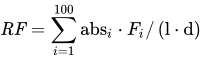
The radiative forcing capacity (RF) is the amount of energy per unit area, per unit time, absorbed by the greenhouse gas, that would otherwise be lost to space. It can be expressed by the formula:
where the subscript i represents a wavenumber interval of 10 inverse centimeters. Absi represents the integrated infrared absorbance of the sample in that interval, and Fi represents the RF for that interval.[citation needed]
The Intergovernmental Panel on Climate Change (IPCC) provides the generally accepted values for GWP, which changed slightly between 1996 and 2001, except for methane, which had its GWP almost doubled. An exact definition of how GWP is calculated is to be found in the IPCC's 2001 Third Assessment Report.[33] The GWP is defined as the ratio of the time-integrated radiative forcing from the instantaneous release of 1 kg of a trace substance relative to that of 1 kg of a reference gas:
where TH is the time horizon over which the calculation is considered; ax is the radiative efficiency due to a unit increase in atmospheric abundance of the substance (i.e., Wm−2 kg−1) and [x](t) is the time-dependent decay in abundance of the substance following an instantaneous release of it at time t=0. The denominator contains the corresponding quantities for the reference gas (i.e. CO2). The radiative efficiencies ax and ar are not necessarily constant over time. While the absorption of infrared radiation by many greenhouse gases varies linearly with their abundance, a few important ones display non-linear behaviour for current and likely future abundances (e.g., CO2, CH4, and N2O). For those gases, the relative radiative forcing will depend upon abundance and hence upon the future scenario adopted.
\,dt}{\int _{0}^{\mathit {TH}}[r](t)\,dt}}}](https://wikimedia.org/api/rest_v1/media/math/render/svg/5eefc12587676de358b67d6a0c9298e286059e59)
Since all GWP calculations are a comparison to CO2 which is non-linear, all GWP values are affected. Assuming otherwise as is done above will lead to lower GWPs for other gases than a more detailed approach would. Clarifying this, while increasing CO2 has less and less effect on radiative absorption as ppm concentrations rise, more powerful greenhouse gases like methane and nitrous oxide have different thermal absorption frequencies to CO2 that are not filled up (saturated) as much as CO2, so rising ppms of these gases are far more significant.
Applications
[edit]Carbon dioxide equivalent
[edit]Carbon dioxide equivalent (CO2e or CO2eq or CO2-e) of a quantity of gas is calculated from its GWP. For any gas, it is the mass of CO2 which would warm the earth as much as the mass of that gas.[34] Thus it provides a common scale for measuring the climate effects of different gases. It is calculated as GWP multiplied by mass of the other gas. For example, if a gas has GWP of 100, two tonnes of the gas have CO2e of 200 tonnes, and 9 tonnes of the gas has CO2e of 900 tonnes.
On a global scale, the warming effects of one or more greenhouse gases in the atmosphere can also be expressed as an equivalent atmospheric concentration of CO2. CO2e can then be the atmospheric concentration of CO2 which would warm the earth as much as a particular concentration of some other gas or of all gases and aerosols in the atmosphere. For example, CO2e of 500 parts per million would reflect a mix of atmospheric gases which warm the earth as much as 500 parts per million of CO2 would warm it.[35][36] Calculation of the equivalent atmospheric concentration of CO2 of an atmospheric greenhouse gas or aerosol is more complex and involves the atmospheric concentrations of those gases, their GWPs, and the ratios of their molar masses to the molar mass of CO2.
CO2e calculations depend on the time-scale chosen, typically 100 years or 20 years,[37][38] since gases decay in the atmosphere or are absorbed naturally, at different rates.
The following units are commonly used:
- By the UN climate change panel (IPCC): billion metric tonnes = n×109 tonnes of CO2 equivalent (GtCO2eq)[39]
- In industry: million metric tonnes of carbon dioxide equivalents (MMTCDE)[40] and MMT CO2eq.[23]
- For vehicles: grams of carbon dioxide equivalent per mile (gCO2e/mile) or per kilometer (gCO2e/km)[41][42]
For example, the table above shows GWP for methane over 20 years at 86 and nitrous oxide at 289, so emissions of 1 million tonnes of methane or nitrous oxide are equivalent to emissions of 86 or 289 million tonnes of carbon dioxide, respectively.
Use in Kyoto Protocol and for reporting to UNFCCC
[edit]Under the Kyoto Protocol, in 1997 the Conference of the Parties standardized international reporting, by deciding (see decision number 2/CP.3) that the values of GWP calculated for the IPCC Second Assessment Report were to be used for converting the various greenhouse gas emissions into comparable CO2 equivalents.[43][44]
After some intermediate updates, in 2013 this standard was updated by the Warsaw meeting of the UN Framework Convention on Climate Change (UNFCCC, decision number 24/CP.19) to require using a new set of 100-year GWP values. They published these values in Annex III, and they took them from the IPCC Fourth Assessment Report, which had been published in 2007.[22] Those 2007 estimates are still used for international comparisons through 2020,[23] although the latest research on warming effects has found other values, as shown in the tables above.
Though recent reports reflect more scientific accuracy, countries and companies continue to use the IPCC Second Assessment Report (SAR)[17] and IPCC Fourth Assessment Report values for reasons of comparison in their emission reports. The IPCC Fifth Assessment Report has skipped the 500-year values but introduced GWP estimations including the climate-carbon feedback (f) with a large amount of uncertainty.[13]
Other metrics to compare greenhouse gases
[edit]The Global Temperature change Potential (GTP) is another way to compare gases. While GWP estimates infrared thermal radiation absorbed, GTP estimates the resulting rise in average surface temperature of the world, over the next 20, 50 or 100 years, caused by a greenhouse gas, relative to the temperature rise which the same mass of CO2 would cause.[13] Calculation of GTP requires modelling how the world, especially the oceans, will absorb heat.[25] GTP is published in the same IPCC tables with GWP.[13]
Another metric called GWP* (pronounced "GWP star"[45]) has been proposed to take better account of short-lived climate pollutants (SLCPs) such as methane. A permanent increase in the rate of emission of an SLCP has a similar effect to that of a one-time emission of an amount of carbon dioxide, because both raise the radiative forcing permanently or (in the case of carbon dioxide) practically permanently (since the CO2 stays in the air for a long time). GWP* therefore assigns an increase in emission rate of an SLCP a supposedly equivalent amount (tonnes) of CO2.[46] However GWP* has been criticised both for its suitability as a metric and for inherent design features which can perpetuate injustices and inequity. Developing countries whose emissions of SLCPs are increasing are "penalized", while developed countries such as Australia or New Zealand which have steady emissions of SLCPs are not penalized in this way, though they may be penalized for their emissions of CO2.[47][48][45]
See also
[edit]

References
[edit]- ^ a b IPCC, 2021: Annex VII: Glossary [Matthews, J.B.R., V. Möller, R. van Diemen, J.S. Fuglestvedt, V. Masson-Delmotte, C. Méndez, S. Semenov, A. Reisinger (eds.)]. In Climate Change 2021: The Physical Science Basis. Contribution of Working Group I to the Sixth Assessment Report of the Intergovernmental Panel on Climate Change [Masson-Delmotte, V., P. Zhai, A. Pirani, S.L. Connors, C. Péan, S. Berger, N. Caud, Y. Chen, L. Goldfarb, M.I. Gomis, M. Huang, K. Leitzell, E. Lonnoy, J.B.R. Matthews, T.K. Maycock, T. Waterfield, O. Yelekçi, R. Yu, and B. Zhou (eds.)]. Cambridge University Press, Cambridge, United Kingdom and New York, NY, USA, pp. 2215–2256, doi:10.1017/9781009157896.022.
- ^ a b 7.SM.6 Tables of greenhouse gas lifetimes, radiative efficiencies and metrics (PDF), IPCC, 2021, p. 7SM-24.
- ^ National Research Council (2005). Radiative Forcing of Climate Change: Expanding the Concept and Addressing Uncertainties. The National Academic Press. doi:10.17226/11175. ISBN 978-0-309-09506-8.
- ^ Drew, Shindell (2013). "Climate Change 2013: The Physical Science Basis – Working Group 1 contribution to the IPCC Fifth Assessment Report: Radiative Forcing in the AR5" (PDF). Department of Environmental Sciences, School of Environmental and Biological Sciences. envsci.rutgers.edu. Rutgers University. Fifth Assessment Report (AR5). Archived (PDF) from the original on 4 March 2016. Retrieved 15 September 2016.
- ^ a b Amendment to the Montreal Protocol on Substances that Deplete the Ozone Layer (the "Montreal Protocol"), adopted at Kigali on October 15, 2016, by the Twenty-Eighth Meeting of the Parties to the Montreal Protocol (the "Kigali Amendment").
- ^ "Understanding Global Warming Potentials". US EPA, Greenhouse Gas Emissions. August 8, 2024. Retrieved August 26, 2024.
- ^ "Global warming potential of greenhouse gases relative to CO2". Our World in Data. Retrieved 2023-12-18.
- ^ IPCC, 2021: Annex VII: Glossary [Matthews, J.B.R., V. Möller, R. van Diemen, J.S. Fuglestvedt, V. Masson-Delmotte, C. Méndez, S. Semenov, A. Reisinger (eds.)]. In Climate Change 2021: The Physical Science Basis. Contribution of Working Group I to the Sixth Assessment Report of the Intergovernmental Panel on Climate Change [Masson-Delmotte, V., P. Zhai, A. Pirani, S.L. Connors, C. Péan, S. Berger, N. Caud, Y. Chen, L. Goldfarb, M.I. Gomis, M. Huang, K. Leitzell, E. Lonnoy, J.B.R. Matthews, T.K. Maycock, T. Waterfield, O. Yelekçi, R. Yu, and B. Zhou (eds.)]. Cambridge University Press, Cambridge, United Kingdom and New York, NY, USA, pp. 2215–2256, doi:10.1017/9781009157896.022.
- ^ a b c d e f g h i j k l m n o p q r s t u v w x y z aa ab Forster, P., T. Storelvmo, K. Armour, W. Collins, J.-L. Dufresne, D. Frame, D.J. Lunt, T. Mauritsen, M.D. Palmer, M. Watanabe, M. Wild, and H. Zhang, 2021: Chapter 7: The Earth's Energy Budget, Climate Feedbacks, and Climate Sensitivity. In https://www.ipcc.ch/report/ar6/wg1/ [Masson-Delmotte, V., P. Zhai, A. Pirani, S.L. Connors, C. Péan, S. Berger, N. Caud, Y. Chen, L. Goldfarb, M.I. Gomis, M. Huang, K. Leitzell, E. Lonnoy, J.B.R. Matthews, T.K. Maycock, T. Waterfield, O. Yelekçi, R. Yu, and B. Zhou (eds.)]. Cambridge University Press, Cambridge, United Kingdom and New York, NY, USA, pp. 923–1054, doi:10.1017/9781009157896.009.
- ^ Yang, Rui; Yuan, Lin-jiang; Wang, Ru; He, Zhi-xian; Lei, Lin; Ma, Yan-chen (2022). "Analyzing the mechanism of nitrous oxide production in aerobic phase of anoxic/aerobic sequential batch reactor from the perspective of key enzymes". Environmental Science and Pollution Research. 29 (26): 39877–39887. Bibcode:2022ESPR...2939877Y. doi:10.1007/s11356-022-18800-3. ISSN 0944-1344. PMID 35113372.
- ^ a b c d "Appendix 8.A" (PDF). Intergovernmental Panel on Climate Change Fifth Assessment Report. p. 731. Archived (PDF) from the original on 13 October 2017. Retrieved 6 November 2017.
- ^ "Table 2.14" (PDF). IPCC Fourth Assessment Report. p. 212. Archived (PDF) from the original on 15 December 2007. Retrieved 16 December 2008.
- ^ a b c d e f g h i j k l m n o p q r s t IPCC AR5 WG1 Ch8 2013, pp. 714, 731.
- ^ "IPCC Sixth Assessment Report: The Physical Science Basis Ch7.Supp Mat Table 7" (PDF). Archived from the original (PDF) on 30 June 2024.
- ^ This is so, because of the reaction formula: CH4 + 2O2 → CO2 + 2 H2O. As mentioned in the article, the oxygen and water is not considered for GWP purposes, and one molecule of methane (molar mass = 16.04 g mol−1) will yield one molecule of carbon dioxide (molar mass = 44.01 g mol−1). This gives a mass ratio of 2.74. (44.01/16.04 ≈ 2.74).
- ^ a b c Warwick, Nicola; Griffiths, Paul; Keeble, James; Archibald, Alexander; John, Pile (2022-04-08). Atmospheric implications of increased hydrogen use (Report). UK Department for Business, Energy & Industrial Strategy (BEIS).
- ^ a b c d e f g IPCC SAR WG1 Ch2 1995, p. 121.
- ^ a b c d e f g h i j k l m n o p IPCC AR4 WG1 Ch2 2007, p. 212.
- ^ Alvarez (2018). "Assessment of methane emissions from the U.S. oil and gas supply chain". Science. 361 (6398): 186–188. Bibcode:2018Sci...361..186A. doi:10.1126/science.aar7204. PMC 6223263. PMID 29930092.
- ^ Etminan, M.; Myhre, G.; Highwood, E. J.; Shine, K. P. (28 December 2016). "Radiative forcing of carbon dioxide, methane, and nitrous oxide: A significant revision of the methane radiative forcing". Geophysical Research Letters. 43 (24). Bibcode:2016GeoRL..4312614E. doi:10.1002/2016GL071930.
- ^ a b Morton, Adam (26 August 2020). "Methane released in gas production means Australia's emissions may be 10% higher than reported". The Guardian.
- ^ a b "Report of the Conference of the Parties on its 19th Session" (PDF). UNFCCC. 2014-01-31. Archived (PDF) from the original on 2014-07-13. Retrieved 2020-07-01.
- ^ a b c "Inventory of U.S. Greenhouse Gas Emissions and Sinks: 1990–2018, p. ES-3" (PDF). US Environmental Protection Agency. 2020-04-13. Archived (PDF) from the original on 2020-04-14. Retrieved 2020-07-01.
- ^ Regulation (EU) No 517/2014 of the European Parliament and of the Council of 16 April 2014 on fluorinated greenhouse gases Annex IV.
- ^ a b "Understanding Global Warming Potentials". United States Environmental Protection Agency. 12 January 2016. Retrieved 2021-03-02.
- ^ Abernethy, Sam; Jackson, Robert B (February 2022). "Global temperature goals should determine the time horizons for greenhouse gas emission metrics". Environmental Research Letters. 17 (2): 024019. arXiv:2104.05506. Bibcode:2022ERL....17b4019A. doi:10.1088/1748-9326/ac4940. S2CID 233209965.
- ^ Sherwood, Steven C.; Dixit, Vishal; Salomez, Chryséis (2018). "The global warming potential of near-surface emitted water vapour". Environmental Research Letters. 13 (10): 104006. Bibcode:2018ERL....13j4006S. doi:10.1088/1748-9326/aae018. hdl:1959.4/unsworks_57193. S2CID 158806342.
- ^ "The NOAA Annual Greenhouse Gas Index (AGGI)". NOAA.gov. National Oceanic and Atmospheric Administration (NOAA). 2024. Archived from the original on 5 October 2024.
- ^ "Annual Greenhouse Gas Index". U.S. Global Change Research Program. Archived from the original on 21 April 2021. Retrieved 5 September 2020.
- ^ Butler J. and Montzka S. (2020). "The NOAA Annual Greenhouse Gas Index (AGGI)". NOAA Global Monitoring Laboratory/Earth System Research Laboratories. Archived from the original on 22 September 2013. Retrieved 5 September 2020.
- ^ Matthew Elrod, "Greenhouse Warming Potential Model." Based on Elrod, M. J. (1999). "Greenhouse Warming Potentials from the Infrared Spectroscopy of Atmospheric Gases". Journal of Chemical Education. 76 (12): 1702. Bibcode:1999JChEd..76.1702E. doi:10.1021/ed076p1702.
- ^
"Glossary: Global warming potential (GWP)". U.S. Energy Information Administration. Retrieved 2011-04-26.
An index used to compare the relative radiative forcing of different gases without directly calculating the changes in atmospheric concentrations. GWPs are calculated as the ratio of the radiative forcing that would result from the emission of one kilogram of a greenhouse gas to that from the emission of one kilogram of carbon dioxide over a fixed period of time, such as 100 years.
- ^ "Climate Change 2001: The Scientific Basis". www.grida.no. Archived from the original on 31 January 2016. Retrieved 11 January 2022.
- ^ "CO2e". www3.epa.gov. Archived from the original on July 24, 2019. Retrieved 2020-06-27.
- ^ "Atmospheric greenhouse gas concentrations – Rationale". European Environment Agency. 2020-02-25. Retrieved 2020-06-28.
- ^ Gohar, L. K.; Shine, K. P. (November 2007). "Equivalent CO2 and its use in understanding the climate effects of increased greenhouse gas concentrations". Weather. 62 (11): 307–311. Bibcode:2007Wthr...62..307G. doi:10.1002/wea.103.
- ^ Wedderburn-Bisshop, Gerard; Longmire, Andrew; Rickards, Lauren (2015). "Neglected Transformational Responses: Implications of Excluding Short Lived Emissions and Near Term Projections in Greenhouse Gas Accounting". The International Journal of Climate Change: Impacts and Responses. 7 (3): 11–27. doi:10.18848/1835-7156/CGP/v07i03/37242. ProQuest 2794017083.
- ^ Ocko, Ilissa B.; Hamburg, Steven P.; Jacob, Daniel J.; Keith, David W.; Keohane, Nathaniel O.; Oppenheimer, Michael; Roy-Mayhew, Joseph D.; Schrag, Daniel P.; Pacala, Stephen W. (5 May 2017). "Unmask temporal trade-offs in climate policy debates". Science. 356 (6337): 492–493. Bibcode:2017Sci...356..492O. doi:10.1126/science.aaj2350. PMID 28473552. S2CID 206653952.
- ^ Denison, Steve; Forster, Piers M; Smith, Christopher J (December 2019). "Guidance on emissions metrics for nationally determined contributions under the Paris Agreement". Environmental Research Letters. 14 (12): 124002. Bibcode:2019ERL....14l4002D. doi:10.1088/1748-9326/ab4df4.
- ^ "Glossary:Carbon dioxide equivalent – Statistics Explained". ec.europa.eu. Retrieved 2020-06-28.
- ^ "How Clean is Your Electric Vehicle?". Union of Concerned Scientists. Retrieved 2020-07-02.
- ^ Whitehead, Jake (2019-09-07). "The Truth About Electric Vehicle Emissions". www.realclearscience.com. Retrieved 2020-07-02.
- ^ Conference of the Parties (25 March 1998). "Methodological issues related to the Kyoto Protocol". Report of the Conference of the Parties on its third session, held at Kyoto from 1 to 11 December 1997 Addendum Part Two: Action taken by the Conference of the Parties at its third session (PDF). UNFCCC. Archived (PDF) from the original on 2000-08-23. Retrieved 17 January 2011.
- ^ Godal, Odd; Fuglestvedt, Jan (2002). "Testing 100-year global warming potentials: Impacts on compliance costs and abatement profile". Climatic Change. 52 (1/2): 93–127. Bibcode:2002ClCh...52...93G. doi:10.1023/A:1013086803762. S2CID 150488348. ProQuest 198550594.
- ^ a b Rogelj, Joeri; Schleussner, Carl-Friedrich (1 June 2021). "Reply to Comment on 'Unintentional unfairness when applying new greenhouse gas emissions metrics at country level'". Environmental Research Letters. 16 (6): 068002. Bibcode:2021ERL....16f8002R. doi:10.1088/1748-9326/ac02ec.
- ^ Lynch, John; Cain, Michelle; Pierrehumbert, Raymond; Allen, Myles (April 2020). "Demonstrating GWP*: a means of reporting warming-equivalent emissions that captures the contrasting impacts of short- and long-lived climate pollutants". Environmental Research Letters. 15 (4): 044023. Bibcode:2020ERL....15d4023L. doi:10.1088/1748-9326/ab6d7e. PMC 7212016. PMID 32395177.
- ^ Meinshausen, Malte; Nicholls, Zebedee (1 April 2022). "GWP*is a model, not a metric". Environmental Research Letters. 17 (4): 041002. Bibcode:2022ERL....17d1002M. doi:10.1088/1748-9326/ac5930.
- ^ Rogelj, Joeri; Schleussner, Carl-Friedrich (1 November 2019). "Unintentional unfairness when applying new greenhouse gas emissions metrics at country level". Environmental Research Letters. 14 (11): 114039. Bibcode:2019ERL....14k4039R. doi:10.1088/1748-9326/ab4928. hdl:10044/1/77353. S2CID 250668916.
Sources
[edit]- Schimel, D.; Alves, D.; Enting, I.; Heimann, M.; et al. (1995). "Chapter 2: Radiative Forcing of Climate Change". Climate Change 1995: The Science of Climate Change. Contribution of Working Group I to the Second Assessment Report of the Intergovernmental Panel on Climate Change (IPCC SAR WG1). pp. 65–132.
- Forster, P.; Ramaswamy, V.; Artaxo, P.; Berntsen, T.; et al. (2007). "Chapter 2: Changes in Atmospheric Constituents and Radiative Forcing" (PDF). Climate Change 2013: The Physical Science Basis. Contribution of Working Group I to the Fourth Assessment Report of the Intergovernmental Panel on Climate Change. pp. 129–234.
- Myhre, G.; Shindell, D.; Bréon, F.-M.; Collins, W.; et al. (2013). "Chapter 8: Anthropogenic and Natural Radiative Forcing" (PDF). Climate Change 2013: The Physical Science Basis. Contribution of Working Group I to the Fifth Assessment Report of the Intergovernmental Panel on Climate Change. pp. 659–740.
External links
[edit]- List of Global Warming Potentials and Atmospheric Lifetimes from the U.S. EPA
- GWP and the different meanings of CO2e explained


Global warming potential
View on GrokipediaFundamentals
Definition
Global warming potential (GWP) is a metric that expresses the relative radiative forcing impact of a greenhouse gas emission compared to an equivalent mass of carbon dioxide (CO2) over a chosen time horizon, typically 20, 100, or 500 years.[5][1] It integrates the absolute global mean radiative forcing from a pulse emission of the gas, accounting for its atmospheric concentration decay due to removal processes, and normalizes this against the integrated forcing from CO2.[2] By design, GWP enables the aggregation of emissions from diverse greenhouse gases into CO2-equivalent units for inventory and policy purposes, with CO2 assigned a value of 1.[10] The calculation derives from the gas's radiative efficiency—the instantaneous forcing per unit increase in concentration—and its lifetime in the atmosphere, which determines how long the forcing persists.[5] For a gas X, the GWP for time horizon TH is approximated as GWP(TH) = ∫0TH RFX(t) dt / ∫0TH RFCO2(t) dt, where RF(t) is the radiative forcing at time t following a 1 kg emission.[1] This mass-based approach assumes linear forcing-concentration relationships and neglects chemical interactions or saturation effects, which can introduce uncertainties, particularly for gases with lifetimes differing markedly from CO2's effective ~100-year scale.[2] While GWPs facilitate multi-gas comparisons under frameworks like the Kyoto Protocol and Paris Agreement, the choice of time horizon influences values disproportionately for short-lived gases like methane (lifetime ~12 years), yielding higher GWPs over shorter horizons.[5] The 100-year horizon predominates in assessments due to its alignment with long-term climate stabilization goals, though it underweights near-term warming from potent, short-lived pollutants.[10] Updated values reflect refined spectroscopic data and atmospheric models, as in the IPCC's Sixth Assessment Report (2021), but remain simplifications that do not fully capture spatiotemporal forcing variations or biogeochemical feedbacks.[1]Relation to Radiative Forcing
Radiative forcing (RF) quantifies the perturbation to Earth's top-of-atmosphere energy balance caused by a factor such as increased atmospheric concentrations of greenhouse gases, expressed in watts per square meter (W/m²).[11] Positive RF leads to a net warming effect by trapping additional energy.[5] For greenhouse gases, RF is calculated as the product of the gas's radiative efficiency (instantaneous RF per unit increase in concentration) and the change in its atmospheric concentration. Global warming potential (GWP) builds directly on RF by integrating the time-dependent RF resulting from a hypothetical instantaneous pulse emission of 1 kg of a gas, relative to the same for 1 kg of CO₂ over a specified time horizon H.[2] Mathematically, GWP(X, H) = [∫₀ᴴ RF(X(t)) dt] / [∫₀ᴴ RF(CO₂(t)) dt], where RF(X(t)) represents the decaying radiative forcing from the emitted gas X as its concentration diminishes due to atmospheric removal processes.[1] This integration accounts for both the initial strength of the forcing (via radiative efficiency) and the gas's atmospheric lifetime, which determines how long the forcing persists.[10] The approach assumes a linear relationship between RF and global mean surface temperature response, without feedbacks, making GWP a simplified metric for comparing gases' climate impacts on a per-mass basis.[12] For CO₂, the integrated RF is influenced by its complex carbon cycle sinks, resulting in a non-exponential decay, whereas many other gases follow simpler exponential decay based on lifetimes. Indirect effects, such as ozone formation from methane emissions, may be included in some GWP calculations to capture additional RF contributions.[13] Uncertainties arise from radiative efficiency estimates, lifetime variability, and spectral overlap with background gases, often addressed through ensemble modeling in IPCC assessments.Historical Development
Origins in Early Climate Science
The concept of global warming potential (GWP) emerged from foundational work in climate science on radiative forcing, which quantifies perturbations to Earth's energy balance caused by atmospheric constituents. Early investigations into the greenhouse effect, dating to the 19th century, focused primarily on carbon dioxide (CO2). In 1896, Svante Arrhenius performed the first quantitative calculations, estimating that a doubling of atmospheric CO2 would produce a radiative forcing equivalent to a global temperature increase of 5–6°C, based on empirical spectroscopy and simple energy balance models.[14] These efforts laid the groundwork for comparing gases by their infrared absorption properties, though Arrhenius initially emphasized CO2's dominant role without formal relative metrics for others.[14] By the mid-20th century, researchers expanded radiative forcing assessments to non-CO2 greenhouse gases, driven by laboratory measurements of their absorption spectra. John Tyndall's 1861 experiments had already demonstrated that water vapor, CO2, and methane absorb heat-trapping infrared radiation, but systematic global-scale calculations awaited improved atmospheric models. In the 1960s and 1970s, pioneering modeling by Syukuro Manabe and others incorporated multi-gas effects, revealing that trace gases like methane (CH4) and nitrous oxide (N2O) contribute disproportionately to forcing per unit mass due to their molecular absorption efficiencies.[15] Concurrently, concerns over chlorofluorocarbons (CFCs) prompted V. Ramanathan's 1975 calculations, which showed CFCs exert 10,000 times the radiative forcing of CO2 per molecule over short timescales, highlighting the need to account for differing atmospheric lifetimes and decay rates.[15] The 1979 Charney Report marked a pivotal synthesis, defining radiative forcing as the net radiation imbalance at the tropopause induced by CO2 doubling (approximately 4 W/m²), while noting emerging contributions from other gases based on updated spectroscopic data.[16] This report emphasized instantaneous forcing but underscored the importance of integrating effects over time to capture transient responses, a precursor to GWP's time-horizon approach. Pre-1990 efforts thus established that relative warming depends on a gas's radiative efficiency (ΔF/Δconcentration) and lifetime (τ), setting the stage for standardized indices.[16] The explicit formulation of GWP as a metric crystallized in early 1990 with Daniel Lashof and Dilip Ahuja's proposal, defining it as the ratio of time-integrated radiative forcing from a 1 kg pulse of a gas to that of 1 kg CO2 over a chosen horizon.[17] Their calculations, using atmospheric chemistry models and emission scenarios, assigned GWPs of approximately 21 for CH4, 310 for N2O, and thousands for CFCs over 100 years, attributing 20–30% of projected 21st-century forcing to non-CO2 gases.[17] This index addressed the limitations of molecule-based comparisons by normalizing to mass emissions, enabling policy-relevant aggregation despite uncertainties in lifetimes and indirect effects.[17]Evolution Through IPCC Assessments
The concept of global warming potential (GWP) was formally introduced in the Intergovernmental Panel on Climate Change's (IPCC) First Assessment Report (FAR) in 1990 as a metric to compare the radiative impacts of different greenhouse gases relative to carbon dioxide over specified time horizons of 20, 100, and 500 years.[18] It was defined as the ratio of the time-integrated radiative forcing from a unit mass emission of a gas to that from CO₂, assuming a one-time pulse emission and exponential decay based on atmospheric lifetimes.[19] Initial GWPs were calculated for a limited set of gases, including methane (CH₄, 100-year GWP ≈ 21–30 depending on scenario), nitrous oxide (N₂O, ≈ 270–310), and chlorofluorocarbons (CFCs) like CFC-11 (≈ 3,400–5,000), drawing on early radiative efficiency estimates and lifetime data from atmospheric models.[18] In the Second Assessment Report (SAR) of 1995, the IPCC refined GWP calculations by incorporating updated atmospheric chemistry data and expanded coverage to additional hydrofluorocarbons (HFCs) and perfluorocarbons (PFCs), with 100-year GWPs such as CH₄ at 21 and N₂O at 310 becoming the basis for emission accounting under the Kyoto Protocol.[20] Methodological improvements included more precise radiative forcing functions derived from laboratory spectroscopy and global circulation models, though uncertainties remained high (e.g., ±50% for some lifetimes).[21] These values emphasized the 100-year horizon for policy relevance, balancing short-term potency with long-term persistence. Subsequent reports iteratively updated GWPs through enhanced empirical inputs. The Third Assessment Report (TAR) in 2001 adjusted values based on refined isotopic and ice-core data for historical concentrations, yielding minor shifts like CH₄'s 100-year GWP to 23, while introducing uncertainty ranges (e.g., 9–50% for CH₄). The Fourth Assessment Report (AR4) in 2007 incorporated advanced spectral calculations and satellite observations, stabilizing CH₄ at 25 (without feedbacks) and expanding to more fluorinated gases, with explicit reporting of 90% confidence intervals.[3] The Fifth Assessment Report (AR5) in 2013 further evolved the approach by distinguishing direct radiative effects from climate-carbon feedbacks (e.g., CH₄ GWP 28 without, 34 with feedbacks) and providing comprehensive uncertainty distributions from Monte Carlo simulations of model parameters.[10] It stressed the metric's limitations for non-CO₂ gases with varying lifetimes but retained the pulse-response framework. In the Sixth Assessment Report (AR6) of 2021, GWPs were recalibrated using integrated assessment models and new aircraft measurement campaigns, resulting in CH₄ at 27–29.8 (direct to total) over 100 years, alongside broader inclusion of hydrofluoroolefins (HFOs) and updated lifetimes from reanalysis datasets; AR6 also highlighted alternatives like GWP* for short-lived species to better capture emission rate changes, though standard GWPs persisted for inventory consistency.[10][22] Across assessments, core methodology advanced from rudimentary integrations to probabilistic ensembles, driven by accumulating observational data, yet retained foundational assumptions critiqued for oversimplifying transient climate responses.Methodology
Core Calculation Approaches
The global warming potential (GWP) of a greenhouse gas is computed as the ratio of its absolute global warming potential (AGWP) to that of carbon dioxide (CO₂) over a chosen time horizon TH. The AGWP represents the time-integrated radiative forcing (RF) from the instantaneous pulse release of 1 kg of the gas, calculated as ∫₀ᴵᴴ RF(t) dt, where RF(t) is the radiative forcing at time t post-emission.[6][23] For well-mixed, long-lived gases excluding CO₂, RF(t) is derived by multiplying the gas's radiative efficiency (RE)—the steady-state RF per kilogram in the present atmosphere—by an exponential decay term accounting for atmospheric removal: RF(t) ≈ RE × exp(-t/τ), where τ is the perturbation lifetime.[1] The RE is determined via line-by-line radiative transfer models using spectroscopic databases (e.g., HITRAN) to simulate infrared absorption under clear-sky conditions, scaled by atmospheric profiles and overlap with other absorbers. Lifetimes τ are obtained from observational data on emission perturbations or atmospheric chemistry-transport models, with indirect effects (e.g., methane's influence on ozone and stratospheric water vapor) incorporated into RE where relevant. CO₂'s AGWP calculation differs due to its multifaceted removal via ocean uptake, terrestrial biosphere sequestration, and geological processes, lacking a simple exponential decay. IPCC assessments employ Earth system models or parameterized impulse response functions (IRFs) to simulate the multi-decadal to centennial evolution of atmospheric CO₂ concentration and associated RF following a 1 kg pulse, often calibrated against carbon cycle observations and including climate-carbon feedbacks like reduced uptake under warming.[3] These IRFs approximate the integrated airborne fraction, yielding CO₂ AGWPs such as 8.69 × 10⁻¹⁴ W m⁻² yr (kg CO₂)⁻¹ for TH = 100 years in earlier reports, updated in later assessments with refined model ensembles.[3] In practice, IPCC computations integrate these components using consistent model frameworks across gases, with AR6 values reflecting laboratory spectroscopy for RE, satellite-derived lifetimes, and multi-model means for CO₂ dynamics to minimize inconsistencies.[10] This pulse-based integration assumes no background concentration changes and neglects climate response (e.g., efficacy factors), focusing solely on forcing accumulation.[5]Time Horizon Selection
The time horizon in global warming potential (GWP) calculations represents the integration period over which the radiative forcing of a greenhouse gas is cumulatively assessed relative to carbon dioxide (CO2), which has a near-infinite atmospheric lifetime. This horizon, denoted as H, is used in the formula GWP(H) = ∫[0 to H] RF_gas(t) dt / ∫[0 to H] RF_CO2(t) dt, where RF denotes absolute radiative forcing over time t. The choice of H directly influences GWP values, as short-lived gases like methane (atmospheric lifetime ~12 years) exhibit higher GWPs over shorter horizons due to their rapid decay, while long-lived gases like CO2 or sulfur hexafluoride benefit from extended integration.[1][5] The 100-year time horizon (GWP100) has been the standard since early IPCC assessments and was formalized in the Kyoto Protocol for emission inventories, providing a consistent metric for aggregating diverse gases in policy frameworks. This duration was selected as a pragmatic balance between capturing near-term climate risks from short-lived pollutants and long-term commitments from persistent ones, facilitating international comparisons without overemphasizing transient spikes. However, the selection lacks a strict physical basis and is acknowledged as arbitrary by the IPCC, with recommendations that horizons align with specific policy objectives, such as near-term temperature stabilization versus multi-century avoidance of dangerous warming.[13][24][25] Shorter horizons, such as 20 years (GWP20), are advocated for scenarios prioritizing rapid warming mitigation, as they amplify the relative impact of short-lived climate forcers; for instance, methane's GWP rises from 28-36 (100-year) to 81-84 (20-year) in recent IPCC data, highlighting its disproportionate role in near-term forcing. Analyses tied to Paris Agreement goals suggest even tailored horizons—24 years for 1.5°C limits and 58 years for 2°C—better match cumulative emissions pathways, as GWP100 underestimates short-lived gas metrics by up to 63% for 1.5°C alignment. Longer horizons like 500 years are rarely used but emphasize ultra-persistent fluorinated gases.[5][26][26] Critics argue that defaulting to GWP100 distorts policy by undervaluing short-term interventions, such as methane reductions from agriculture or leaks, which could yield faster temperature responses despite equivalent long-term CO2 equivalence. Empirical modeling shows this choice embeds value judgments, potentially skewing carbon pricing and trading schemes toward fossil fuel phase-outs over diversified mitigation, though proponents counter that 100 years ensures intergenerational equity by avoiding overreaction to volatile short-term forcings. The IPCC's AR6 continues GWP100 as the baseline for consistency but urges context-specific alternatives, reflecting ongoing methodological refinement.[27][7][10]Uncertainty Factors
Uncertainties in global warming potential (GWP) calculations arise primarily from variations in estimates of radiative efficiency, atmospheric lifetimes, and the integration of these over chosen time horizons, with additional contributions from climate-carbon feedbacks and model dependencies. Radiative efficiency, which quantifies the instantaneous radiative forcing per unit increase in atmospheric concentration, is subject to errors in spectroscopic measurements, overlapping absorption bands, and atmospheric conditions like temperature and humidity, leading to uncertainties of up to 22% for fluorinated greenhouse gases. For methane (CH4), direct and indirect radiative forcing uncertainties (including effects on tropospheric ozone and stratospheric water vapor) contribute approximately -24% to +29% to the 100-year GWP confidence interval.[28] Atmospheric lifetimes introduce significant variability, particularly for gases with chemical sinks influenced by feedbacks; for CH4, hydroxyl radical (OH) abundance fluctuations due to emissions, temperature, and water vapor can alter lifetimes by 20-30%, propagating to GWP uncertainties of -20% to +23% over short horizons like 20 years.[28] Long-lived gases like CO2 face uncertainties from incomplete knowledge of ocean and terrestrial carbon sinks, contributing roughly half of the ±15% uncertainty in CO2's absolute global warming potential (AGWP).[3] For halogenated compounds, lifetime estimates rely on global modeling of removal processes, with uncertainties around 14% for species with lifetimes exceeding five years and higher for shorter-lived ones due to heterogeneous chemistry.[29] The choice of time horizon (e.g., 20, 100, or 500 years) amplifies relative uncertainties for short-lived gases, as their decay profiles differ sharply from CO2's multi-century persistence, potentially shifting GWPs by factors of 2-4 across horizons; this is compounded by exclusion of nonlinear climate feedbacks, such as carbon cycle responses, which can double uncertainties in metrics like global temperature potential (GTP) compared to GWP.[28] Multi-model ensembles reveal further dispersion; for example, hydrogen's 100-year GWP varies across atmospheric chemistry models due to indirect CH4 lifetime effects.[30] Overall, 90% confidence intervals for major non-CO2 GWPs typically span 30-50% relative to central estimates, underscoring the metrics' sensitivity to input parameters and the need for scenario-specific applications rather than fixed values.[28][3]Standard Values
IPCC AR6 Values (2021)
The Intergovernmental Panel on Climate Change's Sixth Assessment Report (AR6), Working Group I contribution released on August 9, 2021, updated global warming potential (GWP) values using revised estimates of radiative efficiencies, atmospheric lifetimes, and indirect effects from recent empirical data and modeling.[22] These calculations exclude climate-carbon feedbacks (CCF) in baseline values to avoid double-counting in emissions inventories, though AR6 notes that including CCF would increase GWPs for long-lived gases like methane by approximately 20%.[11] GWPs are provided for multiple time horizons (20, 100, and 500 years), with the 100-year horizon adopted as the default for aggregating emissions in CO₂-equivalent terms under international agreements due to its balance between short-term potency and long-term persistence. AR6 distinguishes between fossil and non-fossil (biogenic) methane GWPs, reflecting that fossil methane emissions add net carbon to the atmosphere without biogenic offsets, resulting in a higher effective potency.[11] Values for other gases, such as nitrous oxide and fluorinated compounds, incorporate updated lifetimes and forcing factors from satellite observations and laboratory measurements.[11] Uncertainties arise primarily from lifetime variability and indirect effects, with AR6 providing 90% confidence intervals (e.g., methane 100-year GWP ranging 25–30 excluding CCF).[11] The following table lists selected 100-year GWPs from AR6 Table 7.15 (without CCF), relative to CO₂ (GWP=1):[11]| Greenhouse Gas | Formula | 100-Year GWP |
|---|---|---|
| Carbon dioxide | CO₂ | 1 |
| Methane (fossil) | CH₄ | 29.8 |
| Methane (non-fossil) | CH₄ | 27.0 |
| Nitrous oxide | N₂O | 273 |
| Sulfur hexafluoride | SF₆ | 24,300 |
| Nitrogen trifluoride | NF₃ | 17,400 |
| HFC-23 | CHF₃ | 14,600 |
| HFC-125 | CHF₂CF₃ | 3,740 |
| HFC-134a | CH₂FCF₃ | 1,530 |
| HFC-32 | CH₂F₂ | 771 |
Comparisons with Prior Reports
The global warming potentials (GWPs) for non-CO₂ greenhouse gases have been revised in successive IPCC assessment reports based on updated estimates of atmospheric lifetimes, radiative efficiencies, and indirect effects such as chemical reactions in the atmosphere.[31] These revisions stem from refined laboratory measurements, atmospheric observations, and modeling of radiative forcing, leading to fluctuations rather than monotonic trends in values.[11] For the standard 100-year time horizon, AR6 (2021) values generally align closely with AR5 (2013) but differ from AR4 (2007) by incorporating more comprehensive indirect forcing components and, for some gases, distinctions based on emission sources.[31] Key differences are evident for major gases like methane (CH₄) and nitrous oxide (N₂O). Methane's 100-year GWP rose from 25 in AR4 to 28 in AR5, reflecting enhanced estimates of its radiative efficiency and lifetime adjustments, before stabilizing at 27 in AR6 for non-fossil sources (excluding climate-carbon feedbacks from oxidation to CO₂).[31] AR6 further differentiates fossil methane at 29.8 to account for the CO₂ produced upon atmospheric breakdown, a nuance absent in prior reports.[31] For N₂O, the value decreased from 298 in AR4 to 265 in AR5 due to revised indirect effects on stratospheric ozone depletion, then increased modestly to 273 in AR6 with updated lifetime data extending beyond 100 years.[31] [11]| Greenhouse Gas | AR4 (2007) | AR5 (2013, without feedbacks) | AR6 (2021, without feedbacks) |
|---|---|---|---|
| Methane (CH₄, non-fossil) | 25 | 28 | 27 |
| Nitrous Oxide (N₂O) | 298 | 265 | 273 |
| HFC-134a | 1,430 | 1,300 | 1,530 |
| CF₄ (PFC-14) | 7,390 | 6,630 | 7,380 |
Exclusion of Water Vapor
Water vapor, despite being the most abundant greenhouse gas and contributing approximately 50% to the natural greenhouse effect, is excluded from global warming potential (GWP) calculations because its atmospheric concentration is primarily regulated by temperature-dependent natural processes rather than direct anthropogenic emissions. According to the Clausius-Clapeyron relation, the atmosphere's capacity to hold water vapor increases by about 7% per degree Celsius of warming, making water vapor increases a positive feedback to initial forcings from long-lived gases like CO2, rather than an independent forcing amenable to emission controls. This distinction is critical in GWP methodology, which targets well-mixed, long-lived greenhouse gases (typically with lifetimes exceeding a decade) whose emissions can be directly quantified and regulated, as water vapor's short residence time—on the order of days to weeks due to precipitation and condensation—renders it unsuitable for such metrics.[32] Direct human emissions of water vapor, such as from fossil fuel combustion or irrigation, are negligible relative to the global hydrological cycle, which cycles about 5.17 × 10^13 kg of water annually through evaporation and precipitation, dwarfing anthropogenic contributions estimated at less than 0.001% of this flux. Including water vapor in GWP would thus distort policy-relevant comparisons, as its radiative efficiency varies nonlinearly with temperature and humidity, and its effects are not additive in the same manner as trace gases; estimates suggest a 100-year GWP for emitted water vapor molecules on the order of 0.00003 to 0.000003 relative to CO2, but even these are overestimates due to rapid removal processes.[33] The Intergovernmental Panel on Climate Change (IPCC) explicitly limits GWP assessments to gases like CO2, methane, and fluorocarbons, treating water vapor as a feedback in radiative forcing calculations rather than a primary metric for emission inventories.[11] This exclusion aligns with causal realism in climate modeling, where first-principles physics distinguishes forcings (external drivers like CO2 increases) from feedbacks (responses like water vapor amplification, which IPCC assessments quantify as contributing roughly 50% of the total equilibrium climate sensitivity). Stratospheric water vapor, occasionally influenced by human activities such as methane oxidation or aircraft contrails, receives separate treatment in effective radiative forcing (ERF) analyses, with low ERF values (e.g., near-zero for near-surface emissions) confirming its minor direct role.[34] Omitting water vapor from GWP avoids conflating controllable emissions with uncontrollable hydrological responses, though critics note this can underemphasize feedback amplification in overall warming projections.[32]Limitations and Criticisms
Methodological Flaws
The global warming potential (GWP) metric, while intended to quantify the relative climate impact of greenhouse gases, incorporates several methodological simplifications that critics argue distort its representation of physical processes. One primary flaw is the arbitrary selection of the time horizon, typically 100 years in policy applications, which disproportionately weights long-lived gases like CO2 while understating the near-term potency of short-lived species such as methane; alternative horizons like 20 years yield markedly different relative values, rendering the metric sensitive to subjective choices without a physically justified default.[6][24] This arbitrariness stems from GWP's formulation as the time-integrated radiative forcing of a hypothetical 1 kg pulse emission relative to CO2, ignoring that real-world emissions are continuous and sustained, leading to steady-state concentrations for short-lived gases that amplify their cumulative warming beyond pulse-based estimates.[7][27] Further limitations arise from GWP's exclusive focus on radiative efficiency and atmospheric lifetime, excluding dynamic climate responses such as temperature-dependent decay rates or carbon cycle feedbacks that modulate CO2's effective lifetime; for instance, the metric assumes a fixed CO2 impulse response function without accounting for saturation effects or biosphere uptake variations under warming conditions.[7][35] Critics, including analyses grounded in atmospheric physics, contend that this approach is unphysical because it equates disparate forcing pathways—treating the integrated area under a forcing curve as equivalent to temperature outcomes, despite nonlinear climate sensitivities and time-dependent efficacy factors that GWP overlooks.[36][27] Additionally, the metric's reliance on simplified models for radiative forcing neglects spatial heterogeneity in emissions and heterogeneous climate impacts, such as regional forcing patterns or indirect effects like ozone formation from methane, further decoupling GWP from causal warming mechanisms.[7][6] These flaws contribute to an unintuitive and misleading metric for policy, as GWP values do not directly correspond to end-goal metrics like peak warming or total temperature change, potentially incentivizing reductions in high-GWP but low-volume gases over addressing absolute emission volumes of CO2.[7][27] Empirical assessments highlight uncertainties in input parameters, such as radiative efficiencies derived from laboratory data extrapolated globally, which can vary by up to 20-50% for key gases like methane due to unmodeled spectroscopic details or cloud interactions.[24] While IPCC reports acknowledge these issues—citing simplifications in lifetime estimates and forcing overlaps—the persistence of GWP in frameworks like the Paris Agreement reflects institutional inertia rather than resolution of underlying inconsistencies.[6][37]Impacts of Arbitrary Choices
The selection of a time horizon in global warming potential (GWP) calculations, conventionally set at 100 years by the Intergovernmental Panel on Climate Change (IPCC), represents an arbitrary choice without a direct physical basis tied to specific climate goals or atmospheric dynamics.[25] This horizon integrates the radiative forcing of a greenhouse gas pulse relative to CO2 over the chosen period, but alternatives such as 20 years or 500 years yield markedly different relative potencies. For instance, methane (CH4), with an atmospheric lifetime of about 12 years, has a GWP of approximately 84-86 over 20 years but only 28-34 over 100 years, amplifying its short-term impact by a factor of roughly three when using shorter horizons.[5] [24] Such variability arises because GWP assumes instantaneous pulse emissions and neglects the time-dependent nature of ongoing or fluctuating emission sources, distorting comparisons for gases with differing decay rates.[8] These choices profoundly influence CO2-equivalent (CO2e) emissions inventories and sectoral attributions. Under a 100-year horizon, long-lived gases like CO2 and nitrous oxide (N2O) appear relatively more significant, potentially understating the near-term warming from short-lived climate forcers such as methane, which dominate transient radiative forcing.[38] For near-term targets like limiting warming to 1.5°C, analyses suggest optimal horizons of around 24 years, which would elevate methane's apparent contribution and shift emphasis toward rapid abatement of short-lived pollutants.[26] Conversely, longer horizons diminish the relative urgency of methane reductions, as seen in natural gas production where leakage impacts are downplayed, potentially leading to overinvestment in CO2-focused strategies at the expense of immediate climate stabilization.[39]| Gas | 20-Year GWP | 100-Year GWP | Impact of Shorter Horizon |
|---|---|---|---|
| Methane (CH4) | ~84 | ~28 | Triples reported climate impact per unit mass[24] |
| Nitrous Oxide (N2O) | ~273 | ~273 | Minimal change due to longer lifetime[5] |
Distortions in Policy Prioritization
The application of global warming potential (GWP), especially the 100-year horizon (GWP100), in aggregating emissions into CO2-equivalent (CO2e) metrics for policy targets distorts the relative contributions of economic sectors to future warming, often undervaluing the near-term impacts of short-lived climate pollutants like methane (CH4). Methane-dominated sectors, including agriculture, fossil fuel production and distribution, and waste management, are responsible for approximately 60% of projected warming over the next decade and 53% by 2050 under climate modeling that accounts for atmospheric lifetimes, compared to only 28% when using GWP100-based CO2e calculations.[38] This underestimation arises because GWP100 averages radiative forcing over a century, diluting the potent but transient effects of gases with lifetimes of about a decade, such as methane's initial radiative efficiency, which is over 100 times that of CO2 in the first 20 years.[7] Consequently, policies relying on GWP100 may prioritize long-lived CO2 reductions from energy sectors over methane mitigation, reducing the potential to avoid 52% of warming by 2050 through short-lived gas controls in pathways aligned with 1.5°C limits.[38] For ongoing emissions scenarios, GWP further misleads by equating sustained methane emissions to continuous CO2 emissions, implying perpetual warming accumulation rather than equilibrium concentrations and stable forcing levels after an initial ramp-up. Under GWP100, constant methane emissions are scored as positive CO2e outflows akin to accumulating CO2, which discourages crediting stabilization efforts—such as maintaining steady emissions to halt further methane forcing growth—as effectively zero additional warming, comparable to net-zero CO2.[9] This framing distorts national and sectoral targets, such as those in the Paris Agreement framework, by imposing unrealistically deep cuts (near-zero) on methane sources to achieve "net-zero" CO2e, even when stabilization alone would cap their contribution to temperature rise, potentially sidelining feasible near-term strategies like leak reductions in natural gas infrastructure where actual temperature modeling favors low-leak gas over coal at thresholds below 3% (versus GWP-implied 6.5–8%).[7][9] These distortions risk suboptimal resource allocation, as evidenced by GWP100's failure to reflect time-dependent temperature responses, where short-term methane potency is understated relative to long-term CO2 persistence, leading to policies that undervalue bending the warming curve promptly.[7] In integrated assessment models for 1.5°C or 2°C pathways, alternative short-horizon GWPs (e.g., GWP20) or adjusted metrics better align sectoral responsibilities with actual warming attribution, highlighting the need for horizon selection tied to policy timelines rather than a fixed 100 years.[38] Such misalignments have contributed to debates over emissions trading schemes, where methane credits may not equivalently offset CO2 in terms of peak temperature avoidance.[9]Policy Applications
CO2-Equivalent Metrics
Carbon dioxide-equivalent (CO₂e) metrics convert emissions of non-CO₂ greenhouse gases (GHGs) into the mass of CO₂ that would exert an equivalent radiative forcing over a defined time period, enabling aggregation and comparison of diverse GHG impacts.[42] This approach relies on global warming potentials (GWPs), which quantify the time-integrated radiative forcing of a gas relative to CO₂ (assigned GWP = 1).[43] The core calculation for CO₂e of a specific GHG is the emission mass multiplied by its GWP for the chosen time horizon: CO₂e = emission × GWP.[10] For total anthropogenic emissions, CO₂e sums contributions across gases: CO₂e_total = Σ (emission_i × GWP_i), excluding water vapor as it is not directly controlled by human activities.[5] The 100-year horizon (GWP₁₀₀) predominates in applications due to its balance between capturing long-term effects of persistent gases like CO₂ and fluorocarbons while addressing policy-relevant timescales.[43] In climate policy, CO₂e metrics underpin UNFCCC national inventories and reporting, where countries express basket-of-gases emissions (CO₂, CH₄, N₂O, and fluorinated gases) as total CO₂e using IPCC GWPs, typically from the latest assessment reports like AR6 (2021).[44][45] Under the Paris Agreement, many Nationally Determined Contributions (NDCs) set reduction targets in CO₂e terms, facilitating cross-gas trade-offs in mitigation strategies and alignment with global stocktakes.[44] Recent GHG Protocol updates (2024) incorporate AR6 GWPs, including indirect CO₂ formation from gases like methane, to refine equivalence calculations.[10] These metrics support emission trading schemes and corporate reporting standards, such as those from the EPA and GHG Protocol, by providing a unit for cap-and-trade systems and sustainability disclosures.[46] However, variations in adopted GWPs across jurisdictions—e.g., AR4 vs. AR5—can lead to inconsistencies in reported totals, with AR6 values adjusting methane's GWP₁₀₀ upward to 27.0–30.0 (with climate-carbon feedbacks) from prior estimates.[10][45]International Treaty Implementations
The Kyoto Protocol, adopted on December 11, 1997, and entering into force on February 16, 2005, was the first international treaty to establish legally binding emission reduction targets for developed countries (Annex I parties) using GWP as the metric for aggregating a "basket" of six greenhouse gases: carbon dioxide (CO2), methane (CH4), nitrous oxide (N2O), hydrofluorocarbons (HFCs), perfluorocarbons (PFCs), and sulfur hexafluoride (SF6).[47] Emissions of non-CO2 gases were converted to CO2-equivalents (CO2e) based on their 100-year GWP values from the IPCC's Second Assessment Report (SAR, 1995) for the first commitment period (2008–2012), allowing parties to meet targets through equivalent reductions across gases rather than gas-specific caps.[48] For the second commitment period (2013–2020) under the Doha Amendment, parties could opt for updated GWPs from the IPCC's Fourth Assessment Report (AR4, 2007).[44] The Paris Agreement, adopted on December 12, 2015, and entering into force on November 4, 2016, under the UNFCCC framework, mandates that parties report greenhouse gas inventories and nationally determined contributions (NDCs) in CO2e using the 100-year GWP (GWP100) values from the IPCC's Fifth Assessment Report (AR5, 2014) or any subsequent report, ensuring consistency in multi-gas accounting without reverting to prior metrics unless justified.[5] [49] This approach facilitates comparability of emissions across countries and gases in biennial transparency reports, though NDCs remain voluntary and non-binding in targets, contrasting with Kyoto's quantified obligations.[44] The Kigali Amendment to the Montreal Protocol, adopted on October 15, 2016, and entering into force on January 1, 2019, extends the treaty's scope beyond ozone-depleting substances to phase down HFCs—potent greenhouse gases not controlled for ozone depletion but with GWPs up to 14,800 (e.g., HFC-23)—using baseline consumption calculated partly via GWP-weighted ODS phase-out under the original protocol.[50] [51] Developed countries committed to 85% reduction by 2036, while developing countries follow phased schedules starting 2024 or 2028, with GWP metrics informing the climate co-benefits of HFC reductions, estimated to avoid up to 0.5°C of warming by 2100 alongside ozone protection.[50] This amendment marks the first multilateral environmental agreement to target high-GWP substances explicitly for climate mitigation, leveraging the protocol's compliance mechanisms.[51]Reporting Frameworks
Reporting frameworks for greenhouse gas (GHG) emissions integrate global warming potential (GWP) values to express emissions of various gases in carbon dioxide equivalents (CO2e), enabling standardized aggregation and cross-gas comparisons in national, corporate, and regulatory inventories. Under the United Nations Framework Convention on Climate Change (UNFCCC), Parties submit annual national GHG inventories using 100-year time-horizon GWP values from the Intergovernmental Panel on Climate Change (IPCC) Fifth Assessment Report (AR5, 2013–2014) or subsequent reports if available, as required by the Enhanced Transparency Framework of the Paris Agreement.[52] This approach, outlined in Decision 18/CMA.1, ensures emissions and removals are reported in CO2e for the basket of seven GHGs (CO2, CH4, N2O, HFCs, PFCs, SF6, and NF3), with total anthropogenic emissions calculated accordingly.[52] National inventories must maintain methodological consistency, applying the same GWP values to both base-year and current-year emissions to avoid distortions in trend reporting.[53] The IPCC's 2006 Guidelines for National Greenhouse Gas Inventories, refined in 2019, provide the methodological foundation, recommending AR5 GWPs for inventory compilation while allowing AR4 (2007) values for historical consistency in some cases. For instance, the United States Environmental Protection Agency (EPA) in its 1990–2023 inventory applies AR5 GWPs, such as 28 for methane (CH4) and 265 for nitrous oxide (N2O), to ensure international comparability.[5] Similarly, the European Union's Monitoring Mechanism Regulation mandates AR5 GWPs for Member State reporting under the Governance Regulation (EU) 2018/841.[5] Corporate and value-chain reporting follows the GHG Protocol, a collaboration between the World Resources Institute and World Business Council for Sustainable Development, which disseminates IPCC-derived GWP tables for Scope 1, 2, and 3 emissions. The protocol's August 2024 update incorporates AR6 (2021) values, including an adjusted CH4 GWP of 29.8 that accounts for CO2 feedback from oxidation, though it advises consistent application across reporting periods to preserve baseline integrity.[10] Standards like ISO 14064-1:2018 align with this by requiring GWP-based CO2e conversions using IPCC values, emphasizing transparency in GWP selection.[54] These frameworks prioritize a 100-year horizon for policy alignment, though some jurisdictions, such as California, periodically review GWPs for state inventories while adhering to UNFCCC conventions.[55]| Framework | GWP Source | Key Requirement | Example Gases' 100-Year GWPs (AR5 unless noted) |
|---|---|---|---|
| UNFCCC National Inventories | IPCC AR5 (or later) | Consistent use for base and current years; CO2e aggregation for 7 GHGs | CH4: 28; N2O: 265; SF6: 23,500[52] |
| GHG Protocol (Corporate) | IPCC AR6 (2024 update) | Scope 3 compatibility; feedback-adjusted for CH4 | CH4: 29.8 (with CO2 feedback); HFC-134a: 1,370[10] |
| EU MMR | IPCC AR5 | Annual reporting in CO2e | Consistent with UNFCCC for comparability[5] |