Hubbry Logo
CangueCangueMain
Open search
Cangue
Community hub
Cangue
logo
8 pages, 0 posts
0 subscribers
Be the first to start a discussion here.
Cangue
Cangue
from Wikipedia
Cangue
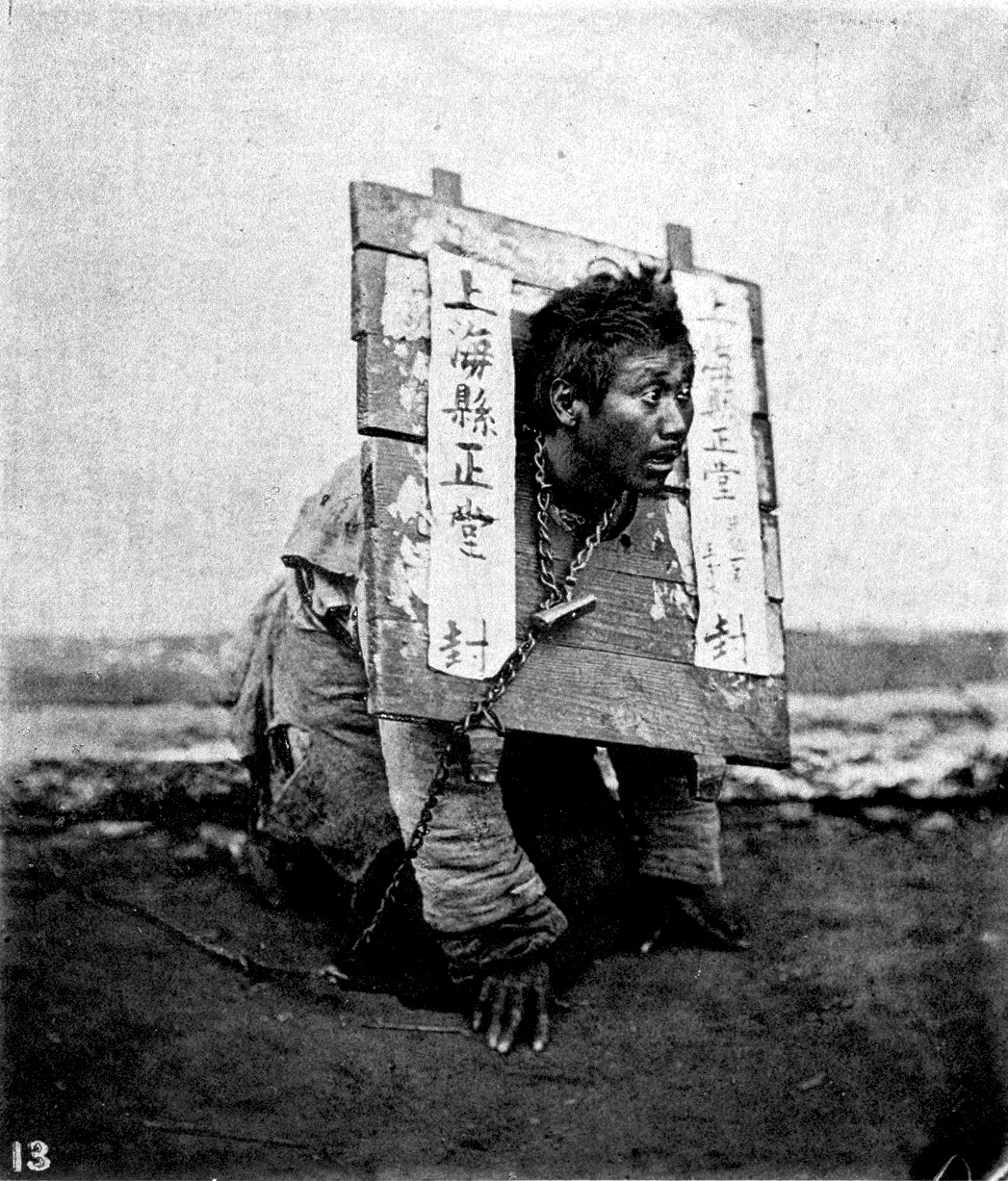
A man in a cangue in Shanghai, photographed by John Thomson c. 1870. The label reads "上海縣正堂,封," meaning "Sealed by the Shanghai County Magistrate." The offender had to rely on passersby for food.
Classical Chinese
Chinese
Transcriptions
Standard Mandarin
Hanyu Pinyinjiā
IPA[tɕjá]
Yue: Cantonese
Yale Romanizationgāa
Jyutpinggaa1
Modern Chinese
Chinese木枷
Literal meaningwooden cangue
Transcriptions
Standard Mandarin
Hanyu Pinyinmùjīa
Third alternative Chinese name
Chinese枷鎖
Literal meaningcangue lock
Transcriptions
Standard Mandarin
Hanyu Pinyinjiāsuǒ
Vietnamese name
Vietnamesegông cùm
Salle des Martyrs at the Paris Foreign Missions Society. The ladder-like apparatus in the middle is the cangue that was worn by Pierre Borie in captivity.

A cangue (/kæŋ/ KANG), in Chinese referred to as a jia or tcha (Chinese: ), is a device that was used for public humiliation and corporal punishment in East Asia[1] and some other parts of Southeast Asia until the early years of the twentieth century. It was also occasionally used for or during torture. Because it restricted a person's movements, it was common for people wearing cangues to starve to death as they were unable to feed themselves.[2]

The word "cangue" is French, from the Portuguese "canga," which means yoke, the carrying tool has also been used to the same effect, with the hands tied to each arm of the yoke. Frequently translated as pillory, it was similar to that European punishment except that the movement of the prisoner's hands was not as rigorously restricted and that the board of the cangue was not fixed to a base and had to be carried around by the prisoner.[1]

At times, the cangue was used as a general means of restraining prisoners along with manacles and leg chains; this was true particularly of those with grave sentences or low social standing.[3]

Forms

[edit]

Although there are many different forms, a typical cangue would consist of a large, heavy flat board with a hole in the center large enough for a person's neck. The board consisted of two pieces. These pieces were closed around a prisoner's neck, and then fastened shut along the edges by locks or hinges. The opening in the center was large enough for the prisoner to breathe and eat, but not large enough for a head to slip through. The prisoner was confined in the cangue for a period of time as a punishment. The size and especially weight were varied as a measure of severity of the punishment. The Great Ming Legal Code [zh] (大明律) published in 1397 specified that a cangue should be made from seasoned wood and weigh 25, 20 or 15 jīn (roughly 20–33 lb or 9–15 kg) depending on the nature of the crime involved. Often the cangue was large enough that the prisoner required assistance to eat or drink, as his hands could not reach his own mouth, or even lie down.

By the 17th century, the typical cangue had become lighter and was used primarily for public humiliation. Even so, it was intended to be worn continuously for periods as long as several months in severe cases, and a heavy cangue weighing as much as 160lbs (roughly 73 kg) could be used.[4]

Cage

[edit]

The cangue would be placed on top of a cage, such that the prisoner's feet could not quite touch the ground. Supports would be placed under the feet initially, so that he would stand without pressure on the neck. Gradually, the supports would be removed, forcing the cangue to slowly strangle him.

Ritual

[edit]

Historically cangues were used in rituals of penance in Chinese folk religion. These cangues either resembled the traditional wooden ones or were made out of three swords tied together or paper. Similar to its use as a torture and public humiliation device the penitent writes their sins on the board and parades themselves through the city until coming to the temple (generally a temple to the City God) and having their sins absolved. Often the cangue was then burned, especially if made of paper. The selling of ritual cangues was a major source of income for Chinese temples and continues to be one in Taiwan. The selling of fake ritual cangue by commoners was criminalized during the Qing dynasty.[5]

References

[edit]
[edit]
Revisions and contributorsEdit on WikipediaRead on Wikipedia
from Grokipedia
The cangue, known in Chinese as jia (枷), was a traditional East Asian punishment device comprising a large wooden board locked around an offender's neck to impose public humiliation and restrict movement. Constructed from two hinged wooden sections secured by iron pins, it immobilized the wearer, preventing easy access to food or rest and often bearing inscriptions detailing the crime and sentence. Primarily employed in China from the Song Dynasty (960–1279 CE) through the Qing Dynasty (1644–1912 CE), variants appeared in Korea (as kal) and Taiwan under Qing rule, targeting offenses ranging from theft and corruption to rebellion. Offenders paraded through public spaces or stationed in prominent locations endured the device's weight—typically 15 to 150 jin (approximately 9 to 90 kilograms)—for durations of one month to six months, depending on crime severity, with prolonged exposure risking starvation or death from immobility. Even high-ranking officials faced this degrading penalty, as in the case of Ming Wang Shizhen (1466–1542), underscoring its role in enforcing social and moral order beyond mere physical torment. Abolished in the late Qing era amid modernizing reforms, the cangue exemplified pre-modern penal systems prioritizing communal shaming over incarceration, persisting in imagery and artifacts as a marker of historical judicial practices in the region.

Definition and Description

Physical Construction

The cangue was constructed as a heavy rectangular wooden board or yoke, typically formed by two slabs of seasoned hardwood with matching semi-circular cutouts that aligned to encircle the offender's neck when clamped together. The slabs were secured using iron bolts, hinges, or padlocks to prevent removal without tools, ensuring effective restraint while distributing weight across the shoulders. Historical specifications indicate dimensions of approximately 5 to 6 chi (about 1.6 to 1.9 meters) in length and 2.5 to 2.6 chi (roughly 0.8 meters) in width, with the neck encirclement measuring 1.4 to 1.6 chi (around 0.45 to 0.51 meters) across to accommodate the head securely. Weights varied but were standardized in later imperial regulations to 25 to 30 jin (approximately 15 to 18 kilograms or 33 to 40 pounds), though heavier variants up to 60 to 70 jin existed for severe cases, emphasizing immobility and visibility. Larger boards, extending up to 3 to 4 feet (0.9 to 1.2 meters) wide in some implementations, prevented the wearer from concealing the device or passing through narrow spaces, while the front face often bore inscriptions detailing the offense in bold characters for immediate public legibility. Durable woods such as those resistant to were selected to maintain structural integrity over extended wear periods.

Application and Restraint Mechanism

The cangue, known as jia in Chinese, consisted of a rectangular wooden board divided into two sections with a central for the neck, which officials fitted around the offender's neck in a public setting to ensure visibility and during application. The sections were secured using iron pins, bolts, staples, or hinges closed with a lock or , often sealed with a bearing the magistrate's chop and a statement of the offense pasted over the fastening point. Once applied, the device's weight—typically 25 to 70 jin (approximately 15 to 42 kilograms) in the —rested heavily on the wearer's shoulders and neck, restricting arm movement due to the board's width of about 5 to 6 chi (roughly 1.6 to 2 meters), preventing the hands from reaching the face for eating, drinking, or self-care without assistance from passersby. This mechanism induced immediate physical strain, including exhaustion from limited mobility, inability to lie down flat as the board would strike the ground, and vulnerability to weather exposure without shelter, often leading to galled shoulders and rapid fatigue. Sentences lasted from 10 days for lesser offenses to several months or half a year for graver crimes, with periodic official inspections to verify compliance but no interim removal; heavier variants exceeding 70 jin could cause death within days from the cumulative burden. In some cases, inscriptions on the board noted release dates, enforcing the fixed duration until judicial expiration.

Historical Development

Origins in Ancient China

The earliest precursors to the cangue, a wooden neck restraint known as jia (枷), appeared in the (c. 1600–1046 BCE), where oracle bone inscriptions reference restraining devices via the character (圉), and pottery figurines depict criminals bound with hand and foot fetters to enforce immobilization. These rudimentary wooden instruments prioritized physical control over lethal or permanent harm, laying groundwork for later humiliation-focused penalties. In the (1046–256 BCE), penal practices advanced with differentiated restraints outlined in texts like the Zhouli, including gōng (for hand fetters) and zhí (for foot ) scaled to offense gravity, such as lighter woods for minor crimes versus heavier for severe ones. This era marked a conceptual shift toward non-mutilating detention, evidenced by inscriptions and descriptions emphasizing public exposure to deter through social shame rather than bodily alteration. Following the abolition of the five mutilating punishments (rǔxíng) under Han Emperor Wen (r. 180–157 BCE), early imperial China (Qin 221–206 BCE and Han 206 BCE–220 CE) substituted iron neck collars (qián), weighing about 2 jīn (roughly 1.2 kg) with a 1.5 chǐ (about 50 cm) handle, for offenses previously warranting amputation or castration. These devices, locked around the to restrict movement while allowing public parading, evolved amid resource constraints—such as iron shortages during Cao Cao's Jiǎzǐ reforms (early CE)—into wooden variants termed sānmù (three wooden tools), prototypes of the cangue that amplified humiliation by preventing self-feeding and bearing inscribed crimes. The term jia first surfaced in Jin dynasty (265–420 CE) records, denoting a formalized square wooden board (typically 5–6 chǐ long and 2.5 chǐ wide, with a 1.4–1.6 chǐ ) locked via sliding panels, designed for extended wear in marketplaces to enforce visibility and communal . By the Northern Dynasties (386–581 CE), such as (386–535 CE) specifications of 1.3 zhàng width, the cangue integrated into penal servitude () and exile (liú) codes, supplanting irons for their psychological impact over raw discomfort, as wood allowed lighter yet bulkier forms that immobilized without scarring.

Use Across Dynasties

During the (960–1279), the cangue was employed as a standardized punitive tool weighing 15 to 25 jin, applied to offenses such as and to enforce public shaming in communal spaces like marketplaces, thereby promoting moral rectification through visible deterrence. In the (1368–1644), integration into the formal penal code specified cangue weights by sentence severity: 15 jin for recipients of blows with the heavy stick, 20 jin for those undergoing penal servitude or , and heavier models up to 35 jin for graver penalties nearing execution. Worn for durations of one to six months—or rarely lifelong—the device targeted male offenders, combining restraint with extended public exposure to reinforce ethical conduct and prevent repetition of crimes like or . The (1644–1912) perpetuated this system, extending cangue application to both and Manchu bannermen from 1656, often alongside exile or penal for infractions including evasion and . Weights fluctuated, with light variants reduced to 25 jin under the in 1740 before rising to 35 jin in the early ; boards frequently bore inscriptions of the offense to amplify humiliation. Late imperial photographs, such as those from circa 1870–1872, illustrate chained wooden cangues on offenders, reflecting minor adaptations for enhanced security while preserving the core mechanism of public moral education inherited from prior dynasties.

Abolition in the Early 20th Century

The cangue's abolition formed part of the late Qing dynasty's sweeping legal reforms initiated after the Boxer Rebellion in 1900, which sought to modernize China's penal system amid foreign pressures and internal recognition of outdated practices. In 1905, the Qing government, influenced by Western and Japanese legal models, began revising the criminal code to eliminate severe corporal punishments, including , and emphasized imprisonment over physical restraint and public shaming. By the very late Qing period, the cangue—classified as a form of penal servitude through —was formally discontinued as reformers prioritized fines, labor, and incarceration to align with international standards and reduce barbarity. Key figures like Shen Jiaben, co-chair of the Qing's legal revision commission from 1906 to 1911, drove these changes by advocating the discard of penalties in favor of rehabilitative measures, arguing that traditional tools like the cangue perpetuated inefficiency and cruelty unfit for a modern state. Shen's 1910 draft explicitly shifted toward lighter, less bodily invasive punishments, reflecting a humanitarian drawn from global penal trends while addressing criticisms of Qing justice as archaic. This reformist momentum accelerated with the dynasty's collapse in 1911 and the Republic of China's founding in 1912, when the provisional government under fully enshrined the abolition of such imperial-era devices in the new legal framework. Although officially eradicated in urban and central administration by 1912, enforcement lagged in rural peripheries during the fragmented Republican era, where autonomy sometimes preserved informal traditional practices into the 1920s before Nationalist unification efforts imposed standardized modern prisons. The transition marked a causal break from dynastic retribution toward state-controlled deterrence, though incomplete implementation highlighted the challenges of uprooting entrenched local customs.

Forms and Variations

Punitive Cangue

The punitive cangue, or jia (枷), served as the standard apparatus for criminal punishment in imperial China, functioning as a heavy wooden collar that immobilized the wearer's head for public exposure and restraint without fully prohibiting locomotion. Constructed from a thick rectangular board—typically 5 to 6 chi (approximately 1.6 to 2 meters) long in the Song dynasty (960–1279 CE)—it featured a central neck hole secured by sliding panels or locks, often with the offender's crime inscribed on the surface to amplify communal shaming during street parades or stationary displays. This design permitted bearers to shuffle short distances for begging or menial tasks but rendered actions like eating, sleeping supine, or evading oversight impractical, thereby enforcing visibility and dependence on passersby. Sizing and weight varied by offense gravity to calibrate suffering and deterrence: lighter boards of 15 jin (roughly 9 kilograms) applied to misdemeanors warranting public beatings, medium 20 jin (12 kilograms) for terms of or servitude, and heavier exceeding 25 jin (15 kilograms) for felonies nearing capital sentences, per (1368–1644 CE) regulations. (1644–1912 CE) reforms standardized weights at 25–30 jin via a 1740 edict, though augmented variants up to 70 jin persisted for severe crimes, sometimes paired with iron chains binding ankles or wrists to curtail mobility further. District magistrates administered enforcement following , fitting the device in court or public venues and mandating its wear for durations from weeks to years, contingent on crime specifics and . As both punitive tool and social marker, it compelled offenders into community-integrated , distinguishing its criminal application from ceremonial or symbolic adaptations by emphasizing enforced portability and labor under duress.

Ritual and Symbolic Forms

In , cangues served non-punitive roles in rituals, where individuals voluntarily adopted lighter wooden or symbolic variants to atone for perceived sins or fulfill , emphasizing spiritual over physical . These practices contrasted sharply with judicial applications by prioritizing temporary self-restraint in temple settings, often as acts of devotion to deities or ancestral spirits. During the Ming (1368–1644) and Qing (1644–1912) dynasties, such rituals integrated into regional folk performances and ceremonies, particularly in areas like Fujian Province's Puxian region, where Daoist-influenced puppet theater dramatized symbolic cangue use. A notable historical narrative involves the figure Tian Zhibiao (also known as Tian Yuanshuai), who, after curing the emperor's mother of illness, donned a cangue on the emperor's behalf to redeem a pre-existing vow, portraying the device as a emblem of sacrificial piety rather than penalty. This lighter, ceremonial form—evident in scripts like the Puxian puppet piece Yuan—was affixed briefly during processions or invocations, underscoring themes of redemption and divine reciprocity without the extended immobility or public shaming of punitive versions. Symbolic cangues, sometimes crafted from paper or lightweight wood for burning or display, persisted in these contexts to represent moral purification, aligning with broader folk religious motifs of confessing faults to avert misfortune. Unlike their heavier counterparts weighing up to 25 kilograms in legal enforcement, variants typically measured under 1 meter across and allowed basic movement, facilitating participation in communal rites.

Purpose and Implementation

Deterrence Through Public Humiliation

The cangue functioned primarily as a mechanism of by exploiting public exposure to induce , drawing on Confucian cultural norms that prioritized mianzi (face) and honor over individual isolation. In societies where personal reputation intertwined with family and communal standing, the visible degradation of the offender disrupted social harmony, serving as a deterrent by threatening long-term relational and reputational damage rather than mere physical confinement. Offenses were typically inscribed on placards affixed to the cangue, detailing the to heighten stigma and invite public scorn, thereby mobilizing community members to enforce norms through informal and verbal condemnation. This communal participation reinforced moral education, as onlookers witnessed the consequences of deviance, embedding deterrence within everyday social interactions. Authorities applied the cangue predominantly to minor and moderate infractions, such as , evasion, or familial disobedience, positioning it as a resource-efficient alternative to incarceration in resource-scarce pre-modern states. By devolving costs to societal pressures rather than sustained state custody, it alleviated while maintaining order through decentralized humiliation. The cangue, known as jia in Chinese, was codified as a standard intermediate punishment in imperial legal frameworks, positioned between monetary fines or light beatings and more severe penalties like penal servitude or execution. The Great Ming Legal Code (Da Ming lü), promulgated in 1397, explicitly regulated its construction from seasoned wood and prescribed weights varying by sentence severity: 25 jin (approximately 15 kg) for capital offenses, 20 jin for servitude or , and 15 jin for lesser crimes. This gradation reflected a structured hierarchy of sanctions designed to calibrate retribution to offense gravity, ensuring the cangue served as a non-lethal deterrent for mid-level infractions such as petty theft or minor assaults. Administration fell to county-level magistrates, who operated yamen courts as the primary judicial units for commoner cases, imposing the cangue immediately upon conviction for applicable offenses. Durations were scaled proportionally to crime severity, often ranging from several days to several months, with the device locked around the offender's neck to restrict movement while allowing basic sustenance through public begging. The (1644–1912) inherited and expanded this system, integrating the cangue into the Da Qing lü li code, where local officials enforced it as a procedural staple for efficient case resolution without requiring prolonged incarceration. Frequently, the cangue was compounded with complementary sanctions to form graduated responses, such as preceding or accompanying forced labor (tu), where convicts wore it during work assignments, or exile (liu), entailing transport in the device to distant locales. In some instances, it substituted for bastinado beatings or served as a temporary measure pending appeals, allowing magistrates flexibility within the codified framework to balance enforcement costs and penal proportionality. This modular integration underscored the cangue's role in a bureaucratic justice system prioritizing local adjudication and resource-efficient punishment over centralized imprisonment.

Effectiveness and Societal Impact

Evidence of Deterrent Role

The cangue's role as a deterrent is inferred from the broader punitive framework of imperial China, where public shaming aligned with Confucian emphasis on social harmony and familial honor, amplifying psychological costs in collectivist communities. Historical analyses of Qing dynasty records reveal homicide rates ranging from 0.35 to 1.47 per 100,000 inhabitants annually, comparatively low for pre-modern agrarian societies with populations exceeding 300 million, suggesting effective overall crime control through visible punishments like the cangue for non-capital offenses. This stability persisted despite population growth, with extensions of cangue duration for repeat offenses indicating a system designed to escalate shame and prevent recidivism by marking offenders publicly with inscribed boards detailing crimes. In low-literacy, rural settings predominant in imperial , the cangue's immediate visibility—requiring offenders to parade or stand in villages—provided tangible causal links to social , outperforming abstract legal threats in enforcing compliance. Textual accounts from Qing legal precedents describe communities reinforcing deterrence through self-policing, as shamed individuals faced kin rejection and economic isolation, reducing petty and in localized jurisdictions. Empirical proxies, such as sustained low reported amid dense rural populations, support this efficacy, as the device's portability enabled widespread application without relying on centralized enforcement. Comparisons to the Western , a fixed-frame analog used until the in and colonial America, reveal parallel deterrent mechanisms in honor-based societies; English records from the note declines in public drunkenness and minor assaults following exposures, mirroring cangue effects where communal witnessing fostered voluntary restraint to preserve status. Unlike incarceration, which isolates, the cangue's ensured ongoing visibility, leveraging causal pathways of reputational damage in tight-knit groups to sustain order without high , as inferred from the rarity of escalated corporal penalties in routine case reviews.

Comparisons with Other Punishments

The cangue served as a milder alternative to capital punishments like lingchi (slow slicing) or decapitation, which were applied to serious offenses such as treason or murder in imperial China, often resulting in immediate death and dismemberment of the body. In contrast, the cangue imposed temporary immobilization and public exposure without lethality, preserving the offender's life and potential labor capacity in agrarian societies where human resources were essential for agriculture and taxation. Unlike earlier mutilating penalties—such as facial tattooing (mo), nose amputation (yi), or foot amputation (jue) under systems like the Five Punishments—the cangue avoided permanent physical or , reflecting a penal toward reversible forms of correction from the early onward. This shift prioritized social reintegration over irreversible harm, aligning with legal reforms that substituted wearing the cangue for bodily alterations to maintain workforce utility while enforcing deterrence. In comparison to European equivalents like the or , which immobilized the offender in a fixed public position to invite ridicule and minor assaults, the cangue's portable wooden collar allowed limited ambulation despite its weight (typically 10–50 kilograms), enabling the punished to traverse markets or beg for sustenance under guard supervision. This mobility distinguished it by combining restraint with nominal productivity, such as soliciting to offset the punishment's economic burden on families, whereas fixed devices like the confined victims statically for hours or days, heightening vulnerability to crowds without self-provisioning.

Criticisms and Ethical Considerations

Physical and Psychological Effects

The cangue exerted severe physical strain through its weight, typically ranging from 10 to 100 pounds depending on the offense and , which bore down on the wearer's and shoulders, leading to and potential from restricted mobility. The wooden board's rough edges often caused chafing, sores, and open wounds on the , exacerbated by prolonged wear without relief, with historical accounts noting infections as a frequent complication among female prisoners. Inability to use arms effectively for or drinking frequently resulted in , , or , though family or bystanders sometimes provided assistance; extended sentences, lasting days to months, heightened these risks, occasionally culminating in death from exhaustion or secondary infections. Exposure to elements without further compounded vulnerabilities to , heatstroke, or . Psychologically, the cangue induced acute shame through forced public display, where wearers endured , , and from passersby, amplifying feelings of degradation in collectivist societies where communal was paramount. This public ostracism often equated to , as the stigma persisted beyond the sentence, leading to familial rejection and isolation, with emotional tolls including despair and helplessness intensified by physical immobility. Historical reports emphasize the device's design to target dignity, fostering long-term through enforced helplessness and spectacle. Severity escalated with duration, as cumulative eroded self-worth, sometimes prompting in extreme cases documented in Qing-era records.

Debates on Humane Treatment in Historical Context

In imperial , the cangue was regarded by Confucian scholars and officials as a proportionate response to non-capital offenses, serving retribution through public shame while avoiding the permanent of earlier mutilating punishments like tattooing or , which were phased out from the onward in favor of less invasive measures such as the cangue and flogging. This shift reflected a first-principles emphasis on restoring social harmony via moral education, where targeted the offender's inner rather than inflicting lethal or irreversible damage, aligning with Confucian ideals that prioritized societal deterrence and ethical over mere physical suffering. Traditionalists defended its use for crimes like or minor , arguing it fostered communal vigilance and personal repentance without the high execution rates of alternatives like strangulation or , which were reserved for graver violations. Critics within the , particularly during periods of administrative excess, contended that the cangue's implementation could deviate from proportionality when local officials extended durations beyond statutory limits—typically days to months—or imposed heavier boards for personal gain, leading to unintended fatalities from or exposure despite its non-lethal intent. Such abuses were empirically linked to in unstable locales, though in centralized dynasties like the Ming and early Qing, oversight by the Board of Punishments ensured adherence to graded scales, where the cangue's weight (often 20-50 jin) and exposure time correlated directly to offense severity. Imperial edicts, such as those under the in 1669, even applied it to Manchu elites for humiliation without execution, underscoring its role as a calibrated tool for elite accountability rather than indiscriminate cruelty. By the late , reformers like Shen Jiaben advocated abolishing the cangue alongside other archaic penalties in the 1910 penal code revisions, viewing it as incompatible with emerging Western-influenced concepts of and rehabilitation, which prioritized isolation over public spectacle. Traditionalists countered that such changes ignored the cangue's causal efficacy in reinforcing communal norms through visible deterrence, a mechanism unachievable in private confinement, and warned that discarding it risked undermining the moral fabric that sustained order without relying on abstract notions of inherent absent in pre-modern . These debates highlighted a tension between empirical utility—evident in its widespread retention for petty crimes across centuries—and calls for systemic overhaul amid dynastic decline, rather than outright condemnation as inhumane by contemporary standards.

Legacy and Modern Interpretations

Cultural Representations

Photographs and illustrations from the late Qing dynasty capture the cangue as a visible emblem of imperial authority, with prisoners displayed in urban settings to enforce social order through collective witnessing. Scottish photographer John Thomson documented such scenes in Shanghai circa 1870–1872, showing individuals encumbered by the wooden frame, often reliant on public charity for sustenance, thereby highlighting the punishment's role in communal enforcement. Similarly, 19th-century European illustrations, such as those depicting the "Tcha" or cangue in travel-related publications, portrayed it as a distinctive feature of Chinese penal practices, emphasizing restraint and public inscription of offenses to deter deviance. In artistic collections, works like the anonymous Chinese painting "[The Cangue]" held by the Getty Museum illustrate confined figures in tattered garb, underscoring the device's integration into visual records of as state power. These depictions, including sketches by British artist George Chinnery of a man viewed from front and back, served to document and exoticize the cangue for Western audiences, framing it within narratives of Eastern . Twentieth-century literature repurposed the cangue symbolically, as in Eileen Chang's 1943 novella The Golden Cangue, where the titular device metaphorically binds the protagonist Cao Qiqiao to a loveless and familial , evoking entrapment beyond physical form. This allegorical use reflects the punishment's enduring cultural resonance as a motif for constraint and societal judgment in modern Chinese fiction.

Relevance to Contemporary Discussions on Punishment

The cangue exemplifies historical shame-based punishments that inform ongoing criminological debates over alternatives to mass incarceration, particularly in high-cost systems like the , where state and federal prisons house over 1.2 million inmates at an annual expense surpassing $80 billion, with three-year rates averaging 67.8%. Proponents of reintegrative shaming, as articulated in John Braithwaite's framework, argue that community disapproval fostering offender reintegration—rather than isolation—can enhance deterrence for minor offenses in cohesive societies, potentially reducing reliance on prisons that often fail to address root causes like social disconnection. Empirical studies, including meta-analyses of interventions, suggest they may lower compared to incarceration alone by leveraging to promote behavioral change, though results vary by cultural context and implementation. Critiques of prison overreliance highlight how Western penal reforms, imported to during colonial and modernizing periods, displaced culturally attuned shaming practices without sufficient adaptation, leading to overcrowded facilities in nations like , where incarceration rates have risen sharply since the 1980s amid economic reforms. Persistent shaming elements endure in contemporary Asian systems, such as 's social credit framework, which imposes reputational on over 28 million individuals as of for infractions like debt evasion, effectively mirroring traditional stigma without physical devices and correlating with compliance rates exceeding 90% in monitored cases. This continuity underscores arguments that abolishing humiliation-based deterrents overlooked high-trust communal norms in Confucian-influenced societies, where public dishonor historically sustained order more efficiently than custodial isolation for non-violent crimes. A balanced assessment reveals the cangue's model challenges narratives of inevitable penal "progress" toward either unchecked leniency or expansive , as its deterrent efficacy in collectivist settings questions assumptions that inherently fails absent empirical cultural mismatch. Nonetheless, in modern individualistic contexts marked by weakened social bonds and standards emphasizing , such visible shaming risks amplifying psychological harm, vigilante escalation, and inefficacy against anomic offenders, rendering widespread revival improbable despite isolated judicial experiments with apologies or service. These tensions highlight causal trade-offs: shame's low fiscal footprint and involvement versus incarceration's containment benefits, urging context-specific hybrids over ideological abolition.

References

Add your contribution
Related Hubs
User Avatar
No comments yet.