Hubbry Logo
Cape CrossCape CrossMain
Open search
Cape Cross
Community hub
Cape Cross
logo
8 pages, 0 posts
0 subscribers
Be the first to start a discussion here.
Cape Cross
Cape Cross
from Wikipedia

Cape Cross (Afrikaans: Kaap Kruis; German: Kreuzkap; Portuguese: Cabo da Cruz) is a headland in the South Atlantic in Skeleton Coast, western Namibia.[1]

Key Information

History

[edit]
Stamps for German South West Africa postmarked Cap Cross 1900

In 1484, Portuguese navigator and explorer Diogo Cão was ordered by King John II of Portugal to advance south into undiscovered regions along the west coast of Africa, as part of the search for a sea route to India and the Spice Islands. While doing so, he was to choose some particularly salient points and claim them for Portugal by erecting stone crosses called padrões. During his first voyage, thought to have taken place in 1482, he reached a place he called Monte Negro, now called Cabo de Santa Maria, roughly 150 km southwest of today's Benguela, Angola.

During his second voyage, in 1484–1486, Cão reached Cape Cross in January 1486, being the first European to visit this area. He is known to have erected two padrões in the areas beyond his first voyage, one in Monte Negro, and the second at Cape Cross. The current name of the place is derived from this padrão. What can today be found at Cape Cross are two replicas of that first cross.[2]

Padrão

[edit]
Cape Cross inscription, modern copy at site

The original Cape Cross padrão was removed in 1893 by Corvette captain Gottlieb Becker, commander of the unprotected cruiser SMS Falke of the German Navy, and taken to Berlin. The cross is now held in the Deutsches Historisches Museum. A simple wooden cross was put in its place. The wooden cross was replaced two years later by a stone replica.

At the end of the 20th century, thanks to private donations, another cross, more similar to the original one, was erected at the cape along with the first replica. The inscription on the padrão reads, in English translation:[3]

In the year 6685 after the creation of the world and 1485 after the birth of Christ, the brilliant, far-sighted King John II of Portugal ordered Diogo Cão, knight of his court, to discover this land and to erect this padrão here".

Seal reserve

[edit]
A confrontation at the Cape Cross seal colony

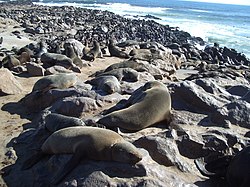
Cape Cross is a protected area proclaimed in the early 1960s.[4] Today it owned by the government of Namibia under the name Cape Cross Seal Reserve. The reserve is the home of one of the largest colonies of Cape fur seals in the world.[5]

Cape Cross is one of two main sites in Namibia (the other is in Lüderitz) where seals are culled, partly for selling their hides and partly for protecting the fish stock. The economic impact of seals on the fish resources is controversial: while a government-initiated study found that seal colonies consume more fish than the entire fishing industry can catch,[6] animal protection society Seal Alert South Africa estimated less than 0.3% losses to commercial fisheries.[7]

References

[edit]
[edit]
Revisions and contributorsEdit on WikipediaRead on Wikipedia
from Grokipedia
Cape Cross is a headland on the Atlantic coast of northwestern , situated about 120 kilometres north of within the Desert's region, best known as the site of the Cape Cross Seal Reserve, which safeguards the world's largest breeding colony of Cape fur seals (Arctocephalus pusillus pusillus), peaking at up to 210,000 individuals during the November-to-December pupping season. The locality derives its name from a padrão, a pillar topped with a cross and the Portuguese coat of arms, erected in 1486 by explorer during his voyages to claim territory for , with the original artifact later removed to and a remaining on-site. The reserve, proclaimed in the early and now managed by Namibia's Ministry of Environment, Forestry and Tourism, spans a coastal area where the seals haul out year-round, though numbers swell dramatically for breeding, with adult males arriving in to establish territories amid intense competition that can involve aggressive confrontations. Ecologically, the colony supports a key segment of the ' total , estimated at around 1.7 to 2 million along Namibian and South African coasts, serving as a vital pupping ground where over 90 percent of offspring are born in a compressed 34-day window, each weighing 4.5 to 6.4 kilograms at birth. Historically, the site's deposits fueled a late-19th-century extraction industry that briefly transformed it into a bustling outpost before depletion shifted focus to the seals, which faced commercial harvesting pressures until protective measures curbed . Visitors encounter the stark interplay of arid dunes, cold waters, and the seals' pervasive odor and vocalizations, underscoring Cape Cross's role as a premier site for observing behavior in a minimally developed natural setting.

Geography and Environment

Location and Physical Description


Cape Cross is a headland on the Skeleton Coast of Namibia, extending into the South Atlantic Ocean within the Erongo Region. Positioned at approximately 21°46′11″S 13°58′12″E, it lies about 60 kilometers north of Henties Bay and 130 kilometers northwest of Swakopmund.
The cape features a rugged rocky with exposed coastal , including rocky bays and expansive sandy beaches backed by gravel plains. Adjacent salt pans and elements of the Desert , such as sparse desert vegetation and occasional sand dunes, define the immediate surroundings. The area's geomorphology reflects the broader characteristics, with soft sands interrupted by rocky outcrops and a narrow strip of ocean-adjacent gravels and thin sands. This configuration contributes to an inhospitable environment marked by frequent fog, strong winds, and limited accessibility.

Climate and Coastal Ecosystem

The climate of Cape Cross is classified as hot desert (Köppen BWh), characterized by extreme aridity with annual rainfall typically ranging from 2 to 20 millimeters, often in the form of fog drip or rare drizzle rather than measurable precipitation. Influenced by the Benguela Current's cold upwelling, the area experiences persistent coastal fog and low clouds for over 180 days per year, moderating temperatures to mild levels: average daytime highs of 17–22°C year-round, with lows around 10–15°C at night. Strong southeast winds prevail, exacerbating the desiccating conditions and contributing to sand abrasion along the shore. This climatic regime interfaces with a dynamic coastal driven by the Large Marine , one of the most productive zones globally, with mean primary productivity of 1.25 gC/m²/year and peaks over 300 gC/m²/year fueling blooms. The nutrient enrichment from upwelled waters supports dense populations, including sardines and anchovies, forming the base of a that sustains apex predators such as Cape fur seals (Arctocephalus pusillus pusillus), whose colony at Cape Cross hosts up to 210,000 individuals—nearly 70% of the ' global breeding population. Terrestrially, the hyper-arid conditions limit vegetation to fog-adapted species like lichens, saltbush (Atriplex spp.), and sparse dune-stabilizing grasses, with ecosystem productivity reliant on marine subsidies via seal guano deposition, which enhances soil fertility and supports seabird colonies and scavengers including brown hyenas and jackals. The interplay of fog moisture and marine nutrients creates a narrow but resilient ecotone, vulnerable to perturbations like overfishing or climate-driven shifts in upwelling intensity.

Historical Background

Early Exploration and the Padrão

The Cape Cross region, located on Namibia's , was first documented by European explorers during the Age of Discoveries, as navigators sought a sea route to by charting Africa's western coastline. In the mid-1480s, , a explorer commissioned by King John II, undertook a second voyage southward from the , advancing beyond previous limits to counterbalance Spanish influence in the Atlantic. Cão's expedition reached Cape Cross in January 1486, marking the southernmost point achieved by explorers at that time and representing the first recorded European contact with the area. Upon landing, Cão erected a padrão, a large pillar approximately 3 meters tall, inscribed with the and a Latin dedication attributing the act to King John II's orders. The inscription dates the event to 1485 by the (corresponding to 1486 Gregorian), stating: "In the year 6685 after the creation of the world and 1485 after the birth of Christ, the King of Don João II ordered this place to be marked by ." Padrões like the one at Cape Cross served dual purposes: as symbols of sovereignty to assert territorial claims against rivals, and as navigational beacons for future voyages, often positioned at prominent headlands with embedded lead plates containing messages for passing ships. This structure at Cape Cross, originally termed Cabo do Padrão by the , facilitated subsequent explorations, including Bartolomeu Dias's rounding of the in 1488, though no immediate settlements or further claims followed due to the harsh environment and logistical challenges. The site's isolation preserved the padrão until its removal by German naval forces in 1893, underscoring its enduring historical significance as one of the few surviving markers from Cão's voyages.

19th-Century Resource Extraction

In the late 19th century, Cape Cross emerged as a site of commercial resource extraction, primarily guano deposits and Cape fur seals, driven by European demand for fertilizer and animal products. Guano, accumulated bird droppings prized as "white gold" for its nitrogen-rich content, was discovered at the headland in 1894 by explorer Walter Matthews during an expedition from Swakopmund. This led to the formation of the Damaraland Guano Company, an English venture backed by Matthews' uncle, which secured a 10-year concession from German colonial authorities to exploit guano and seals in the area between Cape Cross and the Kunene River. Operations commenced in 1895, with guano scraped from rock platforms and fossilized layers, then crushed and transported to waiting ships. By 1896, the site supported up to 100 laborers, who faced harsh desert conditions and imported water and equipment from Britain, establishing temporary infrastructure including a , customs office, , and worker housing. To facilitate export, the company constructed Namibia's first , a 21-kilometer narrow-gauge line from the extraction sites to the beach for loading onto vessels. Over the operation's duration until depletion in 1903, the Damaraland Company exported approximately 5,700,000 kilograms of , yielding significant profits before the deposits were exhausted. Remnants of this era, such as rusted tracks and ruins, persist amid the dunes. Concurrent with guano mining, intensive harvesting of Cape fur seals targeted pups and adults for their pelts and , which were processed for leather, oil, and meat. The first recorded European observation of seals at Cape Cross dates to 1884 by Captain Hoffmann, but commercial culling escalated under the company's concession from 1895, contributing to a regional population crash below 100,000 individuals by 1900. The operation alone yielded about 2,500 seal skins for export, transported via the new railway, amid broader 19th-century harvests that claimed roughly 650,000 Cape fur seals across southern African colonies from 1814 to 1899. These activities, while economically viable short-term, led to rapid resource depletion and abandonment by 1903, marking the end of Cape Cross's extractive boom.

20th-Century Designation and Preservation Efforts

Throughout the , preservation efforts at Cape Cross addressed both the ecological of the Cape population and the historical significance of the site. Early regulations under German colonial administration in 1893 required permits for fur seal hunting, followed by seasonal restrictions in 1909, and further controls in 1922 and 1949 under South African mandate rule, aimed at preventing depletion amid commercial sealing. In 1918, concessions for extraction, , and sealing were granted, balancing resource use with emerging conservation needs. These measures reflected growing recognition of the area's biological importance, hosting the world's largest Cape breeding colony. The pivotal designation occurred on 16 June 1969, when the South West Africa administration proclaimed the Cape Cross Seal Reserve via Proclamation 37 in Official Gazette No. 3007, establishing a 60 km² protected area to conserve the seal population and associated coastal ecosystem. This formal protection built on prior regulations and was reinforced by the 1973 Sea Birds and Seals Protection Act, which promoted sustainable harvesting practices while safeguarding breeding sites. The reserve's boundaries incorporated former mining lands, addressing historical exploitation impacts. Parallel efforts preserved the historical erected by in 1486. After the original's removal to in 1893, a with German insignia was erected in 1895 under Kaiser Wilhelm II's authorization. In 1980, the South West African government installed a second of dolerite on the original site, enhancing the monument's visibility and protection as a national heritage marker. Attempts to repatriate the original intensified in the mid-20th century, with formal requests from the South African government in 1925 and the National Monuments Council in 1956, underscoring the site's enduring cultural value despite colonial disruptions.

Cape Cross Seal Reserve

Establishment and Governance

The Cape Cross Seal Reserve was proclaimed as a in 1968 to safeguard the world's largest breeding colony of Cape fur seals (Arctocephalus pusillus pusillus), spanning 60 km² along Namibia's Atlantic coast. This designation occurred during the administration of (now ), prior to the country's in , with the primary aim of conserving the seal population amid growing commercial harvesting pressures. The reserve's boundaries encompass rocky bays, sandy beaches, and adjacent salt pans, integrating it into the broader Namib Desert ecosystem while bordering the Dorob National Park to the south. Governance of the reserve falls under the Namibian Ministry of Environment, and (MEFT), which holds ownership and operational authority as a national . MEFT enforces regulations on access, harvesting quotas, and habitat protection, including seasonal restrictions during pupping periods from November to December, when up to 210,000 seals congregate. A comprehensive plan for 2022/2023–2031/2032 outlines strategies for biodiversity conservation, sustainable resource use, and mitigation of threats like illegal and impacts, emphasizing data-driven monitoring of seal demographics. Enforcement involves collaboration with local communities and international observers to balance ecological preservation with economic activities such as limited for fisheries .

Cape Fur Seal Population Dynamics

The Cape fur seal (Arctocephalus pusillus pusillus) colony at Cape Cross constitutes the largest continuous breeding aggregation of the , with aerial censuses during the peak breeding season (November–December) recording up to 210,000 individuals. Pup production at the site, a key metric for population assessment, rose substantially from 17,839 in 1972 to a peak of 65,557 in 1993, before stabilizing with a count of 54,546 in 2004; this mirrors broader Namibian trends of 3.1% annual growth through 1993 followed by no significant change, yielding an overall population estimate of approximately 2 million (including non-pups). These figures derive from standardized during pupping (December–January), when neonates are concentrated and countable, enabling extrapolation to total colony size via demographic ratios (pups typically comprising 10–15% of the ). Reproductive dynamics feature polygynous breeding, with dominant males defending harems of 5–20 females for 4–6 weeks; females give birth to a single pup annually (mean weight 4–6 kg at birth) and nurse for 4–12 months while foraging offshore in the Benguela Current zone for prey like (Sardinops sagax) and (Merluccius capensis). Juvenile survival rates average 70–80% in stable conditions, but fluctuate with prey density; for instance, a 2020 mass abortion event deposited an estimated 5,000 foetuses along Namibian shores, linked to sardine scarcity reducing maternal body condition and , alongside 150 preterm pups at Cape Cross. Natural mortality includes predation by and orcas, entanglement in fishing gear (rates of 0.15–0.17% observed in Namibian colonies), and episodic die-offs from biotoxins or hypoxia. Human management via regulated pup (quotas of 50,000– annually across , including Cape Cross) targets surplus males to mitigate fishery competition and maintain ecological balance, with no evidence of attributable to harvesting; quotas are adjusted based on pup counts to sustain 12% annual recruitment. The colony's stability since the , despite a historical below total seals pre-1900 from overhunting, reflects protection since 1893 and favorable productivity, though ongoing northward range shifts and colony proliferation (from 23 in 1973 to 40 in 2009) suggest density-dependent dispersal from core sites like Cape Cross. Recent data indicate persistence at residents year-round, with the total Namibian subpopulation holding steady at 1.5–2.2 million amid variable rescue rates for stranded pups signaling localized nutritional stress.

Biodiversity and Associated Wildlife

The Cape Cross Seal Reserve's biodiversity encompasses associated terrestrial mammals, rich seabird populations, and a marine-influenced coastal , all sustained by the nutrient-rich environment supporting the primary Cape fur seal . Scavenger species such as black-backed jackals (Canis mesomelas) and brown hyenas (Parahyaena brunnea) exploit the abundance of seal pups, placentas, and carcasses, facilitating nutrient transfer from marine to terrestrial systems. Avian diversity is notable, with over 247 bird species recorded in the vicinity, including breeding seabirds like Cape cormorants (Phalacrocorax capensis), kelp gulls (Larus dominicanus), and the near-endemic Damara tern (Sternula balaenarum) on coastal gravel plains. Guano platforms from historical seabird colonies attract waders such as grey phalaropes (Phalaropus fulicarius) and waterfowl including greater flamingos (Phoeniconaias roseus), lesser flamingos (Phoenicopterus minor), and Cape teals (Anas capensis). The reserve lies within the Large Marine Ecosystem, where cold drives high productivity, underpinning the food chains for seals, birds, and opportunistic predators. Vegetation is sparse, reflecting the Skeleton Coast's aridity, dominated by communities (e.g., Parmelia spp.) and occasional salt-tolerant desert near coastal saltpans. This limited terrestrial supports minimal herbivory, emphasizing the area's reliance on marine-derived resources.

Human Utilization and Management

Seal Harvesting Practices

Seal harvesting at Cape Cross Seal Reserve targets Cape fur seals (Arctocephalus pusillus pusillus), focusing on weaned pups for their pelts and oil, and adult bulls for , skins, and oil. The Namibian Ministry of Fisheries and Marine Resources (MFMR) administers the practice through licensed concession holders, setting annual quotas based on population surveys to maintain , as the colony supports over 200,000 individuals during peak breeding periods. Operations occur from to , post-whelping when pups (aged 4-6 weeks) have developed sufficient layers, optimizing yield while avoiding interference with breeding. Pups are herded in groups away from the shoreline to reduce flight response, then clubbed with wooden implements weighing at least 5 kg and measuring at least 6 cm in diameter, striking the cranium between the eyes and base to induce immediate and . Adult bulls undergo similar clubbing, supplemented by spinal cord severance via to verify fatality. MFMR-appointed oversee compliance, requiring single blows where possible and prohibiting until is confirmed. National quotas for 2024 totaled 80,000 pups and 6,000 bulls across sites including Cape Cross, though actual takes often range 50-70% below limits due to market demand and logistical factors, equating to under 1% of the Cape Cross . Harvested materials are processed on-site or nearby, with pelts salted for , blubber rendered into oil for pharmaceuticals and , and utilized locally or for fishmeal. The MFMR justifies the practice as essential for amid with fisheries, citing stable or growing seal numbers despite harvests.

Tourism Infrastructure and Visitor Impact

The Cape Cross Seal Reserve features tourism infrastructure designed to facilitate safe observation of the Cape fur seal while limiting environmental disturbance, including a at the seal colony viewpoint equipped with signs for educational purposes. Renovated picnic areas and five campsites with fireplaces and timber-plastic windshields provide basic amenities for day visitors and overnight stays, supplemented by ablution facilities and parking near the viewpoint. Access is regulated through the C34 road gate, with the reserve operating from 07:00 in the off-season (16 November to 30 June) and 10:00 during the seal harvesting period (1 July to 15 November) to separate tourist activities from operations. Nearby private accommodations, such as Cape Cross Lodge, offer additional lodging options, though park camping adheres to a "take in-take out" waste policy with no on-site disposal facilities. Visitor management guidelines enforce strict protocols to mitigate impacts on the seals and , prohibiting off-road , littering, pet entry, drone use, fishing, and straying from designated paths or the 2-meter distance from seals and . Regulations displayed at entrances require adherence, with violations subject to eviction or prosecution under the Environmental Management Act of 2007, and environmental impact assessments mandated for any commercial developments. These measures address risks such as from vehicle tracks on sensitive gypsum crusts and lichens, potential seal disturbance during breeding season (November-December), and from waste, while promoting educational signage and zonation to sustain . Entry fees, collected via permits, fund conservation efforts, generating significant revenue—such as NAD 4,221,570 in the 2019 financial year—despite fluctuations, with 4,480 visitors recorded in 2020 amid pandemic restrictions. As one of Namibia's most visited protected areas and the third-most popular nationally, Cape Cross draws thousands annually, peaking at up to 400 visitors per day from July to December, supporting regional through seal watching without evidence of substantial ecological degradation when guidelines are followed. The infrastructure enables non-invasive viewing of up to 210,000 seals during breeding, contributing to objectives of balancing with conservation, though ongoing monitoring of carrying capacities in sensitive zones is recommended to prevent cumulative effects like increased human-seal proximity conflicts. Proposed enhancements, including adjustments and an eco-tourism center, aim to further improve accessibility and revenue while enforcing low-impact development near boundaries.

Controversies and Debates

Ethical and Ecological Concerns over

The commercial harvest of Cape s at Cape Cross involves clubbing primarily 7- to 10-month-old pups in dense colonies, a method criticized for frequent ineffective requiring multiple blows and instances of animals regaining before . Undercover observations from July 2009 at Cape Cross documented violations of regulations, such as clubbing in large groups rather than small, monitored releases, leading to chaotic strikes, prolonged suffering, and inadequate post- bleeding. pups prior to slaughter induces acute stress, , and suffocation risks, while chronic colony disturbances disrupt maternal-pup bonding, potentially causing nursing failures and pup starvation, rendering the practice inherently inhumane despite regulatory guidelines. advocates, including the World Society for the Protection of Animals, contend that the scale of operations in crowded environments precludes humane outcomes, with Namibia's hunt unique among Cape range states for permitting commercial pup slaughter. Ecologically, the annual quota of approximately 60,000 pups and 8,000 adult bulls from Cape Cross and other sites is defended by Namibian authorities as sustainable, citing a 2011 scientific survey confirming biological viability amid a total exceeding 1 million individuals across 26 colonies. Critics, however, highlight risks of disruption, as Cape fur seals consume an estimated 2 million tons of marine biomass annually, functioning as generalist predators that control mid-trophic competitors like and sardines, thereby indirectly supporting targeted fisheries; their removal could cascade through food webs, favoring unchecked prey proliferation or alternative apex pressures. Natural die-offs, such as the 300,000 seal deaths in 1994 and 1995 linked to anomalous conditions, underscore high baseline mortality that may obviate for , while quota expansions—from 20,500 in 1996 to over 80,000 by the —coincide with entanglement threats and habitat stressors, potentially compounding declines in pup production observed at some sites. Seals' predation on commercial stocks prompts blame for fishery depletions, yet evidence suggests and poor management as primary drivers, with seals exhibiting adaptive diets that include non-commercial and damaged gear contributing to incidental mortality. Advocacy groups like the Wildlife Animal Protection Forum argue that such harvests threaten transboundary , particularly affecting South African waters via migratory flows, despite falling demand for seal products.

Cultural Artifact Repatriation

The Stone Cross of Cape Cross, a padrão erected by Portuguese explorer Diogo Cão in 1486 to mark territorial claims along the southwestern African coast, represents an early European navigational monument featuring a limestone pillar topped with a cross and inscribed with the coat of arms of Portugal's Avis dynasty. This artifact, standing approximately 2 meters tall, was removed from its original site during the German colonial administration of South West Africa in the late 19th or early 20th century and transported to Germany, where it entered the collection of the German Historical Museum in Berlin. Namibia formally requested the repatriation of the cross in June 2017, framing it as a cultural heritage item integral to the nation's pre-colonial and colonial , despite its Portuguese origins, emphasizing its long-standing presence at Cape Cross within modern territory. German authorities, including the Federal for and the Media Monika Grütters, approved the return on May 17, 2019, as part of broader commitments to address colonial-era acquisitions and foster bilateral cultural restitution efforts. The artifact was ceremonially repatriated to Namibia on August 6, 2019, and is now housed in the National Museum of Namibia in , while a replica remains at the Cape Cross site to preserve the historical landmark for visitors and researchers. The repatriation process highlighted cooperative diplomacy between and , with no reported legal disputes or competing claims from , the original erector's nation; German officials described it as a gesture of historical responsibility rather than an admission of illicit acquisition. This case aligns with increasing global precedents for returning colonial-era artifacts to African nations, though it involved minimal controversy compared to items with indigenous cultural ties, given the padrão's function as a foreign imperial marker rather than a local artifact.

Recent Developments and Future Outlook

Infrastructure and Policy Updates

In December 2021, the Namibian Ministry of Environment, Forestry and Tourism (MEFT) inaugurated upgraded infrastructure at Cape Cross Seal Reserve as part of the NamParks V development program for coastal parks, including a new park management office to enhance conservation oversight, renovated staff housing units, an entry gate, and associated facilities like vehicle garages and signage. These improvements aimed to support on-site enforcement against encroachment and illegal activities while improving operational efficiency for rangers. Tourism-related enhancements included a new elevated walkway for safer seal observation, interpretive signs along the path, refurbished picnic areas, and five equipped campsites with fireplaces to accommodate overnight visitors without expanding built structures into sensitive habitats. The reserve's management emphasized restricting visitor access to designated paths to minimize disturbance to the seal colony, with policies prohibiting wandering beyond barriers during breeding seasons. The MEFT released a comprehensive Management Plan for Cape Cross covering 2022/2023 to 2031/2032, outlining strategies to address threats like , habitat degradation, and human-seal conflicts through zoned , quotas, and monitoring protocols. This plan prioritizes biodiversity conservation alongside economic benefits from , projecting increased visitor numbers while maintaining harvest quotas for seals under separate fisheries regulations to prevent impacts on local fisheries. No major policy shifts on or caps have been enacted since 2022, though parliamentary reviews in 2023 highlighted the reserve's role as Namibia's third-most visited seal-watching site, underscoring tensions between viewing revenue and control. The Cape fur seal (Arctocephalus pusillus pusillus) population at Cape Cross constitutes the largest breeding colony globally, with aerial surveys estimating up to 210,000 individuals present during peak breeding months of and . This figure reflects a stable high-density aggregation within the reserve, supported by the site's protected status since , though precise annual counts vary with seasonal migrations and pup production rates of around 60,000–80,000 per year at the colony. Nationwide in , the total Cape fur seal has exhibited marked growth, rising from 1.3 million to 1.6 million individuals between 2021 and 2024, driven by recovery from historical overhunting and favorable prey availability in the upwelling system. Recent estimates place the overall at approximately 1.7 million, distributed across 23–24 colonies along the Namibian coast, with Cape Cross accounting for roughly 10–15% of the total. This expansion follows a post-1990 rebound after commercial exploitation reduced numbers to under 500,000 in the mid-20th century, but growth rates have accelerated beyond historical norms, exceeding sustainable forage levels in localized areas. Sustainability challenges stem primarily from ecological limits and human-wildlife conflicts, as the burgeoning population exerts pressure on shared . Seals at Cape Cross and other sites consume an estimated 1–2 million tons of fish annually, including commercially vital species like sardines (Sardinops sagax), anchovies, and , contributing to stock depletions that have reduced Namibia's pilchard catches by up to 90% since the and threatening an industry employing over 10,000 people. Overabundance risks density-dependent effects, such as increased pup during prey shortages and heightened disease transmission, exemplified by periodic outbreaks in coastal colonies. Additional threats include anthropogenic factors like fishery bycatch, with hundreds of entanglements reported annually at Namibian colonies, disproportionately affecting pups and juveniles via monofilament lines around necks, leading to mortality rates of 10–20% in affected cohorts. To address these, Namibian authorities implement annual culling quotas—80,000 pups and adults targeted for 2024, following 86,000 in 2023—aimed at stabilizing numbers at 800,000–1 million to align with ecosystem productivity and mitigate fishery losses estimated at N$200 million yearly. Without adaptive management, including enhanced monitoring and quota adjustments based on prey biomass surveys, unchecked growth could precipitate population crashes via forage depletion, underscoring the need for evidence-based harvest strategies over unrestricted protection.

References

Add your contribution
Related Hubs
User Avatar
No comments yet.