


Community hub
Recent from talks
Contribute something
Nothing was collected or created yet.
Universal joint
View on Wikipedia
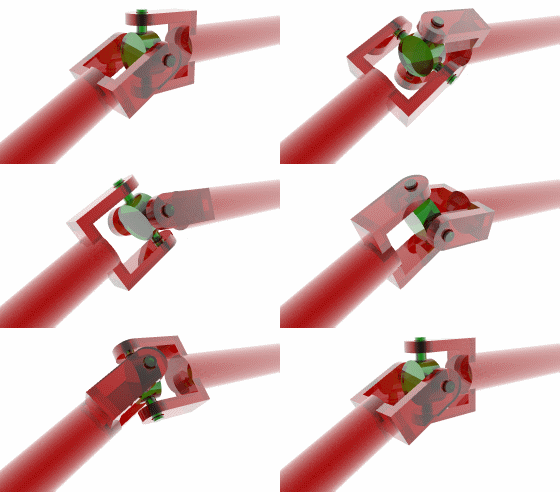
A universal joint (also called a universal coupling or U-joint) is a joint or coupling connecting rigid shafts whose axes are inclined to each other. It is commonly used in shafts that transmit rotary motion. It consists of a pair of hinges located close together, oriented at 90° to each other, connected by a cross shaft. The universal joint is not a constant-velocity joint.[1]
U-joints are also sometimes called by various eponymous names, as follows:
- Cardan joint, after Gerolamo Cardano, a polymath of the 16th century who contributed to knowledge of various clever mechanisms, including gimbals
- Hooke joint or Hooke's joint, after Robert Hooke, a polymath of the 17th century who contributed to knowledge of various clever mechanisms
- Spicer joint, after Clarence W. Spicer and the Spicer Manufacturing Company, who manufactured U joints
- Hardy Spicer joint, after the Hardy Spicer brand, a successor to the Spicer brand
History
[edit]
The main concept of the universal joint is based on the design of gimbals, which have been in use since antiquity. One anticipation of the universal joint was its use by the ancient Greeks on ballistae.[2] In Europe the universal joint is often called the Cardano joint (and a drive shaft that uses the joints, a Cardan shaft), after the 16th century Italian mathematician, Gerolamo Cardano, who was an early writer on gimbals, although his writings mentioned only gimbal mountings, not universal joints.[3]
The mechanism was later described in Technica curiosa sive mirabilia artis (1664) by Gaspar Schott, who mistakenly claimed that it was a constant-velocity joint.[4][5][6] Shortly afterward, between 1667 and 1675, Robert Hooke analysed the joint and found that its speed of rotation was nonuniform, but that property could be used to track the motion of the shadow on the face of a sundial.[4] In fact, the component of the equation of time which accounts for the tilt of the equatorial plane relative to the ecliptic is entirely analogous to the mathematical description of the universal joint. The first recorded use of the term 'universal joint' for this device was by Hooke in 1676, in his book Helioscopes.[7][8][9] He published a description in 1678,[10] resulting in the use of the term Hooke's joint in the English-speaking world. In 1683, Hooke proposed a solution to the nonuniform rotary speed of the universal joint: a pair of Hooke's joints 90° out of phase at either end of an intermediate shaft, an arrangement that is now known as a type of constant-velocity joint.[4][11] Christopher Polhem of Sweden later re-invented the universal joint, giving rise to the name Polhemsknut ("Polhem knot") in Swedish.
In 1841, the English scientist Robert Willis analyzed the motion of the universal joint.[12] By 1845, the French engineer and mathematician Jean-Victor Poncelet had analyzed the movement of the universal joint using spherical trigonometry.[13]
The term universal joint was used in the 18th century[10] and was in common use in the 19th century. Edmund Morewood's 1844 patent for a metal coating machine called for a universal joint, by that name, to accommodate small alignment errors between the engine and rolling mill shafts.[14] Ephriam Shay's locomotive patent of 1881, for example, used double universal joints in the locomotive's drive shaft.[15] Charles Amidon used a much smaller universal joint in his bit-brace patented 1884.[16] Beauchamp Tower's spherical, rotary, high speed steam engine used an adaptation of the universal joint c. 1885.[17]
The term 'Cardan joint' appears to be a latecomer to the English language. Many early uses in the 19th century appear in translations from French or are strongly influenced by French usage. Examples include an 1868 report on the Exposition Universelle of 1867[18] and an article on the dynamometer translated from French in 1881.[19]
In the 20th century, Clarence W. Spicer and the Spicer Manufacturing Company, as well as the Hardy Spicer successor brand, helped further popularize universal joints in the automotive, farm equipment, heavy equipment, and industrial machinery industries.
Equation of motion
[edit]


The Cardan joint suffers from one major problem: even when the input drive shaft axle rotates at a constant speed, the output drive shaft axle rotates at a variable speed, thus causing vibration and wear. The variation in the speed of the driven shaft depends on the configuration of the joint, which is specified by three variables:
- the angle of rotation for axle 1
- the angle of rotation for axle 2
- the bend angle of the joint, or angle of the axles with respect to each other, with zero being parallel or straight through.

These variables are illustrated in the diagram on the right. Also shown are a set of fixed coordinate axes with unit vectors and and the planes of rotation of each axle. These planes of rotation are perpendicular to the axes of rotation and do not move as the axles rotate. The two axles are joined by a gimbal which is not shown. However, axle 1 attaches to the gimbal at the red points on the red plane of rotation in the diagram, and axle 2 attaches at the blue points on the blue plane. Coordinate systems fixed with respect to the rotating axles are defined as having their x-axis unit vectors ( and ) pointing from the origin towards one of the connection points. As shown in the diagram, is at angle with respect to its beginning position along the x axis and is at angle with respect to its beginning position along the y axis.


is confined to the "red plane" in the diagram and is related to by:
![{\displaystyle {\hat {\mathbf {x} }}_{1}=\left[\cos \gamma _{1}\,,\,\sin \gamma _{1}\,,\,0\right]}](https://wikimedia.org/api/rest_v1/media/math/render/svg/29b84fdcd5b6bc07d771b025df6ccac73e27c185)
is confined to the "blue plane" in the diagram and is the result of the unit vector on the x axis being rotated through Euler angles :
![{\displaystyle {\hat {x}}=[1,0,0]}](https://wikimedia.org/api/rest_v1/media/math/render/svg/0bd3be5ddf79743233234f9f2af9943acc1aa0a7)
![{\displaystyle \left[{\tfrac {\pi }{2}}\,,\,\beta \,,\,\gamma _{2}\right]}](https://wikimedia.org/api/rest_v1/media/math/render/svg/f4c05e96d1ff75ffceacaf7cbf3cf5ad2d28bc71)
![{\displaystyle {\hat {\mathbf {x} }}_{2}=\left[-\cos \beta \sin \gamma _{2}\,,\,\cos \gamma _{2}\,,\,\sin \beta \sin \gamma _{2}\right]}](https://wikimedia.org/api/rest_v1/media/math/render/svg/a7c672bb06806fbbef22b24b171fca3c4f5ad4c1)
A constraint on the and vectors is that since they are fixed in the gimbal, they must remain at right angles to each other. This is so when their dot product equals zero:

Thus the equation of motion relating the two angular positions is given by:

with a formal solution for :
![{\displaystyle \gamma _{2}=\arctan \left[\tan \gamma _{1}\sec \beta \right]\,}](https://wikimedia.org/api/rest_v1/media/math/render/svg/85fe6c650cd9945fb691cbcd5581566eef7447db)
The solution for is not unique since the arctangent function is multivalued, however it is required that the solution for be continuous over the angles of interest. For example, the following explicit solution using the atan2(y,x) function will be valid for :


The angles and in a rotating joint will be functions of time. Differentiating the equation of motion with respect to time and using the equation of motion itself to eliminate a variable yields the relationship between the angular velocities and :


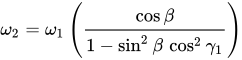
As shown in the plots, the angular velocities are not linearly related, but rather are periodic with a period half that of the rotating shafts. The angular velocity equation can again be differentiated to get the relation between the angular accelerations and :



Double Cardan shaft
[edit]
A configuration known as a double Cardan joint drive shaft partially overcomes the problem of jerky rotation. This configuration uses two U-joints joined by an intermediate shaft, with the second U-joint phased in relation to the first U-joint to cancel the changing angular velocity. In this configuration, the angular velocity of the driven shaft will match that of the driving shaft, provided that both the driving shaft and the driven shaft are at equal angles with respect to the intermediate shaft (but not necessarily in the same plane) and that the two universal joints are 90 degrees out of phase. This assembly is commonly employed in rear wheel drive vehicles, where it is known as a drive shaft or propeller (prop) shaft.
Even when the driving and driven shafts are at equal angles with respect to the intermediate shaft, if these angles are greater than zero, oscillating moments are applied to the three shafts as they rotate. These tend to bend them in a direction perpendicular to the common plane of the shafts. This applies forces to the support bearings and can cause "launch shudder" in rear wheel drive vehicles.[20] The intermediate shaft will also have a sinusoidal component to its angular velocity, which contributes to vibration and stresses.
Mathematically, this can be shown as follows: If and are the angles for the input and output of the universal joint connecting the drive and the intermediate shafts respectively, and and are the angles for the input and output of the universal joint connecting the intermediate and the output shafts respectively, and each pair are at angle with respect to each other, then:



If the second universal joint is rotated 90 degrees with respect to the first, then . Using the fact that yields:


and it is seen that the output drive is just 90 degrees out of phase with the input shaft, yielding a constant-velocity drive.
NOTE: The reference for measuring angles of input and output shafts of universal joint are mutually perpendicular axes. So, in absolute sense the forks of the intermediate shaft are parallel to each other. (Since, one fork is acting as input and the other fork is acting as output for shafts and above 90 degree phase difference is mentioned between the forks.)
Double Cardan joint
[edit]A double Cardan joint consists of two universal joints mounted back to back with a centre yoke; the centre yoke replaces the intermediate shaft. Provided that the angle between the input shaft and centre yoke is equal to the angle between the centre yoke and the output shaft, the second Cardan joint will cancel the velocity errors introduced by the first Cardan joint and the aligned double Cardan joint will act as a CV joint.
Thompson coupling
[edit]A Thompson coupling is a refined version of the double Cardan joint. It offers slightly increased efficiency with the penalty of great increase in complexity.
See also
[edit]Notes
[edit]- ^ UjjwalRane (8 July 2010). "Kinematics with MicroStation - Ch02 J Hookes Joint". Archived from the original on 11 March 2016. Retrieved 4 May 2018 – via YouTube.
- ^ see: "Universal Joint - Invented by Gerolamo Cardano" "Universal Joint, Universal Joint inventors". Archived from the original on 2017-04-22. Retrieved 2017-04-21.
- ^ See:
- Tony Rothman (2013) "Cardano v. Tartaglia: The Great Feud Goes Supernatural", p. 25. Available on-line at: Arxiv.org. (Note that Rothman mentions Wikipedia's error regarding Cardano's supposed invention of the universal joint.)
- Hans-Christoph Seherr-Thoss, Friedrich Schmelz, Erich Aucktor, Universal Joints and Driveshafts: Analysis, Design, Applications (Berlin, Germany: Springer Verlag, 1992), p. 1.
- Marie Boas, The Scientific Renaissance: 1450-1630 (New York, New York: Harper Brothers, 1962), p. 186 Archived 2016-04-11 at the Wayback Machine.
- James Eckman, Jerome Cardan (Baltimore, Maryland: The Johns Hopkins Press, 1946.), p. 77.
- Hieronymi Cardanime (Gerolamo Cardano), De Subtilitate Libri XXI. (On subtle things in 21 books) (Basel, Switzerland: Sebastian Henric Petri, 1553), Liber XVII. De Artibus, Artificiosisque; rebus. (Book 17. On crafts and ingenious devices), p. 817. (Note: (1) This book is a reprint of the 1500 original. (2) In the margin of p. 817 is printed: Sedes mira (miraculous chair).) From p. 817: Archived 2017-10-11 at the Wayback Machine "Simili ratione inventũ est, ut Cæsaris sedes ita disponeretur, ut quocumque situ constituatur, ille immobilis, ac commodè dum vehitur sedeat. Hoc tractum ex armillarum ratione: cum enim circuli tres chalybei constituentur, polis sursum, deorsum, antè, retro, dextra ac sinistra mobilibus, cum plures non possint esse situs, necesse est ipsum in essedo quomodocumque agatur quiescere perpetuò." (By similar reasoning, [it] has been found that the Emperor's chair might be so arranged that he [remain] fixed in whatever orientation be decided and he sit comfortably while he is transported. This is based on the logic of the gimbal mounting: the three steel rings are arranged by the movable poles [i.e., ends of the axes] upwards, downwards, forwards, backwards, right and left, when more [motions] cannot be allowed, [because it] is necessary [that] he in the carriage somehow be made to remain still constantly.)
- Hieronymi Cardani (Gerolamo Cardano), Mediolanensis Philosophi ac Medici Celeberrimi Operum [Of the very famous works of the Milanese philosopher and physician] (Lyon (Lugdunum), France: Jean Antoine Huguetan and Marc Antoine Ravaud, 1663), vol. 10: Opuscula miscellanea (Miscellaneous works), Paralipomenon (Supplement), Liber V. De rebus factis raris & artificiis (Book 5. On rare and ingeniously made things), Caput VII. De Armillarum instrumento (Chapter 7. On the armillary), pp. 488-489.
- ^ a b c Mills, Allan, "Robert Hooke's 'universal joint' and its application to sundials and the sundial-clock", Notes & Records of the Royal Society, 2007, accessed online Archived 2015-09-25 at the Wayback Machine 2010-06-16
- ^ Gasparis Schotti, Technica Curiosa, sive Mirabilia Artis, Libris XII. … [Curious works of skill, or marvelous works of craftsmanship] (Nuremberg (Norimberga), (Germany): Johannes Andreas Endter & Wolfgang Endter, 1664), Liber IX. Mirabilia Chronometrica, … (Book 9. Marvelous Clocks, … ), Caput V. Signa chronometrica optica, seu indices. (Chapter 5. Marvelous visual clocks, or clocks with hands), pp. 664-665: Propositio XX. Indicem sinuosum & obliquatum per anfractus quosvis, sine Rotis dentatis quocumque lubet educere. (Proposition 20. [How], without any gears, to lead the twisting, turning pointer [i.e., the shaft that drives the clock's hands] through any bend one pleases.) In the margin is printed: Vide Iconism. VII. Fig. 32. (See Plate 7, Figure 32.), which depicts Schott's universal joint. Schott first notes that there may be occasions when a clock's gear works and its face can't be conveniently aligned; e.g., public clocks installed in towers. He then mentions, in the description of its construction (Technasma, the Greek word for "artifice"), that the universal joint resembles a gimbal that is used to hold an oil lamp so that it won't spill oil. Schott's joint consists of two forks (fuscinula), each of which consists of a shaft to which a metal strip, bent into a semicircle, is attached to one end. Near each end of the semicircle, a hole is drilled. A cross with four perpendicular arms (crux sive 4 brachia) is also made. The holes in each semicircle fit over the ends of an opposing pair of arms. The angle between the shafts must be greater than a right angle. In discussing the joint's motion (Motus), Schott claims that the two shafts move at the same speed (i.e., they form a constant-velocity joint): " … horum autem ductum necesse est sequatur & altera fuscinula, parique cum priore illa feratur velocitate: unde si fuerit unius fuscinulae motus regularis circularis, erit similis & alterius … " ( … but this driven [fork] must follow the other [driving] fork, and it be born at a speed equal to the former: whence if one fork's motion were regularly circular, it will be similarly with the other … ).
- ^ For a (partial) history of universal joints, see: Robert Willis, Principles of Mechanism …, 2nd ed. (London, England: Longmans, Green, and Co., 1870), Part the Fifth: On Universal Joints, pp. 437-457.
- ^ "universal, a. (adv.) and n.", para.13, Oxford English Dictionary Online, accessed 2010-06-16
- ^ Hooke first described a universal joint in Hevelius' instrument in: Robert Hooke, Animadversions on the first part of the Machina Coelestis … (London, England: John Martyn, 1674), p. 73. Here he calls the joint a "universal Instrument". From page 73: I shall show " … what use I have made of this Joynt, for a universal Instrument for Dialling, for equalling of Time, for making the Hand of a Clock move in the Shadow of a Style, and for performing a multitude of other Mechanical Operations." The joint is depicted on Plate X, Fig.s 22 and 23, which are available at: Posner Memorial Collection - Carnegie Mellon University Archived 2015-11-17 at the Wayback Machine
- ^ Robert Hooke, A Description of Helioscopes, and Some Other Instruments (London, England: John Martyn, 1676), p. 14. From p. 14: "The Universal Joynt for all these manner of Operations, having not had time to describe the last Exercise, I shall now more particularly explain." Illustrations of Hooke's universal joint appear on p. 40, Fig.s 9 and 10; available at: ETU Library; Zurich, Switzerland Archived 2015-09-23 at the Wayback Machine.
- ^ a b Review of Ferdinand Berthoud's Treatise on Marine Clocks, Appendix Art. VIII, The Monthly Review or Literary Journal, Vol. L, 1774; see footnote, page 565.
- ^ Gunther, Robert Theodore, Early Science in Oxford, vol. 7: "Life and work of Robert Hooke, Part II" (Oxford, England: Dawsons of Pall Mall, 1930), pp. 621–622.
- ^ Willis, Robert, Principles of Mechanisms, … (London, England: John W. Parker, 1841), pp. 272-284.
- ^ J. V. Poncelet, Traité de mécanique appliquée aux machines, Part 1 (Liége, France: Librairie scientifique et industrielle, 1845), pp. 121-124.
- ^ Edmund P. Morewood, Improvement in Coating Iron and Copper, U.S. Patent 3,746, Sept. 17, 1844.
- ^ Ephraim Shay, Locomotive-Engine, U.S. Patent 242,992, June 14, 1881.
- ^ Charles H. Amidon, Bit-Brace, U.S. Patent 298,542, May 13, 1884.
- ^ Douglas Self. "The Tower Spherical Engine".
- ^ William P. Blake, Report of the Commissioner to the Paris Exposition, 1867, Chapter 1, Transactions of the California State Agricultural Society, During the Years 1866 and 1867, Vol X, Gelwicks, Sacramento, 1868.
- ^ The Dynamometer Balance, [Van Nostrand's Engineering Magazine], Vol. XXV, No. CLVI (Dec. 1881); page 471.
- ^ Electronically-controlled adjustable height bearing support bracket - US Patent 6345680 Archived February 5, 2009, at the Wayback Machine
References
[edit]- Theory of Machines 3 from National University of Ireland
External links
[edit]- [1] by Sándor Kabai, Wolfram Demonstrations Project.
- DIY: Replacing Universal Joints Archived 2008-03-24 at the Wayback Machine at About.com.
- Thompson Couplings Limited explanation of the Thompson coupling.
- Universal Joint Failure - Custom Solutions Address Common Problems
- Universal Joint Phasing - The Concept and Importance of Universal Joint Phasing and Drive Shaft Alignment
- The Thompson Coupling - invented by Glenn Thompson by ABC Television (The New Inventors, broadcast Feb 2007).
- U.S. patent 7,144,326 (constant-velocity coupling).
- About universal joints at McMaster Carr.
- Cardan Shaft at McMaster Carr.


| International | |
|---|---|
| Other | |

Universal joint
View on GrokipediaFundamentals
Definition and Purpose
A universal joint, also known as a U-joint, is a mechanical coupling that connects two rigid shafts whose axes are inclined to each other, enabling the transmission of torque and rotary motion while accommodating angular misalignment typically up to approximately 30 degrees.[6][7] This design allows the joint to flex without disconnecting the shafts, maintaining continuous power delivery despite non-collinear alignment.[8] The primary purpose of a universal joint is to facilitate power transfer in mechanical systems where perfect shaft alignment is impractical or impossible, such as in automotive drive trains connecting the transmission to the differential.[9] By permitting relative movement, it prevents binding, reduces excessive wear on connected components, and accommodates dynamic changes like suspension travel in vehicles.[10] This makes it essential for applications requiring reliable torque transmission under varying operating angles. Universal joints offer several basic advantages over alternatives like flexible couplings, including a compact design that fits in space-constrained assemblies, cost-effectiveness for moderate-duty uses, and the capacity to handle reasonable speeds and loads without significant energy loss.[12][13] These attributes contribute to their widespread adoption in industrial and vehicular machinery.[14] The device has various historical names reflecting its evolution, including Hooke's joint after Robert Hooke, who described it in 1676 for astronomical instruments despite earlier conceptual uses; Cardan joint, tracing to 16th-century Italian mathematician Girolamo Cardano's theoretical work on gimbals for motion transmission; and Spicer joint, named for Clarence W. Spicer's 1903 patent that popularized it in automobiles.[15]Components and Assembly
A universal joint, also known as a Cardan joint, consists of several key components that enable the transmission of rotary motion between misaligned shafts. The primary elements include the yokes, which are forked ends attached to the input and output shafts, providing the connection points for the joint. The central cross, often referred to as the spider, is a cruciform piece with four perpendicular arms or trunnions that serve as pivoting axes. Bearing caps encase needle or roller bearings that fit over the trunnions of the cross, allowing smooth rotation within the yoke ears. Retaining clips, such as snap rings, or bolts secure the bearing caps in place to prevent disassembly during operation.[14][16] The assembly process begins with attaching the yokes to the respective shafts, typically via splines, keys, or welding, ensuring a secure and balanced fit. The cross is then inserted into the yokes by aligning its trunnions with the bearing caps pre-installed in the yoke ears. For needle-bearing designs, the caps are pressed into the yokes, and the cross trunnions are inserted into the bearings, followed by securing the caps with snap rings using pliers or an assembly tool to ensure proper seating without play. In bolted configurations, cap bolts are tightened to specified torques (e.g., 137–195 N·m depending on size) and locked with wire or lubricant for retention. Traditional manual assembly often uses a high-pressure press, while modern automated methods employ staking rigs for precision and reduced material stress.[17][18][19] Materials for these components are selected for durability and load-bearing capacity, with yokes and crosses commonly made from heat-treated alloy steel for high strength and fatigue resistance, though stainless steel (e.g., 303 or 416 grades) is used in corrosive environments. Bearing caps and needles are typically steel-based, with options for roller bearings in larger joints to handle higher loads. Lubrication is integral, achieved via grease fittings (e.g., R1/8 type) on the cross or each cap, using lithium soap-based greases applied periodically (1–3 months) in quantities scaled to joint size (e.g., 10–180 ml for the cross kit). Boots made of nitrile or silicone may enclose the joint to retain lubricant and exclude contaminants.[14][16][17] Variations in assembly address performance factors like vibration and longevity. Phasing involves aligning the yokes of input and output shafts in the same plane (e.g., both horizontal or vertical) using match marks, which minimizes torsional vibrations especially at higher speeds (≥800 rpm). Retention methods differ by design: snap rings for smaller, high-speed joints (e.g., RA1310 series) allow easy maintenance, while bolted or peened caps suit heavy-duty applications for greater security. Interference fits or crowned rollers in bearings further reduce friction during pivoting.[14][17][18]Types and Configurations
Hooke's Joint
The Hooke's joint, also known as the single universal joint or Cardan joint, is a fundamental mechanical coupling that connects two shafts whose axes are not coaxial, enabling the transmission of rotary motion across an angular misalignment. It consists of two yokes—one attached to each shaft—linked by a central cross-piece or spider with arms perpendicular to each other, allowing the joint to accommodate relative angular displacement in one plane while constraining other motions. This design provides two degrees of freedom for rotation, effectively equivalent to two intersecting revolute joints oriented at 90 degrees.[20] In terms of geometry, the input and output shaft axes intersect at the center of the cross-piece, with the yokes bolted or pinned to the cross arms such that the connecting lines between the yokes and cross are perpendicular. The cross-piece typically features needle bearings at each arm end to reduce friction and support radial loads during operation. This configuration ensures that torque is transmitted through the cross without direct contact between the yokes, maintaining alignment at the intersection point even as the shafts deflect angularly up to their operational limits.[20][21] Operationally, the Hooke's joint transmits constant angular velocity only when the shafts are perfectly aligned; under misalignment, it introduces cyclic speed fluctuations in the output shaft, manifesting as periodic acceleration and deceleration over each rotation. These variations arise because the effective transmission path changes with the input shaft's rotation angle, leading to torque pulsations that can reach up to 28.9% speed variation at a 30-degree misalignment. To mitigate these effects and achieve near-constant velocity, Hooke's joints are commonly implemented in pairs, oriented 90 degrees out of phase and connected by an intermediate shaft, which cancels the fluctuations. Typical maximum misalignment angles for single joints are limited to around 35 degrees to avoid excessive wear and vibration, though operating angles are often kept below 22 degrees for optimal performance in high-speed applications.[20][21][22] Maintenance of the Hooke's joint focuses on preventing bearing wear and contamination, primarily through periodic greasing of the needle bearings to maintain lubrication and reduce friction-induced heat. Protective elements such as rubber boots or gaiters are often fitted to shield the joint from dirt, water, and grit, which can accelerate failure; regular inspections for unusual vibrations, noise, or play in the joint are recommended to detect early signs of damage.[20][22]Double Cardan Joint
The double Cardan joint, also known as the double Hooke's joint, consists of two single universal joints connected in series by an intermediate shaft and a centering mechanism, such as a coupling yoke with a ball-and-socket or bisecting link, to maintain alignment and equalize angular deflections.[23][24] This setup builds on the basic Hooke's joint by pairing them to address limitations in velocity transmission.[25] The mechanism achieves constant velocity transmission through the centering device, which bisects the total misalignment angle equally between the two joints, ensuring that the input and output shafts rotate at the same angular speed by canceling the sinusoidal velocity fluctuations inherent in a single joint.[23][24] For this to occur, the yokes of the input and output shafts must remain parallel, and the intermediate shaft orients at twice the offset angle relative to each joint.[25] Geometrically, the double Cardan joint accommodates total misalignment angles up to approximately 30 degrees between input and output shafts, with the intermediate shaft deflecting at twice this offset to balance the configuration.[23][25] This allows operation over a wider range of deflections compared to a single joint while preserving near-constant velocity.[24] In vehicular applications, the double Cardan shaft refers to a drive shaft assembly incorporating this joint, commonly used to transmit torque from the transmission to the differential or axle in light-duty vehicles and agricultural machinery where moderate angular offsets are present.[23][24] Advantages of the double Cardan joint include smoother operation at higher rotational speeds, such as above 1,000 rpm, due to reduced vibrations from velocity constancy, along with simpler sealing without boots and resistance to debris in certain designs.[23][24]Thompson Coupling
The Thompson coupling, also known as the Thompson constant velocity joint (TCVJ), is a specialized variant of the double Cardan joint designed to transmit torque between misaligned shafts at a constant velocity ratio. Unlike traditional double Cardan joints that rely on a centering yoke or bisector for alignment, the Thompson coupling incorporates a spherical or ball-and-socket centering mechanism to constrain the intermediate linkage, ensuring that the input and output shafts maintain equal angular velocities without speed fluctuations.[26] In terms of geometry, the Thompson coupling consists of input and output yokes connected through two universal (U-)joints and a central ball joint that serves as the geometric center of rotation. The central ball joint allows the intermediate shaft or linkage to pivot freely, distributing the deflection angles equally between the two U-joints while all rotational axes intersect at a common point in the homokinetic plane—the bisector of the supplementary angle between the input and output shaft axes. This configuration uses a spherical pantograph or control yoke to constrain motion, enabling operation at articulation angles up to 20 degrees in standard designs and up to 45 degrees in specialized variants, with no load-bearing sliding surfaces to minimize friction.[26][27] A key feature of the Thompson coupling is its self-aligning centering ball, which accommodates minor misalignments without requiring precise phasing during assembly, thereby reducing vibrations and oscillatory torques that are common in single or standard double Cardan joints. This mechanism ensures near-constant velocity transmission with efficiencies exceeding 99.95% and operates at near-ambient temperatures, even under high loads, due to the absence of sliding contacts and the use of roller bearings for low-friction articulation.[26][28] Compared to standard double Cardan joints, the Thompson coupling offers superior tolerance to misalignment errors, as the spherical centering eliminates the need for parallel alignment of the U-joints and provides inherent balance through symmetrical angle distribution. This results in longer operational life, particularly in high-vibration environments, by dampening torsional oscillations and reducing wear on connected components, with bearing life ratings up to 2,000 hours under rated loads.[28][27] The patented design was developed by Glenn Alexander Thompson and first introduced in 1999 through the founding of Thompson Couplings Ltd. in Australia, with global patents emphasizing the novel control system for constant velocity transmission. It earned recognition, including the Australian Society for Engineering in Agriculture Engineering Award, for its innovative application in driveline systems.[26][29]Historical Development
Early Inventions
The origins of the universal joint trace back to ancient engineering, where early mechanisms for compensating shaft misalignment appeared in Greek and Roman devices. Indications suggest possible use in ballistae, siege engines that employed swivel joints to adjust aiming on uneven terrain, allowing rotational transmission despite angular offsets.[30] The concept has roots in ancient Greek gimbals dating to around 300 BCE, which allowed rotation in multiple axes. These rudimentary applications laid foundational ideas for connecting non-collinear shafts, though they lacked the precision of later designs. In the 16th century, Italian polymath Gerolamo Cardano advanced the concept through mathematical description in his 1550 treatise De subtilitate, where he outlined the joint's ability to transmit rotary motion between inclined axes.[31] This publication formalized the mechanism's principles, earning it the enduring name "Cardan joint" and influencing subsequent mechanical thought. Cardano's work emphasized the joint's utility in devices requiring flexible power transmission, marking a shift from empirical to theoretical understanding. The 17th century saw further refinement by English scientist Robert Hooke, who in 1676 described and illustrated an improved universal joint in his Helioscopes.[32] Hooke applied it to astronomical instruments, such as sundials and telescopes, to maintain alignment during observation, and to pumps for handling rotational inconsistencies. His design enhanced durability and smoothness, coining the term "universal joint" for its versatility in accommodating various angles.[33] By the 19th century, practical implementations emerged in precision mechanisms like clockworks, where universal joints connected extended rods without multiple supports, reducing friction in complex assemblies.[34] These early patents and applications, often handcrafted from metal components, were limited to low-speed operations due to wear from imprecise manufacturing and lack of lubrication, restricting them to non-industrial scales.[33]19th and 20th Century Advancements
In the 19th century, universal joints gained widespread adoption in steam engines and industrial machinery to facilitate power transmission between misaligned shafts, addressing alignment issues in early mechanized systems. A notable advancement was the improved cross design incorporated in Edmund Morewood's 1844 U.S. patent for a metal coating machine, which utilized the joint to compensate for small angular displacements between connected components.[35] The early 20th century marked a pivotal shift with the development of needle-bearing universal joints tailored for automotive applications. Clarence W. Spicer patented an encased universal joint in 1904, featuring needle bearings that reduced friction and enabled efficient power delivery to rear wheels in rear-wheel-drive vehicles, laying the foundation for modern drivetrains.[36] Mid-20th century innovations focused on constant-velocity variants to support higher operating speeds and smoother performance. Refinements to the double Cardan joint, including the addition of a centering ball mechanism in the 1920s, ensured angular alignment between the two individual joints, minimizing velocity fluctuations and vibrations in front-wheel-drive systems.[37] Post-World War II advancements emphasized reliability and maintenance reduction through international standardization of dimensions via ISO specifications, the adoption of synthetic lubricants to enhance load-bearing capacity and longevity, and sealed designs that protected against contaminants. A significant milestone occurred in the 1950s with the transition to mass-produced alloy steels, such as chrome-molybdenum variants, which improved strength and drastically lowered failure rates in high-volume vehicle production.[38]Mechanical Analysis
Kinematics
The kinematics of a universal joint describe the geometric relationships governing the transmission of rotational motion between two misaligned shafts. The joint allows torque to be transferred while accommodating an angular bend α between the shaft axes, typically through a cross-piece that pivots on perpendicular axes. This configuration results in one primary rotational degree of freedom for torque transmission along the shafts, with the cross arms enabling pivoting to maintain connection under misalignment.[20] The relationship between the input shaft angular displacement θ and the output shaft angular displacement φ is given by the equation where α represents the fixed bend angle between the shafts. This relation arises from the spherical trigonometry of the joint's geometry, ensuring that the output rotation lags or leads the input depending on the bend angle. Misalignment introduces variations in the angular velocity ratio between the input and output shafts. For a single universal joint, the instantaneous velocity ratio is expressed as which fluctuates cyclically twice per input revolution, reaching maximum and minimum values at θ = 0° and θ = 90°, respectively. This non-uniformity becomes more pronounced as α increases, leading to torsional vibrations in applications with significant bend angles. Constant velocity transmission, where at all times, occurs only when α = 0°, corresponding to aligned shafts with no joint function needed. In practical setups, constant velocity is achieved by employing symmetric double universal joint configurations, such as the double Cardan joint, where two single joints are arranged with equal bend angles in opposing planes to cancel velocity fluctuations.[16] Geometric analysis of the universal joint often involves vector representations of shaft positions to visualize motion paths. The input and output shafts can be modeled as vectors intersecting at the joint center, with the cross arms defining pivot planes; this vector approach highlights how the bend angle α alters the projection of rotational vectors, without deriving full dynamic equations.[20]Equation of Motion
The equation of motion for a universal joint, also known as a Hooke's joint, describes the time-dependent rotational dynamics between the input and output shafts under applied loads. Building on the kinematic relation where the output angle relates to the input angle and joint angle as , the angular velocity and acceleration are obtained by successive differentiation with respect to time, assuming constant input angular velocity .[39] Differentiating the kinematic relation yields the output angular velocity . This expression reveals the cyclic variation in output speed, with minima occurring when (yielding ) and maxima when (yielding ). Further differentiation gives the output angular acceleration , which applies Newton's second law for rotation to link inertial torques to these variations.[39] Torque transmission follows from conservation of power, assuming no losses: , so . This indicates torque amplification at positions where is minimized, potentially up to times the input torque.[39] To account for inertia effects, such as vibrations from the cross and yoke masses, the Lagrangian formulation incorporates the kinetic energy (where is the moment of inertia) and potential energy terms, leading to equations of motion via , with and generalized coordinates including and . This yields a dynamic stiffness matrix that includes inertial contributions from component masses, enabling analysis of torsional oscillations.[40][41] For a numerical example at and constant rpm, the output speed varies from a minimum of approximately 866 rpm (when ) to a maximum of approximately 1155 rpm (when ), representing a fluctuation of about 33% over one input rotation. This variation drives periodic accelerations up to in magnitude.[42]Design Considerations
When designing universal joints, sizing factors are critical to ensure the component can handle the required loads without failure. The torque capacity is primarily determined by the shear strength of the joint's cross or yokes, with the maximum torque approximated by the formula , where is the diameter of the arm or trunnion, and is the allowable shear strength of the material.[43] This calculation provides a baseline for selecting joint size based on expected torque, often adjusted by service factors for dynamic loads, speed, and misalignment.[16] Manufacturers provide torque ratings such as endurance torque (for reversing loads) and peak torque (based on yield strength), which guide selection for applications up to several hundred thousand lb-in.[16] Operating angle limits must be considered to prevent lock-up and excessive wear. For a single Hooke's joint, the maximum operating angle is typically 20-30° to maintain smooth motion and avoid binding, though higher angles up to 45° are possible with reduced bearing life and durability.[14] Double Cardan joints allow for higher effective misalignment, often up to 45° total, by compensating for velocity fluctuations in the paired configuration.[44] Exceeding these limits accelerates fatigue in bearings and yokes due to increased oscillatory motion.[2] Balancing and phasing are essential for minimizing vibrations and harmonics in rotating assemblies. Yoke alignment, or phasing, ensures that the yokes on paired joints are oriented in a "Z" or "W" configuration to achieve near-constant velocity and cancel out angular accelerations, reducing torsional vibrations.[16] For high-speed operations above 850 RPM, dynamic balancing is required to limit imbalance forces, while lower speeds may use static balancing.[16] Critical speed calculations help avoid resonance, approximated by , where is the shaft stiffness and is the moment of inertia; operating speeds are typically limited to 75% of this value to prevent excessive deflections.[16] Material selection influences load capacity, durability, and environmental suitability. Heat-treated alloy steels, such as those with yield strengths exceeding 100 ksi, are standard for high-torque applications to enhance fatigue resistance and shear strength.[16] For corrosive environments like marine settings, stainless steels (e.g., 316L) or specialized alloys like Inconel provide superior resistance to oxidation and pitting while maintaining mechanical integrity.[45] Bearing materials, often including needle rollers, are chosen for low friction and high PV (pressure-velocity) limits.[14] Common failure modes include fatigue cracking from prolonged misalignment and inadequate lubrication, which leads to bearing spalling and accelerated wear.[46] These are mitigated through proper preload in the joint assembly to maintain contact without excessive stress, and specification of lubrication intervals based on speed and angle—typically grease with EP additives for high-load conditions—to reduce friction and heat buildup.[47] Over-torquing can cause immediate shear failure in the cross, underscoring the need for adherence to rated capacities.[16]Applications and Limitations
Automotive Uses
In rear-wheel-drive vehicles, universal joints primarily connect the transmission output to the propeller shaft and the propeller shaft to the differential input, enabling power transmission while accommodating the angular misalignment caused by the vehicle's underbody geometry.[48] This setup is essential for transferring rotational torque from the engine to the rear wheels, allowing the driveshaft to flex during acceleration, braking, and suspension movement without binding.[9] In typical configurations, a single universal joint is installed at each end of the driveshaft, providing up to 30 degrees of operating angle per joint while maintaining efficient power delivery.[49] For trucks and sport utility vehicles (SUVs) with steeper driveline angles—often due to higher ground clearance or lifted suspensions—double Cardan configurations are employed, featuring two universal joints in series at one end to minimize speed fluctuations and vibrations.[50] These setups, as detailed in the Double Cardan Joint section, support greater articulation for off-road applications while integrating with the vehicle's suspension system. Additionally, universal joints appear in differentials with live axles, where they link the driveshaft to the pinion yoke, and in steering columns to adjust for column tilt and driver positioning, ensuring precise control input transfer to the steering gear.[51] Integration with slip yokes further accommodates suspension travel, allowing the driveshaft to extend or compress by 1 to 2 inches during wheel articulation without disengaging the joints.[49] The evolution of universal joints in automotive applications traces back to Clarence W. Spicer's 1903 patent and the establishment of his company in 1904, with universal joints becoming standard in over 90% of automobiles by 1910 due to their reliability in early rear-wheel-drive designs, and Spicer's designs playing a key role.[36][52] By the mid-20th century, these joints had evolved into greaseable variants for extended service life, with needle-bearing crosses to reduce friction and wear. In modern front-wheel-drive vehicles, however, constant-velocity (CV) joints have largely supplanted universal joints for axle applications, offering smoother operation at higher angles without the velocity variations inherent to single Cardan designs.[53] Passenger car universal joints, commonly the 1310 or 1350 series, are rated for continuous operation up to 5,000 RPM, supporting torque loads from 150 to 210 lb-ft depending on the series, while greaseable designs permit periodic lubrication to achieve lifespans exceeding 100,000 miles under normal conditions.[54][55]Industrial and Other Applications
Universal joints play a crucial role in industrial machinery for power transmission, particularly in systems requiring misalignment compensation. In pumps and conveyors, they connect drive shafts to motors or engines, enabling efficient torque transfer while accommodating angular offsets that arise from equipment vibration or installation variances.[56] For agricultural equipment, such as tractors, universal joints are integral to power take-off (PTO) shafts, where they link the tractor's engine to implements like mowers or balers, allowing rotational power to be transmitted at angles up to 30 degrees for flexible field operations.[57][58] In robotics and instrumentation, miniature universal joints facilitate precise multi-axis motion in compact assemblies. These small-scale joints, often with bore diameters as low as 3 mm, are employed in remote manipulators to connect actuators to end-effectors, enabling smooth torque transmission despite joint misalignments in dynamic environments.[59] Similarly, in camera gimbals, they support stabilized rotation for optical systems, allowing independent pitch and yaw adjustments while maintaining alignment between the camera and drive mechanisms.[60] Sealed variants of universal joints are essential in marine and aerospace applications to withstand harsh conditions. In boats, stainless steel universal joints connect propeller shafts to engines, providing corrosion-resistant power transmission through flexible couplings that handle thrust and angular deflections in saltwater environments.[61][62] For aircraft, they form critical control linkages, attaching to yoke shafts for rudder or aileron actuation, where sealed designs prevent contamination and ensure reliable operation under high-vibration flight conditions.[63][64] Custom adaptations of universal joints incorporate advanced materials for specialized uses. High-precision versions with polymer bearings, such as acetal-molded radial supports, are used in medical devices like endoscopic tools, where low-friction operation minimizes tissue trauma during articulated movements.[65][66] In low-torque optics systems, such as laser alignment instruments, these joints enable fine angular adjustments with minimal backlash, supporting sub-millimeter precision in beam steering.[66] Universal joints vary widely in scale to suit diverse industrial demands, from micro-sized units with outer diameters of 10 mm for delicate instrumentation to heavy-duty models capable of transmitting torques exceeding 20,000 kNm in high-load scenarios.[67] In mining drills, robust variants handle extreme torques in the range of several tons-force equivalents, connecting rotary heads to drive motors amid significant axial and angular stresses during rock penetration.[68]Limitations and Alternatives
Universal joints, particularly single Cardan types, transmit torque with inherent angular velocity variations between input and output shafts, resulting in periodic fluctuations that induce vibrations in the drivetrain, especially at higher operating angles.[14] These variations become more pronounced as the misalignment angle increases, contributing to uneven power delivery and potential resonance issues in connected machinery.[56] The maximum operating angle for a single universal joint is typically limited to around 45 degrees total, beyond which efficiency drops sharply and mechanical stress escalates, often necessitating double-joint configurations for larger deflections.[56] Additionally, these joints require regular lubrication to minimize friction in the bearing surfaces, with maintenance intervals recommended every 200 to 500 hours of operation or 40,000 to 50,000 miles in automotive applications, depending on load conditions.[69] They are generally unsuitable for very high rotational speeds exceeding 10,000 RPM, as excessive RPM generates heat that degrades lubrication and accelerates component failure.[14] Wear in universal joints often stems from bearing fatigue under sustained misalignment, where constant angular deflection leads to uneven loading, surface spalling, and eventual play or backlash in the joint assembly.[70] This fatigue is exacerbated by contaminants or inadequate lubrication, reducing the joint's lifespan and requiring frequent inspections for early detection of brinelling or pitting.[56] Alternatives to traditional universal joints include flexible couplings, such as rubber disc types suited for low-torque applications with moderate misalignment, offering damping of vibrations without the need for precise alignment.[6] Constant-velocity (CV) joints, like the Rzeppa design commonly used in front-wheel-drive vehicles, maintain uniform angular velocity across a wider range of angles (up to 45-50 degrees), eliminating the velocity fluctuations and vibrations inherent in single universal joints.[71] For parallel misalignment scenarios, Oldham couplings with sliding gear-like elements provide reliable torque transmission without angular deflection limitations, ideal for offset shafts in precision machinery.[72] Selection of alternatives is guided by specific requirements; for operating angles exceeding 30 degrees or applications demanding zero-maintenance, CV joints or elastomeric flexible types are preferred over universal joints to ensure smoother operation and reduced downtime.[73] Emerging trends as of 2025 include hybrid universal joint designs incorporating embedded sensors for real-time monitoring of torque, vibration, and temperature, enabling predictive maintenance in industrial applications.[74]References
- https://www.beldenuniversal.com/knowledge/technical-information/[terminology](/page/Terminology)