Hubbry Logo
Cast netCast netMain
Open search
Cast net
Community hub
Cast net
logo
8 pages, 0 posts
0 subscribers
Be the first to start a discussion here.
Cast net
Cast net
from Wikipedia
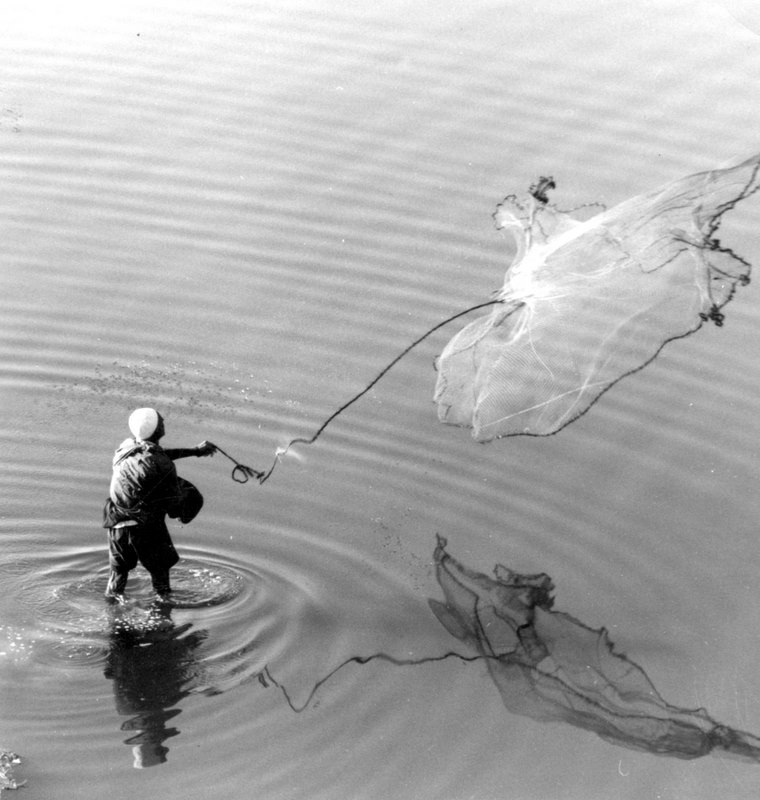
Casting the Net, by pioneering Iraqi photographer Murad al-Daghistani, 1930s

A casting net, also called a throw net, is a net used for fishing. It is a circular net with small weights distributed around its edge.

The net is cast or thrown by hand in such a manner that it spreads out while it's in the air before it sinks into the water. This technique is called net casting or net throwing. Fish are caught as the net is hauled back in.[1] This simple device is particularly effective for catching small bait or forage fish, and has been in use, with various modifications, for thousands of years.

Construction and technique

[edit]
The net as it falls into the water

Contemporary cast nets have a radius which ranges from 4 to 12 feet (1.2 to 3.6 metres). Standard nets for recreational fishing have a four-foot hoop. Weights are usually distributed around the edge at about one pound per foot (1.5 kilograms per metre). Attached to the net is a handline, one end of which is held in the hand as the net is thrown. When the net is full, a retrieval clamp, which works like a wringer on a mop, closes the net around the fish. The net is then retrieved by pulling on this handline. The net is lifted into a bucket and the clamp is released, dumping the caught fish into the bucket.[2]

Cast nets work best in water no deeper than their radius. Casting is best done in waters free of obstructions. Reeds cause tangles and branches can rip nets. The net caster may choose to stand with one hand holding the handline, and with the net draped over the other arm so that the weights dangle, or, with most of the net being held in one hand and only a part of the lead line held in the other hand so the weights dangle in a staggered fashion (approximately half of the weights in the throwing hand being held higher than the rest of the weights). The line is then thrown out to the water, using both hands, in a circular motion rather as in hammer throwing. The net can be cast from a boat, or from the shore, or by wading.[1]

There are also optional net throwers that can make casting easier. These look like a lid from a trash can, including the handle on top. The outside circumference has a deep gutter. The net is loaded along the gutter and the weights are placed inside the gutter. The net is then tossed into the water using the thrower.[citation needed]

Regulations and guidelines

[edit]

The use of a cast net may be restricted in some areas when stated by use of sign or authorities. Some government entities in states like Florida state that most shrimp and fish under 8 inches can be caught using, “Cast nets having a stretched mesh size not greater than 1 inch in fresh waters of the state unless specifically prohibited.[3]”. While in a state such as Illinois the law “Provides that all casting nets shall be legal, without size limits, for the capture of shad, minnow,[4]” and many other bait fish. Along with this, different states may also require a fishing license to cast net in waters. In some states, such as Texas, "it is legal only for non-game fish"[5] and there are also regulations in place to protect endangered species. If the guidelines outlined by the states and localities are disobeyed, fines and penalties can be brought against the individual who broke the rules. An example of this being that, "The use of cast net or throw net in any other Commonwealth waters is a violation of the Fish and Boat Code and is punishable by a fine and may result in the loss of fishing privileges"[5]

Biology

[edit]
4th century BC mosaic showing a retiarius or "net fighter" with a trident and cast net, fighting a secutor

Net-casting spiders (or retiarius spiders) are stick-like spiders that build webs suspended between their front legs. When prey approaches, the spider stretches its net till it is much larger, and then propels itself onto its prey, entangling it in the web.[6]

History

[edit]

In ancient Rome, in a parody of fishing, a type of gladiator called a retiarius or "net fighter" was armed with a trident and a cast net. The retiarius was traditionally pitted against a secutor.[7]

Between 177 and 180 the Greek author Oppian wrote the Halieutica, a didactic poem about fishing. He described various means of fishing including the use of nets cast from boats.

In Norse mythology the sea giantess Rán cast a fishing net to trap lost sailors.[8]

There is a reference in the New Testament to cast netting. Per John 21:6: "He said, “Throw your net on the right side of the boat and you will find some.” When they did, they were unable to haul the net in because of the large number of fish."[9]

See also

[edit]

Notes

[edit]

References

[edit]
[edit]
Revisions and contributorsEdit on WikipediaRead on Wikipedia
from Grokipedia
A cast net, also known as a throw net, is a circular fishing net consisting of a conical or disk-shaped webbing with a weighted perimeter line and a central retrieving rope, designed to be thrown by hand over schools of fish in shallow waters to trap them in a pocket upon sinking and retrieval. This method has been practiced for centuries by commercial and recreational fishermen worldwide, with archaeological evidence indicating its use in ancient Peruvian societies, such as at Cerro Azul (c. AD 1000–1470), where fishermen were buried with cast nets alongside other fishing gear. Introduced to the New World by European settlers in the 16th century, cast nets gained particular prominence in the southeastern United States for targeting species like mullet, though their application spans diverse environments from freshwater rivers to coastal shallows. Modern versions are typically constructed from synthetic materials such as nylon or monofilament, with sizes ranging from 4 to 14 feet in radius, and require skill in throwing to achieve an even spread that maximizes the catch. Regulations often limit their use to non-game species and specify mesh sizes to promote sustainable fishing practices.

Design and Construction

Materials and Components

Cast nets are primarily constructed from synthetic mesh materials designed for durability, flexibility, and resistance to environmental degradation. The net body consists of monofilament nylon or polyethylene netting, which provides a lightweight yet strong structure capable of withstanding repeated use in both freshwater and saltwater environments. These materials replaced earlier natural fibers like cotton or linen starting in the mid-20th century, offering improved UV resistance and reduced weight for easier handling. When selecting the type of nylon for cast nets, monofilament nylon offers several advantages including fast sinking, low visibility to fish, high durability, and reduced tangling, although it is initially stiffer and bulkier to store; it is ideal for most applications, especially in clear water for maximum yield. Multifilament nylon, on the other hand, is softer, easier to throw and open, and better suited for beginners or larger nets, but it sinks slower, is more visible, offers more water resistance, and tends to tangle more if mishandled; it is particularly suitable for murky water where visibility is less critical. Key structural components include the central handline, typically a sturdy rope or attached pole that allows the user to control and retrieve the net from the center point. Radial lines, often referred to as brail or gore lines, extend from the handline to the perimeter weights, enabling the net to collapse and form a pocket upon retrieval. A retrieval horn or funnel, usually made of rigid plastic or metal, is integrated at the apex to facilitate the bunching of the netting, while the perimeter features a lead line—composed of small lead weights distributed evenly along the edge—to ensure rapid sinking and a wide spread upon deployment. In some designs, steel weights are used as an alternative to lead for environmental or regulatory reasons. The construction process begins with machine-weaving or hand-tying the mesh into a circular or slightly conical shape, often divided into gores or skirts for uniform expansion. Weights are then attached at equal intervals along the lead line, typically every few meshes, using secure knots or clips to maintain balance. The apex is reinforced with additional twine or fabric to secure the handline and horn, enhancing overall durability against abrasion and tension during use. Mesh sizes generally range from 1/4 inch to 1 inch (0.6–2.5 cm) in stretched measure, selected to target small fish or bait species while allowing debris to pass through.

Sizes, Weights, and Variations

Cast nets are manufactured in standard sizes measured by radius, typically ranging from 4 to 14 feet (1.2 to 4.3 meters), which determines the net's coverage area when fully opened—spanning roughly 50 to 600 square feet. Recreational anglers often select smaller nets with 4- to 6-foot radii for ease of throwing and transport, while commercial operations favor larger 8- to 14-foot radius models to maximize catch volume in open waters. Weight specifications for cast nets center on the lead line encircling the perimeter, with approximately 1 pound (0.45 kg) of lead per linear foot of radius to achieve balanced sinking rates without excessive strain during retrieval. These weights, often in rounded or pencil-shaped forms, are evenly spaced at intervals of 3 to 6 inches (7.6 to 15 cm) to promote uniform deployment and rapid submersion in currents. Heavier configurations, such as 1.25 pounds per foot, enhance performance in deeper or windier conditions. Specialized variations adapt cast nets to specific fishing scenarios, including bait nets that feature smaller radii (3 to 5 feet) and finer mesh (3/16- to 3/8-inch square) for targeting minnows, shrimp, or other small baitfish in shallow areas. Forage nets, by contrast, employ larger radii (8 to 10 feet) with coarser mesh (1- to 1.25-inch square) to capture shrimp, crabs, or mullet in broader sweeps. Construction differences include braided nylon handlines for tangle resistance in rough waters versus knotted monofilament meshes for abrasion durability in rocky environments. Cast nets generally sink to depths of up to 20 feet (6 meters), supported by handlines of 30 to 50 feet to allow full submersion before retrieval. Modern innovations include illuminated weights or luminous beads integrated into the net for improved visibility during night fishing, aiding in precise throws under low-light conditions. Additionally, biodegradable options using starch-based or PLA materials have emerged, offering environmental benefits by decomposing if lost and reducing long-term marine pollution.

Usage Techniques

Throwing Methods

Throwing a cast net involves a coordinated motion to deploy the net in a flat, circular "pancake" shape that maximizes coverage and capture efficiency. The basic mechanics rely on a circular arm swing combined with a wrist snap and full extension to unfurl the net evenly across 360 degrees, allowing the lead weights to pull the perimeter outward and downward. This technique ensures the net sinks rapidly to trap fish in shallow waters, with the handline controlling the release and retrieval. The step-by-step process begins with preparing the net by checking for tangles and coiling it neatly around the horn at the center. Secure the handline loop around the wrist of the dominant hand, then coil the line into loose loops of about 12 inches to prevent snags during the throw. Next, load the net by gripping the horn with the throwing hand while using the other hand to gather the lead line, folding it over the arm or holding sections to distribute weight evenly—often dividing the net into thirds for balance. Position the body sideways to the target, feet shoulder-width apart for stability, and initiate the throw from waist height using an underhand or overhand motion: swing the loaded arm in a smooth arc, snapping the wrist at the apex to release the net upward at a 30- to 45-degree angle, timing the handline release so the net lands flat over the target area. Optimal conditions for throwing include calm, shallow waters 1 to 10 feet deep, where the net can settle quickly without excessive drift; in areas with wind or current, anglers adjust by facing into the elements and using a slightly more forceful swing to counteract displacement. For beginners, starting with smaller nets (3- to 5-foot radius) in controlled environments like a backyard or park builds proficiency before transitioning to water. Common errors, such as an uneven spread from improper loading or mistimed release, can reduce capture rates by causing the net to bunch or skim the surface rather than envelop the target. For larger nets, such as 9-foot models, additional common causes of incomplete opening include inadequate momentum or rotation due to increased weight, which necessitates stronger body rotation and speed; uneven net loading causing one side to fold or fail to extend; and insufficient adaptation of technique, such as using the basic half-load method unsuitable for larger nets' extra material and lead weights. Practice drills, like repeated dry throws marking the spread with cones or tape, help identify issues like side biases in opening and improve consistency with regular practice.

Retrieval and Handling

Once the cast net has sunk and trapped fish beneath it, retrieval begins with a steady pull on the handline attached to the center of the net. This action causes the lead weights around the perimeter to collapse inward, drawing the net's edges together and forming a pouch that secures the catch. In shallower waters, the angler can haul the net directly by hand, but in deeper areas, a pole provides leverage to lift the net without excessive strain, or a boat may be used to position the user closer to the catch for easier access. Upon surfacing, the net is carefully brought aboard or to shore, where the catch is handled to separate desirable fish from undersized individuals and debris. This typically involves gently shaking the net or dipping it into the water to release smaller fish through the mesh, allowing them to swim free while retaining larger specimens. In commercial operations, additional care is taken to minimize injury, such as avoiding overcrowding during transfer to holding containers and using smooth, quick motions to reduce stress on the fish. After use, proper maintenance ensures the net's longevity and performance. The net should be rinsed thoroughly with fresh water to remove salt, sand, and organic debris, then hung in a shaded area to dry completely, preventing mildew growth. Inspection follows for any tears in the monofilament mesh or loss of lead weights, with repairs made promptly using compatible materials to maintain structural integrity. Larger nets demand greater pull effort during retrieval due to increased weight and drag.

Historical Development

Ancient Origins

The earliest archaeological evidence for cast nets emerges from ancient Egypt during the Middle Kingdom's 12th Dynasty (ca. 1991–1802 BCE), where iconographic depictions in tombs and lead net weights indicate their use as a fishing tool. These nets were constructed from plant fibers such as flax, with stones or early lead pieces serving as weights to facilitate sinking and retrieval. Possible precursors trace back to the Epipalaeolithic period (ca. 10,000–5000 BCE), though direct evidence for cast nets specifically remains elusive before the Middle Kingdom. In Mesopotamia, contemporary records and finds suggest similar net-based fishing with plant-fiber construction and stone weights, reflecting shared regional practices in riverine environments. In the Americas, archaeological evidence from ancient Peruvian societies, such as the Moche culture (circa AD 100–800), includes individuals buried with cast nets alongside other fishing gear, indicating their use in coastal fisheries. By the classical era, cast nets appeared in diverse cultural contexts across the Mediterranean. In Rome, from the mid-1st century CE to the 3rd century CE, retiarius gladiators employed weighted combat nets (rete) paired with tridents, mimicking fishermen to ensnare opponents in the arena—a spectacle that popularized the tool's tactical design. The Greek poet Oppian detailed cast nets among various fishing implements in his didactic poem Halieutica (ca. 177–180 CE), describing their deployment from boats or shores to capture fish in shallow waters. These references underscore the net's versatility in both practical and performative roles. The practice spread through Mediterranean and other trade routes, with archaeological evidence from Egyptian origins to Greek, Roman, and beyond, though some sources suggest earlier development in India. Mythological traditions further embedded cast nets in ancient narratives. In 1st-century CE Biblical accounts, John 21:6 recounts disciples instructed to cast their net on the right side of the boat, yielding a miraculous haul that highlights the technique's communal and symbolic importance in early Christian texts. Norse lore, predating 1000 CE, portrays the sea goddess Rán wielding a vast net to ensnare drowned sailors, drawing them to her underwater hall—a motif reflecting the perils of maritime life. Early cast nets were typically limited to a radius of 3–5 feet (1.1–1.6 meters) due to the fragility of organic fibers and weight distribution challenges, constraining their scale until later innovations.

Evolution and Cultural Significance

Following the ancient origins of cast nets, their evolution during the medieval period in Europe involved refinements in materials and design, with fishermen adopting stronger natural fibers like cotton and linen for the netting to enhance durability in varied waters. Iron weights were increasingly incorporated as sinkers along the perimeter to improve sinking speed and capture efficiency, particularly in coastal and riverine environments across regions from the Mediterranean to the North Sea between 500 and 1500 CE. The technique spread to the Americas through European colonization in the 16th century, as documented in Spanish colonial inventories from Florida between 1565 and 1569, which list casting nets among fishing equipment used by settlers and adapted for local freshwater and estuarine habitats. In the modern era, post-World War II advancements in the 1940s and 1950s introduced synthetic meshes, such as nylon and polyethylene, which replaced natural fibers and allowed for larger, lighter nets that resisted rot and maintained strength in harsh conditions. This shift facilitated 20th-century commercialization, particularly in Asia—suggested to have originated in India—and in Africa, supporting expanded subsistence and market-oriented operations in coastal communities. Beyond practical utility, cast nets hold deep cultural significance in various traditions, notably among Indigenous Australian communities where they were integral to fishing rituals; fishermen sang songs to the nets to imbue them with spiritual power, ensuring successful catches and honoring ancestral connections to water and resources. In Polynesian societies, such as among Māori in New Zealand, similar rites preceded net use, including purification rituals like urinating on the net to invoke protection and abundance from sea deities, embedding the tool in broader cosmologies of harmony with marine environments. Symbolically, cast nets appear in folklore and art as metaphors for entrapment and provision, as seen in tales where they represent divine intervention or communal sustenance, transcending fishing to embody themes of fate and community resilience. Today, cast nets remain widely adopted for subsistence fishing in over 50 countries across coastal and inland waters, sustaining millions in small-scale operations from Southeast Asia to sub-Saharan Africa.

Regional Laws and Restrictions

In the United States, regulations on cast nets vary by state, with specific limits on mesh size, net dimensions, and usage areas to manage fish populations and habitats. In Florida, cast nets used in freshwater must have a stretched mesh size not greater than 1 inch, while in saltwater, the total mesh area is limited to 500 square feet or less, corresponding to a maximum radius of approximately 12 feet. In Illinois, cast nets are permitted for taking baitfish with no overall size limit beyond a maximum diameter of 24 feet and a mesh size not larger than 1 inch bar measurement, but their use is prohibited in certain designated lakes and reservoirs, such as below spillways in specific conservation areas. Internationally, cast net restrictions reflect conservation priorities and cultural considerations. In , regulations differ by state; for example, cast nets are outright banned in waters for recreational use, and in Queensland's Aboriginal and Islander communities, a fisheries permit is required for netting activities, including cast nets up to 3.7 in with mesh sizes not exceeding 28 , to respect traditional practices while ensuring . Many jurisdictions impose outright prohibitions on cast nets in sensitive environments to safeguard . Cast nets are restricted or prohibited in waters in states like Georgia (illegal in ) and (permit required for specific waters), with similar year-round net restrictions in New York's inland . Violations of these rules carry significant penalties; in many U.S. states like Florida and Texas, fines for illegal cast net use or exceeding limits can reach up to $1,000 per offense, classified as misdemeanors with potential license suspension.

Licensing, Guidelines, and Enforcement

In the United States, a fishing license is required for using cast nets in nearly all states for individuals aged 16 and older, with specific endorsements often needed for net-based gear in states like Georgia and Florida to target certain species such as shrimp or nongame fish. Annual fees for basic recreational fishing licenses typically range from $10 to $50, depending on residency status and state, while commercial or specialized net endorsements can cost higher, such as $250 for a cast net shrimp license in Georgia. Guidelines for cast net fishing emphasize sustainable practices, as outlined by the National Oceanic and Atmospheric Administration (NOAA) through its National Standard Guidelines, which require fishery management plans to prevent overfishing and minimize bycatch while promoting ecosystem health. The Food and Agriculture Organization (FAO) provides complementary recommendations in its Technical Guidelines for Responsible Recreational Fisheries, advocating for seasonal closures to protect spawning stocks and habitat recovery, applicable to small-scale methods like cast netting. Safety protocols, particularly for boat-based casting, include requirements from NOAA for vessel stability, personal flotation devices, and avoidance of hazardous weather, integrated into broader recreational fishing best practices to reduce accidents. Enforcement of cast net regulations is primarily handled by state wildlife officers, who conduct patrols, inspections, and issue citations or seize illegal gear for violations such as unlicensed use or exceeding size limits, as authorized under federal frameworks like the Magnuson-Stevens Act. The United Nations Convention on the Law of the Sea (UNCLOS) influences coastal enforcement by granting coastal states sovereign rights to regulate fishing within their exclusive economic zones, enabling measures like vessel boardings and penalties to ensure compliance with conservation laws. In Texas, updates to regulations effective in 2024 and ongoing as of 2025 incorporate digital tools for through the Texas Hunt & app, though specific catch reporting remains geared toward rather than routine cast net use for nongame . Regulations evolve, and anglers should consult state sources for the latest . In the Pacific Islands, community-led guidelines for cultural fisheries, as detailed in the Secretariat of the Pacific Community's framework, promote traditional cast net practices through locally managed marine areas, emphasizing consensus-based rules for and integration with customary laws.

Ecological and Biological Considerations

Targeted Species and Habitats

Cast nets are primarily employed to target small schooling baitfish species, such as mullet (Mugil cephalus), shad (Dorosoma spp.), and anchovies (Engraulis spp.), which typically measure 2–6 inches (5–15 cm) in length. These species belong to families such as Mugilidae, Clupeidae, and Engraulidae, while cast nets are also used for freshwater minnows from families like Cyprinidae. These fish exhibit biological traits that enhance their vulnerability to cast nets, including tight schooling behavior in response to predators. Invertebrates like shrimp (Penaeus spp.) and crabs (e.g., blue crabs, Callinectes sapidus) are also common targets, particularly in areas where they aggregate near the bottom, with net mesh sizes of 3/8 to 1/2 inch (9–13 mm) selected to match their body dimensions and prevent escape. The effectiveness of cast nets relies on habitats that facilitate schooling and accessibility, including freshwater ponds, coastal bays, and estuaries with soft, muddy bottoms that allow for easy retrieval. These environments often feature shallow depths of 1–15 feet (0.3–4.6 m) and vegetated areas like marshes or seagrass beds, where target species seek cover and forage. For instance, in estuarine settings, the net's design aligns with the biology of species like pinfish (Lagodon rhomboides) and menhaden (Brevoortia spp.), which form dense schools in these low-visibility, sheltered waters. Capture efficiency for cast nets in dense schools ranges from 10% to 28%, with higher rates achieved during seasonal spawning aggregations, such as the fall mullet runs along coastal migrations from the Carolinas to Florida. These events concentrate finger mullet (juveniles under 6 inches) in predictable inshore paths, making them ideal for targeted throws, though efficiency varies with school density and water clarity.

Environmental Impacts and Sustainability

Cast net fishing, as a small-scale artisanal method, generally exerts a low ecological footprint compared to industrial techniques like bottom trawling, primarily due to its targeted, hand-operated nature in shallow waters. Bycatch in cast net operations is typically minimal, often consisting of non-target juveniles or undersized fish that can be returned alive to the water, thereby reducing mortality rates. For instance, in shrimp cast net fisheries, bycatch concerns are rated low, with incidental captures rarely threatening population sustainability. Habitat disruption is also limited, as the nets are deployed briefly without dragging along the seabed, avoiding significant sediment resuspension or turbidity increases that plague more invasive gears. Sustainability efforts in cast net fishing emphasize gear modifications and best practices to further mitigate impacts. Selective mesh sizes, typically ranging from 1/2 to 1 inch, help minimize entanglement of larger non-target species like sea turtles by allowing quicker passage or escape during retrieval. Catch-and-release protocols are widely promoted, particularly for bait fishing, where juvenile fish such as finger mullet are often captured incidentally and released unharmed to support stock replenishment. Long-term environmental effects of cast net fishing remain modest on a global scale, representing a minor portion of small-scale fisheries catch, which accounts for about 40% of global marine production but with far lower discard rates than industrial methods. In overfished regions like the Gulf of Mexico, cumulative pressures from multiple gears can strain stocks, yet case studies from post-1995 Florida net bans demonstrate recovery in species like red drum, where allowing selective cast nets alongside restrictions on entangling gears facilitated biomass rebound without exacerbating depletion. As of 2025, 30 years after the ban, coastal fish stocks in Florida have shown sustained improvement. The 2024 FAO State of World Fisheries and Aquaculture report underscores that such artisanal practices, when regulated, support sustainable yields and minimal ecosystem alteration, with global aquatic food production reaching a record 223.2 million tonnes in 2022.

References

Add your contribution
Related Hubs
User Avatar
No comments yet.