


Community hub
Recent from talks
Contribute something
Nothing was collected or created yet.
Catalonia Offensive
View on Wikipedia| Catalonia Offensive | |||||||
|---|---|---|---|---|---|---|---|
| Part of the Spanish Civil War | |||||||
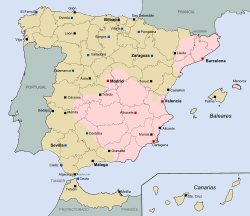
 Map of Spain in November 1938, right after the end of the Battle of the Ebro and immediately before the start of the Catalonia Offensive. Territory still controlled by the Republic is depicted in pink | |||||||
| |||||||
| Belligerents | |||||||
| Commanders and leaders | |||||||
| Strength | |||||||
|
Thomas: 300,000[1] Beevor: 220,000[2] Jackson: 90,000[3] Thomas: 360 artillery pieces[4] Beevor: 250 artillery pieces[2] Thomas: 200 tanks and armoured cars[4] Beevor: 40 tanks and armoured cars[2] Thomas: 80 aircraft[4] Beevor: 106 aircraft[5] |
Jackson: 350,000[3] Beevor: 340,000[6] Thomas: 300,000[1] Beevor: 1,400 artillery pieces[6] Thomas: 565 artillery pieces[1] 300 tanks[6] 500 aircraft[7] | ||||||
| Casualties and losses | |||||||
|
Unknown dead 10,000 wounded 60,000 captured[8] 220,000 disarmed in France[9] | Unknown | ||||||


The Catalonia Offensive (Catalan: Ofensiva de Catalunya, Spanish: Ofensiva de Cataluña) was part of the Spanish Civil War. The Nationalist Army started the offensive on 23 December 1938 and rapidly conquered Republican-held Catalonia with Barcelona (the Republic's capital city from October 1937).[10] Barcelona was captured on 26 January 1939. The Republican government headed for the French border. Thousands of people fleeing the Nationalists also crossed the frontier in the following month, to be placed in internment camps. Franco closed the border with France by 10 February 1939.
Background
[edit]After its defeat at the Battle of the Ebro the Republican Army was broken and would never recover. The Republicans had lost most of their armament and experienced units.[11] Furthermore, in October 1938 the Republican government agreed to withdraw the volunteers of the International Brigades.[12] On the other hand, the Nationalists received new supplies of ammunition, weapons and aircraft from Germany.[13] Furthermore, after the Munich Agreement, the hope of an intervention of the Western democracies in order to aid the Republic against Germany and Italy vanished.[11] France had closed the frontier again in mid-June 1938 and frozen Republican financial assets in French banks.[14]
Opposing forces
[edit]Nationalists
[edit]At the beginning of December, the nationalist faction concentrated an Army Group, the Army of the North, of 300,000[1]–340,000[6] men led by the general Fidel Dávila in order to conquer Catalonia. The Nationalists assembled their best divisions all along the front from the Pyrenees to the Mediterranean. Along the Segre the Nationalists deployed Muñoz Grandes's Army of Urgel, Garcia Valiño's Army of Maestrazgo and Moscardo's Aragon Army; in the confluence of the Segre with the Ebro Gambara's Italian Cuerpo Legionario Italiano of four divisions (55,000 men) and Solchaga's Army Corps of Navarra; and in the Ebro the Yagüe's Moroccan Corps.[1] The Nationalists also had, according to Beevor, 300 tanks, more than 500 aircraft (among them the Bf 109E and Heinkel 112 fighters) and 1,400 cannon.[15]
Republicans
[edit]Opposing the Nationalists, the Republicans had Colonel Perea Capulino's Eastern Army and Colonel Juan Modesto's Ebro Army, united under the command of General Juan Hernandez Saravia, commander of the Eastern Region Army Group, with 220,000[2]–300,000[1] men, many unarmed (Hernandez Saravia said that the Republican army had only 17,000 rifles for all Catalonia),[16] 106 airplanes[5] (most of them Chatos), 250 cannons and 40 tanks (many of them unserviceable due to shortage of spare parts).[2]
The Soviet government agreed to send to Catalonia a shipment of 250 aircraft, 250 tanks and 650 cannons,[1] but the shipment did not reach Bordeaux until 15 January and only a small part of it crossed the border.[17] Furthermore, because of the international isolation of the Republic and the lack of food (according to Beevor, in Barcelona the ration per day was down to 100 grams of lentils)[5] the morale of the government troops and civil population in the Republican zone was very low. The people only wished the end of the war: "...just let it be over, it doesn't matter how it ends, but let it end now."[18]
Battle
[edit]Nationalist offensive
[edit]The Nationalist offensive was planned for 10 December but was postponed to 23 December.[1] On 23 December the Italians and the Navarreses crossed the Segre at Mequinenza, broke the Republican lines, and advanced sixteen kilometres, but they were stopped by the V and XV Republican corps led by Lister on 25 December. On the left flank, Muñoz Grandes and Garcia Valiño advanced towards Cervera and Artesa, but they were blocked by the 26th Republican Division. On the south, Yagüe's troops were held back by the Ebro's floodwater. The Republicans had stopped the first Nationalist attack; nevertheless, they had lost 40 aircraft in the first ten days of the battle.[19]
On 3 January Solchaga attacked Les Borges Blanques, Muñoz Grandes and Garcia Valiño occupied Artesa, and Yagüe crossed the Ebro. Moscardo attacked from Lleida and the Italians occupied Les Borges Blanques on 5 January. The same day, the Republican army started a surprise attack in Extremadura towards Peñarroya in order to divert Nationalist forces, but the offensive was halted after a few days and the Nationalist offensive in Catalonia continued.[20] On 9 January the Moscardo's Aragon Army Corps joined Gambara at Mollerusa and broke the northern part of the front. The V and XV Republican Corps collapsed and retreated in disorder. On 15 January the Aragon and Maestrazgo Corps conquered Cervera and the Moroccan Corps after a one-day march of 50 km occupied Tarragona. By this day, the Nationalists had conquered a third of Catalonia, had taken 23,000 prisoners, and had killed 5,000 Republican soldiers.[21]
Fall of Barcelona
[edit]The Republican government then attempted to organize a defense of Barcelona, ordering the general mobilization of all men to forty-five and militarized all the industry. Nevertheless, the successive defensive lines (L1, L2, L3) fell,[22] the Republican forces were outnumbered six to one and the Nationalist air force bombed Barcelona every day (40 times between 21 and 25 January).[23] It became clear that the defense of the city was impossible.[24] On 22 January Solchaga and Yagüe reached the Llobregat only a few miles west of Barcelona, Muñoz Grandes and Garcia Valiño attacked Sabadell and Terrassa, and Gambara advanced to Badalona. The chief of staff of the Republican Army, Rojo told the Republican prime minister Negrín that the front had ceased to exist so the government abandoned Barcelona after releasing most of its prisoners.[25] A large part of the Barcelona population fled from the city as well. On 24 January Garcia Valiño occupied Manresa,[4] and on 25 January the Nationalist vanguard occupied the Tibidabo in the outskirts of Barcelona. The Nationalists finally occupied Barcelona on 26 January[26] and there were five days of looting by the Yagüe's Regulares[27] and extrajudicial killings (paseos).[28]
Retreat
[edit]After the occupation of Barcelona, the Nationalist troops, tired from the long marches, slowed their advance but soon resumed their offensive, pursuing the retreating columns of Republican soldiers and civilians.[25] On 1 February Negrín proposed, in the last meeting of the Cortes in the Figueres Castle, capitulation with the sole condition of respecting the lives of the vanquished and the holding of a plebiscite so the Spanish people could decide the form of government, but Franco did not accept.[29] On 2 February the Nationalists entered Girona, arrived within 50 kilometers of the frontier on 3 February, occupied Figueres on 8 February and Rojo ordered the Republican troops to withdraw to the French frontier.[8] Hundreds of thousands of Republican soldiers, women, children and old men marched to the French frontier on foot and on carts, buses and trucks[26] through bitterly cold sleet and snow. Their retreat was covered by units of the Republican Army, which carried out hit and run attacks and ambushes.[30] The Nationalist air force and the Condor Legion bombed and strafed the roads leading to France.[31] On 28 January the French government announced that civilians could cross the frontier and, on 5 February, the Republican soldiers as well.[32] Between 400,000[33] and 500,000,[8] Republican refugees crossed the frontier, among them the president of the Republic (Manuel Azaña), the prime minister (Juan Negrín) and the chief of staff of the Republican Army (Vicente Rojo), as well the president of Catalonia (Lluís Companys) and the members of the Catalan government. Negrín returned to Spain on 9 February but Azaña and Rojo refused to return.[31] By 9 February the Nationalists reached the frontier, and on the following day the last units of Modesto's Army of the Ebro crossed into France and the Nationalists sealed the frontier.[1]
Aftermath
[edit]Military and political consequences
[edit]
With the fall of Catalonia, the Republic lost the second largest city of the country, the Catalan war industry and a large part of its army (more than 200,000 soldiers).[32] On 2 February Azaña resigned and on 27 February France and the United Kingdom formally recognized the Francoist government.[34] Further military resistance became impossible and the war was lost for the Republic, despite the fact that 30% of Spain was still under Republican control after the offensive and Prime Minister Juan Negrín insisted that the Republic could continue to resist.[35]
The Catalonia autonomy was abolished. The Catalan language, the Sardana and Catalan Christian names were forbidden. All Catalan newspapers were requisitioned and the forbidden books retired and burned.[36] Even the inscriptions on tombs in the Montjuïc Cemetery commemorating Durruti, Ascaso and Ferrer i Guardia were removed.[37]
Fate of the Republican refugees
[edit]The Republican exiles were interned in fifteen improvised camps (mostly barbed-wire enclosures on the sand, without basic shelter, sanitary or cooking facilities)[38] by the French government in places such as Argelès, Gurs, Rivesaltes and Vernet.[39] The living conditions in the camps were very harsh: in the first six months, 14,672 refugees died from malnutrition or dysentery.[38] The French government encouraged the refugees to return and, by the end of 1939, between 70,000[40] and 180,000 refugees returned to Spain. However, 300,000 never returned.[41] Many sought asylum in other countries: the Soviet Union (between 3,000[41] and 5,000),[42] USA and Canada (about 1,000), Great Britain, Belgium and other European countries (between 3,000[43] and 5,000)[41] and Latin America (30,000 to Mexico, 10,000 to Argentina, 5,000 to Venezuela, 5,000 to Dominican Republic, 3,500 to Chile, etc.).[43][44] Nevertheless, at least 140,000 refugees remained in France while 19,000 went to the French colonies of North Africa.[43] After the fall of France 10,000[45]–15,000[46] refugees were detained by the Nazis and deported to concentration camps. Another 10,000 joined the French Resistance[47] and more than 2,000 joined the Free French Forces.[42]
See also
[edit]Notes
[edit]- ^ a b c d e f g h i Thomas 2001, p. 844.
- ^ a b c d e Beevor 2006, p. 373.
- ^ a b Jackson 1967, p. 463.
- ^ a b c d Thomas 2001, p. 845.
- ^ a b c Beevor 2006, p. 368.
- ^ a b c d Beevor 2006, p. 372.
- ^ Beevor 2006, p. 372; Thomas 2001, p. 844.
- ^ a b c Beevor 2006, p. 382.
- ^ Thomas 2001, p. 877.
- ^ Graham 2005, p. 102.
- ^ a b Preston 2006, p. 292.
- ^ Preston 2006, pp. 292–293.
- ^ Preston 2006, p. 294.
- ^ Graham 2005, p. 99.
- ^ Beevor 2006, pp. 372–373.
- ^ Thomas 2001, p. 847.
- ^ Beevor 2006, p. 488.
- ^ Graham 2005, p. 111.
- ^ Beevor 2006, p. 374.
- ^ Beevor 2006, pp. 375–376.
- ^ Beevor 2006, pp. 374–376.
- ^ Thomas 2001, p. 848.
- ^ Beevor 2006, pp. 376, 484.
- ^ Beevor 2006, p. 376.
- ^ a b Beevor 2006, p. 377.
- ^ a b Preston 2002, p. 374.
- ^ Beevor 2006, p. 378.
- ^ Thomas 2001, p. 850.
- ^ Beevor 2006, pp. 380–381.
- ^ Beevor 2006, p. 379.
- ^ a b Preston 2006, p. 295.
- ^ a b Thomas 2001, p. 854.
- ^ Thomas 2001, p. 860.
- ^ Graham 2005, p. 165.
- ^ Preston 2006, p. 296.
- ^ Beevor 2006, pp. 378–379.
- ^ Beevor 2006, pp. 850–851.
- ^ a b Preston 2002, p. 180.
- ^ Beevor 2006, pp. 411–412.
- ^ Graham 2005, p. 117.
- ^ a b c Beevor 2006, p. 412.
- ^ a b Graham 2005, p. 120.
- ^ a b c "Mapa del exilio republicano". Archived from the original on 8 May 2012. Retrieved 25 November 2011.
- ^ Graham 2005, p. 115.
- ^ Graham 2005, p. 126.
- ^ Preston 2006, p. 315.
- ^ Graham 2005, p. 125.
Sources
[edit]- Beevor, Antony (2006) [1982]. The Battle for Spain: The Spanish Civil War 1936–1939. London: Weidenfeld & Nicolson. ISBN 0-297-84832-1.
- Graham, Helen (2005). The Spanish Civil War: A very short introduction. New York, NY: Oxford University Press. doi:10.1093/actrade/9780192803771.001.0001. ISBN 978-0-19-280377-1.
- Jackson, Gabriel (1967). The Spanish Republic and the Civil War, 1931–1939. Princeton: Princeton University Press. ISBN 0-691-00757-8. OCLC 185862219.
- Preston, Paul (2002). Doves of War: Four Women of Spain. London: HarperCollins. ISBN 978-0-00-638694-0.
- Preston, Paul (2006). The Spanish Civil War: Reaction, Revolution, and Revenge. New York: WW Norton & Co. ISBN 0-393-32987-9.
- Thomas, Hugh (2001). The Spanish Civil War. Modern Library. ISBN 0-375-75515-2.
Catalonia Offensive
View on GrokipediaHistorical Prelude
Strategic Imperatives for the Nationalists
The Nationalists, led by General Francisco Franco, prioritized the Catalonia Offensive as a means to exploit the Republican exhaustion following the Battle of the Ebro (July 25–November 18, 1938), where Republican forces suffered approximately 70,000 casualties and lost much of their offensive capability, leaving Catalonia as the primary remaining bastion with around 250,000 troops. The core imperative was to annihilate or disperse these forces before they could reorganize, thereby isolating the central Republican zone around Madrid and Valencia, which controlled fewer resources and was vulnerable to encirclement without northeastern support. This aligned with Franco's broader doctrine of sequential destruction of Republican armies in the field, avoiding prolonged stalemates and leveraging Nationalist superiority in aviation (over 500 aircraft, including German Condor Legion units) and artillery (around 1,000 pieces) for breakthroughs.[7] Catalonia's strategic value stemmed from its role as the Republican industrial heartland, producing munitions, textiles, and machinery essential for sustaining the war effort, alongside ports like Barcelona that facilitated limited cross-border supplies from France despite the 1936 Non-Intervention Agreement. Capturing the region would sever these lifelines, secure the Pyrenees frontier to preclude French military aid or intervention—particularly amid France's internal political instability under Édouard Daladier—and deny Republicans access to recruitment pools in the populous northeast. Franco delayed an earlier push after the April 1938 Aragon offensive, which had already severed Catalonia from the central zone by reaching the Mediterranean at Vinaròs, to consolidate gains and assess international reactions; by late 1938, the Munich Agreement (September 29–30, 1938) signaled Allied appeasement of Axis powers, emboldening Franco to act decisively before potential escalations tied to European tensions. The offensive's design emphasized rapid maneuver along the Segre River front, committing some 300,000 troops under generals like Juan Yagüe and Camilo Alonso Vega, to shatter Republican defenses at key points like Borredà and Lleida, forcing a collapse rather than a negotiated pause. This approach reflected causal priorities: Nationalist unity under Franco contrasted with Republican factionalism, enabling efficient resource allocation from German and Italian allies (providing 50,000 troops and extensive materiel), while aiming to induce mass desertions and demoralization upon Barcelona's fall, projected as the psychological linchpin for overall Republican capitulation.[7] Such imperatives underscored a realist assessment that total control of Catalonia would compel surrender in the remaining 200,000-square-kilometer central pocket, ending hostilities by early 1939 without risking overextension.Republican Disarray and Internal Divisions
The Republican government, led by socialist Prime Minister Juan Negrín since May 1937, struggled with deep ideological fractures among its coalition partners, including the communist Partido Comunista de España (PCE), anarcho-syndicalist Confederación Nacional del Trabajo (CNT), Marxist Workers' Party of Marxist Unification (POUM), and rival socialist factions within the Partido Socialista Obrero Español (PSOE).[8] These divisions, rooted in competing visions for post-war Spain—ranging from centralized Soviet-style control favored by the PCE to decentralized worker self-management advocated by the CNT—had escalated during the May Days clashes in Barcelona on May 3–8, 1937, where communist-led assaults on CNT-POUM positions resulted in over 500 deaths, the outlawing of the POUM, and the marginalization of anarchist militias.[8] In Catalonia, the communist-aligned Partit Socialista Unificat de Catalunya (PSUC) consolidated power within the regional Generalitat, eroding local autonomy and fostering resentment among non-communist groups, which undermined coordinated resistance as the Nationalist threat intensified.[9] Military disarray compounded these political rifts, particularly after the Republican defeat in the Battle of the Ebro (July 25–November 18, 1938), which inflicted approximately 70,000 casualties and exhausted reserves of men and materiel.[10] By late November 1938, Republican forces in Catalonia numbered around 250,000–300,000 troops but suffered from plummeting morale, widespread desertions (estimated at tens of thousands across the front), and supply shortages exacerbated by severed sea routes following Nationalist advances.[8] Negrín's insistence on continued resistance, backed by PCE influence in the Ejército Popular de la República, clashed with dissenting voices like former defense minister Indalecio Prieto, who criticized communist dominance in command structures and advocated negotiations to avert total collapse.[11] This internal antagonism led to purges of non-communist officers and unreliable units, further eroding trust and operational effectiveness, as communist commissars prioritized political loyalty over tactical competence.[8] The absence of unified leadership was evident in Catalonia's fragmented defenses, where the Eastern Regional Army under General Felipe Pretel lacked cohesion due to mixed loyalties and inadequate fortifications along the Segre River line.[8] Anarchist and POUM remnants, though suppressed, contributed to passive resistance and sabotage rumors, while Negrín's reliance on Soviet aid—limited after Munich Agreement concessions to Hitler in September 1938—failed to offset the PCE's overextension in controlling key industries and militias.[12] These fissures, persisting into December 1938, rendered the Republicans vulnerable to the impending Nationalist offensive, as ideological purges and morale collapse prioritized factional survival over strategic defense.[8]Opposing Forces
Nationalist Composition and Advantages
The Nationalist ground forces for the Catalonia Offensive were primarily drawn from the Army of the North, commanded by General Fidel Dávila Arrondo, which included elite units such as the Moroccan Army Corps with its Regulares infantry and Foreign Legion battalions, alongside regular Spanish divisions like the 13th "Black Hand" Division. These forces incorporated battle-hardened veterans from earlier campaigns, including Carlist Requetés from the Navarrese Corps and Falangist elements integrated into the professionalized army structure, totaling an estimated 250,000 to 300,000 combat troops supported by extensive artillery and mechanized elements.[13][7] Foreign contingents bolstered the Nationalist effort, with the Italian Corpo Truppe Volontarie (CTV) contributing divisions such as the Assault Division "Littorio," comprising motorized Bersaglieri and infantry regiments equipped with Fiat tanks and artillery, as part of the roughly 78,500 Italian volunteers deployed overall in Spain. German involvement focused on air support through the Condor Legion, which provided tactical bombing, reconnaissance, and fighter cover with units like Junkers Ju 87 Stukas and Messerschmitt Bf 109s, drawing from approximately 18,000 personnel experienced in combined arms operations.[13][7] The Nationalists held decisive advantages in air superiority, with over 800 aircraft enabling relentless close air support and interdiction that demoralized Republican defenses and disrupted retreats, contrasting sharply with the Republicans' dwindling fleet of around 200 planes. Unified command under General Francisco Franco ensured coherent strategy and logistics, sustained by Axis supplies of modern weaponry, while higher troop morale—bolstered by recent victories like the Battle of the Ebro—and professional training in elite units such as the Regulares provided superior combat effectiveness against a fractious Republican opponent plagued by desertions and shortages.[7][13]Republican Forces and Weaknesses
The Republican forces arrayed against the Nationalist advance in Catalonia were primarily organized under the Grup d'Exèrcits de la Regió Oriental (GERO), encompassing the Army of the Ebro (Ejército del Ebro) under Lieutenant Colonel Juan Modesto, which fielded 11 divisions, and the Eastern Army under Juan Perea, with 9 divisions, for a total of roughly 20 divisions.[14] Overall strength numbered approximately 250,000 troops, many of whom were remnants of units battered during the preceding Battle of the Ebro (July-November 1938), supplemented by conscripts and rearguard formations.[7] These forces included a mix of regular army brigades, Catalan regional units, and scattered International Brigade veterans, though the latter had been largely dissolved by late 1938 under Republican government orders to appease international opinion.[15] Equipment shortages critically undermined combat effectiveness, with estimates of 250-360 artillery pieces and fewer than 200 tanks available, much of it Soviet-supplied materiel lost or worn from the Ebro campaign.[14] The Republican air force, reliant on aging Soviet aircraft and limited French imports, mustered only about 90 fighters and lacked the bombers or anti-aircraft defenses to contest Nationalist aerial dominance, bolstered by German Legion Condor and Italian Aviazione Legionaria squadrons.[16] Ammunition and fuel reserves were perilously low due to the ongoing Nationalist naval blockade, severed supply lines from the central front, and the tapering of Soviet aid amid Republican diplomatic isolation under the Non-Intervention Agreement.[17] Key weaknesses stemmed from the psychological and organizational fallout of the Ebro defeat, which inflicted over 70,000 casualties and destroyed much of the army's offensive capacity, leaving units understrength, demoralized, and prone to defeatism.[15] Morale plummeted amid widespread desertions—estimated at tens of thousands in the months prior—and collapsing discipline, exacerbated by food shortages, harsh winter conditions, and awareness of the Republic's eroding political cohesion in Barcelona.[17] Leadership suffered from politicization, with communist influence in the officer corps fostering purges and rivalries that prioritized ideological loyalty over tactical competence, while coordination between Modesto's Ebro Army and adjacent formations faltered due to fragmented command structures inherited from earlier militia-based defenses.[18] Logistical disarray further compounded vulnerabilities, as Catalonia's industrial base, while providing some small arms production, could not sustain prolonged attrition without external imports, and internal sabotage by fifth columnists eroded rear-area security. These factors—depletion of veteran manpower, matériel deficits, eroded unit cohesion, and pervasive pessimism—rendered the Republican defenses incapable of mounting a sustained counteroffensive, setting the stage for rapid Nationalist breakthroughs despite numerical parity on paper.[15]Conduct of the Campaign
Launch of the Offensive (December 23–31, 1938)
The Catalonia Offensive commenced on December 23, 1938, when Nationalist forces under General Francisco Franco launched a coordinated assault across the Segre River, the principal defensive line held by the Republicans in northeastern Spain. Ignoring Vatican-mediated proposals for a Christmas truce, the attack involved approximately 250,000 Nationalist troops, including elite Navarrese units and Italian expeditionary forces from the Corpo Truppe Volontarie (CTV), supported by over 500 artillery pieces and dominant air power from the Aviazione Legionaria.[19][13] The initial thrust targeted weak points near Mequinenza, where Italian and Navarrese divisions crossed the river under cover of intense bombardment, breaking through Republican positions defended by the depleted Army of the Ebro.[20] In the northern sector, the Navarrese Corps, commanded by General Camilo Alonso Vega, advanced rapidly after securing bridgeheads on the Segre's eastern bank, capturing key towns such as Artesa de Segre by December 25. Southern operations featured Moroccan Regulares and additional Italian units pressing along the Ebro's confluence with the Segre, exploiting Republican shortages in ammunition and fuel that had persisted since the Battle of the Ebro's conclusion in November. Republican commander General Juan Hernandez Sarabia, overseeing around 220,000 troops in the Eastern Army Group, ordered counterattacks, but these faltered due to inferior firepower and low morale, allowing Nationalists to gain up to 16 kilometers in the first days.[21][20] By December 31, Nationalist advances had penetrated 20-30 kilometers into Republican territory, threatening the provincial capital of Lleida and forcing a disorganized withdrawal to secondary defenses along the Serra de Montsec. Luftwaffe and Italian aircraft conducted relentless bombing runs on troop concentrations and supply lines, exacerbating Republican disarray without effective anti-air response. This opening phase demonstrated Nationalist logistical superiority and the Republicans' inability to mount sustained resistance, setting the stage for deeper incursions in early January.[22][13]Main Advance and Key Engagements (January 1–25, 1939)
Following the initial breakthroughs across the Segre River in late December 1938, Nationalist forces under Generals José Solchaga, Juan Yagüe, and Alberto Bayo Moscardó pressed their advantage in early January 1939, exploiting Republican disorganization and superior air support from the Aviazione Legionaria. On January 3, Solchaga's Navarrese Corps, supported by Italian troops, captured Les Borges Blanques, while Yagüe's Moroccan Corps crossed the Ebro River and advanced toward key coastal positions; simultaneously, forces under Generals Miguel García Valiño and Emilio Herrera Grande seized Artesa de Lleida, and Moscardó initiated attacks from the recently secured Lleida area.[23] These maneuvers fragmented Republican defenses along the Ebro and Llobregat lines, with Nationalist motorized units and legionnaires outpacing the exhausted Republican Army of the Ebro, which suffered from ammunition shortages and low morale. By January 9, Moscardó's corps, aided by Italian General Gastone Gambara's CTV divisions, shattered the Republican frontline at Mollerussa, opening the central Catalan plain to further exploitation and forcing Republican withdrawals toward the interior. The rapid tempo reflected Nationalist advantages in artillery coordination and Luftwaffe reconnaissance, which neutralized Republican counterattacks; engagements here involved intense but brief clashes, with Republican units like the XV Corps abandoning positions amid collapsing command structures. Continuing the momentum, the Aragon and Maestrazgo Army Corps overran Cervera on January 15, while Yagüe's Moroccan Corps executed a 50-kilometer forced march to occupy Tarragona, a vital port and logistical hub, effectively severing Republican supply lines along the Mediterranean coast.[23] [24] These advances yielded significant Republican losses, with approximately 5,000 soldiers killed and 23,000 taken prisoner by mid-January, underscoring the one-sided nature of the engagements as Republican forces prioritized retreat over defense. Toward the end of the period, on January 22, Solchaga and Yagüe reached the Llobregat River just west of Barcelona, while Muñoz Grandes' and García Valiño's divisions threatened Sabadell and Terrassa from the north, encircling the Catalan capital and prompting mass evacuations.[23] [25] The period's key engagements, characterized by flanking maneuvers rather than prolonged battles, highlighted the Republicans' inability to mount cohesive resistance, hastened by internal divisions and the cessation of Soviet aid.[14]Capture of Barcelona (January 26, 1939)
As Nationalist forces closed in on Barcelona following the collapse of Republican lines in preceding weeks, the city faced intensive aerial bombardment from January 21 to 24, with Italian and German aircraft conducting multiple sorties that killed hundreds of civilians and accelerated the exodus of Republican defenders and officials.[26] By January 25, Republican commander José Riquelme ordered the evacuation of remaining troops, leaving the urban center without organized resistance as the government relocated northward to Figueras.[27] On January 26, 1939, vanguard units of the Nationalist Army of the East—comprising elements of the Moroccan Regulares under General Juan Yagüe and Navarre infantry divisions—advanced into Barcelona from the southwest, encountering only sporadic sniper fire and finding streets largely deserted.[28] [13] The entry proceeded without street-to-street fighting, as an estimated 200,000 Republican soldiers and civilians had already begun the retreat toward the Pyrenees, abandoning munitions depots and infrastructure intact for Nationalist use.[29] General Francisco Franco, supreme commander of Nationalist forces, declared the capture a decisive victory, though he did not arrive in the city until February 5.[22] The fall severed the Republican zone's industrial heartland, with Barcelona's ports and factories—previously sustaining Republican logistics—now bolstering Nationalist supply lines for the final push into central Spain.[30] Initial Nationalist reports noted minimal damage to the city core, attributing the swift occupation to the Republicans' demoralization and logistical collapse rather than direct combat superiority in the urban assault.[31] Over the following days, Francoist troops secured peripheral districts, imposed martial law, and began purging suspected Republican sympathizers, while pursuing retreating columns northward.[28]Pursuit and Collapse (January 27–February 10, 1939)
Following the fall of Barcelona on January 26, 1939, Nationalist forces, led by General Juan Yagüe's Moroccan Corps and supported by the Navarrese and Aragonese corps, launched a swift pursuit of the disintegrating Republican armies toward the French border. [28] [26] The Republicans, numbering approximately 250,000 troops under commanders like Colonel Vicente Rojo and General Juan Modesto, suffered from severe morale collapse, widespread desertions, and lack of cohesive command, rendering organized defense impossible. [7] [32] Nationalist advances proceeded with minimal opposition, covering over 100 kilometers in less than two weeks; by February 4, they captured Girona after brief skirmishes, while the Republican government convened its final session on Spanish soil at Figueres Castle on February 1. [29] Air superiority, bolstered by German Condor Legion and Italian Aviazione Legionaria units, facilitated relentless bombing of retreating columns, exacerbating the chaos. [2] Republican attempts to form rearguard actions failed due to unit fragmentation, with thousands surrendering or fleeing en masse alongside civilians. [33] By February 8, Nationalist vanguard units reached Figueres, prompting the final Republican exodus; the border crossings peaked as over 400,000 refugees, including soldiers and non-combatants, sought asylum in France. [29] [34] On February 9, the last pockets of resistance crumbled near the Pyrenees, and by February 10, Franco's forces sealed the frontier, marking the complete Nationalist conquest of Catalonia. [32] [7] This phase saw negligible Nationalist casualties compared to the Republican collapse, underscoring the latter's logistical exhaustion and absence of foreign reinforcement after Soviet withdrawals. [33]